Category Archives: Writing Exercise

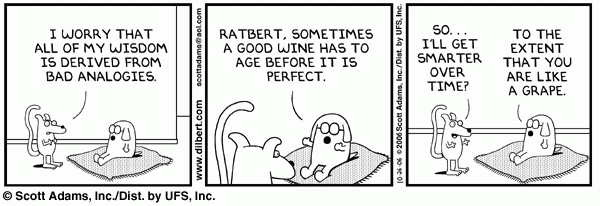
The Pitfalls of Analogies

These are priceless examples of creativity gone awry.  I don’t know who originally wrote these gems or compiled them; if you know, please tell me so that I can give credit where credit is due!

21 Analogies Used by High School Students in English Essays

  1. “When she tried to sing, it sounded like a walrus giving birth to farm equipment.”
  2. “Her eyes twinkled, like the moustache of a man with a cold.”
  3. “She was like a magnet: Attractive from the back, repulsive from the front.”
  4. “The ballerina rose gracefully en pointe and extended one long slender leg behind her, like at dog at a fire hydrant.”
  5. “She grew on him like she was a colony of E. Coli and he was a room temperature Canadian beef.”
  6. “She had him like a toenail stuck in a shag carpet.”
  7. “The lamp just sat there, like an inanimate object.”
  8. “Her face was a perfect oval, like a circle that had two sides gently compressed by a Thigh Master.”
  9. “Her eyes were like the stars, not because they twinkle, but because they were so far apart.”
  10. “His career was blowing up like a man with a broken metal detector walking through an active minefield.”
  11. “The sun was below the watery horizon, like a diabetic grandma easing into a warm salt bath.”
  12. “From the attic came an unearthly howl. The whole scene had an eerie, surreal quality, like when you’re on vacation in another city and Jeopardy comes at 7:00 p.m. instead of 7:30.”
  13. “It was as easy as taking candy from a diabetic man who no longer wishes to eat candy.”
  14. “She had a deep, throaty, genuine laugh, like that sound a dog makes before it throws up.”
  15. “Their love burned with the fiery intensity of a urinary tract infection.”
  16. “It’s basically an illusion and no different than if I were to imagine something else, like Batman riding a flying toaster.”
  17. “If it was any colder, it would be like being in a place that’s a little colder than it is here.”
  18. “Joy fills her heart like a silent but deadly fart fills a room with no windows.”
  19. “The bird flew gracefully into the air like a man stepping on a landmine in zero gravity.”
  20. “He felt confused. As confused as a homeless man on house arrest.”
  21. “The revelation that his marriage of 30 years had disintegrated because of his wife’s infidelity came as a rude shock, like a surcharge at a formerly surcharge-free ATM.”

dilbert-bad-analogies

4 Comments

Filed under Cartoon, Grammar, Humor, Lists, Nuts & Bolts, Writing Exercise, Writing Prompt

Truth into Fiction

Sometimes truth is more fascinating, more adventurous than fiction.  Sometimes a news article becomes a spark for a fictional story.  One of the greatest films of all time, Titanic, took its cue from real life; many books and films are based on real life stories, mysteries, narrow escapes, historical events and experiences.  The best kinds of story sparks are those things which capture our imagination; not only best for the reader, but also for the writer – for if you are not excited by and captivated by what you’re writing about, researching and investigating, how do you expect a reader to be excited or captivated by it?  Personally, history has always fascinated me; I wonder, “What would it be like to walk among them?” or “What would it be like to discover these events as a modern archaeologist?”  I explored such a theme in my novels, “The Cardinal“.

Here are a few historical sparks that might capture your imagination; just click on  each image to link to the article:

Artifacts from the Battle of the Egadi Islands, ca. 240 BC

Battle of the Egadi Islands, 241 BC

The City of Heracleion, Plunged into the Sea

Heracleion Artifacts

China’s Atlantis:  Shi Cheng

China's Atlantis of the East, Shi Cheng

The Skulls of  Sac Uayum

The Elongated Skulls of the Yucatan underwater cave, Sac Uayum

An Ancient Roman Shipwreck Reveals Medicinal Remedies

Roman Shipwreck with Medicinal Supplies

2 Comments

Filed under History, Images, Lists, Nuts & Bolts, Plot Thots & Profiles, Research, Writing Exercise

The Psychology of Colour

I was recently talking with someone, and the topic of the psychology of colours came up in connection with health care; it got me thinking about how it could be applied to practical applications, as well as writing fiction.   My particular practical application is crocheting hats to donate to the local cancer patient clinics, and I wanted to know which colours would be more appropriate.

In writing fiction, colours play an important part as well; they help set the scene:  Is it a dark and gloomy scene?  Don’t choose pink or pastels – unless you want to make it a creepy-gloomy scene.  The colour of the sky, the grass, the sand, living room walls, a person’s eyes – they all help set the stage, or paint the backdrop of your fictional character’s life, situations, or the overall tone of the book; it can also help establish your character’s personality:  Are they a compassionate, stable person?  Perhaps beige combined with a bit of pink.  Is your character blind, (figuratively or literally)?  Red is the easiest colour for a visually impaired person to see, so accent their home in red.  You get the idea!  Advertisers have been using the psychology of colours to manipulate consumers for decades; the more we understand the application of colour, the more we can see through the tactic and at the same time apply it to our writing.  Here are a few images to consider as you think into this topic and apply it to your own fictional characters.

color-guide Colour & Mood Psychology 2 Colour & Mood Psychology

Leave a comment

Filed under Images, Nuts & Bolts, Plot Thots & Profiles, Writing Exercise

Tricks for Writing Dialogue

Listen, RespondI recently listened to a Ted Talk by British psychologist Elizabeth Stokoe, who analyses patterns, rhythms and wording in conversations. From her talk, I distilled a few interesting points that could be applied when writing a dialogue for fiction, and I’d like to share them with you:

  1. Are you willing?  If a person is given a sense of control or authority in the situation, they’re far more likely to cooperate.  If you ask, “Do you want this service / action to happen?” you may draw a blank response; but if you ask that person, “Would you be willing to receive this service / be willing to see X happen?” you’re more likely to get a positive response.
  2. How did you…?  When you want to find out particular information from a person, how and when you ask for that information in the course of a conversation / dialogue greatly decreases or increases your chances of getting a positive response / reply.  If rapport is first established, they are much more willing to reply.
  3. Why did you / were you…?  If an open-ended question is asked, target information may not come; but if a target-specific question is asked non-confrontationally, the desired information is more certain.  “Why did you do X?” or “Where have you been?” are both confrontational, and the reaction will likely be evasive or defensive.  But if you instead say, “I was wondering what your reasons for doing X were… could you explain?” or “I tried to reach you earlier, and was wondering where you were”, these are more likely to get a more positive response, or to solicit the information you’re searching for.
  4. Any or Some?  “Any” tends to elicit a negative response or a refusal, while “some” invites a more positive response.  A simple example is, “Would you like any tea?” – this implies an unwillingness or a reluctance on the speaker’s part to provide, whereas, “Would you like some tea?” implies the assumption of a positive response, and is thus more likely to solicit an affirmative response.  In both cases the person asked may want tea, but would be unwilling to coerce the one offering if they have the impression that the offer is made unwilling through the use of “any”.

When applying these ideas to writing a dialogue, a positive application will move your characters closer to a solution or resolution, whereas the negative application will lead them more toward miscommunication and conflict; depending on what you need to happen, you choose which way the dialogue takes your characters, and thus your readers.

Keep writing!

Leave a comment

Filed under Articles, Nuts & Bolts, Writing Exercise

The Glorious Chaos of English

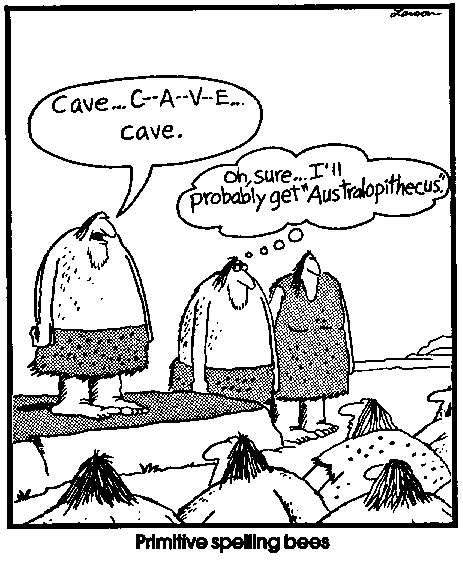
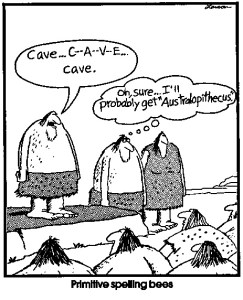
Primative Spelling BeesEnglish, in many ways, is one of the simplest languages to learn quickly and in which to converse fluently; but scratching below the surface one rapidly finds incongruities.  As a teacher for English as a foreign language for adults (TEFLA), I was frequently confronted with the challenges of teaching students to spell and pronounce words correctly, but I was also comforted by the fact that English nouns only come with four possible preceding cases, or articles (a, an, the, and none), rather than, say, German, in which each noun has a nominative, genative, dative or accusative, singular or plural form of their case; or Finnish, which has a whopping 15 cases.

The Chaos, a poem written by the Dutch traveller & teacher,  Gerard Nolst Trenité (1870–1946), gives ~800 examples of irregular spelling.  In general one can say that there are spelling “rules”, but English, in all its historic complexities of absorbing, digesting and recycling influences from conquerors, enemies, travelling companions and allies, seems designed to say “rules can and will be broken”.  I would never give his last advice to anyone – but after reading this poem, you’ll understand that English needs tenacity and constant practice to use well!

The Chaos

by G. Nolst Trenite’ a.k.a. “Charivarius” 1870 – 1946

Dearest creature in creation

Studying English pronunciation,

I will teach you in my verse

Sounds like corpse, corps, horse and worse

I will keep you, Susy, busy,

Make your head with heat grow dizzy.

Tear in eye your dress you’ll tear,

So shall I! Oh, hear my prayer,

Pray, console your loving poet,

Make my coat look new, dear, sew it!

Just compare heart, beard and heard,

Dies and diet, lord and word,

Sword and sward, retain and Britain.

(Mind the latter, how it’s written).

Made has not the sound of bade,

Say said, pay-paid, laid, but plaid.

Now I surely will not plague you

With such words as vague and ague,

But be careful how you speak,

Say break, steak, but bleak and streak.

Previous, precious, fuchsia, via,

Pipe, snipe, recipe and choir,

Cloven, oven, how and low,

Script, receipt, shoe, poem, toe.

Hear me say, devoid of trickery:

Daughter, laughter and Terpsichore,

Typhoid, measles, topsails, aisles.

Exiles, similes, reviles.

Wholly, holly, signal, signing.

Thames, examining, combining

Scholar, vicar, and cigar,

Solar, mica, war, and far.

From “desire”: desirable–admirable from “admire.”

Lumber, plumber, bier, but brier.

Chatham, brougham, renown, but known.

Knowledge, done, but gone and tone,

One, anemone. Balmoral.

Kitchen, lichen, laundry, laurel,

Gertrude, German, wind, and mind.

Scene, Melpomene, mankind,

Tortoise, turquoise, chamois-leather,

Reading, reading, heathen, heather.

This phonetic labyrinth

Gives moss, gross, brook, brooch, ninth, plinth.

Billet does not end like ballet;

Bouquet, wallet, mallet, chalet;

Blood and flood are not like food,

Nor is mould like should and would.

Banquet is not nearly parquet,

Which is said to rime with “darky.”

Viscous, Viscount, load, and broad.

Toward, to forward, to reward.

And your pronunciation’s O.K.,

When you say correctly: croquet.

Rounded, wounded, grieve, and sieve,

Friend and fiend, alive, and live,

Liberty, library, heave, and heaven,

Rachel, ache, moustache, eleven,

We say hallowed, but allowed,

People, leopard, towed, but vowed.

Mark the difference, moreover,

Between mover, plover, Dover,

Leeches, breeches, wise, precise,

Chalice, but police, and lice.

Camel, constable, unstable,

Principle, disciple, label,

Petal, penal, and canal,

Wait, surmise, plait, promise, pal.

Suit, suite, ruin, circuit, conduit,

Rime with “shirk it” and “beyond it.”

But it is not hard to tell,

Why it’s pall, mall, but Pall Mall.

Muscle, muscular, gaol, iron,

Timber, climber, bullion, lion,

Worm and storm, chaise, chaos, and chair,

Senator, spectator, mayor,

Ivy, privy, famous, clamour

And enamour rime with hammer.

Pussy, hussy, and possess,

Desert, but dessert, address.

Golf, wolf, countenance, lieutenants.

Hoist, in lieu of flags, left pennants.

River, rival, tomb, bomb, comb,

Doll and roll and some and home.

Stranger does not rime with anger.

Neither does devour with clangour.

Soul, but foul and gaunt but aunt.

Font, front, won’t, want, grand, and grant.

Shoes, goes, does. Now first say: finger.

And then: singer, ginger, linger,

Real, zeal, mauve, gauze, and gauge,

Marriage, foliage, mirage, age.

Query does not rime with very,

Nor does fury sound like bury.

Dost, lost, post; and doth, cloth, loth;

Job, Job; blossom, bosom, oath.

Though the difference seems little,

We say actual, but victual.

Seat, sweat; chaste, caste.; Leigh, eight, height;

Put, nut; granite, and unite.

Reefer does not rime with deafer,

Feoffer does, and zephyr, heifer.

Dull, bull, Geoffrey, George, ate, late,

Hint, pint, Senate, but sedate.

Scenic, Arabic, Pacific,

Science, conscience, scientific,

Tour, but our and succour, four,

Gas, alas, and Arkansas.

Sea, idea, guinea, area,

Psalm, Maria, but malaria,

Youth, south, southern, cleanse and clean,

Doctrine, turpentine, marine.

Compare alien with Italian,

Dandelion with battalion.

Sally with ally, yea, ye,

Eye, I, ay, aye, whey, key, quay.

Say aver, but ever, fever.

Neither, leisure, skein, receiver.

Never guess–it is not safe:

We say calves, valves, half, but Ralph.

Heron, granary, canary,

Crevice and device, and eyrie,

Face but preface, but efface,

Phlegm, phlegmatic, ass, glass, bass.

Large, but target, gin, give, verging,

Ought, out, joust, and scour, but scourging,

Ear but earn, and wear and bear

Do not rime with here, but ere.

Seven is right, but so is even,

Hyphen, roughen, nephew, Stephen,

Monkey, donkey, clerk, and jerk,

Asp, grasp, wasp, and cork and work.

Pronunciation–think of psyche–!

Is a paling, stout and spikey,

Won’t it make you lose your wits,

Writing “groats” and saying “grits”?

It’s a dark abyss or tunnel,

Strewn with stones, like rowlock, gunwale,

Islington and Isle of Wight,

Housewife, verdict, and indict!

Don’t you think so, reader, rather,

Saying lather, bather, father?

Finally: which rimes with “enough”

Though, through, plough, cough, hough, or tough?

Hiccough has the sound of “cup.”

My advice is–give it up!

1 Comment

Filed under Articles, Cartoon, Grammar, Nuts & Bolts, Quotes, Writing Exercise

Thoughts From Gibraltar and London

I just returned from a research trip a week ago; after the dust of “coming home” has settled, it’s time to sit down and get to work in earnest on my next novel.  I’m working on the third book in my 18th century historical trilogy, and to be honest, up until this trip I would have rather been working on a different manuscript!  My time away was research into the major section of the book which takes place in the Royal Navy aboard a ship of the line.  Part of the reason I think I’ve had “writer’s block” on this manuscript is that the military aspect of the plot is not my favourite topic to delve into from a writing aspect – I love reading about it, but condensing that down into dialogue and prose is not my forté.  But I know myself:  As with anything, if it’s not my strength I’ll work at it and hone it until it is.

The Cutty Sark 1

The Cutty Sark

A very important thing for me to remember in the midst of the research is that I’m not writing a maritime history book, but a novel; I’ve got to take the research, sift it for the elements that support my plot and leave the rest of the information aside as “nice to know”.  I’ve bought, read and taken notes on dozens of history books focused on the Royal Navy; I spent a day taking in impressions aboard the Cutty Sark (one of the fastest clippers from the days of Sail, on the right), and talking to curators both there and in the Maritime Museum, as well as the British Museum; I spent time on a clipper on the Thames, taking in the sights, sounds, smells, salt spray and tastes of the river.   My hotel was literally just round the corner from the largest used book shop in London (Skoob Books)… a very dangerous thing.  Trust me.  I found some great gems, from a history book on the Seven Years War (exactly in my time period), to a portrait collection of 18th century fashions – invaluable visual aids, with explanations of things like mob caps, waistcoats, etc.  If I’d had more time (and more room in my carry-on-sized luggage), I still would have had to leave hundreds of great books behind…!

Gibraltar - Barbary macaque 2

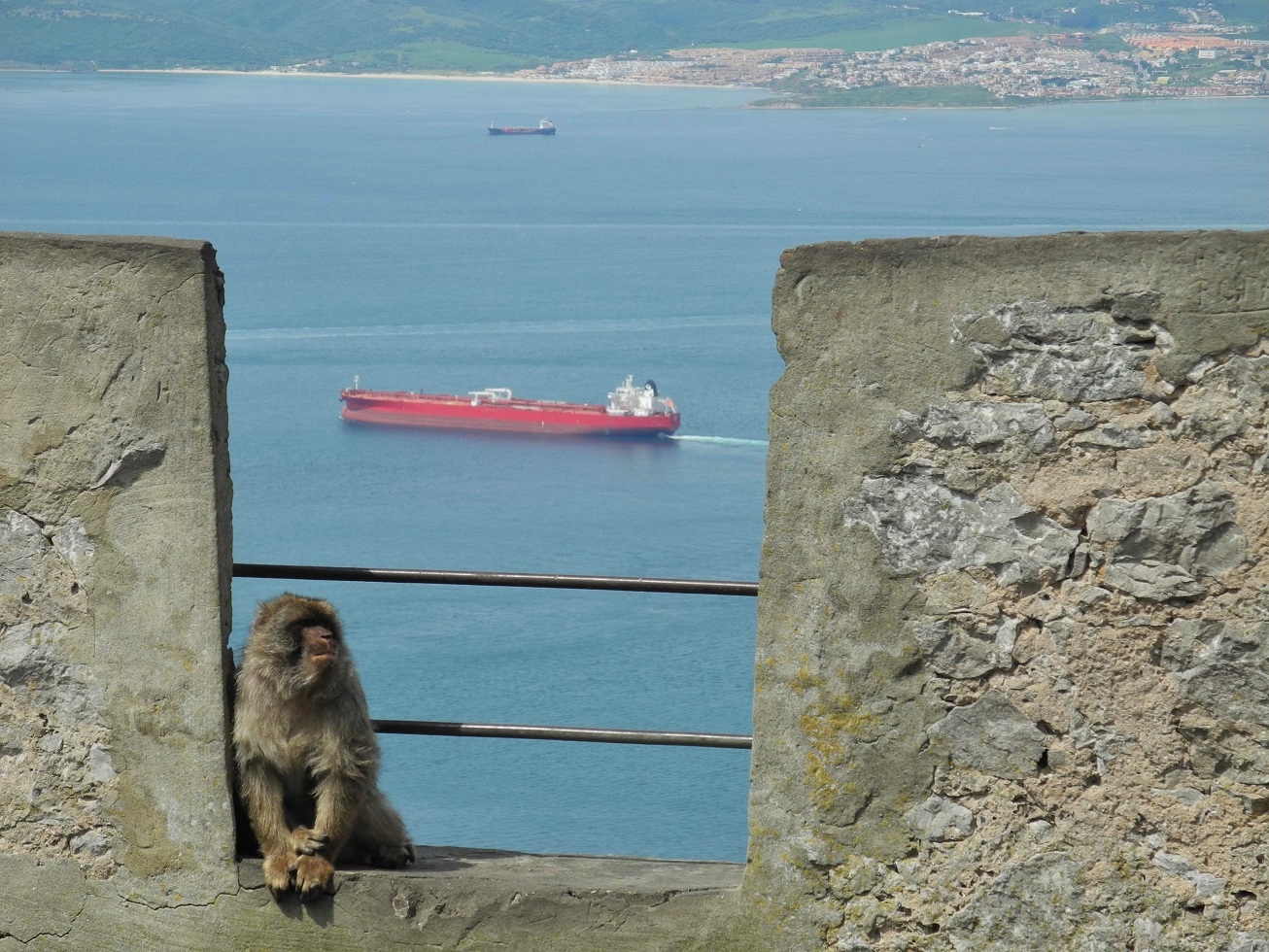
A Barbary Ape, with Spain in the distance.

Gibraltar itself was a special time:  I was there with my husband, who then took off for a 10-day bike ride toward Madrid on the day I flew to London.  Gibraltar was vitally important as a British Naval base for centuries, and you literally cannot walk down any street without being reminded of its military past:  Atop the Rock are the ruins of fortifications; St Michael’s cave was a strategic hideout; in the town are cannons everywhere; ramparts are now part of walled parks, and everywhere there are military street names, town square names, and military ships in the harbour; Spain is a spit away, and Morocco is visible even on a foggy day; it is literally the gateway to the Mediterranean.  Taking a cable car to the top of the Rock you’ll find Barbary Macaque (aka Barbary Apes, though they are tailless monkeys) everywhere; they were originally brought from Africa in the 18th century by British sailors.  A few of them escaped and set up house on the rocky slopes above the town, and now they run the show; tourists are lower down in the pecking order than they are, and if they get half a blink they’ll steal your food if you’re silly enough to take it outside.  They usually stay up on the Rock, but it’s still not wise to leave your hotel window open…

Gibraltar: The War Memorial with a Russian cannon in the foreground.

Gibraltar: The War Memorial with a Russian cannon in the foreground.

So now that I’m back, I’m looking forward to sinking my teeth into this new manuscript!  Sometimes it just helps to get away, get new impressions, percolate ideas, and become inspired.  If you’re stuck on something you’re writing, get out!  Go on a research trip, or if you can’t afford it time- or money-wise, then get out to a park, or somewhere different for a change; take your notebook, and let your mind wander.  You’ll find a way through the block!

Leave a comment

Filed under Articles, History, Research, Writing Exercise

Writing Tips: Dialogue

howtobebritish1Dialogue is (to point out the obvious) vital to a novel; it displays the voices of your characters and helps the reader get to know and care about the characters, understand their motives, their interrelationships, and distinguish each character’s point of view.  If you don’t get the dialogue right, you rip the reader out of the story, or worse – make them put down your novel and add your name to “never again” lists!  So, here are a few pointers and tips to keep in mind as you develop your characters and put words into their mouths:

1) Develop your characters well enough to make their voice distinct; do they have catch-phrases, or local dialects that influence their vocabulary?  Do they tend toward long or short sentences, or are they from a past time and place that had a different way of speaking?  Educate yourself if necessary in various modes of speech .

2) Dialogue is an illusion of conversation; but it’s also about what is not said.  Non-verbal actions reveal:

a) How a character says something

b) What a character chooses not to say, but inadvertantly reveals through actions.

c) Why the character says what they do.

Do they have particular actions when they are upset or aggitated that communicate their moods to the reader?  Do they bounce their knees when excited?  Does their body language confirm or contradict their verbal message?

3)  Fictional dialogue needs to cut to the chase; if there’s no point to the text (revealing motivation, character or plot point), then chop it!

4)  Avoid the trap of using dialogue as exposition (the proverbial villain’s monologue as he prepares to destroy the hero), but rather reveal essential information through action, or narration.

Explore your characters and develop their voices, and above all – keep writing!

Leave a comment

Filed under Articles, Cartoon, Nuts & Bolts, Plot Thots & Profiles, Writing Exercise, Writing Prompt

Archetypes: Aphrodite vs. Dionysus

Throughout literary history, archetypes have been used to help us relate to characters, their stories, the morals of the tale and the paths they choose and why.  Understanding the archetypes helps to figure out how to portray a particular character; it keeps you on the “same page” as you write, as you develop characters, and try to figure out what makes them tick and where that ticking will take you and them.  Today I’d like to take a closer look at Aphrodite and her male counterpart, Dionysus.  I’ll give examples of these characters from films and books, relatable to most whether you like to read or prefer the visual experience of film.

Kim Novak,  Vertigo

Kim Novak, Vertigo

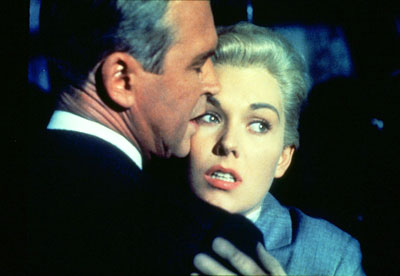
Aphrodite was the Greek goddess of love, pleasure, beauty and procreation.  Like a coin, there are two sides to the character:  The Lover (or seductive muse), and the Femme Fatale.  On the Lover’s side of the coin, there are characters such as Julia Roberts in Pretty Woman, or Ginger on Gilligan’s Island.  The positive side of this character motivates others to improve themselves.  The flip side of that coin are seen in Sharon Stone’s portrayal in Basic Instinct, Kim Novak’s character in Vertigo, or the Bible characters of Salome or Delilah.  On one side you have a character that is nurturing, attractive, seductive and at the core often good, while the Femme Fatale is seductive with often quite dark ulterior motives.  Sean Young’s character in Blade Runner is a good example of the Seductive Muse; she forces Harrison Ford’s character to examine his own sense of humanity by her mere existence.

Mr. Willoughby, in Sense & Sensibility

Mr. Willoughby, in Sense & Sensibility

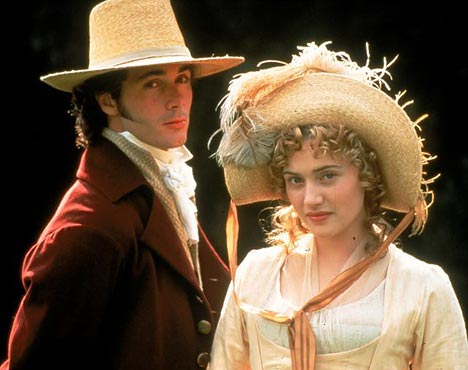
Dionysus is her male counterpart:  His two sides are the Woman’s Man, and the Seducer.  Either way, Dionysus needs women in his life.  He loves women; on the positive side, he loves to make women feel loved.  The flip side is abuse in one form or another, with darker motivations behind his love.  Fifty Shades of Grey is a touchy topic right now; on one hand it’s immensely popular, and on the other very harshly condemned as glorifying abuse, violence and manipulation in the guise of relationship or love.  I tend toward the latter view, as did the main actor in interviews during his junket (he often found himself apologizing to his co-star after their scenes, which speaks volumes about his instincts of what’s right and wrong, and Shades definitely crossed that line for him and for a growing number of critics).  Other examples are Mel Gibson’s character in What Women Want – his character makes the arc from the negative side to the positive; Cary Grant’s character in An Affair to Remember makes a similar arc.  Leo DeCaprio’s Jack in Titanic sits firmly on the positive side of the coin, and makes for a memorable and loved character.  Count Dracula is a typical Seducer, as is Jane Austen’s character of Mr Willoughby in Sense and Sensibility.

There are many other archetypes; if you’d like to know more on the topic, check out Victoria Lynn Schmidt’s 45 Master Characters.

Keep writing!

1 Comment

Filed under Articles, Plot Thots & Profiles, Research, Writing Exercise

Writing Tip: “Sense” Your Scenes

I try to read a book a week; it’s usually on a Saturday, when I have time to sit down and read a good chunk at a time.  This past weekend I read a book which prompted thoughts around this concept of “sensing” a scene, and reading it aloud to hear any howlers that might have crept into the writing.  The author of that book obviously did neither, though her editor might have told her to beef up descriptives – so they were clumped all together, staggering me as a reader to a halt while I tried to figure out the context of the pages of descriptives before remembering what the characters were doing there in the first place, and often the dialogue sounded very stilted (e.g. using “vocalized” instead of “shouted” – the latter of the two would have fit into the character’s time and place far better) – a good reading-aloud editing session might have done wonders for the novel.

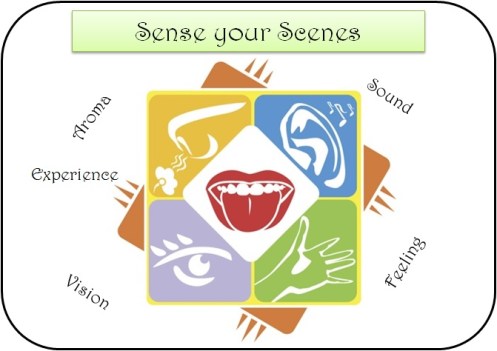
SensesThis image is one I have printed out on a card and hung near my desk when writing; it reminds me to apply all of my senses to a scene, to enrich the imagery and draw the reader in.  Describe the sights, smells, sounds, feelings and taste of a scene; make it a sensory experience and it will be far more memorable; this is done through sentence structure and the pacing of those elements, but sometimes also through “camera angle” – looking at the scene from a particular perspective.  How does your character feel in the moment?  What are their perceptions?  Does a smell remind them of something or someone?  Here are a few tips to achieving these goals:
  1. While adjectives are useful for adding colour or depth to a sentence, think of them as pepper; too much can spoil the scene.  If using more than one to describe a noun, familiarize yourself with the rule of order for adjectives.
  2. Use action verbs rather than passive/being verbs with adverbs.  E.g. “She stumbled down the hill” rather than “She went unsteadily down the hill”.
  3. Most importantly:  Read your sentences and scenes aloud!  I cannot stress this enough – if it sounds choppy or stilted to your ears, or doesn’t sound like something your character would say or do, then change it!

Writing is a dynamic process, and being a writer means constantly striving to improve oneself – building vocabulary and learning how to use words effectively, building your knowledge through research, studying, and reading, reading, reading!  Keep on writing!

2 Comments

Filed under Articles, Images, Nuts & Bolts, Plot Thots & Profiles, Writing Exercise

Writing Tip: Dealing with Boredom

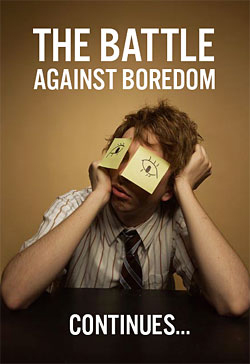
boredomIf you’re bored with the subject you’re writing about, it won’t work to try and think your way out of it, or to convince yourself to write.  I know all too well that when that’s the case I can find a million things that are suddenly far more pressing, like cleaning out a (clean) cupboard or repairing a household appliance.  But often, boredom is an indication that we don’t know enough about our subject matter, and that our writing has simply subsided into going through the motions.

There’s a simple solution:  Find out more!  Read more on your topic; travel to the location; find maps from your time period; investigate the place with Google Earth Street View; go to a museum; ask questions; look for original documents; engage your senses to gain more knowledge and understanding about your theme.  As you find out more, write scenes to inform your work, or a dialogue between characters that will inform you about their situation, setting, personalities or role in the story as a whole.  Beware of your motives in extended periods of research, however:  Are you procrastinating, or percolating?

I look at it this way:  If I’m not getting anywhere with a manuscript, I can either give in and call it “writer’s block” and allow it to paralyze me, or I can proactively work against that block in what I call “percolating mode” – thinking around the problems that I’ve run into, and use the time to inform myself, learn about the time period, and investigate aspects of the story that I am interested in.  That block may be like a boulder in the stream’s path, but my writing, like water, will eventually find a way around it.

Let that boulder of a writer’s block make you stronger and more diversified – and keep on writing!

2 Comments

Filed under Articles, Research, Writing Exercise