Will Rogers is one of those larger-than-life characters who seemed to have had his fingers in every pie imaginable: Born in November 1879 as a Cherokee Nation citizen in the Indian Territory now known as Oklahoma, he was the youngest of eight siblings, only three of whom survived into adulthood. His mother died when he was just ten years old. By the time he was 20, he’d begun appearing in rodeos, and in 1902 at the age of 22, he and a friend moved to Argentina to find work as gauchos (a skilled horseman, hired by ranchers in many South American countries). When their adventure failed, and they’d lost all their money, Will couldn’t bear to ask for money from home, so he took a boat to South Africa, where he was hired as a ranch hand. His career as a trick roper began there, as he joined the Texas Jack’s Wild West Circus. From there, armed with a letter of reference from Texas Jack, he moved to Australia and joined the Wirth Brothers Circus as a rider and trick roper. By 1904, he’d returned to the States and performed in the St. Louis World’s Fair, then began using his riding and roping skills in the Vaudeville circuits; he was often billed as The Cherokee Kid. His natural humour hit a chord with audiences, who loved his frontier twang of an accent coupled with his off-the-cuff wit and commentary on current events; he built his later career around that talent.
In 1908, he married Betty Blake, and they had four children; three survived into adulthood, all of whom went on to have careers in the public eye in one way or another.
By 1916, Rogers was a featured star in Ziegfeld’s Follies on Broadway; from there he branched off into silent films; at that time, most films were made in or around New York, which allowed him to continue performing on Broadway. The New York Times syndicated his weekly newspaper column, “Will Rogers Says”, from 1922 to 1935; he also wrote for The Saturday Evening Post; this progressed into books – over 30 of them. He also hosted a radio program, telling jokes and discussing current events with his simple, disarming humour.
Click here to see a short, 3-minute video showcasing some of his amazing rope tricks.
He was an avid supporter of the aviation industry, and he took many opportunities to fly to his various engagements. In 1926, while touring Europe, he saw how much more advanced the commercial services were there in comparison to the States; his newspaper columns often emphasized the safety and speed of travel aeroplanes offered, which helped shape public opinion about the new mode of transport.
In 1935, Wiley Post, a famous aviator of his time, proposed flying from the West Coast to Russia to find a mail-and-passenger air route, and Rogers asked to go with him in order to find new material for his newspaper columns. Post’s plane was modified for the long flight, and floats were added for landing on water. On 15 August, they took off from Fairbanks, Alaska, for Point Barrow, a headland on the Arctic coast. Bad weather hindered their ability to calculate their position, and, after landing in a lagoon to ask directions and taking off again, the engine failed at low altitude and plunged into the lagoon, killing both men. Rogers was 55.
In such a short life, he left a huge legacy in many fields of entertainment and helped shape public perspectives on politics and civil responsibility. He was a household name in the early 20th Century and a trusted voice during the Great Depression, identifying with the struggles of the average American and holding a mirror to politics with his witty satire.
Here are a few of his famous quotes:
Be thankful we’re not getting all the government we’re paying for.
Even if you are on the right track, you will get run over if you just sit there.
Everything is funny, as long as it’s happening to somebody else.
I don’t make jokes. I just watch the government and report the facts.
My ancestors didn’t come over on the Mayflower, but they were there to meet the boat.
Live so that you wouldn’t be ashamed to sell the family parrot to the town gossip.
The only difference between death and taxes is that death doesn’t get worse every time Congress meets.
The trouble with practical jokes is that very often they get elected.
There’s no trick to being a humorist when you have the whole government working for you.
This country has come to feel the same when Congress is in session as when the baby gets hold of a hammer.
I don’t know if you’ve yet heard about the sneaky change coming into effect, without warning, on 26 February for your Kindle account, but as of that date, if you haven’t downloaded your books to your computer or to your tab, phone, or other device besides a Kindle e-book reader, you will no longer be able to do so! They are taking away that right in order to get customers more dependent on their services; but they are in effect simply ticking people off. You’d think they could have learned something from Canada’s, Denmark’s and Gaza’s responses to POTUS’s hammer-fisted tactics, but they will likely spark a rebellion against their services. Another great reason to get your ebooks at Smashwords, or anywhere else but Amazon!
For more information, please click here for a 6-minute video, telling you about the changes coming and how you can save your books from being inaccessible to you in the future.
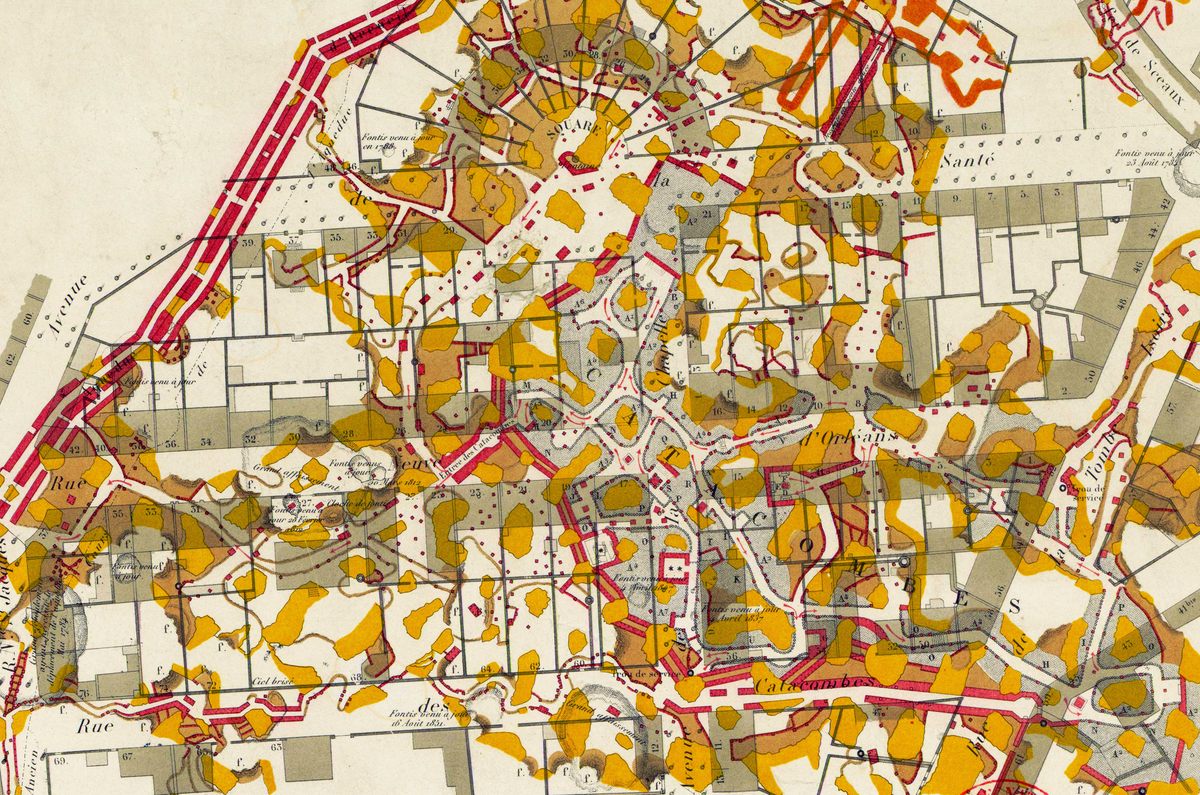
This week’s adventurous tale is a proverbial rabbit hole; diving into it takes us past the problem of Paris’ 18th century dilemma of dealing with the “explosive” issue of overfilled cemeteries, which forced King Louis XVI to take action: Bury them deeper. Following this problem and its solution into the ground, so to speak, leads us into the massive (1.5 km long) ossuary (bone depository) of Paris. Once you reach the ossuary, which contains the artfully arranged skulls and bones of some six million residents (around three times more than the actual population of central Paris, which as of 2023 was 2.1 million…), you aren’t officially allowed to go any further – because above your head is the bustling city of street cafés, boutiques, and historical buildings. And when someone buys a house up there, they are actually also buying the land on which it stands – which includes their section of the underground maze of mining tunnels and caverns; venturing beyond the official section makes you an intruder on private property or breaking and entering an actual shop – but more on that in a moment. The message above the entrance to the ossuary reads, Arrête! C’est ici l’empire de la Mort. (“Halt! This is the Empire of Death.”). That warning doesn’t stop it from being one of Paris’ most popular tourist attractions.
The tunnels, now known as The Catacombs, were originally dug far outside of the small 13th-century city when Lutetian limestone was mined as a local building material (any town or city with a distinctive architecture owes its appearance to whatever was available locally when it was founded – whether wood, stone, thatch or brick). Though no one knows with certainty, as the mining resources were eventually exhausted and the mines abandoned, an estimated 350 kilometres of tunnels undermined the city, which covers some 32 square kilometres beneath Paris… a city beneath a city, as it were.
And yes, buildings have occasionally been swallowed; in 1774, about 30 metres of a street disappeared into a cavern below. This led to the formation of the Générale des Carrières (IGC), an office created in 1777 by King Louis XVI to oversee the mapping and maintenance of the catacombs. During the French Revolution, many things got lost and fell out of collective memory, including the underground map.
Paris Catacombs Map – Inspection Générale des Carrières, 1857, Pulbic Domain
Throughout the years, the tunnels have been put to various purposes, aside from the macabre: Mushrooms were cultivated there; beer was brewed, wine aged, and Chartreuse liquors were distilled down there by monks in the 17th century. The city beneath the city had no prime real estate overhead for businesses, and many took advantage of the free space, making access for their customers through the various access points throughout Paris. It also served the French Resistance during world war 2, even though the Nazis also used a section of the tunnels. Now, let’s go back up out of the rabbit hole for a brief moment.
Remember that I wrote officially allowed? Well, a secret maze of tunnels is too much to resist for the adventurous, called cataphiles. But there is a secret society at large down there, too.
When you think of a secret society, you might think of the Luminati or something else sinister; but the Les Ux would be more akin to Robin Hood. The story goes that in 1981, a group of kids were talking after school, and one of them mentioned that he could break into any building in Paris; in fact, his next target was the Pantheon. They didn’t believe him, and so they all went down together – and found out just how easy it was to go wherever they wanted. The Pantheon, which was the tallest structure in Paris until the Eifel Tower was constructed, vacillated between being a church and a secular building several times over its history, depending on the political regime, and it finally became a secular structure in 1885 under the Third Republic. It now is a mausoleum, with famous residents like Marie Curie, Victor Hugo, Alexandre Dumas and Voltaire; but it is also a museum, an art exhibition hall, hosts school events and lectures, and is linked to a section of the catacombs – which is where the group of school friends began their adventures.
During one of their nocturnal outings, the group stumbled upon a narrow passage full of electrical cables; following those, they found themselves in the basement of the Ministry of Communications. No security stopped them and they were able to explore at their leisure. In a drawer, they found the motherlode: A map of the entire catacomb structure. That changed the course of their lives, and they eventually became known as the Les Ux, short for “urban experiment”. These individuals, unknown to anyone but themselves, specialize in safeguarding Paris cultural goods – stepping in when the government can either not afford to or doesn’t care enough to preserve something of cultural or historical value. They seem to think that, unless it’s a big-ticket attraction like the Mona Lisa, things get neglected. For instance, the mission statement of one branch of Les Ux is to reclaim and transform disused city spaces for the creation of zones of expression for free and independent art.
The group, now a full-fledged underground movement, is divided up into teams with seemingly nonsensical names: The Mouse House (an all-female team of infiltrators), La Mexicaine De Perforation (in charge of clandestine artistic events and underground shows), and the Untergunther (specializing in restorations); they also have teams that specialize in things like running internal messaging systems and coded radio networks, a database team, and a team of photographers.
Some of their exploits include restoring a forgotten metro station, a 12th-century crypt, an old French bunker, and a World War 2 air raid shelter. One member, likely from the Mouse House, wrote a detailed report about a particular museum’s security, telling them how many ways she could have broken in and stolen had she been so inclined. She then infiltrated the museum and left the report on the desk of the museum’s head of security. He went straight to the police to press charges. They refused to pursue the matter.
They built an entire cinema complex in the catacombs, complete with a bar and restaurant, where they are thought to have held film festivals for several months or even years before being discovered by the police in a random training exercise. When the police returned to remove the cinema, everything was gone except a note which read, “Don’t try to find us.”
Les Ux has held many events within the Pantheon over the years, including parties and art exhibitions – all vanishing, and leaving the place cleaner when they left, before the museum opened the next day. One night, a team member (from Untergunther) decided to take a closer look at the broken Wagner clock, which hangs over a prominent entrance within the building. Their most public restoration (that we know of so far) was, of course, an embarrassment to the management of the Pantheon: One of the members, Jean-Baptiste Viot, was a professional clockmaker; the team snuck in for nearly a year to restore the clock. They built a secret workshop (complete with armchairs, bookcase, and bar, which they nicknamed the Unter and Gunther Winter Kneipe – German for winter boozer!) high up in the dome of the pantheon, and carried out the clock work by night. Once it was done, they knew that the clock would need to be wound regularly to continue working – so they broke protocol and met with the museum director to tell him the good news. He promptly pressed charges… but there are no laws in France about repairing an expensive clock at their own expense, and the case was dismissed with the comment, “This was stupid!” The museum director hired someone to break the clock, presumably to avoid the hassle of winding it up regularly, and also out of spite for losing his case and his face; the person refused to damage the clock, simply deactivating the mechanism. Les Ux snuck back in to let the clock chime over the days around Christmas, then went back in and removed a component to prevent any further damage the next time spite struck. I’ve read that since that time, the clockmaker of Untergunther has actually been hired by the Pantheon to maintain the clocks.
We only know of a fraction of their activities, of course, because they don’t publicise their accomplishments or events. Below are a few links if you’d like to read more on this fascinating topic! I hope you enjoyed this little exploration as much as I did!
Here are a few links to articles, if you’re interested in learning more:
Throughout history, languages have come and gone; an estimated 30,000 have existed at some point in time, though currently, there are roughly 6,000 to 7,000 languages in use – and most are threatened with extinction. Think about that. The impact on the loss of cultural history, connection to ways of thinking, ways of communicating, and ways of processing information; senses of humour, and national heritages will be lost.
An example of a language nearly lost, but which is now familiar to most of us by sight, is the logogram language of Egyptian hieroglyphs. The knowledge of how to interpret the symbols had been lost for centuries, until 1799, when a stone was found near Rosetta, along the Nile Delta in Egypt; the stone was a stele with a decree issued in 196 BC; the texts carved into the stone were Ancient Egyptian (“demotic” text), hieroglyphs, and Ancient Greek. Because Greek was a known language, they could use the Rosetta stone to decipher the forgotten languages.
When we think of writing, we may think of various alphabets: Greek, Roman (of which English makes use), Norse Runes, or the logographic or ideographic languages of Asia, such as Chinese or Japanese, or the cuneiform writing of the Ancient Near East. But did you know that there have been languages based on string?
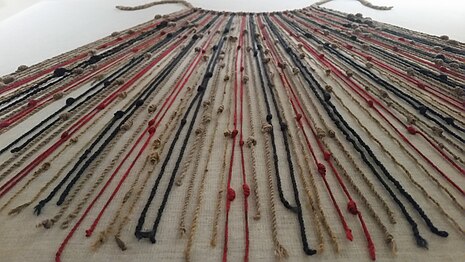
Quipu in the Museo Machu Picchu, Casa Concha, Cusco. Source: Wikipedia
The Inca people, in the region of modern Peru and Chile, used knots on an elaborate system of connected strings or cords for collecting data, keeping records, recording taxes or census records, making calendars, or for military organisation. When the Spanish Conquistadors swept through, they found numerous bundles of strings, but had no idea of their significance; they destroyed many of the quipu*, not realizing that they might have held in their hands a record of an individual’s wealth in animals or crops. [*Quipu is the Spanish spelling used in English; it is also spelled khipu or kipu.] Other cultures have also used similar concepts with knotted strings to record information, unrelated to South America; these include China, Japan, Taiwan New Zealand, Hawaii, and other parts of Polynesia.
As with most textiles, they unfortunately didn’t stand the test of time very well, and only a fraction remains today. The ancient world may have taken the concept of the quipu one step further in creating the more flexible abacus, though the latter was (and is still) used for temporary calculations, while the former was rather for recording information. Whether or not there is a historical link, both are visual tools that can be used for similar functions to a certain extent.
Even with such widespread use of these knotting records, their meaning was nearly lost, until a Harvard student, Manny Madrano, had time on his hands one summer and solved a centuries-old mystery!
For an interesting video on this topic, please click here. I hope you’ve learned something! Keep being curious about our fascinating world!
Back in January, I wrote about the phenomenon of the Hum, something that occurs around the world.
Another global phenomenon is that of “ghost lights,” also known as fata morgana, mirages (both inferior and superior), will-o’-the-wisps, fairy fires, or ignis fatuus (“foolish flame”).
I grew up in a climate zone with hot, dry summers and wide, flat highways that stretched to the horizon. On a hot summer day, you could see the cab of a semi-truck floating mid-air for some distance before you actually saw the truck finally touch the ground. Sometimes the highway would look flooded – this kind of water mirage is also a danger in desert regions. Death Valley is dangerous, not only because of the heat but also because of disorienting mirages.
Ghost Lights can have a variety of natural causes: methane gas combustion or other organic decay which can cause photon emissions (these lights often appear over swamp or boggy areas); light refraction in certain atmospheric conditions that cause the lights of cars on distant roads or firelights from campfires to “float” midair (like the semi-truck cab above); it may also be caused by the bioluminescence of various micro-organisms and insects.
For a fun dive into these phenomena, the Why Files has a video covering the topic (the actual content starts at 4:15); I enjoy his videos because the author in me likes the way he sets stories up as real – as if reporting facts – before he debunks them or offers probable explanations. While he knows that many people likely believe in the stories he eventually debunks, he goes about it in a respectful, tongue-in-cheek way.
Around the world, fireworks are a traditional part of certain celebrations: Here in Switzerland, the two national nights would be the 1st of August (1291, Independence Day), and New Year’s Eve. In America, the 4th of July is probably the most widespread fireworks night. In Japan, fireworks competitions are enjoyed by spectators during the Sumidagawa Firework Festival, and in India, it’s Diwali, the Festival of Lights. In many countries in South America, Christmas is the big night; in Britain, Guy Fawkes Night is celebrated with both fireworks and bonfires (in Scotland); he was most associated with a failed gunpowder plot intended to blow up parliament and assassinate King James I of Scotland / James IV of England and Ireland.
Most people have, at some time in their lives, seen fireworks go off; but most people have no idea how they produce varying shapes and colours. Derek Muller, aka Youtuber of the Veritasium channel, goes into the details of what makes fireworks take shape, have varying colours and enable them to have precision timing in displays. To watch the video, called “The Hidden Science of Fireworks”, which includes footage of a drone’s perspective amid a fireworks display, just click on the image below! Enjoy!
My husband and I have a quirky sense of humour; we recently had a good laugh coming up with pets’ names in pairs (don’t ask why that topic came up – it’s too hard to reconstruct!): There are pairs of names commonly associated with each other, such as Tom and Jerry, or Cain and Abel; last night, we thought of naming two cats Maelstrom and Doldrum – the irony is that these are nautical terms for ocean conditions and we live in a land-locked country. My husband says that if we ever have a snake, he’ll name it “Abebambelela” (which is a Swiss German phrase meaning “to hang down”)! There are certain words that I find funny, like Asparagus (or the old English version, Sparrowgrass), and I can imagine naming cats something Latinesque, some of which are actually quite beautiful (Aurora, Adamaris, etc.)
Pet names are as creative as the owners, so the sky’s the limit! I once heard of a dog called Dillingham Osborn Gunderson… initials being DOG. Naming a pet Velcro, Big Mac, Groucho or Tweezer seems tame to some purebred titles (such as Bluewater Full Metal Jacket – Jack for everyday wear). When our cat had kittens (the mother, Gandria, and father, Caprino, were named after towns along Lake Lugano), we used musical terms (sticking with Italian): The first came out vocal, so he became Crescendo; the second was slow and calm, thus Piano; and the 3rd is gentle but friendly – Allegra. We kept Allegra, who is curled up between my feet as I write this; the other two were adopted by neighbours – who subsequently moved to give the cats more room!
I will never have a purebred pet; more often than not, the animals are sickly, as traits have been unnaturally bred into them; pugs and Persian cats are prime examples of pets that simply cannot breathe properly, and have respiratory infections or even failure. These health issues are hot topics between breeders and vets or those who care for animals such as the Kitten Lady. Give us a good ol’ farm cat, “Heinz 57-pedigree”, and they’ll do just fine! We have three cats: Allegra (born in 2009), Andromeda Zora (from an animal shelter, born in 2020), and Mira Bella (born in a home nearby, 2021).
Do you have any pets? If so, what are their names, and how did you choose them? Please comment below!
This past week, I’ve been knee-deep in my craft room making flowers. I’ve made crepe paper flowers before, but these are on a whole new level: Giants, to be precise. So far, I’ve made three giant daisies that stand about two metres tall and two of four dandelions in different phases or similar size.
Dandelions are something everyone knows – you’ve seen them, you may have been irritated by their invasiveness in a garden, but honestly, have you ever stopped to look at them? In this project, I’ve needed to look at them in detail – where do the leaves sit on the stem? What colour is the stem? How do the bud leaves fall from the bloom? When does the yellow turn into white fuzzy parachutes?
I found a year-long timelapse of the growth of a dandelion, from seed to seedhead; click here to watch the 3:46-minute video. What I find fascinating is the animation of plants that are only seen when we view them sped up; they stretch, move and grow – the movement is coming from the plant itself as this video was made in a controlled environment (no wind involved).
The edible plant has been used for centuries as a leafy green, leaf, flower or root tea, medicine, and as a source of nutrition for animals such as horses or ruminates (herbivorous grazing animals, such as cattle or deer). It’s an important plant for pollinators as it’s often the earliest flowering plant. For more information about its many uses, check out the Wikipedia article linked here. For a short but informative (and entertaining) video about the lion’s tooth, dent de lion, click here.
The next time you’re outside enjoying nature, stop and moment and appreciate the humble, often overlooked flower! And make yourself a dandelion salad.
The topic of this article has been on my mind for the past two weeks; last week flew by so fast I barely had time to blink, let alone order my thoughts into coherent sentences. The topic was sparked by coming across an article online about what is known as the “Milan Conference” or “The Second International Congress on Education of the Deaf” (though it was, in fact, the first), held in Milan, Italy in 1880.
To give you a bit of my personal background, I learned BSL (The Glaswegian dialect) and translated for the deaf when I lived in Scotland. Being as close to that community as I was, I’d shockingly never heard about the Milan Conference until a fortnight ago.
When I first moved to Switzerland, I wanted to continue working with the deaf and began taking Swiss German sign classes. I immediately began hitting brick walls: The crux of the matter was spelled out – they didn’t want hearing people in their world. It made little sense to me back then, and it was frustrating. Also at that time, my husband wasn’t yet hearing impaired – which would have made a difference in their attitude toward me, as people with family members affected by hearing loss were more acceptable to them. In light of the Milan Conference, their reticence makes perfect sense. I never was able to break that barrier, and I’ve lost much of the sign language I once used fluently.
The conference was an international gathering of (hearing – with only ONE exception) educators of the deaf and mute. The imperialist arrogance of the discriminating resolutions passed profoundly wounded and damaged the deaf community for nearly 100 years.
To sum up the conference’s resolutions briefly, the majority decided that sign language was disadvantageous to integrating the deaf into the hearing world, and they banned – yes, banned – sign language from the education of the deaf in favour of “oralism” – forcing the deaf to read lips to make them assimilate to the hearing world’s culture. Deaf teachers lost their jobs, and an overall decline of deaf professionals resulted – they were no longer allowed the tools to communicate in their own language, and communication professions such as artists, lawyers and writers fell silent. Here in Switzerland, there was a two-fold impact: Deaf children were forced to sit on their hands and learn to lip-read from High German-speaking teachers; but when they went home on holidays, they couldn’t lip-read their own family’s dialects of Swiss German, and so they were isolated from society both in school and at home. The anger and resentment to the hearing world still runs deep.
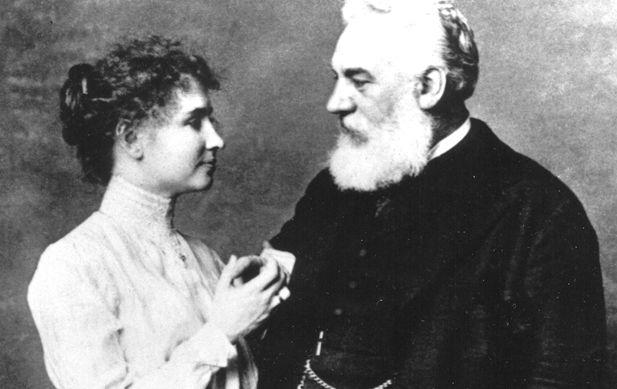
Most disturbing for me is the fact that Alexander Graham Bell, whose own mother and wife were deaf and who worked with the deaf throughout his life – including helping bring Helen Keller out of her silent world as a blind and deaf girl – was one of the strongest proponents for oralism at the conference. The most famous picture of Bell and Keller is one in which Keller is finger-spelling on Bell’s hand. It is a form of sign language. Yet he advocated to eradicate it.
The resolutions of 1880 held their ground until they were overturned in 2013 when an official apology was issued to the deaf community. Eleven years ago. Let that sink in. Inroads were made to teach sign in pockets here and there; in America, most schools for the deaf only began teaching sign language again in the 1960s; in the UK it was around a decade later. Generations suffered under the restriction. [For those who have been deaf their whole lives – what’s known as pre-lingually deaf – it means that sign language is their first language, while spoken English is their second; this can lead to difficulties in understanding complex or abstract messages in English. Imagine being denied your own native language…] Only in 2003, the British government recognised BSL as a minority language – but so far, Scotland is the only country in the UK that has given BSL legal recognition. The shift in understanding and recognition had already been set in motion by the time I’d moved to the UK, which is perhaps why the Milan Conference was no longer a topic when I was involved in the deaf community.
The ban is the main reason there are so many regional dialects today: Even though sign language was officially banned, the deaf still needed to communicate among themselves, and so signs evolved “under the table” within each pocket of deaf students. There was no exchange of information; for example, “bread” took on the shape of the local speciality, so in the French part it looks like a long baguette, while in the Zurich region, it looks more like a half-sphere. There are 5 major Swiss-German dialects; in Scotland, there were at least 7.
Please click here to watch a ~13-minute video by Storied about the history of sign language and the Milan Conference. If you’d like to learn more about the timeline of sign language in Britain, please click here to visit University College London’s website, and to learn more about BSL in Scotland, click hereto read the Scottish Parliament’s article.
ASL, American Sign Language, also has a forgotten predecessor that was largely written out of history: The Plains Indian Sign Language, also known as “hand talk”. For an interesting video about that history, click here.
I hope you’ve enjoyed this brief insight into a long and tangled topic, and that it encourages you to look into it more.
Just as a parting trivia: Everyone recognizes the sign for phone; but did you know that it became a euphemism in some deaf communities for the restroom/loo? Back when restaurants had their public phones near the “small closets”, the Deaf would sign “phone” as a polite, covert way of saying they were going to the restroom/loo.
Below are the British Sign Language and the American Sign Language alphabets; I’d encourage you to learn one or the other and stretch those grey cells a wee bit!
Recently I came across an article on the phenomena of “The Hum” – a low-frequency sound heard by people across the globe. The hums are often given their location’s place name, such as the Taos Hum of New Mexico, the Auckland Hum or the Windsor Hum. While these sounds are clearly heard, no one seems to agree on the source of the sound: It could be produced by electrical equipment, an unfamiliar animal sound (such as the toadfish), the Jet Stream shearing powerline posts, volcanic eruptions, lightning static, ocean wave vibrations, or internal biological auditory signals.
If you stop and listen, there are sounds everywhere. But The Hum is not tinnitus, which has a much higher sound frequency. I’ve had tinnitus for years; when it’s quiet, I can hear up to eight tones of ringing in my ears. It’s something that affects around 15% of the population, but the only time it really becomes an issue is if it triggers a fight-or-flight response in a person – I’ve heard that the more you focus on the ringing, the more you hear it (the more it bothers you). In almost half of the people who have tinnitus, it can lead to phases of anxiety or depression, likely linked to that psychological fear response. Some people don’t even realize they have tinnitus – they automatically, subconsciously distract themselves with sound (music or television being common tactics). The causes of tinnitus vary, but in my case, I know exactly when it started: I was flying from London to Glasgow, and I had a head cold. The flight was just at that altitude where your ears almost pop, and it was excruciating. I can still hear fleas sneeze and “tell you if they’re male or female”, but the ringing is always present – I just ignore it for the most part. I hear so well that I sleep with earplugs each night – otherwise, I can hear electricity in the walls, and a battery charger at the far end of our home sounds like a car alarm to me!
Have you heard The Hum? Do you have tinnitus, and if so, does it bother you in any way or are you able to ignore it?
If you’d like to learn a bit more about The Hum, and what it could be or what it could mean, please click here for a 12-minute BBC report on the issue.










Who’s Who in Quotes: Will Rogers
Will Rogers is one of those larger-than-life characters who seemed to have had his fingers in every pie imaginable: Born in November 1879 as a Cherokee Nation citizen in the Indian Territory now known as Oklahoma, he was the youngest of eight siblings, only three of whom survived into adulthood. His mother died when he was just ten years old. By the time he was 20, he’d begun appearing in rodeos, and in 1902 at the age of 22, he and a friend moved to Argentina to find work as gauchos (a skilled horseman, hired by ranchers in many South American countries). When their adventure failed, and they’d lost all their money, Will couldn’t bear to ask for money from home, so he took a boat to South Africa, where he was hired as a ranch hand. His career as a trick roper began there, as he joined the Texas Jack’s Wild West Circus. From there, armed with a letter of reference from Texas Jack, he moved to Australia and joined the Wirth Brothers Circus as a rider and trick roper. By 1904, he’d returned to the States and performed in the St. Louis World’s Fair, then began using his riding and roping skills in the Vaudeville circuits; he was often billed as The Cherokee Kid. His natural humour hit a chord with audiences, who loved his frontier twang of an accent coupled with his off-the-cuff wit and commentary on current events; he built his later career around that talent.
In 1908, he married Betty Blake, and they had four children; three survived into adulthood, all of whom went on to have careers in the public eye in one way or another.
By 1916, Rogers was a featured star in Ziegfeld’s Follies on Broadway; from there he branched off into silent films; at that time, most films were made in or around New York, which allowed him to continue performing on Broadway. The New York Times syndicated his weekly newspaper column, “Will Rogers Says”, from 1922 to 1935; he also wrote for The Saturday Evening Post; this progressed into books – over 30 of them. He also hosted a radio program, telling jokes and discussing current events with his simple, disarming humour.
Click here to see a short, 3-minute video showcasing some of his amazing rope tricks.
He was an avid supporter of the aviation industry, and he took many opportunities to fly to his various engagements. In 1926, while touring Europe, he saw how much more advanced the commercial services were there in comparison to the States; his newspaper columns often emphasized the safety and speed of travel aeroplanes offered, which helped shape public opinion about the new mode of transport.
In 1935, Wiley Post, a famous aviator of his time, proposed flying from the West Coast to Russia to find a mail-and-passenger air route, and Rogers asked to go with him in order to find new material for his newspaper columns. Post’s plane was modified for the long flight, and floats were added for landing on water. On 15 August, they took off from Fairbanks, Alaska, for Point Barrow, a headland on the Arctic coast. Bad weather hindered their ability to calculate their position, and, after landing in a lagoon to ask directions and taking off again, the engine failed at low altitude and plunged into the lagoon, killing both men. Rogers was 55.
In such a short life, he left a huge legacy in many fields of entertainment and helped shape public perspectives on politics and civil responsibility. He was a household name in the early 20th Century and a trusted voice during the Great Depression, identifying with the struggles of the average American and holding a mirror to politics with his witty satire.
Here are a few of his famous quotes:
2 Comments
Filed under History, History Undusted, Humanity Highlights, Quotes, Snapshots in History, YouTube Link
Tagged as Alaska, Australia, Aviation, Broadway, Cherokee Nation, Circus, Entertainment, Gauchos, Great Depression, Indian Territory, New York, New York Times, Oklahoma, Politics, Quotes, Satire, Saturday Evening Post, Social Commentary, The Cherokee Kid, Trick Roper, Vaudville, Who's Who in Quotes, Will Rogers, Ziegfeld's Follies