History Undusted: MacGyver and Blue Peter

This week’s topic arose from a conversation with my husband; we were discussing a temporary fix we had made at his mother’s home to make something usable until we could find a permanent solution. I said that we had “MacGyvered” it, and he had never heard the word before. That led me down a rabbit hole to naval flags, a card game, and British tele.

First, MacGyver: Though I knew the term, I had no idea what its origin was. The name comes from the eponymous character in a US television series that ran from 1985 to 1992; Angus MacGyver was a non-violent, resourceful genius, and his favourite tool was, of course, a Swiss Army knife. Though I was living in the States at that time, its running years explain why I didn’t know of the origin: In 1985, I was in college, having finished high school a year early (I took my final two years in one); I was too busy to watch television. In 1986, I moved to Hawaii to do a Discipleship Training School (DTS) with Youth With A Mission (YWAM), and went from there to the Philippines, where we worked in the red-light district of Olongapo. 1987 was a year of multiple jobs, earning money and hanging out with college friends – again, TV was not a priority. In 1988, I emigrated to Scotland.

The traits mentioned above made MacGyver a verb; when something is “MacGyvered“, a simple yet elegant solution to a problem is employed by using existing resources. At my mother-in-law’s home, we needed to level a new microwave that was sitting tilted atop the welded inserts that fit the original one. Our solution was to use an actual leveller, removing the end caps to make it fit inside the metal frame.

Now, down the rabbit hole: In the time of British ships of sail, when a blue flag with a white square or rectangle in the centre flew alone, it served as the sign for imminent departure (signifying P, leaving port); any passengers and crew in port would then return to the ship. The flag came into use in 1777, and by the turn of the century had become known as the blue peter. I have my suspicions that the term may have come from the card game of whist, in which a strategic manoeuvre known as the “blue peter” calls for trumps by throwing away a higher card of a suit while holding a lower one. No one can say for sure which came first, the ship or the card, so to speak, but the connection is likely.

The British children’s television programme, Blue Peter, first aired on 16 October 1958; the name was inspired when Owen Reed, the producer, was inspired by a radio programme for children (produced by Trevor Hill) that began airing on television once a month; it was launched aboard the MV Royal Iris ferry on the River Mersey, Liverpool, with presenter Judith Chalmers standing at the bottom of the gangplank to welcome everyone aboard. Reed was so captivated by the idea, and with the blue peter flag, that he asked to rename the programme (then called the Children’s Television Club) and take it to London.

Blue Peter, catering to younger children, is the longest-running children’s TV programme in the world; over the years it has changed with the times, and its content is wide-ranging, but they still give a nod and a wink to that original blue peter flag by giving out badges in the shape of a shield with a blue ship of sail on a wave. It is awarded to viewers for achievements, efforts, or creative work. There are different levels of badges, with the gold badge being the most prestigious; this is usually given to presenters upon their retirement or to people who have accomplished something extraordinary.

Among other things, the show is famous for its segments of “makes” – demonstrations of how to make useful objects, or how to make something to eat. This is the element that linked the term Blue Peter to MacGyver in my mind, so now ya know!

What is something that you have MacGyvered? And do any of my British followers know if “Blue Peter” is used as a verb in a similar fashion? Please comment below!
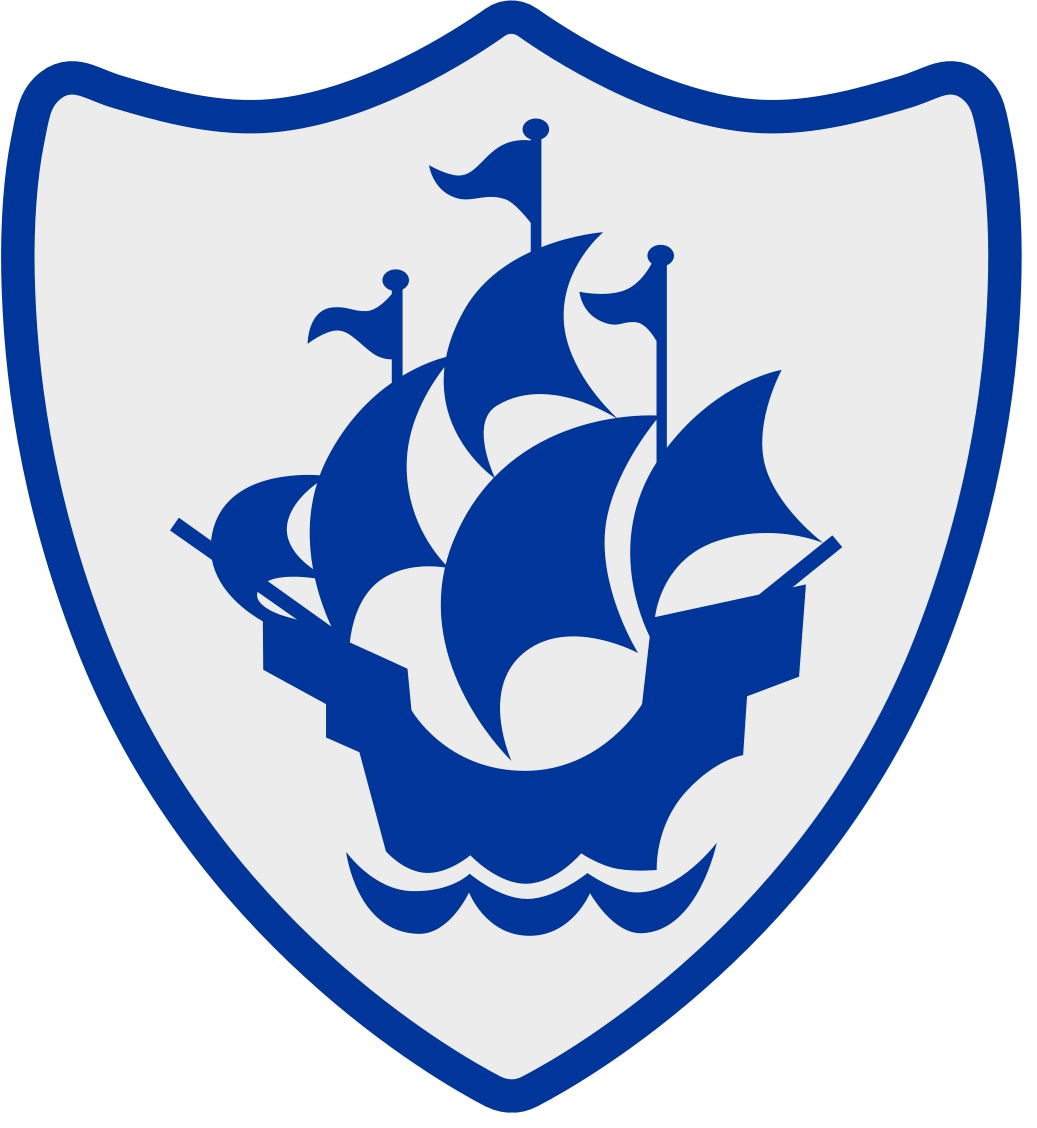
Blue Peter Badge

1 Comment

Filed under Etymology, Family History, History, History Undusted, How It's Made, Liguistics, Military History

Etymology Undusted: Zarf

To me, the word Zarf sounds like a sci-fi comedy name for an inept villain. But, in fact, it’s a word that entered English in 1836, and is the Arabic word for “vessel”. It describes an object that you’ve seen or have likely had in your hand at some point. I will freely admit that the zarfs we know today have fallen a long way from their original forms: A zarf is the holder of a coffee cup. That sounds fairly straightforward. You may have instantly pictured a highly decorative, precious metal jewelled… no? Are those crickets I hear chirping in the vast silence of confusion? Or maybe you pictured the cardboard contraption around a hot cup of Starbucks coffee. Fallen a long way, indeed. (Camps are divided on whether the latter constitutes a zarf… for good reason: I think they would be better referred to as sleeves, as to put them on par with the bejewelled masterpieces would be an insult to the artisans of bygone days.)

Zarfs arose out of the necessity of protecting one’s hands from a hot cup; before the monster of plastic reared its ugly head, cups were made from metal or glass, often without handles. Further back, they might have been made from plant products such as coconut shells. The oldest known cups were found in Gough’s Cave in Cheddar Gorge, Somerset, England, and dated to 14,700 years ago; they were made of cannibalised human skulls.

During the 16th century, coffee gained popularity throughout the Ottoman Empire. It led to the popularity of coffee paraphernalia and coffee houses, which eventually spread worldwide and remain popular to this day. In Britain, for instance, a coffee-house culture arose in the 17th century; by the end of the century, there were over 3,000. Such venues became known as penny universities, because, for the price of a cup of coffee, men could join in the hubs of intellectual exchange and debate. Artists, journalists, poets and writers gathered to discuss God and the world; the Inklings, a literary group including C.S. Lewis and JRR Tolkien, met regularly at the Eagle and Child in St Giles’, Oxford.

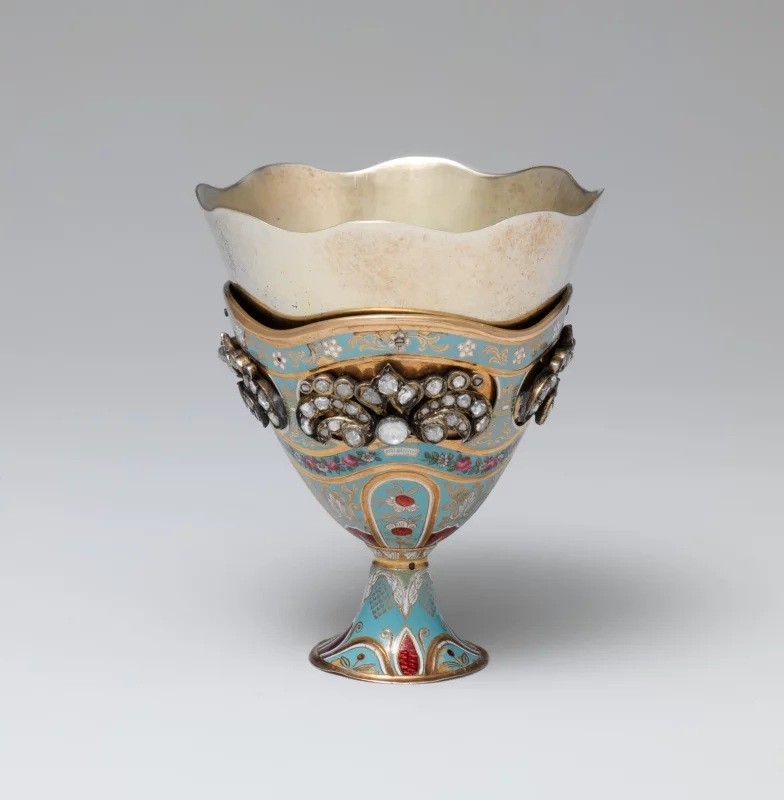
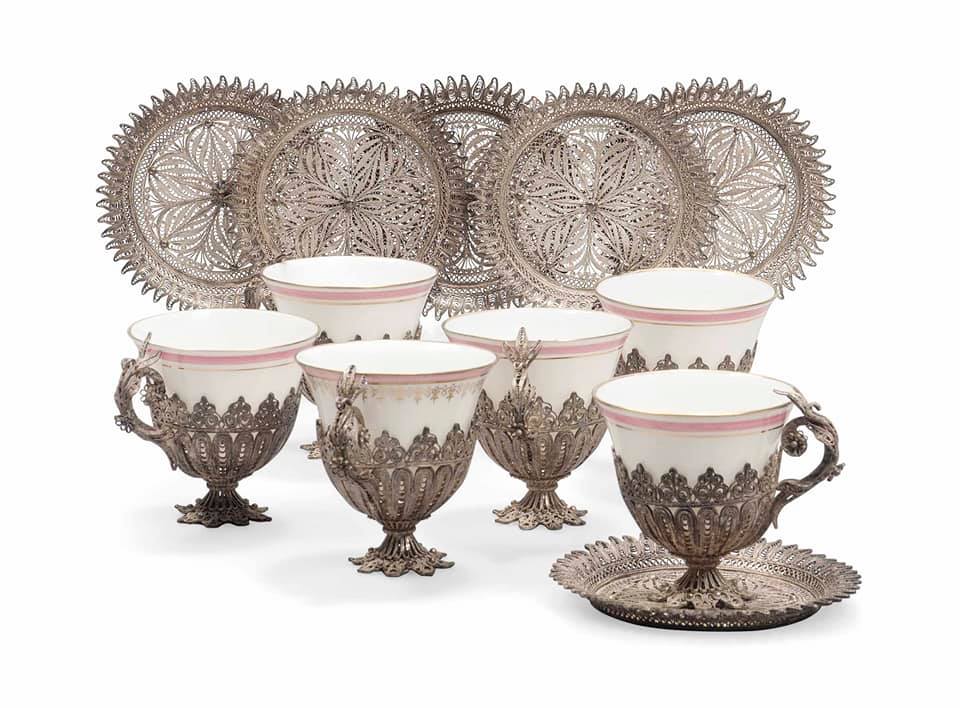
By the 19th century, the goldsmiths of Switzerland had become leaders in the production and export of ornate zarfs, made of precious metals and inlaid with precious stones or small hand-painted medallions. They were often made in fine filigree, with a smaller cup, known as a fincan, made of ceramic or glass, slipped inside to hold the coffee. A modern version of this is still widely used, called a demitasse (French for half cup), in which espresso is often served.

Without further ado, here are a few examples of zarfs and fincans, along with demitasses:

Source: Sothebys.com
A Swiss musical box zarf, ca. 1840 – Metropolitan Museum of Art
Fincans within zarfs
Demitasse set. Source, Wikipedia
Starbucks “zarf”, or sleeve

2 Comments

Filed under Etymology, Food History, History, Liguistics, Linguistics

Obscurities: Mondegreen

The word Mondegreen is an example of what it means: Misheard lyrics in songs. The word was coined by the journalist Sylvia Wright in 1954, when she misheard the lyrics in a Scottish ballad; instead of hearing They have slain the Earl o’ Moray, / And laid him on the green, she heard Lady Mondegreen.

Examples of this happen frequently; when I was a child, I misheard the lyrics from Dashing through the snow in a one-horse open sleigh as a one-hose hope and slay – I had no idea what that was supposed to mean, but I sang it with gusto! A famous mondegreen is Bob Dylan’s The answer, my friend, is blowing in the wind misheard as The ants are my friends. All the whiskey in the sea can be heard in Club Tropica, by Wham!; the actual line is All that’s missing is the sea. From Toto’s song Africa, instead of the line bless the rains down in Africa, some people hear left my brains down in Africa. In Abba’s Dancing Queen, they sing feel the beat from the tambourine, but I hear tangerine. There are likely as many mondegreens as there are songs, as garbled communication, Chinese whispers, accents and the mix of words and music can all lead to different conclusions than those intended by the singers or songwriters.

Have you ever misheard lyrics? Share your mondegreens below!

5 Comments

Filed under Cartoon, Etymology, Liguistics, Linguistics, Mistranslations, Obscurities

Obsoletusvocabularium…  Up with Archaism!

English is relatively young, as languages go. Like a sponge, it absorbs words and meanings from other languages, then squeezes them out in a similar (or widely different) form.  In other words, English is a survivor; it has survived the attempts to destroy it by the Danish Vikings, the French (Normans, aka Vikings disguised as French), and the Germans. These historical encounters give me high hopes that it will survive the age of the Cell Phone.  With each skirmish, it has come out stronger, more versatile and more flexible.  When the Pilgrims packed up English and crated it off to the New World, it was locked, as it were, in a time capsule. British English absorbed a few bad habits from the French before they thought better of it and distanced themselves during the French Revolution, but in the meantime, contentious pronunciation differences to that time-capsule relative over the Pond had crept in and persist to this day. One example: The American pronunciation of schedule (/skedju(e)l/) is from the original Greek pronunciation, which was used in Britain for onk-years until they took on the fancier French-ified pronunciation of /shedju(e)l/.  For a fascinating glimpse into how Modern English was formed, William Caxton (~1422-~1491) is your man.

While English pilled through the pockets of invaders stealing loose grammar, we also lost a few words along the way:  Some words are known to us in one form but not the other, while other words have been lost altogether due to a more convenient absorption or form arising.  You know of disgruntled (adj.), but what about gruntle (v.) or disgruntle (v.)?  And dis– in this particular case is not used to form the antonym of gruntle, but means exceedingly gruntled.  And I don’t know about you, but conject as a verb makes more sense than “conjecture” to me.  And shall we vote to bring back “Oliphant,” as J.R.R. Tolkien saved it from extinction through his use of it in Lord of the Rings?  What about pash (n.), contex (v.), or spelunk (n.)?  We know of fiddle-faddle, but what about plain ol’ “faddle” (to trifle)?  Some, admittedly, are not missed; toforan is better served with heretofore, in my humble opinion (IMHO).  Needsways is a Scottish word, obsolete in England and America perhaps, but alive and well north of the Border.  There are some deliciously eccentric words which deserve resuscitation, such as loblolly, bric-a-brac, sulter, pill (v., to plunder, pillage – ought to come in handy, that), quib, bugbear, uptake (as a verb), wist (intent), or sluggy.  If Sir Walter Scott can save words such as doff and don from extinction, so can we.

Oh, and if you’re wondering about the word archaism, it means “retention of what is old and obsolete.”  So twinge your language to include these mobile words and their meanings, and revelate your intelligence! And if you’re curious, yes, Grammarly and spellcheck were going batship crazy with this post!😎

(Comic from xkcd used under a Creative Commons license)

1 Comment

Filed under Cartoon, Etymology, Grammar, History, History Undusted, Humanity Highlights, Liguistics, Linguistics, Snapshots in History

History Undusted: Code Talkers

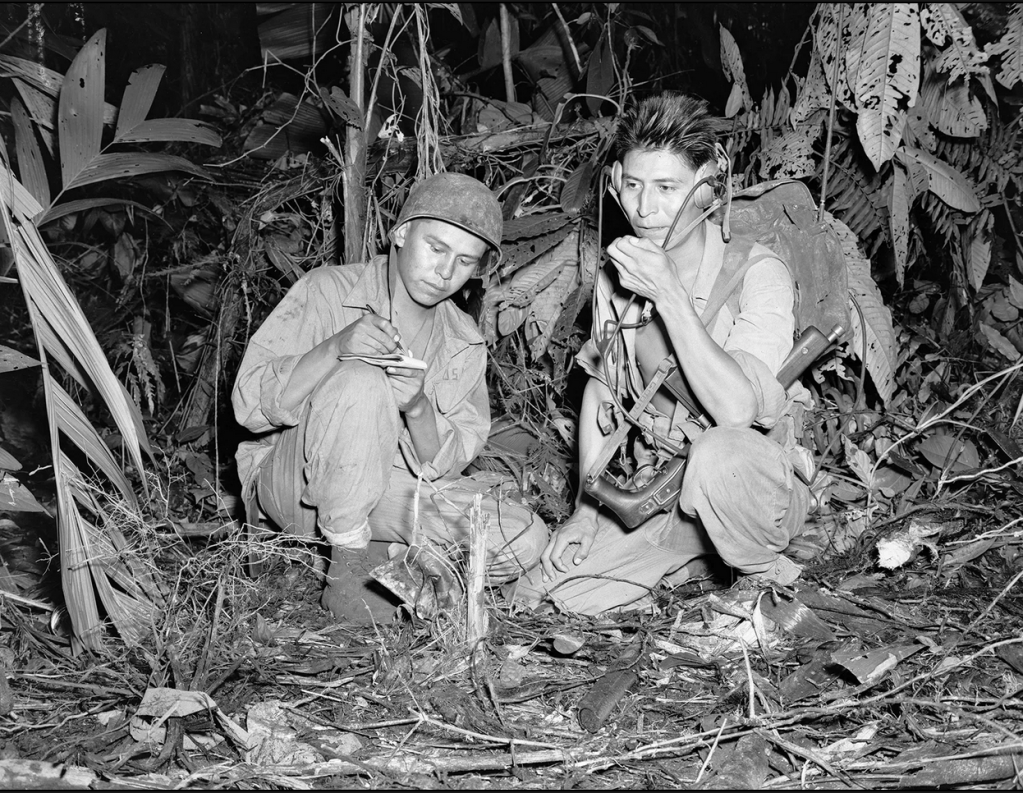
Navajo code talkers, Cpl. Henry Blake Jr. and PFC George H Kirk, who served with the Marine Signal Unit.
Source: Public Domain

Code talkers were Native Americans from various tribes who were employed by the US military during World War 2 as radio operators; their native tongues were indecipherable to anyone listening in, and as a result, their transmissions of sensitive messages were invaluable in allied victories on every Pacific island, including Iwo Jima, as well as in Europe in decisive battles.

Codes were developed based on the languages of the Assiniboin, Cherokee, Cheyenne, Choctaw, Comanche, Cree, Crow, Fox, Hopi, Kiowa, Menominee, Navajo, Ojibwa, Oneida, Osage, Pawnee, Sauk, Seminole, and Sioux peoples. These men could transmit over open radio channels, knowing that the enemy would be unable to break their code. If a military term did not exist in their languages, a phrase was used in its place: A submarine became an iron fish; a fighter plane became a hummingbird; a squad became a black street. In all, throughout WW2, over 400 terms were developed and needed to be memorised by each code talker.

The code talkers continued to be used after the end of the war, which delayed their recognition by the wider public – until documentaries about their service finally began to emerge in the 1990s. In 2002, the U.S. Congress passed the Code Talkers Recognition Act, followed by a similar act in 2008 to honour the tribes who used their languages in the wartime service of the United States.

The use of code talkers was a socially complex one: The languages that were so invaluable to the US military were the very tools that the US government had been trying to eradicate in the name of cultural assimilation. Between 1880 and 1905, boarding schools were established, in which Native American children were taken from their families and educated; they were taught to reject their Native values, languages, traditions and anything to do with their native culture. They were punished, sometimes severely, for using their native tongues; they were forced to dress like the “white man”, and were not allowed to wear their native garments or have any vestiges of their tribes. Some 100,000 Native Americans were forced to attend such schools. Parents who resisted the kidnapping of their children were imprisoned; several from the Hopi tribe were even imprisoned on Alcatraz Island. Though most of these schools had been closed by the 1930s, the cultural and psychological damage had taken its toll on many native people groups, many of whom still struggle with their cultural identities today. At the time these young warriors were called into military service or chose to join after the bombing of Pearl Harbor, many were not even legal American citizens, yet they fought for their land and their families.

With that background in mind, the dedication and ingenuity of the code talkers are all the more astounding. They were often in the first wave of soldiers deployed as they were needed to pass on messages for the strategic planning and execution of driving back the Japanese from the Pacific islands. In addition to the Pacific arena, the European front also benefited from the code talkers’ ability to communicate directly with each other: Comanche code talkers were assigned to the 4th Infantry Division when it landed at Normandy in June 1944. In this context, some of the Comanche substitutes were turtle for tank, a pregnant bird for bomber, and crazy white man was their term for Adolf Hitler – a more insightful term has never been more aptly applied.

For a fascinating look into a history largely forgotten, please click on the following video recounting code talkers telling their stories firsthand as they return to the Pacific Islands with their families and find peace after decades of PTSD. The video is 1:10, but well worth the time when you can take it: Navajo Code Talkers of World War II (2018) | Documentary

Other sources:

https://eji.org/news/history-racial-injustice-cultural-genocide/

https://www.britannica.com/topic/code-talker

8 Comments

Filed under History, History Undusted, Humanity Highlights, Liguistics, Linguistics, Links to External Articles, Military History, Psychology Undusted, Snapshots in History, YouTube Link

Just for Fun: Boxes

Good intentions of writing a blog this week went out the window when temperatures soared to mid-30s Celsius (which, local microclimate-wise, is high 30s into 40s); it’s simply too hot to focus right now… I know what I want to write about, but heat-induced brain fog is real!

So in the meantime, I’ll leave you with something just for fun!😉

2 Comments

Filed under Humor, Images, Just for Fun

Geology Undusted: Rock vs Stone

Today’s topic is the kind of thing that flashes through my brain at 4 a.m. when I’m dropping off to sleep.

Sometimes rock and stone can be used interchangeably, depending on the context of science, society or conversation; but some phrases are intuitively either stone- or rock-rooted: We say rock road, rockslide and rock salt, but stonemason, stone wall and Stonehenge.

In geological terms, a rock is a naturally occurring mass of minerals, particularly those with a distinctive composition (e.g. granite, bedrock, igneous, or features such as Ayers Rock). Other geological terms range from clay, silt, sand, pebble, gravel, cobble, boulder or glacial erratic (material moved by geological forces from one location to another) to mountain in size.

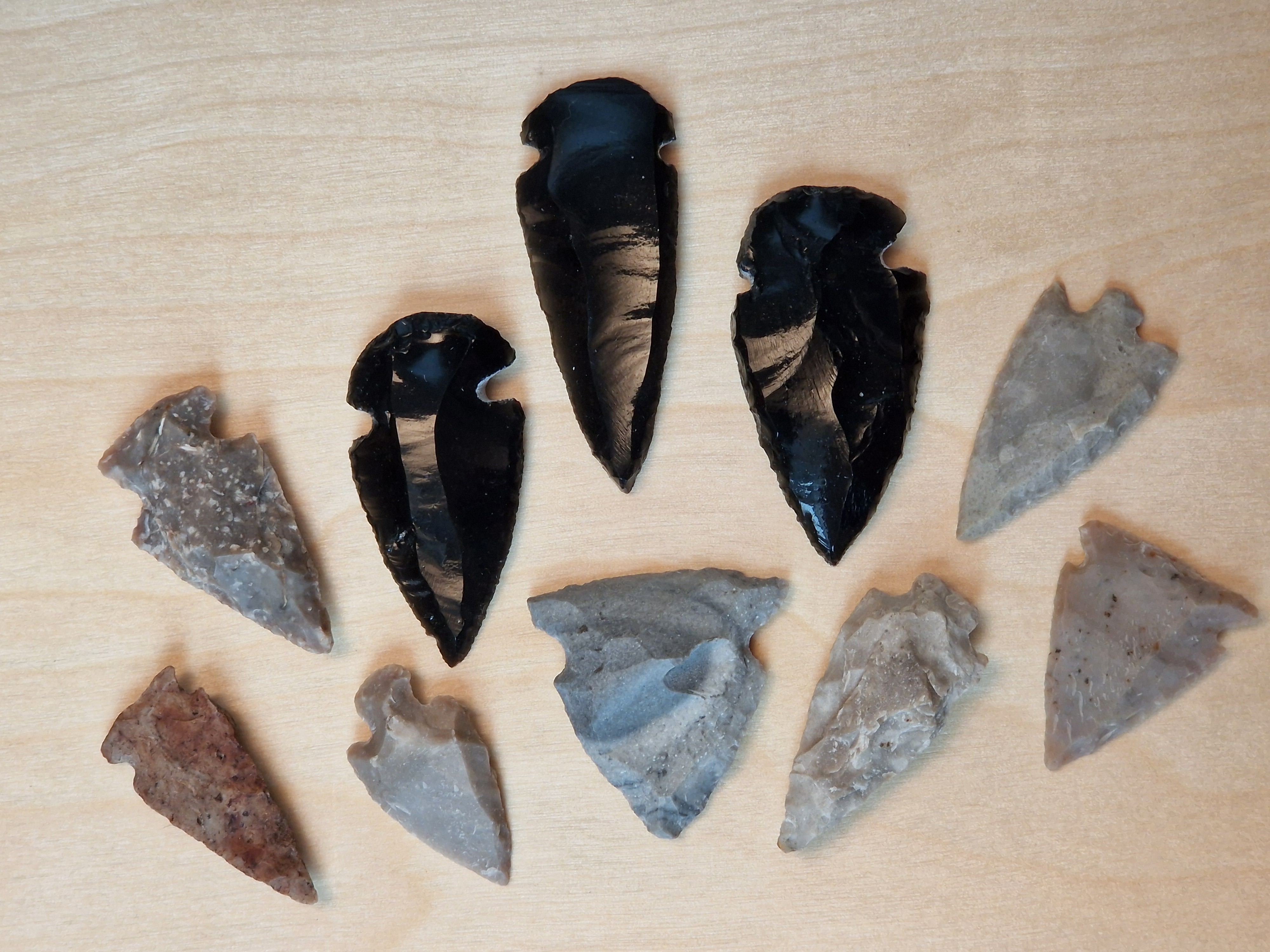
In Archaeological terms, rock refers to a geological formation, while stone refers to any rock that has been placed or modified into a tool by humans (ergo, Stonehenge, not Rockhenge). When an archaeological dig is underway and they pull out a rock, trained eyes can spot signs of scarring, or scoring, such as on a core, which is a piece of rock that has been worked by a stone tool referred to as a hammerstone (for obvious reasons), used to shape another rock into a tool, such as in the process of flint knapping (the more refined the knapping process, the more refined the tools become, such as using antler or copper nubs to chip away finer areas of an arrowhead or hunting barb). In Kansas, where I grew up, arrowheads are still discovered occasionally; I have a small collection, along with a few obsidian arrowheads.

In archaeological excavations, what might appear to be a natural rock formation may turn out to be an ancient boundary wall, with stones intentionally stacked for a specific purpose. In that sense, though a rock road has intentionally been placed, it is not stone – it is placed for a purpose, yes, but its arrangement is left as it falls, so it is referred to as a rock road.

Years ago, when my husband and I were walking along a rocky riverbank in Ticino (in the Italian-speaking part of Switzerland), I picked up a stone; it had obvious signs of human activity, with smoothed sides where hands held it, and scrapes along the top and bottom, such as might be caused by sharpening a tool – whether antler or arrowhead. As it was washed down from its resting place in the rapids, it was no longer in situ and therefore would have no archaeological significance.

So which is it, stone or rock? For me, the answer is this: When it has been modified or intentionally placed or ordered by humans, it’s stone; when it’s naturally occurring, it’s rock.

I’ll leave you with a few idioms carved in stone or rock:

Set /carved in stone

Living under a rock

Leave no stone unturned

On the rocks

Heart of stone

Kill two birds with one stone

Have rocks in one’s head

Cast the first stone

As solid as a rock / As solid as the Rock of Gibraltar

Written in stone

Like getting blood from a rock

Between a rock and a hard place

A stone’s throw

Leave a comment

Filed under Etymology, History Undusted, Images, Liguistics, Linguistics, Nature, Science & Technology

Etymology Undusted: Fiddle-Faddle

Sometimes, my husband and I discuss history, and an odd topic here or there pops up; I’ll often delve into the history or etymology of a phrase, word, or idiom and share my findings here. So, no more fiddling about; let’s get to it.

A reduplication in English is a word or sound that’s doubled or altered the second time for effect; there are a few kinds of reduplications: Exact repeats, like bye-bye or night-night; rhyming, like okey-dokey, easy-peasy, or higgledy-piggledy; ablauts, like chit-chat, criss-cross, splish-splash, or wishy-washy; there is even a series of -shm reduplications, like fancy-shmancy, laborday-shmaborday, or work-shmerk. Some reduplications emphasise the first term to focus on the prototypical or normal form of something, e.g. ‘I just was a salad-salad (not bean salad or tuna salad)’. Many such words have become standard in English, such as flip-flops, wingdings, or zig-zag. Every language probably has such words; German has krimskrams, schnikschnak, mischmasch, larifari, Wirrwarr and more. Italian has a few that have slipped into use in other languages, such as piano piano (very slowly), Mamma mia (literally, my mother, but used as an expression of surprise, frustration, or even delight, similar to ‘Oh my goodness‘), or bric-a-brac (knick-knack).

Have you ever said (or heard someone else say) Fiddle-faddle? It first appeared in English in the 1570s, meaning trifles, or to talk nonsense or speak of something not worth serious attention. Fiddle is another word for violin and is the more colloquial/casual of the two; as such, it has long been associated with less important things. Georgette Heyer uses fiddle without faddle to mean trivial or nonsense; the reduplication would merely emphasise the meaning of the first word, so she chose to drop the second.

John Milton Edwards (the pen-name of William Wallace Cook, 1867-1933) wrote, “There’s a lot of fiddle-faddle wrapped up in that word ‘inspiration.’ It is the last resort of the lazy writer, of the man who would rather sit and dream than be up and doing...”

It was also used as an adjective to describe a troublesome person, such as a nit-picky, ceremonious old woman. As a verb, to fiddle-faddle means to dally, which leads us to another reduplication: dilly-dally, which means to loiter, delay, or trifle! A fiddle-faddler is a person who trifles or dallies.

No dilly-dallying, let’s get to the point: Which reduplications have you used? Have you ever known a fiddle-faddler or a dilly-dallier? If you know of more such words, please put them in the comments below!

10 Comments

Filed under Articles, Etymology, History Undusted, Liguistics, Linguistics

History Undusted: Engadin Sgraffito

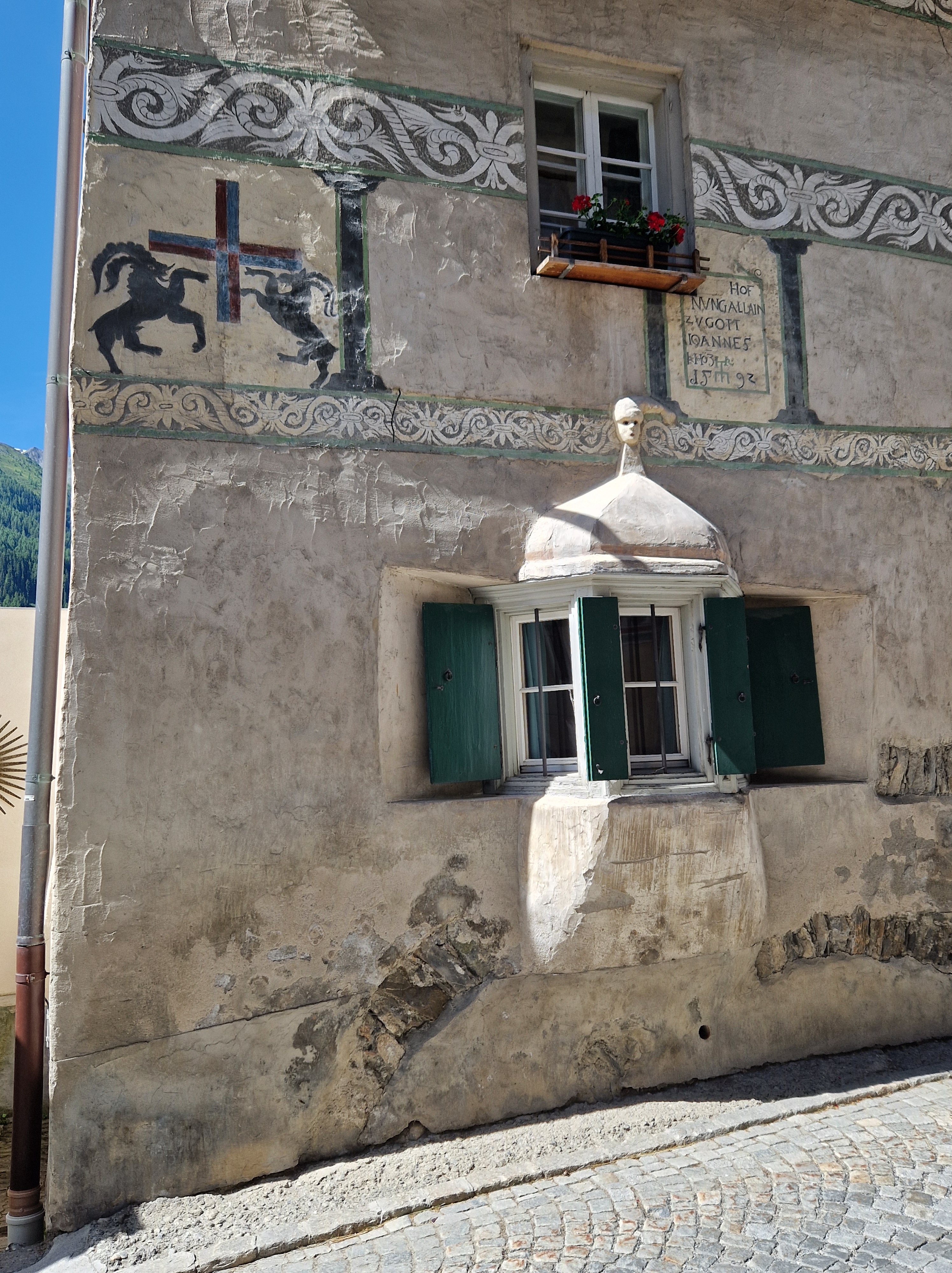
I know that, for most of you, neither Engadin nor Sgraffito have made you any wiser as to what this blog is about, so first, I’ll start off by explaining where and what they are, respectively.

Engadin (pronounced En-Ga-Deen) is a long, towering Alpine valley in the Romansh-speaking canton of Graubünden in southeast Switzerland. The first mention of this valley was in Latin as vallis Eniatina in AD 930; in the Romansh language (one of the four national languages of Switzerland), it is Engiadina. The river running through the valley is called the En or Inn, and it is the only river in Switzerland that runs (via Austria) into the Black Sea. The region is usually divided into lower and upper Engadin, and it is connected to the surrounding regions by several mountain passes.

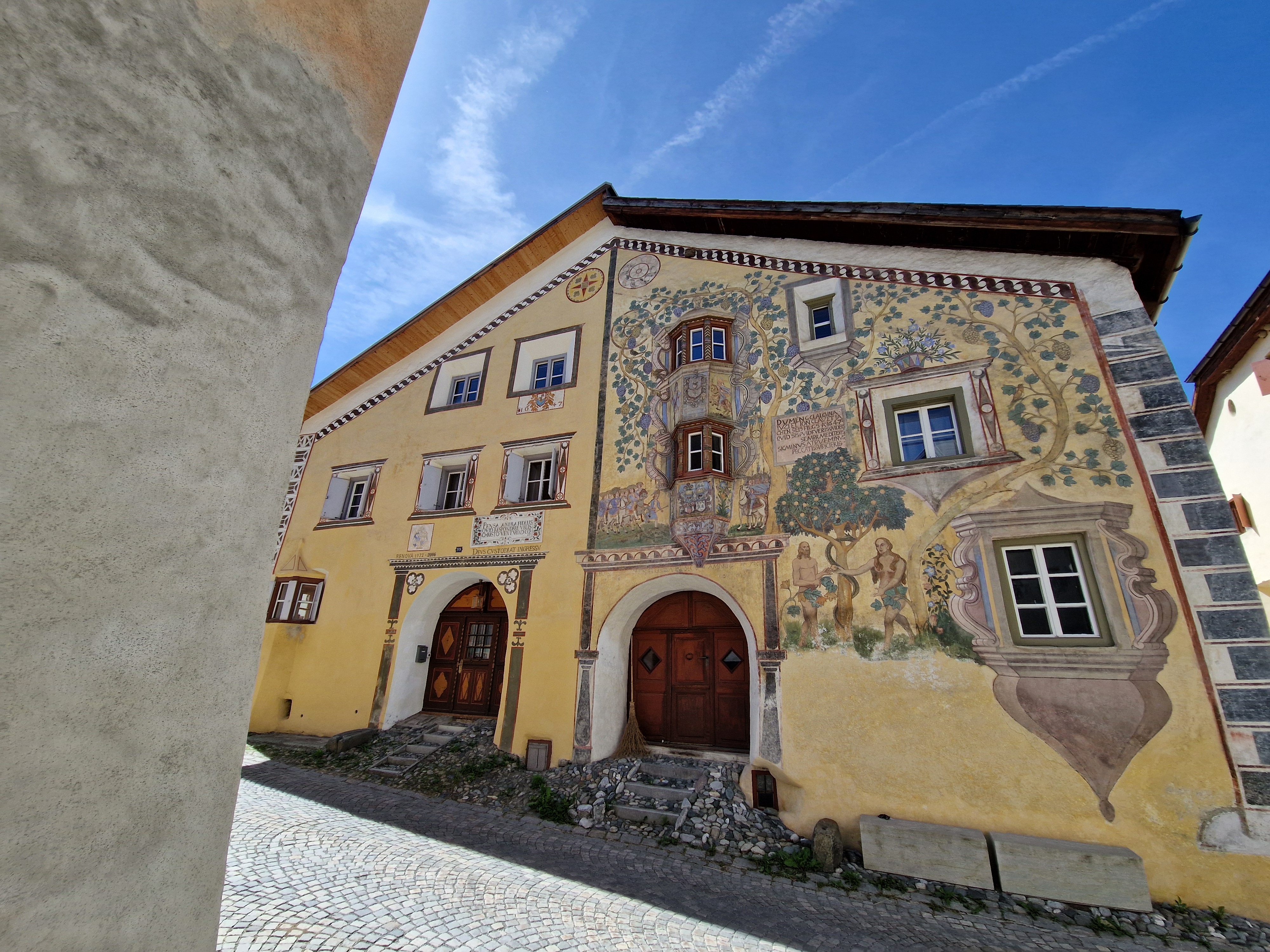
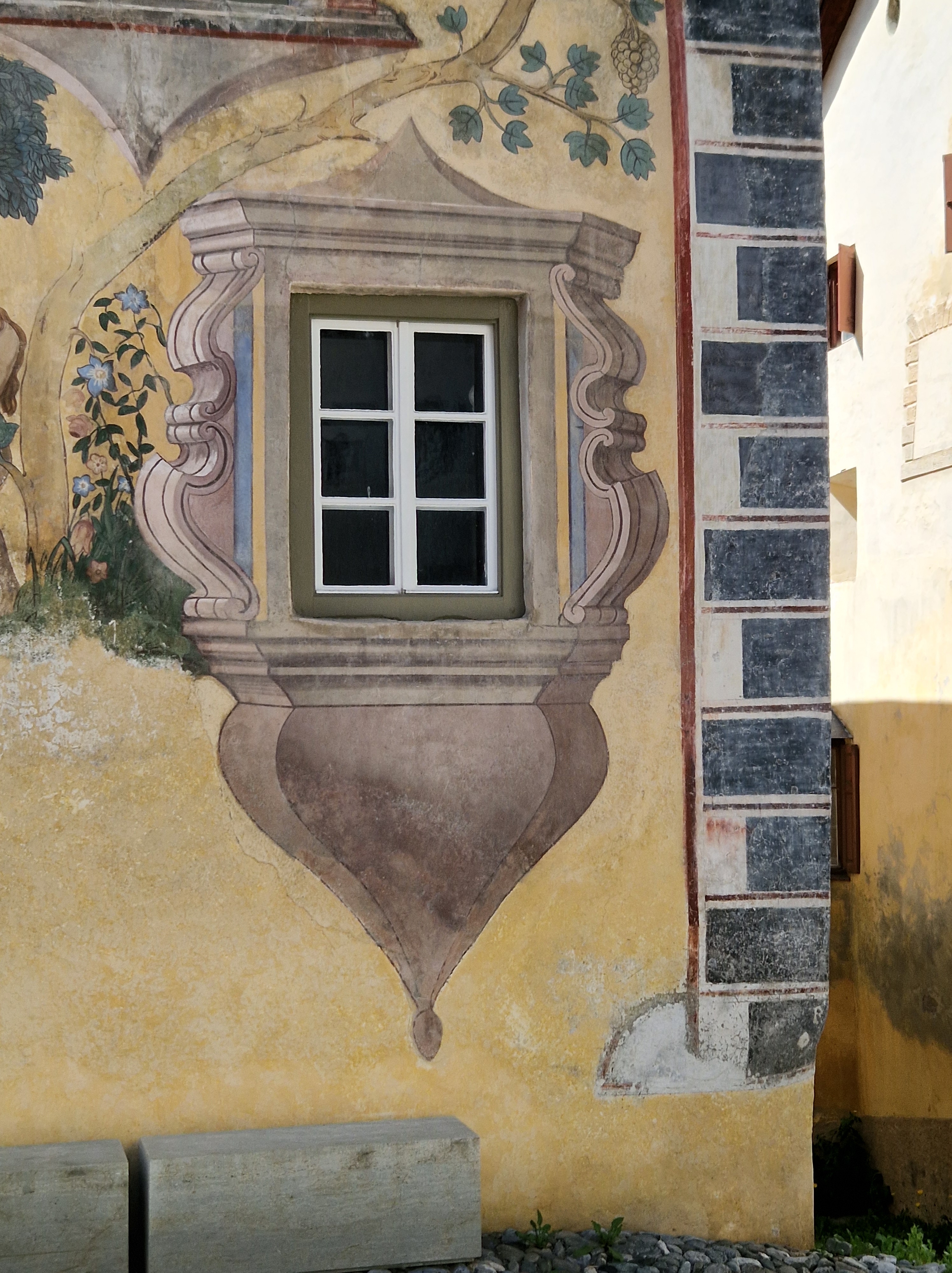
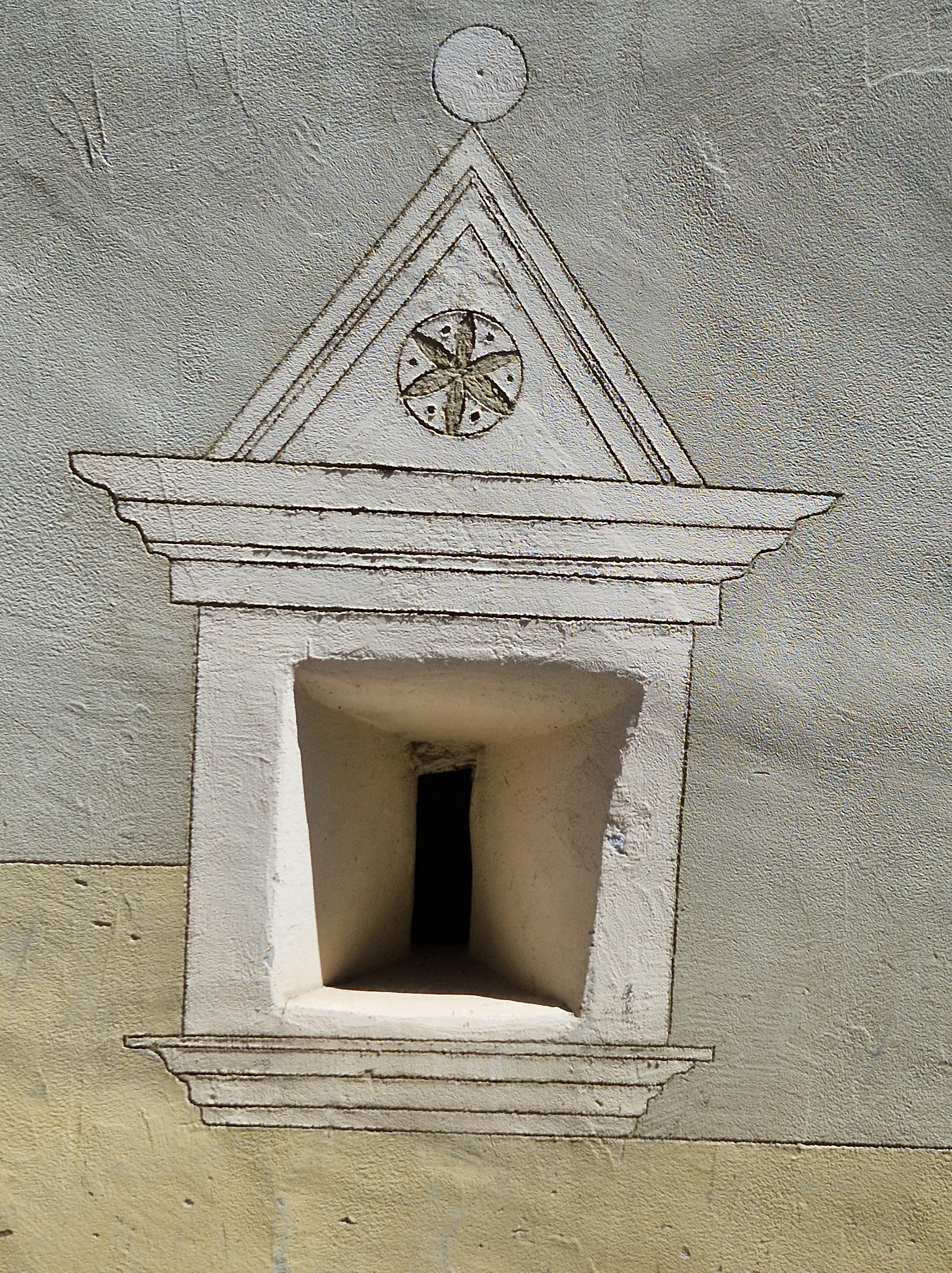
The second word, Sgraffito, describes a plaster technique that is traditional throughout Engadin: Layers of plaster of contrasting colours are scratched through, creating intricate designs on the facades of buildings (many of the buildings in Engadin towns were built (or rebuilt) in the late 1500s to early 1600s). The word comes from the Italian graffiare, which means to scratch; it can be traced back to the Greek word graphein, meaning to write (from which we also get any words containing the prefix, suffix, or derivative of graph (graphite, typography, graptolite, parallelogram, holograph, etc.). Sgraffito is not only used on buildings to make them look decorative, but it also serves the purpose of making a small feature look larger; on one building, the same floor had different-sized windows, likely installed over generations; the sgraffito was used to give a more uniform look to the façade. The decorations also make a plain building look grander, giving a more opulent impression. One building, pictured below, obviously had two occupants with very different characters back when they were originally decorated…

The basic technique for architectural features is to plaster the façade with the base colour; once that has set, it is then plastered with a contrasting colour; once that has set just enough, the scratching, or carving, begins. This is also a technique used in pottery and in creating stained glass effects (just click on the links if you’d like to see how these crafts are made).

One thing to note is that many old buildings here in Switzerland have dates listed on them: Of when they were originally built, and when they’ve been renovated. Part of the history of such renovations may include fires that swept through villages, or avalanches that buried a layer, or wars, such as the Swabian War and war against the Habsburgs, and the subsequent renovation or rebuilding of the towns or individual homes. Sometimes, along with the dates, a list of past and present occupants will also be displayed, preserving their names and memories within the history and changes of the building itself.

Below are a few pictures taken in Engadin during our recent summer holidays. Enjoy! Feel free to zoom in on the pictures to see the details.

5 Comments

Filed under Articles, Etymology, History, History Undusted, How It's Made, Liguistics, Links to External Articles, Military History, Snapshots in History, YouTube Link

A Long Dordogne Weekend

The first weekend in June, I took a much-needed break. Our home renovations, which lasted 14 months altogether, were finally finished. For a few months, I’d been looking for a suitable writers’ retreat, or a creative retreat – ones that didn’t have yoga as part of the course (I won’t go into my reasons; let’s just say I wouldn’t be able to relax in that kind of atmosphere). I’d finally found one – and it would be at a place in the Dordogne (one of the “departments”, or regions, of France) I already knew from the YouTube channel Manor & Maker. After I’d booked the course, which would have been a creative weekend around the theme of fairy tales, it unfortunately had to be cancelled. But as I’d paid for the course and flights, I decided to go anyway.

The “weekend” started off on Thursday, with the worst travelling day I’ve experienced in years: In France, workers will strike at the drop of a hat; I think they still haven’t figured out that the French Resistance and the habit of inconveniencing everyone just because they can is passé. But the Bordeaux taxis were on strike Thursday and Friday – which meant that the roads in and out of the Bordeaux airport were blocked (the police were even helping the strikers). Therefore, the airport shuttle across the city to Gare Saint-Jean (train station) was thrown off its scheduled routes. I waited in vain for the shuttle to arrive at its alternative location, and, through a succession of helpful advice (more or less – not everyone was informed about the strike and changed traffic routes as a result), what should have taken 30 minutes ended up taking 3 hours (carrying luggage). I finally arrived, then bought a train ticket (the last train of the day possible), then waited. And waited. Other trains leaving after mine popped up on the board, but not the train for Limoges (my stop would be Thiviers).

In the ticket office, the woman in charge (who spoke little English when she chose and had fobbed me off to someone more capable) had belligerence and a little-god/diva complex down to a fine art. (As the saying goes, be careful how you treat me or you’ll end up in one of my novels…) As the train’s track information didn’t pop up and still didn’t show up, I braced myself and got back into the queue to ask about it. Fortunately for me, the older French couple in the queue in front of me asked about the train for Limoges; I could follow enough of the French and body language to know what happened next: The diva answered curtly with a generous portion of rudeness added – and promptly had her head scrubbed, bitten off and handed to her on a silver platter – to the applause of everyone who’d had to deal with her already. The husband of the couple was ready to rip her hair out for speaking to him the way she had, until another ticket woman stepped in between them and tried to diffuse the situation – apparently, she had practice at it. This second woman then came out with the growing crowd of waiting passengers to see what the problem was at the information board; after several minutes on the headset with the control room (I assume), it finally popped up. Naturally, it was the farthest train track, and we had only 5 minutes to reach it! The couple took me under their wing, and we made it to our seats just before the doors closed. I finally arrived at my destination, Thiviers, around 9 p.m.

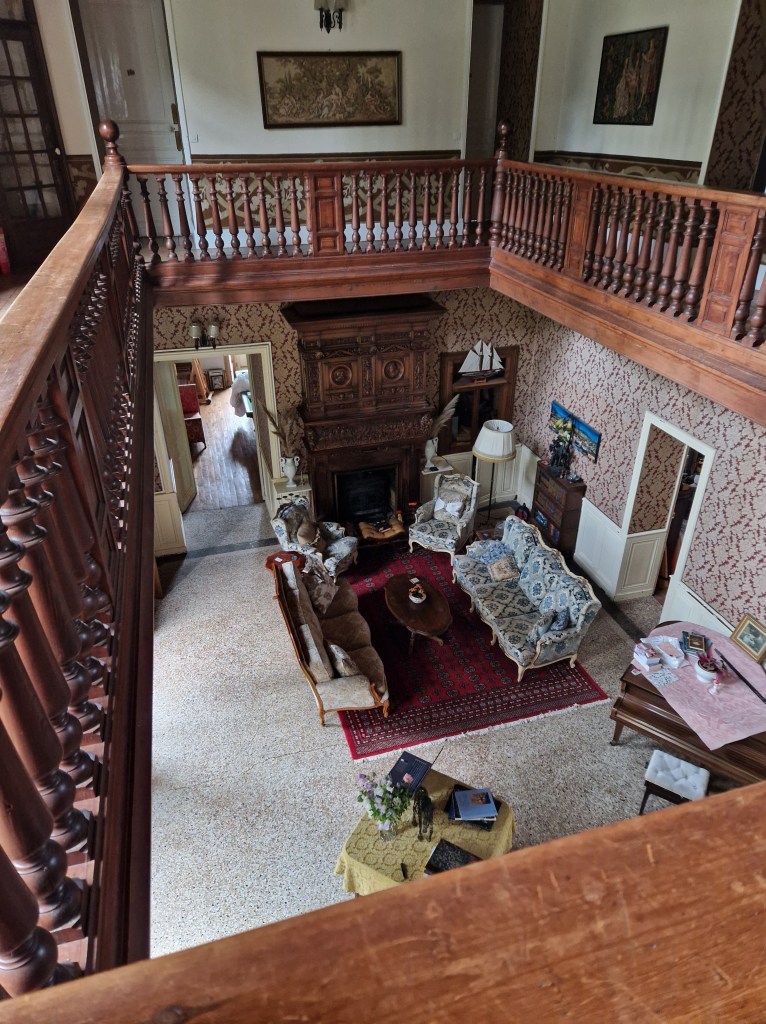
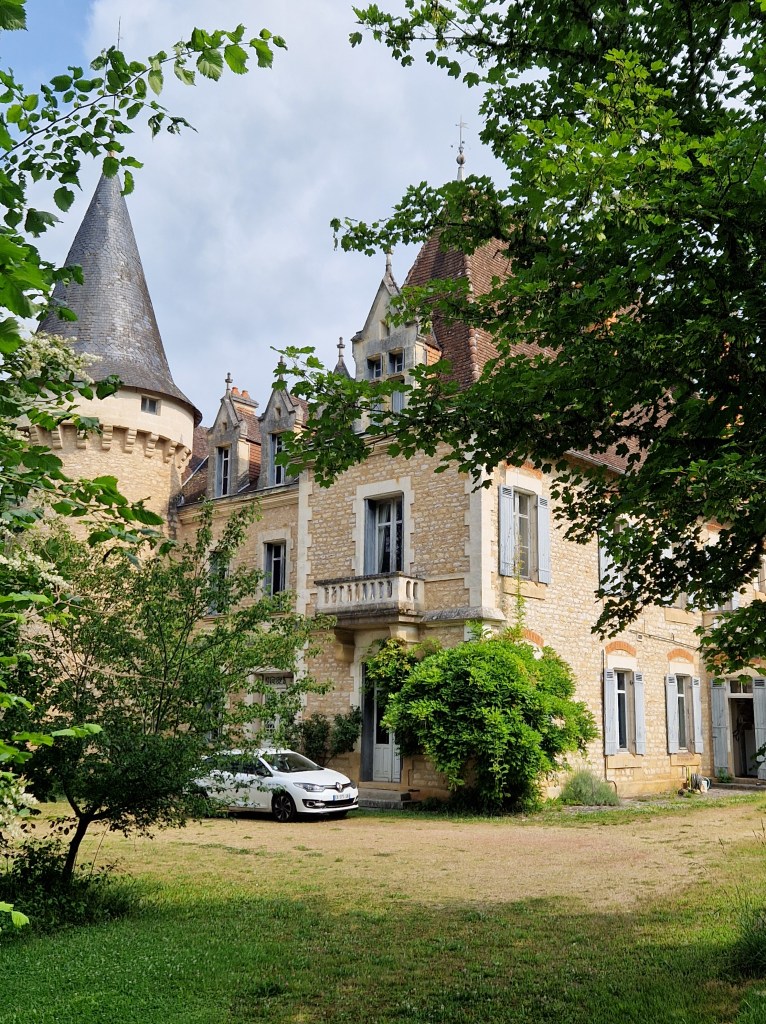
I was met there by Stephen, the Chatelain of Chateau de Saint-Germain-des-prés, and driven back to their home. What followed was a lovely, long weekend; only one other B&B couple were there, but rarely seen. I had time to unwind, work on my next novel, and spend time with Stephen and Sara (the Chatelaine) and Sara’s mother, Dee. Sara is a costume seamstress, and she was working on a Regency coat for Steve for an upcoming BBC segment at the chateau of their friends. Dee and I helped piece the pattern together, and the billiard table in their grand salon became the sewing table for the project.

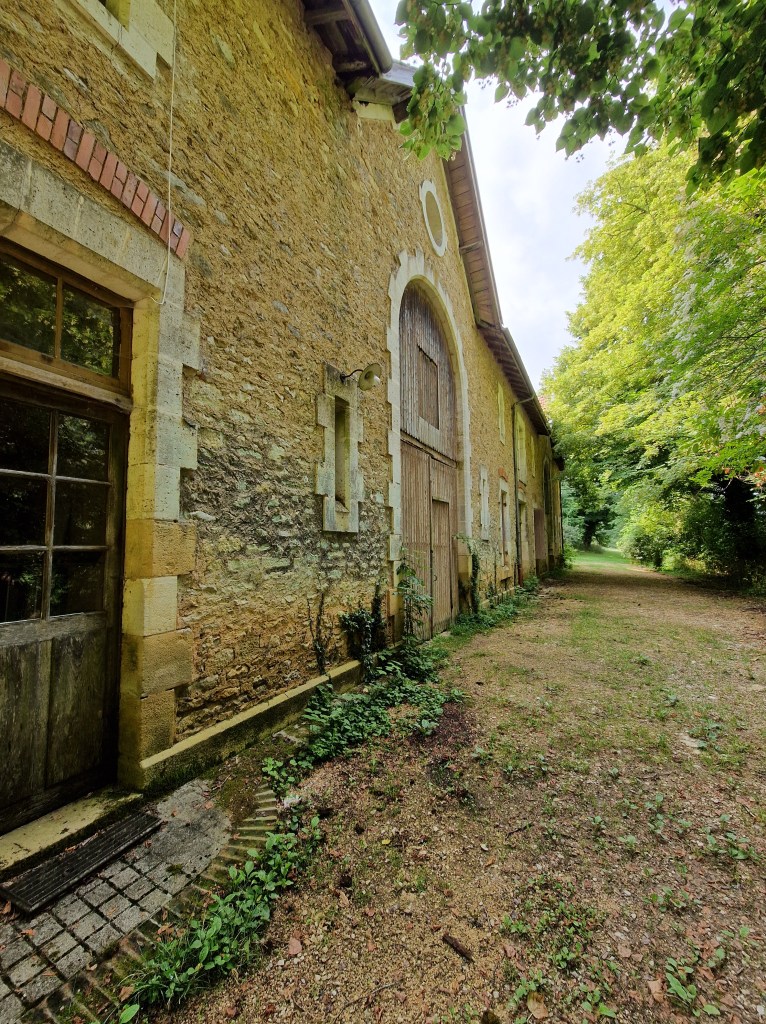
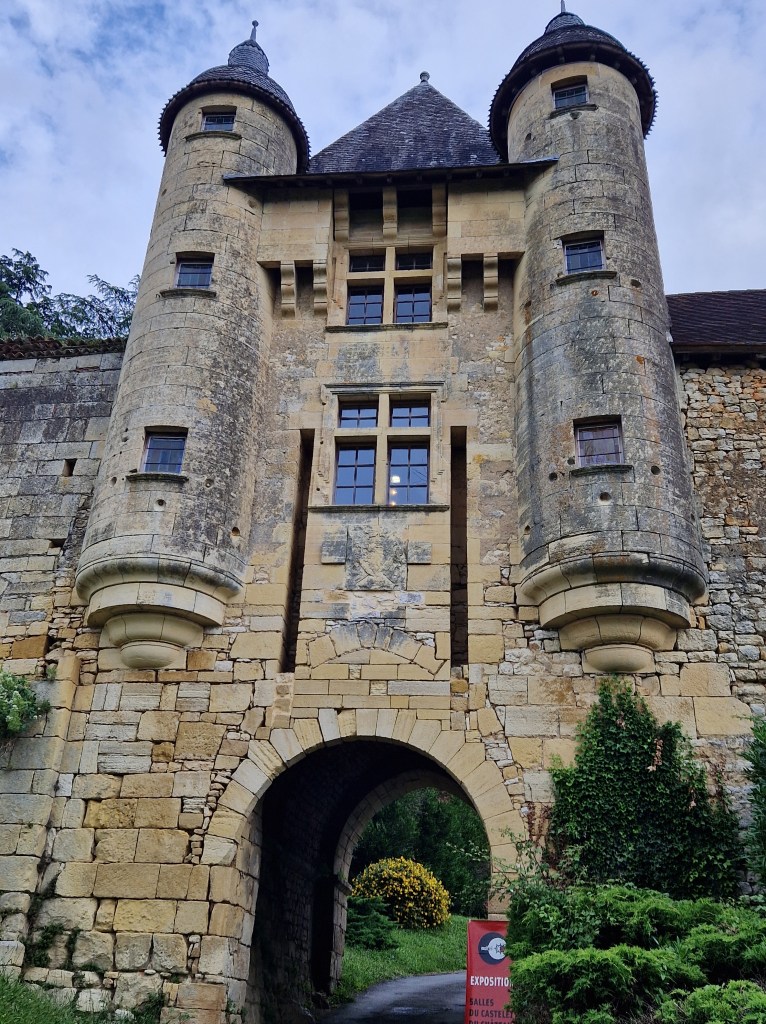
Here are a few pictures from the weekend, which included a modern art exhibition at another local chateau, as well as an outdoor artisan pottery fair. Barring strikes, I’d love to go again sometime!

3 Comments

Filed under Images, Links to External Articles