Tag Archives: Etymology

History Undusted: The CB Radio

You know how your brain fires off random thoughts as you fall to sleep, or combines odds-bods into dreams forgotten as soon as you wake up? For some reason, 10-4 popped into my head in those moments last night. It sent me down the rabbit hole I now present: The history of the CB radio.

The often-forgotten or overlooked inventor of the Citizen’s Band (CB) radio system, along with inventions such as a patented version of the walkie-talkie (originally invented by the Englishman Donald Hings), the telephone pager, and the cordless telephone – all precursors to today’s cell phones, was Al Gross (1918-2000): Born in Toronto, Canada, he grew up in Cleveland, Ohio. The son of Romanian-Jewish immigrants, his love for electronics was sparked when, at the age of nine, he was travelling by steamboat on Lake Erie; he explored the ship and ended up in the radio transmissions room, where the operator let him listen in. Eventually, he turned the family’s basement into a radio station built from scraps. During his higher studies, he experimented with ways to use radio frequencies.

During World War 2, he had some involvement with developing a two-way VHF air-to-ground communications system for the U.S. Office of Strategic Services, known as the Joan-Eleanor system, and after the war, the Federal Communications Commission (FCC) allocated a few frequencies for the Citizens’ Radio Service Frequency Band, in 1946. Gross saw the potential and founded the Gross Electronics Co. to produce two-way communications systems to make use of these frequencies; his firm was the first to receive FCC approval in 1948. For more about his other inventions, just follow the link on his name above. For now, let’s focus on the CB:

The CB radio became an international hit back before cell phones and computers became a thing (despite the prevalence of cell phones, CBs are still around; truckers still communicate about road conditions, etc. Its usage was also revived by the Covid lockdown, when people began reaching out to meet and talk to others outside of their own four walls). It was, and is, a way to communicate with others long-distance from home or on the go.

My dad was always interested in the latest technological gadgets; in the mid-70s, we got a laserdisc player, the precursor of CDs, and DVD/Blu-Ray players. I remember watching films like Logan’s Run and Heaven Can Wait on that format. Laserdiscs never really took off, and only about 2% of US households had one (it became more popular in Japan at the time). Around that time, we also got a CB radio in our VW van. My dad had a chart with all of the CB slang words and codes, and I memorised it, fascinated by the lingo. On long road trips, I would get on the CB and chat with truck drivers. My handle (nickname) was Spider-Fingers, as I liked spiders and had long fingers (long fingers has the connotation of thief, so I didn’t want to use that!). Here is just the tip of the iceberg, a smattering of the codes and slangs used by CB radio enthusiasts, truckers and handymen:

There were dozens of slang terms for law enforcement officers: Bear (police officer); bear trap (speed trap, radar trap) taking pictures, also called a Kojak With A Kodak; bear bait (an erratic or speeding driver); bear with ears (listening to CB traffic); bear in the air/flying doughnut/Spy in the sky (helicopter radar traps), baby bear (rookie), fox in the henhouse/Smokey in a plain wrapper (policemen in unmarked vehicles); honey bear, mamma bear or Miss Piggy (slangs for female police officers); Brush Your Teeth And Comb Your Hair (a law enforcement vehicle is radaring vehicles – as if preparing for an official photo). A Driving Award was a speeding ticket. To wish someone Shiny side up meant that you wished them safe travels (keeping the vehicle upright).

There were slang terms for objects or events, such as Bambi, meaning that there was wildlife near the road and to take precautions; a crotch rocket was a fast motorcycle; double-nickels was a 55-mph speed limit area; a fighter pilot was an erratic driver who switched lanes frequently, while a gear jammer was someone who sped up and slowed down frequently; Alabama chrome was duct tape; an alligator/gator was a piece of blown tire on the highway, as it looked in the distance like a gator sunbathing. Convoys had front doors and back doors – the front or back truck in the group that would keep an eye open for bear traps. Motion lotion was fuel; the hammer lane was the fast lane (hammer was the gas pedal, and to hammer down was to drive full-speed). Break/breaker: Informing other CB users that one wanted to start transmission on a channel; a handle might be introduced, or requested if someone was looking for a CB friend. “Breaker, this is Spider-Fingers, over.” Asking for a comeback meant that you couldn’t hear the last transmission or wanted the other driver to talk. Break check meant traffic congestion ahead, slow down. A Bumper Sticker/hitchhiker is a vehicle that is tailgating another vehicle.

Aside from hundreds of slang terms, there was a whole list of codes (I guess you could say that the codes were the precursors of emojis!):

10-4: Agreed, understood, acknowledged

4-10: The opposite – asking for agreement or if a transmission was received.

10-6: Busy, stand by

10-7: Signing off

10-10: Transmission completed, standing by (you’ll be listening)

10-20: Location – What’s your (10-)20? Home-20 was asking for a driver’s home location/base.

10-33: Emergency traffic, clear the channel. CB code for Mayday for trucks and police cars.

10-42: Accident on the road

3s and 8s: Well wishes to a fellow driver. Borrowed from amateur ham radio codes “73” (best regards) and “88” (hugs and kisses).

The lists go on and on! I love the dry sense of humour reflected in the slang, and I think our everyday language could be a bit livelier if we included a few phrases that looked at things from a different perspective. Everyone could do with more 3s and 8s, 4-10?

1 Comment

Filed under Articles, Etymology, Family History, History, History Undusted, Humanity Highlights, Humor, Liguistics, Linguistics, Links to External Articles, Military History, Science & Technology

History Undusted: MacGyver and Blue Peter

This week’s topic arose from a conversation with my husband; we were discussing a temporary fix we had made at his mother’s home to make something usable until we could find a permanent solution. I said that we had “MacGyvered” it, and he had never heard the word before. That led me down a rabbit hole to naval flags, a card game, and British tele.

First, MacGyver: Though I knew the term, I had no idea what its origin was. The name comes from the eponymous character in a US television series that ran from 1985 to 1992; Angus MacGyver was a non-violent, resourceful genius, and his favourite tool was, of course, a Swiss Army knife. Though I was living in the States at that time, its running years explain why I didn’t know of the origin: In 1985, I was in college, having finished high school a year early (I took my final two years in one); I was too busy to watch television. In 1986, I moved to Hawaii to do a Discipleship Training School (DTS) with Youth With A Mission (YWAM), and went from there to the Philippines, where we worked in the red-light district of Olongapo. 1987 was a year of multiple jobs, earning money and hanging out with college friends – again, TV was not a priority. In 1988, I emigrated to Scotland.

The traits mentioned above made MacGyver a verb; when something is “MacGyvered“, a simple yet elegant solution to a problem is employed by using existing resources. At my mother-in-law’s home, we needed to level a new microwave that was sitting tilted atop the welded inserts that fit the original one. Our solution was to use an actual leveller, removing the end caps to make it fit inside the metal frame.

Now, down the rabbit hole: In the time of British ships of sail, when a blue flag with a white square or rectangle in the centre flew alone, it served as the sign for imminent departure (signifying P, leaving port); any passengers and crew in port would then return to the ship. The flag came into use in 1777, and by the turn of the century had become known as the blue peter. I have my suspicions that the term may have come from the card game of whist, in which a strategic manoeuvre known as the “blue peter” calls for trumps by throwing away a higher card of a suit while holding a lower one. No one can say for sure which came first, the ship or the card, so to speak, but the connection is likely.

The British children’s television programme, Blue Peter, first aired on 16 October 1958; the name was inspired when Owen Reed, the producer, was inspired by a radio programme for children (produced by Trevor Hill) that began airing on television once a month; it was launched aboard the MV Royal Iris ferry on the River Mersey, Liverpool, with presenter Judith Chalmers standing at the bottom of the gangplank to welcome everyone aboard. Reed was so captivated by the idea, and with the blue peter flag, that he asked to rename the programme (then called the Children’s Television Club) and take it to London.

Blue Peter, catering to younger children, is the longest-running children’s TV programme in the world; over the years it has changed with the times, and its content is wide-ranging, but they still give a nod and a wink to that original blue peter flag by giving out badges in the shape of a shield with a blue ship of sail on a wave. It is awarded to viewers for achievements, efforts, or creative work. There are different levels of badges, with the gold badge being the most prestigious; this is usually given to presenters upon their retirement or to people who have accomplished something extraordinary.

Among other things, the show is famous for its segments of “makes” – demonstrations of how to make useful objects, or how to make something to eat. This is the element that linked the term Blue Peter to MacGyver in my mind, so now ya know!

What is something that you have MacGyvered? And do any of my British followers know if “Blue Peter” is used as a verb in a similar fashion? Please comment below!

Blue Peter Badge

1 Comment

Filed under Etymology, Family History, History, History Undusted, How It's Made, Liguistics, Military History

Obsoletusvocabularium…  Up with Archaism!

English is relatively young, as languages go. Like a sponge, it absorbs words and meanings from other languages, then squeezes them out in a similar (or widely different) form.  In other words, English is a survivor; it has survived the attempts to destroy it by the Danish Vikings, the French (Normans, aka Vikings disguised as French), and the Germans. These historical encounters give me high hopes that it will survive the age of the Cell Phone.  With each skirmish, it has come out stronger, more versatile and more flexible.  When the Pilgrims packed up English and crated it off to the New World, it was locked, as it were, in a time capsule. British English absorbed a few bad habits from the French before they thought better of it and distanced themselves during the French Revolution, but in the meantime, contentious pronunciation differences to that time-capsule relative over the Pond had crept in and persist to this day. One example: The American pronunciation of schedule (/skedju(e)l/) is from the original Greek pronunciation, which was used in Britain for onk-years until they took on the fancier French-ified pronunciation of /shedju(e)l/.  For a fascinating glimpse into how Modern English was formed, William Caxton (~1422-~1491) is your man.

While English pilled through the pockets of invaders stealing loose grammar, we also lost a few words along the way:  Some words are known to us in one form but not the other, while other words have been lost altogether due to a more convenient absorption or form arising.  You know of disgruntled (adj.), but what about gruntle (v.) or disgruntle (v.)?  And dis– in this particular case is not used to form the antonym of gruntle, but means exceedingly gruntled.  And I don’t know about you, but conject as a verb makes more sense than “conjecture” to me.  And shall we vote to bring back “Oliphant,” as J.R.R. Tolkien saved it from extinction through his use of it in Lord of the Rings?  What about pash (n.), contex (v.), or spelunk (n.)?  We know of fiddle-faddle, but what about plain ol’ “faddle” (to trifle)?  Some, admittedly, are not missed; toforan is better served with heretofore, in my humble opinion (IMHO).  Needsways is a Scottish word, obsolete in England and America perhaps, but alive and well north of the Border.  There are some deliciously eccentric words which deserve resuscitation, such as loblolly, bric-a-brac, sulter, pill (v., to plunder, pillage – ought to come in handy, that), quib, bugbear, uptake (as a verb), wist (intent), or sluggy.  If Sir Walter Scott can save words such as doff and don from extinction, so can we.

Oh, and if you’re wondering about the word archaism, it means “retention of what is old and obsolete.”  So twinge your language to include these mobile words and their meanings, and revelate your intelligence! And if you’re curious, yes, Grammarly and spellcheck were going batship crazy with this post!😎

(Comic from xkcd used under a Creative Commons license)

1 Comment

Filed under Cartoon, Etymology, Grammar, History, History Undusted, Humanity Highlights, Liguistics, Linguistics, Snapshots in History

Etymology Undusted: Fiddle-Faddle

Sometimes, my husband and I discuss history, and an odd topic here or there pops up; I’ll often delve into the history or etymology of a phrase, word, or idiom and share my findings here. So, no more fiddling about; let’s get to it.

A reduplication in English is a word or sound that’s doubled or altered the second time for effect; there are a few kinds of reduplications: Exact repeats, like bye-bye or night-night; rhyming, like okey-dokey, easy-peasy, or higgledy-piggledy; ablauts, like chit-chat, criss-cross, splish-splash, or wishy-washy; there is even a series of -shm reduplications, like fancy-shmancy, laborday-shmaborday, or work-shmerk. Some reduplications emphasise the first term to focus on the prototypical or normal form of something, e.g. ‘I just was a salad-salad (not bean salad or tuna salad)’. Many such words have become standard in English, such as flip-flops, wingdings, or zig-zag. Every language probably has such words; German has krimskrams, schnikschnak, mischmasch, larifari, Wirrwarr and more. Italian has a few that have slipped into use in other languages, such as piano piano (very slowly), Mamma mia (literally, my mother, but used as an expression of surprise, frustration, or even delight, similar to ‘Oh my goodness‘), or bric-a-brac (knick-knack).

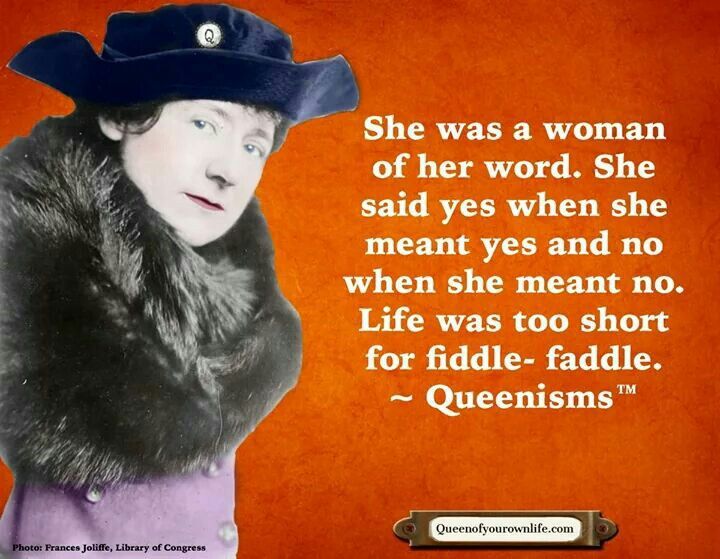
Have you ever said (or heard someone else say) Fiddle-faddle? It first appeared in English in the 1570s, meaning trifles, or to talk nonsense or speak of something not worth serious attention. Fiddle is another word for violin and is the more colloquial/casual of the two; as such, it has long been associated with less important things. Georgette Heyer uses fiddle without faddle to mean trivial or nonsense; the reduplication would merely emphasise the meaning of the first word, so she chose to drop the second.

John Milton Edwards (the pen-name of William Wallace Cook, 1867-1933) wrote, “There’s a lot of fiddle-faddle wrapped up in that word ‘inspiration.’ It is the last resort of the lazy writer, of the man who would rather sit and dream than be up and doing...”

It was also used as an adjective to describe a troublesome person, such as a nit-picky, ceremonious old woman. As a verb, to fiddle-faddle means to dally, which leads us to another reduplication: dilly-dally, which means to loiter, delay, or trifle! A fiddle-faddler is a person who trifles or dallies.

No dilly-dallying, let’s get to the point: Which reduplications have you used? Have you ever known a fiddle-faddler or a dilly-dallier? If you know of more such words, please put them in the comments below!

10 Comments

Filed under Articles, Etymology, History Undusted, Liguistics, Linguistics

History Undusted: Engadin Sgraffito

I know that, for most of you, neither Engadin nor Sgraffito have made you any wiser as to what this blog is about, so first, I’ll start off by explaining where and what they are, respectively.

Engadin (pronounced En-Ga-Deen) is a long, towering Alpine valley in the Romansh-speaking canton of Graubünden in southeast Switzerland. The first mention of this valley was in Latin as vallis Eniatina in AD 930; in the Romansh language (one of the four national languages of Switzerland), it is Engiadina. The river running through the valley is called the En or Inn, and it is the only river in Switzerland that runs (via Austria) into the Black Sea. The region is usually divided into lower and upper Engadin, and it is connected to the surrounding regions by several mountain passes.

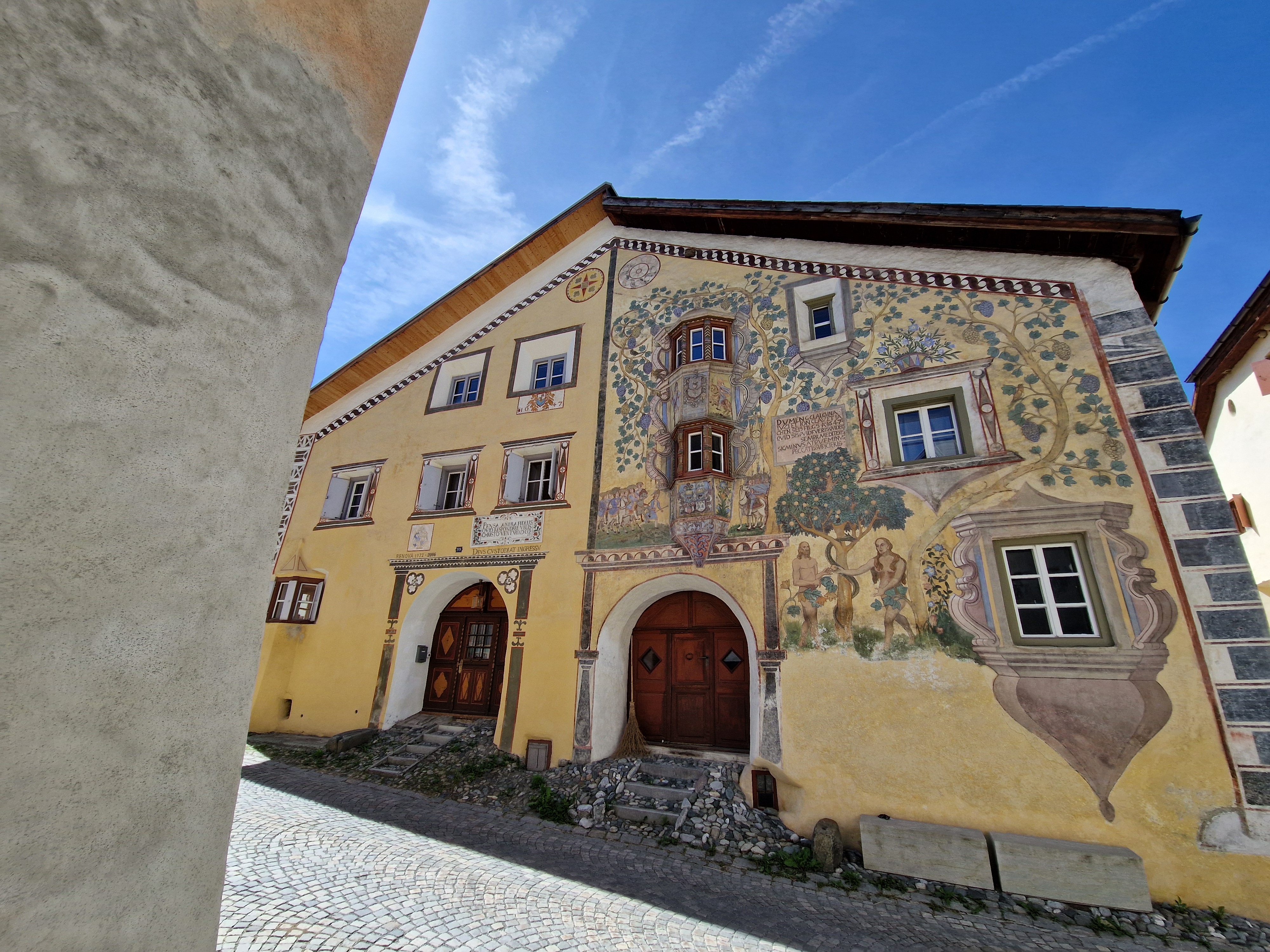
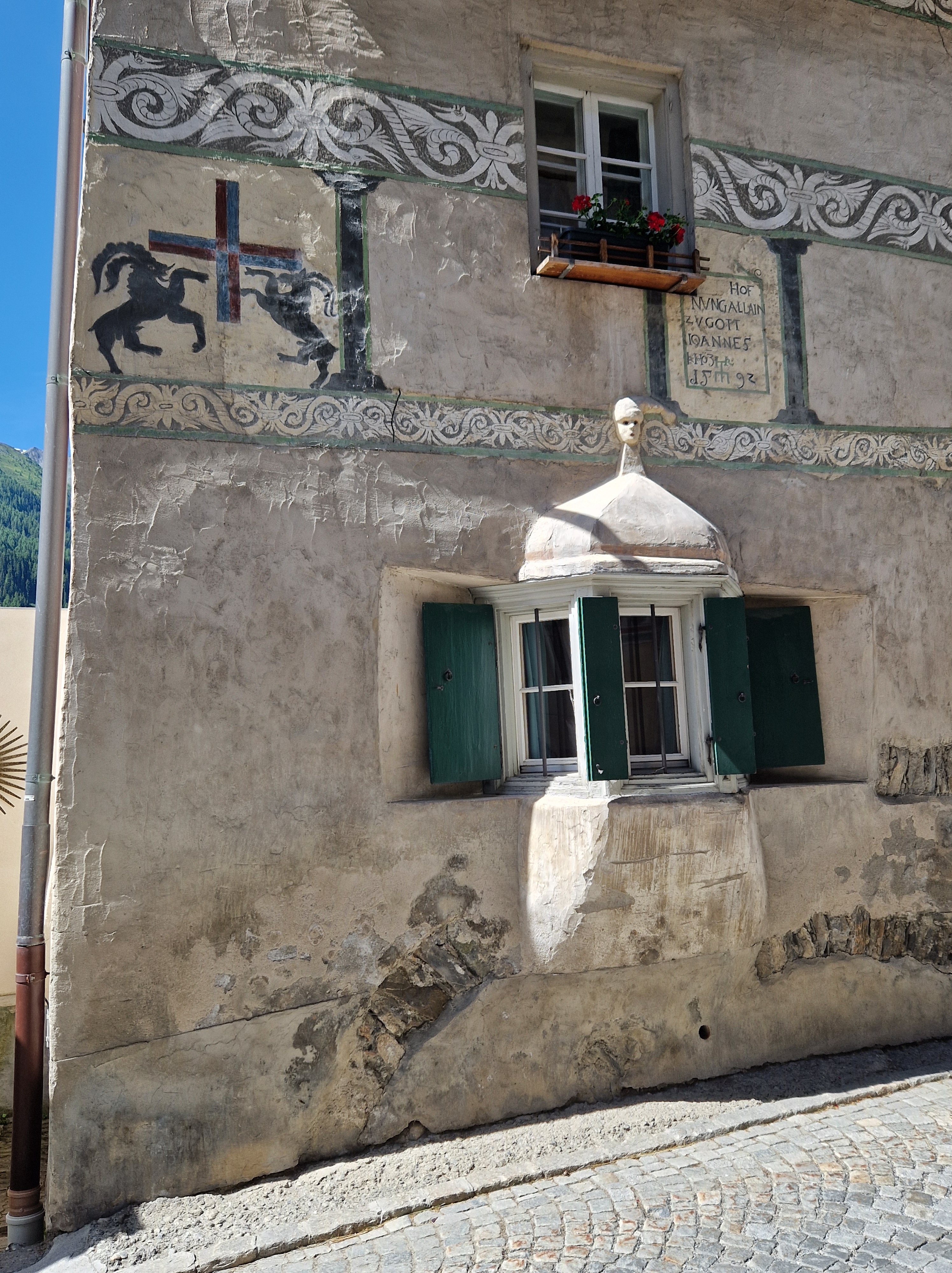
The second word, Sgraffito, describes a plaster technique that is traditional throughout Engadin: Layers of plaster of contrasting colours are scratched through, creating intricate designs on the facades of buildings (many of the buildings in Engadin towns were built (or rebuilt) in the late 1500s to early 1600s). The word comes from the Italian graffiare, which means to scratch; it can be traced back to the Greek word graphein, meaning to write (from which we also get any words containing the prefix, suffix, or derivative of graph (graphite, typography, graptolite, parallelogram, holograph, etc.). Sgraffito is not only used on buildings to make them look decorative, but it also serves the purpose of making a small feature look larger; on one building, the same floor had different-sized windows, likely installed over generations; the sgraffito was used to give a more uniform look to the façade. The decorations also make a plain building look grander, giving a more opulent impression. One building, pictured below, obviously had two occupants with very different characters back when they were originally decorated…

The basic technique for architectural features is to plaster the façade with the base colour; once that has set, it is then plastered with a contrasting colour; once that has set just enough, the scratching, or carving, begins. This is also a technique used in pottery and in creating stained glass effects (just click on the links if you’d like to see how these crafts are made).

One thing to note is that many old buildings here in Switzerland have dates listed on them: Of when they were originally built, and when they’ve been renovated. Part of the history of such renovations may include fires that swept through villages, or avalanches that buried a layer, or wars, such as the Swabian War and war against the Habsburgs, and the subsequent renovation or rebuilding of the towns or individual homes. Sometimes, along with the dates, a list of past and present occupants will also be displayed, preserving their names and memories within the history and changes of the building itself.

Below are a few pictures taken in Engadin during our recent summer holidays. Enjoy! Feel free to zoom in on the pictures to see the details.

5 Comments

Filed under Articles, Etymology, History, History Undusted, How It's Made, Liguistics, Links to External Articles, Military History, Snapshots in History, YouTube Link

Idioms Undusted: When Too Many is Too Much

I know that most of you can relate to the occasional feeling of having too many things going on at once; juggling jobs, family, civic responsibilities and household management can bring on the feeling of a hamster in a wheel, moving, moving, but not really getting anywhere!

That feeling began creeping up again for me last week, and a few idioms came to mind related to that feeling – which tells me that the condition of being overwhelmed or over-busy is an age-old challenge.

You can’t dance at two weddings

This idiom means that you can’t do two things simultaneously – you have to decide for one or the other. Sometimes that’s a tough choice – both things would be great to be involved in but, unless you’ve learned how to clone yourself, a choice must be made.

The phrase’s etymology leads us to the Yiddish language: Historically Judeo-German, Yiddish is a West Germanic language historically spoken by Ashkenazi Jews and originated in the 9th century. What I find interesting is that, about 25 years ago, when I was still learning High German alongside Swiss German (Zurich dialect), my husband was invited to perform some of his troubadour songs in a concert with several other artists; one of the groups performed in Yiddish. I could understand and follow the story of their song, while my husband and other Swiss around me couldn’t. I think it was a combination of me being a fresh learner of the two languages simultaneously, having a musical ear and, perhaps more importantly, having a Scottish accent still in my ear and a bit in my Swiss German – for me, it sounded a bit like a combination of the two! My brain combined it all, and I could follow the story – my explanation to my husband was then confirmed by their translation given after the song was over.

The idiom is likely derived from the Hebrew translation of the story in 1 Kings 18:21; the English NIV says “How long will you waver between two opinions?” but the Tanach could be read as, “How long will you hop between two platforms?”

Spread butter too thin (over too much toast)

This idiom, with a similar connotation, implies that one overcommits to too many things, leading to unsuccessful results, or leading to exhaustion or poor performance.

A good example of this idiom is happening right now in our flat: Of all the companies we’ve had to work with on the various issues of resolving water damage (the entire process began in April 2024, and no, it’s not over yet!), one company has teams in several functions – floor renovation, plastering, painting… and probably others, of which I hope I never have experience. Every single repair they’ve undertaken has been shoddy, and they’ve had to repeat the exercise – meaning we have had to move half of our flat away from floors, walls and pathways several times already as they have to re-do badly-done work! I’ve put my foot down and insisted that project managers show up and check the work before the workers are done, from now until I never have to see the company again!

The companies that concentrate their expertise on one area, such as plumbing, balcony renovation, façade renovation, or electrical repairs, have all done great work, done and dusted.

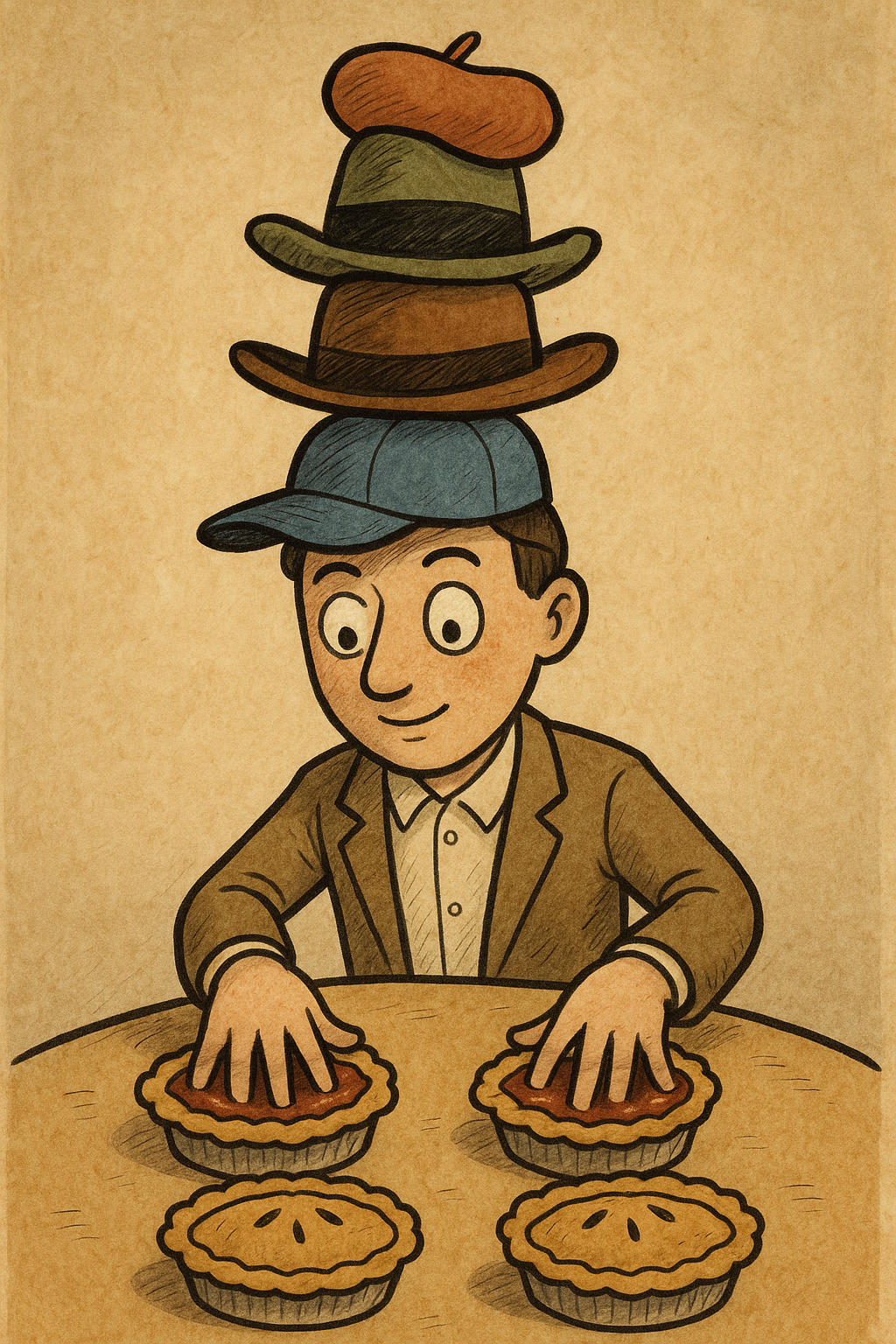
Have one’s fingers in too many pies

This idiom is similar to the butter metaphor, and it means to be involved in many different activities or projects at once, often to the point of being overstretched; It suggests a lack of focus or a tendency to dabble in various things without fully committing to any. 

Shakespeare used this imagery in Henry VIII, in which the Duke of Buckingham refers to Cardinal Wolsey: “The devil speed him! no man’s pie is freed from this ambitious finger“.

In Italian, the phrase “avere le mani in pasta” means to have one’s hand in the pies, or pasta, or simply being hands-on.

This idiom is so visual that it is difficult to trace its origins, as it likely had many concurrent origins throughout history. Shakespeare most likely wasn’t the first to use it, though he no doubt popularized it, like so many things he’s “credited” with.

Wearing too many hats

This idiom, also as “man of many hats” stems from a recent past when people wore hats on a daily basis.

Men had hats, usually bowlers, to wear in the city during the day, while they wore a different hat on the hunting field, another when riding horses, and another for evening parties. Cricketers, cowboys, players of various sports (baseball, American football, etc.), military ranks with casual uniforms or dress uniforms or combat uniforms all wear different hats.

To wear too many hats implies that a person is trying to perform too many different roles or jobs than is realistically feasible, implying that they may struggle to fulfil responsibilities effectively.

Have you had times in your lives when too many is too much? If so, let’s all learn to slow dance, eat less butter, bake fewer pies, and choose one hat at a time!

1 Comment

Filed under Etymology, History, History Undusted, Linguistics, Military History

Etymology Undusted: Ducks and Drakes

Today’s phrase, playing at / making ducks and drakes, refers to skipping stones across a water surface, much like the image of a waterbird coming in for a watery landing. By 1614, the meaning had come to be associated with squandering or throwing one’s money away needlessly, much like stones were tossed away in stone-skipping.

The first written evidence of the phrase was in 1585, The nomenclator, or remembrancer of Adrianus Junius, translated by John Higgins:

“A kind of sport or play with an oister shell or stone throwne into the water, and making circles yer it sinke, etc. It is called a ducke and a drake, and a halfe-penie cake.”

These two terms also appear in nursery rhymes; the first, found in A History of Nursery Rhymes (1899) by Percy B. Green, where he mentions that this rhyme was repeated when skimming stones:

A duck, a drake, a barley cake,
A penny to pay the baker;
A hop, a scotch, another notch –
Slitherum, slitherum, take her.

The “barley cake” is “halfpenny cake” in this 1916 version of The Real Mother Goose:

A duck and a drake,
And a halfpenny cake,
With a penny to pay the old baker.
A hop and a scotch
Is another notch,
Slitherum, slatherum, take her.

In 1626, it is mentioned in the play Dick of Devon:The poorest ship-boy Might on the Thames make duckes and drakes with pieces Of eight fetchd out of Spayne.”

Many cultures share the simple pastime of stone tossing, with their own terms for it: American English, skipping stones; British English, skimming stones or ducks and drakes; in Scottish, Skiting or Skliffing; in Irish, stone skiffing. In French, making ricochets (faire des ricochets); in German, stone flitting (Steinehüpfen); in various languages such as Bulgarian, Greek, Latvian and Lithuanian, their terms refer to frogs rather than ducks. In Japanese, cutting water. In Norwegian, fish bounce (fiskesprett). In Portuguese, either water shearing (capar a água) or making tiny hats (fazer chapeletas). The list goes on and on!

The oldest reference to the pastime goes back to the 2nd century AD by the Greek scholar Julius Pollux; in the 3rd century, Marcus Minucius Felix (a Latin writer) mentions children skipping shells on the beach.

Today, of course, it has become a serious competition for some. According to the Guinness Book of World Records, the record for the number of skips is 88, held by Kurt Steiner; the furthest distance for men is 121.8m, made by Scotsman Dougie Isaacs, and 52.5m for women, thrown by Nina Luginbuhl from Switzerland.

The next time you’re out at a lake or shore, toss a stone and remember the long and colourful history of ducks, drakes, frogs, fish, hats and water!

Leave a comment

Filed under Etymology, History Undusted, Liguistics, Linguistics, Snapshots in History

Etymology Undusted: Murphy’s Law

The adage “Murphy’s Law” refers to the idea that anything that can go wrong will go wrong. You forget your umbrella and it will be sure to rain; your computer crashes at the worst possible moment; your worst itch is always where you can least reach it, and so on.

Similar sentiments are centuries old: E.g. Augustus D. Morgan, a British mathematician, wrote in 1866: “Whatever can happen, will happen”; Alfred Holt, an engineer, wrote in 1877: “It is found that anything that can go wrong at sea generally does go wrong sooner or later.” British stage magician Nevil Maskelyne wrote in 1908, “Everything that can go wrong will go wrong.”

But who was Murphy? And why is it his law? I’d always assumed that Murphy was either a fictional black sheep created to blame everything on, or someone from a century or more ago, much like Hobson of the “Hobson’s Choice” idiom; but Murphy’s Law comes from the 1940s aerospace era.

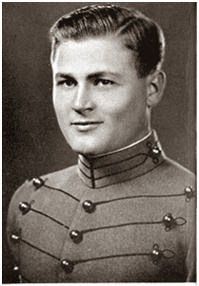
The “law” was coined by and named after Edward A. Murphy Jr. (b.11 January 1918; d.17 July 1990):  Born in the Panama Canal Zone in 1918, he finished high school in New Jersey and eventually graduated from West Point in 1940, joining the Army Air Corps, serving in the Pacific Theatre of World War 2, and in the Korean War, reaching the rank of major. According to his obituary on findagrave.com, he is credited with design work on crew escape systems for some of the most famous experimental aircraft of the 20th century, including the F-4 Phantom, the SR-71 Blackbird, the X-15 rocket plane, and later the Apache helicopter. He also worked on safety and life support systems for NASA’s Apollo space missions. Although he was apparently chagrined by the namesake, he believed in the concept as a key to good defensive design – that one must always assume worst-case scenarios and work to counter them in thorough planning, engineering and execution of mechanical designs.

Around 1948, Murphy and his team were testing rocket sleds, which were used to test the acceleration of equipment deemed too hazardous to test in a piloted aircraft and also to test missile components without risking actual (more expensive) missiles in the testing. The saying arose when training his engineers to avoid designing missile components that could be confused one for another; he said, “If a part can be installed in more than one position, it will be incorrectly installed in the field.” Perhaps Murphy was familiar with the sentiment of those past engineers, given his background in engineering, but wherever it came from, his name was attached and, as they say, the rest is history.

Edward Aloysius Murphy Jr, in his West Point uniform

5 Comments

Filed under Etymology, History, History Undusted, Humanity Highlights, Military History, Science & Technology, Space, Astronomy

Etymology Undusted: Tangle

Do you ever have those moments where you catch yourself thinking about the simplest of things in life? Things that are common to you, yet you’ve never stopped to think about why you call something by a certain term and where those words or phrases come from? I do, with alarming frequency… I guess it’s the product of a curious mind.

I have long hair; so long that, if it’s not in a braid or some other up-do, I’d be sitting on it with ease. I braid it every day and every night – otherwise, it tangles. And thus, while brushing my hair out this morning, the word tangle tangled in my tangled mind. As someone once said, my hair isn’t messy; it’s just erupting with awesomeness.

As a verb, meaning “to knit together confusedly, encumber, or enmesh”, it came into English in the mid-14th century via Old Norse þongull, meaning seaweed, from the Proto-Germanic thangul. Other Germanic languages have related words: In both Dutch and German, we find Tang (seaweed), and in Frisian we find Tung [Frisia is a cultural region that lies over the border between the Netherlands and Germany.] Looking at the image below, it’s easy to imagine a ship’s tackle becoming entangled in the tang…

Image Credit: The Norwegian Blue Forests Network

As with any useful word, it began to collect variations: The transitive sense of entrapping someone or bringing someone under one’s influence; the sense of fighting with someone; Tanglefoot was a western slang meaning strong whiskey, and tanglesome (1823), meaning complicated.

So I hope I’ve untangled the origins of this tanglesome word! Have a great, untangled week!

4 Comments

Filed under Articles, Etymology, Images, Liguistics, Musings

Who’s Who in Quotes: Samuel Johnson

Dr Samuel Johnson (1709-1784) was an English poet, playwright, essayist, moralist, literary critic, sermonist, biographer, editor, and lexicographer, and his writings have lasted the test of time. He has been called “the most distinguished man of letters in English history” (The Oxford Dictionary of National Biography). His most notable work is “A Dictionary of the English Language” (1755), though he was a prolific writer in every expression of the craft.

Based on biographies by those who knew him, such as his friend, James Boswell, his mannerisms and behaviours were so well documented that a posthumous diagnosis of Tourette’s Syndrome can be attributed to him. The most famous portrait of Johnson is the one above, painted by Joshua Reynolds, with whom he founded The Literary Club in 1764. The club would meet regularly, and included members from the literary and historical disciplines; membership was by unanimous election only; if a nominee was undesirable, a member could submit a black ball (white and black balls were likely deposited in an urn to keep the vote confidential). The term “to blackball someone” arose in 1770, and it means “to exclude from a club by adverse votes”. It may have originated at this club or simply have been a general practice employed in clubs and societies around this time.

So, without further ado, here are 10 quotes by Dr Johnson:

“I know not, Madam, that you have a right, upon moral principles, to make your readers suffer so much.”

“I never desire to converse with a man who has written more than he has read.”

“It is better to live rich than to die rich.”

“No man will be a sailor who has contrivance enough to get himself into a jail; for being in a ship is being in a jail, with the chance of being drowned. … A man in a jail has more room, better food and commonly better company.” (Boswell’s Life of Johnson)

“The chains of habit are too weak to be felt until they are too strong to be broken.”

“The use of travelling is to regulate imagination by reality, and instead of thinking how things may be, to see them as they are.”

“Great works are performed not by strength, but by perseverance.”

“In order that all men may be taught to speak truth, it is necessary that all likewise should learn to hear it.”

“When a man knows he is to be hanged in a fortnight, it concentrates his mind wonderfully.”

“The superiority of some men is merely local. They are great because their associates are little.”

3 Comments

Filed under Articles, Etymology, History, History Undusted, Quotes, Snapshots in History