Tag Archives: History Undusted

History Undusted: The Art of Cookery made Plain and Easy

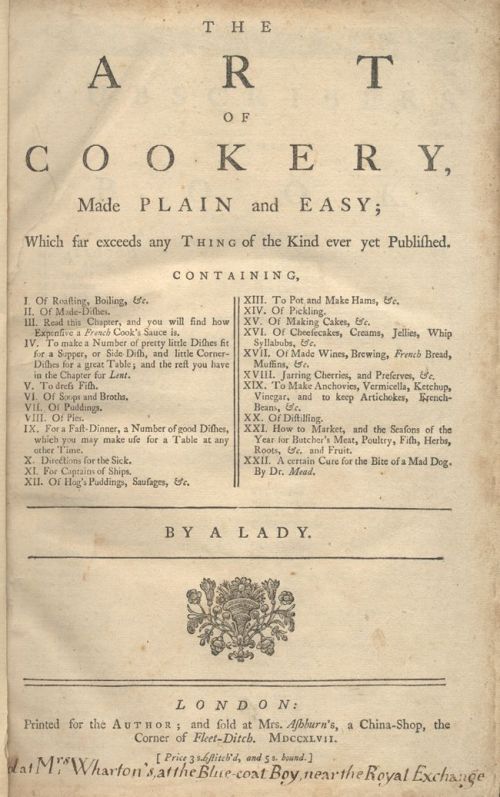
L0014984 H. Glasse's "Art of cookery": lady and her maidThe Art of Cookery made Plain and Easy was written in 1747 by Hannah Glasse (1708-1770) and played a dominant role in shaping the practices of domestic cooks in England and the American colonies for over one hundred years.  It is an excellent reference for historical writers, reenactors, and living museums.  Hannah wrote mostly for the “lower sort” as she called them, domestic servants who might not have had much exposure to various cooking techniques or ingredients before entering the service of a larger household.  She wrote it in a simple language, and can come across at times quite condescending; her writing style, spelling variations (including capitalisation which was much like German, with all nouns capitalised), and punctuation are in themselves a fascinating look at the standard of printing and editing, and what was most likely “acceptable English” of the times (I dread to think what future generations might assume is the “standard” of our own times, based on the slipshod average of what is unleashed online…!).  I’ve tried to leave Hannah’s work as-is, though sometimes the auto-correct sneaks by even the most diligent.

In my current manuscript, the third book in The Northing Trilogy, Asunder, my heroine goes from being of the upper class to marrying a lieutenant in the Royal Navy, disobliging her family and being cut off by the father.  Her mother sends her Hannah Glasse’s book, and she writes a journal entry regarding her use of it and trying to decipher just what is meant by instructions that, even with the attempt at instructing servants new to the kitchen, assumes a great deal of pre-knowledge (e.g. “first skin the meat and take off all the fat” or “chicken, which must be very nicely picked and clean“).

She had a very clear opinion as to what was right and wrong, how a thing was to be prepared and “there is no other way to do it right.”  Many of the “receipts” (recipes) are still known, such as Hasty Pudding or Yorkshire pudding, while others would be unthinkable – whole Woodcocks, Ortolans and snipes (with nothing removed), or how to prepare meat when it’s begun to stink.  They served every part of the animal, from entrails neatly presented to split skulls (with specific directions for how to lay the tongue most becomingly…).  There were a surprising variety of spices, herbs and ingredients used, and which she assumed every household would have on hand, such as China root, balsam of Tolu, and liquorice; she even included a few Indian curry recipes, reflecting the East Indian connections.   She minced no words on what she thought of extravagant (read wasteful) French cooking habits, and her disdain was evident in numerous passages.  Her recipes were by no means all original; many were common sense, but many were also shamelessly plagiarised from other published works (perhaps we should be grateful for that now, as otherwise they might have been lost to the mists of time!).  There are recipes of how to certainly avoid the plague, how a ship’s captain could have food prepared for long voyages, and recipes for medicinal purposes.

Not all homes had ovens, and in one recipe it is worded “send it to the oven… when it comes home” – this would imply that it was sent to the village bakery, and brought home to finish off once it had been sent away to be baked.  Because of that limitation, many recipes are for boiling; they seemed to boil the living daylights out of meat, vegetables, or anything else that they could put in a pot.

It is a fascinating historical document, reference work and recipe source (many, purely for the pleasure of grossing out your kids or guests) for those interested; but for those not interested, it would be a torture for me to post hideously long blogs on the topic.  The book can be found nowadays on Amazon in paperback, or online in PDF format. Below, I’ll share the original “pre-index” image, and her own personal note “To The Reader”, which in and of itself is entertaining, informative and historical.  She minces no words on her disdain for the French, so to my French readers, I ask that they please take it on the chin with a pinch of salt and a wink!

Hannah Glasse Book

Hannah Glasse’s “To the Reader.”

“I Believe I have attempted a branch of Cookery, which nobody has yet thought worth their while to write upon:  but as I have both seen, and found, by experienced, that the generality of servants are greatly wanting in that point, therefore I have taken upon me to instruct them in the best manner I am capable; and, I dare say, that every servant who can but read will be capable of making a tolerable good cook, and those who have the least notion of Cookery cannot miss of being very good ones.

“If I have not wrote in the high polite style, I hope I shall be forgiven; for my intention is to instruct the lower sort, and therefore must treat them in their own way.  For example:  when I bid them lard a fowl, if I should bid them lard with large lardoons, they would not know what I meant; but when I say they must lard with little pieces of bacon, they know what I mean.  So, in many other things in Cookery, the great cooks have such a high way of expressing themselves, that the poor girls are at a loss to know what they mean:  and in all Receipt Books yet printed, there are such an odd jumble of things as would quite spoil a good dish; and indeed some things so extravagant, that it would be almost a shame to make use of them, when a dish can be made full as good, or better, without them.  For example:  when you entertain ten or twelve people, you shall use for a cullis, a leg of veal and a ham, which, with the other ingredients, makes it very expensive, and all this only to mix with other sauce.  And again, the essence of ham for sauce to on dish; when I will prove it, for about three shillings I will make as rich and high a sauce as all that will be, when done.  For example:

“Take a large deep stew-pan, half a pound of bacon, fat and lean together, cut the fat and lay it over the bottom of the pan; then take a pound of veal, cut it into thin slices, beat it well with the back of a knife, lay it all over the bacon; then have six-penny worth of the coarse lean part of the beef cut thin and well beat, lay a layer of it all over, with some carrot, then the lean of the bacon cut thin and laid over that:  then cut two onions and strew over, a bundle of sweet-herbs, four or five blades of mace, six or seven cloves, a spoonful of whole pepper, black and white together, half a nutmeg beat, a pigeon beat all to pieces, lay that all over, half an ounce of truffles and morels, then the rest of your beef, a good crust of bread toasted very brown and dry on both sides:  you may add an old cock beat to pieces; cover it close, and let it stand over a slow fire two or three minutes, then pour on boiling water enough to fill the pan, cover it close, and let it stew till it is as rich as you would have it, and then strain off all that sauce.  Put all your ingredients together again, fill the pan with boiling water, put in a fresh onions, a blade of mace, and a piece of carrot; cover it close, and let it stew till it is as strong as you want it.  This will be full as good as the essence of ham for all sorts of fowls, or indeed most made-dishes, mixed with a glass of wine, and two or three spoonfuls of catchup.  When your first gravy is cool, skim off all the fat, and keep it for use. – This falls far short of the expense of a leg of veal and ham, and answers every purpose you want.

“If you go to market, the ingredients will not come to above half a crown, or for about eighteen-pence you may make as much good gravy as will serve twenty people.

“Take twelve-penny worth of coarse lean beef, which will be six or seven pounds, cut it all to pieces, flour it well, take a quarter of a pound of good butter, put it into a little pot or large deep stew-pan, and put in your beef:  keep stirring it, and when it begins to look a little brown, pour in a pint of boiling water; stir it all together, put in a large onion, a bundle of sweet herbs, two or three blades of made, five or six cloves, a spoonful of whole pepper, a crust of bread toasted, and a piece of carrot; then pour in four or five quarts of water, stir all together, cover close, and let it stew till it is as rich as you would have it; when enough, strain it off, mix it with two or three spoonfuls of catchup, and half a pint of white wine; then put all the ingredients together again, and put in two quarts of boiling water, cover it close, and let it boil till there is about a pint; strain it off well, add it to the first, and give it a boil together.  This will make a great deal of rich good gravy.

“You may leave out the wine, according to what use you want it for; so that really one might have a genteel entertainment, for the price the sauce of one dish comes to:  but if gentlemen will have French cooks, they must pay for French tricks.

“A Frenchman in his own country will dress a fine dinner of twenty dishes, and all genteel and pretty, for the expense he will put an English lord to for dressing one dish.  But then there is the little petty profit.  I have heard of a cook that used six pounds of butter to fry twelve eggs; when everybody knows (that understands cooking) that half a pound is full enough, or more than need be used; but then it would not be French.  So much is the blind folly of this age, that they would rather be imposed on by a French booby, than give encouragement to a good English cook!

“I doubt I shall not gain the esteem of those gentlemen; however, let that be as it will, it little concerns me; but should I be so happy as to gain the good opinion of my own sex, I desire no more; that will be a full recompence for all my trouble; and I only beg the favour of every lade to read my Book throughout before they censure me, and then I flatter myself I shall have their approbation.

“I shall not take upon me to meddle in the physical way farther than two receipts, which will be of use to the public in general: one is for the bit of a mad dog: and the other, if a man would be near where the plague is, he shall be in no danger; which, if made use of, would be found of very great service to those who go abroad.

“Nor shall I take upon me to direct a lady in the economy of her family, for every mistress does, or at least ought to know, what is most proper to be done there; therefore I shall not fill my Book with a deal of nonsense of that kind, which I am very well assured none will have regard to.

“I have indeed given some of my dishes French names to distinguish them, because they are known by those names:  and where there is a great variety of dishes and a large table to cover, so there must be a variety of names for them; and it matters not whether they be called by a French, Dutch or English name, so they are good, and done with as little expence as the dish will allow of.

“I shall say no more, only hope my Book will answer the ends I intend it for; which is to improve the servants, and save the ladies a great deal of trouble.”

Originally posted on History Undusted, 28 May 2013

5 Comments

Filed under Articles, History, History Undusted, Lists, Research

History Undusted: WW2 Shipboard Journals

The following post was originally 3 separate posts on my History Undusted blog; it is a lengthier post than I usually offer, but well worth the read for those interested in history, World War Two, and life in the US Navy.  Enjoy!

My grandfather, Raymond Dale Kuhns, was a clerk aboard the cruiser USS Metevier for 6-9 months during World War 2, based out of San Diego, California.  His typewriter was bolted to the desk, the desk to the floor, but his chair was on rollers; so he’d type a few letters before rolling away, and wait to roll back; ever after he typed with the hunt and peck method, as it apparently didn’t do much good to learn touch typing.

The document below is the onboard journal that he kept during that time, beginning in November 1944, through June 1945.  There are a few notes for clarity interspersed, written by myself, or by my mother, Connie, of stories he told her; she was three at the time.  While the journal entries are very matter-of-fact, without many personal “memoir” elements, it is still a fascinating historical insight into life aboard a ship during the Second World War.  My grandfather was the biggest practical joker I will ever care or dare to come into contact with; any practical jokes that happened aboard, such as the monkey and chicken, were most likely instigated by him…

November 1944 – February 1945

3 Nov. 1944 – Underway in heavy fog.

4 Nov 1944 – Loaded ammunition.  Dropped some down hatch!  Whew!

9 Nov. 1944 (mail sent)  Passed through gate to Limon Bay, Canal Zone, Panama.   Moored Coaling Pier, Cristobal.  Left (Nov) 10th, went through Miraflores Lock.

13 Nov. 1944 (mail sent)  Crossed equator at 0756.  Now a “Shellback”.  (Connie’s note- Dad told stories about the hazing men endured first time to cross the equator. – had to run a gauntlet of fire hoses in action,  a “swat-line” between the “old timers” hitting them with paddles,  all kinds of practical jokes, etc.).  Entered Deolian Cave, Baltna Island, Galapagos.  Saw 2 seals, fishing.  Left 14th.

25 Nov. 1944. (mail sent) Entered Bora Bora, Society Island.  Beautiful.  Purchased 2 grass skirts, bracelet, 2 sets beads.  Were they made in U.S.???  Left 26th  (Connie – “We probably still have the grass skirts – and I know there is a picture of AJ and I with them.  Also, the “beads” were small conch shells – probably also a pic somewhere, I’ll try to find it”).

Summary:  Month was uneventful.  Seasick first night out.  Never set my foot on land.  Received no mail.

3 Dec. 1944.    No such date for us.  Crossed the International Date Line.

6 Dec. 1944.  Missed wife on her birthday.  Great gal.  Made landfall on Solomon.  Skirted NW tip of Guadalcanal.  First liberty.  4 Cokes!!  Left 8 Dec.

11 Dec. 1944.  Entered Humbolt Bay, Dutch New Guinea (“Hollandia”)  Left 19th

14 Dec. 1944.  Connie’s birthday.  Miss the rascal.

25 Dec. 1944.  Miss my wife and kiddies especially.  First enemy contact. Dropped bomb.  One plane.  Undamaged or undamaging.

26 Dec. 1944.  Entered Leyte Gulf.  Left 27th.

Summary:  Looks like business is picking up.  I forgot to mention that Dec. 24th, we made our first depth charge attack.  No luck!  Amazed at mass of ships in Leyte.  No attacks while there.

15 Jan. 1945.  Leaving Lingayen Gulf for  Leyte??

16 Jan 1945. Friendly plane came out of clouds. G.Q. called (“general quarters”).  Came near firing.  From angle it approached, we couldn’t hardly of missed.  A real scare.

17 Jan. 1945.  0300 D.Disn. Convoy destroyed Jap barge.  Search light revealed several Japs in it.  Used 5″ and 40 mm.  Did not try to rescue any.

20 Jan. 1945. (mail sent/  mail received)  Entered San Pedro Bay, Leyte, Philippines.  Hope wife receives letter I wrote today.

26 Jan. 1945. Left Leyte for invasion of Luzon, just north of Subic Bay.

29 Jan. 1945.  14 hours minus 1 or 7:30 naval bombardment of beaches to begin.  However, 10 minutes before, Philippine guerillas came out and informed us territory taken.  So this invasion force of 60,000 landed without a shot being fired.  We are sitting 60 miles from Manila.  It is now mid-afternoon, and Japs have not contested invasion at all.  Things look good for us here.  Left 2000 for Leyte without once contacting enemy.

30 Jan 1945.  Ship in convoy was struck by torpedo.  No casualties.  Ship towed in and repaired.

This month really went fast!

1 Feb. 1945.  Arrived back in Leyte.  No action or alerts on return trip from Luzon.  Too late to go after mail!!!  SHUCKS!

2 Feb. 1945.  Liberty in Leyte.  6 Cokes!!  Learned foot soldiers’ view of our enemy.

3 Feb. 1945 (mail received/ mail sent)  Brought 2 monkeys and 2 roosters aboard.  Had to get rid of them.

6 Feb. 1945.  Left Leyte without getting any more mail.

11 Feb. 1945.  Arrived Woendi.  This is a group of coral islands near New Guinea.  Beautiful.  Like a vacation here.

12 Feb. 1945.  Liberty.  Played basketball, then went swimming.

13 Feb. 1945.  Received special liberty to play on baseball (softball) team.  Defeated tug 4 – 3 in 10 innings.  Won 4 cases beer and got 5 cases from ship.  The boys all came back stewed.  I had to drink one for thirst.  No fresh water available.

14 Feb, 1945,  Left this “rest camp” with memories of best time since leaving dear wife and kiddies.  Going back to front in all probability.  Feeling ready now.  Hope to get mail SOON!!

20 Feb. 1945.  (Mail received/ mail sent)  Arrived back on Leyte.  Trip back uneventful.  Received 24 letters. Boy oh Boy!

21 Feb, 1945.  Liberty.  Sold beer for $1,  gave other 3 away.

24 Feb, 1945, (mail sent/mail received).  Received 16 more letters.

25 Feb. 1945.  Attended church USS Wasatch.  Refused liberty. Stayed aboard and wrote letters.

27 Feb. 1945.  Left Leyte for Mindoro.  Glad to get away.  Poor liberty.

Summary:  This month very uneventful.  Enjoyed liberty at Woendi more than anything else.  Got fairly well caught up on mail.

Here are a few extra bits of trivia from my mother:

  • “4 Nov. ’44 –  the “Whew” was probably a prayer of thankfulness that the whole load had not exploded when some got dropped!
  • I only heard your grandpa talk once about the horrors he must have seen. – ships blown out of the water, etc.  He and my uncle Victor talked one Christmas when I was a teen about picking surviving mates off an adjacent ship in the fleet that had been torpedoed – and picking survivors out of the ocean.
  • 13 Feb ’45.  Your grandpa didn’t drink beer – of course, his father (Reverend H.A. Kuhns) wouldn’t have liked it – although before H.A. was saved, he had “owned a dance hall” – your grandpa told me after we were grown women.  So I’m sure beer at least was part of my grandpa’s experience B.C.
  • 25 Feb. ’45 –  Of course “liberty” for most meant finding liquor and women, which were not for your grandpa.  I am so thankful for the Christian heritage we have!!!!!”
  • Note of interest:  Aboard they slept in hammocks; once the guy above him jumped up at the call for general quarters, and knocked himself out on the overhead beam; needless to say he didn’t make it to his station on time…

March – April 1945

raymond-kuhns-age-45-taken-in-1965

Raymond Kuhns, Age 45, taken in 1965

[NOTE:  Back in the mid-1980s I was in the Philippines for two months, living near the Subic Bay Naval Base just across a bridge from Olongapo.  I saw up close and personal the temptations men in the military face, and for a Christian man such as my grandfather, he had to try and find alternatives to “going out with the boys” on liberty, though often the Red Light District was (and is) where the restaurants were, so it was a Catch 22.  When I was living there I was working with a Christian missions organisation among the prostitutes, drug dealers and pimps, as well as those who worked in street shop/booths (I’m still in touch with one or two!), and our home was a place for the Christian military men to come and hang out when they were off-duty; nearly every day I’d come down to the living room to find strangers there, reading or talking.  I don’t know if he had such a place back then, but fisherman’s missions and military missions are far more common now, because the temptations (the sex industry, drugs, alcohol, etc.) are more rampant than ever.  When I returned to the States he enjoyed talking to me about Subic and the PI as he knew it, and I think it was special for him to talk to his granddaughter who had seen some of the places and things he’d seen so many years before.]

1 March 1945.  This month started off with a bang.  Dropped D.C. (depth charges)- 5 of them in the middle of the night.  I was on helm.  Boys sleeping really thought we got it. Entered Mindoro.

2-5 March 1945.  (mail sent/mail received) A/S duty Mangatin Bay.  Got mail, which means they transferred us here for duty.

6 March 1945. Off Manila Bay A/S duty, then returned to Mangatin Bay.

7 March 1945.  Entered Bay for fueling.

8,9,10 March, 1945. Another A/S* sweep to Luzon. (*anti-mine sweep)

11 March 1945.  Back to A/S Mindoro.

12 March 1945.  (mail sent/mail received).  Got mail via ship that had been in Port.  Proceeded into Bay and got more mail.

14 March 1945. Availability cancelled.  A ship on A/S sweep run aground we had to relieve it.  Just our luck.

15-18 March 1945.  A/S sweep and on 18 entered Mangarin for 2 days availablity.

19 March 1945.  Liberty in Mindoro.  Quite a place.  Rode in a jeep with army captain to San Jose.  Saw sugar mill that was hit by P-47 in morning.  Saw unit of paratroopers who made landings on Corrigedor.  Helped sort mail at P.O.  FINALLY got Christmas presents. Included billfold, leather toilet kit, shower shoes, pictures, and wedding band.  Every gift perfect.  One box of candy had to be thrown away.  Really enjoyed it even though it was late.

20-23 March 1945.  A/S sweep off Mindoro.

24-25 March 1945. (mail sent/mail received)  A/S sweep to Luzon and returned.  Fueled and got underway for Leyte.  These two days were roughest I have seen.  Had to strap myself in sack.  Did not get sick.  36 bags Christmas mail.

26-28 March 1945.  Escorting Army tug with barge at 3-1/2 knots.  No wonder it took us 4 days to get here.  Entered San Pedro Bay.

29-31 March 1945. (sent mail/received mail).  Available for maintenance.  We got 11 bags of mail, but most of it was rest of Christmas packages.

Summary:  Most of this month was spent on ping line of A/S duty.  The first was most amusing.  Christmas packages really helped our moral.  Nothing exciting or dangerous.

1-4 April 1945.  (mail sent/mail received)  In San Pedro Bay.  Received one liberty – had interesting conversation with Philippine guerrila.  Scabby sores on natives pathetic sight.  Still getting good mail service.  Red Light District.

(Note: the “scabby sores” were probably secondary syphillis – sailors often given penicillin IM before they let them off the boat!)

5 April 1945. Underway to Manila.  3 escorts with one troop ship.  15 knots – exceptionally fast convoy.

7 April 1945.  Arrived Manila. Passed very close to Corregidor and got a good look at it.  Liberty in Manila.  What a place.  Harbor full of sunken Jap ships.  Every building in business district damaged.  Most of them blown to bits.  Saw Jap mass-burial place.  Cars that looked like strainers.  Eats very high – 75 cents for one scoop ice cream.  Rode in cart affair (horse-drawn) through town cost us $2.50.  Men came back to ship drunk and not virgins.  People dress very American.  Had to wear whites on this liberty.  Really got my first glimpse of war devastation.  Got stamps and money souvenirs.

8-9 April 1945. Anchored in Manila harbor.  No mail service here at all.

10 April 1945.  Left Manila for Leyte

11 April 1945.  All hell broke loose at 1130.  We rammed native sailboat that was carrying 42 persons.  Called to G.Q.  As I was asleep, I really bounced out of my sack when alarm sounded.   Arrived at G.Q. station and heard hysterical screams of survivors and saw them as we illuminated them.  Picked up 37 survivors.  Continued search.  Picked up 2 small babies floating face down.  Dead when rescued, but boys worked feverishly for 3 hours with artificial respiration, but no luck.

12 April 1945.  (sent mail/received mail)  0330 another G.Q. with fire amidships.  I couldn’t imagine us having another G.Q. and just stood and listened to alarm, but when fire was announced, I tore up to station.  I was not in my sack at the time, as survivors had our compartment.  Two small girls had my bunk.  Fire not serious and confined to drying room.  Had 4-8 watch, so was up till 10:30 next night without sleep.  One small baby died from effects of night before.  Transferred the survivors around noon, as we arrived back in Leyte.  There were 36 alive (one expected to die), 3 dead, and 3 we could not find in the wreckage.  The miracle to me was the number that lived through the ordeal.  Saw anguish in mothers’ faces as they looked at dead children.  Saw and sympathized with those who missed their children.  The native craft was supposed to have been 50 feet in length and cost 10,000 pesos.  A very large native boat.  It was taking natives away from Japs on Mindanao.  We were first Americans they had seen since 1941. Doubt very much if they were happy to see us.  Made Y2C (Yeoman 2nd class).  Received authorization from ComSerfor.  Ship was very nice and did not make me wait for first of month.  That means treats for the boys.

13 April 1945.  (mail received)  Learned of President’s death (FDR).  Also got news of being 50 miles from Berlin.  Liberty at Pambujuan, Samar.  Pulled joke on chief regarding censorship regulations – very effective.

14 April 1945. LOST MY WEDDING BAND!  Don’t know how or where.  Did not eat morning chow, I felt so bad.  Hope my darling wife isn’t too mad at me for it.

15 April 1945.  (Mail sent/mail received)  Church on USS Medusa.  Memorial service for Roosevelt.  Very good.  Got our first fresh provisions in approx 3 months.  Received  letters from Wanda. Put 3 coats of paint on bottom of ship in 48 hours.  Not bad while in dry dock. Got us up at 5:30 for special sea details, then didn’t get away before 1100.  Purchased treats on ratings*. (Note:  *Rations?)

May – June 1945

25 April 1945 (sent mail/received mail)  Received Easter pictures.  Just love the ones of my wife.

26 April 1945 Saw 10 carriers of British Fleet which was a  big encouragement.  Firing practice.

27 April 1945 (mail sent/mail received)  Underway to Okinawa.  More firng practice.  New war cruising watch.  Now at G-2.

30 April 1945.  G.Q. at 0200.  3 planes.  Did not close.  Started dusk and dawn alerts.

Summary:  What a Month!!  Interesting at Manila.  Sailboat incident.  Lost wedding band. Made Rate (grade of official standing of enlisted men). Dry Dock (Whooie).  Headed for Okinawa.  196 days since I have seen my family.  Sure miss them.

1 May 1945 –  Rolled D.C. (damage control?) at good contact. At 1305, called to G-2.  Exploded a mine.  We were headed right for it when lookout sighted it.  Explosion sent water 150 feet in the air.

2 May 1945. Arrived Okinawa.  No suicide raids.  Shelling beaches.

3 May 1945.  1000 left Okinawa in company with BB Tennesee.  Heard of suicide raids 6 hours after we left.  One DD who was stationed 3000 yards from us was hit with 5 suicides.

4 May 1945.  Big suicide raids on Okinawa and Jap reinforcements landed.  Believe God definitely answered prayers of protection on this mission.  It was too rainy all the time we were in Okinawa for raids.  Numerous ones feel we were fortunate and lucky, but as far as I am concerned, God gets the credit.

6 May 1945. (mail sent/mail received)  Arrived back in Leyte after sinking floating nets earlier in the morning. Received 11 letters – more than I deserved for the ones I wrote this trip.

7 May 1945.  Liberty.  tramped through hills of  Samar.  Rest of day uneventful.  May 8 or 9- V.E. Day!!

9 May 1945  Into Dry Dock again.  Sound dome came loose.  Oh Me!!  Manicani Island.

10 May 1945.  Water hours.

11 May 1945.  Left dry dock.  Reported on ping line between Homonhon Island and Dinagat Island in Surigao Straits.  This is point of big Philippine naval battles.

12 May 1945.  Firing practice.  Shore bombard on Dinagat Island.

13 May 1945.  Firing Practice.  Held Vesper service in accordance with President’s request for prayers. Remembered and offered thanks for V.E. Day.  Mothers’ Day.  Sure miss you, Wanda.   Picked up loose sono buoy.

14 May 1945.  AA (anti-aircraft) Practice.  Knocked down sleeves, which indicates we could hit airplanes. Returned to Leyte.  Movies.  I played checkers.

15 May 1945. (mail sent/mail received).   Received 5 letters.  On liberty in Samar.  Boys couldn’t get over seeing WAC Camp – white women.  First group we have seen.  Played checkers again.

16 May 1945.  Starting on mail run.  Best and safest duty we could have gotten.

17 May 1945.  Arrived Zamboanga, Mindanao.  First stop on mail run.  Natives came out to ship in droves.  Bought large seashell.  Left at 1300.

18 May 1945.  Arrived Panay, second stop mail run.  PT boat came out so we didn’t go into port.  Left 0700.  Arrived Mindoro at 1900.  Showed movie.  Left 1000.

19 May 1945.  Arrived Manila 0600, left 1130.  Arrived Subic Bay 1500, left 0630.

21 May 1945.  Arrived Leyte 0600. Trip very uneventful.  No mail.  I was sort of disappointed.  Attended U.S.O. show on beach.  Oklahoma – very good under conditions.

22 May 1945.  Left 0930 for Guivan Roadstead.  Arrived 11:00.  Got stores, had movie in PM (I played checkers).

23 May 1945.  Left 0600.  Arrived Leyte 0800.  Left Leyte at 1000 for San Bernadine Straits.

24 May 1945.  Arrived on patrol station in straits. Boiler trouble, so we head back to Leyte.

25 May 1945.  (mail sent/mail received).  Saw 2 water spouts.  Arrived back home.  Received 3 letters.

26 May 1945 (mail sent/mail received)   Received 2 more letters today.  Got 2 Cokes off Medusa, Oh Boy!  2 for a nickel.

26 May to 9 June 1945.  Tied up alongside Medusa.  Enjoyed being able to get Cokes, Ice Cream, liberty every third day, and movies every night.  One  fellow went nuts and run off in the woods.  Not such a bad idea.  It got him back to the states.  Good church services on Medusa.

10 June 1945. Underway 1800 for Calicoan to get supplies.

11 June 1945.  Helped get stores on beach.  Missed good turkey dinner.  Left for Leyte about 1800.  Just got outside nets when we discovered 3 men left behind, so we turned around.

12 June 1945.  Headed for Leyte with full crew. Then headed out for patrol halfway between Leyte and  Yap. Firing practice.

15 June 1945. Dropped hedge hogs [A type of depth charge employed against U-Boats which were thrown ahead of the ASW ship. These devices were designed to explode on contact.].  Probably scared fish.  Sub reported sighted in our area, but we didn’t get any good contacts.

17 June 1945.  FATHERS’ DAY.  Oh me!  Here I am way out here. Headed for tropical storm area to investigate storm.  This navy is NUTS at times!!

He signed off “This is all I have”  – apparently he had written more, but the rest was lost – either while he was still in the military or in the subsequent years.

My grandfather passed away 8 February 2004.  I saw him for the last time in October of 2003 when I went back to America for a visit; I told him at the time that I knew it would be the last time I’d see him this side of heaven, and that I would not be able to be there for his funeral (I live in Switzerland).  His response was typical:  He said, “Well that’s alright, I won’t be there either!”  I loved him dearly, and I miss him; but I did give him one final warning:  God had strict instructions not to allow him anywhere NEAR my mansion until I get there… no booby trapping allowed!

Originally posted on History Undusted, 28 May 2013

Save

6 Comments

Filed under Articles, History, History Undusted, Military History

Imagination vs Knowledge

Some say that imagination is more important than knowledge; to a certain extent, that may be true because imagination leads to new discoveries, inventions, and revelations.  But knowledge is often the basis for such discoveries; that which has been passed down by others who’ve researched, discovered, identified and recorded are the foundational stones upon which things are often built, whether in science, technology, or life in general.

beware-of-the-half-truth-wrong-halfIn this day and age, however, sometimes imagination overtakes knowledge (or simply ignores it).  An informed mind is a powerful tool; an uninformed mind can be a dangerous weapon.  This is true whether writing non-fiction, fiction, or passing on something on social media.  We should beware of the half truths – we may have gotten hold of the wrong half.

It’s now more important than ever to test the veracity of reports and even images; anyone can make an ass out of an angel, so to speak, with photoshop, et al.  How much misinformation is spread by simple carelessness or wilful misdirection (that includes, unfortunately, mainstream news media)?  Or by assuming that since something is from a trusted friend it must be true?  How often have you gotten upset by an article you’ve seen and commented on it, or passed it on, allowing it to form an opinion in your subconscious at the very least, and in your active thoughts at worst, only to find out later that it was a false report, a hoax, or sloppy journalism?

abraham-lincoln-internet-quote

As you probably know, I love to learn; I have a steel trap of a mind for little bits of trivia, like the fact that certain microbes concentrate and disperse (read “poop”) gold, or that all living creatures, including you and I, emit visible light (probably a byproduct of biochemical reactions).  As a writer of fiction that comes in handy; I can extrapolate knowledge and use it as a plot detail or a character quirk; but when I’m writing a blog, e.g. about a historical detail, I want to make sure I get it right.  A case in point was an article I wrote in 2014 about post-mortem photography in the Victorian period; it was by far the most popular post to date on that blog and continues to generate interest.  In particular, two points from the article were addressed, researched, and edited/corrected either in the article itself or in the comments and discussion that ensued.  Mistakes happen, but when I catch them, I will do my best to correct them!

For writers, it is important to cross-reference anything you find online, especially if you’re basing something significant on it such as character development, location, or plot.  Assumptions can also get you into trouble; I know that Geneva is part of Switzerland, but in writing 18th-century fiction, I need to be aware of the fact that it was merely an ally of the Swiss Confederacy from the 16th century, but only became part of Switzerland in 1814.  Any reference I have to it in my trilogy needs to reflect that fact.

I recently read a collection of short stories on Kindle, and on nearly every single Kindle page there were mistakes (that adds up to a lot of mistakes per manuscript page!):  Missing words that the authors assumed were there, typos, commas 2 or 3 words off-position, stray quotation marks, and countless words they assumed were the correct ones but obviously were not (e.g. catwalk instead of rampart for a castle).  This is where imagination overtook the writer, and knowledge gave way to ignorance…  I have understanding for one or two such errors in a manuscript of that length, but none whatsoever for several per page; that simply smacks of laziness and poor-to-no editing, and it boils down to an unintentional slap in the face to any reader who’s taken the time to read their story.

Knowledge without imagination is like a rusted hinge; imagination is the oil that makes the knowledge come to life, and the writer is the door handle that opens the door to new worlds, new ideas, new discoveries, and inventions. It sounds noble, doesn’t it?  But did you realize that many of the electronic gadgets we take for granted today were at one time birthed in the imaginations of men like Gene Roddenberry, creator of Star Trek?  It inspired countless children who went on to become astronauts, scientists, and engineers, who made those science-fiction inventions become reality and discovered distant worlds (now known as exoplanets).  I’m waiting with bated breath for the transporter to replace airline security queues…

Those hinges are necessary, as is the oil, so that the door handle can do its job and get out of the way, allowing the world beyond to unfold.

Save

Save

2 Comments

Filed under Articles, History, History Undusted, Musings, Nuts & Bolts, Plot Thots & Profiles, Research, Science & Technology, Space, Astronomy

History Undusted: The History of Valentine’s Day

vintage-valentine-cardWith Valentine’s Day just around the corner, I thought I’d just say a bit about the actual history of the celebration of love.  Throughout history, there have been variations of celebrations of love, but they didn’t always take on the innocuous form that modern-day marketing departments have dreamed up.  Here in Switzerland, 14 February is still fairly similar to 14 March – in other words, just another day in the calendar.  But celebrating love, in whatever form it takes, from loving your spouse or partner to loving your parents, your friends, pets or kids, is never a bad idea.  So let’s take a look at how bygone ages viewed it:

The innocently playful Valentine card started off more like a lottery ticket:  In ancient Rome, during the celebration of Lupercalia, the names of willing young ladies were put into a box and mixed up; young, available men could draw out a card at random, and that young woman or girl was thus won to remain his companion for the length of the celebration which lasted the modern date equivalent of 13-15 February, and was accompanied by animal sacrifices (a goat and dog).  Nothing said romance to the Romans like blood and guts and the smell of burning fur, apparently.

After a few centuries, the established Church realized that though you can lead a horse to water you can’t make it drink; so instead of forbidding the celebrations, they adapted them to be less offensive:  Their version was also a bit less entertaining; they drew names from the lottery as before but this time instead of young women, the name of a saint was drawn to whom prayers would be offered.  It was at this stage that Saint Valentine came to be associated with the day, as he had a reputation for being warm-hearted.  So the lottery for girls continued, perhaps more or less under the table, while ostensibly under the patronage of a saint.  By 1725 it had evolved into a game of drawing lots from two vessels, one each for men and women; their lot drawn was then their “Valentine”.  Not so sure how that worked – there must have been a prodigious amount of love triangles as the woman drew one name, the man drew another, and so on…

Another evolution in the celebration was as follows:  The first man seen by a woman that morning (outside her own household) became her willy-nilly Valentine, and neither could look for an alternative.  The famous Pepys left his home early on the morning of 14 February 1661 to be assured of getting the “right” Valentine, swapping a friend’s wife for his own for the day in a good-natured jest with the four of them.  It was customary at that time to give a handsome present to the Valentine’s woman, so it was worth getting a good one.  Mrs. Pepys got half a dozen pairs of gloves and a pair of silk stockings and garters out of that swap, so I can imagine that her husband did no less for his friend’s wife!

Letters to Valentines began as early as 1479, with references found in the Paston Letters, and continued for over 300 years.  The oldest Valentine’s cards were, naturally, all hand-made; the oldest one in possession, dated 1750, was in the Hull Museum as of the late 1940s.  Many such Valentine’s cards and letters were not kept as they were not worth the keeping to those who received them.  As the custom progressed, however, a clever marketing scheme was bound to spring up.  In the 19th century the commercial Valentine began life in the form of stationery (envelopes were unknown until after the 1840s), the stationery itself folded and serving as the envelope.  Still, such a ready-made Valentine was seen as a proof of failure, as people prided themselves in poems and compositions… they were labours of love, not a quickly-posted printed monstrosity.  So, new strategy:  Some Valentines were produced half-finished to allow the personal touch to be added in, and they were provided with a small parcel of add-ons (lace, hearts, trimmings, etc.) to that end.  In the end, it was hard for the individual to compete with a designer employing skilful artists, and the homemade Valentine vanished.

By 1880 the British post had to employ an additional 300-400 workers on 13 February to deal with the 1.5 million Valentines. (This statistic comes from the Post Office Magazine from February 1937.)  The manufactured cards continued to become more elaborate, embossed, lithographed, laced with studs, birds, baskets, ribbons and Cupids with colourful petals, trellis-work, and even perfume.  But as with all mass-produced items, art decays when it becomes profitable; mass-production caused a huge drop in popularity.  In the mid-1930s a new medium was explored, the Valentine telegram, which continued up until WW2.

My earliest memory of Valentine’s Day was in grade school; we each constructed and decorated a “letter box” and taped it to our school lockers; every day was like Christmas for that week, wondering who we’d gotten anonymous cards from!  Another Valentine memory is from college when I dated someone who was studying Chinese to become a missionary; on that February morning I went to my car to go to work and found a long-stemmed rose on the windshield with a card… in Chinese.  I still have the card somewhere, as a bookmark, and it still makes me smile.  We both went on with our lives in different directions, but I still consider him a friend.

So the next time you choose a Valentine’s card, ponder a moment.  Perhaps the sentiment would be better represented by a good, old-fashioned handmade card instead… that personal touch that will still speak volumes in years to come.

What are some of your own Valentine’s memories?

(For more fascinating histories of holidays and celebrations, check out The English Festivals, by Laurence Whistler.)

Posted Originally posted on History Undusted,

Save

16 Comments

Filed under History Undusted, Research

History Undusted: Naval Slang

In our everyday language, we often use sayings without really knowing how they originated.  Sayings such as “to swing a cat” or “down the hatch” or “break the ice”.  These three have something in common:  They all began life as naval slang.

cat-o_-nine-tails__psf_The first, “to swing a cat,” has a rather gruesome beginning:  It refers to the cat-o’-nine-tails, a whip made up of nine knotted cords roughly 75 cm long that was designed by the British Royal Navy to inflict severe pain and lacerate the skin.  It was used in flogging for anything from drunkenness to mutinous talk to stealing.  It was known as a “cat,” and obviously they needed room to swing it, to get the full effect.  Today it merely refers to the size of a room or space as being “too small to swing a cat”.  Another nautical idiom with cat was “to cat the anchor”:  The cat referred to here was a large wooden beam on either side of the bow of a sailing ship which was used to support the weight of the anchor as it was raised or lowered; since there was usually the head of a lion or large cat carved at the head of the beam, it was called a cathead.

“Down the hatch” is more straightforward:  The hatch was the covering of the hatchway on a ship, an opening in the deck which allowed vertical access into the hold for loading cargo.  It means the act of drinking in particular, the mouth being the “hatch”.

“To break the ice” means to remove the invisible social barriers between strangers to ease conversation and social contact.  It comes from the specialized ships called “ice breakers,” which were designed to plough through icy waters, making the passage of other vessels possible.  Without such a ship, arctic expeditions could find themselves frozen in, land-locked by shifting ice sheets.

For many more sayings relating to naval history, check out “Not Enough Room to Swing a Cat” – Naval Slang and its Everyday Usage by Martin Robson.

Originally posted 28 on History Undusted.

22 Comments

Filed under Etymology, History, History Undusted, Military History, Research

History Undusted: Decisions, Decisions

In May 2013, I began blogging here on WordPress; at the time, I had several topics of interest that I wanted to pursue, and to that end I began several blogs.  As time has marched on sometimes other priorities took over, or focus changed, and now I have three active blogs.  This eponymous blog is my home-base, but one of my favourite blogs to write besides this one is History Undusted.  I love finding the dusty bits of history and “undusting” them for the unsuspecting public.  But sadly, it has never really seemed to find notice by WordPress, and many of the posts have gone unseen.

Because history and the research thereof is a big part of my writing process, whether it be Viking history, archaeology, Scottish history, 18th century England, science, technology, advertisement, historical characters, or any of a dozen other topics, I have decided to combine the two blogs into this one.  If history isn’t your thing, don’t worry – I will still enjoy posting articles regularly about the writing process and the nuts and bolts involved!  I will begin “importing” (and, if necessary, augmenting) those blogs gradually, until they’re all safely here.

So without further ado, here is the first offering:

Decisions, Decisions

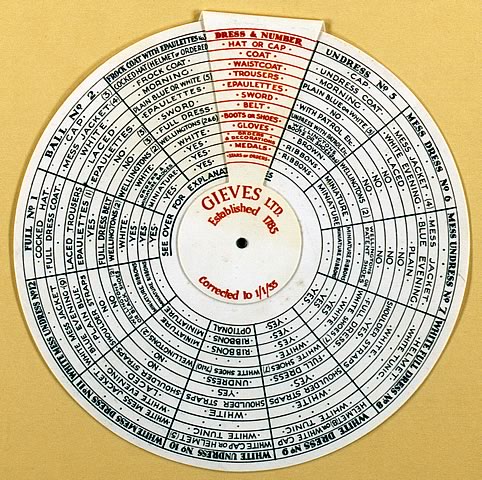
gieves-dress-wheelHave you ever heard of a butler (or male servant, in general) referred to as “Gieves” or “Jeeves”?  This might just be where it all started:  The Gieves Gentlemen’s Tailor Company was founded in 1771, and became a limited company in 1785; their dress wheel aided naval officers in choosing what to wear at any particular occasion, for any part of the world they might have found themselves in at the time.  Dressing, even for men, was an extremely complex social signal in bygone eras.  By 1935 there were twelve styles of dress, including tropical options.  By turning the wheel, an officer could see just what to wear on any occasion.  A handy little marketing device, it gained Gieves loyal royal naval customers, and the company has thrived ever since, with loyal customers including members of the British royal family today. For an interesting history of the company, click here.

Sir P.G. Wodehouse, an English author and one of the most widely-read humorists of the 20th century, named the comical fictional character of his shrewd valet “Jeeves”; the name was taken from Percy Jeeves, who was a cricketer killed during the First World War. Both the wheel and the fictional character served to cement the name in the collective conscience of the western world as a reliable servant.

Originally posted 27 May 2013 on History Undusted

10 Comments

Filed under Articles, Etymology, History, Images, Military History, Research

The Thorny Issue of Horns

As an author and writer, I do a LOT of research.  I love history particularly, but then I could say the same thing about the topics of geology, astronomy, archaeology, science and technology, crafting, drawing, botany, and a dozen others.  As I apply my studies to my work, I am sometimes faced with the issue of horns – Viking helmet horns.

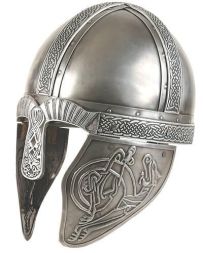
Real Viking Helmet


Accurate Viking helmet, reproduction.  Photo credit, Pinterest, unknown


While everyone seems to accept as a historically proven fact that Viking helmets had horns, the actual fact of the matter is that they didn’t.  While there were many horned helmets dating to before the rise of the Norse powers of Sweden, Norway and Denmark, most, if not all, were for religious or ceremonial purposes.  However, if I write a description of a Norse helmet and leave off the horns, someone will inevitably point it out.

Recently I spent a couple hours on Skype with one of my Beta readers for my current project, the third book in the Northing Trilogy (set in 18th century England).  Several of her comments were based on her knowledge of the 19th century as portrayed by Georgette Heyer, while others were based on her lack of historical knowledge that I, as the author, have amassed over time.  While some of that knowledge needs to seep into my writing to help the reader along, I have to continually remind myself (especially with this particular book in the trilogy, as it is centred around the Royal Navy) that I am not writing a history book but a novel, and anything I include needs to support the plot – the plot should never be forced to support a history lesson.  So it is that questions arose as to the behaviour and manners of the children of the time.

In any time period up until the mid-20th century, children in western societies matured far sooner than their modern counterparts, both out of necessity and out of cultural understanding of their roles in society.  Many families were dependent on the contribution made by the children in their household, whether it was housework, factory work, or working on the streets as beggars, shoe shiners, chimney sweeps, street sweepers, selling newspapers, or any other job they could earn money with (this is still true in many poorer countries of the world today).

If they came from a wealthy family, children were educated, but as to what extent and to which form it took very much depended on their particular circumstances:  They were educated either at home by tutors, or sent away to a boarding school.  Leaving school might be anywhere between ten and twenty; Jane Austen finished her formal education at the age of 10 or 11, whereas Charlotte Brontë’s character Jane Eyre left school at 18.  Boys who were second sons were often educated (after their basic education in either a college or at home) toward the military or toward a life as a minister (if their families held a high status in society, they might be trained toward politics; first-born sons, heirs, were rarely sent to the military due to the inherent dangers).

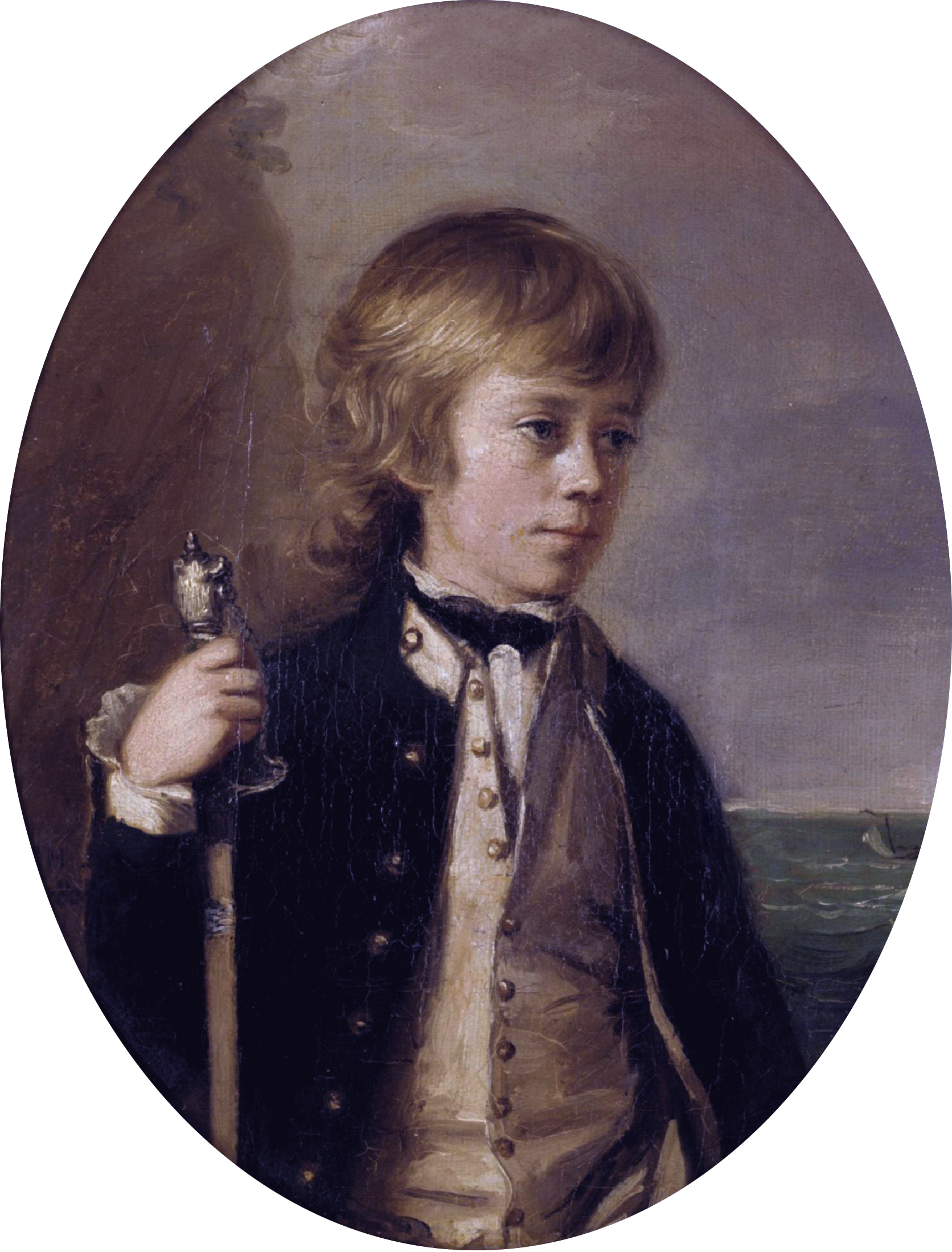
Midshipman Henry William Baynton, aged 13 -1780 - Wikipedia.jpg

Henry William Baynton, aged 13 years, 6 months, midshipman on the Cleopatra.  Photo Credit, Wikipedia.

If their fathers could afford to do so, these younger sons were often bought commissions in the military so that they would start off their career with some smidgen of position, such as a midshipman in the Royal Navy; the younger they entered, the sooner they could rise through the ranks, and thus it was not uncommon for lads of 7 or 8 to enter the navy.  Aboard ship they were trained in various skills, which included not only practical skills to do with the day-to-day running of the ship, but how to read navigational charts and how to use instruments such as sextants. How fast or slow they rose to higher ranks thereafter depended on their skills, intelligence, connections, and luck.

If poor children were either abandoned or given to workhouse orphanages because their families could not afford to keep them alive, they were also trained:  The girls were trained toward becoming servants (paying back society for the privilege of being alive), and the boys were trained for a life in the military (ditto).  They were taught to read using the Bible, and were expected to live by its principles.  Unfortunately, religion was often used as a guise for abuse and heavy-handed tyranny, but as the characters in Jane Eyre portrayed, some were true Christians in their behaviour toward her, such as her friend Helen, or the kind apothecary.  If the girls were going to become governesses, they would also be trained in more refined accomplishments such as French, drawing, needlework, history, etc.

All of this is to say that, were I to include all of this kind of information in a novel (and believe me, there’s a lot more where that came from!), it would get boring rather quickly.  And so I need to pick and choose what is used in the organic flow of the plot and character development that both serves those elements and also helps inform the reader; sometimes it’s a tricky balance.  So when the 11-year-old boy acts far more mature than a modern boy, unless the reader is aware of the historical context, I will inevitably get feedback to that effect.  Sometimes I can help their understanding by including e.g. the subjects he might be learning with his tutor, such as French, sciences, or elocution, but more than that might drag the story into the realm of a history lesson.

There are many modern myths, like the Viking horns, that people have accepted as historically accurate, when in fact they’re not.  One of my pet peeves is Christmas films that inevitably portray three kings showing up at the manger along with the shepherds in Bethlehem.  I won’t go into that here – if you’re interested in the historical details, read my article on History Undusted, here.  Other urban legends include:  We only use 10% of our brains; the full moon affects our behaviour; lightning never strikes the same place twice; cracking your knuckles gives you arthritis, and antibiotics kill viruses.  If I rankled any feathers there, or you said to yourself, “But that one is actually true,” then I would suggest you do your own research on the issue… I’ve got my plate full at the moment with the 18th century.

Save

7 Comments

Filed under Articles, History, Musings, Nuts & Bolts, Plot Thots & Profiles, Research

Odd Jobs #3: Bereavement Coordinator to Car Plate Blockers

JAPAN-ART-PAINTING

Body Painter.  Photo credit: YOSHIKAZU TSUNO/AFP/Getty Images

For most of the odd jobs in this week’s lineup, I was able to find a link with a description of some kind; but, not surprisingly, “one of these is not like the others” (a Sesame Street throwback…) – the only illegal job of them all; it seems to have found a niche market in a black market sense of the word.  In a weird way, it reminds me of “lines of desire” – where there’s a will, there’s a way.

I find it interesting to include “Blacksmith” in this list; what was once a trade found in any town worth its salt, and testified to by the number of people with the surname Smith, is now a rarity.

By the way, I’m running a similar series on my history blog under the heading “Odd Jobs of Bygone Days” in case you’re interested.

6 Comments

Filed under Articles, Images, Lists, Research

Nautical Terms with Anglo-Saxon Origins

Nautical Jargon

Nautical Jargon

In the course of writing novels, I do a lot – I mean a LOT – of research.  And in the course of doing that LOT of research I come across interesting bits and bobs that I glean, putting into files on my computer for reference and rainy days.  So it was that I came across a digitalized version of the 1867 “The Sailor’s Word-Book:  An Alphabetical Digest of Nautical Terms, including some more especially military and scientific, but useful to seamen; as well as archaisms of early voyagers, etc. by the late ADMIRAL W. H. SMYTH, K.S.F., D.C.L., &c.”  I love the fact that antique books had entire blurbs built into their titles!  The document itself translates into no less than 586 pages in a word document; obviously I won’t force that upon you.  But I will give you a snippet of words from A to Z that have an Anglo-Saxon origin or influence. If you’re interested in even more such lists broken down from the book, check out my “History Undusted” blog here.  But first, here’s a snatch from the preface, written by the late Admiral W.H.Smyth:

“This predilection for sea idiom is assuredly proper in a maritime people, especially as many of the phrases are at once graphic, terse, and perspicuous. How could the whereabouts of an aching tooth be better pointed out to an operative dentist than Jack’s “‘Tis the aftermost grinder aloft, on the starboard quarter.” The ship expressions preserve many British and Anglo-Saxon words, with their quaint old preterites and telling colloquialisms; and such may require explanation, as well for the youthful aspirant as for the cocoa-nut-headed prelector in nautic lore. It is indeed remarkable how largely that foundation of the English language has been preserved by means of our sailors.

“This phraseology has necessarily been added to from time to time, and consequently bears the stamp of our successive ages of sea-life. In the “ancient and fishlike” terms that brave Raleigh derived from his predecessors, many epithets must have resulted from ardent recollections of home and those at home, for in a ship we find: Apeak, Apron, A-stay, Bonnet, Braces, Bridle, Cap, Catharpins, Cat-heads, Cat’s-paw, Cot, Cradle, Crib, Crow-foot, Crow’s nest, Crown, Diamond, Dog, Driver, Earrings, Eyes, Fox, Garnet, Goose-neck, Goose-wing, Horse, Hose, Hound, Jewel, Lacings, Martingale, Mouse, Nettle, Pins, Puddings, Rabbit, Ribband, Saddle, Sheaves, Sheets, Sheepshank, Shoe, Sister, Stays, Stirrup, Tiller, Truck, Truss, Watch, Whip, Yard.”

Now, on with the show!

A-C

A. The highest class of the excellence of merchant ships on Lloyd’s books, subdivided into A 1 and A 2, after which they descend by the vowels: A 1 being the very best of the first class. Formerly a river-built (Thames) ship took the first rate for 12 years, a Bristol one for 11, and those of the northern ports 10. Some of the out-port built ships keep their rating 6 to 8 years, and inferior ones only 4. But improvements in ship-building, and the large introduction of iron, are now claiming longer life.  “A” is an Anglo-Saxonism for in or on; as a‘board, a‘going, &c.

ABORD. An Anglo-Saxon term, meaning across, from shore to shore, of a port or river.

ACUMBA. Oakum. The Anglo-Saxon term for the hards, or the coarse part, of flax or unplucked wool.

ADOWN. The bawl of privateersmen for the crew of a captured vessel to go below. Saxon, adoun.

ÆWUL. An Anglo-Saxon term for a twig basket for catching fish.

AFORE. A Saxon word opposed to abaft, and signifying that part of the ship which lies forward or near the stem. It also means farther forward; as, the galley is afore the bitts.—Afore, the same as before the mast.—Afore the beam, all the field of view from amidship in a right angle to the ship’s keel to the horizon forward.

AFT—a Saxon word contradistinctive of fore, and an abbreviation of abaft—the hinder part of the ship, or that nearest the stern.—Right aft is in a direct line with the keel from the stern.—To haul aft a sheet is to pull on the rope which brings the clue or corner of the sails more in the direction of the stern.—The mast rakes aft when it inclines towards the stern.

AHOO, or All Ahoo, as our Saxon forefathers had it; awry, aslant, lop-sided.

ALLAN. A word from the Saxon, still used in the north to denote a piece of land nearly surrounded by a stream.

ALOFT [Anglo-Saxon, alofte, on high]. Above; overhead; on high. Synonymous with up above the tops, at the mast-head, or anywhere about the higher yards, masts, and rigging of ships.—Aloft there! the hailing of people in the tops.—Away aloft! the command to the people in the rigging to climb to their stations. Also, heaven: “Poor Tom is gone aloft.”

ALONG [Saxon]. Lengthwise.—Alongside, by the side of a ship; side by side.—Lying along, when the wind, being on the beam, presses the ship over to leeward with the press of sail; or, lying along the land.

AMAIN [Saxon a, and mægn, force, strength]. This was the old word to an enemy for “yield,” and was written amayne and almayne. Its literal signification is, with force or vigour, all at once, suddenly; and it is generally used to anything which is moved by a tackle-fall, as “lower amain!” let run at once. When we used to demand the salute in the narrow seas, the lowering of the top-sail was called striking amain, and it was demanded by the wave amain, or brandishing a bright sword to and fro.

ANGIL. An old term for a fishing-hook [from the Anglo-Saxon ongul, for the same]. It means also a red worm used for a bait in angling or fishing.

ATEGAR. The old English hand-dart, named from the Saxon aeton, to fling, and gar, a weapon.

AXE. A large flat edge-tool, for trimming and reducing timber. Also an Anglo-Saxon word for ask, which seamen still adhere to, and it is difficult to say why a word should be thought improper which has descended from our earliest poets; it may have become obsolete, but without absolutely being vulgar or incorrect.

BAT, or Sea-bat. An Anglo-Saxon term for boat or vessel. Also a broad-bodied thoracic fish, with a small head, and distinguished by its large triangular dorsal and anal fins, which exceed the length of the body. It is the Chætodon vespertilio of naturalists.

BAT-SWAIN. An Anglo-Saxon expression for boatswain.

BEACON. [Anglo-Saxon, béacn.] A post or stake erected over a shoal or sand-bank, as a warning to seamen to keep at a distance; also a signal-mark placed on the top of hills, eminences, or buildings near the shore for the safe guidance of shipping.

BECK [the Anglo-Saxon becca]. A small mountain-brook or rivulet, common to all northern dialects. A Gaelic or Manx term for a thwart or bench in the boat.

BLEAK. The Leuciscus alburnus of naturalists, and the fresh-water sprat of Isaak Walton. The name of this fish is from the Anglo-Saxon blican, owing to its shining whiteness—its lustrous scales having long been used in the manufacture of false pearls.

BRAND. The Anglo-Saxon for a burnished sword. A burned device or character, especially that of the broad arrow on government stores, to deface or erase which is felony.

BROKER. Originally a broken tradesman, from the Anglo-Saxon broc, a misfortune; but, in later times, a person who usually transacts the business of negotiating between the merchants and ship-owners respecting cargoes and clearances: he also effects insurances with the underwriters; and while on the one hand he is looked to as to the regularity of the contract, on the other he is expected to make a candid disclosure of all the circumstances which may affect the risk.

BURG [the Anglo-Saxon burh]. A word connected with fortification in German, as in almost all the Teutonic languages of Europe. In Arabic the same term, with the alteration of a letter, burj, signifies primarily a bastion, and by extension any fortified place on a rising ground. This meaning has been retained by all northern nations who have borrowed the word; and we, with the rest, name our towns, once fortified, burghs or boroughs.

BURN, or Bourne. The Anglo-Saxon term for a small stream or brook, originating from springs, and winding through meadows, thus differing from a beck. Shakespeare makes Edgar say in “King Lear”—

CAPTAIN. This title is said to be derived from the eastern military magistrate katapan, meaning “over everything;” but the term capitano was in use among the Italians nearly 200 years before Basilius II. appointed his katapan of Apulia and Calabria, A.D. 984. Hence, the corruption of the Apulian province into capitanata. Among the Anglo-Saxons the captain was schipp-hláford, or ship’s lord. The captain, strictly speaking, is the officer commanding a line-of-battle ship, or a frigate carrying twenty or more cannon. A captain in the royal navy is answerable for any bad conduct in the military government, navigation, and equipment of his ship; also for any neglect of duty in his inferior officers, whose several charges he is appointed to regulate. It is also a title, though incorrectly, given to the masters of all vessels whatever, they having no commissions. It is also applied in the navy itself to the chief sailor of particular gangs of men; in rank, captain of the forecastle, admiral’s coxswain, captain’s coxswain, captain of the hold, captain of main-top, captain of fore-top, &c.

CHESIL. From the Anglo-Saxon word ceosl, still used for a bank or shingle, as that remarkable one connecting the Isle of Portland with the mainland, called the Chesil Beach.

CHIMBE [Anglo-Saxon]. The prominent part or end of the staves, where they project beyond the head of a cask.

CHIULES. The Saxon ships so called.

CLIFF [from the Anglo-Saxon cleof]. A precipitous termination of the land, whatever be the soil.

COGGE. An Anglo-Saxon word for a cock-boat or light yawl, being thus mentioned in Morte Arthure— “Then he covers his cogge, and caches one ankere.”  But coggo, as enumerated in an ordinance of parliament (temp. Rich. II.), seems to have been a vessel of burden used to carry troops.

COLMOW. An old word for the sea-mew, derived from the Anglo-Saxon.

CONN, Con, or Cun, as pronounced by seamen. This word is derived from the Anglo-Saxon conne, connan, to know, or be skilful. The pilot of old was skillful, and later the master was selected to conn the ship in action, that is, direct the helmsman. The quarter-master during ordinary watches conns the ship, and stands beside the wheel at the conn, unless close-hauled, when his station is at the weather-side, where he can see the weather-leeches of the sails.

COOMB. The Anglo-Saxon comb; a low place inclosed with hills; a valley. (CWM: CWM, or Comb. A British word signifying an inlet, valley, or low place, where the hilly sides round together in a concave form; the sides of a glyn being, on the contrary, convex.)

CORN, To. A remainder of the Anglo-Saxon ge-cyrned, salted. To preserve meat for a time by salting it slightly.

CRAFT [from the Anglo-Saxon word cræft, a trading vessel]. It is now a general name for lighters, hoys, barges, &c., employed to load or land any goods or stores.—Small craft. The small vessels of war attendant on a fleet, such as cutters, schooners, gunboats, &c., generally commanded by lieutenants. Craft is also a term in sea-phraseology for every kind of vessel, especially for a favourite ship. Also, all manner of nets, lines, hooks, &c., used in fishing.

CROCK [Anglo-Saxon, croca]. An earthen mess-vessel, and the usual vegetables were called crock-herbs. In the Faerie Queene Spenser cites the utensil:— “Therefore the vulgar did aboute him flocke,
Like foolish flies about an honey-crocke.”

CULVER. A Saxon word for pigeon, whence Culver-cliff, Reculvers, &c., from being resorted to by those birds. [Latin, columba; b and v are often interchanged.]

CUTE. Sharp, crafty, apparently from acute; but some insist that it is the Anglo-Saxon word cuth, rather meaning certain, known, or familiar.

D-F

DEL. Saxon for part.—Del a bit, not a bit, a phrase much altered for the worse by those not aware of its antiquity.

DENE. The Anglo-Saxon dæne; implying a kind of hollow or ravine through which a rivulet runs, the banks on either side being studded with trees.

DIGHT [from the Anglo-Saxon diht, arranging or disposing]. Now applied to dressing or preparing for muster; setting things in order.

DREINT. The old word used for drowned, from the Anglo-Saxon.

DRIVE, To [from the Anglo-Saxon dryfan]. A ship drives when her anchor trips or will not hold. She drives to leeward when beyond control of sails or rudder; and if under bare poles, may drive before the wind. Also, to strike home bolts, tree-nails, &c.

DUNES. An Anglo-Saxon word still in use, signifying mounds or ridges of drifted sands.

DYKE. From the Anglo-Saxon dic, a mound or bank; yet in some parts of England the word means a ditch.

EAGRE, or Hygre. The reciprocation of the freshes of various rivers, as for instance the Severn, with the flowing tide, sometimes presenting a formidable surge. The name seems to be from the Anglo-Saxon eágor, water, or Ægir, the Scandinavian god of the sea.

EAST. From the Anglo-Saxon, y’st. One of the cardinal points of the compass. Where the sun rises due east, it makes equal days and nights, as on the equator.

EASTINTUS. From the Saxon, east-tyn, an easterly coast or country. Leg. Edward I.

EBB. The lineal descendant of the Anglo-Saxon ep-flod, meaning the falling reflux of the tide, or its return back from the highest of the flood, full sea, or high water. Also termed sæ-æbbung, sea-ebbing, by our progenitors.

EBBER, or Ebber-shore. From the Anglo-Saxon signifying shallow.

EGG, To. To instigate, incite, provoke, to urge on: from the Anglo-Saxon eggion.

EKE, To. [Anglo-Saxon eácan, to prolong.] To make anything go far by reduction and moderation, as in shortening the allowance of provisions on a voyage unexpectedly tedious.

ENSIGN. [From the Anglo-Saxon segn.] A large flag or banner, hoisted on a long pole erected over the stern, and called the ensign-staff. It is used to distinguish the ships of different nations from each other, as also to characterize the different squadrons of the navy; it was formerly written ancient. Ensign is in the army the title of the junior rank of subaltern officers of infantry; from amongst them are detailed the officers who carry the colours.

ERNE. From the Anglo-Saxon earne, a vulture, a bird of the eagle kind. Now used to denote the sea-eagle.

FARE [Anglo-Saxon, fara]. A voyage or passage by water, or the money paid for such passage. Also, a fishing season for cod; and likewise the cargo of the fishing vessel.

FATHOM [Anglo-Saxon, fædm]. The space of both arms extended. A measure of 6 feet, used in the length of cables, rigging, &c., and to divide the lead (or sounding) lines, for showing the depth of water.—To fathom, is to ascertain the depth of water by sounding. To conjecture an intention.

FELL, To. To cut down timber. To knock down by a heavy blow. Fell is the Anglo-Saxon for a skin or hide.

FIN [Anglo-Saxon, Finn]. A native of Finland; those are Fins who live by fishing. We use the whole for a part, and thus lose the clue which the Fin affords of a race of fishermen.

FIRE-BARE. An old term from the Anglo-Saxon for beacon.

FLOAT [Anglo-Saxon fleot or fleet]. A place where vessels float, as at Northfleet. Also, the inner part of a ship-canal. In wet-docks ships are kept afloat while loading and discharging cargo. Two double gates, having a lock between them, allow the entry and departure of vessels without disturbing the inner level. Also, a raft or quantity of timber fastened together, to be floated along a river by a tide or current.

FOAM [Anglo-Saxon, feám]. The white froth produced by the collision of the waves, or by the bow of a ship when acted on by the wind; and also by their striking against rocks, vessels, or other bodies.

FORE-FINGER, or Index-finger. The pointing finger, which was called shoot-finger by the Anglo-Saxons, from its use in archery, and is now the trigger-finger from its duty in gunnery.

FOTHER [Anglo-Saxon foder]. A burden; a weight of lead equal to 191⁄2 cwts. Leaden pigs for ballast.

FYRDUNG [the Anglo-Saxon fyrd ung, military service]. This appears on our statutes for inflicting a penalty on those who evaded going to war at the king’s command.

G-H

GARE. The Anglo-Saxon for ready.

GAR-FISH. The Belone vulgaris, or bill-fish, the bones of which are green. Also called the guard-fish, but it is from the Anglo-Saxon gar, a weapon.

GEAR [the Anglo-Saxon geara, clothing]. A general name for the rigging of any particular spar or sail; and in or out of gear implies anything being fit or unfit for use.

GLEN. An Anglo-Saxon term denoting a dale or deep valley; still in use for a ravine.

GOD. We retain the Anglo-Saxon word to designate the Almighty; signifying good, to do good, doing good, and to benefit; terms such as our classic borrowings cannot pretend to.

GRIP. The Anglo-Saxon grep. The handle of a sword; also a small ditch or drain. To hold, as “the anchor grips.” Also, a peculiar groove in rifled ordnance.

GUTTER [Anglo-Saxon géotan, to pour out or shed]. A ditch, sluice, or gote.

HACOT. From the Anglo-Saxon hacod, a large sort of pike.

HAVEN [Anglo-Saxon, hæfen]. A safe refuge from the violence of wind and sea; much the same as harbour, though of less importance. A good anchorage rather than place of perfect shelter. Milford Haven is an exception.

HAVEN-SCREAMER. The sea-gull, called hæfen by the Anglo-Saxons.

HEFT. The Anglo-Saxon hæft; the handle of a dirk, knife, or any edge-tool; also, the handle of an oar.

HELMY. Rainy [from an Anglo-Saxon phrase for rainy weather].

HERE-FARE [Anglo-Saxon]. An expedition; going to warfare.

HERRING. A common fish—the Clupea harengus; Anglo-Saxon hæring and hering.

HILL. In use with the Anglo-Saxons. An insulated rise of the ground, usually applied to heights below 1000 feet, yet higher than a hillock or hummock.

HOLD. The whole interior cavity of a ship, or all that part comprehended between the floor and the lower deck throughout her length.—The after-hold lies abaft the main-mast, and is usually set apart for the provisions in ships of war.—The fore-hold is situated about the fore-hatchway, in continuation with the main-hold, and serves the same purposes.—The main-hold is just before the main-mast, and generally contains the fresh water and beer for the use of the ship’s company.—To rummage the hold is to examine its contents.—To stow the hold is to arrange its contents in the most secure and commodious manner possible.—To trim the hold. Also, an Anglo-Saxon term for a fort, castle, or stronghold.—Hold is also generally understood of a ship with regard to the land or to another ship; hence we say, “Keep a good hold of the land,” or “Keep the land well aboard,” which are synonymous phrases, implying to keep near the land; when applied to a ship, we say, “She holds her own;” i.e. goes as fast as the other ship; holds her wind, or way.—To hold. To assemble for public business; as, to hold a court-martial, a survey, &c.—Hold! An authoritative way of separating combatants, according to the old military laws at tournaments, &c.; stand fast!

HOLT [from the Anglo-Saxon]. A peaked hill covered with a wood.

HORN-FISC. Anglo-Saxon for the sword-fish.

HOUND-FISH. The old Anglo-Saxon term for dog-fish—húnd-fisc.

HURST. Anglo-Saxon to express a wood.

HYTHE. A pier or wharf to lade or unlade wares at [from the Anglo-Saxon hyd, coast or haven].

I-L

ILAND. The Saxon ealand (See Island.)

KEEL. The lowest and principal timber of a ship, running fore and aft its whole length, and supporting the frame like the backbone in quadrupeds; it is usually first laid on the blocks in building, being the base of the superstructure. Accordingly, the stem and stern-posts are, in some measure, a continuation of the keel, and serve to connect the extremities of the sides by transoms, as the keel forms and unites the bottom by timbers. The keel is generally composed of several thick pieces placed lengthways, which, after being scarphed together, are bolted and clinched upon the upper side. In iron vessels the keel is formed of one or more plates of iron, having a concave curve, or limber channel, along its upper surface.—To give the keel, is to careen.—Keel formerly meant a vessel; so many “keels struck the sands.” Also, a low flat-bottomed vessel used on the Tyne to carry coals (21 tons 4 cwt.) down from Newcastle for loading the colliers; hence the latter are said to carry so many keels of coals. [Anglo-Saxon ceol, a small bark.]—False keel. A fir keel-piece bolted to the bottom of the keel, to assist stability and make a ship hold a better wind. It is temporary, being pinned by stake-bolts with spear-points; so when a vessel grounds, this frequently, being of fir or Canada elm, floats and comes up alongside.—Rabbets of the keel. The furrow, which is continued up stem and stern-post, into which the garboard and other streaks fay. The butts take into the gripe ahead, or after-deadwood and stern-post abaft.—Rank keel. A very deep keel, one calculated to keep the ship from rolling heavily.—Upon an even keel. The position of a ship when her keel is parallel to the plane of the horizon, so that she is equally deep in the water at both ends.

KEELS. An old British name for long vessels—formerly written ceol and cyulis. Verstegan informs us that the Saxons came over in three large ships, styled by themselves keeles.

KERS. An Anglo-Saxon word for water-cresses.

KNAP [from the Anglo-Saxon cnæp, a protuberance]. The top of a hill. Also, a blow or correction, as “you’ll knap it,” for some misdeed.

LADE. Anglo-Saxon lædan, to pour out. The mouth of a channel or drain. To lade a boat, is to throw water out.

LAGAN, or Lagam. Anglo-Saxon liggan. A term in derelict law for goods which are sunk, with a buoy attached, that they may be recovered. Also, things found at the bottom of the sea. Ponderous articles which sink with the ship in wreck.

LEAK [Anglo-Saxon leccinc]. A chink in the deck, sides, or bottom of a ship, through which the water gets into her hull. When a leak begins, a vessel is said to have sprung a leak.

LEWTH [from the Anglo-Saxon lywd]. A place of shelter from the wind.

LEX, or Leax. The Anglo-Saxon term for salmon.

LODESMEN. An Anglo-Saxon word for pilots.

M-O

MARSH [Anglo-Saxon mersc, a fen]. Low land often under water, and producing aquatic vegetation. Those levels near the sea coast are usually saturated with salt water.

MAST [Anglo-Saxon mæst, also meant chief or greatest]. A long cylindrical piece of timber elevated perpendicularly upon the keel of a ship, to which are attached the yards, the rigging, and the sails. It is either formed of one piece, and called a pole-mast, or composed of several pieces joined together and termed a made mast. A lower mast is fixed in the ship by sheers, and the foot or keel of it rests in a block of timber called the step, which is fixed upon the keelson.—Expending a mast, or carrying it away, is said, when it is broken by foul weather.—Fore-mast. That which stands near the stem, and is next in size to the main-mast.—Jury-mast.Main-mast. The largest mast in a ship.—Mizen-mast. The smallest mast, standing between the main-mast and the stern.—Over-masted, or taunt-masted. The state of a ship whose masts are too tall or too heavy.—Rough-mast, or rough-tree. A spar fit for making a mast.—Springing a mast. When it is cracked horizontally in any place.—Top-mast. A top-mast is raised at the head or top of the lower-mast through a cap, and supported by the trestle-trees.—Topgallant-mast. A mast smaller than the preceding, raised and secured to its head in the same manner.—Royal-mast. A yet smaller mast, elevated through irons at the head of the topgallant-mast; but more generally the two are formed of one spar.—Under-masted or low-masted ships. Vessels whose masts are small and short for their size.—To mast a ship. The act of placing a ship’s masts.

MAST-ROPE [Anglo-Saxon mæst-ràp]. That which is used for sending masts up or down.

MERE. An Anglo-Saxon word still in use, sometimes meaning a lake, and generally the sea itself.

MEW [Anglo-Saxon mæw]. A name for the sea-gull.

MIST [Anglo-Saxon]. A thin vapour, between a fog and haze, and is generally wet.

MOUNT, or Mountain. An Anglo-Saxon term still in use, usually held to mean eminences above 1000 feet in height. In a fort it means the cavalier.

MOUTH [the Anglo-Saxon muda]. The embouchure opening of a port or outlet of a river, as Yarmouth, Tynemouth, Exmouth, &c.

NAME-BOOK. The Anglo-Saxon nom-bóc, a mustering list.

NORTH. From the Anglo-Saxon nord.

OAKUM [from the Anglo-Saxon æcumbe]. The state into which old ropes are reduced when they are untwisted and picked to pieces. It is principally used in caulking the seams, for stopping leaks, and for making into twice-laid ropes. Very well known in workhouses.—White Oakum. That which is formed from untarred ropes.

OVERWHELM. A comprehensive word derived from the Ang.-Saxon wylm, a wave. Thus the old song—

P-R

PORT. An old Anglo-Saxon word still in full use. It strictly means a place of resort for vessels, adjacent to an emporium of commerce, where cargoes are bought and sold, or laid up in warehouses, and where there are docks for shipping. It is not quite a synonym of harbour, since the latter does not imply traffic. Vessels hail from the port they have quitted, but they are compelled to have the name of the vessel and of the port to which they belong painted on the bow or stern.—Port is also in a legal sense a refuge more or less protected by points and headlands, marked out by limits, and may be resorted to as a place of safety, though there are many ports but rarely entered. The left side of the ship is called port, by admiralty order, in preference to larboard, as less mistakeable in sound for starboard.—To port the helm. So to move the tiller as to carry the rudder to the starboard side of the stern-post.—Bar-port. One which can only be entered when the tide rises sufficiently to afford depth over a bar; this in many cases only occurs at spring-tides.—Close-port. One within the body of a city, as that of Rhodes, Venice, Amsterdam, &c.—Free-port. One open and free of all duties for merchants of all nations to load and unload their vessels, as the ports of Genoa and Leghorn. Also, a term used for a total exemption of duties which any set of merchants enjoy, for goods imported into a state, or those exported of the growth of the country. Such was the privilege the English enjoyed for several years after their discovery of the port of Archangel, and which was taken from them on account of the regicide in 1648.

PUNT. An Anglo-Saxon term still in use for a flat-bottomed boat, used by fishermen, or for ballast lumps, &c.

ROPE. Is composed of hemp, hide, wire, or other stuff, spun into yarns and strands, which twisted together forms the desired cordage. The word is very old, being the actual representative of the Anglo-Saxon ráp.—To rope a sail. To sew the bolt-rope round its edges, to strengthen it and prevent it from rending.

ROTHER. This lineal descendant of the Anglo-Saxon róter is still in use for rudder.

ROVING COMMISSION. An authority granted by the Admiralty to a select officer in command of a vessel, to cruise wherever he may see fit. [From the Anglo-Saxon ròwen.]

RUDDER. The appendage attached by pintles and braces to the stern-post of a vessel, by which its course through the water is governed. It is formed of several pieces of timber, of which the main one is generally of oak, extending the whole length. Tiphys is said to have been its inventor. The Anglo-Saxon name was steor-roper.

RYNE. An Anglo-Saxon word still in use for a water-course, or streamlet which rises high with floods.

S-Z

SACK, To [from the Anglo-Saxon sæc]. To pillage a place which has been taken by storm.

SCONCE. A petty fort. Also, the head; whence Shakespeare’s pun in making Dromio talk of having his sconce ensconced. Also, the Anglo-Saxon for a dangerous candle-holder, made to let into the sides or posts in a ship’s hold. Also, sconce of the magazine, a close safe lantern.

SCOT, or Shot. Anglo-Saxon sceat. A share of anything; a contribution in fair proportion.

SCRAPER [from the Anglo-Saxon screope]. A small triangular iron instrument, having two or three sharp edges. It is used to scrape the ship’s side or decks after caulking, or to clean the top-masts, &c. This is usually followed by a varnish of turpentine, or a mixture of tar and oil, to protect the wood from the weather. Also, metaphorically, a cocked hat, whether shipped fore-and-aft or worn athwart-ships.

SCURRY. Perhaps from the Anglo-Saxon scur, a heavy shower, a sudden squall. It now means a hurried movement; it is more especially applied to seals or penguins taking to the water in fright.

SEAL [from the Anglo-Saxon seolh]. The well-known marine piscivorous animal.

SEAM. The sewing together of two edges of canvas, which should have about 110 stitches in every yard of length. Also, the identical Anglo-Saxon word for a horse-load of 8 bushels, and much looked to in carrying fresh fish from the coast. Also, the opening between the edges of the planks in the decks and sides of a ship; these are filled with a quantity of oakum and pitch, to prevent the entrance of water.

SETTLE. Now termed the stern-sheets [derived from the Anglo-Saxon settl, a seat].—To settle. To lower; also to sink, as “the deck has settled;” “we settled the land.”  “Settle the main top-sail halliards,” i.e. ease them off a little, so as to lower the yard, as on shaking out a reef.

SHACKLE [from the Anglo-Saxon sceacul]. A span with two eyes and a bolt, attached to open links in a chain-cable, at every 15 fathoms; they are fitted with a movable bolt, so that the chain can there be separated or coupled, as circumstances require. Also, an iron loop-hooked bolt moving on a pin, used for fastening the lower-deck port-bars.

SHIFT. In ship-building, when one butt of a piece of timber or plank overlaunches the butt of another, without either being reduced in length, for the purpose of strength and stability.—To shift [thought to be from the Anglo-Saxon scyftan, to divide]. To change or alter the position of; as, to shift a sail, top-mast, or spar; to shift the helm, &c. Also, to change one’s clothes.

SHIP [from the Anglo-Saxon scip]. Any craft intended for the purposes of navigation; but in a nautical sense it is a general term for all large square-rigged vessels carrying three masts and a bowsprit—the masts being composed of a lower-mast, top-mast, and topgallant-mast, each of these being provided with tops and yards.—Flag-ship. The ship in which the admiral hoists his flag; whatever the rank of the commander be; all the lieutenants take rank before their class in other ships.—Line-of-battle ship. Carrying upwards of 74 guns.—Ship of war. One which, being duly commissioned under a commissioned officer by the admiralty, wears a pendant. The authority of a gunboat, no superior being present, is equal to that of an admiral.—Receiving ship. The port, guard, or admiral’s flag-ship, stationed at any place to receive volunteers, and bear them pro. tem. in readiness to join any ship of war which may want hands.—Store-ship. A vessel employed to carry stores, artillery, and provisions, for the use of a fleet, fortress, or Garrison.—Troop-ship. One appointed to carry troops, formerly called a transport.—Hospital-ship. A vessel fitted up to attend a fleet, and receive the sick and wounded. Scuttles are cut in the sides for ventilation. The sick are under the charge of an experienced surgeon, aided by a staff of assistant-surgeons, a proportional number of assistants, cook, baker, and nurses.—Merchant ship.—A vessel employed in commerce to carry commodities of various sorts from one port to another.—Private ship of war.Slaver, or slave-ship. A vessel employed in carrying negro slaves.—To ship. To embark men or merchandise. It also implies to fix anything in its place, as “Ship the oars,” i.e. place them in their rowlocks; “Ship capstan-bars.” Also, to enter on board, or engage to join a ship.—To ship a sea. A wave breaking over all in a gale. Hence the old saying— “Sometimes we ship a sea,
Sometimes we see a ship.”  To ship a swab. A colloquialism for mounting an epaulette, or receiving a commission.

SHIP-CRAFT. Nearly the same as the Anglo-Saxon scyp-cræft, an early word for navigation.

SHIPMAN [Anglo-Saxon scyp-mann]. The master of a barge, who in the days of Chaucer had but “litel Latin in his mawe,” and who, though “of nice conscience toke he no kepe,” was certainly a good fellow.

SHIP-STAR. The Anglo-Saxon scyp-steora, an early name for the pole-star, once of the utmost importance in navigation.

SHOOT-FINGER. This was a term in use with the Anglo-Saxons from its necessity in archery, and is now called the trigger-finger from its equal importance in modern fire-arms. The mutilation of this member was always a most punishable offence; for which the laws of King Alfred inflicted a penalty of fifteen shillings, which at that time probably was a sum beyond the bowman’s means.

SLADE [the Anglo-Saxon slæd]. A valley or open tract of country.

SMELT [Anglo-Saxon, smylt]. The fry of salmon, samlet, or Salmo eperlanus.

SNOOD [Anglo-Saxon, snod]. A short hair-line or wire to which hooks are fastened below the lead in angling. Or the link of hair uniting the hook and fishing-line.

SOUND [Anglo-Saxon, sund]. An arm of the sea over the whole extent of which soundings may be obtained, as on the coasts of Norway and America. Also, any deep bay formed and connected by reefs and sand-banks. On the shores of Scotland it means a narrow channel or strait. Also, the air-bladder of the cod, and generally the swimming-bladder or “soundes of any fysshes.” Also, a cuttle-fish.

SOUNDING-LINE. This line, with a plummet, is mentioned by Lucilius; and was the sund-gyrd of the Anglo-Saxons.

SPARTHE. An Anglo-Saxon term for a halbert or battle-axe.

SPELL. The period wherein one or more sailors are employed in particular duties demanding continuous exertion. Such are the spells to the hand-lead in sounding, to working the pumps, to look out on the mast-head, &c., and to steer the ship, which last is generally called the “trick at the wheel.” Spel-ian, Anglo-Saxon, “to supply another’s room.” Thus, Spell ho! is the call for relief.

SPRIT [Anglo-Saxon, spreotas]. A small boom which crosses the sail of a boat diagonally from the mast to the upper aftmost corner: the lower end of the sprit rests in a sort of becket called the snotter, which encircles the mast at that place. These sails are accordingly called sprit-sails. Also, in a sheer-hulk, a spur or spar for keeping the sheers out to the required distance, so that their head should plumb with the centre of the ship when taking out or putting in masts.

STADE. The Anglo-Saxon stæde, still in use. A station for ships. From stade is derived staith.

STAITH [Anglo-Saxon stæde]. An embankment on the river bank whence to load vessels. Also, a large wooden wharf, with a timber frame of either shoots or drops, according to circumstances.

STARBOARD. The opposite of larboard or port; the distinguishing term for the right side of a ship when looking forward [from the Anglo-Saxon stéora-bórd].

STEEP-TO. [Anglo-Saxon stéap.] Said of a bold shore, admitting of the largest vessels coming very close to the cliffs without touching the bottom.

STEERING [Anglo-Saxon stéoran]. The perfection of steering consists in a vigilant attention to the motion of the ship’s head, so as to check every deviation from the line of her course in the first instant of its commencement, and in applying as little of the power of the helm as possible, for the action of the rudder checks a ship’s speed.

STERE’S-MAN. A pilot or steerer, from the Anglo-Saxon stéora.

STORMS [from the Anglo-Saxon steorm]. Tempests, or gales of wind in nautic language, are of various kinds, and will be found under their respective designations. But that is a storm which reduces a ship to her storm staysails, or to her bare poles.

STRAND. A number of rope-yarns twisted together; one of the twists or divisions of which a rope is composed. The part which passes through to form the eye of a splice. Also, a sea-margin; the portion alternately left and covered by tides. Synonymous with beach. It is not altered from the original Anglo-Saxon.

STREAM. Anglo-Saxon for flowing water, meaning especially the middle or most rapid part of a tide or current.

STRING [Anglo-Saxon stræng]. In ship-building, a strake within side, constituting the highest range of planks in a ship’s ceiling, and it answers to the sheer-strake outside, to the scarphs of which it gives strength.

SWIM, To [from the Anglo-Saxon swymm]. To move along the surface of the water by means of the simultaneous movement of the hands and feet. With the Romans this useful art was an essential part of education.

SYKE [from the Anglo-Saxon sych]. A streamlet of water that flows in winter and dries up in summer.

TAKEL [Anglo-Saxon]. The arrows which used to be supplied to the fleet; the takill of Chaucer.

TALE [from Anglo-Saxon tael, number]. Taylor thus expressed it in 1630—

TAR [Anglo-Saxon tare]. A kind of turpentine which is drained from pines and fir-trees, and is used to preserve standing rigging, canvas, &c., from the effects of weather, by rendering them water-proof. Also, a perfect sailor; one who knows his duty thoroughly. (See Jack Tar.)—Coal or gas tar. A fluid extracted from coal during the operation of making gas, &c.; chiefly used on wood and iron, in the place of paint.

TARGET [Anglo-Saxon targe]. A leathern shield. A mark to aim at.

TAUT [from the Anglo-Saxon tought]. Tight.

THOLE, Thole-pin, or Thowel [from the Anglo-Saxon thol]. Certain pins in the gunwale of a boat, instead of the rowlock-poppets, and serving to retain the oars in position when pulling; generally there is only one pin to each oar, which is retained upon the pin by a grommet, or a cleat with a hole through it, nailed on the side of the oar. The principal use is to allow the oar, in case of action, suddenly to lie fore-and-aft over the side, and take care of itself. This was superseded by the swinging thowel, or metal crutch, in 1819, and by admiralty order at Portsmouth Yard in 1830.

TIMBER [Anglo-Saxon]. All large pieces of wood used in ship-building, as floor-timbers, cross-pieces, futtocks, frames, and the like (all which see).

TON, or Tun [from the Anglo-Saxon tunne]. In commerce, 20 cwt., or 2240 lbs., but in the cubical contents of a ship it is the weight of water equal to 2000 lbs., by the general standard for liquids. A tun of wine or oil contains 4 hogsheads. A ton or load of timber is a measure of 40 cubic feet in the rough, and of 50 when sawn: 42 cubic feet of articles equal one ton in shipment.

TONGUE [Anglo-Saxon tunga]. The long tapered end of one piece of timber made to fay into a scarph at the end of another piece, to gain length. Also, a low salient point of land. Also, a dangerous mass of ice projecting under water from an iceberg or floe, nearly horizontally; it was on one of these shelves that the Guardian frigate struck.

TOR. A high rock or peak: also a tower, thus retaining the same meaning it had, as torr, with the Anglo-Saxons.

TOTTY-LAND. Certain heights on the side of a hill [probably derived from the Anglo-Saxon totian, to elevate].

TOW-LINE [Anglo-Saxon toh-line]. A small hawser or warp used to move a ship from one part of a harbour or road to another by means of boats, steamers, kedges, &c.

TROUGH [from the Anglo-Saxon troh]. A small boat broad at both ends. Also, the hollow or interval between two waves, which resembles a broad and deep trench perpetually fluctuating. As the set of the sea is produced by the wind, the waves and the trough are at right angles with it; hence a ship rolls heaviest when she is in the trough of the sea.

TUG, To [from the Anglo-Saxon teogan, to pull]. It now signifies to hang on the oars, and get but little or nothing ahead.

WADE, To. An Anglo-Saxon word, meaning to pass through water without swimming. In the north, the sun was said to wade when covered by a dense atmosphere.

WAFT [said to be from the Anglo-Saxon weft], more correctly written wheft. It is any flag or ensign, stopped together at the head and middle portions, slightly rolled up lengthwise, and hoisted at different positions at the after-part of a ship. Thus, at the ensign-staff, it signifies that a man has fallen overboard; if no ensign-staff exists, then half-way up the peak. At the peak, it signifies a wish to speak; at the mast-head, recalls boats; or as the commander-in-chief or particular captain may direct.

WAR-SCOT.
A contribution for the supply of arms and armour, in the time of the Saxons.

WAVE [from the Anglo-Saxon wæg]. A volume of water rising in surges above the general level, and elevated in proportion to the wind.

WEATHER [from the Anglo-Saxon wæder, the temperature of the air]. The state of the atmosphere with regard to the degree of wind, to heat and cold, or to dryness and moisture, but particularly to the first. It is a word also applied to everything lying to windward of a particular situation, hence a ship is said to have the weather-gage of another when further to windward. Thus also, when a ship under sail presents either of her sides to the wind, it is then called the weather-side, and all the rigging situated thereon is distinguished by the same epithet. It is the opposite of lee. To weather anything is to go to windward of it. The land to windward, is a weather shore.

WEDGE [from the Anglo-Saxon wege]. A simple but effective mechanical force; a triangular solid on which a ship rests previous to launching. Many of the wedges used in the building and repairing of vessels are called sett-wedges.

WEEVIL [from the Anglo-Saxon wefl]. Curculio, a coleopterous insect which perforates and destroys biscuit, wood, &c.

WEIGH, To [from the Anglo-Saxon woeg]. To move or carry. Applied to heaving up the anchor of a ship about to sail, but also to the raising any great weight, as a sunken ship, &c.

WELKIN [from, the Anglo-Saxon, weal can]. The visible firmament.  “One cheer more to make the welkin ring.”

WELL [from the Anglo-Saxon wyll]. A bulk-headed inclosure in the middle of a ship’s hold, defending the pumps from the bottom up to the lower deck from damage, by preventing the entrance of ballast or other obstructions, which would choke the boxes or valves in a short time, and render the pumps useless. By means of this inclosure the artificers may likewise more readily descend into the hold, to examine or repair the pumps, as occasion requires.

WESTWARD [Anglo-Saxon weste-wearde].—Westward-hoe. To the west! It was one of the cries of the Thames watermen.

WHITTLE [from the Anglo-Saxon hwytel]. A knife; also used for a sword, but contemptuously.—To whittle. To cut sticks.

WICK [Anglo-Saxon wyc]. A creek, bay, or village, by the side of a river.

WINCH [from the Anglo-Saxon wince]. A purchase formed by a shaft whose extremities rest in two channels placed horizontally or perpendicularly, and furnished with cranks, or clicks, and pauls. It is employed as a purchase by which a rope or tackle-fall may be more powerfully applied than when used singly. A small one with a fly-wheel is used for making ropes and spun-yarn. Also, a support to the windlass ends. Also, the name of long iron handles by which the chain-pumps are worked. Also, a small cylindrical machine attached to masts or bitts in vessels, for the purpose of hoisting anything out of the hold, warping, &c.

WIND [precisely the Anglo-Saxon word]. A stream or current of air which may be felt. The horizon being divided into 32 points, the wind which blows from any of them has an assignable name.

YARD [Anglo-Saxon gyrde]. A long cylindrical timber suspended upon the mast of a vessel to spread a sail. They are termed square, lateen, or lug: the first are suspended across the masts at right angles, and the two latter obliquely. The square yards taper from the middle, which is called the slings, towards the extremities, which are termed the yard-arms; and the distance between is divided by the artificers into quarters, called the first, second, third quarters, and yard-arms. The middle quarters are formed into eight sides, and each of the end parts is figured like the frustum of a cone: on the alternate sides of the octagon, in large spars, oak battens are brought on and hooped, so as to strengthen, and yet not greatly increase, the weight.—To brace the yards. To traverse them about the masts, so as to form greater or lesser angles with the ship’s length.—To square the yards.

YESTY [from the Anglo-Saxon gist]. A foaming breaking sea. Shakespeare in Macbeth gives great power to this state of the waters:—  “Though the yesty waves
Confound, and swallow navigation up.”

YOUNGSTER, or Younker [an old term; from the Anglo-Saxon junker]. A volunteer of the first-class, and a general epithet for a stripling in the service.

Save

10 Comments

Filed under Articles, History, Lists, Quotes, Research