While many English words can be traced back to an event, such as the French absorbed into the language after 1066, some words we use today can be traced much further back to the formation of the language.
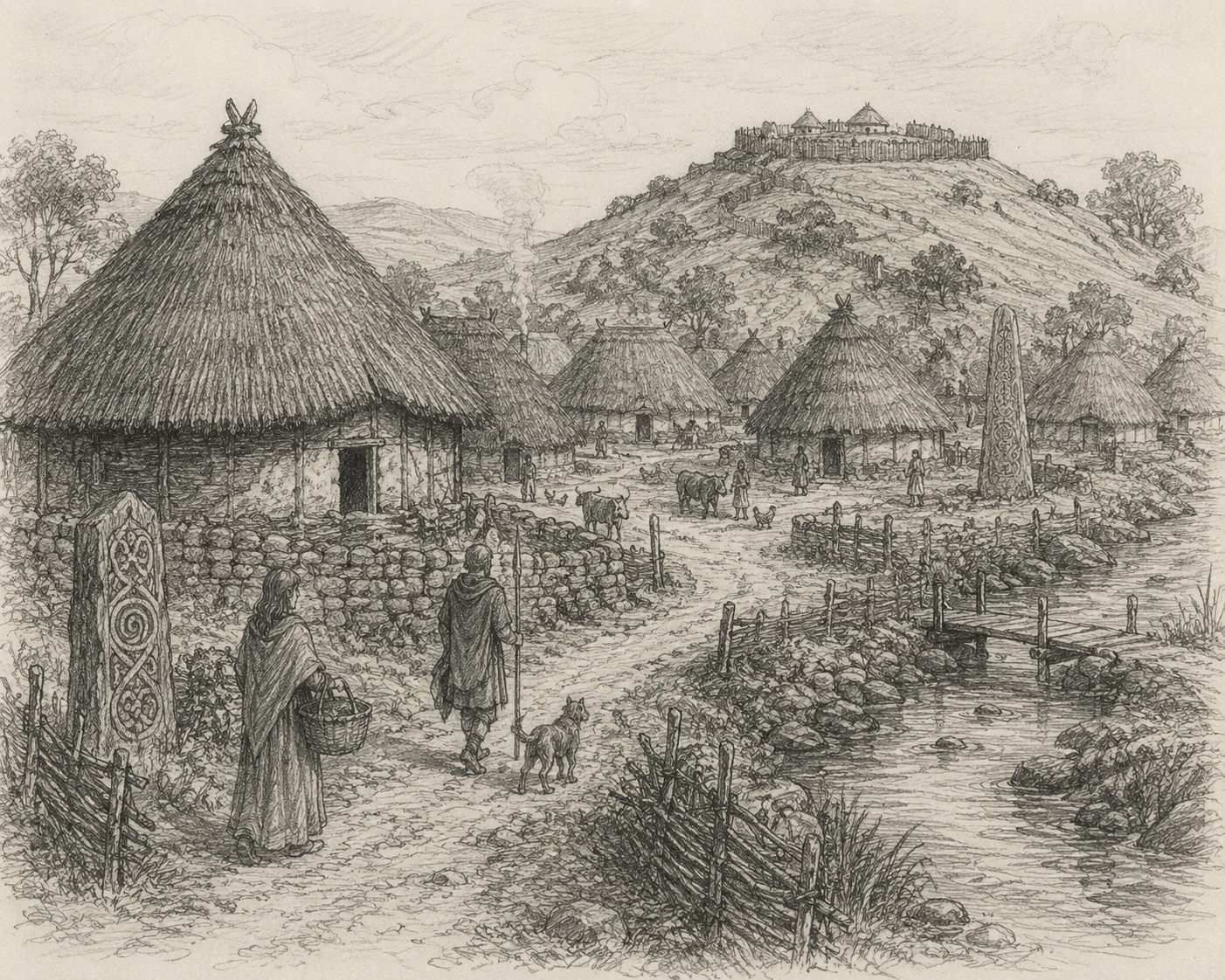
English itself is a West Germanic language of the Indo-European language family. During the period of Roman Britain (AD 43 to AD 410), what we know as Britain today spoke Brittonic dialects and languages, influenced by the Celtic migration from the Continent around 1300-800 BC; during the Roman occupation, many words from Latin were assimilated, and English as a language began to emerge around 450 AD. Old English would be unintelligible to most English speakers today; I won’t go into the history of the Great Vowel Shift again, which fundamentally changed the sound of the language, but suffice to say, we still use many Old English words today. Famously, Winston Churchill used many Old English words in his “We shall never surrender” speech, delivered just after the evacuation from Dunkirk was successfully completed. Old English words tend to be short, giving the speech more emphasis; click on this link for a clip from the film Darkest Hour, portraying the speech. As one man in the clip says, he mobilised the English language and sent it into battle.
Even though English as a language has adapted, evolved and adopted words from around the globe since its inception, there are ancient words from Brittonic which we still use today. Here are a few:
Ass, crag, doe, wan, combe (valley), peat, hog, gull, brock, bin, coracle, flannel, and bannock. Possible words (etymology is unclear, but these are suspected to be Celtic British) include basket, sark (a shirt or smock in Scotland and northern England), wan, and dun.
Among the place names from Brittonic are Avon, Derwent, York, Leeds, and London. The elements of Aber-, Caer-, Pen-, and Dun– are typical Brittonic place-name derivatives; these include: Aberdeen, Aberfeldy, Cardiff, Carlisle, Penzance, Dumbarton, Dundee, and Dumfries.
Some of these words are more common, for instance, in Scotland than in America, but they are still words used today. As you can imagine, the farther back we go in history, the more we’ll realise that earlier words have been usurped by “modern” ones – even if “modern” refers to a thousand years ago. What we know today only as “eggs” once had a variety of spellings: æg, ei, ey, eai, egge, eyern, eyeren, eggys, eggja. All of these were in use until William Caxton (c. 1422 – c. 1491) decided on eggs (thank you!). Only because of him do we spell it thus, and not æg or anything else.
I realise that all of this is an over-simplification, but it would be impossible to do justice to a language that has been developing for well over a thousand years, no matter how many books have been written on the subject. Hopefully, this little insight gives you a deeper appreciation for the fact that your spouse can write “eggs” on the shopping list and that you understand the term!
(AI Gen Image)