Tag Archives: Writing Tools

How To Boost Your Focus

I’m probably the most organised person I know; I’m not OCD about it, I just work better when things are organised.  Writing a book means that I accumulate bits and pieces of information, research facts, website links, editing tips, formatting guidelines, historical trivia that I can integrate into my plot (but only if I can find it when I get there), maps, diagrams, lists of names in various languages, grammar points to remember (I’ve made up a word for “points to remember” – poitrems – you heard it here first), How-To cheat-sheets for PhotoShop, publication checklists (pre- and post-), Shelfari to-dos, and… need I continue?  I’m just getting started.  And that’s my point.  If I’m not organised, I’ll waste half my day looking for something… where did I put that note about the dimensions of a modern casket?  Was it hot arsenic or cyanide that smells like garlic?  Are blue diamonds more valuable than pure white?  What kind of micro-organism poops arsenic?  A friend of mine complimented me one day when I told her some of the things I was researching; she said, “You’re just weird.”  And it’s something my husband repeats fondly on a regular basis.

So, I’d like to share a few of my organisational tips with you:

1)  Know thyself.  Know your weaknesses (You know, those distractions, procrastination excuses, time-eating habits like “just checking into Facebook for a minute before I sit down to write” and an hour later you’re hungry, then you see that the kitchen needs cleaning… you know who you are.).  Recognize those time-wasters, and nip them in the bud before they mushroom into a day wasted.  Keep your cell phone at a safe distance; wear earplugs if you need to; turn on music if it helps you focus, turn it off if it distracts you.  Write down points to research and only dive into research when you have 5 items on the list (and stay away from time-monster sites like Facebook and Youtube while you’re working!)

Character Profile Worksheet 12)  Find a system that works for you.  I organise my notes, etc. in various ways:  I have pocket-sized Moleskin books for quick reference character profiles, lists of words, family trees of characters, etc.; I also have lined notebooks with those heavy-duty post-it tabs labelling the sections (that are well-spaced apart for future additions); I write the section names on the front and back of those tabs so that I can find it from either way the notebook lands on my desk.  For instance, one notebook I always have at hand has sections like publications, pre- & post- publication to-dos, paperback formatting checklist, KDP guidelines, CreateSpace guidelines, grammar, PhotoShop Elements helps, editing checklists, proofing checklists, Beta checklists, and step-by-step guides for various publication formats.  Another notebook I keep on hand has things like time-related notes (Julian calendar terms, Ages [Stone Age = ~6,000-2,000 BC], etc.), medical notes (that’s where I put that note about modern casket dimensions), glossaries for archaeological terms, 18th century England notes, lists of museum curators’ names, phone numbers and emails, etc.  Besides notebooks, I keep “cards” – here’s an example (to the right):  I type up the information in PowerPoint, then save each “card” to .jpg format through MS Paint.  These cards are then saved onto my Tab through Dropbox, and Bob’s your uncle, I’ve got them handy whether I’m writing on the couch, on holiday, or in a café.

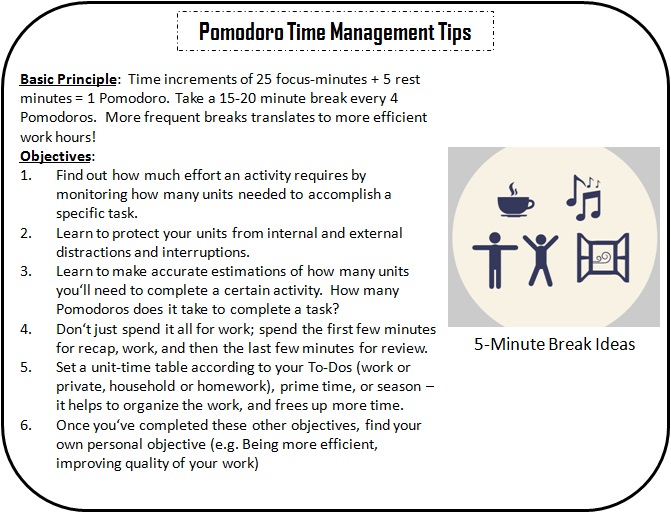
Pomodoro Time Management Tips3) Learn to focus.  I’ve recently found a great way to focus better through those hours of the day and night when I know I’m going to be most distracted:  It’s called Focus Booster.  It’s basically a timer on your desktop that counts down time increments, with an additional break-time at the end of each cycle.  The standard unit of time is 25/5, though you can adjust it to your rhythm.  The thinking is that anyone can focus on a given task for 25 minutes, even those who struggle with ADD.  In using it, I’ve realized how often I get distracted by a thought that comes into my mind while writing and I get up to do something quickly.  This way, I stay working for a solid amount of time, and use that 5 minutes to switch gears and get other things done; it’s amazing how much you can get accomplished in 30 minutes.  I’d encourage you to download it and give it a try if you struggle with concentration.  Here’s a second card I’ve made with the basic principles for the Booster.

Those are just a few ideas; if you struggle with a specific area, or would like suggestions on dealing with specific challenges in focusing, just ask away!  Focus well, and your writing will flow so much more smoothly and swiftly.


3 Comments

Filed under Articles, Nuts & Bolts, Research, Writing Exercise

Punctuation Dragons

Raphael - Saint George and the DragonThose wee things called punctuation are probably the most important things in writing; they are the proverbial insects of the writing world, for without them the entire system would disintegrate.  At the same time, they can sometimes be as daunting as fighting a dragon.

So without further ado, below is a brief breakdown of the most familiarly-confusing punctuation marks.  There may be a few discrepancies between various dialects / regional rules, but these are the basic rules – if you have these firmly in hand and use them consistently, you’ll recognize those rules that differ to what you learned in school; just apply whichever rules you use with consistency.  Feel free to copy / paste the post and print it out to keep handy (with that goal in mind, I’ll keep it comment-free)!

 Commas:

Where possible, leave out.  Where confusing, put in.

  • Separate elements in a series.
  • , + small conjunction (i.e. and, but, or):  If in doubt, use it here.
  • To set off introductory elements.  The comma can be omitted for short elements unless it makes the meaning unclear or confusing.
  • To set off parenthetical elements (added information that, if removed, does not affect the meaning of the sentence).
  • To separate coordinate adjectives (e.g. tall, distinguished woman)
  • To set off quoted elements:  , “(quote/dialogue).”  OR  , “(quote/dialogue),” (prose).
  • To set off contrasting expressions.
  • To avoid confusion.
  • Never use only one comma between a subject and its verb! (Only one would constitute a splice – see below)
  • Typographical reasons (i.e. dates, numbers, location references, etc.)

Comma Splice:  When a comma is misplaced between two independent clauses or randomly in the middle of a sentence, or between the subject and its verb.

Semi-Colon:

  • Use to join two independent clauses (e.g. “My wife would like tea; I would prefer coffee.”)
  • Use to separate items in a list that includes other punctuation (e.g. “The people present were Jamie, who came from New Zealand; John, the milkman’s son; and George, a gaunt kind of man.”)

 Apostrophe:

  • To express the possessive (e.g. Jane’s book)
  • To signify contractions (e.g. It’s cold outside.)
  • Some proper names use an apostrophe (e.g. O’Donnell, O’Malley)
  • Apostrophes are NEVER to be used to form a plural.  Never.  It’s CDs, not CD’s; DVDs, not DVD’s; the 1980s, not the 1980’s; 100s, not 100’s.  This may be a controversial “never” as they are common mistakes – so common that some writers perceive them as correct (just because some people use them does not make them correct usage… jumping off a cliff and all that).  The only exception to this “never” is when there may be the possibility of misreading.

 Hyphen (-) vs. en-dash (–) vs. em-dash (—)

Hyphen:

  • To join two words into a single meaning (e.g. decision-maker), or linked as an adjective before a noun (e.g. decision-making process).

En-dash: (Key: Ctrl + number – / Alt+0150)

  • To join two words that are separate but related, for example as a substitute for and or to.

Em-dash:  (Key:  AltGr + number – / Alt+0151)

  • Used to form parenthetical phrases.  These are used, for example, if there is the risk of confusion when other punctuation is used in the same sentence – for example commas.

The general rule of thumb in the UK seems to be as follows:  Use the en-dash within dialogues and prose, but end abrupt, interrupted dialogue with an em-dash.

There is a fourth dash called the Horizontal Bar.  It is usually used to set off quotation sources.  it is generally the same length as an em-dash, so this is often used instead. The main difference between the two is that some software may insert a line break after an em-dash but not after a quotation dash.

Parentheses / Brackets:

  • Order of usage:  (…[…{…}…]…).
  • Use to contain material that could be omitted without altering a sentence’s meaning, and where commas used elsewhere may lead to confusion if too many are used.  Any punctuation inside the brackets is independent from the main sentence.
  • […] Square brackets/crochets are used to mark omitted material from a quote of an original, more complete text.

Ellipsis:  … / . . . aka “Suspension Point”

  • Use for intentional omissions or an unfinished thought.
  • Use for unstated alternatives (implied by context).  E.g. “I’m on a… special diet.” (Edward Cullen, in Twilight)
  • Use for a slight pause.
  • Use for a nervous or awkward silence.
  • Use at the beginning or end of a sentence to inspire feelings of melancholy or longing.

Leave a comment

Filed under Nuts & Bolts, Writing Exercise

Writing to Distraction!

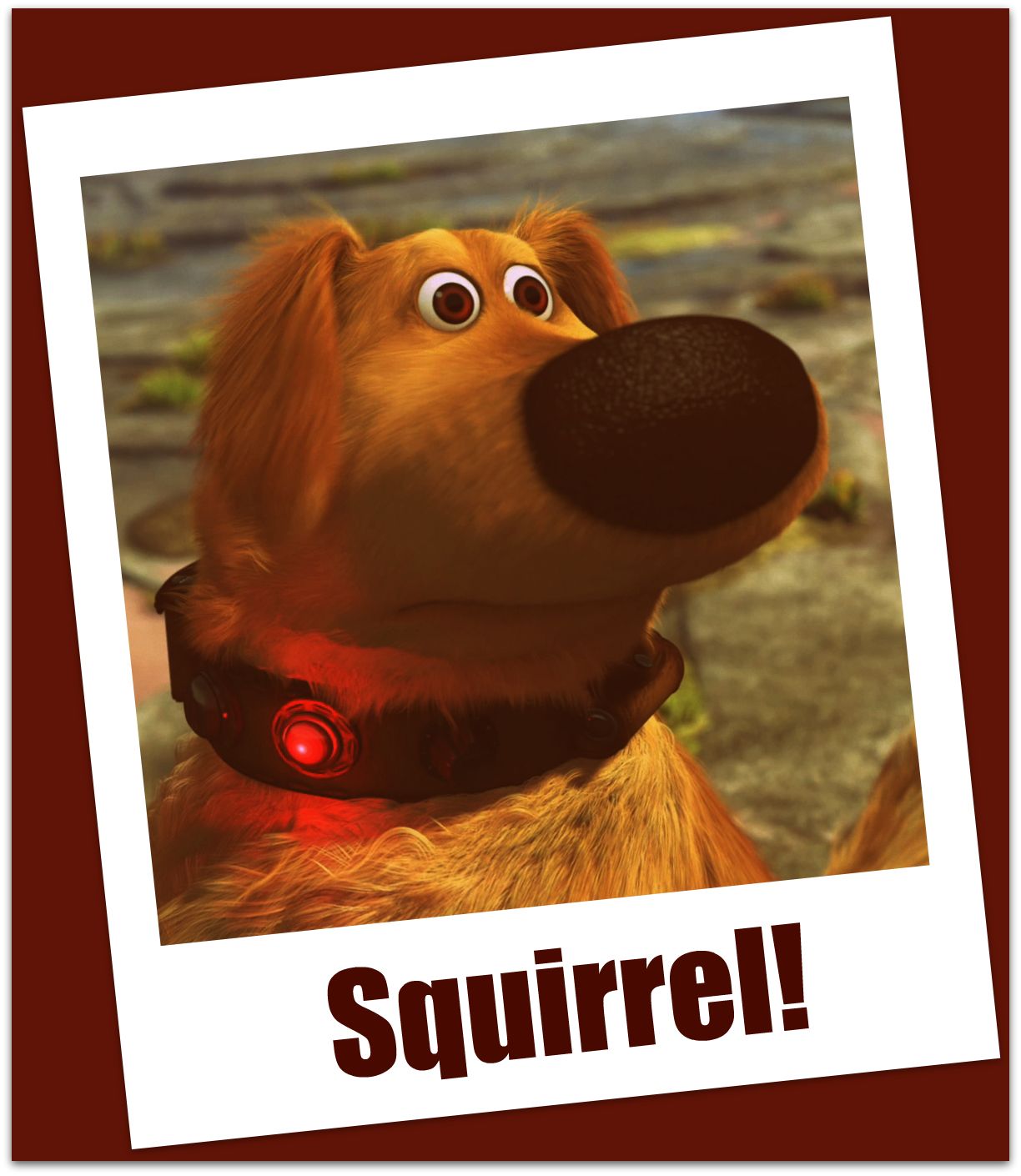
Squirrel_DugIf you’re a writer you know exactly what that title means.  Working on a project usually requires research; I don’t know what I’d do without internet connection, honestly – I’m too busy to take a day and plough through the local library, and as my local library consists of 99.9% German books anyway it’s not very helpful for writing English novels.  I have an extensive library here at home, and my research section is better equipped than the public library… but I digress.  Sometimes distractions come at you from every side; I feel like those dogs in “Up”… Squirrel!

And that’s the point.  Let’s say I go to YouTube for research:  It’s a great place to find out how to do just about anything, from how to throw a keris dagger and the aerodynamic difference between the wavy and the straight blade; how to make a vase out of a plastic bottle; how to make yarn from plastic bags; how to make an emergency stove out of a coke can or a light bulb out of a PET bottle with water, and the list goes on and on and on and on.  There are also hundreds of documentaries available on YouTube, from entertainment like the Horrible Histories series, to astronomy, science, history, you name it.  But if you’re like me you are interested in all of the above; and like Pringles, it’s hard to watch just one.  When I need a change of pace I also like to watch things on YouTube like the Actor’s Studio series, or talk show interviews (and we don’t have English-language television channels, which is actually fine by me – we use our television for sports programs and DVDs – but I digress.  Again.).  And YouTube is just one resource.  I have dozens of links to glossaries, websites that specialize in various aspects of history, science, technology, historical fashions, linguistics, etymology or other areas of interest, reference and research.

An important rule in dealing with online information is to have it confirmed by legitimate sources before using it, for instance, as a basis for anything substantial in a novel or other work of literature.  That rule has led me more than once to buying a book online.  In researching for The Price of Freedom and Redemption, I was especially frustrated with online research in the area of accurate apparel:  1788 was a world of difference in England to 1790, as the French Revolution changed fashion sensibilities in England – people distanced themselves from France, and patriotic influences as well as English fashion designers and trend setters came into their own more because of the vacuum.  But most online research that I came across either had the 18th century all lumped into one style, or “1700 to 1750” and “the latter half of the 18th century” which meant “French Revolution and thereafter” nine times out of ten.  Dubious at best, that.  Not even contemporary paintings are an accurate reference, as many of the “new middlings” had their clothing, and even background houses and gardens, “augmented” (read “upgraded”) for their paintings to add elegance to their new money.  And often, when I search for “18th century” I come across sites that actually mean the 1800s (that is, the 19th century).  My definitive source of information on that topic has become “The Dress of the People: Everyday Fashion in Eighteenth-Century England.”

So in trying to find one tiny little detail for fleshing out a scene, one can spend hours surfing, reading, searching, scanning and getting distracted by something else interesting along the way.  Yesterday I spent hours trying to find online PDFs or text of any kind from actual October 1789 The Times (London) newspaper (I’d have been satisfied with any month of that year!), just to find out what topics were being written about in the newspaper at the time aside from the Revolution.  What were the gossip columns writing about?  What kind of advertisements were there?  What were things considered newsworthy in that newspaper that year?  So far, Research – zilch, Time Spent – 3+ hours.  I looked at archives.com, Google images… nothing.  If anyone knows a resource for that, please let me know!! (If you think it would be impossible to find such old bits and pieces online in the cyber age, think again; I’ve found all kinds of documents far older that have been digitalized; someone out there is interested in it besides me, and chances are, someone has uploaded it into cyberspace; it’s just a matter of finding it in the static of cutesy videos and brainless teenage selfies…)

It can be so easy, and so enticing, to “waste” hours researching.  I try to follow two rules, and perhaps they’ll help you save time as well:

1)  Set a time limit for research.  When I need a break from the manuscript, but I don’t want to stray too far, I look at the clock and set myself one hour to find something on my research list.

2)  Make that research list; as you’re writing, keep a list somewhere (I have an e-post-it on my desktop) of things you’ll need to research, and do it all at once or in organized chunks.  It helps keep you focused on the manuscript, and makes the time you spend both on and off the actual script more efficient.

3 Comments

Filed under Articles, Research

Science-Fiction Made Real: The Origami Microscope

Recently I looked at past technologies; today I came across a TED video that is simply mind-boggling:  An Origami microscope that is cheap, powerful (magnifications up to 2,000x), waterproof, durable, and can be made available to anyone.  It sounds like science fiction, but it’s real, today; think of the possibilities for early diagnosis for the remote people of the earth who have all too often been neglected due to a lack of funds.  Click on the image below to see a 9-minute presentation by Stanford bioengineering professor Manu Prakash, PhD.

origami-microscope


2 Comments

Filed under Articles, How It's Made, Research, Videos

20 Common Grammar Errors

For writers and bloggers, being reminded of the basic grammar rules from time to time is a good thing; they can help to improve our communication and efficiency.  If you’re like me, you may be writing along when a question pops up like, “Does this sentence need a comma here or not?”  The more familiar we become with the rules (and keep in mind that there are some differences between nationally-accepted rules, e.g. between the British standard and the American standard), the faster such decisions will become and the less time will be lost on such mundanely important details.  Click on the image below for a link to the 20 most common grammar errors and how to solve them.

AA Mistakes

Leave a comment

Filed under Nuts & Bolts, Research, Writing Exercise

60 Uncommon Things Men Find Attractive About Women

Here’s a list that proves attraction is just weird, and that beauty really is in the eye of the beholder! I find this interesting especially because of the possibilities for finding that quirky element for building fictional characters. Enjoy, and be inspired to write depth and breadth!  Click on the image below to view the article:

Shutterstock

Leave a comment

Filed under Lists

A great resource: The King of Random

If you’re a writer like me, you like keeping your eyes and ears open for interesting websites, information, random bits that can inspire and inform your writing.  I just came across a great little gem on You Tube, the channel of Grant Thompson, the King of Random.  He has, well, random videos, including scientific experiments, life-hacks, how-tos and a lot more.  Need to know how to make fire with water?  Check.  Need to know how to fold a napkin to look like a shirt, or flower, or boat?  Check?  How to cut an apple to look like a swan?  Check.  Check him out by clicking on the photo below!

King of Random

Leave a comment

Filed under Research, Videos

From the 1867 Sailor’s Word-Book: Nautical Orders

First Rate ship at Anchor, and Frame of Second Rate Ship. Steel engraving.

First Rate ship at Anchor, and Frame of Second Rate Ship. Steel engraving.

As part of my research for novels, I came across the 1867 “The Sailor’s Word-Book:  An Alphabetical Digest of Nautical Terms, including some more especially military and scientific, but useful to seamen; as well as archaisms of early voyagers, etc. by the late ADMIRAL W. H. SMYTH, K.S.F., D.C.L., &c.”  It’s a massive document, but below is a gleaning of the orders listed in the word-book.  It’s a fascinating insight into life and demands at sea in the 18th & 19th centuries especially.  Enjoy!

Nautical Orders

ABOUT. Circularly; the situation of a ship after she has gone round, and trimmed sails on the opposite tack.—Ready about! and About-ship! are orders to the ship’s company to prepare for tacking by being at their stations.

ADVANCED SQUADRON. One on the look-out.—Advance, or vanguard, that division of a force which is next the enemy, or which marches before a body.—Advance fosse, a ditch of water round the esplanade or glacis of a fortification.—Advance! the order to marines and small-arm men to move forward.

AFTER-ORDERS. Those which are given out after the regular issue of the daily orders.

A-LEE. The contrary of a-weather: the position of the helm when its tiller is borne over to the lee-side of the ship, in order to go about or put her head to windward.—Hard a-lee! or luff a-lee! is said to the steersman to put the helm down.—Helm’s a-lee! the word of command given on putting the helm down, and causing the head-sails to shake in the wind.

ALL. The total quantity; quite; wholly.—All aback, when all the sails are taken aback by the winds.—All ahoo, or all-a-ugh, confused; hanging over; crooked.—All-a-taunt-o, a ship fully rigged, with masts in and yards crossed.—All hands, the whole ship’s company.—All hands ahoy, the boatswain’s summons for the whole crew to repair on deck, in distinction from the watch.—All hands make sail! the cheering order when about to chase a strange vessel.—All hands to quarters! the call in armed merchantmen, answering to the Beat to quarters in a man-of-war.—All in the wind, when a vessel’s head is too close to the wind, so that all her sails are shivering.—All over, resemblance to a particular object, as a ship in bad kelter: “she’s a privateer all over.”—All overish, the state of feeling when a man is neither ill nor well, restless in bed and indifferent to meals. In the tropics this is considered as the premonitory symptom of disease, and a warning which should be looked to.—All ready, the answer from the tops when the sails are cast loose, and ready to be dropped.—All standing, fully equipped, or with clothes on. To be brought up all standing, is to be suddenly checked or stopped, without any preparation.—Paid off all standing, without unrigging or waiting to return stores; perhaps recommissioned the next day or hour.—All’s well, the sentry’s call at each bell struck (or half hour) between the periods of broad daylight, or from 8 P.M. to 4 A.M.—All to pieces, a phrase used for out-and-out, extremely, or excessively; as, “we beat her in sailing all to pieces.”—All weathers, any time or season; continually.

ARRAY. The order of battle.—To array. To equip, dress, or arm for battle.

ASSEMBLY. That long roll beat of the drum by which soldiers, or armed parties, are ordered to repair to their stations. It is sometimes called the fall-in.

AVAST. The order to stop, hold, cease, or stay, in any operation: its derivation from the Italian basta is more plausible than have fast.

AVAST HEAVING! The cry to arrest the capstan when nippers are jammed, or any other impediment occurs in heaving in the cable, not unfrequently when a hand, foot, or finger, is jammed;—stop!

AWAY ALOFT. The order to the men in the rigging to start up.

AWAY SHE GOES. The order to step out with the tackle fall. The cry when a vessel starts on the ways launching; also when a ship, having stowed her anchor, fills and makes sail.

AWAY THERE. The call for a boat’s crew; as, “away there! barge-men.”

AWAY WITH IT. The order to walk along briskly with a tackle fall, as catting the anchor, &c.

AYE, AYE, SIR. A prompt reply on receiving an order. Also the answer on comprehending an order. Aye-aye, the answer to a sentinel’s hail, from a boat which has a commissioned officer on board below the rank of captain. The name of the ship in reply from the boat indicates the presence of a captain. The word “flag,” indicates the presence of an admiral.

BACK-HER. The order, in steam-navigation, directing the engineer to reverse the movement of the cranks and urge the vessel astern.

BACK OFF ALL. The order when the harpooner has thrown his harpoon into the whale. Also, to back off a sudden danger.

BADGER, To. To tease or confound by frivolous orders.

BEAT TO QUARTERS. The order for the drummer to summon every one to his respective station.

BECKET, The Tacks and Sheets in the. The order to hang up the weather-main and fore-sheet, and the lee-main and fore-tack, to the small knot and eye becket on the foremost-main and fore-shrouds, when the ship is close hauled, to prevent them from hanging in the water. A kind of large cleat seized on a vessel’s fore or main rigging for the sheets and tacks to lie in when not required. Cant term for pockets—”Hands out of beckets, sir.”

BELL. Strike the bell. The order to strike the clapper against the bell as many times as there are half hours of the watch elapsed; hence we say it is two bells, three bells, &c., meaning there are two or three half-hours past. The watch of four hours is eight bells.

BOUT. A turn, trial, or round. An attack of illness; a convivial meeting.—‘Bout ship, the brief order for “about ship.”

BRACE UP AND HAUL AFT! The order usually given after being hove-to, with fore or main top-sail square or aback, and jib-sheet flowing, i.e. haul aft jib-sheet, brace up the yards which had been squared, for the purpose of heaving to.

BRAIL UP! The order to pull upon the brails, and thereby spill and haul in the sail. The mizen, or spanker, or driver, or any of the gaff-sails, as they may be termed, when brailed up, are deemed furled; unless it blows hard, when they are farther secured by gaskets.

BREAK-OFF. (See Broken-off). “She breaks off from her course,” applied only when the wind will not allow of keeping the course; applies only to “close-hauled” or “on a wind.”—Break-off! an order to quit one department of duty, to clap on to another.

BRIGADE-ORDERS. Those issued by the general officer commanding troops which are brigaded.

BRING-TO, To. To bend, as to bring-to a sail to the yard. Also, to check the course of a ship by trimming the sails so that they shall counteract each other, and keep her nearly stationary, when she is said to lie by, or lie-to, or heave-to.—Bring to! The order from one ship to another to put herself in that situation in order to her being boarded, spoken to, or examined. Firing a blank gun across the bows of a ship is the forcible signal to shorten sail and bring-to until further pleasure.—Bring-to is also used in applying a rope to the capstan, as “bring-to the messenger.”

BRING-TO AN ANCHOR, To. To let go the anchor in the intended port. “All hands bring ship to an anchor!” The order by which the people are summoned for that duty, by the pipes of the boatswain and his mates.

CAPSTAN, To come up the. In one sense is to lift the pauls and walk back, or turn the capstan the contrary way, thereby slackening, or letting out some of the rope on which they have been heaving. The sudden order would be obeyed by surging, or letting go any rope on which they were heaving. Synonymous to “Come up the purchase.”

CAPSTAN, Surge the. Is the order to slacken the rope which is wound round the barrel while heaving, to prevent it from riding or fouling. This term specially applies to surging the messenger when it rides, or when the two lashing eyes foul on the whelps or the barrel.

CEASE FIRING. The order to leave off.

CLAP ON! The order to lay hold of any rope, in order to haul upon it. Also, to “Clap on the stoppers before the bitts,” i.e. fasten the stoppers; or, “Clap on the cat-fall,” i.e. lay hold of the cat-fall.—To clap a stopper over all, to stop a thing effectually; to clap on the stopper before the bitts next to the manger or hawse-hole; to order silence.—To clap in irons, to order an offender into the bilboes.—To clap on canvas, to make more sail.

CLUE UP! The order to clue up the square sails.

COME NO NEAR! The order to the helmsman to steer the ship on the course indicated, and not closer to the wind, while going “full and by.”—Come on board, sir. An officer reporting himself to his superior on returning from duty or leave.—Come to. To bring the ship close to the wind.—Come to an anchor. To let go the anchor.—Come up! with a rope or tackle, is to slack it off.—Comes up, with the helm. A close-hauled ship comes up (to her course) as the wind changes in her favour. To come up with or overhaul a vessel chased.—Come up the capstan. Is to turn it the contrary way to that which it was heaving, so as to take the strain off, or slacken or let out some of the cablet or rope which is about it.—Come up the tackle-fall. Is to let go.—To come up, in ship-building, is to cast loose the forelocks or lashings of a sett, in order to take in closer to the plank.

DEPRESS. The order to adjust the quoin in great-gun exercise; to depress the muzzle to point at an object below the level, in contradistinction to elevate.

DOWN ALL CHESTS! The order to get all the officers’ and seamen’s chests down below from off the gun-decks when clearing the ship for an engagement.

DOWN ALL HAMMOCKS! The order for all the sailors to carry their hammocks down, and hang them up in their respective berths in readiness to go to bed, or to lessen top-weight and resistance to wind in chase.

DOWN KILLOCK! Let go the grapnel; the corruption of keel-hook or anchor.

DOWN OARS! The order on shoving off a boat when the men have had them “tossed up.”

DOWN WITH THE HELM! An order to put the helm a-lee.

EASE, To Stand at. To remain at rest.

EASE AWAY! To slacken out a rope or tackle-fall.

EASE HER! In a steamer, is the command to reduce the speed of the engine, preparatory to “stop her,” or before reversing for “turn astern.”

EASE OFF! Ease off handsomely, or Ease away there! To slacken out a rope or tackle-fall carefully.

EASE THE HELM! An order often given in a vessel close-hauled, to put the helm down a few spokes in a head sea, with the idea that if the ship’s way be deadened by her coming close to the wind she will not strike the opposing sea with so much force. It is thought by some that extreme rolling as well as pitching are checked by shifting the helm quickly, thereby changing the direction of the ship’s head, and what is technically called “giving her something else to do.”

ELEVATE! In great-gun exercise, the order which prepares for adjusting the quoin.

EVERY INCH OF THAT! An exclamation to belay a rope without rendering it.

EVERY ROPE AN-END. The order to coil down the running rigging, or braces and bowlines, after tacking, or other evolution. Also, the order, when about to perform an evolution, to see that every rope is clear for running.

FALL IN, To. The order to form, or take assigned places in ranks. (See Assembly.)

FILL THE MAIN-YARD. An order well understood to mean, fill the main-topsail, after it has been aback, or the ship hove-to.

FIRE! The order to put the match to the priming, or pull the trigger of a cannon or other fire-arm so as to discharge it. The act of discharging ordnance.

FOOT IT IN. An order to stow the bunt of a sail snugly in furling, executed by the bunt-men dancing it in, holding on by the topsail-tye. Frequently when a bunt-jigger has parted men have fallen on deck.

FRESH HAND AT THE BELLOWS. Said when a gale freshens suddenly.

FULL FOR STAYS! The order to keep the sails full to preserve the velocity, assisting the action of the rudder in tacking ship.

FULL SPEED! A self-explanatory order to the engineer of a steamer to get his engine into full play.

GET-A-PULL. The order to haul in more of a rope or tackle.

GIVE HER SHEET. The order to ease off; give her rope.

GIVE WAY. The order to a boat’s crew to renew rowing, or to increase their exertions if they were already rowing. To hang on the oars.

GO AHEAD! or Go on! The order to the engineer in a steamer.

GO SLOW. The order to the engineer to cut off steam without stopping the play of the engine.

HALF-SPEED! An order in steam navigation to reduce the speed. (See Full Speed!)

HALF-TURN AHEAD! An order in steam navigation. (See Turn Ahead!)

HALT! The military word of command to stop marching, or any other evolution. A halt includes the period of such discontinuance.

HANDS REEF TOP-SAILS! The order to reef by all hands, instead of the watch, or watch and idlers.

HANG ON HER! In rowing, is the order to stretch out to the utmost to preserve or increase head-way on the boat.

HARD-A-PORT! The order so to place the tiller as to bring the rudder over to the starboard-side of the stern-post, whichever way the tiller leads. (See Hard-a-lee.)

HARD-A-STARBOARD. The order so to place the tiller as to bring the rudder over to the port-side of the stern-post, whichever way the tiller leads. (See Hard-a-lee.)

HARD-A-WEATHER! The order so to place the tiller as to bring the rudder on the lee-side of the stern-post, whichever way the tiller leads, in order to bear away; it is the position of the helm as opposed to hard-a-lee (which see). Also, a hardy seaman.

HAUL OF ALL! An order to brace round all the yards at once—a manœuvre sometimes used in tacking, or on a sudden change of wind; it requires a strong crew.

HAUL OUT TO LEEWARD! In reefing top-sails, the cry when the weather earing is passed.

HEAVE AND A-WASH. An encouraging call when the ring of the anchor rises to the surface, and the stock stirs the water.

HEAVE AND A-WEIGH. Signifies that the next effort will start the anchor from its bed, and make it a-trip. “Heave and a-weigh, sir,” from the forecastle, denotes that the anchor is a-weigh; it inspirits the men to run it to the bows rapidly.

HEAVE AND IN SIGHT. A notice given by the boatswain to the crew when the anchor is drawn up so near the surface of the water as to be seen by its muddy water surrounding it.

HEAVE AND PAUL. Is the order to turn the capstan or windlass till the paul may be put in, by which it is prevented from coming up, and is something similar to belay, applied to a running rope.

HEAVE AND RALLY! An encouraging order to the men at the capstan to heave with spirit, with a rush, and thereby force the anchor out of the ground. When there is a rising sea “heave and rally” implies, “heave and stand to your bars,” the pauls taking the strain, and the next wave probably lifting the anchor.

HEAVE OUT THERE! The order to hasten men from their hammocks.

HOLD-FAST. A rope; also the order to the people aloft, when shaking out reefs, &c., to suspend the operation. In ship-building, it means a bolt going down through the rough tree rail, and the fore or after part of each stanchion.

IN-BOATS! The order to hoist the boats in-board.

IN-BOW! The order to the bowman to throw in his oar, and prepare his boat-hook, previous to getting alongside.

KEEP YOUR LUFF. An order to the helmsman to keep the ship close to the wind, i.e. sailing with a course as near as possible to the direction from which the wind is coming. (See Close-hauled.)

LANE. “Make a lane there!” An order for men to open a passage and allow a person to pass through.

LASH AND CARRY. The order given by the boatswain and his mates on piping up the hammocks, to accelerate the duty.

LASH AWAY. A phrase to hasten the lashing of hammocks.

LAUNCH-HO! The order to let go the top-rope after the top-mast has been swayed up and fidded. It is literally “high enough.” So in pumping, when the spear sucks, this term is “Cease.”

LAY IN. The opposite of lay out. The order for men to come in from the yards after reefing or furling. It also applies to manning, or laying in, to the capstan-bars.

LAY OR LIE ON YOUR OARS! The order to desist rowing, without laying the oars in.—Lay out on your oars! is the order to give way, or pull with greater force.

LAY OUT. See Lie Out!

LET DRAW! The order to let the wind take the after-leeches of the jibs, &c., over to the lee-side, while tacking.

LET FALL! The order to drop a sail loosed from its gaskets, in order to set it.

LET GO AND HAUL! or Afore haul! The order to haul the head-yards round by the braces when the ship casts on the other tack. “Let go,” alluding to the fore-bowline and lee head-braces.

LET GO UNDER FOOT. See Under Foot.

LET RUN, or let go by the Run. Cast off at once.

LIE IN! The order to come in from the yards when reefing, furling, or other duty is performed.

LIE OFF! An order given to a boat to remain off on her oars till permission is given for her to come alongside.

LIE OUT! The order to the men aloft to distribute themselves on the yards for loosing, reefing, or furling sails.

LONG STROKE. The order to a boat’s crew to stretch out and hang on her.

LOWER HANDSOMELY, Lower Cheerly. Are opposed to each other; the former being the order to lower gradually, and the latter to lower expeditiously.

LUFF, or Loofe. The order to the helmsman, so as to bring the ship’s head up more to windward. Sometimes called springing a luff. Also, the air or wind. Also, an old familiar term for lieutenant. Also, the fullest or roundest part of a ship’s bows. Also, the weather-leech of a sail.

LUFF AND TOUCH HER! Try how near the wind she will come. (See Touching.)

MAIN-SAIL HAUL! The order given to haul the after-yards round when the ship is nearly head to wind in tacking.

MAIN-TOPSAIL HAUL! The order used instead of main-sail haul, when the main-sail is not set.

MAKE A LANE THERE! The order of the boatswain for the crew to separate at muster, to facilitate the approach of any one whose name is called. (See Lane.)

MAKE IT SO. The order of a commander to confirm the time, sunrise, noon, or sunset, reported to him by the officer of the watch.

MAKE READY! Be prepared.

MEET HER! The order to adjust the helm, so as to check any further movement of the ship’s head in a given direction.

MUZZLE TO THE RIGHT, or Muzzle to the Left! The order given to trim the gun to the object.

OARS! The order to cease rowing, by lifting the oars from the water, and poising them on their looms horizontally in their rowlocks.—Look to your oars! Passing any object or among sea-weed.—Double-banked oars (which see).

ORDER ARMS! The word of command, with muskets or carbines, to bring the butt to the ground, the piece vertical against the right side, trigger-guard to the front.—Open order and close order, are terms for keeping the fleet prepared for any particular manœuvre.

OUT-BOATS. The order to hoist out the boats.

OUT-OARS. The order to take to rowing when the sails give but little way on a boat.

PIPE DOWN! The order to dismiss the men from the deck when a duty has been performed on board ship.

PUMP SHIP! The order to the crew to work the pumps to clear the hold of water.

PUT OFF! or Push off. The order to boats to quit the ship or the shore.

READY ABOUT! or Ready Oh! The order to prepare for tacking, each man to his station. (See About.)

READY WITH THE LEAD! A caution when the vessel is luffed up to deaden her way, followed by “heave.”

RETREAT. The order in which a fleet or squadron declines engagement. Or the retrograde movement of any body of men who retire from a hostile force. Also, that beat of drum about sunset which orders the guards and piquets to take up their night duties.

RIGHT THE HELM! The order to put it amidships, that is, in a line with the keel.

RIG THE GRATINGS. Prepare them for punishment.

RODE OF ALL. Improperly so written for rowed of all (which see). The order to throw in and boat the oars.

ROUSE AND BIT. The order to turn out of the hammocks.

ROW DRY! The order to those who row, not to splash water into the boat.

ROWED OF ALL! The orders for the rowers to cease, and toss their oars into the boat simultaneously, in naval style.

RUN AWAY WITH IT! The order to men on a tackle fall, when light goods are being hoisted in, or in hoisting top-sails, jib, or studding-sails.

SENTRY GO! The order to the new sentry to proceed to the relief of the previous one.

SET ON! The order to set the engine going on board a steamer.

SHEET HOME! The order, after the sails are loosed, to extend the sheets to the outer extremities of the yards, till the clue is close to the sheet-block. Also, when driving anything home, as a blow, &c.

SHIFT THE HELM! The order for an alteration of its position, by moving it towards the opposite side of the ship; that is, from port to starboard, or vice versa.

SHOVE OFF! The order to the bowman to put the boat’s head off with his boat-hook.

SHOW A LEG! An exclamation from the boatswain’s mate, or master-at-arms, for people to show that they are awake on being called. Often “Show a leg, and turn out.”

SLACK OFF, or Slacken! The order to ease away the rope or tackle by which anything is held fast; as, “Slack up the hawser.”

SO! An order to desist temporarily from hauling upon a rope, when it has come to its right position.

SOAK AND SEND! The order to pass wet swabs along.

SQUARE YARDS! The order to attend to the lifts and braces, for going before the wind.—To square a yard. In working ship, means to bring it in square by the marks on the braces. Figuratively, to settle accounts.

STAMP AND GO! The order to step out at the capstan, or with hawsers, topsail-halliards, &c., generally to the fife or fiddle.

STAND BY! The order to be prepared; to look out to fire when directed.—To stand by a rope, is to take hold of it; the anchor, prepare to let go.

STAND CLEAR OF THE CABLE! A precautionary order when about to let go the anchor, that nothing may obstruct it in running out of the hawse-holes. Also, a warning when idlers obstruct quarter-deck duty.

STAND FROM UNDER! A notice given to those below to keep out of the way of anything being lowered down, or let fall from above.

STASH IT THERE! An old order to cease or be quiet.

STATIONS FOR STAYS! Repair to your posts to tack ship.

STEADY! The order given to the steersman, in a fair wind, to steer the ship on her course without deviating; to which he answers, Steady it is, sir.

STOP HER! An order to check the cable in being payed out. Also, a self-explanatory phrase to direct the engineer of a steamer to stop the action of the engines.

STRETCH OUT! In rowing, is the order to pull strong; to bend forward to the utmost.

STRIKE DOWN! The order to lower casks, &c., into the hold.

TAIL ON, or Tally on. The order to clap on to a rope.

THUS, Very well Thus, or Dyce. The order to the helmsman to keep the ship in her present direction, when sailing close-hauled. This truly sailor’s motto was adopted by the Earl St. Vincent.

TOE A LINE! The order to stand in a row.

TOP-SAIL HAUL! or Main-topsail Haul! When the main-sail is not set, this is the order given to haul the after-yards round when the ship is nearly head to wind in tacking.

TOSS IN YOUR OARS! The order to desist rowing, and throw the oars in out of the rowlocks.

TOSS THE OARS UP! Throw them up out of the rowlocks, and raise them perpendicularly an-end; the act is intended as a compliment to a superior officer rowing by. Also, the order to a boat’s crew to get the oars ready for rowing, and to salute the officer on his entering the boat.

TRICE UP—LIE OUT! The order to lift the studding-sail boom-ends while the top-men move out on the yards, preparatory to reefing or furling.

TRIM THE BOAT! The order to sit in the boat in such a manner as that she shall float upright. Also, to edge aft, so that her steerage becomes easier, and she does not ship heavy seas.

TURN AHEAD! A self-explanatory order to the engineer, in regulating the movement of a steamer.

TURN OUT THE GUARD! The order for the marines of the guard to fall in, on the quarter-deck, in order to receive a superior officer on board.

UP BOATS! The order to hoist the boats to the stern and quarter davits.

UP COURSES! The order to haul them up by the clue-garnets, &c.

UP SCREW! The order in steamers to lift the screw on making sail.

WALK AWAY! The order to step out briskly with a tackle fall, as in hoisting boats.

WALK BACK! A method in cases where a purchase must not be lowered by a round turn, as “Walk back the capstan;” the men controlling it by the bars and walking back as demanded.

Leave a comment

Filed under Articles, History, Lists, Research

From the 1867 Sailor’s Word-Book: Nautical Verbs, K-Z

Ship in a StormEvery profession develops its own jargon, a kind of short-hand between those in the know.  The sailing profession is one of the oldest on the planet, and has developed over the centuries; many of its terms have made it into everyday language.

Below is a gleaning of nautical actions from a digitalized version of the 1867 “The Sailor’s Word-Book:  An Alphabetical Digest of Nautical Terms, including some more especially military and scientific, but useful to seamen; as well as archaisms of early voyagers, etc. by the late ADMIRAL W. H. SMYTH, K.S.F., D.C.L., &c.”  For those of you interested in this topic you’ll appreciate the richness of life at sea represented here; for those of you interested in language, it’s a great source of history and etymology.  Because of the length, I’ve broken it down into two sections; here’s the second part, K-Z.  Enjoy!

K-O

KEN, To. Ang.-Sax. descrying, as Shakespeare in Henry VI.:— “And far as I could ken thy chalky cliffs.”  —Ken, a speck, a striking object or mark.

(Note:  “Ken, to” is also used in modern Scots to describe knowing or understanding someone or something.)

KICK THE BUCKET, To. To expire; an inconsiderate phrase for dying.

KICK UP A DUST, To. To create a row or disturbance.

KIDNAP, To. To crimp or carry off by artifice.

KREE, To. A north-country word: to beat, or bruise.

KRINGLE, To. To dry and shrivel up. Also a form of cringle.

LABBER, To. To struggle in water, as a fish when caught. To splash.

LACE, To. To apply a bonnet by lacing it to a sail. Also, to beat or punish with a rattan or rope’s-end. Also, the trimmings of uniforms.

LARRUP, To. An old word meaning to beat with a rope’s-end, strap, or colt.

LASK, To. To go large.—Lasking along. Sailing away with a quartering wind.

LATHER, To. To beat or drub soundly.

LAUNCH, To. To send a ship, craft, or boat off the slip on shore into the water, “her native element,” as newspapers say. Also, to move things; as, launch forward, or launch aft. Launch is also the movement by which the ship or boat descends into the water.

LAVEER, To. An old sea-term for beating a ship to windward; to tack.

LAY, To. To come or go; as, lay aloft, lay forward, lay aft, lay out. This is not the neuter verb lie mispronounced, but the active verb lay.

LAY A GUN, To. So to direct it as that its shot may be expected to strike a given object; for which purpose its axis must be pointed above the latter, at an angle of elevation increasing according to its distance.

LAY HER COURSE, To. To be able to sail in the direction wished for, however barely the wind permits it.

LAY IN SEA-STOCK, To. To make provision for the voyage.

LAY THE LAND, To. Barely to lose sight of it.

LAY-TO. To bring the weather-bow to the sea, with one sail set, and the helm lashed a-lee.

LAY UP A SHIP, To. To dismantle her.

LET DRIVE, To. To slip or let fly. To discharge, as a shot from a gun.

LET FLY, To. To let go a rope at once, suddenly.

LET IN, To. To fix or fit a diminished part of one plank or piece of timber into a score formed in another to receive it, as the ends of the carlings into the beams.

LET OUT, or Shake out, a Reef, To. To increase the dimensions of a sail, by untying the points confining a reef in it.

LIE ALONG, To.  A ship is said to lie along when she leans over with a side wind.—To lie along the land, is to keep a course parallel with it.

LIE ATHWART, To. When the tide slackens, and the wind is across tide, it makes a vessel ride athwart.

LIE BY, To. Dodging under small sail under the land.

LIE THE COURSE, To. When the vessel’s head is in the direction wished.

LIE-TO, To. To cause a vessel to keep her head steady as regards a gale, so that a heavy sea may not tumble into her. She has perhaps a main-topsail or trysails, and comes up to within six points, and falls off to wind abeam, forging rather ahead, but should not altogether fall too much to leeward.

LIE UNDER ARMS, To. To remain in a state of preparation for immediate action.

LIFT AN ANCHOR, To. Either by the purchase; or a ship if she has not sufficient cable on a steep bank lifts, or shoulders, her anchor.

LIGHT, To. To move or lift anything along; as “light over to windward,” the cry for helping the man at the weather-earing when taking in a reef. Each man holding by a reef-point helps it over, as the lee-earing cannot be passed until the man to windward calls out, “Haul out to leeward.”

LIGHTEN, To. To throw ballast, stores, cargo, or other things, overboard in stress of weather, to render the vessel more buoyant.

LINE, To. To cover one piece with another. Also, to mark out the work on a floor for determining the shape of a vessel’s body.—To line a ship, is to strike off with a batten, or otherwise, the directional lines for painting her. (See Toe a Line.)

LIST, To. To incline to one side; as “the ship has a list to port,” i.e. leans over to that side.

LIVE, To. To be able to withstand the fury of the elements; said of a boat or ship, &c.

LIVELY. To lift lightly to the sea; as a boat, &c.

LOCK, To. To entangle the lower yards when tacking.

LOOK, To. The bearing or direction, as, she looks up, is approaching her course.—A plank looks fore and aft, means, is placed in that direction.

LOOM, To. An indistinct enlarged appearance of any distant object in light fogs, as the coast, ships, &c.; “that land looms high,” “that ship looms large.” The effect of refraction.

LOOSE, To. To unfurl or cast loose any sail, in order to its being set, or dried after rain.

LOOSE A ROPE, To. To cast it off, or let it go.

LOSE WAY, To. When a ship slackens her progress in the water.

LOWER, To. The atmosphere to become cloudy. Also, to ease down gradually, expressed of some weighty body suspended by tackles or ropes, which, being slackened, suffer the said body to descend as slowly, or expeditiously, as occasion requires.

LUFF INTO A HARBOUR, To. To sail into it, shooting head to wind, gradually. A ship is accordingly said to spring her luff when she yields to the effort of the helm, by sailing nearer to the wind, or coming to, and does not shake the wind out of her sails until, by shortening all, she reaches her anchorage.

MAKE, To. Is variously applied in sea-language.

MAKE BAD WEATHER, To. A ship rolling, pitching, or leaking violently in a gale.

MAKE FAST. A word generally used for tying or securing ropes. To fasten.

MAKE FREE WITH THE LAND, To. To approach the shore closely.

MAKE LEE-WAY, To. To drift to leeward of the course.

MAKE SAIL, To. To increase the quantity of sail already set, either by letting out reefs, or by setting additional sails.

MAKE STERN-WAY, To. To retreat, or move stern foremost.

MAKE THE LAND, To. To see it from a distance after a voyage.

MAKE WATER, To. Usually signifies the act of a ship leaking, unless the epithet foul be added. (See Foul Water.)

MAN, To. To provide a competent number of hands for working and fighting a ship; to place people for duty, as “Man the barge;” “Man the capstan;” “Man the yards,” &c.

MANARVEL, To. To pilfer small stores.

MANGONIZE, To. To traffic in slaves.

MAN-HANDLE, To. To move by force of men, without levers or tackles.

MARINATE, To. To salt fish, and afterwards preserve it in oil or vinegar.

MARL, To. To souse fish in vinegar to be eaten cold.

MARLE, To. To wind marline, spun-yarn, twine, &c., about a rope, so that every turn is secured by a kind of knot, and remains fixed, in case the rest should be cut through by friction. It is commonly used to fasten slips of canvas, called parsling, upon the surface of a rope, to prevent its being galled, or to attach the foot of a sail to its bolt-rope, &c., with marling hitches, instead of sewing it.

MARRY, To, the Ropes, Braces, or Falls. To hold both together, and by pressure haul in both equally. Also so to join the ends of two ropes, that they will pass through a block.

MEND SAILS, To. To loose and skin them afresh on the yards.

MOOR, To. To secure a ship with anchors, or to confine her in a particular station by two chains or cables, either fastened to the mooring chains or to the bottom; a ship is moored when she rides by two anchors.

MOOR ACROSS, To. To lay out one of the anchors across stream.

MOOR ALONG, To. To anchor in a river with a hawser on shore to steady her.

MOOR QUARTER-SHOT, To. To moor quartering, between the two ways of across and along.

MOOR THE BOAT, To. To fasten her with two ropes, so that the one shall counteract the other, and keep her in a steady position.

MOOR WITH A SPRING ON THE CABLE, To. See Spring.

MOUNT, To. When said of a ship-of-war, implies the number of guns she carries.—To mount, in a military sense, is also to furnish with horses.

MOUNT A GUN, To. To place it on its carriage.

MOVE OFF, To. To defile.

MOYLE, To. To defile; an old term.

MUFFLE THE OARS, To. To put some matting or canvas round the loom when rowing, to prevent its making a noise against the tholes, or in the rowlocks. For this service thole-pins are best. In war time, rowing guard near the ships or batteries of the enemy, or cutting out, many a pea-jacket has been sacrificed for this purpose. Whale-boats have their oars muffled to prevent frightening the whales.

MUSTER, To. To assemble in order that the state and condition of the men may be seen, and also at times to inspect their arms and clothing.

NAIL, To. Is colloquially used for binding a person to a bargain. In weighing articles of food, a nail is 8 lbs.

NAUFRAGIATE, To. An old expression, meaning to suffer shipwreck. It occurs in Lithgow’s Pilgrime’s Farewell, 1618.

NEGOTIATE, To. The duty of a diplomatist; the last resource and best argument being now 12-ton guns.

OBSERVE, To. To take a bearing or a celestial observation.

OCCUPY, To. To take military possession.

OPEN LOWER DECKERS, To. To fire the lower tier of guns. Also said of a person using violent language.

OUT-FLANK, To. By a longer front, to overlap the enemy’s opposite line, and thus gain a chance to turn his flank.

OUT-SAIL, To. To sail faster than another ship, or to make a particular voyage with greater despatch.

OVER-PRESS, To. To carry too much sail on a ship.

OVERSHOOT, To. To give a ship too much way.

OWN, To. To be a proprietor in a ship.

P-R

PARCEL, To. To wind tarred canvas round a rope.

PARLEY. That beat of drum by which a conference with the enemy is desired. Synonymous with chamade.—To parley. To bandy words.

PART, To. To break a rope. To part from an anchor is in consequence of the cable parting.

PASS, To. To give from one to another, and also to take certain turns of a rope round a yard, &c., as “Pass the line along;” “pass the gasket;” “pass a seizing;” “pass the word there,” &c.

PAY A MAST OR YARD, To. To anoint it with tar, turpentine, rosin, tallow, or varnish; tallow is particularly useful for those masts upon which the sails are frequently hoisted and lowered, such as top-masts and the lower masts of sloops, schooners, &c.

PAY A VESSEL’S BOTTOM, To. To cover it with tallow, sulphur, rosin, &c.

PAY ROUND, To. To turn the ship’s head.

PEAK, To. To raise a gaff or lateen yard more obliquely to the mast. To stay peak, or ride a short stay peak, is when the cable and fore-stay form a line: a long peak is when the cable is in line with the main-stay.

PICK UP A WIND, To. Traverses made by oceanic voyagers; to run from one trade or prevalent wind to another, with as little intervening calm as possible.

PITCH IN, To. To set to work earnestly; to beat a person violently. (A colloquialism.)

PLANK IT, To. To sleep on the bare decks, choosing, as the galley saying has it, the softest plank.

PLASH, To. To wattle or interweave branches.

PLY, To. To carry cargoes or passengers for short trips. Also, to work to windward, to beat. Also, to ply an oar, to use it in pulling.

POINT A GUN, To. To direct it on a given object.

POINT A SAIL, To. To affix points through the eyelet-holes of the reefs.

POWDER, To. To salt meat slightly; as Falstaff says, “If thou embowel me to-day, I’ll give you leave to powder me, and eat me too, to-morrow.”—Powdering-tub. A vessel used for pickling beef, pork, &c.

PRESS, To. To reduce an enemy to straits.

PRIME, To. To make ready a gun, mine, &c., for instantaneous firing. Also, to pierce the cartridge with the priming-wire, and apply the quill-tube in readiness for firing the cannon.—To prime a fire-ship. To lay the train for being set on fire.—To prime a match. Put a little wet bruised powder made into the paste called devil, upon the end of the rope slow-match, with a piece of paper wrapped round it.

PRISE, To. To raise, or slue, weighty bodies by means of a lever purchase or power.

PROVE, To. To test the soundness of fire-arms, by trying them with greater charges than those used on service.

PULL FOOT, To. To hasten along; to run.

PURCHASE A COMMISSION, To. A practice in our army, which has been aptly termed the “buying of fetters;” it is the obtaining preferment at regulated prices. At present the total value of a commission in a regiment of infantry of the line ranges from £450 for an ensigncy, up to £4540 for a lieutenant-colonelcy, and higher in the other branches of the service.

PURSUE, To. To make all sail in chase.

PUSH, To. To move a vessel by poles.

PUT BACK, To. To return to port—generally the last left.

PUT INTO PORT, To. To enter an intermediate or any port in the course of a voyage, usually from stress of weather.

PUT TO SEA, To. To quit a port or roadstead, and proceed to the destination.

PYKE, To. A old word signifying to haul on a wind.

PYKE OFF, To. To go away silently.

QUADRATE, To. To trim a gun on its carriage and its trucks; to adjust it for firing on a level range.

QUICKEN, To. In ship-building, to give anything a greater curve; as, to quicken the sheer, opposed to straightening it.

RACE, To. Applies to marking timber with the race-tool.

RADDLE, To. To interlace; as in making boats’ gripes and flat gaskets.

RAISE, To. To make an object subtend a larger angle by approaching it, which is the foundation of perspective, and an effect increased by the sphericity of our globe: the opposite of laying.

RAISE A SIEGE, To. To abandon or cause the abandonment of a siege.

RAISE THE METAL To. To elevate the breech, and depress thereby the muzzle of a gun.

RAISE THE WIND, To. To make an exertion; to cast about for funds.

RAM HOME, To. To drive home the ammunition in a gun.

RANGE, To. To sail in a parallel direction, and near to; as “we ranged the coast;” “the enemy came ranging up alongside of us.”

RANSACK, To. To pillage; but to ransack the hold is merely to overhaul its contents.

RATE A CHRONOMETER, To. To determine its daily gaining or losing rate on mean time.

RATTLE DOWN RIGGING, To; or, To Rattle the Shrouds. To fix the ratlines in a line parallel to the vessel’s set on the water.

RAZE, To. To level or demolish (applicable to works or buildings).

REAM or Reem Out, To. To enlarge the bore of a cannon with a special tool, so that it may take a larger projectile.

RE-ASSEMBLE. To gather together a fleet, or convoy, after having been scattered.

REAVEL, or Raffle. To entangle; to knot confusedly together.

REDUCE, To. To degrade to a lower rank; or to shorten the allowance of water or provisions.

REDUCE A CHARGE, To. To diminish the contents of a cartridge, sometimes requisite during heavy firing.

REDUCE A PLACE, To. To compel its commander to surrender, or vacate it by capitulation.

REEVE, To. To pass the end of a rope through any cavity or aperture, as the channel of a block; to unreeve is the opposite.

REINFORCE, To. To strengthen a fleet, squadron, army, or detachment, by additional means and munitions.

RELIEVE, To. To put fresh men or ships upon a stipulated duty.

REPEAT SIGNALS, To. Is to make the same signal exhibited by the admiral, in order to its being more readily distinguished at a distance, or through smoke, &c. Frigates and small vessels out of the line were deemed repeating ships, and enforced signals by guns. The repeat from a superior intended to convey rebuke for inattention, is usually accompanied by one gun, or several.

REPLENISH, To. To obtain supplies of water and provisions up to the original amount.

REPORT ONE’S SELF, To. When an officer returns on board from duty, or from leave of absence.

RE-SHIP. To ship again, or ship goods that have been imported or conveyed by water.

RESOLVE, To. To reduce a traverse, or day’s work, to its exact limits.

RET, To. To soak in water, as in seasoning timber, hemp, &c.

RETURN A SALUTE, To. Admirals are saluted, but return two guns less for each rank that the saluting officer is below the admiral.

RIDE, To. To ride at anchor. A vessel rides easily, apeak, athwart, head to wind, out a gale, open hawse, to the tide, to the wind, &c. A rope rides, as when round the capstan or windlass the strain part overlies and jams the preceding turn.—To ride between wind and tide. Said of a ship at anchor when she is acted upon by wind and tide from different directions, and takes up a position which is the result of both forces.

RIG, To. To fit the shrouds, stays, braces, and running-rigging to their respective masts, yards, and sails. Colloquially, it means to dress.—To rig in a boom, is to draw it in.—To rig out a boom, is to run it out from a yard, in order to extend the foot of a sail upon it, as with studding-sail booms, &c.

RIG THE CAPSTAN, To. To fix the bars in the drumhead in readiness for heaving; not forgetting to pin and swift.

RISK A RUN, To. To take chance without convoy.

ROLL UP A SAIL, To. To hand it quickly.

ROUND-IN, To. To haul in on a fall; the act of pulling upon any slack rope which passes through one or more blocks in a direction nearly horizontal, and is particularly applied to the braces, as “Round-in the weather-braces.” It is apparently derived from the circular motion of the rope about the sheave or pulley, through which it passes.

ROUND-TO, To. To bring to, or haul to the wind by means of the helm. To go round, is to tack or wear.

ROUSE, To. To man-handle. “Rouse in the cable,” haul it in, and make it taut.

ROW, To. To propel a boat or vessel by oars or sweeps, which are managed in a direction nearly horizontal.

RUN ATHWART A SHIP’S COURSE, To. To cross her path.

RUN DOWN A COAST, To. To sail along it, keeping parallel to or skirting its dangers.

RUN DOWN A VESSEL, To. To pass over, into, or foul her by running against her end-on, so as to jeopardize her.

RUN OUT A WARP, To. To carry a hawser out from the ship by a boat, and fasten it to some distant place to remove the ship towards that place, or to keep her steady whilst her anchors are lifted, &c.

S-T

SAGG, To. To bend or give way from heavy weight; to press down towards the middle; the opposite of hogging. In Macbeth the word is figuratively applied—

“The mind I sway by, and the heart I bear,
Shall never sagg with doubt, nor shake with fear.”

SAGGING TO LEEWARD. To drift off bodily to leeward. The movement by which a ship makes a considerable lee-way.

whose chief at that time was the redoubtable Saladin.

SALAM, To. To salute a superior; a very common term, borrowed from India. Overdoing it does not please Jack, for he dislikes to see his commander “salamming like a captured Frenchman.”

SCOUR A BEACH, To. To pour a quick flanking fire along it, in order to dislodge an enemy.

SCOUR THE SEAS, To. To infest the ocean as a pirate.

SCUTTLE, To. To cut or bore holes through part of a ship when she is stranded or over-set, and continues to float, in order to save any part of her contents. Also, a trick too often practised by boring holes below water, to sink a ship, where fictitious cargo is embarked and the vessel insured beyond her value.

SEDUCE, To. To inveigle a man to desertion.

SEND, To. To rise after pitching heavily and suddenly between two waves, or out of the trough of the sea.

SERVE, To. To supply the gun with powder and shot. Also, to handle it through all the changes of station.

SERVE THE VENT, To. To stop it with the thumb.

SET THE CHASE, To. To mark well the position of the vessel chased by bearing, so that by standing away from her on one tack, she may be cut off on the other.

SET UP RIGGING, To. To take in the slack of the shrouds, stays, and backstays, to bring the same strain as before, and thus secure the masts.

SHAKE, To. To cast off fastenings, as—To shake out a reef. To let out a reef, and enlarge the sail.—To shake off a bonnet of a fore-and-aft sail.—To shake a cask. To take it to pieces, and pack up the parts, then termed “shakes.” Thus the term expressing little value, “No great shakes.”

SHAKE IN THE WIND, To. To bring a vessel’s head so near the wind, when close-hauled, as to shiver the sails.

SHEER OFF, To. To move to a greater distance, or to steer so as to keep clear of a vessel or other object.

SHEER TO THE ANCHOR, To. To direct the ship’s bows by the helm to the place where the anchor lies, while the cable is being hove in.

SHEER UP ALONGSIDE, To. To approach a ship or other object in an oblique direction.

SHIEVE, To. To have head-way. To row the wrong way, in order to assist the steersman in a narrow channel.

SHIFT A BERTH, To. To move from one anchorage to another.

SHIN UP, To. To climb up a rope or spar without the aid of any kind of steps.

SHOOT, To. To move suddenly; as “the ballast shoots on one side.” Also, a ship shoots ahead in stays. Also, to push off in a boat from the shore into a current; to descend a rapid. The term is well used thus amongst the powerful rivers of N. America, of which perhaps the finest example is given by the St. Lawrence at La Chine, there reported to rush in spring-time at the rate of 40 miles an hour. Thus the shooting Old London Bridge was the cause of many deaths, and gave occasion to the admirable description in the Loves of the Triangles (anti-Jacobin), when all were agreed:

“‘Shoot we the bridge,’ the vent’rous boatmen cry;
‘Shoot we the bridge,’ th’ exulting fare reply.”

SHOOT THE COMPASS, To. To shoot wide of the mark.

SHOOT THE SUN, To. To take its meridional altitude; literally aiming at the reflected sun through the telescope of the instrument. “Have you obtained a shot?” applied to altitudes of the meridian, as for time, lunar distances, &c.

SHORTEN, To. Said of a ship’s sails when requisite to reduce those that are set. And shorten in, when alluding to the anchor, by heaving in cable.

SHUT IN, To. Said of landmarks or points of land, when one is brought to transit and overlap the other, or intercept the view of it.

SIDE OUT FOR A BEND, To. The old well-known term to draw the bight of a hempen cable towards the opposite side, in order to make room for the bight being twined to coil it in the tier. The most expert and powerful seamen were selected for this duty, now rare.

SIGHT THE ANCHOR, To. To heave it up in sight, in order to prove that it is clear, when, from the ship having gone over it, there is suspicion that it may be fouled by the slack cable.

SIGNALIZE, To. To distinguish one’s self; a word also degraded to the meaning of communicating intelligence by means of signals or telegraph.

SILT-UP, To. To be choked with mud or sand, so as to obstruct vessels.

SINGLE, To. To unreeve the running part of top-sail sheets, &c., to let them run freely, or for harbour duty.

SIZE, To. To range soldiers, marines, and small-arm men, so that the tallest may be on the flanks of a party.

SKEDADDLE, To. To stray wilfully from a watering or a working party. An archaism retained by the Americans.

SKELP, To. To slap with the open hand: an old word, said to have been imported from Iceland:— “I canno’ tell a’;
Some gat a skelp, and some gat a claw.”

SLING, To. To pass the top-chains round the yards when going into action. Also, to set any large article, in ropes, so as to put a tackle on, and hoist or lower it. When the clues are attached to a cot or hammock, it is said to be slung; also water-kegs, buoys, &c., are slung.

SLUE, To. To turn anything round or over in situ: especially expressing the movement of a gun, cask, or ship; or when a mast, boom, or spar is turned about in its cap or boom iron.

SNAGGLE, To. To angle for geese with a hook and line properly baited.

SNAPE, To. In ship-carpentry, is to hance or bevel the end of anything, so as to fay upon an inclined plane: it is also designated flinch.

SPAN IN THE RIGGING, To. To draw the upper parts of the shrouds together by tackles, in order to seize on the cat-harping legs. The rigging is also “spanned in” when it has been found to stretch considerably on first putting to sea, but cannot be set up until it moderates.

SPEAK A VESSEL, To. To pass within hail of her for that purpose.

SPILL, To. Whether for safety or facility, it is advisable to shiver the wind out of a sail before furling or reefing it. This is done either by collecting the sail together, or by bracing it bye, so that the wind may strike its leech and shiver it. A very effeminate captain was accustomed to order, “Sheevar the meezen taus’le, and let the fore-topmast staysail lie dormant in the brails!”

SPIN A TWIST OR A YARN, To. To tell a long story; much prized in a dreary watch, if not tedious.

SPOOM, To. An old word frequently found in Dryden, who thus uses it, “When virtue spooms before a prosp’rous gale,
My heaving wishes help to fill the sail.”

SPREAD A FLEET, To. To keep more open order.

STAND, To. The movement by which a ship advances towards a certain object, or departs from it; as, “The enemy stands in shore;” “We saw three sail standing to the southward.” “That ship has not a mast standing,” implies that she has lost all her masts.

STAND IN SHORE, To. To sail directly for the land.

STAND SQUARE, To. To stand or be at right angles relatively to some object.

STAVE, To. To break a hole in any vessel. Also, to drive in the head of a cask, as of spirits, to prevent the crew from misusing it in case of wreck.—To stave off. To boom off; to push anything off with a pole.

STEER HER COURSE, To. Going with the wind fair enough to lay her course.

STEER LARGE, To. To go free, off the wind. Also, to steer loosely.

STEER SMALL, To. To steer well and within small compass, not dragging the tiller over from side to side.

STEP OUT, To. To move along simultaneously and cheerfully with a tackle-fall, &c.

STOKE, To. To frequent the galley in a man-of-war, or to trim fires.

STOP THE VENT, To. To close it hermetically by pressing the thumb to it.

STORM, To. To take by vigorous assault, in spite of the resistance of the defenders.

STREAM THE BUOY, To. To let the buoy fall from the after-part of the ship’s side into the water, preparatory to letting go the anchor, that it may not foul the buoy-rope as it sinks to the bottom.

STRETCH ALONG A BRACE, To. To lay it along the decks in readiness for the men to lay hold of; called manning it.

STRIKE, To. A ship strikes when she in any way touches the bottom. Also, to lower anything, as the ensign or top-sail in saluting, or as the yards, topgallant-masts, and top-masts in a gale. It is also particularly used to express the lowering of the colours in token of surrender to a victorious enemy.

STRIKE SOUNDINGS, To. To gain bottom, or the first soundings, by the deep-sea lead, on coming in from sea.

STRIP THE MASTS, To. To clear the masts of their rigging.

SUCK THE MONKEY, To. To rob the grog-can.

SUGG, To. To move or rock heavily on a bank or reef.

SUPPORT A FRIEND, To. To make every exertion to assist a vessel in distress, from whatever cause. Neglect of this incurs punishment.

SURGE THE CAPSTAN, To. To slacken the rope heaved round upon its barrel, to prevent its parts from riding or getting foul.

SWAGG, To. To sink down by its own weight; to move heavily or bend. Synonymous with sagg. Also, the bellying of a heavy rope.

SWAY UP, To. To apply a strain on a mast-rope in order to lift the spar upwards, so that the fid may be taken out, previous to lowering the mast. Or sway yards aloft ready for crossing.

SWIG OFF, To. To pull at the bight of a rope by jerks, having its lower end fast; or to gain on a rope by jumping a man’s weight down, instead of hauling regularly.

SWILKER, To. A provincialism for splashing about.

SWIM, To [from the Anglo-Saxon swymm]. To move along the surface of the water by means of the simultaneous movement of the hands and feet. With the Romans this useful art was an essential part of education.

SWING, To. A ship is said to swing to the wind or tide, when they change their direction while she is lying at anchor.—To swing ship for local attraction and adjustment of compasses. This is done by taking the bearings of a very distant object at each point of the compass to which her head is brought; also, by using a theodolite on shore, and taking its bearing from the ship, and the observer’s head from the theodolite.

TAKE WATER ON BOARD, To. To ship a sea.

TALLY, To. To haul the sheets aft; as used by Falconer— “And while the lee clue-garnet’s lower’d away,
Taut aft the sheet they tally, and belay.”

TEACH, To. In marine architecture, is applied to the direction which any line or curve seems to point out.

TELEGRAPH, To. To convey intelligence to a distance, through the medium of signals.

TELL OFF, To. To divide a body of men into divisions and subdivisions, preparatory to a special service.

TEND, To. To watch a vessel at anchor on the turn of a tide, and cast her by the helm, and some sail if necessary, so as to keep the cable clear of the anchor or turns out of her cables when moored.

TERTIATE, To. To examine whether a piece of ordnance is truly bored and has its due proportion of metal in every part, especially at the vent, the trunnions, and the muzzle.

TEW, To. To beat hemp.

TOP A YARD OR BOOM, To. To raise up one end of it by hoisting on the lift, as the spanker-boom is lifted before setting the sail.

TOP THE GLIM, To. To snuff the candle.

TOP THE OFFICER, To. To arrogate superiority.

TOSS UP THE BUNT, To. In furling a sail, to make its final package at the centre of the yard when in its skin.

TOUCH UP IN THE BUNT, To. To mend the sail on the yard; figuratively, to goad or remind forcibly.

TOUT, To. An old term for looking out, or keeping a prying watch; whence the revenue cruisers and the customs officers were called touters. The name is also given to crimps.

TOW, To. To draw or drag a ship or boat by means of a rope attached to another vessel or boat, which advances by steam-power, rowing, or sailing. The Roman method, as appears by the triumphal arch at Orange, was by a rope fastened to a pulley at the top of the mast. They also fastened a rope to the head of a boat, and led it over men’s shoulders, as practised on our canals at the present day.

TRAIL A PIKE, To. To hold the spear end in the right hand, and the butt trailed behind the bearer.

TRANS-SHIP, To. To remove a cargo from one ship to another.

TRAVEL, To. For a thimble, block, &c., to run along on beams or ropes.

TRAVERSE A YARD, To. To get it fore and aft.

TREAD WATER, To. The practice in swimming by which the body is sustained upright, and the head kept above the surface.

TRENCH THE BALLAST, To. To divide the ballast in a ship’s hold to get at a leak, or to trim and stow it.

TREND, To. To bend or incline, speaking of a coast; as, “The land trends to the south-west.” Also, the course of a current or stream.

TRICE, To. To haul or lift up by means of a lashing or line.

TROUNCE, To. To beat or punish. An old word; in Mathew’s translation of the Bible, 1537, we find, “The Lord trounced Sisera.”

TRUSS UP, To. To brail up a sail suddenly; to toss up a bunt.

TRY BACK FOR A BEND, To. To pay back some of the bight of a cable, in order to have sufficient to form the bend.

TRY DOWN, To. To boil out the oil from blubber at sea in whalers.

TURN A TURTLE, To. To take the animal by seizing a flipper, and  throwing him on his back, which renders him quite helpless. Also applied to a vessel capsizing; or throwing a person suddenly out of his hammock.

TURN IN, To. To go to bed.—To turn out. To get up.

TURN IN A DEAD-EYE OR HEART, To. To seize the end of a shroud or stay, &c., securely round it.

TURN OVER MEN, To. To discharge them out of one ship into another.

TURN THE HANDS UP, To. To summon the entire crew on deck.

TURN TO WINDWARD, To. To gain on the wind by alternate tacking. It is when a ship endeavours to make progress against the wind by a compound course inclined to the place of her destination; otherwise called plying or beating to windward.

TWIG, To. To pull upon a bowline. Also, in familiar phrase, to understand or observe.

U-Z

UNBEND, To. To cast off or untie; to remove the sails from their yards and stays; to cast loose the cables from their anchors, or to untie one rope from another.

UNBITT, To. To remove the turns of a cable from off the bitts.

UNDER-RUN A HAWSER OR WARP, To. To haul a boat along underneath it, in order to clear it, if any part happens to be foul. To under-run a tackle, is to separate the several parts of which it is composed, and range them in order, so that the general effort may not be interrupted when it is put in motion by the parts crossing, or by thorough-foots.

UNDER-SHORE, To. To support or raise a thing by putting a spar or prop under it, as a ship is shored up in dock.

UNLIMBER, To. With a gun on a travelling-carriage, to release it from the limber, by lifting the trail off the pintle and placing it on the ground, thus bringing it to the position for action.

UNREEVING. The act of withdrawing a rope from any block, thimble, dead-eye, &c., through which it had formerly passed.

UNRIG, To. To dismantle a ship of her standing and running rigging.—To unrig the capstan is to take out the bars.

UNSHIP, To. The opposite of to ship. To remove any piece of timber from its situation in which it is generally used, as “unship the oars,” lay them in the boat from the rowlocks; “unship the capstan bars,” &c.

VAIL, To. An old word signifying to lower, to bend in token of submission; as, “Vail their top-gallants.” Thus in the old play George a-Green, “Let me alone, my lord; I’ll make them vail their plumes.”

VEER, To. To let out, to pay out, to turn or change. Also, to veer or wear, in contradistinction from tacking. In tacking it is a necessary condition that the ship be brought up to the wind as close-hauled, and put round against the wind on the opposite tack. But in veering or wearing, especially when strong gales render it dangerous, unseamanlike, or impossible, the head of the vessel is put away from the wind, and turned round 20 points of the compass instead of 12, and, without strain or danger, is brought to the wind on the opposite tack. Many deep-thinking seamen, and Lords St. Vincent, Exmouth, and Sir E. Owen, issued orders to wear instead of tacking, when not inconvenient, deeming the accidents and wear and tear of tacking, detrimental to the sails, spars, and rigging.

VEER A BUOY IN A SHIP’S WAKE, To. To slack out a rope to which a buoy has been attached, and let it go astern, for the purpose of bringing up a boat, or picking up a man who may have fallen overboard.

VEER AND HAUL, To. To gently tauten and then slacken a rope three times before giving a heavy pull, the object being to concentrate the force of several men. The wind is said to veer and haul when it alters its direction; thus it is said, to veer aft, and haul forward.

VEER AWAY THE CABLE, To. To slack and let it run out.

WADE, To. An Anglo-Saxon word, meaning to pass through water without swimming. In the north, the sun was said to wade when covered by a dense atmosphere.

WAIVE, To. To give up the right to demand a court-martial, or to enforce forfeitures, by allowing people who have deserted, &c., to return to their duties.

WALK SPANISH, To. To quit duty without leave; to desert.

WALK THE QUARTER-DECK, To. A phrase signifying to take the rank of an officer.

WATER, To. To fill the casks or tanks; to complete water.

WEATHER ONE’S DIFFICULTIES, To. A colloquial phrase meaning to contend with and surmount troubles.

WEATHER THE CAPE, To. To become experienced; as it implies sailing round Cape Horn, or the Cape of Good Hope.

WEED, To. To clear the rigging of stops, rope-yarns, and pieces of oakum.

WELD, To. To join pieces of iron or other metal by placing in contact the parts heated almost to fusion, and hammering them into one mass.

WELL OFF, To. A mode of shutting off a leak by surrounding it by timbers screwed home through the lining to the timbers, and carrying up this trunk, like a log-hut, above the water-line.

WEND A COURSE, To. To sail steadily on a given direction.

WHISTLE FOR THE WIND, To. A superstitious practice among old seamen, who are equally scrupulous to avoid whistling during a heavy gale.—To wet one’s whistle. To take a drink. Thus Chaucer tells us that the miller of Trumpington’s lady had “Hir joly whistle wel ywette.”

WIND A SHIP OR BOAT, To. To change her position by bringing her stern round to the place where the head was.

WIND AWAY, To. To steer through narrow channels.

WING UP BALLAST, To. To carry the dead weight from the bottom as high as consistent with the stability of a ship, in order to ease her quick motion in rolling.

WOBBLE, To. In mechanics, to sway or roll from side to side.

WOOD, To. A gun is said to wood when it takes the port-sills or port-sides, or the trucks the water-ways.—To wood. When wooding-parties are sent out to cut or procure wood for a ship.

WORK, To. Said of a ship when she strains in a tempestuous sea, so as to loosen her joints.

WORK A SHIP, To. To adapt the sails to the force and direction of the wind.

WORK DOUBLE-TIDES, To. Implying that the work of three days is done in two, or at least two tides’ work in twenty-four hours.

WORK UP JUNK, To. To draw yarns from old cables, &c., and therewith to make foxes, points, gaskets, sinnet, or spun-yarn.

WRING A MAST, To. To bend, cripple, or strain it out of its natural position by setting the shrouds up too taut. The phrase, to wring, is also applied to a capstan when by an undue strain the component parts of the wood become deranged, and are thereby disunited. The head of a mast is frequently wrung by bracing up the lower yards beyond the dictates of sound judgment.

WRONG, To. To out-sail a vessel by becalming her sails is said to wrong her.

9 Comments

Filed under Articles, History, Lists, Research

From the 1867 Sailor’s Word-Book: Nautical Verbs, A-J

Tops

Nautical Ropes

Every profession develops its own jargon, a kind of short-hand between those in the know.  The sailing profession is one of the oldest on the planet, and has developed over the centuries; many of its terms have made it into everyday language.

Below is a gleaning of nautical actions from a digitalized version of the 1867 “The Sailor’s Word-Book:  An Alphabetical Digest of Nautical Terms, including some more especially military and scientific, but useful to seamen; as well as archaisms of early voyagers, etc. by the late ADMIRAL W. H. SMYTH, K.S.F., D.C.L., &c.”  For those of you interested in this topic you’ll appreciate the richness of life at sea represented here; for those of you interested in language, it’s a great source of history and etymology.  Because of the length, I’ll break it down into two sections, with K-Z following next.  Enjoy!

A-B

ABASE, To. An old word signifying to lower a flag or sail. Abaisser is in use in the French marine, and both may be derived from the still older abeigh. Abase literally means to cast down, to humble.

ABATE, To. An old Anglo-Norman word from abattre, to beat down or destroy; as, to abate a castle or fort, is to beat it down; and a gale is said to abate when it decreases. The term is still used in law.

ABET, To. To excite or encourage—a common word, greatly in use at boat-racings, and other competitive acts.

ABRASE, To. To dubb or smooth planks.

ACCOIL, To. To coil together, by folding round.

ACCOMPANY, To. To sail together; to sail in convoy.

ACCOST, To. To pass within hail of a ship; to sail coastwise; to approach, to draw near, or come side by side.

ADJOURN, To. To put off till another day. Adjournments can be made in courts-martial from day to day, Sundays excepted, until sentence is passed.

ADJUST, To. To arrange an instrument for use and observation; as, to adjust a sextant, or the escapement of a chronometer. To set the frame of a ship.

ADVANCE, To. An old word, meaning to raise to honour.

AID, To. To succour; to supply with provisions or stores.

ALLOW, To. To concede a destined portion of stores, &c.

ANNUL, To. To nullify a signal.

ANSWER, To. To reply, to succeed; as, the frigate has answered the signal. This boat will not answer.

ARRIBAR, To. To land, to attain the bank, to arrive.

ARRIVE, To. In the most nautical sense, is to come to any place by water, to reach the shore.

ASSAIL, To. To attack, leap upon, board, &c.

ASSIEGE, To. To besiege, to invest or beset with an armed force.

ATTEMPT, To. To endeavour to carry a vessel or place by surprise; to venture at some risk, as in trying a new channel, &c.

BADGER, To. To tease or confound by frivolous orders.

BALANCE, To. To contract a sail into a narrower compass;—this is peculiar to the mizen of a ship, and to the main-sail of those vessels wherein it is extended by a boom. The operation of balancing the mizen is performed by lowering the yard or gaff a little, then rolling up a small portion of the sail at the peak or upper corner, and lashing it about one-fifth down towards the mast. A boom main-sail is balanced by rolling up a portion of the clew, or lower aftermost corner, and fastening it strongly to the boom.—N.B. It is requisite in both cases to wrap a piece of old canvas round the sail, under the lashing, to prevent its being fretted by the latter.

BALE, To. To lade water out of a ship or vessel with buckets (which[71] were of old called bayles), cans, or the like, when the pumps are ineffective or choked.

BALLARAG, To. To abuse or bully. Thus Warton of the French king— “You surely thought to ballarag us
With your fine squadron off Cape Lagos.”

BALL-OFF, To. To twist rope-yarns into balls, with a running end in the heart for making spun-yarn.

BAMBOOZLE, To. To decoy the enemy by hoisting false colours.

BANK, To. Also, an old word meaning to sail along the margins or banks of river-ports: thus Shakspeare in “King John” makes Lewis the Dauphin demand— “Have I not heard these islanders shout out
Vive le Roy! as I have bank’d their towns?”

BASTE, To. To beat in punition. A mode of sewing in sail-making.

BATTLE THE WATCH, To. To shift as well as we can; to contend with a difficulty. To depend on one’s own exertions.

BEACH, To. Sudden landing—to run a boat on the shore, to land a person with intent to desert him—an old buccaneer custom. To land a boat on a beach before a dangerous sea, this demands practical skill, for which the Dover and Deal men are famed.

BEAR, To. The direction of an object from the viewer; it is used in the following different phrases: The land’s end bore E.N.E.; i.e. it was seen from the ship in a line with the E.N.E. point of the compass. We bore down upon the enemy; i.e. having the advantage of the wind, or being to windward, we approached the enemy by sailing large, or from the wind. When a ship that was to windward comes under another ship’s stern, and so gives her the wind, she is said to bear under the lee; often as a mark of respect. She bears in with the land, is said of a ship when she runs towards the shore. We bore off the land; i.e. we increased our distance from the land.—To bear down upon a ship, is to approach her from the windward.—To bear ordnance, to carry her guns well.—To bear sail, stiff under canvas.—To bear up, to put the helm up, and keep a vessel off her course, letting her recede from the wind and move to leeward; this is synonymous with to bear away, but is applied to the ship instead of the helm.—Bear up, one who has duly served for a commission, but from want of interest bears up broken-hearted and accepts an inferior warrant, or quits the profession, seeking some less important vocation; some middies have borne up and yet become bishops, lord-chancellors, judges, surgeons, &c.—To bear up round, is to put a ship right before the wind.—To bring a cannon to bear, signifies that it now lies right with the mark.—To bear off from, and in with the land, signifies standing off or going towards the coast.

BECALM, To. To intercept the current of the wind in its passage to a ship, by means of any contiguous object, as a high shore, some other ship to windward, &c. At this time the sails remain in a sort of rest, and consequently deprived of their power to govern the motion of the ship. Thus one sail becalms another.

BELAY, To. To fasten a rope when it has been sufficiently hauled upon, by twining it several times round a cleat, belaying pin, or kevel, without hitching or seizing; this is chiefly applied to the running rigging, which needs to be so secured that it may be quickly let go in case of a squall or change of wind; there being several other expressions used for securing large ropes, as bitting, making fast, stoppering, &c.—Belay there, stop! that is enough!—Belay that yarn, we have had enough of it. Stand fast, secure all, when a hawser has been sufficiently hauled. When the top-sails, or other sails have been hoisted taut up, or “belay the main-tack,” &c.

BEND, To. To fasten one rope to another, or to an anchor. The term is also applied to any sudden or remarkable change in the direction of a river, and is then synonymous with bight or loop.—Bend a sail is to extend or make it fast to its proper yard or stay.  Also, bend to your oars, throw them well forward.

BESIEGE, To. To endeavour to gain possession of a fortified place defended by an enemy, by directing against it a connected series of offensive military operations.[98]

BINGE, To. To rinse, or bull, a cask.

BITT THE CABLE, To. To put it round the bitts, in order to fasten it, or slacken it out gradually, which last is called veering away.

BLARE, To. To bellow or roar vehemently.—Blare, a mixture of hair and tar made into a kind of paste, used for tightening the seams of boats.

BLAZE, To. To fire away as briskly as possible. To blaze away is to keep up a running discharge of fire-arms. Also, to spear salmon. Also, in the woods, to mark a tree by cutting away a portion of its outer surface, thus leaving a patch of whiter internal surface exposed, to call attention or mark a track.

BLOAT, To. To dry by smoke; a method latterly applied almost exclusively to cure herrings or bloaters.—Bloated is also applied to any half-dried fish.

BLOW OFF, To. To clear up in the clouds.

BLOW UP, To. To abuse angrily.

BOGUE, To. To drop off from the wind. To edge away to leeward with the wind; not holding a good wind, and driving very much to leeward. Used only to clumsy inferior craft.

BONE, To. To seize, take, or apprehend. A ship is said to carry a bone in her mouth and cut a feather, when she makes the water foam before her.

BORROW, To. To approach closely either to land or wind; to hug a shoal or coast in order to avoid adverse tide.

BOTCH, To. To make bungling work.

BOWSE, To. To pull upon any body with a tackle, or complication of pulleys, in order to remove it, &c. Hauling upon a tack is called “bowsing upon a tack,” and when they would have the men pull all together, they cry, “Bowse away.” Also used in setting up rigging, as “Bowse away, starboard;” “Bowse away, port.” It is, however, mostly a gun-tackle term.—Bowse up the jib, a colloquialism to denote the act of tippling: it is an old phrase, and was probably derived from the Dutch buyzen, to booze.

BOX THE COMPASS, To. Not only to repeat the names of the thirty-two points in order and backwards, but also to be able to answer any and all questions respecting its divisions.

BRACE ABACK, To. To brace the yards in, so as to lay the sails aback.—To brace about, to turn the yards round for the contrary tack, or in consequence of a change of wind.—To brace abox, a manœuvre to insure casting the right way, by bracing the head-yards flat aback (not square).—To brace by, to brace the yards in contrary directions to each other on the different masts, to effect the stopping of the vessel. —To brace in, to lay the yard less oblique, as for a free wind, or nearly square.—To brace round, synonymous with brace about.—To brace sharp, to cause the yards to have the smallest possible angle with the keel, for the ship to have head-way: deemed generally to form an angle of 20° with the keel.—To brace to, is to check or ease off the lee braces, and round in the weather ones, to assist in the manœuvre of tacking or wearing.—To brace up, or brace sharp up, to lay the yards more obliquely fore and aft, by easing off the weather-braces and hauling in the lee ones, which enables a ship to lie as close to the wind as possible.

BRAN, To. To go on; to lie under a floe edge, in foggy weather, in a boat in Arctic seas, to watch the approach of whales.

BRAY, To. To beat and bruise in a mortar.

BREAK, To. To deprive of commission, warrant, or rating, by court-martial.

BREAK-SHEER, To. When a ship at anchor is laid in a proper position to keep clear of her anchor, but is forced by the wind or current out of that position, she is said to break her sheer. Also, for a vessel to break her sheer, or her back, means destroying the gradual sweep lengthways.

BREAK-UP, To. To take a ship to pieces when she becomes old and unserviceable.

BREAST, To. To run abeam of a cape or object. To cut through a sea, the surface of which is poetically termed breast.—To breast the sea, to meet it by the bow on a wind.—To breast the surf, to brave it, and overcome it swimming.—To breast a bar, to heave at the capstan.—To breast to, the act of giving a sheer to a boat.

BRING BY THE LEE, To. To incline so rapidly to leeward of the course when the ship sails large, or nearly before the wind, as in scudding before a gale, that the lee-side is unexpectedly brought to windward, and by laying the sails all aback, exposes her to the danger of over-setting.

BRING HOME THE ANCHOR, To, is to weigh it. It applies also when the flukes slip or will not hold; a ship then brings home her anchor.—Bring home the log. When the pin slips out of the log ship and it slides through the water.

BRING-TO, To. To bend, as to bring-to a sail to the yard. Also, to check the course of a ship by trimming the sails so that they shall counteract each other, and keep her nearly stationary, when she is said to lie by, or lie-to, or heave-to.—Bring to! The order from one ship to another to put herself in that situation in order to her being boarded, spoken to, or examined. Firing a blank gun across the bows of a ship is the forcible signal to shorten sail and bring-to until further pleasure.—Bring-to is also used in applying a rope to the capstan, as “bring-to the messenger.”

BRING-TO AN ANCHOR, To. To let go the anchor in the intended port. “All hands bring ship to an anchor!” The order by which the people are summoned for that duty, by the pipes of the boatswain and his mates.

BRING UP, To. To cast anchor.

BROACH A BUSINESS, To. To begin it.

BROACH-TO, To. To fly up into the wind. It generally happens when a ship is carrying a press of canvas with the wind on the quarter, and a good deal of after-sail set. The masts are endangered by the course being so altered, as to bring it more in opposition to, and thereby increasing the pressure of the wind. In extreme cases the sails are caught flat aback, when the masts would be likely to give way, or the ship might go down stern foremost.

BUCK, To. To wash a sail.

BUFFET A BILLOW, To. To work against wind and tide.

BUILD A CHAPEL, To. To turn a ship suddenly by negligent steerage.

BULCH, To. To bilge a ship.

BULLYRAG, To. To reproach contemptuously, and in a hectoring manner; to bluster, to abuse, and to insult noisily. Shakspeare makes mine host of the Garter dub Falstaff a bully-rook.

BUMP, To. To bump a boat, is to pull astern of her in another, and insultingly or inimically give her the stem; a practice in rivers and narrow channels.

BUNDLE-UP! The call to the men below to hurry up on deck.

BUNGLE, To. To perform a duty in a slovenly manner.

BURNETTIZE, To. To impregnate canvas, timber, or cordage with Sir William Burnett’s fluid, a solution of chloride of zinc.

C

CADGE, To. To carry.—Cadger, a carrier. Kedge may be a corruption, as being carriable.

CAMP, or Camp-out, To. In American travel, to rest for the night without a standing roof; whether under a light tent, a screen of boughs, or any makeshift that the neighbourhood may afford.

CANT, To. To turn anything about, or so that it does not stand square. To diverge from a central right line. Cant the boat or ship; i.e. for careening her.

CANT, To. To turn anything about, or so that it does not stand square. To diverge from a central right line. Cant the boat or ship; i.e. for careening her.

CAPSIZE, To. To upset or overturn anything.

CAPSTAN, To come up the. In one sense is to lift the pauls and walk back, or turn the capstan the contrary way, thereby slackening, or letting out some of the rope on which they have been heaving. The sudden order would be obeyed by surging, or letting go any rope on which they were heaving. Synonymous to “Come up the purchase.”

CAPSTAN, To heave at the. To urge it round, by pushing against the bars, as already described.

CAPSTAN, To man the. To place the sailors at it in readiness to heave.

CAPSTAN, To paul the. To drop all the pauls into their sockets, to prevent the capstan from recoiling during any pause of heaving.[161]

CAPSTAN, To rig the. To fix the bars in their respective holes, thrust in the pins to confine them, and reeve the swifter through the ends.

CAPSTAN, Surge the. Is the order to slacken the rope which is wound round the barrel while heaving, to prevent it from riding or fouling. This term specially applies to surging the messenger when it rides, or when the two lashing eyes foul on the whelps or the barrel.

CAREEN, To. A ship is said to careen when she inclines to one side, or lies over when sailing on a wind; off her keel or carina.

CARRY, To. To subdue a vessel by boarding her. To move anything along the decks. (See Lash and Carry, as relating to hammocks.) Also, to obtain possession of a fort or place by force. Also, the direction or movement of the clouds. Also, a gun is said to carry its shot so many yards. Also, a ship carries her canvas, and her cargo.

CARRY AWAY, To. To break; as, “That ship has carried away her fore-topmast,” i.e. has broken it off. It is customary to say, we carried away this or that, when knocked, shot, or blown away. It is also used when a rope has been parted by violence.

CARRY ON, To. To spread all sail; also, beyond discretion, or at all hazards. In galley-slang, to joke a person even to anger; also riotous frolicking.

CAST, To. To fall off, so as to bring the direction of the wind on one side of the ship, which before was right ahead. This term is particularly applied to a ship riding head to wind, when her anchor first loosens from the ground. To pay a vessel’s head off, or turn it, is getting under weigh on the tack she is to sail upon, and it is casting to starboard, or port, according to the intention.—To cast anchor. To drop or let go the anchor for riding by—synonymous with to anchor.—To cast a traverse. To calculate and lay off the courses and distances run over upon a chart.—To cast off. To let go at once. To loosen from.

CAST OF THE LEAD. The act of heaving the lead into the sea to ascertain what depth of water there is. (See also Heave the Lead and Sounding.) The result is a cast—”Get a cast of the lead.”

CAULK, To. (See Caulking.) To lie down on deck and sleep, with clothes on.

CERTIFY, To. To bear official testimony.

CHAFE, To. To rub or fret the surface of a cable, mast, or yard, by the motion of the ship or otherwise, against anything that is too hard for it.—Chafing-gear, is the stuff put upon the rigging and spars to prevent their being chafed.

CHALK, To. To cut.—To walk one’s chalks, to run off; also, an ordeal for drunkenness, to see whether the suspected person can move along the line. “Walking a deck-seam” is to the same purpose, as the man is to proceed without overstepping it on either side.

CHASE, To. To pursue a ship, which is also called giving chase.—A stern chase is when the chaser follows the chased astern, directly upon the same point of the compass.—To lie with a ship’s fore-foot in a chase, is to sail and meet with her by the nearest distance, and so to cross her in her way, as to come across her fore-foot. A ship is said to have a good chase when she is so built forward or astern that she can carry many guns to shoot forwards or backwards; according to which she is said to have a good forward or good stern chase. Chasing to windward, is often termed chasing in the wind’s eye.

CHEER, To. To salute a ship en passant, by the people all coming on deck and huzzahing three times; it also implies to encourage or animate. (See also Hearty and Man Ship!)

CHIME IN, To. To join a mess meal or treat. To chime in to a chorus or song.

CHINSE, To. To stop small seams, by working in oakum with a knife or chisel—a temporary expedient. To caulk slightly those openings that will not bear the force required for caulking.

CHIP, To. To trim a gun when first taken from the mould or castings.

CHOP-ABOUT, To. Is applied to the wind when it varies and changes suddenly, and at short intervals of time.

CLAW, or Claw off, To. To beat, or turn to windward from a lee-shore, so as to be at sufficient distance from it to avoid shipwreck. It is generally used when getting to windward is difficult.

CLEAR, To. Has several significations, particularly to escape from, to unload, to empty, to prepare, &c., as:—To clear for action. To prepare for action.—To clear away for this or that, is to get obstructions out of the way.—To clear the decks. To remove lumber, put things in their places, and coil down the ropes. Also, to take the things off a table after a meal.—To clear goods. To pay the custom-house dues and duties.—To clear the land. To escape from the land.—To clear a lighter, or the hold. To empty either.

CLEAT A GUN, To. To nail large cleats under the trucks of the lower-deckers in bad weather, to insure their not fetching way.

CLENCH, To. To secure the end of a bolt by burring the point with a hammer. Also, a mode of securing the end of one rope to another.

CLINCH. A particular method of fastening large ropes by a half hitch, with the end stopped back to its own part by seizings; it is chiefly to fasten the hawsers suddenly to the rings of the kedges or small anchors; and the breechings of guns to the ring-bolts in the ship’s side. Those parts of a rope or cable which are clinched. Thus the outer end is “bent” by the clinch to the ring of the anchor. The inner or tier-clinch in the good old times was clinched to the main-mast, passing under the tier beams (where it was unlawfully, as regards the custom of the navy, clinched). Thus “the cable runs out to the clinch,” means, there is no more to veer.—To clinch is to batter or rivet a bolt’s end upon a ring or piece of plate iron; or to turn back the point of a nail that it may hold fast.

CLINCH A BUSINESS, To. To finish it; to settle it beyond further dispute, as the recruit taking the shilling.

CLOSE THE WIND, To. To haul to it.—Close upon a tack or bowline, or close by a wind, is when the wind is on either bow, and the tacks or bowlines are hauled forwards that they may take the wind to make the best of their way.—Close to the wind, when her head is just so near the wind as to fill the sails without shaking them.

CLOSE WITH THE LAND, To. To approach near to it.

CLOY, To. To drive an iron spike by main force into the vent or touch-hole of a gun, which renders it unserviceable till the spike be either worked out, or a new vent drilled. (See Nailing and Spiking.)

CLUB-HAUL, To. A method of tacking a ship by letting go the lee-anchor as soon as the wind is out of the sails, which brings her head to wind, and as soon as she pays off, the cable is cut and the sails trimmed; this is never had recourse to but in perilous situations, and when it is expected that the ship would otherwise miss stays. The most gallant example was performed by Captain Hayes in H.M.S. Magnificent, 74, in Basque Roads, in 1814, when with lower-yards and top-masts struck, he escaped between two reefs from the enemy at Oleron. He bore the name of Magnificent Hayes to the day of his death, for the style in which he executed it.

COBBLE, To. To mend or repair hastily. Also, the coggle or cog.—Cobble or coggle stones, pebbly shingle, ballast-stones rounded by attrition, boulders, &c.

COMMIT ONE’S SELF, To. To break through regulations. To incur responsibility without regard to results.

COMMUTE, To. To lighten the sentence of a court-martial, on a recommendation of the court to the commander-in-chief.

COMPASS, To. To curve; also to obtain one’s object.

COMPLAIN, To. The creaking of masts, or timbers, when over-pressed, without any apparent external defect. One man threatening to complain of another, is saying that he will report misconduct to the officer in charge of the quarter-deck.

COMPLIMENT, To. To render naval or military honour where due.

CONQUER, To. To overcome decidedly.

CONSIGN, To. To send a consignment of goods to an agent or factor for sale or disposal.

CONTACT. Brought in contact with, as touching the sides of a ship. In astronomy, bringing a reflected body, as the sun, in contact with the moon or with a star. (See Lunar Distances, Sextant, &c.)

COPPER, To. To cover the ship’s bottom with prepared copper.

CORN, To. A remainder of the Anglo-Saxon ge-cyrned, salted. To preserve meat for a time by salting it slightly.

COUNTER-BRACE, To. Is bracing the head-yards one way, and the after-yards another. The counter-brace is the lee-brace of the fore-topsail-yard, but is only distinguished by this name at the time of the ship’s going about (called tacking), when the sail begins to shiver in the wind, this brace is hauled in to flatten the sail against the lee-side of the top-mast, and increase the effect of the wind in forcing her round. Counter-bracing becomes necessary to render the vessel stationary when sounding, lowering a boat, or speaking a stranger. It is now an obsolete term, and the manœuvre is called heaving-to.

COUPLE, To. To bend two hawsers together; coupling links of a cable; coupling shackles.

CRACK ON, To. To carry all sail.

CRIPPLE, To. To disable an enemy’s ship by wounding his masts, yards, and steerage gear, thereby placing him hors de combat.

CROWD SAIL, To. To carry an extraordinary press of canvas on a ship, as in pursuit of, or flight from, an enemy, &c.

CUND, To. To give notice which way a shoal of fish is gone.

CURE, To. To salt meat or fish.

CUT AND RUN, To. To cut the cable for an escape. Also, to move off quickly; to quit occupation; to be gone.

CUT AND THRUST. To give point with a sword after striking a slash.

CUT A STICK, To. To make off clandestinely.—Cut your stick, be off, or go away.

CUT OUT, To. To attack and carry a vessel by a boat force; one of the most dashing and desperate services practised by Nelson and Cochrane, of which latter that of cutting out the Esmeralda at Callao stands unequalled.

CUT THE CABLE, To. A manœuvre sometimes necessary for making a ship cast the right way, or when the anchor cannot be weighed.


D-F

DEADEN A SHIP’S WAY, To. To retard a vessel’s progress by bracing in the yards, so as to reduce the effect of the sails, or by backing minor sails. Also, when sounding to luff up and shake all, to obtain a cast of the deep-sea lead.

DEBARK, To. To land; to go on shore.

DECAMP, To. To raise the camp; the breaking up from a place where an army has been encamped.

DECK, To. A word formerly in use for to trim, as “we deckt up our sails.”

DERRICK, To. A cant term for setting out on a small not over-creditable enterprise. The act is said to be named from a Tyburn executioner.

DIDDLE, To. To deceive.

DIE ON THE FIN, To. An expression applied to whales, which when dying rise to the surface, after the final dive, with one side uppermost.

DING, To. To dash down or throw with violence.

DIP, To. To lower. An object is said to be dipping when by refraction it is visible just above the horizon. Also, to quit the deck suddenly.

DISCOURSE, To. An old sea term to traverse to and fro off the proper course.

DISCRETION. To surrender at discretion, implies an unconditional yielding to the mercy of the conquerors.

DISEMBAY. To work clear out of a gulf or bay.

DISH, To. To supplant, ruin, or frustrate.

DISLODGE. To drive an enemy from any post or station.

DISMISS. Pipe down the people. To dismiss a drill from parade is to break the ranks.

DISMOUNT, To. To break the carriages of guns, and thereby render them unfit for service. Also, in gun exercise, to lift a gun from its carriage and deposit it elsewhere.[251]

DISORGANIZE, To. To degrade a man-of-war to a privateer by irregularity.

DISPARTING A GUN. To bring the line of sight and line of metal to be parallel by setting up a mark on the muzzle-ring of a cannon, so that a sight-line, taken from the top of the base-ring behind the touch-hole, to the mark set near the muzzle, may be parallel to the axis of the bore.

DIVE, To. To descend or plunge voluntarily head-foremost under the water. To go off deck in the watch. A ship is said to be “diving into it” when she pitches heavily against a head-sea.

DOCK HERSELF, To. When a ship is on the ooze, and swaddles a bed, she is said to dock herself.

DOCK UP, OR DUCK UP. To clue up a corner of a sail that hinders the helmsman from seeing.

DOFF, To. To put aside.

DO FOR, To. A double-barrelled expression, meaning alike to take care of or provide for an individual, or to ruin or kill him.

DOUBLE, To. To cover a ship with an extra planking, usually of 4 inches, either internally or externally, when through age or otherwise she has become loosened; the process strengthens her without driving out the former fastenings. Doubling, however, is a term applied only where the plank thus used is not less than 2 inches thick.—To double a cape.

DOUBLE-BANK A ROPE, To. To clap men on both sides.

DOUBLING UPON. In a naval engagement, the act of inclosing any part of a hostile fleet between two fires, as Nelson did at the Nile. The van or rear of one fleet, taking advantage of the wind or other circumstances, runs round the van or rear of the enemy, who will thereby be exposed to great danger and confusion.

DOUSE, To. To lower or slacken down suddenly; expressed of a sail in a squall of wind, an extended hawser, &c. Douse the glim, your colours, &c., to knock down.

DOUT, To. To put out a light; to extinguish; do out. Shakspeare makes the dauphin of France say in “King Henry V.:”—

“That their hot blood may spin in English eyes,
And dout them.”

DRAG FOR THE ANCHOR, To. The same as creep or sweep.

DRAG THE ANCHOR, To. The act of the anchors coming home.

DRESS, To. To place a fleet in organized order; also, to arrange men properly in ranks; to present a true continuous line in front.—To dress a ship. To ornament her with a variety of colours, as ensigns, flags, pendants, &c., of various nations, displayed from different parts of her masts, rigging, &c., on a day of festivity.

DROP ASTERN, To. To slacken a ship’s way, so as to suffer another one to pass beyond her. Also, distancing a competitor.

DRUB. To beat. (Captain’s despatch.) “We have drubbed the enemy.”

DUBB, To. To smooth and cut off with an adze the superfluous wood.—To dubb a vessel bright, is to remove the outer surface of the plank completely with an adze. Spotting to examine planks with the adze is also dubbing.

DUCK, To. To dive, or immerse another under water; or to avoid a shot.

DUCK-UP! A term used by the steersman when the main-sail, fore-sail, or sprit-sail hinders his seeing to steer by a landmark, upon which he calls out, “Duck-up the clue-lines of those sails,” that is, haul the sails out of the way. Also, when a shot is made by a chase-piece, if the clue of the sprit-sail hinders the sight, they call out, “Duck-up,” &c.

EASE UP, To. To come up handsomely with a tackle-fall.

EATING THE WIND OUT OF A VESSEL. Applies to very keen seamanship, by which the vessel, from a close study of her capabilities, steals to windward of her opponent. This to be done effectually demands very peculiar trim to carry weather helm to a nicety.

EDGE AWAY, To. To decline gradually from the course which the ship formerly steered, by sailing larger, or more off, or more away from before the wind than she had done before.

EDGE DOWN, To. To approach any object in an oblique direction.

EGG, To. To instigate, incite, provoke, to urge on: from the Anglo-Saxon eggion.

EKE, To. [Anglo-Saxon eácan, to prolong.] To make anything go far by reduction and moderation, as in shortening the allowance of provisions on a voyage unexpectedly tedious.[275]

EMBARK, To. To go on board, or to put on board a vessel.

EMBATTLE. To arrange forces for conflict.

ENDANGER, To. To expose to peril.

ENROL, To. To enter the name on the roll of a corps.

ENSCONCE, To. To intrench; to protect by a slight fortification.

EQUIP, To. A term frequently applied to the business of fitting a ship for a trading voyage, or arming her for war.

EXPORT, To. To send goods or commodities out of a country, for the purposes of traffic, under the general name of exports.

FAFF, To. To blow in flaws.

FAG, To. To tire.—A fag. A deputy labouring-man, or one who works hard for another.

FAG-OUT, To. To wear out the end of a rope or end of canvas.

FALL, To. A town or fortress is said to fall when it is compelled to surrender to besiegers.

FALL ABOARD OF, To. To strike another vessel, or have a collision with it. Usually applied to the motion of a disabled ship coming in contact with another.

FALL ASTERN, To. To lessen a ship’s way so as to allow another to get ahead of her. To be driven backwards.[287]

FALL BACK, To. To recede from any position previously occupied.

FALL CALM, To. Speaking of the weather, implies a total cessation of the wind.

FALL DOWN, To. To sail, drift, or be towed to some lower part nearer a river’s mouth or opening.

FALL FOUL OF, To. To reprimand severely.

FALL IN, To. The order to form, or take assigned places in ranks.

FALL IN WITH, To. To meet, when speaking of a ship; to discover, when speaking of the land.

FALL OUT, To. To increase in breadth. Among soldiers and small-arm men, to quit the ranks of a company.

FANG, To. To pour water into a pump in order to fetch it, when otherwise the boxes do not hold the water left on them.

FAVOUR, To. To be careful of; also to be fair for.—”Favour her” is purely a seaman’s term; as when it blows in squalls, and the vessel is going rap-full, with a stiff weather-helm and bow-seas, “favour her boy” is “ease the helm, let the sails lift, and head the sea.” So, in hauling in a rope, favour means to trust to the men’s force and elasticity, and not part the rope by taking a turn on a cleat, making a dead nip. A thorough seaman “favours” his spars and rigging, and sails his ship economically as well as expeditiously.

FAY, To. To fit any two pieces of wood, so as to join close and fair together; the plank is said to fay to the timbers, when it lies so close to them that there shall be no perceptible space between them.

FEATHER, To Cut a. When a ship has so sharp a bow that she makes the spray feather in cleaving it.

FEATHER AN OAR, To. In rowing, is to turn the blade horizontally, with the top aft, as it comes out of the water. This lessens the resistance of the air upon it.

FEAZE, To. To untwist, to unlay ropes; to teaze, to convert it into oakum.[291]

FEEL THE HELM, To. To have good steerage way, carrying taut weather-helm, which gives command of steerage. Also said of a ship when she has gained head-way after standing still, and begins to obey the helm.

FELL, To. To cut down timber. To knock down by a heavy blow. Fell is the Anglo-Saxon for a skin or hide.

FEND. An aphæresis from defend; to ward off.[292]

FEND OFF, To. In order to avoid violent contact, is, by the application of a spar, junk, rattans, &c., to prevent one vessel running against another, or against a wharf, &c. Fend off, with the boat-hook or stretchers in a boat.—Fend the boat, keep her from beating against the ship’s side.

FETCH, To. To reach, or arrive at; as, “we shall fetch to windward of the lighthouse this tack.”

FETCHING THE PUMP. Pouring water into the upper part in order to expel the air contained between the lower box and that of the pump-spear.

FETCH WAY, To. Said of a gun, or anything which escapes from its place by the vessel’s motion at sea.

FETTLE, To. To fit, repair, or put in order. Also, a threat.

FILE OFF, To. To march off to a flank by files, or with a very small front.

FILL, To. To brace the yards so that the wind strikes the after side of the sails, and advances the ship in her course, after the sails had been shivering, or braced aback. A ship may be forced backward or forward, or made to remain in her place, with the same wind, by “backing, filling,” or shivering the sails. (See Brace, Back, and Shiver.) Colliers generally tide it, “backing and filling” down the Thames until they gain the reaches, where there is room for tacking, or the wind is fair enough for them to lay their course.—An idle skulker, a fellow who loiters, trying to avoid being seen by the officer of the watch, is said to be “backing and filling;” otherwise, doing nothing creditably.

FILLING A SHIP’S BOTTOM. Implies covering the bottom of a ship with broad-headed nails, so as to give her a sheathing of iron, to prevent the worms getting into the wood; sheathing with copper is found superior, but the former plan is still used for piles in salt-water.

FIND, To. To provide with or furnish.

FIRE! The order to put the match to the priming, or pull the trigger of a cannon or other fire-arm so as to discharge it. The act of discharging ordnance.

FISH THE ANCHOR, To. To turn up the flukes of an anchor to the gunwale for stowage, after being catted.—Other fish to fry, a common colloquialism, expressing that a person has other occupation demanding his attention.

FIST, To. To handle a rope or sail promptly; thus fisting a thing is readily getting hold of it.

FIT RIGGING, To. To cut or fit the standing and running rigging to the masts, [301]&c.

FITTING OUT A SHIP. The act of providing a ship with sufficient masts, sails, yards, ammunition, artillery, cordage, anchors, provisions, stores, and men, so that she is in proper condition for the voyage or purpose to which she is appointed.

FLABBERGAST, To. To throw a person aback by a confounding assertion; to produce a state of extreme surprise.

FLANK, To. To defend that part; incorrectly used sometimes for firing upon a flank.

FLARE, To. To rake back, as of a fashion-piece or knuckle-timber.

FLATTEN IN, To. The action of hauling in the aftmost clue of a sail to give it greater power of turning the vessel; thus, if the mizen or after sails are flatted in, it is to carry the stern to leeward, and the head to windward; and if, on the contrary, the head-sails are flatted in, the intention is to make the ship fall off when, by design or accident, she has come so near as to make the sails shiver; hence flatten in forward is the order to haul in the jib and foretop-mast staysail-sheets towards the middle of the ship, and haul forward the fore-bowline; this operation is seldom necessary except when the helm has not sufficient government of the ship, as in variable winds or inattentive steerage.

FLEATE, To. To skim fresh water off the sea, as practised at the mouths of the Rhone, the Nile, &c. The word is derived from the Dutch vlieten, to skim milk; it also means to float.

FLEMISH, To. To coil down a rope concentrically in the direction of the sun, or coil of a watch-spring, beginning in the middle without riders; but if there must be riding fakes, they begin outside, and that is the true French coil.

FLENSE, To. To strip the fat off a flayed seal, or the blubber from a whale.

FLETCH, To. To feather an arrow.

FLICKER, To. To veer about.

FLOP, To. To fall flat down: as “soused flop in the lee-scuppers.”

FORE-REACH, To. To shoot ahead, or go past another vessel, especially when going in stays: to sail faster, reach beyond, to gain upon.

FORGE AHEAD, To. To shoot ahead, as in coming to an anchor—a motion or moving forwards. A vessel forges ahead when hove-to, if the tide presses her to windward against her canvas.

FOUNDER, To. To fill with water and go down.

FRAP, To. To bind tightly together. To pass lines round a sail to keep it from blowing loose. To secure the falls of a tackle together by means of spun yarn, rope yarn, or any lashing wound round them. To snap the finger and thumb; to beat.

FREE, To.—To free a prisoner. To restore him to liberty.—To free a pump. To disengage or clear it.—To free a boat or ship. To clear it of water.

FREEZE, To. To congeal water or any fluid. Thus sea-water freezes at 28° 5′ Fah.; fresh water at 32°; mercury at 39° 5′ below zero. All fluids change their degree of freezing in accordance with mixtures of alcohol or solutions of salt used for the purpose. Also, according to the atmospheric pressure; and by this law heights of mountains are measured by the boiling temperature of water.

FRESHEN, To. To relieve a rope of its strain, or danger of chafing, by shifting or removing its place of nip.

FRESHEN HAWSE, To. To relieve that part of the cable which has for some time been exposed to friction in one of the hawse-holes, when the ship rolls and pitches at anchor in a high sea; this is done by applying fresh service to the cable within board, and then veering it into the hawse. (See Service, Keckling, or Rounding.)

FRESHEN THE NIP, To. To veer a small portion of cable through the hawse-hole, or heave a little in, in order to let another part of it bear the stress and friction. A common term with tipplers, especially after taking the meridian observation.

FRET, To. To chafe.

FUMIGATE, To. To purify confined or infectious air by means of smoke, sulphuric acid, vinegar, and other correctives.

FURL, To. To roll up and bind a sail neatly upon its respective yard or boom.


G-J

GAIN THE WIND, To. To arrive on the weather-side of some other vessel in sight, when both are plying to windward.

GAMMON, To. To pass the lashings of the bowsprit.

GATHER AFT A SHEET, To. To pull it in, by hauling in slack.

GATHER WAY, To. To begin to feel the impulse of the wind on the sails, so as to obey the helm.

GEE, To. To suit or fit; as, “that will just gee.”

GIP, To. To take the entrails out of fishes.

GIRD, To. To bind; used formerly for striking a blow.

GIVE CHASE, To. To make sail in pursuit of a stranger.

GLENT, To. To turn aside or quit the original direction, as a shot does from accidentally impinging on a hard substance.

GLOWER, To. To stare or look intently.

GO ASHORE, To. To land on leave.

GRABBLE, To. To endeavour to hook a sunk article. To catch fish by hand in a brook.

GRAPPLE, To. To hook with a grapnel; to lay hold of. First used by Duilius to prevent the escape of the Carthaginians.

GRAVE, To. To clean a vessel’s bottom, and pay it over.

GRILL, To. To broil on the bars of the galley-range, as implied by its French derivation.

GROUND, To. To take the bottom or shore; to be run aground through ignorance, violence, or accident.—To strike ground. To obtain soundings.

GUDDLE, To. To catch fish with the hands by groping along a stream’s bank.

GUDGE, To. To poke or prod for fish under stones and banks of a river.

HAIL, To. To hail “from a country,” or claim it as a birthplace. A ship is said to hail from the port where she is registered, and therefore properly belongs to. When hailed at sea it is, “From whence do you come?” and “where bound?”—”Pass within hail,” a special signal to approach and receive orders or intelligence, when boats cannot be lowered or time is precious. One vessel, the senior, lies to; the other passes the stern under the lee.—Hail-fellows, messmates well matched.

HAILING-ALOFT. To call to men in the tops and at the mast-head to “look out,” too often an inconsistent bluster from the deck.

HARASS, To. To torment and fatigue men with needless work.

HAUL, To. An expression peculiar to seamen, implying to pull or bowse at a single rope, without the assistance of blocks or other mechanical powers upon it; as “haul in,” “haul down,” “haul up,” “haul aft,” “haul together.” (See Bowse, Hoist, and Rouse.) A vessel hauls her wind by trimming the yards and sails so as to lie nearer to, or close to the wind, and by the power of the rudder shaping her course accordingly.

HAUL IN, To. To sail close to the wind, in order to approach nearer to an object.

HAUL OFF, To. To sail closer to the wind, in order to get further from any object.

HAZE, To. To punish a man by making him do unnecessary work.

HEAVE, To. To throw anything overboard. To cast, as heaving the log or the lead. Also, to drag, prize, or purchase, as heaving up the anchor.

HEAVE ABOUT, To. To go upon the other tack suddenly.

HEAVE SHORT, To. To heave in on the cable until the vessel is nearly over her anchor, or sufficiently near it for sail being made before the anchor is tripped. Short, is when the fore-stay and cable are in line.

HEAVE THE LEAD. To take soundings with the hand lead-line. “Get a cast of the lead,” with the deep-sea lead

and line.

HEAVE-TO, To. To put a vessel in the position of lying-to, by adjusting her sails so as to counteract each other, and thereby check her way, or keep her perfectly still. In a gale, it implies to set merely enough sail to steady the ship; the aim being to keep the sea on the weather bow whilst the rudder has but little influence, the sail is chiefly set on the main and mizen-mast; as hove-to under a close-reefed main-topsail, or main-trysail, or driver. It is customary in a foul wind gale, and a last resource in a fair one.

HIDE, To. To beat; to rope’s-end or drub. Also, to secrete.

HIE, To. To flow quickly in a tide-way.

HIKE. A brief equivalent to “Be off,” “Go away.” It is generally used in a contemptuous sense; as, he was “hiked off”—that is, dismissed at once, or in a hurry. To swing.[383]

HIKE UP, To. To kidnap; to carry off by force.

HIRE, To. To take vessel or men on service at a stipulated remuneration.

HOIST, or Hoise, To. To raise anything; but the term is specially applied to the operation of swaying up a body by the assistance of tackles. It is also invariably used for the hauling up the sails along the masts or stays, and the displaying of flags and pendants, though by the help of a single block only. (See Sway, Tracing-up, and Whip.)

HOLD A GOOD WIND, To. To have weatherly qualities.

HOLD UP, To. In meteorological parlance, for the weather to clear up after a gale; to stop raining.[386]

HOUSE, To. To enter within board. To house a topgallant-mast, is to lower it so as to prevent the rigging resting or chafing on the cap, and securing its heel to the mast below it. This admits of double-reefed top-sails being set beneath.

HUG, To.—To hug the land, to sail as near it as possible, the land however being to windward.—To hug the wind, to keep the ship as close-hauled to the wind as possible.

HURTLE, To. To send bodily on by a swell or wind.

IMPRESS, To. To compel to serve.

JAB, To. To pierce fish by prodding.

JAG, To. To notch an edge irregularly.—Jagged, a term applied to denticulated edges, as in jagged bolts to prevent their coming out.

JAM, To. Anything being confined, so that it cannot be freed without trouble and force; the term is also applied to the act of confining it. To squeeze, to wedge, to press against. (See Jambing.)

JIRK, To. To cut or score the flesh of the wild hog on the inner surface, as practised by the Maroons. It is then smoked and otherwise prepared in a manner that gives the meat a fine flavour.

JOIN, To. To repair to a ship, and personally to enter on an official position on board her. So also the junction of one or more ships with each other.

Leave a comment

Filed under Articles, History, Lists, Research