Tag Archives: YouTube Link

History Undusted: Radium Girls

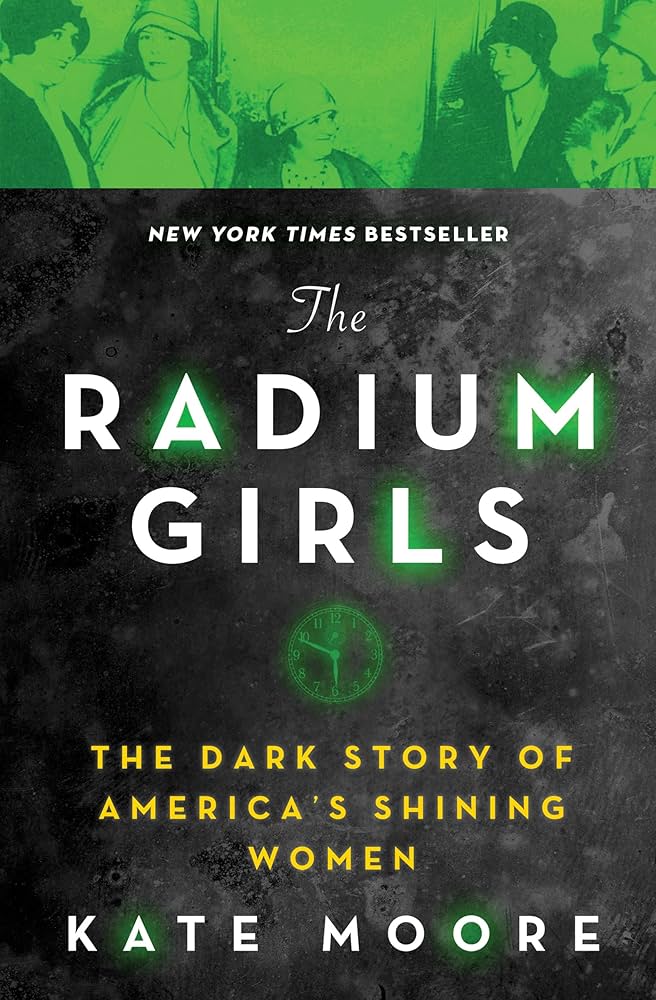
I’ve been thinking about writing on the topic of the Radium Girls for some time now. In our home library, the book by Kate Moore, The Radium Girls – The Dark Story of America’s Shining Women (2017), has been glowing at me (not literally, thank goodness!). The book is a fascinating history of the women who worked in watch-making factories across the States, and the groundbreaking battle for workers’ and women’s rights, which helped shape labour laws that would protect future generations from shameless exploitation.

Curie is the unit of measurement for radioactivity, named for both Marie Sklodowska-Curie and Pierre Curie (co-winners of her first Nobel Prize, in Physics, 1903); Marie went on to win a second in another field (Chemistry, 1911). Their oldest daughter, Irene Joilet-Curie, won the Nobel Prize (with her husband, Frédéric) in 1935, also in chemistry. Marie Curie died from the effects of exposure to radiation on 4 July 1934 (her husband would have had the same fate, but he was killed in 1906 in a road accident). Even today, her papers and even her cookbook are so radioactive that they are stored in lead boxes, and anyone examining them must be fully protected. I could do a whole history of the Sklodowska and Curie families; the women were intelligent, educated, ahead of their time and left their marks on history in several fields of science. [I don’t know if the book would be available where you live, but the youngest daughter of Marie, Eve Curie, wrote a biography about her mother, published in 1937 in several languages (I have the 1938 Swiss edition, in German). The book can be found in e-book formats as well.]
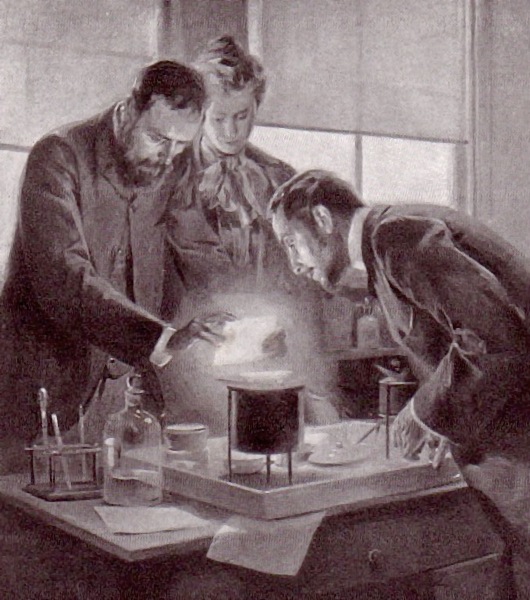
Marie and Pierre Curie experimenting with radium. Drawing by André Castaigne. Notice that they are all handling the radioactive material without protective gear…

Radium, discovered by the Curies in December 1898, caught public fascination; soon, Radium was touted as the cure-all of the new century. It was sold as healthy, as something that would make your skin glow. It was said to cure ailments and recharge your physiological batteries with pure energy. It was put into toothpastes, face creams, soaps, bath salts, makeup, and pure energy drinks. And it was painted onto the face of watches: Each painter would mix her own paints in a small crucible; they each had a camel hair paint brush and were instructed to keep their brushes pointed with their lips: Lip, dip, paint. The girls at the factories would paint their nails and faces with the paint for fun.

And then people started getting sick. Eaten from the inside out, their bodies started disintegrating, and they started dying. And at the time, workers at factories were earning a penny per watch face painted; they were too poor to quit, and too sick to work. And the company big boys denied all responsibility, medical aid or financial compensation. Eventually, though some of the Radium Girls tried to sue the United States Radium Corporation, the company dragged the case on so long that most of the women were bedridden by the time the company forced them to settle out of court. It was too late for those girls and those like them still working in the factories; their bones will glow for a thousand years. But public opinion was already on the side of the women, and it fueled a turning point in protective legislation, not only in America but in Europe as well.

For a fascinating insight into this topic, here are two links:

Radium Girls, Wikipedia

The film: Radium Girls (2020) (1:37)

Oh, and by the way: If you find an old, glow-in-the-dark watch face for sale made any time before 1971, give it a WIDE berth.
2 Comments

Filed under History, History Undusted, Humanity Highlights, Links to External Articles, Science & Technology, YouTube Link

History Undusted: Code Talkers

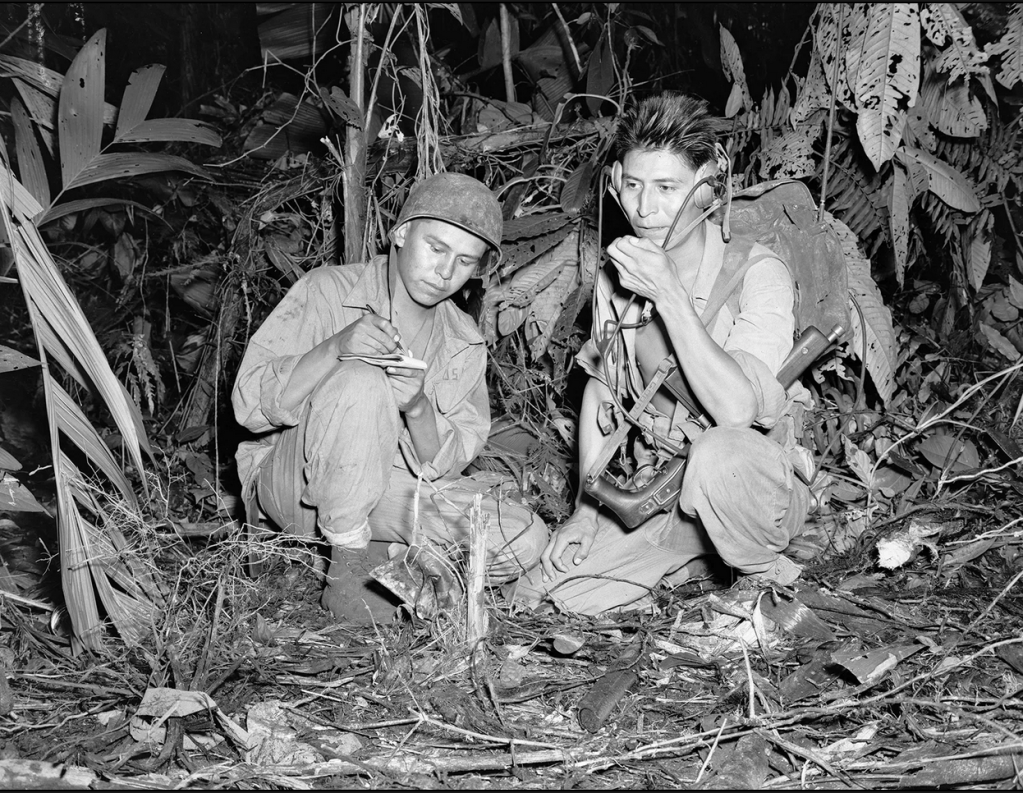
Navajo code talkers, Cpl. Henry Blake Jr. and PFC George H Kirk, who served with the Marine Signal Unit.
Source: Public Domain

Code talkers were Native Americans from various tribes who were employed by the US military during World War 2 as radio operators; their native tongues were indecipherable to anyone listening in, and as a result, their transmissions of sensitive messages were invaluable in allied victories on every Pacific island, including Iwo Jima, as well as in Europe in decisive battles.

Codes were developed based on the languages of the Assiniboin, Cherokee, Cheyenne, Choctaw, Comanche, Cree, Crow, Fox, Hopi, Kiowa, Menominee, Navajo, Ojibwa, Oneida, Osage, Pawnee, Sauk, Seminole, and Sioux peoples. These men could transmit over open radio channels, knowing that the enemy would be unable to break their code. If a military term did not exist in their languages, a phrase was used in its place: A submarine became an iron fish; a fighter plane became a hummingbird; a squad became a black street. In all, throughout WW2, over 400 terms were developed and needed to be memorised by each code talker.

The code talkers continued to be used after the end of the war, which delayed their recognition by the wider public – until documentaries about their service finally began to emerge in the 1990s. In 2002, the U.S. Congress passed the Code Talkers Recognition Act, followed by a similar act in 2008 to honour the tribes who used their languages in the wartime service of the United States.

The use of code talkers was a socially complex one: The languages that were so invaluable to the US military were the very tools that the US government had been trying to eradicate in the name of cultural assimilation. Between 1880 and 1905, boarding schools were established, in which Native American children were taken from their families and educated; they were taught to reject their Native values, languages, traditions and anything to do with their native culture. They were punished, sometimes severely, for using their native tongues; they were forced to dress like the “white man”, and were not allowed to wear their native garments or have any vestiges of their tribes. Some 100,000 Native Americans were forced to attend such schools. Parents who resisted the kidnapping of their children were imprisoned; several from the Hopi tribe were even imprisoned on Alcatraz Island. Though most of these schools had been closed by the 1930s, the cultural and psychological damage had taken its toll on many native people groups, many of whom still struggle with their cultural identities today. At the time these young warriors were called into military service or chose to join after the bombing of Pearl Harbor, many were not even legal American citizens, yet they fought for their land and their families.

With that background in mind, the dedication and ingenuity of the code talkers are all the more astounding. They were often in the first wave of soldiers deployed as they were needed to pass on messages for the strategic planning and execution of driving back the Japanese from the Pacific islands. In addition to the Pacific arena, the European front also benefited from the code talkers’ ability to communicate directly with each other: Comanche code talkers were assigned to the 4th Infantry Division when it landed at Normandy in June 1944. In this context, some of the Comanche substitutes were turtle for tank, a pregnant bird for bomber, and crazy white man was their term for Adolf Hitler – a more insightful term has never been more aptly applied.

For a fascinating look into a history largely forgotten, please click on the following video recounting code talkers telling their stories firsthand as they return to the Pacific Islands with their families and find peace after decades of PTSD. The video is 1:10, but well worth the time when you can take it: Navajo Code Talkers of World War II (2018) | Documentary

Other sources:

https://eji.org/news/history-racial-injustice-cultural-genocide/

https://www.britannica.com/topic/code-talker

8 Comments

Filed under History, History Undusted, Humanity Highlights, Liguistics, Linguistics, Links to External Articles, Military History, Psychology Undusted, Snapshots in History, YouTube Link

History Undusted: Engadin Sgraffito

I know that, for most of you, neither Engadin nor Sgraffito have made you any wiser as to what this blog is about, so first, I’ll start off by explaining where and what they are, respectively.

Engadin (pronounced En-Ga-Deen) is a long, towering Alpine valley in the Romansh-speaking canton of Graubünden in southeast Switzerland. The first mention of this valley was in Latin as vallis Eniatina in AD 930; in the Romansh language (one of the four national languages of Switzerland), it is Engiadina. The river running through the valley is called the En or Inn, and it is the only river in Switzerland that runs (via Austria) into the Black Sea. The region is usually divided into lower and upper Engadin, and it is connected to the surrounding regions by several mountain passes.

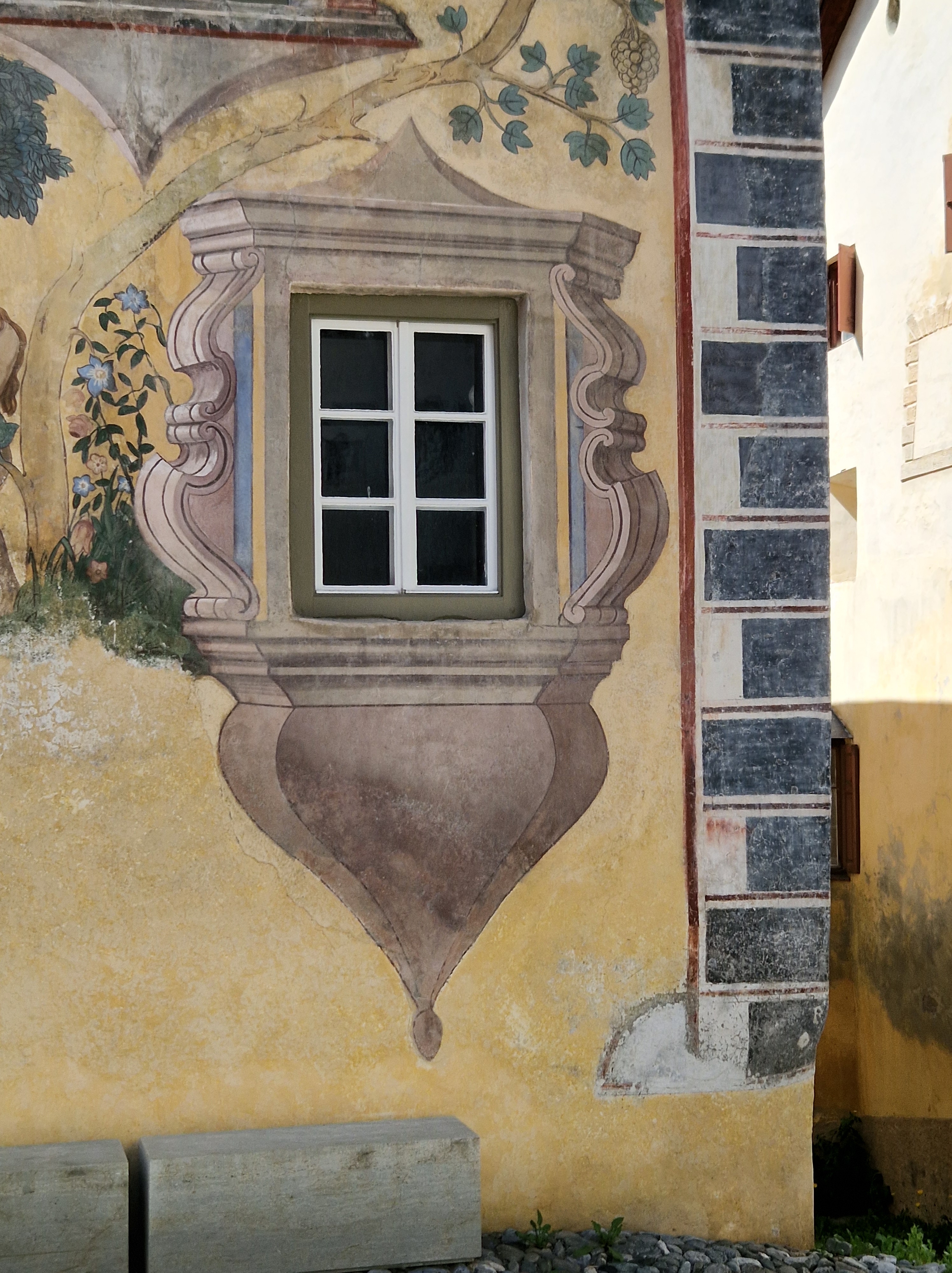
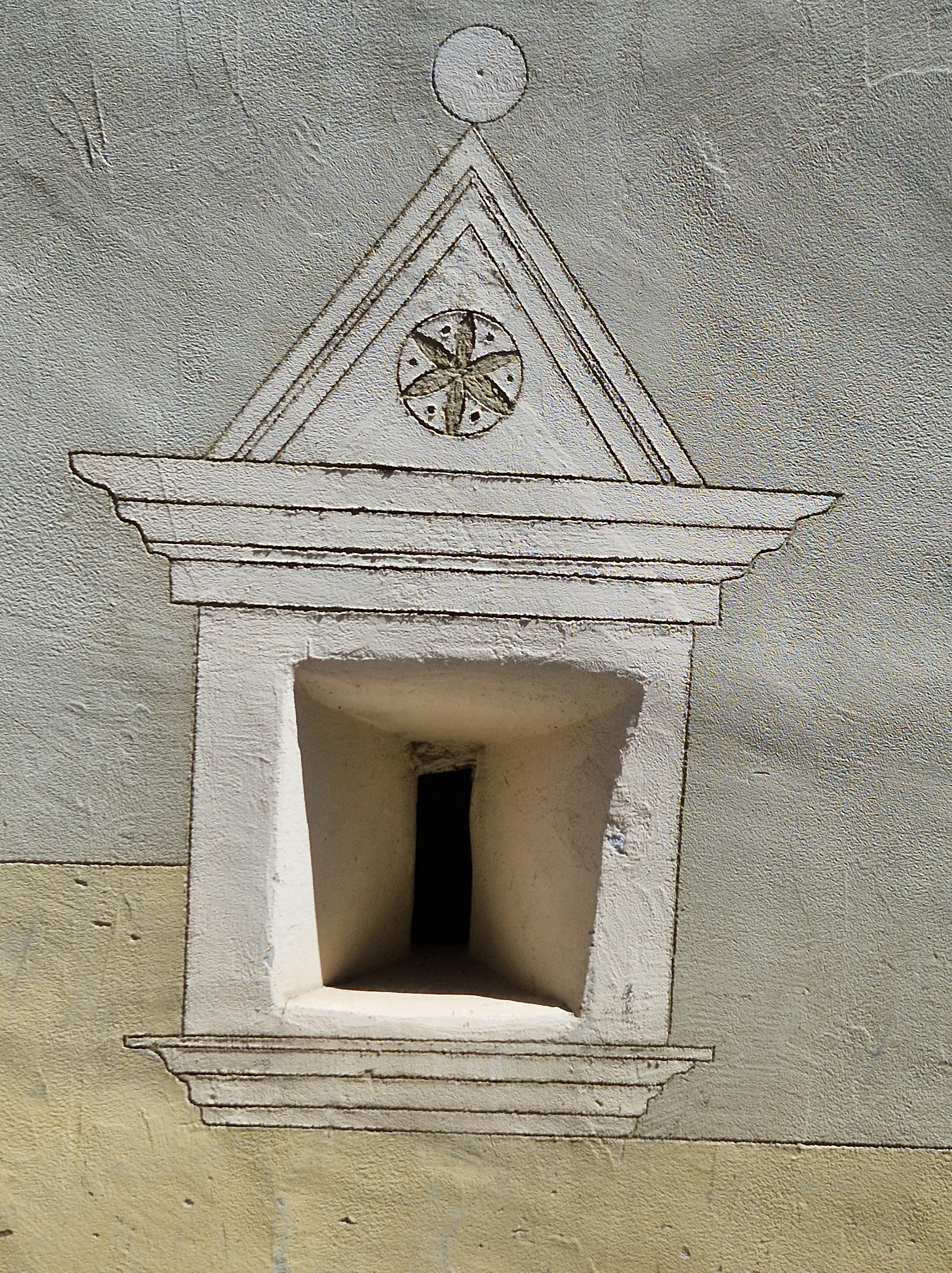
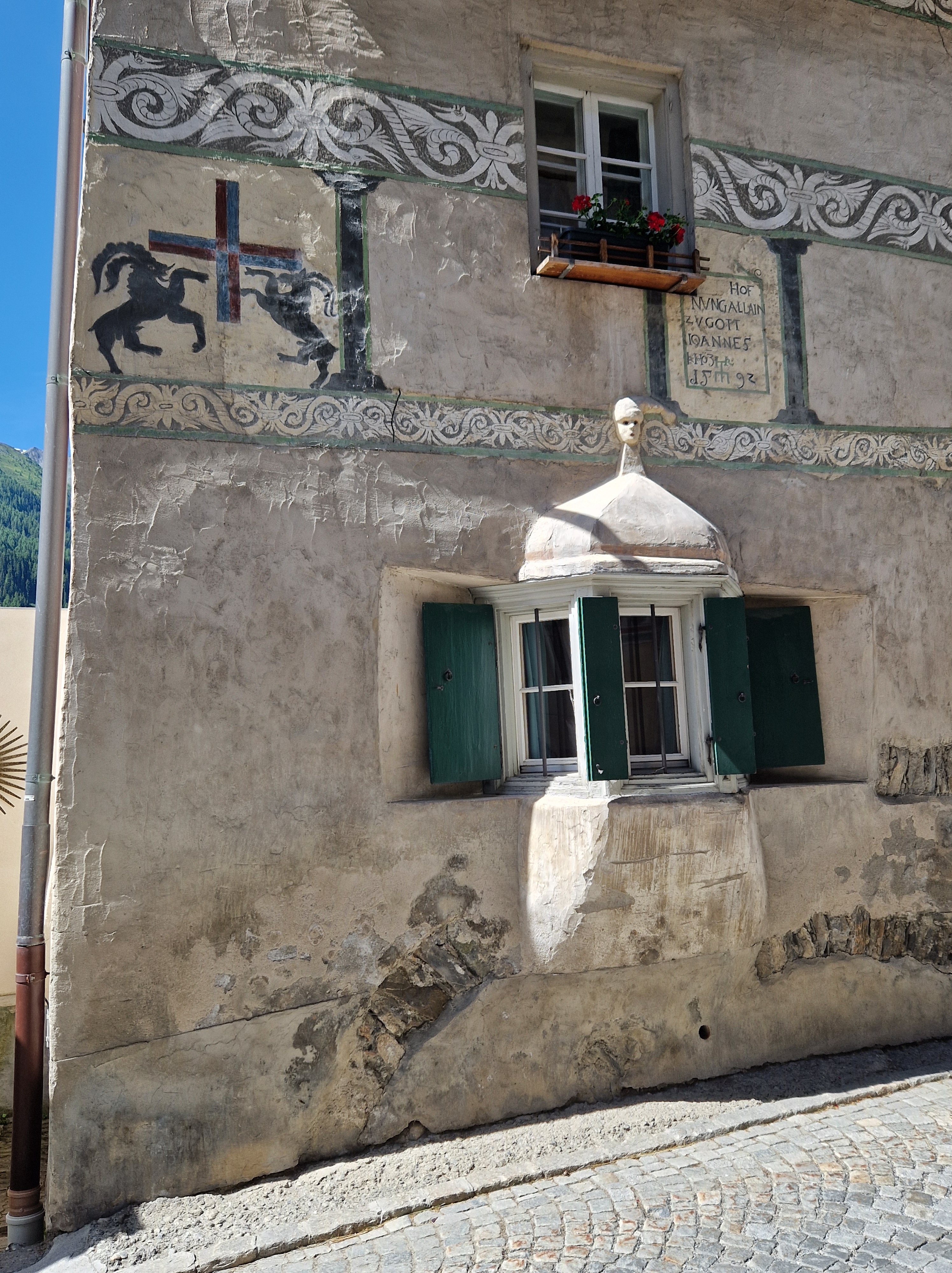
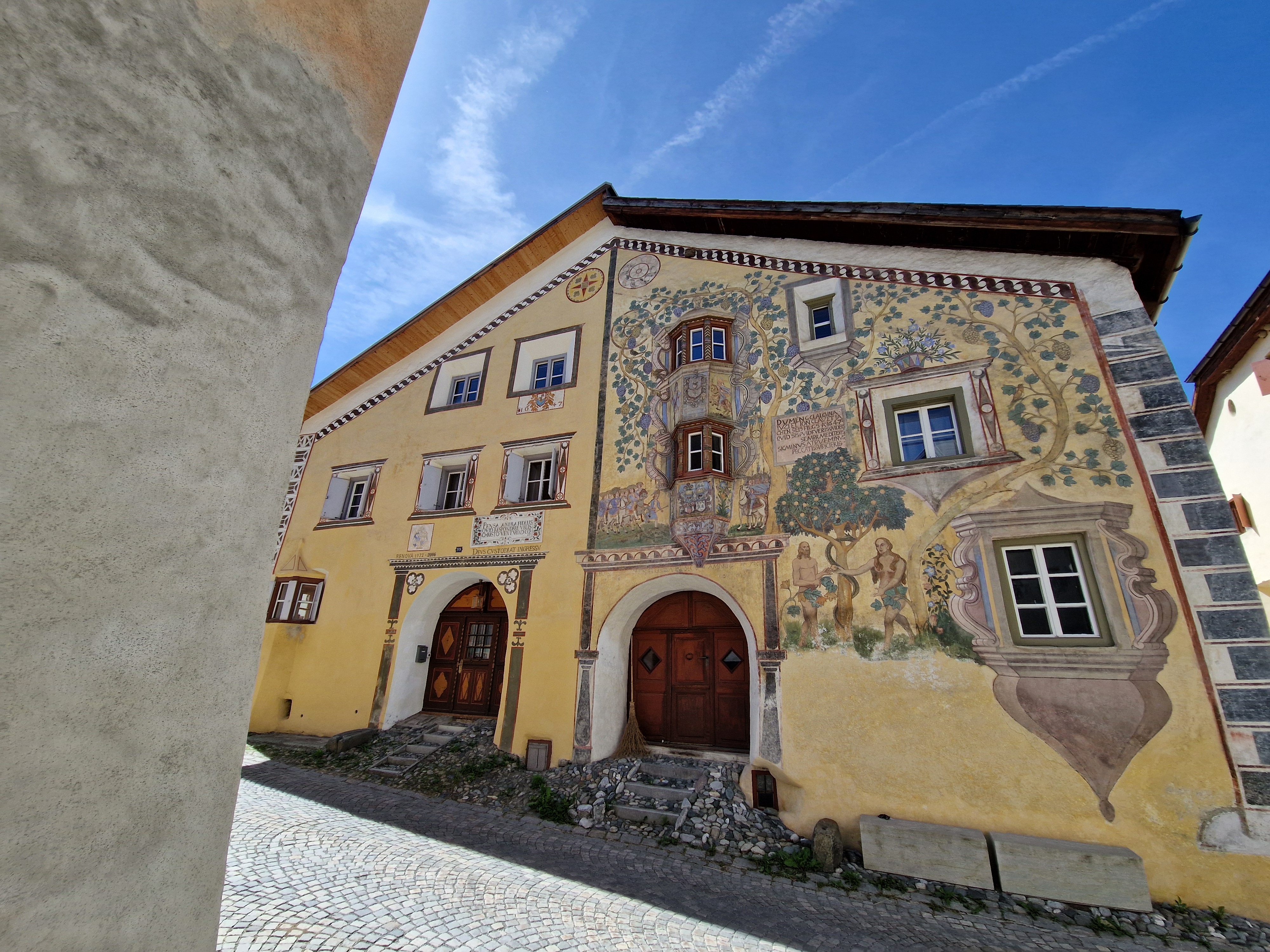
The second word, Sgraffito, describes a plaster technique that is traditional throughout Engadin: Layers of plaster of contrasting colours are scratched through, creating intricate designs on the facades of buildings (many of the buildings in Engadin towns were built (or rebuilt) in the late 1500s to early 1600s). The word comes from the Italian graffiare, which means to scratch; it can be traced back to the Greek word graphein, meaning to write (from which we also get any words containing the prefix, suffix, or derivative of graph (graphite, typography, graptolite, parallelogram, holograph, etc.). Sgraffito is not only used on buildings to make them look decorative, but it also serves the purpose of making a small feature look larger; on one building, the same floor had different-sized windows, likely installed over generations; the sgraffito was used to give a more uniform look to the façade. The decorations also make a plain building look grander, giving a more opulent impression. One building, pictured below, obviously had two occupants with very different characters back when they were originally decorated…

The basic technique for architectural features is to plaster the façade with the base colour; once that has set, it is then plastered with a contrasting colour; once that has set just enough, the scratching, or carving, begins. This is also a technique used in pottery and in creating stained glass effects (just click on the links if you’d like to see how these crafts are made).

One thing to note is that many old buildings here in Switzerland have dates listed on them: Of when they were originally built, and when they’ve been renovated. Part of the history of such renovations may include fires that swept through villages, or avalanches that buried a layer, or wars, such as the Swabian War and war against the Habsburgs, and the subsequent renovation or rebuilding of the towns or individual homes. Sometimes, along with the dates, a list of past and present occupants will also be displayed, preserving their names and memories within the history and changes of the building itself.

Below are a few pictures taken in Engadin during our recent summer holidays. Enjoy! Feel free to zoom in on the pictures to see the details.

5 Comments

Filed under Articles, Etymology, History, History Undusted, How It's Made, Liguistics, Links to External Articles, Military History, Snapshots in History, YouTube Link

Tasteful History: Hot Cross Buns

This “History Undusted” has a tasty twist: I’ll dive into the history behind this food popular throughout the English-speaking world and Commonwealth nations, and then I’ll include a recipe if you’d like to try it yourself.

Pompei Bread, AD 79

Hot Cross Buns can be traced back to the medieval period, though scoring the top of breads has been practised for thousands of years; a bread, found in the ashes of the volcanic eruption that wiped out Pompei, shows scoring – likely to make the portioning of the loaf easier; it’s a precursor to the sliced bread we know today. Early Hot Cross Buns used this knife-scoring; the version we recognize today was first introduced in 1361 by Brother Thomas Rocliffe, an English monk at St Alban’s Abbey, who made what he called the Saint Alban’s Bun; he distributed the baked goods to the poor and pilgrims on Good Friday. Many foods can be traced back to a specific holiday: For instance, when you think of a Christmas meal, wherever you are in the world that celebrates Christmas, specific combinations of dishes come to mind that you probably don’t eat at any other time of the year.

During the medieval period, the crossed buns would be hung from the rafters of houses for an entire year, believing that they would ward off evil spirits. During the 1600s, the Puritans put an end to that practice, and Queen Elizabeth I even banned the sweet breads, consigning them to consumption on Good Friday, Christmas, or at funerals (bad luck for the deceased, who missed the excuse for the treat). By the 18th century, it had become firmly associated with Good Friday. To give you a taste of history, click here to watch a short video from the York Castle Museum.

Today, all kinds of versions are on the market year-round, from the traditional, to chocolate, to Cheddar cheese and marmite.

So, without further ado, here’s a traditional recipe you can recreate for yourself.

Hot Cross Buns

To watch this recipe’s creation, click here. Below, I’ve listed out the ingredients and basic instructions, as used in this video by Chef Jack Ovens.

1½ C. (375 ml.) whole milk – heat the milk until just warm on the stove or in the microwave on short bursts, until around 104°F/40°C.

In a mixing bowl, add 1 Tbs./9gr. Dry yeast & 2 tsp. out of ½ C. sugar (the rest will be used later); pour in the warm milk and whisk until combined. Set it aside for 10 minutes to allow the yeast to feed off of the sugar. A froth will form, which means the yeast is active.

Add in 4 ¼ C. (640 gr.) bread flour

the rest of the ½ C. sugar

1½ C. sultanas (raisins) (you could substitute ¼ C. with candied orange for the traditional version)

2 tsp. ground cinnamon

2 tsp. ground allspice (cloves, for the traditional version)

The zest of 1 large orange

1 egg, beaten

50 gr. melted, cooled unsalted butter

¾ tsp. sea salt

Mix all of this until thoroughly combined – either using a mixer with a dough hook, or by hand.

Dust your workspace with flour, turn the dough out and knead for 8-10 minutes. Shape it into a smooth ball. In a greased mixing bowl, place the dough and cover with a warm, damp tea towel and allow to proof for 1 hour, or until doubled in size. When it’s risen, punch the dough a few times to remove the air; dust your workspace with flour and tip out the dough. Knead the dough to remove any air bubbles, then shape it into a log around 60 cm / 23 inches long. Slice that in half, then roll each section to a log to 40 cm / 15 inches long.

Slice each half into 6 even pieces; form each into a ball, tucking the edges underneath.

Line a deep-sided baking tray with parchment/baking paper, and lay your balls of dough in rows of 3 by 4. Cover with an oiled piece of plastic wrap to allow the buns to rise without sticking to a towel. Allow to proof for 40 minutes.

While it’s proofing this final time, preheat your oven to 180°C/350°F

To make the dough for the crosses:

½ C. /70 gr. bread flour

95 ml. cold water

Whisk these together until it forms a piping paste.

In either a piping bag with a 3mm nozzle or in a plastic bag with the corner snipped off, spoon in the dough and pipe it across the rows of buns, making sure to cover to the edges of the buns.

Bake for 20-22 minutes, rotating the tray halfway through. A few minutes before the buns are done, in a small bowl, mix:

½ C. / 110 gr. caster sugar

150 ml. boiling water

Mix with a pastry brush until the sugar is dissolved. Remove the buns from the oven and glaze them with the sugar water – just enough to cover each. This will give a nice crunch to the crust of the bun. Allow them to sit in the tray for a few minutes, then transfer to a wire rack. Slice, butter, and enjoy!

Leave a comment

Filed under Food History, History, History Undusted, Snapshots in History, YouTube Link

History Undusted – The Tactile Language of the Quipu

Throughout history, languages have come and gone; an estimated 30,000 have existed at some point in time, though currently, there are roughly 6,000 to 7,000 languages in use – and most are threatened with extinction. Think about that. The impact on the loss of cultural history, connection to ways of thinking, ways of communicating, and ways of processing information; senses of humour, and national heritages will be lost.

An example of a language nearly lost, but which is now familiar to most of us by sight, is the logogram language of Egyptian hieroglyphs. The knowledge of how to interpret the symbols had been lost for centuries, until 1799, when a stone was found near Rosetta, along the Nile Delta in Egypt; the stone was a stele with a decree issued in 196 BC; the texts carved into the stone were Ancient Egyptian (“demotic” text), hieroglyphs, and Ancient Greek. Because Greek was a known language, they could use the Rosetta stone to decipher the forgotten languages.

When we think of writing, we may think of various alphabets: Greek, Roman (of which English makes use), Norse Runes, or the logographic or ideographic languages of Asia, such as Chinese or Japanese, or the cuneiform writing of the Ancient Near East. But did you know that there have been languages based on string?

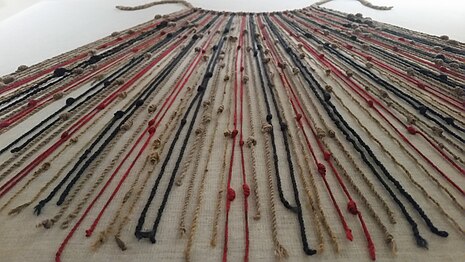
Quipu in the Museo Machu Picchu, Casa Concha, Cusco. Source: Wikipedia

The Inca people, in the region of modern Peru and Chile, used knots on an elaborate system of connected strings or cords for collecting data, keeping records, recording taxes or census records, making calendars, or for military organisation. When the Spanish Conquistadors swept through, they found numerous bundles of strings, but had no idea of their significance; they destroyed many of the quipu*, not realizing that they might have held in their hands a record of an individual’s wealth in animals or crops. [*Quipu is the Spanish spelling used in English; it is also spelled khipu or kipu.] Other cultures have also used similar concepts with knotted strings to record information, unrelated to South America; these include China, Japan, Taiwan New Zealand, Hawaii, and other parts of Polynesia.

As with most textiles, they unfortunately didn’t stand the test of time very well, and only a fraction remains today. The ancient world may have taken the concept of the quipu one step further in creating the more flexible abacus, though the latter was (and is still) used for temporary calculations, while the former was rather for recording information. Whether or not there is a historical link, both are visual tools that can be used for similar functions to a certain extent.

Even with such widespread use of these knotting records, their meaning was nearly lost, until a Harvard student, Manny Madrano, had time on his hands one summer and solved a centuries-old mystery!

For an interesting video on this topic, please click here. I hope you’ve learned something! Keep being curious about our fascinating world!

6 Comments

Filed under Etymology, History, History Undusted, Liguistics, Science & Technology, YouTube Link

In a Name

My husband and I have a quirky sense of humour; we recently had a good laugh coming up with pets’ names in pairs (don’t ask why that topic came up – it’s too hard to reconstruct!): There are pairs of names commonly associated with each other, such as Tom and Jerry, or Cain and Abel; last night, we thought of naming two cats Maelstrom and Doldrum – the irony is that these are nautical terms for ocean conditions and we live in a land-locked country. My husband says that if we ever have a snake, he’ll name it “Abebambelela” (which is a Swiss German phrase meaning “to hang down”)! There are certain words that I find funny, like Asparagus (or the old English version, Sparrowgrass), and I can imagine naming cats something Latinesque, some of which are actually quite beautiful (Aurora, Adamaris, etc.)

Pet names are as creative as the owners, so the sky’s the limit! I once heard of a dog called Dillingham Osborn Gunderson… initials being DOG. Naming a pet Velcro, Big Mac, Groucho or Tweezer seems tame to some purebred titles (such as Bluewater Full Metal Jacket – Jack for everyday wear). When our cat had kittens (the mother, Gandria, and father, Caprino, were named after towns along Lake Lugano), we used musical terms (sticking with Italian): The first came out vocal, so he became Crescendo; the second was slow and calm, thus Piano; and the 3rd is gentle but friendly – Allegra. We kept Allegra, who is curled up between my feet as I write this; the other two were adopted by neighbours – who subsequently moved to give the cats more room!

I will never have a purebred pet; more often than not, the animals are sickly, as traits have been unnaturally bred into them; pugs and Persian cats are prime examples of pets that simply cannot breathe properly, and have respiratory infections or even failure. These health issues are hot topics between breeders and vets or those who care for animals such as the Kitten Lady. Give us a good ol’ farm cat, “Heinz 57-pedigree”, and they’ll do just fine! We have three cats: Allegra (born in 2009), Andromeda Zora (from an animal shelter, born in 2020), and Mira Bella (born in a home nearby, 2021).

Do you have any pets? If so, what are their names, and how did you choose them? Please comment below!

Left to Right: Allegra, Andromeda, Mira

4 Comments

Filed under Articles, Etymology, Family History, Musings, YouTube Link

History Undusted: The Atrocities of the Milan Conference

The topic of this article has been on my mind for the past two weeks; last week flew by so fast I barely had time to blink, let alone order my thoughts into coherent sentences. The topic was sparked by coming across an article online about what is known as the “Milan Conference” or “The Second International Congress on Education of the Deaf” (though it was, in fact, the first), held in Milan, Italy in 1880.

To give you a bit of my personal background, I learned BSL (The Glaswegian dialect) and translated for the deaf when I lived in Scotland. Being as close to that community as I was, I’d shockingly never heard about the Milan Conference until a fortnight ago.

When I first moved to Switzerland, I wanted to continue working with the deaf and began taking Swiss German sign classes. I immediately began hitting brick walls: The crux of the matter was spelled out – they didn’t want hearing people in their world. It made little sense to me back then, and it was frustrating. Also at that time, my husband wasn’t yet hearing impaired – which would have made a difference in their attitude toward me, as people with family members affected by hearing loss were more acceptable to them. In light of the Milan Conference, their reticence makes perfect sense. I never was able to break that barrier, and I’ve lost much of the sign language I once used fluently.

The conference was an international gathering of (hearing – with only ONE exception) educators of the deaf and mute. The imperialist arrogance of the discriminating resolutions passed profoundly wounded and damaged the deaf community for nearly 100 years.

To sum up the conference’s resolutions briefly, the majority decided that sign language was disadvantageous to integrating the deaf into the hearing world, and they banned – yes, banned – sign language from the education of the deaf in favour of “oralism” – forcing the deaf to read lips to make them assimilate to the hearing world’s culture. Deaf teachers lost their jobs, and an overall decline of deaf professionals resulted – they were no longer allowed the tools to communicate in their own language, and communication professions such as artists, lawyers and writers fell silent. Here in Switzerland, there was a two-fold impact: Deaf children were forced to sit on their hands and learn to lip-read from High German-speaking teachers; but when they went home on holidays, they couldn’t lip-read their own family’s dialects of Swiss German, and so they were isolated from society both in school and at home. The anger and resentment to the hearing world still runs deep.

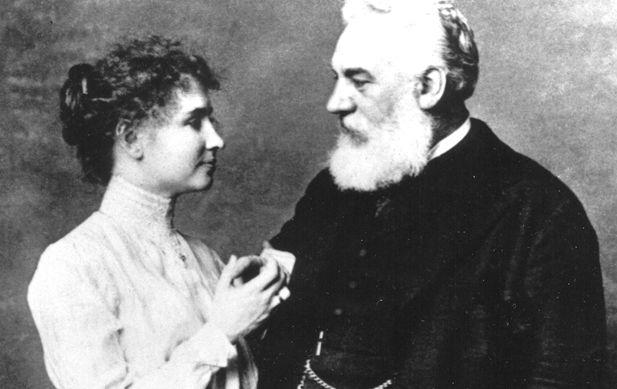
Most disturbing for me is the fact that Alexander Graham Bell, whose own mother and wife were deaf and who worked with the deaf throughout his life – including helping bring Helen Keller out of her silent world as a blind and deaf girl – was one of the strongest proponents for oralism at the conference. The most famous picture of Bell and Keller is one in which Keller is finger-spelling on Bell’s hand. It is a form of sign language. Yet he advocated to eradicate it.

The resolutions of 1880 held their ground until they were overturned in 2013 when an official apology was issued to the deaf community. Eleven years ago. Let that sink in. Inroads were made to teach sign in pockets here and there; in America, most schools for the deaf only began teaching sign language again in the 1960s; in the UK it was around a decade later. Generations suffered under the restriction. [For those who have been deaf their whole lives – what’s known as pre-lingually deaf – it means that sign language is their first language, while spoken English is their second; this can lead to difficulties in understanding complex or abstract messages in English. Imagine being denied your own native language…] Only in 2003, the British government recognised BSL as a minority language – but so far, Scotland is the only country in the UK that has given BSL legal recognition. The shift in understanding and recognition had already been set in motion by the time I’d moved to the UK, which is perhaps why the Milan Conference was no longer a topic when I was involved in the deaf community.

The ban is the main reason there are so many regional dialects today: Even though sign language was officially banned, the deaf still needed to communicate among themselves, and so signs evolved “under the table” within each pocket of deaf students. There was no exchange of information; for example, “bread” took on the shape of the local speciality, so in the French part it looks like a long baguette, while in the Zurich region, it looks more like a half-sphere. There are 5 major Swiss-German dialects; in Scotland, there were at least 7.

Please click here to watch a ~13-minute video by Storied about the history of sign language and the Milan Conference. If you’d like to learn more about the timeline of sign language in Britain, please click here to visit University College London’s website, and to learn more about BSL in Scotland, click here to read the Scottish Parliament’s article.

ASL, American Sign Language, also has a forgotten predecessor that was largely written out of history: The Plains Indian Sign Language, also known as “hand talk”. For an interesting video about that history, click here.

 I hope you’ve enjoyed this brief insight into a long and tangled topic, and that it encourages you to look into it more.

Just as a parting trivia: Everyone recognizes the sign for phone; but did you know that it became a euphemism in some deaf communities for the restroom/loo? Back when restaurants had their public phones near the “small closets”, the Deaf would sign “phone” as a polite, covert way of saying they were going to the restroom/loo.

Below are the British Sign Language and the American Sign Language alphabets; I’d encourage you to learn one or the other and stretch those grey cells a wee bit!

9 Comments

Filed under Articles, Etymology, Grammar, History, History Undusted, Humanity Highlights, Links to External Articles, Signs, Translations, YouTube Link

The Hum

Recently I came across an article on the phenomena of “The Hum” – a low-frequency sound heard by people across the globe. The hums are often given their location’s place name, such as the Taos Hum of New Mexico, the Auckland Hum or the Windsor Hum. While these sounds are clearly heard, no one seems to agree on the source of the sound: It could be produced by electrical equipment, an unfamiliar animal sound (such as the toadfish), the Jet Stream shearing powerline posts, volcanic eruptions, lightning static, ocean wave vibrations, or internal biological auditory signals.

If you stop and listen, there are sounds everywhere. But The Hum is not tinnitus, which has a much higher sound frequency. I’ve had tinnitus for years; when it’s quiet, I can hear up to eight tones of ringing in my ears. It’s something that affects around 15% of the population, but the only time it really becomes an issue is if it triggers a fight-or-flight response in a person – I’ve heard that the more you focus on the ringing, the more you hear it (the more it bothers you). In almost half of the people who have tinnitus, it can lead to phases of anxiety or depression, likely linked to that psychological fear response. Some people don’t even realize they have tinnitus – they automatically, subconsciously distract themselves with sound (music or television being common tactics). The causes of tinnitus vary, but in my case, I know exactly when it started: I was flying from London to Glasgow, and I had a head cold. The flight was just at that altitude where your ears almost pop, and it was excruciating. I can still hear fleas sneeze and “tell you if they’re male or female”, but the ringing is always present – I just ignore it for the most part. I hear so well that I sleep with earplugs each night – otherwise, I can hear electricity in the walls, and a battery charger at the far end of our home sounds like a car alarm to me!

Have you heard The Hum? Do you have tinnitus, and if so, does it bother you in any way or are you able to ignore it?

If you’d like to learn a bit more about The Hum, and what it could be or what it could mean, please click here for a 12-minute BBC report on the issue.

8 Comments

Filed under Articles, History, Humanity Highlights, Nature, Psychology Undusted, Science & Technology, YouTube Link

Humanity Highlight: Redeeming Toxic Land with Lavender

I came across this story today, and wanted to share it: In the US, coal mining used to be big business; but with the move away from fossil fuels toward solar and other less destructive sources, companies have been in decline; before the mid-1970s, mining companies could just abandon the scarred land, but laws were passed that would require the companies to revitalise the wasteland; but if a company simply went bankrupt, the land sat barren, polluting the surrounding environment for decades, as rocks and minerals that had been buried forever were exposed to air and water, releasing their substances into groundwater and the air. Millions of acres of scarred land are the result.

Now, Appalachian Botanical Company in West Virginia has begun reclaiming the land in a beautiful way: Hiring ex-miners who’ve lost their jobs or other people who need a second chance just like the land, such as ex-drug addicts, they are now working in fields of flowers. Lavender is a hardy plant in the mint family that likes to grow in poor soil; it’s a perfect match for the rocky wastelands around coal mines. Every part of the plant is used: The flowers and upper stems are distilled down to make lavender essential oils that are then also used to make various creams and lotions, honey, salts, and hand sanitisers; when it’s done, they transform the biomass into compost to revitalise the land. The lower leaves are first removed, dipped in rooting powder, and planted to make the next harvest.

It’s an amazingly holistic approach to the problems: Creating jobs in the regions that have been hard-hit by economic downturns; revitalising the land through restoration – lavender will help prepare the land for other less hardy species to take root; and on a larger scale, it provides an example of what could be done with scarred land. To watch the Business Insider video, just click here. To check out the ABCo website and their products, click on the image below. Enjoy, and if you’d like to support what they’re doing, check out the pages on their websites, too.

2 Comments

Filed under Articles, How It's Made, Humanity Highlights, Links to External Articles, Nature, Science & Technology, Videos, YouTube Link

Humanity Highlight: Fighting Deforestation with Coconuts

I love coming across stories about individuals making a difference in the world; it shows that one person can really make a difference – not just the rich and famous, but the unknown and unsung heroes that have a vision, and do what they can with what they have until they have more to see their vision unfold.

Alhaji Siraj Bah is such a person: a young Sierra Leonean, he lost his adoptive family to a mudslide when he was 17. The mudslides are an increasing problem, as 70% of the Sierra Leonean forests have been chopped down for firewood; most families use small wood-burning cookers. But something else that everyone does is eat coconuts. Every day, tons of coconut husks are emptied in the street markets, and the sellers then have to pay to remove their biowaste. Alhaji worked on and found a solution to both problems: Turning the biowaste into biofuel briquettes – coconut coal which gives off less smoke and burns four times more efficiently than wood-based products. This idea is not original – there are many similar products on the market; but what I like about his story is that he refused to give up, looking for a solution to local problems, providing jobs, a free removal service, and offering a locally-grown waste-turned-fuel.

To see an interesting video from Business Insider on his story, just click here.

1 Comment

Filed under How It's Made, Humanity Highlights, Science & Technology, YouTube Link