English is relatively young, as languages go. Like a sponge, it absorbs words and meanings from other languages, then squeezes them out in a similar (or widely different) form. In other words, English is a survivor; it has survived the attempts to destroy it by the Danish Vikings, the French (Normans, aka Vikings disguised as French), and the Germans. These historical encounters give me high hopes that it will survive the age of the Cell Phone. With each skirmish, it has come out stronger, more versatile and more flexible. When the Pilgrims packed up English and crated it off to the New World, it was locked, as it were, in a time capsule. British English absorbed a few bad habits from the French before they thought better of it and distanced themselves during the French Revolution, but in the meantime, contentious pronunciation differences to that time-capsule relative over the Pond had crept in and persist to this day. One example: The American pronunciation of schedule (/skedju(e)l/) is from the original Greek pronunciation, which was used in Britain for onk-years until they took on the fancier French-ified pronunciation of /shedju(e)l/. For a fascinating glimpse into how Modern English was formed, William Caxton (~1422-~1491) is your man.
While English pilled through the pockets of invaders stealing loose grammar, we also lost a few words along the way: Some words are known to us in one form but not the other, while other words have been lost altogether due to a more convenient absorption or form arising. You know of disgruntled (adj.), but what about gruntle (v.) or disgruntle (v.)? And dis– in this particular case is not used to form the antonym of gruntle, but means exceedingly gruntled. And I don’t know about you, but conject as a verb makes more sense than “conjecture” to me. And shall we vote to bring back “Oliphant,” as J.R.R. Tolkien saved it from extinction through his use of it in Lord of the Rings? What about pash (n.), contex (v.), or spelunk (n.)? We know of fiddle-faddle, but what about plain ol’ “faddle” (to trifle)? Some, admittedly, are not missed; toforan is better served with heretofore, in my humble opinion (IMHO). Needsways is a Scottish word, obsolete in England and America perhaps, but alive and well north of the Border. There are some deliciously eccentric words which deserve resuscitation, such as loblolly, bric-a-brac, sulter, pill (v., to plunder, pillage – ought to come in handy, that), quib, bugbear, uptake (as a verb), wist (intent), or sluggy. If Sir Walter Scott can save words such as doff and don from extinction, so can we.
Oh, and if you’re wondering about the word archaism, it means “retention of what is old and obsolete.” So twinge your language to include these mobile words and their meanings, and revelate your intelligence! And if you’re curious, yes, Grammarly and spellcheck were going batship crazy with this post!😎
(Comic from xkcd used under a Creative Commons license)
My husband and I were having lunch recently, and a package of Swedish crackers was on the table; I pointed to the brand name, Pågen. In English, our pronunciation of these vowels would lead us to say pagan /pæg-in/, whereas the Swedish would rather be more like /po-gen/. I just mentioned that English might have sounded similar to that before the Great Vowel Shift, which he’d never heard of (being Swiss, it’s not likely he would be familiar with this aspect of English etymology), so I promised to write a blog about it; here we go!
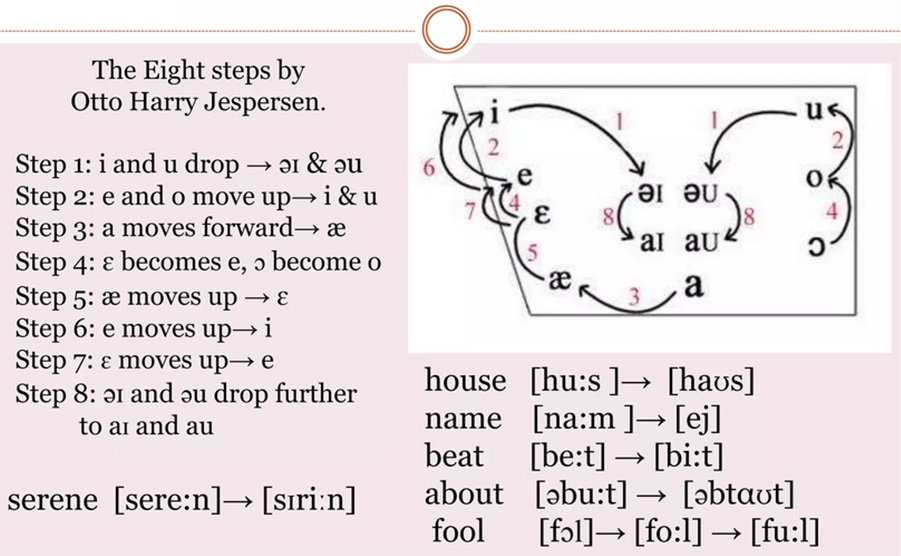
The term Great Vowel Shift was coined by the Danish linguist, Otto Jespersen (1860-1943), who specialised in the English language. Though the GVS is considered a single event (because of the changes being viewed as part of a chain reaction, with each vowel sound changing in a predictable way), the actual transition of English pronunciation was gradual, taking place over about 200 years, from ~1400 to ~1600. The shift began in Middle English, which was spoken from 1066 until the late 15th century – that form familiar to Geoffrey Chaucer (though his pronunciation would be unintelligible to us, his words still survive through his famous Canterbury Tales) – into Early Modern English (from the beginning of the Tudor period through to the Stuart Restoration period); Shakespeare would have been familiar with it. From there, English transitioned into Modern English in the mid-to-late 17th Century.
The main changes were that, from Middle to Early Modern English, the long vowels shortened; weef became wife, moos* became mice, beet became bite, and so on. (*The word moose entered English through Native American languages in 1610). I will also mention that in Scottish, a lot of the older vowel pronunciations still exist; house is still huus, full is homophonous with fool, etc.
Here’s a look at just how the English vowels shifted:
Source: SlideShare
If you’ve been paying any sort of attention to English, you’ll know that our spelling is a bit chaotic; the language is full of homonyms, which are divided into either homophones (words that sound the same but have different spellings, e.g. beet and beat; bear and bare; to, too and two), or homographs (two words with differing meanings, same spellings, but not necessarily the same pronunciation: e.g. bank [of river; finance] or agape [with mouth open; love], or entrance [a way inside; to delight]) or tear [ripping; crying]. These -graphs and -phones came into English from regional dialects that were transported as migration and cultural mixing took place, and the GVS added its two pennies to the mix. Just think of the variety we have in the sounds /ea/ (bread, beat, bear, break); /oo/ (look, spool, blood); or /gh/ (through, cough, sight).
Certain factors contributed to the speed of language shift: The Black Death (1346-1353) wiped out up to 50% of Europe’s population. Stop a minute and let that sink in. What if the population of your town were reduced by half? And the next town, and the next. That single event changed the course of history on many levels; surfs could finally demand better wages wherever they ended up settling; if you lived in a town that no longer had the skills of a baker, blacksmith, or any other trade you’d depended on, you’d move to where those services existed – and jobs existed – and that meant places that had been hit the hardest by the plague and thus where everyone else was migrating, such as London. As mass movement followed the epidemic, people brought their dialects and their spellings with them. It began to converge into a new, distinct way of speaking, thinking and spelling. The geopolitical climate of the time also influenced English; England and France have been annoying each other for over a thousand years; whenever England was enamoured by all things French, they tried to emulate their pronunciations. That influence came and went; in one such moment, the pilgrims set sail for America (1620), taking a time capsule of the language with them, while England’s English continued to be influenced by French up until the French Revolution, when it quickly fell out of favour in England, though the changes had already taken place (one example is the American /k/ in schedule, closer to the original Latin, while the English say /sch/ without the /k/, which is closer to the French cedule). This factor of influence also affected differences of speech between the lower class and upper class at that time; the upper class wanted to sound more posh, more fashionable, and above all, not like the lower class.
A major contributing factor to our chaotic spelling is that ca. 1440, the Gutenberg printing technique was introduced, and by the 1470s, William Caxton had imported the invention to England; we have him to thank for Chaucer’s Canterbury Tales being known today, as that was the first book he printed in England. We also have him to thank for the influence of Chancery English (the English used by the secretariat of King Henry VI) in the standardization of the language, as he used it as his own guidelines in printing. The vowels had already begun to shift by that time; enter the written word, a rise in literacy, and you have the jumbled effects of “mid-shift” on English spelling – people began to adapt their pronunciation to the written word, so whichever form the printer used is the one that began to prevail, even though some sounds were still in transition. Like nailing down jelly. You could say that many of our odd spellings are simply a snapshot in time.
It is also important to point out that the GVS didn’t have the same influence everywhere: The main changes occurred around London, but the farther away you move from that epicentre, the less the effects on the local dialects, which still holds true today – though gradual merging has allowed people from, say, Cornwall, to understand people from Yorkshire – which wouldn’t have been the case centuries ago. Even though they can understand each other, their dialects are still distinct. I’ve already mentioned that Scots English (as opposed to Gaelic) still retains many of the longer vowels long since lost in standardized English; being so far from London, they simply ignored them. English may be taught in their schools, but Scots dialects prevail in the home and hearth. Regional dialects in English exist the world over, and though spelling and pronunciation may differ from region to region, and the language continues to be a living, breathing, growing and changing being, it’s still a language that enables the modern world to communicate, whether English is their mother tongue or not.
The idiom “Catch-22” comes from a book of the same title by American author Joseph Heller (1923-1999). The term originally referred to a military rule whose provisions are mutually frustrating. Heller used Catch-18 instead of Catch-22 when the first chapter of his book was originally published in 1955. He changed it by the time the entire book was published in 1961 because his publisher had already published a book that year with “18” in the title (Leon Uris’ novel, Mila 18). So in 1961, the phrase Catch-22 first appeared. It was first used figuratively in 1971 in Atlantic Monthly magazine. As far as the form goes, it is usually hyphenated and with a capital C, as that is the way Heller originally wrote it.
Since the author’s first usage of the idiom, it has taken on a life of its own: Today, its broader meaning is a paradoxical situation from which an individual cannot escape because of contradictory rules or limitations. It has also been used as a mnemonic for the symptoms of DiGeorge syndrome.
One particular quote from Heller is thought-provokingly insightful: “Everyone in my book accuses everyone else of being crazy. Frankly, I think the whole society is nuts – and the question is: What does a sane man do in an insane society?” In a way, this is perhaps an example of a Catch-22 for the sane person: If they stay in an insane society, they may lose their sanity; but by leaving such a society, they throw away any chance of bringing it back to a state of reason. Social and political polarisation are both poisons that infect society.
This word is doubly obscure, at least for me: Whilom (c. 1200), means having once been; former; once upon a time, erewhile, or at times past. It comes from the Old English hwilum, meaning at times, and is related to today’s while. It is doubly obscure for me because it has a similar formation to an equally obscure German word, weiland, meaning formerly, of yore. This German word is related to the modern weil, which is a false friend to the English word; the German word means because. The relation between the two is not a far stretch, as because implies that something happened in times past, once upon a time.
What do you think? Should we bring back whilom? I think, at any rate, we should start using of yore every chance we get!
Picking up from where I left off in February, here are a few more everyday phrases that have been gleaned from the times when ships at sail were the most influential source of importing new ideas, foreign words and catchy tunes (such as shanties). The first of these phrases might be recognized by Star Trek fans, as the captain usually used this term or something similar to hand over the authority of the ship whenever he left the bridge.
Take the Conn: A term used to take over navigational duties on the bridge of a ship (this comes from the mid-1800s, during the age of iron-clad warships). Idiomatically, it means to take control of a situation. The word conn is either a noun or a verb and comes from conning tower – a raised platform from which the entire deck and surrounding environment can be observed.
Sailing Close to the Wind: Strong winds can be just as problematic at sea as no wind; strong winds can unexpectedly shift and take control of a boat’s direction, and many sailors will lower their sails until more favourable conditions exist. To use strong winds for sailing is risky and unpredictable but sometimes necessary; the modern term refers to taking risks that may be unreasonable, being close to breaking the law or going too far.
All Hands on Deck: A call to action – everyone must assist in resolving a problem or addressing a situation. During inspection or trouble, all hands were called to the deck; everyone needed to be present or accounted for, and working as directed.
On the Right Tack/Track: The correct course while sailing requires you to tack or move the sail to catch the wind to keep you on course. To take the wrong tack means to be off course, heading in the wrong direction. Tack has changed to track in a more modern language. Today it refers to Taking the line/course of action that leads to the correct conclusion.
Overboard: If cargo or people went overboard when sailing, the call “overboard” would be yelled out to draw attention to the event. With luck, the items or people could be recovered, but unfortunately, this was not often the case.
Abandon Ship: When a ship was sinking or being overrun by an enemy ship, sailors would need to abandon their posts and escape. The call to abandon the ship was considered a last resort.
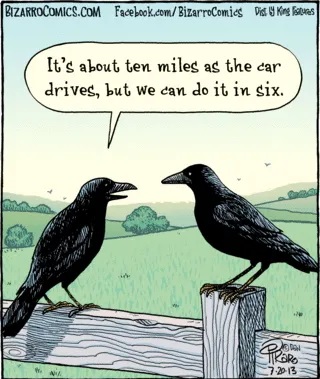
As the Crow Flies: After crossing the oceans, sailors would watch for birds to detect nearby land. Following the direction of birds, such as a crow or seagulls, got them closer to shore to follow it to a port. Crows fly straight, and so it refers to the shortest distance between two points.
Tide Over: When a ship could not get under sail due to poor winds, they would ride the tide until the winds returned. If something tides one over, it will last until new provisions can be obtained or until conditions change.
High and Dry: If a ship was caught in low tide or ran up on the shoals, it might end up being stranded with no hope of recovery. The term was to be caught high and dry, as in up out of the water. It’s used today to describe the feeling of being abandoned, stranded, or helpless.
Sink or Swim: Tossing a person overboard resulted either in them sinking or swimming. The term was made popular in swashbuckling movies featuring pirates deciding on whether they should spare their captives or not. Today, it refers to either failing (sinking) or succeeding (swimming) in a task or an endeavour.
The topic of this article has been on my mind for the past two weeks; last week flew by so fast I barely had time to blink, let alone order my thoughts into coherent sentences. The topic was sparked by coming across an article online about what is known as the “Milan Conference” or “The Second International Congress on Education of the Deaf” (though it was, in fact, the first), held in Milan, Italy in 1880.
To give you a bit of my personal background, I learned BSL (The Glaswegian dialect) and translated for the deaf when I lived in Scotland. Being as close to that community as I was, I’d shockingly never heard about the Milan Conference until a fortnight ago.
When I first moved to Switzerland, I wanted to continue working with the deaf and began taking Swiss German sign classes. I immediately began hitting brick walls: The crux of the matter was spelled out – they didn’t want hearing people in their world. It made little sense to me back then, and it was frustrating. Also at that time, my husband wasn’t yet hearing impaired – which would have made a difference in their attitude toward me, as people with family members affected by hearing loss were more acceptable to them. In light of the Milan Conference, their reticence makes perfect sense. I never was able to break that barrier, and I’ve lost much of the sign language I once used fluently.
The conference was an international gathering of (hearing – with only ONE exception) educators of the deaf and mute. The imperialist arrogance of the discriminating resolutions passed profoundly wounded and damaged the deaf community for nearly 100 years.
To sum up the conference’s resolutions briefly, the majority decided that sign language was disadvantageous to integrating the deaf into the hearing world, and they banned – yes, banned – sign language from the education of the deaf in favour of “oralism” – forcing the deaf to read lips to make them assimilate to the hearing world’s culture. Deaf teachers lost their jobs, and an overall decline of deaf professionals resulted – they were no longer allowed the tools to communicate in their own language, and communication professions such as artists, lawyers and writers fell silent. Here in Switzerland, there was a two-fold impact: Deaf children were forced to sit on their hands and learn to lip-read from High German-speaking teachers; but when they went home on holidays, they couldn’t lip-read their own family’s dialects of Swiss German, and so they were isolated from society both in school and at home. The anger and resentment to the hearing world still runs deep.
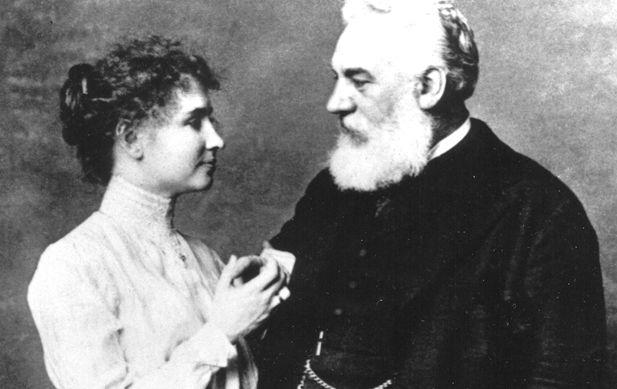
Most disturbing for me is the fact that Alexander Graham Bell, whose own mother and wife were deaf and who worked with the deaf throughout his life – including helping bring Helen Keller out of her silent world as a blind and deaf girl – was one of the strongest proponents for oralism at the conference. The most famous picture of Bell and Keller is one in which Keller is finger-spelling on Bell’s hand. It is a form of sign language. Yet he advocated to eradicate it.
The resolutions of 1880 held their ground until they were overturned in 2013 when an official apology was issued to the deaf community. Eleven years ago. Let that sink in. Inroads were made to teach sign in pockets here and there; in America, most schools for the deaf only began teaching sign language again in the 1960s; in the UK it was around a decade later. Generations suffered under the restriction. [For those who have been deaf their whole lives – what’s known as pre-lingually deaf – it means that sign language is their first language, while spoken English is their second; this can lead to difficulties in understanding complex or abstract messages in English. Imagine being denied your own native language…] Only in 2003, the British government recognised BSL as a minority language – but so far, Scotland is the only country in the UK that has given BSL legal recognition. The shift in understanding and recognition had already been set in motion by the time I’d moved to the UK, which is perhaps why the Milan Conference was no longer a topic when I was involved in the deaf community.
The ban is the main reason there are so many regional dialects today: Even though sign language was officially banned, the deaf still needed to communicate among themselves, and so signs evolved “under the table” within each pocket of deaf students. There was no exchange of information; for example, “bread” took on the shape of the local speciality, so in the French part it looks like a long baguette, while in the Zurich region, it looks more like a half-sphere. There are 5 major Swiss-German dialects; in Scotland, there were at least 7.
Please click here to watch a ~13-minute video by Storied about the history of sign language and the Milan Conference. If you’d like to learn more about the timeline of sign language in Britain, please click here to visit University College London’s website, and to learn more about BSL in Scotland, click hereto read the Scottish Parliament’s article.
ASL, American Sign Language, also has a forgotten predecessor that was largely written out of history: The Plains Indian Sign Language, also known as “hand talk”. For an interesting video about that history, click here.
I hope you’ve enjoyed this brief insight into a long and tangled topic, and that it encourages you to look into it more.
Just as a parting trivia: Everyone recognizes the sign for phone; but did you know that it became a euphemism in some deaf communities for the restroom/loo? Back when restaurants had their public phones near the “small closets”, the Deaf would sign “phone” as a polite, covert way of saying they were going to the restroom/loo.
Below are the British Sign Language and the American Sign Language alphabets; I’d encourage you to learn one or the other and stretch those grey cells a wee bit!
I’ve been trying to blog the last few weeks, but to do so, it helps to be logged in to WordPress – and it kept logging me out every time I switched to my site. I finally found the solution this morning, so here I am!
One thing I’ve been ruminating about is the etymology of everyday words; words come from somewhere, and I’ve always wondered what word(s) were used before a word came along. There are famous examples of invented words that never stuck, such as Lewis Carol’s “Jabberwocky“, but what I’m referring to are common words. What did they use before the word “egg” came along? The word itself comes from Old Norse, eggys, eggja, or egge, but before the common spelling was decided on, every English dialect in Britain had at least a couple of different spellings of the word!
William Shakespeare (1564-1616) is sometimes credited with having created upwards of 1,700 words, but many of those were likely already in circulation – he simply wrote them down in his plays. Some words accredited to him are: dishearten; dislocate; auspicious; obscene; monumental; majestic; accommodation; amazement; dwindle; exposure; bloody; countless; courtship; impartial; gnarled; gloomy; generous; reliance; pious; inauspicious; bump; frugal; submerge; critic; lapse; laughable; lonely, suspicious, and many, many more.
But long before William Shakespeare drew breath, there was another William who influenced English in profound ways, and yet his name is little known today: William Caxton. Born around 1420, he was a merchant, printer and the first English retailer of books; he introduced the printing press to England, set up in Westminster, 1476. Though he published many books, the first book he is known to have published is The Canterbury Tales, by Geoffrey Chaucer (1340s – 1400); that work alone is credited with influencing both the English language and literature, as it shows a clear correspondence between the rhythm of written English poetry and the cadence of spoken English. Chaucer is also known for having looted the French language, bringing into English such words as governance, paramour, difficult, dishonest, edifice, and ignorant, to name a few. Chaucer was aware of the wide variety of English dialects, which we would never recognize as English today, and he was anxious about the confusion of languages in Britain and that his work would be able to be comprehended in the future. In his poem, Troilus and Criseyde, he bids it a poignant but troubled farewell: “Go, litel bok . . . And for ther is so gret diversite In Englissh and in writyng of oure tonge, So prey I God that non miswryte the [thee]. . . . That thow be understonde, God I biseche!”
However, because William Caxton chose to publish Chaucer’s work, we still have it to this day. Caxton was also the first to translate Aesop’s Fablesinto English (1484). Although he was not a great translator and sometimes simply used the French word “Englishified”, his translations were popular; because of that, he inadvertently helped promote Chancery* English as the standard English dialect throughout England. (*Chancery refers to the dialect used by the officials of Henry V’s government). Thanks to men like William Caxton and those who followed, refining and shaping the language we know today, we are able to enjoy a standard English spelling and grammar structure that is understood around the world; there are still regional and national dialect differences, but we can be understood wherever in the world English is used.
If you’d like to learn more about this topic, one book I can highly recommend is Melvyn Bragg’s The Adventure of English (The Biography of a Language); it’s available in physical form, e-book, and audiobook.
These past few weeks have flown by so quickly, I’ve hardly had time to look up from my keyboard! Except when I went to the optometrist for new glasses (there might have been a slight connection between the two). I’ve been editing my final sci-fi draft. When I need a break from editing, I’ve been reading into articles by the new ebook company I’ll be working with, Draft2Digital, which has recently merged with Smashwords (my current and former platform). And in the context of editing, I’ve been down several rabbit holes:
Dashes
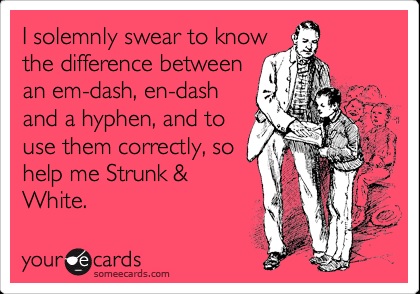
Back when I learned English, we had the good ol’ hyphen and the dash. Somewhere along the way the en-dash and the em-dash moved in, and they turned out to be worthy additions to the conversation. Now to make things confusing, 2em-dashes and 3em-dashes have elbowed their way into the punctuation party. I’m not sure how I feel about them yet, but their definitions seem to have squeezed the others so close that they often overlap or exchange places on the definition and usage dance floor. Until I need them to fix me a drink, I’ll probably ignore the party crashers.
Strunk and White’s The Element of Style is a cornerstone of grammar and writing style and is widely considered timeless; in fact, it was listed by TIME in 2011 as one of the 100 best and most influential books written in English since 1923. The irony of this cartoon is that when I recently pulled out my copy to find out the nitty-gritty of using en- and em-dashes in dialogue, I found not a jot or tittle about them in the entire book. It covers hyphens and dashes, both briefly, but nary a word beyond. Every website that I looked at had contradictory definitions and usages of all types of dashes; so until an authoritative source comes up with a defined set of rules, I will continue to use them the way I’ve learned them, and just be consistent in my punctuation within my current manuscript.
Dialogue Tags vs. Action Tags
Another rabbit hole I went down was a learning curve on the two types of tags. On one hand, I’d never honestly thought about the fact that there could a difference in punctuation between the two; on the other hand, for the most part, I’ve intuitively done it right, though not always, which is why I’ve added it to my checklist of edits – and something I will keep a closer eye on in the future. Here’s an example:
He said, “Oh, the irony of ignorance!” – This is a dialogue tag with its attending punctuation. Dialogue tags are any verb that can be spoken – said, cheered, whispered, etc.
He nodded. “I hadn’t thought about it, but that makes sense.” – Nodding is something done, and this is, therefore, an action tag. Notice that its attending punctuation is a period separating the action tag from the dialogue.
Two things make less logical sense to me; if you have insight on them or experience using them or reading them in novels, please comment! [Keep in mind that these are American English rules; I am writing my current novel in American English, though until now, I’ve written in Commonwealth English (I use that term rather than British English because it is used beyond Britain).]
How often have you spoken and laughed, chuckled, or smiled simultaneously? These are, for me, nuances in spoken vocabulary, and not action tags. Would you rather write: He smiled, “I thought you might say that.” or He smiled. “I thought you might say that.” ? In this particular instance both would work, but there are times when it has the potential to break up the rhythm of a sentence or scene too much. Which do you prefer?
When an action interrupts dialogue, it needs to be separated with (IMHO) rather odd punctuation, for example: “From what I’ve read about these dwellings” –he looked at the woman kindly– “they’re far from mud huts.” My years as an English teacher mean that missing commas and attached en-dashes hurt my eyes; maybe that’s why I needed new glasses!
Euphemisms
Another tangent this week has been looking for creative swear words. Nothing irritates me more, when reading a book, for the author to fall back on standard F-bombs. That just says too lazy to be creative to me. It’s unimaginative. It doesn’t make a character stand out from the rest of the lazy crowd. There are so many fun alternatives, there really is no excuse! Here are a few I’ve come across and found myself smiling:
People cussing in a foreign language; it sounds better to them.
Fart knocker (e.g. “you little fart knocker”)
Sun of a nutcracker! Sun of a biscuit!
Cheese n’ crackers!
Shoot a monkey!
Shiitake mushrooms!
Well, butter my bum!
Clusterfluff!
In a type of Chinese Whispers, “Hells bells” became “hells bells, conker shells”, misunderstood by kids as “hells bells, taco shells” – now that family just yells, “Taco shells!” when they’re upset!
Names as swear words might backfire if you happen to meet someone by that name; here are a few: Christopher Columbus; Gordan Bennett (in Scotland); Gottfried Stutz (here in Switzerland – I actually taught English in a company that had an employee with that name!)
Sugar Honey Ice Tea!
Sunny Beaches
Fudgenuts
Someone I used to know would say things like “bug knuckles” or “dog feathers” or “ants pants” when she was upset.
Credit: Getty Images
These are just a few of the areas I’ve delved into in the past few weeks; I’m still deep in the editing/proofreading process; once that’s complete, the “behind the scenes” checklists begin – those are the things readers will never see: The number of hours put into finding the right images and designing the best cover art possible; choosing the right fonts; formatting for the various mediums online and print; writing blurbs, preparing marketing bits and bobs, and setting up all the dominoes in a row for the final push of publishing!
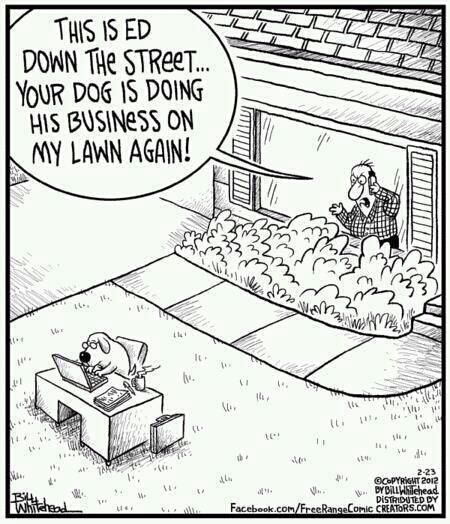
Euphemisms… we use them daily, whether we realize it or not. They abound in English, multiplying like rabbits in every dark corner of life. In fact, they hardly ever multiply in the sunny spots, because we don’t require them there. The very definition of the word confirms that notion: “The use of a word or phrase to replace another with one that is considered less offensive, blunt or vulgar than the word or phrase which it replaces.”
Every generation creates new ones, because a parent’s euphemism becomes the general term which is then too close to the original meaning, and so the children get creative with words, and so on. There are a few euphemisms that have remained unchanged over centuries, such as passed away, which came into English from the French “passer” (to pass) in the 10th century; others shift gradually, such as the word “nice”: When it first entered English from the French in the 13th century, it meant foolish, ignorant, frivolous or senseless. It graduated to mean precise or careful [in Jane Austen’s “Persuasion”, Anne Elliot is speaking with her cousin about good society; Mr Elliot reponds, “Good company requires only birth, education, and manners, and with regard to education is not very nice.” Austen also reflects the next semantic change in meaning (which began to develop in the late 1760s): Within “Persuasion”, there are several instances of “nice” also meaning agreeable or delightful (as in the nice pavement of Bath).]. As with nice, the side-stepping manoeuvres of polite society’s language shift over time, giving us a wide variety of colourful options to choose from.
Recently, my husband and I were talking about the topic, and the specifics of the word stupid came up; so without further ado, here’s a round-up of ways of getting around describing someone as stupid, dumb, or, well, an ass:
Thick as a post
Doesn’t have both oars in the water
Two sandwiches shy of a picnic
A beer short of a six-pack
A brick short of a load
A pickle short of a barrel
Has delusions of adequacy
Has a leak in their think-tank
Not the sharpest knife in the drawer
Not the sharpest tack in the box
Not the sharpest pencil in the box
Not the sharpest tool in the shed
His belt doesn’t go through all the loops
His cheese has slipped off his cracker
The light’s on but nobody’s home
If you stand close enough to them, you’d hear the ocean
Mind like a rubber bear trap
Would be out of their depth in a mud puddle
Their elevator is stuck between two floors
They’re not tied to the pier
One prop short of a plane
Off his rocker
Not the brightest light in the harbour
Not the brightest bulb in the pack
Has a few loose screws
So dense, light bends around them
Their elevator/lift doesn’t reach the top floor
Dumber than a bag of rocks
Dumber than a hammer
Fell out of the family tree
Doesn’t have all the dots on his dice
As slow as molasses in winter
As smart as bait
Has an intellect only rivalled by garden tools
A few clowns short of a circus
Silly as a goose
Addlepated
Dunderheaded
A few peas short of a casserole
Isn’t playing with a full deck of cards
Has lost his marbles / isn’t playing with all his marbles
Has bats in his belfry
A dim bulb
He’s got cobwebs in his attic
Couldn’t think his way out of a paper bag
Fell out of the Stupid Tree and hit every branch on the way down
If brains were dynamite, he couldn’t blow his nose
I’m sure there are dozens more! If you know of any that haven’t made this list, please put them in a comment below!









 Every generation creates new ones, because a parent’s euphemism becomes the general term which is then too close to the original meaning, and so the children get creative with words, and so on. There are a few euphemisms that have remained unchanged over centuries, such as passed away, which came into English from the French “passer” (to pass) in the 10th century; others shift gradually, such as the word “nice”: When it first entered English from the French in the 13th century, it meant foolish, ignorant, frivolous or senseless. It graduated to mean precise or careful [in Jane Austen’s “Persuasion”, Anne Elliot is speaking with her cousin about good society; Mr Elliot reponds, “Good company requires only birth, education, and manners, and with regard to education is not very nice.” Austen also reflects the next semantic change in meaning (which began to develop in the late 1760s): Within “Persuasion”, there are several instances of “nice” also meaning agreeable or delightful (as in the nice pavement of Bath).]. As with nice, the side-stepping manoeuvres of polite society’s language shift over time, giving us a wide variety of colourful options to choose from.




 Stephanie Huesler