Category Archives: History Undusted

Food History Undusted: Mac & Cheese

As I recently mentioned, we had problems with kitchen moths; the source has been found (dates) – the jar which contained them also isolated them; I played the jar like a maraca and sang “La Cucaracha” as we put them in the compost. We are now moth-free! Woo-hoo!

We really appreciate the advantages of storing everything in glass jars: It looks pretty, we can see exactly how much we have, what we have, and it’s inviting to be creative in meal planning. One of the pasta jars we have contains mini “Hörnli / Hoernli” – the Swiss word for “little horns” and what the rest of the world probably refers to as macaroni. The topic came up as a meal idea, and of course, being us, we got into the historical aspect. Where did it originally come from? Did it arrive in America with Italian immigrants or is it a hybrid dish?

Mac & Cheese History

This image above is nearly sacrilege for many people, myself included – I cannot imagine eating pasta from a can! But just after World War 2, manufacturing of canned goods, frozen meals and the like were coming into their stride as families pieced their lives back together and got on with the business of rebuilding the country and economy; televisions entered the home mainstream in the early 1950s (think black and white, rabbit ear antennas, no remote and 2 channels) – but that’s another topic. Product placement during television programmes and news was a major factor in influencing the purchasing power of the average consumer (product placement may have begun as early as 1873, when Jules Verne’s fame led shipping companies to lobby being mentioned by name in his upcoming novel,  “Around the World in 80 Days”).*

The oldest known reference to a dish that may be recognizable as the ancestor to the modern concoction is from the 13th century, from someone in the court of Charles II of Anjou who was familiar with the Neapolitan court; the dish was basically prepared with sheets of lasagne sliced into small squares, cooked in water and tossed with Parmesan cheese. The American version some might be more familiar with has two claims to ancestry: Either it began as a Connecticut church supper dish known as Macaroni Pudding, or it was brought over from Italy in the form of a recipe by Thomas Jefferson, who also brought back a pasta machine.

So, where was the noodle dish invented that we know today as “Macaroni and Cheese”? Switzerland, of course!

The dish, known as “Älplermagronen” (=”Alpine herders’ macaroni“) in the German-speaking areas and “Macaroni du Chalet” in the French-speaking areas, is made with those Hörnli, also known as “Magronen”, which were dubbed for the horns of the cattle, sheep and goats which the herders tend. The cheese was often a local product from the milk of those very animals, and the dry pasta was easy to hike up to their summer chalets where they slept on the Alps during the summer grazing seasons.

For a good, long read about the history of the pasta, click here for a “BBC Travel” article on the topic – and get a good taste of the Swiss Alps in the meal! And be honest – how many of you have a hankering for Mac & cheese after reading this? Click on the image below for an authentic recipe.
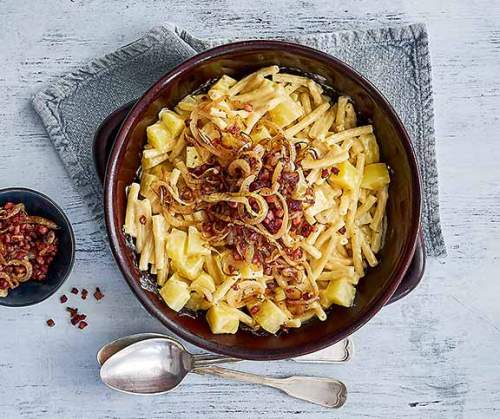
Alplermagronen - Betty Bossi

Image credit: Betty Bossi (the Swiss version of Betty Crocker)


*Information source: Wikipedia, William Butcher (translation and introduction). Around the World in Eighty Days, Oxford Worlds Classics, 1995, Introduction.

3 Comments

Filed under Articles, Etymology, History, History Undusted, Images, Links to External Articles, Military History, Research, Science & Technology, Snapshots in History

How About a Virtual Visit? NYC 1911

I just came across a fascinating glimpse into the past, through film footage of New York City’s hustle and bustle, 1911-speed. To take the virtual visit, just click on the image below. Enjoy!

nyc-1911

1 Comment

Filed under History, History Undusted, Videos

History Undusted: Bubble Wrap

I do a lot of crafts. I mean, a lot variety-wise, and a lot quantity-wise. When I’m not writing, managing our household, planning meetings or teaching students (I’m a vocal coach and an English teacher for adults), I’m usually doing some kind of craft, and it more often than not involves some form of upcycling – turning “trash” into “treasures”. Recently, I’ve been making sheets of plastic-confetti-filled bubble wrap, ironed into what’s known as “ploth” (plastic cloth). These can then be sewn into bags, etc. It got me to thinking about just how bubble wrap came to be. I have tons of the stuff, stashed here and there in the craft room, for such projects – and I’m constantly on the lookout for creative uses for that poppable fun.

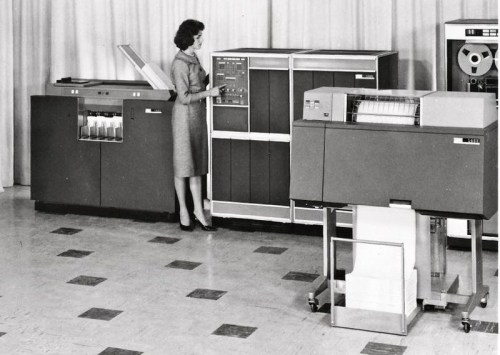
Did you know that originally it wasn’t intended as packing material but as wallpaper? In 1957, Swiss chemist Marc Chavannes and his business partner, Alfred Fielding, wanted to make a wallpaper that would appeal to the emerging Beat culture [for those of you unfamiliar with that term, it was a generation of post-war, anti-establishment rebels who were more or less the precursor to the 60’s hippie and counterculture movements]. What the partners did was simple enough: They put two layers of a plastic shower curtain through a heat-sealing machine. But it came out in what they first saw as a failure, with air bubbles trapped between the two layers. They figured they were onto something, failure or not, and so they got a patent and then began experimenting to find other uses. Wallpaper wasn’t popular; neither was their suggestion to use it as insulation for greenhouses (perhaps that was simply a matter of marketing to the wrong demographic). Then, around 1960, IBM began shipping their newly-designed 1410 computers and needed a way to protect the delicate dinosaurs – eh, I mean, computing mammoths. That’s a LOT of bubble wrap. The rest is, as they say, history. And in case you’re wondering, yes, people have been popping the bubbles from the beginning, just for fun. So much fun, in fact, that the last Monday of every January is officially “Bubble Wrap Appreciation Day”.

Click on the image below to watch an IBM recruiting film (1 minute), from 1960. You can also see one of IBM’s massive scientific mainframes being used by the original “computers” of NASA in the film “Hidden Figures“.

IBM 1401 unit - History of Computer Museum archive photo

IBM’s 1410 computer promotional photo, 1959. Credit, Computer History Museum archives


6 Comments

Filed under Articles, History, History Undusted, Research, Science & Technology, Snapshots in History, Space, Astronomy

History Undusted: Human Alarm Clocks

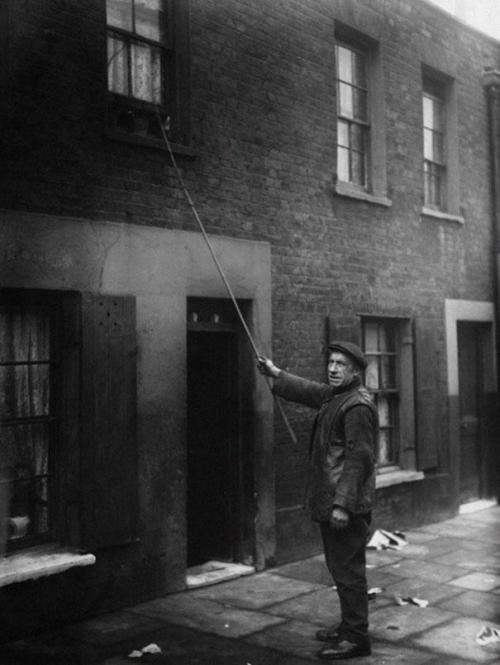
If you were living in the 19th century, before the age of reliable and affordable mechanical alarm clocks, how could you be ensured of getting up on time to get to work? Hire a knocker-up, of course. That’s if you lived in Britain or Ireland. Knockers-up were employed from the time of the Industrial Revolution; the last one retired in Bolton (a former mill town in Greater Manchester) in 1973. Also known as “human alarm clocks” they would use sticks, clubs, pebbles or pea shooters to knock on clients’ door and windows; some would move on after a few taps, while others wouldn’t move on until they were sure the client was up. I wonder who woke them up?

According to the Lancashire Mining Museum, there was a conundrum from the times that went like this:

We had a knocker-up, and our knocker-up had a knocker-up

And our knocker-up’s knocker-up didn’t knock our knocker up, up

So our knocker-up didn’t knock us up ‘Cos he’s not up.

The original problem employed knockers-up faced was how not to wake up their paying clients and several of their neighbours on either side for free; they hit upon (no pun intended) the idea of long poles or pea shooters to tap on the upper windows; clients obviously couldn’t sleep in a back room, or they’d never hear the knock. The fees charged depended on how far the knocker had to travel to reach the house and how early said knock needed to be.

In 1878, a Canadian reporter was told by Mrs Waters, of northern England, that she charged eighteenpence a week for those who needed waking before 4 a.m., and for those after 4 a.m., it was a shilling (twelvepence) a week. Those who had to be aroused from five to six o’clock paid from sixpence to threepence.

The miners of County Durham, Ireland, refined the requirements a bit: Built into the outer wall of their houses was a slate board, on which they would write their shift times in the mine; the company-hired knockers-up would then know when and when not to wake them up. These boards were known as wake-up slates or (far better, in my opinion), knocky-up boards.

Here are a few rare photographs of knockers-up knocking up:

HUMANA~3

Human Alarm Clock 2Human Alarm Clock

Knocker-up - old-leigh-marshs-row-twist-lane

And just so we’re clear, the American English phrase “to be knocked up” (pregnant) has nothing to do etymologically with the British occupation or the sundry adjectives that derived from it. The knockers-up were usually elderly men or women, or even policemen who supplemented their incomes by taking on the task of waking their clients. In fact, one policeman (as told during the inquest) saw no reason to abandon his post as a knocker-up when a man found him on his route and told him that he’d found a dead woman; she turned out to be Mary Nichols, the first victim of Jack the Ripper.

Original post, September 2015

5 Comments

Filed under Articles, Etymology, History, History Undusted, Images, Links to External Articles, Snapshots in History

History Undusted: Santa & the Traditions of Christmas

Known as Sinterklaas, Father Christmas, Kris Kringle, Saint Nick / Nicholas, Père Noel, Papa Noel, Babbo Natale, Weihnachtsmann, Christkind, and many other names, Santa has been around in various versions and various cultures for roughly 1,300 years, as a character associated with Christmas and gift-giving. As such, it would be impossible to pinpoint exactly when and where the original basis for the legends began. Saint Nicholas was a 4th-century Greek Christian bishop of Myra (in modern-day Turkey). He became the patron saint of sailors, and so it is quite possible that his kindness to the poor inspired sea-faring men to spread the ideals of his charitable acts to other places. As time passed, facts gave way to tall tales and legends, and the rest, as they say, is history.

Christmas stockings have been around for centuries as well; the story goes that a widower with three daughters was worried about them being unable to marry as he had no money for their dowries. Nicholas heard of their plight and, knowing that the father would never accept charity, tossed three bags of gold in through an open window one night; the girls had hung their stockings by the fireplace to dry, and one of the bags landed in a stocking. How much of that is based on historical facts and how much is legend is a balance lost to time.

The modern-day image of Santa, with his rotund belly and his red coat, was  popularized by Thomas Nast, an American illustrator for the Harper Weekly, in the 1860s. Nast, being a German immigrant, based his images on the German Weihnachtsmann and Sankt Nicholaus. Before his illustration, Father Christmas was portrayed as wearing any colour coat, from tan and fur-lined, to pink or purple, brown, grey, white, green or blue, and sometimes even red. [It is a myth that a 1933 Coca-Cola advertising campaign is to thank for a red-cloaked Santa.]

This slideshow requires JavaScript.

I could go on and on about the traditions associated with Christmas – the tree, the ornaments, the yule log, Santa’s helpers, reindeer (or was it a motorcycle, blimp or plane?) and other practices that are spread wherever Christmas is celebrated. It’s a holiday that’s been adopted in countries that have no Christian roots, such as Asian countries; there, it could be seen as an excuse for a holiday, or as a marketing ploy. And maybe that’s what it’s become for many people even in the West; but all of these traditions put people in a contemplative, forgiving, generous spirit, which is perhaps the most important aspect of the holiday.

Just as the nativity scene [please click on the link to read about Christmas from a Christian aspect] was a simplified version of the Gospel, created by St. Francis of Assissi to explain events to a largely illiterate population and to counter what he felt was a growing commercialism associated with the holiday (and that, back in 1223!), so it is that many traditions arise over the centuries, often a grain of truth with things then tacked on over the years and through cultural adaptations.  Santa’s legend has grown into what we know today, likely not by leaps and bounds, but by a progressive adaptation to cultural times.

However you celebrate Christmas, whether you’re alone or with too many people for your liking, remember that all of us have the capacity to bless others; as the adage goes, it is more blessed to give than to receive. If you don’t have anyone in your life presently to give gifts to, remember, like Saint Nicholas, the poor and the needy. We can all make a difference, and who knows – maybe in a thousand years, your name will be mentioned alongside his.

Merry Christmas!

Christmas GIF 2

10 Comments

Filed under Articles, History, History Undusted, Images, Snapshots in History

History Undusted: If World War I were a Bar Fight

History can be confusing sometimes, especially if it’s distant – beyond our own experience. Who’s who, who did what, and what the consequences were can all seem a bit vague. The analogy below, put into a relatable context, may help you visualize an important bit of world history; I don’t know who came up with the original piece, but it’s brilliant! I’ve made several additions here and there, but otherwise, it’s someone else’s work – if anyone knows who originally came up with this analogy, please let me know so that I can give credit where credit is due!

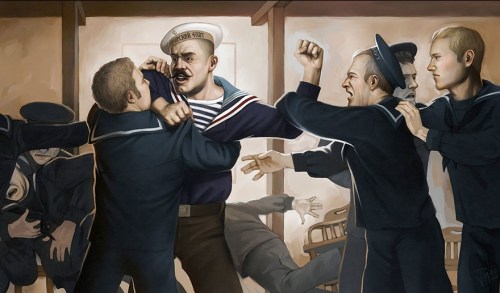
If World War I were a Bar Fight

Bar Fight, World War 1

Germany, Austria and Italy are standing together in the middle of a pub when Serbia bumps into Austria and spills Austria’s pint. Austria demands Serbia buy it a whole new suit because of the new beer stains on its trouser leg. Germany expresses its support of Austria’s point of view.

Britain recommends that everyone calm down a bit.

Serbia points out that it can’t afford a whole new suit, but offers to pay for the cleaning of Austria’s trousers. Russia and Serbia look at Austria. Austria asks Serbia who they’re looking at. Russia suggests that Austria should leave its little brother alone. Austria inquires as to whose army will help Russia make them do so.

Germany appeals to Britain that France has been eyeing Britain, and that it’s unwise for Britain not to intervene. Britain replies that France can look at whoever it wants to, and that Britain has been watching Germany too, and what is Germany going to do about it? Germany tells Russia to stop looking at Austria, or Germany will render Russia incapable of such action anymore. Britain and France ask Germany whether it’s looking at Belgium.

Turkey and Germany go off into a corner and whisper.  When they come back, Turkey makes a show of not looking at anyone.

Germany rolls up its sleeves, looks at France, and punches Belgium and Luxembourg, who had been minding their own business at the end of the bar. France and Britain punch Germany; Austria punches Bosnia and Herzegovina (which Russia and Serbia took personally); Germany punches Britain and France with one fist and Russia with the other. Russia throws a punch at Germany, but misses and nearly falls over.

Japan calls from the other side of the room that it’s on Britain’s side, but stays there.

Italy surprises everyone by punching Austria. Australia punches Turkey and gets punched back.  There are no hard feelings, however,  because Britain made Australia do it.

France gets thrown through a plate-glass window, but gets back up and carries on fighting.  Russia gets thrown through another one, gets knocked out, suffers brain damage, and wakes up with a complete personality change.

Italy throws a punch at Austria and misses, but Austria falls over anyway.  Italy raises both fists in the air and runs around the room chanting. America waits until Germany is about to fall over from sustained punching from Britain and France, then walks over and smashes it with a barstool and pretends it won the fight all by itself.

By now all the chairs are broken and the big mirror over the bar is shattered.  Britain, France and America agree that Germany threw the first punch, so the whole thing is Germany’s fault.  While Germany is still unconscious, they go through its pockets, steal its wallet, and buy drinks for all their friends.

Everyone went home, leaving Germany to pout on the floor planning on how to get even.


Originally posted on History Undusted, September 2015

18 Comments

Filed under History, History Undusted, Military History, Snapshots in History

How It’s Made: Rubber Bands

Rubber bands are ubiquitous; everyone has them and occasionally uses them. They come in nearly every shape and size; they’ve even become a craft accessory out of which creative shapes can be formed (just google “rainbow loom designs”).

But have you ever stopped to think about how they’re made? Are they made from natural or synthetic materials? You might be tempted to think that they’re some kind of plastic or silicone, but most rubber bands are made out of the sap of rubber tree plants; that sap, specifically, is latex. Trees are “tapped” – a slice of bark removed – every two days, and the latex gathers in bowls attached below the cut. It will flow for an hour or two and then heals over.

The actual process to turn rubber latex into uniform rubberbands is a complex one; it’s a process that evolved over time, trial, and error into a well-oiled machine – literally. To learn more, click on the following links:

Alliance Rubber Company – The birthplace of the modern rubber band

YouTube: How It’s Made

As with anything, we should take care to use what we buy, and buy what we’ll use. Rubber bands are produced by the millions each day (the factory featured in the YouTube video produces 40 million per day), so use the ones you have wisely!Rubber band ball If you’re curious as to how to make a rubber band ball like this image, just click here. I have several of these around the house, and they’re practical and easy to make. Enjoy!

9 Comments

Filed under Articles, History Undusted, How It's Made, Links to External Articles, Science & Technology

History Undusted / Flashback: The Rack

The rack has been used as a torture device since at least AD 65; it is still in use today, except that now it’s a piece of equipment found in a chiropractor’s office, with padded joints and supposedly-comfortable straps…  I called this a flashback as I personally experienced the rack for six years, three times a week, twenty minutes at a time, as a child (followed by electric shock, all in the name of medicine).  Just looking at this image makes my back hurt!  To read more about the history, just click on the image.

Torture - Middle Ages, the Rack


Originally posted on History Undusted, 31

11 Comments

Filed under History Undusted, Links to External Articles, Military History, Snapshots in History

History Undusted: The Colour of Carrots

Unless you’ve been living under a rock all your life, chances are you’ve eaten carrots. Orange through and through, they can be eaten sweet, as in a carrot cake, or savoury with dips or in a stew. But where did they come from? Have they always been orange? The short answers are Central Asia, and nope.

Carrots - Carrot-Museum-co-uk

Carrots, which likely originated in the Himalayas and the Hindu Kush ranges and spread along the Silk Road, were white/ivory wild roots gleaned for their leaves and seeds – much like their genetic relatives of coriander and parsley, and it may be that the products of these plants were used medicinally, like many other plants and herbs.

They were first cultivated as a food crop in the Iranian Plateau and Persia, and even today the centre of diversity remains in the region, in Afghanistan. Long before they were cultivated, the wild varieties had become widespread throughout Europe, as far back as 5,000 years ago, though fossilized pollen has been identified as belonging to the carrot family in the Eocene period (55 to 34 million years ago).

These little roots have approximately 32,000 genes, which is more than you and I do; and just two of those genes are recessive, creating a build-up of alpha- and beta-carotene. Over a thousand years ago, purple and yellow varieties began to appear, and around 600 years ago, the orange variety began to dominate the market, appearing in Spain and Germany around the 15th or 16th century.

One apocryphal theory is that the orange coloured carrots were cultivated by the Dutch in honour of William of Orange, a 16th century commander who fought against the Habsburg dynasty; even if this legend isn’t true, the orange carrot did become associated with William of Orange, and during the 18th century, the noticeable display at market stalls was considered to be a provocative political gesture in support of William’s descendant, who had been driven from the English throne. The distaste for the political figure didn’t stem the taste for the root, however, and they grew in popularity. Most modern orange carrots descend from a strain grown in Hoorn, Holland; today’s carrots, more vivid orange, contain 50% more carotene than those of 1970. Modern carrot breeders continue to refine the carrot, improving flavour, colour and texture, as well as reducing bitterness and enhancing sweetness.

Though other varieties of carrots are making a comeback, the beta-carotene and vitamin A which causes the deep orange was thought to improve eyesight (that is a misnomer). This led to a diversion tactic of the British during World War 2: They claimed that eating carrots improved night-vision and that their pilots ate carrots to have that advantage; it was misinformation spread to hide the Royal Air Force’s development of radar technology from the Germans. Aside from the propaganda ploy by the military, carrots were a staple in the diets of the British, who used the humble root as a sweetener and a vegetable staple, and was promoted for health benefits. Food rationing tightened the Brits’ belts, but the carrot came to the rescue; it was a common, home-grown staple, and could be used as a substitute for restricted items as it was not subject to rationing. Carrot was even used as a secret code word, broadcast by the BBC in French to the French Resistance, to warn of the impending D-Day landing in Normandy: On the 4th of June 1944, several messages that seemed nonsensical to listeners were broadcast, including, “les carottes sont cuites, je répète, les carottes sont cuites!” (“The carrots are cooked, I repeat, the carrots are cooked!”) This gave the resistance fighters the signal to carry out their plans to sabotage railway and telephone lines. Carrots were the last vegetables added to a stew; if they were already cooked, it meant that the plans were set – no going back. Normandy landings began the next day, 5 June, which led to the liberation of France and the ultimate defeat of the Nazis.

The word carrot was first recorded in English around 1530 and was borrowed from Middle French carotte, originally from the Indo-European root *ker– (horn), probably due to its horn-like shape. At the time, carrots (white) were visually similar to parsnips, the two being collectively called moru (from the Proto-Indo-European word mork (edible root)); the German for carrot is Möhre).

For more information than most people could possibly use in their lifetime, check out this link to The Carrot Museum, my main source of information for this article (along with the Economist).

The next time you sit down to a good vegetable stew or a plate of crudité and dips, think of the grand history of the humble carrot.

6 Comments

Filed under Articles, Etymology, History, History Undusted, Links to External Articles, Military History, Research

Science Undusted: Prince Rupert Drops

Let’s talk about shattering glass. As one does.

Probably as far back as molten glass was first produced intentionally by man (i.e. not volcanic glass drops formed naturally, which are known as Pele’s tears) drips of molten glass fell into the glass blower’s water, kept nearby to cool the glass products in. Sometimes, these drops have particular strength, and these alone are true Prince Rupert Drops.

The English name is a classic example of who knew who, and who wrote the history books: The drops had been made Mecklenburg, northern Germany, since 1625, though some think they go back as far as the days of the Roman Empire; they were sold around Europe as toys or curiosities. In 1660, Prince Rupert brought some of them back to London as a gift for King Charles II, who then gave them to the Royal Society to investigate and attempt to reproduce. Thus, Rupert’s name has gone down in history – for bringing back a souvenir for the right person.

Their unusual strength comes from how they cool; when done right, they will come out shaped like a tadpole with a long, thin tail. The heads can be struck with a hammer or shot with a gun, and they will not shatter; but if the tail is knicked or disturbed, the entire drop shatters into glass dust instantly, from the tail down.

Not all drips of glass cooled in water produce Prince Rupert Drops, also known as Dutch tears, Prussian tears, or Batavian tears; the difference is their behaviour and is probably influenced by impurities or inclusions in the mineral composition of the material used. Higher quality glass produces pure Prince Rupert’s Drops; low quality may simply not have the tension created in the cooling process to be a shattering success. I have a drop of molten glass, found on a beach in the Scilly Isles (UK); it is the result of a shipwreck from around the 17th or 18th century, and the drop is full of the impurities of the orginal glassware plus black flecks of cinders from the burning ship. The tail was snapped off over time, yet the head survived – thus, it was not a Prince Rupert Drop.

For a cool video that explains the science behind the drops, including slow motion analysis of the shattering, just click on the image below; the video is from one of my favourite YouTube channels, Smarter Every Day. For further behind-the-scenes footage of another experiment that Destin did with these drops, click here.

Prince Rupert Drop

Leave a comment

Filed under Articles, Etymology, History, History Undusted, Research, Science & Technology