Category Archives: Military History

10 Everyday Phrases with Nautical Origins #3

Some of today’s nautical idioms are well known, such as to be on board with a proposal or suggestion or learning the ropes in a new job or position, while others, such as three sheets to the wind are less common (unless you happen to work in a bar – then it may come in quite handy). Either way, enjoy these, matey!

Be On Board: As part of a crew, a sailor bore their part of the responsibilities. In today’s terms, it means to accept or agree with a proposal or a way of doing something and go along with it.

Rats Deserting a Sinking Ship: Rats and mice were common aboard ships, often in the bulkhead (lowest section of a ship, where the grains were stored (the weightier things being stored low and balanced to keep the ship sturdy in rough seas). If the ship began to take on water, the rats would go up the deck ladders to stay away from the water; if they started jumping overboard, sailors wouldn’t stand much better of a chance (most sailors could not swim). It’s a vividly grim picture of life aboard. Now, it’s an idiom describing people abandoning a failing activity or situation.

Close/Tight Quarters: Tightly packed (e.g. people in a small space). Space was at a premium, especially on the lower decks of a ship of sail. Men slept in hammocks close together and shared the space with stowed ship equipment and their own storage chests. Even today on submarines, bunks are shared by those who are off-duty and those on-duty to save sleeping quarter space.

Run a Tight Ship: Manage and organization strictly, efficiently, and effectively. A ship, especially in times of war, was run tightly to avoid unnecessary dangers and/or deaths, and to maintain discipline that would be needed to succeed in crucial moments.

Learn the Ropes: Sails were raised and lowered with ropes, and knowing how to control the sails allowed a ship to take full advantage of the wind and sail safely. There were miles of ropes on a ship, each with an important and specific function. Learning the ropes was essential for everyone aboard – it would keep others out of danger and oneself alive! Today, one learns the way things are done in a given setting or situation.

Broadside: The broadside was the side of the ship which sat above the waterline; cannons were arranged on several decks, and when ships sat broadsides facing, firing simultaneously, it was known as broadsiding. Today, it refers to being taken off guard or being surprised by something unpleasant.

 Broad in the Beam: Describes the width of the beam or mast on a larger ship. It denotes a person who’s wide across the hips and buttocks.

Keel Over: To collapse, to die. If the keel of a boat were to rise out of the water, the ship would be in danger of capsizing; this might happen due to a storm or damage by an enemy attack.

To Keelhaul: To rebuke harshly. It was a punishment meted out in extreme cases by dragging someone, ankles weighted, by ropes beneath the ship along or over the keel (the backbone of wood along the bottom of the ship). As these were usually covered with barnacles, clothes and skin would be shredded by the barnacle shells, and if the salt water of the ocean didn’t disinfect the wounds on the way up, it could be a death sentence. How much it was actually practised is difficult to say, as written records are sparse (perhaps a cruel captain didn’t want it on record, or perhaps it was not as widely practised as we think); the most concrete records of the punishment come from the Dutch. It was banned by the British Royal Navy around 1720, and by the Dutch around 1750. That bans were necessary tells its own tale…

Three Sheets to the Wind: Implies an unsteady, drunk person. The sheet referred to the ropes (lines) used to control the trim (the advantageous angle of the sails in relation to the wind) of the sail. If the sheets are loose, the sails will flap in the wind which causes the ship to lurch about like a drunken sailor. There are variations of the number of sheets in the idiom: 1 would be tipsy, 3 would be staggering drunk!
3 Comments

Filed under Etymology, History, History Undusted, Lists, Military History

History Undusted: The Westray Dons

My past two articles have been about everyday phrases with maritime roots; not only is a language affected by sailors, but sometimes entire populations.

Around the British Isles, there have been countless shipwrecks. The waters can be treacherous, with islets and rocky outcrops just under the waves – splinters of divided continents worn down by the power of the sea until they become hidden snares. My husband and I were once on holiday on St Mary’s, Scilly Islands; with every tide, flotsam fragments of shipwrecks (nearly 1,000 known so far) from the 16th through the 19th centuries wash ashore, and I gathered a handful of beach pottery and glass, not knowing at the time that the worn but still decorated pieces could be centuries old. Buried beneath the sand, they’d retained their colourful glazing until washed ashore.

That’s the goods and plates aboard; but what of the people? Many sailors of past centuries couldn’t swim; if their ships foundered too far from shore, they sank to Davy Jones’s Locker. Those who were fortunate enough to make it ashore were not guaranteed a safe sojourn; if the island had scant supplies, it could get ugly – as it did for Spanish sailors on Fair Isle (more on that in a moment). But first, a brief background on the situation that led to the Spanish Armada being in British waters, and their shipwrecks:

The reasons the Armada moved to attack England are complex; let’s just say that Philip II, heir apparent to the Spanish throne, had married (in a political manoeuvre) Bloody Mary, the Catholic queen of England, who’d had her Protestant half-sister, Elizabeth, placed under house arrest to prevent any political ambitions from growing in the Protestant faction. When Mary died childless, Philip (King of Spain and Portugal, as well as of Ireland and England through marriage and until Mary’s death in 1558) returned to his own kingdom in Spain, and Queen Elizabeth I ascended to the throne of England. But being the daughter of King Henry VIII and his second wife, Anne Boleyn (whom he’d had executed when Elizabeth was two years old), Elizabeth was illegitimate in the eyes of many Catholics, as her parents’ marriage had been annulled two days before her mother’s execution. Ironically, confinement hadn’t taught Elizabeth any compassion; she had her Catholic cousin, Mary, Queen of Scots, imprisoned for nineteen years, and eventually executed in February of 1587. Mary had been Spain’s Catholic ally, and her death was the final straw for Philip II of Spain, as the religious tensions had been mounting between England and Spain. Philip prepared his Armada, sailing out of Lisbon in 1588.

If you look at a map of Europe, you will see that Spain is southwest of the British Isles; they had to sail through the Bay of Biscay, and then either west of England through the waters between England and Ireland, or east through the English Channel and French waters (and the French were usually at war with everyone) to reach the east coast of England.

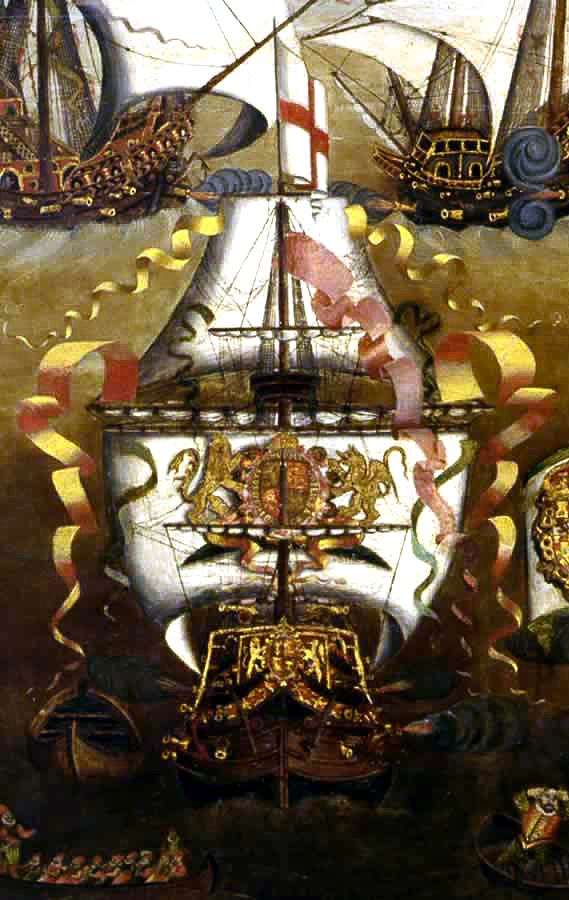
Sir Francis Drake’s Revenge, with Armada ships in the background. Credit, Wikipedia

The battle ensued; the English ships had superior long-range cannon, with which they harried the Spanish fleet. Weather and prevailing winds interfered; battle lines were redrawn, only to be scuppered again. In August 1588, the Spanish fleet had been defeated by Sir Francis Drake’s command of the English ships, and the remnants of the fleet retreated into the North Sea. By early September, seventeen ships had been lost to storms. Many of the ships not sunk by the British navy or taken out by the sea were blown onto the rocky shores of Ireland and Scotland; of the 150 ships that set out from Lisbon, only 65 returned.

Replica of the 16th century Spanish Galeón Andalucía. Photo credit, Fundacion Nao Victoria. Click on the image to see details about the ship.

Three of the ships were separated in the storm from the rest of the fleet: The Barca de Amburgo foundered off of Fair Isle, but the crew was rescued by the El Gran Grifón and the Trinidad Valencera. With the extra crew aboard, the El Gran Grifón tried to anchor to make repairs but was wrecked on the rocks of Stroms Hellier, Fair Isles (a steep, rocky outcrop of land halfway between Shetland to the north and Orkney to the south). According to historian Sir Robert Sibbald (1641-1722), the crew was on the island for two months (~August-September 1588); though they paid for their supplies, tensions were high with locals as food stores were meagre and “Spanish money doesn’t fill hungry bellies”. The island itself has never supported more than 400 inhabitants (today’s population is 65); the Spanish shipwreck brought 300 to shore. 50 of the crew either starved to death or were killed when the locals turned on them: Any Spaniard found alone was tossed over a cliff; when that wasn’t efficient enough, the islanders deliberately collapsed a flagstone roof over the sleeping crew.

The survivors fled; some to Shetland, and some to Orkney. Enter that dusty bit of history, the Westray Dons.

Westray is the northernmost island of the Orkney archipelago, a group of 70 islands*, 16 of which are inhabited (*or more, depending on who you ask – skerries or uninhabited islets may or may not count). They not only welcomed the Spaniards but intermarried with them. The men remained on the island, and their descendants became known as the Westry Dons. Spanish heritage is still seen in the Orcadian population today, though the Dons are no longer a separate community; Orkney has a higher percentage of dark-haired, dark-eyed inhabitants than any other Scandinavian-heritage region. Orcadian oral tradition, according to the Sanday folklorist Walter Traill Dennison, says that the Dons were exceptional seamen, many of whose descendants went on to become sailors and sea captains. The Dons largely adopted Orcadian surnames, the most common (but not exclusively) being Petrie, Hewison, and Reid.

I hope you enjoyed this quick dive; if you’d like to read and hear a Scottish song about the Dons, just click here (warning: It’s in thick Scottish brogue!).

To see a timeline of the Spanish Armada battle, just click on the image below.

3 Comments

Filed under Articles, History, History Undusted, Links to External Articles, Military History, Snapshots in History

10 Everyday Phrases with Nautical Origins #2

Today’s everyday phrases can come in handy when you’re in a tight spot, avoiding danger, or reaching your goal (land ho!) Chockablock came in handy for me last week, as it described how I felt after having been sick for nearly two months (Covid into bronchitis, joy), and then catching up with all those little things in our household that had gone undone. Anyone who’s been married for any length of time will know that spouses tend to take over specific jobs – whether that’s carrying out the rubbish or doing the laundry, cleaning drains or watering plants. I’ll let you guess which jobs are whose. Catching up with those undone jobs stemmed the tide of accumulating chores, and helped me get our home back to shipshape and in Bristol fashion! So enjoy these phrases, and please share in the comments which ones apply to your life!

Chockablock: Jam-packed; overcrowded; completely filled, stuffed, or jammed tightly together. You may have heard the term block and tackle; This refers to a system in which a rope, chain or cable (= tackle) is passed over pulleys enclosed in two or more blocks, one fixed and one attached to a load (see image). When these blocks are pulled so close together that no further movement is possible, this is known as being chockablock (this is the usual spelling, which illustrates its meaning perfectly – no space, not even a dash between words!).

Stem the Tide: Try to prevent a situation from becoming worse than it already is. Nautically, it means to tack (steer) against the tide or oncoming storm to avoid being blown off course or capsized.

To be Shanghaied: A city in China, Shanghai implied a long voyage (just as Switzerland today implies neutrality in the collective conscious). When landsmen were impressed (volunteered against their will) into the British or American navies in the days of wooden ships of sail, to be Shanghaied meant to be impressed and sent away from home for a long time or extended voyage (not necessarily to China!).

Limey: Shortened slang for “lime juicer”, referring to the English naval ships and the practice of carrying barrels of limes or lime juice to ward off scurvy on long voyages. As the British navy was a dominant force on the seas, the term gradually came to mean British.

Shipshape (and in Bristol Fashion): Everything is okay and in good order. Bristol was, at one point, Britain’s main west coast port; the idiom was used to describe everything being in order with cargo and at the port.

Give a Wide Berth: Leave space for, veer around. Even when a ship is at anchor, it will move with the tide and wind, so the berth, or a docking space, for a ship needs to be ample for a safe mooring. The modern phrase still denotes the danger of steering too close to an unpredictable situation.

Loose Cannon: Unpredictable danger (can be said of a person or situation). When a cannon or a cannonball broke free from its mooring, it created a hazardous situation as it rolled around or across the deck during a storm or in battle.

Port, Starboard: This simple explanation is that these are left and right, respectively, on any ship or airplane. But simple is a bit boring! Buckle up: In the past, as today, the majority of people were right-handed; ships of sail had rudders centred on the stern (back of the ship), but the steering oar came up onto the quarter deck through the right side of the stern. This leads us to the term starboard: Old English steorbord literally meant steer-board, the side on which a vessel was steered.

When pulling into a port, as the steering oar was on the right side, they would anchor starboard out, port in. The port, the left side of the ship as seen from the stern facing forward toward the bow, was formerly known as larboard, from Middle English ladde-borde, meaning loading board (side); it was eventually renamed as the similarity to starboard was confusing in the loud life aboard.

Most airplanes follow this tradition today, with boarding being on the left (port) side. In fact, jet bridges are designed to match the left side of the plane, so unless you are climbing into a grasshopper flight on a remote island, you will board port side!

Ahoy: Used to hail a ship, a boat or a person, or to attract attention. Used today as a humorous warning of impending danger or inconvenience.

Land Ho: To call out “Land ho!” was to let the crew know that land had been spotted. It is a way to let everyone know that the end of a voyage is imminent.

2 Comments

Filed under Articles, Etymology, History, History Undusted, Lists, Military History

10 Everyday Phrases with Nautical Origins #I

A phrase I use often is to “batten down the hatches” – meaning “put things away in preparation for (leaving on holidays, guests arriving, or the next project)”. I know that it originates from ship jargon, where it means preparing for rough seas or as a precaution to some other danger. That set me thinking about how many other phrases and idioms we use regularly in English that have their roots in nautical history. I’ve written on this topic before, highlighting the phrases of cathead, to swing a cat, down the hatch or break the ice, and even toe the line vs tow the line. Here are 10 more to get you thinking, with more to come!

Long Shot: A situation needing a good deal of luck. The guns aboard ships of sail were often inaccurate, or the decks would be too high for close-range accuracy. If a cannon successfully struck its target from a “long shot”, it was considered extraordinarily good luck.

Flotsam and Jetsam: A collection of miscellaneous items of little importance; odds bods, odds and ends. Flotsam refers to items unintentionally cast adrift or washed ashore, while Jetsam describes items intentionally cast overboard, such as when lightening the load for buoyancy.  They are almost always a paired idiom.

Taken Aback: Suddenly or unexpectedly checked or disappointed; startled or surprised.  It comes from the situation when a ship’s square sails were flattened against the masts by a sudden change of wind, stopping the forward motion.

In the Doldrums: Listless, depressed. Doldrums, aka the Intertropical Convergence Zone (ITCZ), is an area of the ocean near the equator where calms, squalls, and light, baffling winds are common. Sailing ships would often hit the Doldrums and be stranded until the wind could pick up their sails and empower the ship to move on. Large ships of sail had the disadvantage of having no ability to be oared forward.

The Cut of One’s Jib: One’s general appearance. The jib was the large, triangular foresail of a ship. When someone on the watch spotted a vessel on the horizon, they would look at the cut of the sails to determine whether they were friend or foe. A modern equivalent would be plane spotters, who can determine the make of an airplane by the shape of its hull and wings.

Show One’s True Colours: Being honest, open. Though the cut of the jib would determine a ship’s origin, it became more complicated as ships were captured by an enemy and repurposed for their own use. Because of that, ships of sail would hoist their colours – flags – to proclaim their current nationality. To show one’s true colours meant being honest, because enemy vessels might fly false colours until within firing range and then switch flags, declaring their true intentions at the last minute.

Pipe Down: Imperative – be quiet. Aboard a ship, the bo’sun’s pipe whistle would signal various activities.  To “pipe down” was the signal given to dismiss the crew from duty.

Landlubber: This word has a long history, though it eventually became known as a derogatory nautical term for people who struggle with being at sea or who get seasick and therefore dislike boats, or what the sailor considered a lazy person preferring life ashore. The term lubber goes much further back: In the mid-fourteenth century, it meant a clumsy, stupid person who lives in idleness. An earlier form, Lobi, meaning lazy lout, may have Scandinavian roots; it may also derive from the Old French term lobeor, meaning swindler, parasite. Any way you slice it, being called a Landlubber was basically an insult – or an accurate description of your character, depending on whether you were on the receiving or giving end of the word…

Bottoms Up: Known today as a drinking cheer to encourage people to finish off their drink, it has a much darker past. During the days of sail, the British navy would press men into service. If you volunteered, you were given “the King’s shilling” as first payment. Scrupulous press gangs would slip a shilling into a man’s drink, and if he finished off the drink, he was considered as having accepted the payment and was hauled off to sea. Innkeepers became wise to their tactics and began serving drinks in glass beer mugs rather than earthenware mugs, encouraging their patrons to check “bottoms up” to make sure there wasn’t a coin in the glass.

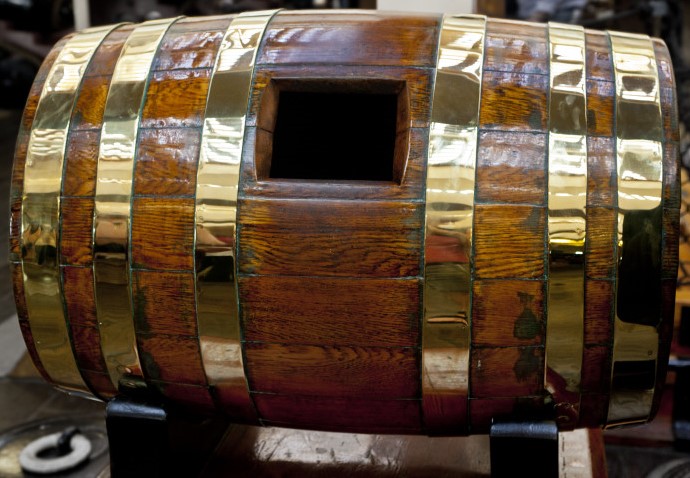
Scuttlebutt: The Butt was a cask with a capacity of between 110 to 140 imperial gallons of liquid (see my article about it here).  Scuttle was an opening in the ship’s deck, and as a verb, it meant to intentionally sink a ship by either putting a hole in it or leaving the portholes open with the intention of making a vessel unusable by an enemy. The barrels aboard ships were usually laid on their sides within braces, and a scuttle was a hole in the side for a cup or scoop to be inserted. The drinking hole became a popular gathering place, and the term “drinking hole” also became synonymous with the office drinking fountain or the local pub – a place to gather and have a drink together. To scuttlebutt means to idly chatter, start rumours, or gossip.

Which of these phrases are new to you? How many do you use, and if you use them, how frequently? I’d love to hear about it in the comments!

4 Comments

Filed under Etymology, History, History Undusted, Lists, Military History, Snapshots in History

History Undusted: Jumièges Abbey

Jumièges Abbey is one of the oldest Benedictine monasteries in Normandy; to dive into its history is akin to diving down Alice’s rabbit hole. For instance, I could say that the abbey was sponsored by the Frankish Queen Balthild, as she persuaded her husband, King Clovis II, to donate land to the Frankish nobleman Filibertus in order to found an abbey. But to know who she was, ah, that is where the intrigue begins.

Who and where were the Franks, when were they a thing, and what are they to us today?

Who, where and when: They were a Western European people who began as a Germanic people along the lower Rhine (which flows from Bonn, Germany, and ends up in the North Sea at the southwestern corner of the Netherlands), along the northern frontier of the Roman Empire. During the Middle Ages, they expanded their scope of rule as the Western Roman Empire began to collapse, and they imposed their power over many post-Roman kingdoms and beyond. That’s the crux of the matter though, as with any political history, it’s far more complex than that. The Franks are distinguished into two main groups by historians: The Salian Franks, to the west, and the Rhineland Franks, to the east.

In the mid-5th century, The Salian king, Childeric I, was a commander of Roman forces against the Gauls, most of whom Childeric and his son, Clovis I, conquered in the 6th century. Clovis was the first king of the Franks to unite the Frankish tribes under one ruler, and he founded the Merovingian dynasty – which ruled the Frankish tribes for 2 centuries. Clovis, in essence, is known as the first king of what would become France. As a side note, the Frankish name of Clovis is at the root of the French name of Louis, borne by eighteen kings of France.

Now, back to Queen Balthild (AD 626 – 680): Sold into slavery as a young girl, she was beautiful and intelligent. She served in the household of Erchinoald, the mayor of the palace of Neustria to Clovis II. Her master, a widower, wanted to marry her, but she hid herself from his sight until he married someone else (apparently the household of servants was numerous enough to enable her to avoid her unwanted suitor). Perhaps through Erchinoald’s notice of her, she came to the attention of Clovis II, who proposed to her and was accepted; hiding herself away may have been a political tactic to gain a higher rank with the king than with the mayor; According to the Vita Sancti Wilfrithi by Stephen of Ripon (written around AD 710), Bathild was a ruthless ruler, in conflict with the bishops and perhaps responsible for several assassinations. Some historians interpret Queen Balthild’s association with founding monasteries as a way of balancing or neutralizing aristocratic opposition to her rule. By installing her own bishops and donating lands for abbeys, she strengthened her own power as ruler (she was regent during the minority of her son). To put that in proper perspective, she was no different than most male counterparts of her day. [I could go off on a tangent about how adjectives differ when applied to the male or female state of affairs (a man is ambitious; a woman is pushy or ruthless), but I won’t. Yet.] From most accounts, however, she was pious and humble. Whichever way you butter that croissant, in ca. 860 she was canonized, thereafter to be referred to as Saint Balthild…

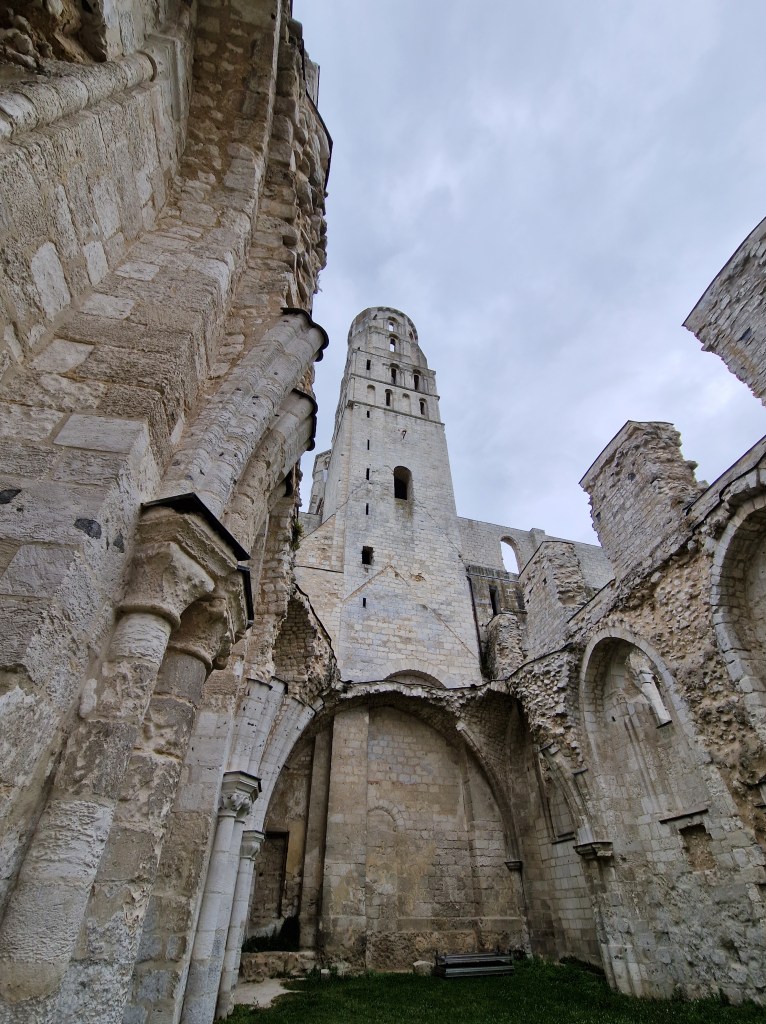
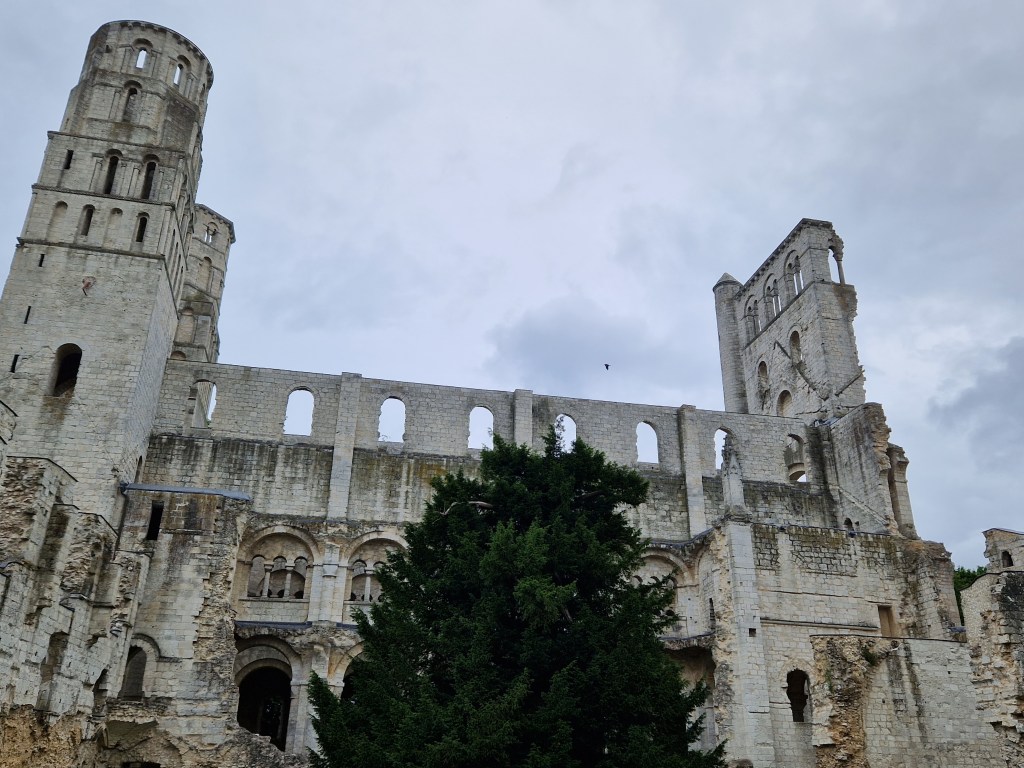
In 654, Balthild gave a parcel of royal land to Philibert, or Filibertus, on which he founded the Notre Dame de Jumièges. His main spiritual influence was that of the Irish monk, Columbanus (who founded several monasteries in the Frankish and Lombardi kingdoms).  The abbey flourished until the Viking invasions of 841 (Remember Rolf Ganger?), which caused disruptions to its first momentum, but it soon began to prosper again. The church itself was rebuilt between 1040 and 1066; it was dedicated on 1 July 1067, with none other present than William the Conqueror, Duke of Normandy and King of England (1066 and all that). The patronage of such a nobleman ensured the abbey’s success.

Jumièges Abbey was, like any abbey of its time, a veritable town. The church was only the heart of the community; there was a 14-acre enclosed park, terraced gardens, the abbatial manor, a bakery, landscaping to evoke biblical scenes, a hostelry, the 14th century “Charles VII” walkway (a covered walkway between the Notre Dame and St Peter’s church, named after the fact that Charles VII and his favourite mistress visited the monastery), and the cloister.

The next major disruption was from 1415, when the monks were forced to regularly seek refuge in Rouen as the English occupied Normandy during the Hundred Years’ War. The abbey eventually recovered and began to flourish again, until the whole province was plunged into the chaos of the Wars of Religion (1562-1598), resulting in the population’s decimation and famine. In 1649, the abbey was taken over by a Benedictine congregation, when some of its former glory was revitalized. Having survived all of that, its ruin came at the hands of the French Revolution, when it was sold as a “national property” and turned into a stone quarry (seen only as a source of ready-cut stones). At last, its historical value was recognized in the 19th century, putting an end to its wanton deconstruction.

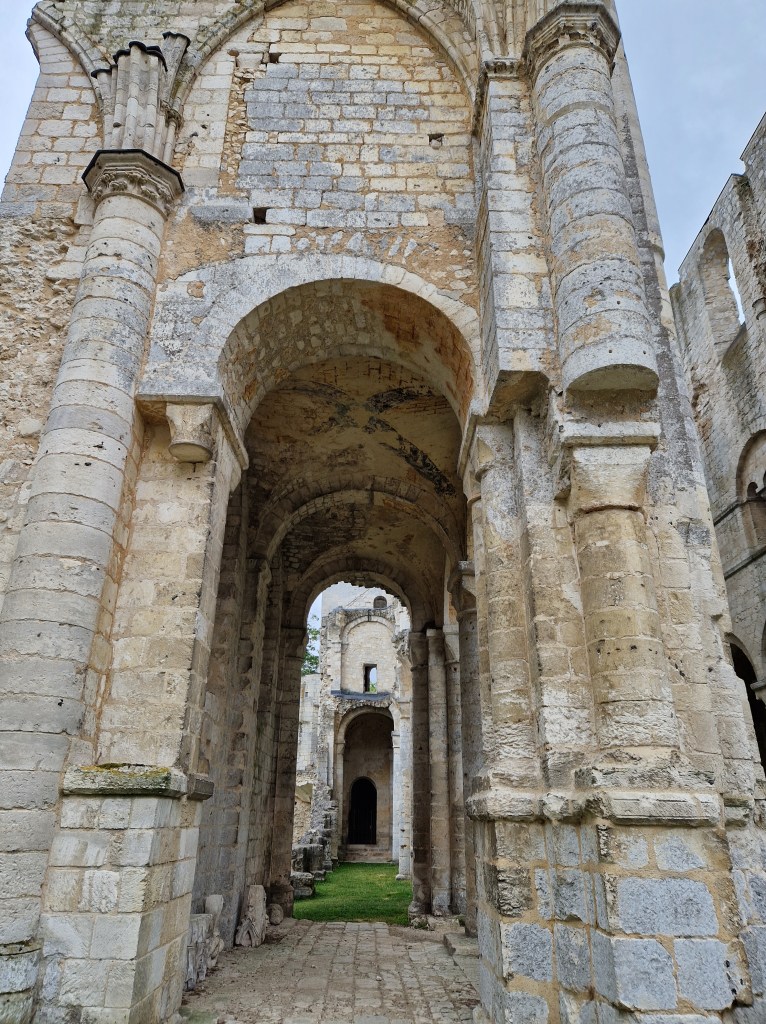
When we visited the abbey last summer, its grandeur, although only ruins today, is still evident; when it was at its height of prosperity, it must have been an awesome sight to behold! In the photos below, which I took during our visit, you can see evidence of the various phases of destruction and reconstruction. Enjoy!

2 Comments

Filed under Articles, Etymology, History, History Undusted, Military History, Snapshots in History

History Undusted: The Great Clock of Rouen, France

Last summer, my husband and I rented a privately-owned motorhome in Caen, France, and travelled around Normandy for 10 weather-perfect days. One of the places we had on our short list to see was the city of Rouen, a region with a long and rich history. One icon of the city is a clock. Not just any clock. The Great Clock of Rouen.

Rouen was a pivotal location in the Hundred Years’ War (1337-1453 – calling it the “Hundred-and-Sixteen Years’ War” is more accurate but not as catchy, though the name is likely based on the fact that there were periods of fragile truces); the central conflict was the English claim to the French throne. In the context of this war, Joan of Arc became a victim of male chauvinism and political expediency. But that’s another story.

The mechanism of this clock was built in 1389. Let’s put that into perspective: That’s over 100 years before Columbus set out to discover a western passage to the East Indies and inadvertently discovered America; Richard II took over as king of England; it was made during the Hundred Years’ War; Joan of Arc would have seen this clock on her way to her execution (by burning at the stake). It was made more than 190 years before our modern Gregorian calendar replaced the Julian calendar, in 1582.

The mechanism deserved not only a grand position, but a grand façade: The Rouennais aldermen decided that the town needed a clock, and the construction of a tower to house the clock took 9 years; the architect was Jehan de Bayeux, though the tower was completed by his son in 1398. The original designer of the clock’s facades, Jordan Delettre, was no more (whether he died or was removed is unknown), and it was completed by Jean de Felain, who became the first “governor of the clock”, maintaining it in exchange for a home in the clock’s tower. Towers and wars came and went, and the clock survived; it was moved to its current location in 1410, now housed astride an ornately carved stone archway.

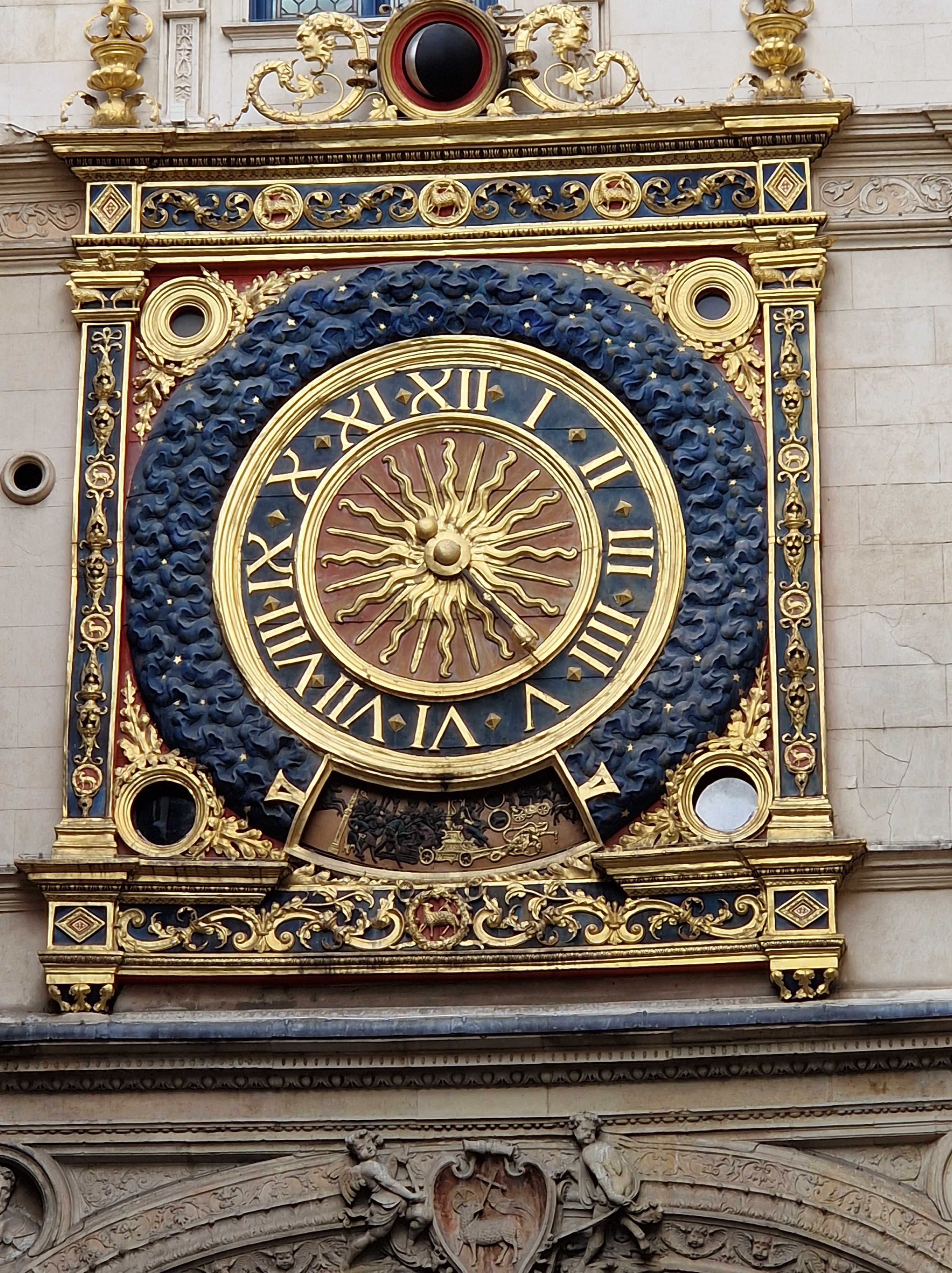
The clock faces (on both sides of a stone archway and connected to a central mechanism shared by both) are 2.5 metres (over 8 feet) in diameter, and each has only a single hand, tipped with the depiction of a lamb, which shows the hour; moon phases are indicated in the 30 cm oculus above the clock face, which makes a full rotation every 29 days. The face depicts 24 rays of the sun surrounded by a dark blue starry frame. A hand which shows the day of the week is located in an opening at the base of the dial, with each day represented by a different Greek god: Diane as the moon (Monday), Mars (Tuesday), Mercury (Wednesday), Jupiter (Thursday), Venus (Friday), Saturn (Saturday) and Apollo (Sunday).

Although the mechanism of the clock still works, it has been powered by electricity since 1928, and the tower itself was renovated in the late 1990s.

Underneath the clock in the centre of the archway, the coat of arms of Rouen can be seen: It depicts the Paschal lamb on a red background (the official colour of Rouen); it is held by two angels (if you look closely at the angel on the right, you’ll notice that its head is on wrong; it is thought to be due to disgruntled construction workers – obviously an age-old problem…). Beneath the arch are elaborate bas-reliefs of Jesus as the Good Shepherd caring for his flocks; the clock’s hand, the coat of arms and the reliefs all echo the importance of textile and wool trade to the city. One clock face alone has at least 15 sheep (zoom in on the picture of the clock and see if you can spot them all!). Next to the clock is a Gothic belfry tower built in the 14th and 15th centuries which houses the bells connected to the clock, which ring on the quarter-hour.

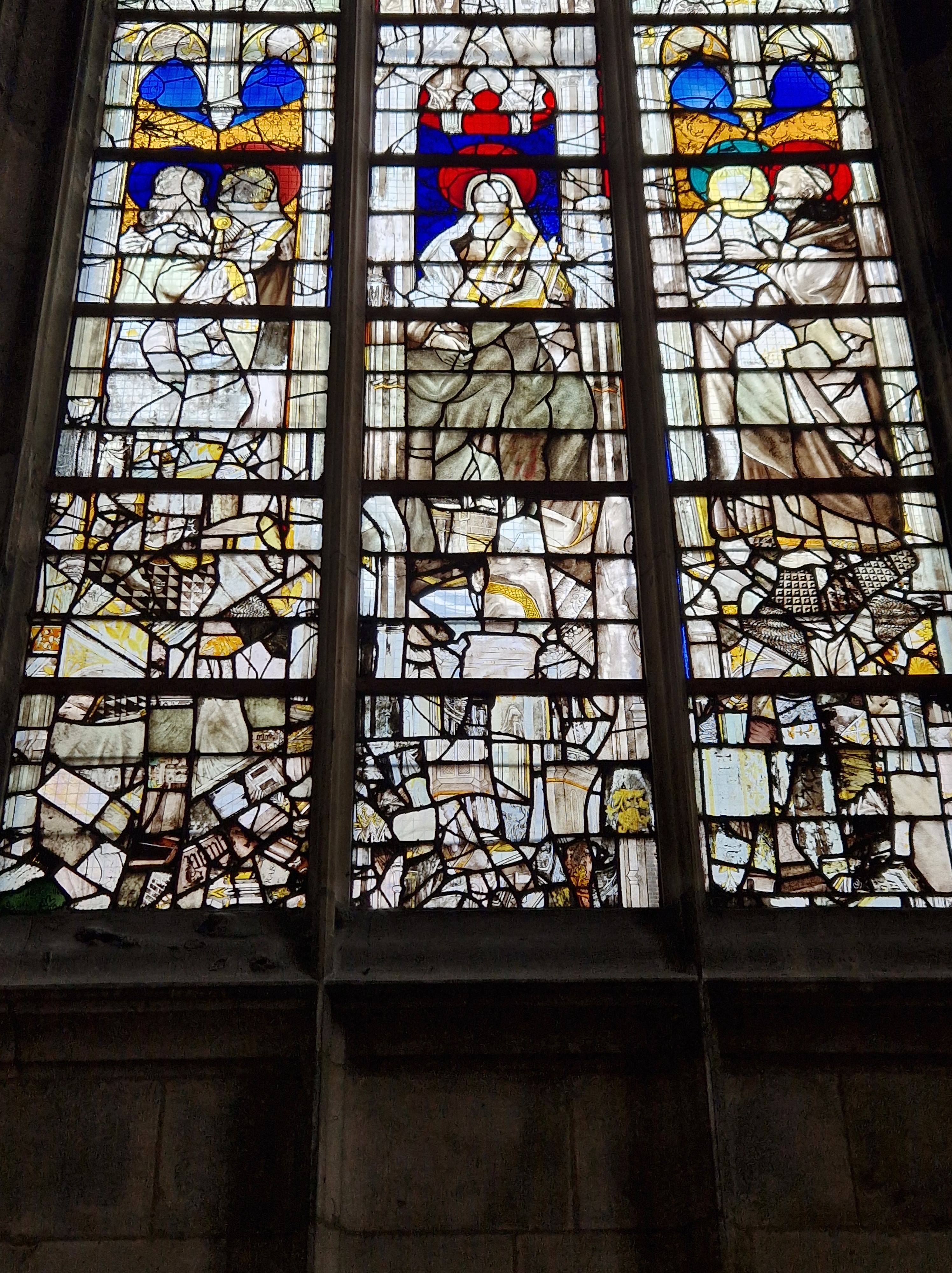
Rouen is a survivor: It has outlasted Viking raids that travelled up the Seine River, the Hundred Years’ War, the Religion Wars of the Renaissance period, the Franco-Prussian War of 1870, the French Revolution, and even World War 2; the latter damaged nearly half the city, and shrapnel and bullet scars can still be seen in façades. The cathedral’s stained-glass windows were shattered by a WW2 bomb and were subsequently reconstructed using the fragments, creating jumbled images that reflect its history and its survival.

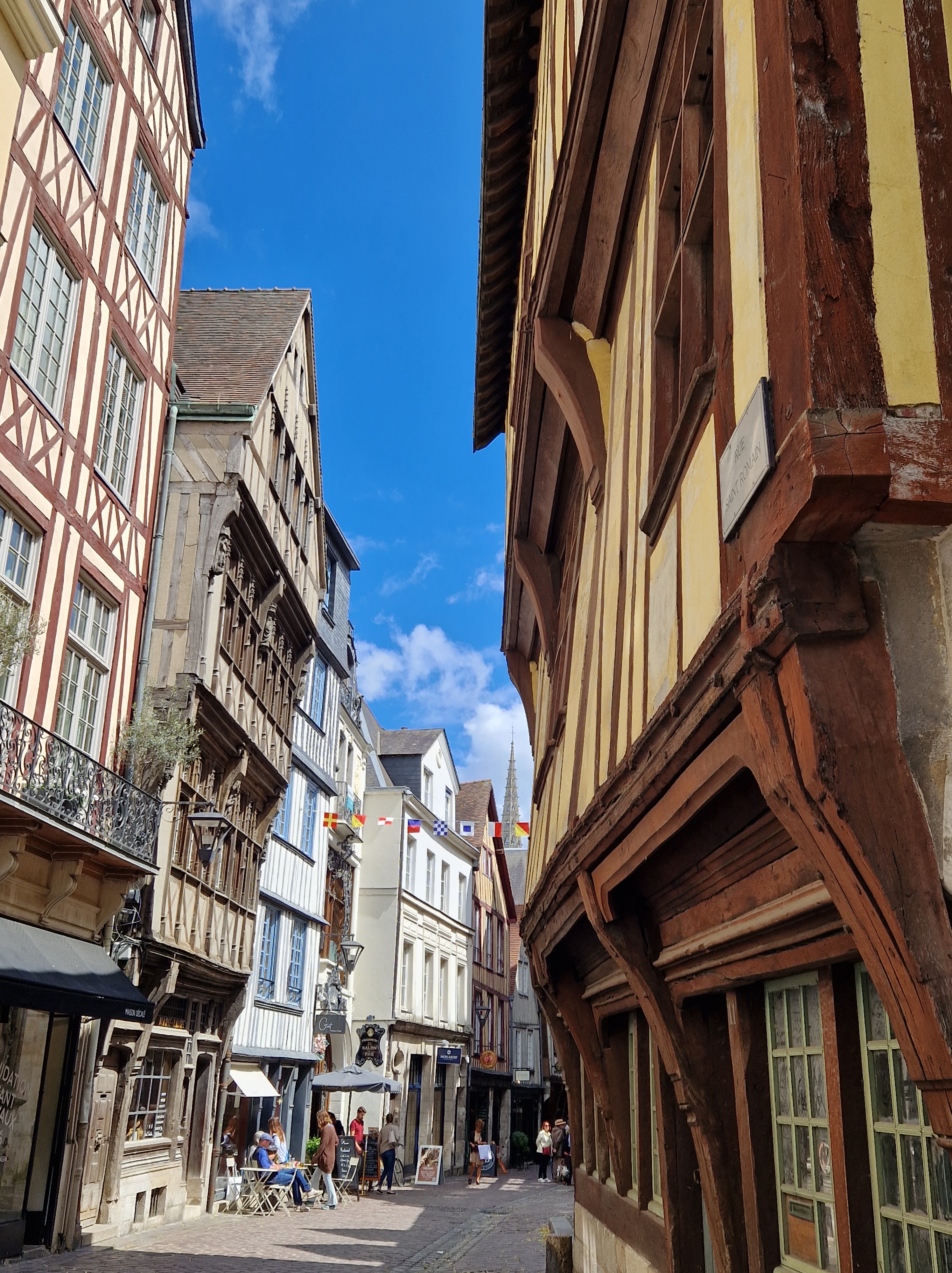
For me, the clock must really be seen within its context to truly appreciate it; it’s surrounded by wonky Medieval buildings which are three or four stories tall and built when plumb lines and uniformity were still futuristic concepts. They were built out of timber, as there is abundant forest nearby but no stone quarries.

The clock adorns the arch over the Rue du Gros-Horloge (“Street of the Great Clock”), which runs between the Gothic cathedral, made famous by Claude Monet (who painted over 30 canvases centred on the cathedral), and the old market square, where Joan of Arc was burned at the stake. Perhaps ironically in light of the latter event, the street just off of the clock’s archway is called Rue Massacre…

Though I do not speak French, I know that in French, clocks today are referred to in the feminine form, la horloge; but prior to the 18th century, clocks were masculine; so, the great clock of Rouen, in French, is still Le Gros-Horloge.

Below are a few of our holiday photos: They include the cathedral’s jumbled windows and the clock from various angles, as well as a few of the wonky buildings. Enjoy!

5 Comments

Filed under History, History Undusted, Military History, Science & Technology, Snapshots in History

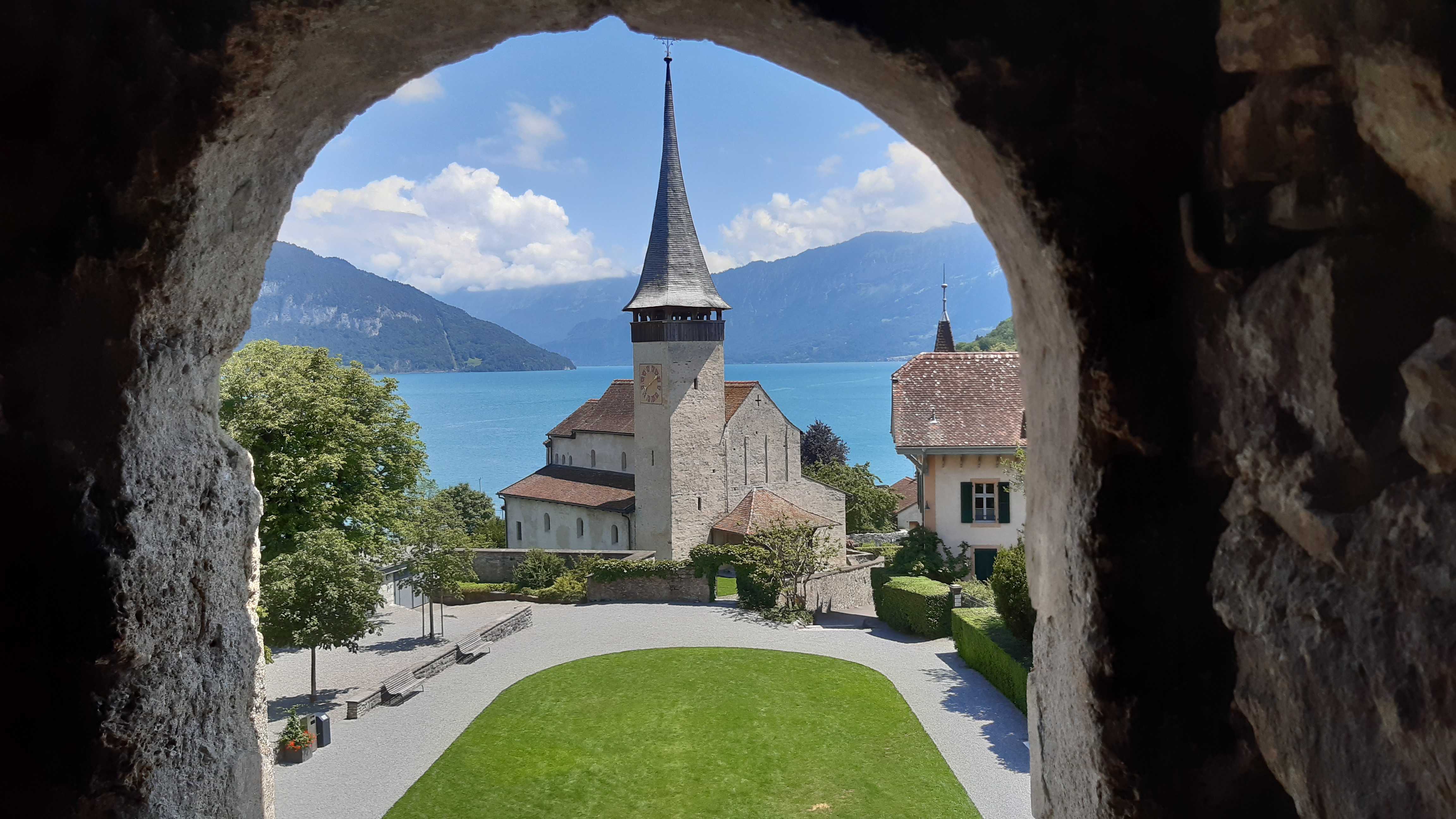
History Undusted: Spiez Town, Church & Castle

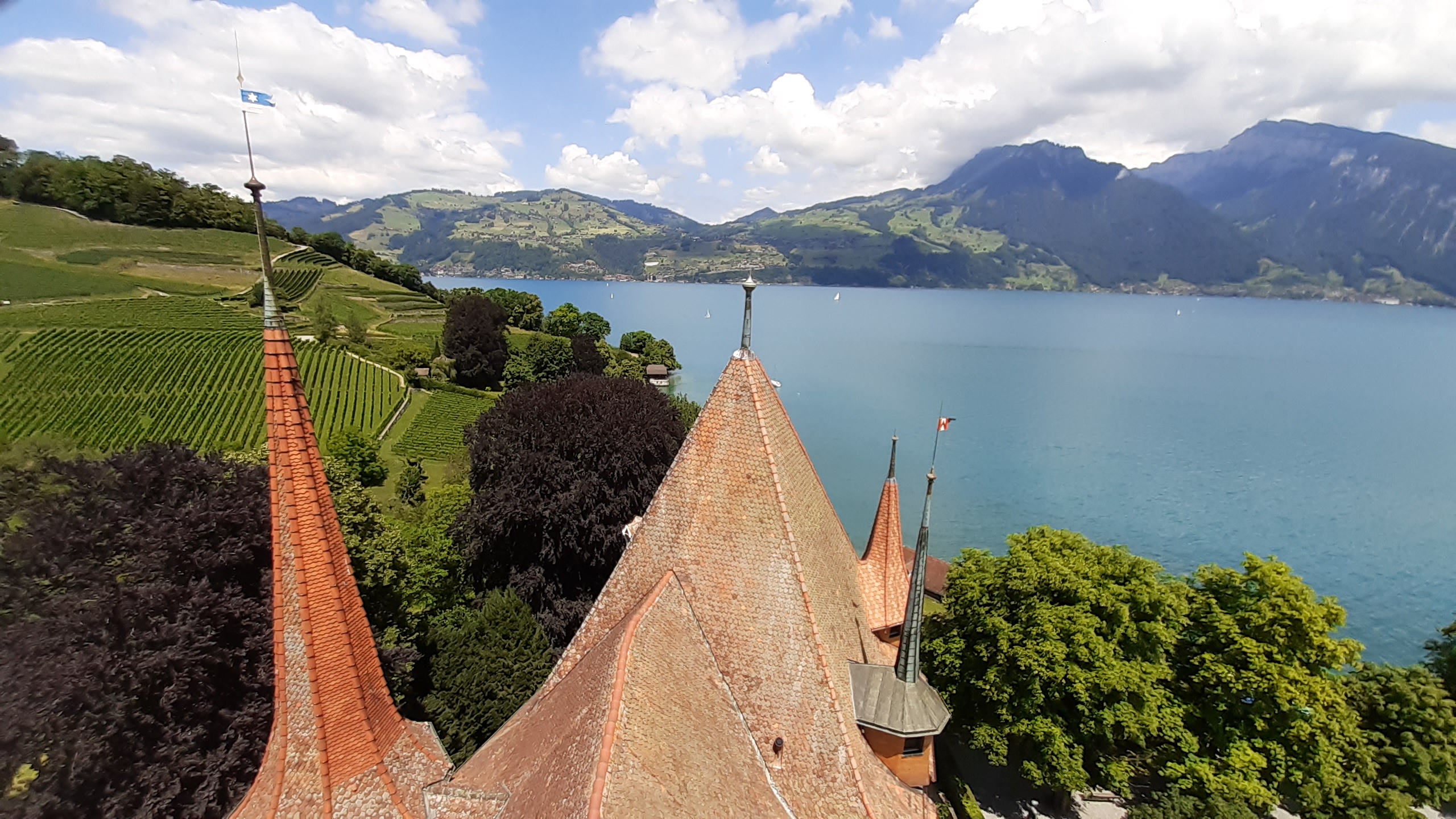
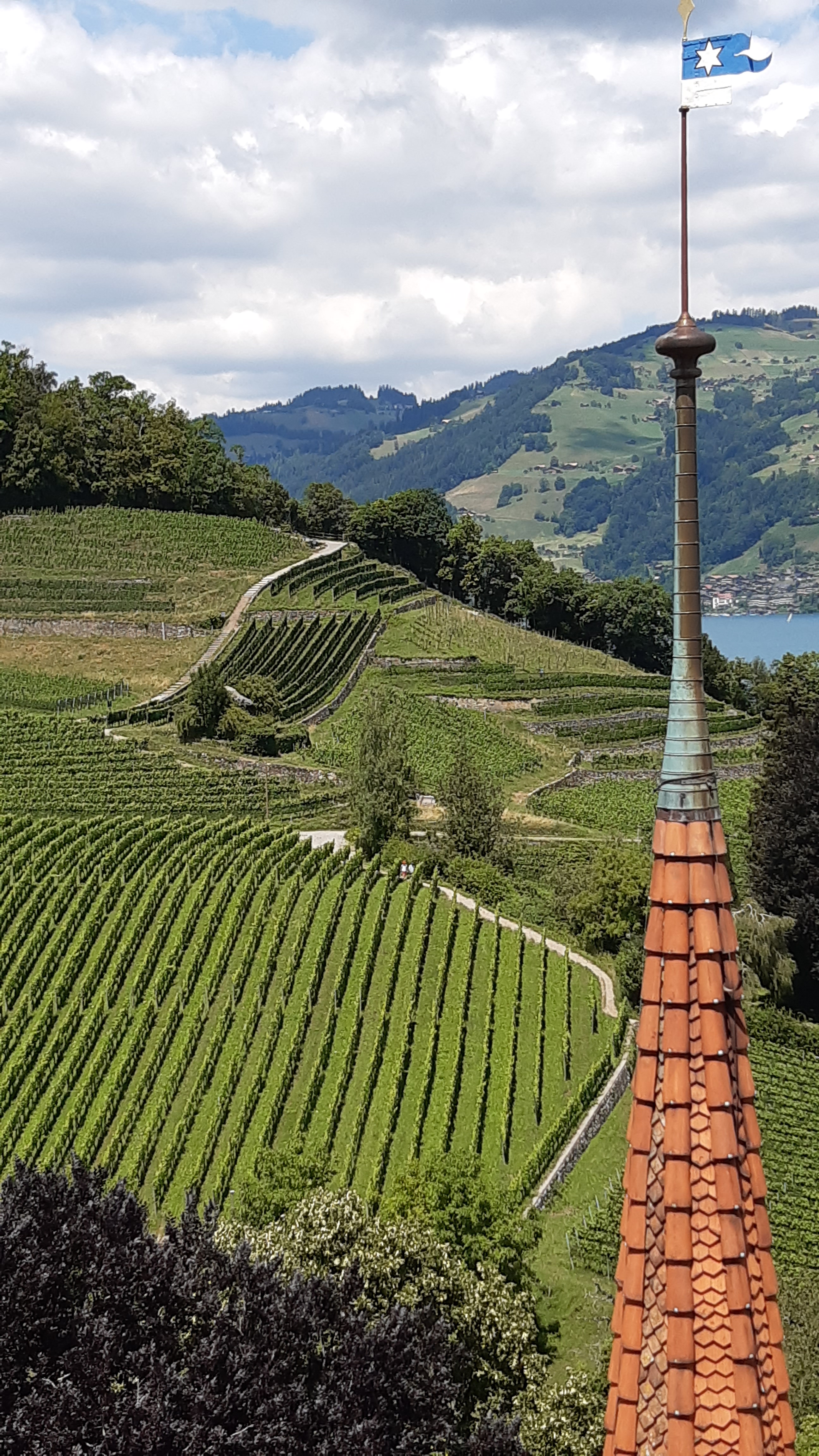
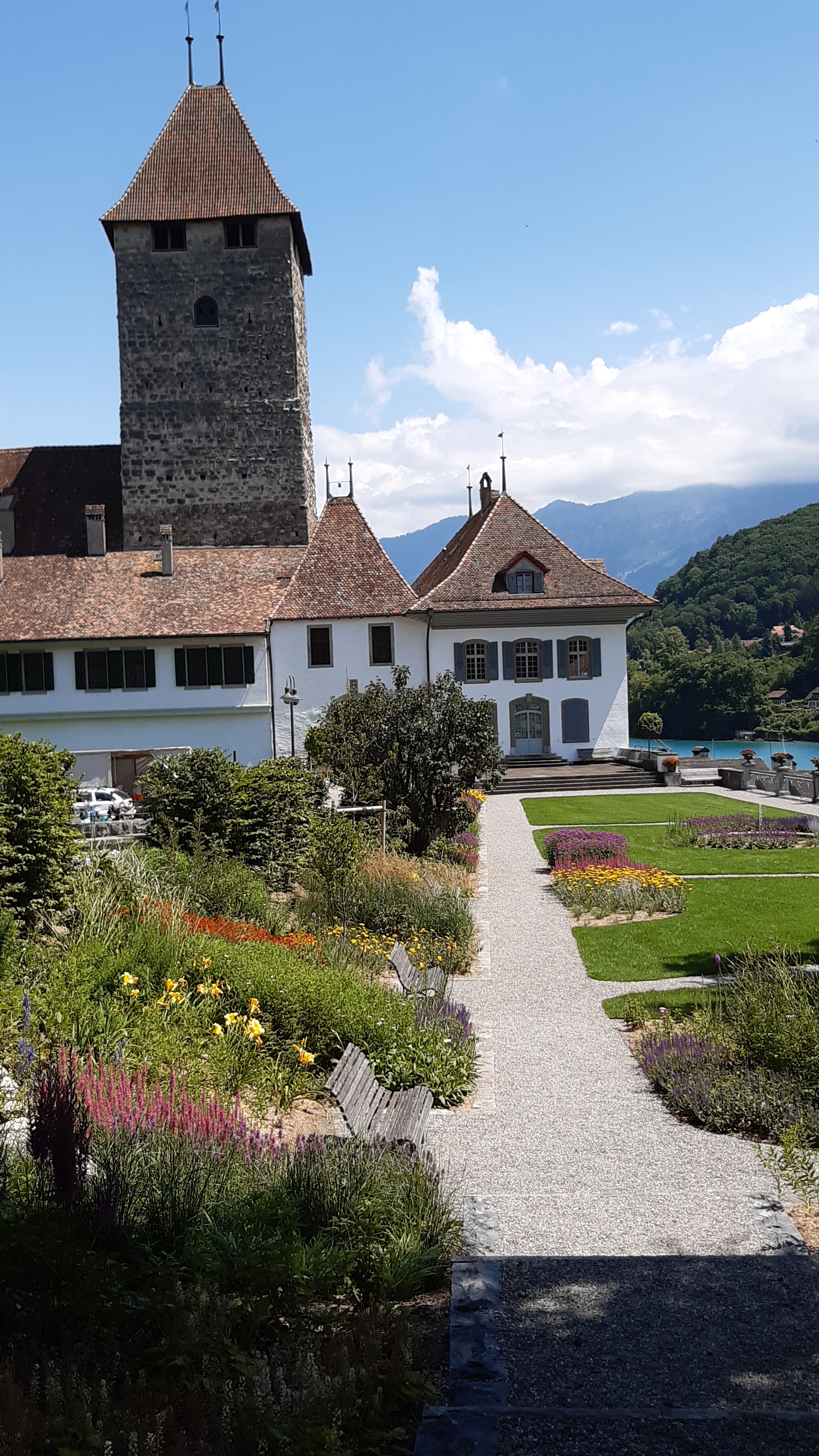
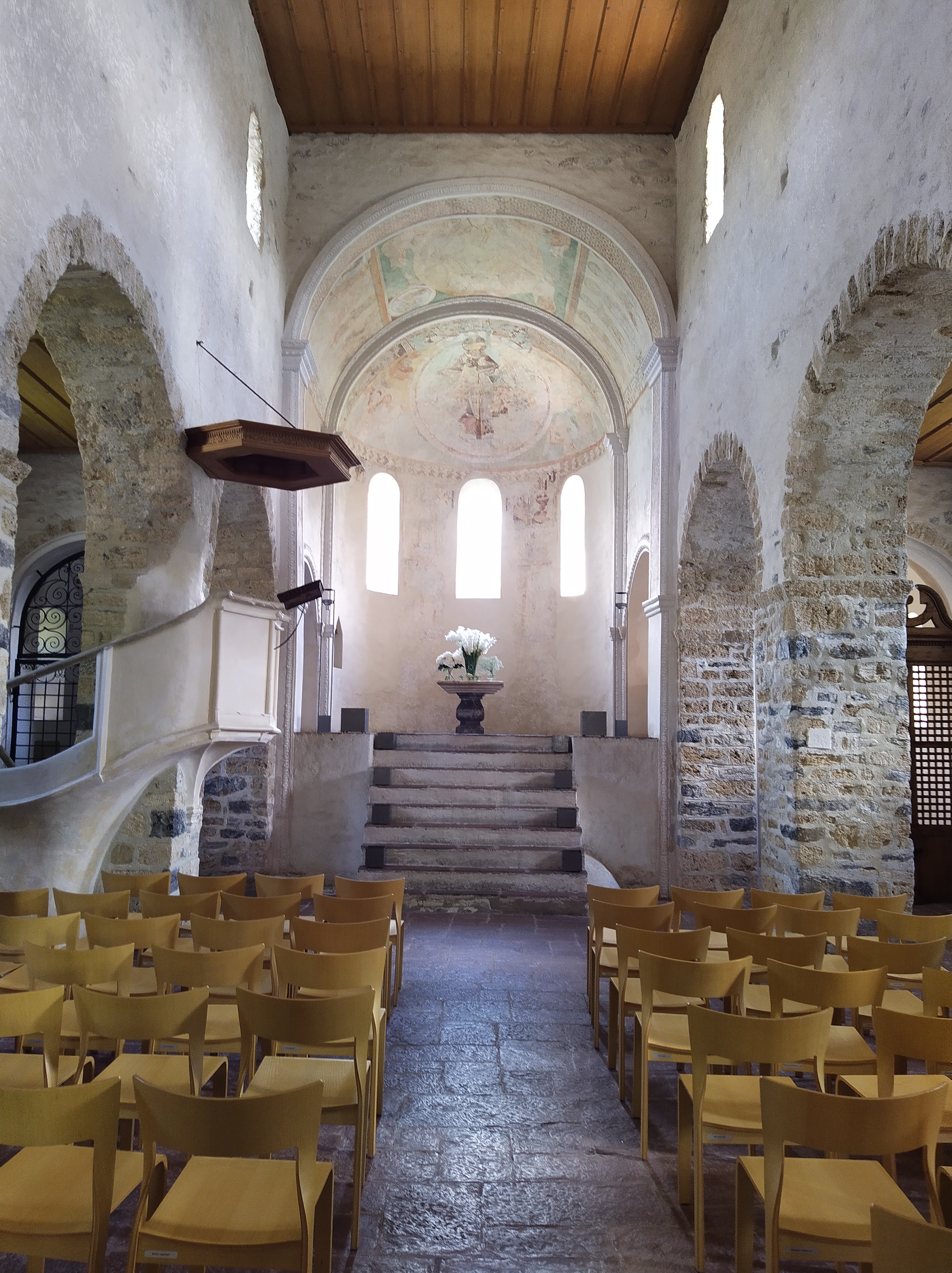
Let’s take a virtual tour of a beautiful little castle on Lake Thun, here in Switzerland: Spiez Castle is a grand but pocket-sized edifice that sits on a spit of land jutting out into the lake, with the town of Spiez surrounding it. The area has several substantial bronze- and iron-age settlement sites, which shows that the area has been rich in natural resources and populated since time immemorial. The town and its church were first mentioned around AD 762, when Bishop Heddo of Strasbourg disposed of the church and tithes in his will. In AD 933, the King of Burgundy, Rudolph II, had Spiez castle built, and soon the Freiherr of Strättligen settled there. [Freiherr was a rank of nobility within Germanic-speaking areas that would have roughly translated to the English rank of baron.] Sections of the current shield walls and tower were built in the 12th century, and though the town was originally located within the castle walls, by the 13th century it had outgrown the walled enclosures. The small church, which is on the castle grounds, is one of the twelve Lake Thun churches mentioned in the Strättliger Chronicle [a Swiss dynastic and national history of the rulers of Bebenberg and Strättligen and their lands and churches – all within canton Bern, covering from AD 1100 through 1464].

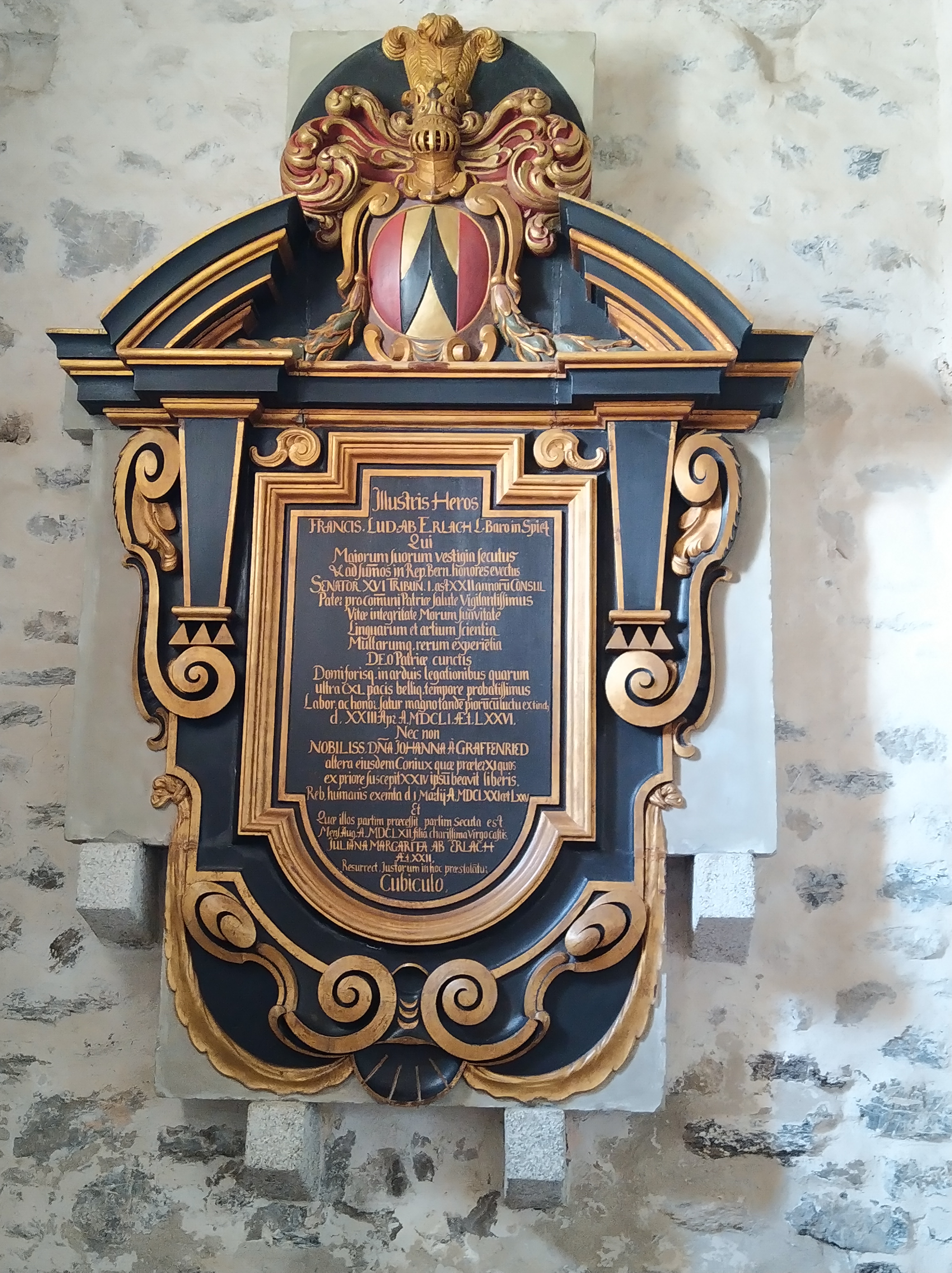
The castle changed hands numerous times, whether through political manoeuvring or through dynastic extinction. Last week, my article touched on the French invasion of Switzerland; After that 1798 French invasion and the creation of the Helvetic Republic, the von Erlach family lost the rights to hold the lands as well as their jurisdiction over the village, but retained ownership of the castle until 1875. In the church is a panel in Latin about the titles of the baron von Erlach and of (who I assume was) his wife, Johanna Graffenried (from another noble family in Berne), with the family crest (see the images below).

This past summer, my husband and I toured the castle and the church; it was an awe-inspiring feeling to know that we were walking where people have walked for well over a thousand years; where nobility and peasants, servants and pilgrims have stood, walked, talked, lived and passed. Here are a few impressions of the castle, church and the views we enjoyed, and I hope you enjoy, too.

6 Comments

Filed under Articles, History, History Undusted, Military History

History Undusted: The Age of Revolutions

This past summer, my husband and I rented a motorhome and travelled around Switzerland; we tend to prefer nature or museums to overly-touristy attractions. One of the places we visited was Spiez Castle. Before I tell you about that, however, a little historical backdrop is necessary, so buckle up and enjoy the ride!

Everyone’s heard of the French Revolution, which began in May 1789: It was a struggle to become free from the heavy yoke of an elitist monarchical regime, quasi out of the frying pan and into the fire of the Reign of Terror – during which many of the original rebels, in a twist of morbid irony, also had their heads removed by Monsieur Guillotine; it ended in November 1799 with the abolition of the Ancien Régime and the creation of constitutional monarchy (not far from where they started) and the French Consulate (which lasted nearly 5 years until the start of the Napoleonic Empire in May 1804).

But what many people might not know is that the French Revolution was internationally both influenced and influential. Modern “small world” effects are not modern at all; even in ancient times, people had international news: Travelling merchants and traders, messengers, signal towers (such as those the Romans used along the British frontiers), and even smoke signals, all conveyed news. When the French Revolution began, there was already a growing political dissent spreading throughout Western Europe; the English “coffeehouse culture” enabled men to gather in small groups and discuss business and politics; this concept travelled to America, and the discontent culminated in the American Revolution, starting in April of 1775. The French people watched and learned. The British government naturally became wary – they were losing the American colonies to the Revolutionary War, which they finally lost in September 1783. The Americans were supported during that time by France and Spain (the two main long-term enemies of Britain), so the British were hemmed in by threats to their own social order from both the east and the west, and they had well-founded fears of the discontent sparking revolt in the dry tinder of their own oppressed ranks.

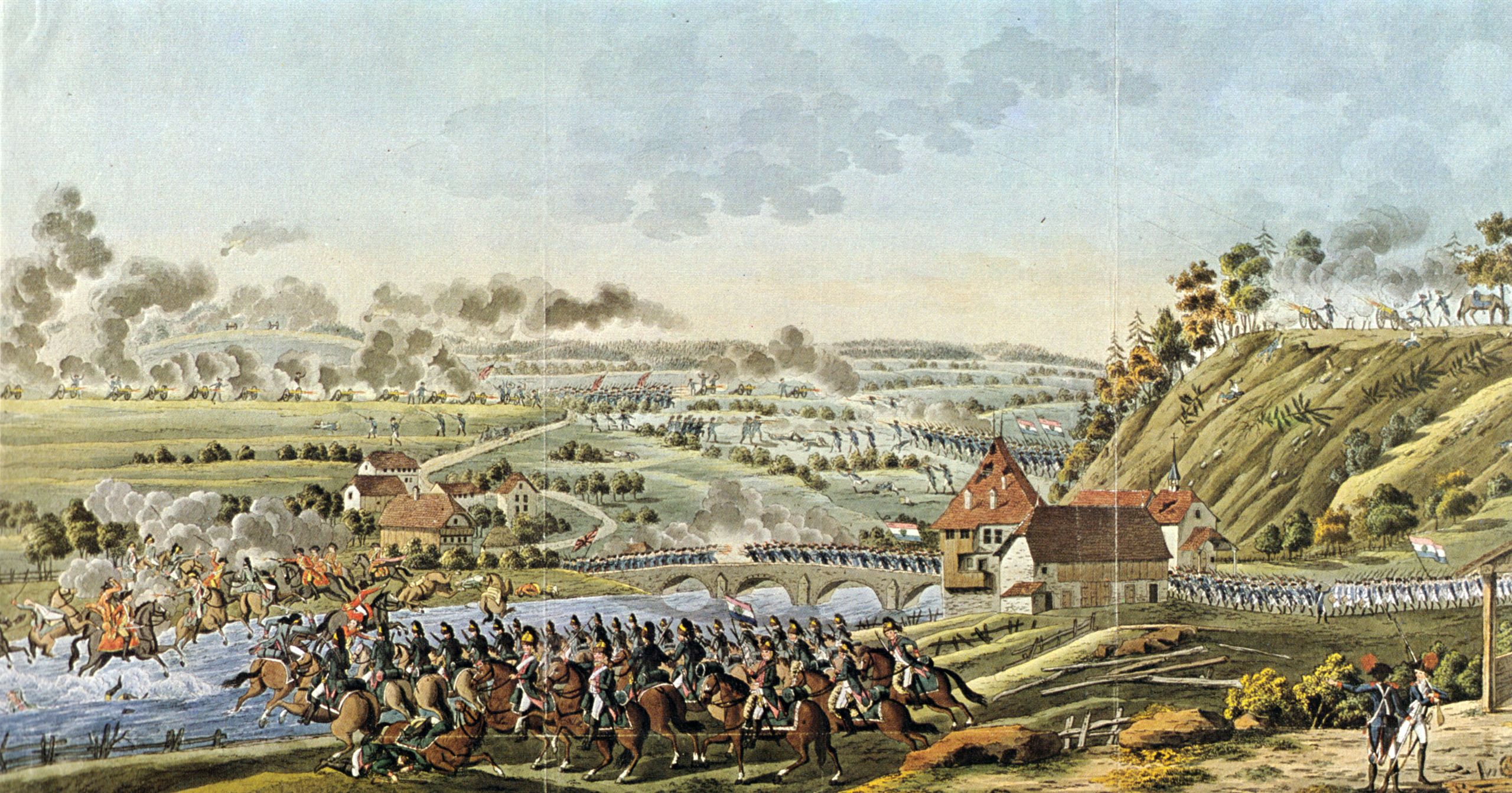
And now we come to Switzerland: To understand the Swiss backstory in a nutshell, which does no justice to a history that began in the Palaeolithic Age or further back, let me sum it up: The Old Swiss Confederacy was an alliance between independent small states, starting on 1 August 1291 with the “Rütlischwur”(an oath of allegiance between the cantons of Uri, Schwyz and Unterwalden), which date is considered by the Swiss to be the birth of the nation (though history is more complicated). As the French Revolution was beginning to wind down, Napoleon Bonaparte, then a French general, pressed the French Directory (the then-current French governing committee) to invade Switzerland. The atmosphere within the Old Swiss Confederacy was tense, fearing that the French Revolution would spill over with or without direct French military involvement. At the invitation of a French-speaking faction in Vaud (then part of Canton Berne), 12,000 French troops invaded through Vaud on 28 January 1798, and for the next four months, battles were waged between the French and the Swiss “Loyal Legions”. It ended in May with the swift collapse of the Swiss Old Confederacy.  

The Battle of Neuenegg, 1798 – Graphics Collection, Central Library, Zürich

However, the French Directory needed a solid neighbour, a buffer zone along their eastern borders, not a loosely associated collection of small states; they tried to steer toward a re-establishment of national unity with a Paris-drawn constitution, but on April 1798, Swiss cantonal leaders proclaimed the Helvetic Republic, with new legal structures that abolished feudal rights within individual cantons in favour of a national unity. A few battles later, and coalition armies waging war in and around Switzerland against France, eventually left Switzerland as a sovereign, neutral nation; it has remained so ever since, despite two world wars.

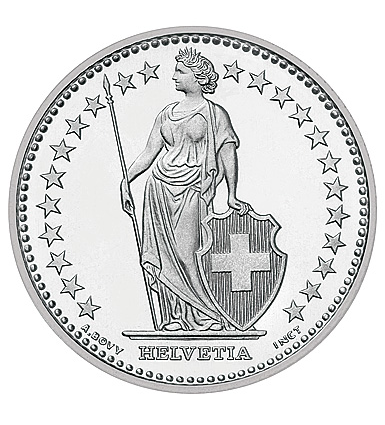
An etymological side note on the Latin name of the Swiss Confederation (Switzerland), Confoederatio Helvetica: Helvetia is the female personification of Switzerland, found on nearly every coin, much like Lady Liberty of America. The name derives from Helvetii, a Celtic tribe that inhabited the Swiss Plateau since before the Roman Era. The earliest reference of the name is dated to ca. 300 BC, written in Etruscan on a vessel from Mantua (located in Lombardy, Italy). By the time the Romans arrived, they were well-established tribes governed by noblemen; the Roman historians tended to refer to anyone not Roman as “barbarian”, which tends to skew modern understanding of the peoples they conquered; it was perhaps their way of justifying invasions against peaceful, intact civilisations. Naming no names, but R—– is repeating that same shameful tactic today; there’s nothing new under the sun.

It’s easy to overlook the complexities of historical events or view them from only one nation’s side; after all, as Mark Twain once wrote, “The very ink with which all history is written is merely fluid prejudice.” History’s angle is in the hands of those who wrote it – if they were Roman, everyone else was barbarian; if they were English, the Scottish / Irish / Indians were backwaters in need of a guiding stick, and so on.

So, now that you know a bit more about the history in and around Switzerland, I’ll highlight Spiez Castle next!

3 Comments

Filed under Etymology, History, History Undusted, Military History, Quotes, Snapshots in History

History Undusted: Rabbit Holes & Licorice Candy

This week, I did a major shopping at a couple Asian food stores; I stocked up on the ingredients I know, and some I didn’t; I like to get things I’ve never heard of, and do a bit of research on how to use it in cooking; things I picked up in that category are Iranian Kashk, which is a tangy fermented, yoghurt used as a condiment; canned palm hearts, which make a nice topping on desserts; and fermented black beans, which can be used in a variety of Asian dishes, including in a black bean sauce. I also bought several fresh vegetables and herbs to dehydrate and turn into a greens powder for adding flavours to dishes (I have a more usual greens powder with standard greens, like cauliflower leaves, spinach, etc. that I use daily).

One of the herbs I used was acacia leaf: When I opened the package, a pungent, sulphur-like smell hit me, and I wasn’t sure I’d use it. But when I began de-leafing it (much like you would thyme, though carefully as it’s got some vicious thorns!), it began to smell like mint! As I added lemongrass, Thai water spinach and other herbs, you can imagine the cacophony of fragrances in my kitchen – which filled the house as they dehydrated.

So what does this have to do with licorice? Well, one of the fresh herbs I also processed was Thai basil; I’d never used it before, and when I opened the packaging, a wave of anise- or licorice aroma hit me. And as usual, that set my mind off, thinking about the history of licorice!

Licorice is a flowering plant native to parts of Asia and Europe; its scientific name, Glycyrrhiza, comes from Greek and means “sweet root” (the linguistic roots are related to words like glycerine and rhizome); it is the ingredient that gives the signature flavour to black licorice, though today anise oil is often used as a substitute because the Glycyrrhiza can have toxic effects if ingested too much.

In looking into the history of this flavour, I came across a fascinating documentary: Ostensibly, it covers the history of the Switzer Licorice candy company. But in truth, it’s a fascinating historical insight into the history of Irish immigration, social unrest, the Irish famine, Irish revolution and exile, union labour foundations, World War 1 through the eyes of a family, the economic upheavals of war, rations and the company’s creative solutions, the history of sugar, post-war recovery, the Great Depression, the American Dream, candy-making, the rise of a family from Kerry Patch (the Irish ghetto of St. Louis, Missouri) to the suburbs, the history and development of St. Louis, and the demise of a family company resurrected by later generations. All in a 55-minute video!

 To watch this fascinating slice of history, click here. To check out the company’s website, click here.

I hope you enjoy this short history, and while you’re at it, enjoy a piece of licorice!

Image Credit: Switzer website (see link above)

Leave a comment

Filed under Articles, Etymology, History, History Undusted, How It's Made, Links to External Articles, Military History, Science & Technology, Snapshots in History, Videos, YouTube Link

History Undusted: The History of Money in the American Colonies

Today we’ve got a variety of ways to make financial transactions: Online payment, cheques (checks), cash (coins or bills), debit cards, giros (UK), credit cards, bitcoins, Twint, and probably a dozen other ways. But when did it all get started? Why are there ridges or texts on the edges of coins? What did people use before coins were widely spread enough to be a viable means of transaction? I’ve written about the history of shillings before, and ancient payments using hack silver, but the complications that arose across the Atlantic between the British crown and the colonies of America, before they won their independence, is as fascinating as any thriller. It’s a tale of laws passed to stranglehold the colonies into submission or to stop an artery bleed of silver across the ocean, and loopholes and nooks and crannies found to carry on with business anyway.

For a fascinating video on the topic by Jon Townsend, an 18th-century reenactor and specialist with a great YouTube channel, just click on the image below. Enjoy travelling back in time!

Leave a comment

Filed under History, History Undusted, Military History, Snapshots in History, YouTube Link