Unless you’ve been living under a rock, I’m guessing you know that the world is batship crazy right now: Wars and rumours of wars (Matthew 24:6); earthquakes setting off chain-reactions of town-swallowing landslides and a cluster of volcanoes taking deep breaths to blast anytime soon; massive storms and flooding in places unprepared for such weather. And those topics are just the tips of melting icebergs.
We could focus on such things and despair; it’s no wonder that depression soars, in some places as high as 1 in 6 people globally. Positive news is elusive – not because it isn’t there, but because it doesn’t grab our emotions like negative or shocking news does; this is why it’s dominant in news reports, newspapers or YouTube thumbnails. Drama sells. But it’s also selling anti-depressants.
But I have good news: Focus is what it’s all about.
If we focus on something, that’s what we’ll begin to see everywhere. Take the example of a puzzle: When you’re working on a particular section and looking for blue, you’ll begin to see blue on pieces you hadn’t noticed before. If we focus on the negative and the bad things happening in the world, we’ll begin to see only that, and it’s no wonder we feel blue.
The Bible has a lot of wisdom, even if you don’t yet believe in God. Philippians 4:8 encourages us to focus on good things: “…whatever is true, whatever is noble, whatever is right, whatever is pure, whatever is lovely, whatever is admirable – if anything is excellent or praiseworthy – think about such things.” The message of Jesus is called the Good News for many reasons; I encourage you to explore the Bible. If you prefer to watch rather than read, I highly recommend The Chosen series – all free online, in any language! All you need to do is sign up, and you’ll have access to the series and all the extras that have already been released – five seasons so far, with two to come.
My husband and I read a devotional every evening, and one of the elements is this: “As I end this day in God’s safe keeping, I count three blessings before my sleeping.” It causes us to focus on the good things of the day; sometimes it can be as simple as, “I was able to get up without assistance, dress myself, and walk and breathe on my own.” All things that most people take for granted… until they’re gone. They are tremendous blessings and not inevitable or unimportant! It’s a good way to end the day… focusing on upsies, not downsies.
There is a lot of good news happening around the world, but as I said, it can be elusive. Thankfully, there are people out there focused on finding it for us and reporting about it! Here’s a link to the appropriately named Good News YouTube channel that brings a dose of good reports from around the world, from ecology to breakthroughs in science and medicine. Another channel worth watching is called Planet Wild, which focuses on restoration and conservation, putting people’s money to immediate use in projects focused on the environment and ecology. They show the progress and report on positive changes.
When you hear about or watch something that’s good news, please let me know in the comments below which story captures your imagination or encourages you!
Take a few minutes every day to focus on what is true, noble, right, pure, lovely, admirable, excellent and praiseworthy.
I hope you all had a refreshing Christmas and are about to have a great start to the coming new year! If you’re like me, Christmas songs have been playing for the past few weeks; and if you stop to think about it, every song we know and sing has an origin story: “Amazing Grace” was written by John Newton (an English slave trader-turned-abolitionist); the hymn “It Is Well With My Soul” was written by Horatio Spafford as his ship passed over the place where his four daughters had drowned in a shipwreck. Every song has a story, and the Carol of the Bells is no different.
The Carol of the Bells has been recorded well over a hundred times in the past decades, and it is one of the “classic” and loved Christmas carols – except that it didn’t start out as a Christmas song, but rather a spring song. I don’t usually like to offer little more than links, but explaining the history of the song and the fate of its Ukrainian composer is best told in the following video:
As explaining a song without singing or playing it is a bit like explaining a story with no details, I would rather leave you with a few music video links to my favourite versions:
I’ve been thinking about writing on the topic of the Radium Girls for some time now. In our home library, the book by Kate Moore, The Radium Girls – The Dark Story of America’s Shining Women (2017), has been glowing at me (not literally, thank goodness!). The book is a fascinating history of the women who worked in watch-making factories across the States, and the groundbreaking battle for workers’ and women’s rights, which helped shape labour laws that would protect future generations from shameless exploitation.
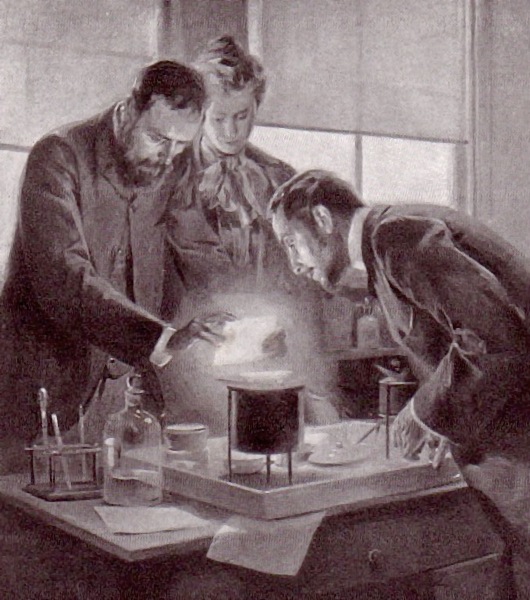
Curie is the unit of measurement for radioactivity, named for both Marie Sklodowska-Curie and Pierre Curie (co-winners of her first Nobel Prize, in Physics, 1903); Marie went on to win a second in another field (Chemistry, 1911). Their oldest daughter, Irene Joilet-Curie, won the Nobel Prize (with her husband, Frédéric) in 1935, also in chemistry. Marie Curie died from the effects of exposure to radiation on 4 July 1934 (her husband would have had the same fate, but he was killed in 1906 in a road accident). Even today, her papers and even her cookbook are so radioactive that they are stored in lead boxes, and anyone examining them must be fully protected. I could do a whole history of the Sklodowska and Curie families; the women were intelligent, educated, ahead of their time and left their marks on history in several fields of science. [I don’t know if the book would be available where you live, but the youngest daughter of Marie, Eve Curie, wrote a biography about her mother, published in 1937 in several languages (I have the 1938 Swiss edition, in German). The book can be found in e-book formats as well.]
Marie and Pierre Curie experimenting with radium. Drawing by André Castaigne. Notice that they are all handling the radioactive material without protective gear…
Radium, discovered by the Curies in December 1898, caught public fascination; soon, Radium was touted as the cure-all of the new century. It was sold as healthy, as something that would make your skin glow. It was said to cure ailments and recharge your physiological batteries with pure energy. It was put into toothpastes, face creams, soaps, bath salts, makeup, and pure energy drinks. And it was painted onto the face of watches: Each painter would mix her own paints in a small crucible; they each had a camel hair paint brush and were instructed to keep their brushes pointed with their lips: Lip, dip, paint. The girls at the factories would paint their nails and faces with the paint for fun.
And then people started getting sick. Eaten from the inside out, their bodies started disintegrating, and they started dying. And at the time, workers at factories were earning a penny per watch face painted; they were too poor to quit, and too sick to work. And the company big boys denied all responsibility, medical aid or financial compensation. Eventually, though some of the Radium Girls tried to sue the United States Radium Corporation, the company dragged the case on so long that most of the women were bedridden by the time the company forced them to settle out of court. It was too late for those girls and those like them still working in the factories; their bones will glow for a thousand years. But public opinion was already on the side of the women, and it fueled a turning point in protective legislation, not only in America but in Europe as well.
For a fascinating insight into this topic, here are two links:
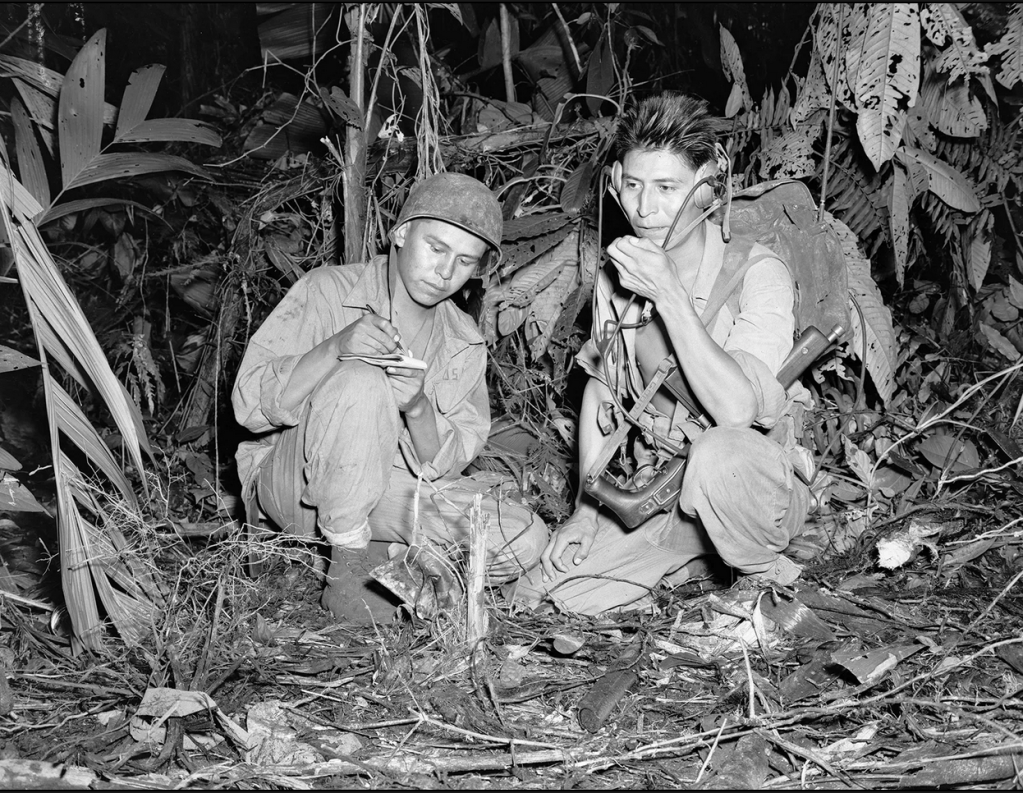
Navajo code talkers, Cpl. Henry Blake Jr. and PFC George H Kirk, who served with the Marine Signal Unit. Source: Public Domain
Code talkers were Native Americans from various tribes who were employed by the US military during World War 2 as radio operators; their native tongues were indecipherable to anyone listening in, and as a result, their transmissions of sensitive messages were invaluable in allied victories on every Pacific island, including Iwo Jima, as well as in Europe in decisive battles.
Codes were developed based on the languages of the Assiniboin, Cherokee, Cheyenne, Choctaw, Comanche, Cree, Crow, Fox, Hopi, Kiowa, Menominee, Navajo, Ojibwa, Oneida, Osage, Pawnee, Sauk, Seminole, and Sioux peoples. These men could transmit over open radio channels, knowing that the enemy would be unable to break their code. If a military term did not exist in their languages, a phrase was used in its place: A submarine became an iron fish; a fighter plane became a hummingbird; a squad became a black street. In all, throughout WW2, over 400 terms were developed and needed to be memorised by each code talker.
The code talkers continued to be used after the end of the war, which delayed their recognition by the wider public – until documentaries about their service finally began to emerge in the 1990s. In 2002, the U.S. Congress passed the Code Talkers Recognition Act, followed by a similar act in 2008 to honour the tribes who used their languages in the wartime service of the United States.
The use of code talkers was a socially complex one: The languages that were so invaluable to the US military were the very tools that the US government had been trying to eradicate in the name of cultural assimilation. Between 1880 and 1905, boarding schools were established, in which Native American children were taken from their families and educated; they were taught to reject their Native values, languages, traditions and anything to do with their native culture. They were punished, sometimes severely, for using their native tongues; they were forced to dress like the “white man”, and were not allowed to wear their native garments or have any vestiges of their tribes. Some 100,000 Native Americans were forced to attend such schools. Parents who resisted the kidnapping of their children were imprisoned; several from the Hopi tribe were even imprisoned on Alcatraz Island. Though most of these schools had been closed by the 1930s, the cultural and psychological damage had taken its toll on many native people groups, many of whom still struggle with their cultural identities today. At the time these young warriors were called into military service or chose to join after the bombing of Pearl Harbor, many were not even legal American citizens, yet they fought for their land and their families.
With that background in mind, the dedication and ingenuity of the code talkers are all the more astounding. They were often in the first wave of soldiers deployed as they were needed to pass on messages for the strategic planning and execution of driving back the Japanese from the Pacific islands. In addition to the Pacific arena, the European front also benefited from the code talkers’ ability to communicate directly with each other: Comanche code talkers were assigned to the 4th Infantry Division when it landed at Normandy in June 1944. In this context, some of the Comanche substitutes were turtle for tank, a pregnant bird for bomber, and crazy white man was their term for Adolf Hitler – a more insightful term has never been more aptly applied.
For a fascinating look into a history largely forgotten, please click on the following video recounting code talkers telling their stories firsthand as they return to the Pacific Islands with their families and find peace after decades of PTSD. The video is 1:10, but well worth the time when you can take it: Navajo Code Talkers of World War II (2018) | Documentary
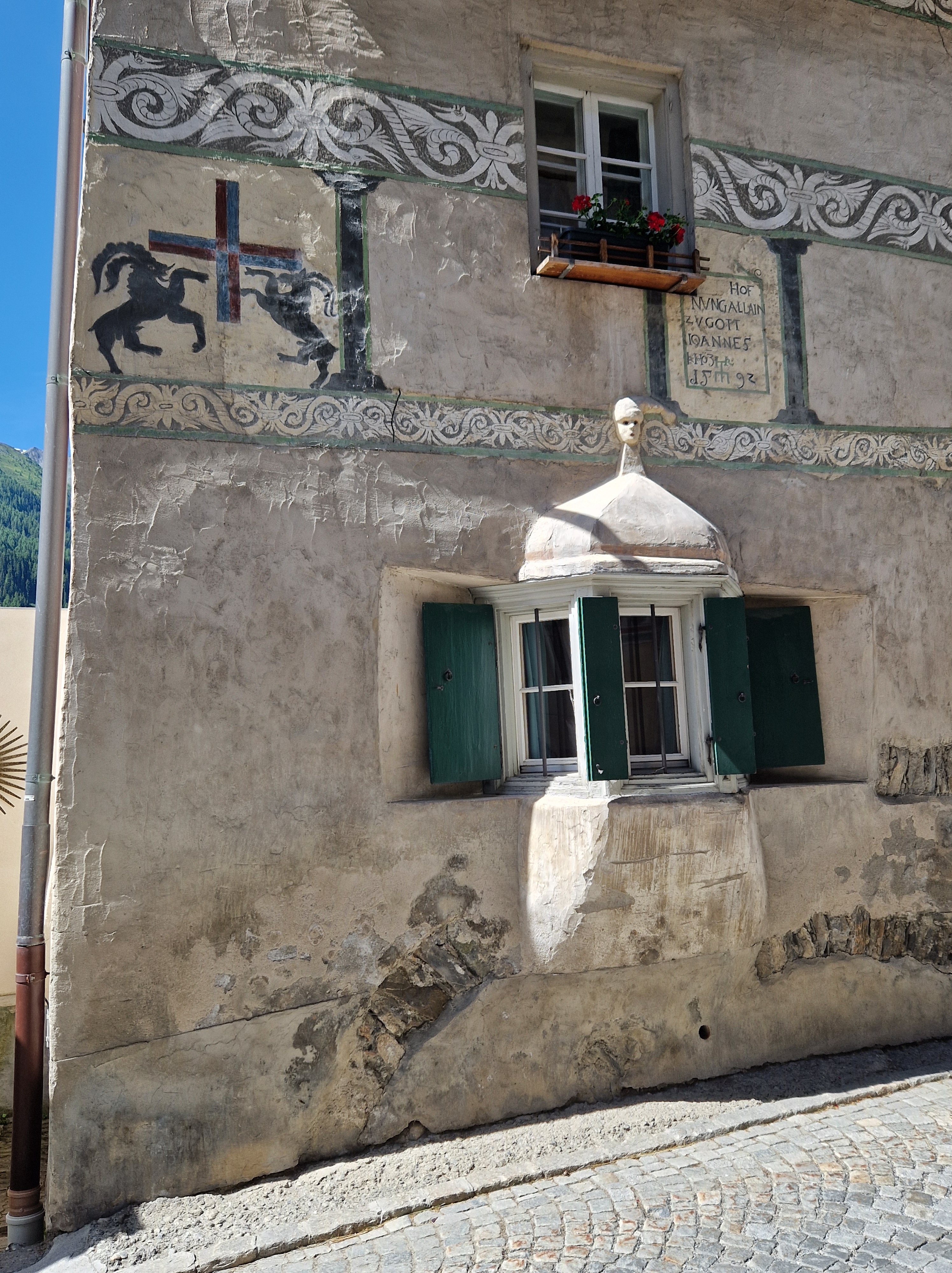
I know that, for most of you, neither Engadin nor Sgraffito have made you any wiser as to what this blog is about, so first, I’ll start off by explaining where and what they are, respectively.
Engadin (pronounced En-Ga-Deen) is a long, towering Alpine valley in the Romansh-speaking canton of Graubünden in southeast Switzerland. The first mention of this valley was in Latin as vallis Eniatina in AD 930; in the Romansh language (one of the four national languages of Switzerland), it is Engiadina. The river running through the valley is called the En or Inn, and it is the only river in Switzerland that runs (via Austria) into the Black Sea. The region is usually divided into lower and upper Engadin, and it is connected to the surrounding regions by several mountain passes.
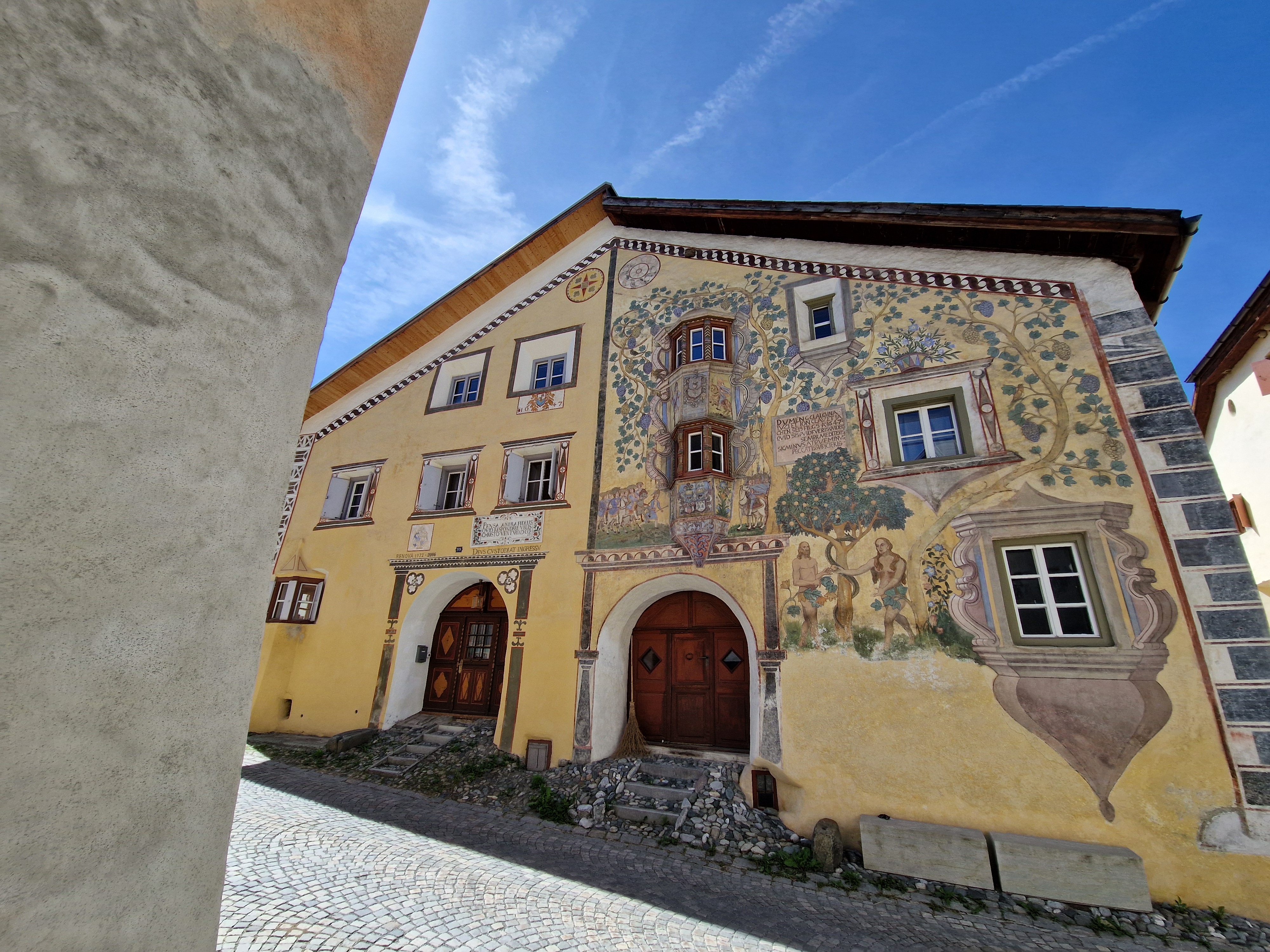
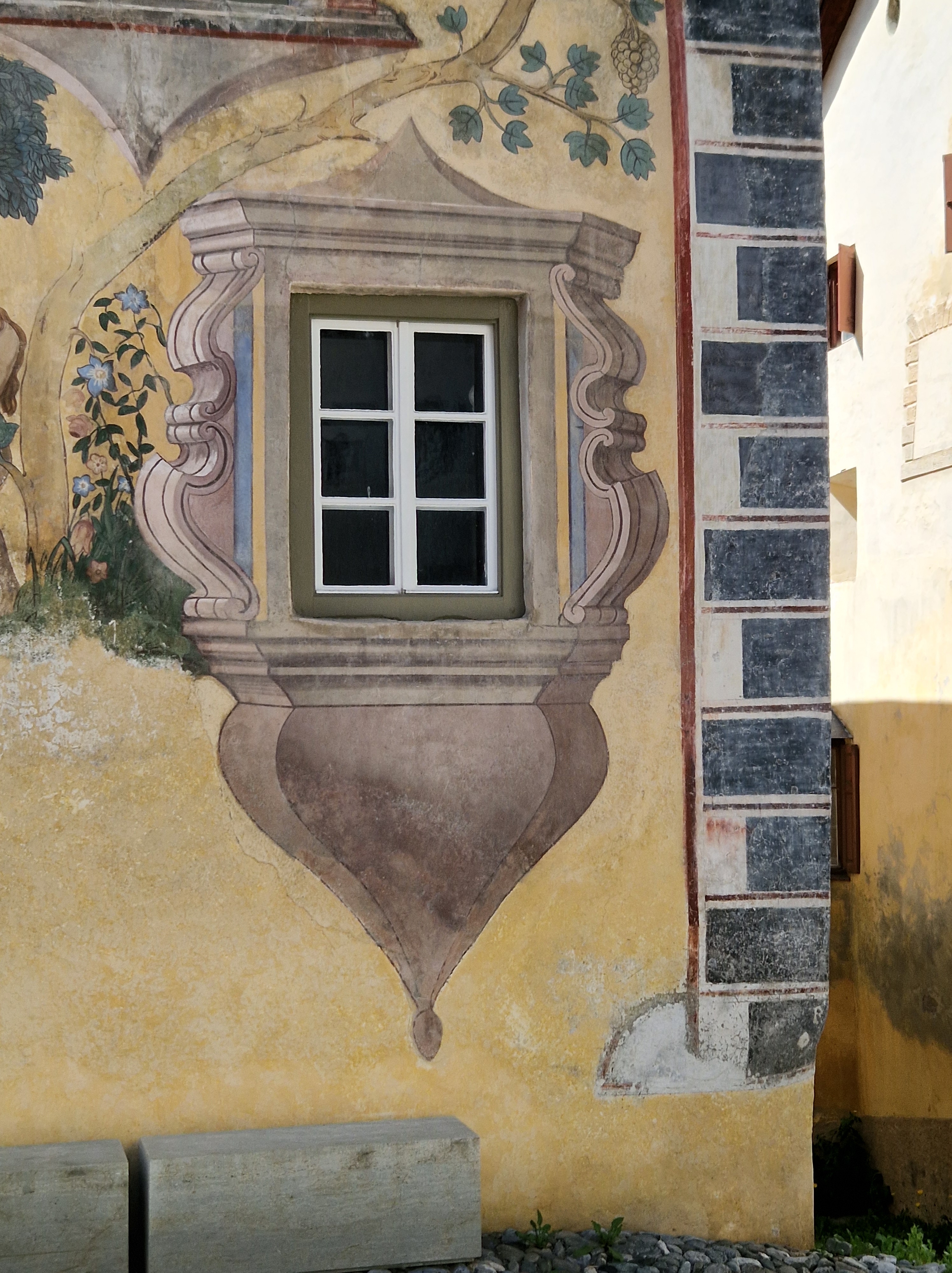
The second word, Sgraffito, describes a plaster technique that is traditional throughout Engadin: Layers of plaster of contrasting colours are scratched through, creating intricate designs on the facades of buildings (many of the buildings in Engadin towns were built (or rebuilt) in the late 1500s to early 1600s). The word comes from the Italian graffiare, which means to scratch; it can be traced back to the Greek word graphein, meaning to write (from which we also get any words containing the prefix, suffix, or derivative of graph (graphite, typography, graptolite, parallelogram, holograph, etc.). Sgraffito is not only used on buildings to make them look decorative, but it also serves the purpose of making a small feature look larger; on one building, the same floor had different-sized windows, likely installed over generations; the sgraffito was used to give a more uniform look to the façade. The decorations also make a plain building look grander, giving a more opulent impression. One building, pictured below, obviously had two occupants with very different characters back when they were originally decorated…
The basic technique for architectural features is to plaster the façade with the base colour; once that has set, it is then plastered with a contrasting colour; once that has set just enough, the scratching, or carving, begins. This is also a technique used in pottery and in creating stained glass effects (just click on the links if you’d like to see how these crafts are made).
One thing to note is that many old buildings here in Switzerland have dates listed on them: Of when they were originally built, and when they’ve been renovated. Part of the history of such renovations may include fires that swept through villages, or avalanches that buried a layer, or wars, such as the Swabian War and war against the Habsburgs, and the subsequent renovation or rebuilding of the towns or individual homes. Sometimes, along with the dates, a list of past and present occupants will also be displayed, preserving their names and memories within the history and changes of the building itself.
Below are a few pictures taken in Engadin during our recent summer holidays. Enjoy! Feel free to zoom in on the pictures to see the details.
This “History Undusted” has a tasty twist: I’ll dive into the history behind this food popular throughout the English-speaking world and Commonwealth nations, and then I’ll include a recipe if you’d like to try it yourself.
Pompei Bread, AD 79
Hot Cross Buns can be traced back to the medieval period, though scoring the top of breads has been practised for thousands of years; a bread, found in the ashes of the volcanic eruption that wiped out Pompei, shows scoring – likely to make the portioning of the loaf easier; it’s a precursor to the sliced bread we know today. Early Hot Cross Buns used this knife-scoring; the version we recognize today was first introduced in 1361 by Brother Thomas Rocliffe, an English monk at St Alban’s Abbey, who made what he called the Saint Alban’s Bun; he distributed the baked goods to the poor and pilgrims on Good Friday. Many foods can be traced back to a specific holiday: For instance, when you think of a Christmas meal, wherever you are in the world that celebrates Christmas, specific combinations of dishes come to mind that you probably don’t eat at any other time of the year.
During the medieval period, the crossed buns would be hung from the rafters of houses for an entire year, believing that they would ward off evil spirits. During the 1600s, the Puritans put an end to that practice, and Queen Elizabeth I even banned the sweet breads, consigning them to consumption on Good Friday, Christmas, or at funerals (bad luck for the deceased, who missed the excuse for the treat). By the 18th century, it had become firmly associated with Good Friday. To give you a taste of history, click here to watch a short video from the York Castle Museum.
Today, all kinds of versions are on the market year-round, from the traditional, to chocolate, to Cheddar cheese and marmite.
So, without further ado, here’s a traditional recipe you can recreate for yourself.
Hot Cross Buns
To watch this recipe’s creation, click here. Below, I’ve listed out the ingredients and basic instructions, as used in this video by Chef Jack Ovens.
1½ C. (375 ml.) whole milk – heat the milk until just warm on the stove or in the microwave on short bursts, until around 104°F/40°C.
In a mixing bowl, add 1 Tbs./9gr. Dry yeast & 2 tsp. out of ½ C. sugar (the rest will be used later); pour in the warm milk and whisk until combined. Set it aside for 10 minutes to allow the yeast to feed off of the sugar. A froth will form, which means the yeast is active.
Add in 4 ¼ C. (640 gr.) bread flour
the rest of the ½ C. sugar
1½ C. sultanas (raisins) (you could substitute ¼ C. with candied orange for the traditional version)
2 tsp. ground cinnamon
2 tsp. ground allspice (cloves, for the traditional version)
The zest of 1 large orange
1 egg, beaten
50 gr. melted, cooled unsalted butter
¾ tsp. sea salt
Mix all of this until thoroughly combined – either using a mixer with a dough hook, or by hand.
Dust your workspace with flour, turn the dough out and knead for 8-10 minutes. Shape it into a smooth ball. In a greased mixing bowl, place the dough and cover with a warm, damp tea towel and allow to proof for 1 hour, or until doubled in size. When it’s risen, punch the dough a few times to remove the air; dust your workspace with flour and tip out the dough. Knead the dough to remove any air bubbles, then shape it into a log around 60 cm / 23 inches long. Slice that in half, then roll each section to a log to 40 cm / 15 inches long.
Slice each half into 6 even pieces; form each into a ball, tucking the edges underneath.
Line a deep-sided baking tray with parchment/baking paper, and lay your balls of dough in rows of 3 by 4. Cover with an oiled piece of plastic wrap to allow the buns to rise without sticking to a towel. Allow to proof for 40 minutes.
While it’s proofing this final time, preheat your oven to 180°C/350°F
To make the dough for the crosses:
½ C. /70 gr. bread flour
95 ml. cold water
Whisk these together until it forms a piping paste.
In either a piping bag with a 3mm nozzle or in a plastic bag with the corner snipped off, spoon in the dough and pipe it across the rows of buns, making sure to cover to the edges of the buns.
Bake for 20-22 minutes, rotating the tray halfway through. A few minutes before the buns are done, in a small bowl, mix:
½ C. / 110 gr. caster sugar
150 ml. boiling water
Mix with a pastry brush until the sugar is dissolved. Remove the buns from the oven and glaze them with the sugar water – just enough to cover each. This will give a nice crunch to the crust of the bun. Allow them to sit in the tray for a few minutes, then transfer to a wire rack. Slice, butter, and enjoy!
Will Rogers is one of those larger-than-life characters who seemed to have had his fingers in every pie imaginable: Born in November 1879 as a Cherokee Nation citizen in the Indian Territory now known as Oklahoma, he was the youngest of eight siblings, only three of whom survived into adulthood. His mother died when he was just ten years old. By the time he was 20, he’d begun appearing in rodeos, and in 1902 at the age of 22, he and a friend moved to Argentina to find work as gauchos (a skilled horseman, hired by ranchers in many South American countries). When their adventure failed, and they’d lost all their money, Will couldn’t bear to ask for money from home, so he took a boat to South Africa, where he was hired as a ranch hand. His career as a trick roper began there, as he joined the Texas Jack’s Wild West Circus. From there, armed with a letter of reference from Texas Jack, he moved to Australia and joined the Wirth Brothers Circus as a rider and trick roper. By 1904, he’d returned to the States and performed in the St. Louis World’s Fair, then began using his riding and roping skills in the Vaudeville circuits; he was often billed as The Cherokee Kid. His natural humour hit a chord with audiences, who loved his frontier twang of an accent coupled with his off-the-cuff wit and commentary on current events; he built his later career around that talent.
In 1908, he married Betty Blake, and they had four children; three survived into adulthood, all of whom went on to have careers in the public eye in one way or another.
By 1916, Rogers was a featured star in Ziegfeld’s Follies on Broadway; from there he branched off into silent films; at that time, most films were made in or around New York, which allowed him to continue performing on Broadway. The New York Times syndicated his weekly newspaper column, “Will Rogers Says”, from 1922 to 1935; he also wrote for The Saturday Evening Post; this progressed into books – over 30 of them. He also hosted a radio program, telling jokes and discussing current events with his simple, disarming humour.
Click here to see a short, 3-minute video showcasing some of his amazing rope tricks.
He was an avid supporter of the aviation industry, and he took many opportunities to fly to his various engagements. In 1926, while touring Europe, he saw how much more advanced the commercial services were there in comparison to the States; his newspaper columns often emphasized the safety and speed of travel aeroplanes offered, which helped shape public opinion about the new mode of transport.
In 1935, Wiley Post, a famous aviator of his time, proposed flying from the West Coast to Russia to find a mail-and-passenger air route, and Rogers asked to go with him in order to find new material for his newspaper columns. Post’s plane was modified for the long flight, and floats were added for landing on water. On 15 August, they took off from Fairbanks, Alaska, for Point Barrow, a headland on the Arctic coast. Bad weather hindered their ability to calculate their position, and, after landing in a lagoon to ask directions and taking off again, the engine failed at low altitude and plunged into the lagoon, killing both men. Rogers was 55.
In such a short life, he left a huge legacy in many fields of entertainment and helped shape public perspectives on politics and civil responsibility. He was a household name in the early 20th Century and a trusted voice during the Great Depression, identifying with the struggles of the average American and holding a mirror to politics with his witty satire.
Here are a few of his famous quotes:
Be thankful we’re not getting all the government we’re paying for.
Even if you are on the right track, you will get run over if you just sit there.
Everything is funny, as long as it’s happening to somebody else.
I don’t make jokes. I just watch the government and report the facts.
My ancestors didn’t come over on the Mayflower, but they were there to meet the boat.
Live so that you wouldn’t be ashamed to sell the family parrot to the town gossip.
The only difference between death and taxes is that death doesn’t get worse every time Congress meets.
The trouble with practical jokes is that very often they get elected.
There’s no trick to being a humorist when you have the whole government working for you.
This country has come to feel the same when Congress is in session as when the baby gets hold of a hammer.
I don’t know if you’ve yet heard about the sneaky change coming into effect, without warning, on 26 February for your Kindle account, but as of that date, if you haven’t downloaded your books to your computer or to your tab, phone, or other device besides a Kindle e-book reader, you will no longer be able to do so! They are taking away that right in order to get customers more dependent on their services; but they are in effect simply ticking people off. You’d think they could have learned something from Canada’s, Denmark’s and Gaza’s responses to POTUS’s hammer-fisted tactics, but they will likely spark a rebellion against their services. Another great reason to get your ebooks at Smashwords, or anywhere else but Amazon!
For more information, please click here for a 6-minute video, telling you about the changes coming and how you can save your books from being inaccessible to you in the future.
This week’s adventurous tale is a proverbial rabbit hole; diving into it takes us past the problem of Paris’ 18th century dilemma of dealing with the “explosive” issue of overfilled cemeteries, which forced King Louis XVI to take action: Bury them deeper. Following this problem and its solution into the ground, so to speak, leads us into the massive (1.5 km long) ossuary (bone depository) of Paris. Once you reach the ossuary, which contains the artfully arranged skulls and bones of some six million residents (around three times more than the actual population of central Paris, which as of 2023 was 2.1 million…), you aren’t officially allowed to go any further – because above your head is the bustling city of street cafés, boutiques, and historical buildings. And when someone buys a house up there, they are actually also buying the land on which it stands – which includes their section of the underground maze of mining tunnels and caverns; venturing beyond the official section makes you an intruder on private property or breaking and entering an actual shop – but more on that in a moment. The message above the entrance to the ossuary reads, Arrête! C’est ici l’empire de la Mort. (“Halt! This is the Empire of Death.”). That warning doesn’t stop it from being one of Paris’ most popular tourist attractions.
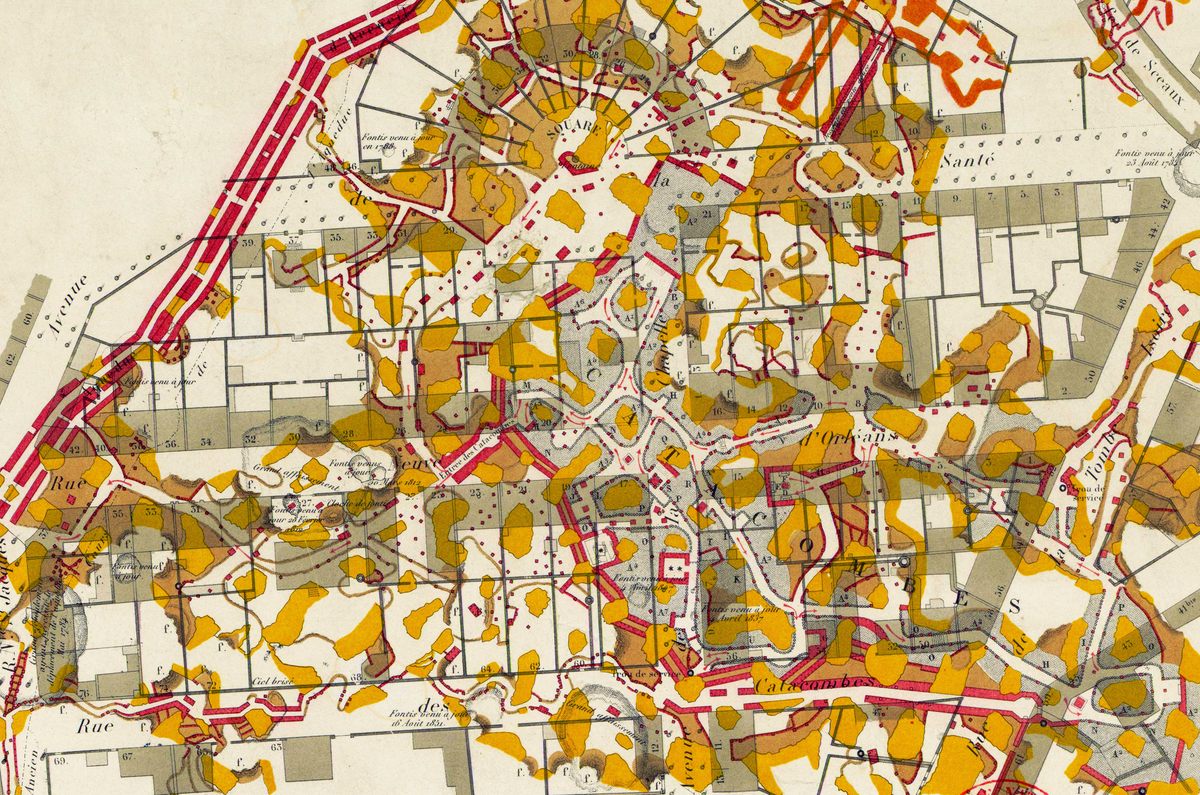
The tunnels, now known as The Catacombs, were originally dug far outside of the small 13th-century city when Lutetian limestone was mined as a local building material (any town or city with a distinctive architecture owes its appearance to whatever was available locally when it was founded – whether wood, stone, thatch or brick). Though no one knows with certainty, as the mining resources were eventually exhausted and the mines abandoned, an estimated 350 kilometres of tunnels undermined the city, which covers some 32 square kilometres beneath Paris… a city beneath a city, as it were.
And yes, buildings have occasionally been swallowed; in 1774, about 30 metres of a street disappeared into a cavern below. This led to the formation of the Générale des Carrières (IGC), an office created in 1777 by King Louis XVI to oversee the mapping and maintenance of the catacombs. During the French Revolution, many things got lost and fell out of collective memory, including the underground map.
Paris Catacombs Map – Inspection Générale des Carrières, 1857, Pulbic Domain
Throughout the years, the tunnels have been put to various purposes, aside from the macabre: Mushrooms were cultivated there; beer was brewed, wine aged, and Chartreuse liquors were distilled down there by monks in the 17th century. The city beneath the city had no prime real estate overhead for businesses, and many took advantage of the free space, making access for their customers through the various access points throughout Paris. It also served the French Resistance during world war 2, even though the Nazis also used a section of the tunnels. Now, let’s go back up out of the rabbit hole for a brief moment.
Remember that I wrote officially allowed? Well, a secret maze of tunnels is too much to resist for the adventurous, called cataphiles. But there is a secret society at large down there, too.
When you think of a secret society, you might think of the Luminati or something else sinister; but the Les Ux would be more akin to Robin Hood. The story goes that in 1981, a group of kids were talking after school, and one of them mentioned that he could break into any building in Paris; in fact, his next target was the Pantheon. They didn’t believe him, and so they all went down together – and found out just how easy it was to go wherever they wanted. The Pantheon, which was the tallest structure in Paris until the Eifel Tower was constructed, vacillated between being a church and a secular building several times over its history, depending on the political regime, and it finally became a secular structure in 1885 under the Third Republic. It now is a mausoleum, with famous residents like Marie Curie, Victor Hugo, Alexandre Dumas and Voltaire; but it is also a museum, an art exhibition hall, hosts school events and lectures, and is linked to a section of the catacombs – which is where the group of school friends began their adventures.
During one of their nocturnal outings, the group stumbled upon a narrow passage full of electrical cables; following those, they found themselves in the basement of the Ministry of Communications. No security stopped them and they were able to explore at their leisure. In a drawer, they found the motherlode: A map of the entire catacomb structure. That changed the course of their lives, and they eventually became known as the Les Ux, short for “urban experiment”. These individuals, unknown to anyone but themselves, specialize in safeguarding Paris cultural goods – stepping in when the government can either not afford to or doesn’t care enough to preserve something of cultural or historical value. They seem to think that, unless it’s a big-ticket attraction like the Mona Lisa, things get neglected. For instance, the mission statement of one branch of Les Ux is to reclaim and transform disused city spaces for the creation of zones of expression for free and independent art.
The group, now a full-fledged underground movement, is divided up into teams with seemingly nonsensical names: The Mouse House (an all-female team of infiltrators), La Mexicaine De Perforation (in charge of clandestine artistic events and underground shows), and the Untergunther (specializing in restorations); they also have teams that specialize in things like running internal messaging systems and coded radio networks, a database team, and a team of photographers.
Some of their exploits include restoring a forgotten metro station, a 12th-century crypt, an old French bunker, and a World War 2 air raid shelter. One member, likely from the Mouse House, wrote a detailed report about a particular museum’s security, telling them how many ways she could have broken in and stolen had she been so inclined. She then infiltrated the museum and left the report on the desk of the museum’s head of security. He went straight to the police to press charges. They refused to pursue the matter.
They built an entire cinema complex in the catacombs, complete with a bar and restaurant, where they are thought to have held film festivals for several months or even years before being discovered by the police in a random training exercise. When the police returned to remove the cinema, everything was gone except a note which read, “Don’t try to find us.”
Les Ux has held many events within the Pantheon over the years, including parties and art exhibitions – all vanishing, and leaving the place cleaner when they left, before the museum opened the next day. One night, a team member (from Untergunther) decided to take a closer look at the broken Wagner clock, which hangs over a prominent entrance within the building. Their most public restoration (that we know of so far) was, of course, an embarrassment to the management of the Pantheon: One of the members, Jean-Baptiste Viot, was a professional clockmaker; the team snuck in for nearly a year to restore the clock. They built a secret workshop (complete with armchairs, bookcase, and bar, which they nicknamed the Unter and Gunther Winter Kneipe – German for winter boozer!) high up in the dome of the pantheon, and carried out the clock work by night. Once it was done, they knew that the clock would need to be wound regularly to continue working – so they broke protocol and met with the museum director to tell him the good news. He promptly pressed charges… but there are no laws in France about repairing an expensive clock at their own expense, and the case was dismissed with the comment, “This was stupid!” The museum director hired someone to break the clock, presumably to avoid the hassle of winding it up regularly, and also out of spite for losing his case and his face; the person refused to damage the clock, simply deactivating the mechanism. Les Ux snuck back in to let the clock chime over the days around Christmas, then went back in and removed a component to prevent any further damage the next time spite struck. I’ve read that since that time, the clockmaker of Untergunther has actually been hired by the Pantheon to maintain the clocks.
We only know of a fraction of their activities, of course, because they don’t publicise their accomplishments or events. Below are a few links if you’d like to read more on this fascinating topic! I hope you enjoyed this little exploration as much as I did!
Here are a few links to articles, if you’re interested in learning more:
Throughout history, languages have come and gone; an estimated 30,000 have existed at some point in time, though currently, there are roughly 6,000 to 7,000 languages in use – and most are threatened with extinction. Think about that. The impact on the loss of cultural history, connection to ways of thinking, ways of communicating, and ways of processing information; senses of humour, and national heritages will be lost.
An example of a language nearly lost, but which is now familiar to most of us by sight, is the logogram language of Egyptian hieroglyphs. The knowledge of how to interpret the symbols had been lost for centuries, until 1799, when a stone was found near Rosetta, along the Nile Delta in Egypt; the stone was a stele with a decree issued in 196 BC; the texts carved into the stone were Ancient Egyptian (“demotic” text), hieroglyphs, and Ancient Greek. Because Greek was a known language, they could use the Rosetta stone to decipher the forgotten languages.
When we think of writing, we may think of various alphabets: Greek, Roman (of which English makes use), Norse Runes, or the logographic or ideographic languages of Asia, such as Chinese or Japanese, or the cuneiform writing of the Ancient Near East. But did you know that there have been languages based on string?
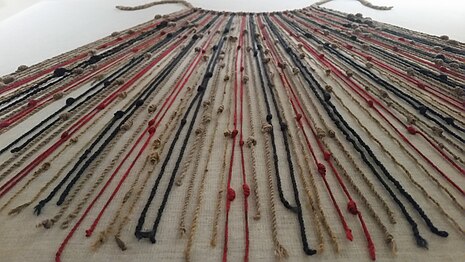
Quipu in the Museo Machu Picchu, Casa Concha, Cusco. Source: Wikipedia
The Inca people, in the region of modern Peru and Chile, used knots on an elaborate system of connected strings or cords for collecting data, keeping records, recording taxes or census records, making calendars, or for military organisation. When the Spanish Conquistadors swept through, they found numerous bundles of strings, but had no idea of their significance; they destroyed many of the quipu*, not realizing that they might have held in their hands a record of an individual’s wealth in animals or crops. [*Quipu is the Spanish spelling used in English; it is also spelled khipu or kipu.] Other cultures have also used similar concepts with knotted strings to record information, unrelated to South America; these include China, Japan, Taiwan New Zealand, Hawaii, and other parts of Polynesia.
As with most textiles, they unfortunately didn’t stand the test of time very well, and only a fraction remains today. The ancient world may have taken the concept of the quipu one step further in creating the more flexible abacus, though the latter was (and is still) used for temporary calculations, while the former was rather for recording information. Whether or not there is a historical link, both are visual tools that can be used for similar functions to a certain extent.
Even with such widespread use of these knotting records, their meaning was nearly lost, until a Harvard student, Manny Madrano, had time on his hands one summer and solved a centuries-old mystery!
For an interesting video on this topic, please click here. I hope you’ve learned something! Keep being curious about our fascinating world!

















 Stephanie Huesler
Who’s Who in Quotes: Will Rogers
Will Rogers is one of those larger-than-life characters who seemed to have had his fingers in every pie imaginable: Born in November 1879 as a Cherokee Nation citizen in the Indian Territory now known as Oklahoma, he was the youngest of eight siblings, only three of whom survived into adulthood. His mother died when he was just ten years old. By the time he was 20, he’d begun appearing in rodeos, and in 1902 at the age of 22, he and a friend moved to Argentina to find work as gauchos (a skilled horseman, hired by ranchers in many South American countries). When their adventure failed, and they’d lost all their money, Will couldn’t bear to ask for money from home, so he took a boat to South Africa, where he was hired as a ranch hand. His career as a trick roper began there, as he joined the Texas Jack’s Wild West Circus. From there, armed with a letter of reference from Texas Jack, he moved to Australia and joined the Wirth Brothers Circus as a rider and trick roper. By 1904, he’d returned to the States and performed in the St. Louis World’s Fair, then began using his riding and roping skills in the Vaudeville circuits; he was often billed as The Cherokee Kid. His natural humour hit a chord with audiences, who loved his frontier twang of an accent coupled with his off-the-cuff wit and commentary on current events; he built his later career around that talent.
In 1908, he married Betty Blake, and they had four children; three survived into adulthood, all of whom went on to have careers in the public eye in one way or another.
By 1916, Rogers was a featured star in Ziegfeld’s Follies on Broadway; from there he branched off into silent films; at that time, most films were made in or around New York, which allowed him to continue performing on Broadway. The New York Times syndicated his weekly newspaper column, “Will Rogers Says”, from 1922 to 1935; he also wrote for The Saturday Evening Post; this progressed into books – over 30 of them. He also hosted a radio program, telling jokes and discussing current events with his simple, disarming humour.
Click here to see a short, 3-minute video showcasing some of his amazing rope tricks.
He was an avid supporter of the aviation industry, and he took many opportunities to fly to his various engagements. In 1926, while touring Europe, he saw how much more advanced the commercial services were there in comparison to the States; his newspaper columns often emphasized the safety and speed of travel aeroplanes offered, which helped shape public opinion about the new mode of transport.
In 1935, Wiley Post, a famous aviator of his time, proposed flying from the West Coast to Russia to find a mail-and-passenger air route, and Rogers asked to go with him in order to find new material for his newspaper columns. Post’s plane was modified for the long flight, and floats were added for landing on water. On 15 August, they took off from Fairbanks, Alaska, for Point Barrow, a headland on the Arctic coast. Bad weather hindered their ability to calculate their position, and, after landing in a lagoon to ask directions and taking off again, the engine failed at low altitude and plunged into the lagoon, killing both men. Rogers was 55.
In such a short life, he left a huge legacy in many fields of entertainment and helped shape public perspectives on politics and civil responsibility. He was a household name in the early 20th Century and a trusted voice during the Great Depression, identifying with the struggles of the average American and holding a mirror to politics with his witty satire.
Here are a few of his famous quotes:
2 Comments
Filed under History, History Undusted, Humanity Highlights, Quotes, Snapshots in History, YouTube Link
Tagged as Alaska, Australia, Aviation, Broadway, Cherokee Nation, Circus, Entertainment, Gauchos, Great Depression, Indian Territory, New York, New York Times, Oklahoma, Politics, Quotes, Satire, Saturday Evening Post, Social Commentary, The Cherokee Kid, Trick Roper, Vaudville, Who's Who in Quotes, Will Rogers, Ziegfeld's Follies