Happy New Year!

New Year's Resolution

1 Comment

December 31, 2019 · 7:13 AM

History Undusted: Santa & the Traditions of Christmas

Known as Sinterklaas, Father Christmas, Kris Kringle, Saint Nick / Nicholas, Père Noel, Papa Noel, Babbo Natale, Weihnachtsmann, Christkind, and many other names, Santa has been around in various versions and various cultures for roughly 1,300 years, as a character associated with Christmas and gift-giving. As such, it would be impossible to pinpoint exactly when and where the original basis for the legends began. Saint Nicholas was a 4th-century Greek Christian bishop of Myra (in modern-day Turkey). He became the patron saint of sailors, and so it is quite possible that his kindness to the poor inspired sea-faring men to spread the ideals of his charitable acts to other places. As time passed, facts gave way to tall tales and legends, and the rest, as they say, is history.

Christmas stockings have been around for centuries as well; the story goes that a widower with three daughters was worried about them being unable to marry as he had no money for their dowries. Nicholas heard of their plight and, knowing that the father would never accept charity, tossed three bags of gold in through an open window one night; the girls had hung their stockings by the fireplace to dry, and one of the bags landed in a stocking. How much of that is based on historical facts and how much is legend is a balance lost to time.

The modern-day image of Santa, with his rotund belly and his red coat, was  popularized by Thomas Nast, an American illustrator for the Harper Weekly, in the 1860s. Nast, being a German immigrant, based his images on the German Weihnachtsmann and Sankt Nicholaus. Before his illustration, Father Christmas was portrayed as wearing any colour coat, from tan and fur-lined, to pink or purple, brown, grey, white, green or blue, and sometimes even red. [It is a myth that a 1933 Coca-Cola advertising campaign is to thank for a red-cloaked Santa.]

This slideshow requires JavaScript.

I could go on and on about the traditions associated with Christmas – the tree, the ornaments, the yule log, Santa’s helpers, reindeer (or was it a motorcycle, blimp or plane?) and other practices that are spread wherever Christmas is celebrated. It’s a holiday that’s been adopted in countries that have no Christian roots, such as Asian countries; there, it could be seen as an excuse for a holiday, or as a marketing ploy. And maybe that’s what it’s become for many people even in the West; but all of these traditions put people in a contemplative, forgiving, generous spirit, which is perhaps the most important aspect of the holiday.

Just as the nativity scene [please click on the link to read about Christmas from a Christian aspect] was a simplified version of the Gospel, created by St. Francis of Assissi to explain events to a largely illiterate population and to counter what he felt was a growing commercialism associated with the holiday (and that, back in 1223!), so it is that many traditions arise over the centuries, often a grain of truth with things then tacked on over the years and through cultural adaptations.  Santa’s legend has grown into what we know today, likely not by leaps and bounds, but by a progressive adaptation to cultural times.

However you celebrate Christmas, whether you’re alone or with too many people for your liking, remember that all of us have the capacity to bless others; as the adage goes, it is more blessed to give than to receive. If you don’t have anyone in your life presently to give gifts to, remember, like Saint Nicholas, the poor and the needy. We can all make a difference, and who knows – maybe in a thousand years, your name will be mentioned alongside his.

Merry Christmas!

Christmas GIF 2

10 Comments

Filed under Articles, History, History Undusted, Images, Snapshots in History

History Undusted: If World War I were a Bar Fight

History can be confusing sometimes, especially if it’s distant – beyond our own experience. Who’s who, who did what, and what the consequences were can all seem a bit vague. The analogy below, put into a relatable context, may help you visualize an important bit of world history; I don’t know who came up with the original piece, but it’s brilliant! I’ve made several additions here and there, but otherwise, it’s someone else’s work – if anyone knows who originally came up with this analogy, please let me know so that I can give credit where credit is due!

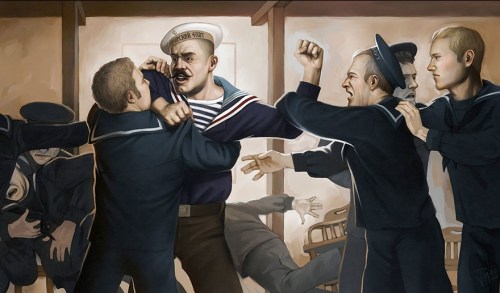
If World War I were a Bar Fight

Bar Fight, World War 1

Germany, Austria and Italy are standing together in the middle of a pub when Serbia bumps into Austria and spills Austria’s pint. Austria demands Serbia buy it a whole new suit because of the new beer stains on its trouser leg. Germany expresses its support of Austria’s point of view.

Britain recommends that everyone calm down a bit.

Serbia points out that it can’t afford a whole new suit, but offers to pay for the cleaning of Austria’s trousers. Russia and Serbia look at Austria. Austria asks Serbia who they’re looking at. Russia suggests that Austria should leave its little brother alone. Austria inquires as to whose army will help Russia make them do so.

Germany appeals to Britain that France has been eyeing Britain, and that it’s unwise for Britain not to intervene. Britain replies that France can look at whoever it wants to, and that Britain has been watching Germany too, and what is Germany going to do about it? Germany tells Russia to stop looking at Austria, or Germany will render Russia incapable of such action anymore. Britain and France ask Germany whether it’s looking at Belgium.

Turkey and Germany go off into a corner and whisper.  When they come back, Turkey makes a show of not looking at anyone.

Germany rolls up its sleeves, looks at France, and punches Belgium and Luxembourg, who had been minding their own business at the end of the bar. France and Britain punch Germany; Austria punches Bosnia and Herzegovina (which Russia and Serbia took personally); Germany punches Britain and France with one fist and Russia with the other. Russia throws a punch at Germany, but misses and nearly falls over.

Japan calls from the other side of the room that it’s on Britain’s side, but stays there.

Italy surprises everyone by punching Austria. Australia punches Turkey and gets punched back.  There are no hard feelings, however,  because Britain made Australia do it.

France gets thrown through a plate-glass window, but gets back up and carries on fighting.  Russia gets thrown through another one, gets knocked out, suffers brain damage, and wakes up with a complete personality change.

Italy throws a punch at Austria and misses, but Austria falls over anyway.  Italy raises both fists in the air and runs around the room chanting. America waits until Germany is about to fall over from sustained punching from Britain and France, then walks over and smashes it with a barstool and pretends it won the fight all by itself.

By now all the chairs are broken and the big mirror over the bar is shattered.  Britain, France and America agree that Germany threw the first punch, so the whole thing is Germany’s fault.  While Germany is still unconscious, they go through its pockets, steal its wallet, and buy drinks for all their friends.

Everyone went home, leaving Germany to pout on the floor planning on how to get even.


Originally posted on History Undusted, September 2015

17 Comments

Filed under History, History Undusted, Military History, Snapshots in History

Wordless Wednesday #67: Not a Word

Alot

11 Comments

December 11, 2019 · 12:16 PM

How It’s Made: Rubber Bands

Rubber bands are ubiquitous; everyone has them and occasionally uses them. They come in nearly every shape and size; they’ve even become a craft accessory out of which creative shapes can be formed (just google “rainbow loom designs”).

But have you ever stopped to think about how they’re made? Are they made from natural or synthetic materials? You might be tempted to think that they’re some kind of plastic or silicone, but most rubber bands are made out of the sap of rubber tree plants; that sap, specifically, is latex. Trees are “tapped” – a slice of bark removed – every two days, and the latex gathers in bowls attached below the cut. It will flow for an hour or two and then heals over.

The actual process to turn rubber latex into uniform rubberbands is a complex one; it’s a process that evolved over time, trial, and error into a well-oiled machine – literally. To learn more, click on the following links:

Alliance Rubber Company – The birthplace of the modern rubber band

YouTube: How It’s Made

As with anything, we should take care to use what we buy, and buy what we’ll use. Rubber bands are produced by the millions each day (the factory featured in the YouTube video produces 40 million per day), so use the ones you have wisely!Rubber band ball If you’re curious as to how to make a rubber band ball like this image, just click here. I have several of these around the house, and they’re practical and easy to make. Enjoy!

9 Comments

Filed under Articles, History Undusted, How It's Made, Links to External Articles, Science & Technology

A Crafty Life & All That Jazz

I can’t believe how fast the month has flown by!  Life took over – more like, it grabbed me by the neck and took me for a wild ride – and writing took a back seat; it sat back there, observing, taking notes, and waiting for the first opportunity to grab the wheel again.

Dilbert -Head will explode

Meetings, challenges and dealing with the messy bits that make up a full life took most of my time this past month. English classes; singing students; somewhere in there also comes housework and grocery shopping. Our church held a bazaar, and I was counted on by the organizers to bring a variety of crafts (I have a bit of a reputation). I spent two days baking with a friend; I spent nearly two weeks organizing and supplementing my crafts to sell, including deciding on prices for each (and we all know how easy that is…). I had dozens of Scherenschnitte (some in frames, some without); plarn (= plastic yarn, made from upcycled plastic bags) purses and baskets (including two baskets made out of an old air mattress); each plarn bag, including glazed cardboard buttons, has a unique tag recording how much time was spent, and what materials each is made of. I also had beaded bookmarks, wine charms, tin embossed Christmas ornaments, a bowl full of surprise gift bags, and three kinds of cookies (Spitzbuben, Bretzeli, and savoury cheese cookies). The crafts also required props – tags, packaging cards, a hanging display rod, and a display bowl and wine glass (both paper-maché), etc. etc. Whew. You can see why it took me two weeks! I now have a few special orders that were sold at the bazaar which I need to make and get sent off in time for Christmas.

Somewhere in that busyness, someone moved in with us; she’ll be with us for at least the next three months, and I’ve been helping her deal with the official business of moving (deregistering from Zürich, registering here in our town, etc.), and also settling in as far as finding her way around the town, public transport, and our home.

All the while, in the back seat, writing has been breathing down my neck; but it’s not the only thing, and it hasn’t been the loudest by a long shot. I have responsibilities in our church that require phone calls, organisational meetings, organising people who have lives of their own, too, leading the church services (two per Sunday morning) at least once a month, and sometimes getting things pushed uphill – empathies for Sisyphus.

I have dozens of ideas to share with you; it comes down to eking enough time to do a topic justice. But life is slowing down a bit more once again, so I look forward to letting writing climb back into the front seat! I’ve started working again on my next novel, and keeping an eye out for a topic that wants undusting. Keep your eyes open – I’m back!

5 Comments

Filed under Articles, Cartoon, Musings

History Undusted / Flashback: The Rack

The rack has been used as a torture device since at least AD 65; it is still in use today, except that now it’s a piece of equipment found in a chiropractor’s office, with padded joints and supposedly-comfortable straps…  I called this a flashback as I personally experienced the rack for six years, three times a week, twenty minutes at a time, as a child (followed by electric shock, all in the name of medicine).  Just looking at this image makes my back hurt!  To read more about the history, just click on the image.

Torture - Middle Ages, the Rack


Originally posted on History Undusted, 31

11 Comments

Filed under History Undusted, Links to External Articles, Military History, Snapshots in History

Wordless Wednesday #66: Modernity

Antidepressants

3 Comments

Filed under Cartoon, Humor, Images, Wordless Wednesday

History Undusted: The Colour of Carrots

Unless you’ve been living under a rock all your life, chances are you’ve eaten carrots. Orange through and through, they can be eaten sweet, as in a carrot cake, or savoury with dips or in a stew. But where did they come from? Have they always been orange? The short answers are Central Asia, and nope.

Carrots - Carrot-Museum-co-uk

Carrots, which likely originated in the Himalayas and the Hindu Kush ranges and spread along the Silk Road, were white/ivory wild roots gleaned for their leaves and seeds – much like their genetic relatives of coriander and parsley, and it may be that the products of these plants were used medicinally, like many other plants and herbs.

They were first cultivated as a food crop in the Iranian Plateau and Persia, and even today the centre of diversity remains in the region, in Afghanistan. Long before they were cultivated, the wild varieties had become widespread throughout Europe, as far back as 5,000 years ago, though fossilized pollen has been identified as belonging to the carrot family in the Eocene period (55 to 34 million years ago).

These little roots have approximately 32,000 genes, which is more than you and I do; and just two of those genes are recessive, creating a build-up of alpha- and beta-carotene. Over a thousand years ago, purple and yellow varieties began to appear, and around 600 years ago, the orange variety began to dominate the market, appearing in Spain and Germany around the 15th or 16th century.

One apocryphal theory is that the orange coloured carrots were cultivated by the Dutch in honour of William of Orange, a 16th century commander who fought against the Habsburg dynasty; even if this legend isn’t true, the orange carrot did become associated with William of Orange, and during the 18th century, the noticeable display at market stalls was considered to be a provocative political gesture in support of William’s descendant, who had been driven from the English throne. The distaste for the political figure didn’t stem the taste for the root, however, and they grew in popularity. Most modern orange carrots descend from a strain grown in Hoorn, Holland; today’s carrots, more vivid orange, contain 50% more carotene than those of 1970. Modern carrot breeders continue to refine the carrot, improving flavour, colour and texture, as well as reducing bitterness and enhancing sweetness.

Though other varieties of carrots are making a comeback, the beta-carotene and vitamin A which causes the deep orange was thought to improve eyesight (that is a misnomer). This led to a diversion tactic of the British during World War 2: They claimed that eating carrots improved night-vision and that their pilots ate carrots to have that advantage; it was misinformation spread to hide the Royal Air Force’s development of radar technology from the Germans. Aside from the propaganda ploy by the military, carrots were a staple in the diets of the British, who used the humble root as a sweetener and a vegetable staple, and was promoted for health benefits. Food rationing tightened the Brits’ belts, but the carrot came to the rescue; it was a common, home-grown staple, and could be used as a substitute for restricted items as it was not subject to rationing. Carrot was even used as a secret code word, broadcast by the BBC in French to the French Resistance, to warn of the impending D-Day landing in Normandy: On the 4th of June 1944, several messages that seemed nonsensical to listeners were broadcast, including, “les carottes sont cuites, je répète, les carottes sont cuites!” (“The carrots are cooked, I repeat, the carrots are cooked!”) This gave the resistance fighters the signal to carry out their plans to sabotage railway and telephone lines. Carrots were the last vegetables added to a stew; if they were already cooked, it meant that the plans were set – no going back. Normandy landings began the next day, 5 June, which led to the liberation of France and the ultimate defeat of the Nazis.

The word carrot was first recorded in English around 1530 and was borrowed from Middle French carotte, originally from the Indo-European root *ker– (horn), probably due to its horn-like shape. At the time, carrots (white) were visually similar to parsnips, the two being collectively called moru (from the Proto-Indo-European word mork (edible root)); the German for carrot is Möhre).

For more information than most people could possibly use in their lifetime, check out this link to The Carrot Museum, my main source of information for this article (along with the Economist).

The next time you sit down to a good vegetable stew or a plate of crudité and dips, think of the grand history of the humble carrot.

6 Comments

Filed under Articles, Etymology, History, History Undusted, Links to External Articles, Military History, Research

Science Undusted: Prince Rupert Drops

Let’s talk about shattering glass. As one does.

Probably as far back as molten glass was first produced intentionally by man (i.e. not volcanic glass drops formed naturally, which are known as Pele’s tears) drips of molten glass fell into the glass blower’s water, kept nearby to cool the glass products in. Sometimes, these drops have particular strength, and these alone are true Prince Rupert Drops.

The English name is a classic example of who knew who, and who wrote the history books: The drops had been made Mecklenburg, northern Germany, since 1625, though some think they go back as far as the days of the Roman Empire; they were sold around Europe as toys or curiosities. In 1660, Prince Rupert brought some of them back to London as a gift for King Charles II, who then gave them to the Royal Society to investigate and attempt to reproduce. Thus, Rupert’s name has gone down in history – for bringing back a souvenir for the right person.

Their unusual strength comes from how they cool; when done right, they will come out shaped like a tadpole with a long, thin tail. The heads can be struck with a hammer or shot with a gun, and they will not shatter; but if the tail is knicked or disturbed, the entire drop shatters into glass dust instantly, from the tail down.

Not all drips of glass cooled in water produce Prince Rupert Drops, also known as Dutch tears, Prussian tears, or Batavian tears; the difference is their behaviour and is probably influenced by impurities or inclusions in the mineral composition of the material used. Higher quality glass produces pure Prince Rupert’s Drops; low quality may simply not have the tension created in the cooling process to be a shattering success. I have a drop of molten glass, found on a beach in the Scilly Isles (UK); it is the result of a shipwreck from around the 17th or 18th century, and the drop is full of the impurities of the orginal glassware plus black flecks of cinders from the burning ship. The tail was snapped off over time, yet the head survived – thus, it was not a Prince Rupert Drop.

For a cool video that explains the science behind the drops, including slow motion analysis of the shattering, just click on the image below; the video is from one of my favourite YouTube channels, Smarter Every Day. For further behind-the-scenes footage of another experiment that Destin did with these drops, click here.

Prince Rupert Drop

Leave a comment

Filed under Articles, Etymology, History, History Undusted, Research, Science & Technology