Wassail & Lamb’s Wool

I’d like to depart from my usual, all-about-writing habit, and post something slightly different:  On one of my other blogs, CuppaNatter, I’ve posted the history of,  and the recipes for, Wassail and Lamb’s Wool.  With winter and the Christmas season upon us, curling up with a good book will be an extra special treat with a good cuppa!  The calligram I made for the blog is the text of a typical wassailing song, and was a fun creative writing exercise.

Enjoy!

Source: Wassail & Lamb’s Wool

6 Comments

Filed under Articles

December Musings

December means a lot of things to a lot of people:  For some it’s a month for slowing down, or baking, or taking time with family and friends, or cuddling up on the couch with a good book while it snows and blows and freezes outside (for those of us in the northern hemisphere, at least); for others it’s a month of work stress in winding up the year-end’s tasks, or cramming in meetings and project plans that need to take off in the New Year; for others it’s stress due to shopping – either because one has no idea what so-and-so wants/needs yet one must give said person a gift, or because of the crowds that seem to defy population censuses for any given town.

For me, it’s the juxtaposition of wanting to cuddle up with a selection of books on the couch between our three cats, settling in with an Earl Grey tea and a blanket and ignoring the world for a day or two, versus reaching my goal of getting the first draft of my fifth novel done before Christmas.  Said draft goal is only realistic if I keep at it, every day, disciplining myself to ignore the urge to kick up my feet and read, and (I will admit it) even ignoring the urge to write for my blogs, until I’ve written 1,000 words toward the completion of the manuscript.  Once that’s done (or the equivalent in editing and tweaking), other things can be given attention.  Important tasks that come at the right time are “priority”, but when they come up at the wrong time and intrude on my concentration, they are merely distractions.

So here I sit, 2:30 a.m. and finally have time to sit down to write to you.   Whatever your December looks like – whether stressful or relaxed, planned to the gills or with room for the spontaneous – remember that each day we wake up is a fresh opportunity to get it right, and each time we go to bed is an opportunity to take a moment to remember the blessings that came our way that day.

Awkward

4 Comments

Filed under Cartoon, Musings

A Page in History

As a writer, I’m constantly absorbing information; I never know when something might come in handy!  It may inform my scene with more realism, or infuse a character with a quirk or a background that gives them depth.  History is full of oddities and amazing events that can spark our imaginations; the event below is one such event:  If you ever need to write a scene about an explosion, or the effects of wrong decisions gone awry, look to history to teach you how it’s done (or in this case, how it should not be done).  This story shows the importance of decisions, and begs the question, “What if?”  What if one of those factors had changed?  What if the captain of the SS Imo had given way to the captain of the SS Mont-Blanc?  We’ll never know, but as writers, we can use our greatest tool:  Imagination.

This day in history:  The Halifax Explosion

6 December 1917 will live on in infamy in Halifax, Nova Scotia, and in Canada, as one of the worst disasters in history.  On that day, the largest man-made explosion prior to the Nuclear Age occurred, wiping out several communities and reshaping Halifax forever.

The events that led up to the explosion that killed thousands and maimed thousands more reads like a thriller:  The delay of a shipment of coal; the climate of war that complicated the comings and goings from the harbour; an experienced captain now behind schedule who “bent the rules” for once; the captain whose impatience at previous delays pressed him to disregard the harbour speed limits and refuse to give way a third time; the third ship in his path who, because of their cargo (tons of explosives), could not make sudden manoeuvres and was relying on him to give way; a right decision made too late.  Curious onlookers who gathered at their windows to watch the blazing ship in the harbour had little idea that it would be the last thing most of them would ever see; if they were not obliterated in the initial blast, the light from the flash or the window glass shattering [in virtually every window within a 2.6-kilometre (1.6 mile) radius] blinded them; some 5,900 eye injuries were treated, leaving over 40 survivors permanently blind.

Confusion after the initial blast was compounded when people began evacuating thinking that it was a German bomb attack; fires throughout the city (caused by tipped oil lamps and ovens in collapsed homes) added to the confusion and hindrance to rescue efforts,  but within a few hours the true cause had become widely-enough known to calm initial fears.  Rescue teams started arriving from as far away as 200 km (120 miles), their help hampered by damaged roads and fears of secondary explosions from a munitions magazine at the Wellington Barracks.  To make matters worse, the next day blew in a blizzard which dumped 41 cm (16 inches) of heavy snow on the area; this blocked train transport with snowdrifts, and tore down hastily-erected telegraph lines.  Halifax was isolated, though the snow did help to extinguish the fires throughout the city.

Here in Switzerland, the NZZ (Neue Zürcher Zeitung) reported on the 7th of December:

“Zerstörung der Stadt Halifax? New York, 6. Dez. (Havas.)  Aus Halifax wird gemeldet: Die Hälfte der Stadt Halifax sei ein Trummerhaufen infolge einer Explosion.  Die Verluste werden auf mehrere Millionen geschätzt.  Der Nordteil der Stadt steht in Flammen.  Es gibt hunderte von Toten und an die tausend Verwundete.

[“Destruction of the city of Halifax?  New York, 6 December (Havas – a French media group based in Paris.)  From Halifax was reported:  Half of the city of Halifax lies in ruins as a result of an explosion.  The loss has been estimated at several million (unclear whether it means Canadian dollars or Swiss Francs).  The northern part of the city is in flames.  There are hundreds of dead and thousands injured.”]

On the 8th of December, a similar footnote was reported, adding, “Kein Haus der Stadt ist unbeschädigt geblieben…” (“No house in the city has remained undamaged”)

That it even made it into a footnote of the international news section is actually remarkable, considering that Switzerland was surrounded by war at the time and had far more pressing matters on the home front and in neighbouring countries with which to keep abreast.

In the end, it is estimated that over 2,000 people were killed and 9,000 injured (of those injured, it is unclear how many died of the injuries, and how many were permanently disabled in some way).  The blast was so hot that it evaporated water in the harbour, exposing the harbour’s floor momentarily; as water rushed back in to fill the void, the resulting tsunami erased a settlement of  Mi’kmaq First Nations along the shores of Bedford Basin, on the Dartmouth side of the harbour; how many were killed is not known, though around 20 families lived there at the time.

Halifax Explosion, 6 December 1917To read the fascinating history of this event, please click here.

Sources:  Wikipedia; NZZ digital archives

8 Comments

Filed under Articles, History, Plot Thots & Profiles, Quotes, Research, Translations

‘Tis the Season

Sometimes despite the best of intentions real life takes over.  I’ve been silent in cyberspace for nearly a fortnight as real-world events took precedence over the virtual world.  I try to post only when I find something interesting to share or to write about, and can take the time to make it worth my time and yours; but we all know those times when our energy and concentration power are required by more pressing events or situations, and so I hope you’ll pardon me for having been silent.

With Christmas approaching, perhaps your thoughts are turning toward the season of giving, of slowing down to spend time with friends and family, and perhaps it’s also a time of contemplation about the past year and the future:  What would you change if you could?  How can you move forward and learn from mistakes or challenges, and take positive steps to see things change for the better in the coming year?  I don’t mean New Year’s Resolutions; those rarely hold for more than a week or two, because they are purely decisions of the head, and if our hearts are not in agreement with those choices, it’s only a matter of time before they fall flat.  If it’s a decision of both head and heart, why wait until the New Year?  The old adage holds true:  “We cannot be guided unless we are moving.”  The greatest journey begins with the first step, followed by the next, and the next… eventually we’ll arrive at our goal, but only if we step out first.

I recently watched a TED talk by Brother David Steindl-Rast, of the Gratefulness movement; for him one of the keys to finding moments of gratefulness in everyday life is to “Stop. Look. Go.”:  To pause in our hectic lives and take a moment to smell the roses; to open our senses to the world around us and become grateful for the things we take for granted, such as clean, flowing water on tap (even cold and hot), or for the roof over our heads.  The more we look around, the more we’ll find to be grateful for.  The “Go” part of that equation is to act on that gratefulness – passing it on to those around us.  Positivity and smiles are contagious, and they are magnets that draw people; negativity and scowls are also contagious, but they will repel and isolate us.  We all have times of trials, difficulties and challenges; how we choose to face them decides whether they master us, or serve us.  One example from my own life was this past summer, described in the article, “I got Staffa’d“; I chose to be grateful in the midst of it, and it made it much easier to master it.

Whatever you’ve got planned over the coming weeks, I’d encourage you to take a moment to stop, look and then go; become aware of things in your life to be grateful for, look around and see how you can bless others, and move forward with a fresh awareness of the beauty of life.

Ps.  If you’d like some ideas for advent calendar- and stocking-stuffers, click here.Gratitude

5 Comments

Filed under Articles, Musings

Knowing Jack Schitt

This piece of writing has been floating around cyberspace for quite some time; I’ve tried to track down just who is responsible for it, with no luck [Note, November 2024: It was written by Jim Hickerson, as a fun email among co-workers back in 1998. See links to explanation and to the credits page].  It’s so tongue-in-cheek, your tongue may permanently stay there, and I dare you not to think of the whole family tree the next time you hear any of the associated phrases!

Who is Jack Schitt?

The lineage is finally revealed. Many people are at a loss for a response when someone says “You don’t know Jack Schitt.” Now you can intellectually handle the situation.

Jack is the son of Awe Schitt and O. Schitt. Awe Schitt, the fertilizer magnate, married O. Schitt, the owner of Needeep N. Schitt Inc. They had one son, Jack. In turn Jack Schitt married Noe Schitt, the deeply religious couple produced six children: Holie Schitt, Fulla Schitt, Giva Schitt, Bull Schitt, and the twins: Deap Schitt and Dip Schitt. Against her parents’ objections, Deap Schitt married Dumb Schitt, a high school drop out.

However, after being married 15 years, Jack and Noe Schitt divorced. Noe Schitt later remarried Ted Sherlock and, because her kids were living with them, she wanted to keep her previous name.

She was then known as Noe Schitt-Sherlock. Meanwhile, Dip Schitt married Loda Schitt and they produced a son of nervous disposition, Chicken Schitt. Two other of the six children, Fulla Schitt and Giva Schitt, were inseparable throughout childhood and subsequently married the Happens brothers in a dual ceremony.

The wedding announcement in the newspaper announced the Schitt-Happens wedding. The Schitt-Happens children were Dawg, Byrd, and Hoarse. Bull Schitt, the prodigal son, left home to tour the world. He recently returned from Italy with his new Italian bride, Pisa Schitt.  She’d had a pet dog, a mastiff who was known in the region by his Chinese name, Ho Le Schitt, because he ate small gangsters for breakfast; she couldn’t afford to feed him in her new country, so she left him where his food supply would not run out.

So now when someone says, “You don’t know Jack Schitt,” you can correct them.

Image Credit: Nobleworkscards.com

O. Schitt – this tree doesn’t quite match the lineage above. O. Well. Image Credit: Nobleworkscards.com

19 Comments

Filed under Humor, Images

If These Walls Could Speak

There’s just something about abandoned places that speaks to me; each one has a unique history, and an ending that seems somehow premature.  Whether it be a shopping mall in Thailand now occupied by goldfish; cities within range of the radioactivity of Chernobyl; an island that was once inhabited but now forlorn; an underground station or even an entire train station in the middle of an inhabited city, or an abandoned house, they each have a story to tell.  If their walls could speak, what would they say?  What have they seen?  What would they have liked to see but were prematurely cut off from the habitation or transient experiences of humanity?

DSCN5118 - Overtoun House

Overtoun House. Image Credit: Stephanie Huesler

I once lived in a manor house in Scotland, called Overtoun House; it was often my home over the years that I lived in the UK; once we moved away it fell into disrepair, ransacked by vandals and left to rot by the town council that was charged with its maintenance.  Several years ago I went back to visit and actually cried at the state it had fallen into – it was literally like finding a good friend face down in the gutter.  Finally, a few years ago an organisation moved in to restore the building to its former glory, and it will be used to house women in distressed circumstances.  My husband and I met there in 1991, and this past summer we went back for a visit; it was comforting to see her in good hands once more.

If you google “abandoned places”, you’ll find thousands of photos and stories just begging to be told:  Salton City, former Olympic venues, World War Two installations, train stations, castles, theme parks, homes, libraries (abandoning books is just wrong), subway / underground stations, shipwrecks, asylums, private homes, and even (most tragic of all) the abandoned dead in the “death zone” of Mount Everest.  Each one with a history and a reason they were abandoned, yet also an inspiration for writers to dig below the superficial surface to create an untold tale.

If those walls could speak to your inner writer, what would you hear?  Write it!

21 Comments

Filed under History, Research, Writing Exercise

SWOT Analysis in Fiction

Writing fiction often brings the writer to a crossroads:  Should I take my character(s) down this road or that?  Will they decide this or that, and what will the consequences of either choice or decision be?  Which would fit best into my plot?  All of these questions can be answered by applying a corporate business tool called the SWOT analysis chart.  I have this baby hung on a magnet strip near my desk, along with other prompts such as the sensory image, and I apply it frequently.  Just last week I faced a crossroads:  Would A) my character run away, or would B) another character (or C) take her away?  On the latter question, I had another two options (thus, B & C); I needed the SWOT.

SWOT Analysis Chart, Watermark

This image shows you the variables of each option; internal vs. external influences or attributes of a situation or choice; helpful vs. harmful in reaching the character’s goals, or the consequences of the choices laid before you.  What are the Strengths, Weaknesses, Opportunities and Threats of each path at your character’s feet?

I’ll give you the example of my thought process as I applied it to my historical novel’s fictional situation:  If my character ran away (A) , the strength would be that she would be taking her destiny into her own hands – it’s what you want your main character to do; the threat would be that such an action might raise assumptions that would damage her reputation (was she pregnant?).  The opportunity of doing things in her own timing was overshadowed by the weakness of practicalities:  How would she, without support, get from her family’s estate to Portsmouth, at least a good half-day’s journey by carriage?  If the “B” character (her mother) took her to Portsmouth, the main character would be passive in the decision – the action would happen to her rather than her controlling or causing it.  The opportunity of solving the weakness of “A” by giving her a ride to Portsmouth was a strong incentive, but would raise a bigger threat in that it might seem like the mother was being just as manipulative as the father, forcing the main character into making a choice to suit the mother, which wasn’t the case.  If “C”, her future husband, came to sweep her away from the problems at home, again it would seem that the main female character wasn’t strong on her own two feet, or was too pliable and passive.

I took each scenario through the SWOT rigorously, and in the end I decided – well, when the book comes out next year, you can find out for yourself!

Applying such tools helps you focus your energies on finding solutions, rather than finding yourself stuck in writer’s block.

6 Comments

Filed under Articles, Images, Nuts & Bolts, Plot Thots & Profiles, Research, Writing Exercise

Two Essentials on Every Blog in WordPress Land

I love looking at other blogs – it gives me a window into another culture, another mind, another lifestyle and another perspective.  I also like to click on the Gravatars of others who’ve “liked” the same article, to see what like-minds have to offer.  In doing so, I’ve repeatedly come across Gravatars & blogs that have two essentials missing:  Blog links, and “Like” buttons.

Everyone who’s got a WordPress site has a Gravatar; on the Gravatar you’ve got the opportunity to put a link to your blog(s), your Twitter account, Facebook, Pinterest, or any other link you’d like to connect to one face, one place.  Think of it as a virtual pin board, or bulletin board.  If you’ve got a blog, that’s the place to have a link!

To the right of this blog page, you see the example of my own Gravatar:  A photo of moi, my Gravatar’s name and a brief description, followed by a list of my personal links – some are to my other three blogs, and my Amazon Author’s Page, as well as my Pinterest board.  I’ve never twittered, and maintaining a public Facebook page on top of four blogs plus a writer’s forum on another website was too much of a time-eating monster… I’d rather be working on my next novel’s manuscript!

I’ll explain how to get what you need, as sometimes it’s helpful – I’m sure a lot of you know more about finding your way around cyberspace than I do, but sharing knowledge is what makes connecting with others enjoyable!

gravatar-logo-512To add a link to your Gravatar:

On your blog, click on your Gravatar’s name (just under the Gravatar photo on your blog, if you’ve got that set up; if not, click on your chosen image at the top right of your screen’s bar – that will take you to the reader, where you should see the name in blue).  Once you’re signed in through WordPress, below the Gravatar’s name you should see the options “Edit My Profile” and “Hide My Profile”.  Click on Edit; on the new screen to the right you will see a list; chose “Websites”.  On the new screen, you can add a new website by copying and pasting the URL after clicking either of the “Add Website” options.  Be sure to title it too.

One more thought:  Don’t leave a generic image as your Gravatar’s face; put something that represents you, whether a photo of you or your cat or a flower – it’s a lot more attractive, individualized, and says something about the person behind the words.

Web

To add a Like button:

Go to your blog’s main page, and hover over “My Sites” in the top left corner; one from the bottom you should see “Settings”; click on that.  From this new screen, in the last section on the left you should see “sharing”.  Here you should be able to add a like option.

I’m not certain this is correct, as I’ve already got the option on all four of my blogs; but it may also depend on which theme you choose for your blog.  If anyone knows how to get the like button up front, please let me know!  If you can’t add like in the way described, you may want to consider changing your blog’s visual theme (different themes offer different options).  Your content matters, and people want to let you know!

Also, when adding a new post, make certain that you’ve ticked on the “Likes and Shares” (in the left-hand side bar).

Just one more thought:  Be aware of how colour schemes affect the reader:  If you’ve got a bright background and clashing font colours, it’s just plain irritating, and will likely drive more people from than to your blog.  Choose colour combinations that are easy on the eye, which makes them much more attractive to read.

Please tell me in the comments below how you’ve experienced these points, and if you have any tips on improving the layouts and function of blogs!

16 Comments

Filed under Articles, Nuts & Bolts

The Pitfalls of Analogies

These are priceless examples of creativity gone awry.  I don’t know who originally wrote these gems or compiled them; if you know, please tell me so that I can give credit where credit is due!

21 Analogies Used by High School Students in English Essays

  1. “When she tried to sing, it sounded like a walrus giving birth to farm equipment.”
  2. “Her eyes twinkled, like the moustache of a man with a cold.”
  3. “She was like a magnet: Attractive from the back, repulsive from the front.”
  4. “The ballerina rose gracefully en pointe and extended one long slender leg behind her, like at dog at a fire hydrant.”
  5. “She grew on him like she was a colony of E. Coli and he was a room temperature Canadian beef.”
  6. “She had him like a toenail stuck in a shag carpet.”
  7. “The lamp just sat there, like an inanimate object.”
  8. “Her face was a perfect oval, like a circle that had two sides gently compressed by a Thigh Master.”
  9. “Her eyes were like the stars, not because they twinkle, but because they were so far apart.”
  10. “His career was blowing up like a man with a broken metal detector walking through an active minefield.”
  11. “The sun was below the watery horizon, like a diabetic grandma easing into a warm salt bath.”
  12. “From the attic came an unearthly howl. The whole scene had an eerie, surreal quality, like when you’re on vacation in another city and Jeopardy comes at 7:00 p.m. instead of 7:30.”
  13. “It was as easy as taking candy from a diabetic man who no longer wishes to eat candy.”
  14. “She had a deep, throaty, genuine laugh, like that sound a dog makes before it throws up.”
  15. “Their love burned with the fiery intensity of a urinary tract infection.”
  16. “It’s basically an illusion and no different than if I were to imagine something else, like Batman riding a flying toaster.”
  17. “If it was any colder, it would be like being in a place that’s a little colder than it is here.”
  18. “Joy fills her heart like a silent but deadly fart fills a room with no windows.”
  19. “The bird flew gracefully into the air like a man stepping on a landmine in zero gravity.”
  20. “He felt confused. As confused as a homeless man on house arrest.”
  21. “The revelation that his marriage of 30 years had disintegrated because of his wife’s infidelity came as a rude shock, like a surcharge at a formerly surcharge-free ATM.”

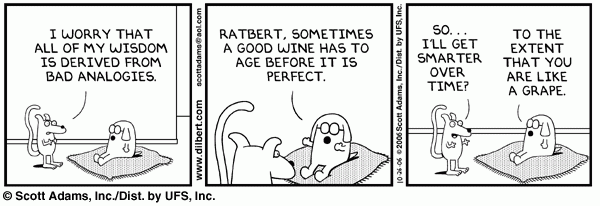
dilbert-bad-analogies

4 Comments

Filed under Cartoon, Grammar, Humor, Lists, Nuts & Bolts, Writing Exercise, Writing Prompt

Time of the Mad Atom

I came across this poem recently; more of Virginia Brasier’s works can still be found in printed form, or on Google Books.  This was originally posted (from what I can find out) in the Saturday Evening Post, Volume 221, 1949.  Whenever it was written, it’s just as timely and poignant today.

“Time of the Mad Atom”

This is the age of the half-read page.

And the quick hash and the mad dash.

The bright night with the nerves tight.

The plane hop and the brief stop.

The lamp tan in a short span.

The Big Shot in a good spot.

And the brain strain and the heart pain.

And the cat naps till the spring snaps—

And the fun’s done!

By Virginia Brasier

Sunlamp

3 Comments

Filed under History, Poetry, Quotes