To-Do or To-Be, That is the Question


resizedimage400325-Timemanagement-forblogger

Credit:  www.acceleo.com

Working at home is a double-edged sword; most people think they would love to be their own boss, to set their own schedule, to pursue their own dreams.  But that’s just it:  You have to be your own boss, and not let meetings, schedules, appointments, to-do lists and sundry responsibilities outside of work consume you; you have to set your own schedule and stick to it, or time will hijack it; you have to actively pursue your dream (and success usually comes dressed in work clothes), or it will never come true.  It’s a lot like writing:  Most people don’t really want to write a book, as they claim; they want to have written a book, and there is a vast difference between the two.

If you’re like me, you’re organized; we need to be, to keep work, tasks and schedules from eating us alive.  Sometimes even with the best of intentions and plans, squirrels still come along… if you have no idea what I mean, just click on the link!  To keep the squirrels at bay, I keep a book of to-do lists.  I have one for my household tasks, telephones, repairs, appointments, administrative issues, etc.  I have as many as it takes for revisions and the like for my current manuscript, as well as marketing lists, etc… plus writing blogs.  Sometimes frankly they can all be overwhelming, and that’s where I need grace with myself.  It’s times like that when having a boss might be preferable, telling me what to do next (I just have to remember the last two bosses I had, and that wistful thought vanishes pronto)!

Despite the long lists, I still need to find time and space to just “be”, and that is a challenge for me.  Even when I’m sitting still, my mind’s going 1,000 RPM, percolating on a plot idea, developing a character or plot twist, thinking about what I’ll make for dinner – do I need to go shopping? – or what the schedule will be once others are home again.  Leaving work at the office is more difficult when home and work occupy the same space.  And, oh yeah, daily exercise would be a good idea too.  I have periods each day that are what I call “limbo time” – too short or chopped up by others to dive into a larger project.  I could fill the “limbo” time of my schedule with a myriad of micro-sized tasks; but I also need to learn to step back, take a deep breath or ten, and not be productive or feel guilty that I’m not being productive.  Such recuperation time shouldn’t be relinquished to the edge of “micro crumbs” of time left over; it is just as important to schedule a time of rest, and should be taken just as seriously as any task, though it often isn’t (I’m getting better at it).

Some of the things I’ve learned about time management so far are:

  • Know how your time is spent.  If you don’t, it will run through your fingers like fine sand.  In my article on productivity, I mentioned a few helpful apps; they help me track how my time is being used, and it helps me to focus.  Even my breaks are scheduled with the Clear Focus app mentioned.
  • Have a pad of paper nearby to jot down the random thoughts that come. I’ve found that jotting them down quickly helps clear my mind to focus better on the task at hand.
  • Schedule down-time: Take a power-nap, or do something you enjoy like sitting in the sunshine, going for a refreshing walk, or creating something crafty.
  • Create habits. One habit I have is a bit like “clocking in” at my desk:  I set both my landline phone and my cell phone into a holder on the desk, and this little action signals to my mind that it’s “time to focus”.  Another habit might be making myself a tea either before I sit down, or on a break.

How do you deal with balancing work and rest, real life and dwelling in the fantasy world of a writer?  Have you developed any habits that help?  Please share them below – we can all benefit, I know!  The next thing on my schedule is – squirrel! – taking time to swing by others’ blogs, and be inspired.  The squirrel is now caged.

2 Comments

Filed under Articles, Lists, Musings, Writing Exercise

The Third Place

We humans are social beings; we crave, in varying degrees and in varying times, social interaction.  For extroverts that comes more frequently than for introverts; but at some point in time we all want to connect.  We each have what are known as physical “places” in our lives:  The first place is the private home; the second is often either the workplace or school; the third place is an environment in which we feel comfortable, “at home”, or refreshed in one way or another.  Some examples of third places are libraries, the barber’s or hair salon, Starbucks, pubs, public recreational centres, and restaurants that don’t breathe down your neck to order or clear your table.  The first two places are where we go because we need to, but the third is where we go because we choose to.

Bloomsbury Coffee House, London

Bloomsbury Coffee House, London; image credit – TripAdvisor.co.uk

Companies like Starbucks, or television shows like “Cheers” capitalize on this craving; they create an environment which feels like a home away from home, a place to slow down, to rest awhile, to read or write or study, and they attract people in droves.  In this cyber age we also have virtual places:  Facebook is the virtual equivalent to a pub, where people hang out and share their lives while friends are free to share and receive to whatever degree that suits them; in a way, it is essentially selfish:  We all have those friends who bask in the sunny parts of our lives, but shy away from our shadows; cyber platforms such as Facebook merely amplify that tendency.  Nevertheless, it provides a platform to connect with others with whom physical contact may be impossible; I have family abroad and friends in every time zone, and keeping up with them would be impossible without Skype and Facebook.

My third place varies:  We have a large flat with peaceful neighbours, so this introvert doesn’t necessarily need a third place on a regular basis; we have a library in our home, where I usually write, though I sometimes settle on our upstairs couch to work as well (just for a change).  When I go out, I go to a local restaurant during its slow hours, and I can unpack my laptop and work a few hours without a sideways glance from the personnel.  My favourite third place is actually in London; located in the cellar of the hotel (St. Athens Hotel, on Tavistock Place) I usually stay in while I’m there, Bloomsbury Coffee House is a friendly pocket-sized place with about twenty tables, and they are usually filled with students on laptops in work groups, and lone readers, writers and businessmen out for quiet breaks.  It’s dangerously close to (just around the corner from) London’s largest second-hand book store, Skoob Books.  The combination is irresistible.

Where is your favourite home-away-from-home place?  Where can you stretch your wings, sit back and relax, people-watch, read, write or simply contemplate the deeper things of life?  Let us know in the comments below, and inspire others with your ideas!

9 Comments

Filed under Articles, Musings

Deaf Space

Take a moment to stop what you’re doing, and close your eyes:  What do you hear?  A tea kettle? The hum of your computer?  a television?  A car driving by?  All of these sounds tell you something about your environment:  That water is boiling; that your computer is working well, or struggling, or processing something that makes it slower at the moment; that someone, perhaps in another room, is occupied; that traffic is flowing, or that it might be dangerous for children outside at play.

Now take away all those sounds.  It can be disorienting; it makes you feel insecure.  It also makes you more alert to other environmental cues, and to your other senses – particularly sight.  If a person mumbles, or turns away, or moves their hand across their face while speaking to a deaf person, communication is disrupted.  People can be sensitized to the challenges, but can architecture?  Yes.  It can be made suitable for various perceptions and perspectives.

When I lived in Scotland, I translated regularly (BSL) for the deaf in our church, and would hang out with deaf friends sometimes.  Some of them lived in a flat complex designed for the visually or auditorily-impaired, with bold red counter tops, light switches and phones to help them navigate, as well as light signals for various things such as the door bell or the phone ringing.  The deaf sports club was a wide-open space, with room for a large crowd to chat in groups; as a hearing person, it was a unique experience to be in a crowd of signing people:  There are few secrets in the deaf community, because even across the room one can understand the conversation; and though we were all signing, it was not quiet – sounds made with the mouth to support the sign, or the slap of skin on skin, or a laugh, or the shifting of clothing could be heard.

Look at the layout of your room, or office:  If your interaction with the people around you needs to be visual, what could potentially hinder it?  A solid wall, a glaring light fixture, blind corners, stairs (which must be focused on, to navigate), or a narrow passage that makes it difficult to walk side by side, signing.  Deaf architects have begun incorporating their unique considerations into designs, and they not only offer a unique perspective on architecture but, by doing so, have created some stunning spaces:  Deaf Space.  To see a short video on the topic, please click here.  Do yourself a favour, and watch the video at least once without sound.  Below are a few images of deaf space from Google Images.

As a writer, it is always fascinating for me to explore new perspectives, and to try to see the world around me through the eyes of others; doing so enriches the writing experience, and opens new possibilities in developing characters, environments, or situational elements.

This slideshow requires JavaScript.

5 Comments

Filed under Articles, Research, Signs, Videos

Mark Twain on Switzerland & the Awful Language of German

This past week I’ve been quite busy getting ready for a big change in our lives:  Taking in an exchange (high school) student for nearly a year.  She’s coming from Thailand, and wants to learn German; I’m not sure she knows what she’s getting herself into, as we don’t speak the German she will need to learn for school; we speak Swiss German, which is about as similar to High German as Old English is to modern English.

In preparation, I’ve been doing a bit of spring cleaning too – might as well, right?  My main work room, our library, is also where I keep folders full of stories I’ve saved over the years, and while sifting through them I was reminded of an article about Mark Twain’s observations on the German language.  I found what I was looking for in a Kindle book; it would be astonishing (and perhaps a bit discouraging) to Mark Twain if he could see his entire life’s work reduced to an e-book for less than $ 2.00, but so it is.  I was surprised to find a short description of his time in Switzerland, as part of his Grand Tour no doubt.  And as I mentioned above, the German dialects we speak are not the German Mark Twain describes, so I can laugh along with the rest of you (and I can laugh at the fact that the WordPress spell check is going berserk).  I’ll need to resort to High German for the sake of our exchange student, but it grates on my ears and tongue like sandpaper on the eyeballs.  Mark Twain seems to have had similar sentiments.  I will first share his impression of Switzerland, and then bombard you with his opinion of the German language.  This post is a bit longer than my usual offering, but Twain is well worth it!  So put your feet up, get a cuppa, and enjoy!

On Switzerland

Interlaken, Switzerland, 1891.

“It is a good many years since I was in Switzerland last. … there are only two best ways to travel through Switzerland. The first best is afloat. The second best is by open two-horse carriage. One can come from Lucerne to Interlaken over the Brunig by ladder railroad in an hour or so now, but you can glide smoothly in a carriage in ten, and have two hours for luncheon at noon—for luncheon, not for rest. There is no fatigue connected with the trip. One arrives fresh in spirit and in person in the evening—no fret in his heart, no grime on his face, no grit in his hair, not a cinder in his eye. This is the right condition of mind and body, the right and due preparation for the solemn event which closed the day—stepping with metaphorically uncovered head into the presence of the most impressive mountain mass that the globe can show—the Jungfrau. The stranger’s first feeling, when suddenly confronted by that towering and awful apparition wrapped in its shroud of snow, is breath-taking astonishment. It is as if heaven’s gates had swung open and exposed the throne. It is peaceful here and pleasant at Interlaken. Nothing going on—at least nothing but brilliant life-giving sunshine. There are floods and floods of that. One may properly speak of it as “going on,” for it is full of the suggestion of activity; the light pours down with energy, with visible enthusiasm. This is a good atmosphere to be in, morally as well as physically.

DCF 1.0

Vierwaldstättersee, taken 2006

“After trying the political atmosphere of the neighboring monarchies, it is healing and refreshing to breathe air that has known no taint of slavery for six hundred years, and to come among a people whose political history is great and fine, and worthy to be taught in all schools and studied by all races and peoples. For the struggle here throughout the centuries has not been in the interest of any private family, or any church, but in the interest of the whole body of the nation, and for shelter and protection of all forms of belief. This fact is colossal. If one would realize how colossal it is, and of what dignity and majesty, let him contrast it with the purposes and objects of the Crusades, the siege of York, the War of the Roses, and other historic comedies of that sort and size. Last week I was beating around the Lake of Four Cantons [Vierwaldstättersee], and I saw Rutli and Altorf. Rutli is a remote little patch of meadow, but I do not know how any piece of ground could be holier or better worth crossing oceans and continents to see, since it was there that the great trinity of Switzerland joined hands six centuries ago and swore the oath which set their enslaved and insulted country forever free…”

On the Awful German Language

What he had to say about the German and their language is quite different, however:

“Even German is preferable to death.”

“Surely there is not another language that is so slipshod and systemless, and so slippery and elusive to the grasp. One is washed about in it, hither and thither, in the most helpless way; and when at last he thinks he has captured a rule which offers firm ground to take a rest on amid the general rage and turmoil of the ten parts of speech, he turns over the page and reads, “Let the pupil make careful note of the following EXCEPTIONS.” He runs his eye down and finds that there are more exceptions to the rule than instances of it. So overboard he goes again, to hunt for another Ararat and find another quicksand.”

“German books are easy enough to read when you hold them before the looking-glass or stand on your head—so as to reverse the construction—but I think that to learn to read and understand a German newspaper is a thing which must always remain an impossibility to a foreigner.”

“…in a German newspaper they put their verb away over on the next page; and I have heard that sometimes after stringing along the exciting preliminaries and parentheses for a column or two, they get in a hurry and have to go to press without getting to the verb at all. Of course, then, the reader is left in a very exhausted and ignorant state.”… “It reminds a person of those dentists who secure your instant and breathless interest in a tooth by taking a grip on it with the forceps, and then stand there and drawl through a tedious anecdote before they give the dreaded jerk.”

Mark Twain, Young“Some German words are so long that they have a perspective. Observe these examples:

Freundschaftsbeziehungen.

Dilettantenaufdringlichkeiten.

Stadtverordnetenversammlungen.

These things are not words, they are alphabetical processions. And they are not rare; one can open a German newspaper at any time and see them marching majestically across the page—and if he has any imagination he can see the banners and hear the music, too. They impart a martial thrill to the meekest subject. I take a great interest in these curiosities. Whenever I come across a good one, I stuff it and put it in my museum. In this way I have made quite a valuable collection. When I get duplicates, I exchange with other collectors, and thus increase the variety of my stock. Here are some specimens which I lately bought at an auction sale of the effects of a bankrupt bric-a-brac hunter:

Generalstaatsverordnetenversammlungen.

Alterthumswissenschaften.

Kinderbewahrungsanstalten.

Unabhängigkeitserklärungen.

Wiedererstellungbestrebungen.

Waffenstillstandsunterhandlungen.

Of course when one of these grand mountain ranges goes stretching across the printed page, it adorns and ennobles that literary landscape—but at the same time it is a great distress to the new student, for it blocks up his way; he cannot crawl under it, or climb over it, or tunnel through it. So he resorts to the dictionary for help, but there is no help there. The dictionary must draw the line somewhere—so it leaves this sort of words out. And it is right, because these long things are hardly legitimate words, but are rather combinations of words, and the inventor of them ought to have been killed.”

“My philological studies have satisfied me that a gifted person ought to learn English (barring spelling and pronouncing) in thirty hours, French in thirty days, and German in thirty years. It seems manifest, then, that the latter tongue ought to be trimmed down and repaired. If it is to remain as it is, it ought to be gently and reverently set aside among the dead languages, for only the dead have time to learn it.”

Quotes from the Complete Works of Mark Twain (Illustrated). Delphi Classics. Kindle Edition.

11 Comments

Filed under Articles, Humor, Musings, Quotes

One Fine Day in the Middle of the Night

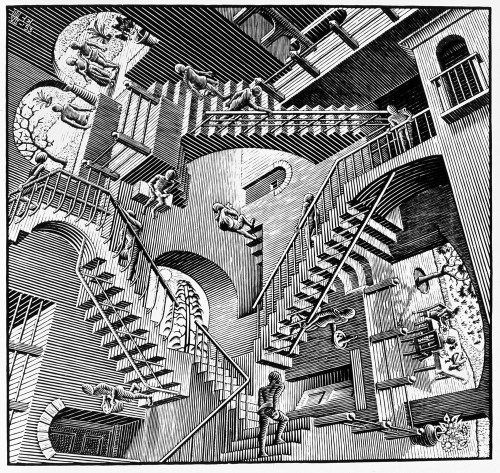
Escher-relativity 2Back before I was married, I lived in Paisley (Scotland) with an English roommate; we got along like clotted cream and jam, and, among other things, we would recite the following verse in sync any time we heard someone say,  “I see”.  There are longer, more elaborate versions that have been around for over 50 years.  The mutations make it hard to trace it to the original source, as it seems that each person, school class or generation tweaks it with their own twist.
One Fine Day

“I see,” said the blind man to the deaf man

One fine day in the middle of the night,

Two dead men got up to fight;

Back to back they faced each other,

Drew their swords and shot each other.

A deaf policeman heard the noise,

And came and shot those two dead boys.

If you don’t believe my tale is true,

Ask the blind man, he saw it too.

Do you have any favourite rhymes, verses or ditties that you’ve known for years?

Please share them in the comments below!

Illustration:  “Relativity”, by M.C. Escher

29 Comments

Filed under Humor, Images, Poetry

Writing Trivia: Earthen Floors

I do a lot of research online; sometimes it leads down the oddest of trails, and those are always the fun ones to follow – the road less travelled, and all that.  I keep a storehouse of “odds and ends” information, the trivial bits and bobs that might come in handy as I create a new world for a story.

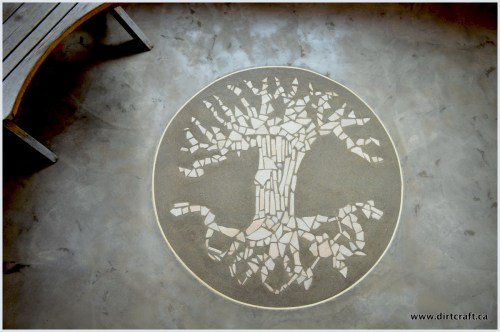
I was recently writing an article for one of my other blogs (click here to read it), and came across an interesting article on the topic of earthen flooring; such an element could be used in historical fiction, science fiction, or modern eco-escapism fiction.

What I found fascinating is the way the writer describes her first experience of walking on such a floor:  The leathery softness, the warmth, the texture, and the creative possibilities this type of flooring allows.

Such things stir my creative juices, and I have to remind myself to finish my current manuscript before moving on!  But such an element will come in very handy for my next book, which is a science fiction story… and now, because I’ve shared it with you, I’ll know where to find it when I need it!

Click on the image below to read the article, and be inspired.  Keep writing!

Earthen Flooring


5 Comments

Filed under Articles, Nuts & Bolts, Plot Thots & Profiles, Research

Stop Apostrophe Abuse

Back in the summer of 2013, I wrote this article on apostrophe abuse; after having surfed around a few blogs recently, I felt my pet peeve starting to twitch and decided to share it with you again, as many of you have joined me more recently. Enjoy!

Trinity's avatarStephanie Huesler

Okay, grammar pet peeve time:  Apostrophe abuse.  It needs to stop.  Now.apostrophe Puppy

There are only two instances in the English language in which apostrophes are used:

1) Contractions, as in:  you are = you’re, or have not = haven’t, or I am = I’m. Just keep in mind that the apostrophe takes the place of the missing letter(s); if you take a letter out to combine (contract) two words together, place the apostrophe where the missing letter would have been written.

2) Possessives, as in:  Steve’s hat (the hat belongs to Steve), or today’s specials (specials on for today)

Apostrophe Tombstone Alway’s there for us. Who is Alway?

Never, I repeat NEVER should an apostrophe be used to indicate a plural!!  Never, EVER.  If you see it used as a plural, it’s wrong – even if it’s on a tombstone (see the image below). Apostrophe Tombstone 2

In the illustration…

View original post 254 more words

7 Comments

Filed under Articles, Cartoon

5 Life Hacks for Productivity

Let’s face it… humans are creatures of habit.  That phrase often has a negative connotation; in a conference that lasts several days, people will tend to sit within a few chairs of the seats they sat in on the first day, whether they like the location or not; once a person starts hanging the loo roll on the dispenser either top or bottom, the other way is just wrong.  But habits can also work to our advantage, if we form good ones:  Cleaning up after ourselves should have been a habit formed in our childhoods; brushing our teeth, pushing a chair in after we leave the table, and dozens of other little habits are hygienic, energy-saving, and contribute to more harmonious relationships within our social and environmental landscapes.

Those of us who express ourselves through creative media (such as writing, arts or crafts) might tend to see ourselves or the expression of our craft as outsiders, or at least mavericks, when it comes to business practices.  However, there are many tools (such as the SWOT) and principles for increasing productivity in the business sector that we can and should apply to our creative streaks (if the intention is to take them beyond the level of hobby to a more serious endeavour).  One of those principles involves forming good habits.  Below, I’ve listed five things that I do to keep my creativity fresh, and thus keep the time that I spend writing more productive than it would otherwise be (I know from experience).  For practical purposes I’ll refer to the expressions from the perspective of a writer, but these hacks apply to any creative discipline.

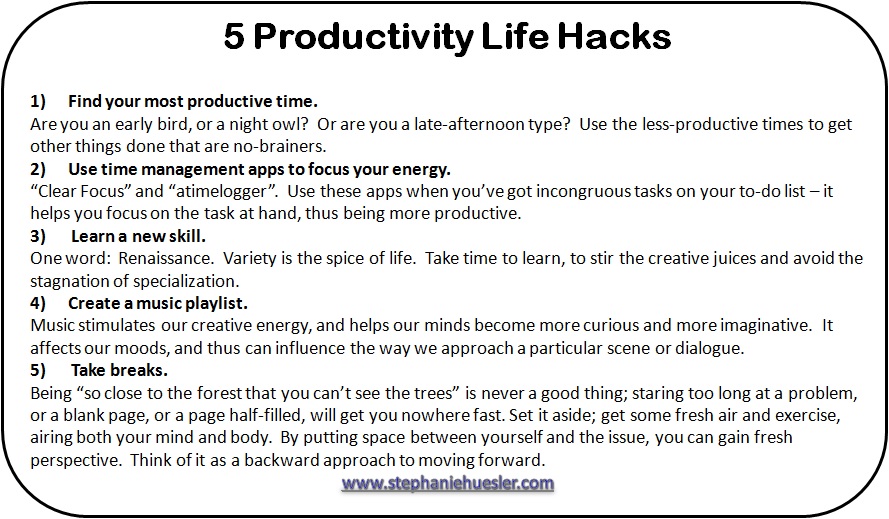
5 Productivity Life Hacks

I’ve taken the liberty of making a “cheat sheet” as a reminder of these principles; if it’s helpful for you, feel free to print it out and hang it up where you work or write.

1)   Find your most productive time.

Are you an early bird, or a night owl?  Or are you a late-afternoon type?  Most people have 9-to-5 jobs that dictate when they have free time; but when you are looking for time to write, try to schedule it in your most productive time of the day.  I am an extreme night owl; I need very little sleep and work at home, so my time is flexible; yet my most productive time of the day is between 01:00 and 04:00, with the second-most productive period being late-afternoons. I know this about myself, so I use the less-productive times to get other things done that are no-brainers (housework, shopping, etc.).

2)  Use time management apps to focus your energy.

I have two (android) apps that I use:  “Clear Focus” and “aTimeLogger”.  The first app counts down from the time I set, with a five-minute break following; every three sessions, it encourages me to take a longer break of fifteen minutes.  The second app allows me to log how much time I spend in a particular activity; I have added customized activities such as editing and blogging.  I use these apps especially when I’ve got a dozen incongruous tasks on my to-do list – it helps me focus on the task at hand, thus being more productive.

3)  Learn a new skill.

That may sound a bit odd; after all, it takes time to learn a new skill, right?  But bear with me a moment:  The current thinking of today is that one should become a specialist; the thinking goes that if you focus your energy into learning one skill to a high degree, you will be successful in it.  But I have one word in answer to that:  Renaissance.  During the Renaissance it was considered ideal for one to pursue multiple disciplines; a gentleman of the time was expected to speak several languages, be well-versed in various scientific disciplines such as astronomy, botany, or medicine, and be eloquent with words through writing poetry, play a musical instrument, study philosophy, theology, and so on.  The standard was set, and met – think of all that was accomplished, discovered, and invented during that age!  Variety is the spice of life, and I find that iron sharpens iron – that one skill hones another.  So take some time to learn something new; it will stir the creative juices and get them flowing much more productively than if you stagnate in specialization.  And in gathering new skills, you will add to your arsenal of personal experience from which to draw on when fleshing out characters, worlds, scenes and dialogues.

4)  Create a music playlist.

Spotify is a great invention!  I have dozens of playlists, and depending on what I’m working on, I’ll turn on music to set the mood for a scene I’m writing (for me, it has to be just right or it can be counter-productive), or to speed me up or slow me down.  Music stimulates our creative energy, and helps our minds become more curious and more imaginative.  It affects our moods, and thus can influence the way we approach a particular scene or dialogue.  Just for the record, as I write this, I’m listening to the album Grace by Steven Sharp Nelson (of the Piano Guys).

5) Take breaks.

This is another habit that runs counterintuitively to conventional wisdom, but being “so close to the forest that you can’t see the trees” is never a good thing; staring too long at a problem, or a blank page, will get you nowhere fast.  Frustration builds, making any mental block that much thicker.  Set it aside; get some fresh air and exercise, airing both your mind and body.  By putting space between ourselves and the issue, we often gain fresh perspective.  Think of it as a backward approach to moving forward.  As Steven Spielberg advises, contemplation time is essential in the creative process – don’t fill it with brain work that distracts.  Take a bath.  Do the laundry.  Draw; doodle; do a craft.  Some of my best solutions or plot twists have come while doing a craft.  By the way, crafts encourage abstract thinking, problem solving, and creative perspectives.  To apply this, take a 20-30 minute break after you complete a particular element; sometimes it actually helps me to start that new element before taking a break – it gives my mind time to percolate away from the computer, yet gives me a starting point when I return to work.

I hope these hacks encourage you in developing and honing your craft.  Keep writing!

14 Comments

Filed under Articles, Lists, Nuts & Bolts, Plot Thots & Profiles, Writing Exercise

Just Sayin’

I had to share this!  As Mark Twain once said, “The difference between the right word and the almost right word is the difference between lightning and a lightning bug.”  In this case, it’s the difference between a home run and a strike…

Right Word


3 Comments

Filed under Humor, Images, Quotes

Loops of Life

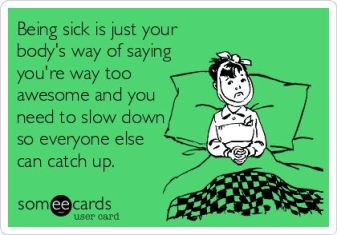
Sick and AwsomeIsn’t it amazing that the smallest of life forms can upend your life, change your priorities overnight, and put your schedule, and even deadlines, on hold?  Otherwise known as the flu bug.  It knocked me for a loop or three just after the New Year, and I’ve been battling it off ever since.  Everything, and I mean everything, gets put on hold at such times.

I’m sure you all know that there is no convenient time for a flu, but sometimes it’s easier on the schedule than others.   I’m grateful that it was after Christmas, because on Christmas Day I was at last able to complete the first draft of my next novel!  And later this month I don’t need it, because I get to go and stay in a posh resort overnight, also known as a hospital bed, to catch a few hours of sleep while they remove a few plates and lots of screws from one of my ankles, making it easier to get through airport security.  My bone will look a bit like Swiss cheese after they’re done, which means I get a few weeks of feet-up-and-read-lots-of-books time, followed by the ability to walk, exercise, and get a bit of muscle tone back.  Woohoo.

I began thinking about loops, in the wider scope, while I had some down-time this past month:  They come in all shapes and sizes; sometimes they’re hiccups in relationships, jobs, studies, goals or even social or environmental challenges.  Those loops, we can handle; they’re all essentially first-world problems, so I won’t complain; at least my loops don’t include wondering where my next meal will come from, where I’ll be sleeping tonight, or how to find clean water and a safe hiding place from men with guns hunting me down.  Even though my schedule has gotten thrown on its ear, and I feel like something the cat dragged in, I will count myself blessed.

If you’re going through loops of your own right now, look for the things in your life that remind you that you are blessed, and remember that jumping through loops will make us stronger in the end.

4 Comments

Filed under Articles, Cartoon, Humor, Musings