Let’s face it… humans are creatures of habit. That phrase often has a negative connotation; in a conference that lasts several days, people will tend to sit within a few chairs of the seats they sat in on the first day, whether they like the location or not; once a person starts hanging the loo roll on the dispenser either top or bottom, the other way is just wrong. But habits can also work to our advantage, if we form good ones: Cleaning up after ourselves should have been a habit formed in our childhoods; brushing our teeth, pushing a chair in after we leave the table, and dozens of other little habits are hygienic, energy-saving, and contribute to more harmonious relationships within our social and environmental landscapes.
Those of us who express ourselves through creative media (such as writing, arts or crafts) might tend to see ourselves or the expression of our craft as outsiders, or at least mavericks, when it comes to business practices. However, there are many tools (such as the SWOT) and principles for increasing productivity in the business sector that we can and should apply to our creative streaks (if the intention is to take them beyond the level of hobby to a more serious endeavour). One of those principles involves forming good habits. Below, I’ve listed five things that I do to keep my creativity fresh, and thus keep the time that I spend writing more productive than it would otherwise be (I know from experience). For practical purposes I’ll refer to the expressions from the perspective of a writer, but these hacks apply to any creative discipline.

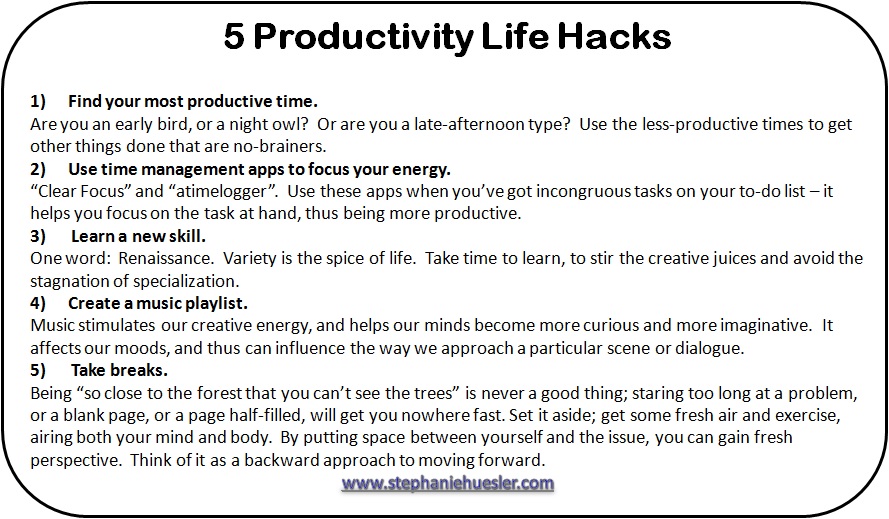
I’ve taken the liberty of making a “cheat sheet” as a reminder of these principles; if it’s helpful for you, feel free to print it out and hang it up where you work or write.
1) Find your most productive time.
Are you an early bird, or a night owl? Or are you a late-afternoon type? Most people have 9-to-5 jobs that dictate when they have free time; but when you are looking for time to write, try to schedule it in your most productive time of the day. I am an extreme night owl; I need very little sleep and work at home, so my time is flexible; yet my most productive time of the day is between 01:00 and 04:00, with the second-most productive period being late-afternoons. I know this about myself, so I use the less-productive times to get other things done that are no-brainers (housework, shopping, etc.).
2) Use time management apps to focus your energy.
I have two (android) apps that I use: “Clear Focus” and “aTimeLogger”. The first app counts down from the time I set, with a five-minute break following; every three sessions, it encourages me to take a longer break of fifteen minutes. The second app allows me to log how much time I spend in a particular activity; I have added customized activities such as editing and blogging. I use these apps especially when I’ve got a dozen incongruous tasks on my to-do list – it helps me focus on the task at hand, thus being more productive.
3) Learn a new skill.
That may sound a bit odd; after all, it takes time to learn a new skill, right? But bear with me a moment: The current thinking of today is that one should become a specialist; the thinking goes that if you focus your energy into learning one skill to a high degree, you will be successful in it. But I have one word in answer to that: Renaissance. During the Renaissance it was considered ideal for one to pursue multiple disciplines; a gentleman of the time was expected to speak several languages, be well-versed in various scientific disciplines such as astronomy, botany, or medicine, and be eloquent with words through writing poetry, play a musical instrument, study philosophy, theology, and so on. The standard was set, and met – think of all that was accomplished, discovered, and invented during that age! Variety is the spice of life, and I find that iron sharpens iron – that one skill hones another. So take some time to learn something new; it will stir the creative juices and get them flowing much more productively than if you stagnate in specialization. And in gathering new skills, you will add to your arsenal of personal experience from which to draw on when fleshing out characters, worlds, scenes and dialogues.
4) Create a music playlist.
Spotify is a great invention! I have dozens of playlists, and depending on what I’m working on, I’ll turn on music to set the mood for a scene I’m writing (for me, it has to be just right or it can be counter-productive), or to speed me up or slow me down. Music stimulates our creative energy, and helps our minds become more curious and more imaginative. It affects our moods, and thus can influence the way we approach a particular scene or dialogue. Just for the record, as I write this, I’m listening to the album Grace by Steven Sharp Nelson (of the Piano Guys).
5) Take breaks.
This is another habit that runs counterintuitively to conventional wisdom, but being “so close to the forest that you can’t see the trees” is never a good thing; staring too long at a problem, or a blank page, will get you nowhere fast. Frustration builds, making any mental block that much thicker. Set it aside; get some fresh air and exercise, airing both your mind and body. By putting space between ourselves and the issue, we often gain fresh perspective. Think of it as a backward approach to moving forward. As Steven Spielberg advises, contemplation time is essential in the creative process – don’t fill it with brain work that distracts. Take a bath. Do the laundry. Draw; doodle; do a craft. Some of my best solutions or plot twists have come while doing a craft. By the way, crafts encourage abstract thinking, problem solving, and creative perspectives. To apply this, take a 20-30 minute break after you complete a particular element; sometimes it actually helps me to start that new element before taking a break – it gives my mind time to percolate away from the computer, yet gives me a starting point when I return to work.
I hope these hacks encourage you in developing and honing your craft. Keep writing!






 Isn’t it amazing that the smallest of life forms can upend your life, change your priorities overnight, and put your schedule, and even deadlines, on hold? Otherwise known as the flu bug. It knocked me for a loop or three just after the New Year, and I’ve been battling it off ever since. Everything, and I mean everything, gets put on hold at such times.