Tag Archives: English

Etymology Undusted: Ducks and Drakes

Today’s phrase, playing at / making ducks and drakes, refers to skipping stones across a water surface, much like the image of a waterbird coming in for a watery landing. By 1614, the meaning had come to be associated with squandering or throwing one’s money away needlessly, much like stones were tossed away in stone-skipping.

The first written evidence of the phrase was in 1585, The nomenclator, or remembrancer of Adrianus Junius, translated by John Higgins:

“A kind of sport or play with an oister shell or stone throwne into the water, and making circles yer it sinke, etc. It is called a ducke and a drake, and a halfe-penie cake.”

These two terms also appear in nursery rhymes; the first, found in A History of Nursery Rhymes (1899) by Percy B. Green, where he mentions that this rhyme was repeated when skimming stones:

A duck, a drake, a barley cake,
A penny to pay the baker;
A hop, a scotch, another notch –
Slitherum, slitherum, take her.

The “barley cake” is “halfpenny cake” in this 1916 version of The Real Mother Goose:

A duck and a drake,
And a halfpenny cake,
With a penny to pay the old baker.
A hop and a scotch
Is another notch,
Slitherum, slatherum, take her.

In 1626, it is mentioned in the play Dick of Devon:The poorest ship-boy Might on the Thames make duckes and drakes with pieces Of eight fetchd out of Spayne.”

Many cultures share the simple pastime of stone tossing, with their own terms for it: American English, skipping stones; British English, skimming stones or ducks and drakes; in Scottish, Skiting or Skliffing; in Irish, stone skiffing. In French, making ricochets (faire des ricochets); in German, stone flitting (Steinehüpfen); in various languages such as Bulgarian, Greek, Latvian and Lithuanian, their terms refer to frogs rather than ducks. In Japanese, cutting water. In Norwegian, fish bounce (fiskesprett). In Portuguese, either water shearing (capar a água) or making tiny hats (fazer chapeletas). The list goes on and on!

The oldest reference to the pastime goes back to the 2nd century AD by the Greek scholar Julius Pollux; in the 3rd century, Marcus Minucius Felix (a Latin writer) mentions children skipping shells on the beach.

Today, of course, it has become a serious competition for some. According to the Guinness Book of World Records, the record for the number of skips is 88, held by Kurt Steiner; the furthest distance for men is 121.8m, made by Scotsman Dougie Isaacs, and 52.5m for women, thrown by Nina Luginbuhl from Switzerland.

The next time you’re out at a lake or shore, toss a stone and remember the long and colourful history of ducks, drakes, frogs, fish, hats and water!

Leave a comment

Filed under Etymology, History Undusted, Liguistics, Linguistics, Snapshots in History

History Undusted: The Great Vowel Shift

My husband and I were having lunch recently, and a package of Swedish crackers was on the table; I pointed to the brand name, Pågen. In English, our pronunciation of these vowels would lead us to say pagan /pæg-in/, whereas the Swedish would rather be more like /po-gen/. I just mentioned that English might have sounded similar to that before the Great Vowel Shift, which he’d never heard of (being Swiss, it’s not likely he would be familiar with this aspect of English etymology), so I promised to write a blog about it; here we go!

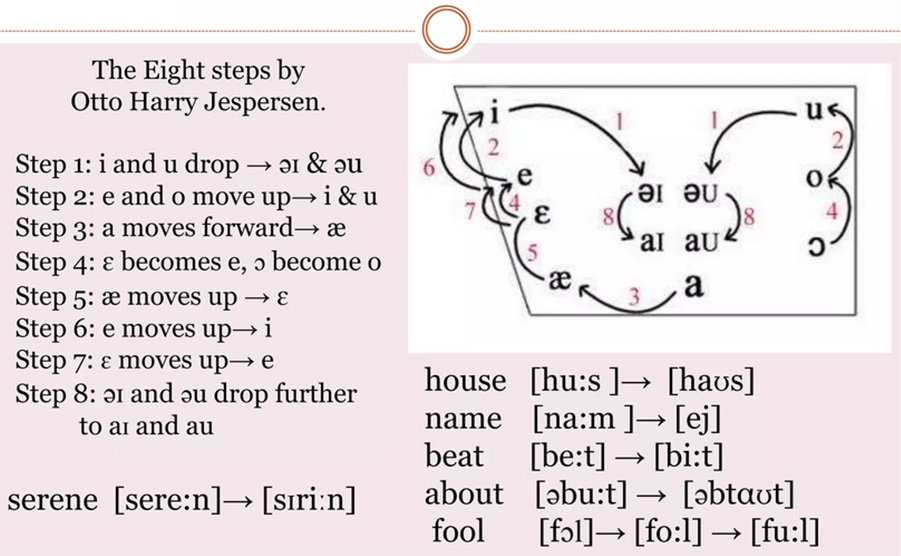
The term Great Vowel Shift was coined by the Danish linguist, Otto Jespersen (1860-1943), who specialised in the English language. Though the GVS is considered a single event (because of the changes being viewed as part of a chain reaction, with each vowel sound changing in a predictable way), the actual transition of English pronunciation was gradual, taking place over about 200 years, from ~1400 to ~1600. The shift began in Middle English, which was spoken from 1066 until the late 15th century – that form familiar to Geoffrey Chaucer (though his pronunciation would be unintelligible to us, his words still survive through his famous Canterbury Tales) – into Early Modern English (from the beginning of the Tudor period through to the Stuart Restoration period); Shakespeare would have been familiar with it. From there, English transitioned into Modern English in the mid-to-late 17th Century.

The main changes were that, from Middle to Early Modern English, the long vowels shortened; weef became wife, moos* became mice, beet became bite, and so on. (*The word moose entered English through Native American languages in 1610). I will also mention that in Scottish, a lot of the older vowel pronunciations still exist; house is still huus, full is homophonous with fool, etc.

Here’s a look at just how the English vowels shifted:

Source: SlideShare

If you’ve been paying any sort of attention to English, you’ll know that our spelling is a bit chaotic; the language is full of homonyms, which are divided into either homophones (words that sound the same but have different spellings, e.g. beet and beat; bear and bare; to, too and two), or homographs (two words with differing meanings, same spellings, but not necessarily the same pronunciation: e.g. bank [of river; finance] or agape [with mouth open; love], or entrance [a way inside; to delight]) or tear [ripping; crying]. These -graphs and -phones came into English from regional dialects that were transported as migration and cultural mixing took place, and the GVS added its two pennies to the mix. Just think of the variety we have in the sounds /ea/ (bread, beat, bear, break); /oo/ (look, spool, blood); or /gh/ (through, cough, sight).

Certain factors contributed to the speed of language shift: The Black Death (1346-1353) wiped out up to 50% of Europe’s population. Stop a minute and let that sink in. What if the population of your town were reduced by half? And the next town, and the next. That single event changed the course of history on many levels; surfs could finally demand better wages wherever they ended up settling; if you lived in a town that no longer had the skills of a baker, blacksmith, or any other trade you’d depended on, you’d move to where those services existed – and jobs existed – and that meant places that had been hit the hardest by the plague and thus where everyone else was migrating, such as London. As mass movement followed the epidemic, people brought their dialects and their spellings with them. It began to converge into a new, distinct way of speaking, thinking and spelling. The geopolitical climate of the time also influenced English; England and France have been annoying each other for over a thousand years; whenever England was enamoured by all things French, they tried to emulate their pronunciations. That influence came and went; in one such moment, the pilgrims set sail for America (1620), taking a time capsule of the language with them, while England’s English continued to be influenced by French up until the French Revolution, when it quickly fell out of favour in England, though the changes had already taken place (one example is the American /k/ in schedule, closer to the original Latin, while the English say /sch/ without the /k/, which is closer to the French cedule). This factor of influence also affected differences of speech between the lower class and upper class at that time; the upper class wanted to sound more posh, more fashionable, and above all, not like the lower class.

A major contributing factor to our chaotic spelling is that ca. 1440, the Gutenberg printing technique was introduced, and by the 1470s, William Caxton had imported the invention to England; we have him to thank for Chaucer’s Canterbury Tales being known today, as that was the first book he printed in England. We also have him to thank for the influence of Chancery English (the English used by the secretariat of King Henry VI) in the standardization of the language, as he used it as his own guidelines in printing. The vowels had already begun to shift by that time; enter the written word, a rise in literacy, and you have the jumbled effects of “mid-shift” on English spelling – people began to adapt their pronunciation to the written word, so whichever form the printer used is the one that began to prevail, even though some sounds were still in transition. Like nailing down jelly. You could say that many of our odd spellings are simply a snapshot in time.

It is also important to point out that the GVS didn’t have the same influence everywhere: The main changes occurred around London, but the farther away you move from that epicentre, the less the effects on the local dialects, which still holds true today – though gradual merging has allowed people from, say, Cornwall, to understand people from Yorkshire – which wouldn’t have been the case centuries ago. Even though they can understand each other, their dialects are still distinct. I’ve already mentioned that Scots English (as opposed to Gaelic) still retains many of the longer vowels long since lost in standardized English; being so far from London, they simply ignored them. English may be taught in their schools, but Scots dialects prevail in the home and hearth. Regional dialects in English exist the world over, and though spelling and pronunciation may differ from region to region, and the language continues to be a living, breathing, growing and changing being, it’s still a language that enables the modern world to communicate, whether English is their mother tongue or not.

3 Comments

Filed under Articles, Etymology, Grammar, History, History Undusted, Liguistics, Linguistics, Snapshots in History

The Glorious Chaos of English

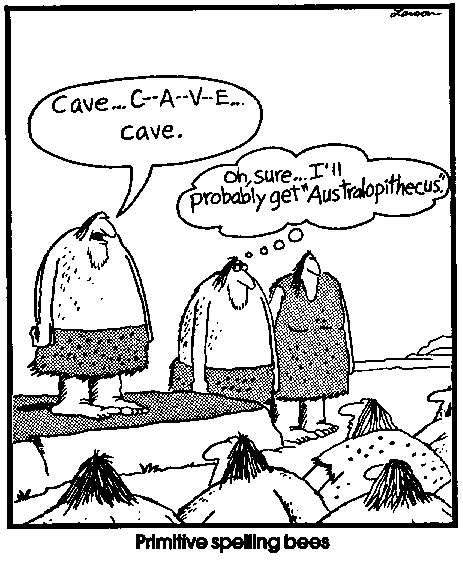
Primative Spelling BeesEnglish, in many ways, is one of the simplest languages to learn quickly and in which to converse fluently; but scratching below the surface one rapidly finds incongruities.  As a teacher for English as a foreign language for adults (TEFLA), I was frequently confronted with the challenges of teaching students to spell and pronounce words correctly, but I was also comforted by the fact that English nouns only come with four possible preceding cases, or articles (a, an, the, and none), rather than, say, German, in which each noun has a nominative, genative, dative or accusative, singular or plural form of their case; or Finnish, which has a whopping 15 cases.

The Chaos, a poem written by the Dutch traveller & teacher,  Gerard Nolst Trenité (1870–1946), gives ~800 examples of irregular spelling.  In general one can say that there are spelling “rules”, but English, in all its historic complexities of absorbing, digesting and recycling influences from conquerors, enemies, travelling companions and allies, seems designed to say “rules can and will be broken”.  I would never give his last advice to anyone – but after reading this poem, you’ll understand that English needs tenacity and constant practice to use well!

The Chaos

by G. Nolst Trenite’ a.k.a. “Charivarius” 1870 – 1946

Dearest creature in creation

Studying English pronunciation,

I will teach you in my verse

Sounds like corpse, corps, horse and worse

I will keep you, Susy, busy,

Make your head with heat grow dizzy.

Tear in eye your dress you’ll tear,

So shall I! Oh, hear my prayer,

Pray, console your loving poet,

Make my coat look new, dear, sew it!

Just compare heart, beard and heard,

Dies and diet, lord and word,

Sword and sward, retain and Britain.

(Mind the latter, how it’s written).

Made has not the sound of bade,

Say said, pay-paid, laid, but plaid.

Now I surely will not plague you

With such words as vague and ague,

But be careful how you speak,

Say break, steak, but bleak and streak.

Previous, precious, fuchsia, via,

Pipe, snipe, recipe and choir,

Cloven, oven, how and low,

Script, receipt, shoe, poem, toe.

Hear me say, devoid of trickery:

Daughter, laughter and Terpsichore,

Typhoid, measles, topsails, aisles.

Exiles, similes, reviles.

Wholly, holly, signal, signing.

Thames, examining, combining

Scholar, vicar, and cigar,

Solar, mica, war, and far.

From “desire”: desirable–admirable from “admire.”

Lumber, plumber, bier, but brier.

Chatham, brougham, renown, but known.

Knowledge, done, but gone and tone,

One, anemone. Balmoral.

Kitchen, lichen, laundry, laurel,

Gertrude, German, wind, and mind.

Scene, Melpomene, mankind,

Tortoise, turquoise, chamois-leather,

Reading, reading, heathen, heather.

This phonetic labyrinth

Gives moss, gross, brook, brooch, ninth, plinth.

Billet does not end like ballet;

Bouquet, wallet, mallet, chalet;

Blood and flood are not like food,

Nor is mould like should and would.

Banquet is not nearly parquet,

Which is said to rime with “darky.”

Viscous, Viscount, load, and broad.

Toward, to forward, to reward.

And your pronunciation’s O.K.,

When you say correctly: croquet.

Rounded, wounded, grieve, and sieve,

Friend and fiend, alive, and live,

Liberty, library, heave, and heaven,

Rachel, ache, moustache, eleven,

We say hallowed, but allowed,

People, leopard, towed, but vowed.

Mark the difference, moreover,

Between mover, plover, Dover,

Leeches, breeches, wise, precise,

Chalice, but police, and lice.

Camel, constable, unstable,

Principle, disciple, label,

Petal, penal, and canal,

Wait, surmise, plait, promise, pal.

Suit, suite, ruin, circuit, conduit,

Rime with “shirk it” and “beyond it.”

But it is not hard to tell,

Why it’s pall, mall, but Pall Mall.

Muscle, muscular, gaol, iron,

Timber, climber, bullion, lion,

Worm and storm, chaise, chaos, and chair,

Senator, spectator, mayor,

Ivy, privy, famous, clamour

And enamour rime with hammer.

Pussy, hussy, and possess,

Desert, but dessert, address.

Golf, wolf, countenance, lieutenants.

Hoist, in lieu of flags, left pennants.

River, rival, tomb, bomb, comb,

Doll and roll and some and home.

Stranger does not rime with anger.

Neither does devour with clangour.

Soul, but foul and gaunt but aunt.

Font, front, won’t, want, grand, and grant.

Shoes, goes, does. Now first say: finger.

And then: singer, ginger, linger,

Real, zeal, mauve, gauze, and gauge,

Marriage, foliage, mirage, age.

Query does not rime with very,

Nor does fury sound like bury.

Dost, lost, post; and doth, cloth, loth;

Job, Job; blossom, bosom, oath.

Though the difference seems little,

We say actual, but victual.

Seat, sweat; chaste, caste.; Leigh, eight, height;

Put, nut; granite, and unite.

Reefer does not rime with deafer,

Feoffer does, and zephyr, heifer.

Dull, bull, Geoffrey, George, ate, late,

Hint, pint, Senate, but sedate.

Scenic, Arabic, Pacific,

Science, conscience, scientific,

Tour, but our and succour, four,

Gas, alas, and Arkansas.

Sea, idea, guinea, area,

Psalm, Maria, but malaria,

Youth, south, southern, cleanse and clean,

Doctrine, turpentine, marine.

Compare alien with Italian,

Dandelion with battalion.

Sally with ally, yea, ye,

Eye, I, ay, aye, whey, key, quay.

Say aver, but ever, fever.

Neither, leisure, skein, receiver.

Never guess–it is not safe:

We say calves, valves, half, but Ralph.

Heron, granary, canary,

Crevice and device, and eyrie,

Face but preface, but efface,

Phlegm, phlegmatic, ass, glass, bass.

Large, but target, gin, give, verging,

Ought, out, joust, and scour, but scourging,

Ear but earn, and wear and bear

Do not rime with here, but ere.

Seven is right, but so is even,

Hyphen, roughen, nephew, Stephen,

Monkey, donkey, clerk, and jerk,

Asp, grasp, wasp, and cork and work.

Pronunciation–think of psyche–!

Is a paling, stout and spikey,

Won’t it make you lose your wits,

Writing “groats” and saying “grits”?

It’s a dark abyss or tunnel,

Strewn with stones, like rowlock, gunwale,

Islington and Isle of Wight,

Housewife, verdict, and indict!

Don’t you think so, reader, rather,

Saying lather, bather, father?

Finally: which rimes with “enough”

Though, through, plough, cough, hough, or tough?

Hiccough has the sound of “cup.”

My advice is–give it up!

1 Comment

Filed under Articles, Cartoon, Grammar, Nuts & Bolts, Quotes, Writing Exercise

Anonymously Bad Grammar

The following sentences are taken verbatim from comments on unwitting websites; I’ve collected them as I’ve come across them since Autumn of 2013.  Sometimes I couldn’t help myself and put my comments in parentheses; other comments there are simply reference to the context.  I have dozens more, but certain things in life are better in small doses… Crap

  • “Don’t look like you like didn’t eat it all” (man, late-50s)
  • “I just havta buy some…” (woman, 18)
  • (Headline): “Welfare Check Leads to Homicide Investigation” (Referring to a response of officers to check on a suspicious situation, and not a monetary cheque…)
  • “I love London. Especially the countryside.” (face palm…not strictly bad grammar; just ignorance…)
  • “Now this statement I like – we are Ameica and our language is English – you want6 to live hear learn our language. And go by our rules.” (Concerning a sign that said, “Welcome to America. Press 1 for English; Press 2 to disconnect until you learn English.”  Clearly they missed grammar and spelling lessons.)
  • “Lively up yourself.”
  • “Who’s agree with us?”
  • “Sorry hand finger bad cut bleeding after topaz scared and did it. sorry it not up in the morning. Sorry sorting it I hope” (Whaaat??)
  • “I think it gonna b 2 these 4 me 2nite.” (Clearly.)
  • “That is the days I go shopping even if I don’t buy nothing hoping the family left at home do something.” (Hopefully the family is learning better grammar than this mother did…)

2 Comments

Filed under Humor, Lists, Nuts & Bolts, Quotes