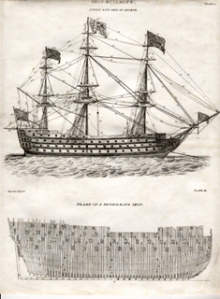
First Rate ship at Anchor, and Frame of Second Rate Ship. Steel engraving.
As part of my research for novels, I came across the 1867 “The Sailor’s Word-Book: An Alphabetical Digest of Nautical Terms, including some more especially military and scientific, but useful to seamen; as well as archaisms of early voyagers, etc. by the late ADMIRAL W. H. SMYTH, K.S.F., D.C.L., &c.” It’s a massive document, but below is a gleaning of the orders listed in the word-book. It’s a fascinating insight into life and demands at sea in the 18th & 19th centuries especially. Enjoy!
Nautical Orders
ABOUT. Circularly; the situation of a ship after she has gone round, and trimmed sails on the opposite tack.—Ready about! and About-ship! are orders to the ship’s company to prepare for tacking by being at their stations.
ADVANCED SQUADRON. One on the look-out.—Advance, or vanguard, that division of a force which is next the enemy, or which marches before a body.—Advance fosse, a ditch of water round the esplanade or glacis of a fortification.—Advance! the order to marines and small-arm men to move forward.
AFTER-ORDERS. Those which are given out after the regular issue of the daily orders.
A-LEE. The contrary of a-weather: the position of the helm when its tiller is borne over to the lee-side of the ship, in order to go about or put her head to windward.—Hard a-lee! or luff a-lee! is said to the steersman to put the helm down.—Helm’s a-lee! the word of command given on putting the helm down, and causing the head-sails to shake in the wind.
ALL. The total quantity; quite; wholly.—All aback, when all the sails are taken aback by the winds.—All ahoo, or all-a-ugh, confused; hanging over; crooked.—All-a-taunt-o, a ship fully rigged, with masts in and yards crossed.—All hands, the whole ship’s company.—All hands ahoy, the boatswain’s summons for the whole crew to repair on deck, in distinction from the watch.—All hands make sail! the cheering order when about to chase a strange vessel.—All hands to quarters! the call in armed merchantmen, answering to the Beat to quarters in a man-of-war.—All in the wind, when a vessel’s head is too close to the wind, so that all her sails are shivering.—All over, resemblance to a particular object, as a ship in bad kelter: “she’s a privateer all over.”—All overish, the state of feeling when a man is neither ill nor well, restless in bed and indifferent to meals. In the tropics this is considered as the premonitory symptom of disease, and a warning which should be looked to.—All ready, the answer from the tops when the sails are cast loose, and ready to be dropped.—All standing, fully equipped, or with clothes on. To be brought up all standing, is to be suddenly checked or stopped, without any preparation.—Paid off all standing, without unrigging or waiting to return stores; perhaps recommissioned the next day or hour.—All’s well, the sentry’s call at each bell struck (or half hour) between the periods of broad daylight, or from 8 P.M. to 4 A.M.—All to pieces, a phrase used for out-and-out, extremely, or excessively; as, “we beat her in sailing all to pieces.”—All weathers, any time or season; continually.
ARRAY. The order of battle.—To array. To equip, dress, or arm for battle.
ASSEMBLY. That long roll beat of the drum by which soldiers, or armed parties, are ordered to repair to their stations. It is sometimes called the fall-in.
AVAST. The order to stop, hold, cease, or stay, in any operation: its derivation from the Italian basta is more plausible than have fast.
AVAST HEAVING! The cry to arrest the capstan when nippers are jammed, or any other impediment occurs in heaving in the cable, not unfrequently when a hand, foot, or finger, is jammed;—stop!
AWAY ALOFT. The order to the men in the rigging to start up.
AWAY SHE GOES. The order to step out with the tackle fall. The cry when a vessel starts on the ways launching; also when a ship, having stowed her anchor, fills and makes sail.
AWAY THERE. The call for a boat’s crew; as, “away there! barge-men.”
AWAY WITH IT. The order to walk along briskly with a tackle fall, as catting the anchor, &c.
AYE, AYE, SIR. A prompt reply on receiving an order. Also the answer on comprehending an order. Aye-aye, the answer to a sentinel’s hail, from a boat which has a commissioned officer on board below the rank of captain. The name of the ship in reply from the boat indicates the presence of a captain. The word “flag,” indicates the presence of an admiral.
BACK-HER. The order, in steam-navigation, directing the engineer to reverse the movement of the cranks and urge the vessel astern.
BACK OFF ALL. The order when the harpooner has thrown his harpoon into the whale. Also, to back off a sudden danger.
BADGER, To. To tease or confound by frivolous orders.
BEAT TO QUARTERS. The order for the drummer to summon every one to his respective station.
BECKET, The Tacks and Sheets in the. The order to hang up the weather-main and fore-sheet, and the lee-main and fore-tack, to the small knot and eye becket on the foremost-main and fore-shrouds, when the ship is close hauled, to prevent them from hanging in the water. A kind of large cleat seized on a vessel’s fore or main rigging for the sheets and tacks to lie in when not required. Cant term for pockets—”Hands out of beckets, sir.”
BELL. Strike the bell. The order to strike the clapper against the bell as many times as there are half hours of the watch elapsed; hence we say it is two bells, three bells, &c., meaning there are two or three half-hours past. The watch of four hours is eight bells.
BOUT. A turn, trial, or round. An attack of illness; a convivial meeting.—‘Bout ship, the brief order for “about ship.”
BRACE UP AND HAUL AFT! The order usually given after being hove-to, with fore or main top-sail square or aback, and jib-sheet flowing, i.e. haul aft jib-sheet, brace up the yards which had been squared, for the purpose of heaving to.
BRAIL UP! The order to pull upon the brails, and thereby spill and haul in the sail. The mizen, or spanker, or driver, or any of the gaff-sails, as they may be termed, when brailed up, are deemed furled; unless it blows hard, when they are farther secured by gaskets.
BREAK-OFF. (See Broken-off). “She breaks off from her course,” applied only when the wind will not allow of keeping the course; applies only to “close-hauled” or “on a wind.”—Break-off! an order to quit one department of duty, to clap on to another.
BRIGADE-ORDERS. Those issued by the general officer commanding troops which are brigaded.
BRING-TO, To. To bend, as to bring-to a sail to the yard. Also, to check the course of a ship by trimming the sails so that they shall counteract each other, and keep her nearly stationary, when she is said to lie by, or lie-to, or heave-to.—Bring to! The order from one ship to another to put herself in that situation in order to her being boarded, spoken to, or examined. Firing a blank gun across the bows of a ship is the forcible signal to shorten sail and bring-to until further pleasure.—Bring-to is also used in applying a rope to the capstan, as “bring-to the messenger.”
BRING-TO AN ANCHOR, To. To let go the anchor in the intended port. “All hands bring ship to an anchor!” The order by which the people are summoned for that duty, by the pipes of the boatswain and his mates.
CAPSTAN, To come up the. In one sense is to lift the pauls and walk back, or turn the capstan the contrary way, thereby slackening, or letting out some of the rope on which they have been heaving. The sudden order would be obeyed by surging, or letting go any rope on which they were heaving. Synonymous to “Come up the purchase.”
CAPSTAN, Surge the. Is the order to slacken the rope which is wound round the barrel while heaving, to prevent it from riding or fouling. This term specially applies to surging the messenger when it rides, or when the two lashing eyes foul on the whelps or the barrel.
CEASE FIRING. The order to leave off.
CLAP ON! The order to lay hold of any rope, in order to haul upon it. Also, to “Clap on the stoppers before the bitts,” i.e. fasten the stoppers; or, “Clap on the cat-fall,” i.e. lay hold of the cat-fall.—To clap a stopper over all, to stop a thing effectually; to clap on the stopper before the bitts next to the manger or hawse-hole; to order silence.—To clap in irons, to order an offender into the bilboes.—To clap on canvas, to make more sail.
CLUE UP! The order to clue up the square sails.
COME NO NEAR! The order to the helmsman to steer the ship on the course indicated, and not closer to the wind, while going “full and by.”—Come on board, sir. An officer reporting himself to his superior on returning from duty or leave.—Come to. To bring the ship close to the wind.—Come to an anchor. To let go the anchor.—Come up! with a rope or tackle, is to slack it off.—Comes up, with the helm. A close-hauled ship comes up (to her course) as the wind changes in her favour. To come up with or overhaul a vessel chased.—Come up the capstan. Is to turn it the contrary way to that which it was heaving, so as to take the strain off, or slacken or let out some of the cablet or rope which is about it.—Come up the tackle-fall. Is to let go.—To come up, in ship-building, is to cast loose the forelocks or lashings of a sett, in order to take in closer to the plank.
DEPRESS. The order to adjust the quoin in great-gun exercise; to depress the muzzle to point at an object below the level, in contradistinction to elevate.
DOWN ALL CHESTS! The order to get all the officers’ and seamen’s chests down below from off the gun-decks when clearing the ship for an engagement.
DOWN ALL HAMMOCKS! The order for all the sailors to carry their hammocks down, and hang them up in their respective berths in readiness to go to bed, or to lessen top-weight and resistance to wind in chase.
DOWN KILLOCK! Let go the grapnel; the corruption of keel-hook or anchor.
DOWN OARS! The order on shoving off a boat when the men have had them “tossed up.”
DOWN WITH THE HELM! An order to put the helm a-lee.
EASE, To Stand at. To remain at rest.
EASE AWAY! To slacken out a rope or tackle-fall.
EASE HER! In a steamer, is the command to reduce the speed of the engine, preparatory to “stop her,” or before reversing for “turn astern.”
EASE OFF! Ease off handsomely, or Ease away there! To slacken out a rope or tackle-fall carefully.
EASE THE HELM! An order often given in a vessel close-hauled, to put the helm down a few spokes in a head sea, with the idea that if the ship’s way be deadened by her coming close to the wind she will not strike the opposing sea with so much force. It is thought by some that extreme rolling as well as pitching are checked by shifting the helm quickly, thereby changing the direction of the ship’s head, and what is technically called “giving her something else to do.”
ELEVATE! In great-gun exercise, the order which prepares for adjusting the quoin.
EVERY INCH OF THAT! An exclamation to belay a rope without rendering it.
EVERY ROPE AN-END. The order to coil down the running rigging, or braces and bowlines, after tacking, or other evolution. Also, the order, when about to perform an evolution, to see that every rope is clear for running.
FALL IN, To. The order to form, or take assigned places in ranks. (See Assembly.)
FILL THE MAIN-YARD. An order well understood to mean, fill the main-topsail, after it has been aback, or the ship hove-to.
FIRE! The order to put the match to the priming, or pull the trigger of a cannon or other fire-arm so as to discharge it. The act of discharging ordnance.
FOOT IT IN. An order to stow the bunt of a sail snugly in furling, executed by the bunt-men dancing it in, holding on by the topsail-tye. Frequently when a bunt-jigger has parted men have fallen on deck.
FRESH HAND AT THE BELLOWS. Said when a gale freshens suddenly.
FULL FOR STAYS! The order to keep the sails full to preserve the velocity, assisting the action of the rudder in tacking ship.
FULL SPEED! A self-explanatory order to the engineer of a steamer to get his engine into full play.
GET-A-PULL. The order to haul in more of a rope or tackle.
GIVE HER SHEET. The order to ease off; give her rope.
GIVE WAY. The order to a boat’s crew to renew rowing, or to increase their exertions if they were already rowing. To hang on the oars.
GO AHEAD! or Go on! The order to the engineer in a steamer.
GO SLOW. The order to the engineer to cut off steam without stopping the play of the engine.
HALF-SPEED! An order in steam navigation to reduce the speed. (See Full Speed!)
HALF-TURN AHEAD! An order in steam navigation. (See Turn Ahead!)
HALT! The military word of command to stop marching, or any other evolution. A halt includes the period of such discontinuance.
HANDS REEF TOP-SAILS! The order to reef by all hands, instead of the watch, or watch and idlers.
HANG ON HER! In rowing, is the order to stretch out to the utmost to preserve or increase head-way on the boat.
HARD-A-PORT! The order so to place the tiller as to bring the rudder over to the starboard-side of the stern-post, whichever way the tiller leads. (See Hard-a-lee.)
HARD-A-STARBOARD. The order so to place the tiller as to bring the rudder over to the port-side of the stern-post, whichever way the tiller leads. (See Hard-a-lee.)
HARD-A-WEATHER! The order so to place the tiller as to bring the rudder on the lee-side of the stern-post, whichever way the tiller leads, in order to bear away; it is the position of the helm as opposed to hard-a-lee (which see). Also, a hardy seaman.
HAUL OF ALL! An order to brace round all the yards at once—a manœuvre sometimes used in tacking, or on a sudden change of wind; it requires a strong crew.
HAUL OUT TO LEEWARD! In reefing top-sails, the cry when the weather earing is passed.
HEAVE AND A-WASH. An encouraging call when the ring of the anchor rises to the surface, and the stock stirs the water.
HEAVE AND A-WEIGH. Signifies that the next effort will start the anchor from its bed, and make it a-trip. “Heave and a-weigh, sir,” from the forecastle, denotes that the anchor is a-weigh; it inspirits the men to run it to the bows rapidly.
HEAVE AND IN SIGHT. A notice given by the boatswain to the crew when the anchor is drawn up so near the surface of the water as to be seen by its muddy water surrounding it.
HEAVE AND PAUL. Is the order to turn the capstan or windlass till the paul may be put in, by which it is prevented from coming up, and is something similar to belay, applied to a running rope.
HEAVE AND RALLY! An encouraging order to the men at the capstan to heave with spirit, with a rush, and thereby force the anchor out of the ground. When there is a rising sea “heave and rally” implies, “heave and stand to your bars,” the pauls taking the strain, and the next wave probably lifting the anchor.
HEAVE OUT THERE! The order to hasten men from their hammocks.
HOLD-FAST. A rope; also the order to the people aloft, when shaking out reefs, &c., to suspend the operation. In ship-building, it means a bolt going down through the rough tree rail, and the fore or after part of each stanchion.
IN-BOATS! The order to hoist the boats in-board.
IN-BOW! The order to the bowman to throw in his oar, and prepare his boat-hook, previous to getting alongside.
KEEP YOUR LUFF. An order to the helmsman to keep the ship close to the wind, i.e. sailing with a course as near as possible to the direction from which the wind is coming. (See Close-hauled.)
LANE. “Make a lane there!” An order for men to open a passage and allow a person to pass through.
LASH AND CARRY. The order given by the boatswain and his mates on piping up the hammocks, to accelerate the duty.
LASH AWAY. A phrase to hasten the lashing of hammocks.
LAUNCH-HO! The order to let go the top-rope after the top-mast has been swayed up and fidded. It is literally “high enough.” So in pumping, when the spear sucks, this term is “Cease.”
LAY IN. The opposite of lay out. The order for men to come in from the yards after reefing or furling. It also applies to manning, or laying in, to the capstan-bars.
LAY OR LIE ON YOUR OARS! The order to desist rowing, without laying the oars in.—Lay out on your oars! is the order to give way, or pull with greater force.
LAY OUT. See Lie Out!
LET DRAW! The order to let the wind take the after-leeches of the jibs, &c., over to the lee-side, while tacking.
LET FALL! The order to drop a sail loosed from its gaskets, in order to set it.
LET GO AND HAUL! or Afore haul! The order to haul the head-yards round by the braces when the ship casts on the other tack. “Let go,” alluding to the fore-bowline and lee head-braces.
LET GO UNDER FOOT. See Under Foot.
LET RUN, or let go by the Run. Cast off at once.
LIE IN! The order to come in from the yards when reefing, furling, or other duty is performed.
LIE OFF! An order given to a boat to remain off on her oars till permission is given for her to come alongside.
LIE OUT! The order to the men aloft to distribute themselves on the yards for loosing, reefing, or furling sails.
LONG STROKE. The order to a boat’s crew to stretch out and hang on her.
LOWER HANDSOMELY, Lower Cheerly. Are opposed to each other; the former being the order to lower gradually, and the latter to lower expeditiously.
LUFF, or Loofe. The order to the helmsman, so as to bring the ship’s head up more to windward. Sometimes called springing a luff. Also, the air or wind. Also, an old familiar term for lieutenant. Also, the fullest or roundest part of a ship’s bows. Also, the weather-leech of a sail.
LUFF AND TOUCH HER! Try how near the wind she will come. (See Touching.)
MAIN-SAIL HAUL! The order given to haul the after-yards round when the ship is nearly head to wind in tacking.
MAIN-TOPSAIL HAUL! The order used instead of main-sail haul, when the main-sail is not set.
MAKE A LANE THERE! The order of the boatswain for the crew to separate at muster, to facilitate the approach of any one whose name is called. (See Lane.)
MAKE IT SO. The order of a commander to confirm the time, sunrise, noon, or sunset, reported to him by the officer of the watch.
MAKE READY! Be prepared.
MEET HER! The order to adjust the helm, so as to check any further movement of the ship’s head in a given direction.
MUZZLE TO THE RIGHT, or Muzzle to the Left! The order given to trim the gun to the object.
OARS! The order to cease rowing, by lifting the oars from the water, and poising them on their looms horizontally in their rowlocks.—Look to your oars! Passing any object or among sea-weed.—Double-banked oars (which see).
ORDER ARMS! The word of command, with muskets or carbines, to bring the butt to the ground, the piece vertical against the right side, trigger-guard to the front.—Open order and close order, are terms for keeping the fleet prepared for any particular manœuvre.
OUT-BOATS. The order to hoist out the boats.
OUT-OARS. The order to take to rowing when the sails give but little way on a boat.
PIPE DOWN! The order to dismiss the men from the deck when a duty has been performed on board ship.
PUMP SHIP! The order to the crew to work the pumps to clear the hold of water.
PUT OFF! or Push off. The order to boats to quit the ship or the shore.
READY ABOUT! or Ready Oh! The order to prepare for tacking, each man to his station. (See About.)
READY WITH THE LEAD! A caution when the vessel is luffed up to deaden her way, followed by “heave.”
RETREAT. The order in which a fleet or squadron declines engagement. Or the retrograde movement of any body of men who retire from a hostile force. Also, that beat of drum about sunset which orders the guards and piquets to take up their night duties.
RIGHT THE HELM! The order to put it amidships, that is, in a line with the keel.
RIG THE GRATINGS. Prepare them for punishment.
RODE OF ALL. Improperly so written for rowed of all (which see). The order to throw in and boat the oars.
ROUSE AND BIT. The order to turn out of the hammocks.
ROW DRY! The order to those who row, not to splash water into the boat.
ROWED OF ALL! The orders for the rowers to cease, and toss their oars into the boat simultaneously, in naval style.
RUN AWAY WITH IT! The order to men on a tackle fall, when light goods are being hoisted in, or in hoisting top-sails, jib, or studding-sails.
SENTRY GO! The order to the new sentry to proceed to the relief of the previous one.
SET ON! The order to set the engine going on board a steamer.
SHEET HOME! The order, after the sails are loosed, to extend the sheets to the outer extremities of the yards, till the clue is close to the sheet-block. Also, when driving anything home, as a blow, &c.
SHIFT THE HELM! The order for an alteration of its position, by moving it towards the opposite side of the ship; that is, from port to starboard, or vice versa.
SHOVE OFF! The order to the bowman to put the boat’s head off with his boat-hook.
SHOW A LEG! An exclamation from the boatswain’s mate, or master-at-arms, for people to show that they are awake on being called. Often “Show a leg, and turn out.”
SLACK OFF, or Slacken! The order to ease away the rope or tackle by which anything is held fast; as, “Slack up the hawser.”
SO! An order to desist temporarily from hauling upon a rope, when it has come to its right position.
SOAK AND SEND! The order to pass wet swabs along.
SQUARE YARDS! The order to attend to the lifts and braces, for going before the wind.—To square a yard. In working ship, means to bring it in square by the marks on the braces. Figuratively, to settle accounts.
STAMP AND GO! The order to step out at the capstan, or with hawsers, topsail-halliards, &c., generally to the fife or fiddle.
STAND BY! The order to be prepared; to look out to fire when directed.—To stand by a rope, is to take hold of it; the anchor, prepare to let go.
STAND CLEAR OF THE CABLE! A precautionary order when about to let go the anchor, that nothing may obstruct it in running out of the hawse-holes. Also, a warning when idlers obstruct quarter-deck duty.
STAND FROM UNDER! A notice given to those below to keep out of the way of anything being lowered down, or let fall from above.
STASH IT THERE! An old order to cease or be quiet.
STATIONS FOR STAYS! Repair to your posts to tack ship.
STEADY! The order given to the steersman, in a fair wind, to steer the ship on her course without deviating; to which he answers, Steady it is, sir.
STOP HER! An order to check the cable in being payed out. Also, a self-explanatory phrase to direct the engineer of a steamer to stop the action of the engines.
STRETCH OUT! In rowing, is the order to pull strong; to bend forward to the utmost.
STRIKE DOWN! The order to lower casks, &c., into the hold.
TAIL ON, or Tally on. The order to clap on to a rope.
THUS, Very well Thus, or Dyce. The order to the helmsman to keep the ship in her present direction, when sailing close-hauled. This truly sailor’s motto was adopted by the Earl St. Vincent.
TOE A LINE! The order to stand in a row.
TOP-SAIL HAUL! or Main-topsail Haul! When the main-sail is not set, this is the order given to haul the after-yards round when the ship is nearly head to wind in tacking.
TOSS IN YOUR OARS! The order to desist rowing, and throw the oars in out of the rowlocks.
TOSS THE OARS UP! Throw them up out of the rowlocks, and raise them perpendicularly an-end; the act is intended as a compliment to a superior officer rowing by. Also, the order to a boat’s crew to get the oars ready for rowing, and to salute the officer on his entering the boat.
TRICE UP—LIE OUT! The order to lift the studding-sail boom-ends while the top-men move out on the yards, preparatory to reefing or furling.
TRIM THE BOAT! The order to sit in the boat in such a manner as that she shall float upright. Also, to edge aft, so that her steerage becomes easier, and she does not ship heavy seas.
TURN AHEAD! A self-explanatory order to the engineer, in regulating the movement of a steamer.
TURN OUT THE GUARD! The order for the marines of the guard to fall in, on the quarter-deck, in order to receive a superior officer on board.
UP BOATS! The order to hoist the boats to the stern and quarter davits.
UP COURSES! The order to haul them up by the clue-garnets, &c.
UP SCREW! The order in steamers to lift the screw on making sail.
WALK AWAY! The order to step out briskly with a tackle fall, as in hoisting boats.
WALK BACK! A method in cases where a purchase must not be lowered by a round turn, as “Walk back the capstan;” the men controlling it by the bars and walking back as demanded.


 Language is a fluid concept, constantly changing, adapting, creating, compensating and inventing itself. Euphemisms are a prime example of that fluctuation and adaptation; successive generations come to know only the euphemism which in turn ceases to be one by that very definition, and which means that new ones will be invented to skirt the issue once again. For instance, there are hundreds of words for smell or stink, yet only a handful of satisfactory synonyms for words like fragrance, simply because hiding the ugly requires far more creativity than hiding the lovely. For that reason alone, writers who fall back on expletives like the highly offensive F-word (a euphemism for, well, you know) are simply lazy in my book; they’re missing a great opportunity for creativity! Interestingly, that word’s meaning has never shifted over time – it’s been in the English language since before the fifteenth century, and even then it was only written in cipher because it was too offensive to record in ink. In my opinion it still is, and one should consider












 Stephanie Huesler