Tag Archives: writing

New Book Release: Redemption, the Northing Trilogy, Book 2

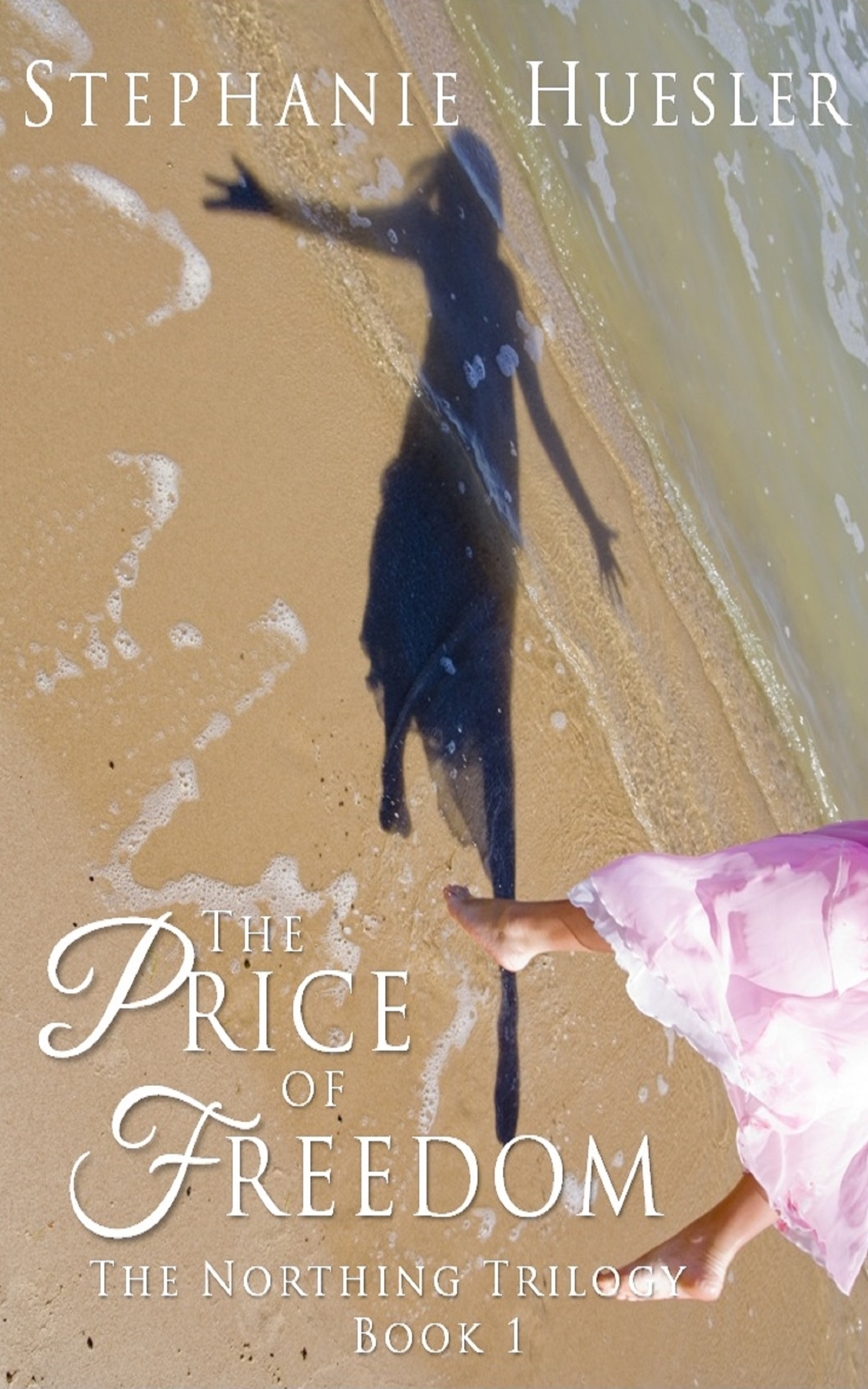
Redemption CoverAnnouncing the release of my second book, Redemption!  At the moment both books are available on Kindle, and coming soon in paperback.  If you enjoy 18th century fiction a la Jane Austen or Georgette Heyer, I think you’ll love these two books!  I’ve thoroughly enjoyed writing them; before writing the third book in this series, however, I’ll be finishing two other manuscripts, in vastly different genres.  So keep your eye out for more news!

The reason for the brief interlude between the releases of The Price of Freedom and Redemption is that the second was nearly complete when I released the first one; POF had been done for a few months by the time I actually had time to sit down and go through the publication process for the first time properly; don’t think either book was rushed, as I’m meticulous with the nuts and bolts, and I would like to think quality, though that is up to the reader to assess, not me!

To read a snippet of the book and find out more, please check out my “Publications” page, and let me know what you think – I’d love to hear from you!

4 Comments

Filed under Publications, Research

From the 1867 Sailor’s Word-Book: Nautical Orders

First Rate ship at Anchor, and Frame of Second Rate Ship. Steel engraving.

First Rate ship at Anchor, and Frame of Second Rate Ship. Steel engraving.

As part of my research for novels, I came across the 1867 “The Sailor’s Word-Book:  An Alphabetical Digest of Nautical Terms, including some more especially military and scientific, but useful to seamen; as well as archaisms of early voyagers, etc. by the late ADMIRAL W. H. SMYTH, K.S.F., D.C.L., &c.”  It’s a massive document, but below is a gleaning of the orders listed in the word-book.  It’s a fascinating insight into life and demands at sea in the 18th & 19th centuries especially.  Enjoy!

Nautical Orders

ABOUT. Circularly; the situation of a ship after she has gone round, and trimmed sails on the opposite tack.—Ready about! and About-ship! are orders to the ship’s company to prepare for tacking by being at their stations.

ADVANCED SQUADRON. One on the look-out.—Advance, or vanguard, that division of a force which is next the enemy, or which marches before a body.—Advance fosse, a ditch of water round the esplanade or glacis of a fortification.—Advance! the order to marines and small-arm men to move forward.

AFTER-ORDERS. Those which are given out after the regular issue of the daily orders.

A-LEE. The contrary of a-weather: the position of the helm when its tiller is borne over to the lee-side of the ship, in order to go about or put her head to windward.—Hard a-lee! or luff a-lee! is said to the steersman to put the helm down.—Helm’s a-lee! the word of command given on putting the helm down, and causing the head-sails to shake in the wind.

ALL. The total quantity; quite; wholly.—All aback, when all the sails are taken aback by the winds.—All ahoo, or all-a-ugh, confused; hanging over; crooked.—All-a-taunt-o, a ship fully rigged, with masts in and yards crossed.—All hands, the whole ship’s company.—All hands ahoy, the boatswain’s summons for the whole crew to repair on deck, in distinction from the watch.—All hands make sail! the cheering order when about to chase a strange vessel.—All hands to quarters! the call in armed merchantmen, answering to the Beat to quarters in a man-of-war.—All in the wind, when a vessel’s head is too close to the wind, so that all her sails are shivering.—All over, resemblance to a particular object, as a ship in bad kelter: “she’s a privateer all over.”—All overish, the state of feeling when a man is neither ill nor well, restless in bed and indifferent to meals. In the tropics this is considered as the premonitory symptom of disease, and a warning which should be looked to.—All ready, the answer from the tops when the sails are cast loose, and ready to be dropped.—All standing, fully equipped, or with clothes on. To be brought up all standing, is to be suddenly checked or stopped, without any preparation.—Paid off all standing, without unrigging or waiting to return stores; perhaps recommissioned the next day or hour.—All’s well, the sentry’s call at each bell struck (or half hour) between the periods of broad daylight, or from 8 P.M. to 4 A.M.—All to pieces, a phrase used for out-and-out, extremely, or excessively; as, “we beat her in sailing all to pieces.”—All weathers, any time or season; continually.

ARRAY. The order of battle.—To array. To equip, dress, or arm for battle.

ASSEMBLY. That long roll beat of the drum by which soldiers, or armed parties, are ordered to repair to their stations. It is sometimes called the fall-in.

AVAST. The order to stop, hold, cease, or stay, in any operation: its derivation from the Italian basta is more plausible than have fast.

AVAST HEAVING! The cry to arrest the capstan when nippers are jammed, or any other impediment occurs in heaving in the cable, not unfrequently when a hand, foot, or finger, is jammed;—stop!

AWAY ALOFT. The order to the men in the rigging to start up.

AWAY SHE GOES. The order to step out with the tackle fall. The cry when a vessel starts on the ways launching; also when a ship, having stowed her anchor, fills and makes sail.

AWAY THERE. The call for a boat’s crew; as, “away there! barge-men.”

AWAY WITH IT. The order to walk along briskly with a tackle fall, as catting the anchor, &c.

AYE, AYE, SIR. A prompt reply on receiving an order. Also the answer on comprehending an order. Aye-aye, the answer to a sentinel’s hail, from a boat which has a commissioned officer on board below the rank of captain. The name of the ship in reply from the boat indicates the presence of a captain. The word “flag,” indicates the presence of an admiral.

BACK-HER. The order, in steam-navigation, directing the engineer to reverse the movement of the cranks and urge the vessel astern.

BACK OFF ALL. The order when the harpooner has thrown his harpoon into the whale. Also, to back off a sudden danger.

BADGER, To. To tease or confound by frivolous orders.

BEAT TO QUARTERS. The order for the drummer to summon every one to his respective station.

BECKET, The Tacks and Sheets in the. The order to hang up the weather-main and fore-sheet, and the lee-main and fore-tack, to the small knot and eye becket on the foremost-main and fore-shrouds, when the ship is close hauled, to prevent them from hanging in the water. A kind of large cleat seized on a vessel’s fore or main rigging for the sheets and tacks to lie in when not required. Cant term for pockets—”Hands out of beckets, sir.”

BELL. Strike the bell. The order to strike the clapper against the bell as many times as there are half hours of the watch elapsed; hence we say it is two bells, three bells, &c., meaning there are two or three half-hours past. The watch of four hours is eight bells.

BOUT. A turn, trial, or round. An attack of illness; a convivial meeting.—‘Bout ship, the brief order for “about ship.”

BRACE UP AND HAUL AFT! The order usually given after being hove-to, with fore or main top-sail square or aback, and jib-sheet flowing, i.e. haul aft jib-sheet, brace up the yards which had been squared, for the purpose of heaving to.

BRAIL UP! The order to pull upon the brails, and thereby spill and haul in the sail. The mizen, or spanker, or driver, or any of the gaff-sails, as they may be termed, when brailed up, are deemed furled; unless it blows hard, when they are farther secured by gaskets.

BREAK-OFF. (See Broken-off). “She breaks off from her course,” applied only when the wind will not allow of keeping the course; applies only to “close-hauled” or “on a wind.”—Break-off! an order to quit one department of duty, to clap on to another.

BRIGADE-ORDERS. Those issued by the general officer commanding troops which are brigaded.

BRING-TO, To. To bend, as to bring-to a sail to the yard. Also, to check the course of a ship by trimming the sails so that they shall counteract each other, and keep her nearly stationary, when she is said to lie by, or lie-to, or heave-to.—Bring to! The order from one ship to another to put herself in that situation in order to her being boarded, spoken to, or examined. Firing a blank gun across the bows of a ship is the forcible signal to shorten sail and bring-to until further pleasure.—Bring-to is also used in applying a rope to the capstan, as “bring-to the messenger.”

BRING-TO AN ANCHOR, To. To let go the anchor in the intended port. “All hands bring ship to an anchor!” The order by which the people are summoned for that duty, by the pipes of the boatswain and his mates.

CAPSTAN, To come up the. In one sense is to lift the pauls and walk back, or turn the capstan the contrary way, thereby slackening, or letting out some of the rope on which they have been heaving. The sudden order would be obeyed by surging, or letting go any rope on which they were heaving. Synonymous to “Come up the purchase.”

CAPSTAN, Surge the. Is the order to slacken the rope which is wound round the barrel while heaving, to prevent it from riding or fouling. This term specially applies to surging the messenger when it rides, or when the two lashing eyes foul on the whelps or the barrel.

CEASE FIRING. The order to leave off.

CLAP ON! The order to lay hold of any rope, in order to haul upon it. Also, to “Clap on the stoppers before the bitts,” i.e. fasten the stoppers; or, “Clap on the cat-fall,” i.e. lay hold of the cat-fall.—To clap a stopper over all, to stop a thing effectually; to clap on the stopper before the bitts next to the manger or hawse-hole; to order silence.—To clap in irons, to order an offender into the bilboes.—To clap on canvas, to make more sail.

CLUE UP! The order to clue up the square sails.

COME NO NEAR! The order to the helmsman to steer the ship on the course indicated, and not closer to the wind, while going “full and by.”—Come on board, sir. An officer reporting himself to his superior on returning from duty or leave.—Come to. To bring the ship close to the wind.—Come to an anchor. To let go the anchor.—Come up! with a rope or tackle, is to slack it off.—Comes up, with the helm. A close-hauled ship comes up (to her course) as the wind changes in her favour. To come up with or overhaul a vessel chased.—Come up the capstan. Is to turn it the contrary way to that which it was heaving, so as to take the strain off, or slacken or let out some of the cablet or rope which is about it.—Come up the tackle-fall. Is to let go.—To come up, in ship-building, is to cast loose the forelocks or lashings of a sett, in order to take in closer to the plank.

DEPRESS. The order to adjust the quoin in great-gun exercise; to depress the muzzle to point at an object below the level, in contradistinction to elevate.

DOWN ALL CHESTS! The order to get all the officers’ and seamen’s chests down below from off the gun-decks when clearing the ship for an engagement.

DOWN ALL HAMMOCKS! The order for all the sailors to carry their hammocks down, and hang them up in their respective berths in readiness to go to bed, or to lessen top-weight and resistance to wind in chase.

DOWN KILLOCK! Let go the grapnel; the corruption of keel-hook or anchor.

DOWN OARS! The order on shoving off a boat when the men have had them “tossed up.”

DOWN WITH THE HELM! An order to put the helm a-lee.

EASE, To Stand at. To remain at rest.

EASE AWAY! To slacken out a rope or tackle-fall.

EASE HER! In a steamer, is the command to reduce the speed of the engine, preparatory to “stop her,” or before reversing for “turn astern.”

EASE OFF! Ease off handsomely, or Ease away there! To slacken out a rope or tackle-fall carefully.

EASE THE HELM! An order often given in a vessel close-hauled, to put the helm down a few spokes in a head sea, with the idea that if the ship’s way be deadened by her coming close to the wind she will not strike the opposing sea with so much force. It is thought by some that extreme rolling as well as pitching are checked by shifting the helm quickly, thereby changing the direction of the ship’s head, and what is technically called “giving her something else to do.”

ELEVATE! In great-gun exercise, the order which prepares for adjusting the quoin.

EVERY INCH OF THAT! An exclamation to belay a rope without rendering it.

EVERY ROPE AN-END. The order to coil down the running rigging, or braces and bowlines, after tacking, or other evolution. Also, the order, when about to perform an evolution, to see that every rope is clear for running.

FALL IN, To. The order to form, or take assigned places in ranks. (See Assembly.)

FILL THE MAIN-YARD. An order well understood to mean, fill the main-topsail, after it has been aback, or the ship hove-to.

FIRE! The order to put the match to the priming, or pull the trigger of a cannon or other fire-arm so as to discharge it. The act of discharging ordnance.

FOOT IT IN. An order to stow the bunt of a sail snugly in furling, executed by the bunt-men dancing it in, holding on by the topsail-tye. Frequently when a bunt-jigger has parted men have fallen on deck.

FRESH HAND AT THE BELLOWS. Said when a gale freshens suddenly.

FULL FOR STAYS! The order to keep the sails full to preserve the velocity, assisting the action of the rudder in tacking ship.

FULL SPEED! A self-explanatory order to the engineer of a steamer to get his engine into full play.

GET-A-PULL. The order to haul in more of a rope or tackle.

GIVE HER SHEET. The order to ease off; give her rope.

GIVE WAY. The order to a boat’s crew to renew rowing, or to increase their exertions if they were already rowing. To hang on the oars.

GO AHEAD! or Go on! The order to the engineer in a steamer.

GO SLOW. The order to the engineer to cut off steam without stopping the play of the engine.

HALF-SPEED! An order in steam navigation to reduce the speed. (See Full Speed!)

HALF-TURN AHEAD! An order in steam navigation. (See Turn Ahead!)

HALT! The military word of command to stop marching, or any other evolution. A halt includes the period of such discontinuance.

HANDS REEF TOP-SAILS! The order to reef by all hands, instead of the watch, or watch and idlers.

HANG ON HER! In rowing, is the order to stretch out to the utmost to preserve or increase head-way on the boat.

HARD-A-PORT! The order so to place the tiller as to bring the rudder over to the starboard-side of the stern-post, whichever way the tiller leads. (See Hard-a-lee.)

HARD-A-STARBOARD. The order so to place the tiller as to bring the rudder over to the port-side of the stern-post, whichever way the tiller leads. (See Hard-a-lee.)

HARD-A-WEATHER! The order so to place the tiller as to bring the rudder on the lee-side of the stern-post, whichever way the tiller leads, in order to bear away; it is the position of the helm as opposed to hard-a-lee (which see). Also, a hardy seaman.

HAUL OF ALL! An order to brace round all the yards at once—a manœuvre sometimes used in tacking, or on a sudden change of wind; it requires a strong crew.

HAUL OUT TO LEEWARD! In reefing top-sails, the cry when the weather earing is passed.

HEAVE AND A-WASH. An encouraging call when the ring of the anchor rises to the surface, and the stock stirs the water.

HEAVE AND A-WEIGH. Signifies that the next effort will start the anchor from its bed, and make it a-trip. “Heave and a-weigh, sir,” from the forecastle, denotes that the anchor is a-weigh; it inspirits the men to run it to the bows rapidly.

HEAVE AND IN SIGHT. A notice given by the boatswain to the crew when the anchor is drawn up so near the surface of the water as to be seen by its muddy water surrounding it.

HEAVE AND PAUL. Is the order to turn the capstan or windlass till the paul may be put in, by which it is prevented from coming up, and is something similar to belay, applied to a running rope.

HEAVE AND RALLY! An encouraging order to the men at the capstan to heave with spirit, with a rush, and thereby force the anchor out of the ground. When there is a rising sea “heave and rally” implies, “heave and stand to your bars,” the pauls taking the strain, and the next wave probably lifting the anchor.

HEAVE OUT THERE! The order to hasten men from their hammocks.

HOLD-FAST. A rope; also the order to the people aloft, when shaking out reefs, &c., to suspend the operation. In ship-building, it means a bolt going down through the rough tree rail, and the fore or after part of each stanchion.

IN-BOATS! The order to hoist the boats in-board.

IN-BOW! The order to the bowman to throw in his oar, and prepare his boat-hook, previous to getting alongside.

KEEP YOUR LUFF. An order to the helmsman to keep the ship close to the wind, i.e. sailing with a course as near as possible to the direction from which the wind is coming. (See Close-hauled.)

LANE. “Make a lane there!” An order for men to open a passage and allow a person to pass through.

LASH AND CARRY. The order given by the boatswain and his mates on piping up the hammocks, to accelerate the duty.

LASH AWAY. A phrase to hasten the lashing of hammocks.

LAUNCH-HO! The order to let go the top-rope after the top-mast has been swayed up and fidded. It is literally “high enough.” So in pumping, when the spear sucks, this term is “Cease.”

LAY IN. The opposite of lay out. The order for men to come in from the yards after reefing or furling. It also applies to manning, or laying in, to the capstan-bars.

LAY OR LIE ON YOUR OARS! The order to desist rowing, without laying the oars in.—Lay out on your oars! is the order to give way, or pull with greater force.

LAY OUT. See Lie Out!

LET DRAW! The order to let the wind take the after-leeches of the jibs, &c., over to the lee-side, while tacking.

LET FALL! The order to drop a sail loosed from its gaskets, in order to set it.

LET GO AND HAUL! or Afore haul! The order to haul the head-yards round by the braces when the ship casts on the other tack. “Let go,” alluding to the fore-bowline and lee head-braces.

LET GO UNDER FOOT. See Under Foot.

LET RUN, or let go by the Run. Cast off at once.

LIE IN! The order to come in from the yards when reefing, furling, or other duty is performed.

LIE OFF! An order given to a boat to remain off on her oars till permission is given for her to come alongside.

LIE OUT! The order to the men aloft to distribute themselves on the yards for loosing, reefing, or furling sails.

LONG STROKE. The order to a boat’s crew to stretch out and hang on her.

LOWER HANDSOMELY, Lower Cheerly. Are opposed to each other; the former being the order to lower gradually, and the latter to lower expeditiously.

LUFF, or Loofe. The order to the helmsman, so as to bring the ship’s head up more to windward. Sometimes called springing a luff. Also, the air or wind. Also, an old familiar term for lieutenant. Also, the fullest or roundest part of a ship’s bows. Also, the weather-leech of a sail.

LUFF AND TOUCH HER! Try how near the wind she will come. (See Touching.)

MAIN-SAIL HAUL! The order given to haul the after-yards round when the ship is nearly head to wind in tacking.

MAIN-TOPSAIL HAUL! The order used instead of main-sail haul, when the main-sail is not set.

MAKE A LANE THERE! The order of the boatswain for the crew to separate at muster, to facilitate the approach of any one whose name is called. (See Lane.)

MAKE IT SO. The order of a commander to confirm the time, sunrise, noon, or sunset, reported to him by the officer of the watch.

MAKE READY! Be prepared.

MEET HER! The order to adjust the helm, so as to check any further movement of the ship’s head in a given direction.

MUZZLE TO THE RIGHT, or Muzzle to the Left! The order given to trim the gun to the object.

OARS! The order to cease rowing, by lifting the oars from the water, and poising them on their looms horizontally in their rowlocks.—Look to your oars! Passing any object or among sea-weed.—Double-banked oars (which see).

ORDER ARMS! The word of command, with muskets or carbines, to bring the butt to the ground, the piece vertical against the right side, trigger-guard to the front.—Open order and close order, are terms for keeping the fleet prepared for any particular manœuvre.

OUT-BOATS. The order to hoist out the boats.

OUT-OARS. The order to take to rowing when the sails give but little way on a boat.

PIPE DOWN! The order to dismiss the men from the deck when a duty has been performed on board ship.

PUMP SHIP! The order to the crew to work the pumps to clear the hold of water.

PUT OFF! or Push off. The order to boats to quit the ship or the shore.

READY ABOUT! or Ready Oh! The order to prepare for tacking, each man to his station. (See About.)

READY WITH THE LEAD! A caution when the vessel is luffed up to deaden her way, followed by “heave.”

RETREAT. The order in which a fleet or squadron declines engagement. Or the retrograde movement of any body of men who retire from a hostile force. Also, that beat of drum about sunset which orders the guards and piquets to take up their night duties.

RIGHT THE HELM! The order to put it amidships, that is, in a line with the keel.

RIG THE GRATINGS. Prepare them for punishment.

RODE OF ALL. Improperly so written for rowed of all (which see). The order to throw in and boat the oars.

ROUSE AND BIT. The order to turn out of the hammocks.

ROW DRY! The order to those who row, not to splash water into the boat.

ROWED OF ALL! The orders for the rowers to cease, and toss their oars into the boat simultaneously, in naval style.

RUN AWAY WITH IT! The order to men on a tackle fall, when light goods are being hoisted in, or in hoisting top-sails, jib, or studding-sails.

SENTRY GO! The order to the new sentry to proceed to the relief of the previous one.

SET ON! The order to set the engine going on board a steamer.

SHEET HOME! The order, after the sails are loosed, to extend the sheets to the outer extremities of the yards, till the clue is close to the sheet-block. Also, when driving anything home, as a blow, &c.

SHIFT THE HELM! The order for an alteration of its position, by moving it towards the opposite side of the ship; that is, from port to starboard, or vice versa.

SHOVE OFF! The order to the bowman to put the boat’s head off with his boat-hook.

SHOW A LEG! An exclamation from the boatswain’s mate, or master-at-arms, for people to show that they are awake on being called. Often “Show a leg, and turn out.”

SLACK OFF, or Slacken! The order to ease away the rope or tackle by which anything is held fast; as, “Slack up the hawser.”

SO! An order to desist temporarily from hauling upon a rope, when it has come to its right position.

SOAK AND SEND! The order to pass wet swabs along.

SQUARE YARDS! The order to attend to the lifts and braces, for going before the wind.—To square a yard. In working ship, means to bring it in square by the marks on the braces. Figuratively, to settle accounts.

STAMP AND GO! The order to step out at the capstan, or with hawsers, topsail-halliards, &c., generally to the fife or fiddle.

STAND BY! The order to be prepared; to look out to fire when directed.—To stand by a rope, is to take hold of it; the anchor, prepare to let go.

STAND CLEAR OF THE CABLE! A precautionary order when about to let go the anchor, that nothing may obstruct it in running out of the hawse-holes. Also, a warning when idlers obstruct quarter-deck duty.

STAND FROM UNDER! A notice given to those below to keep out of the way of anything being lowered down, or let fall from above.

STASH IT THERE! An old order to cease or be quiet.

STATIONS FOR STAYS! Repair to your posts to tack ship.

STEADY! The order given to the steersman, in a fair wind, to steer the ship on her course without deviating; to which he answers, Steady it is, sir.

STOP HER! An order to check the cable in being payed out. Also, a self-explanatory phrase to direct the engineer of a steamer to stop the action of the engines.

STRETCH OUT! In rowing, is the order to pull strong; to bend forward to the utmost.

STRIKE DOWN! The order to lower casks, &c., into the hold.

TAIL ON, or Tally on. The order to clap on to a rope.

THUS, Very well Thus, or Dyce. The order to the helmsman to keep the ship in her present direction, when sailing close-hauled. This truly sailor’s motto was adopted by the Earl St. Vincent.

TOE A LINE! The order to stand in a row.

TOP-SAIL HAUL! or Main-topsail Haul! When the main-sail is not set, this is the order given to haul the after-yards round when the ship is nearly head to wind in tacking.

TOSS IN YOUR OARS! The order to desist rowing, and throw the oars in out of the rowlocks.

TOSS THE OARS UP! Throw them up out of the rowlocks, and raise them perpendicularly an-end; the act is intended as a compliment to a superior officer rowing by. Also, the order to a boat’s crew to get the oars ready for rowing, and to salute the officer on his entering the boat.

TRICE UP—LIE OUT! The order to lift the studding-sail boom-ends while the top-men move out on the yards, preparatory to reefing or furling.

TRIM THE BOAT! The order to sit in the boat in such a manner as that she shall float upright. Also, to edge aft, so that her steerage becomes easier, and she does not ship heavy seas.

TURN AHEAD! A self-explanatory order to the engineer, in regulating the movement of a steamer.

TURN OUT THE GUARD! The order for the marines of the guard to fall in, on the quarter-deck, in order to receive a superior officer on board.

UP BOATS! The order to hoist the boats to the stern and quarter davits.

UP COURSES! The order to haul them up by the clue-garnets, &c.

UP SCREW! The order in steamers to lift the screw on making sail.

WALK AWAY! The order to step out briskly with a tackle fall, as in hoisting boats.

WALK BACK! A method in cases where a purchase must not be lowered by a round turn, as “Walk back the capstan;” the men controlling it by the bars and walking back as demanded.

Leave a comment

Filed under Articles, History, Lists, Research

From the 1867 Sailor’s Word-Book: Nautical Verbs, K-Z

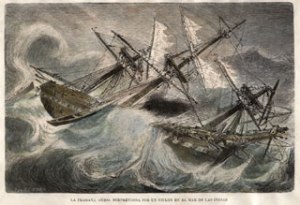
Ship in a StormEvery profession develops its own jargon, a kind of short-hand between those in the know.  The sailing profession is one of the oldest on the planet, and has developed over the centuries; many of its terms have made it into everyday language.

Below is a gleaning of nautical actions from a digitalized version of the 1867 “The Sailor’s Word-Book:  An Alphabetical Digest of Nautical Terms, including some more especially military and scientific, but useful to seamen; as well as archaisms of early voyagers, etc. by the late ADMIRAL W. H. SMYTH, K.S.F., D.C.L., &c.”  For those of you interested in this topic you’ll appreciate the richness of life at sea represented here; for those of you interested in language, it’s a great source of history and etymology.  Because of the length, I’ve broken it down into two sections; here’s the second part, K-Z.  Enjoy!

K-O

KEN, To. Ang.-Sax. descrying, as Shakespeare in Henry VI.:— “And far as I could ken thy chalky cliffs.”  —Ken, a speck, a striking object or mark.

(Note:  “Ken, to” is also used in modern Scots to describe knowing or understanding someone or something.)

KICK THE BUCKET, To. To expire; an inconsiderate phrase for dying.

KICK UP A DUST, To. To create a row or disturbance.

KIDNAP, To. To crimp or carry off by artifice.

KREE, To. A north-country word: to beat, or bruise.

KRINGLE, To. To dry and shrivel up. Also a form of cringle.

LABBER, To. To struggle in water, as a fish when caught. To splash.

LACE, To. To apply a bonnet by lacing it to a sail. Also, to beat or punish with a rattan or rope’s-end. Also, the trimmings of uniforms.

LARRUP, To. An old word meaning to beat with a rope’s-end, strap, or colt.

LASK, To. To go large.—Lasking along. Sailing away with a quartering wind.

LATHER, To. To beat or drub soundly.

LAUNCH, To. To send a ship, craft, or boat off the slip on shore into the water, “her native element,” as newspapers say. Also, to move things; as, launch forward, or launch aft. Launch is also the movement by which the ship or boat descends into the water.

LAVEER, To. An old sea-term for beating a ship to windward; to tack.

LAY, To. To come or go; as, lay aloft, lay forward, lay aft, lay out. This is not the neuter verb lie mispronounced, but the active verb lay.

LAY A GUN, To. So to direct it as that its shot may be expected to strike a given object; for which purpose its axis must be pointed above the latter, at an angle of elevation increasing according to its distance.

LAY HER COURSE, To. To be able to sail in the direction wished for, however barely the wind permits it.

LAY IN SEA-STOCK, To. To make provision for the voyage.

LAY THE LAND, To. Barely to lose sight of it.

LAY-TO. To bring the weather-bow to the sea, with one sail set, and the helm lashed a-lee.

LAY UP A SHIP, To. To dismantle her.

LET DRIVE, To. To slip or let fly. To discharge, as a shot from a gun.

LET FLY, To. To let go a rope at once, suddenly.

LET IN, To. To fix or fit a diminished part of one plank or piece of timber into a score formed in another to receive it, as the ends of the carlings into the beams.

LET OUT, or Shake out, a Reef, To. To increase the dimensions of a sail, by untying the points confining a reef in it.

LIE ALONG, To.  A ship is said to lie along when she leans over with a side wind.—To lie along the land, is to keep a course parallel with it.

LIE ATHWART, To. When the tide slackens, and the wind is across tide, it makes a vessel ride athwart.

LIE BY, To. Dodging under small sail under the land.

LIE THE COURSE, To. When the vessel’s head is in the direction wished.

LIE-TO, To. To cause a vessel to keep her head steady as regards a gale, so that a heavy sea may not tumble into her. She has perhaps a main-topsail or trysails, and comes up to within six points, and falls off to wind abeam, forging rather ahead, but should not altogether fall too much to leeward.

LIE UNDER ARMS, To. To remain in a state of preparation for immediate action.

LIFT AN ANCHOR, To. Either by the purchase; or a ship if she has not sufficient cable on a steep bank lifts, or shoulders, her anchor.

LIGHT, To. To move or lift anything along; as “light over to windward,” the cry for helping the man at the weather-earing when taking in a reef. Each man holding by a reef-point helps it over, as the lee-earing cannot be passed until the man to windward calls out, “Haul out to leeward.”

LIGHTEN, To. To throw ballast, stores, cargo, or other things, overboard in stress of weather, to render the vessel more buoyant.

LINE, To. To cover one piece with another. Also, to mark out the work on a floor for determining the shape of a vessel’s body.—To line a ship, is to strike off with a batten, or otherwise, the directional lines for painting her. (See Toe a Line.)

LIST, To. To incline to one side; as “the ship has a list to port,” i.e. leans over to that side.

LIVE, To. To be able to withstand the fury of the elements; said of a boat or ship, &c.

LIVELY. To lift lightly to the sea; as a boat, &c.

LOCK, To. To entangle the lower yards when tacking.

LOOK, To. The bearing or direction, as, she looks up, is approaching her course.—A plank looks fore and aft, means, is placed in that direction.

LOOM, To. An indistinct enlarged appearance of any distant object in light fogs, as the coast, ships, &c.; “that land looms high,” “that ship looms large.” The effect of refraction.

LOOSE, To. To unfurl or cast loose any sail, in order to its being set, or dried after rain.

LOOSE A ROPE, To. To cast it off, or let it go.

LOSE WAY, To. When a ship slackens her progress in the water.

LOWER, To. The atmosphere to become cloudy. Also, to ease down gradually, expressed of some weighty body suspended by tackles or ropes, which, being slackened, suffer the said body to descend as slowly, or expeditiously, as occasion requires.

LUFF INTO A HARBOUR, To. To sail into it, shooting head to wind, gradually. A ship is accordingly said to spring her luff when she yields to the effort of the helm, by sailing nearer to the wind, or coming to, and does not shake the wind out of her sails until, by shortening all, she reaches her anchorage.

MAKE, To. Is variously applied in sea-language.

MAKE BAD WEATHER, To. A ship rolling, pitching, or leaking violently in a gale.

MAKE FAST. A word generally used for tying or securing ropes. To fasten.

MAKE FREE WITH THE LAND, To. To approach the shore closely.

MAKE LEE-WAY, To. To drift to leeward of the course.

MAKE SAIL, To. To increase the quantity of sail already set, either by letting out reefs, or by setting additional sails.

MAKE STERN-WAY, To. To retreat, or move stern foremost.

MAKE THE LAND, To. To see it from a distance after a voyage.

MAKE WATER, To. Usually signifies the act of a ship leaking, unless the epithet foul be added. (See Foul Water.)

MAN, To. To provide a competent number of hands for working and fighting a ship; to place people for duty, as “Man the barge;” “Man the capstan;” “Man the yards,” &c.

MANARVEL, To. To pilfer small stores.

MANGONIZE, To. To traffic in slaves.

MAN-HANDLE, To. To move by force of men, without levers or tackles.

MARINATE, To. To salt fish, and afterwards preserve it in oil or vinegar.

MARL, To. To souse fish in vinegar to be eaten cold.

MARLE, To. To wind marline, spun-yarn, twine, &c., about a rope, so that every turn is secured by a kind of knot, and remains fixed, in case the rest should be cut through by friction. It is commonly used to fasten slips of canvas, called parsling, upon the surface of a rope, to prevent its being galled, or to attach the foot of a sail to its bolt-rope, &c., with marling hitches, instead of sewing it.

MARRY, To, the Ropes, Braces, or Falls. To hold both together, and by pressure haul in both equally. Also so to join the ends of two ropes, that they will pass through a block.

MEND SAILS, To. To loose and skin them afresh on the yards.

MOOR, To. To secure a ship with anchors, or to confine her in a particular station by two chains or cables, either fastened to the mooring chains or to the bottom; a ship is moored when she rides by two anchors.

MOOR ACROSS, To. To lay out one of the anchors across stream.

MOOR ALONG, To. To anchor in a river with a hawser on shore to steady her.

MOOR QUARTER-SHOT, To. To moor quartering, between the two ways of across and along.

MOOR THE BOAT, To. To fasten her with two ropes, so that the one shall counteract the other, and keep her in a steady position.

MOOR WITH A SPRING ON THE CABLE, To. See Spring.

MOUNT, To. When said of a ship-of-war, implies the number of guns she carries.—To mount, in a military sense, is also to furnish with horses.

MOUNT A GUN, To. To place it on its carriage.

MOVE OFF, To. To defile.

MOYLE, To. To defile; an old term.

MUFFLE THE OARS, To. To put some matting or canvas round the loom when rowing, to prevent its making a noise against the tholes, or in the rowlocks. For this service thole-pins are best. In war time, rowing guard near the ships or batteries of the enemy, or cutting out, many a pea-jacket has been sacrificed for this purpose. Whale-boats have their oars muffled to prevent frightening the whales.

MUSTER, To. To assemble in order that the state and condition of the men may be seen, and also at times to inspect their arms and clothing.

NAIL, To. Is colloquially used for binding a person to a bargain. In weighing articles of food, a nail is 8 lbs.

NAUFRAGIATE, To. An old expression, meaning to suffer shipwreck. It occurs in Lithgow’s Pilgrime’s Farewell, 1618.

NEGOTIATE, To. The duty of a diplomatist; the last resource and best argument being now 12-ton guns.

OBSERVE, To. To take a bearing or a celestial observation.

OCCUPY, To. To take military possession.

OPEN LOWER DECKERS, To. To fire the lower tier of guns. Also said of a person using violent language.

OUT-FLANK, To. By a longer front, to overlap the enemy’s opposite line, and thus gain a chance to turn his flank.

OUT-SAIL, To. To sail faster than another ship, or to make a particular voyage with greater despatch.

OVER-PRESS, To. To carry too much sail on a ship.

OVERSHOOT, To. To give a ship too much way.

OWN, To. To be a proprietor in a ship.

P-R

PARCEL, To. To wind tarred canvas round a rope.

PARLEY. That beat of drum by which a conference with the enemy is desired. Synonymous with chamade.—To parley. To bandy words.

PART, To. To break a rope. To part from an anchor is in consequence of the cable parting.

PASS, To. To give from one to another, and also to take certain turns of a rope round a yard, &c., as “Pass the line along;” “pass the gasket;” “pass a seizing;” “pass the word there,” &c.

PAY A MAST OR YARD, To. To anoint it with tar, turpentine, rosin, tallow, or varnish; tallow is particularly useful for those masts upon which the sails are frequently hoisted and lowered, such as top-masts and the lower masts of sloops, schooners, &c.

PAY A VESSEL’S BOTTOM, To. To cover it with tallow, sulphur, rosin, &c.

PAY ROUND, To. To turn the ship’s head.

PEAK, To. To raise a gaff or lateen yard more obliquely to the mast. To stay peak, or ride a short stay peak, is when the cable and fore-stay form a line: a long peak is when the cable is in line with the main-stay.

PICK UP A WIND, To. Traverses made by oceanic voyagers; to run from one trade or prevalent wind to another, with as little intervening calm as possible.

PITCH IN, To. To set to work earnestly; to beat a person violently. (A colloquialism.)

PLANK IT, To. To sleep on the bare decks, choosing, as the galley saying has it, the softest plank.

PLASH, To. To wattle or interweave branches.

PLY, To. To carry cargoes or passengers for short trips. Also, to work to windward, to beat. Also, to ply an oar, to use it in pulling.

POINT A GUN, To. To direct it on a given object.

POINT A SAIL, To. To affix points through the eyelet-holes of the reefs.

POWDER, To. To salt meat slightly; as Falstaff says, “If thou embowel me to-day, I’ll give you leave to powder me, and eat me too, to-morrow.”—Powdering-tub. A vessel used for pickling beef, pork, &c.

PRESS, To. To reduce an enemy to straits.

PRIME, To. To make ready a gun, mine, &c., for instantaneous firing. Also, to pierce the cartridge with the priming-wire, and apply the quill-tube in readiness for firing the cannon.—To prime a fire-ship. To lay the train for being set on fire.—To prime a match. Put a little wet bruised powder made into the paste called devil, upon the end of the rope slow-match, with a piece of paper wrapped round it.

PRISE, To. To raise, or slue, weighty bodies by means of a lever purchase or power.

PROVE, To. To test the soundness of fire-arms, by trying them with greater charges than those used on service.

PULL FOOT, To. To hasten along; to run.

PURCHASE A COMMISSION, To. A practice in our army, which has been aptly termed the “buying of fetters;” it is the obtaining preferment at regulated prices. At present the total value of a commission in a regiment of infantry of the line ranges from £450 for an ensigncy, up to £4540 for a lieutenant-colonelcy, and higher in the other branches of the service.

PURSUE, To. To make all sail in chase.

PUSH, To. To move a vessel by poles.

PUT BACK, To. To return to port—generally the last left.

PUT INTO PORT, To. To enter an intermediate or any port in the course of a voyage, usually from stress of weather.

PUT TO SEA, To. To quit a port or roadstead, and proceed to the destination.

PYKE, To. A old word signifying to haul on a wind.

PYKE OFF, To. To go away silently.

QUADRATE, To. To trim a gun on its carriage and its trucks; to adjust it for firing on a level range.

QUICKEN, To. In ship-building, to give anything a greater curve; as, to quicken the sheer, opposed to straightening it.

RACE, To. Applies to marking timber with the race-tool.

RADDLE, To. To interlace; as in making boats’ gripes and flat gaskets.

RAISE, To. To make an object subtend a larger angle by approaching it, which is the foundation of perspective, and an effect increased by the sphericity of our globe: the opposite of laying.

RAISE A SIEGE, To. To abandon or cause the abandonment of a siege.

RAISE THE METAL To. To elevate the breech, and depress thereby the muzzle of a gun.

RAISE THE WIND, To. To make an exertion; to cast about for funds.

RAM HOME, To. To drive home the ammunition in a gun.

RANGE, To. To sail in a parallel direction, and near to; as “we ranged the coast;” “the enemy came ranging up alongside of us.”

RANSACK, To. To pillage; but to ransack the hold is merely to overhaul its contents.

RATE A CHRONOMETER, To. To determine its daily gaining or losing rate on mean time.

RATTLE DOWN RIGGING, To; or, To Rattle the Shrouds. To fix the ratlines in a line parallel to the vessel’s set on the water.

RAZE, To. To level or demolish (applicable to works or buildings).

REAM or Reem Out, To. To enlarge the bore of a cannon with a special tool, so that it may take a larger projectile.

RE-ASSEMBLE. To gather together a fleet, or convoy, after having been scattered.

REAVEL, or Raffle. To entangle; to knot confusedly together.

REDUCE, To. To degrade to a lower rank; or to shorten the allowance of water or provisions.

REDUCE A CHARGE, To. To diminish the contents of a cartridge, sometimes requisite during heavy firing.

REDUCE A PLACE, To. To compel its commander to surrender, or vacate it by capitulation.

REEVE, To. To pass the end of a rope through any cavity or aperture, as the channel of a block; to unreeve is the opposite.

REINFORCE, To. To strengthen a fleet, squadron, army, or detachment, by additional means and munitions.

RELIEVE, To. To put fresh men or ships upon a stipulated duty.

REPEAT SIGNALS, To. Is to make the same signal exhibited by the admiral, in order to its being more readily distinguished at a distance, or through smoke, &c. Frigates and small vessels out of the line were deemed repeating ships, and enforced signals by guns. The repeat from a superior intended to convey rebuke for inattention, is usually accompanied by one gun, or several.

REPLENISH, To. To obtain supplies of water and provisions up to the original amount.

REPORT ONE’S SELF, To. When an officer returns on board from duty, or from leave of absence.

RE-SHIP. To ship again, or ship goods that have been imported or conveyed by water.

RESOLVE, To. To reduce a traverse, or day’s work, to its exact limits.

RET, To. To soak in water, as in seasoning timber, hemp, &c.

RETURN A SALUTE, To. Admirals are saluted, but return two guns less for each rank that the saluting officer is below the admiral.

RIDE, To. To ride at anchor. A vessel rides easily, apeak, athwart, head to wind, out a gale, open hawse, to the tide, to the wind, &c. A rope rides, as when round the capstan or windlass the strain part overlies and jams the preceding turn.—To ride between wind and tide. Said of a ship at anchor when she is acted upon by wind and tide from different directions, and takes up a position which is the result of both forces.

RIG, To. To fit the shrouds, stays, braces, and running-rigging to their respective masts, yards, and sails. Colloquially, it means to dress.—To rig in a boom, is to draw it in.—To rig out a boom, is to run it out from a yard, in order to extend the foot of a sail upon it, as with studding-sail booms, &c.

RIG THE CAPSTAN, To. To fix the bars in the drumhead in readiness for heaving; not forgetting to pin and swift.

RISK A RUN, To. To take chance without convoy.

ROLL UP A SAIL, To. To hand it quickly.

ROUND-IN, To. To haul in on a fall; the act of pulling upon any slack rope which passes through one or more blocks in a direction nearly horizontal, and is particularly applied to the braces, as “Round-in the weather-braces.” It is apparently derived from the circular motion of the rope about the sheave or pulley, through which it passes.

ROUND-TO, To. To bring to, or haul to the wind by means of the helm. To go round, is to tack or wear.

ROUSE, To. To man-handle. “Rouse in the cable,” haul it in, and make it taut.

ROW, To. To propel a boat or vessel by oars or sweeps, which are managed in a direction nearly horizontal.

RUN ATHWART A SHIP’S COURSE, To. To cross her path.

RUN DOWN A COAST, To. To sail along it, keeping parallel to or skirting its dangers.

RUN DOWN A VESSEL, To. To pass over, into, or foul her by running against her end-on, so as to jeopardize her.

RUN OUT A WARP, To. To carry a hawser out from the ship by a boat, and fasten it to some distant place to remove the ship towards that place, or to keep her steady whilst her anchors are lifted, &c.

S-T

SAGG, To. To bend or give way from heavy weight; to press down towards the middle; the opposite of hogging. In Macbeth the word is figuratively applied—

“The mind I sway by, and the heart I bear,
Shall never sagg with doubt, nor shake with fear.”

SAGGING TO LEEWARD. To drift off bodily to leeward. The movement by which a ship makes a considerable lee-way.

whose chief at that time was the redoubtable Saladin.

SALAM, To. To salute a superior; a very common term, borrowed from India. Overdoing it does not please Jack, for he dislikes to see his commander “salamming like a captured Frenchman.”

SCOUR A BEACH, To. To pour a quick flanking fire along it, in order to dislodge an enemy.

SCOUR THE SEAS, To. To infest the ocean as a pirate.

SCUTTLE, To. To cut or bore holes through part of a ship when she is stranded or over-set, and continues to float, in order to save any part of her contents. Also, a trick too often practised by boring holes below water, to sink a ship, where fictitious cargo is embarked and the vessel insured beyond her value.

SEDUCE, To. To inveigle a man to desertion.

SEND, To. To rise after pitching heavily and suddenly between two waves, or out of the trough of the sea.

SERVE, To. To supply the gun with powder and shot. Also, to handle it through all the changes of station.

SERVE THE VENT, To. To stop it with the thumb.

SET THE CHASE, To. To mark well the position of the vessel chased by bearing, so that by standing away from her on one tack, she may be cut off on the other.

SET UP RIGGING, To. To take in the slack of the shrouds, stays, and backstays, to bring the same strain as before, and thus secure the masts.

SHAKE, To. To cast off fastenings, as—To shake out a reef. To let out a reef, and enlarge the sail.—To shake off a bonnet of a fore-and-aft sail.—To shake a cask. To take it to pieces, and pack up the parts, then termed “shakes.” Thus the term expressing little value, “No great shakes.”

SHAKE IN THE WIND, To. To bring a vessel’s head so near the wind, when close-hauled, as to shiver the sails.

SHEER OFF, To. To move to a greater distance, or to steer so as to keep clear of a vessel or other object.

SHEER TO THE ANCHOR, To. To direct the ship’s bows by the helm to the place where the anchor lies, while the cable is being hove in.

SHEER UP ALONGSIDE, To. To approach a ship or other object in an oblique direction.

SHIEVE, To. To have head-way. To row the wrong way, in order to assist the steersman in a narrow channel.

SHIFT A BERTH, To. To move from one anchorage to another.

SHIN UP, To. To climb up a rope or spar without the aid of any kind of steps.

SHOOT, To. To move suddenly; as “the ballast shoots on one side.” Also, a ship shoots ahead in stays. Also, to push off in a boat from the shore into a current; to descend a rapid. The term is well used thus amongst the powerful rivers of N. America, of which perhaps the finest example is given by the St. Lawrence at La Chine, there reported to rush in spring-time at the rate of 40 miles an hour. Thus the shooting Old London Bridge was the cause of many deaths, and gave occasion to the admirable description in the Loves of the Triangles (anti-Jacobin), when all were agreed:

“‘Shoot we the bridge,’ the vent’rous boatmen cry;
‘Shoot we the bridge,’ th’ exulting fare reply.”

SHOOT THE COMPASS, To. To shoot wide of the mark.

SHOOT THE SUN, To. To take its meridional altitude; literally aiming at the reflected sun through the telescope of the instrument. “Have you obtained a shot?” applied to altitudes of the meridian, as for time, lunar distances, &c.

SHORTEN, To. Said of a ship’s sails when requisite to reduce those that are set. And shorten in, when alluding to the anchor, by heaving in cable.

SHUT IN, To. Said of landmarks or points of land, when one is brought to transit and overlap the other, or intercept the view of it.

SIDE OUT FOR A BEND, To. The old well-known term to draw the bight of a hempen cable towards the opposite side, in order to make room for the bight being twined to coil it in the tier. The most expert and powerful seamen were selected for this duty, now rare.

SIGHT THE ANCHOR, To. To heave it up in sight, in order to prove that it is clear, when, from the ship having gone over it, there is suspicion that it may be fouled by the slack cable.

SIGNALIZE, To. To distinguish one’s self; a word also degraded to the meaning of communicating intelligence by means of signals or telegraph.

SILT-UP, To. To be choked with mud or sand, so as to obstruct vessels.

SINGLE, To. To unreeve the running part of top-sail sheets, &c., to let them run freely, or for harbour duty.

SIZE, To. To range soldiers, marines, and small-arm men, so that the tallest may be on the flanks of a party.

SKEDADDLE, To. To stray wilfully from a watering or a working party. An archaism retained by the Americans.

SKELP, To. To slap with the open hand: an old word, said to have been imported from Iceland:— “I canno’ tell a’;
Some gat a skelp, and some gat a claw.”

SLING, To. To pass the top-chains round the yards when going into action. Also, to set any large article, in ropes, so as to put a tackle on, and hoist or lower it. When the clues are attached to a cot or hammock, it is said to be slung; also water-kegs, buoys, &c., are slung.

SLUE, To. To turn anything round or over in situ: especially expressing the movement of a gun, cask, or ship; or when a mast, boom, or spar is turned about in its cap or boom iron.

SNAGGLE, To. To angle for geese with a hook and line properly baited.

SNAPE, To. In ship-carpentry, is to hance or bevel the end of anything, so as to fay upon an inclined plane: it is also designated flinch.

SPAN IN THE RIGGING, To. To draw the upper parts of the shrouds together by tackles, in order to seize on the cat-harping legs. The rigging is also “spanned in” when it has been found to stretch considerably on first putting to sea, but cannot be set up until it moderates.

SPEAK A VESSEL, To. To pass within hail of her for that purpose.

SPILL, To. Whether for safety or facility, it is advisable to shiver the wind out of a sail before furling or reefing it. This is done either by collecting the sail together, or by bracing it bye, so that the wind may strike its leech and shiver it. A very effeminate captain was accustomed to order, “Sheevar the meezen taus’le, and let the fore-topmast staysail lie dormant in the brails!”

SPIN A TWIST OR A YARN, To. To tell a long story; much prized in a dreary watch, if not tedious.

SPOOM, To. An old word frequently found in Dryden, who thus uses it, “When virtue spooms before a prosp’rous gale,
My heaving wishes help to fill the sail.”

SPREAD A FLEET, To. To keep more open order.

STAND, To. The movement by which a ship advances towards a certain object, or departs from it; as, “The enemy stands in shore;” “We saw three sail standing to the southward.” “That ship has not a mast standing,” implies that she has lost all her masts.

STAND IN SHORE, To. To sail directly for the land.

STAND SQUARE, To. To stand or be at right angles relatively to some object.

STAVE, To. To break a hole in any vessel. Also, to drive in the head of a cask, as of spirits, to prevent the crew from misusing it in case of wreck.—To stave off. To boom off; to push anything off with a pole.

STEER HER COURSE, To. Going with the wind fair enough to lay her course.

STEER LARGE, To. To go free, off the wind. Also, to steer loosely.

STEER SMALL, To. To steer well and within small compass, not dragging the tiller over from side to side.

STEP OUT, To. To move along simultaneously and cheerfully with a tackle-fall, &c.

STOKE, To. To frequent the galley in a man-of-war, or to trim fires.

STOP THE VENT, To. To close it hermetically by pressing the thumb to it.

STORM, To. To take by vigorous assault, in spite of the resistance of the defenders.

STREAM THE BUOY, To. To let the buoy fall from the after-part of the ship’s side into the water, preparatory to letting go the anchor, that it may not foul the buoy-rope as it sinks to the bottom.

STRETCH ALONG A BRACE, To. To lay it along the decks in readiness for the men to lay hold of; called manning it.

STRIKE, To. A ship strikes when she in any way touches the bottom. Also, to lower anything, as the ensign or top-sail in saluting, or as the yards, topgallant-masts, and top-masts in a gale. It is also particularly used to express the lowering of the colours in token of surrender to a victorious enemy.

STRIKE SOUNDINGS, To. To gain bottom, or the first soundings, by the deep-sea lead, on coming in from sea.

STRIP THE MASTS, To. To clear the masts of their rigging.

SUCK THE MONKEY, To. To rob the grog-can.

SUGG, To. To move or rock heavily on a bank or reef.

SUPPORT A FRIEND, To. To make every exertion to assist a vessel in distress, from whatever cause. Neglect of this incurs punishment.

SURGE THE CAPSTAN, To. To slacken the rope heaved round upon its barrel, to prevent its parts from riding or getting foul.

SWAGG, To. To sink down by its own weight; to move heavily or bend. Synonymous with sagg. Also, the bellying of a heavy rope.

SWAY UP, To. To apply a strain on a mast-rope in order to lift the spar upwards, so that the fid may be taken out, previous to lowering the mast. Or sway yards aloft ready for crossing.

SWIG OFF, To. To pull at the bight of a rope by jerks, having its lower end fast; or to gain on a rope by jumping a man’s weight down, instead of hauling regularly.

SWILKER, To. A provincialism for splashing about.

SWIM, To [from the Anglo-Saxon swymm]. To move along the surface of the water by means of the simultaneous movement of the hands and feet. With the Romans this useful art was an essential part of education.

SWING, To. A ship is said to swing to the wind or tide, when they change their direction while she is lying at anchor.—To swing ship for local attraction and adjustment of compasses. This is done by taking the bearings of a very distant object at each point of the compass to which her head is brought; also, by using a theodolite on shore, and taking its bearing from the ship, and the observer’s head from the theodolite.

TAKE WATER ON BOARD, To. To ship a sea.

TALLY, To. To haul the sheets aft; as used by Falconer— “And while the lee clue-garnet’s lower’d away,
Taut aft the sheet they tally, and belay.”

TEACH, To. In marine architecture, is applied to the direction which any line or curve seems to point out.

TELEGRAPH, To. To convey intelligence to a distance, through the medium of signals.

TELL OFF, To. To divide a body of men into divisions and subdivisions, preparatory to a special service.

TEND, To. To watch a vessel at anchor on the turn of a tide, and cast her by the helm, and some sail if necessary, so as to keep the cable clear of the anchor or turns out of her cables when moored.

TERTIATE, To. To examine whether a piece of ordnance is truly bored and has its due proportion of metal in every part, especially at the vent, the trunnions, and the muzzle.

TEW, To. To beat hemp.

TOP A YARD OR BOOM, To. To raise up one end of it by hoisting on the lift, as the spanker-boom is lifted before setting the sail.

TOP THE GLIM, To. To snuff the candle.

TOP THE OFFICER, To. To arrogate superiority.

TOSS UP THE BUNT, To. In furling a sail, to make its final package at the centre of the yard when in its skin.

TOUCH UP IN THE BUNT, To. To mend the sail on the yard; figuratively, to goad or remind forcibly.

TOUT, To. An old term for looking out, or keeping a prying watch; whence the revenue cruisers and the customs officers were called touters. The name is also given to crimps.

TOW, To. To draw or drag a ship or boat by means of a rope attached to another vessel or boat, which advances by steam-power, rowing, or sailing. The Roman method, as appears by the triumphal arch at Orange, was by a rope fastened to a pulley at the top of the mast. They also fastened a rope to the head of a boat, and led it over men’s shoulders, as practised on our canals at the present day.

TRAIL A PIKE, To. To hold the spear end in the right hand, and the butt trailed behind the bearer.

TRANS-SHIP, To. To remove a cargo from one ship to another.

TRAVEL, To. For a thimble, block, &c., to run along on beams or ropes.

TRAVERSE A YARD, To. To get it fore and aft.

TREAD WATER, To. The practice in swimming by which the body is sustained upright, and the head kept above the surface.

TRENCH THE BALLAST, To. To divide the ballast in a ship’s hold to get at a leak, or to trim and stow it.

TREND, To. To bend or incline, speaking of a coast; as, “The land trends to the south-west.” Also, the course of a current or stream.

TRICE, To. To haul or lift up by means of a lashing or line.

TROUNCE, To. To beat or punish. An old word; in Mathew’s translation of the Bible, 1537, we find, “The Lord trounced Sisera.”

TRUSS UP, To. To brail up a sail suddenly; to toss up a bunt.

TRY BACK FOR A BEND, To. To pay back some of the bight of a cable, in order to have sufficient to form the bend.

TRY DOWN, To. To boil out the oil from blubber at sea in whalers.

TURN A TURTLE, To. To take the animal by seizing a flipper, and  throwing him on his back, which renders him quite helpless. Also applied to a vessel capsizing; or throwing a person suddenly out of his hammock.

TURN IN, To. To go to bed.—To turn out. To get up.

TURN IN A DEAD-EYE OR HEART, To. To seize the end of a shroud or stay, &c., securely round it.

TURN OVER MEN, To. To discharge them out of one ship into another.

TURN THE HANDS UP, To. To summon the entire crew on deck.

TURN TO WINDWARD, To. To gain on the wind by alternate tacking. It is when a ship endeavours to make progress against the wind by a compound course inclined to the place of her destination; otherwise called plying or beating to windward.

TWIG, To. To pull upon a bowline. Also, in familiar phrase, to understand or observe.

U-Z

UNBEND, To. To cast off or untie; to remove the sails from their yards and stays; to cast loose the cables from their anchors, or to untie one rope from another.

UNBITT, To. To remove the turns of a cable from off the bitts.

UNDER-RUN A HAWSER OR WARP, To. To haul a boat along underneath it, in order to clear it, if any part happens to be foul. To under-run a tackle, is to separate the several parts of which it is composed, and range them in order, so that the general effort may not be interrupted when it is put in motion by the parts crossing, or by thorough-foots.

UNDER-SHORE, To. To support or raise a thing by putting a spar or prop under it, as a ship is shored up in dock.

UNLIMBER, To. With a gun on a travelling-carriage, to release it from the limber, by lifting the trail off the pintle and placing it on the ground, thus bringing it to the position for action.

UNREEVING. The act of withdrawing a rope from any block, thimble, dead-eye, &c., through which it had formerly passed.

UNRIG, To. To dismantle a ship of her standing and running rigging.—To unrig the capstan is to take out the bars.

UNSHIP, To. The opposite of to ship. To remove any piece of timber from its situation in which it is generally used, as “unship the oars,” lay them in the boat from the rowlocks; “unship the capstan bars,” &c.

VAIL, To. An old word signifying to lower, to bend in token of submission; as, “Vail their top-gallants.” Thus in the old play George a-Green, “Let me alone, my lord; I’ll make them vail their plumes.”

VEER, To. To let out, to pay out, to turn or change. Also, to veer or wear, in contradistinction from tacking. In tacking it is a necessary condition that the ship be brought up to the wind as close-hauled, and put round against the wind on the opposite tack. But in veering or wearing, especially when strong gales render it dangerous, unseamanlike, or impossible, the head of the vessel is put away from the wind, and turned round 20 points of the compass instead of 12, and, without strain or danger, is brought to the wind on the opposite tack. Many deep-thinking seamen, and Lords St. Vincent, Exmouth, and Sir E. Owen, issued orders to wear instead of tacking, when not inconvenient, deeming the accidents and wear and tear of tacking, detrimental to the sails, spars, and rigging.

VEER A BUOY IN A SHIP’S WAKE, To. To slack out a rope to which a buoy has been attached, and let it go astern, for the purpose of bringing up a boat, or picking up a man who may have fallen overboard.

VEER AND HAUL, To. To gently tauten and then slacken a rope three times before giving a heavy pull, the object being to concentrate the force of several men. The wind is said to veer and haul when it alters its direction; thus it is said, to veer aft, and haul forward.

VEER AWAY THE CABLE, To. To slack and let it run out.

WADE, To. An Anglo-Saxon word, meaning to pass through water without swimming. In the north, the sun was said to wade when covered by a dense atmosphere.

WAIVE, To. To give up the right to demand a court-martial, or to enforce forfeitures, by allowing people who have deserted, &c., to return to their duties.

WALK SPANISH, To. To quit duty without leave; to desert.

WALK THE QUARTER-DECK, To. A phrase signifying to take the rank of an officer.

WATER, To. To fill the casks or tanks; to complete water.

WEATHER ONE’S DIFFICULTIES, To. A colloquial phrase meaning to contend with and surmount troubles.

WEATHER THE CAPE, To. To become experienced; as it implies sailing round Cape Horn, or the Cape of Good Hope.

WEED, To. To clear the rigging of stops, rope-yarns, and pieces of oakum.

WELD, To. To join pieces of iron or other metal by placing in contact the parts heated almost to fusion, and hammering them into one mass.

WELL OFF, To. A mode of shutting off a leak by surrounding it by timbers screwed home through the lining to the timbers, and carrying up this trunk, like a log-hut, above the water-line.

WEND A COURSE, To. To sail steadily on a given direction.

WHISTLE FOR THE WIND, To. A superstitious practice among old seamen, who are equally scrupulous to avoid whistling during a heavy gale.—To wet one’s whistle. To take a drink. Thus Chaucer tells us that the miller of Trumpington’s lady had “Hir joly whistle wel ywette.”

WIND A SHIP OR BOAT, To. To change her position by bringing her stern round to the place where the head was.

WIND AWAY, To. To steer through narrow channels.

WING UP BALLAST, To. To carry the dead weight from the bottom as high as consistent with the stability of a ship, in order to ease her quick motion in rolling.

WOBBLE, To. In mechanics, to sway or roll from side to side.

WOOD, To. A gun is said to wood when it takes the port-sills or port-sides, or the trucks the water-ways.—To wood. When wooding-parties are sent out to cut or procure wood for a ship.

WORK, To. Said of a ship when she strains in a tempestuous sea, so as to loosen her joints.

WORK A SHIP, To. To adapt the sails to the force and direction of the wind.

WORK DOUBLE-TIDES, To. Implying that the work of three days is done in two, or at least two tides’ work in twenty-four hours.

WORK UP JUNK, To. To draw yarns from old cables, &c., and therewith to make foxes, points, gaskets, sinnet, or spun-yarn.

WRING A MAST, To. To bend, cripple, or strain it out of its natural position by setting the shrouds up too taut. The phrase, to wring, is also applied to a capstan when by an undue strain the component parts of the wood become deranged, and are thereby disunited. The head of a mast is frequently wrung by bracing up the lower yards beyond the dictates of sound judgment.

WRONG, To. To out-sail a vessel by becalming her sails is said to wrong her.

9 Comments

Filed under Articles, History, Lists, Research

Nautical Terms with Anglo-Saxon Origins

Nautical Jargon

Nautical Jargon

In the course of writing novels, I do a lot – I mean a LOT – of research.  And in the course of doing that LOT of research I come across interesting bits and bobs that I glean, putting into files on my computer for reference and rainy days.  So it was that I came across a digitalized version of the 1867 “The Sailor’s Word-Book:  An Alphabetical Digest of Nautical Terms, including some more especially military and scientific, but useful to seamen; as well as archaisms of early voyagers, etc. by the late ADMIRAL W. H. SMYTH, K.S.F., D.C.L., &c.”  I love the fact that antique books had entire blurbs built into their titles!  The document itself translates into no less than 586 pages in a word document; obviously I won’t force that upon you.  But I will give you a snippet of words from A to Z that have an Anglo-Saxon origin or influence. If you’re interested in even more such lists broken down from the book, check out my “History Undusted” blog here.  But first, here’s a snatch from the preface, written by the late Admiral W.H.Smyth:

“This predilection for sea idiom is assuredly proper in a maritime people, especially as many of the phrases are at once graphic, terse, and perspicuous. How could the whereabouts of an aching tooth be better pointed out to an operative dentist than Jack’s “‘Tis the aftermost grinder aloft, on the starboard quarter.” The ship expressions preserve many British and Anglo-Saxon words, with their quaint old preterites and telling colloquialisms; and such may require explanation, as well for the youthful aspirant as for the cocoa-nut-headed prelector in nautic lore. It is indeed remarkable how largely that foundation of the English language has been preserved by means of our sailors.

“This phraseology has necessarily been added to from time to time, and consequently bears the stamp of our successive ages of sea-life. In the “ancient and fishlike” terms that brave Raleigh derived from his predecessors, many epithets must have resulted from ardent recollections of home and those at home, for in a ship we find: Apeak, Apron, A-stay, Bonnet, Braces, Bridle, Cap, Catharpins, Cat-heads, Cat’s-paw, Cot, Cradle, Crib, Crow-foot, Crow’s nest, Crown, Diamond, Dog, Driver, Earrings, Eyes, Fox, Garnet, Goose-neck, Goose-wing, Horse, Hose, Hound, Jewel, Lacings, Martingale, Mouse, Nettle, Pins, Puddings, Rabbit, Ribband, Saddle, Sheaves, Sheets, Sheepshank, Shoe, Sister, Stays, Stirrup, Tiller, Truck, Truss, Watch, Whip, Yard.”

Now, on with the show!

A-C

A. The highest class of the excellence of merchant ships on Lloyd’s books, subdivided into A 1 and A 2, after which they descend by the vowels: A 1 being the very best of the first class. Formerly a river-built (Thames) ship took the first rate for 12 years, a Bristol one for 11, and those of the northern ports 10. Some of the out-port built ships keep their rating 6 to 8 years, and inferior ones only 4. But improvements in ship-building, and the large introduction of iron, are now claiming longer life.  “A” is an Anglo-Saxonism for in or on; as a‘board, a‘going, &c.

ABORD. An Anglo-Saxon term, meaning across, from shore to shore, of a port or river.

ACUMBA. Oakum. The Anglo-Saxon term for the hards, or the coarse part, of flax or unplucked wool.

ADOWN. The bawl of privateersmen for the crew of a captured vessel to go below. Saxon, adoun.

ÆWUL. An Anglo-Saxon term for a twig basket for catching fish.

AFORE. A Saxon word opposed to abaft, and signifying that part of the ship which lies forward or near the stem. It also means farther forward; as, the galley is afore the bitts.—Afore, the same as before the mast.—Afore the beam, all the field of view from amidship in a right angle to the ship’s keel to the horizon forward.

AFT—a Saxon word contradistinctive of fore, and an abbreviation of abaft—the hinder part of the ship, or that nearest the stern.—Right aft is in a direct line with the keel from the stern.—To haul aft a sheet is to pull on the rope which brings the clue or corner of the sails more in the direction of the stern.—The mast rakes aft when it inclines towards the stern.

AHOO, or All Ahoo, as our Saxon forefathers had it; awry, aslant, lop-sided.

ALLAN. A word from the Saxon, still used in the north to denote a piece of land nearly surrounded by a stream.

ALOFT [Anglo-Saxon, alofte, on high]. Above; overhead; on high. Synonymous with up above the tops, at the mast-head, or anywhere about the higher yards, masts, and rigging of ships.—Aloft there! the hailing of people in the tops.—Away aloft! the command to the people in the rigging to climb to their stations. Also, heaven: “Poor Tom is gone aloft.”

ALONG [Saxon]. Lengthwise.—Alongside, by the side of a ship; side by side.—Lying along, when the wind, being on the beam, presses the ship over to leeward with the press of sail; or, lying along the land.

AMAIN [Saxon a, and mægn, force, strength]. This was the old word to an enemy for “yield,” and was written amayne and almayne. Its literal signification is, with force or vigour, all at once, suddenly; and it is generally used to anything which is moved by a tackle-fall, as “lower amain!” let run at once. When we used to demand the salute in the narrow seas, the lowering of the top-sail was called striking amain, and it was demanded by the wave amain, or brandishing a bright sword to and fro.

ANGIL. An old term for a fishing-hook [from the Anglo-Saxon ongul, for the same]. It means also a red worm used for a bait in angling or fishing.

ATEGAR. The old English hand-dart, named from the Saxon aeton, to fling, and gar, a weapon.

AXE. A large flat edge-tool, for trimming and reducing timber. Also an Anglo-Saxon word for ask, which seamen still adhere to, and it is difficult to say why a word should be thought improper which has descended from our earliest poets; it may have become obsolete, but without absolutely being vulgar or incorrect.

BAT, or Sea-bat. An Anglo-Saxon term for boat or vessel. Also a broad-bodied thoracic fish, with a small head, and distinguished by its large triangular dorsal and anal fins, which exceed the length of the body. It is the Chætodon vespertilio of naturalists.

BAT-SWAIN. An Anglo-Saxon expression for boatswain.

BEACON. [Anglo-Saxon, béacn.] A post or stake erected over a shoal or sand-bank, as a warning to seamen to keep at a distance; also a signal-mark placed on the top of hills, eminences, or buildings near the shore for the safe guidance of shipping.

BECK [the Anglo-Saxon becca]. A small mountain-brook or rivulet, common to all northern dialects. A Gaelic or Manx term for a thwart or bench in the boat.

BLEAK. The Leuciscus alburnus of naturalists, and the fresh-water sprat of Isaak Walton. The name of this fish is from the Anglo-Saxon blican, owing to its shining whiteness—its lustrous scales having long been used in the manufacture of false pearls.

BRAND. The Anglo-Saxon for a burnished sword. A burned device or character, especially that of the broad arrow on government stores, to deface or erase which is felony.

BROKER. Originally a broken tradesman, from the Anglo-Saxon broc, a misfortune; but, in later times, a person who usually transacts the business of negotiating between the merchants and ship-owners respecting cargoes and clearances: he also effects insurances with the underwriters; and while on the one hand he is looked to as to the regularity of the contract, on the other he is expected to make a candid disclosure of all the circumstances which may affect the risk.

BURG [the Anglo-Saxon burh]. A word connected with fortification in German, as in almost all the Teutonic languages of Europe. In Arabic the same term, with the alteration of a letter, burj, signifies primarily a bastion, and by extension any fortified place on a rising ground. This meaning has been retained by all northern nations who have borrowed the word; and we, with the rest, name our towns, once fortified, burghs or boroughs.

BURN, or Bourne. The Anglo-Saxon term for a small stream or brook, originating from springs, and winding through meadows, thus differing from a beck. Shakespeare makes Edgar say in “King Lear”—

CAPTAIN. This title is said to be derived from the eastern military magistrate katapan, meaning “over everything;” but the term capitano was in use among the Italians nearly 200 years before Basilius II. appointed his katapan of Apulia and Calabria, A.D. 984. Hence, the corruption of the Apulian province into capitanata. Among the Anglo-Saxons the captain was schipp-hláford, or ship’s lord. The captain, strictly speaking, is the officer commanding a line-of-battle ship, or a frigate carrying twenty or more cannon. A captain in the royal navy is answerable for any bad conduct in the military government, navigation, and equipment of his ship; also for any neglect of duty in his inferior officers, whose several charges he is appointed to regulate. It is also a title, though incorrectly, given to the masters of all vessels whatever, they having no commissions. It is also applied in the navy itself to the chief sailor of particular gangs of men; in rank, captain of the forecastle, admiral’s coxswain, captain’s coxswain, captain of the hold, captain of main-top, captain of fore-top, &c.

CHESIL. From the Anglo-Saxon word ceosl, still used for a bank or shingle, as that remarkable one connecting the Isle of Portland with the mainland, called the Chesil Beach.

CHIMBE [Anglo-Saxon]. The prominent part or end of the staves, where they project beyond the head of a cask.

CHIULES. The Saxon ships so called.

CLIFF [from the Anglo-Saxon cleof]. A precipitous termination of the land, whatever be the soil.

COGGE. An Anglo-Saxon word for a cock-boat or light yawl, being thus mentioned in Morte Arthure— “Then he covers his cogge, and caches one ankere.”  But coggo, as enumerated in an ordinance of parliament (temp. Rich. II.), seems to have been a vessel of burden used to carry troops.

COLMOW. An old word for the sea-mew, derived from the Anglo-Saxon.

CONN, Con, or Cun, as pronounced by seamen. This word is derived from the Anglo-Saxon conne, connan, to know, or be skilful. The pilot of old was skillful, and later the master was selected to conn the ship in action, that is, direct the helmsman. The quarter-master during ordinary watches conns the ship, and stands beside the wheel at the conn, unless close-hauled, when his station is at the weather-side, where he can see the weather-leeches of the sails.

COOMB. The Anglo-Saxon comb; a low place inclosed with hills; a valley. (CWM: CWM, or Comb. A British word signifying an inlet, valley, or low place, where the hilly sides round together in a concave form; the sides of a glyn being, on the contrary, convex.)

CORN, To. A remainder of the Anglo-Saxon ge-cyrned, salted. To preserve meat for a time by salting it slightly.

CRAFT [from the Anglo-Saxon word cræft, a trading vessel]. It is now a general name for lighters, hoys, barges, &c., employed to load or land any goods or stores.—Small craft. The small vessels of war attendant on a fleet, such as cutters, schooners, gunboats, &c., generally commanded by lieutenants. Craft is also a term in sea-phraseology for every kind of vessel, especially for a favourite ship. Also, all manner of nets, lines, hooks, &c., used in fishing.

CROCK [Anglo-Saxon, croca]. An earthen mess-vessel, and the usual vegetables were called crock-herbs. In the Faerie Queene Spenser cites the utensil:— “Therefore the vulgar did aboute him flocke,
Like foolish flies about an honey-crocke.”

CULVER. A Saxon word for pigeon, whence Culver-cliff, Reculvers, &c., from being resorted to by those birds. [Latin, columba; b and v are often interchanged.]

CUTE. Sharp, crafty, apparently from acute; but some insist that it is the Anglo-Saxon word cuth, rather meaning certain, known, or familiar.

D-F

DEL. Saxon for part.—Del a bit, not a bit, a phrase much altered for the worse by those not aware of its antiquity.

DENE. The Anglo-Saxon dæne; implying a kind of hollow or ravine through which a rivulet runs, the banks on either side being studded with trees.

DIGHT [from the Anglo-Saxon diht, arranging or disposing]. Now applied to dressing or preparing for muster; setting things in order.

DREINT. The old word used for drowned, from the Anglo-Saxon.

DRIVE, To [from the Anglo-Saxon dryfan]. A ship drives when her anchor trips or will not hold. She drives to leeward when beyond control of sails or rudder; and if under bare poles, may drive before the wind. Also, to strike home bolts, tree-nails, &c.

DUNES. An Anglo-Saxon word still in use, signifying mounds or ridges of drifted sands.

DYKE. From the Anglo-Saxon dic, a mound or bank; yet in some parts of England the word means a ditch.

EAGRE, or Hygre. The reciprocation of the freshes of various rivers, as for instance the Severn, with the flowing tide, sometimes presenting a formidable surge. The name seems to be from the Anglo-Saxon eágor, water, or Ægir, the Scandinavian god of the sea.

EAST. From the Anglo-Saxon, y’st. One of the cardinal points of the compass. Where the sun rises due east, it makes equal days and nights, as on the equator.

EASTINTUS. From the Saxon, east-tyn, an easterly coast or country. Leg. Edward I.

EBB. The lineal descendant of the Anglo-Saxon ep-flod, meaning the falling reflux of the tide, or its return back from the highest of the flood, full sea, or high water. Also termed sæ-æbbung, sea-ebbing, by our progenitors.

EBBER, or Ebber-shore. From the Anglo-Saxon signifying shallow.

EGG, To. To instigate, incite, provoke, to urge on: from the Anglo-Saxon eggion.

EKE, To. [Anglo-Saxon eácan, to prolong.] To make anything go far by reduction and moderation, as in shortening the allowance of provisions on a voyage unexpectedly tedious.

ENSIGN. [From the Anglo-Saxon segn.] A large flag or banner, hoisted on a long pole erected over the stern, and called the ensign-staff. It is used to distinguish the ships of different nations from each other, as also to characterize the different squadrons of the navy; it was formerly written ancient. Ensign is in the army the title of the junior rank of subaltern officers of infantry; from amongst them are detailed the officers who carry the colours.

ERNE. From the Anglo-Saxon earne, a vulture, a bird of the eagle kind. Now used to denote the sea-eagle.

FARE [Anglo-Saxon, fara]. A voyage or passage by water, or the money paid for such passage. Also, a fishing season for cod; and likewise the cargo of the fishing vessel.

FATHOM [Anglo-Saxon, fædm]. The space of both arms extended. A measure of 6 feet, used in the length of cables, rigging, &c., and to divide the lead (or sounding) lines, for showing the depth of water.—To fathom, is to ascertain the depth of water by sounding. To conjecture an intention.

FELL, To. To cut down timber. To knock down by a heavy blow. Fell is the Anglo-Saxon for a skin or hide.

FIN [Anglo-Saxon, Finn]. A native of Finland; those are Fins who live by fishing. We use the whole for a part, and thus lose the clue which the Fin affords of a race of fishermen.

FIRE-BARE. An old term from the Anglo-Saxon for beacon.

FLOAT [Anglo-Saxon fleot or fleet]. A place where vessels float, as at Northfleet. Also, the inner part of a ship-canal. In wet-docks ships are kept afloat while loading and discharging cargo. Two double gates, having a lock between them, allow the entry and departure of vessels without disturbing the inner level. Also, a raft or quantity of timber fastened together, to be floated along a river by a tide or current.

FOAM [Anglo-Saxon, feám]. The white froth produced by the collision of the waves, or by the bow of a ship when acted on by the wind; and also by their striking against rocks, vessels, or other bodies.

FORE-FINGER, or Index-finger. The pointing finger, which was called shoot-finger by the Anglo-Saxons, from its use in archery, and is now the trigger-finger from its duty in gunnery.

FOTHER [Anglo-Saxon foder]. A burden; a weight of lead equal to 191⁄2 cwts. Leaden pigs for ballast.

FYRDUNG [the Anglo-Saxon fyrd ung, military service]. This appears on our statutes for inflicting a penalty on those who evaded going to war at the king’s command.

G-H

GARE. The Anglo-Saxon for ready.

GAR-FISH. The Belone vulgaris, or bill-fish, the bones of which are green. Also called the guard-fish, but it is from the Anglo-Saxon gar, a weapon.

GEAR [the Anglo-Saxon geara, clothing]. A general name for the rigging of any particular spar or sail; and in or out of gear implies anything being fit or unfit for use.

GLEN. An Anglo-Saxon term denoting a dale or deep valley; still in use for a ravine.

GOD. We retain the Anglo-Saxon word to designate the Almighty; signifying good, to do good, doing good, and to benefit; terms such as our classic borrowings cannot pretend to.

GRIP. The Anglo-Saxon grep. The handle of a sword; also a small ditch or drain. To hold, as “the anchor grips.” Also, a peculiar groove in rifled ordnance.

GUTTER [Anglo-Saxon géotan, to pour out or shed]. A ditch, sluice, or gote.

HACOT. From the Anglo-Saxon hacod, a large sort of pike.

HAVEN [Anglo-Saxon, hæfen]. A safe refuge from the violence of wind and sea; much the same as harbour, though of less importance. A good anchorage rather than place of perfect shelter. Milford Haven is an exception.

HAVEN-SCREAMER. The sea-gull, called hæfen by the Anglo-Saxons.

HEFT. The Anglo-Saxon hæft; the handle of a dirk, knife, or any edge-tool; also, the handle of an oar.

HELMY. Rainy [from an Anglo-Saxon phrase for rainy weather].

HERE-FARE [Anglo-Saxon]. An expedition; going to warfare.

HERRING. A common fish—the Clupea harengus; Anglo-Saxon hæring and hering.

HILL. In use with the Anglo-Saxons. An insulated rise of the ground, usually applied to heights below 1000 feet, yet higher than a hillock or hummock.

HOLD. The whole interior cavity of a ship, or all that part comprehended between the floor and the lower deck throughout her length.—The after-hold lies abaft the main-mast, and is usually set apart for the provisions in ships of war.—The fore-hold is situated about the fore-hatchway, in continuation with the main-hold, and serves the same purposes.—The main-hold is just before the main-mast, and generally contains the fresh water and beer for the use of the ship’s company.—To rummage the hold is to examine its contents.—To stow the hold is to arrange its contents in the most secure and commodious manner possible.—To trim the hold. Also, an Anglo-Saxon term for a fort, castle, or stronghold.—Hold is also generally understood of a ship with regard to the land or to another ship; hence we say, “Keep a good hold of the land,” or “Keep the land well aboard,” which are synonymous phrases, implying to keep near the land; when applied to a ship, we say, “She holds her own;” i.e. goes as fast as the other ship; holds her wind, or way.—To hold. To assemble for public business; as, to hold a court-martial, a survey, &c.—Hold! An authoritative way of separating combatants, according to the old military laws at tournaments, &c.; stand fast!

HOLT [from the Anglo-Saxon]. A peaked hill covered with a wood.

HORN-FISC. Anglo-Saxon for the sword-fish.

HOUND-FISH. The old Anglo-Saxon term for dog-fish—húnd-fisc.

HURST. Anglo-Saxon to express a wood.

HYTHE. A pier or wharf to lade or unlade wares at [from the Anglo-Saxon hyd, coast or haven].

I-L

ILAND. The Saxon ealand (See Island.)

KEEL. The lowest and principal timber of a ship, running fore and aft its whole length, and supporting the frame like the backbone in quadrupeds; it is usually first laid on the blocks in building, being the base of the superstructure. Accordingly, the stem and stern-posts are, in some measure, a continuation of the keel, and serve to connect the extremities of the sides by transoms, as the keel forms and unites the bottom by timbers. The keel is generally composed of several thick pieces placed lengthways, which, after being scarphed together, are bolted and clinched upon the upper side. In iron vessels the keel is formed of one or more plates of iron, having a concave curve, or limber channel, along its upper surface.—To give the keel, is to careen.—Keel formerly meant a vessel; so many “keels struck the sands.” Also, a low flat-bottomed vessel used on the Tyne to carry coals (21 tons 4 cwt.) down from Newcastle for loading the colliers; hence the latter are said to carry so many keels of coals. [Anglo-Saxon ceol, a small bark.]—False keel. A fir keel-piece bolted to the bottom of the keel, to assist stability and make a ship hold a better wind. It is temporary, being pinned by stake-bolts with spear-points; so when a vessel grounds, this frequently, being of fir or Canada elm, floats and comes up alongside.—Rabbets of the keel. The furrow, which is continued up stem and stern-post, into which the garboard and other streaks fay. The butts take into the gripe ahead, or after-deadwood and stern-post abaft.—Rank keel. A very deep keel, one calculated to keep the ship from rolling heavily.—Upon an even keel. The position of a ship when her keel is parallel to the plane of the horizon, so that she is equally deep in the water at both ends.

KEELS. An old British name for long vessels—formerly written ceol and cyulis. Verstegan informs us that the Saxons came over in three large ships, styled by themselves keeles.

KERS. An Anglo-Saxon word for water-cresses.

KNAP [from the Anglo-Saxon cnæp, a protuberance]. The top of a hill. Also, a blow or correction, as “you’ll knap it,” for some misdeed.

LADE. Anglo-Saxon lædan, to pour out. The mouth of a channel or drain. To lade a boat, is to throw water out.

LAGAN, or Lagam. Anglo-Saxon liggan. A term in derelict law for goods which are sunk, with a buoy attached, that they may be recovered. Also, things found at the bottom of the sea. Ponderous articles which sink with the ship in wreck.

LEAK [Anglo-Saxon leccinc]. A chink in the deck, sides, or bottom of a ship, through which the water gets into her hull. When a leak begins, a vessel is said to have sprung a leak.

LEWTH [from the Anglo-Saxon lywd]. A place of shelter from the wind.

LEX, or Leax. The Anglo-Saxon term for salmon.

LODESMEN. An Anglo-Saxon word for pilots.

M-O

MARSH [Anglo-Saxon mersc, a fen]. Low land often under water, and producing aquatic vegetation. Those levels near the sea coast are usually saturated with salt water.

MAST [Anglo-Saxon mæst, also meant chief or greatest]. A long cylindrical piece of timber elevated perpendicularly upon the keel of a ship, to which are attached the yards, the rigging, and the sails. It is either formed of one piece, and called a pole-mast, or composed of several pieces joined together and termed a made mast. A lower mast is fixed in the ship by sheers, and the foot or keel of it rests in a block of timber called the step, which is fixed upon the keelson.—Expending a mast, or carrying it away, is said, when it is broken by foul weather.—Fore-mast. That which stands near the stem, and is next in size to the main-mast.—Jury-mast.Main-mast. The largest mast in a ship.—Mizen-mast. The smallest mast, standing between the main-mast and the stern.—Over-masted, or taunt-masted. The state of a ship whose masts are too tall or too heavy.—Rough-mast, or rough-tree. A spar fit for making a mast.—Springing a mast. When it is cracked horizontally in any place.—Top-mast. A top-mast is raised at the head or top of the lower-mast through a cap, and supported by the trestle-trees.—Topgallant-mast. A mast smaller than the preceding, raised and secured to its head in the same manner.—Royal-mast. A yet smaller mast, elevated through irons at the head of the topgallant-mast; but more generally the two are formed of one spar.—Under-masted or low-masted ships. Vessels whose masts are small and short for their size.—To mast a ship. The act of placing a ship’s masts.

MAST-ROPE [Anglo-Saxon mæst-ràp]. That which is used for sending masts up or down.

MERE. An Anglo-Saxon word still in use, sometimes meaning a lake, and generally the sea itself.

MEW [Anglo-Saxon mæw]. A name for the sea-gull.

MIST [Anglo-Saxon]. A thin vapour, between a fog and haze, and is generally wet.

MOUNT, or Mountain. An Anglo-Saxon term still in use, usually held to mean eminences above 1000 feet in height. In a fort it means the cavalier.

MOUTH [the Anglo-Saxon muda]. The embouchure opening of a port or outlet of a river, as Yarmouth, Tynemouth, Exmouth, &c.

NAME-BOOK. The Anglo-Saxon nom-bóc, a mustering list.

NORTH. From the Anglo-Saxon nord.

OAKUM [from the Anglo-Saxon æcumbe]. The state into which old ropes are reduced when they are untwisted and picked to pieces. It is principally used in caulking the seams, for stopping leaks, and for making into twice-laid ropes. Very well known in workhouses.—White Oakum. That which is formed from untarred ropes.

OVERWHELM. A comprehensive word derived from the Ang.-Saxon wylm, a wave. Thus the old song—

P-R

PORT. An old Anglo-Saxon word still in full use. It strictly means a place of resort for vessels, adjacent to an emporium of commerce, where cargoes are bought and sold, or laid up in warehouses, and where there are docks for shipping. It is not quite a synonym of harbour, since the latter does not imply traffic. Vessels hail from the port they have quitted, but they are compelled to have the name of the vessel and of the port to which they belong painted on the bow or stern.—Port is also in a legal sense a refuge more or less protected by points and headlands, marked out by limits, and may be resorted to as a place of safety, though there are many ports but rarely entered. The left side of the ship is called port, by admiralty order, in preference to larboard, as less mistakeable in sound for starboard.—To port the helm. So to move the tiller as to carry the rudder to the starboard side of the stern-post.—Bar-port. One which can only be entered when the tide rises sufficiently to afford depth over a bar; this in many cases only occurs at spring-tides.—Close-port. One within the body of a city, as that of Rhodes, Venice, Amsterdam, &c.—Free-port. One open and free of all duties for merchants of all nations to load and unload their vessels, as the ports of Genoa and Leghorn. Also, a term used for a total exemption of duties which any set of merchants enjoy, for goods imported into a state, or those exported of the growth of the country. Such was the privilege the English enjoyed for several years after their discovery of the port of Archangel, and which was taken from them on account of the regicide in 1648.

PUNT. An Anglo-Saxon term still in use for a flat-bottomed boat, used by fishermen, or for ballast lumps, &c.

ROPE. Is composed of hemp, hide, wire, or other stuff, spun into yarns and strands, which twisted together forms the desired cordage. The word is very old, being the actual representative of the Anglo-Saxon ráp.—To rope a sail. To sew the bolt-rope round its edges, to strengthen it and prevent it from rending.

ROTHER. This lineal descendant of the Anglo-Saxon róter is still in use for rudder.

ROVING COMMISSION. An authority granted by the Admiralty to a select officer in command of a vessel, to cruise wherever he may see fit. [From the Anglo-Saxon ròwen.]

RUDDER. The appendage attached by pintles and braces to the stern-post of a vessel, by which its course through the water is governed. It is formed of several pieces of timber, of which the main one is generally of oak, extending the whole length. Tiphys is said to have been its inventor. The Anglo-Saxon name was steor-roper.

RYNE. An Anglo-Saxon word still in use for a water-course, or streamlet which rises high with floods.

S-Z

SACK, To [from the Anglo-Saxon sæc]. To pillage a place which has been taken by storm.

SCONCE. A petty fort. Also, the head; whence Shakespeare’s pun in making Dromio talk of having his sconce ensconced. Also, the Anglo-Saxon for a dangerous candle-holder, made to let into the sides or posts in a ship’s hold. Also, sconce of the magazine, a close safe lantern.

SCOT, or Shot. Anglo-Saxon sceat. A share of anything; a contribution in fair proportion.

SCRAPER [from the Anglo-Saxon screope]. A small triangular iron instrument, having two or three sharp edges. It is used to scrape the ship’s side or decks after caulking, or to clean the top-masts, &c. This is usually followed by a varnish of turpentine, or a mixture of tar and oil, to protect the wood from the weather. Also, metaphorically, a cocked hat, whether shipped fore-and-aft or worn athwart-ships.

SCURRY. Perhaps from the Anglo-Saxon scur, a heavy shower, a sudden squall. It now means a hurried movement; it is more especially applied to seals or penguins taking to the water in fright.

SEAL [from the Anglo-Saxon seolh]. The well-known marine piscivorous animal.

SEAM. The sewing together of two edges of canvas, which should have about 110 stitches in every yard of length. Also, the identical Anglo-Saxon word for a horse-load of 8 bushels, and much looked to in carrying fresh fish from the coast. Also, the opening between the edges of the planks in the decks and sides of a ship; these are filled with a quantity of oakum and pitch, to prevent the entrance of water.

SETTLE. Now termed the stern-sheets [derived from the Anglo-Saxon settl, a seat].—To settle. To lower; also to sink, as “the deck has settled;” “we settled the land.”  “Settle the main top-sail halliards,” i.e. ease them off a little, so as to lower the yard, as on shaking out a reef.

SHACKLE [from the Anglo-Saxon sceacul]. A span with two eyes and a bolt, attached to open links in a chain-cable, at every 15 fathoms; they are fitted with a movable bolt, so that the chain can there be separated or coupled, as circumstances require. Also, an iron loop-hooked bolt moving on a pin, used for fastening the lower-deck port-bars.

SHIFT. In ship-building, when one butt of a piece of timber or plank overlaunches the butt of another, without either being reduced in length, for the purpose of strength and stability.—To shift [thought to be from the Anglo-Saxon scyftan, to divide]. To change or alter the position of; as, to shift a sail, top-mast, or spar; to shift the helm, &c. Also, to change one’s clothes.

SHIP [from the Anglo-Saxon scip]. Any craft intended for the purposes of navigation; but in a nautical sense it is a general term for all large square-rigged vessels carrying three masts and a bowsprit—the masts being composed of a lower-mast, top-mast, and topgallant-mast, each of these being provided with tops and yards.—Flag-ship. The ship in which the admiral hoists his flag; whatever the rank of the commander be; all the lieutenants take rank before their class in other ships.—Line-of-battle ship. Carrying upwards of 74 guns.—Ship of war. One which, being duly commissioned under a commissioned officer by the admiralty, wears a pendant. The authority of a gunboat, no superior being present, is equal to that of an admiral.—Receiving ship. The port, guard, or admiral’s flag-ship, stationed at any place to receive volunteers, and bear them pro. tem. in readiness to join any ship of war which may want hands.—Store-ship. A vessel employed to carry stores, artillery, and provisions, for the use of a fleet, fortress, or Garrison.—Troop-ship. One appointed to carry troops, formerly called a transport.—Hospital-ship. A vessel fitted up to attend a fleet, and receive the sick and wounded. Scuttles are cut in the sides for ventilation. The sick are under the charge of an experienced surgeon, aided by a staff of assistant-surgeons, a proportional number of assistants, cook, baker, and nurses.—Merchant ship.—A vessel employed in commerce to carry commodities of various sorts from one port to another.—Private ship of war.Slaver, or slave-ship. A vessel employed in carrying negro slaves.—To ship. To embark men or merchandise. It also implies to fix anything in its place, as “Ship the oars,” i.e. place them in their rowlocks; “Ship capstan-bars.” Also, to enter on board, or engage to join a ship.—To ship a sea. A wave breaking over all in a gale. Hence the old saying— “Sometimes we ship a sea,
Sometimes we see a ship.”  To ship a swab. A colloquialism for mounting an epaulette, or receiving a commission.

SHIP-CRAFT. Nearly the same as the Anglo-Saxon scyp-cræft, an early word for navigation.

SHIPMAN [Anglo-Saxon scyp-mann]. The master of a barge, who in the days of Chaucer had but “litel Latin in his mawe,” and who, though “of nice conscience toke he no kepe,” was certainly a good fellow.

SHIP-STAR. The Anglo-Saxon scyp-steora, an early name for the pole-star, once of the utmost importance in navigation.

SHOOT-FINGER. This was a term in use with the Anglo-Saxons from its necessity in archery, and is now called the trigger-finger from its equal importance in modern fire-arms. The mutilation of this member was always a most punishable offence; for which the laws of King Alfred inflicted a penalty of fifteen shillings, which at that time probably was a sum beyond the bowman’s means.

SLADE [the Anglo-Saxon slæd]. A valley or open tract of country.

SMELT [Anglo-Saxon, smylt]. The fry of salmon, samlet, or Salmo eperlanus.

SNOOD [Anglo-Saxon, snod]. A short hair-line or wire to which hooks are fastened below the lead in angling. Or the link of hair uniting the hook and fishing-line.

SOUND [Anglo-Saxon, sund]. An arm of the sea over the whole extent of which soundings may be obtained, as on the coasts of Norway and America. Also, any deep bay formed and connected by reefs and sand-banks. On the shores of Scotland it means a narrow channel or strait. Also, the air-bladder of the cod, and generally the swimming-bladder or “soundes of any fysshes.” Also, a cuttle-fish.

SOUNDING-LINE. This line, with a plummet, is mentioned by Lucilius; and was the sund-gyrd of the Anglo-Saxons.

SPARTHE. An Anglo-Saxon term for a halbert or battle-axe.

SPELL. The period wherein one or more sailors are employed in particular duties demanding continuous exertion. Such are the spells to the hand-lead in sounding, to working the pumps, to look out on the mast-head, &c., and to steer the ship, which last is generally called the “trick at the wheel.” Spel-ian, Anglo-Saxon, “to supply another’s room.” Thus, Spell ho! is the call for relief.

SPRIT [Anglo-Saxon, spreotas]. A small boom which crosses the sail of a boat diagonally from the mast to the upper aftmost corner: the lower end of the sprit rests in a sort of becket called the snotter, which encircles the mast at that place. These sails are accordingly called sprit-sails. Also, in a sheer-hulk, a spur or spar for keeping the sheers out to the required distance, so that their head should plumb with the centre of the ship when taking out or putting in masts.

STADE. The Anglo-Saxon stæde, still in use. A station for ships. From stade is derived staith.

STAITH [Anglo-Saxon stæde]. An embankment on the river bank whence to load vessels. Also, a large wooden wharf, with a timber frame of either shoots or drops, according to circumstances.

STARBOARD. The opposite of larboard or port; the distinguishing term for the right side of a ship when looking forward [from the Anglo-Saxon stéora-bórd].

STEEP-TO. [Anglo-Saxon stéap.] Said of a bold shore, admitting of the largest vessels coming very close to the cliffs without touching the bottom.

STEERING [Anglo-Saxon stéoran]. The perfection of steering consists in a vigilant attention to the motion of the ship’s head, so as to check every deviation from the line of her course in the first instant of its commencement, and in applying as little of the power of the helm as possible, for the action of the rudder checks a ship’s speed.

STERE’S-MAN. A pilot or steerer, from the Anglo-Saxon stéora.

STORMS [from the Anglo-Saxon steorm]. Tempests, or gales of wind in nautic language, are of various kinds, and will be found under their respective designations. But that is a storm which reduces a ship to her storm staysails, or to her bare poles.

STRAND. A number of rope-yarns twisted together; one of the twists or divisions of which a rope is composed. The part which passes through to form the eye of a splice. Also, a sea-margin; the portion alternately left and covered by tides. Synonymous with beach. It is not altered from the original Anglo-Saxon.

STREAM. Anglo-Saxon for flowing water, meaning especially the middle or most rapid part of a tide or current.

STRING [Anglo-Saxon stræng]. In ship-building, a strake within side, constituting the highest range of planks in a ship’s ceiling, and it answers to the sheer-strake outside, to the scarphs of which it gives strength.

SWIM, To [from the Anglo-Saxon swymm]. To move along the surface of the water by means of the simultaneous movement of the hands and feet. With the Romans this useful art was an essential part of education.

SYKE [from the Anglo-Saxon sych]. A streamlet of water that flows in winter and dries up in summer.

TAKEL [Anglo-Saxon]. The arrows which used to be supplied to the fleet; the takill of Chaucer.

TALE [from Anglo-Saxon tael, number]. Taylor thus expressed it in 1630—

TAR [Anglo-Saxon tare]. A kind of turpentine which is drained from pines and fir-trees, and is used to preserve standing rigging, canvas, &c., from the effects of weather, by rendering them water-proof. Also, a perfect sailor; one who knows his duty thoroughly. (See Jack Tar.)—Coal or gas tar. A fluid extracted from coal during the operation of making gas, &c.; chiefly used on wood and iron, in the place of paint.

TARGET [Anglo-Saxon targe]. A leathern shield. A mark to aim at.

TAUT [from the Anglo-Saxon tought]. Tight.

THOLE, Thole-pin, or Thowel [from the Anglo-Saxon thol]. Certain pins in the gunwale of a boat, instead of the rowlock-poppets, and serving to retain the oars in position when pulling; generally there is only one pin to each oar, which is retained upon the pin by a grommet, or a cleat with a hole through it, nailed on the side of the oar. The principal use is to allow the oar, in case of action, suddenly to lie fore-and-aft over the side, and take care of itself. This was superseded by the swinging thowel, or metal crutch, in 1819, and by admiralty order at Portsmouth Yard in 1830.

TIMBER [Anglo-Saxon]. All large pieces of wood used in ship-building, as floor-timbers, cross-pieces, futtocks, frames, and the like (all which see).

TON, or Tun [from the Anglo-Saxon tunne]. In commerce, 20 cwt., or 2240 lbs., but in the cubical contents of a ship it is the weight of water equal to 2000 lbs., by the general standard for liquids. A tun of wine or oil contains 4 hogsheads. A ton or load of timber is a measure of 40 cubic feet in the rough, and of 50 when sawn: 42 cubic feet of articles equal one ton in shipment.

TONGUE [Anglo-Saxon tunga]. The long tapered end of one piece of timber made to fay into a scarph at the end of another piece, to gain length. Also, a low salient point of land. Also, a dangerous mass of ice projecting under water from an iceberg or floe, nearly horizontally; it was on one of these shelves that the Guardian frigate struck.

TOR. A high rock or peak: also a tower, thus retaining the same meaning it had, as torr, with the Anglo-Saxons.

TOTTY-LAND. Certain heights on the side of a hill [probably derived from the Anglo-Saxon totian, to elevate].

TOW-LINE [Anglo-Saxon toh-line]. A small hawser or warp used to move a ship from one part of a harbour or road to another by means of boats, steamers, kedges, &c.

TROUGH [from the Anglo-Saxon troh]. A small boat broad at both ends. Also, the hollow or interval between two waves, which resembles a broad and deep trench perpetually fluctuating. As the set of the sea is produced by the wind, the waves and the trough are at right angles with it; hence a ship rolls heaviest when she is in the trough of the sea.

TUG, To [from the Anglo-Saxon teogan, to pull]. It now signifies to hang on the oars, and get but little or nothing ahead.

WADE, To. An Anglo-Saxon word, meaning to pass through water without swimming. In the north, the sun was said to wade when covered by a dense atmosphere.

WAFT [said to be from the Anglo-Saxon weft], more correctly written wheft. It is any flag or ensign, stopped together at the head and middle portions, slightly rolled up lengthwise, and hoisted at different positions at the after-part of a ship. Thus, at the ensign-staff, it signifies that a man has fallen overboard; if no ensign-staff exists, then half-way up the peak. At the peak, it signifies a wish to speak; at the mast-head, recalls boats; or as the commander-in-chief or particular captain may direct.

WAR-SCOT.
A contribution for the supply of arms and armour, in the time of the Saxons.

WAVE [from the Anglo-Saxon wæg]. A volume of water rising in surges above the general level, and elevated in proportion to the wind.

WEATHER [from the Anglo-Saxon wæder, the temperature of the air]. The state of the atmosphere with regard to the degree of wind, to heat and cold, or to dryness and moisture, but particularly to the first. It is a word also applied to everything lying to windward of a particular situation, hence a ship is said to have the weather-gage of another when further to windward. Thus also, when a ship under sail presents either of her sides to the wind, it is then called the weather-side, and all the rigging situated thereon is distinguished by the same epithet. It is the opposite of lee. To weather anything is to go to windward of it. The land to windward, is a weather shore.

WEDGE [from the Anglo-Saxon wege]. A simple but effective mechanical force; a triangular solid on which a ship rests previous to launching. Many of the wedges used in the building and repairing of vessels are called sett-wedges.

WEEVIL [from the Anglo-Saxon wefl]. Curculio, a coleopterous insect which perforates and destroys biscuit, wood, &c.

WEIGH, To [from the Anglo-Saxon woeg]. To move or carry. Applied to heaving up the anchor of a ship about to sail, but also to the raising any great weight, as a sunken ship, &c.

WELKIN [from, the Anglo-Saxon, weal can]. The visible firmament.  “One cheer more to make the welkin ring.”

WELL [from the Anglo-Saxon wyll]. A bulk-headed inclosure in the middle of a ship’s hold, defending the pumps from the bottom up to the lower deck from damage, by preventing the entrance of ballast or other obstructions, which would choke the boxes or valves in a short time, and render the pumps useless. By means of this inclosure the artificers may likewise more readily descend into the hold, to examine or repair the pumps, as occasion requires.

WESTWARD [Anglo-Saxon weste-wearde].—Westward-hoe. To the west! It was one of the cries of the Thames watermen.

WHITTLE [from the Anglo-Saxon hwytel]. A knife; also used for a sword, but contemptuously.—To whittle. To cut sticks.

WICK [Anglo-Saxon wyc]. A creek, bay, or village, by the side of a river.

WINCH [from the Anglo-Saxon wince]. A purchase formed by a shaft whose extremities rest in two channels placed horizontally or perpendicularly, and furnished with cranks, or clicks, and pauls. It is employed as a purchase by which a rope or tackle-fall may be more powerfully applied than when used singly. A small one with a fly-wheel is used for making ropes and spun-yarn. Also, a support to the windlass ends. Also, the name of long iron handles by which the chain-pumps are worked. Also, a small cylindrical machine attached to masts or bitts in vessels, for the purpose of hoisting anything out of the hold, warping, &c.

WIND [precisely the Anglo-Saxon word]. A stream or current of air which may be felt. The horizon being divided into 32 points, the wind which blows from any of them has an assignable name.

YARD [Anglo-Saxon gyrde]. A long cylindrical timber suspended upon the mast of a vessel to spread a sail. They are termed square, lateen, or lug: the first are suspended across the masts at right angles, and the two latter obliquely. The square yards taper from the middle, which is called the slings, towards the extremities, which are termed the yard-arms; and the distance between is divided by the artificers into quarters, called the first, second, third quarters, and yard-arms. The middle quarters are formed into eight sides, and each of the end parts is figured like the frustum of a cone: on the alternate sides of the octagon, in large spars, oak battens are brought on and hooped, so as to strengthen, and yet not greatly increase, the weight.—To brace the yards. To traverse them about the masts, so as to form greater or lesser angles with the ship’s length.—To square the yards.

YESTY [from the Anglo-Saxon gist]. A foaming breaking sea. Shakespeare in Macbeth gives great power to this state of the waters:—  “Though the yesty waves
Confound, and swallow navigation up.”

YOUNGSTER, or Younker [an old term; from the Anglo-Saxon junker]. A volunteer of the first-class, and a general epithet for a stripling in the service.

Save

10 Comments

Filed under Articles, History, Lists, Quotes, Research

Merisms

Here and NowMerisms are figures of speech in which a single thing is implied by stating several elements of it, usually contrasting concepts or parts, used to refer to an entirety; the elements can be literal or metaphorical.  They are striking features in ancient Biblical poetry, such as “The God of heaven and earth” meaning of everything (the universe).  Here are a few more:

here and there

here and now

life and death

body and soul

the length and breadth

high and low

ladies and gentlemen

young and old

rich and poor

kind and cruel

smart and stupid

from A to Z

Alpha and Omega

The beginning and the end

lock, stock and barrel

day and night

left and right

bag and baggage

the whole kit and caboodle


Can you think of any others?

Leave a comment

Filed under Cartoon, Grammar, Nuts & Bolts, Writing Exercise

On intellectual laziness

Resume“Intellectual laziness and the hurry of the age have produced a craving for literary nips.  The torpid brain… has grown too weak for sustained thought.  There never was an age in which so many people were able to write badly.”

Israel Zangwill, the Bachelor’s Club, 1891

2 Comments

September 14, 2013 · 10:00 PM

Affect vs. Effect

aardvark - affect vs effectAffect and effect are probably two of the more confusing words in the English language.  Or should I say the use of them is the confusing bit.

A general rule of thumb is that affect is usually used as a verb, and effect is usually used as a noun.  As with other parts of speech, when in doubt try to replace it with a word you know the function of (i.e. clearly a verb, or clearly a noun); if it still makes sense then you know which one to use.

Example:  “The arrow affected the aardvark.”  “The arrow injured the aardvark.”  Injured makes sense here, so you need the verb form.

Effect is a noun, so try to replace it with another noun, e.g. “outcome.”

Example:  “The outcome was eye-popping.”  If you place these substitute words in the other sentences they wouldn’t make sense.

I hope that helps!  If you’re confused, just think of the aardvarks…

2 Comments

Filed under Articles, Nuts & Bolts, Writing Exercise

New Book Release: The Price of Freedom

POF1 - Amazon Optimal Pixel

The Price of Freedom
Now available on Amazon

At last, I can announce it!  My first published book, pre-Regency fiction called “The Price of Freedom” is out!  Available on Amazon worldwide, and ready to read and enjoy in the Kindle e-book format!

It’s been a long process, and one fraught with delays, hiccups, a lot of homework, and the unsexy side of writing.  It’s my first baby – the story that started me writing several years ago, and has been the friend I honed my writing chops on.  It’s hard to let go of that baby and let the wider world into its life, and allow it to take on a life of its own, but so it is.

As you know, self-published books are dependent on word-of mouth marketing.  I would really appreciate your help!  If anyone would like to interview me, review the book, and / or write a great review on Amazon, that would be amazing!  If you know anyone remotely interested in literary fiction, Jane Austen, Georgette Heyer (my style has been compared to both of those writers by editors & other writers), historical fiction, Regency or Pre-Regency era, please pass the word on to them!

Here’s a review, from Sue Moorcroft (Author, tutor):

“She was tall and willowy, and had a way of coming into a room like a welcomed summer breeze, drawing all eyes to herself.” – What a great description! It’s the kind of thing I wish I’d written. It really conjures up an image for the reader.

“…his death at such a ripe old age could not conveniently be avoided I suppose…” – A great snippet of dialogue. It’s exactly this kind of sly humour, that Jane Austen did so well, that earns for Regency fiction the tag, ‘comedy of manners’.

So… pass the word, download the book, grap a cuppa and curl up for a good read!

Leave a comment

Filed under Publications

Spoonerisms

A Spoonerism is a deliberate (or accidental) play on words in which the corresponding consonants of two words, vowels, or morphemes are switched between two words in a sentence to create two new words.  For instance, “talking back” becomes “balking tack.”  The name comes from an Oxford minister, Rev. William A. Spooner, who was notorious for making these mistakes.  He must have been an entertaining minister to listen to!  The poor fellow didn’t appreciate the honour of using his name for such mistakes; he had enough on his plate with being Albino with poor eyesight, but he was well-liked, and the dubious honour accorded him was kindly meant.

spoonerism 3Here are a few examples (the interchangeable letters are capitalized):

The Weight of Rages will press hard upon the employer. (Rev. Spooner)

a Tip of the Slung

Dear old Queen / Queer old Dean

Runny Babbit

is the Bean Dizzy?

Fight in your Race

a Pack of Lies

Pest in DRink

the Might is in my Lies

Belly Jeans

BRimulate your Stain

as the FLow CRies

SMart Feller

I’d rather have a bottle in front of me than a frontal lobotomy.

SHake a Tower

well-boiled icicle, well-oiled bicycle

the Pea little THrigs

Roaring with Pain

Ragged Jocks

the Loose that Gaid the olden Geggs

the Mog in the Danger

the Pag at the STool

Beeping SLeauty

… and the Gist Loes on!


All I can say is, Roonerisms SPock!

Leave a comment

Filed under Articles, Nuts & Bolts

On being powerful

“When I dare to be powerful – to use my strength in the service of my vision – it becomes less & less important whether I am afraid.”

Audre-Lorde-620x480Audre Lorde, 20th C. Caribbean-American writer

Leave a comment

August 18, 2013 · 10:00 PM