Category Archives: Articles

History Undusted: Bells

Recently, my husband was catching up with the articles on my blog, and he made the cheeky comment that I’d written about everything except the history of bells. Now, I know that’s not true – there are other things out there I still have yet to discover – but I took up the challenge; hence, this post. The history of bells, or of anything, for that matter, is an audacious title; as Mark Twain once said, “The very ink with which all history is written is merely fluid prejudice.” At best, such an online article can skim the surface of any historical topic; my purpose is not to give an extensive report – it’s to whet your appetites to search out history for yourself. I “undust” it for you – it’s up to you to grab it by the horns and hang on.

Every country has their favourite bells: Americans have the Liberty Bell (“At noon, on the Fourth of July, 1826, while the Liberty Bell was again sounding its old message to the people of Philadelphia, the soul of Thomas Jefferson passed on; and a few hours later John Adams entered into rest, with the name of his old friend upon his lips.” – Allen Johnson); the Brits have Big Ben (it’s the actual name of the bell, not the clock tower) and other, regional celebrities; the Russians have the Tsar Bell, in Moscow; the Polish have the Sigismund, located in Wawel Cathedral in Krakow, Poland. but where did they come from originally? What was their original purpose?

The oldest known bell is from around 2000 BC, from Neolithic China, and it was made of pottery tiles. As far as historians can deduce, the bell has always been associated with two social functions: As a signal for messages, such as when a work day would begin or end, and for calls to religious ceremonies or as reminders for specific times of day for various rituals. The sound of bells have always been associated with divinity, likely because it was a sound unlike any natural sound known to the people who heard them ringing out over a great distance – they could hear them, but not see the source of the sound. In ancient times, when most people were both uneducated and superstitious, it’s not hard to follow such reasoning.

Bells can range from tiny jingle bells to several tonnes; the Great Bell of Dhammazedi was the largest bell ever made, in 1484, for King Dhammazedi of Hanthawaddy Pegu (Lower Burma), and weighed 327 tonnes. It was placed in the temple of Shwedagon Pagoda and stolen by the Portuguese – whose ship promptly sunk under the weight of the bell.

Today, church bells still ring out across Europe, calling parishioners to church services, as well as ringing out on the hour to mark the passing of time. They ring out in special ways for various celebrations, whether weddings or holidays such as Christmas, New Year’s Eve, and Easter.

16th century Islamic painting of Alexander the Great lowered in a glass diving bell - Wikipedia

16th-century Islamic painting of Alexander the Great lowered in a glass diving bell – Wikipedia

Certain kinds of bells hold special value: Ship’s bells are like catnip to divers – they’re the primary method of identifying ships, as their names are engraved on the bells even long after the painted names on the hulls have succumbed to the sea; they are a wreck-diver’s trophy of desire, and always hold special place in their collections. An interesting link between diving and bells is that the first actual diving bells – the rigid chambers designed to transport divers from the surface to the depths and back – were shaped like ringing bells; the air would be trapped in the upside-down chamber, allowing a person to be underwater and still breathe. The first description of its use is recorded by Aristotle in the 4th century BC; the most famous diver from that period is Alexander the Great.


English has many idioms associated with bells: Alarm bells ringing (or set off alarm bells, or warning bells going off – i.e. your mind is warning you about a danger or deception in a particular situation); to be as sound as a bell (to be healthy or in good condition); when something has (all the) bells and whistles (extra or entertaining features or functions that aren’t necessary, but nice-to-haves); Hell’s bells! (an expression when one is surprised or annoyed); something rings a bell (i.e. sounds familiar); saved by the bell (i.e. a difficult situation is ended suddenly by an unforeseen interruption); with bells on (i.e. if you go somewhere or do something with bells on, you do it with great enthusiasm or energy); to bell the cat (i.e. undertake a difficult or dangerous task); something to be as clear as a bell (i.e. clearly understood); pull the other leg/one – it has bells on it (i.e. you don’t fool me); one can’t unring a bell (once something has been said or done, you can’t unsay or undo it); the final bell (the end of an event or, euphemistically, a life). I’m sure there are more – if you know of one, please leave it in the comments below!

There is also a powerful experience written by Corrie Ten Boom, a Holocaust survivor, about the Bells of Forgiveness – you can read her story here.

If you’ve got an hour to spare, BBC has an hour-long “History of Bell Ringing” video on YouTube.

So there you have it: Bells, undusted, to pull your rope cord and get those bells ringing in your head, to find out more for yourself!
8 Comments

Filed under Articles, Grammar, History, History Undusted, Military History, Quotes, Research

The Salt of the Matter

Recently I was looking into the matter of salt (as one does). Salt is a mineral made mostly of sodium chloride, and in its crystalline state is also known as rock salt or halite. It is essential for life in general, is present in our oceans, and is one of our five basic tastes (sweet, sour, bitter, umami and salty). As a spice, it is the oldest in the world; gathered along dried seashores from evaporated tidal pools, hunter-gatherers soon learned to value it.  Even as far back as 6000 BC, intentional salt production (by boiling or evaporating seawater) was around.  Since ancient times, it has been used as a seasoning, a preservative (whether air-drying in salt or through the brining process), a disinfectant, a unit of exchange, and ceremonial uses. Newborn babies were rubbed with salt to disinfect them (see Ezekiel 16:4 as an example of this ancient practice).

The word brings quite a few things to mind, from culinary to military to spiritual:  One speaks of seasoned soldiers – those who’ve seen action and have learned how to respond rightly in a crisis.  Roman soldiers were given an allowance for the purchase of salt; it’s where we get the word salary (salarius – Latin, pertaining to salt), and worth one’s salt is thought to come from that concept of the Roman soldier’s payment. The phrase above salt, referring to someone high in rank or honour, came from the seating position that a person would be invited to take at a dinner party – the salt being placed in the middle of the long dining table; the more honoured a guest, the closer they sat to the host at the head of the table, above salt (used as far back as AD 1200 in that context).

Salt preserves and adds flavour by bringing out the full bouquet of flavour within the thing it’s added to.  It enhances a sweet melon or a savoury slice of meat.  Seasoned just right, even a lowly carrot or potato can become an explosion of taste.  In Colossians 4:6, the apostle Paul uses this culinary metaphor:  “Let your conversation be always full of grace, seasoned with salt, so that you may know how to answer everyone.”  Applying the qualities of salt to our speech, let it always be full of good taste, preserving the honour of those with and about whom we speak, bringing out their potential, enhancing them.  Such speech is applicable in every situation; such a reply is never wrong.  How we say something is at least as important as what we say; that’s the salt of the matter.  Salt was also used by ancient armies to symbolically curse the fields of a conquered area (it is erroneously thought that the salt was sown to make the land unproductive, but it would take a prohibitive amount of salt to accomplish that, so it’s logically rather a symbolic than literal salting).

Salt also gives us several more idioms than those mentioned above:

  • To take something with a grain of salt – from Modern Latin, cum grano salis. It means not to believe something at face value, or take something completely seriously.
  • (To go) back to the salt mines – (To go) back to work
  • To rub salt in (someone’s) wound – To make someone’s problem or bad situation worse
  • Salt of the earth – a good, honest, upright person
  • To salt (something) away – To save money or other item for another time or purpose
  • Salty dog – An experienced sailor (nickname due to the salinity of the sea)

Today, most countries have a wide variety of salt available: The typical salt in western societies is called “table salt”, and it has been iodized with iodine since 1924, to correct the deficiency of iodine in the average diet. The deficiency can lead to thyroid problems in adults and cretinism in children. Another mineral sometimes added is fluoride, to prevent tooth decay. The additives vary from country to country, which may also add to the variety and regional differences in taste.

Salts

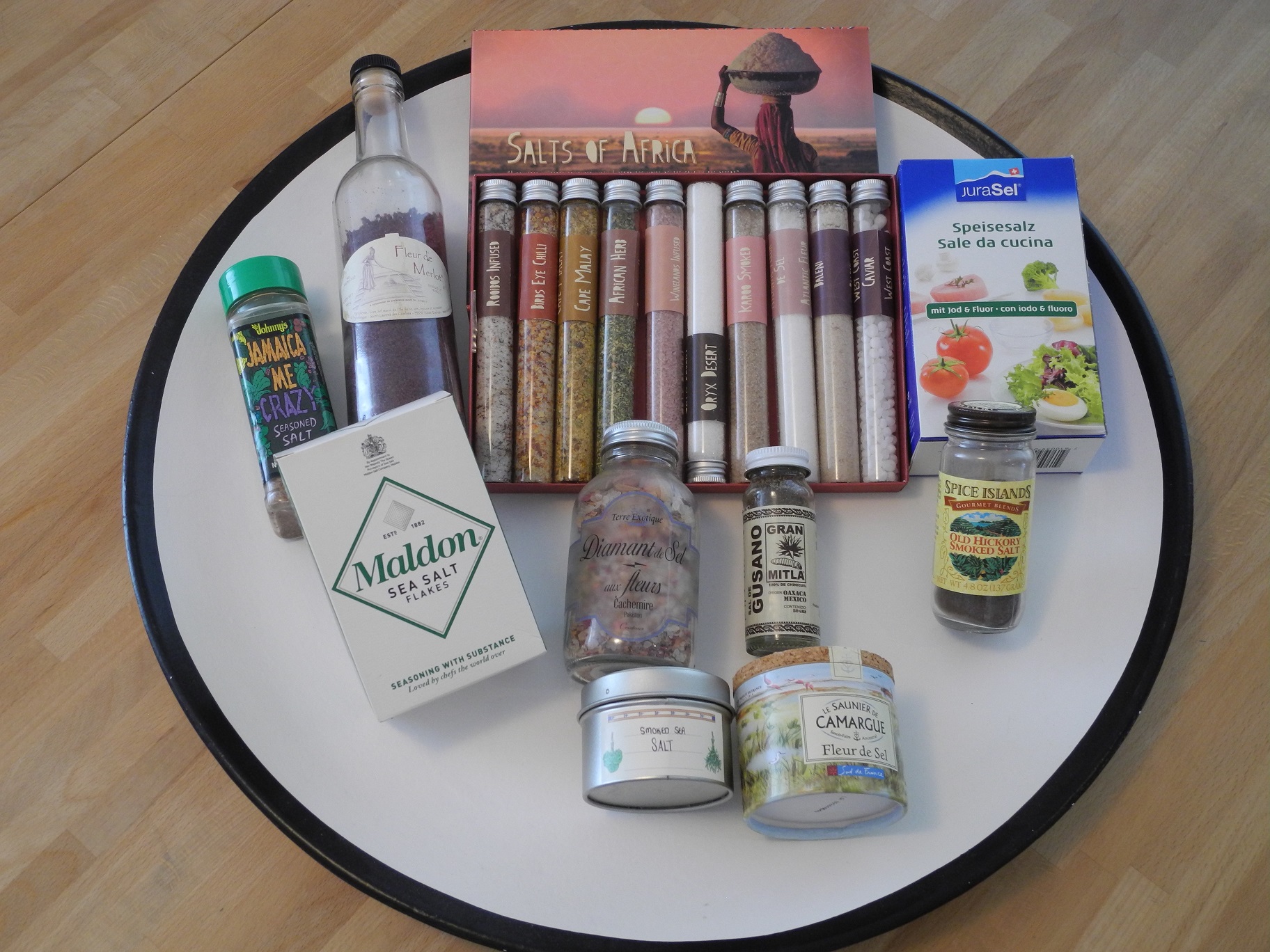
The variety of salts found in my own kitchen

Sea Salt is just that – from the sea, including traces of algae, salt-resistant bacteria and also sediment impurities.

Bamboo Salt (Jukyeom) is prepared by roasting salt in a bamboo container plugged with mud at both ends; it absorbs minerals from the bamboo and the mud, which in turn adds a distinct flavour to the salt.

Celtic Sea Salt, also known as grey salt (from French, sel gris), is harvested by raking salt crystals off of the bottom of tidal pools along the coast of France. It’s got a distinctive briny flavour.

Fluer de Sel (Flower salt), is another tidal salt from France, but its crystals are paper-thin flakes taken from the water’s surface. Because of the labour-intensive harvesting, it’s known as the “caviar of salts” as it is the most expensive salt on the market (1 pound of salt can be $20). Any salt harvested from the water’s surface creates flakes, so there are less expensive varieties available.

Kosher, or kitchen, salt is coarse-grained and non-iodized and used for things like cooking or pretzel-making.

Pickling salt has a very fine grain to speed up the dissolving process in cooking or brining.

Gourmet salts often have other spices or elements added or infused into the salt grains.

Kala namak (Nepalese for black salt) is a Himalayan salt that’s been packed into a container with charcoal, herbs, seeds and bark, then fired in a furnace for a full day before it’s cooled, stored and aged. This process gives it a distinctive reddish-black colour, a pungent, salty taste and the faint sulphurous aroma of eggs, which lends vegan dishes the taste of egg.

Pink Himalayan Salt is rock salt mined in the Salt Range mountains of the Punjab region of Pakistan, and the colour comes from trace impurities found in the soil, ranging from transparent to beet-red. It is comparable to table salt in taste, though it lacks the health benefits of the latter. This salt is especially popular as it is erroneously purported to have special health benefits for everything from reducing ageing, clearing up sinus problems, to increasing bone strength and even more dangerous presumptions – a modern-day snake oil medicine. It is fine as a supplement to, but not a replacement of, our salt intake.

Hawaiian Black Lava Salt is a sea salt harvested from the volcanic islands of Hawaii, and it gets its deep, black colour from the additive of activated charcoal. Alaea Salt is an unrefined red Hawaiian salt; its colour comes from the reddish, iron-rich volcanic clay called alaea, and it adds a robust flavour.

Persian Blue Diamond Salt is extracted from salt mines in the Semman province of ancient Persia (now Iran). Mineral deposits add small flecks of blue to some of the crystals, giving it its name.

Smoked Salt is slow-smoked up to two weeks over a wood fire of hickory, mesquite, apple, oak or alder wood, and it adds a smoky flavour to dishes.

Cyprus Black Lava Salt comes from the Mediterranean Sea. These crystals are formed through natural evaporation; mixed with activated charcoal, the grains look like miniature pieces of charcoal and have a very mild salt flavour.

Red Wine Salt comes from France (where else?); I have one called Fleur de Merlot. It is a coarse-grained salt mixed with wine and then allowed to evaporate, infusing the salt grains with a dark red wine flavour. It goes well with robust flavours with which you might serve Merlot wine.

New Zealand Lake Grassmere Salt: Seawater from the deep is brought to seaside ponds surrounding Lake Grassmere in New Zealand, and at the end of the summer, salt crusts are lifted from the bottom of the ponds.

In some cultures, salt is not a staple condiment, replaced instead by high-sodium ingredients that fulfil the function of salt: Soy sauce, fish sauce, or oyster sauce, to name a few. I cook a variety of dishes, and all of these have their place in my kitchen; you can’t cook an authentic-tasting Asian meal without them.

There are probably thousands of types of salt in the world; each one has its own distinct colours and flavours due to the mineral deposits that seep into the water before or during the evaporation process, or because of additives such as wine, crushed tequila worms, rosebuds or herbs.

Because salt is used as a preservative, many processed foods include it. Over-consumption of salt can lead to health problems – just think of a salt-brined fish, and apply that principle to your organs to get an idea of what happens. I use processed foods sparingly – mainly things I cannot process myself, such as canned tuna. Be aware also of the amount of salt included in spice mixtures; it is hidden in most pre-made items (unless sugar is used as the preservative – but that’s another story). The best way to control your salt intake in a day is to eat fresh fruits and vegetables, and make things like spice mixtures and batters from scratch – that way you’ll know exactly what you’re putting into your body!

The next time you reach for the salt, pause a moment and consider where it came from: It could be from the ocean or from a salt mine deep in the earth; it could be from a tidal pool bottom or top or the scum of a pond. It could have intentional additives or random mineral impurities that add to its flavour. Even the humble salt crystal, when seen under a microscope (below), takes on a grandeur that has the thumbprints of a grand Designer.

10 Comments

Filed under Articles, Etymology, History, History Undusted, Riddles, Science & Technology

History Undusted: Lammas Day

Did any of you celebrate Lammas Day this past Thursday, 1 August?  The original Thanksgiving day, Lammas has a centuries-old tradition in some English-speaking countries.  “Lammas” comes from the Old English hlafmæsse, meaning “loaf mass”, and was a celebration to give thanks for the harvest.  Everyone would bring a loaf of bread to the church on that day, made from freshly-harvested wheat; it would then be blessed by the minister as a symbol of giving thanks for the entire harvest.  Perhaps this is the Eucharistic overtone admitted by J.R.R. Tolkien* in a private letter concerning the Lembas Bread of the Elves; this bread might have been based on Hardtack texture-wise, but the name itself is a  clear nod to Lammas. 

In the Anglo-Saxon Chronicles, it’s mentioned several times, where it is referred to as the feast of the first fruits. To read more about this celebration, click on the image below.

And before I close, I will also say, “Happy Birthday, Switzerland!”  Thursday was also our Founding Day, the first being in 1291.  It was perfect weather for fireworks, and we enjoyed the displays of towns and villages from our flat!

Breads, Harvest, Lammas Day

*Carpenter, Humphrey, ed. (1981), The Letters of J. R. R. Tolkien, Boston: Houghton Mifflin, ISBN 0-395-31555-7


Originally posted on 1

12 Comments

Filed under Articles, Etymology, History, History Undusted

Wallace Hall of Heroes: Margaret MacDonald Mackintosh

After our holidays in Lugano, mentioned in the last post, I went to Scotland with my husband for a five-day whirlwind visit with friends. Spending time together with them morning and evening, we took day trips out in between and were able to see astonishingly much in that short time!

One of the things we went to see was the Wallace Monument, near Stirling; we trekked up the steep, narrow spiral staircase to the top, stopping along the way at each of three levels before reaching the top (with a stunning view). One of the levels was called the “Hall of Heroes”: Filled with marble statues of Scottish scientists, politicians, shakers and makers of the past centuries, without exception, they were all men. Until this year. Two statues of women have been added, along with 6 pillars of women who were chosen by a panel of judges from among the long list of Scottish women who have been influential in Scottish history.

As the saying goes, “Behind every great man, there’s a great woman”. Many of these women were ignored by history, which is more often than not written down by men, from a man’s perspective, for a man’s world. I’m not a feminist by any stretch of the imagination; but I do have a strong sense of justice, and I am a woman who has often been overlooked and marginalized by society, by prospective bosses, and by mentalities that belittle women solely based on gender. So I take pleasure when I see women from the past being acknowledged for the contributions they’ve made, and I take special pleasure in “undusting” their history for you here on my blog. With that said, here’s the first:

How many of you are familiar with Charles Rennie Mackintosh? Perhaps not the name, but certainly the distinctive art style he is known for:

Charles Rennie Mackintosh Rose

He is frequently claimed as Scotland’s most influential and distinguished artist, yet he once reportedly said of his wife (whom he married on 22 August 1900), “Margaret has genius, I have only talent.” If you look at her own work, you see that she was the main inspiration behind his more simplistic designs; the famous “Mackintosh rose” is clearly seen in her works:

This slideshow requires JavaScript.

Margaret MacDonald Mackintosh, born 5 November 1864, was part of what was known as the “Glasgow Four”, which included her sister Frances, Herbert MacNair, and Charles Rennie Mackintosh, and during her lifetime, she was recognized for her defining influence in the “Glasgow Art” style of the 1890s, during which period she and her sister opened an art studio together (the MacDonald Sisters Studio at 128 Hope Street, Glasgow) – at a time when women were still very much expected to get married and live a quiet life in submission to a husband. Though she was known and respected in her own lifetime, consequent generations have forgotten her genius; for instance, Charles was famous as an architect, yet in a letter to his wife he wrote, “Remember, you are half if not three-quarters in all my architectural work.” Her interior designs (often mixed mediums, including the use of gesso, beads, metal and textiles) made his buildings typically “Mackintosh”, yet there is not a single mention of her in an article about Mackintosh architecture on a website devoted to architectural design, though they had ample opportunity to give her deserved recognition.

Margaret MacDonald Mackintosh - Interior Design for a Music Room

Margaret MacDonald Mackintosh – Interior Design for a Music Room

Between 1895 and 1924, she contributed to more than forty European and American exhibitions. She exhibited with her husband at the 1900 Vienna Secession, where her work could arguably be described as an influence on the Secessionists Gustav Klimt and Josef Hoffmann, yet again, she is ignored posthumously.

Ill health decreased her artistic output from around 1921, and she passed away in 1933, five years after her husband’s death. Her artwork lives on, and I hope her legacy earns equal recognition with that of her husband’s as times change, and the women of history begin to receive the recognition they truly deserve.

6 Comments

Filed under Articles, History, History Undusted, Research, Snapshots in History

Calligram # 1: Ticino

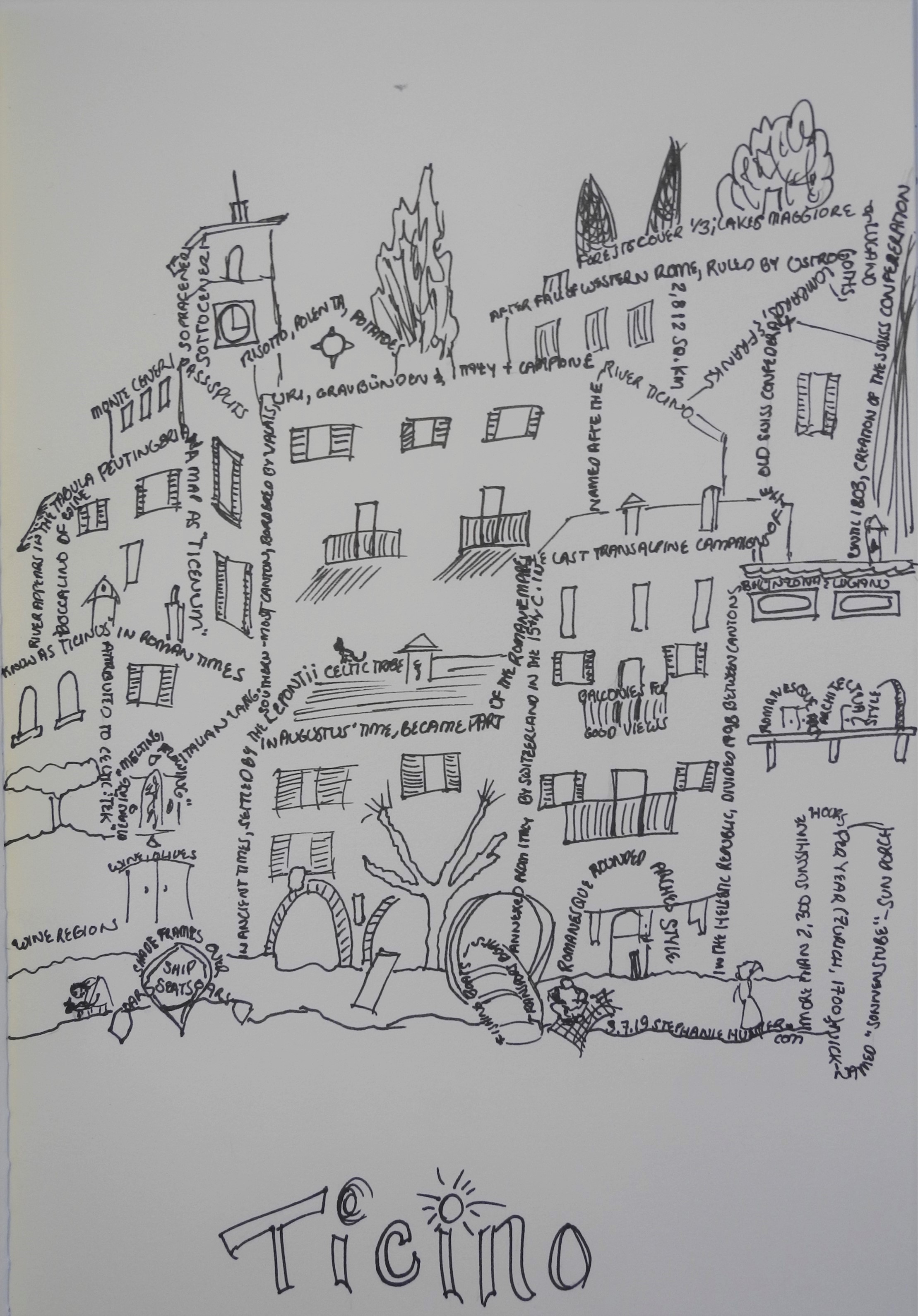
For those of you unfamiliar with calligrams, they are images created out of spatially-arranged text, usually related to the image they create.

I began doing calligrams several years ago, and enjoy the “bite-sized” research involved in gathering facts, history and general information about a subject. The first one I made was probably a Viking ship or the wassail tree; the latter, I accidentally found being used as the back cover design of an art magazine online out of Romania; I asked them to attach my web address and credit the image to me, and they did so, but it taught me a valuable lesson: embed my name into the calligram!

Below is one that I did recently while on holiday in Lugano. You’ll hear more about that soon, but in the meantime, enjoy this calligram!  Just click on it to enlarge it. The image itself is based on a vintage postcard collage.

If anyone would like to use this in any way, please contact me through the comments below; whenever using any image, please give credit – whenever possible – where credit is due!

Ticino Brighter

6 Comments

Filed under Articles, Calligram, History, History Undusted, Images, Publications, Research, Writing Exercise

A Rabble of Animals

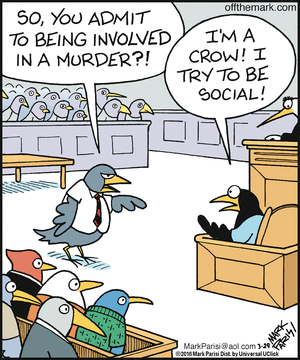
Collective Noun - Murder of Crows

Did you know that a group of vultures has a sense of humour? Or at least the people who decided to name them did (likely back in the 16th century, when a slew of collective nouns emerged): While hanging out and doing nothing, vultures are called a committee. When feeding, they’re called a wake. There’s irony in them thar’ varmints.

Some collective nouns are common sense, and others simply common, such as packs of wolves, flocks of birds or herds of cattle; but did you know that lice flock, and sea urchins form herds, too? If I say swarm, you might think of flies or gnats or even minnows; but you could use the same word to describe a group of eels.

Worms bed, dotterels trip, cheetahs form a coalition, and Hippopotami bloat. Rhinoceroses either crash or form a stubbornness, while skunks stench and squirrels scurry. Jellyfish smack, brood or fluther, while oysters bed and goldfish glint or create a troubling. Butterflies flutter, swarm or kaleidoscope; caterpillars army, while grasshoppers cloud.

There are some fun combinations: Crows murder (they also gather as a storytelling or a parcel), Flamingos flamboyance, guillemots bazaar, gulls screech (don’t they, though?), and hawks kettle (flying in large numbers) and boil (two or more spiralling on an updraft). Hummingbirds charm, as do Magpies (unless they murder), and owls and rooks hold a parliament – I’d trust them to do so more than most politicians. Peacocks muster, ostentation and pride, while penguins tuxedo or huddle (I kid you not). Young penguins gather in a Créche, just like human toddlers, and seagulls squabble.

Starlings form beautiful murmurations and chatterings, while swifts scream and tigers ambush. I’d love to see a zeal of zebras, but not so much a prickle of porcupines. Whales pod while trout hover and stingrays fever; snails walk, frogs knot and, believe it or not, rattlesnakes rhumba! Elephants gather as a memory, while deer gang and bucks clash, and gnus form an implausibility. Running into a mob of kangaroos might be quite pleasant, but not an intrusion of cockroaches!

There are hundreds more such collective nouns; English is an ever-changing language, but some things are just too good to allow them to go the way of the Dodo, so add a few more colourful expressions to your language, and enjoy the idiosyncrasies of English!

I’ll just add that, by now, my grammar-checking program is having a nervous breakdown.

Leave a comment

Filed under Articles, Cartoon, Grammar, Humor, Lists, Nuts & Bolts, Research

History Undusted: Earrings in the 18th Century

I recently watched the film “Emma”, with Gwyneth Paltrow and Jeremy Northam; as the proposal scene was playing, I noticed her earring and wondered if that was historically accurate – did they have pierced earrings in England at that time (the early 1800s)? I’m not into fashion (that’s an understatement – I’m very pragmatic when it comes to clothes!), but the historical aspect fascinated me enough to look into the matter.

While we have probably all heard of “Girl with a Pearl Earring”, painted ~1665 by Johannes Vermeer (doubts have been raised as to whether it is actually pearl or rather polished tin or coque de perle, given the reflective qualities and size, but that’s another issue), it is a Dutch painting from the 17th century and thus doesn’t answer my question. My interest lies more in the 1700s (18th Century) of Britain, and so I began researching 18th C. English portraits.

I discovered that, while there are many portraits with earrings displayed, there are far more without. So it would have been possible, but was by no means as common as it is today. Also, sometimes the current hairstyle hid the ears, such as that of the 1770s and 1780s, or perhaps their ears were hidden by the custom of married women wearing mob caps, even beneath other “public” hats.


Mid-to-late 1780s

Typical 1780s hairstyle; such a style would have either hidden earrings or made them obsolete.


Mrs. Lewis Thomas Watson (Mary Elizabeth Milles, 1767–1818) by Sir Joshua Reynolds, 1789

A married woman wearing a mob cap under her bonnet (though from the black cape and hat combined with a white dress, she may be at the end of a period of mourning, wearing “half weeds”). Mrs Lewis Thomas Watson (Mary Elizabeth Milles, 1767–1818) by Sir Joshua Reynolds, 1789


The portraits do not reveal whether or not they were merely clip-on earrings or studs, though ear piercing has been around for centuries, varying in intensity and use from culture to culture (some for religious purposes, some for ownership such as slave earrings, and others were status symbols for royalty or nobility). I’ve found many portraits from Europe as a whole, between the 16th and 19th centuries which portray women wearing earrings; here are a few, with their details:

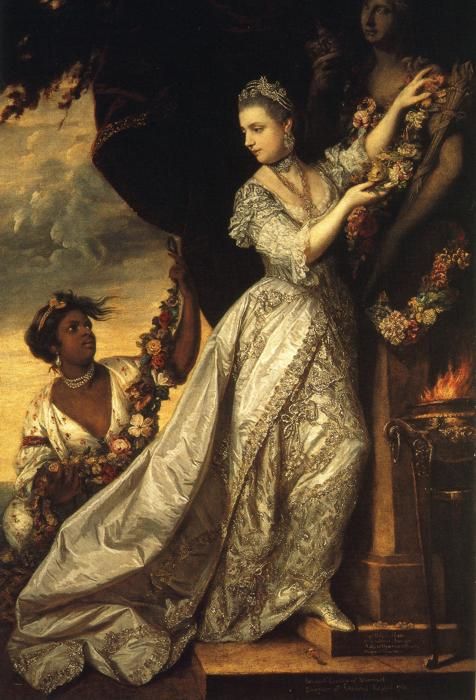
1761 Joshua Reynolds. Lady Elizabeth Keppel

1761, by Joshua Reynolds: Lady Elizabeth Keppel. Note that the Indian woman is also wearing an earring(s), and a rope of pearls; I don’t know whether she is portrayed as a servant or merely inferior in rank, due to her placement in the portrait…


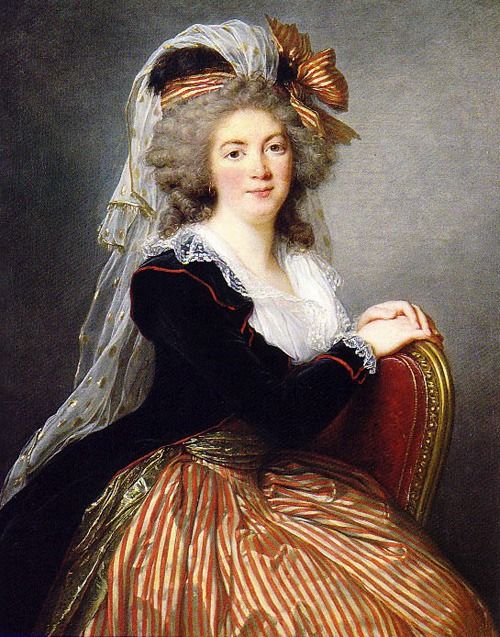
Genevieve-Sophie le Coulteux du Molay, 1788 by Elisabeth Louise Vigee Le Brun

Genevieve-Sophie le Coulteux du Molay, 1788 by Elisabeth Louise Vigee Le Brun. Though this is a French portrait by subject & painter, it is from the period in question and displays a hoop earring, as well as the hairstyle common in this period in England as well.


Turkish Dress c1776 Portrait of a Woman, possibly Miss Hill

Turkish Dress, c1776 Portrait of a Woman, possibly Miss Hill


Young Woman in Powder Blue, ca. 1777

A young woman in powder blue, ca. 1777


Thomas Gainsborough, 1727-1788 London, Portrait of Lady Anne Furye, née Greenly - born 1738

Thomas Gainsborough, 1727-1788 London, Portrait of Lady Anne Furye, née Greenly


Based on History Undusted Original Post, June 2015


4 Comments

Filed under Articles, History, History Undusted, Images, Links to External Articles, Research

History Undusted: Look, Ma – No Ropes!

Many men risked their lives, back in the days before safety finally became standard, to construct the world’s skyscrapers. The first image below is one of those daredevils who captured such moments on film for posterity. His name was Charles C. Ebbets, and he was himself an adventurer, stuntman, actor, wing-walker and photographer. If you’d like to know more about him, his daughter has set up a website to document his life and pictures; click here. Meanwhile, enjoy the images below – even if it’s just with morbid curiosity (if you’re afraid of heights, take a deep breath first).


Charles C Ebbets, Photographer of Skyscraper images in the 1930s

Charles C. Ebbets

Charles C Ebbets, waldorf-astoria, Bettmann Archives, Corbis

Charles C. Ebbets’ “Waldorf, Astoria”, © Bettmann Archives, Corbis

Charles-Ebbets-Laurel-and-hardy-Bettmann Archives, Corbis

Charles C. Ebbets’ Laurel and Hardy, © Bettmann Archives, Corbis

Construction - Charles C Ebbets, Lunchtime atop a Skyscraper

Charles C. Ebbets’ famous “Lunchtime atop a Skyscraper”

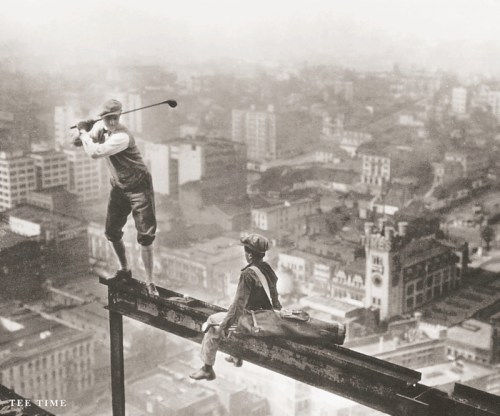
Construction - Charles C Ebbets, Tee Time, copyright Bettmann Archives, Corbis

Charles C. Ebbets’ “Tee Time”, © Bettmann Archives, Corbis

Construction - Photographer, 1907, sitting at the top of a column of a new building

Unidentified photographer, 1907

Construction worker painting the Eifel Tower - March 28, 1953, CSU Archives, Everett Collection

Worker painting the Eifel Tower, 1953

Construction workers building the Golden Gate Bridge

Construction workers on the Gold Gate Bridge

Construction workers on lunch break on the edges of the building they're working on, London, 1929

London, 1929


5 Comments

Filed under Articles, History, History Undusted, Images, Snapshots in History

The Long and Short

It’s been nearly 3 weeks since I last posted, for which I apologize. Sometimes life just takes over, and my mind gets going in several different directions; when that happens, it’s hard to focus on writing a blog that’s worth its content, and I don’t want to post just to post. It needs a purpose.

In my post about cutting my nails, I told you that I’m getting down to serious writing. It’s been an interesting process, as I’m actually writing two manuscripts at the moment – one from the perspective of the heroine, and the other, the villain. But as any villain will tell you, they are the hero of their own story; I started writing from the second POV to develop the character and decipher the plot ins and outs through that back door, so to speak – if I don’t have a clear grasp on the villain and their motives, this particular plotline won’t work.

But in the meantime, life has intruded (so rude of it) several times; I’m involved in leadership teams in our church, so that’s taken quite a bit of time in this phase of our growth; my husband and I also went away to the Alps for a long weekend this past week, and while it was enjoyable, I didn’t sleep much – and I didn’t have my laptop with me to work when I couldn’t sleep. [Sleep is a whole other kettle of fish; I’ll just say that I don’t sleep horizontally, as it’s too painful.] So, to pass the time, I watched stars or wrote short stories.

I started writing short stories several years ago – just as a hobby, really; but this year, I decided to take it to the next level – competitions, and looking into anthologies. My mother has been sending me helpful links in the latter category, and in the former, I have a whole list of month-by-month due dates that I could target. If I miss the deadline for a particular competition, I can still write a short using their criteria, for practice as well as having something ready the next time.

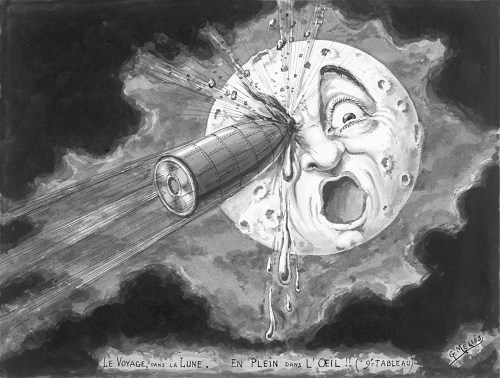
Part of my writing “time” has been spent trying to figure out a way around the monopoly that is Amazon. Basically, that’s been nothing but frustration. I used to be able to order paperback books through CreateSpace, at author’s cost, and have them shipped to Switzerland. They no longer ship here, because apparently, we’re now behind Timbuktu. Authors in other countries can buy author copies; basically, anywhere except Switzerland, Liechtenstein, and “some regions in Germany”. That’s a quote from a reply to my enquiry. How does one region of Germany differ from any other, I ask (rhetorically)? There is no longer a Berlin Wall – or does Amazon not realize this yet? If I could shoot Amazon to the moon, I would do it in a heartbeat. Any suggestions? I wonder if they sell rocket fuel?

Rocket in the Moon's Eye

7 Comments

Filed under Articles, Musings

Cutting My Nails

I know that’s an odd title, but it will make sense in a minute!

You know the feeling when you have a big project looming; it might be a household chore, such as cleaning the cellar, or a work project that just needs undivided time. If you’re like me, you think about it long before it actually happens; but there comes that moment when you make the decision to tackle it. Perhaps to do so, you need to make a purchase (like clear plastic boxes to help you organize the cellar), or something needs to happen before the project begins, but once you’ve done that something, it will happen.

Nail Art Inspiration

What my nails looked like until yesterday. Photo credit: Instagram 8715

Well, that’s where cutting my nails comes in: I have very hard nails; cutting and filing them takes about an hour, and usually, I can’t be bothered so I let them grow, keeping them oval-shaped as they go. I enjoy doing nail art, so I’ve been experimenting (this photo was my inspiration when I painted my [longer] nails last week, and it came out looking exactly like the image, minus the cool ring!). But long nails also kill my keyboards – I’ve at length (no pun intended) resorted to keyboard letter stickers; as long as the keys still work, other people can find their way around my keyboards. Even at that, when writing a novel, I go through a keyboard a year (e.g. the letters stop working).


Lately, I’ve been working on short stories, and doing a bit of “spring cleaning” in my writing files – projects half done (what I call my “PHDs”),  ideas that want fleshing out, etc. and so I haven’t had to cut my nails. But now I’m getting ready to tuck into my next novel – this time science fiction. And so, today, I cut my fingernails. For me, it’s an act that means I’m serious about this project; in my mind, it moves from “hobby” to “profession” by that simple act.

Maybe there’s a project you want to work on, but something’s keeping you from digging into it. I write this to encourage you to go for it! Take that step, whatever it is, that’s between you and getting down to brass tacks about your goal. Cut your nails; clean off your writing desk to eliminate distractions; buy those boxes if you need them; simplify life; get rid of the clutter that keeps you from your goal. Then enjoy that sweet moment when you reach that goal, or begin a new chapter in your life, figuratively or (as in my case) literally.

9 Comments

Filed under Articles, Musings