Happy New Year, everyone! As usual, January starts off with a bang of busy catch-up; for me, perhaps more than normal, as I was sick the whole month of December (bronchitis) and had to push appointments forward. Let me back up a moment to explain what also happened leading up to December:
At the end of October, we realised that our elderly cat, Allegra, was tired of life; she’d been sick for a while, but we’d managed with daily pain meds, and she was happy and active – until about mid-October, when she began doing little more than sleeping. We said our goodnights on 3 November, leaving us with 2 cats: Andromeda, 5½, whom we adopted from a local animal shelter, and Mira, 5, whom we adopted from a private family when she was old enough to leave her mother. We knew we wanted three cats, so mid-December, we returned to the same animal shelter and adopted Callisto, born end-August 2025. He has two speeds: Whirlwind and cuddle. Since around day 4 of his being here, he and Adromeda have been fast friends, playing, sleeping and snacking together.
A problem emerged with Mira, who would go out of her way to attack Callisto – when she wasn’t staring at him and stalking him incessantly. Fortunately, he has a sunny disposition and the attention span of a gnat, so it didn’t faze him! We thought Mira’s behaviour would taper off after a few days, but as the weeks went on, we realised that she was making it clear that she would be happier in a solo-cat home. She’d never really understood the body language of our other cats, anyway, and she’d never played with them; also, she doesn’t like surprises – and Callisto is full of them! We were quickly able to find her a good, loving home with some friends of ours who had lost their elderly cat and had not yet adopted another cat, so it was perfect timing! Mira is slowly coming out of her shell in her new home and starting to play again. Now to shake up our home once more and adopt another cat as soon as we can arrange it!
Between nursing a sick cat through to October, preparing all of my crafts for sale and being present at our annual Advent market, then being sick for a month, breaking up cat fights, and keeping an eye on an energy ball who is in that toddler phase of putting everything in his mouth – including electrical cables*, I haven’t had much focus or energy to write or edit; I don’t like wasting time, even when I’m sick, so I’ve been crafting – that’s free therapy…if you know, you know! [* We were sitting at breakfast the Sunday before Christmas, when half of our tree lights went dark; a cable shred was swinging helplessly as Callisto began to move on to the other cable! Our first deed of the day was to wrap as many cables as we could in chew-guard tubes!]
I hope your 2026 has started off well, and I look forward to what this year will bring!
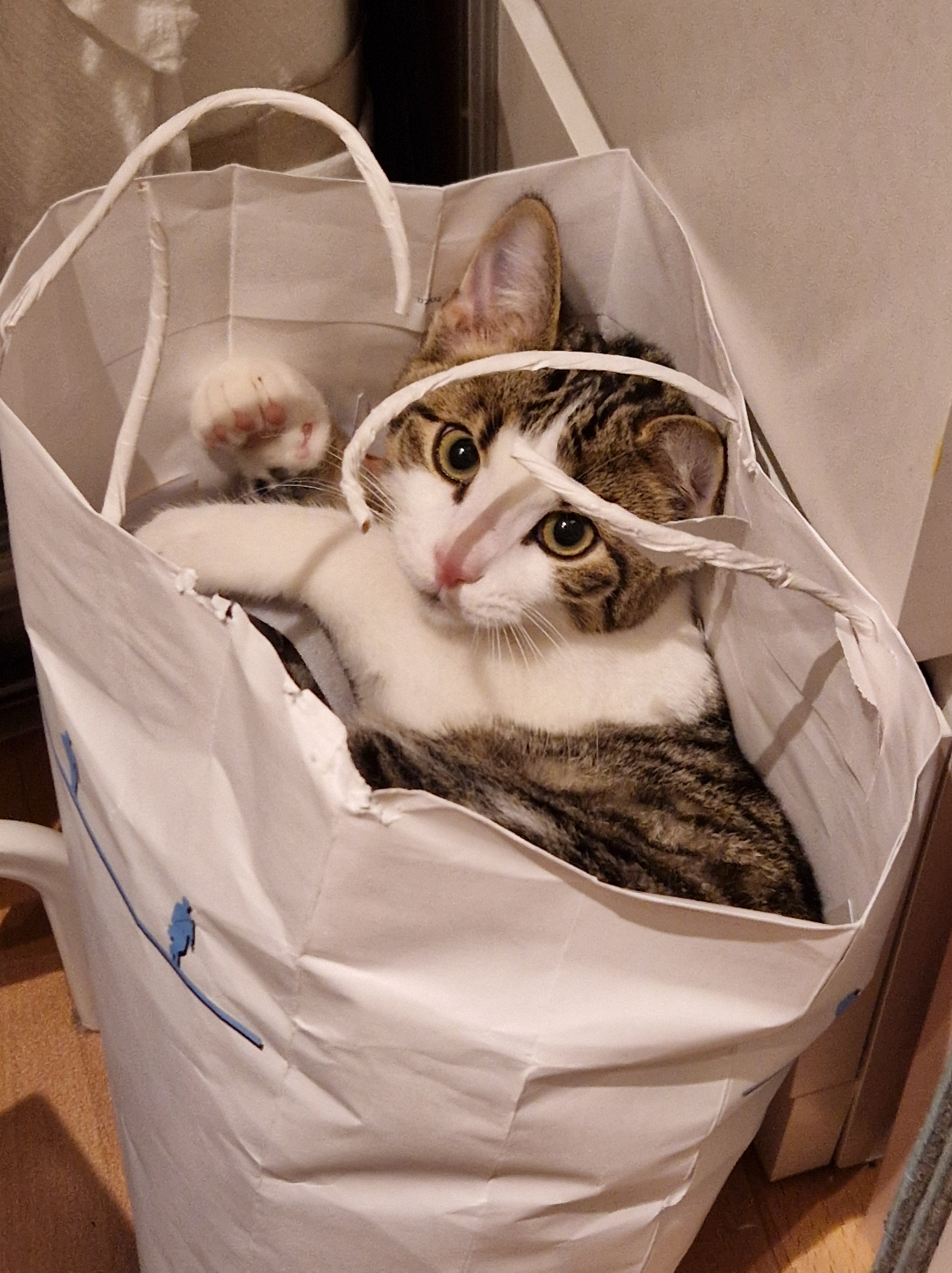
The whirlwind, Callisto, dismantling my craft room’s paper recycling bag one piece at a time…
You know how your brain fires off random thoughts as you fall to sleep, or combines odds-bods into dreams forgotten as soon as you wake up? For some reason, 10-4 popped into my head in those moments last night. It sent me down the rabbit hole I now present: The history of the CB radio.
The often-forgotten or overlooked inventor of the Citizen’s Band (CB) radio system, along with inventions such as a patented version of the walkie-talkie (originally invented by the Englishman Donald Hings), the telephone pager, and the cordless telephone – all precursors to today’s cell phones, was Al Gross (1918-2000): Born in Toronto, Canada, he grew up in Cleveland, Ohio. The son of Romanian-Jewish immigrants, his love for electronics was sparked when, at the age of nine, he was travelling by steamboat on Lake Erie; he explored the ship and ended up in the radio transmissions room, where the operator let him listen in. Eventually, he turned the family’s basement into a radio station built from scraps. During his higher studies, he experimented with ways to use radio frequencies.
During World War 2, he had some involvement with developing a two-way VHF air-to-ground communications system for the U.S. Office of Strategic Services, known as the Joan-Eleanor system, and after the war, the Federal Communications Commission (FCC) allocated a few frequencies for the Citizens’ Radio Service Frequency Band, in 1946. Gross saw the potential and founded the Gross Electronics Co. to produce two-way communications systems to make use of these frequencies; his firm was the first to receive FCC approval in 1948. For more about his other inventions, just follow the link on his name above. For now, let’s focus on the CB:
The CB radio became an international hit back before cell phones and computers became a thing (despite the prevalence of cell phones, CBs are still around; truckers still communicate about road conditions, etc. Its usage was also revived by the Covid lockdown, when people began reaching out to meet and talk to others outside of their own four walls). It was, and is, a way to communicate with others long-distance from home or on the go.
My dad was always interested in the latest technological gadgets; in the mid-70s, we got a laserdisc player, the precursor of CDs, and DVD/Blu-Ray players. I remember watching films like Logan’s Run and Heaven Can Wait on that format. Laserdiscs never really took off, and only about 2% of US households had one (it became more popular in Japan at the time). Around that time, we also got a CB radio in our VW van. My dad had a chart with all of the CB slang words and codes, and I memorised it, fascinated by the lingo. On long road trips, I would get on the CB and chat with truck drivers. My handle (nickname) was Spider-Fingers, as I liked spiders and had long fingers (long fingers has the connotation of thief, so I didn’t want to use that!). Here is just the tip of the iceberg, a smattering of the codes and slangs used by CB radio enthusiasts, truckers and handymen:
There were dozens of slang terms for law enforcement officers: Bear (police officer); bear trap (speed trap, radar trap) taking pictures, also called a Kojak With A Kodak; bear bait (an erratic or speeding driver); bear with ears (listening to CB traffic); bear in the air/flying doughnut/Spy in the sky (helicopter radar traps), baby bear (rookie), fox in the henhouse/Smokey in a plain wrapper (policemen in unmarked vehicles); honey bear, mamma bear or Miss Piggy (slangs for female police officers); Brush Your Teeth And Comb Your Hair (a law enforcement vehicle is radaring vehicles – as if preparing for an official photo). A Driving Award was a speeding ticket. To wish someone Shiny side up meant that you wished them safe travels (keeping the vehicle upright).
There were slang terms for objects or events, such as Bambi, meaning that there was wildlife near the road and to take precautions; a crotch rocket was a fast motorcycle; double-nickels was a 55-mph speed limit area; a fighter pilot was an erratic driver who switched lanes frequently, while a gear jammer was someone who sped up and slowed down frequently; Alabama chrome was duct tape; an alligator/gator was a piece of blown tire on the highway, as it looked in the distance like a gator sunbathing. Convoys had front doors and back doors – the front or back truck in the group that would keep an eye open for bear traps. Motion lotion was fuel; the hammer lane was the fast lane (hammer was the gas pedal, and to hammer down was to drive full-speed). Break/breaker: Informing other CB users that one wanted to start transmission on a channel; a handle might be introduced, or requested if someone was looking for a CB friend. “Breaker, this is Spider-Fingers, over.” Asking for a comeback meant that you couldn’t hear the last transmission or wanted the other driver to talk. Break check meant traffic congestion ahead, slow down. A Bumper Sticker/hitchhiker is a vehicle that is tailgating another vehicle.
Aside from hundreds of slang terms, there was a whole list of codes (I guess you could say that the codes were the precursors of emojis!):
10-4: Agreed, understood, acknowledged
4-10: The opposite – asking for agreement or if a transmission was received.
10-6: Busy, stand by
10-7: Signing off
10-10: Transmission completed, standing by (you’ll be listening)
10-20: Location – What’s your (10-)20? Home-20 was asking for a driver’s home location/base.
10-33: Emergency traffic, clear the channel. CB code for Mayday for trucks and police cars.
10-42: Accident on the road
3s and 8s: Well wishes to a fellow driver. Borrowed from amateur ham radio codes “73” (best regards) and “88” (hugs and kisses).
The lists go on and on! I love the dry sense of humour reflected in the slang, and I think our everyday language could be a bit livelier if we included a few phrases that looked at things from a different perspective. Everyone could do with more 3s and 8s, 4-10?
This week’s topic arose from a conversation with my husband; we were discussing a temporary fix we had made at his mother’s home to make something usable until we could find a permanent solution. I said that we had “MacGyvered” it, and he had never heard the word before. That led me down a rabbit hole to naval flags, a card game, and British tele.
First, MacGyver: Though I knew the term, I had no idea what its origin was. The name comes from the eponymous character in a US television series that ran from 1985 to 1992; Angus MacGyver was a non-violent, resourceful genius, and his favourite tool was, of course, a Swiss Army knife. Though I was living in the States at that time, its running years explain why I didn’t know of the origin: In 1985, I was in college, having finished high school a year early (I took my final two years in one); I was too busy to watch television. In 1986, I moved to Hawaii to do a Discipleship Training School (DTS) with Youth With A Mission (YWAM), and went from there to the Philippines, where we worked in the red-light district of Olongapo. 1987 was a year of multiple jobs, earning money and hanging out with college friends – again, TV was not a priority. In 1988, I emigrated to Scotland.
The traits mentioned above made MacGyver a verb; when something is “MacGyvered“, a simple yet elegant solution to a problem is employed by using existing resources. At my mother-in-law’s home, we needed to level a new microwave that was sitting tilted atop the welded inserts that fit the original one. Our solution was to use an actual leveller, removing the end caps to make it fit inside the metal frame.
Now, down the rabbit hole: In the time of British ships of sail, when a blue flag with a white square or rectangle in the centre flew alone, it served as the sign for imminent departure (signifying P, leaving port); any passengers and crew in port would then return to the ship. The flag came into use in 1777, and by the turn of the century had become known as the blue peter. I have my suspicions that the term may have come from the card game of whist, in which a strategic manoeuvre known as the “blue peter” calls for trumps by throwing away a higher card of a suit while holding a lower one. No one can say for sure which came first, the ship or the card, so to speak, but the connection is likely.
The British children’s television programme, Blue Peter, first aired on 16 October 1958; the name was inspired when Owen Reed, the producer, was inspired by a radio programme for children (produced by Trevor Hill) that began airing on television once a month; it was launched aboard the MV Royal Iris ferry on the River Mersey, Liverpool, with presenter Judith Chalmers standing at the bottom of the gangplank to welcome everyone aboard. Reed was so captivated by the idea, and with the blue peter flag, that he asked to rename the programme (then called the Children’s Television Club) and take it to London.
Blue Peter, catering to younger children, is the longest-running children’s TV programme in the world; over the years it has changed with the times, and its content is wide-ranging, but they still give a nod and a wink to that original blue peter flag by giving out badges in the shape of a shield with a blue ship of sail on a wave. It is awarded to viewers for achievements, efforts, or creative work. There are different levels of badges, with the gold badge being the most prestigious; this is usually given to presenters upon their retirement or to people who have accomplished something extraordinary.
Among other things, the show is famous for its segments of “makes” – demonstrations of how to make useful objects, or how to make something to eat. This is the element that linked the term Blue Peter to MacGyver in my mind, so now ya know!
What is something that you have MacGyvered? And do any of my British followers know if “Blue Peter” is used as a verb in a similar fashion? Please comment below!
My husband and I have a quirky sense of humour; we recently had a good laugh coming up with pets’ names in pairs (don’t ask why that topic came up – it’s too hard to reconstruct!): There are pairs of names commonly associated with each other, such as Tom and Jerry, or Cain and Abel; last night, we thought of naming two cats Maelstrom and Doldrum – the irony is that these are nautical terms for ocean conditions and we live in a land-locked country. My husband says that if we ever have a snake, he’ll name it “Abebambelela” (which is a Swiss German phrase meaning “to hang down”)! There are certain words that I find funny, like Asparagus (or the old English version, Sparrowgrass), and I can imagine naming cats something Latinesque, some of which are actually quite beautiful (Aurora, Adamaris, etc.)
Pet names are as creative as the owners, so the sky’s the limit! I once heard of a dog called Dillingham Osborn Gunderson… initials being DOG. Naming a pet Velcro, Big Mac, Groucho or Tweezer seems tame to some purebred titles (such as Bluewater Full Metal Jacket – Jack for everyday wear). When our cat had kittens (the mother, Gandria, and father, Caprino, were named after towns along Lake Lugano), we used musical terms (sticking with Italian): The first came out vocal, so he became Crescendo; the second was slow and calm, thus Piano; and the 3rd is gentle but friendly – Allegra. We kept Allegra, who is curled up between my feet as I write this; the other two were adopted by neighbours – who subsequently moved to give the cats more room!
I will never have a purebred pet; more often than not, the animals are sickly, as traits have been unnaturally bred into them; pugs and Persian cats are prime examples of pets that simply cannot breathe properly, and have respiratory infections or even failure. These health issues are hot topics between breeders and vets or those who care for animals such as the Kitten Lady. Give us a good ol’ farm cat, “Heinz 57-pedigree”, and they’ll do just fine! We have three cats: Allegra (born in 2009), Andromeda Zora (from an animal shelter, born in 2020), and Mira Bella (born in a home nearby, 2021).
Do you have any pets? If so, what are their names, and how did you choose them? Please comment below!
You’ve probably heard the saying, “When it rains, it pours” (or the British version, “It never rains but it pours”). The idiom refers to a series of unfortunate events occurring within a short amount of time.
I wouldn’t necessarily limit it to unfortunate events; sometimes they’re just inevitable occurrences or busy times. The latter two would describe my past few months: From mid-January to last weekend, one of our nephews was staying with us every weekend when he had time off from his basic military training; this 18-week period is mandatory here in Switzerland, but our nephew is half-Swiss, half-Mexican, and is currently living in South Africa, so he actually volunteered. Not only did he want to be near Swiss family and have the experience of being away from his home and in a camaraderie, but when he returns next autumn to begin university studies here, it would be easier for him to be accepted if he did so.
What that meant for us is that, though we really enjoyed having him here and spending time with him, the things that normally happen on weekends simply had no room, and the weeks were ultra-busy, leaving little time to tackle those things. When our nephew was here, the focus was on him; “Tia” (Spanish for “aunt”; Tio is “uncle”) was frequently heard. Laundry (tons of it!), cooking, shopping, meal-planning… they all happened much more frequently – he was a bottomless pit, as most teenage boys are. The first month or two were most intensive, as he had grown up with a maid – which he rapidly learned I am NOT. He learned a lot of “life lessons”, and about family house rules – things he’ll need to know when he finds a student flat-share; he learned to cook a few new meals, clean up the kitchen after himself, and how to cut his own hair. He learned that if he put his socks into the laundry bunched up into a ball, that’s exactly how he’d get them back – that, and we have no clothes dryer (only drying racks) – so timing on getting his clothes back clean and dry for the following week was a crash course. He learned to think about and change habits to reduce his environmental footprint.
My weekends were usually when I could plan, write and edit blogs. Because that time was either reduced or swallowed up entirely every weekend, some tasks took precedence; when I had time, focus and energy for writing, it went into getting my five books prepped for paperback release, and gradually getting them sent off for proof copies. So far, I’ve been able to release two of the five novels. The printer (who is either in England or in France) doesn’t ship to Switzerland (why do companies frequently act as if Switzerland is on another planet?!); it’s been a challenge getting the books to me – fortunately, some of our family lives in France, so they can receive it. Sometimes the packages are sent, sometimes carried by hand to closer family, sometimes handed off in car parks!
Two weeks before our nephew’s time here came to an end, we accidentally discovered that we’ve got a huge problem in our flat: Water damage coming from somewhere that will now require walls, floors, balcony tiles, windows and downstairs ceiling to be ripped out and repaired! Raining, pouring… For the past four years, repairmen have come and gone but none of them have gotten to the root cause. So this time, I’ll be watching them like a hawk and pestering them to push beyond their nose to find the actual cause, repairing that first! And that all begins this week.
After the past few intensive months, I’ve been trying to catch up on those things that, of necessity, were neglected, and those things I need to prepare for when our home is invaded by an army of repairmen – at least that’s what I’m imagining, though it will more likely be a steady stream of comings and goings, appointments, and cleaning up the aftermath of dust and debris…
And now that my schedule can resume a partial semblance of normal, I want to get back into creative writing – my next novel, as well as this blog! So many projects, so little time! But if a day had 40 hours, it would still not be enough to accommodate everything I’d like to do. Maybe it’s God’s mercy that we don’t have 40-hour days!
I’ve been preparing my manuscripts for new releases through a new publisher, and making crafts for our church’s annual craft sale; in the latter process, I’ve discovered a wealth of images through Pinterest (nothing new to me in itself). How many of you used to collect stamps, or postcards, or specific objects? For me, the new method is Pinterest. You can find stamps on any topic, and rare ones; you can find coins, bank notes, and just about anything you used to collect physically, now available at a click with historic backgrounds and full details you could never have fit into an album.
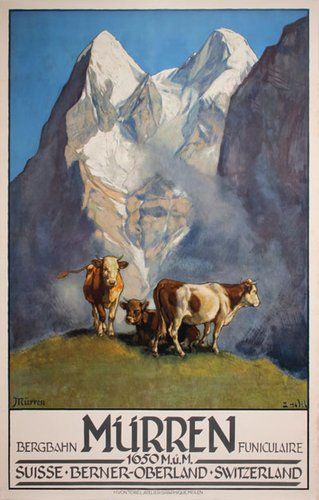
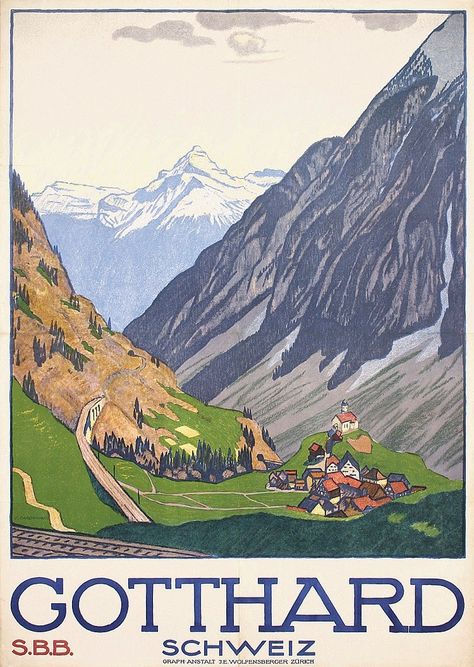
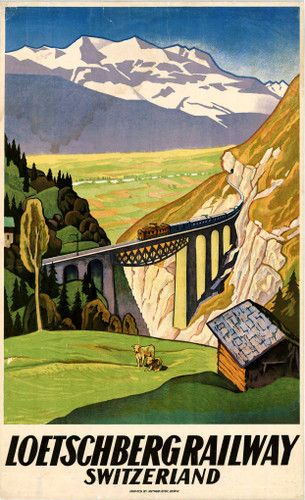
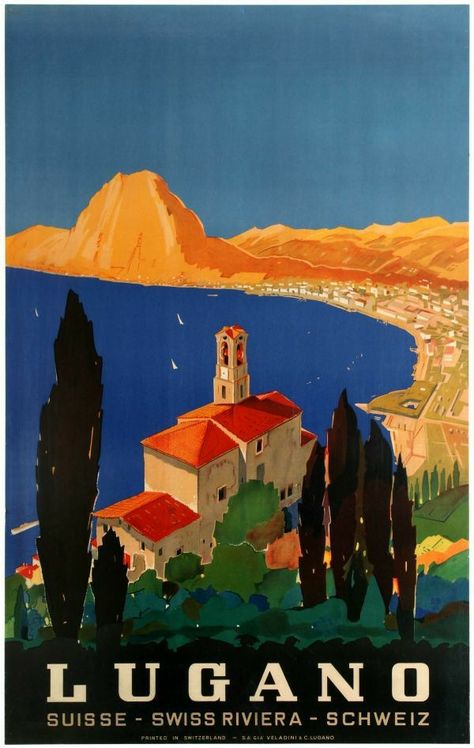
But today, I’d like to focus on Vintage travel posters, specifically for Switzerland. So far, I have nearly 350 in my collection, and it’s likely a drop in the bucket of what was produced; every region advertised itself to attract tourists or travellers, and it’s fascinating to see what they highlighted, how they did so, what their perspective was, and how the people dressed (if they’re shown – in Switzerland, at least, a big focus is on the Alps). Did you know that the word “homesick” in English came from Switzerland? The Swiss merchants that travelled abroad in the 17th century took the word with them; when they spoke of “Heimweh”, however, they weren’t referring to people, or their home, or even their town, but of the mountains. They missed the Alps when they were away… and I can understand why. I think it must run in the veins of every Swiss-born person; when my husband and his mother speak of the mountains, it’s a foreign language to me (even though I’m fluent in Swiss German!).
We might tend to think of tourism as a modern thing; but Grand Tours began in the 17th Century, when wealthy young men, and sometimes women, would embark from the UK on a European tour. At the beginning, Switzerland was a sleepy backwater in some ways – there were few, if any, hotels – if a traveller arrived in a town seeking accommodation for themselves, their servants, postillions and horses, they were often invited to stay in the home of the local politician, who likely had the largest house… But the Swiss soon caught up with the trend, and tourism became a vital source of income, especially for small settlements in the mountainous regions.
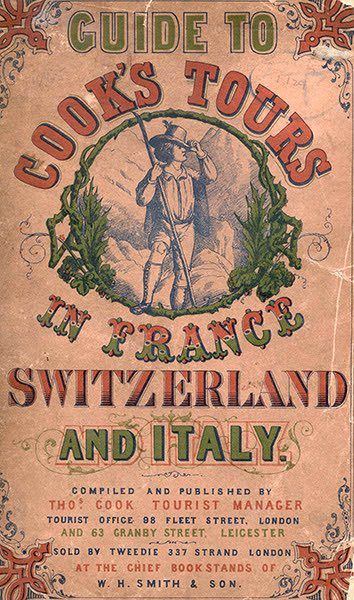
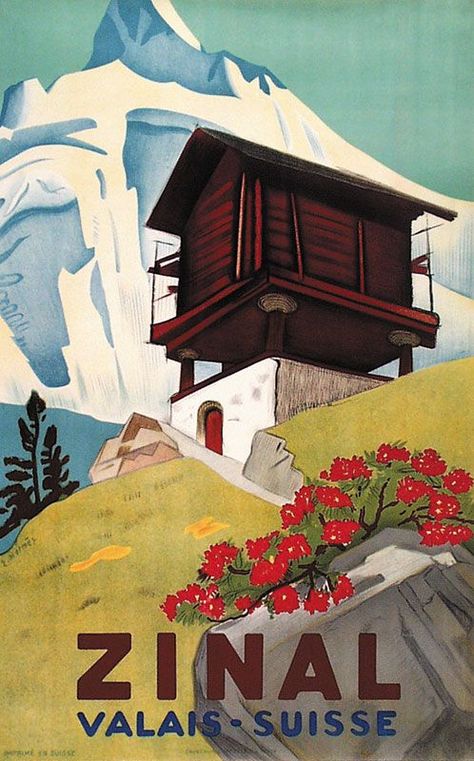
The three images below are, from left to right, from 1897, 1865, and likely the early 19th century. The house shown in the Zinal ad is typical of Wallis (Valais in French): It is built on stilts with round, flat stones between the pillar and house base; we chatted with an elderly man when we were on holidays in the region and asked him about it; it is a way to keep rats and mice out of the houses. It also means that the back, and sometimes even the front, is only accessible by ladder.
The 1865 poster is about a tour organized by Thomas Cook, a well-known name in the British travel industry even today; Cook took his first tour group of around 485 people on an 11-mile train trip from Leicester station to Loughborough, in 1841. Soon, he began to expand his scope, and by the 1860s, that included Switzerland.
The Spiez poster below shows the castle and lake; The Zürich poster shows a view over Lake Zürich from atop the Uetliberg mountain, the summit of which is called Uto Kulm. To see a live-cam panorama from that vantage point, just click here. The Mürren poster is a view typical of every Alpine pasture, even today.
The next 3 images are firmly in the Alps: The glacier shown in the first image is the Aletsch Glacier, the largest in the Alps, covering around 80 square kilometres (31 m2), with a length of ~23 km (14 miles) with a maximum thickness of ~1 km of ice. As with most glaciers in the world, it is retreating. Gotthard (officially the Saint-Gotthard Massif) is an impressive region connecting north and south Switzerland between Uri and Ticino, German- and Italian-speaking cantons, respectively. It has long been a major axis of Europe, with a road across, a vehicle tunnel through (built 1980), a cargo and transport train tunnel (opened 1882), and now a passenger- and vehicle-transport train tunnel which opened in 2016 and is the world’s longest railway tunnel and the deepest traffic tunnel, as well as the first flat low-level tunnel through the Alps. The 3rd poster highlights the Lötschberg, a massif with a train transport tunnel linking the north and south of Switzerland through the Berne and Valais routes. We often take this route when going to Valais or Ticino on holidays; the train is an open, continuous carriage, meaning you drive on, sit in your car, and watch the tunnel fly past.
The next 3 posters highlight something nearly ubiquitous in Switzerland: Lakes. They’re everywhere. We even share Lake Constance with Germany and Austria, and Lake Geneva with France. From border to border, we have over 100 main lakes and countless smaller ones (in an area what easily fits within the state of Maine, US, to give you a size comparison). The first poster is encouraging locals to explore, commemorating the 650th anniversary of the formation of the core of Switzerland. The second shows Lake Lugano from the perspective of Monte Bre, with the city of Lugano along the shore. It’s a perspective I know well, as the family had a holiday home on the flanks of Monte Bre until last year. San Salvatore is the mountain peak shown. The third poster is of the Vierwaldstättersee (“Lake of the four forested settlments”): This is the most complex lake in Switzerland, and not only for its names: In English it’s known as Lake Lucerne, although that is just one arm of the sprawl. Sections are Lake Lucerne, Lake Urner, Lake Kussnacht, Chrüztrichter and Lake Alpnacher. The many-armed lake is shared by the cantons of Uri, Schwyz, Obwalden, Nidwalden (originally one canton known as Unterwalden) and Lucerne. Signs of settlements found by archaeologists go back to at least 3,000 BC. To see this lake through live-cams, just click here. The site is in German, but just click on the view you’d like to explore.
I hope you’ve enjoyed this virtual tour! And perhaps you’ll come to Switzerland one day to see it for yourself!
Life and all that jazz have been happening at a full stop here this past month: My husband, whose immune system is weakened by chemotherapy at the moment, caught the flu at work, and was down for nearly 2 weeks; though I managed to avoid it a week, it finally caught up with me and within a few days had dropped into my lungs (it’s not Covid-19 – I already know what that feels like!). So this month, I’ve been out of action except for coughing and sleepless nights. Ergo, no blogging. I haven’t had enough brainpower to think about any topic for more than a few minutes. I’m now on the mend, with a vaccination cure for bronchitis on the go. Now that I slowly have more energy returning, I’ve come out of that “zone” – that tunnel vision that focuses only on the most elemental priorities, like health – and realized that October is nearly over. Advent is on the way! [I know that, for Americans at least, Thanksgiving is in focus before Advent, though we don’t have that as a traditional festive day here.]
The last few days have been Indian summer here, so we’ve been getting ready for winter and seasonal changes. I’m taking advantage of the sunny balcony to spray paint crafts. I’m starting to think about advent calendars, stocking stuffers, and Samichlaussäckli. I’ve gone through my crafts inventory for the annual Christmas market, where I sell things, and I’ve planned the annual baking day with a friend to make things for our families as well as for selling at the market.
I’ve talked about how minimalistic most Swiss households are decorated, so I won’t have much preparation where that’s concerned. But one thing I do begin to prepare now is the advent calendar. Our advent calendar the past few years has been a decorative ribbon strung along a wall, with small Christmas stockings hung with numbered wooden clothes pegs. I’ve made the stockings (pictured below), and they can double as silverware holders on a decorative table at Christmas – that’s assuming we can have guests around that time, Covid notwithstanding. I’ve also made matching wine slip-coasters (shown) and matching wine charms to go with each glass’s stocking.
It’s getting harder to find good advent gifts; we have everything we need. Larger gifts go under the tree or in a larger stocking, but what are small gifts – about the size of a lip balm? Somehow, every year, I manage to find 12 each that are practical or fun: mini toiletry items, erasers, pens, fun magnets or post-its, small liqueurs for my husband (though this year, that’s a no-go due to chemo), rings or earrings, sampler perfumes or aftershaves and, of course, one individually-wrapped chocolate in each (something like Ferrero Rocher or Raffaello– something that won’t leak, like Mon Cheri).
In the midst of all that, as my energy returns, I’ve been sculpting the ending of my current manuscript (science fiction). That takes a level of mental focus that has been fleeting this month, so I try to catch it when I can and have the grace with my health situation not to stress when I can’t. When I can’t write, I at least have the energy to do something crafty.
While writing this, my curiosity has been building, so now come the questions to you!
Do you have an Advent calendar? If so, what’s it like? Do you have gifts, or simply opening doors with an image hiding behind them? If you have one with gifts, did you make it yourself or buy a store-bought themed calendar? Did you grow up with a culture of Advent calendars where you live/lived as a child? I did not, so I’ve thoroughly embraced the Swiss tradition, adding my own twist of stockings (which are not common here, though the idea is catching on slowly).
I’d love to read your answers in the comments below!
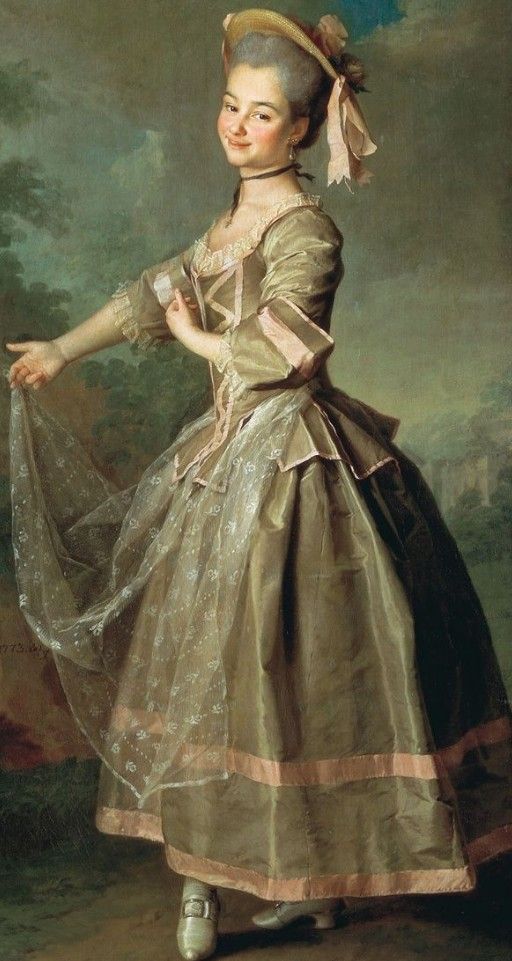
Aprons have probably been around since the dawn of clothing; up until the Industrial Revolution, most people only had the clothes on their backs, or at most one additional change of clothing – in which case they were considered either very well off or thieves; a large number of the thefts reported in the 17th and 18th centuries had to do with clothing articles; the clothes made the man or woman, and if they could upgrade their wardrobe through “five-finger discounting,” they might have a better chance at finding a good job with better wages. The style of aprons has changed through the years, and while sometimes their function was little more than a fashion statement, such as in the painting below, their main purpose has never become obsolete: To carry out every imaginable chore in and around the home.
Dancing Girl, Levitsky Dmitry, 1735-1822
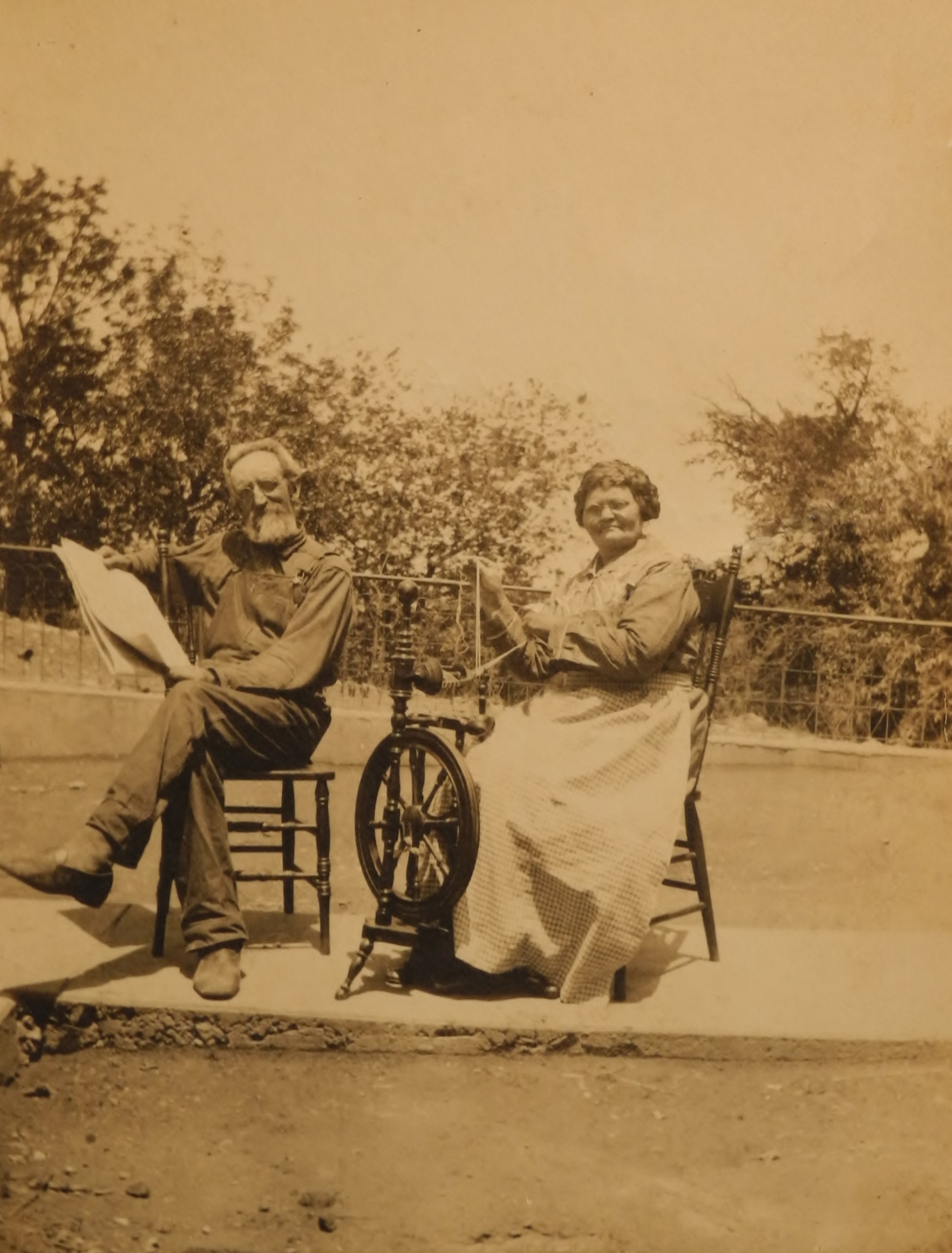
My paternal grandparents, the Herrings, were Kansas pioneer farmers; my grandmother (Mary Mae) headed west from Indiana in a covered wagon with her parents (James Allen and Carrie Christine Higbee nee Aaroe) as a baby; she grew up on the prairies of Kansas, met my grandfather, and the rest is history.
Nis and Maren Kirstine Aaroe-Aagaard, immigrants from Vonsild, Nørre Tyrstrup, Vejle, Denmark, who settled in Kansas; taken ca 1890. My great-great grandmother is in her daily apron at the spinning wheel.
Most of my childhood memories are of my paternal grandparents’ farm; we spent many weekends there helping out, and I spent a week or two every summer with them. My grandmother was always in an apron, except for Sunday mornings and special events – and those are the times when photographs were taken, so unfortunately I don’t have a photo of her in an apron. But I have something much better: A hand-sewn quilt, made lovingly by her from around 1920 to the late 1970s. The materials used for that quilt are her old aprons, Sunday dress scraps and other spare cloths; I remember seeing her in several of them.
Apron Quilt, Grandma Herring, sewn between 1920s and late 1970s
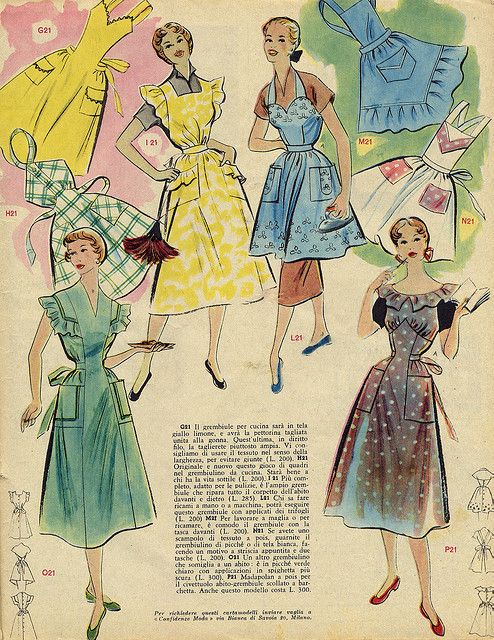
Apron – 1950s Vintage Fashionable Aprons
Being a farmer’s wife, my grandmother’s aprons weren’t as fancy as these vintage patterns shown above; they were plain, simple and hand-made; they did what they were needed for, and no more, no less. But as simple as they might have been, those aprons were worth their weight in gold on a farm: They protected her scanty wardrobe – she didn’t need much, didn’t want much, and was satisfied to take care of what she’d been blessed with. Those aprons carried baby chicks, kittens, flowers, herbs, chicken eggs, apples, firewood and wood chips, baby birds fallen from nests in a wind storm, and the occasional sugar cube for the horses. They wiped away tears, cleaned dirty faces, dusted furniture if guests were walking up the path, took delicious things from the oven, cold things from the freezer, and helped open canning jars. They shaded a cold pie on her lap in the old Chevy truck while we bounced across the fields to bring my grandfather a picnic for lunch break in the summer heat (she could have used an old quilt for the pie, but that was often used to cradle a large mason jar full of ice cold water, the best thirst-quencher I know). Those aprons helped gather grains, and stones to move either from the garden or to the flower bed. They carried chicken feed and broken eggs shells to feed the chickens to make their eggs stronger; they held potatoes, carrots, green beans, corn, sweet peas, strawberries and squash. They were the perfect cradle for a garden watermelon, rolling it into the refrigerator to get it nice and cold on a hot day. They warmed her hands on a cold day as she dug for the last of the potatoes before winter’s freeze, and hid her dirty hands when guests arrived unannounced. They polished cutlery, fanned her face to cool her down on a sweltering hot day, and were the perfect place to hide for shy children. One never knew what that apron would do next.
Little could my paternal grandmother have guessed that the quilt she made from so many scraps of memories would eventually accompany her granddaughter back over the ocean her mother had traversed as a newborn baby from Denmark, and end up within 20 km from where my maternal ancestors have been traced: Zofingen, Aargau, Switzerland. I can’t imagine any other piece of cloth carrying so much history, authority, importance, practicality, humility, common sense and love.
Adapted from an article originally posted on History Undusted, 5 Oct. 2015
















 Stephanie Huesler