Unless you’ve been busier than I‘ve been, you’ll have realized that half of January 2025 is already gone. The end of 2024 was crazy busy, and after the dust of the Christmas holidays settled, life was about getting caught up with all of those little things that had been neglected for a couple of months.
I’ve thought about how I want to go forward with this blog in the coming year; I enjoy having this platform to dive into topics I might not otherwise encounter in my day-to-day life, but life in the real world has many facets that keep me busy, too. I’ve decided to post roughly once per fortnight, giving me time to live, write/edit/publish, and research topics of interest. I’ve always tried to write quality above quantity, and I want to share things that interest me, grab my imagination, or give me a good laugh. If you feel the same, sit back and enjoy the ride!
Since this is mid-January, let’s take a look at some of the highlights of history on this day, the 15th of January:
1541: A commission to settle New France (Canada) was granted by King Francis I of France.
1559: Queen Elizabeth I was crowned Queen of England in Westminster Abbey, London.
1759: The British Museum opened to the public for the first time.
1777: In the American Revolutionary War, New Connecticut (Vermont) declares its independence.
1782 – The U.S. Congress was petitioned to establish a national mint and decimal coinage.
1870 – For the first time, a political cartoon symbolizes the Democratic Party with a donkey (“A Live Jackass Kicking a Dead Lion” by Thomas Nast for Harper’s Weekly).
1889 – The Pemberton Medicine Company (later to become known as the Coca-Cola Company) is incorporated in Atlanta.
1908 – The Alpha Kappa Alpha sorority becomes the first Greek-letter organization founded and established by African American college women.
1919 – Great Molasses Flood (a wave of molasses ejected from an exploding storage tank) sweeps through Boston, Massachusetts.
1943 – The Pentagon is dedicated in Arlington County, Virginia.
2001 – Wikipedia, a free Wiki content encyclopedia, is launched (Wikipedia Day).
2009 – US Airways Flight 1549 ditches safely in the Hudson River after the plane collides with birds less than two minutes after take-off. This became known as “The Miracle on the Hudson” as all 155 people on board were rescued. This story was adapted for the “Sully” film in 2016.
2015 – The Swiss National Bank abandons the cap on the Swiss franc’s value relative to the euro, causing turmoil in international financial markets.
2022 – The Hunga Tonga-Hunga Haʻapai volcano erupts, cutting off communications with Tonga and causing a tsunami across the Pacific. It was the largest volcanic eruption since the 1991 eruption of Mt. Pinatubo (Philippines).
Which of these events do you find most interesting? Please comment below and let us know! For me personally, it’s the opening of the British Museum. What was it like back in 1759, and how has it evolved into the massive collection it is today? I’ve been there a few times, but I have yet to see it all!
This is AI’s interpretation of “ancient scroll rolled up”. No idea where the man came into that result, but his longsuffering expression is apt!
This week’s adventurous tale is a proverbial rabbit hole; diving into it takes us past the problem of Paris’ 18th century dilemma of dealing with the “explosive” issue of overfilled cemeteries, which forced King Louis XVI to take action: Bury them deeper. Following this problem and its solution into the ground, so to speak, leads us into the massive (1.5 km long) ossuary (bone depository) of Paris. Once you reach the ossuary, which contains the artfully arranged skulls and bones of some six million residents (around three times more than the actual population of central Paris, which as of 2023 was 2.1 million…), you aren’t officially allowed to go any further – because above your head is the bustling city of street cafés, boutiques, and historical buildings. And when someone buys a house up there, they are actually also buying the land on which it stands – which includes their section of the underground maze of mining tunnels and caverns; venturing beyond the official section makes you an intruder on private property or breaking and entering an actual shop – but more on that in a moment. The message above the entrance to the ossuary reads, Arrête! C’est ici l’empire de la Mort. (“Halt! This is the Empire of Death.”). That warning doesn’t stop it from being one of Paris’ most popular tourist attractions.
The tunnels, now known as The Catacombs, were originally dug far outside of the small 13th-century city when Lutetian limestone was mined as a local building material (any town or city with a distinctive architecture owes its appearance to whatever was available locally when it was founded – whether wood, stone, thatch or brick). Though no one knows with certainty, as the mining resources were eventually exhausted and the mines abandoned, an estimated 350 kilometres of tunnels undermined the city, which covers some 32 square kilometres beneath Paris… a city beneath a city, as it were.
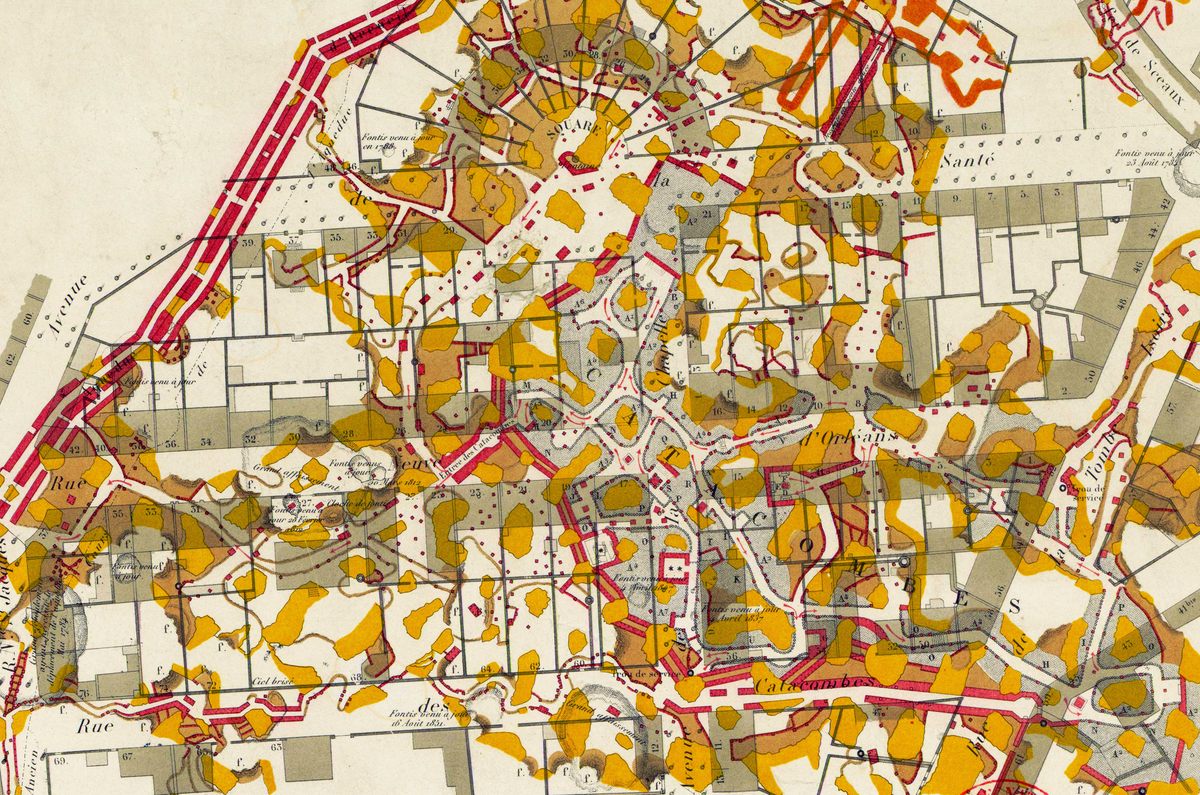
And yes, buildings have occasionally been swallowed; in 1774, about 30 metres of a street disappeared into a cavern below. This led to the formation of the Générale des Carrières (IGC), an office created in 1777 by King Louis XVI to oversee the mapping and maintenance of the catacombs. During the French Revolution, many things got lost and fell out of collective memory, including the underground map.
Paris Catacombs Map – Inspection Générale des Carrières, 1857, Pulbic Domain
Throughout the years, the tunnels have been put to various purposes, aside from the macabre: Mushrooms were cultivated there; beer was brewed, wine aged, and Chartreuse liquors were distilled down there by monks in the 17th century. The city beneath the city had no prime real estate overhead for businesses, and many took advantage of the free space, making access for their customers through the various access points throughout Paris. It also served the French Resistance during world war 2, even though the Nazis also used a section of the tunnels. Now, let’s go back up out of the rabbit hole for a brief moment.
Remember that I wrote officially allowed? Well, a secret maze of tunnels is too much to resist for the adventurous, called cataphiles. But there is a secret society at large down there, too.
When you think of a secret society, you might think of the Luminati or something else sinister; but the Les Ux would be more akin to Robin Hood. The story goes that in 1981, a group of kids were talking after school, and one of them mentioned that he could break into any building in Paris; in fact, his next target was the Pantheon. They didn’t believe him, and so they all went down together – and found out just how easy it was to go wherever they wanted. The Pantheon, which was the tallest structure in Paris until the Eifel Tower was constructed, vacillated between being a church and a secular building several times over its history, depending on the political regime, and it finally became a secular structure in 1885 under the Third Republic. It now is a mausoleum, with famous residents like Marie Curie, Victor Hugo, Alexandre Dumas and Voltaire; but it is also a museum, an art exhibition hall, hosts school events and lectures, and is linked to a section of the catacombs – which is where the group of school friends began their adventures.
During one of their nocturnal outings, the group stumbled upon a narrow passage full of electrical cables; following those, they found themselves in the basement of the Ministry of Communications. No security stopped them and they were able to explore at their leisure. In a drawer, they found the motherlode: A map of the entire catacomb structure. That changed the course of their lives, and they eventually became known as the Les Ux, short for “urban experiment”. These individuals, unknown to anyone but themselves, specialize in safeguarding Paris cultural goods – stepping in when the government can either not afford to or doesn’t care enough to preserve something of cultural or historical value. They seem to think that, unless it’s a big-ticket attraction like the Mona Lisa, things get neglected. For instance, the mission statement of one branch of Les Ux is to reclaim and transform disused city spaces for the creation of zones of expression for free and independent art.
The group, now a full-fledged underground movement, is divided up into teams with seemingly nonsensical names: The Mouse House (an all-female team of infiltrators), La Mexicaine De Perforation (in charge of clandestine artistic events and underground shows), and the Untergunther (specializing in restorations); they also have teams that specialize in things like running internal messaging systems and coded radio networks, a database team, and a team of photographers.
Some of their exploits include restoring a forgotten metro station, a 12th-century crypt, an old French bunker, and a World War 2 air raid shelter. One member, likely from the Mouse House, wrote a detailed report about a particular museum’s security, telling them how many ways she could have broken in and stolen had she been so inclined. She then infiltrated the museum and left the report on the desk of the museum’s head of security. He went straight to the police to press charges. They refused to pursue the matter.
They built an entire cinema complex in the catacombs, complete with a bar and restaurant, where they are thought to have held film festivals for several months or even years before being discovered by the police in a random training exercise. When the police returned to remove the cinema, everything was gone except a note which read, “Don’t try to find us.”
Les Ux has held many events within the Pantheon over the years, including parties and art exhibitions – all vanishing, and leaving the place cleaner when they left, before the museum opened the next day. One night, a team member (from Untergunther) decided to take a closer look at the broken Wagner clock, which hangs over a prominent entrance within the building. Their most public restoration (that we know of so far) was, of course, an embarrassment to the management of the Pantheon: One of the members, Jean-Baptiste Viot, was a professional clockmaker; the team snuck in for nearly a year to restore the clock. They built a secret workshop (complete with armchairs, bookcase, and bar, which they nicknamed the Unter and Gunther Winter Kneipe – German for winter boozer!) high up in the dome of the pantheon, and carried out the clock work by night. Once it was done, they knew that the clock would need to be wound regularly to continue working – so they broke protocol and met with the museum director to tell him the good news. He promptly pressed charges… but there are no laws in France about repairing an expensive clock at their own expense, and the case was dismissed with the comment, “This was stupid!” The museum director hired someone to break the clock, presumably to avoid the hassle of winding it up regularly, and also out of spite for losing his case and his face; the person refused to damage the clock, simply deactivating the mechanism. Les Ux snuck back in to let the clock chime over the days around Christmas, then went back in and removed a component to prevent any further damage the next time spite struck. I’ve read that since that time, the clockmaker of Untergunther has actually been hired by the Pantheon to maintain the clocks.
We only know of a fraction of their activities, of course, because they don’t publicise their accomplishments or events. Below are a few links if you’d like to read more on this fascinating topic! I hope you enjoyed this little exploration as much as I did!
Here are a few links to articles, if you’re interested in learning more:
My husband and I were having lunch recently, and a package of Swedish crackers was on the table; I pointed to the brand name, Pågen. In English, our pronunciation of these vowels would lead us to say pagan /pæg-in/, whereas the Swedish would rather be more like /po-gen/. I just mentioned that English might have sounded similar to that before the Great Vowel Shift, which he’d never heard of (being Swiss, it’s not likely he would be familiar with this aspect of English etymology), so I promised to write a blog about it; here we go!
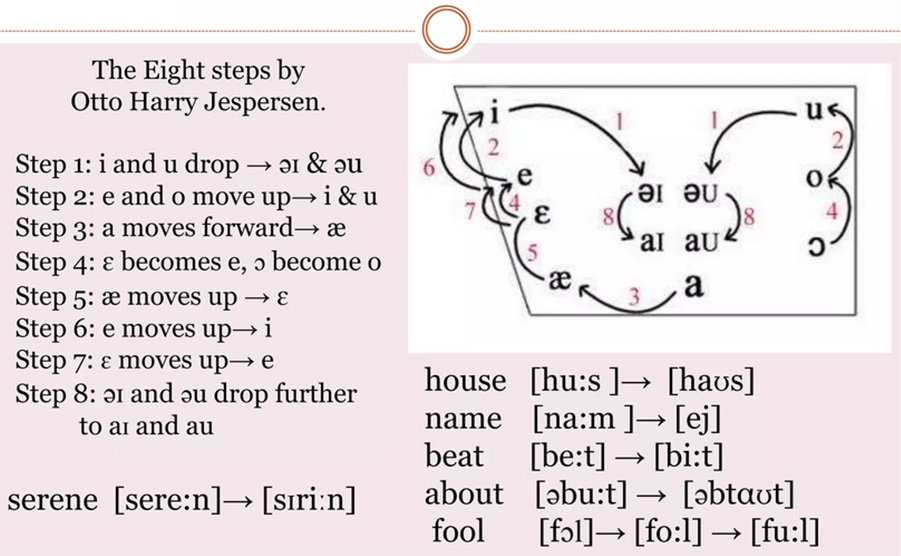
The term Great Vowel Shift was coined by the Danish linguist, Otto Jespersen (1860-1943), who specialised in the English language. Though the GVS is considered a single event (because of the changes being viewed as part of a chain reaction, with each vowel sound changing in a predictable way), the actual transition of English pronunciation was gradual, taking place over about 200 years, from ~1400 to ~1600. The shift began in Middle English, which was spoken from 1066 until the late 15th century – that form familiar to Geoffrey Chaucer (though his pronunciation would be unintelligible to us, his words still survive through his famous Canterbury Tales) – into Early Modern English (from the beginning of the Tudor period through to the Stuart Restoration period); Shakespeare would have been familiar with it. From there, English transitioned into Modern English in the mid-to-late 17th Century.
The main changes were that, from Middle to Early Modern English, the long vowels shortened; weef became wife, moos* became mice, beet became bite, and so on. (*The word moose entered English through Native American languages in 1610). I will also mention that in Scottish, a lot of the older vowel pronunciations still exist; house is still huus, full is homophonous with fool, etc.
Here’s a look at just how the English vowels shifted:
Source: SlideShare
If you’ve been paying any sort of attention to English, you’ll know that our spelling is a bit chaotic; the language is full of homonyms, which are divided into either homophones (words that sound the same but have different spellings, e.g. beet and beat; bear and bare; to, too and two), or homographs (two words with differing meanings, same spellings, but not necessarily the same pronunciation: e.g. bank [of river; finance] or agape [with mouth open; love], or entrance [a way inside; to delight]) or tear [ripping; crying]. These -graphs and -phones came into English from regional dialects that were transported as migration and cultural mixing took place, and the GVS added its two pennies to the mix. Just think of the variety we have in the sounds /ea/ (bread, beat, bear, break); /oo/ (look, spool, blood); or /gh/ (through, cough, sight).
Certain factors contributed to the speed of language shift: The Black Death (1346-1353) wiped out up to 50% of Europe’s population. Stop a minute and let that sink in. What if the population of your town were reduced by half? And the next town, and the next. That single event changed the course of history on many levels; surfs could finally demand better wages wherever they ended up settling; if you lived in a town that no longer had the skills of a baker, blacksmith, or any other trade you’d depended on, you’d move to where those services existed – and jobs existed – and that meant places that had been hit the hardest by the plague and thus where everyone else was migrating, such as London. As mass movement followed the epidemic, people brought their dialects and their spellings with them. It began to converge into a new, distinct way of speaking, thinking and spelling. The geopolitical climate of the time also influenced English; England and France have been annoying each other for over a thousand years; whenever England was enamoured by all things French, they tried to emulate their pronunciations. That influence came and went; in one such moment, the pilgrims set sail for America (1620), taking a time capsule of the language with them, while England’s English continued to be influenced by French up until the French Revolution, when it quickly fell out of favour in England, though the changes had already taken place (one example is the American /k/ in schedule, closer to the original Latin, while the English say /sch/ without the /k/, which is closer to the French cedule). This factor of influence also affected differences of speech between the lower class and upper class at that time; the upper class wanted to sound more posh, more fashionable, and above all, not like the lower class.
A major contributing factor to our chaotic spelling is that ca. 1440, the Gutenberg printing technique was introduced, and by the 1470s, William Caxton had imported the invention to England; we have him to thank for Chaucer’s Canterbury Tales being known today, as that was the first book he printed in England. We also have him to thank for the influence of Chancery English (the English used by the secretariat of King Henry VI) in the standardization of the language, as he used it as his own guidelines in printing. The vowels had already begun to shift by that time; enter the written word, a rise in literacy, and you have the jumbled effects of “mid-shift” on English spelling – people began to adapt their pronunciation to the written word, so whichever form the printer used is the one that began to prevail, even though some sounds were still in transition. Like nailing down jelly. You could say that many of our odd spellings are simply a snapshot in time.
It is also important to point out that the GVS didn’t have the same influence everywhere: The main changes occurred around London, but the farther away you move from that epicentre, the less the effects on the local dialects, which still holds true today – though gradual merging has allowed people from, say, Cornwall, to understand people from Yorkshire – which wouldn’t have been the case centuries ago. Even though they can understand each other, their dialects are still distinct. I’ve already mentioned that Scots English (as opposed to Gaelic) still retains many of the longer vowels long since lost in standardized English; being so far from London, they simply ignored them. English may be taught in their schools, but Scots dialects prevail in the home and hearth. Regional dialects in English exist the world over, and though spelling and pronunciation may differ from region to region, and the language continues to be a living, breathing, growing and changing being, it’s still a language that enables the modern world to communicate, whether English is their mother tongue or not.
Dr Samuel Johnson (1709-1784) was an English poet, playwright, essayist, moralist, literary critic, sermonist, biographer, editor, and lexicographer, and his writings have lasted the test of time. He has been called “the most distinguished man of letters in English history” (The Oxford Dictionary of National Biography). His most notable work is “A Dictionary of the English Language” (1755), though he was a prolific writer in every expression of the craft.
Based on biographies by those who knew him, such as his friend, James Boswell, his mannerisms and behaviours were so well documented that a posthumous diagnosis of Tourette’s Syndrome can be attributed to him. The most famous portrait of Johnson is the one above, painted by Joshua Reynolds, with whom he founded The Literary Club in 1764. The club would meet regularly, and included members from the literary and historical disciplines; membership was by unanimous election only; if a nominee was undesirable, a member could submit a black ball (white and black balls were likely deposited in an urn to keep the vote confidential). The term “to blackball someone” arose in 1770, and it means “to exclude from a club by adverse votes”. It may have originated at this club or simply have been a general practice employed in clubs and societies around this time.
So, without further ado, here are 10 quotes by Dr Johnson:
“I know not, Madam, that you have a right, upon moral principles, to make your readers suffer so much.”
“I never desire to converse with a man who has written more than he has read.”
“It is better to live rich than to die rich.”
“No man will be a sailor who has contrivance enough to get himself into a jail; for being in a ship is being in a jail, with the chance of being drowned. … A man in a jail has more room, better food and commonly better company.” (Boswell’s Life of Johnson)
“The chains of habit are too weak to be felt until they are too strong to be broken.”
“The use of travelling is to regulate imagination by reality, and instead of thinking how things may be, to see them as they are.”
“Great works are performed not by strength, but by perseverance.”
“In order that all men may be taught to speak truth, it is necessary that all likewise should learn to hear it.”
“When a man knows he is to be hanged in a fortnight, it concentrates his mind wonderfully.”
“The superiority of some men is merely local. They are great because their associates are little.”
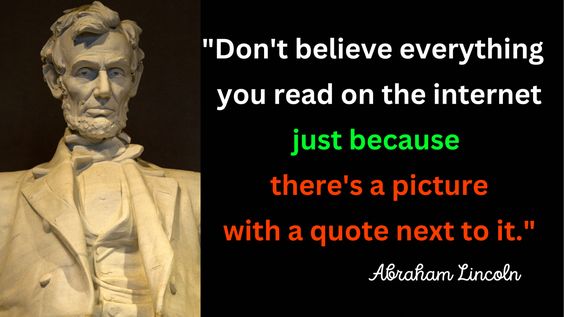
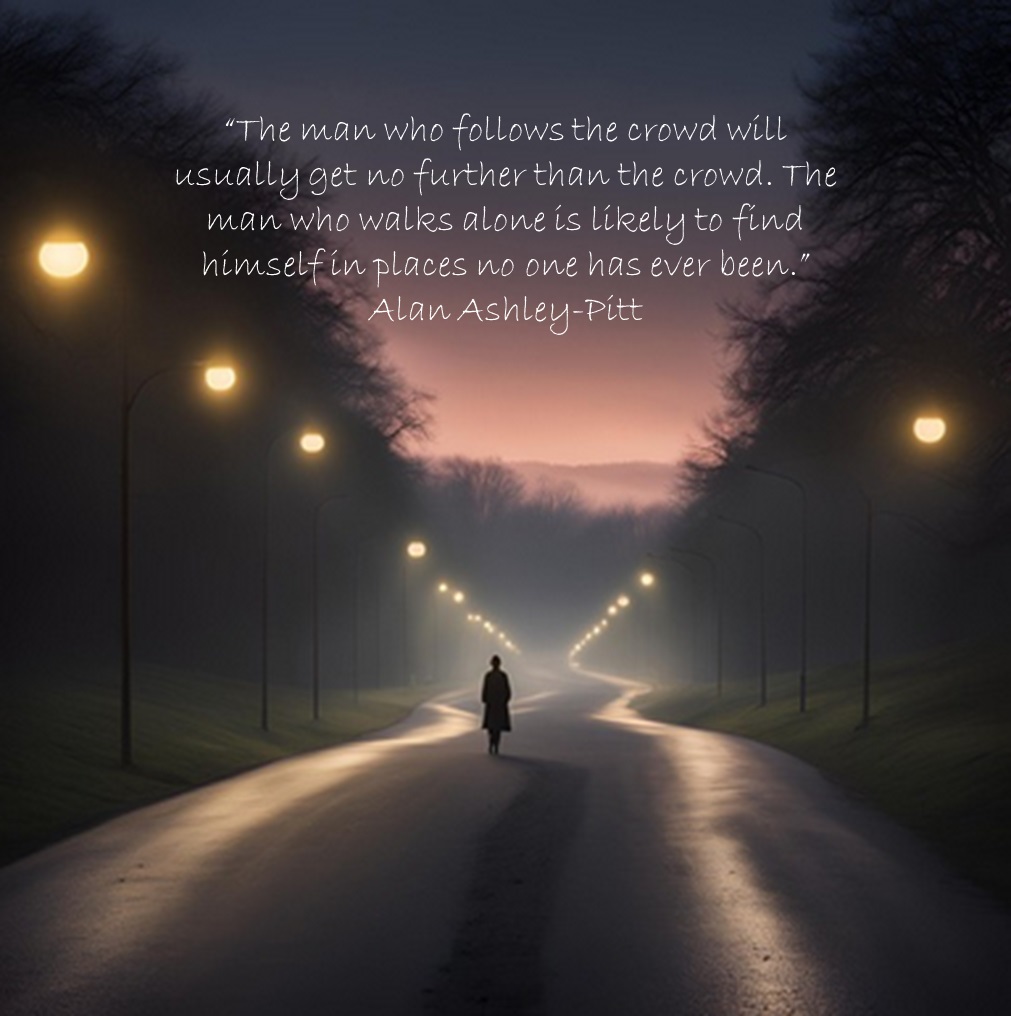
If you’re like me, you might come across a good quote and not think any further about the name attached to it; did that person really say that? I’ve seen quotes attributed to one person but which I know were actually said or written by someone else. Sometimes, a quote is drawn from someone’s writings, letters, essays, or journals from the past. Now, with the dawn of AI upon us, algorithms begin to feed off of their own creations—whether the first effort was accurate or not—which in turn disseminates falsehoods so frequently that most people begin to believe them. It’s important now more than ever that we pay attention and use discernment; don’t believe everything you see or read, but test it. This image is a classic case in point:
So who was Alan Ashley-Pitt? “He” was, in fact, a name made up by a greeting card and poster company headquartered in Santa Barbara, CA, in the late 1960s and early 1970s. The company needed a name to quote for the sayings made up by employees for their cards, decorations, and posters. Though the company was out of business by 1974, many of its creations live on in the Ashley-Pitt quotations. In a way, it’s ironically fitting that a made-up persona’s quote should be imposed on the AI-generated image (below); unfortunately, the AI programs I tried couldn’t grasp the concept of a fork in the road with a crowd on one road and a lone man on the other. It just goes to show you that the human imagination is more creative and able to grasp abstract concepts better than any AI… so far!
Here’s another gem from my recently re-discovered “bits & bobs”: These are actual maintenance complaints submitted by USAF pilots and replies from maintenance crews:
Problem: Left inside main tire almost needs replacement.
Solution: Almost replaced left inside main tire.
Problem: Test flight OK, except autoland very rough.
Solution: Autoland not installed on this aircraft.
Problem: Something loose in cockpit.
Solution: Something tightened in cockpit.
Problem: Evidence of hydraulic leak on right main landing gear.
Solution: Evidence removed.
Problem: Friction locks cause throttle levers to stick.
Solution: That’s what they’re there for.
Problem: Number three engine missing.
Solution: Engine found on right wing after brief search.
The idiom “Catch-22” comes from a book of the same title by American author Joseph Heller (1923-1999). The term originally referred to a military rule whose provisions are mutually frustrating. Heller used Catch-18 instead of Catch-22 when the first chapter of his book was originally published in 1955. He changed it by the time the entire book was published in 1961 because his publisher had already published a book that year with “18” in the title (Leon Uris’ novel, Mila 18). So in 1961, the phrase Catch-22 first appeared. It was first used figuratively in 1971 in Atlantic Monthly magazine. As far as the form goes, it is usually hyphenated and with a capital C, as that is the way Heller originally wrote it.
Since the author’s first usage of the idiom, it has taken on a life of its own: Today, its broader meaning is a paradoxical situation from which an individual cannot escape because of contradictory rules or limitations. It has also been used as a mnemonic for the symptoms of DiGeorge syndrome.
One particular quote from Heller is thought-provokingly insightful: “Everyone in my book accuses everyone else of being crazy. Frankly, I think the whole society is nuts – and the question is: What does a sane man do in an insane society?” In a way, this is perhaps an example of a Catch-22 for the sane person: If they stay in an insane society, they may lose their sanity; but by leaving such a society, they throw away any chance of bringing it back to a state of reason. Social and political polarisation are both poisons that infect society.
Throughout history, languages have come and gone; an estimated 30,000 have existed at some point in time, though currently, there are roughly 6,000 to 7,000 languages in use – and most are threatened with extinction. Think about that. The impact on the loss of cultural history, connection to ways of thinking, ways of communicating, and ways of processing information; senses of humour, and national heritages will be lost.
An example of a language nearly lost, but which is now familiar to most of us by sight, is the logogram language of Egyptian hieroglyphs. The knowledge of how to interpret the symbols had been lost for centuries, until 1799, when a stone was found near Rosetta, along the Nile Delta in Egypt; the stone was a stele with a decree issued in 196 BC; the texts carved into the stone were Ancient Egyptian (“demotic” text), hieroglyphs, and Ancient Greek. Because Greek was a known language, they could use the Rosetta stone to decipher the forgotten languages.
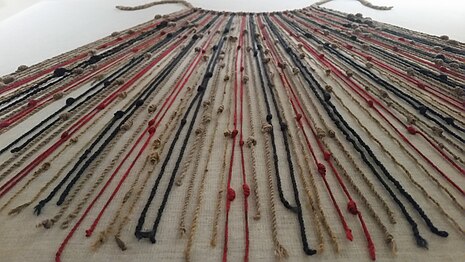
When we think of writing, we may think of various alphabets: Greek, Roman (of which English makes use), Norse Runes, or the logographic or ideographic languages of Asia, such as Chinese or Japanese, or the cuneiform writing of the Ancient Near East. But did you know that there have been languages based on string?
Quipu in the Museo Machu Picchu, Casa Concha, Cusco. Source: Wikipedia
The Inca people, in the region of modern Peru and Chile, used knots on an elaborate system of connected strings or cords for collecting data, keeping records, recording taxes or census records, making calendars, or for military organisation. When the Spanish Conquistadors swept through, they found numerous bundles of strings, but had no idea of their significance; they destroyed many of the quipu*, not realizing that they might have held in their hands a record of an individual’s wealth in animals or crops. [*Quipu is the Spanish spelling used in English; it is also spelled khipu or kipu.] Other cultures have also used similar concepts with knotted strings to record information, unrelated to South America; these include China, Japan, Taiwan New Zealand, Hawaii, and other parts of Polynesia.
As with most textiles, they unfortunately didn’t stand the test of time very well, and only a fraction remains today. The ancient world may have taken the concept of the quipu one step further in creating the more flexible abacus, though the latter was (and is still) used for temporary calculations, while the former was rather for recording information. Whether or not there is a historical link, both are visual tools that can be used for similar functions to a certain extent.
Even with such widespread use of these knotting records, their meaning was nearly lost, until a Harvard student, Manny Madrano, had time on his hands one summer and solved a centuries-old mystery!
For an interesting video on this topic, please click here. I hope you’ve learned something! Keep being curious about our fascinating world!
The baroque town of Solothurn, though only an hour away from our home, was unfamiliar to us until my husband and I took a day trip this week. It has a beautiful historical centre and is known as the “city of elevens”: It was the 11th canton to join the Swiss Confederation; there are 11 towers in the fortification walls of the city; there are 11 churches and chapels, and 11 historical fountains throughout the city; the stairs leading up to the St. Ursus Cathedral have landings every 11 steps; the cathedral itself has 11 altars and 11 bells; the local brewery, producing an eponymous beer, is even called Oeufi – which is a Swiss dialectical word for eleven. 11:00 is the most “auspicious” time to set appointments in the town, and there is even a clock, hanging on the wall of a local bank, which is segmented into 11 hours; it has 11 cogs and 11 bells, which are chimed by a metalwork sculpture of a harlequin on the hours of 11:00, 12:00, 17:00 and 18:00. The bells chime to the tune of the city’s unofficial anthem, the Solothurner Lied.
Solothurn’s history dates back to the palaeolithic era, and its Roman era is dated to around AD 15-25; it was first mentioned in AD 219 as vico saloduro, and may have referred to a Celtic settlement, possibly meaning “Salo’s fort/stronghold”. In the Battle of Sempach, July 1386, the Habsburgs attacked Solothurn; it was a decisive Swiss victory, and even more importantly, it helped to solidify the loosely allied Swiss Confederation cantons into a more unified nation and is seen as a turning point in the growing strength of Switzerland as a nation. Today, it is largely bypassed by tourists due to its proximity to Bern, the Swiss capital, so it remains a hidden gem.
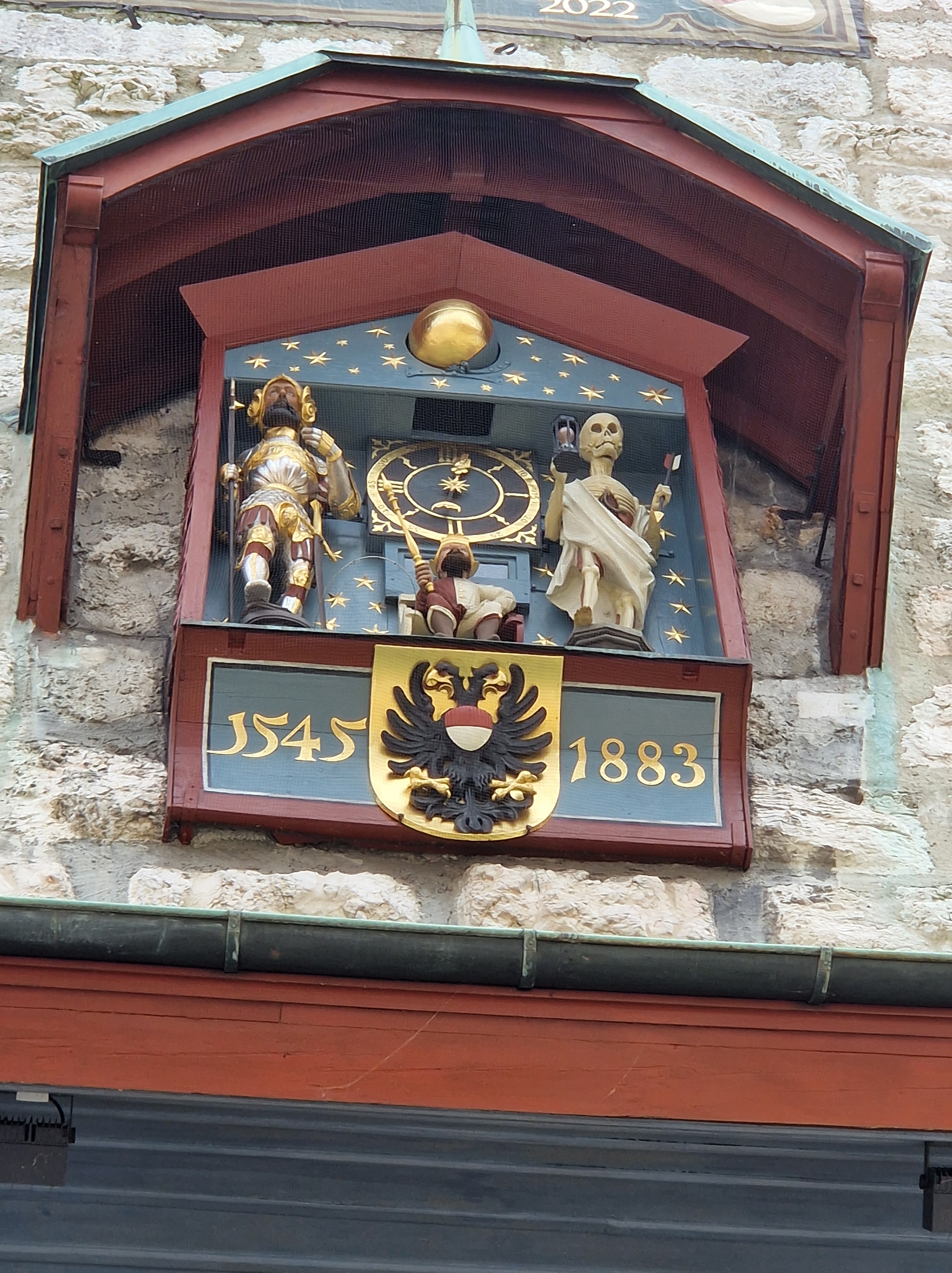
Another interesting clock is the clock tower, the “Zeitglockenturm”, a tower built in 1152 and first mentioned as a “clock tower” in 1406. If you look closely, you’ll see typical rain spouts coming off of the corners of the tower’s spire and roof, shaped like dragon’s heads. The 24-hour astronomical clock was built by Lorenz Liechti and Joachim Habrecht in 1545. The sun and moon hands both run counterclockwise; the moon makes one complete rotation every 27 days, while the sun makes one complete rotation every 365 days.
According to the Roter Turm website, there’s a humorous story connected to the upper, 12-hour clock: By 1753 the hour hand and the bells were no longer in sync; a commission contacted the watchmaker Niklaus Pfluger, reminding him of his gild’s oath, i.e. his responsibility to correct the clock. He suggested to the local government council that they add a minute hand; but minutes were not so important in the 18th century, apparently – they told him to leave it as it had always been. He took matters into his own hands (I guess it was easier to ask for forgiveness than permission…) and in 1756, he added a minute hand. He justified it as the “warning hand of God” – but he made it smaller, less noticeable than the hour hand, so on this clock, the small hand shows the minutes, not the hours.
Because the clock tower was built and added to over time, you’ll see four dates on the full image of the tower: 1411 and 2022 on the highest, 12-hour clock; and 1545 and 1883 on the central tableau; the latter dates usually refer to restorations.
The three figures in the central tableau above the clock are a knight, king, and skeleton (Death), which perform every hour: The knight holds a battleaxe in his right hand, and a sword in his left; every quarter-hour, he turns his head toward Death and strikes his breast, signifying his loyalty to the central figure, the king. On the right stands Death; in its right hand is a hourglass, which is turned on the hour, symbolizing the contradictions of life – good, bad, life, death. In the other hand is an arrow, showing that one could be struck down at any moment. On the hour, its head turns toward the knight.
On the throne between these two figures is the king: In his right hand is a sceptre, which he lifts on the hour. His jaw moves in rhythm with the hour hand, and his beard represents wisdom. However, notice that he’s wearing red and white fool’s garb: If the king does not rule with wisdom and the humour of a fool, his reign will become a tyranny. It tells us that life should have moments of both wisdom and a jester’s humour.
While Death announces the hours, the king swings his sceptre. At the same time, Death nods with each stroke and confirms the relentless passing of the hours. The king with his fool’s garb reminds us of the memento mori. When death or illness reigns, even the power of a wise king can do little (Solothurn was hit by the plague, e.g. in 1348). Though the Freudian era banished death from contact with the living in many Western cultures, death personified as a skeleton is still a symbol seen in many countries around the world. Having death constantly before your eyes encourages you to savour each moment of life.
I hope you’ve enjoyed this brief glimpse into a beautiful city with an ancient history!
Recently, my mother sent me a link on Facebook and asked me to write an article about it; it’s definitely an interesting topic – so thanks, Mom!
First of all, for those of you who don’t know what a folly is:
In architectural terms, a folly is a building that is either constructed as decoration which suggests another purpose or is a practical garden building that transcends its purpose with extravagant features. An example of the former term would be buildings that were designed from the outset to look like ancient ruins, such as Wimpole’s Folly in Cambridgeshire, England; an example of the latter would be buildings like the Dunmore Pineapple in Stirlingshire, Scotland (I’ve been to this site a few times and was once able to go inside the pineapple). Designed to look like a giant pineapple, it was actually a working hothouse; that’s perhaps another story to tell. As for today’s topic, the folly of King Alfred would fall into the former definition.
Second of all, who was King Alfred, and why does he bear the sobriquet Great?
Statue of Alfred the Great at Wantage, Oxfordshire
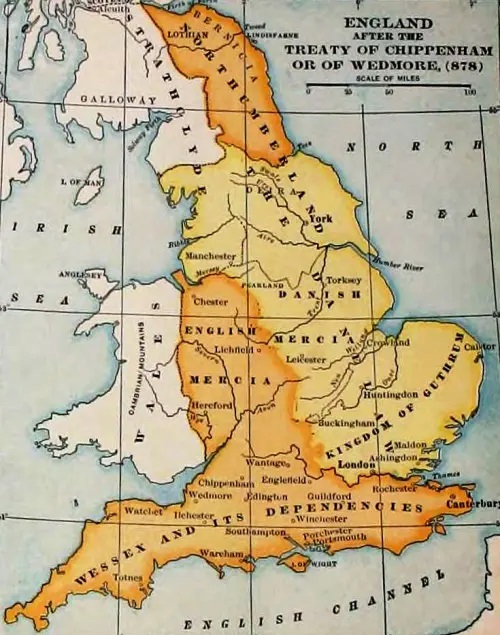
Born in 849 AD, Alfred the Great was King of the West Saxons from 871 to 886, and then King of the Anglo-Saxons from 886 to 899. He lived in a time when Viking invasions and warring tribes were common. Both of his parents died when he was young, and his three older brothers reigned before he eventually came to the throne. The battles, invasions and wars are too numerous to mention; to be a king meant to be at war. At the age of 21, he was already the King of the Wessex and a battle veteran. In early 878, the Danes struck like lightening, taking Chippenham (on the map below, you’ll see that it was in the heart of Alfred’s territories); inhabitants surrendered or fled, and it reduced Alfred and his men to hit and run means of getting provisions; they withdrew into the tidal marshes of Somerset (the area on the other side of the River Severn, just below Wales on the map below). Alfred reevaluated his strategy and learned from his enemy: He and his men began a guerilla war against the Danes, and by May, he’d defeated them in the Battle of Edington. Knowing that he would never be able to drive out such a powerful enemy, he made a treaty with them, establishing borders and what became known as the Danelaw territory; King Guthrum of the Danes converted to Christianity, with Alfred as his godfather and soon son-in-law as he sealed the treaty by marrying one of Guthrum’s daughters, Aethelflaed.
The Great comes from the fact that he united many of the disparate tribes; he recognized the deterioration in learning caused by years of disrupting wars and the Viking’s destruction of the monasteries, which were centres of learning and literacy. He recognized the fact that without widespread literacy, a king cannot rule – a people who were not united by a written language would be more vulnerable; but united through a common tongue, they would have a sense of loyalty and continuity in turbulent times. They would be able to adhere to laws, reach legal decisions, and be called to arms more readily if they could read a common language. He set out to make the English proud of being English and thus be prepared to fight for it.
By stopping the Viking advance against all odds, and consolidating his territories, he set the stage for future kings. His accomplishments in Wessex became the seed that eventually gave fruition to a united Anglo-Saxon England, which is why he alone among all kings or queens of England bears the sobriquet Great.
King Alfred’s Folly:
King Alfred’s Folly – Credit, Flickr, Andrew Bone
King Alfred’s Tower was built between 1769 and 1772. To put those dates into perspective, here are a few events from the year that construction began: 13-year-old Mozart, under his father’s control, was just finishing his third concert tour of Italy; James Watt improved his design for a steam engine that would spark the Industrial Revolution; King Charles III of Spain sent missionaries to California, founding San Diego, Santa Barbara, San Francisco and Monterey; Daniel Boone set out to explore what would become Kentucky; and finally, in August of that year, Napoleon Bonapart was born in Corsica.
The tower itself was built near the site of Egbert’s Stone, which is said to mark the mustering site for the troops of the Battle of Edington; the tower was intended to commemorate the end of the Seven Years’ War and the ascension of King George III to the throne of England. It was designed in the Palladian style (a European architectural style) by the architect Henry Flitcroft, at the commission of Banker Henry Hoare. While the reasons for commissioning the tower might be altruistic of Hoare, its site and magnificence might have had something to do with the fact that the tower was an eye-catcher for those touring the parks at his private estate, Stourhead.
Standing at over 40 metres high (131 feet) and a circumference of 51 metres (167 feet), it is completely hollow; it is a triangular structure with a round “tower” at each corner, though only one of them has a use – a spiral staircase of 205 steps, with no landing places along the dizzying ascent or descent. The only safety is a rope “railing” anchored occasionally along the central pillar of the staircase; passing others up or down can be a tight squeeze, and it is not a climb for the faint-hearted. Once reaching the top, you’ll find a crenelated parapet that surrounds a viewing platform offering a great view of the surrounding region; the centre of the platform is surrounded by a guard rail as it is a gaping hole straight down to the ground level; it’s covered with a mesh netting to prevent birds from using the tower as a dovecote.
In 1944, the tower was damaged when a Canadian single-engine plane crashed into it in the fog, killing all five aboard. In the 1980s, it finally underwent repairs and restoration; the statue of King Alfred above the main entrance was also repaired at that time, restoring a missing right forearm. A stone tablet (also in need of restoration) between the door and statue reads:
ALFRED THE GREAT AD 879 on this Summit Erected his Standard Against Danish Invaders To him We owe The Origin of Juries The Establishment of a Militia The Creation of a Naval Force ALFRED The Light of a Benighted Age Was a Philosopher and a Christian The Father of his People The Founder of the English MONARCHY and LIBERTY