Category Archives: Lists

10 Tips for De-Cluttering

Although it’s already summer, we have only had one day over 30°C. Don’t get me wrong – I’m perfectly happy with cooler days; you can layer clothes, but when it’s hot, you can only take off so much and still be socially acceptable.

But when the weather begins to warm up, thoughts turn to spring cleaning. The practice goes back centuries: For climates that experience cold winter months, spring cleaning usually takes place when the weather begins to be warm enough to open windows but not warm enough yet for swarms of bugs coming in as a side effect. Also, back when wood was the main source of heat, if it was warm enough not to need the wood-burning stove, it was the ideal time to clean out the soot and to dust the house, letting the breeze help carry it away. In modern times, where most houses no longer depend on wood or fireplaces as the main heat source and windows can be opened year-round (with the heater returning indoors to comfortable temperatures), spring cleaning is still a tradition.

Most people have those areas in their homes where things can stand around for months or even years before they put them in their proper places; sometimes those things that don’t have a proper place stand around even longer. Spring cleaning is the ideal occasion to look around, notice those stand-arounds, and put them away properly or eliminate them altogether.

“Mis en place” is a French culinary term meaning “putting in place”, or “gathering” (as in gathering ingredients in preparation for cooking). Outside of the kitchen, it can be used as a description for putting everything in its place. Spring cleaning and mis en place is a great opportunity to de-clutter.

Here are 10 tips for de-cluttering:

  1. Once-in-the-hand principle: Firstly, get yourself a basket to carry from room to room to gather things that need putting in their places; once the basket is full, put the items where they go. Don’t lay things down somewhere else “for now”!
  2. Two-Year Gauge: If you haven’t touched, missed, or used an item in the past two years, chances are you won’t miss it – give it away, donate it to a second-hand shop, or recycle it.
  3. Clothes: Do you have clothes you’ve kept but never wear, or they’re the wrong size, or they’re worn out? Keep one worn-out outfit for dirty work, but bag up the other items to donate, scrap, or give away.
  4. Kitchen: Go through your food cupboards: Toss out anything past its expiry date (this is at your discretion; foods today rather more honestly call it a “best before date”, as canned goods are often good for a while past that…); rotate the older cans of food to the front, the newest toward the back (also best practice when putting away new shopping); toss out any spices that have gone off or are stale.
  5. Storage: Do you have plastic containers without matching lids or lids without containers? Get rid of them. Do you have duplicate utensils that you don’t need? Donate them. Do you have pots or pans that are worn out? Replace them if need be.
  6. Linens (towels, bedding, etc.): Toss or recycle any threadbare, ripped, or worn-out items. Fold the keepers and store them neatly (stacks tend to get lazy over time, don’t they?).
  7. Electronic Gadgets: Go through your electronic items and match cables to each piece of (working) equipment, and recycle the rest. Along the same line, clean out your inbox of superfluous emails.
  8. Toiletries: Toss anything that has gone off – hand cream, makeup, nail polish and medicines included.
  9. Paperwork: Get rid of any guarantees that have expired, old paperwork, or manuals for items you no longer own; file and organize what you keep. While you’re there, check those pens to see which ones still work and chuck the rest.
  10. Sentimentality: Don’t hold on to something out of guilt (someone gave you X…) or obligation (they might notice I’ve tossed it). If it brings you no joy, is not practical, or isn’t in keeping with your aesthetic, don’t keep it.

Have you already started spring cleaning this year? Tackling one point at a time (in a day, or a week) will make it possible, and you’ll be done before the cat can lick its ear!

I’m curious to know if any of these tips inspire you to de-clutter a specific area – please comment below!

3 Comments

Filed under Articles, Cartoon, Lists

Fieldnotes

A few months ago, I began something that has added a layer of creativity and organisation to my life which, to be honest, is fairly creative and organised as it is. But this little addition adds a nice colour: Fieldnotes.

The original concept of taking fieldnotes comes from the scientific disciplines: An archaeologist in the field, taking notes on where, what and when something was uncovered; a geologist, botanist, ornithologist, or entomologist taking notes on observations, perhaps drawing an illustration of a specimen or a map of the landscape.

Fieldnotes can include writing, diagrams, drawings, or visual clues within an entry such as arrows or other visual connectors. They differ from a daily journal in that the fieldnotes are concise… rambling or expanding on a thought belongs elsewhere, but not in a “quick-draw” situation (pun intended).

Creative thinkers have jumped on the idea for reasons other than scientific observation: As a writer, fieldnotes help me capture snippets of ideas, dialogue, or an observation when out in public (I love to people-watch), or something I read – sometimes the comments on YouTube videos are a great capsule of humour! I also use fieldnotes to keep track of tasks on a busy day – lists of to-dos, to-writes, and so on. When I have a creative project, I take notes on the steps taken – such as making giant flowers that no one else has ever made; how to scale up a smaller version of a crepe paper flower is not always straightforward, and if I have several to make, it helps to have those detailed notes of the prototype phase for the next time around.

Taking fieldnotes might help get your creative juices flowing. If you’d like to start this practice, here are a few tips:

  1. Use a small notebook – one that can fit into a shirt pocket, man-bag, or purse. I’ve made my own with 70gsm blank paper, which allows me to make the same size and style repeatedly. But if you can’t do that, just use something like a moleskin notebook; these come in various sizes, with or without lined pages. There is also a company with books called Field Notes, though they seem a bit pricey for what you can do on your own…
  2. Use a good pen, or pencil, or coloured pencils if you want to sketch something with colour.
  3. You can either take chronological notes, such as dating each entry, or you can organise your notes into groupings: One page per character, scene or topic, or for a to-do list, or whatever you want to capture on the go.
  4. Use visual cues, such as boxes around certain elements or arrows connecting one thing to another. Use illustrations or draw diagrams; attach images from magazines, printouts, etc.
  5. Highlight tags or keywords; consider numbering each page and keeping an index at the back of the book to help you find things later on.
  6. One book that might help kick-start illustrative note-taking if it’s new to you is The Sketchnote Handbook, by Mike Rohde.
  7. Think about how you’re recording things on the page: Do you always want to write straight, top left to bottom right, or do you want to mix things up and write diagonally, sideways, or even backwards? Yes, sometimes that’s a thing; Leonardo da Vinci wrote privately in a mirrored direction, only writing normally when he wanted others to read his notes; he also developed his own shorthand.
Leonardo da Vinci’s Vitruvian Man, with mirrored writing.

I also have my own shorthand for many things; Sometimes I use what I call pigeon Asian (I use this when I don’t want anyone else to read it); it’s something I learned when living in Hawaii. It looks like Kanji (the logographic writing of Japan), but it’s not – that’s all I’ll explain! I also use logographs, such as the ancient Anglo-Saxon rune of daeg, which includes the concept of day, dawn, intuition or breakthrough; I use this to designate those times when I’m writing: Rather than writing, “Today, I wrote/worked on the manuscript for...” I just write that symbol plus the name of the manuscript and details. I have a whole series of such shorthand symbols that I use daily.

While there are note-taking apps available (and I use one, called “Keep My Notes”, on my phone for things like shopping lists or feedback notes for singing students or bands that I take during performances and review with them later), sometimes it’s helpful to get away from digital screens. Sometimes I’ll write whole scenes away from the computer – I don’t use my fieldnotes for that, though it will probably be used to outline a scene that comes to mind until I get to another notebook. Something about writing long-hand sparks a level of creativity that might not come while working at a computer; hand-eye coordination should never be underestimated in creative endeavours. Once a scene has developed enough away from the screen to be integrated into my current manuscript, it then takes on another reiteration as I type it in, tweaking and changing… it’s what I call a “ripening process” as a wine metaphor for the creative maturing process a scene goes through by this method. It gets my head into a new space figuratively, literally, and literarily!

In an age when we are constantly bombarded with visuals wherever we go, sometimes it’s healthy to go back to good ol’ pen and paper. On those days so busy that I can’t remember what I’ve actually done, it’s helpful to look back at my fieldnotes as I write out my thoughts in my daily journal.

Do you write? Do you ever make lists for shopping, chores, people to contact, or things to do? If so, how have you kept track of such things so far? If it’s a system that works for you, brilliant! But if you find yourself wanting to switch things up or wanting to improve your use of time, would you consider taking fieldnotes? Please comment below!

2 Comments

Filed under Articles, Etymology, Humanity Highlights, Links to External Articles, Lists, Musings, Nuts & Bolts, Research, Science & Technology, Writing Exercise, Writing Prompt

10 Everyday Phrases with Nautical Origins #4

Picking up from where I left off in February, here are a few more everyday phrases that have been gleaned from the times when ships at sail were the most influential source of importing new ideas, foreign words and catchy tunes (such as shanties). The first of these phrases might be recognized by Star Trek fans, as the captain usually used this term or something similar to hand over the authority of the ship whenever he left the bridge.

Take the Conn: A term used to take over navigational duties on the bridge of a ship (this comes from the mid-1800s, during the age of iron-clad warships). Idiomatically, it means to take control of a situation. The word conn is either a noun or a verb and comes from conning tower – a raised platform from which the entire deck and surrounding environment can be observed.

Sailing Close to the Wind: Strong winds can be just as problematic at sea as no wind; strong winds can unexpectedly shift and take control of a boat’s direction, and many sailors will lower their sails until more favourable conditions exist. To use strong winds for sailing is risky and unpredictable but sometimes necessary; the modern term refers to taking risks that may be unreasonable, being close to breaking the law or going too far.

All Hands on Deck: A call to action – everyone must assist in resolving a problem or addressing a situation. During inspection or trouble, all hands were called to the deck; everyone needed to be present or accounted for, and working as directed.

On the Right Tack/Track: The correct course while sailing requires you to tack or move the sail to catch the wind to keep you on course. To take the wrong tack means to be off course, heading in the wrong direction. Tack has changed to track in a more modern language. Today it refers to Taking the line/course of action that leads to the correct conclusion.

Overboard: If cargo or people went overboard when sailing, the call “overboard” would be yelled out to draw attention to the event. With luck, the items or people could be recovered, but unfortunately, this was not often the case.

Abandon Ship: When a ship was sinking or being overrun by an enemy ship, sailors would need to abandon their posts and escape. The call to abandon the ship was considered a last resort.

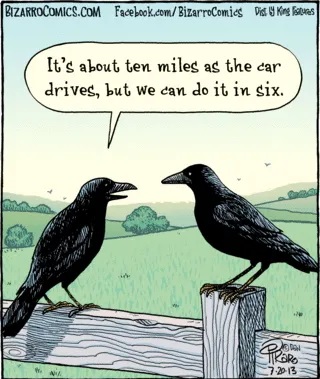
As the Crow Flies: After crossing the oceans, sailors would watch for birds to detect nearby land. Following the direction of birds, such as a crow or seagulls, got them closer to shore to follow it to a port. Crows fly straight, and so it refers to the shortest distance between two points.

Tide Over: When a ship could not get under sail due to poor winds, they would ride the tide until the winds returned. If something tides one over, it will last until new provisions can be obtained or until conditions change.

High and Dry: If a ship was caught in low tide or ran up on the shoals, it might end up being stranded with no hope of recovery. The term was to be caught high and dry, as in up out of the water. It’s used today to describe the feeling of being abandoned, stranded, or helpless.

Sink or Swim: Tossing a person overboard resulted either in them sinking or swimming. The term was made popular in swashbuckling movies featuring pirates deciding on whether they should spare their captives or not. Today, it refers to either failing (sinking) or succeeding (swimming) in a task or an endeavour.

2 Comments

Filed under Articles, Cartoon, Etymology, Grammar, History, Images, Lists, Military History

History Undusted: Burma-Shave

For those outside of the US and/or Millennials, the term “Burma-Shave” might be new to you – which is why I’d like to “undust” this fascinating little piece of history.

The 1920s was a time of change; World War 1 was over, and the following Spanish flu had wiped out more people than the war itself; the survivors just wanted to celebrate life. Out went the starchy mentality of Victorian dresses and in came the flappers; innovations and scientific breakthroughs fed the hunger for the new and anything that made life easier.

At the time, men shaved themselves with shaving cream applied to the face with a brush and a straight razor blade (still common into the 1950s, when the double-edged safety razor began to gradually take over).

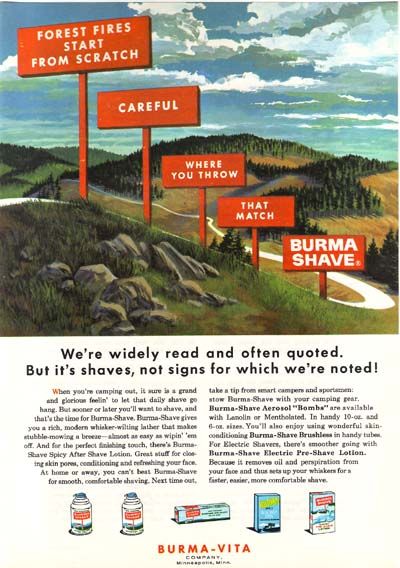
Enter, the Burma-shave brushless shaving cream: Introduced in 1925 by the Burma-Vita Company in Minneapolis, Minnesota, it was purported to have come from “the Malay Peninsula and Burma.” It was, in fact, a result of chemical experiments by chemist Carl Noren. The monicker was a marketing gimmick, much like products touting to be “Swiss” that are unknown here (even “Swiss cheese” – which one of the hundreds is meant?). The cream didn’t really take off, and while other similar products were coming out of larger companies such as Barbasol and Gilette, Burma-Shave managed to beat the odds when their clever advertising campaign was hit upon.

Around this time, the Ford Model T had become a huge success, with millions of new automobiles on ever-expanding road systems. Roadside signage was taking off, and the advertising gimmick was destined to go down in history as one of the quirkiest success stories.

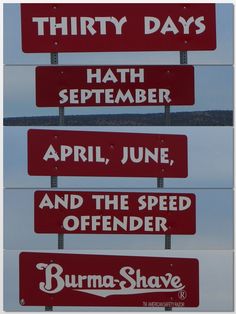
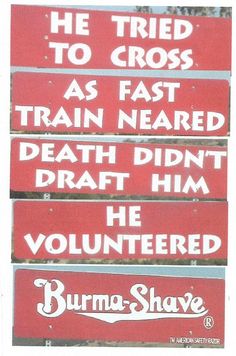
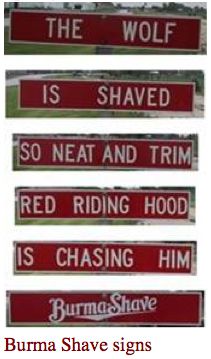
Burma-Shave ads were a series of signs along the road that concluded in the sign saying “Burma-Shave”. The first couple of years, the signs were rather prosaic ads for the company; but as they began bringing in repeat customers, the signs became bolder and more experimental. They became more humorous rhymes – usually five signs, with a sixth ending the series as “Burma-Shave”.

Here are a few examples:

  • Shaving brushes / you’ll soon see ’em / on the shelf / in some / museum / Burma-Shave (1943)
  • Uncle Rube / buys tube / one week / looks sleek / like sheik / Burma-Shave (1930)
  • A shave / that’s real / no cuts to heal / a soothing / velvet after-feel / Burma-Shave (1932)
  • Shaving brush / and soapy smear / went out of / style with / hoops my dear / Burma-Shave (1936)
  • The Burma girls / in Mandalay / dunk bearded lovers / in the bay / who don’t use / Burma-Shave (1937)

As cars began to speed up, safety messages increased around 1939:

  • Hardly a driver / Is now alive / Who passed / On hills / At 75 / Burma-Shave (1939)
  • If you dislike / big traffic fines / slow down / ‘till you / can read these signs / Burma-Shave (1939)
  • At crossroads / don’t just / trust to luck / the other car / may be a truck / Burma-Shave (1939)
  • Don’t pass cars / on curve or hill / if the cops / don’t get you / morticians will / Burma-Shave (1940)
  • At intersections / look each way / a harp sounds nice / but it’s / hard to play / Burma-Shave (1941)

When World War 2 came around, the signs reflected the social conscience:

  • Maybe you can’t / shoulder a gun / but you can shoulder / the cost of one / buy defence bonds / Burma-Shave (1942)
  • Shaving brush / in army pack / was straw that broke / the rookie’s back / use brushless / Burma-Shave (1942)
  • Slap / the Jap / with / iron / scrap / Burma-Shave (1943)
  • Tho tough / and rough / from wind and wave / your cheek grows sleek / with / Burma-Shave (1943)

A few humorous signs:

  • She kissed / the hairbrush / by mistake / she thought it was / her husband Jake / Burma-Shave (1941)
  • We know / how much / you love that gal / but use both hands / for driving pal / Burma-Shave (1947)
  • I use it too / the bald man said / it keeps my chin / just like / my head / Burma-Shave (1947)
  • Road was slippery / curve was sharp / white robe, halo / wings and harp / Burma-Shave (1948)
  • If you think / she likes / your bristles / walk bare-footed / through some thistles / Burma-Shave (1948)
  • A man / a miss / a car – a curve / he kissed the miss / and missed the curve / Burma-Shave (1948)
  • Our fortune / is your / shaven face / it’s our best / advertising space / Burma-Shave (1963)

Toward the latter part of the signage, they began recycling earlier messages. Road signs and maintenance became increasingly expensive, and cars sped by faster than ever. The signs disappeared from the roads in 1963 when the company was sold to Phillip Morris and they discontinued the marketing campaign, which turned out to be a mistake; sold once again, the product eventually disappeared, but the term “Burma-Shave” can still be heard, referring to short, quirky rhymes.

To read more about this topic:

Route Magazine: Defining the American Dream, One Sign at a Time

I hate to end / this fun article / but time is short / so here’s what’s possible / Burma-Shave examples from Pinterest:

This illustration is from “A History of the Burma-Vita Company”, written by Frank Rowsome Jr. and illustrated by Carl Rose (published by the Stephen Greene Press in 1963).

12 Comments

Filed under Articles, History, History Undusted, Links to External Articles, Lists, Military History, Quotes, Signs, Snapshots in History

10 Everyday Phrases with Nautical Origins #3

Some of today’s nautical idioms are well known, such as to be on board with a proposal or suggestion or learning the ropes in a new job or position, while others, such as three sheets to the wind are less common (unless you happen to work in a bar – then it may come in quite handy). Either way, enjoy these, matey!

Be On Board: As part of a crew, a sailor bore their part of the responsibilities. In today’s terms, it means to accept or agree with a proposal or a way of doing something and go along with it.

Rats Deserting a Sinking Ship: Rats and mice were common aboard ships, often in the bulkhead (lowest section of a ship, where the grains were stored (the weightier things being stored low and balanced to keep the ship sturdy in rough seas). If the ship began to take on water, the rats would go up the deck ladders to stay away from the water; if they started jumping overboard, sailors wouldn’t stand much better of a chance (most sailors could not swim). It’s a vividly grim picture of life aboard. Now, it’s an idiom describing people abandoning a failing activity or situation.

Close/Tight Quarters: Tightly packed (e.g. people in a small space). Space was at a premium, especially on the lower decks of a ship of sail. Men slept in hammocks close together and shared the space with stowed ship equipment and their own storage chests. Even today on submarines, bunks are shared by those who are off-duty and those on-duty to save sleeping quarter space.

Run a Tight Ship: Manage and organization strictly, efficiently, and effectively. A ship, especially in times of war, was run tightly to avoid unnecessary dangers and/or deaths, and to maintain discipline that would be needed to succeed in crucial moments.

Learn the Ropes: Sails were raised and lowered with ropes, and knowing how to control the sails allowed a ship to take full advantage of the wind and sail safely. There were miles of ropes on a ship, each with an important and specific function. Learning the ropes was essential for everyone aboard – it would keep others out of danger and oneself alive! Today, one learns the way things are done in a given setting or situation.

Broadside: The broadside was the side of the ship which sat above the waterline; cannons were arranged on several decks, and when ships sat broadsides facing, firing simultaneously, it was known as broadsiding. Today, it refers to being taken off guard or being surprised by something unpleasant.

 Broad in the Beam: Describes the width of the beam or mast on a larger ship. It denotes a person who’s wide across the hips and buttocks.

Keel Over: To collapse, to die. If the keel of a boat were to rise out of the water, the ship would be in danger of capsizing; this might happen due to a storm or damage by an enemy attack.

To Keelhaul: To rebuke harshly. It was a punishment meted out in extreme cases by dragging someone, ankles weighted, by ropes beneath the ship along or over the keel (the backbone of wood along the bottom of the ship). As these were usually covered with barnacles, clothes and skin would be shredded by the barnacle shells, and if the salt water of the ocean didn’t disinfect the wounds on the way up, it could be a death sentence. How much it was actually practised is difficult to say, as written records are sparse (perhaps a cruel captain didn’t want it on record, or perhaps it was not as widely practised as we think); the most concrete records of the punishment come from the Dutch. It was banned by the British Royal Navy around 1720, and by the Dutch around 1750. That bans were necessary tells its own tale…

Three Sheets to the Wind: Implies an unsteady, drunk person. The sheet referred to the ropes (lines) used to control the trim (the advantageous angle of the sails in relation to the wind) of the sail. If the sheets are loose, the sails will flap in the wind which causes the ship to lurch about like a drunken sailor. There are variations of the number of sheets in the idiom: 1 would be tipsy, 3 would be staggering drunk!

3 Comments

Filed under Etymology, History, History Undusted, Lists, Military History

10 Everyday Phrases with Nautical Origins #2

Today’s everyday phrases can come in handy when you’re in a tight spot, avoiding danger, or reaching your goal (land ho!) Chockablock came in handy for me last week, as it described how I felt after having been sick for nearly two months (Covid into bronchitis, joy), and then catching up with all those little things in our household that had gone undone. Anyone who’s been married for any length of time will know that spouses tend to take over specific jobs – whether that’s carrying out the rubbish or doing the laundry, cleaning drains or watering plants. I’ll let you guess which jobs are whose. Catching up with those undone jobs stemmed the tide of accumulating chores, and helped me get our home back to shipshape and in Bristol fashion! So enjoy these phrases, and please share in the comments which ones apply to your life!

Chockablock: Jam-packed; overcrowded; completely filled, stuffed, or jammed tightly together. You may have heard the term block and tackle; This refers to a system in which a rope, chain or cable (= tackle) is passed over pulleys enclosed in two or more blocks, one fixed and one attached to a load (see image). When these blocks are pulled so close together that no further movement is possible, this is known as being chockablock (this is the usual spelling, which illustrates its meaning perfectly – no space, not even a dash between words!).

Stem the Tide: Try to prevent a situation from becoming worse than it already is. Nautically, it means to tack (steer) against the tide or oncoming storm to avoid being blown off course or capsized.

To be Shanghaied: A city in China, Shanghai implied a long voyage (just as Switzerland today implies neutrality in the collective conscious). When landsmen were impressed (volunteered against their will) into the British or American navies in the days of wooden ships of sail, to be Shanghaied meant to be impressed and sent away from home for a long time or extended voyage (not necessarily to China!).

Limey: Shortened slang for “lime juicer”, referring to the English naval ships and the practice of carrying barrels of limes or lime juice to ward off scurvy on long voyages. As the British navy was a dominant force on the seas, the term gradually came to mean British.

Shipshape (and in Bristol Fashion): Everything is okay and in good order. Bristol was, at one point, Britain’s main west coast port; the idiom was used to describe everything being in order with cargo and at the port.

Give a Wide Berth: Leave space for, veer around. Even when a ship is at anchor, it will move with the tide and wind, so the berth, or a docking space, for a ship needs to be ample for a safe mooring. The modern phrase still denotes the danger of steering too close to an unpredictable situation.

Loose Cannon: Unpredictable danger (can be said of a person or situation). When a cannon or a cannonball broke free from its mooring, it created a hazardous situation as it rolled around or across the deck during a storm or in battle.

Port, Starboard: This simple explanation is that these are left and right, respectively, on any ship or airplane. But simple is a bit boring! Buckle up: In the past, as today, the majority of people were right-handed; ships of sail had rudders centred on the stern (back of the ship), but the steering oar came up onto the quarter deck through the right side of the stern. This leads us to the term starboard: Old English steorbord literally meant steer-board, the side on which a vessel was steered.

When pulling into a port, as the steering oar was on the right side, they would anchor starboard out, port in. The port, the left side of the ship as seen from the stern facing forward toward the bow, was formerly known as larboard, from Middle English ladde-borde, meaning loading board (side); it was eventually renamed as the similarity to starboard was confusing in the loud life aboard.

Most airplanes follow this tradition today, with boarding being on the left (port) side. In fact, jet bridges are designed to match the left side of the plane, so unless you are climbing into a grasshopper flight on a remote island, you will board port side!

Ahoy: Used to hail a ship, a boat or a person, or to attract attention. Used today as a humorous warning of impending danger or inconvenience.

Land Ho: To call out “Land ho!” was to let the crew know that land had been spotted. It is a way to let everyone know that the end of a voyage is imminent.

2 Comments

Filed under Articles, Etymology, History, History Undusted, Lists, Military History

10 Everyday Phrases with Nautical Origins #I

A phrase I use often is to “batten down the hatches” – meaning “put things away in preparation for (leaving on holidays, guests arriving, or the next project)”. I know that it originates from ship jargon, where it means preparing for rough seas or as a precaution to some other danger. That set me thinking about how many other phrases and idioms we use regularly in English that have their roots in nautical history. I’ve written on this topic before, highlighting the phrases of cathead, to swing a cat, down the hatch or break the ice, and even toe the line vs tow the line. Here are 10 more to get you thinking, with more to come!

Long Shot: A situation needing a good deal of luck. The guns aboard ships of sail were often inaccurate, or the decks would be too high for close-range accuracy. If a cannon successfully struck its target from a “long shot”, it was considered extraordinarily good luck.

Flotsam and Jetsam: A collection of miscellaneous items of little importance; odds bods, odds and ends. Flotsam refers to items unintentionally cast adrift or washed ashore, while Jetsam describes items intentionally cast overboard, such as when lightening the load for buoyancy.  They are almost always a paired idiom.

Taken Aback: Suddenly or unexpectedly checked or disappointed; startled or surprised.  It comes from the situation when a ship’s square sails were flattened against the masts by a sudden change of wind, stopping the forward motion.

In the Doldrums: Listless, depressed. Doldrums, aka the Intertropical Convergence Zone (ITCZ), is an area of the ocean near the equator where calms, squalls, and light, baffling winds are common. Sailing ships would often hit the Doldrums and be stranded until the wind could pick up their sails and empower the ship to move on. Large ships of sail had the disadvantage of having no ability to be oared forward.

The Cut of One’s Jib: One’s general appearance. The jib was the large, triangular foresail of a ship. When someone on the watch spotted a vessel on the horizon, they would look at the cut of the sails to determine whether they were friend or foe. A modern equivalent would be plane spotters, who can determine the make of an airplane by the shape of its hull and wings.

Show One’s True Colours: Being honest, open. Though the cut of the jib would determine a ship’s origin, it became more complicated as ships were captured by an enemy and repurposed for their own use. Because of that, ships of sail would hoist their colours – flags – to proclaim their current nationality. To show one’s true colours meant being honest, because enemy vessels might fly false colours until within firing range and then switch flags, declaring their true intentions at the last minute.

Pipe Down: Imperative – be quiet. Aboard a ship, the bo’sun’s pipe whistle would signal various activities.  To “pipe down” was the signal given to dismiss the crew from duty.

Landlubber: This word has a long history, though it eventually became known as a derogatory nautical term for people who struggle with being at sea or who get seasick and therefore dislike boats, or what the sailor considered a lazy person preferring life ashore. The term lubber goes much further back: In the mid-fourteenth century, it meant a clumsy, stupid person who lives in idleness. An earlier form, Lobi, meaning lazy lout, may have Scandinavian roots; it may also derive from the Old French term lobeor, meaning swindler, parasite. Any way you slice it, being called a Landlubber was basically an insult – or an accurate description of your character, depending on whether you were on the receiving or giving end of the word…

Bottoms Up: Known today as a drinking cheer to encourage people to finish off their drink, it has a much darker past. During the days of sail, the British navy would press men into service. If you volunteered, you were given “the King’s shilling” as first payment. Scrupulous press gangs would slip a shilling into a man’s drink, and if he finished off the drink, he was considered as having accepted the payment and was hauled off to sea. Innkeepers became wise to their tactics and began serving drinks in glass beer mugs rather than earthenware mugs, encouraging their patrons to check “bottoms up” to make sure there wasn’t a coin in the glass.

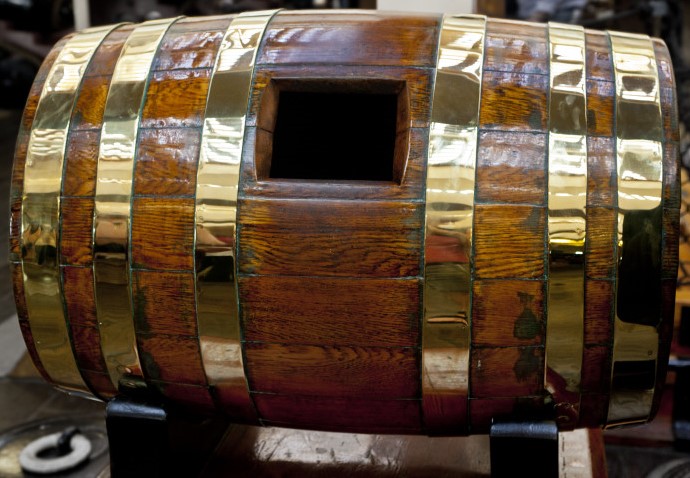
Scuttlebutt: The Butt was a cask with a capacity of between 110 to 140 imperial gallons of liquid (see my article about it here).  Scuttle was an opening in the ship’s deck, and as a verb, it meant to intentionally sink a ship by either putting a hole in it or leaving the portholes open with the intention of making a vessel unusable by an enemy. The barrels aboard ships were usually laid on their sides within braces, and a scuttle was a hole in the side for a cup or scoop to be inserted. The drinking hole became a popular gathering place, and the term “drinking hole” also became synonymous with the office drinking fountain or the local pub – a place to gather and have a drink together. To scuttlebutt means to idly chatter, start rumours, or gossip.

Which of these phrases are new to you? How many do you use, and if you use them, how frequently? I’d love to hear about it in the comments!

4 Comments

Filed under Etymology, History, History Undusted, Lists, Military History, Snapshots in History

Books on Sale!

From 15 December 2023 through 1 January 2024, you can get all of my books on sale for 50% off!

Just click on the image below in that time, and search for my name, Stephanie Huesler!

You can also click on the book covers below to find them directly on Books2Read. From there, you can click on the link to Smashwords, which will take you directly to the sale.

Enjoy – from 18th-century fiction to historical fantasy to science fiction!

Please share these links with your friends and family who love to read! Thank you!

Leave a comment

Filed under Lists, Links to External Articles, Sales, Promotions

History Undusted: William Caxton (the father of English as we know it today)

I’ve been trying to blog the last few weeks, but to do so, it helps to be logged in to WordPress – and it kept logging me out every time I switched to my site. I finally found the solution this morning, so here I am!

One thing I’ve been ruminating about is the etymology of everyday words; words come from somewhere, and I’ve always wondered what word(s) were used before a word came along. There are famous examples of invented words that never stuck, such as Lewis Carol’s “Jabberwocky“, but what I’m referring to are common words. What did they use before the word “egg” came along? The word itself comes from Old Norse, eggys, eggja, or egge, but before the common spelling was decided on, every English dialect in Britain had at least a couple of different spellings of the word!

William Shakespeare (1564-1616) is sometimes credited with having created upwards of 1,700 words, but many of those were likely already in circulation – he simply wrote them down in his plays. Some words accredited to him are: dishearten; dislocate; auspicious; obscene; monumental; majestic; accommodation; amazement; dwindle; exposure; bloody; countless; courtship; impartial; gnarled; gloomy; generous; reliance; pious; inauspicious; bump; frugal; submerge; critic; lapse; laughable; lonely, suspicious, and many, many more.

But long before William Shakespeare drew breath, there was another William who influenced English in profound ways, and yet his name is little known today: William Caxton. Born around 1420, he was a merchant, printer and the first English retailer of books; he introduced the printing press to England, set up in Westminster, 1476. Though he published many books, the first book he is known to have published is The Canterbury Tales, by Geoffrey Chaucer (1340s – 1400); that work alone is credited with influencing both the English language and literature, as it shows a clear correspondence between the rhythm of written English poetry and the cadence of spoken English. Chaucer is also known for having looted the French language, bringing into English such words as governance, paramour, difficult, dishonest, edifice, and ignorant, to name a few. Chaucer was aware of the wide variety of English dialects, which we would never recognize as English today, and he was anxious about the confusion of languages in Britain and that his work would be able to be comprehended in the future. In his poem, Troilus and Criseyde, he bids it a poignant but troubled farewell: “Go, litel bok . . . And for ther is so gret diversite In Englissh and in writyng of oure tonge, So prey I God that non miswryte the [thee]. . . . That thow be understonde, God I biseche!”

However, because William Caxton chose to publish Chaucer’s work, we still have it to this day. Caxton was also the first to translate Aesop’s Fables into English (1484). Although he was not a great translator and sometimes simply used the French word “Englishified”, his translations were popular; because of that, he inadvertently helped promote Chancery* English as the standard English dialect throughout England. (*Chancery refers to the dialect used by the officials of Henry V’s government). Thanks to men like William Caxton and those who followed, refining and shaping the language we know today, we are able to enjoy a standard English spelling and grammar structure that is understood around the world; there are still regional and national dialect differences, but we can be understood wherever in the world English is used.

If you’d like to learn more about this topic, one book I can highly recommend is Melvyn Bragg’s The Adventure of English (The Biography of a Language); it’s available in physical form, e-book, and audiobook.

William Caxton

8 Comments

Filed under Etymology, Grammar, History, History Undusted, Links to External Articles, Lists, Poetry

Rabbit Holes

These past few weeks have flown by so quickly, I’ve hardly had time to look up from my keyboard! Except when I went to the optometrist for new glasses (there might have been a slight connection between the two). I’ve been editing my final sci-fi draft. When I need a break from editing, I’ve been reading into articles by the new ebook company I’ll be working with, Draft2Digital, which has recently merged with Smashwords (my current and former platform). And in the context of editing, I’ve been down several rabbit holes:

Dashes

Back when I learned English, we had the good ol’ hyphen and the dash. Somewhere along the way the en-dash and the em-dash moved in, and they turned out to be worthy additions to the conversation. Now to make things confusing, 2em-dashes and 3em-dashes have elbowed their way into the punctuation party. I’m not sure how I feel about them yet, but their definitions seem to have squeezed the others so close that they often overlap or exchange places on the definition and usage dance floor. Until I need them to fix me a drink, I’ll probably ignore the party crashers.

Strunk and White’s The Element of Style is a cornerstone of grammar and writing style and is widely considered timeless; in fact, it was listed by TIME in 2011 as one of the 100 best and most influential books written in English since 1923. The irony of this cartoon is that when I recently pulled out my copy to find out the nitty-gritty of using en- and em-dashes in dialogue, I found not a jot or tittle about them in the entire book. It covers hyphens and dashes, both briefly, but nary a word beyond. Every website that I looked at had contradictory definitions and usages of all types of dashes; so until an authoritative source comes up with a defined set of rules, I will continue to use them the way I’ve learned them, and just be consistent in my punctuation within my current manuscript.

Dialogue Tags vs. Action Tags

Another rabbit hole I went down was a learning curve on the two types of tags. On one hand, I’d never honestly thought about the fact that there could a difference in punctuation between the two; on the other hand, for the most part, I’ve intuitively done it right, though not always, which is why I’ve added it to my checklist of edits – and something I will keep a closer eye on in the future. Here’s an example:

He said, “Oh, the irony of ignorance!” – This is a dialogue tag with its attending punctuation. Dialogue tags are any verb that can be spoken – said, cheered, whispered, etc.

He nodded. “I hadn’t thought about it, but that makes sense.” – Nodding is something done, and this is, therefore, an action tag. Notice that its attending punctuation is a period separating the action tag from the dialogue.

Two things make less logical sense to me; if you have insight on them or experience using them or reading them in novels, please comment! [Keep in mind that these are American English rules; I am writing my current novel in American English, though until now, I’ve written in Commonwealth English (I use that term rather than British English because it is used beyond Britain).]

  • How often have you spoken and laughed, chuckled, or smiled simultaneously? These are, for me, nuances in spoken vocabulary, and not action tags. Would you rather write: He smiled, “I thought you might say that.” or He smiled. “I thought you might say that.” ? In this particular instance both would work, but there are times when it has the potential to break up the rhythm of a sentence or scene too much. Which do you prefer?
  • When an action interrupts dialogue, it needs to be separated with (IMHO) rather odd punctuation, for example: “From what I’ve read about these dwellings” –he looked at the woman kindly– “they’re far from mud huts.” My years as an English teacher mean that missing commas and attached en-dashes hurt my eyes; maybe that’s why I needed new glasses!

Euphemisms

Another tangent this week has been looking for creative swear words. Nothing irritates me more, when reading a book, for the author to fall back on standard F-bombs. That just says too lazy to be creative to me. It’s unimaginative. It doesn’t make a character stand out from the rest of the lazy crowd. There are so many fun alternatives, there really is no excuse! Here are a few I’ve come across and found myself smiling:

  • People cussing in a foreign language; it sounds better to them.
  • Fart knocker (e.g. “you little fart knocker”)
  • Sun of a nutcracker! Sun of a biscuit!
  • Cheese n’ crackers!
  • Shoot a monkey!
  • Shiitake mushrooms!
  • Well, butter my bum!
  • Clusterfluff!
  • In a type of Chinese Whispers, “Hells bells” became “hells bells, conker shells”, misunderstood by kids as “hells bells, taco shells” – now that family just yells, “Taco shells!” when they’re upset!
  • Names as swear words might backfire if you happen to meet someone by that name; here are a few: Christopher Columbus; Gordan Bennett (in Scotland); Gottfried Stutz (here in Switzerland – I actually taught English in a company that had an employee with that name!)
  • Sugar Honey Ice Tea!
  • Sunny Beaches
  • Fudgenuts
  • Someone I used to know would say things like “bug knuckles” or “dog feathers” or “ants pants” when she was upset.
Credit: Getty Images

These are just a few of the areas I’ve delved into in the past few weeks; I’m still deep in the editing/proofreading process; once that’s complete, the “behind the scenes” checklists begin – those are the things readers will never see: The number of hours put into finding the right images and designing the best cover art possible; choosing the right fonts; formatting for the various mediums online and print; writing blurbs, preparing marketing bits and bobs, and setting up all the dominoes in a row for the final push of publishing!

Clusterfluff! I’d better get my fanny in gear!

10 Comments

Filed under Articles, Etymology, Grammar, Lists, Musings, Nuts & Bolts, Research