Category Archives: Lists

Odd Jobs #3: Bereavement Coordinator to Car Plate Blockers

JAPAN-ART-PAINTING

Body Painter.  Photo credit: YOSHIKAZU TSUNO/AFP/Getty Images

For most of the odd jobs in this week’s lineup, I was able to find a link with a description of some kind; but, not surprisingly, “one of these is not like the others” (a Sesame Street throwback…) – the only illegal job of them all; it seems to have found a niche market in a black market sense of the word.  In a weird way, it reminds me of “lines of desire” – where there’s a will, there’s a way.

I find it interesting to include “Blacksmith” in this list; what was once a trade found in any town worth its salt, and testified to by the number of people with the surname Smith, is now a rarity.

By the way, I’m running a similar series on my history blog under the heading “Odd Jobs of Bygone Days” in case you’re interested.

6 Comments

Filed under Articles, Images, Lists, Research

Odd Jobs #2: Ant Vendors to Beer Testers

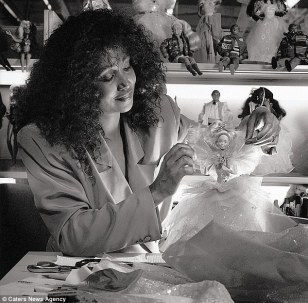
Odd Job - Barbie Doll dress designer, Nancy Rica Schiff

Barbie Doll Dress Desiger.  Image by Nancy Rica Schiff

Here are a few jobs that, only if one stops to think about it really (really) hard, might seem logical.  I guess that if you buy a ball, someone has to have tested it – at least random spot-checking of production lines; but selling ants?  Or making post mortem portraits from cremated ashes?  Or sniffing other people’s armpits (which is easier than sniffing your own, granted…)?  Go figure.  Follow the links to read more about them.

  • Ant Vendor: There are about 12,000 different species of ants in the world, so selling ants might actually be more complicated than you think. If you’ve ever had an ant farm, there was an ant vendor at work behind the scenes.
  • Armpit Sniffer
  • Ash Portrait Artists: Gets creative with the remains of loved ones. Following cremation, some people choose to hire these artists to create a token of remembrance, like a necklace or glass sculpture.
  • Barbecue Editor: Eating at restaurants and writing about it for magazines and newspapers. It may sound like a dream job until you stop to consider the fact that they must eat barbecue several times a day, every day…
  • Backpacking Instructor
  • Bed Tester
  • Ball Tester: Assess basketballs, footballs, volleyballs and soccer balls for air-retention, inflation, roundness, weight and reboundability. This job might also be called a “performance analyst” or “performance evaluation tester”.  If you think about it, someone’s got to test sports balls, tennis rackets for pros, etc.
  • Barbie Dress Designer: Fashion designers at Mattel Toys, the company behind Barbie, create hundreds of new styles for Barbie and her ever-expanding entourage.
  • Beefeater
  • Beer Tester: Taste — and spit out — beer all day to approve new and existing flavours.

9 Comments

Filed under Lists, Research

To-Do or To-Be, That is the Question


resizedimage400325-Timemanagement-forblogger

Credit:  www.acceleo.com

Working at home is a double-edged sword; most people think they would love to be their own boss, to set their own schedule, to pursue their own dreams.  But that’s just it:  You have to be your own boss, and not let meetings, schedules, appointments, to-do lists and sundry responsibilities outside of work consume you; you have to set your own schedule and stick to it, or time will hijack it; you have to actively pursue your dream (and success usually comes dressed in work clothes), or it will never come true.  It’s a lot like writing:  Most people don’t really want to write a book, as they claim; they want to have written a book, and there is a vast difference between the two.

If you’re like me, you’re organized; we need to be, to keep work, tasks and schedules from eating us alive.  Sometimes even with the best of intentions and plans, squirrels still come along… if you have no idea what I mean, just click on the link!  To keep the squirrels at bay, I keep a book of to-do lists.  I have one for my household tasks, telephones, repairs, appointments, administrative issues, etc.  I have as many as it takes for revisions and the like for my current manuscript, as well as marketing lists, etc… plus writing blogs.  Sometimes frankly they can all be overwhelming, and that’s where I need grace with myself.  It’s times like that when having a boss might be preferable, telling me what to do next (I just have to remember the last two bosses I had, and that wistful thought vanishes pronto)!

Despite the long lists, I still need to find time and space to just “be”, and that is a challenge for me.  Even when I’m sitting still, my mind’s going 1,000 RPM, percolating on a plot idea, developing a character or plot twist, thinking about what I’ll make for dinner – do I need to go shopping? – or what the schedule will be once others are home again.  Leaving work at the office is more difficult when home and work occupy the same space.  And, oh yeah, daily exercise would be a good idea too.  I have periods each day that are what I call “limbo time” – too short or chopped up by others to dive into a larger project.  I could fill the “limbo” time of my schedule with a myriad of micro-sized tasks; but I also need to learn to step back, take a deep breath or ten, and not be productive or feel guilty that I’m not being productive.  Such recuperation time shouldn’t be relinquished to the edge of “micro crumbs” of time left over; it is just as important to schedule a time of rest, and should be taken just as seriously as any task, though it often isn’t (I’m getting better at it).

Some of the things I’ve learned about time management so far are:

  • Know how your time is spent.  If you don’t, it will run through your fingers like fine sand.  In my article on productivity, I mentioned a few helpful apps; they help me track how my time is being used, and it helps me to focus.  Even my breaks are scheduled with the Clear Focus app mentioned.
  • Have a pad of paper nearby to jot down the random thoughts that come. I’ve found that jotting them down quickly helps clear my mind to focus better on the task at hand.
  • Schedule down-time: Take a power-nap, or do something you enjoy like sitting in the sunshine, going for a refreshing walk, or creating something crafty.
  • Create habits. One habit I have is a bit like “clocking in” at my desk:  I set both my landline phone and my cell phone into a holder on the desk, and this little action signals to my mind that it’s “time to focus”.  Another habit might be making myself a tea either before I sit down, or on a break.

How do you deal with balancing work and rest, real life and dwelling in the fantasy world of a writer?  Have you developed any habits that help?  Please share them below – we can all benefit, I know!  The next thing on my schedule is – squirrel! – taking time to swing by others’ blogs, and be inspired.  The squirrel is now caged.

2 Comments

Filed under Articles, Lists, Musings, Writing Exercise

5 Life Hacks for Productivity

Let’s face it… humans are creatures of habit.  That phrase often has a negative connotation; in a conference that lasts several days, people will tend to sit within a few chairs of the seats they sat in on the first day, whether they like the location or not; once a person starts hanging the loo roll on the dispenser either top or bottom, the other way is just wrong.  But habits can also work to our advantage, if we form good ones:  Cleaning up after ourselves should have been a habit formed in our childhoods; brushing our teeth, pushing a chair in after we leave the table, and dozens of other little habits are hygienic, energy-saving, and contribute to more harmonious relationships within our social and environmental landscapes.

Those of us who express ourselves through creative media (such as writing, arts or crafts) might tend to see ourselves or the expression of our craft as outsiders, or at least mavericks, when it comes to business practices.  However, there are many tools (such as the SWOT) and principles for increasing productivity in the business sector that we can and should apply to our creative streaks (if the intention is to take them beyond the level of hobby to a more serious endeavour).  One of those principles involves forming good habits.  Below, I’ve listed five things that I do to keep my creativity fresh, and thus keep the time that I spend writing more productive than it would otherwise be (I know from experience).  For practical purposes I’ll refer to the expressions from the perspective of a writer, but these hacks apply to any creative discipline.

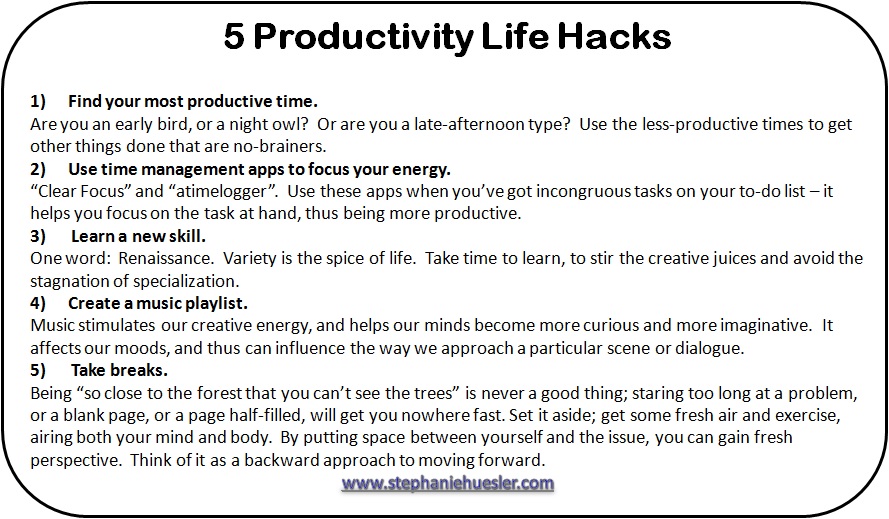
5 Productivity Life Hacks

I’ve taken the liberty of making a “cheat sheet” as a reminder of these principles; if it’s helpful for you, feel free to print it out and hang it up where you work or write.

1)   Find your most productive time.

Are you an early bird, or a night owl?  Or are you a late-afternoon type?  Most people have 9-to-5 jobs that dictate when they have free time; but when you are looking for time to write, try to schedule it in your most productive time of the day.  I am an extreme night owl; I need very little sleep and work at home, so my time is flexible; yet my most productive time of the day is between 01:00 and 04:00, with the second-most productive period being late-afternoons. I know this about myself, so I use the less-productive times to get other things done that are no-brainers (housework, shopping, etc.).

2)  Use time management apps to focus your energy.

I have two (android) apps that I use:  “Clear Focus” and “aTimeLogger”.  The first app counts down from the time I set, with a five-minute break following; every three sessions, it encourages me to take a longer break of fifteen minutes.  The second app allows me to log how much time I spend in a particular activity; I have added customized activities such as editing and blogging.  I use these apps especially when I’ve got a dozen incongruous tasks on my to-do list – it helps me focus on the task at hand, thus being more productive.

3)  Learn a new skill.

That may sound a bit odd; after all, it takes time to learn a new skill, right?  But bear with me a moment:  The current thinking of today is that one should become a specialist; the thinking goes that if you focus your energy into learning one skill to a high degree, you will be successful in it.  But I have one word in answer to that:  Renaissance.  During the Renaissance it was considered ideal for one to pursue multiple disciplines; a gentleman of the time was expected to speak several languages, be well-versed in various scientific disciplines such as astronomy, botany, or medicine, and be eloquent with words through writing poetry, play a musical instrument, study philosophy, theology, and so on.  The standard was set, and met – think of all that was accomplished, discovered, and invented during that age!  Variety is the spice of life, and I find that iron sharpens iron – that one skill hones another.  So take some time to learn something new; it will stir the creative juices and get them flowing much more productively than if you stagnate in specialization.  And in gathering new skills, you will add to your arsenal of personal experience from which to draw on when fleshing out characters, worlds, scenes and dialogues.

4)  Create a music playlist.

Spotify is a great invention!  I have dozens of playlists, and depending on what I’m working on, I’ll turn on music to set the mood for a scene I’m writing (for me, it has to be just right or it can be counter-productive), or to speed me up or slow me down.  Music stimulates our creative energy, and helps our minds become more curious and more imaginative.  It affects our moods, and thus can influence the way we approach a particular scene or dialogue.  Just for the record, as I write this, I’m listening to the album Grace by Steven Sharp Nelson (of the Piano Guys).

5) Take breaks.

This is another habit that runs counterintuitively to conventional wisdom, but being “so close to the forest that you can’t see the trees” is never a good thing; staring too long at a problem, or a blank page, will get you nowhere fast.  Frustration builds, making any mental block that much thicker.  Set it aside; get some fresh air and exercise, airing both your mind and body.  By putting space between ourselves and the issue, we often gain fresh perspective.  Think of it as a backward approach to moving forward.  As Steven Spielberg advises, contemplation time is essential in the creative process – don’t fill it with brain work that distracts.  Take a bath.  Do the laundry.  Draw; doodle; do a craft.  Some of my best solutions or plot twists have come while doing a craft.  By the way, crafts encourage abstract thinking, problem solving, and creative perspectives.  To apply this, take a 20-30 minute break after you complete a particular element; sometimes it actually helps me to start that new element before taking a break – it gives my mind time to percolate away from the computer, yet gives me a starting point when I return to work.

I hope these hacks encourage you in developing and honing your craft.  Keep writing!

14 Comments

Filed under Articles, Lists, Nuts & Bolts, Plot Thots & Profiles, Writing Exercise

The Pitfalls of Analogies

These are priceless examples of creativity gone awry.  I don’t know who originally wrote these gems or compiled them; if you know, please tell me so that I can give credit where credit is due!

21 Analogies Used by High School Students in English Essays

  1. “When she tried to sing, it sounded like a walrus giving birth to farm equipment.”
  2. “Her eyes twinkled, like the moustache of a man with a cold.”
  3. “She was like a magnet: Attractive from the back, repulsive from the front.”
  4. “The ballerina rose gracefully en pointe and extended one long slender leg behind her, like at dog at a fire hydrant.”
  5. “She grew on him like she was a colony of E. Coli and he was a room temperature Canadian beef.”
  6. “She had him like a toenail stuck in a shag carpet.”
  7. “The lamp just sat there, like an inanimate object.”
  8. “Her face was a perfect oval, like a circle that had two sides gently compressed by a Thigh Master.”
  9. “Her eyes were like the stars, not because they twinkle, but because they were so far apart.”
  10. “His career was blowing up like a man with a broken metal detector walking through an active minefield.”
  11. “The sun was below the watery horizon, like a diabetic grandma easing into a warm salt bath.”
  12. “From the attic came an unearthly howl. The whole scene had an eerie, surreal quality, like when you’re on vacation in another city and Jeopardy comes at 7:00 p.m. instead of 7:30.”
  13. “It was as easy as taking candy from a diabetic man who no longer wishes to eat candy.”
  14. “She had a deep, throaty, genuine laugh, like that sound a dog makes before it throws up.”
  15. “Their love burned with the fiery intensity of a urinary tract infection.”
  16. “It’s basically an illusion and no different than if I were to imagine something else, like Batman riding a flying toaster.”
  17. “If it was any colder, it would be like being in a place that’s a little colder than it is here.”
  18. “Joy fills her heart like a silent but deadly fart fills a room with no windows.”
  19. “The bird flew gracefully into the air like a man stepping on a landmine in zero gravity.”
  20. “He felt confused. As confused as a homeless man on house arrest.”
  21. “The revelation that his marriage of 30 years had disintegrated because of his wife’s infidelity came as a rude shock, like a surcharge at a formerly surcharge-free ATM.”

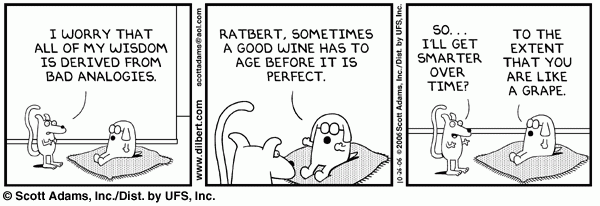
dilbert-bad-analogies

4 Comments

Filed under Cartoon, Grammar, Humor, Lists, Nuts & Bolts, Writing Exercise, Writing Prompt

Truth into Fiction

Sometimes truth is more fascinating, more adventurous than fiction.  Sometimes a news article becomes a spark for a fictional story.  One of the greatest films of all time, Titanic, took its cue from real life; many books and films are based on real life stories, mysteries, narrow escapes, historical events and experiences.  The best kinds of story sparks are those things which capture our imagination; not only best for the reader, but also for the writer – for if you are not excited by and captivated by what you’re writing about, researching and investigating, how do you expect a reader to be excited or captivated by it?  Personally, history has always fascinated me; I wonder, “What would it be like to walk among them?” or “What would it be like to discover these events as a modern archaeologist?”  I explored such a theme in my novels, “The Cardinal“.

Here are a few historical sparks that might capture your imagination; just click on  each image to link to the article:

Artifacts from the Battle of the Egadi Islands, ca. 240 BC

Battle of the Egadi Islands, 241 BC

The City of Heracleion, Plunged into the Sea

Heracleion Artifacts

China’s Atlantis:  Shi Cheng

China's Atlantis of the East, Shi Cheng

The Skulls of  Sac Uayum

The Elongated Skulls of the Yucatan underwater cave, Sac Uayum

An Ancient Roman Shipwreck Reveals Medicinal Remedies

Roman Shipwreck with Medicinal Supplies

2 Comments

Filed under History, Images, Lists, Nuts & Bolts, Plot Thots & Profiles, Research, Writing Exercise

7 Steps to a Powerful Opening

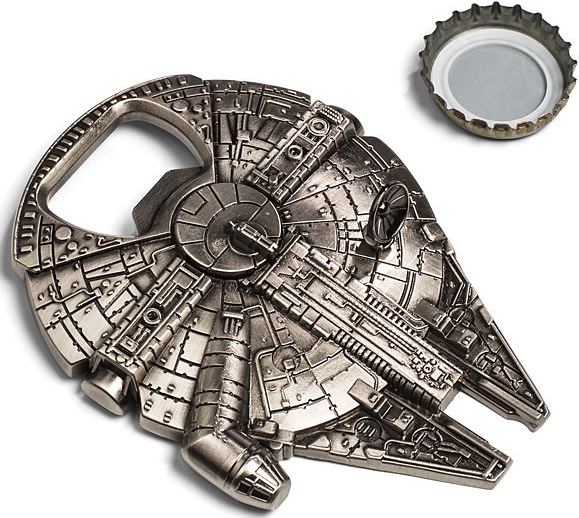
bottle-opener - millennium-falcon-

A powerful opener…

Anyone who writes novels worth reading can tell you that, as with any relationship, the first impression you make is the most important.  You know that you need to get your character from A to Z through the story, but how you introduce A is more important than B through Z – in other words, if you lose your reader’s interest from the get-go, they might not stick around long enough to find out where you want to lead them.  Here are 7 steps to remember that will lead you to that great first impression:

  1. Dive in! Hit the ground running!  Begin your story in the middle of an action scene, or in the middle of a conversation.  Let your reader feel like they’re eavesdropping on a decisive moment in your character’s life.  Make them wonder, make them ask questions they want answers to!  Who’s speaking?  What’s the context?  Why is there X problem / challenge / discussion?
  2. Make your character human: Give them sympathetic traits, a relatable nature, and attitudes that readers can identify with.  Do this through dialogue and actions, or by internalization (getting inside the character’s head, an “inner dialogue”).  It will help you to prepare your main characters by writing out a biography for them.  Give them memorable names (not complicated ones, or names that are difficult to work out how to pronounce).  The main character must be somewhat larger than life (more interesting than the average person in some way); do this through giving them idiosyncrasies, habits, a quirky sense of humour, etc.
  3. Romance: If your character is real, there will be romance – some kind of heart-to-heart relationship that touches that key human emotion.  I’m not talking about slutty romance novels; I’m talking about real human connection and rich emotional landscapes, whether it’s a small-town story, a science fiction planet, or a war zone.
  4. Supporting character: This might be a sidekick, a friend, partner, companion, or even an object or pet.  It is someone or something for the main character to share their experiences with.  The supporting character should contrast your main character – perhaps someone who asks the reader’s questions, or wants explanation of terms or concepts the reader might not be familiar with, without becoming “teach-y”.  They might be the voice of reason to an impulsive main character, or the voice of adventure to a staid hero/heroine.
  5. Antagonist: This opponent is an obstruction to the main character’s goals.  They create problems, sometimes danger.  They may be human, or non-human (e.g. man vs. nature), or may be an internal struggle of the main character (haunted by their past, or an addiction, a weakness such as impatience, etc.).
  6. Emotion: Build an emotional landscape (this links closely with # 3).  Show the main character as life-like, and develop relationships, or show struggles the character has with particular issues that give them depth and breadth.
  7. Style: Bring it all together in a style unique to your character’s voice and biography.  Show their feelings, conflicts, adding complications and subplots to take it deeper.  In your first chapter the goal of your character should come out – what their desires are, their determination, problems to solve, etc. – without making the arrival at that goal all too obvious!

6 Comments

Filed under Lists, Plot Thots & Profiles, Writing Exercise

Creative Writing over Christmas Holidays

I don’t know about the rest of you, but Christmas has snuck up on me this year!  Between publishing two books in November and all of the work involved in that process and the aftermath (promotion, etc.), I came up for breath last weekend, as I wrote about last week.  I took a short break, and now I’m beginning work on the next project (diving into research and scene layout).  But with Christmas coming up, it’s time to shift down a gear or two, and enjoy the season.  If you are a writer like me, writing can be addictive; it’s a good habit to write something every day.  But who says it needs to be a book manuscript, or whatever your next project or usual format is?  If you write poetry, try your hand at calligrams; if you write short stories, try writing an ambigram.  If you write constantly, take a break and read a book that has absolutely nothing to do with research or preparation for your next project!

Here are a few different styles to choose from, just to shake things up a bit:

  • Flash fiction (300-1,000 – word stories)

    One of my first calligrams; not very neat, but cathartic!

    One of my first calligrams; not very neat, but cathartic!

  • Short stories (fiction or nonfiction – limit yourself, e.g. to one page)
  • Nonfiction
  • Anecdotes
  • Jokes
  • Profiles
  • Travel writing
  • Children’s books
  • Screen writing
  • Play writing
  • Poetry
  • Freelance
  • Novel
  • Novella
  • Memoir
  • Autobiography
  • Biography
  • Song writing (lyrics, if you can’t write/read music)
  • Calligram (do a Google Image search to see examples)
  • Asemic writing
  • Book report
  • Fan fiction
  • Letter
  • Journal
  • Dialogue
  • Creative doodles (with or without words)
  • Cartoon strips
  • Ambigram
  • Micography (Microcalligraphy)
  • Concrete poetry (or any number of poetry styles – check out a small list here)
  • Haiku


2 Comments

Filed under Images, Lists, Nuts & Bolts, Writing Exercise

20 Writing Sparks

Creative WritingOnce in a while, we need to get our creative juices flowing; here are some ideas to spark your imagination!  Pick one, get a pen and paper, and start writing!  See where it leads!

20 Writing Sparks

1. What is it that you are absolutely sure you will never forget?

2. doorbell rings

3. perfect family

4. zombie packing list

5. flight vs. invisibility

6. two animals into one hybrid

7. Describe each day of the week as if it was a person.

8. you fly but you lose a minute every time

9. design and describe the perfect bedroom

10. library, museum, zoo

11. which friend will become the most famous?

12. you give a personal concert

13. complain about kids these days

14. glow in the dark tattoo

15. magical mailbox

16. I deserve a day off school

17. average of five people

18. celebrity, famous person, character as sibling

19. describe daily life in 2045

20. honesty room

2 Comments

Filed under Lists, Writing Exercise

Anonymously Bad Grammar

The following sentences are taken verbatim from comments on unwitting websites; I’ve collected them as I’ve come across them since Autumn of 2013.  Sometimes I couldn’t help myself and put my comments in parentheses; other comments there are simply reference to the context.  I have dozens more, but certain things in life are better in small doses… Crap

  • “Don’t look like you like didn’t eat it all” (man, late-50s)
  • “I just havta buy some…” (woman, 18)
  • (Headline): “Welfare Check Leads to Homicide Investigation” (Referring to a response of officers to check on a suspicious situation, and not a monetary cheque…)
  • “I love London. Especially the countryside.” (face palm…not strictly bad grammar; just ignorance…)
  • “Now this statement I like – we are Ameica and our language is English – you want6 to live hear learn our language. And go by our rules.” (Concerning a sign that said, “Welcome to America. Press 1 for English; Press 2 to disconnect until you learn English.”  Clearly they missed grammar and spelling lessons.)
  • “Lively up yourself.”
  • “Who’s agree with us?”
  • “Sorry hand finger bad cut bleeding after topaz scared and did it. sorry it not up in the morning. Sorry sorting it I hope” (Whaaat??)
  • “I think it gonna b 2 these 4 me 2nite.” (Clearly.)
  • “That is the days I go shopping even if I don’t buy nothing hoping the family left at home do something.” (Hopefully the family is learning better grammar than this mother did…)

2 Comments

Filed under Humor, Lists, Nuts & Bolts, Quotes