Category Archives: Nuts & Bolts

The Psychology of Colour

I was recently talking with someone, and the topic of the psychology of colours came up in connection with health care; it got me thinking about how it could be applied to practical applications, as well as writing fiction.   My particular practical application is crocheting hats to donate to the local cancer patient clinics, and I wanted to know which colours would be more appropriate.

In writing fiction, colours play an important part as well; they help set the scene:  Is it a dark and gloomy scene?  Don’t choose pink or pastels – unless you want to make it a creepy-gloomy scene.  The colour of the sky, the grass, the sand, living room walls, a person’s eyes – they all help set the stage, or paint the backdrop of your fictional character’s life, situations, or the overall tone of the book; it can also help establish your character’s personality:  Are they a compassionate, stable person?  Perhaps beige combined with a bit of pink.  Is your character blind, (figuratively or literally)?  Red is the easiest colour for a visually impaired person to see, so accent their home in red.  You get the idea!  Advertisers have been using the psychology of colours to manipulate consumers for decades; the more we understand the application of colour, the more we can see through the tactic and at the same time apply it to our writing.  Here are a few images to consider as you think into this topic and apply it to your own fictional characters.

color-guide Colour & Mood Psychology 2 Colour & Mood Psychology

Leave a comment

Filed under Images, Nuts & Bolts, Plot Thots & Profiles, Writing Exercise

Tricks for Writing Dialogue

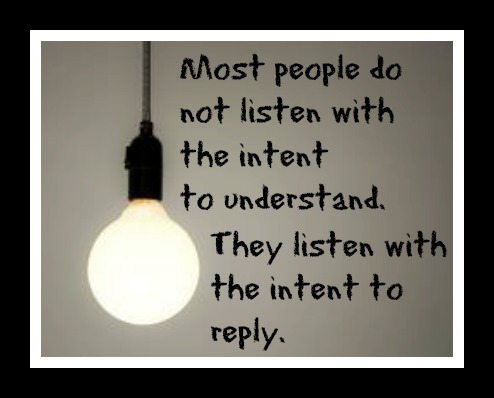
Listen, RespondI recently listened to a Ted Talk by British psychologist Elizabeth Stokoe, who analyses patterns, rhythms and wording in conversations. From her talk, I distilled a few interesting points that could be applied when writing a dialogue for fiction, and I’d like to share them with you:

  1. Are you willing?  If a person is given a sense of control or authority in the situation, they’re far more likely to cooperate.  If you ask, “Do you want this service / action to happen?” you may draw a blank response; but if you ask that person, “Would you be willing to receive this service / be willing to see X happen?” you’re more likely to get a positive response.
  2. How did you…?  When you want to find out particular information from a person, how and when you ask for that information in the course of a conversation / dialogue greatly decreases or increases your chances of getting a positive response / reply.  If rapport is first established, they are much more willing to reply.
  3. Why did you / were you…?  If an open-ended question is asked, target information may not come; but if a target-specific question is asked non-confrontationally, the desired information is more certain.  “Why did you do X?” or “Where have you been?” are both confrontational, and the reaction will likely be evasive or defensive.  But if you instead say, “I was wondering what your reasons for doing X were… could you explain?” or “I tried to reach you earlier, and was wondering where you were”, these are more likely to get a more positive response, or to solicit the information you’re searching for.
  4. Any or Some?  “Any” tends to elicit a negative response or a refusal, while “some” invites a more positive response.  A simple example is, “Would you like any tea?” – this implies an unwillingness or a reluctance on the speaker’s part to provide, whereas, “Would you like some tea?” implies the assumption of a positive response, and is thus more likely to solicit an affirmative response.  In both cases the person asked may want tea, but would be unwilling to coerce the one offering if they have the impression that the offer is made unwilling through the use of “any”.

When applying these ideas to writing a dialogue, a positive application will move your characters closer to a solution or resolution, whereas the negative application will lead them more toward miscommunication and conflict; depending on what you need to happen, you choose which way the dialogue takes your characters, and thus your readers.

Keep writing!

Leave a comment

Filed under Articles, Nuts & Bolts, Writing Exercise

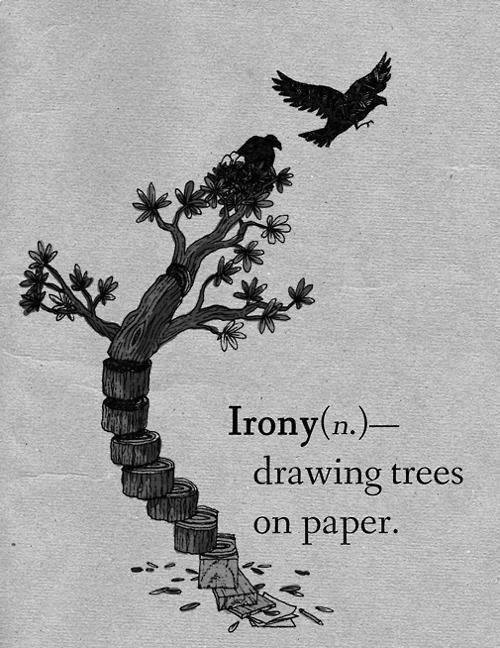
Oh, the Irony

paper

2 Comments

August 8, 2015 · 10:00 AM

The Glorious Chaos of English

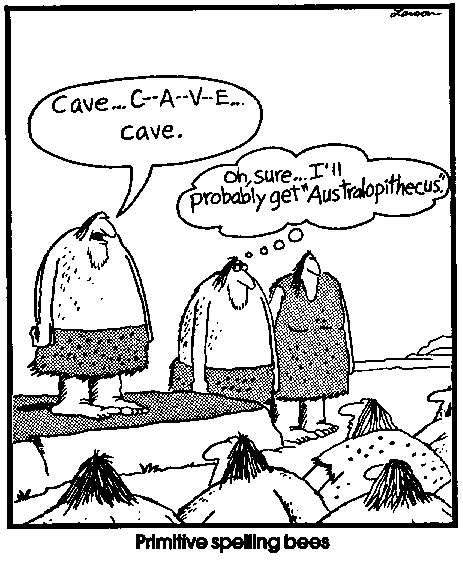
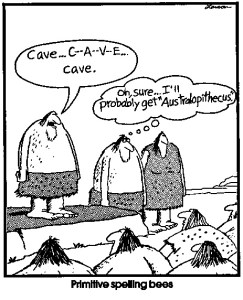
Primative Spelling BeesEnglish, in many ways, is one of the simplest languages to learn quickly and in which to converse fluently; but scratching below the surface one rapidly finds incongruities.  As a teacher for English as a foreign language for adults (TEFLA), I was frequently confronted with the challenges of teaching students to spell and pronounce words correctly, but I was also comforted by the fact that English nouns only come with four possible preceding cases, or articles (a, an, the, and none), rather than, say, German, in which each noun has a nominative, genative, dative or accusative, singular or plural form of their case; or Finnish, which has a whopping 15 cases.

The Chaos, a poem written by the Dutch traveller & teacher,  Gerard Nolst Trenité (1870–1946), gives ~800 examples of irregular spelling.  In general one can say that there are spelling “rules”, but English, in all its historic complexities of absorbing, digesting and recycling influences from conquerors, enemies, travelling companions and allies, seems designed to say “rules can and will be broken”.  I would never give his last advice to anyone – but after reading this poem, you’ll understand that English needs tenacity and constant practice to use well!

The Chaos

by G. Nolst Trenite’ a.k.a. “Charivarius” 1870 – 1946

Dearest creature in creation

Studying English pronunciation,

I will teach you in my verse

Sounds like corpse, corps, horse and worse

I will keep you, Susy, busy,

Make your head with heat grow dizzy.

Tear in eye your dress you’ll tear,

So shall I! Oh, hear my prayer,

Pray, console your loving poet,

Make my coat look new, dear, sew it!

Just compare heart, beard and heard,

Dies and diet, lord and word,

Sword and sward, retain and Britain.

(Mind the latter, how it’s written).

Made has not the sound of bade,

Say said, pay-paid, laid, but plaid.

Now I surely will not plague you

With such words as vague and ague,

But be careful how you speak,

Say break, steak, but bleak and streak.

Previous, precious, fuchsia, via,

Pipe, snipe, recipe and choir,

Cloven, oven, how and low,

Script, receipt, shoe, poem, toe.

Hear me say, devoid of trickery:

Daughter, laughter and Terpsichore,

Typhoid, measles, topsails, aisles.

Exiles, similes, reviles.

Wholly, holly, signal, signing.

Thames, examining, combining

Scholar, vicar, and cigar,

Solar, mica, war, and far.

From “desire”: desirable–admirable from “admire.”

Lumber, plumber, bier, but brier.

Chatham, brougham, renown, but known.

Knowledge, done, but gone and tone,

One, anemone. Balmoral.

Kitchen, lichen, laundry, laurel,

Gertrude, German, wind, and mind.

Scene, Melpomene, mankind,

Tortoise, turquoise, chamois-leather,

Reading, reading, heathen, heather.

This phonetic labyrinth

Gives moss, gross, brook, brooch, ninth, plinth.

Billet does not end like ballet;

Bouquet, wallet, mallet, chalet;

Blood and flood are not like food,

Nor is mould like should and would.

Banquet is not nearly parquet,

Which is said to rime with “darky.”

Viscous, Viscount, load, and broad.

Toward, to forward, to reward.

And your pronunciation’s O.K.,

When you say correctly: croquet.

Rounded, wounded, grieve, and sieve,

Friend and fiend, alive, and live,

Liberty, library, heave, and heaven,

Rachel, ache, moustache, eleven,

We say hallowed, but allowed,

People, leopard, towed, but vowed.

Mark the difference, moreover,

Between mover, plover, Dover,

Leeches, breeches, wise, precise,

Chalice, but police, and lice.

Camel, constable, unstable,

Principle, disciple, label,

Petal, penal, and canal,

Wait, surmise, plait, promise, pal.

Suit, suite, ruin, circuit, conduit,

Rime with “shirk it” and “beyond it.”

But it is not hard to tell,

Why it’s pall, mall, but Pall Mall.

Muscle, muscular, gaol, iron,

Timber, climber, bullion, lion,

Worm and storm, chaise, chaos, and chair,

Senator, spectator, mayor,

Ivy, privy, famous, clamour

And enamour rime with hammer.

Pussy, hussy, and possess,

Desert, but dessert, address.

Golf, wolf, countenance, lieutenants.

Hoist, in lieu of flags, left pennants.

River, rival, tomb, bomb, comb,

Doll and roll and some and home.

Stranger does not rime with anger.

Neither does devour with clangour.

Soul, but foul and gaunt but aunt.

Font, front, won’t, want, grand, and grant.

Shoes, goes, does. Now first say: finger.

And then: singer, ginger, linger,

Real, zeal, mauve, gauze, and gauge,

Marriage, foliage, mirage, age.

Query does not rime with very,

Nor does fury sound like bury.

Dost, lost, post; and doth, cloth, loth;

Job, Job; blossom, bosom, oath.

Though the difference seems little,

We say actual, but victual.

Seat, sweat; chaste, caste.; Leigh, eight, height;

Put, nut; granite, and unite.

Reefer does not rime with deafer,

Feoffer does, and zephyr, heifer.

Dull, bull, Geoffrey, George, ate, late,

Hint, pint, Senate, but sedate.

Scenic, Arabic, Pacific,

Science, conscience, scientific,

Tour, but our and succour, four,

Gas, alas, and Arkansas.

Sea, idea, guinea, area,

Psalm, Maria, but malaria,

Youth, south, southern, cleanse and clean,

Doctrine, turpentine, marine.

Compare alien with Italian,

Dandelion with battalion.

Sally with ally, yea, ye,

Eye, I, ay, aye, whey, key, quay.

Say aver, but ever, fever.

Neither, leisure, skein, receiver.

Never guess–it is not safe:

We say calves, valves, half, but Ralph.

Heron, granary, canary,

Crevice and device, and eyrie,

Face but preface, but efface,

Phlegm, phlegmatic, ass, glass, bass.

Large, but target, gin, give, verging,

Ought, out, joust, and scour, but scourging,

Ear but earn, and wear and bear

Do not rime with here, but ere.

Seven is right, but so is even,

Hyphen, roughen, nephew, Stephen,

Monkey, donkey, clerk, and jerk,

Asp, grasp, wasp, and cork and work.

Pronunciation–think of psyche–!

Is a paling, stout and spikey,

Won’t it make you lose your wits,

Writing “groats” and saying “grits”?

It’s a dark abyss or tunnel,

Strewn with stones, like rowlock, gunwale,

Islington and Isle of Wight,

Housewife, verdict, and indict!

Don’t you think so, reader, rather,

Saying lather, bather, father?

Finally: which rimes with “enough”

Though, through, plough, cough, hough, or tough?

Hiccough has the sound of “cup.”

My advice is–give it up!

1 Comment

Filed under Articles, Cartoon, Grammar, Nuts & Bolts, Quotes, Writing Exercise

Writing Tips: Dialogue

howtobebritish1Dialogue is (to point out the obvious) vital to a novel; it displays the voices of your characters and helps the reader get to know and care about the characters, understand their motives, their interrelationships, and distinguish each character’s point of view.  If you don’t get the dialogue right, you rip the reader out of the story, or worse – make them put down your novel and add your name to “never again” lists!  So, here are a few pointers and tips to keep in mind as you develop your characters and put words into their mouths:

1) Develop your characters well enough to make their voice distinct; do they have catch-phrases, or local dialects that influence their vocabulary?  Do they tend toward long or short sentences, or are they from a past time and place that had a different way of speaking?  Educate yourself if necessary in various modes of speech .

2) Dialogue is an illusion of conversation; but it’s also about what is not said.  Non-verbal actions reveal:

a) How a character says something

b) What a character chooses not to say, but inadvertantly reveals through actions.

c) Why the character says what they do.

Do they have particular actions when they are upset or aggitated that communicate their moods to the reader?  Do they bounce their knees when excited?  Does their body language confirm or contradict their verbal message?

3)  Fictional dialogue needs to cut to the chase; if there’s no point to the text (revealing motivation, character or plot point), then chop it!

4)  Avoid the trap of using dialogue as exposition (the proverbial villain’s monologue as he prepares to destroy the hero), but rather reveal essential information through action, or narration.

Explore your characters and develop their voices, and above all – keep writing!

Leave a comment

Filed under Articles, Cartoon, Nuts & Bolts, Plot Thots & Profiles, Writing Exercise, Writing Prompt

Writing Tip: “Sense” Your Scenes

I try to read a book a week; it’s usually on a Saturday, when I have time to sit down and read a good chunk at a time.  This past weekend I read a book which prompted thoughts around this concept of “sensing” a scene, and reading it aloud to hear any howlers that might have crept into the writing.  The author of that book obviously did neither, though her editor might have told her to beef up descriptives – so they were clumped all together, staggering me as a reader to a halt while I tried to figure out the context of the pages of descriptives before remembering what the characters were doing there in the first place, and often the dialogue sounded very stilted (e.g. using “vocalized” instead of “shouted” – the latter of the two would have fit into the character’s time and place far better) – a good reading-aloud editing session might have done wonders for the novel.

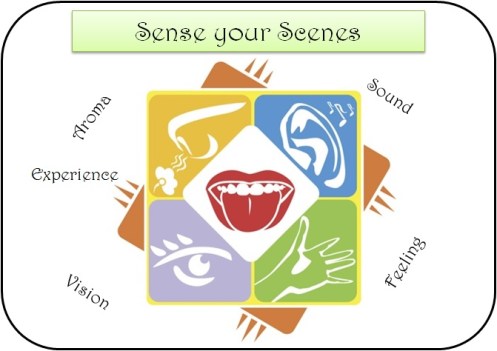
SensesThis image is one I have printed out on a card and hung near my desk when writing; it reminds me to apply all of my senses to a scene, to enrich the imagery and draw the reader in.  Describe the sights, smells, sounds, feelings and taste of a scene; make it a sensory experience and it will be far more memorable; this is done through sentence structure and the pacing of those elements, but sometimes also through “camera angle” – looking at the scene from a particular perspective.  How does your character feel in the moment?  What are their perceptions?  Does a smell remind them of something or someone?  Here are a few tips to achieving these goals:

  1. While adjectives are useful for adding colour or depth to a sentence, think of them as pepper; too much can spoil the scene.  If using more than one to describe a noun, familiarize yourself with the rule of order for adjectives.
  2. Use action verbs rather than passive/being verbs with adverbs.  E.g. “She stumbled down the hill” rather than “She went unsteadily down the hill”.
  3. Most importantly:  Read your sentences and scenes aloud!  I cannot stress this enough – if it sounds choppy or stilted to your ears, or doesn’t sound like something your character would say or do, then change it!

Writing is a dynamic process, and being a writer means constantly striving to improve oneself – building vocabulary and learning how to use words effectively, building your knowledge through research, studying, and reading, reading, reading!  Keep on writing!

2 Comments

Filed under Articles, Images, Nuts & Bolts, Plot Thots & Profiles, Writing Exercise

Writing Tip: Layering

Lightning BugIf you’ve ever painted a picture more than a colouring book or a paint-by-number, chances are you’ve learned something along the way about layers.  Layering is also a digital graphics technique in programs such as Photoshop, and as each layer is made, the image changes, taking on the shapes or colours as you add the consecutive elements.

Besides being a writer, I am also a vocal coach.  I only take on students who are already in bands, or preparing for recordings or competitions, and one of the things I teach them is layering within a vocal performance:  The nuances of thoughts, the power of imagination, the colouring of the vocals through not only the physical placement of the tone within their instrument (their body), but the placement of their imagination.  One can communicate boredom or interest or empathy with the exact same wording by merely varying the intonation, and that comes through the layering of the performance.

Writing is much the same way:  It is through the employment of grammar, spelling and punctuation that we signal the reader to prepare for a particular experience; as Mark Twain said, “The difference between the right word and the almost right word is the difference between lightning and a lightning bug.”  

Oh, the difference between, “It was rainy last night,” and “It was a dark and stormy night”!

So the next time you feel like your manuscript or poem is falling flat, take a minute to think about the layers, and see what creative brush strokes you can give your work.

1 Comment

Filed under Articles, Nuts & Bolts, Plot Thots & Profiles, Writing Exercise

Novel Writing Pyramid

Novel Pyramid

When writing or drafting a new story, sometimes it’s easy to get lost in the forest due to the trees – in the myriad of ideas that flash up in a brainstorm.  The pyramid above helps remind me of the emphasis each area needs in the overall structure:

If a story is too complex, you’ll lose or confuse your readers; but if it’s too simple, it becomes predictable and therefore no challenge to the mind of the adventurer who’s picked up your book to get lost in another world.  Most of the best stories are, at their heart, quite simple – “boy meets girl”, or “person achieves goal”.

If you don’t know what your settings and themes are, how can you effectively work toward the final outcome?  If you don’t know who your character is, and what your basic plot (goal and how it’s achieved) is, how can you guide the reader through dialogue or prose toward the desired conclusion?  Diction is important because it is central to creating the voice of each character, and sticking to genre-specific vocabulary and expressions (i.e. no proverbial airplanes through the scenes of a historical novel).  As Mark Twain once wrote,

“The difference between the right word and the almost-right word is the difference between lightning and a lightning bug.”

And if you have the top four slices of the pyramid in place, but don’t have proper foundations – in other words, know your grammar, spelling, punctuation and syntax (sentence structures, tense usage, etc.) then no matter how brilliant your plot might be, or your character development, if readers can’t get past your bad diction and grammar, you’ve lost them as present and future readers!

I’d like to encourage you to know your weaknesses, and develop them into strengths!  If grammar or spelling is a weakness, work on it – invest time into reviewing the rules – Wikipedia is an excellent source for articles on how to use punctuation, etc.  Buy a good grammar book, or even a grammar practice book with an answer key at the back (The “English Grammar in Use” series is one I used for years with EFLA students).  If plot or character development is a weakness, then make a list of questions for each, and take the time to think about and answer them.

Good writing is about quality; it’s about solid foundations and constant development, the honing of your skills; it’s about research, thinking outside the box, and being able to convey in words the images born in your mind.  Just as sharpening a pencil makes it easier to write, so does sharpening your mind and skills.

1 Comment

Filed under Articles, Images, Nuts & Bolts, Plot Thots & Profiles, Research, Writing Exercise

Plot Thots: 14 Tips from Steven Spielberg

Steven SpielbergHappy New Year!  2015 has begun, and with it I’ve begun the research for my next novel; this one, 18th century historical fiction (rounding off the Northing Trilogy with the final book), is taking me back into the world of workhouse orphanages, royal naval vessels, and 1760s fashions and mores.  As I research, read, take notes and wiggle my way into a mental corset (to limit myself linguistically, morally, historically and socially to the times), I can still take advice from a more modern medium:  Films.

I like to listen to good film commentaries, and one of the best teachers in the field is Steven Spielberg; he not only discusses the filming process itself, but the thought processes and philosophy behind his decisions and choices.  Here are a few notes I’ve taken from his commentaries, and where I noted the particular film, I’ll let you know in case you want to hear it for yourself:

14 Tips from Steven Spielberg:

  • Give environments a “used” feel – gritty, creaky, broken-in.  Don’t explain every little detail, but take some things for “granted” to give an authentic feel. (Star Wars)
  • The subconscious mind doesn’t know the difference between dreams and films – emotions will be touched equally.
  • Running gags create humour (e.g. Indiana Jones hates snakes).
  • One problem solved leads to another.  One bad decision leads down – the main character must either decide to be redeemed by good actions, or be ruined (e.g. Darth Vader).
  • If you have point A & point B of your plot, don’t be afraid to explore, to fill in the blanks to get you from A to B!
  • The clothes have to match the characters to be believable.  (Can you imagine Indiana Jones without that iconic hat?)
  • If you edit cerebrally, you will lose feeling; rather, edit to “it feels right.”
  • Sometimes you need a pointer scene, though it needs to be subtle:  “This is where we are; this is where we need to be; this is how we get there.” (e.g. strategy scene before Luke destroys the Death Star)
  • If there’s no emotional connection, there’s no point in doing something for narrative clarity.
  • Contemplation time is essential in the creative process – don’t fill it with brain work that distracts.  Take a bath.  Do the laundry.  Draw; doodle; do a craft.
  • Get under the skin of a character, or culture, or landscape.
  • Every act has three events.
  • What is your main character’s “third place”?  The first place is home; the second place is work; the third place is a socializer.
  • Establish the mystery, and then begin peeling layers away.

[Plot Thots is my own shorthand for anything to do with mapping out a storyline.]

4 Comments

Filed under Articles, Nuts & Bolts, Plot Thots & Profiles, Quotes, Research

Creative Writing over Christmas Holidays

I don’t know about the rest of you, but Christmas has snuck up on me this year!  Between publishing two books in November and all of the work involved in that process and the aftermath (promotion, etc.), I came up for breath last weekend, as I wrote about last week.  I took a short break, and now I’m beginning work on the next project (diving into research and scene layout).  But with Christmas coming up, it’s time to shift down a gear or two, and enjoy the season.  If you are a writer like me, writing can be addictive; it’s a good habit to write something every day.  But who says it needs to be a book manuscript, or whatever your next project or usual format is?  If you write poetry, try your hand at calligrams; if you write short stories, try writing an ambigram.  If you write constantly, take a break and read a book that has absolutely nothing to do with research or preparation for your next project!

Here are a few different styles to choose from, just to shake things up a bit:

  • Flash fiction (300-1,000 – word stories)

    One of my first calligrams; not very neat, but cathartic!

    One of my first calligrams; not very neat, but cathartic!

  • Short stories (fiction or nonfiction – limit yourself, e.g. to one page)
  • Nonfiction
  • Anecdotes
  • Jokes
  • Profiles
  • Travel writing
  • Children’s books
  • Screen writing
  • Play writing
  • Poetry
  • Freelance
  • Novel
  • Novella
  • Memoir
  • Autobiography
  • Biography
  • Song writing (lyrics, if you can’t write/read music)
  • Calligram (do a Google Image search to see examples)
  • Asemic writing
  • Book report
  • Fan fiction
  • Letter
  • Journal
  • Dialogue
  • Creative doodles (with or without words)
  • Cartoon strips
  • Ambigram
  • Micography (Microcalligraphy)
  • Concrete poetry (or any number of poetry styles – check out a small list here)
  • Haiku


2 Comments

Filed under Images, Lists, Nuts & Bolts, Writing Exercise