Category Archives: Nuts & Bolts

Paraprosdokians. Parawhat?

Paraprosdokian is not a word I would readily remember.  I can even admit freely I’d never heard of it until recently.  Maybe I’m just weird, but I can remember a word much better if I know where it came from; this one actually makes sense: (Greek) para– meaning “against”, and prosdokaō meaning “I expect.”  Against expectations.  It’s not actually that old, and is thought of by some linguists as a bogus term; but there are a lot of words that have crept into the English language on just such a pretext, and have hung around for centuries (thereby gaining loyalty from linguists).  I’d say that sounds like a bit of cosmic humour.

A Paraprosdokian is a phrase or sentence that ends with an unexpected twist.  Now it may be as common as rain where you live, but not here.  I tend to think of these sentences as one-liners, and with good reason – this figure of speech is popular with comedians as it’s short and ends on a punch.  Some Paraprosdokians use a familiar phrase and twist the ending such as the first sentence (“Where there’s a will, there’s a way”).  So I say, call them what you will – just use them well!
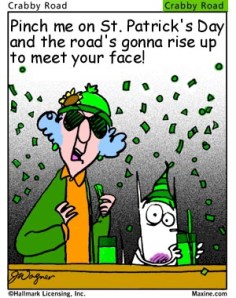
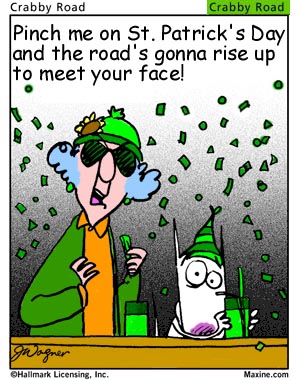
Crabby Road

Where there’s a will, I want to be in it.

I sleep eight hours a day and at least ten at night. (Bill Hicks)

The last thing I want to do is hurt you, but it’s still on my list.

Since light travels faster than sound, some people appear bright until you hear them speak.

You can always count on the Americans to do the right thing – after they have tried everything else. (Winston Churchill)

If I agreed with you, we’d both be wrong.

I don’t belong to an organized political party. I’m a Democrat. (Will Rogers)

We never really grow up, we only learn how to act in public.

War does not determine who is right – only who is left.

This is not a novel to be tossed aside lightly.  It should be thrown with great force.

Knowledge is knowing a tomato is a fruit. Wisdom is not putting it in a fruit salad.

They begin the evening news with Good Evening, then proceed to tell you why it isn’t.

He Ain’t Heavy, He’s My Brother. (Variations on this phrase are attested as early as 1884.)

There’s a fine line between cuddling and holding someone down so they can’t get away.

To steal ideas from one person is plagiarism. To steal from many is research.

If I am reading this graph correctly… I’d be very surprised. (Stephen Colbert)

I haven’t slept for ten days, because that would be too long. (Mitch Hedberg)

Money can’t buy happiness, but it sure makes misery easier to live with.

Buses stop in bus stations. Trains stop in train stations. On my desk is a work station.

I thought I wanted a career. Turns out I just wanted paychecks.

In filling out an application, where it says, ‘In case of emergency, notify, I put DOCTOR.

I like going to the park and watching the children run around because they don’t know I’m using blanks. (Emo Philips)

I didn’t say it was your fault, I said I was blaming you.

Women will never be equal to men until they can walk down the street with a bald head and a beer gut, and still think they are sexy.

Behind every successful man is his woman. Behind the fall of a successful man is usually another woman.

A clear conscience is the sign of a fuzzy memory.

You do not need a parachute to skydive. You only need a parachute to skydive twice.

I used to be indecisive. Now I’m not so sure.

He was at his best when the going was good. (Alistair Cooke on the Duke of Windsor)

You’re never too old to learn something stupid.

To be sure of hitting the target, shoot first and call whatever you hit, the target.

Nostalgia isn’t what it used to be.

Change is inevitable, except from a vending machine.

I’ve had a perfectly wonderful evening, but this wasn’t it. (Groucho Marx)

A modest man, who has much to be modest about. (Winston Churchill, about Clement Attlee)

If I could just say a few words… I’d be a better public speaker.

She was good as cooks go, and as cooks go she went.

Leave a comment

Filed under Articles, Cartoon, Grammar, Humor, Nuts & Bolts

Stop Apostrophe Abuse

Okay, grammar pet peeve time:  Apostrophe abuse.  It needs to stop.  Now.apostrophe Puppy

There are only two instances in the English language in which apostrophes are used:

1) Contractions, as in:  you are = you’re, or have not = haven’t, or I am = I’m.  Just keep in mind that the apostrophe takes the place of the missing letter(s); if you take a letter out to combine (contract) two words together, place the apostrophe where the missing letter would have been written.

2) Possessives, as in:  Steve’s hat (the hat belongs to Steve), or today’s specials (specials on for today)

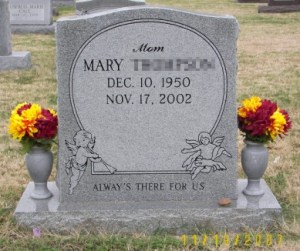
Apostrophe Tombstone

Alway’s there for us. Who is Alway?

Never, I repeat NEVER should an apostrophe be used to indicate a plural!!  Never, EVER.  If you see it used as a plural, it’s wrong – even if it’s on a tombstone (see the image below). Apostrophe Tombstone 2

In the illustration on the right, “Alway’s there for us,” it obviously means “Alway is there for us.”  But who is Alway?  I thought Mary was trying to rest in peace here…  It’s just wrong on so many levels, because it’s not even a plural (which they were aiming for), but an adverb.

Let’s (as in “let us”) look at another very common mistake:  1) it vs. 2) it’s vs. 3) its:

1) “It” is fairly straightforward; it is the third person singular pronoun (used in place of a noun) for objects or gender-neutral references; e.g. The chair is red = It is red.

2) “It’s” is the contracted form of “it is”, as in It’s raining or “it has”, as in It’s been a long time since we saw each other last.

3) “Its” is the possessive form of the third person singular pronoun:  “the dog’s paws” = “its paws”  REMEMBER:  You would never spell “his shirt” as “hi’s shirt”, or “her skirt” as “he’r skirt”; in the same way you should never use the contracted form as the possessive form of it.

It’s not “CD’s” or “DVD’s” as the plural form; this is actually the possessive (which therefore requires an object for that subject’s possessive form, as in the CD’s case), and I find myself asking, “CD’s what?”

If you want more examples, from tombstones to shop signs to tattoos that are embarrassingly wrong, take a look at  www.apostropheabuse.com.  Okay, pet peeve appeased.  Glad to get that off my chest.

5 Comments

Filed under Articles, Cartoon, Grammar, Nuts & Bolts, Writing Exercise

Canadian Tourism Q&A

This was posted by Andy over at his blog, and I just had to repost it – the questions are priceless, but I love the answers.  True sarcasm is a fine art.

Obviously the answers are a joke; but the questions were (apparently) really asked.


Q: I have never seen it warm on Canadian TV, so how do the plants grow? ( England )

A. We import all plants fully grown and then just sit around and watch them die.


Q: Will I be able to see Polar Bears in the street? ( USA ) moose-emblem-on-canadian-flag-darren-greenwood

A: Depends on how much you’ve been drinking.


Q: I want to walk from Vancouver to Toronto – can I follow the Railroad tracks? ( Sweden )

A: Sure, it’s only Four thousand miles, take lots of water.


Q: Is it safe to run around in the bushes in Canada ? ( Sweden )

A: So it’s true what they say about Swedes.


Q: Are there any ATM’s (cash machines) in Canada ? Can you send me a list of them in Toronto , Vancouver , Edmonton and Halifax ? ( England )

A: No, but you’d better bring a few extra furs for trading purposes.


Q: Can you give me some information about hippo racing in Canada ? ( USA )

A: A-fri-ca is the big triangle shaped continent south of Europe Ca-na-da is that big country to your North…oh forget it. Sure, the hippo racing is every Tuesday night in Calgary Come naked.


Q: Which direction is North in Canada ? ( USA )

A: Face south and then turn 180 degrees Contact us when you get here and we’ll send the rest of the directions.


Q: Can I bring cutlery into Canada ? ( England )

A: Why? Just use your fingers like we do.


Q: Can you send me the Vienna Boys’ Choir schedule? ( USA )

A: Aus-t ri-a is that quaint little country bordering Ger-man-y, which is…oh forget it. Sure, the Vienna Boys Choir plays every Tuesday night in Vancouver and in Calgary , straight after the hippo races. Come naked.


Q: Do you have perfume in Canada ? ( Germany )

A: No, WE don’t stink.


Q: I have developed a new product that is the fountain of youth. Where can I sell it in Canada ? ( USA )

A: Anywhere significant numbers of Americans gather.


Q: Can you tell me the regions in British Columbia where the female population is smaller than the male population? ( Italy )

A: Yes, gay nightclubs.


Q: Do you celebrate Thanksgiving in Canada ? ( USA )

A: Only at Thanksgiving.


Q: Are there supermarkets in Toronto and is milk available all year round? ( Germany )

A: No, we are a peaceful civilization of Vegan hunter/gathers. Milk is illegal.


Q: I have a question about a famous animal in Canada , but I forget its name. It’s a kind of big horse with horns. ( USA )

A: It’s called a Moose. They are tall and very violent, eating the brains of anyone walking close to them. You can scare them off by spraying yourself with human urine before you go out walking.


Q: Will I be able to speak English most places I go? ( USA )

A: Yes, but you will have to learn it first.

2 Comments

Filed under Nuts & Bolts, Quotes

That Low-Down Word

That Word CloudI run a forum on a British writers’ website for grammatical problems, and answer questions that come up in the course of their writing projects.  This week the question came up about that little word, “that” – when to use it and when to lose it.  When do you use that?  When do you use a comma instead?  And when is neither one necessary?  Ah, what a tangled web we weave, when first we practice proper grammar.  Hey, just kidding – it’s not that complicated!  Sometimes it doesn’t matter, and sometimes it can be confusing without it.  So, here’s the low-down:

1) Remember Rhythm:  How does your sentence flow?  Read your sentence aloud; does it have a better rhythm with or without that?  When in doubt and rhythm / comprehension is fine with or without, use it – inclusion may benefit the understanding of the sentence as a whole, and omission may cause misunderstandings.  Sometimes using that is a matter of personal taste.  Here’s a sentence that could be understood with or without:  “Fiona thinks (that) Alistair works too hard.

If you’ve already got a that in the sentence elsewhere, consider how your sentence can be reworded to avoid an overload. A double that is usually unnecessary.  In the sentence, “I realised that that would not be a good idea” the first that (acting as a conjunction, whereas the second acts as a pronoun) could be eliminated, aiding the flow but not impeding the comprehension.  Sometimes that is required in one part of a sentence, and when a second that comes up a choice needs to be made:  Take this sentence, from an AP report:  “Ford Motor Co. warned that it no longer expects to return to profitability by next year and that it is trimming North American production of pickups and SUVs for the rest of this year because of high gas prices and a shaky economy.”  The second instance could be eliminated thus:  “…next year; it is trimming…”

2) Comprehension:  Sometimes a sentence can be unintentionally misleading, and using that can help clarify.  For example,  “Fiona maintains Alistair works too hard.”  Does Fiona maintain Alistair and he works too hard? If you insert a that after maintains, it becomes clear that maintains refers to an opinion, and not maintenance of Alistair.

Sometimes in our writing, however, we want to intentionally lead the reader or a character down the garden path toward the wrong conclusion.  It’s a fine art, and understanding how another person interprets what you’ve written or could interpret it goes a long way toward walking that fine line between misdirection and deception; the first will leave a “gotcha” smile, and the latter might leave your next book unread….  As a plot element, it has its uses; but as a badly written sentence, it only results in confusing and frustrating the reader, who has to find the beginning of the sentence and read it again to understand it properly.

3) Commas:  Commas can sometimes replace the word that.  In this example, “Peter Coveney writes that ‘[t]he purpose and strength of . . .’” it would never be “Peter Coveney writes that,” or “Peter Coveney writes, that…” though it could be, “Peter Coveney writes, “…”

I hope that helps some of you dealing with similar issues in writing!

Leave a comment

Filed under Articles, Nuts & Bolts, Research

Musings on the Unsexy Side of Writing

WordItOut-Word-cloud-223251When someone discovers the avenue of writing as a way of expressing their creativity, I can guarantee you they don’t think, “Gee, I can’t wait to get to all those technical details it will take to launch a book!”  That technical nitty-gritty is what the Swiss would call the “unsexy” side of writing.  If you’re a writer, and you’re anything like me, it’s the last thing you want to spend your time doing – I’d much rather be working on the next manuscript than tackling things like blurbs, bios, and summaries, all in various lengths.  I’d rather not have to tackle the issues of pricing, cover art decisions, marketing (most writers enjoy the isolation it takes to be a good writer and concentrate on their craft – we are not born me-salesmen!), networking and promotion.  But that’s the phase I find myself in right now.  And perhaps my situation is a bit more challenging because I am an English-language writer living in an area of a country that speaks an unwritten language:  I live in the Swiss-German speaking area of Switzerland.  There are a variety of dialects here, none of which have an official written structure or spelling (it is usually spelled phonetically, which varies according to the dialect).  High-German is the language of the newspapers and magazines and television (for the most part), but it’s not the language you hear on the streets.  And I certainly don’t have a local writer’s group from which to draw inspiration or encouragement.  I can’t just zip down to the local bookshop and see which publishers are interested in which topics.  It’s just me, myself and moi when it comes to getting it done.

And if you’re anything like me, you’ve got several irons in the fire at any given time:  At the moment I have no less than six novels at various stages of completion.  The second novel of a trilogy is on next, but will soon get put on hold as I travel to Norway for historical research this summer, for another novel in the making.  Focusing on one project at a time is the most efficient way to work; but sometimes it’s not possible.  I actually like the variety, from 18th century fiction, to 8th and 21st century fantasy fiction, contemporary fiction, science fiction… I’ve got my fingers in a lot of pies.  For me the key is self-discipline; setting goals, priorities, and daily schedules so that I can reach those goals one step at a time, all the while not letting any of that quench my creativity.  It would be great to have a support network of writers with whom I could bounce ideas around, or glean encouragment from, or be inspired by.  But life is where it is, so I’ll take the encouragement in any form it comes.  And I’ll slog my way through the unsexy side of the craft, and maybe even learn to enjoy it along the way!


10 Comments

Filed under Nuts & Bolts

Coherency: Just sayin’…

gibberish-cartoonIs it just my imagination, or is written English slipping in quality, even among writers?  Is it that less attention is paid to the end results than to the actual “getting it out there to be read by others”?  I just returned to my blog after taking a jaunt around WordPress Land; the blogs I visited, I went to with good will, interested to see what others are thinking and writing about.  But I have to admit I couldn’t understand half of what was written.  Half.  Now, I’m an English teacher and writer and all that, and yes, I’ve been living in a non-English speaking environment for a quarter of a century.  But has it really deteriorated to the point of not only miscommunication, but of downright gibberish at times?  I’m not looking down my nose at those who are trying to communicate (something); I am simply throwing out this question into the cosmos and asking if I’m the only one who’s noticed this?

Where is the satisfaction of a job well done in a sentence that looks like it was fed through BabbleFish a few dozen times?  Where is the pride in having written something well, communicated the heart of the matter, and allowed others a glimpse into the mind of the writer without confusing them with poor spelling, syntax and punctuation?  I find myself editing more than reading sometimes, and that does not bode well for the writer.  As a writer I take my job seriously, in all its aspects, from research, to presentation.  If we as writers don’t set a good example to follow, how will the next generation know right from wrong, or rite from wong?

A few simple rules I follow:

1) Read your text aloud before you hit that “post” button.

2) Have a good dictionary available (such as onelook.com), and check those words you’re unsure of.

3) Do NOT trust a spell-checker!  Learn the basic rules of spelling, punctuation and syntax, and if you’re still not sure, double-check online with reliable sources.

Let’s swim against the tide of laziness and stagnation in writing; let’s expand our vocabulary instead of relying on the same ol’ same ol’; let’s set an example of good writing, even though it may not be perfect every time.


2 Comments

Filed under Articles, Cartoon, Nuts & Bolts, Writing Exercise

Cover Art, Cover Art, Where Art Thou

For those of us who are writers, you know what I mean when I say that we’d MUCH rather spend our time writing, creating, moulding, researching characters and plots, and basically ANYTHING else than the dusty technical nuts & bolts of publication.  With the hurdles one has to leap in the publishing world, it’s no wonder that e-books are becoming THE path of choice.  I spent those required months writing cover letters, creating packages to agents, etc. only to get those letters back that said, “Great ideas!  We loved it!  But…” when they already have clients in that genre, they’re not about to take on competition for them…  So like many others, I’ve chosen the route of Kindle.  I’ve got one book ready to go, and another first draft just completed, as well as no less than 5 other projects at various stages of completion.  A meeting with an artist proved fruitless to my purpose; he knows art, but not all the aspects of doing cover art.  I’ve worked with graphic artists for album covers and artwork, but I’m not prepared to invest several thousand at a time when I’ve got dozens in my future… so…

That’s where www.Fiverr.com comes in!  For a fiver, you can find just about any service you can think of, from fake testimonials, to placebo-effect health talks, to business advertising on the back of a Harley, to language lessons over Skype,  to cover art for e-books.  If you find yourself swimming in the Maelstrom of publishing, check it out.

But a word to the wise:  You get what you pay for.  Take it as a springboard, an idea; but take it and own it yourself.  Take the time to invest your energy in learning all you can about each step of the publishing, editing, and artistic processes.  Also, such offers only cover e-book cover art; they are lower in pixel than will be required for a paperback cover, so it’s worth looking into a solution that covers both formats.

Leave a comment

Filed under Nuts & Bolts, Research

Animal Idioms

Raining cats and dogs, 1817 caricatureI love idioms; they bring abstract concepts to life with vivid imagery, and range from the practical to the hilarious.  If I said someone was clumsy, that’s all clear and well enough; but if I said they were as clumsy as a cow on rollerskates?  I think you know where that one’s going…  Here are a just few of my favourite animal idioms:

“to be as nervous as a cat in a room full of rocking chairs” – very nervous

“to bark up the wrong tree” – to be mistaken in one’s goals or focus

“to be bright-eyed and bushy-tailed” – to be eager, lively (especially at unexpected times, e.g. morning)

“to have ants in the pants” – to be jittery, excited, animated, hyper

“to cry wolf” – to rouse others to action when it is not necessary

“to be raining cats and dogs” – to be raining hard

“in two shakes of a lamb’s tail” – very quickly

“to look a gift horse in the mouth” – to scrutinize or criticize a gift or an offer to help, etc.

“to look like something the cat dragged in” – to be very ill, to look ill

“not enough room to swing a cat” – a tight space, a small room

“to buy a pig in a poke” – to buy something without having seen its quality first (German:  “die Katze im Sack kaufen”, or “to buy a cat in a sack”)

“to cast pearls before swines” – to waste one’s efforts or investments on worthless schemes or people

“to fight like cats and dogs” – to fight with someone (regularly, or vehemently)

Leave a comment

Filed under Grammar, Images, Nuts & Bolts, Research, Writing Exercise

Mental Sparks: RAWs

Writers tend to have vivid imaginations.  If they’re organized like I am, they probably have a dozen books on the subjects of writing better, plotting, structure, syntax and the like.  But I sometimes find that I can become too bogged down in the nitty-gritty to enjoy; that’s when writer’s block can come.  I’ve found ways to spark creativity in such times (like many writers have, and have made books out of them to share with others), and my way is called RAW:  Randomly Applied Word.

I have a wee box on my desk filled with bits of paper (folded, wadded, you name it), and on each one is written a single word.  I also have a dice in the box that has sides of “place,” “time,” “name,” etc. written on it to give me a further direction if I need it.  I pull out a word and start brainstorming; these have led to short stories, and two manuscripts (so far) that I will be finishing off as novels.  The key for me in the exercise is to think outside of the box – look at it from different camera angles, if you will.  For instance, I pulled the word Drought; automatically I thought of desert; but what if that desert weren’t the usual tan or red colour?  Something completely unexpected?  That led to a science fiction manuscript (in the queue to finish next!), and studies in geology.  Another word was Cardinal.  From that came a modern two-part fantasy novel, The Cardinal.

When I come across an interesting or unusual word, no matter where, I write it down and toss it in the box.  If you want to apply this exercise, get a creative or decorative box or tin (mine is a wooden treasure chest), and start scrapping!

1 Comment

Filed under Nuts & Bolts, Writing Exercise

Punning In Ten Did

visual punI don’t know who originally collected this list together, but have a good laugh, and a good week!
1. Two antennas met on a roof, fell in love and got married. The ceremony wasn’t much, but the reception was excellent.
2. A jumper cable walks into a bar. The bartender says, “I’ll serve you, but don’t start anything.”
3. Two peanuts walk into a bar, and one was a salted.
4. A dyslexic man walked into a bra.
5. A man walks into a bar with a slab of asphalt under his arm, and says: “A beer please, and one for the road.”
6. Two cannibals are eating a clown. One says to the other: “Does this taste funny to you?”
7. “Doc, I can’t stop singing The Green, Green Grass of Home.”
“That sounds like Tom Jones Syndrome.”
“Is it common?”
“Well, It’s Not Unusual.”
8. Two cows are standing next to each other in a field. Daisy says to Dolly, “I was artificially inseminated this morning.”
“I don’t believe you,” says Dolly.
“It’s true; no bull!” exclaims Daisy.
9. An invisible man marries an invisible woman. The kids were nothing to look at either.
10. Deja Moo: The feeling that you’ve heard this bull before.
11. I went to buy some camouflage trousers the other day, but I couldn’t find any.
12. A man woke up in a hospital after a serious accident. He shouted, “Doctor, doctor, I can’t feel my legs!” The doctor replied, “I know, I amputated your arms!”
13. I went to a seafood disco last week…And pulled a mussel.
14. What do you call a fish with no eyes? A fsh.
15. Two fish swim into a concrete wall. The one turns to the other and says, “Dam!”
16. Two Eskimos sitting in a kayak were chilly, so they lit a fire in the craft. Not surprisingly it sank, proving once again that you can’t have your kayak and heat it too.
17. A group of chess enthusiasts checked into a hotel, and were standing in the lobby discussing their recent tournament victories.
After about an hour, the manager came out of the office, and asked them to disperse.
“But why,” they asked, as they moved off.
“Because,” he said. “I can’t stand chess-nuts boasting in an open foyer.”
18. A woman has twins, and gives them up for adoption. One of them goes to a family in Egypt , and is named ‘Ahmal.’ The other goes to a family in Spain ; they name him ‘Juan.’ Years later, Juan sends a picture of himself to his birth mother. Upon receiving the picture, she tells her husband that she wishes she also had a picture of Ahmal. Her husband responds, “They’re twins! If you’ve seen Juan, you’ve seen Ahmal.
19. Mahatma Gandhi, as you know, walked barefoot most of the time, which produced an impressive set of calluses on his feet. He also ate very little, which made him rather frail and with his odd diet, he suffered from bad breath. This made him (oh, man, this is so bad, it’s good)…A super-calloused fragile mystic hexed by halitosis.
20. A dwarf, who was a mystic, escaped from jail. The call went out that there was a small medium at large.
21. And finally, there was the person who sent twenty different puns to his friends, with the hope that at least ten of the puns would make them laugh. No pun in ten did.

Leave a comment

Filed under Nuts & Bolts