I love coming across stories about individuals making a difference in the world; it shows that one person can really make a difference – not just the rich and famous, but the unknown and unsung heroes that have a vision, and do what they can with what they have until they have more to see their vision unfold.
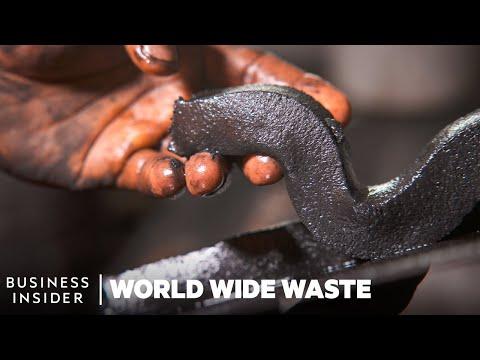
Alhaji Siraj Bah is such a person: a young Sierra Leonean, he lost his adoptive family to a mudslide when he was 17. The mudslides are an increasing problem, as 70% of the Sierra Leonean forests have been chopped down for firewood; most families use small wood-burning cookers. But something else that everyone does is eat coconuts. Every day, tons of coconut husks are emptied in the street markets, and the sellers then have to pay to remove their biowaste. Alhaji worked on and found a solution to both problems: Turning the biowaste into biofuel briquettes – coconut coal which gives off less smoke and burns four times more efficiently than wood-based products. This idea is not original – there are many similar products on the market; but what I like about his story is that he refused to give up, looking for a solution to local problems, providing jobs, a free removal service, and offering a locally-grown waste-turned-fuel.
To see an interesting video from Business Insider on his story, just click here.
This week, I did a major shopping at a couple Asian food stores; I stocked up on the ingredients I know, and some I didn’t; I like to get things I’ve never heard of, and do a bit of research on how to use it in cooking; things I picked up in that category are Iranian Kashk, which is a tangy fermented, yoghurt used as a condiment; canned palm hearts, which make a nice topping on desserts; and fermented black beans, which can be used in a variety of Asian dishes, including in a black bean sauce. I also bought several fresh vegetables and herbs to dehydrate and turn into a greens powder for adding flavours to dishes (I have a more usual greens powder with standard greens, like cauliflower leaves, spinach, etc. that I use daily).
One of the herbs I used was acacia leaf: When I opened the package, a pungent, sulphur-like smell hit me, and I wasn’t sure I’d use it. But when I began de-leafing it (much like you would thyme, though carefully as it’s got some vicious thorns!), it began to smell like mint! As I added lemongrass, Thai water spinach and other herbs, you can imagine the cacophony of fragrances in my kitchen – which filled the house as they dehydrated.
So what does this have to do with licorice? Well, one of the fresh herbs I also processed was Thai basil; I’d never used it before, and when I opened the packaging, a wave of anise- or licorice aroma hit me. And as usual, that set my mind off, thinking about the history of licorice!
Licorice is a flowering plant native to parts of Asia and Europe; its scientific name, Glycyrrhiza, comes from Greek and means “sweet root” (the linguistic roots are related to words like glycerine and rhizome); it is the ingredient that gives the signature flavour to black licorice, though today anise oil is often used as a substitute because the Glycyrrhiza can have toxic effects if ingested too much.
In looking into the history of this flavour, I came across a fascinating documentary: Ostensibly, it covers the history of the Switzer Licorice candy company. But in truth, it’s a fascinating historical insight into the history of Irish immigration, social unrest, the Irish famine, Irish revolution and exile, union labour foundations, World War 1 through the eyes of a family, the economic upheavals of war, rations and the company’s creative solutions, the history of sugar, post-war recovery, the Great Depression, the American Dream, candy-making, the rise of a family from Kerry Patch (the Irish ghetto of St. Louis, Missouri) to the suburbs, the history and development of St. Louis, and the demise of a family company resurrected by later generations. All in a 55-minute video!
To watch this fascinating slice of history, click here. To check out the company’s website, click here.
I hope you enjoy this short history, and while you’re at it, enjoy a piece of licorice!
I’ve been squirrelled away, editing. Editing. Editing. Once in a while, I come up for air or a tea. Then back to it. Then take a walk. Cook dinner. Back to it.
Everyone has their own writing techniques, and over the course of my career, I’ve tried most of them: I’ve outlined a plot and characters to a T; I’ve written out scene cards on post-its and rearranged them until I had the story down. But my tried-and-true method is to open a Word document and make use of their post-it function (that’s what I call their review/comment function), then type out 10 scenes that cover the arc of the story. After that, I toss my characters into the room (parameters of the scene) and let ’em loose. That comment function is worth its weight in gold, as I can slice out something and pop it in a comment off to the side, move it, scrap it, or take out the core and put it somewhere else. I can put reminders to check continuity in there, along with plot development thoughts, what-ifs, alternatives, etc. and try them out whenever it’s time, then delete them and move on. I tried the popular Scrivener program once, and it ate a manuscript for lunch (fortunately, I’d saved a Word version!)! Besides, I’m more organized than that program will ever be!
In my current manuscript, which is science fiction, I tossed the characters on an alien planet (a character in its own right) and let them figure it out. As they talk and move through the scenes and through time, they ripen and develop into full characters with a deeper story as a result. But that can also result in a chunky manuscript, that then needs to go through the toning process – cutting away the excess fat of characters, scenes, and dialogues and making them lean… in the film industry, it’s called the “cutting room floor” process. And that’s the current stage I’m in. When I started out, I had no idea how I’d reach my goal: My starting point, which was the completed manuscript in December last year, was a whopping 148K! My end goal, with a marketable science-fiction range of 100-115K, was over a few hills. But every journey begins and ends with small steps. I started going through my usual edit/proofing list, and I’m now in sight of the goal, just under 117K, and I’m not done yet. The trick is taking off my writer’s cap and putting on my editor’s hat; that means letting go of favourite scenes, plot points, and even characters when necessary. If it doesn’t serve the main- and sub-plots and character development, then out it goes. My husband, who was once a black belt in Lean Six Sigma, has called it my “lean sigma process”.
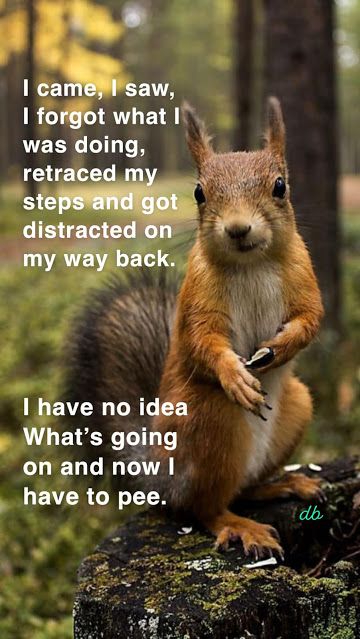
Sometimes I feel like this squirrel… and that’s where that comment function comes in handy again!
So… I’m off to make myself lunch, then dive back into the editing. I’ll reach my goal, with a comfortable margin, within the next week!
If you’re a writer, what is your approach? Copious amounts of pre-notes and hundreds of questions to develop characters and plot in your mind, or winging it? Please spill the beans in the comments below!
These past few weeks have flown by so quickly, I’ve hardly had time to look up from my keyboard! Except when I went to the optometrist for new glasses (there might have been a slight connection between the two). I’ve been editing my final sci-fi draft. When I need a break from editing, I’ve been reading into articles by the new ebook company I’ll be working with, Draft2Digital, which has recently merged with Smashwords (my current and former platform). And in the context of editing, I’ve been down several rabbit holes:
Dashes
Back when I learned English, we had the good ol’ hyphen and the dash. Somewhere along the way the en-dash and the em-dash moved in, and they turned out to be worthy additions to the conversation. Now to make things confusing, 2em-dashes and 3em-dashes have elbowed their way into the punctuation party. I’m not sure how I feel about them yet, but their definitions seem to have squeezed the others so close that they often overlap or exchange places on the definition and usage dance floor. Until I need them to fix me a drink, I’ll probably ignore the party crashers.
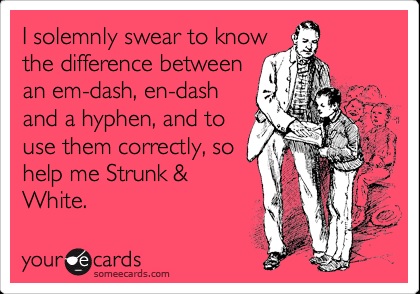
Strunk and White’s The Element of Style is a cornerstone of grammar and writing style and is widely considered timeless; in fact, it was listed by TIME in 2011 as one of the 100 best and most influential books written in English since 1923. The irony of this cartoon is that when I recently pulled out my copy to find out the nitty-gritty of using en- and em-dashes in dialogue, I found not a jot or tittle about them in the entire book. It covers hyphens and dashes, both briefly, but nary a word beyond. Every website that I looked at had contradictory definitions and usages of all types of dashes; so until an authoritative source comes up with a defined set of rules, I will continue to use them the way I’ve learned them, and just be consistent in my punctuation within my current manuscript.
Dialogue Tags vs. Action Tags
Another rabbit hole I went down was a learning curve on the two types of tags. On one hand, I’d never honestly thought about the fact that there could a difference in punctuation between the two; on the other hand, for the most part, I’ve intuitively done it right, though not always, which is why I’ve added it to my checklist of edits – and something I will keep a closer eye on in the future. Here’s an example:
He said, “Oh, the irony of ignorance!” – This is a dialogue tag with its attending punctuation. Dialogue tags are any verb that can be spoken – said, cheered, whispered, etc.
He nodded. “I hadn’t thought about it, but that makes sense.” – Nodding is something done, and this is, therefore, an action tag. Notice that its attending punctuation is a period separating the action tag from the dialogue.
Two things make less logical sense to me; if you have insight on them or experience using them or reading them in novels, please comment! [Keep in mind that these are American English rules; I am writing my current novel in American English, though until now, I’ve written in Commonwealth English (I use that term rather than British English because it is used beyond Britain).]
How often have you spoken and laughed, chuckled, or smiled simultaneously? These are, for me, nuances in spoken vocabulary, and not action tags. Would you rather write: He smiled, “I thought you might say that.” or He smiled. “I thought you might say that.” ? In this particular instance both would work, but there are times when it has the potential to break up the rhythm of a sentence or scene too much. Which do you prefer?
When an action interrupts dialogue, it needs to be separated with (IMHO) rather odd punctuation, for example: “From what I’ve read about these dwellings” –he looked at the woman kindly– “they’re far from mud huts.” My years as an English teacher mean that missing commas and attached en-dashes hurt my eyes; maybe that’s why I needed new glasses!
Euphemisms
Another tangent this week has been looking for creative swear words. Nothing irritates me more, when reading a book, for the author to fall back on standard F-bombs. That just says too lazy to be creative to me. It’s unimaginative. It doesn’t make a character stand out from the rest of the lazy crowd. There are so many fun alternatives, there really is no excuse! Here are a few I’ve come across and found myself smiling:
People cussing in a foreign language; it sounds better to them.
Fart knocker (e.g. “you little fart knocker”)
Sun of a nutcracker! Sun of a biscuit!
Cheese n’ crackers!
Shoot a monkey!
Shiitake mushrooms!
Well, butter my bum!
Clusterfluff!
In a type of Chinese Whispers, “Hells bells” became “hells bells, conker shells”, misunderstood by kids as “hells bells, taco shells” – now that family just yells, “Taco shells!” when they’re upset!
Names as swear words might backfire if you happen to meet someone by that name; here are a few: Christopher Columbus; Gordan Bennett (in Scotland); Gottfried Stutz (here in Switzerland – I actually taught English in a company that had an employee with that name!)
Sugar Honey Ice Tea!
Sunny Beaches
Fudgenuts
Someone I used to know would say things like “bug knuckles” or “dog feathers” or “ants pants” when she was upset.
Credit: Getty Images
These are just a few of the areas I’ve delved into in the past few weeks; I’m still deep in the editing/proofreading process; once that’s complete, the “behind the scenes” checklists begin – those are the things readers will never see: The number of hours put into finding the right images and designing the best cover art possible; choosing the right fonts; formatting for the various mediums online and print; writing blurbs, preparing marketing bits and bobs, and setting up all the dominoes in a row for the final push of publishing!
I don’t know what the current situation is like where you live, but here in Switzerland, Covid restrictions were officially lifted 17 February; that means that, if people want to, they can return to their desk jobs rather than working from home. My husband used to say that he’d never like working from home because he liked the stimulation of the office; but after working nearly 2 years from a cushy home office a few steps away from the kitchen and the coffee machine and home-cooked lunches, he’s decided to do half-weeks from home. Someone from work sent him a funny skit by Foil Arms & Hog, an Irish comedy group, about returning to the office. Just click on the image below! Enjoy!
Today we’ve got a variety of ways to make financial transactions: Online payment, cheques (checks), cash (coins or bills), debit cards, giros (UK), credit cards, bitcoins, Twint, and probably a dozen other ways. But when did it all get started? Why are there ridges or texts on the edges of coins? What did people use before coins were widely spread enough to be a viable means of transaction? I’ve written about the history of shillings before, and ancient payments using hack silver, but the complications that arose across the Atlantic between the British crown and the colonies of America, before they won their independence, is as fascinating as any thriller. It’s a tale of laws passed to stranglehold the colonies into submission or to stop an artery bleed of silver across the ocean, and loopholes and nooks and crannies found to carry on with business anyway.
For a fascinating video on the topic by Jon Townsend, an 18th-century reenactor and specialist with a great YouTube channel, just click on the image below. Enjoy travelling back in time!
Playing keeps us young. Everyone who’s got a healthy sense of balance has a little kid inside of them that likes to come out to play once in a while. And because it’s something all of us can relate to in one way or another, some clever folks have put together a museum dedicated to having fun! From toys, electronic games, television programmes like Sesame Street, board games, ball games, dolls, card games – you name it, they’ve probably got an exhibit about it! The Strong National Museum of Play also has a large number of online exhibits, so if you don’t live near Rochester, New York, you can still enjoy their collections. So come along on a tour of playing – just click on the image below and enjoy playing around!
Question: What was your favourite game as a child? I’d love to hear from you in the comments below!
Photo Credit: Strong National Museum of Play website
“It’s the things we play with and the people who help us play that make a great difference in our lives.”
Fred Rogers, American television personality, 1928–2003
Before we dive into our virtual tour of the world of umbrellas, I’ll take a moment to let you know what I’ve been up to the past fortnight: Editing. I’ve been working on the final draft of my next novel, and I call this phase the “cutting room floor” phase. If any of you have written a novel, you know that there are many ways an author approaches a story. I personally tend to toss my characters into a room and see how things develop. I start off with an idea of where it will end, but how it gets there is the fun part! Once the story is fleshed out, character arcs and story arcs complete, it might be too wordy; and every word needs to count, so tightening the dialogues or prose is a necessary step in the process. My current manuscript needs a fairly good “chop” to bring it into market norms for Science Fiction. So that’s what I’ve been working on. Looming on the future horizon is the fact that BOTH companies that I’ve been working with in the past have been acquired by other companies, meaning that I will now need to chuck out everything I’ve learned about their formatting requirements and processes and reinvent the wheel… Joy. But hopefully, working with the new companies will be a positive experience.
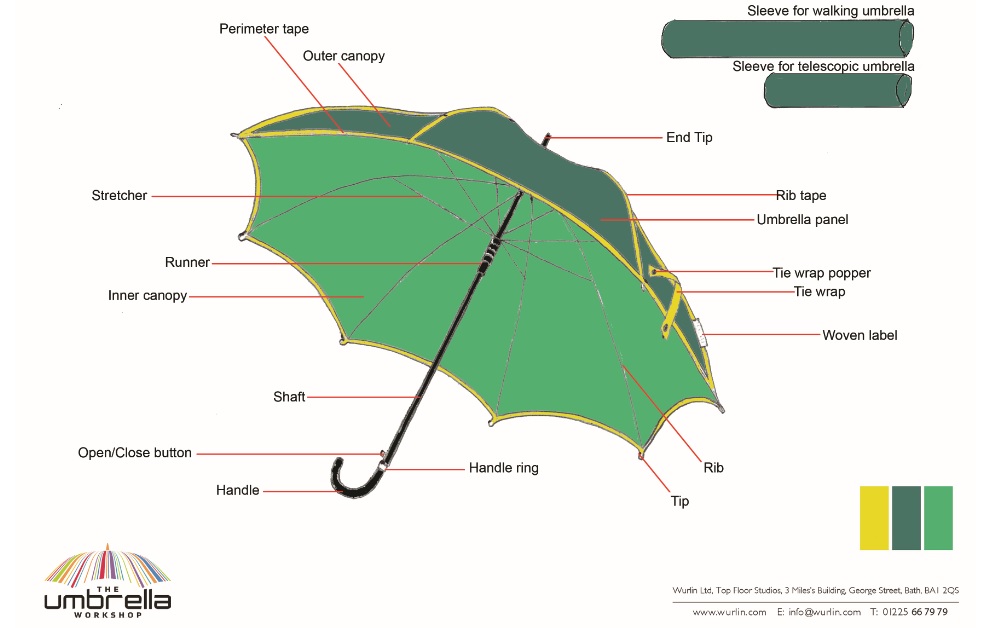
When I need a mental break from writing, I read, or I watch something interesting on YouTube. Recently in our local news, I came across a story about the only umbrella repairman in Switzerland, Erich Baumann. Every one of us has an umbrella; but I’ve never really stopped to think about the fact that each one is different – different mechanical parts and different tools needed to bring them all together. When I lived in Scotland, umbrellas (“Brollies”) were often considered “one-use” objects – the wind would swirl and suck the umbrella’s canopy upward with such violence that the ribs and stretchers would often snap. It didn’t matter whether it was a cheap or an expensive one – they didn’t last long.
Today, many umbrellas come from Asia; that means that replacement parts are hard to find if you live elsewhere; that also means that umbrella repairmen need the spare parts of those throw-away brollies. If you have a moment, go and get one of your umbrellas, open it, and take a good look inside. Appreciate how complex such an everyday object is. And now, take a look at two videos: The first is how an artisan umbrella is made by hand; the second is a look at how they’re repaired. Enjoy!
Learning something new every day keeps us on our toes!









 Stephanie Huesler
Wordless: Followers
2 Comments
May 4, 2022 · 2:58 PM