

The Grassroots Italian Response to Anything: SING!
The Italians have continued singing, despite their quarantine in relatively small flats and closely-packed neighbourhoods. This is a great response to counter the feelings of isolation, breeding solidarity instead. At 12 pm and at 6 pm, people join forces to boost morale.
For a smile or two, click on the links below!
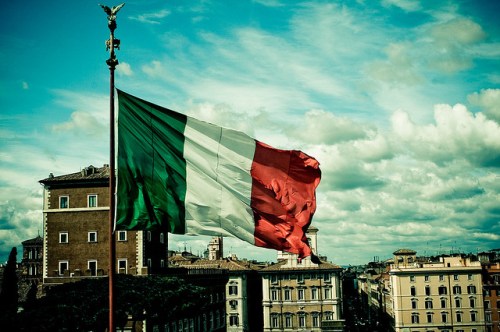
One of the Italian flags flying on front of the Altare della Patria, in Rome (Dave Kellam/flickr)
Filed under Articles, Snapshots in History
The Quandry of Quarantine

There’s been a lot of talk about the Corona Virus; in fact, that seems to be the only topic in the news right now; and while I rarely go onto social media sites, I was curious about what’s circulating there, and so I went on yesterday. While I agree that misinformation and scare-mongering are never helpful (and those both seem to abound in social media, like a wildfire virus) I disagree with people’s faulty conclusion that there must, therefore, be no danger of coming into contact with the disease or with the disease itself.
My husband and I have been cautious, we’ve been washing our hands and keeping a distance between ourselves and others, but the fact is, we all come in contact with things that have been in contact with others every day: The coins you use, the door handles you turn, the shopping cart you push, the food packages stocked onto the shelves in the store by someone else. And despite all our precautions, we have been infected. We are now under self-imposed quarantine for two weeks.
Quarantine will be a topic for a lot of people; in Italy currently, that “lot” is 16 million or more. So what do you do with two weeks within your own walls? Nowadays, I can shop online – I can order groceries delivered to our door from local shops (if they’re not under lock-down, too); I can have electronics delivered overnight – faster than if I had to go to a shop (if the postman can still get out). But I think the most deciding factor in making it through quarantine well is on the level of mental health; however, some people are better-equipped for isolation than others. Indoor hobbies play a huge role in helping people pass the time. Those who have no hobbies, perhaps because they think they have no time for such things, will suddenly find themselves with LOTS of time on their hands. People like my husband, who have to move and exercise or they go a bit stir-crazy, will need to figure out creative ways of doing so within the confines placed on them. Even if you aren’t there yet, it may be helpful to figure out ways to make time pass meaningfully, because like it or not, Corona is in our lives for a while yet, and it will shape our societies, economics and personal constructs for some time to come.
So to help, I thought I’d give a few suggestions of what to do on a rainy day, or as in our case, quarantine:
- Learn something. YouTube abounds with interesting videos on every topic under the sun. Here are a few of my favourite channels:
- For entertainment, YouTube offers films, comedy (try “Dry Bar Comedy“), talk shows (e.g. Good Mythical Morning)
- Do a puzzle. Either a physical one or a virtual puzzle.
- Play an instrument – you might have enough time to polish your abilities.
- Learn a new craft, or dust off one you already know how to do. Find an outlet for your results – often, a goal will help focus your efforts… either as a gift for a friend, or as a donation to a charity or cause (e.g. hats for cancer patients, or toys for animal shelters). I have an endless supply of ideas for crafts, so I’m all set. 😉
- Read a good book. If you need ideas, check out this link! 🙂 Books that I like to read depend on my mood; I like anything by Georgette Heyer, Jane Austen and Stephenie Meyer; the Descended series by Dana Pratola, and anything by C.S. Lewis or J.R.R Tolkien.
- Watch a good film. Whether a DVD or something through an online source, there are hundreds of good possibilities out there.
- Connect with people. That may sound odd as a suggestion for time spent in quarantine, but people are a phone number away. We have one friend here who is also in isolation, and she knows no one else in Switzerland yet; so we are on the phone daily right now, as a way for her to connect with someone outside of her four walls. We’ve called friends to make sure they’re okay (if need be, I can go out, as I have a supply of face masks). If you have other people in your home, play a game together.
I hope you never face quarantine, but if it happens, decide ahead of time to view it as an opportunity dropped into your lap; you’ll be better able to cope with it if you have a positive outlook on it, and you’ll be more equipped to take the bull by the horns and find a way to come out the other side a better person!
Filed under Articles, Cartoon, Humor, Links to External Articles, Musings
Greetings from the Global Village
Depending on where you are in the world, right now you’re feeling the effects of our global village more or less than others. Here in Switzerland, the Corona Virus is headline news. We’ve had a few cases here – 43; the government has issued instructions on how to sneeze properly (into your sleeve “elbow” or into a tissue), to stay home when sick, and to cease greeting rituals (here, that would involve either hand-shaking, three kisses on the cheeks, or hugs). Gatherings of over 1,000 people have been banned – goodbye, sports fan sections and exhibitions. Below that number, lists of participants must still be kept to trace any spread to a patient zero. This includes our church; it was strange not to hug people, and to checklist who attended. It might be just a matter of time before facemasks are commonly worn in public (they’re sold out here, but I’ve yet to see someone wearing them in public).
The global village is also felt in the breakdown of the chain of supplies for goods; many shelves in our supermarkets are empty. If tin cans are made in some outback area of China that has now been quarantined by the Chinese government, then companies canning foods in Europe don’t get the wares they need to keep their factories running – as soon as one interruption happens, it breaks the steady flow. If enough shelves empty, people begin to panic and hamster supplies. Remember Y2K? The panic induced by the media, in the end, came to nothing. Yet the media are once again being panic mongers by continually focusing on this issue. What else is happening in the world? I have no idea, because the Corona Virus has taken over the world press. What I do know is that this is now the new reality; we’ll just have to get used to it and get on with our lives.

Illustration credit: Mayo Clinic website
While I take all of this as seriously as it needs to be taken and find some of these measures sensible in any case of sickness, even the common cold, I am also a lover of history – so let me put the present crisis into a larger context:
- The World Health Organization (based here in Switzerland, by the way) estimates that worldwide, annual influenza epidemics result in about 3-5 million cases of severe illness and about 291,000 to 646,000 deaths. That’s the old, run-of-the-mill flu, something that most of us, if not all, have had once (or even multiple times) in our lives.
- The Covid-19 flu strain (known as the Corona Virus) is 10x likelier to be fatal.
- The Spanish flu, which struck just after WW1 (and which is related to the Swine flu of 2009), killed an estimated 40-50 million (but could have been as high as 100 million). The common name is a misnomer: The reporting of the flu in Allied countries and in Germany was suppressed by wartime censors to avoid damaging already-low morale, but the newspapers were allowed to report cases in other countries, such as Spain. As a result, people thought the flu was heaviest there or had even begun there; thus, the common name. To put that in perspective of the Great War, the total number of military and civilian casualties in World War I is estimated to be about 40 million.
- Going further back, the Black Death killed 50 million people in the 14th century (1346-53) – that was roughly 60% of Europe’s entire population at the time. It reset the economic and social structures, ending centuries of feudalism with its systems of lords, vassals and fiefdoms; it also killed off a disproportionate number of priests as they were infected while helping the sick (as well as the fact that they lived in closed communities). This necessitated a restructuring even of the church in some countries, opening the way for lay preachers and access to the Bible for common people (that’s a whole other topic).
These statistics shouldn’t induce panic; on the contrary: It shows us that life goes on. We should take precautions and practice sensible hygiene – washing hands when we come home from shopping or work, using hand disinfectant* when out, keeping distance as much as possible between ourselves and strangers when out in public, avoiding crowds of people, and avoiding physical contact with people outside the immediate family. But in the end, it is what it is; we can do what we can do, and no more. [* In case hand disinfectant is sold out in your area, you can make your own: Proportion into a pump or squeeze bottle 1/3-1/2 aloe vera gel (as close to 100% aloe vera as you can get), 2/3 rubbing alcohol or any alcohol with 60% vol. or more, and a few drops of essential oils for scent.]
How we respond to the present crisis will show our mettle; there’s no need to panic, to hoard, or to isolate ourselves behind closed doors. Hopefully, the current climate of raised awareness will linger; that it will teach people to consider others (I’ve lost count of the times I’ve been greeted with three kisses, only to be told after the fact that the other person is sick! I’d rather be warned and be able to have a choice in exposing myself or not, thank you very little…) and to generally adopt more hygienic practices even when sick with a common cold.
For me, far more important than the outward circumstances is the heart of a community that manifests itself in times of crisis. If we could look into individual communities in those past ages, we would almost certainly see people supporting others; groups who united to help the families affected. The human stories would most certainly be inspirational. There are numerous contemporary examples of natural disasters in which people have pulled together, whether locally or internationally, and helped the helpless. I can think of a dozen people in our church who would cook meals or run errands for those who are sick, and I’m sure there are far more people out there willing to step out of their own isolated, daily bubbles – and that’s where such a crisis becomes a blessing to communities, in the long run.
Filed under Articles, History, Military History, Science & Technology
History Undusted: Bubble Wrap
I do a lot of crafts. I mean, a lot variety-wise, and a lot quantity-wise. When I’m not writing, managing our household, planning meetings or teaching students (I’m a vocal coach and an English teacher for adults), I’m usually doing some kind of craft, and it more often than not involves some form of upcycling – turning “trash” into “treasures”. Recently, I’ve been making sheets of plastic-confetti-filled bubble wrap, ironed into what’s known as “ploth” (plastic cloth). These can then be sewn into bags, etc. It got me to thinking about just how bubble wrap came to be. I have tons of the stuff, stashed here and there in the craft room, for such projects – and I’m constantly on the lookout for creative uses for that poppable fun.
Did you know that originally it wasn’t intended as packing material but as wallpaper? In 1957, Swiss chemist Marc Chavannes and his business partner, Alfred Fielding, wanted to make a wallpaper that would appeal to the emerging Beat culture [for those of you unfamiliar with that term, it was a generation of post-war, anti-establishment rebels who were more or less the precursor to the 60’s hippie and counterculture movements]. What the partners did was simple enough: They put two layers of a plastic shower curtain through a heat-sealing machine. But it came out in what they first saw as a failure, with air bubbles trapped between the two layers. They figured they were onto something, failure or not, and so they got a patent and then began experimenting to find other uses. Wallpaper wasn’t popular; neither was their suggestion to use it as insulation for greenhouses (perhaps that was simply a matter of marketing to the wrong demographic). Then, around 1960, IBM began shipping their newly-designed 1410 computers and needed a way to protect the delicate dinosaurs – eh, I mean, computing mammoths. That’s a LOT of bubble wrap. The rest is, as they say, history. And in case you’re wondering, yes, people have been popping the bubbles from the beginning, just for fun. So much fun, in fact, that the last Monday of every January is officially “Bubble Wrap Appreciation Day”.
Click on the image below to watch an IBM recruiting film (1 minute), from 1960. You can also see one of IBM’s massive scientific mainframes being used by the original “computers” of NASA in the film “Hidden Figures“.
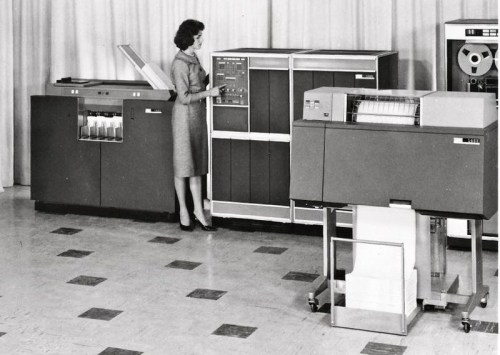
IBM’s 1410 computer promotional photo, 1959. Credit, Computer History Museum archives
History Undusted: Human Alarm Clocks
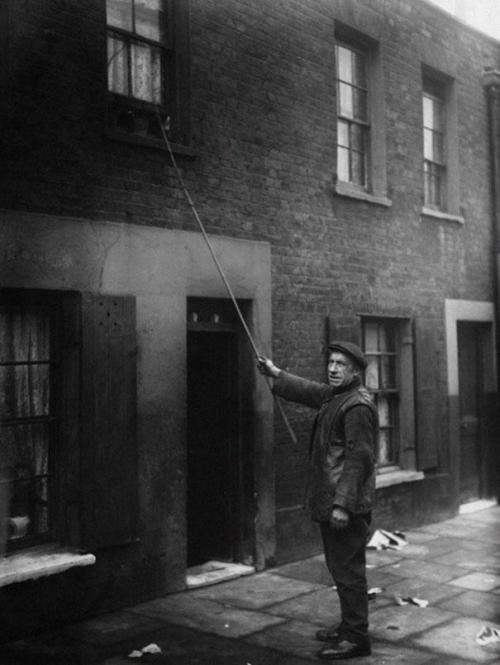
If you were living in the 19th century, before the age of reliable and affordable mechanical alarm clocks, how could you be ensured of getting up on time to get to work? Hire a knocker-up, of course. That’s if you lived in Britain or Ireland. Knockers-up were employed from the time of the Industrial Revolution; the last one retired in Bolton (a former mill town in Greater Manchester) in 1973. Also known as “human alarm clocks” they would use sticks, clubs, pebbles or pea shooters to knock on clients’ door and windows; some would move on after a few taps, while others wouldn’t move on until they were sure the client was up. I wonder who woke them up?
According to the Lancashire Mining Museum, there was a conundrum from the times that went like this:
We had a knocker-up, and our knocker-up had a knocker-up
And our knocker-up’s knocker-up didn’t knock our knocker up, up
So our knocker-up didn’t knock us up ‘Cos he’s not up.
The original problem employed knockers-up faced was how not to wake up their paying clients and several of their neighbours on either side for free; they hit upon (no pun intended) the idea of long poles or pea shooters to tap on the upper windows; clients obviously couldn’t sleep in a back room, or they’d never hear the knock. The fees charged depended on how far the knocker had to travel to reach the house and how early said knock needed to be.
In 1878, a Canadian reporter was told by Mrs Waters, of northern England, that she charged eighteenpence a week for those who needed waking before 4 a.m., and for those after 4 a.m., it was a shilling (twelvepence) a week. Those who had to be aroused from five to six o’clock paid from sixpence to threepence.
The miners of County Durham, Ireland, refined the requirements a bit: Built into the outer wall of their houses was a slate board, on which they would write their shift times in the mine; the company-hired knockers-up would then know when and when not to wake them up. These boards were known as wake-up slates or (far better, in my opinion), knocky-up boards.
Here are a few rare photographs of knockers-up knocking up:


And just so we’re clear, the American English phrase “to be knocked up” (pregnant) has nothing to do etymologically with the British occupation or the sundry adjectives that derived from it. The knockers-up were usually elderly men or women, or even policemen who supplemented their incomes by taking on the task of waking their clients. In fact, one policeman (as told during the inquest) saw no reason to abandon his post as a knocker-up when a man found him on his route and told him that he’d found a dead woman; she turned out to be Mary Nichols, the first victim of Jack the Ripper.
Original post, September 2015
Seeds, Pits, Pips or Stones?
If you’ve hung around here for any length of time, you know that my curiosity likes to sprint down obscure paths. I recently finished the first draft of my next novel (Woohoo! Now the real work ahead!), and one of the things I was researching was something I wanted to write but then hit that proverbial wall: Do I use pit or seed in this context? And what’s the actual difference between the two, or are they interchangeable? And where does stone or pip come in?
Well, as with any roadsign to curious paths, I pulled out my walking stick – or in this case, the dictionary (as in, Wiktionary). And as you’ll see, just looking it up won’t do – I had to learn a wee bit about botany along the way:

Endo- means within, inner, absorbing, or containing. Peri- means peripheral, or surrounding; Meso- means middle (as in Paleolithic, Mesolithic, Neolithic); Exo- means outer (as in exoplanet); and -carp means part of a fruit or fruiting body. I tend to remember something better if I can make a linguistic leap of understanding, and the suffix carp- actually comes from the Greek word Karpos, which was the mythological son of the west wind and spring (new vegetation), which naturally includes fruit.
In this instance, however, the dictionary wasn’t exactly helpful:
SEED: A fertilized and ripened ovule*, containing an embryonic plant. [*the structure in a plant that develops into a seed after fertilization.]
I don’t know about you, but I found myself none the wiser.
PIT is even more confusing! It’s a seed, stone or pip inside a fruit, or a shell in a drupe (such as a peach) containing a seed.
PIP makes the issue even foggier: It’s a British term for a seed inside certain fleshy fruits (compare stone/pit), such as a peach, orange, or apple!
STONE seems the clearest definition (insert sarcastic tone here): The central part of some fruits, particularly drupes; consisting of the seed and a hard endocarp layer.
If I had to put it in layman’s terms, I’d say it like this: The seed contains the embryo; the pit/pip/stone protects the seed until it’s ready to sprout (and only certain types of fruits have pits); pits are usually singular in a fruit, while there may be one or more seeds.
Pits are found in fruits like cherries, mangoes, peaches, plums, avocadoes, olives and dates. Seeds are found in fruits like apples, oranges, and bananas (the variety of bananas usually sold in stores usually have sterile seeds – what we might call “seedless”). If I can follow this jungle-infested side path for a moment, did you know that bananas don’t actually grow on trees, but are the world’s largest herb, and that they grow upside-down, defying gravity? Another interesting point is that a seedless banana can still propagate itself – I should rather refer to it as clone: Each” tree” (i.e. layers of leaves) produces 1 bunch of fruit and then dies; but its rhizome, below ground, simply sprouts up as the one is dying and repeats the process.
Then there’s the hairy issue of the coconut: Technically, it’s a one-seeded drupe; but it could be considered a fruit, a nut, or even a seed. When you buy a coconut in the store, the outer layers have generally been stripped off: The exocarp is usually green; the fibrous husk beneath that is the mesocarp, and the hard, woody layer we often think of as “a coconut” is actually the endocarp. Every part of the coconut and the palm plant (not tree) on which it grows can be used for something, so it’s often referred to as “the tree of life”.
And let’s not get into figs; they’re technically inverted flowers, and besides, there’s probably a wasp inside there (without the fig wasp, we’d have no figs). Now ya know. Don’t look into that too closely unless you really want to know, because you’ll never look at a fig the same way again.
Learn something new and get smarter every day!
Filed under Articles, Etymology, Nuts & Bolts, Research, Science & Technology





 Stephanie Huesler