

History Undusted: The Mississippi Delta Chinese
Mississippi and Chinese are not two terms one usually expects to see in the same sentence; yet it’s a slice of history worth undusting (though, for those who grew up in this subculture of the South, it’s not history, but reality): An industrious, well-educated but small population of Chinese immigrants made a significant impact on the economy and social environment of their communities along the Mississippi Delta.
The first influx of Chinese to America came in the pioneering days, when they worked in gold mines, along railroads, and provided laundry services in the Old West. More came to work in the cotton fields of the South when the plantation owners could no longer count on free slave labour. Most of these Chinese came from Guangdong province in China, which has a similar climate to the Delta. The opportunity for work in America afforded them the chance to help support their family members who remained behind in China. They quickly established themselves in a niche market between the whites and the blacks, serving both communities with segregated grocery stores.
During the Chinese Exclusion Act (1882-1943), they were unable to own property, so the families lived behind their stores in the same building; their children all attended one-room schoolhouses, some of which were built by the Southern Baptist church (which remains a big part of their lives). [The fact that there was such a law implemented to restrict a specific ethnic group is the greatest remaining witness to the number of Chinese immigrants of the initial wave (during the California Gold Rush, 1848-1855), as records or censuses of that time period have all but vanished.] The parents worked 365 days a year to send their children to college; many of those children went on to be pharmacists, NASA scientists, veterans (the Delta was represented by 182 Chinese men who served in World War 2), doctors, and many other professions.
For a fascinating look at an almost unknown community in the heart of America’s South, click on the photo below and the links provided below that.

E. Samantha Cheng: Discovering the Mississippi Delta Chinese Legacy
Heritage Series: Honor and Duty: The Mississippi Delta Chinese
History Undusted: The Immortal Life of Henrietta Lacks
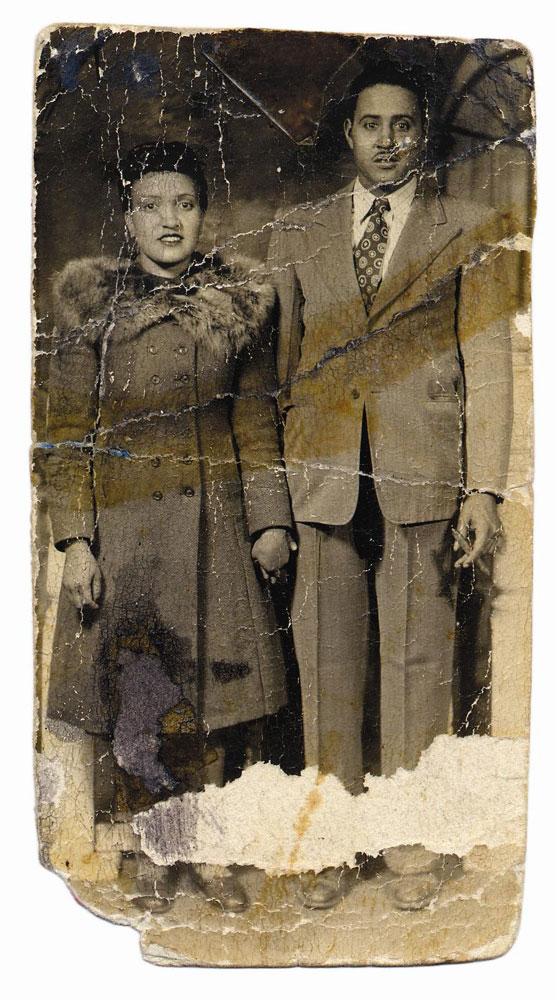 If you’ve ever taken any medication stronger than an aspirin and benefited from it, chances are that you owe your thanks to an African American woman who never lived to hear your tale.
Born in 1920 as Loretta Pleasant, when her mother died giving birth to her 10th child and the father could not support the family, the children were divided among relatives to be raised. Loretta, who became known as Henrietta, was sent to live with her grandfather, Tommy Lacks, who lived in a two-storey log cabin (former slave quarters) on the tobacco plantation of her white great-grandfather. After having five children with her first cousin, whom she married after their first two children were born, she died at the age of 31 of cervix cancer.
What is most remarkable about her life is something she never knew: During the diagnosis of her cancer, done at Johns Hopkins (the only hospital near her home that would treat black patients), her doctor, George Gey, was given samples of her cervix for biopsies. Before this time, any cells cultured from other cells would die within days. Dr Gey discovered that her cells were remarkably durable and prolific. A selection of her cells was isolated and cultured (without her knowledge – back then, permission wasn’t necessary for what was considered tissue waste) into the immortal cell line that became known as HeLa Cells; they are still in use today worldwide, being the first human cells to be cloned successfully, in 1955.
HeLa cells are so prolific that if they land in a petri dish, they will take over; they have been used to create the vaccine against Polio, in research for AIDS, gene mapping, cancers and countless other projects; to date, scientists have grown over 50 million metric tonnes of her cells*, and there are nearly 11,000 patents involving these cells. Her name should be known, and as the godmother of biotechnology, her history deserves to be undusted!
For a fascinating book on this topic, see The Immortal Life of Henrietta Lacks, by Rebecca Skloot. I’ve read it, and had trouble putting it down!
*For a more detailed article in the New York Times, click here.

History Undusted: Hnefatafl (Viking Chess)
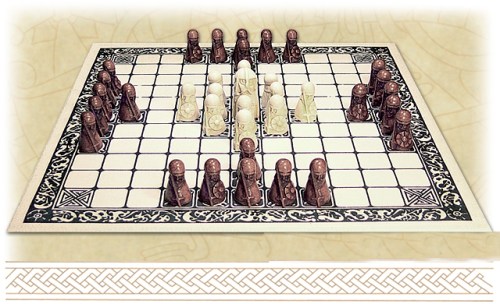
Hnefatafl (meaning King’s Table, aka “Viking Chess”) is a board game that originated in Northern Europe; the oldest board found to date was located in Denmark, dated to ~ 400 BC. Because no written history of that period for northern Europe exists, apart from runic inscriptions on stone, wood, and bone, the rules of this game had to be recreated, so there are no hard and fast rules agreed upon by those who play it. It is far older than chess, which originated in northern India in the 6th century AD and spread to the rest of the world through Persia.
In Hnefatafl, the game is played on a square board (as pictured). There are five spaces on the board that are considered special: The space in the centre of the board is the ‘Throne’ space, and the four corner spaces are the escape points for the King.
Unlike most modern board games, Hnefatafl does not start with even-strength sides (as in chess). The two sides are divided into attackers and defenders; in the illustration, the pieces along the edges of the board are the attackers, and those in the centre are the defenders. The objective of the attacker is to capture the king (centre). The objective of the defenders is to protect the king long enough for him to escape.
The board shown above is a modern version; but online, I’ve seen a wide variety of boards, from draw-bags of leather with stone pieces to wooden blocks on a large outdoor board. I’m certain that the travelling Norse, who loved board games, word games and competitions of any sort, would have made do with whatever was at hand and would have also had travel versions of their favourite games, just like we do today.
For further information, check out the Wikipedia article, or see the rules and how to play the game here.
January 26, 2014
Filed under History, History Undusted, Links to External Articles, Military History, Research

Life & All that Jazz
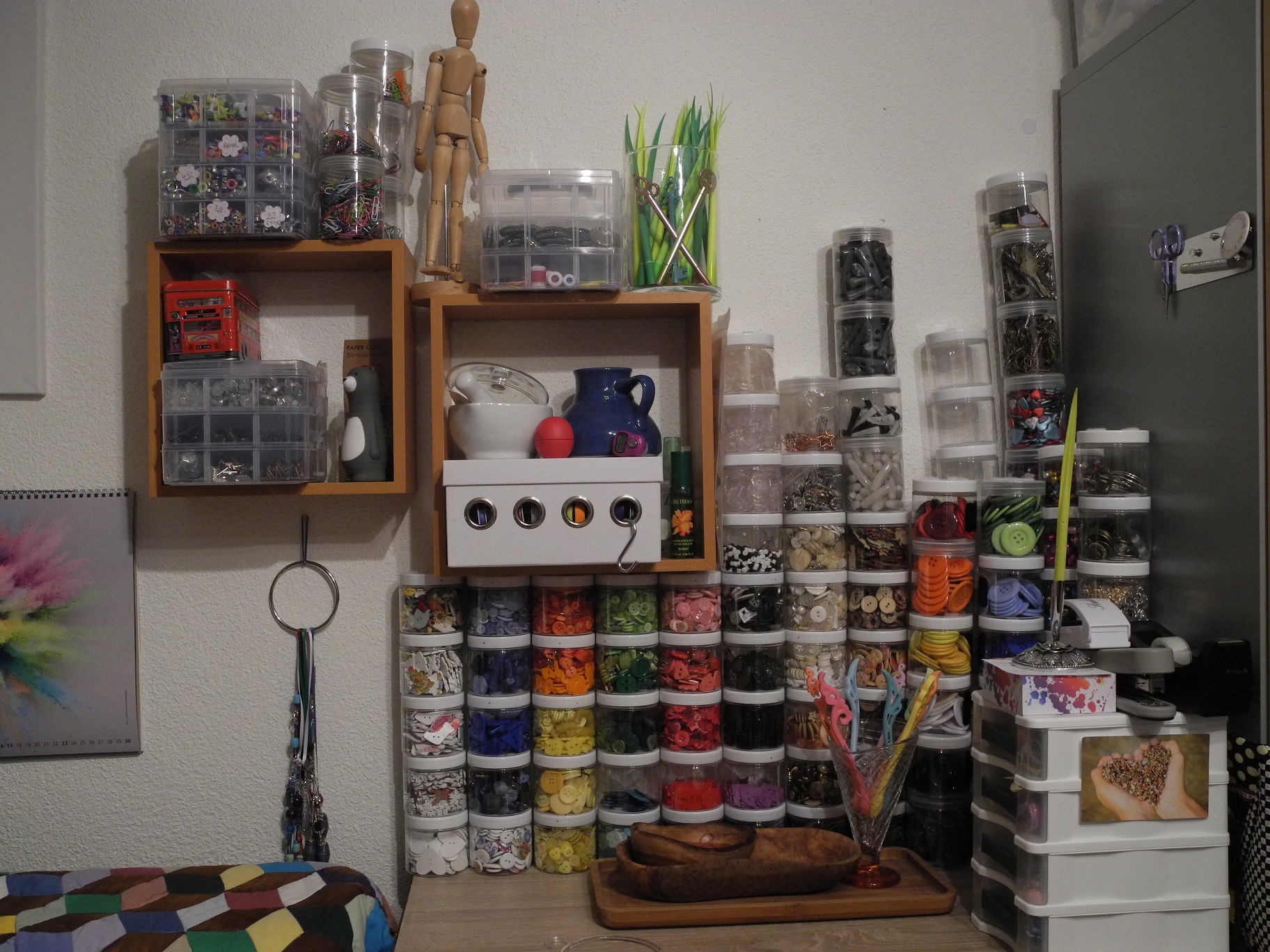
I’ve been silent awhile; sometimes I just need a change of pace from daily writing, and blogging, to retank creative energy. Life has been full in that time, so it’s not as if I’ve been sitting around in a toga eating grapes and reading a book… the whole time. I’ve been doing crafts; I do a lot of all kinds of crafts, and my craft room has a bit of a reputation – it’s packed neatly with more supplies than any craft store I know of in Switzerland, literally. People come to me when they need things repaired, or when they don’t know how to make something, or when e.g. their school class needs party decorations on a large scale, or large paper maché stage props. Here’s a small corner of my craft room… (just click on any of the images below to enlarge and have a snoop!) – everything you see is practical; the bear on the shelf is a ratchet screwdriver with 6 heads tucked into the belly; the grass blades are pens; the wooden bowls are great for sorting bits & bobs… you get the idea!
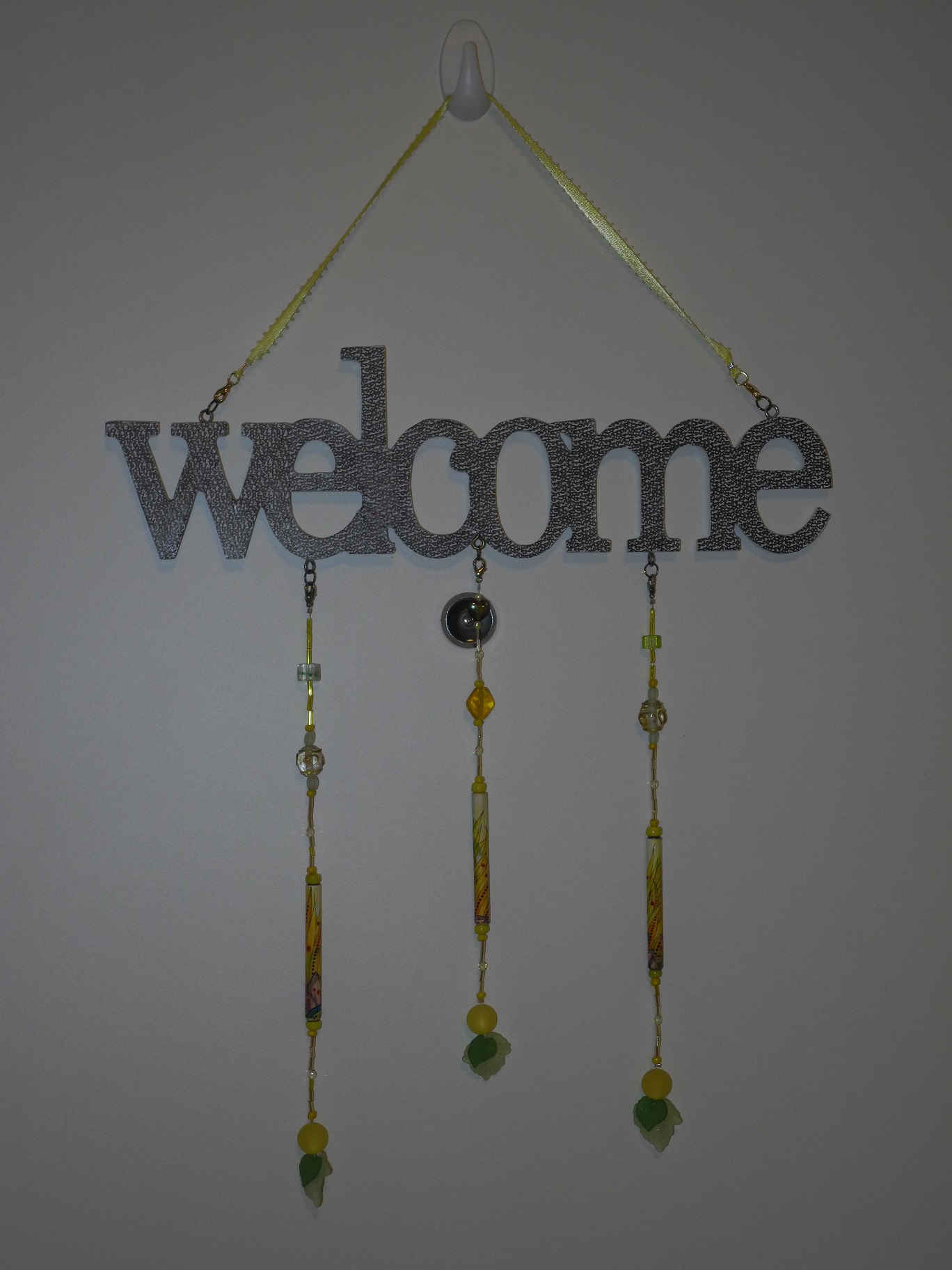
And here’s our front door sign; the sign itself is decoupaged with the inside of security envelopes, and the large beads are made of paper. This is our current sign, though the straps and dangles are interchangeable, as I have several sets (dangling from the metal ring in the photo above), depending on the season and my mood.
I do a lot of practical crafts for our home – from coasters to tea caddies to curtains; here are a few images of things I’ve made from paper and cardboard:
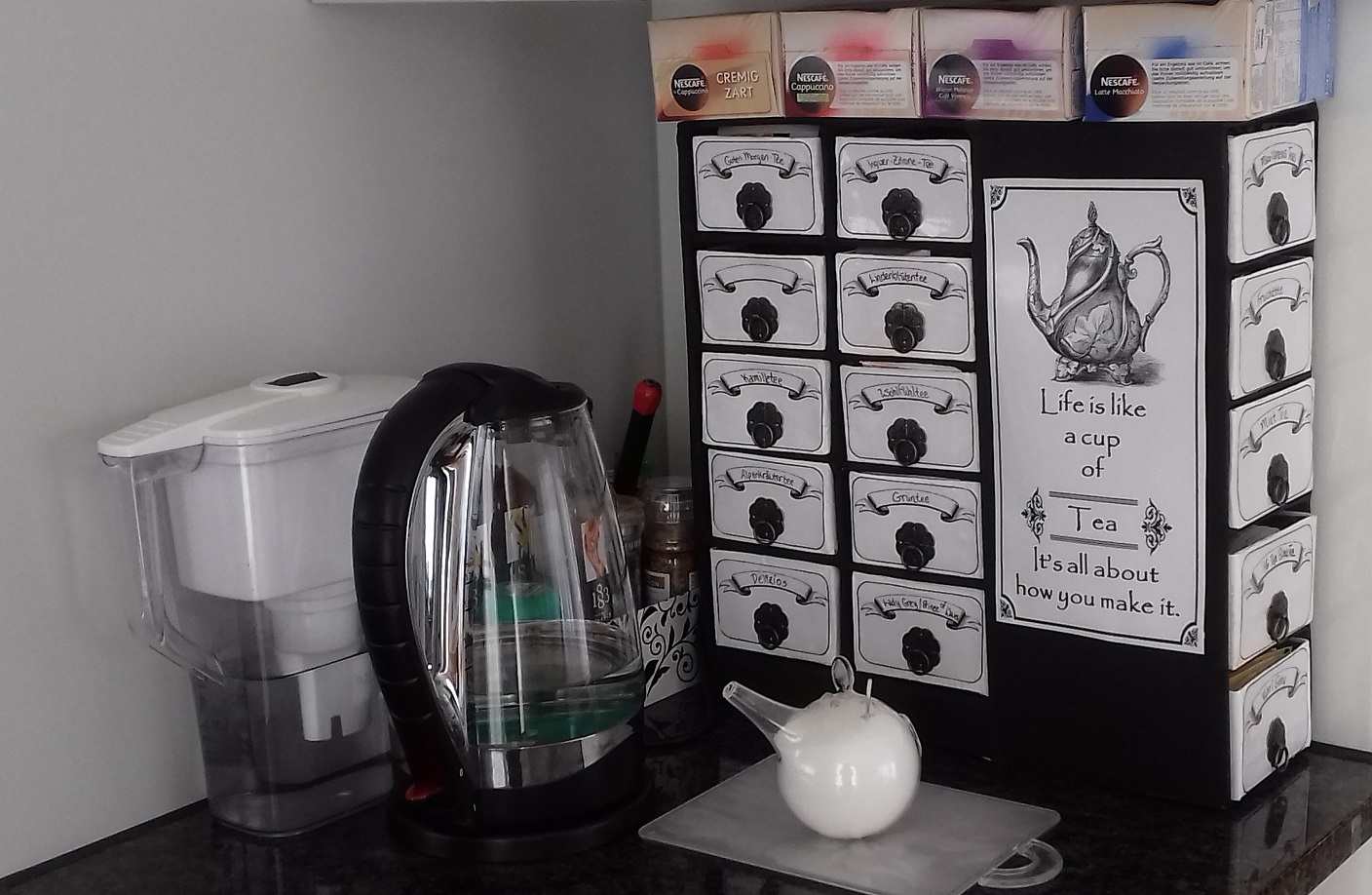

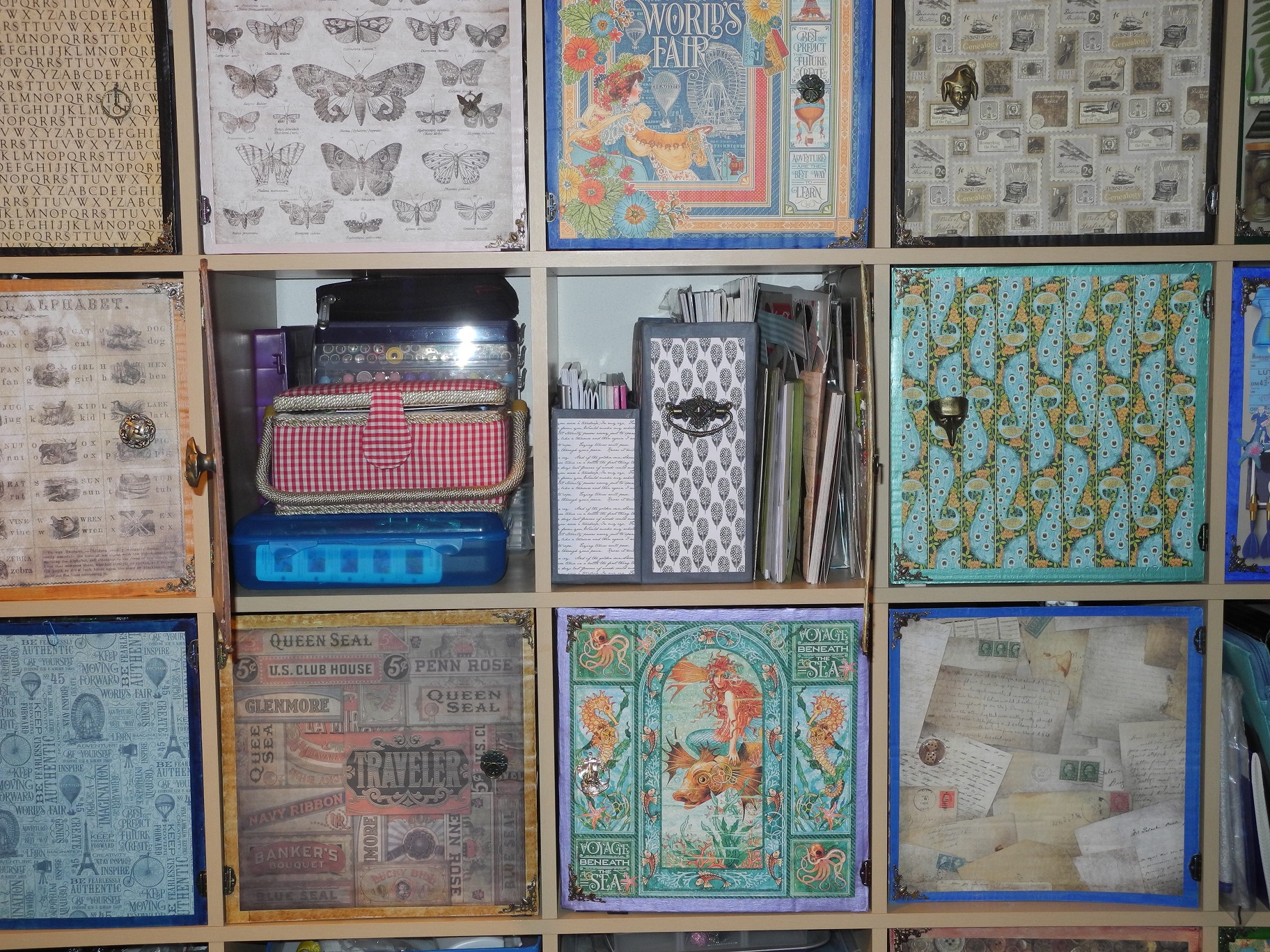

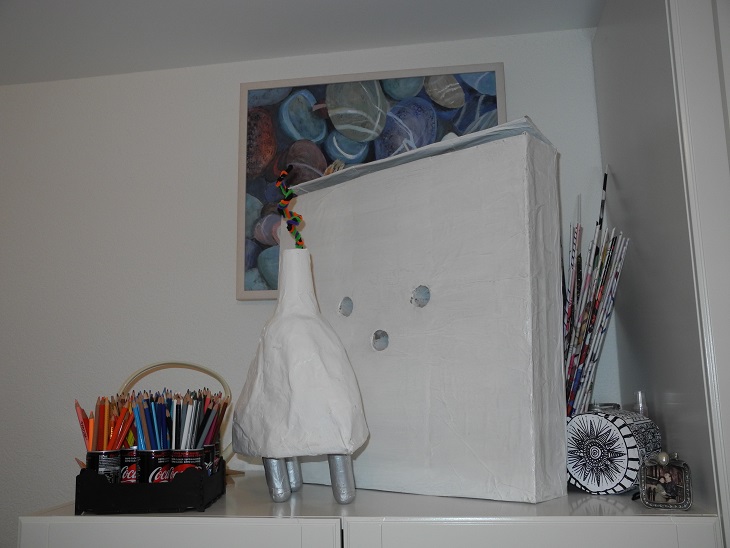
The colourful doors are on my craft room book shelf; each cubby holds a world of crafts supplies! The giant electrical plug & socket are stage props for an upcoming musical production based on my husband’s first CD; that week, I’ll be busy as well, vocal coaching the soloists as well as the choir. On the final evening, the plug will reveal that it is actually a piñata, stuffed with bags of toys and chocolates. Peeking out from behind the socket is the neck of a paper maché ukelele case I made and then doodled, as well as a bouquet of paper rolls ready for another project similar to the library’s round window shade…
Besides crafts, we’ve had a party and a few evenings with guests; the party was for part of my husband’s work gang and their partners, and I made a Mexican fiesta (here’s my menu, for those interested).
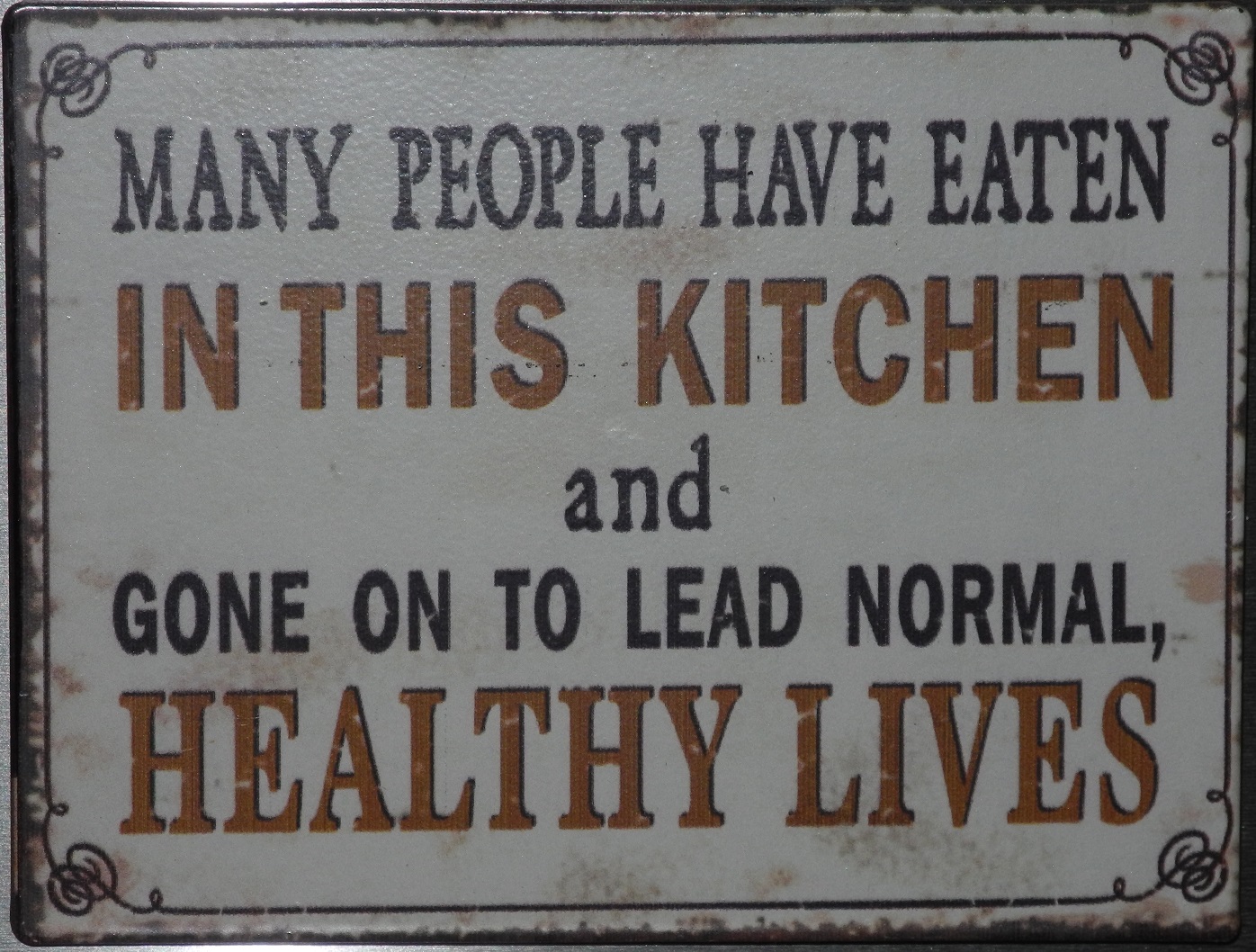
This magnetic sign is now on my stove; I found it in a quaint little vintage café in Bremgarten, when my husband took me out for a day of surprises for our 25th wedding anniversary! He’s good at keeping secrets… he’d invited two couples to celebrate with us: One for lunch in Bremgarten in a restaurant along the river, and one for dinner, at the Wörth Schlössli Restaurant at the base of Rhein Falls. We had a great day together, as always! In between, we went to downtown Zürich to spend a gift certificate I’d received from friends on my birthday; it was, of course, in an art shop!
So, that’s just a glimpse of some of the things I’ve been doing (when not in my toga eating grapes and reading). Now that my mini hiatus is over, I’m tucking back into writing and all the bits and bobs that turn “writing” into novels!
Filed under Articles, Images, Links to External Articles

What’s in a Name?
The topic of names could cover quite a wide variety of areas, such as naming babies, place names, collective names of animal groups, or translations of names into languages such as Elvish or Runes; but I’d like to focus on the naming of characters for fiction writers.
Choosing character names can be fairly straightforward if you’re writing contemporary fiction; having said that, be sure to choose names that are not too similar from one character to the next. Unless there is a reason for close names, such as Sandy and Brandi for twins, the names need to stand apart to help readers keep straight who’s who, especially if there are multiple characters in a scene. In Lord of the Rings, however, JRR Tolkien uses names to comical effect when naming the dwarves: Bifur, Bofur & Bombur; Dori, Nori & Ori; Kili & Fili; Balin & Dwalin; Gloin & Oin; only Thorin stands out as leader and king with a unique name.
When choosing names for modern characters, consider their place, time and age: If you’re writing a grandfatherly character, he can have a name that was popular in the ‘30s or ‘40s; but if your character is in their 20s, then don’t name them Mildred or Frank. If you are writing children’s fiction, keep the names modern and simple to pronounce when reading aloud.
If you’re writing historical fiction, consider the era and country in which you’ve set your characters. For my 18th century trilogy, I compiled a list of names from parish records in southern England from the early-to-mid 18th century, and then condensed it down according to frequency; that gave me a list of the top 20 male names and top 20 females names from which to choose. Back then, children could only be christened with Christian names approved of by the church; names of kings and queens were popular, such as James, William, Charles, Anne, Charlotte, or Elizabeth. Biblical names from the New Testament such as Timothy or Mary were also popular, but Old Testament names, such as Jacob or Rachel, were only given to Jewish children. If you’re setting your story in the ancient Middle East, then find out what names were common then and there; just make sure that whatever you name your characters, they’re easy to read. Combinations of consonants that are difficult to read will be skipped over – a pity, if your main character is saddled with a forgettable name, such as Cthulhu (Lovecraft), or Tylwyth or Tleilax (Dune). In my 18th century trilogy, I also had a few characters’ names which emphasized their general character: Mrs Stacklesprat was a prickly, withered, gossiping, sour woman, while Mrs Huddlepoke was a cuddly, motherly, soft & jolly woman.
For Science Fiction and Fantasy genres, names can be drawn from sources such as planets, galaxies or stars (Andromeda, Galaxus, Draco), or objects such as trees or flowers, or natural occurrences (Vortex, Sparkle, Wave, etc.)
There are so many resources available for choosing names these days: Online you’ll find dozens of sites for baby names and what they mean; a great place to find names is in film credits – I watch those with pen in hand, and when I find an interesting first or last name, I jot them down; you can combine them randomly and come up with some great fictional names.
Things to consider when choosing your names:
- Culture: Don’t assume a name is Japanese when it might be Chinese – research!
- Era: Don’t choose a modern name for a character set in the 1920’s, and vice versa.
- Age of character: Give age-appropriate names to each character, especially for modern fiction.
- Combinations with other characters’ names: Unless you’re going for the comical effect of JRR Tolkien and have the language chops to carry it off, choose names that differ from the others in your story.
- Occupation: Don’t name your murderer Fluffy…
- Ensure it’s fictional: Don’t name a character and publish your book, only to find out it’s a real name (unless it’s John Doe – then I’d say, go back to the drawing board with choosing a good name)! Google it to see if it exists…
- Be cautious: If a character is closely based on someone you know, choose a name unrelated to your (soon-to-be-ex) friend or relative…! Also, there are certain names that are taboo due to historical events; I’d never recommend naming your character Adolf, or Hitler, or Stalin.
- Personality: If your character is a sturdy, reliable, powerful personality, don’t give them a wimpy name! And if a character is a wimp by nature, don’t give them a powerful-sounding name – unless they’re going to grow into the name over the arc of the story.
- Meaning: A name’s meaning might have bearing on your character; it could also add a double meaning. In the story I’m currently writing, a character is called Janus; this was the name of a Roman god who was two-faced – one looking to the past and the other to the future; it is also the name of one of Saturn’s moons. As the story is Science Fiction, either meaning applies to my character.
I hope these thoughts help you on your way to choosing memorable character names for your own projects. Whatever you do, keep writing!


Filed under Articles, Cartoon, Etymology, Humor, Lists, Nuts & Bolts, Research, Space, Astronomy







 Stephanie Huesler