Tag Archives: History

History Undusted: MacGyver and Blue Peter

This week’s topic arose from a conversation with my husband; we were discussing a temporary fix we had made at his mother’s home to make something usable until we could find a permanent solution. I said that we had “MacGyvered” it, and he had never heard the word before. That led me down a rabbit hole to naval flags, a card game, and British tele.

First, MacGyver: Though I knew the term, I had no idea what its origin was. The name comes from the eponymous character in a US television series that ran from 1985 to 1992; Angus MacGyver was a non-violent, resourceful genius, and his favourite tool was, of course, a Swiss Army knife. Though I was living in the States at that time, its running years explain why I didn’t know of the origin: In 1985, I was in college, having finished high school a year early (I took my final two years in one); I was too busy to watch television. In 1986, I moved to Hawaii to do a Discipleship Training School (DTS) with Youth With A Mission (YWAM), and went from there to the Philippines, where we worked in the red-light district of Olongapo. 1987 was a year of multiple jobs, earning money and hanging out with college friends – again, TV was not a priority. In 1988, I emigrated to Scotland.

The traits mentioned above made MacGyver a verb; when something is “MacGyvered“, a simple yet elegant solution to a problem is employed by using existing resources. At my mother-in-law’s home, we needed to level a new microwave that was sitting tilted atop the welded inserts that fit the original one. Our solution was to use an actual leveller, removing the end caps to make it fit inside the metal frame.

Now, down the rabbit hole: In the time of British ships of sail, when a blue flag with a white square or rectangle in the centre flew alone, it served as the sign for imminent departure (signifying P, leaving port); any passengers and crew in port would then return to the ship. The flag came into use in 1777, and by the turn of the century had become known as the blue peter. I have my suspicions that the term may have come from the card game of whist, in which a strategic manoeuvre known as the “blue peter” calls for trumps by throwing away a higher card of a suit while holding a lower one. No one can say for sure which came first, the ship or the card, so to speak, but the connection is likely.

The British children’s television programme, Blue Peter, first aired on 16 October 1958; the name was inspired when Owen Reed, the producer, was inspired by a radio programme for children (produced by Trevor Hill) that began airing on television once a month; it was launched aboard the MV Royal Iris ferry on the River Mersey, Liverpool, with presenter Judith Chalmers standing at the bottom of the gangplank to welcome everyone aboard. Reed was so captivated by the idea, and with the blue peter flag, that he asked to rename the programme (then called the Children’s Television Club) and take it to London.

Blue Peter, catering to younger children, is the longest-running children’s TV programme in the world; over the years it has changed with the times, and its content is wide-ranging, but they still give a nod and a wink to that original blue peter flag by giving out badges in the shape of a shield with a blue ship of sail on a wave. It is awarded to viewers for achievements, efforts, or creative work. There are different levels of badges, with the gold badge being the most prestigious; this is usually given to presenters upon their retirement or to people who have accomplished something extraordinary.

Among other things, the show is famous for its segments of “makes” – demonstrations of how to make useful objects, or how to make something to eat. This is the element that linked the term Blue Peter to MacGyver in my mind, so now ya know!

What is something that you have MacGyvered? And do any of my British followers know if “Blue Peter” is used as a verb in a similar fashion? Please comment below!

Blue Peter Badge

1 Comment

Filed under Etymology, Family History, History, History Undusted, How It's Made, Liguistics, Military History

History Undusted: Engadin Sgraffito

I know that, for most of you, neither Engadin nor Sgraffito have made you any wiser as to what this blog is about, so first, I’ll start off by explaining where and what they are, respectively.

Engadin (pronounced En-Ga-Deen) is a long, towering Alpine valley in the Romansh-speaking canton of Graubünden in southeast Switzerland. The first mention of this valley was in Latin as vallis Eniatina in AD 930; in the Romansh language (one of the four national languages of Switzerland), it is Engiadina. The river running through the valley is called the En or Inn, and it is the only river in Switzerland that runs (via Austria) into the Black Sea. The region is usually divided into lower and upper Engadin, and it is connected to the surrounding regions by several mountain passes.

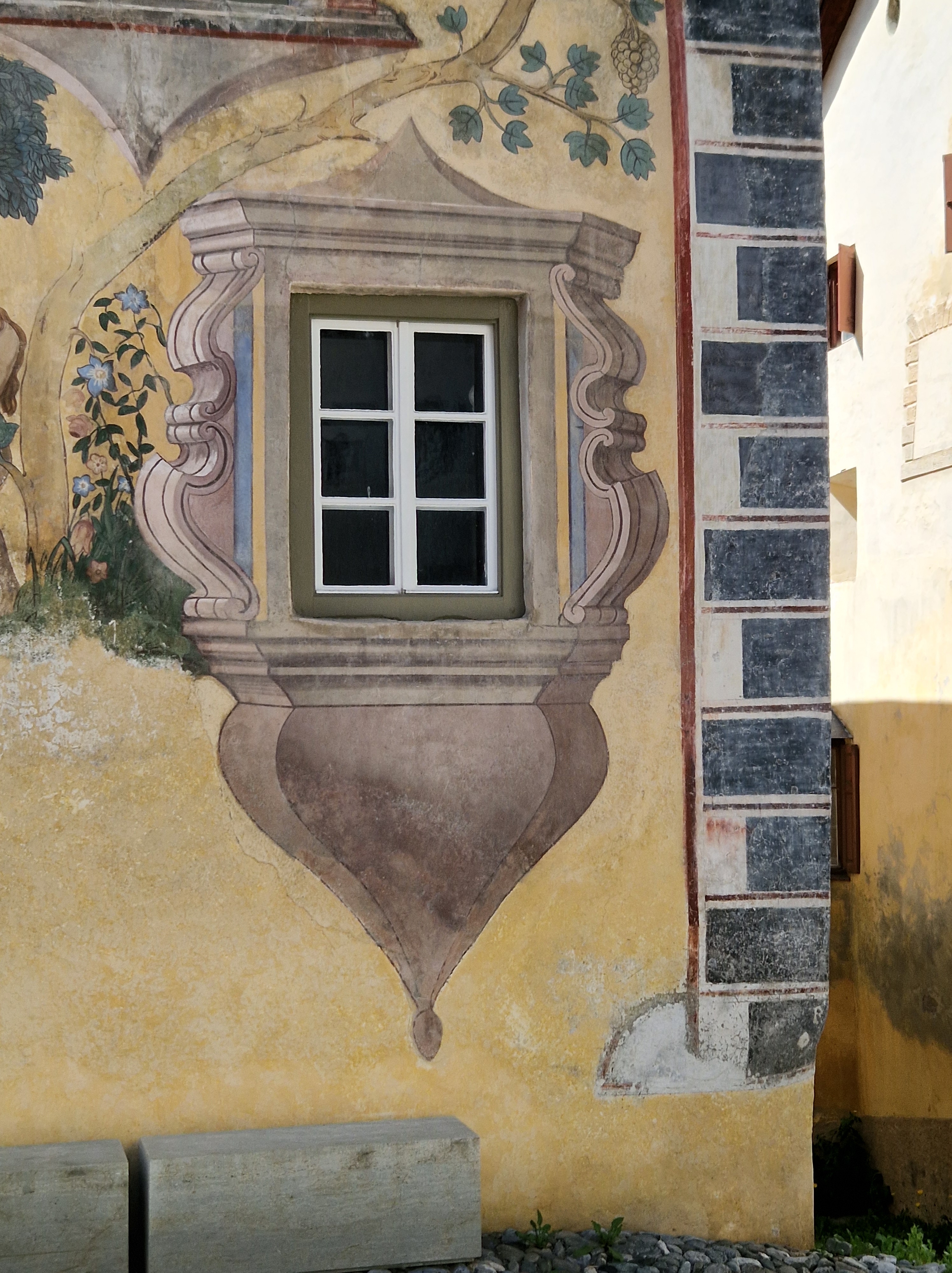
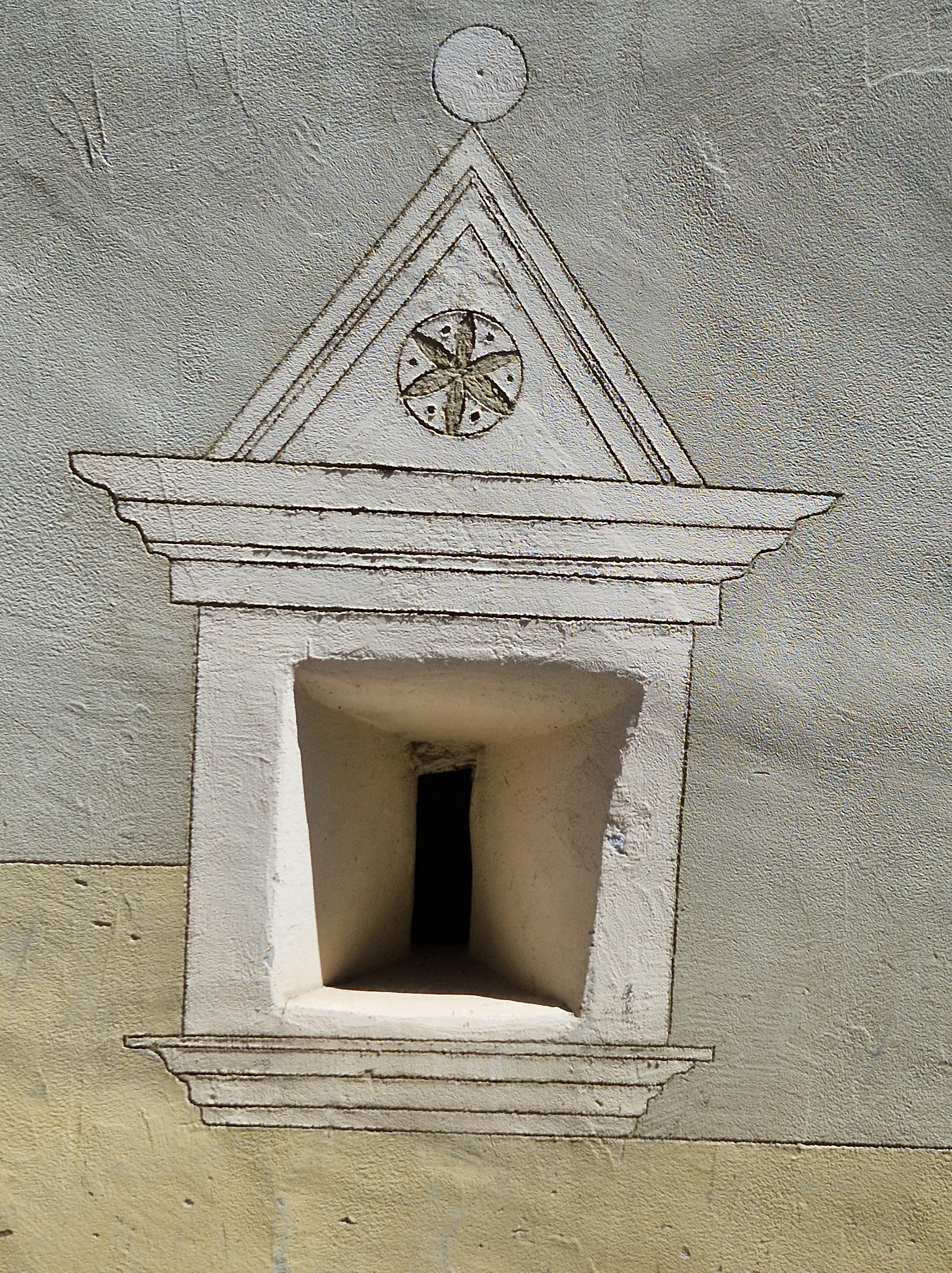
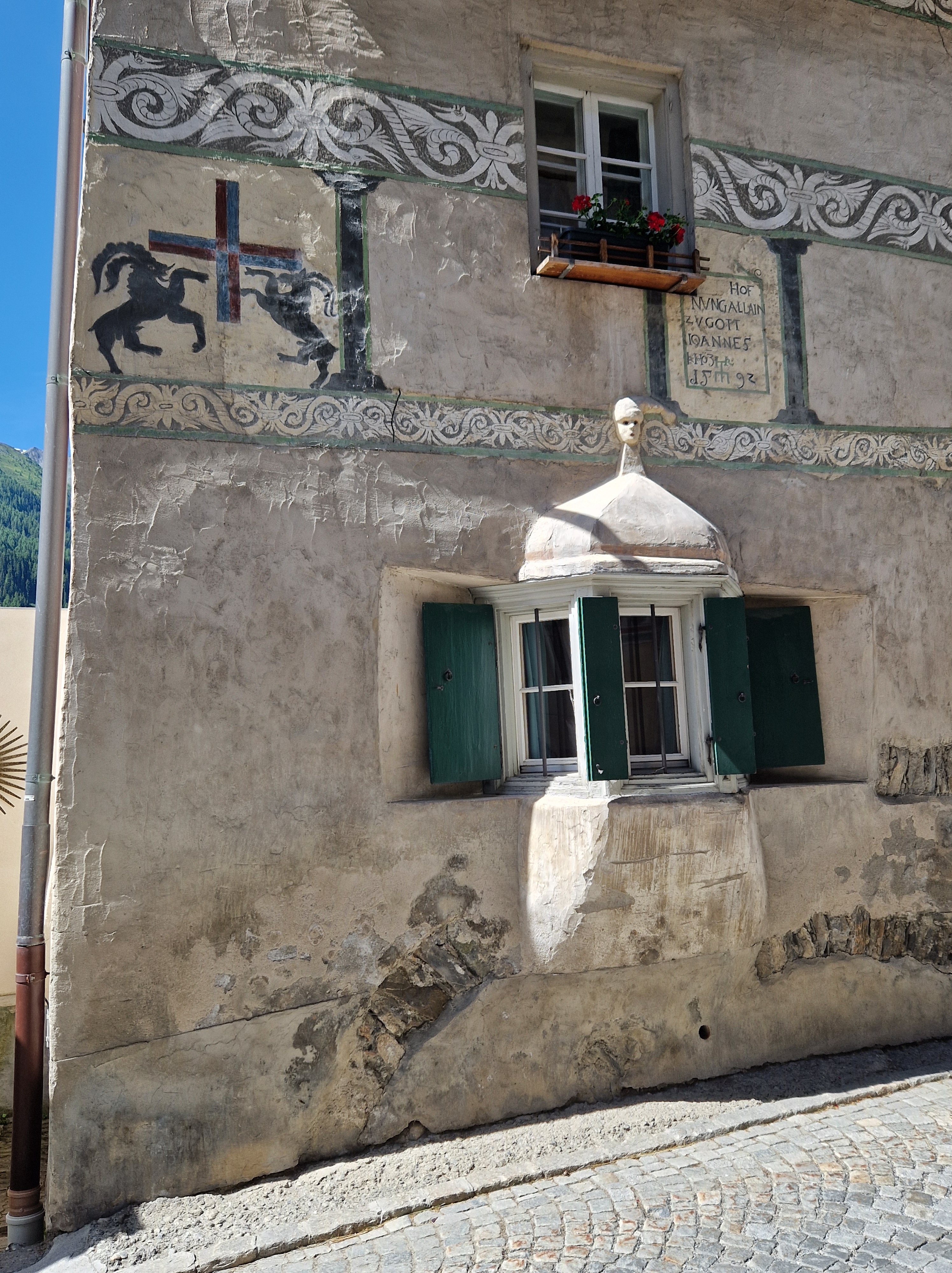
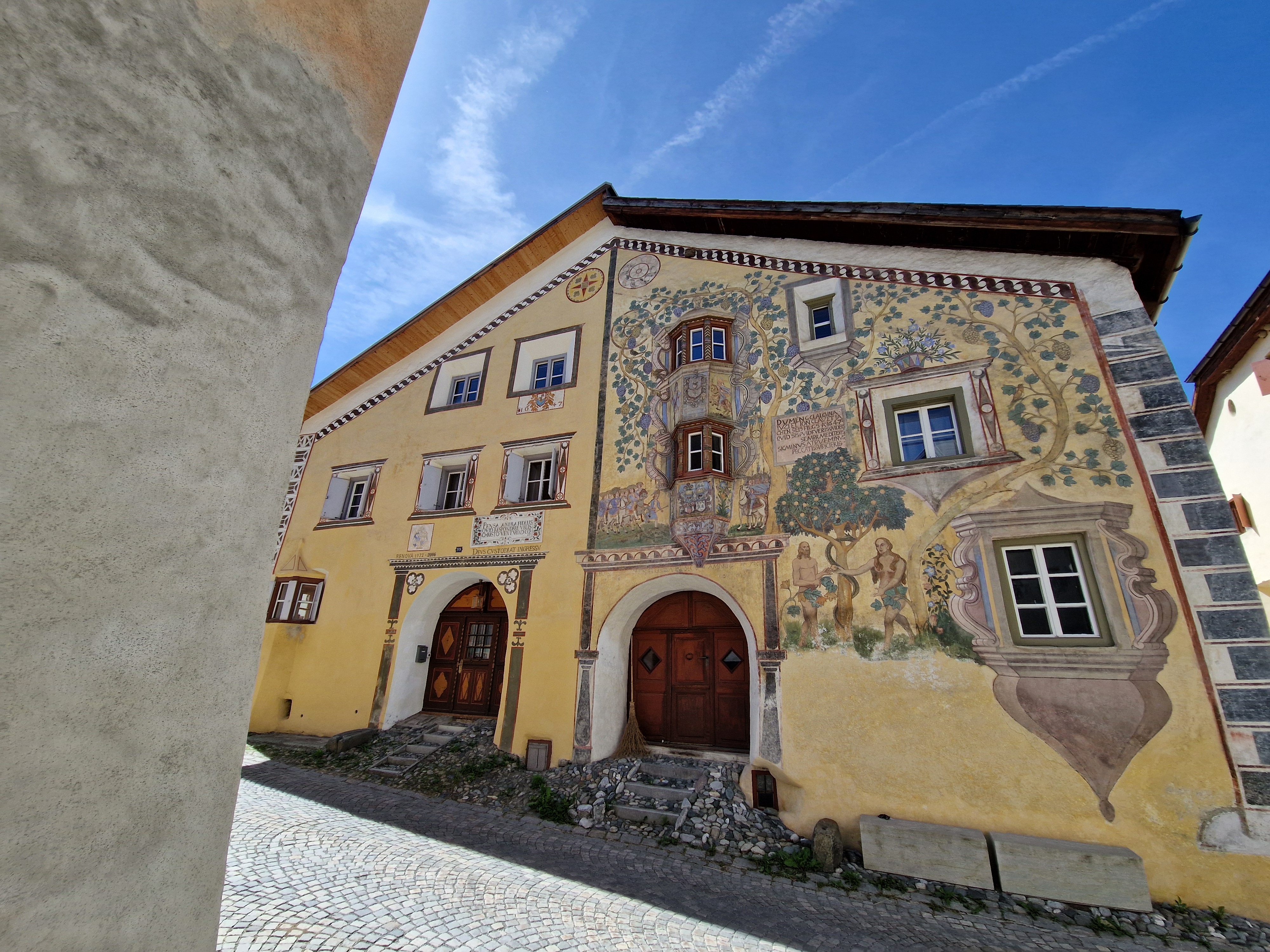
The second word, Sgraffito, describes a plaster technique that is traditional throughout Engadin: Layers of plaster of contrasting colours are scratched through, creating intricate designs on the facades of buildings (many of the buildings in Engadin towns were built (or rebuilt) in the late 1500s to early 1600s). The word comes from the Italian graffiare, which means to scratch; it can be traced back to the Greek word graphein, meaning to write (from which we also get any words containing the prefix, suffix, or derivative of graph (graphite, typography, graptolite, parallelogram, holograph, etc.). Sgraffito is not only used on buildings to make them look decorative, but it also serves the purpose of making a small feature look larger; on one building, the same floor had different-sized windows, likely installed over generations; the sgraffito was used to give a more uniform look to the façade. The decorations also make a plain building look grander, giving a more opulent impression. One building, pictured below, obviously had two occupants with very different characters back when they were originally decorated…

The basic technique for architectural features is to plaster the façade with the base colour; once that has set, it is then plastered with a contrasting colour; once that has set just enough, the scratching, or carving, begins. This is also a technique used in pottery and in creating stained glass effects (just click on the links if you’d like to see how these crafts are made).

One thing to note is that many old buildings here in Switzerland have dates listed on them: Of when they were originally built, and when they’ve been renovated. Part of the history of such renovations may include fires that swept through villages, or avalanches that buried a layer, or wars, such as the Swabian War and war against the Habsburgs, and the subsequent renovation or rebuilding of the towns or individual homes. Sometimes, along with the dates, a list of past and present occupants will also be displayed, preserving their names and memories within the history and changes of the building itself.

Below are a few pictures taken in Engadin during our recent summer holidays. Enjoy! Feel free to zoom in on the pictures to see the details.

5 Comments

Filed under Articles, Etymology, History, History Undusted, How It's Made, Liguistics, Links to External Articles, Military History, Snapshots in History, YouTube Link

The Fascinating History Behind the Fraktur Typeface

Last Sunday at church, a friend filled an entire room with her late father’s books, setting up an impromptu book shop. I chose several books, most of which are in Fraktur typeface, known to some people as “Gothic” or “Old German”. I enjoy reading such books because they offer a snapshot of a cultural way of thinking. The books I chose were printed between 1877 and 1940. The latter date is significant, as you’ll soon see.

First of all, let’s clarify a few terms: Though many people think of font and typeface as interchangeable, in fact, they refer to two different aspects of a writing style. Typeface refers to a particular style of lettering (e.g. Times New Roman), while font refers to the variations within that style, such as size and weight (CAPS, bold, italic, etc.). Another term we know but may not fully understand is Serif: This refers to the small stroke or line attached to the larger stroke of a letter; an example would be an A with “feet” at the bottom of each down-stroke. Sans Serif simply means “without Serif”.

The first moveable-type printing press, designed by Johannes Gutenberg in Germany around 1440, was based on the ancient Roman design of a screw press used to press wine or oil, which in turn went on to be used to press designs into cloths. He was likely familiar with intaglio printing and may have done some work himself in copper engraving.  These designs and uses likely fermented in his inventor’s mind into what became the revolutionary turning point of literacy. Gutenberg’s original typeface was called Donatus-Kalender; the metal type design was itself a form of Textura (more on that in a moment).

Donatus Kalender
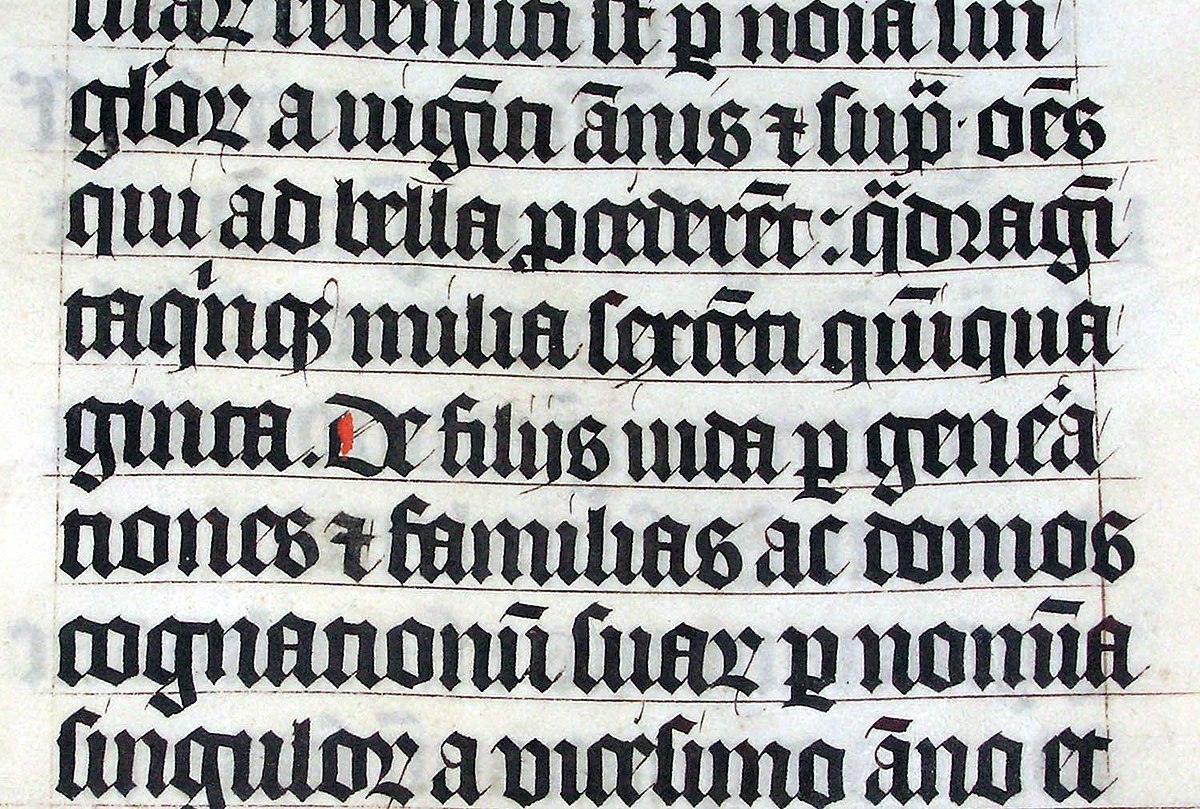
Example of Blackletter (Source: Wikipedia)

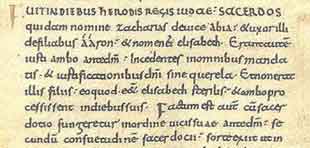
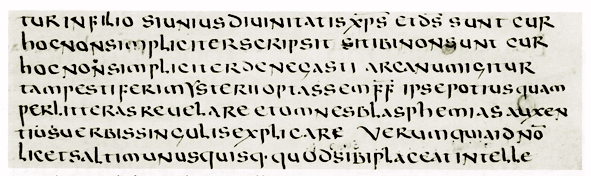
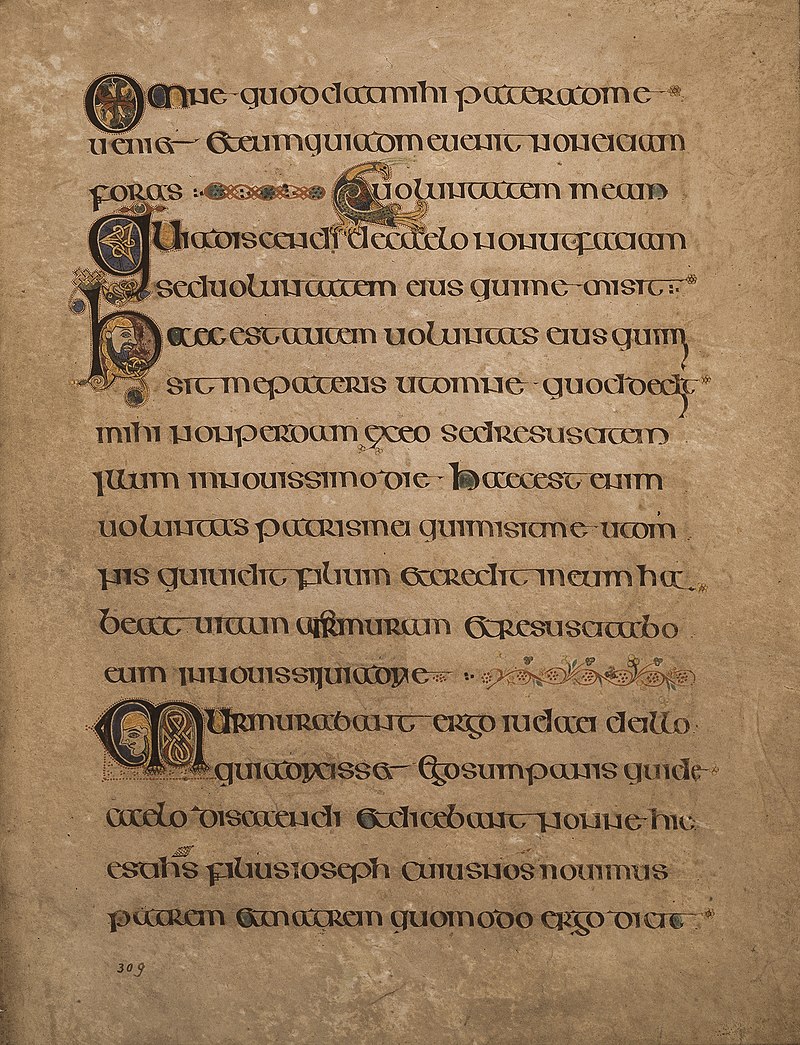
This original family of typefaces was known as “Blackletter”, aka “Gothic scripts”, with the height of popularity peaking around the 14th to 15th centuries. The ancestor of the Blackletter was called the Carolingian minuscule, a calligraphic standard of handwriting widely used in the medieval period, when literacy began increasing and a need for books in a wide range of subjects began to be in demand. It is thought to have been developed in the mid-770s by Benedictine monks north of Paris in the Corbie Abbey, famous for its scriptorium and library. The minuscule itself was derived from Roman Uncial as well as Irish Insular script, which was developed in Irish monasteries and spread throughout Europe.

Carolingian Minuscule
Roman Uncial
From the Book of Kells, an example of the Irish Insular script

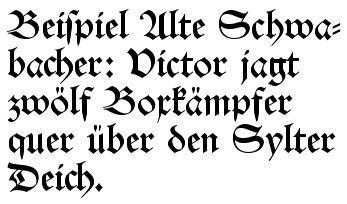
The family of Blackletter typefaces included Early Gothic, which was a transitional script between the Carolingian miniscule and Textura (the most calligraphic form of Blackletter); Schwabacher was a form popular in early German print typefaces (it became widely known with the spread of Luther Bibles from 1522), in use from the 15th century until it was eventually replaced by Fraktur around 1530, though it was still used alongside Fraktur for emphasis, much like we use bold or italic today.

Schwabacher Typeface
Textura Typeface

Another blackletter typeface developed between 1470 and 1600: Antiqua. This typeface’s letters were designed to look like the handwriting of ancient Roman documents, with the letters flowing together, strokes connecting them in a continuous line, whereas Fraktur was distinguished by having letters “fractured” – separate from one another. The Antiqua-Fraktur Dispute deserves its own article, so stay tuned!

Antiqua Typeface (Source: Wikipedia)
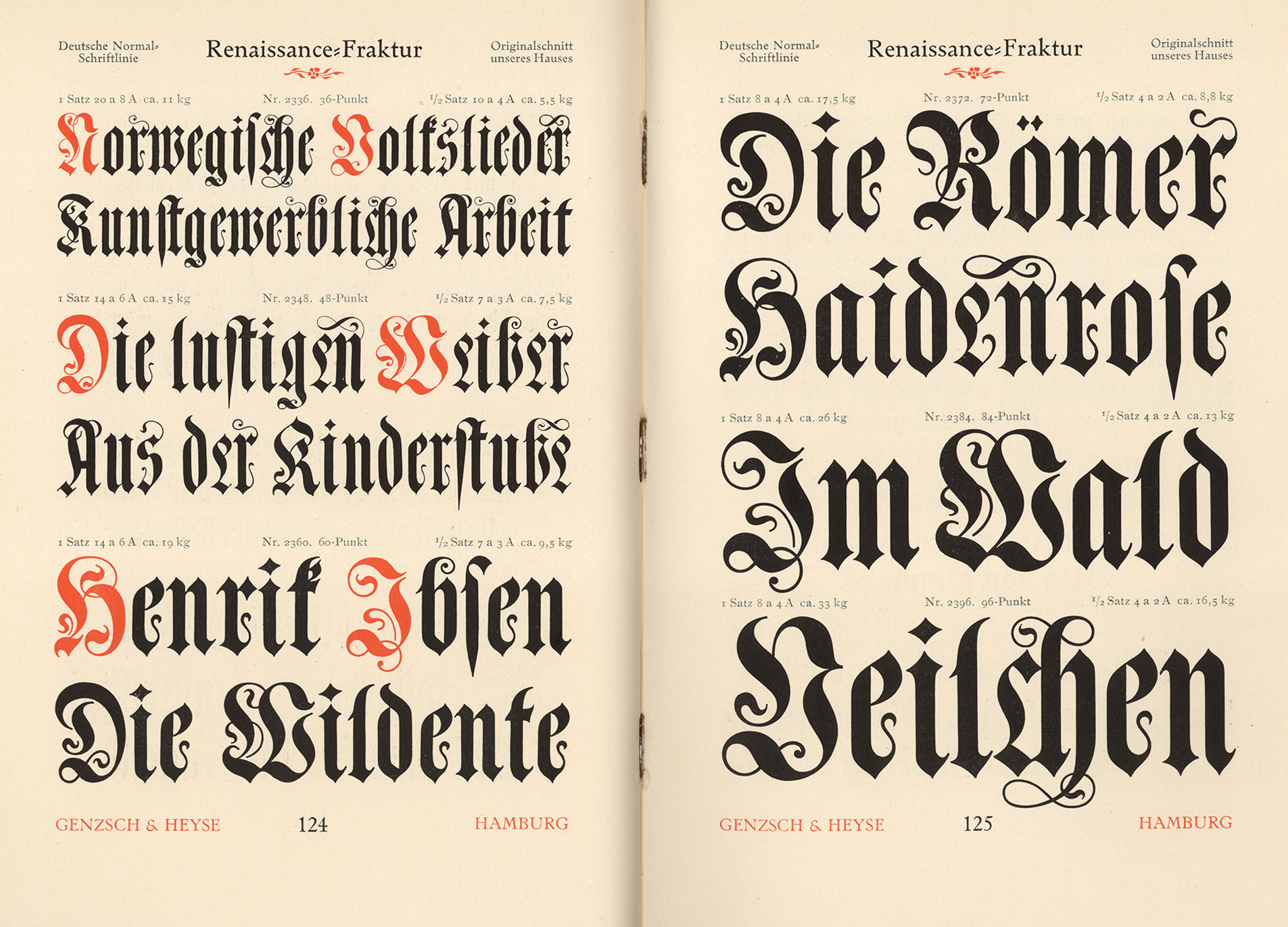
Fraktur Typeface (Source: Fonts in Use)

The Habsburg Emperor Maximillian I (1459-1519) was King of the Romans* from 1486 to 1519 [the title of king was used by the kings of East Francia, the territory later referred to as the Kingdom of Germany, from the time of Henry II (1002) to Joseph II (1764)]. The king commissioned the artist Albrecht Dürer to create a series of woodcut engravings of the Triumphal Arch [Though many are familiar with the Arc de Triomphe in Paris, it is only one example of this ancient Roman architectural feature used as a free-standing structure (rather than the Greek version, which was used within a structure such as a temple).]. These engravings would be used to create what we would recognize today as essentially wallpaper, though its purpose was more of a statement of power or propaganda (read personal marketing) commemorating his nobility, generosity, and military conquests – an incongruous combination, if you ask those conquered… The final composite of printed papers stood nearly 3 metres (12 feet) high and was only one part of a series of three enormous prints commissioned by the king.

Albrecht Dürer’s The Triumphal Arch, for Maximilian I

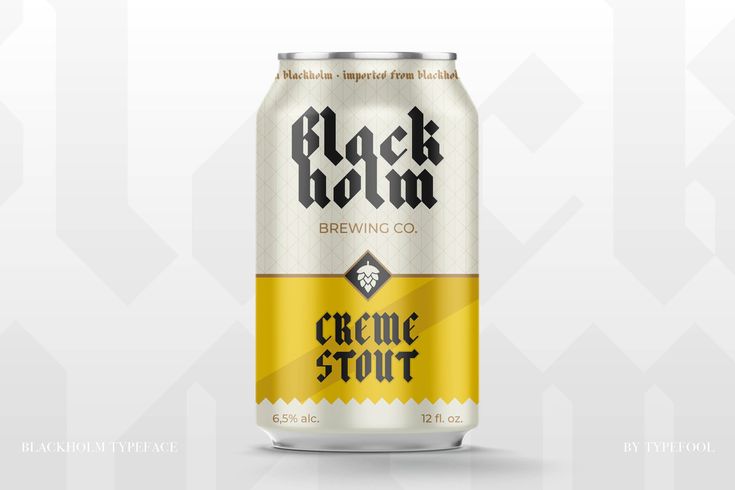
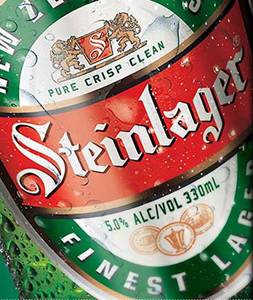
 The Fraktur typeface was designed in the 1530s by Hieronymus Andreae, a German woodblock cutter, printer, publisher, and typographer closely connected to Albrecht Dürer. The typeface was made to decorate the arch, telling the stories of the figures depicted throughout. The typeface became popular in Europe and was in use in the German-speaking world, as well as areas under its influence (Scandinavia, Central Europe, and some eastern European regions), into the 20th century. Specifically, Fraktur was in use in German until 1941, when it was actually banned (which places one of the books I purchased on Sunday within one year of the end of the era of Fraktur!). The atmosphere that led to that ban arose from the dispute mentioned above. Once the Nazis were defeated, the ban was lifted, but Fraktur never regained its widespread popularity after that, though you can still see it occasionally in pub signs or various forms of ads, like beer brands.

I just pulled two books from my library shelves: One is an English book originally printed in 1895, with my book being printed in 1915; the other is a German book printed in 1892. The typefaces are widely different: The English text likely used the French Oldstyle, while the German book uses Renaissance Fraktur for the text body, while the end pages act as indexes and use a variety of blackletter typefaces, such as Muenchner Fraktur, Antike Kanzlei, and Enge verzierte Altdeutsch. To see examples of the typefaces mentioned here, please click on the link for Fonts In Use.

I hope you enjoyed this jaunt through history! Nearly every name mentioned, every typeface, and every event deserves its own undusting. Next time, we’ll deep-dive into the dispute that lasted well over a century!

3 Comments

Filed under Articles, Etymology, History, History Undusted, Humanity Highlights, Images, Liguistics, Linguistics, Links to External Articles, Military History, Signs, Snapshots in History

Tasteful History: Hot Cross Buns

This “History Undusted” has a tasty twist: I’ll dive into the history behind this food popular throughout the English-speaking world and Commonwealth nations, and then I’ll include a recipe if you’d like to try it yourself.

Pompei Bread, AD 79

Hot Cross Buns can be traced back to the medieval period, though scoring the top of breads has been practised for thousands of years; a bread, found in the ashes of the volcanic eruption that wiped out Pompei, shows scoring – likely to make the portioning of the loaf easier; it’s a precursor to the sliced bread we know today. Early Hot Cross Buns used this knife-scoring; the version we recognize today was first introduced in 1361 by Brother Thomas Rocliffe, an English monk at St Alban’s Abbey, who made what he called the Saint Alban’s Bun; he distributed the baked goods to the poor and pilgrims on Good Friday. Many foods can be traced back to a specific holiday: For instance, when you think of a Christmas meal, wherever you are in the world that celebrates Christmas, specific combinations of dishes come to mind that you probably don’t eat at any other time of the year.

During the medieval period, the crossed buns would be hung from the rafters of houses for an entire year, believing that they would ward off evil spirits. During the 1600s, the Puritans put an end to that practice, and Queen Elizabeth I even banned the sweet breads, consigning them to consumption on Good Friday, Christmas, or at funerals (bad luck for the deceased, who missed the excuse for the treat). By the 18th century, it had become firmly associated with Good Friday. To give you a taste of history, click here to watch a short video from the York Castle Museum.

Today, all kinds of versions are on the market year-round, from the traditional, to chocolate, to Cheddar cheese and marmite.

So, without further ado, here’s a traditional recipe you can recreate for yourself.

Hot Cross Buns

To watch this recipe’s creation, click here. Below, I’ve listed out the ingredients and basic instructions, as used in this video by Chef Jack Ovens.

1½ C. (375 ml.) whole milk – heat the milk until just warm on the stove or in the microwave on short bursts, until around 104°F/40°C.

In a mixing bowl, add 1 Tbs./9gr. Dry yeast & 2 tsp. out of ½ C. sugar (the rest will be used later); pour in the warm milk and whisk until combined. Set it aside for 10 minutes to allow the yeast to feed off of the sugar. A froth will form, which means the yeast is active.

Add in 4 ¼ C. (640 gr.) bread flour

the rest of the ½ C. sugar

1½ C. sultanas (raisins) (you could substitute ¼ C. with candied orange for the traditional version)

2 tsp. ground cinnamon

2 tsp. ground allspice (cloves, for the traditional version)

The zest of 1 large orange

1 egg, beaten

50 gr. melted, cooled unsalted butter

¾ tsp. sea salt

Mix all of this until thoroughly combined – either using a mixer with a dough hook, or by hand.

Dust your workspace with flour, turn the dough out and knead for 8-10 minutes. Shape it into a smooth ball. In a greased mixing bowl, place the dough and cover with a warm, damp tea towel and allow to proof for 1 hour, or until doubled in size. When it’s risen, punch the dough a few times to remove the air; dust your workspace with flour and tip out the dough. Knead the dough to remove any air bubbles, then shape it into a log around 60 cm / 23 inches long. Slice that in half, then roll each section to a log to 40 cm / 15 inches long.

Slice each half into 6 even pieces; form each into a ball, tucking the edges underneath.

Line a deep-sided baking tray with parchment/baking paper, and lay your balls of dough in rows of 3 by 4. Cover with an oiled piece of plastic wrap to allow the buns to rise without sticking to a towel. Allow to proof for 40 minutes.

While it’s proofing this final time, preheat your oven to 180°C/350°F

To make the dough for the crosses:

½ C. /70 gr. bread flour

95 ml. cold water

Whisk these together until it forms a piping paste.

In either a piping bag with a 3mm nozzle or in a plastic bag with the corner snipped off, spoon in the dough and pipe it across the rows of buns, making sure to cover to the edges of the buns.

Bake for 20-22 minutes, rotating the tray halfway through. A few minutes before the buns are done, in a small bowl, mix:

½ C. / 110 gr. caster sugar

150 ml. boiling water

Mix with a pastry brush until the sugar is dissolved. Remove the buns from the oven and glaze them with the sugar water – just enough to cover each. This will give a nice crunch to the crust of the bun. Allow them to sit in the tray for a few minutes, then transfer to a wire rack. Slice, butter, and enjoy!

Leave a comment

Filed under Food History, History, History Undusted, Snapshots in History, YouTube Link

History Undusted: 15 January

Unless you’ve been busier than I‘ve been, you’ll have realized that half of January 2025 is already gone. The end of 2024 was crazy busy, and after the dust of the Christmas holidays settled, life was about getting caught up with all of those little things that had been neglected for a couple of months.

I’ve thought about how I want to go forward with this blog in the coming year; I enjoy having this platform to dive into topics I might not otherwise encounter in my day-to-day life, but life in the real world has many facets that keep me busy, too. I’ve decided to post roughly once per fortnight, giving me time to live, write/edit/publish, and research topics of interest. I’ve always tried to write quality above quantity, and I want to share things that interest me, grab my imagination, or give me a good laugh. If you feel the same, sit back and enjoy the ride!

Since this is mid-January, let’s take a look at some of the highlights of history on this day, the 15th of January:

1541: A commission to settle New France (Canada) was granted by King Francis I of France.

1559: Queen Elizabeth I was crowned Queen of England in Westminster Abbey, London.

1759: The British Museum opened to the public for the first time.

1777: In the American Revolutionary War, New Connecticut (Vermont) declares its independence.

1782 – The U.S. Congress was petitioned to establish a national mint and decimal coinage.

1870 – For the first time, a political cartoon symbolizes the Democratic Party with a donkey (“A Live Jackass Kicking a Dead Lion” by Thomas Nast for Harper’s Weekly).

1889 – The Pemberton Medicine Company (later to become known as the Coca-Cola Company) is incorporated in Atlanta.

1908 – The Alpha Kappa Alpha sorority becomes the first Greek-letter organization founded and established by African American college women.

1919 – Great Molasses Flood (a wave of molasses ejected from an exploding storage tank) sweeps through Boston, Massachusetts.

1943 – The Pentagon is dedicated in Arlington County, Virginia.

2001 – Wikipedia, a free Wiki content encyclopedia, is launched (Wikipedia Day).

2009 – US Airways Flight 1549 ditches safely in the Hudson River after the plane collides with birds less than two minutes after take-off. This became known as “The Miracle on the Hudson” as all 155 people on board were rescued. This story was adapted for the “Sully” film in 2016.

2015 – The Swiss National Bank abandons the cap on the Swiss franc’s value relative to the euro, causing turmoil in international financial markets.

2022 – The Hunga Tonga-Hunga Haʻapai volcano erupts, cutting off communications with Tonga and causing a tsunami across the Pacific. It was the largest volcanic eruption since the 1991 eruption of Mt. Pinatubo (Philippines).

Which of these events do you find most interesting? Please comment below and let us know! For me personally, it’s the opening of the British Museum. What was it like back in 1759, and how has it evolved into the massive collection it is today? I’ve been there a few times, but I have yet to see it all!

This is AI’s interpretation of “ancient scroll rolled up”. No idea where the man came into that result, but his longsuffering expression is apt!

3 Comments

Filed under Articles, History, History Undusted, Lists, Military History, Snapshots in History

History Undusted: The Great Vowel Shift

My husband and I were having lunch recently, and a package of Swedish crackers was on the table; I pointed to the brand name, Pågen. In English, our pronunciation of these vowels would lead us to say pagan /pæg-in/, whereas the Swedish would rather be more like /po-gen/. I just mentioned that English might have sounded similar to that before the Great Vowel Shift, which he’d never heard of (being Swiss, it’s not likely he would be familiar with this aspect of English etymology), so I promised to write a blog about it; here we go!

The term Great Vowel Shift was coined by the Danish linguist, Otto Jespersen (1860-1943), who specialised in the English language. Though the GVS is considered a single event (because of the changes being viewed as part of a chain reaction, with each vowel sound changing in a predictable way), the actual transition of English pronunciation was gradual, taking place over about 200 years, from ~1400 to ~1600. The shift began in Middle English, which was spoken from 1066 until the late 15th century – that form familiar to Geoffrey Chaucer (though his pronunciation would be unintelligible to us, his words still survive through his famous Canterbury Tales) – into Early Modern English (from the beginning of the Tudor period through to the Stuart Restoration period); Shakespeare would have been familiar with it. From there, English transitioned into Modern English in the mid-to-late 17th Century.

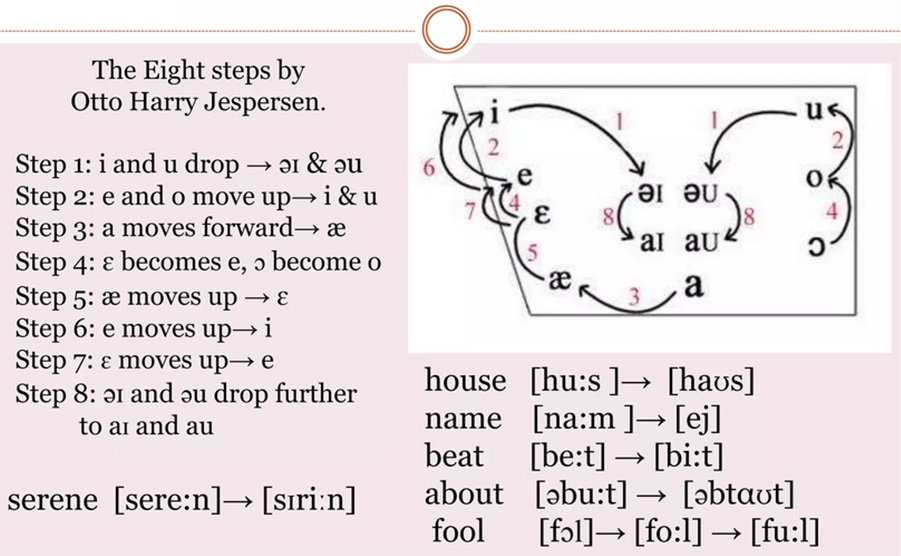
The main changes were that, from Middle to Early Modern English, the long vowels shortened; weef became wife, moos* became mice, beet became bite, and so on. (*The word moose entered English through Native American languages in 1610). I will also mention that in Scottish, a lot of the older vowel pronunciations still exist; house is still huus, full is homophonous with fool, etc.

Here’s a look at just how the English vowels shifted:

Source: SlideShare

If you’ve been paying any sort of attention to English, you’ll know that our spelling is a bit chaotic; the language is full of homonyms, which are divided into either homophones (words that sound the same but have different spellings, e.g. beet and beat; bear and bare; to, too and two), or homographs (two words with differing meanings, same spellings, but not necessarily the same pronunciation: e.g. bank [of river; finance] or agape [with mouth open; love], or entrance [a way inside; to delight]) or tear [ripping; crying]. These -graphs and -phones came into English from regional dialects that were transported as migration and cultural mixing took place, and the GVS added its two pennies to the mix. Just think of the variety we have in the sounds /ea/ (bread, beat, bear, break); /oo/ (look, spool, blood); or /gh/ (through, cough, sight).

Certain factors contributed to the speed of language shift: The Black Death (1346-1353) wiped out up to 50% of Europe’s population. Stop a minute and let that sink in. What if the population of your town were reduced by half? And the next town, and the next. That single event changed the course of history on many levels; surfs could finally demand better wages wherever they ended up settling; if you lived in a town that no longer had the skills of a baker, blacksmith, or any other trade you’d depended on, you’d move to where those services existed – and jobs existed – and that meant places that had been hit the hardest by the plague and thus where everyone else was migrating, such as London. As mass movement followed the epidemic, people brought their dialects and their spellings with them. It began to converge into a new, distinct way of speaking, thinking and spelling. The geopolitical climate of the time also influenced English; England and France have been annoying each other for over a thousand years; whenever England was enamoured by all things French, they tried to emulate their pronunciations. That influence came and went; in one such moment, the pilgrims set sail for America (1620), taking a time capsule of the language with them, while England’s English continued to be influenced by French up until the French Revolution, when it quickly fell out of favour in England, though the changes had already taken place (one example is the American /k/ in schedule, closer to the original Latin, while the English say /sch/ without the /k/, which is closer to the French cedule). This factor of influence also affected differences of speech between the lower class and upper class at that time; the upper class wanted to sound more posh, more fashionable, and above all, not like the lower class.

A major contributing factor to our chaotic spelling is that ca. 1440, the Gutenberg printing technique was introduced, and by the 1470s, William Caxton had imported the invention to England; we have him to thank for Chaucer’s Canterbury Tales being known today, as that was the first book he printed in England. We also have him to thank for the influence of Chancery English (the English used by the secretariat of King Henry VI) in the standardization of the language, as he used it as his own guidelines in printing. The vowels had already begun to shift by that time; enter the written word, a rise in literacy, and you have the jumbled effects of “mid-shift” on English spelling – people began to adapt their pronunciation to the written word, so whichever form the printer used is the one that began to prevail, even though some sounds were still in transition. Like nailing down jelly. You could say that many of our odd spellings are simply a snapshot in time.

It is also important to point out that the GVS didn’t have the same influence everywhere: The main changes occurred around London, but the farther away you move from that epicentre, the less the effects on the local dialects, which still holds true today – though gradual merging has allowed people from, say, Cornwall, to understand people from Yorkshire – which wouldn’t have been the case centuries ago. Even though they can understand each other, their dialects are still distinct. I’ve already mentioned that Scots English (as opposed to Gaelic) still retains many of the longer vowels long since lost in standardized English; being so far from London, they simply ignored them. English may be taught in their schools, but Scots dialects prevail in the home and hearth. Regional dialects in English exist the world over, and though spelling and pronunciation may differ from region to region, and the language continues to be a living, breathing, growing and changing being, it’s still a language that enables the modern world to communicate, whether English is their mother tongue or not.

3 Comments

Filed under Articles, Etymology, Grammar, History, History Undusted, Liguistics, Linguistics, Snapshots in History

Comprehensive Examination

Recently, my office got an upgrade, my “office” being in our home library. I got a larger desk, and in the process of moving the old out and the new in, I took the opportunity to do a bit of “house cleaning” – sorting through papers, a notebook full of articles, and bits and bobs I’d kept over the years for teaching English to adults (I was an active EFLA teacher for more years than I care to calculate!). One of the papers I came across was the following; I knew I needed to share it because it always gives me and my husband a good laugh. I don’t know who originally wrote this, but it’s genius!

Comprehensive Examination

Instructions: Read each question carefully. Answer all questions. Time limit: 4 hours.  Begin immediately.

HISTORY: Describe the history of the papacy from its origins to the present day, concentrating especially but not exclusively, on its social, political, economic, religious and philosophical impact on Europe, Asia, America and Africa. Be brief, concise and specific.

MEDICINE: You have been provided with a razor blade, a piece of gauze and a bottle of scotch. Remove your appendix. Do not suture until your work has been inspected. You have fifteen minutes.

PUBLIC SPEAKING: 2,500 riot-crazed Aborigines are storming the classroom. Calm them. You may use any ancient language except Latin or Greek.

BIOLOGY: Create life. Estimate the differences in subsequent human culture if this form of life had developed 500 million years earlier, with special attention to its probable effect on the English parliamentary system. Prove your thesis.

MUSIC: Write a piano concerto. Orchestrate and perform it with flute and drum. You will find a piano under your seat.

PSYCHOLOGY: Based on your knowledge of their works, evaluate the emotional stability, degree of adjustment and repressed frustrations of each of the following: Alexander of Aphrodisias, Ramses II, Gregory of Nicea, Hammurabi. Support your evaluation with quotations from each man’s work, making appropriate references. It is not necessary to translate.

SOCIOLOGY: Estimate the sociological problems which might accompany the end of the world. Construct an experiment to test your theory.

MANAGEMENT SCIENCE: Define management. Define Science. How do they relate?

COMPUTER SCIENCE: Create a generalized algorithm to optimize all managerial decisions, assuming an 1130 CPU supporting 50 terminals, each terminal to activate your algorithm; design the communications interface and all necessary control programs.

ENGINEERING: The disassembled parts of a high-powered rifle have been placed in a box on your desk. You will also find an instruction manual, printed in Swahili. In ten minutes a hungry Bengal tiger will be admitted to the room. Take whatever action you feel appropriate. Be prepared to justify your decision.

ECONOMICS: Develop a realistic plan for refinancing the national debt. Trace the possible effects of your plan in the following areas: Cubism, the Donatist controversy, and the wave theory of light. Outline a method for preventing any negative effects. Criticize this method from all possible points of view. Point out the deficiencies in your point of view, as demonstrated in your answer to the last question.

POLITICAL SCIENCE: There is a red phone on the desk beside you. Start World War III. Report at length on its socio-political effects, if any.

EPISTEMOLOGY: Take a position for or against the truth. Prove the validity of your position.

PHYSICS: Explain the nature of matter. Include in your answer an evaluation of the impact of the development of any other kind of thought.

PHILOSOPHY: Sketch the development of human thought; estimate its significance. Compare this with the development of any other kind of thought.

GENERAL KNOWLEDGE: Describe in detail. Be objective and specific.

EXTRA CREDIT: Define the universe; give three examples.

7 Comments

Filed under Humor, Just for Fun, Lists, Writing Exercise

History Undusted – The Tactile Language of the Quipu

Throughout history, languages have come and gone; an estimated 30,000 have existed at some point in time, though currently, there are roughly 6,000 to 7,000 languages in use – and most are threatened with extinction. Think about that. The impact on the loss of cultural history, connection to ways of thinking, ways of communicating, and ways of processing information; senses of humour, and national heritages will be lost.

An example of a language nearly lost, but which is now familiar to most of us by sight, is the logogram language of Egyptian hieroglyphs. The knowledge of how to interpret the symbols had been lost for centuries, until 1799, when a stone was found near Rosetta, along the Nile Delta in Egypt; the stone was a stele with a decree issued in 196 BC; the texts carved into the stone were Ancient Egyptian (“demotic” text), hieroglyphs, and Ancient Greek. Because Greek was a known language, they could use the Rosetta stone to decipher the forgotten languages.

When we think of writing, we may think of various alphabets: Greek, Roman (of which English makes use), Norse Runes, or the logographic or ideographic languages of Asia, such as Chinese or Japanese, or the cuneiform writing of the Ancient Near East. But did you know that there have been languages based on string?

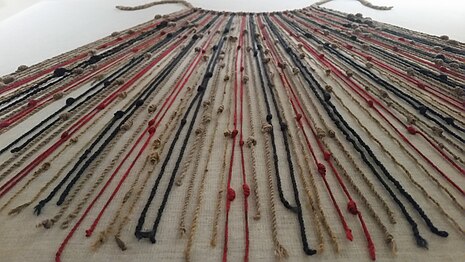
Quipu in the Museo Machu Picchu, Casa Concha, Cusco. Source: Wikipedia

The Inca people, in the region of modern Peru and Chile, used knots on an elaborate system of connected strings or cords for collecting data, keeping records, recording taxes or census records, making calendars, or for military organisation. When the Spanish Conquistadors swept through, they found numerous bundles of strings, but had no idea of their significance; they destroyed many of the quipu*, not realizing that they might have held in their hands a record of an individual’s wealth in animals or crops. [*Quipu is the Spanish spelling used in English; it is also spelled khipu or kipu.] Other cultures have also used similar concepts with knotted strings to record information, unrelated to South America; these include China, Japan, Taiwan New Zealand, Hawaii, and other parts of Polynesia.

As with most textiles, they unfortunately didn’t stand the test of time very well, and only a fraction remains today. The ancient world may have taken the concept of the quipu one step further in creating the more flexible abacus, though the latter was (and is still) used for temporary calculations, while the former was rather for recording information. Whether or not there is a historical link, both are visual tools that can be used for similar functions to a certain extent.

Even with such widespread use of these knotting records, their meaning was nearly lost, until a Harvard student, Manny Madrano, had time on his hands one summer and solved a centuries-old mystery!

For an interesting video on this topic, please click here. I hope you’ve learned something! Keep being curious about our fascinating world!

6 Comments

Filed under Etymology, History, History Undusted, Liguistics, Science & Technology, YouTube Link

Insatiable Fascination

Throughout history, people have always been fascinated by thinking beyond their own known world; before widespread writing and reading, ancient cultures thought about their own mortality (which, in some ages, wasn’t that far off) and the afterlife. Various cultures prepared for the afterlife in their own ways: The Egyptians removed organs and embalmed the rest, making sure to send on the heart & co. in separate jars (except the brain – who’d need that in the next world?), then sent them on their way with an army of servants (killed for the occasion); the Vikings buried their most honoured dead within a ship with their favourite animals and servants (ditto). Other cultures built pyres to send their loved ones up in smoke.

When writing came along, at first it was used to capture the past and the natural world, ala Pliny the Elder; poems, sagas, verbal tales and folklore began to be recorded; we have such writings still with us today: The Greek Epic Cycle, the Orkneyinga Sagas, the Heimskringla, the Poetic Edda.

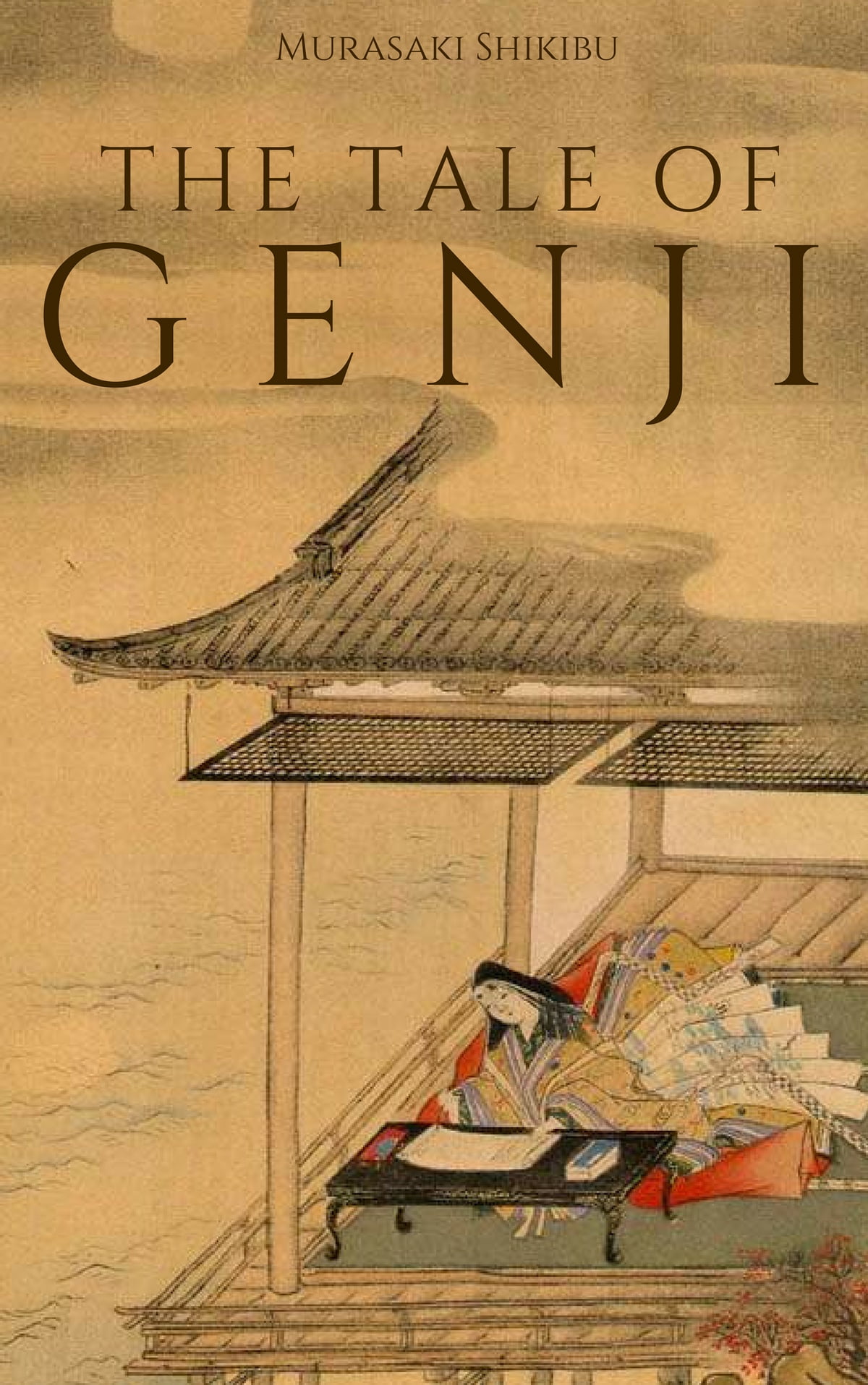
The first novel came along only 1,000 years ago: The Japanese epic The Tale of Genji was written by a woman, Murasaki Shikibu; novels were, for several centuries more, considered on the bottom rung of the literary hierarchy ladder, far behind “serious works” like history. Ironically, Mark Twain referred to history as “fluid prejudice”; it was nearly always recorded by powerful (white) men – hardly ever by a commoner, a member of an ethnic minority, or a woman. The interpretation of events was firmly in the hands of the conquerors. Because of that fact, for instance, we know more about Rome’s version of ancient Britons (Picts, Celts) than we do from their own artefacts; most Celtic and Pictish art is found outside of the UK – many carried off by the Vikings, but that’s another tale. Hollywood has helped perpetuate some of those ancient Roman notions (think of a blue-faced Mel Gibson in Braveheart).

In fact, we don’t even know what the Picts called themselves – the term derives from the Latin Picti, first seen in the writings of Eumenius in AD 297. It can be interpreted (dangerous words) as “to paint” – but there is no evidence that any people groups in northern Britannia painted themselves. Picts is simply a generic term for any people living north of the Forth-Clyde isthmus who fought the Roman Empire’s advancements into their territories. Again, the ink of history flowed from a Roman stylus.

Even Jane Austen herself didn’t begin publishing her novels under her own name. She was a single young woman – for shame that she would dare stain the male-hallowed ground of literature. The saga of how she got published speaks to her tenacity and the support of her family. But she got the last laugh, becoming famous within her (short) lifetime, and she is far better known today than any of the stuffy old men who wrote “proper” books of her day.

The insatiable fascination with other perspectives than our own explains why novels are so popular today. They take us into another time, place and situation, leading us through a story that, if written well, we can relate to and perhaps learn something from. In 1726, Jonathan Swift gave us Gulliver’s Travels. Though he originally wrote it as political satire, to “vex the world rather than divert it”, we know it still today. The fascination with someone being a giant in one land and a miniature in the next grabs our imagination; he travels to floating kingdoms, to an island of immortals, a la Death Becomes Her, and a land of talking horses.

Book Nook (Instagram repeat)

In the age of internet, visual arts have expanded as far as the global imagination can span: Not only paintings or drawings, but even crafts take us into another perspective. I recently saw a series of images in which people have taken the humble walnut shell and turned them into tiny worlds with bookshelves, ladders, lamps, beds and creatures. Book nooks are popular, too: A tiny village, street, or room within the space of a book on a shelf. Science fiction art takes us off-planet.

Films are visual perspectives that take us into other worlds, times and places: When George Lucas showed us a “commonplace” bar scene on Tatooine in the Mos Eisley Cantina in Star Wars, he blew our minds and kicked off a new era of visual storytelling. Avatar took us to another planet and another perception of reality, all the while being an allegorical tale of ecological care vs. abuse. Somewhere along the way, sometime in your life, I’ll bet you’ve been fascinated by a different perspective, whether presented to you through a book, a documentary, a sermon, a play, a film or a conversation.  What did you learn from that encounter? How did it change you, or help shape your perspective? And what is your favourite “escape”: Films, books, visual arts, or music? Please comment below!
8 Comments

Filed under Articles, History Undusted, Humanity Highlights, Images, Psychology Undusted

History Undusted: The Great Clock of Rouen, France

Last summer, my husband and I rented a privately-owned motorhome in Caen, France, and travelled around Normandy for 10 weather-perfect days. One of the places we had on our short list to see was the city of Rouen, a region with a long and rich history. One icon of the city is a clock. Not just any clock. The Great Clock of Rouen.

Rouen was a pivotal location in the Hundred Years’ War (1337-1453 – calling it the “Hundred-and-Sixteen Years’ War” is more accurate but not as catchy, though the name is likely based on the fact that there were periods of fragile truces); the central conflict was the English claim to the French throne. In the context of this war, Joan of Arc became a victim of male chauvinism and political expediency. But that’s another story.

The mechanism of this clock was built in 1389. Let’s put that into perspective: That’s over 100 years before Columbus set out to discover a western passage to the East Indies and inadvertently discovered America; Richard II took over as king of England; it was made during the Hundred Years’ War; Joan of Arc would have seen this clock on her way to her execution (by burning at the stake). It was made more than 190 years before our modern Gregorian calendar replaced the Julian calendar, in 1582.

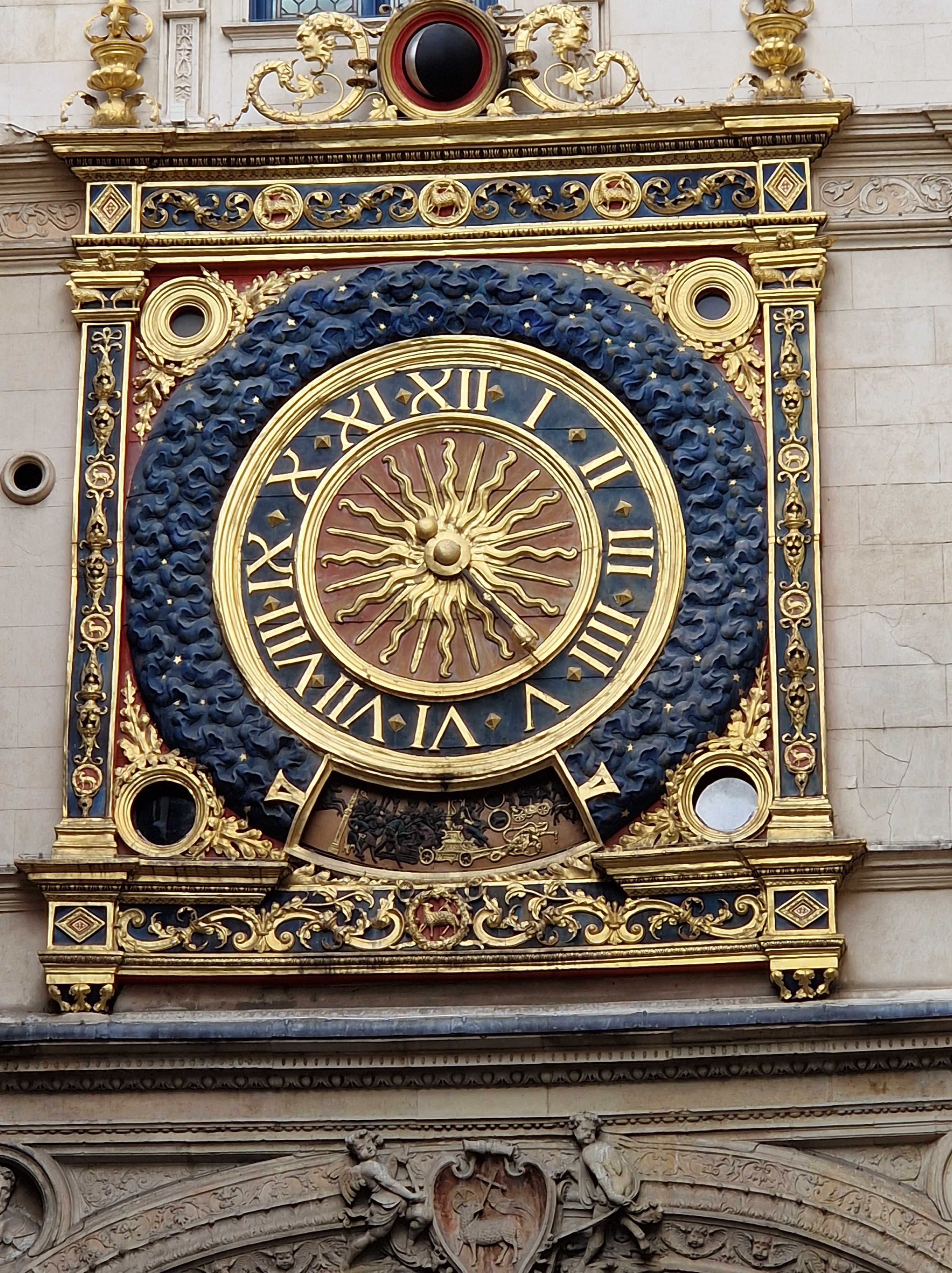
The mechanism deserved not only a grand position, but a grand façade: The Rouennais aldermen decided that the town needed a clock, and the construction of a tower to house the clock took 9 years; the architect was Jehan de Bayeux, though the tower was completed by his son in 1398. The original designer of the clock’s facades, Jordan Delettre, was no more (whether he died or was removed is unknown), and it was completed by Jean de Felain, who became the first “governor of the clock”, maintaining it in exchange for a home in the clock’s tower. Towers and wars came and went, and the clock survived; it was moved to its current location in 1410, now housed astride an ornately carved stone archway.

The clock faces (on both sides of a stone archway and connected to a central mechanism shared by both) are 2.5 metres (over 8 feet) in diameter, and each has only a single hand, tipped with the depiction of a lamb, which shows the hour; moon phases are indicated in the 30 cm oculus above the clock face, which makes a full rotation every 29 days. The face depicts 24 rays of the sun surrounded by a dark blue starry frame. A hand which shows the day of the week is located in an opening at the base of the dial, with each day represented by a different Greek god: Diane as the moon (Monday), Mars (Tuesday), Mercury (Wednesday), Jupiter (Thursday), Venus (Friday), Saturn (Saturday) and Apollo (Sunday).

Although the mechanism of the clock still works, it has been powered by electricity since 1928, and the tower itself was renovated in the late 1990s.

Underneath the clock in the centre of the archway, the coat of arms of Rouen can be seen: It depicts the Paschal lamb on a red background (the official colour of Rouen); it is held by two angels (if you look closely at the angel on the right, you’ll notice that its head is on wrong; it is thought to be due to disgruntled construction workers – obviously an age-old problem…). Beneath the arch are elaborate bas-reliefs of Jesus as the Good Shepherd caring for his flocks; the clock’s hand, the coat of arms and the reliefs all echo the importance of textile and wool trade to the city. One clock face alone has at least 15 sheep (zoom in on the picture of the clock and see if you can spot them all!). Next to the clock is a Gothic belfry tower built in the 14th and 15th centuries which houses the bells connected to the clock, which ring on the quarter-hour.

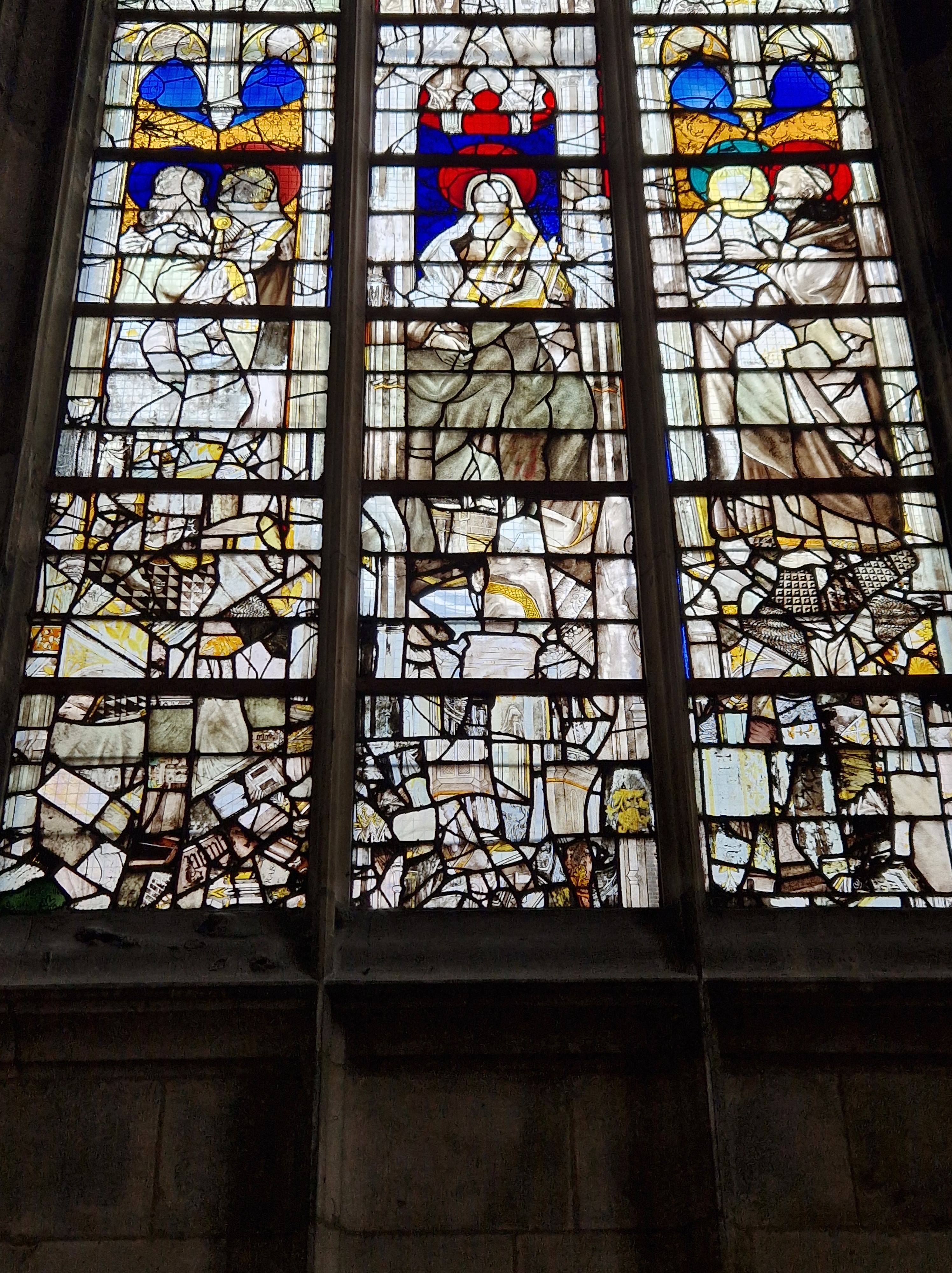
Rouen is a survivor: It has outlasted Viking raids that travelled up the Seine River, the Hundred Years’ War, the Religion Wars of the Renaissance period, the Franco-Prussian War of 1870, the French Revolution, and even World War 2; the latter damaged nearly half the city, and shrapnel and bullet scars can still be seen in façades. The cathedral’s stained-glass windows were shattered by a WW2 bomb and were subsequently reconstructed using the fragments, creating jumbled images that reflect its history and its survival.

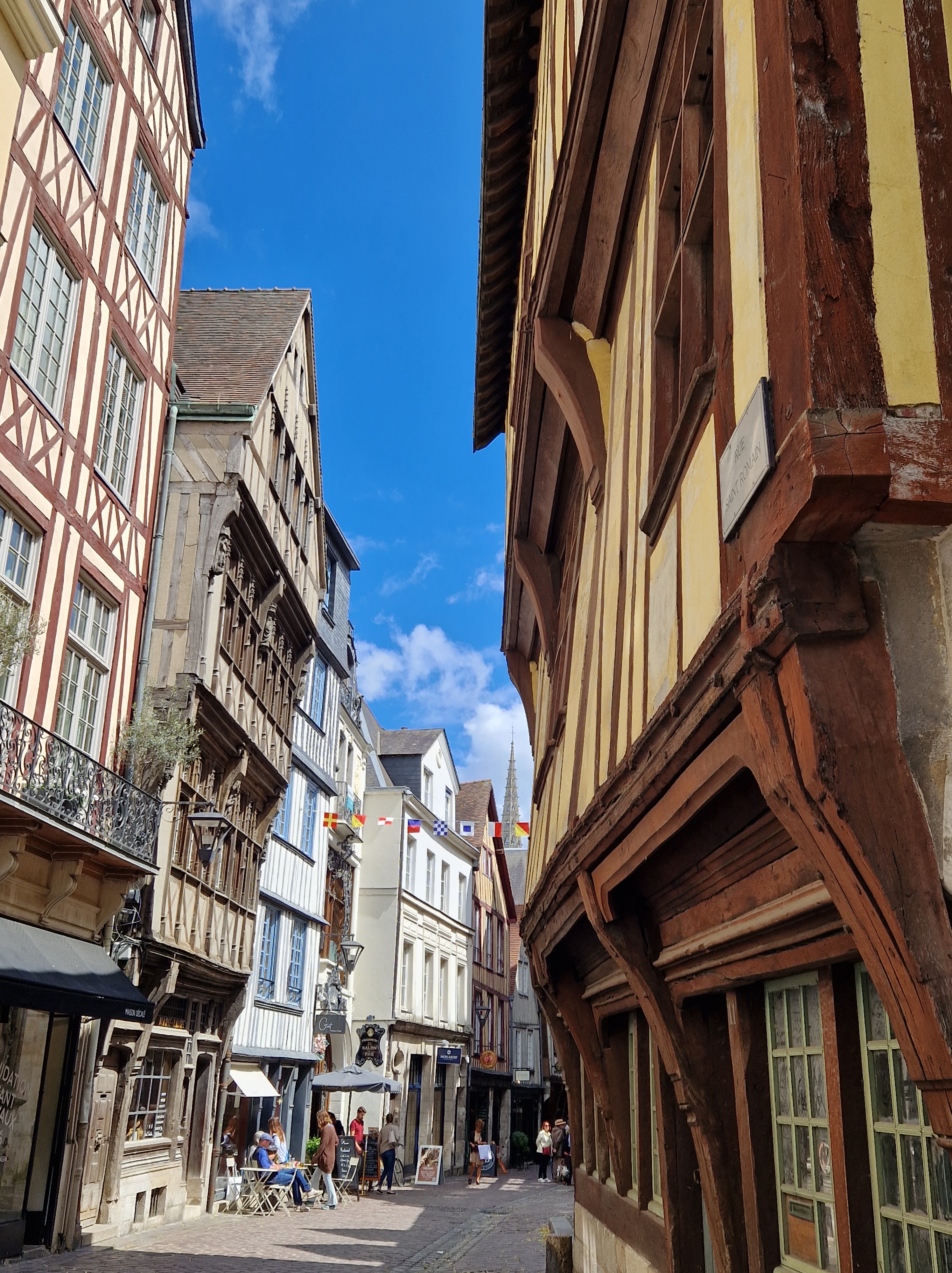
For me, the clock must really be seen within its context to truly appreciate it; it’s surrounded by wonky Medieval buildings which are three or four stories tall and built when plumb lines and uniformity were still futuristic concepts. They were built out of timber, as there is abundant forest nearby but no stone quarries.

The clock adorns the arch over the Rue du Gros-Horloge (“Street of the Great Clock”), which runs between the Gothic cathedral, made famous by Claude Monet (who painted over 30 canvases centred on the cathedral), and the old market square, where Joan of Arc was burned at the stake. Perhaps ironically in light of the latter event, the street just off of the clock’s archway is called Rue Massacre

Though I do not speak French, I know that in French, clocks today are referred to in the feminine form, la horloge; but prior to the 18th century, clocks were masculine; so, the great clock of Rouen, in French, is still Le Gros-Horloge.

Below are a few of our holiday photos: They include the cathedral’s jumbled windows and the clock from various angles, as well as a few of the wonky buildings. Enjoy!

5 Comments

Filed under History, History Undusted, Military History, Science & Technology, Snapshots in History