To me, the word Zarf sounds like a sci-fi comedy name for an inept villain. But, in fact, it’s a word that entered English in 1836, and is the Arabic word for “vessel”. It describes an object that you’ve seen or have likely had in your hand at some point. I will freely admit that the zarfs we know today have fallen a long way from their original forms: A zarf is the holder of a coffee cup. That sounds fairly straightforward. You may have instantly pictured a highly decorative, precious metal jewelled… no? Are those crickets I hear chirping in the vast silence of confusion? Or maybe you pictured the cardboard contraption around a hot cup of Starbucks coffee. Fallen a long way, indeed. (Camps are divided on whether the latter constitutes a zarf… for good reason: I think they would be better referred to as sleeves, as to put them on par with the bejewelled masterpieces would be an insult to the artisans of bygone days.)
Zarfs arose out of the necessity of protecting one’s hands from a hot cup; before the monster of plastic reared its ugly head, cups were made from metal or glass, often without handles. Further back, they might have been made from plant products such as coconut shells. The oldest known cups were found in Gough’s Cave in Cheddar Gorge, Somerset, England, and dated to 14,700 years ago; they were made of cannibalised human skulls.
During the 16th century, coffee gained popularity throughout the Ottoman Empire. It led to the popularity of coffee paraphernalia and coffee houses, which eventually spread worldwide and remain popular to this day. In Britain, for instance, a coffee-house culture arose in the 17th century; by the end of the century, there were over 3,000. Such venues became known as penny universities, because, for the price of a cup of coffee, men could join in the hubs of intellectual exchange and debate. Artists, journalists, poets and writers gathered to discuss God and the world; the Inklings, a literary group including C.S. Lewis and JRR Tolkien, met regularly at the Eagle and Child in St Giles’, Oxford.
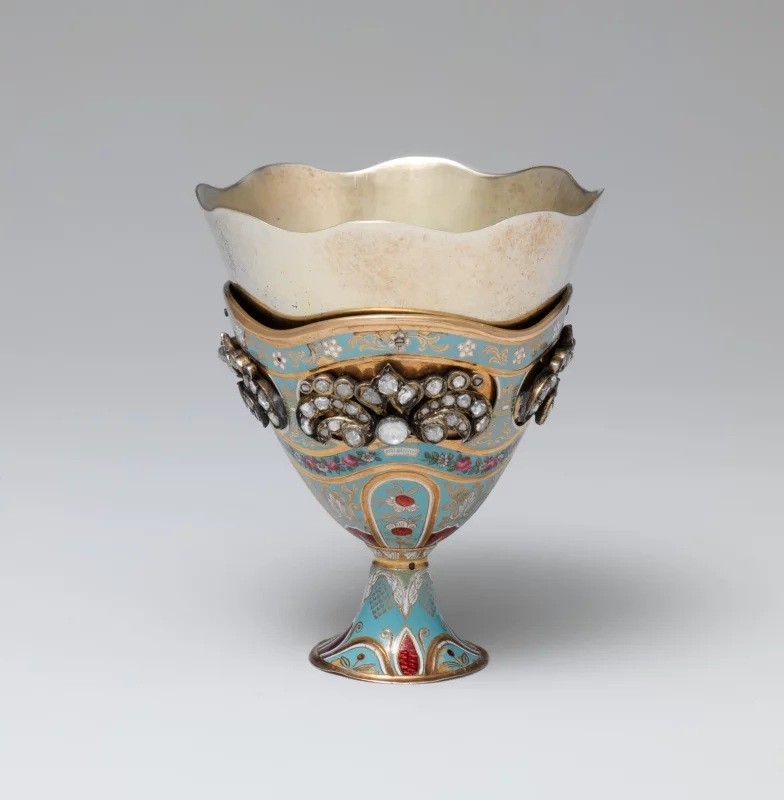
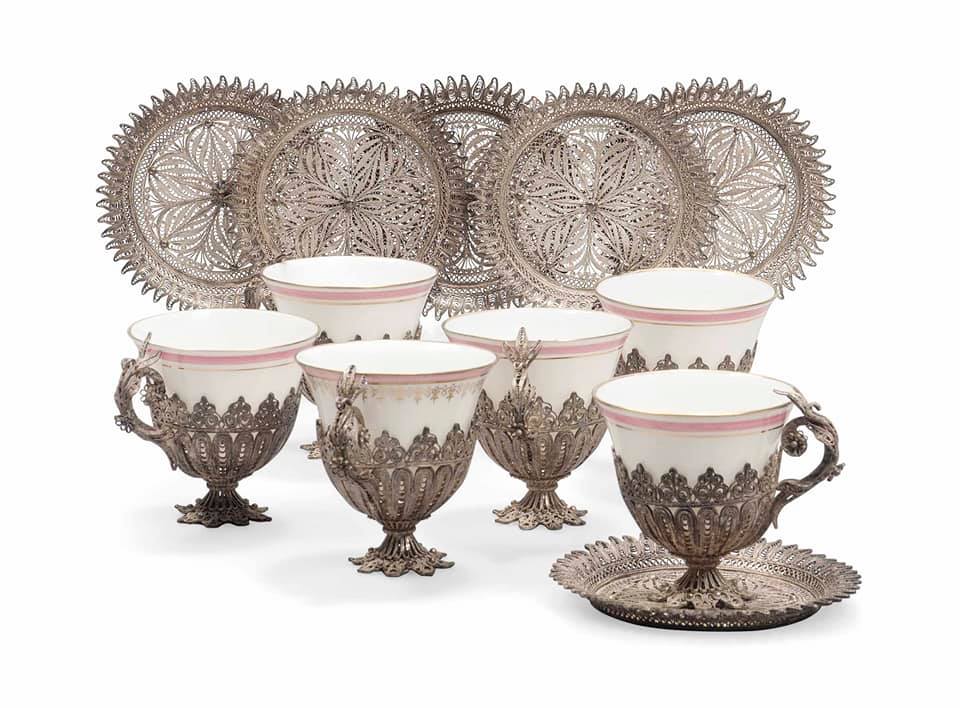
By the 19th century, the goldsmiths of Switzerland had become leaders in the production and export of ornate zarfs, made of precious metals and inlaid with precious stones or small hand-painted medallions. They were often made in fine filigree, with a smaller cup, known as a fincan, made of ceramic or glass, slipped inside to hold the coffee. A modern version of this is still widely used, called a demitasse (French for half cup), in which espresso is often served.
Without further ado, here are a few examples of zarfs and fincans, along with demitasses:
Source: Sothebys.com
A Swiss musical box zarf, ca. 1840 – Metropolitan Museum of Art
I know that, for most of you, neither Engadin nor Sgraffito have made you any wiser as to what this blog is about, so first, I’ll start off by explaining where and what they are, respectively.
Engadin (pronounced En-Ga-Deen) is a long, towering Alpine valley in the Romansh-speaking canton of Graubünden in southeast Switzerland. The first mention of this valley was in Latin as vallis Eniatina in AD 930; in the Romansh language (one of the four national languages of Switzerland), it is Engiadina. The river running through the valley is called the En or Inn, and it is the only river in Switzerland that runs (via Austria) into the Black Sea. The region is usually divided into lower and upper Engadin, and it is connected to the surrounding regions by several mountain passes.
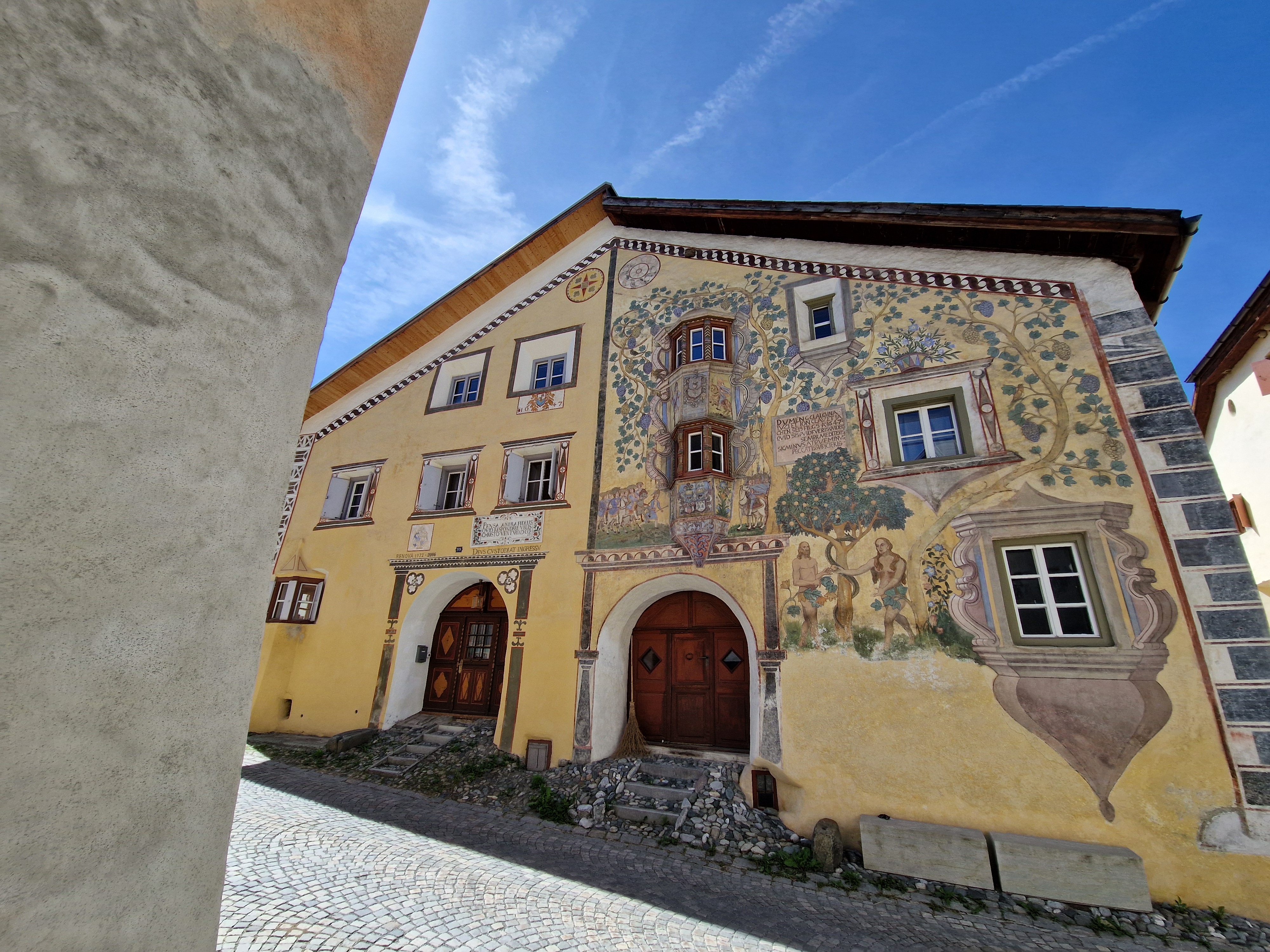
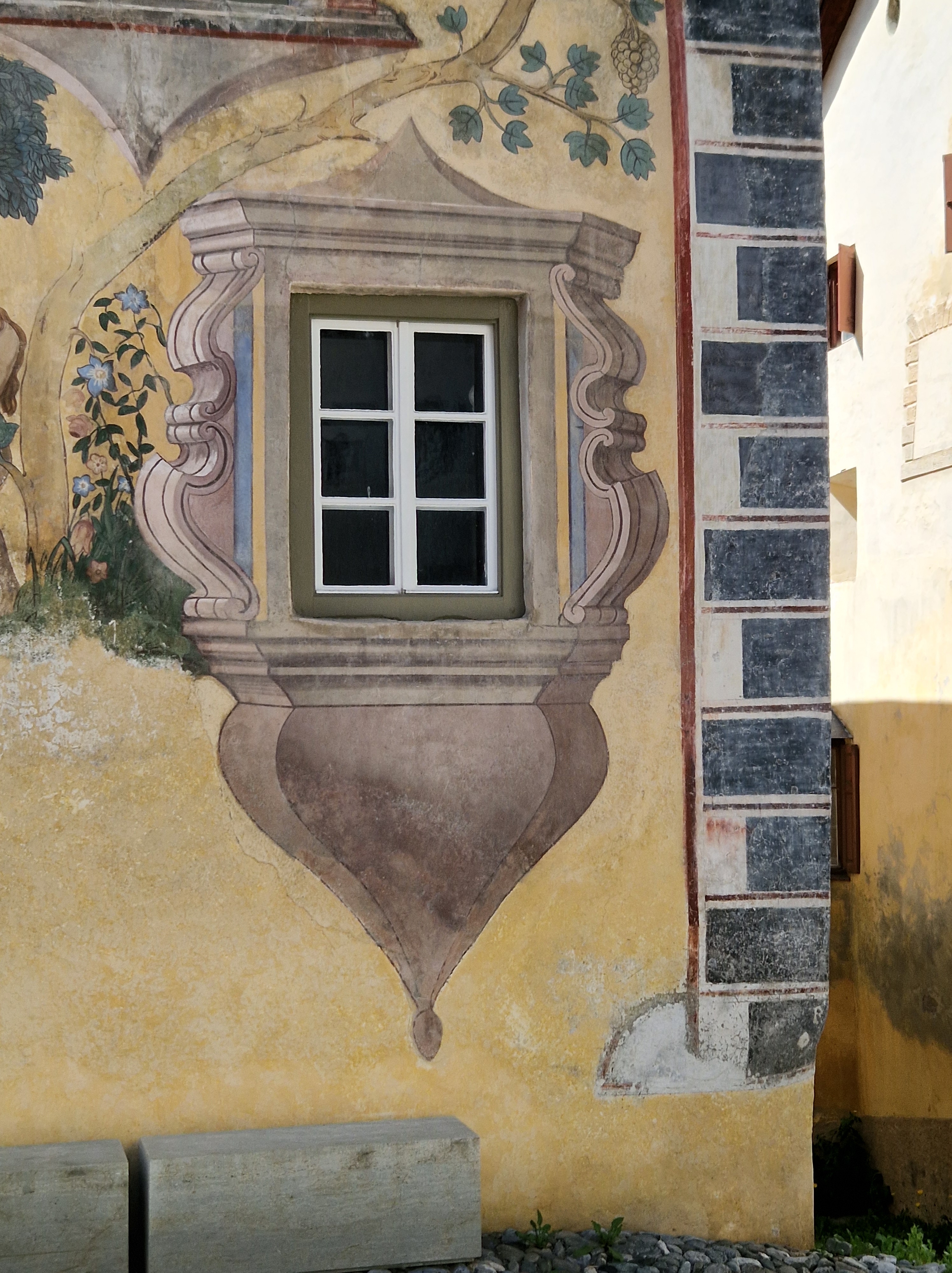
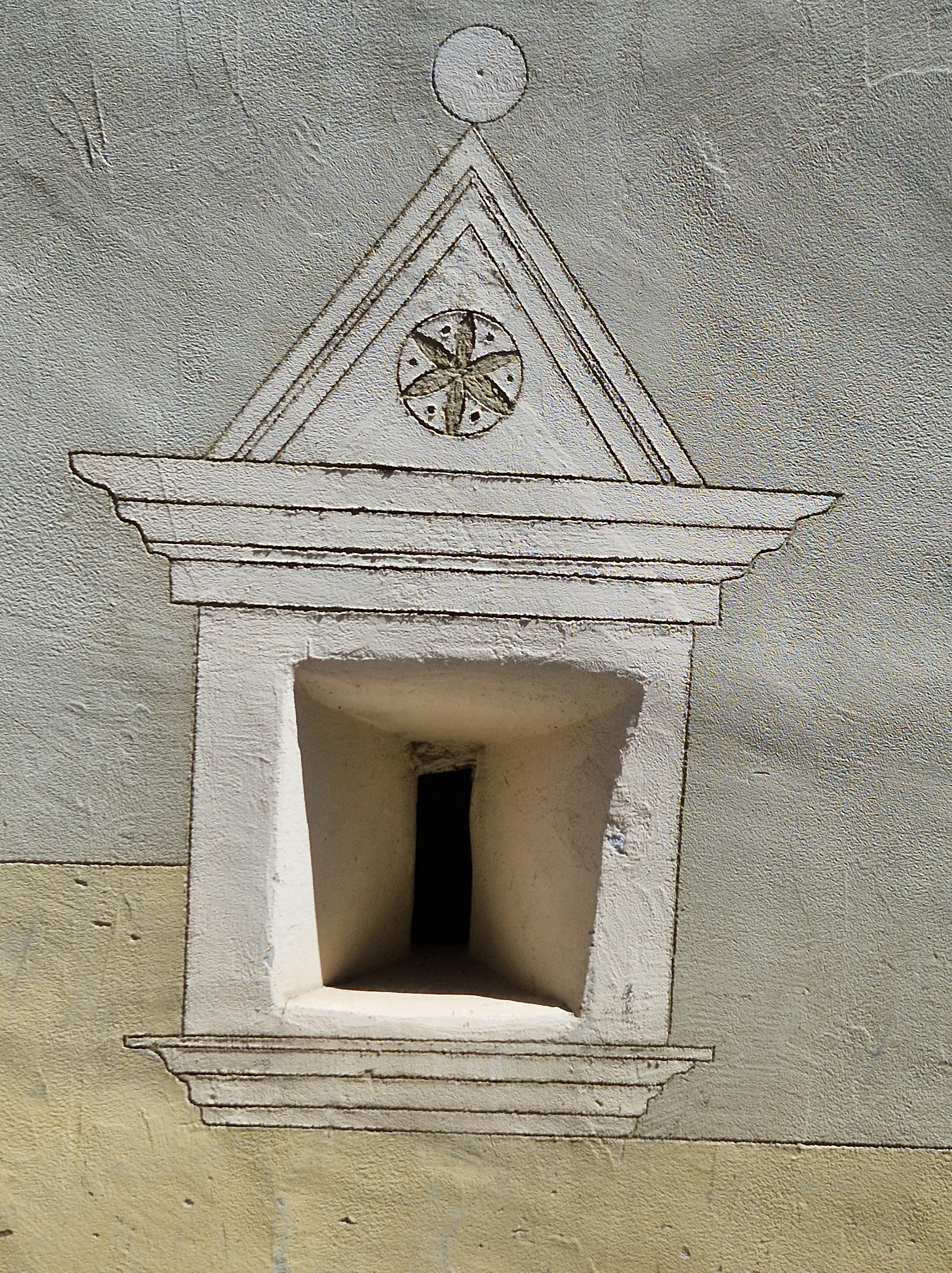
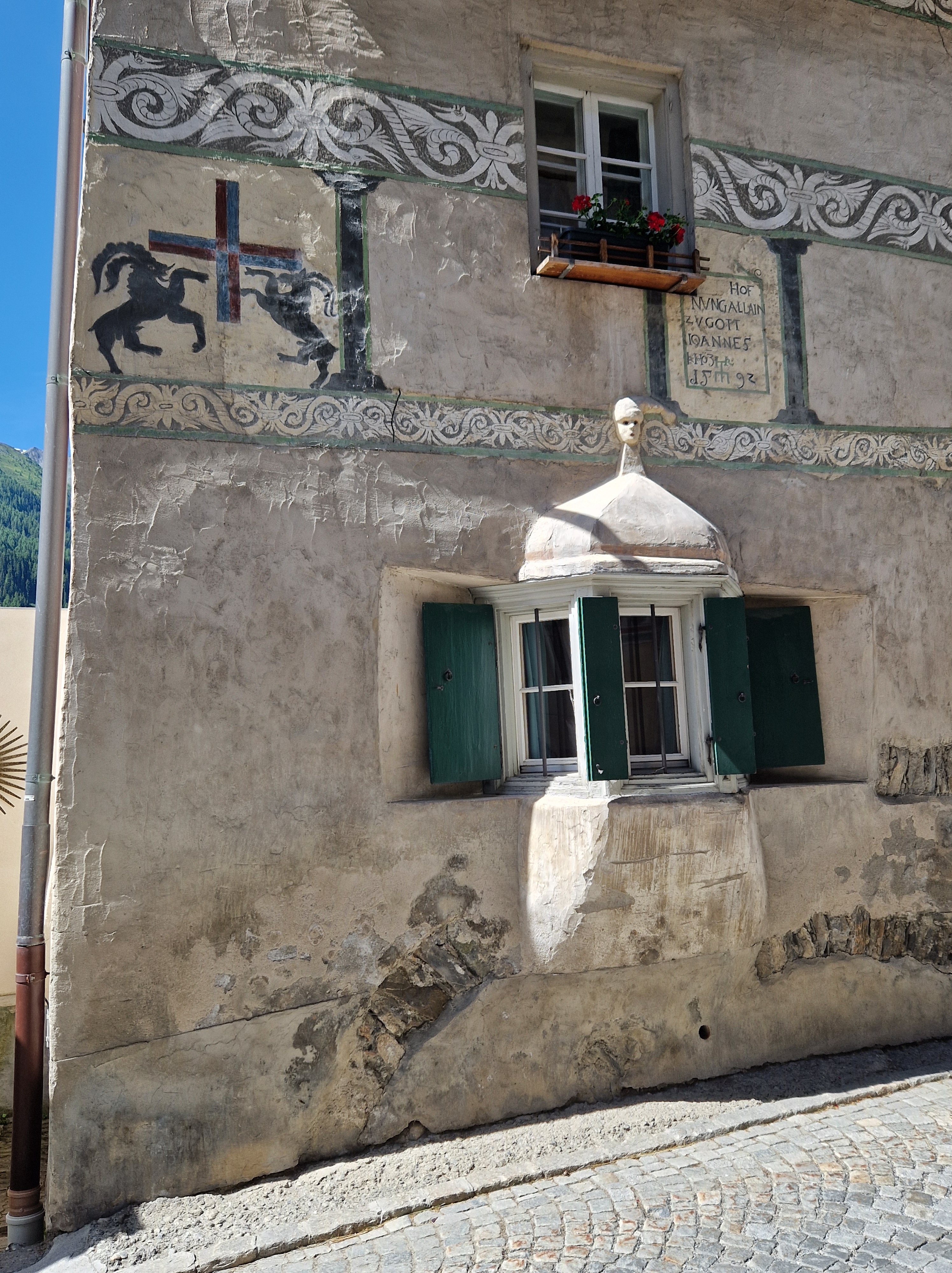
The second word, Sgraffito, describes a plaster technique that is traditional throughout Engadin: Layers of plaster of contrasting colours are scratched through, creating intricate designs on the facades of buildings (many of the buildings in Engadin towns were built (or rebuilt) in the late 1500s to early 1600s). The word comes from the Italian graffiare, which means to scratch; it can be traced back to the Greek word graphein, meaning to write (from which we also get any words containing the prefix, suffix, or derivative of graph (graphite, typography, graptolite, parallelogram, holograph, etc.). Sgraffito is not only used on buildings to make them look decorative, but it also serves the purpose of making a small feature look larger; on one building, the same floor had different-sized windows, likely installed over generations; the sgraffito was used to give a more uniform look to the façade. The decorations also make a plain building look grander, giving a more opulent impression. One building, pictured below, obviously had two occupants with very different characters back when they were originally decorated…
The basic technique for architectural features is to plaster the façade with the base colour; once that has set, it is then plastered with a contrasting colour; once that has set just enough, the scratching, or carving, begins. This is also a technique used in pottery and in creating stained glass effects (just click on the links if you’d like to see how these crafts are made).
One thing to note is that many old buildings here in Switzerland have dates listed on them: Of when they were originally built, and when they’ve been renovated. Part of the history of such renovations may include fires that swept through villages, or avalanches that buried a layer, or wars, such as the Swabian War and war against the Habsburgs, and the subsequent renovation or rebuilding of the towns or individual homes. Sometimes, along with the dates, a list of past and present occupants will also be displayed, preserving their names and memories within the history and changes of the building itself.
Below are a few pictures taken in Engadin during our recent summer holidays. Enjoy! Feel free to zoom in on the pictures to see the details.
The baroque town of Solothurn, though only an hour away from our home, was unfamiliar to us until my husband and I took a day trip this week. It has a beautiful historical centre and is known as the “city of elevens”: It was the 11th canton to join the Swiss Confederation; there are 11 towers in the fortification walls of the city; there are 11 churches and chapels, and 11 historical fountains throughout the city; the stairs leading up to the St. Ursus Cathedral have landings every 11 steps; the cathedral itself has 11 altars and 11 bells; the local brewery, producing an eponymous beer, is even called Oeufi – which is a Swiss dialectical word for eleven. 11:00 is the most “auspicious” time to set appointments in the town, and there is even a clock, hanging on the wall of a local bank, which is segmented into 11 hours; it has 11 cogs and 11 bells, which are chimed by a metalwork sculpture of a harlequin on the hours of 11:00, 12:00, 17:00 and 18:00. The bells chime to the tune of the city’s unofficial anthem, the Solothurner Lied.
Solothurn’s history dates back to the palaeolithic era, and its Roman era is dated to around AD 15-25; it was first mentioned in AD 219 as vico saloduro, and may have referred to a Celtic settlement, possibly meaning “Salo’s fort/stronghold”. In the Battle of Sempach, July 1386, the Habsburgs attacked Solothurn; it was a decisive Swiss victory, and even more importantly, it helped to solidify the loosely allied Swiss Confederation cantons into a more unified nation and is seen as a turning point in the growing strength of Switzerland as a nation. Today, it is largely bypassed by tourists due to its proximity to Bern, the Swiss capital, so it remains a hidden gem.
Another interesting clock is the clock tower, the “Zeitglockenturm”, a tower built in 1152 and first mentioned as a “clock tower” in 1406. If you look closely, you’ll see typical rain spouts coming off of the corners of the tower’s spire and roof, shaped like dragon’s heads. The 24-hour astronomical clock was built by Lorenz Liechti and Joachim Habrecht in 1545. The sun and moon hands both run counterclockwise; the moon makes one complete rotation every 27 days, while the sun makes one complete rotation every 365 days.
According to the Roter Turm website, there’s a humorous story connected to the upper, 12-hour clock: By 1753 the hour hand and the bells were no longer in sync; a commission contacted the watchmaker Niklaus Pfluger, reminding him of his gild’s oath, i.e. his responsibility to correct the clock. He suggested to the local government council that they add a minute hand; but minutes were not so important in the 18th century, apparently – they told him to leave it as it had always been. He took matters into his own hands (I guess it was easier to ask for forgiveness than permission…) and in 1756, he added a minute hand. He justified it as the “warning hand of God” – but he made it smaller, less noticeable than the hour hand, so on this clock, the small hand shows the minutes, not the hours.
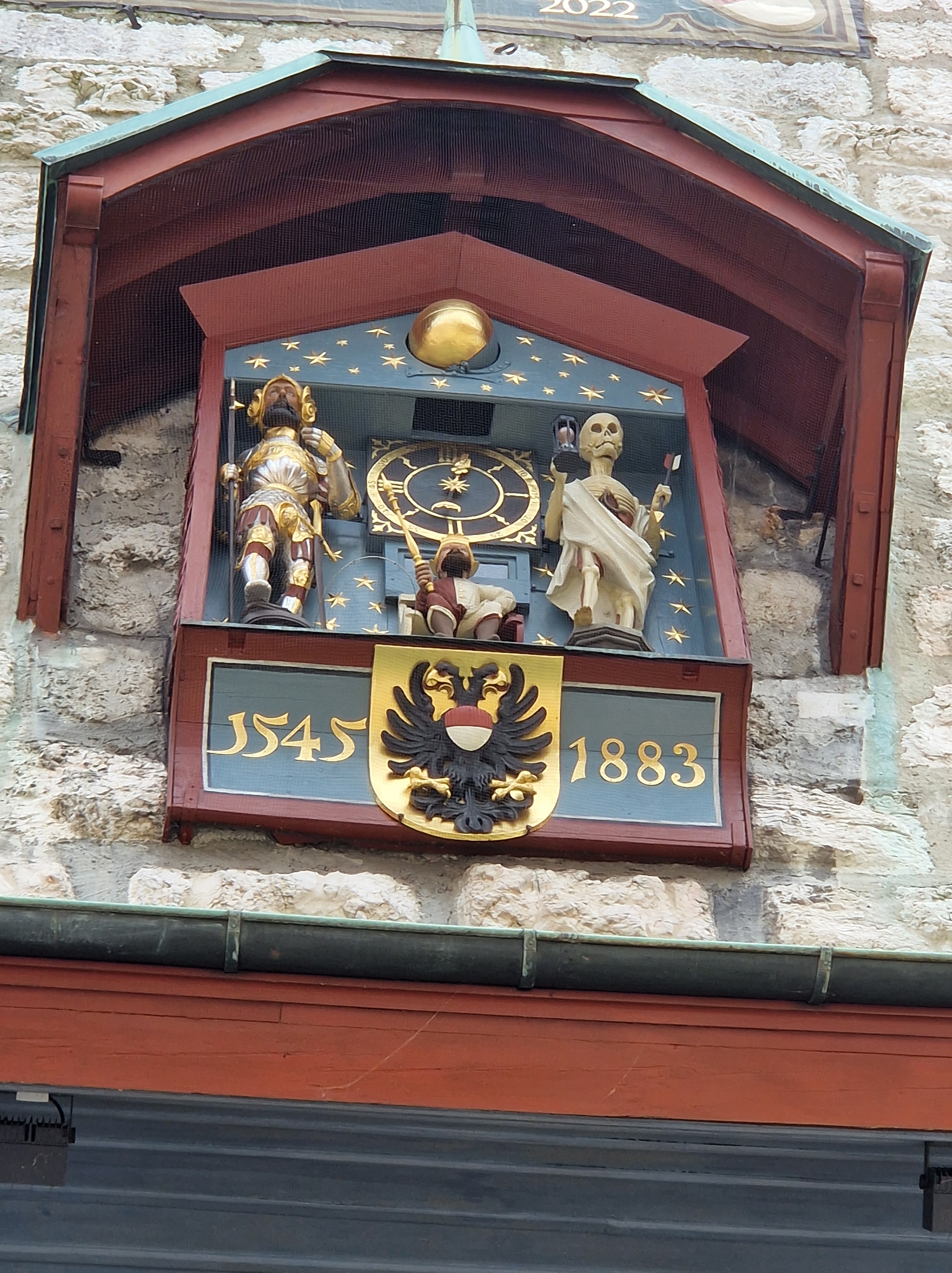
Because the clock tower was built and added to over time, you’ll see four dates on the full image of the tower: 1411 and 2022 on the highest, 12-hour clock; and 1545 and 1883 on the central tableau; the latter dates usually refer to restorations.
The three figures in the central tableau above the clock are a knight, king, and skeleton (Death), which perform every hour: The knight holds a battleaxe in his right hand, and a sword in his left; every quarter-hour, he turns his head toward Death and strikes his breast, signifying his loyalty to the central figure, the king. On the right stands Death; in its right hand is a hourglass, which is turned on the hour, symbolizing the contradictions of life – good, bad, life, death. In the other hand is an arrow, showing that one could be struck down at any moment. On the hour, its head turns toward the knight.
On the throne between these two figures is the king: In his right hand is a sceptre, which he lifts on the hour. His jaw moves in rhythm with the hour hand, and his beard represents wisdom. However, notice that he’s wearing red and white fool’s garb: If the king does not rule with wisdom and the humour of a fool, his reign will become a tyranny. It tells us that life should have moments of both wisdom and a jester’s humour.
While Death announces the hours, the king swings his sceptre. At the same time, Death nods with each stroke and confirms the relentless passing of the hours. The king with his fool’s garb reminds us of the memento mori. When death or illness reigns, even the power of a wise king can do little (Solothurn was hit by the plague, e.g. in 1348). Though the Freudian era banished death from contact with the living in many Western cultures, death personified as a skeleton is still a symbol seen in many countries around the world. Having death constantly before your eyes encourages you to savour each moment of life.
I hope you’ve enjoyed this brief glimpse into a beautiful city with an ancient history!
Around the world, fireworks are a traditional part of certain celebrations: Here in Switzerland, the two national nights would be the 1st of August (1291, Independence Day), and New Year’s Eve. In America, the 4th of July is probably the most widespread fireworks night. In Japan, fireworks competitions are enjoyed by spectators during the Sumidagawa Firework Festival, and in India, it’s Diwali, the Festival of Lights. In many countries in South America, Christmas is the big night; in Britain, Guy Fawkes Night is celebrated with both fireworks and bonfires (in Scotland); he was most associated with a failed gunpowder plot intended to blow up parliament and assassinate King James I of Scotland / James IV of England and Ireland.
Most people have, at some time in their lives, seen fireworks go off; but most people have no idea how they produce varying shapes and colours. Derek Muller, aka Youtuber of the Veritasium channel, goes into the details of what makes fireworks take shape, have varying colours and enable them to have precision timing in displays. To watch the video, called “The Hidden Science of Fireworks”, which includes footage of a drone’s perspective amid a fireworks display, just click on the image below! Enjoy!
This past weekend I had a craft stand at our church’s annual advent market. Ten hours a day. I sold (as you might guess by the title), among other things, gnomes. It got me thinking about the history of these little creatures. I don’t know about where you live, but here in Switzerland, they’re popping up everywhere this season! Statues, cookie tins, ornaments, wrapping paper, socks and anything else you can think of.
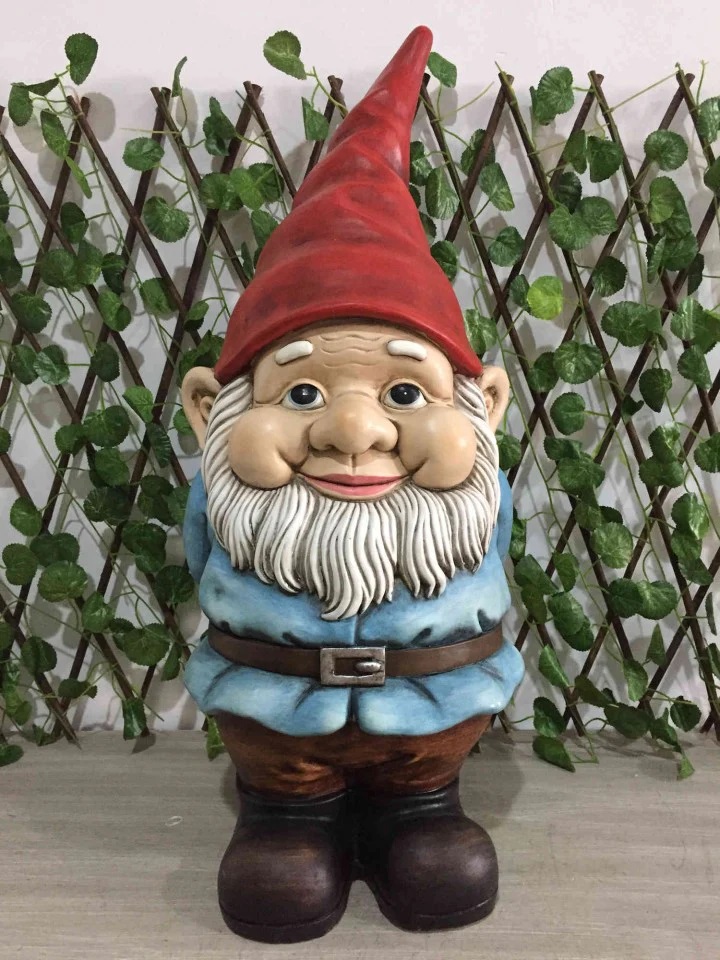
You might think of garden gnomes; but the gnomes I’m referring to simply have a bushy beard, a nose, and a body with a hat on top; sometimes arms, but no eyes, though I added artisan sunglasses to some of mine, and those sold out relatively quickly. The image below is a typical Wichtel here in Switzerland.
I’d always vaguely assumed that gnomes were Scandinavian in origin, but it turns out that they are actually Swiss! First introduced in the 16th century by Paracelsus, born Theophrastus von Hohenheim, who was a Swiss physician, alchemist, lay theologian, and philosopher of the German Renaissance. The term “gnome” might have even been his own invention, based on the Latin genomos, meaning earth-dweller. Paracelsus may have been the first to describe them, but there are examples of similar myths in other cultures, too.
Perhaps the reason I’d thought of gnomes as Scandanavian is that, in the early 19th century Romantic writings, gnomes became entangled in the fairy tales which led them to becoming synonymous with goblins, leprechauns, and brownies, which are in turn similar in character to the Nordic troll. Trolls are said to live in isolated mountains, rocks or caves, and as such, are “earth-dwellers”. While the gnomes were thought to be helpful, trolls were rather unhelpful. Scandinavia does have a gnome-type character as well, known as the Danish and Norwegian nisse, the Swedish tomte, or Finnish tonttu, as well as many dialectical names throughout Scandinavia. In German, they are known as Gartenzwerg or Wichtel.
In folklore, gnomes were thought to be short, stout guardians of mines, treasures, and precious stones, and were the antithesis of the tall and slender elves. JRR Tolkien was likely influenced by these legends when creating his races of dwarves and elves.
The practice of garden statues goes back to ancient Rome, where they set up idols thought to help plants thrive and protect animals. by the 18th century, however, such garden statues were simply seen as a status symbol of wealthier families. The statuary as we think of it today is visually based on the Disney dwarves of Snow White; before that, their look was less homogeneous. Over time, they fell into disfavour among serious gardeners; at the Chelsea Garden Show in the UK, they were banned for several years; the powers that be were accused of snobbery, as garden gnomes were popular among the working class; they were eventually allowed in the show’s garden designs once again.
Garden gnomes in particular are something that you either find adorable or tacky. Like any display piece, if it’s done well, they can add a touch of whimsy to your garden or home.
The topic is one of those rabbit holes you could easily dive into; the traditions of the gnome, after all, go back thousands of years.
I’ve been preparing my manuscripts for new releases through a new publisher, and making crafts for our church’s annual craft sale; in the latter process, I’ve discovered a wealth of images through Pinterest (nothing new to me in itself). How many of you used to collect stamps, or postcards, or specific objects? For me, the new method is Pinterest. You can find stamps on any topic, and rare ones; you can find coins, bank notes, and just about anything you used to collect physically, now available at a click with historic backgrounds and full details you could never have fit into an album.
But today, I’d like to focus on Vintage travel posters, specifically for Switzerland. So far, I have nearly 350 in my collection, and it’s likely a drop in the bucket of what was produced; every region advertised itself to attract tourists or travellers, and it’s fascinating to see what they highlighted, how they did so, what their perspective was, and how the people dressed (if they’re shown – in Switzerland, at least, a big focus is on the Alps). Did you know that the word “homesick” in English came from Switzerland? The Swiss merchants that travelled abroad in the 17th century took the word with them; when they spoke of “Heimweh”, however, they weren’t referring to people, or their home, or even their town, but of the mountains. They missed the Alps when they were away… and I can understand why. I think it must run in the veins of every Swiss-born person; when my husband and his mother speak of the mountains, it’s a foreign language to me (even though I’m fluent in Swiss German!).
We might tend to think of tourism as a modern thing; but Grand Tours began in the 17th Century, when wealthy young men, and sometimes women, would embark from the UK on a European tour. At the beginning, Switzerland was a sleepy backwater in some ways – there were few, if any, hotels – if a traveller arrived in a town seeking accommodation for themselves, their servants, postillions and horses, they were often invited to stay in the home of the local politician, who likely had the largest house… But the Swiss soon caught up with the trend, and tourism became a vital source of income, especially for small settlements in the mountainous regions.
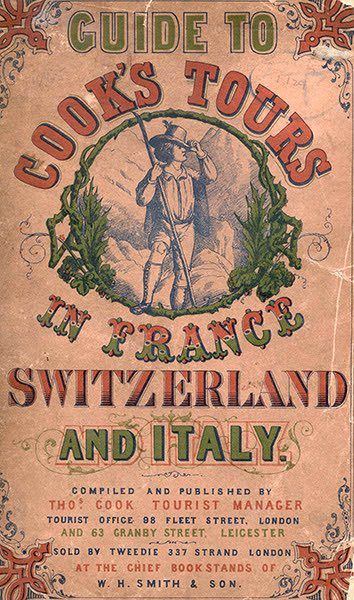
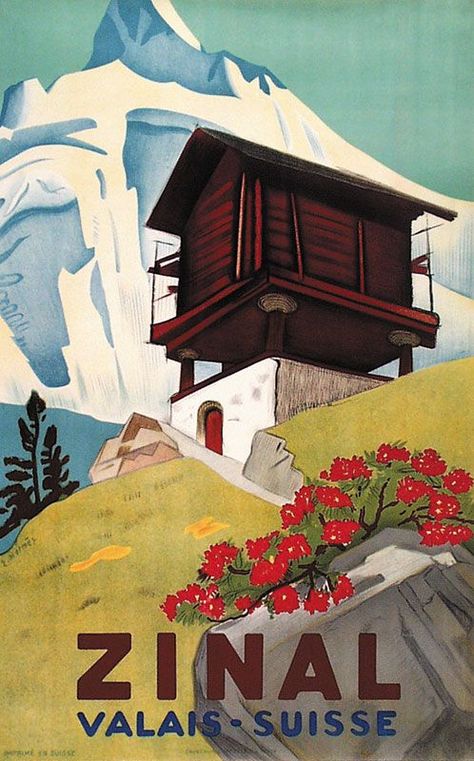
The three images below are, from left to right, from 1897, 1865, and likely the early 19th century. The house shown in the Zinal ad is typical of Wallis (Valais in French): It is built on stilts with round, flat stones between the pillar and house base; we chatted with an elderly man when we were on holidays in the region and asked him about it; it is a way to keep rats and mice out of the houses. It also means that the back, and sometimes even the front, is only accessible by ladder.
The 1865 poster is about a tour organized by Thomas Cook, a well-known name in the British travel industry even today; Cook took his first tour group of around 485 people on an 11-mile train trip from Leicester station to Loughborough, in 1841. Soon, he began to expand his scope, and by the 1860s, that included Switzerland.
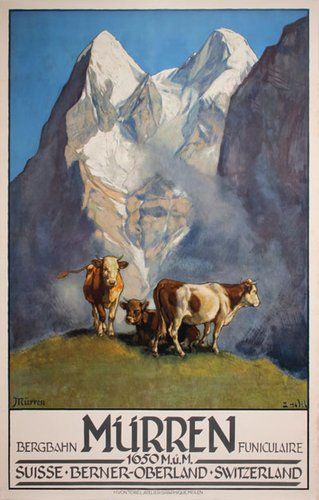
The Spiez poster below shows the castle and lake; The Zürich poster shows a view over Lake Zürich from atop the Uetliberg mountain, the summit of which is called Uto Kulm. To see a live-cam panorama from that vantage point, just click here. The Mürren poster is a view typical of every Alpine pasture, even today.
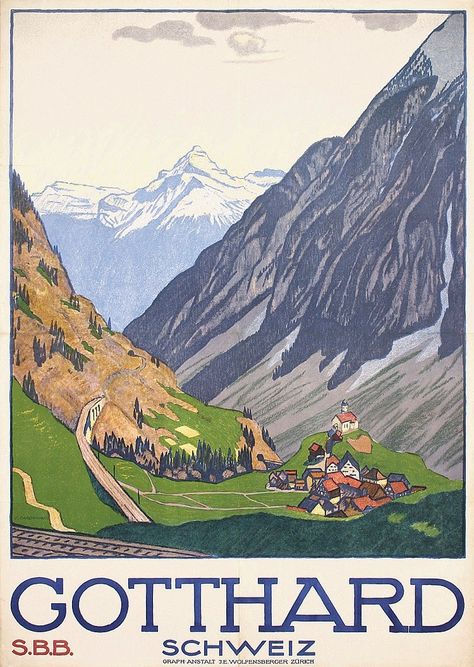
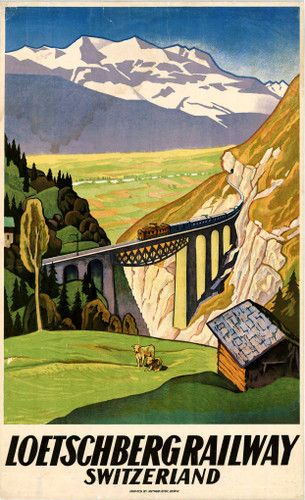
The next 3 images are firmly in the Alps: The glacier shown in the first image is the Aletsch Glacier, the largest in the Alps, covering around 80 square kilometres (31 m2), with a length of ~23 km (14 miles) with a maximum thickness of ~1 km of ice. As with most glaciers in the world, it is retreating. Gotthard (officially the Saint-Gotthard Massif) is an impressive region connecting north and south Switzerland between Uri and Ticino, German- and Italian-speaking cantons, respectively. It has long been a major axis of Europe, with a road across, a vehicle tunnel through (built 1980), a cargo and transport train tunnel (opened 1882), and now a passenger- and vehicle-transport train tunnel which opened in 2016 and is the world’s longest railway tunnel and the deepest traffic tunnel, as well as the first flat low-level tunnel through the Alps. The 3rd poster highlights the Lötschberg, a massif with a train transport tunnel linking the north and south of Switzerland through the Berne and Valais routes. We often take this route when going to Valais or Ticino on holidays; the train is an open, continuous carriage, meaning you drive on, sit in your car, and watch the tunnel fly past.
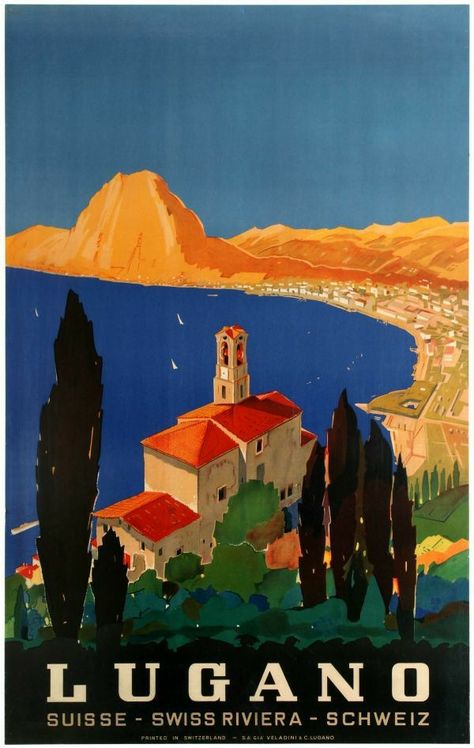
The next 3 posters highlight something nearly ubiquitous in Switzerland: Lakes. They’re everywhere. We even share Lake Constance with Germany and Austria, and Lake Geneva with France. From border to border, we have over 100 main lakes and countless smaller ones (in an area what easily fits within the state of Maine, US, to give you a size comparison). The first poster is encouraging locals to explore, commemorating the 650th anniversary of the formation of the core of Switzerland. The second shows Lake Lugano from the perspective of Monte Bre, with the city of Lugano along the shore. It’s a perspective I know well, as the family had a holiday home on the flanks of Monte Bre until last year. San Salvatore is the mountain peak shown. The third poster is of the Vierwaldstättersee (“Lake of the four forested settlments”): This is the most complex lake in Switzerland, and not only for its names: In English it’s known as Lake Lucerne, although that is just one arm of the sprawl. Sections are Lake Lucerne, Lake Urner, Lake Kussnacht, Chrüztrichter and Lake Alpnacher. The many-armed lake is shared by the cantons of Uri, Schwyz, Obwalden, Nidwalden (originally one canton known as Unterwalden) and Lucerne. Signs of settlements found by archaeologists go back to at least 3,000 BC. To see this lake through live-cams, just click here. The site is in German, but just click on the view you’d like to explore.
I hope you’ve enjoyed this virtual tour! And perhaps you’ll come to Switzerland one day to see it for yourself!
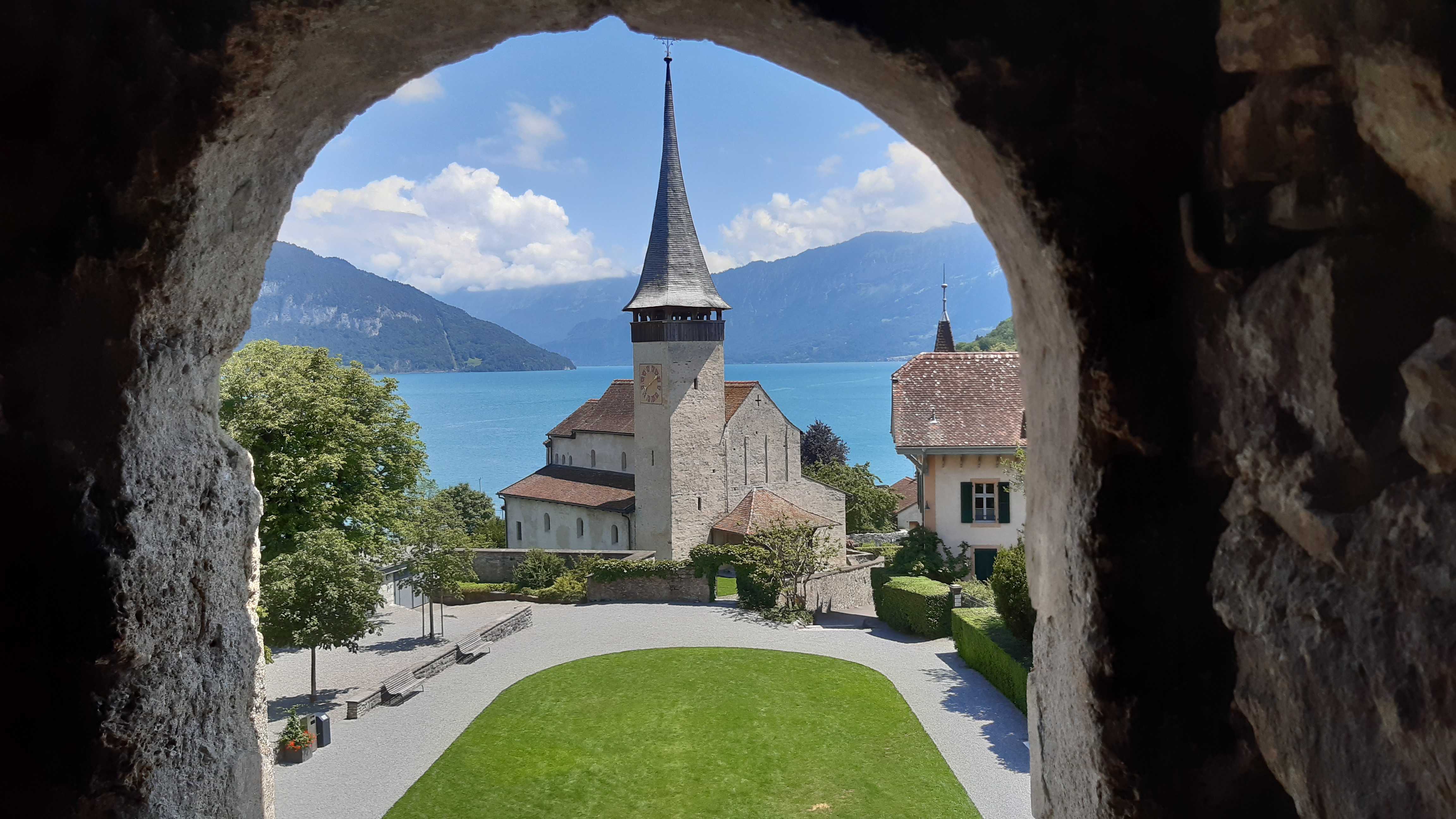
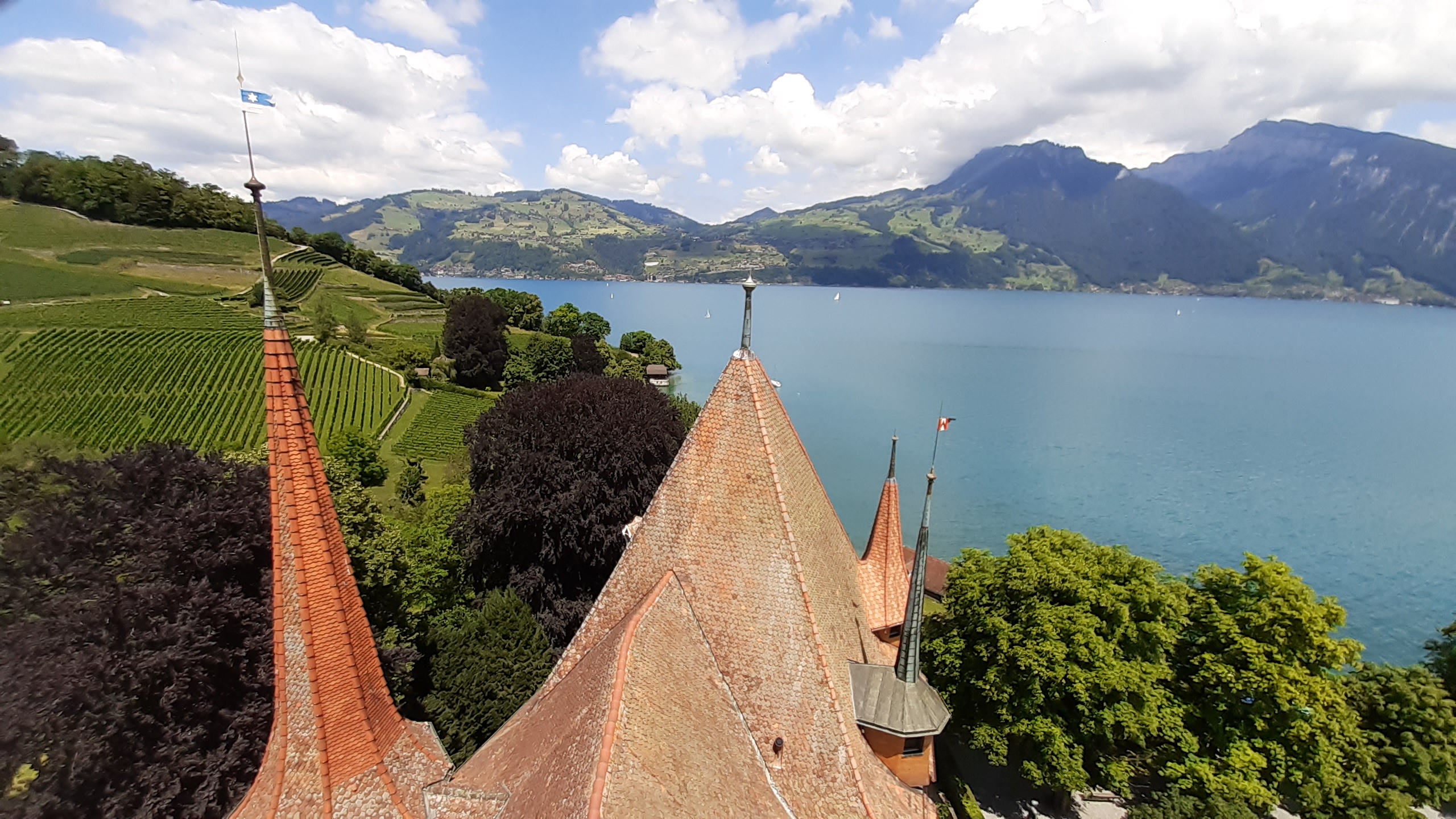
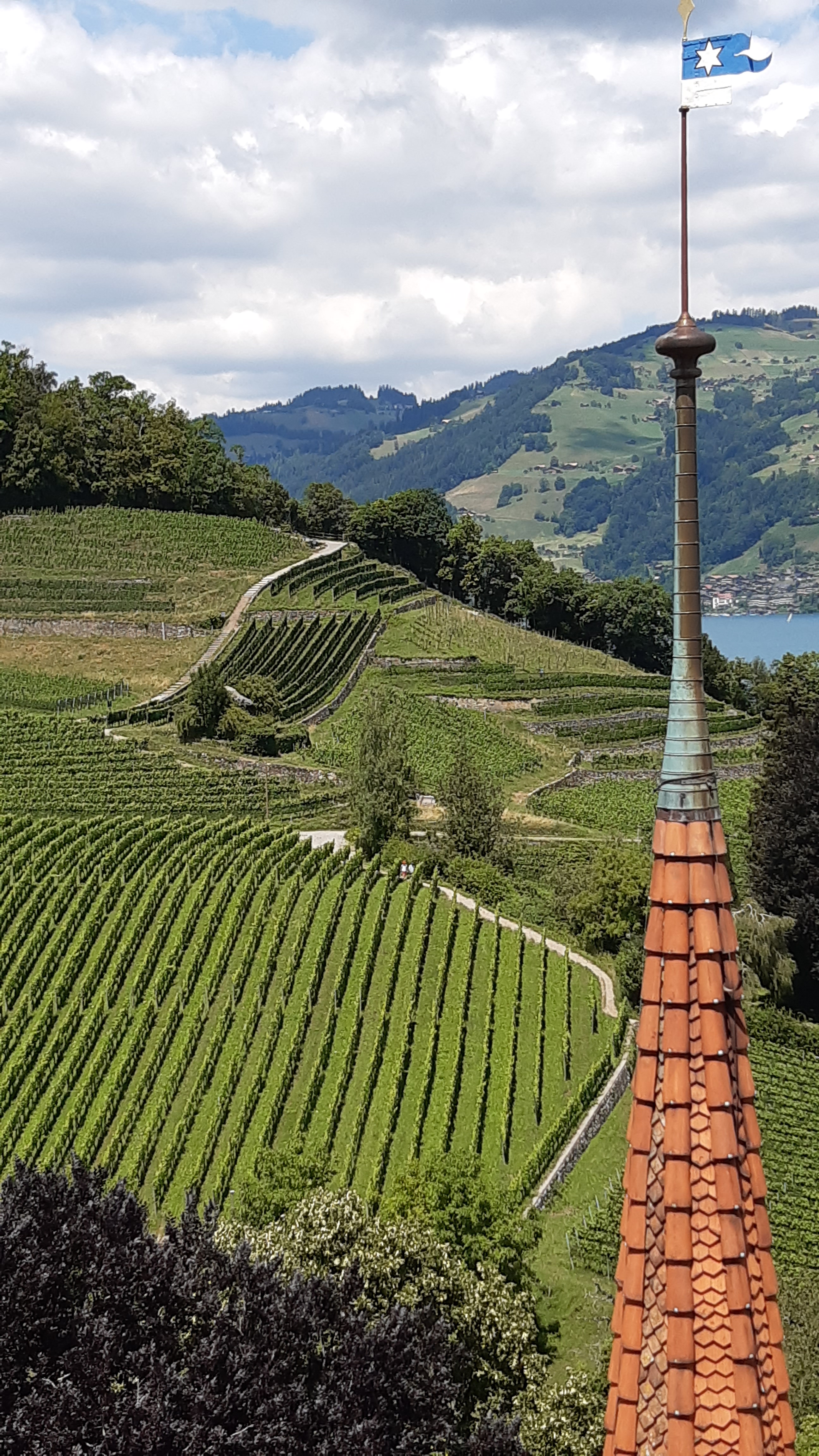
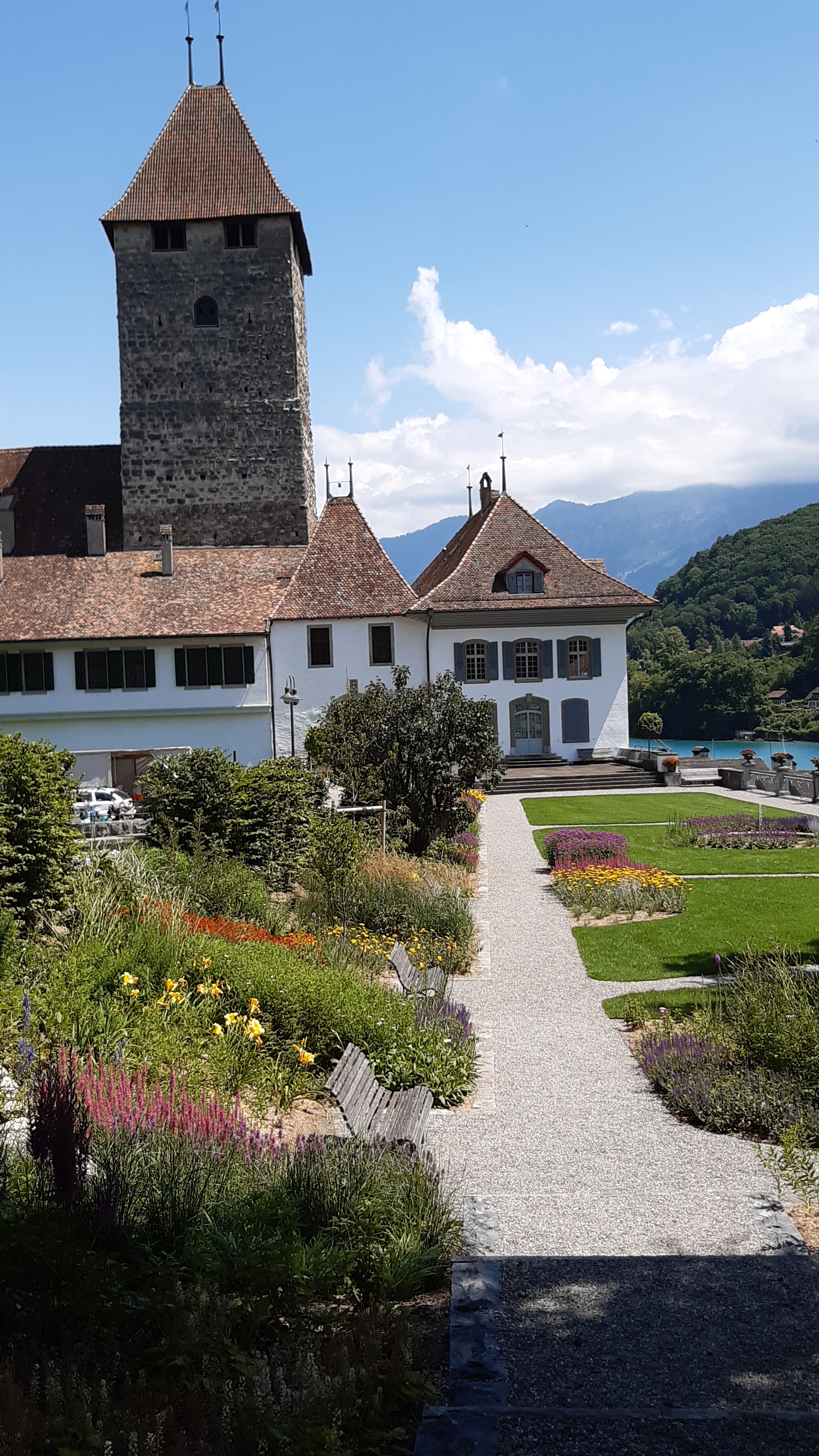
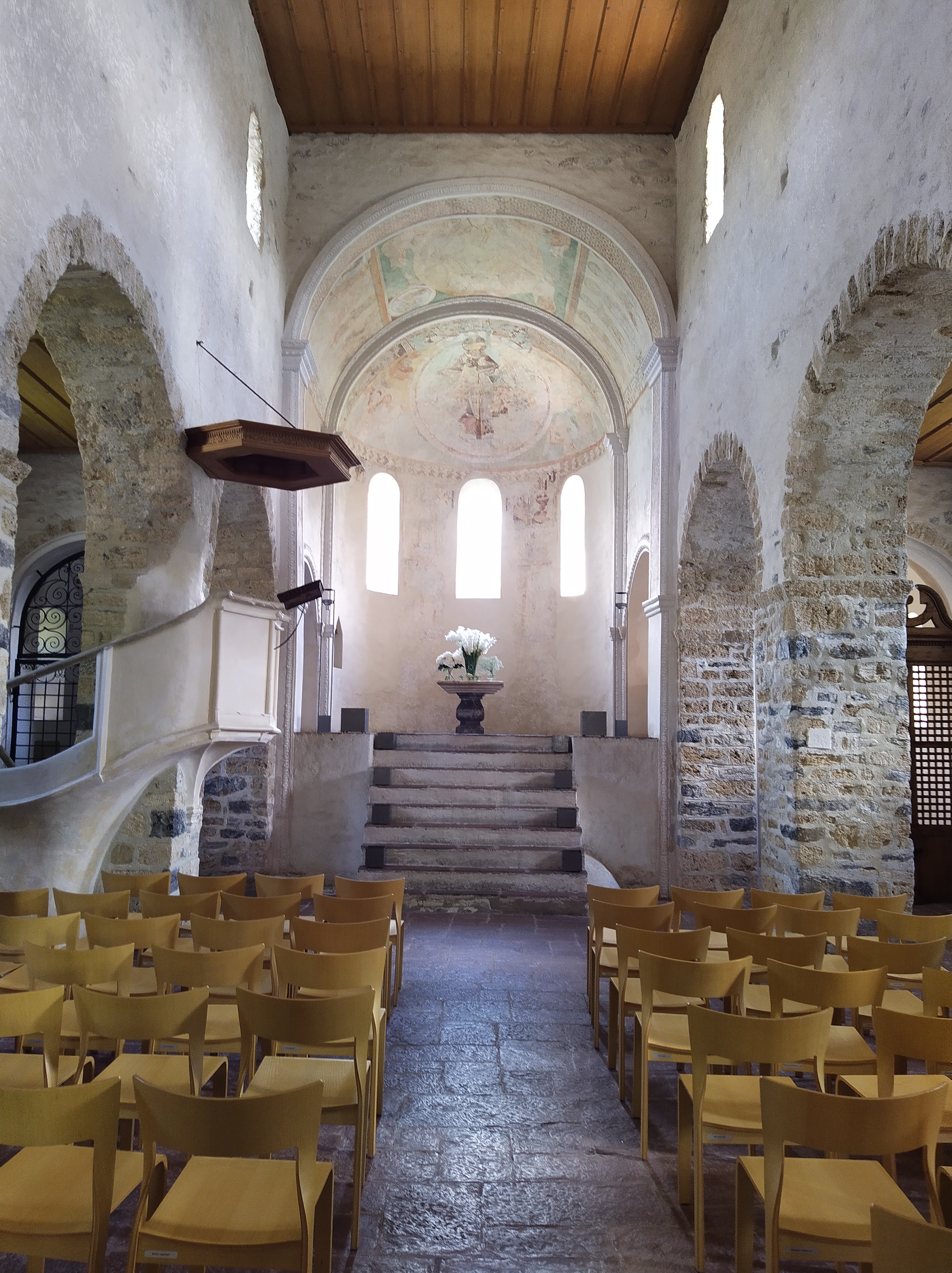
Let’s take a virtual tour of a beautiful little castle on Lake Thun, here in Switzerland: Spiez Castle is a grand but pocket-sized edifice that sits on a spit of land jutting out into the lake, with the town of Spiez surrounding it. The area has several substantial bronze- and iron-age settlement sites, which shows that the area has been rich in natural resources and populated since time immemorial. The town and its church were first mentioned around AD 762, when Bishop Heddo of Strasbourg disposed of the church and tithes in his will. In AD 933, the King of Burgundy, Rudolph II, had Spiez castle built, and soon the Freiherr of Strättligen settled there. [Freiherr was a rank of nobility within Germanic-speaking areas that would have roughly translated to the English rank of baron.] Sections of the current shield walls and tower were built in the 12th century, and though the town was originally located within the castle walls, by the 13th century it had outgrown the walled enclosures. The small church, which is on the castle grounds, is one of the twelve Lake Thun churches mentioned in the Strättliger Chronicle [a Swiss dynastic and national history of the rulers of Bebenberg and Strättligen and their lands and churches – all within canton Bern, covering from AD 1100 through 1464].
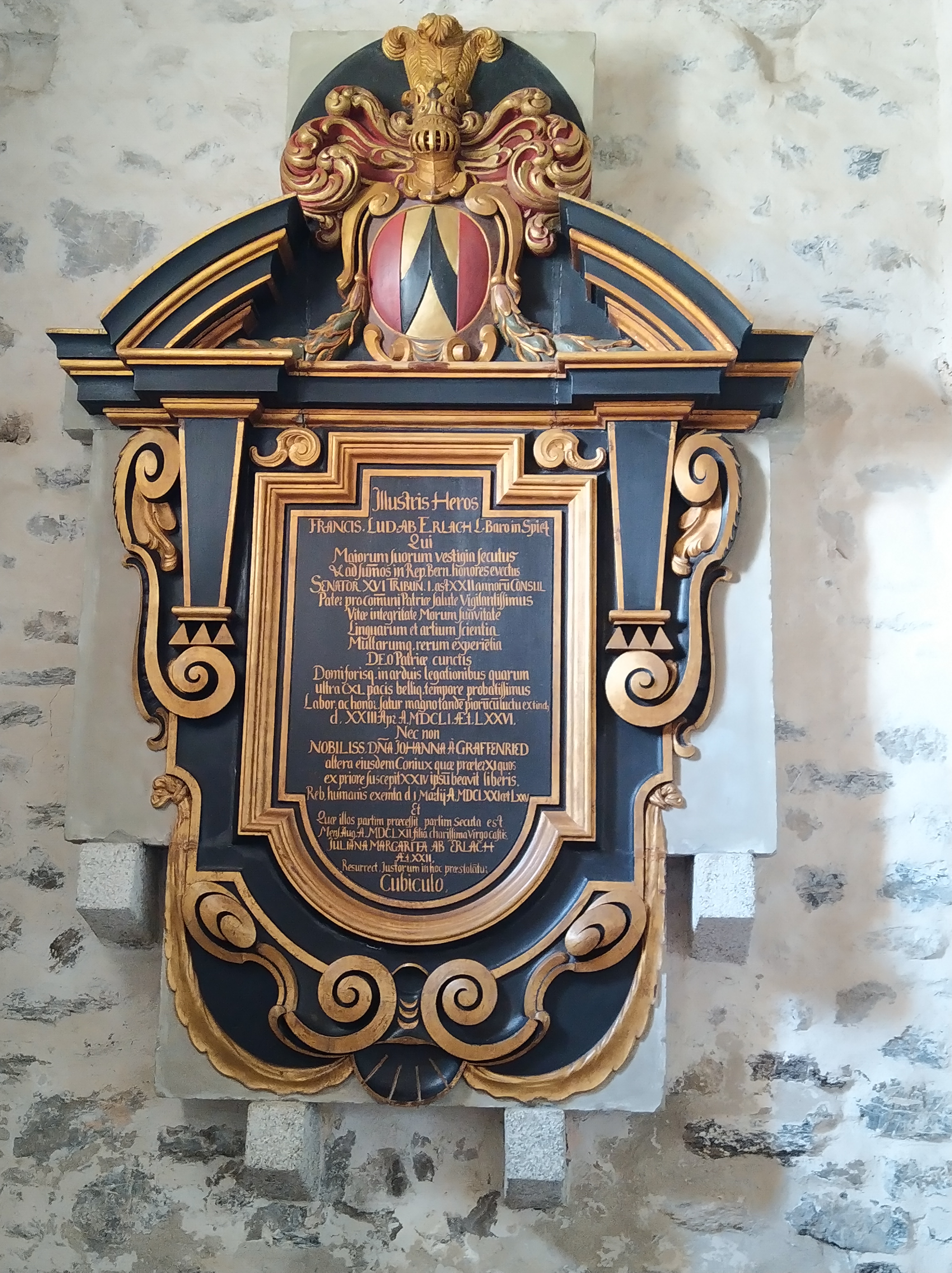
The castle changed hands numerous times, whether through political manoeuvring or through dynastic extinction. Last week, my article touched on the French invasion of Switzerland; After that 1798 French invasion and the creation of the Helvetic Republic, the von Erlach family lost the rights to hold the lands as well as their jurisdiction over the village, but retained ownership of the castle until 1875. In the church is a panel in Latin about the titles of the baron von Erlach and of (who I assume was) his wife, Johanna Graffenried (from another noble family in Berne), with the family crest (see the images below).
This past summer, my husband and I toured the castle and the church; it was an awe-inspiring feeling to know that we were walking where people have walked for well over a thousand years; where nobility and peasants, servants and pilgrims have stood, walked, talked, lived and passed. Here are a few impressions of the castle, church and the views we enjoyed, and I hope you enjoy, too.
This past summer, my husband and I rented a motorhome and travelled around Switzerland; we tend to prefer nature or museums to overly-touristy attractions. One of the places we visited was Spiez Castle. Before I tell you about that, however, a little historical backdrop is necessary, so buckle up and enjoy the ride!
Everyone’s heard of the French Revolution, which began in May 1789: It was a struggle to become free from the heavy yoke of an elitist monarchical regime, quasi out of the frying pan and into the fire of the Reign of Terror – during which many of the original rebels, in a twist of morbid irony, also had their heads removed by Monsieur Guillotine; it ended in November 1799 with the abolition of the Ancien Régime and the creation of constitutional monarchy (not far from where they started) and the French Consulate (which lasted nearly 5 years until the start of the Napoleonic Empire in May 1804).
But what many people might not know is that the French Revolution was internationally both influenced and influential. Modern “small world” effects are not modern at all; even in ancient times, people had international news: Travelling merchants and traders, messengers, signal towers (such as those the Romans used along the British frontiers), and even smoke signals, all conveyed news. When the French Revolution began, there was already a growing political dissent spreading throughout Western Europe; the English “coffeehouse culture” enabled men to gather in small groups and discuss business and politics; this concept travelled to America, and the discontent culminated in the American Revolution, starting in April of 1775. The French people watched and learned. The British government naturally became wary – they were losing the American colonies to the Revolutionary War, which they finally lost in September 1783. The Americans were supported during that time by France and Spain (the two main long-term enemies of Britain), so the British were hemmed in by threats to their own social order from both the east and the west, and they had well-founded fears of the discontent sparking revolt in the dry tinder of their own oppressed ranks.
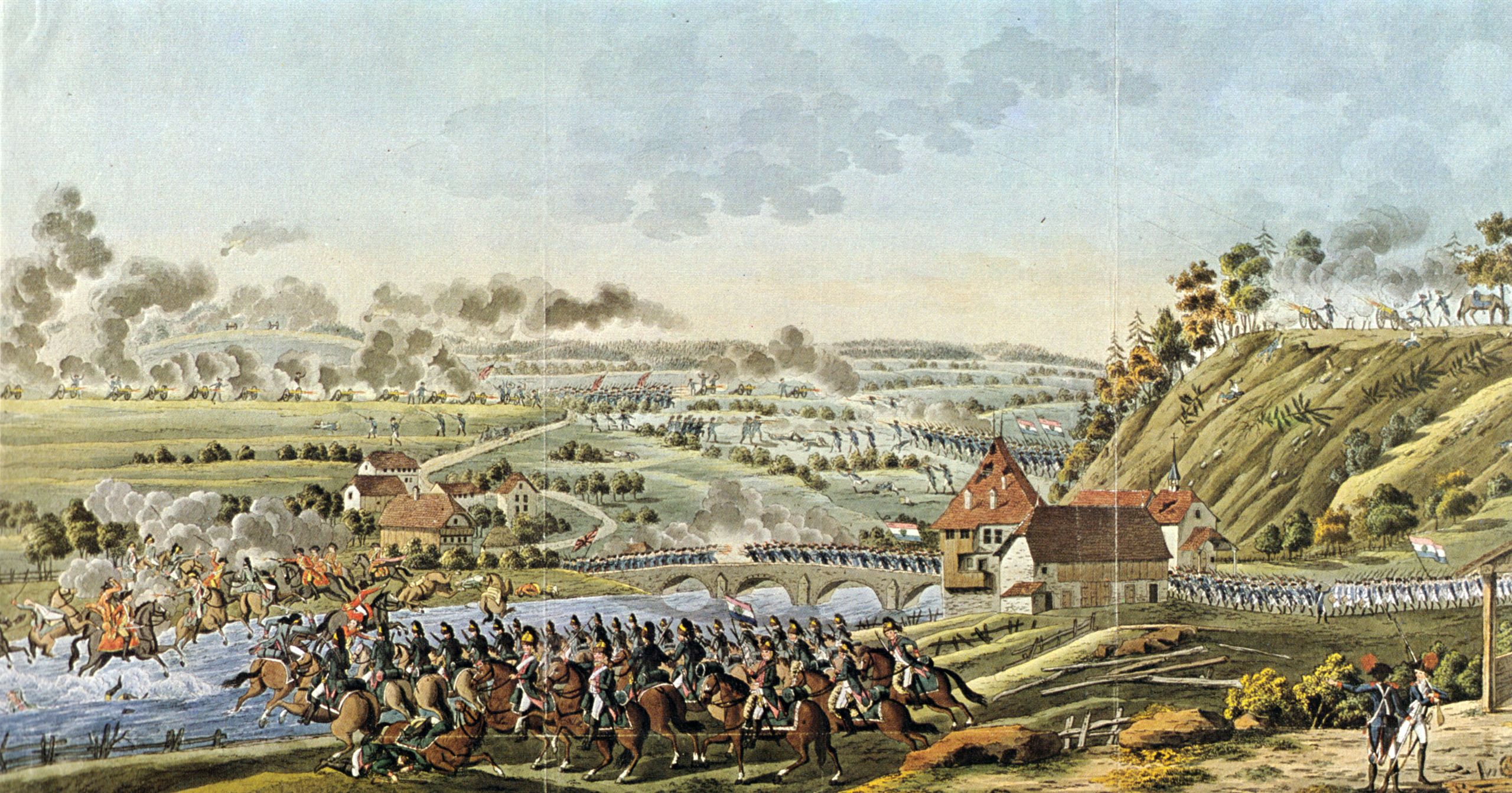
And now we come to Switzerland: To understand the Swiss backstory in a nutshell, which does no justice to a history that began in the Palaeolithic Age or further back, let me sum it up: The Old Swiss Confederacy was an alliance between independent small states, starting on 1 August 1291 with the “Rütlischwur”(an oath of allegiance between the cantons of Uri, Schwyz and Unterwalden), which date is considered by the Swiss to be the birth of the nation (though history is more complicated). As the French Revolution was beginning to wind down, Napoleon Bonaparte, then a French general, pressed the French Directory (the then-current French governing committee) to invade Switzerland. The atmosphere within the Old Swiss Confederacy was tense, fearing that the French Revolution would spill over with or without direct French military involvement. At the invitation of a French-speaking faction in Vaud (then part of Canton Berne), 12,000 French troops invaded through Vaud on 28 January 1798, and for the next four months, battles were waged between the French and the Swiss “Loyal Legions”. It ended in May with the swift collapse of the Swiss Old Confederacy.
The Battle of Neuenegg, 1798 – Graphics Collection, Central Library, Zürich
However, the French Directory needed a solid neighbour, a buffer zone along their eastern borders, not a loosely associated collection of small states; they tried to steer toward a re-establishment of national unity with a Paris-drawn constitution, but on April 1798, Swiss cantonal leaders proclaimed the Helvetic Republic, with new legal structures that abolished feudal rights within individual cantons in favour of a national unity. A few battles later, and coalition armies waging war in and around Switzerland against France, eventually left Switzerland as a sovereign, neutral nation; it has remained so ever since, despite two world wars.
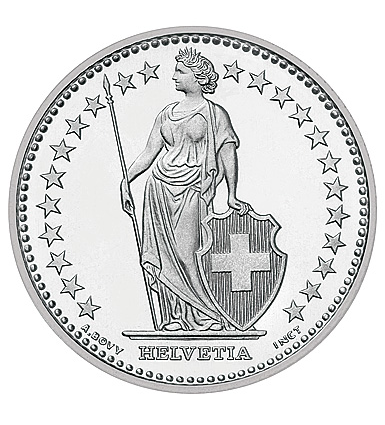
An etymological side note on the Latin name of the Swiss Confederation (Switzerland), Confoederatio Helvetica: Helvetia is the female personification of Switzerland, found on nearly every coin, much like Lady Liberty of America. The name derives from Helvetii, a Celtic tribe that inhabited the Swiss Plateau since before the Roman Era. The earliest reference of the name is dated to ca. 300 BC, written in Etruscan on a vessel from Mantua (located in Lombardy, Italy). By the time the Romans arrived, they were well-established tribes governed by noblemen; the Roman historians tended to refer to anyone not Roman as “barbarian”, which tends to skew modern understanding of the peoples they conquered; it was perhaps their way of justifying invasions against peaceful, intact civilisations. Naming no names, but R—– is repeating that same shameful tactic today; there’s nothing new under the sun.
It’s easy to overlook the complexities of historical events or view them from only one nation’s side; after all, as Mark Twain once wrote, “The very ink with which all history is written is merely fluid prejudice.” History’s angle is in the hands of those who wrote it – if they were Roman, everyone else was barbarian; if they were English, the Scottish / Irish / Indians were backwaters in need of a guiding stick, and so on.
So, now that you know a bit more about the history in and around Switzerland, I’ll highlight Spiez Castle next!
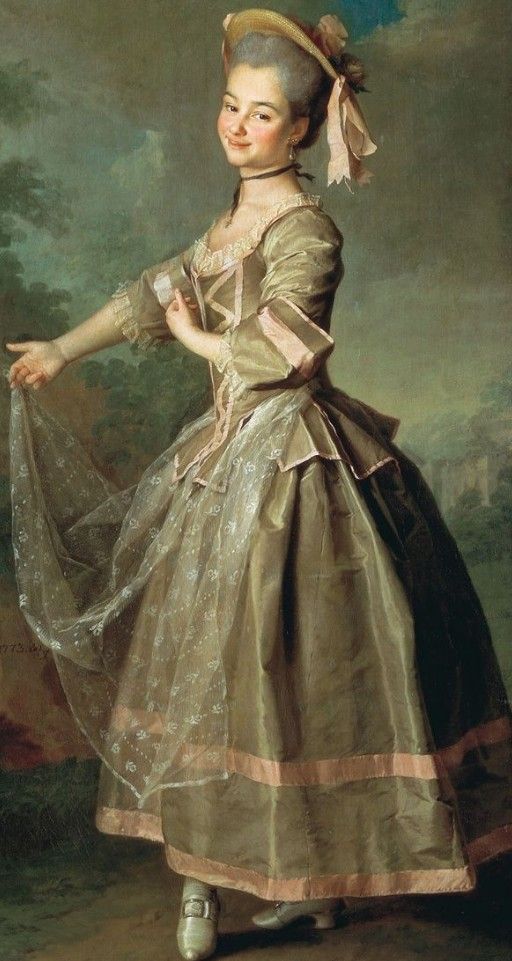
Aprons have probably been around since the dawn of clothing; up until the Industrial Revolution, most people only had the clothes on their backs, or at most one additional change of clothing – in which case they were considered either very well off or thieves; a large number of the thefts reported in the 17th and 18th centuries had to do with clothing articles; the clothes made the man or woman, and if they could upgrade their wardrobe through “five-finger discounting,” they might have a better chance at finding a good job with better wages. The style of aprons has changed through the years, and while sometimes their function was little more than a fashion statement, such as in the painting below, their main purpose has never become obsolete: To carry out every imaginable chore in and around the home.
Dancing Girl, Levitsky Dmitry, 1735-1822
My paternal grandparents, the Herrings, were Kansas pioneer farmers; my grandmother (Mary Mae) headed west from Indiana in a covered wagon with her parents (James Allen and Carrie Christine Higbee nee Aaroe) as a baby; she grew up on the prairies of Kansas, met my grandfather, and the rest is history.
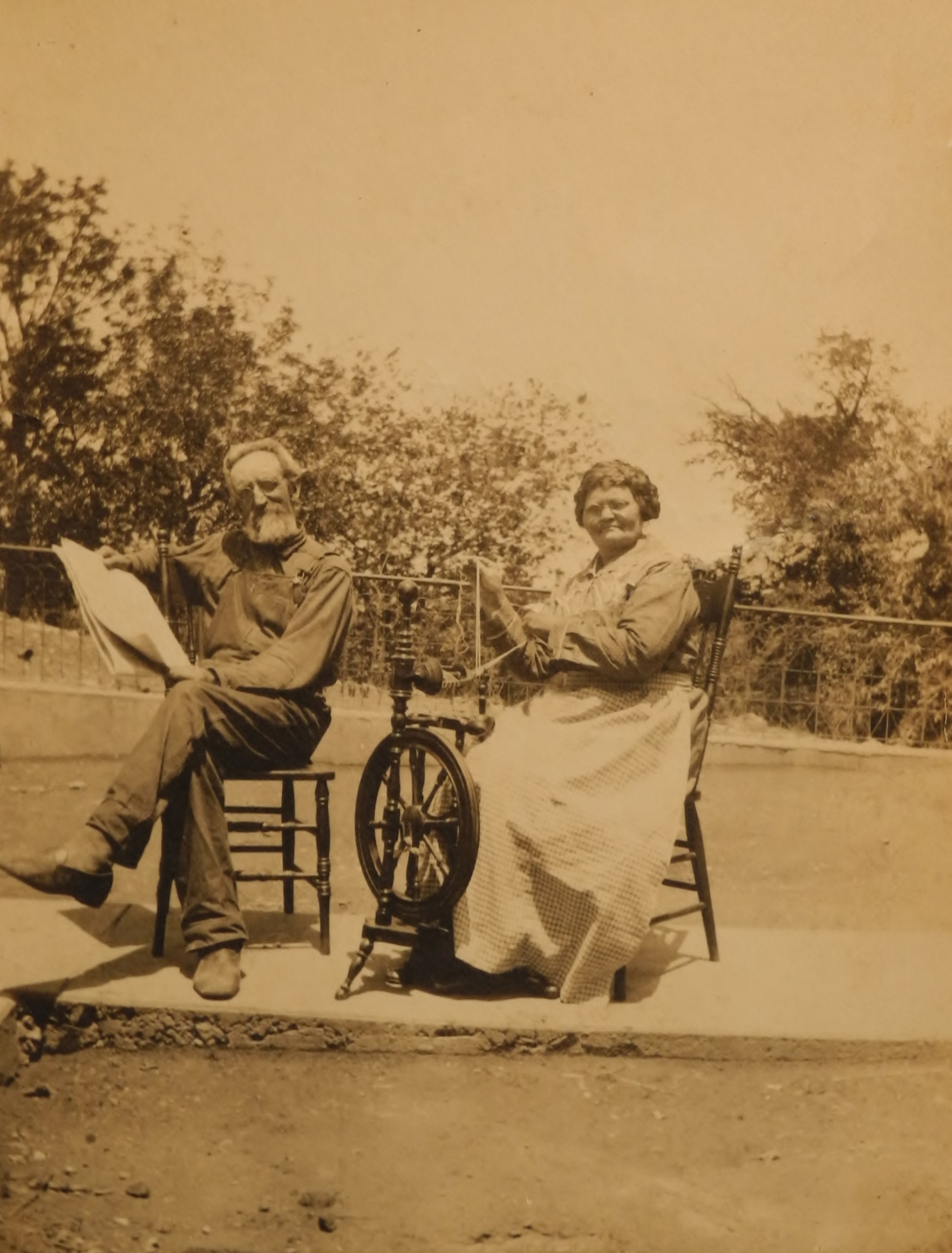
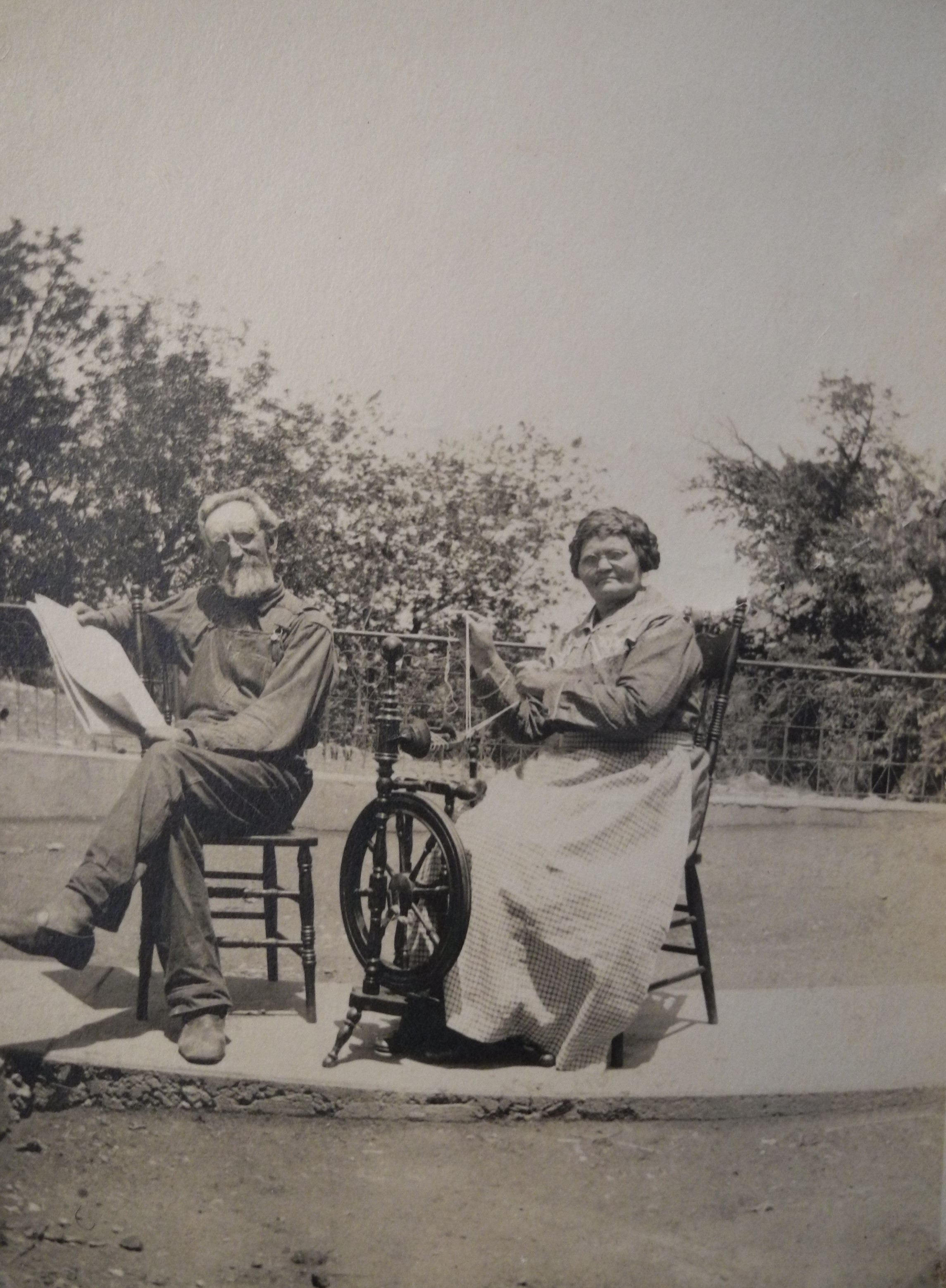
Nis and Maren Kirstine Aaroe-Aagaard, immigrants from Vonsild, Nørre Tyrstrup, Vejle, Denmark, who settled in Kansas; taken ca 1890. My great-great grandmother is in her daily apron at the spinning wheel.
Most of my childhood memories are of my paternal grandparents’ farm; we spent many weekends there helping out, and I spent a week or two every summer with them. My grandmother was always in an apron, except for Sunday mornings and special events – and those are the times when photographs were taken, so unfortunately I don’t have a photo of her in an apron. But I have something much better: A hand-sewn quilt, made lovingly by her from around 1920 to the late 1970s. The materials used for that quilt are her old aprons, Sunday dress scraps and other spare cloths; I remember seeing her in several of them.
Apron Quilt, Grandma Herring, sewn between 1920s and late 1970s
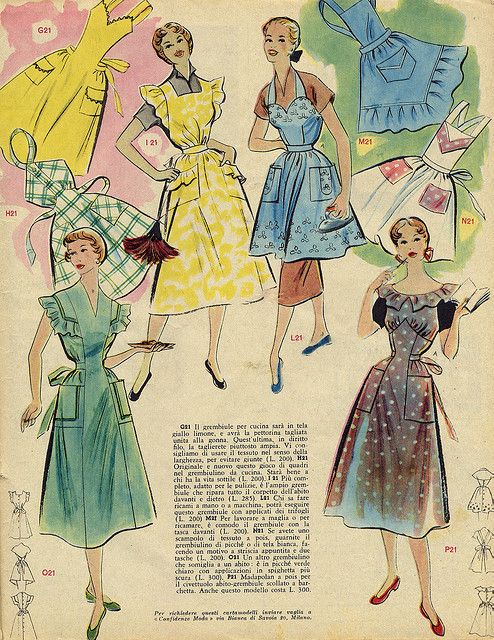
Apron – 1950s Vintage Fashionable Aprons
Being a farmer’s wife, my grandmother’s aprons weren’t as fancy as these vintage patterns shown above; they were plain, simple and hand-made; they did what they were needed for, and no more, no less. But as simple as they might have been, those aprons were worth their weight in gold on a farm: They protected her scanty wardrobe – she didn’t need much, didn’t want much, and was satisfied to take care of what she’d been blessed with. Those aprons carried baby chicks, kittens, flowers, herbs, chicken eggs, apples, firewood and wood chips, baby birds fallen from nests in a wind storm, and the occasional sugar cube for the horses. They wiped away tears, cleaned dirty faces, dusted furniture if guests were walking up the path, took delicious things from the oven, cold things from the freezer, and helped open canning jars. They shaded a cold pie on her lap in the old Chevy truck while we bounced across the fields to bring my grandfather a picnic for lunch break in the summer heat (she could have used an old quilt for the pie, but that was often used to cradle a large mason jar full of ice cold water, the best thirst-quencher I know). Those aprons helped gather grains, and stones to move either from the garden or to the flower bed. They carried chicken feed and broken eggs shells to feed the chickens to make their eggs stronger; they held potatoes, carrots, green beans, corn, sweet peas, strawberries and squash. They were the perfect cradle for a garden watermelon, rolling it into the refrigerator to get it nice and cold on a hot day. They warmed her hands on a cold day as she dug for the last of the potatoes before winter’s freeze, and hid her dirty hands when guests arrived unannounced. They polished cutlery, fanned her face to cool her down on a sweltering hot day, and were the perfect place to hide for shy children. One never knew what that apron would do next.
Little could my paternal grandmother have guessed that the quilt she made from so many scraps of memories would eventually accompany her granddaughter back over the ocean her mother had traversed as a newborn baby from Denmark, and end up within 20 km from where my maternal ancestors have been traced: Zofingen, Aargau, Switzerland. I can’t imagine any other piece of cloth carrying so much history, authority, importance, practicality, humility, common sense and love.
Adapted from an article originally posted on History Undusted, 5 Oct. 2015
Have you ever started what seemed like a small project, only to realize that you’d fallen down Alice’s rabbit hole, ala Wonderland?
I was sitting in my library last weekend, and I glanced up at a few old photo albums on the top shelf of one of our bookcases. I’ve been meaning to photograph, restore and edit those pictures for years, so I finally pulled one down and began. It happened to be my family history album, with photographs as far back as 1890. And so it began.
The last time I wrote an article about family history, only a couple days later I was contacted by then-unknown branches of that family – distant relatives who’d been looking for that kind of missing-link information. That article was posted on a dormant blog of mine, so I’ll post it here this coming week – who knows, maybe more relatives will show up for the party!
I spread the album open on our dining table, and began taking pictures of pictures (if you’ve ever done this, you’ll know that glossy photos are the bane of restoration attempts!), then painstakingly took out each scratch and superficial film blemish caused by age and my two emigrations (first Scotland, then Switzerland). I cropped, turned, tweaked and focused until each photo was restored and properly labelled. Then I began feeding them into a digital album program – when it’s ready, I’ll be able to order a physical hardback book, and the project will be on my cloud account to avoid losing the whole project, as happened once before (I still have the photos, and the printed book, so I can re-create it, but it hurts to have lost all that work through a computer crash, pre-cloud…!).
That’s when the first rabbit hole opened. Being a writer, I’m curious by nature. Or maybe my curiosity led me into writing. Whatever. I’m curious, and I love research. I also have a lot of experience in tracking missing persons: About 12 years ago, I tracked down nearly all of my 35 former classmates from Hawaii, 1986, from Australia to Guam to Norway to Brazil to Seattle. Every evening, when my husband came home from work, he couldn’t wait to hear what I’d accomplished that day: I “bribed” a retired LAPD detective with a bar of Swiss chocolate to track down one friend who was a hermit in the Californian mountains with no phone, no internet, and no address. I had enough for him to go on, and he put legs to my work – within 24 hours, I had my man – he came down the mountain for a phone call with me. Another friend had moved out of state from the last known address, and his name was a common one – too common to find him through conventional ways. So, I put Google Earth, white pages and intuition together, with a dose of southern charm (I’m not from the south, but I can turn it on if need be!), and got the state he’d moved to from a former neighbour of his – all he knew was where he might be working. Another friend was off-grid for security reasons – and I still tracked her down (I told her, “I could tell you how I did it, but then I’d have to kill you!” 😉) Needless to say, almost every track was an adventure.
Which brings me to the present rabbit hole: I’ve begun work on my paternal family album; on the maternal side, I don’t have any information beyond my great-grandparents, but I can trace my paternal grandmother’s family back to the Danish village they came from, on the island west of Copenhagen – and once I’ve filled in as wide as I can from the emigrated side, I’ll contact the Danish records offices or cemetery of the Old Town and go back further still if I can – so far, I’m into the 1830s; hopefully, such European records survived World Wars 1 & 2.
Nis & Maren “Mary” Aaroe, my great-great-grandparents, who immigrated with 2 small children to Kansas from Vonsild, Denmark in the 1880s. Here, in the late 1910’s.
There are a few websites that specialize in ancestry – but most of them want to charge you to see the information. I understand that a company needs to have a viable income to offset their costs, but such websites often rely on volunteer family members feeding in that information on their own dime, so I won’t support them. I have found two websites that have proven invaluable; if you want to do something similar, here they are:
www.findagrave.com is a website gathering of history and genealogy enthusiasts who photograph tombstones and gather personal information about the individual from official documents, obits, etc., with the purpose of honouring them and allowing others to find family members. It was the first time I’d seen my own father’s gravestone. I’ve been on there less than a week, and I’ve become the custodian of a dozen virtual family graves; it will be easier to add information as I come across it in research as the rabbit hole deepens. Through the efforts of complete strangers unrelated to my family, I’ve been able to fill in the blanks of missing birthdates and death-dates, as well as next of kin, and their next of kin, and so on. Another rabbit hole!
The second website is www.wikitree.com; it is a free website, like Wikipedia, but for genealogists to collaborate through, with forums and all kinds of helpful groups to get you started. So far, I haven’t needed any of the forums myself, but I’ve been busy building up the family tree and collecting pictures and information there. As I have my husband’s family tree already, it will be my next project on that website.
Keep in mind that I’m doing all of this in my spare time; I’m working on my 5th novel’s manuscript, and I have a husband in home office through the week, which means 2 meals a day instead of just 1 to plan ahead for and prepare. Someone does laundry, and cleans the house and goes grocery shopping – but since I haven’t been able to train our cats to do that, I guess it’s me, while my husband earns our keep. He earns, I spend – it works well for us. 😉
For the sake of potential relatives searching for family names online, my heritage is as follows:
Umbarger, Kuhns, Hüsler (Huesler), Aagaard (The anglicized Danish surname is sometimes misspelled as Agard or Aagard), Aaroe, Higbee, Herring. So glad I don’t have that string on my official documents! Two things can sometimes make tracking difficult is that firstly, maiden names are exchanged for the married surname, causing a break in the chain; secondly, the Ellis Island effect – officials didn’t know how to spell the name properly, so they recorded it phonetically, which makes unravelling the true path more of a challenge.
This week, the intrigue continues as I begin trying to track down the missing branches of my family. My goal is to make the album project available to even distant relatives who might be interested, although it will obviously have the emphasis of my personal perspective as far as photos go, the closer to my generation I get.
Have you done any family history research, or a family tree? Have you ever taken a DNA test? If so, what did it reveal about you and your ancestors? Please comment below!



























 Stephanie Huesler