Category Archives: Articles

In Other Words – Make Every Word Count!

I’ve been out of WordPress-land for the past week or so; I’ve been focused on editing and didn’t want to blog until I had something worth writing about.  I thought I’d tell you a bit about what I’ve been working on & thinking about:

One golden rule in writing is to make every word count; along that yellow brick road are all kinds of signposts and potholes.  Signposts are things like “make verbs do the actions”, while potholes are “watch out for unnecessary words” – either for the sake of padding word count (e.g. for a short story or report that needs to reach a certain word count), or words that slip in needlessly.  Examples of unnecessary words are -ly adverbs (if we use the best verb, the adverb will be superfluous), strings of adjectives, really, very, and there is/are/were/was.  Recently I’ve been scanning my current manuscript for the kinds of words that slip in easily while writing in a flow; I have a list of things that I watch out for personally, and one item is “there”.  While I try to catch them as I write, sometimes I will intentionally use them as a “place-marker” – knowing that I’ll come searching for them later, find it, and re-write the sentence or scene with a fresher eye than I had at the time I originally wrote it.  That’s just me – I know myself, that I won’t leave things like that long.  If you’re not sure you’ll catch those sentences you want to improve on later, then mark them with a different coloured text, or an e-post-it, or something that will jump out at you.

Mark Twain - Very, Damn

Here are a few examples of sentences (from my current manuscript) with “there” before and after editing:

…there was a crisp off-shore wind… —> …a crisp off-shore wind blew…

…there was no recollection in his eyes… —> …no recollection flickered in his eyes…

…there was a twinkle of amusement in his eyes… —> …amusement twinkled in his eyes…

…there was no sign of the HMS Norwich… —> …the HMS Norwich was nowhere to be seen…

…there would be dire consequences… —> …dire consequences would follow…

…there was a smirk on the captain’s face… —> …a smirk spread across the captain’s face…

Tightening up the wording makes the sentence less clunky and more precise.  Making every word count is not about reducing word count, although that will be a natural consequence sometimes; at other times, by changing the sentence to mean more precisely what you want to convey, it may result in the word count actually increasing.  Just make sure that the words you use carry their weight.  Waffling, rambling & repetition will not win us any brownie points; I could easily go into detail about the ropes of a ship of sail, but it would probably bore most readers to death!  Sometimes “less is more”; it’s enough to say “ropes”.  If I describe a surgeon’s table and list the instruments he’s about to use, it may be TMI (“too much information”) if using the word “instruments” is enough; if I want something more specific, then I could name a tool at a particular moment in the scene.  Though I like the (audio) book “The Host”, by Stephenie Meyer, my one gripe with it is what I call the “roll call” scenes – where the characters present are listed, as if in a roll call.  It’s TMI – it would be enough to say something like, “those I counted as allies were with me”.

Other times, a list of words may become a linguistic collage, painting a picture in the reader’s mind of a character, or a place, or a mood.  A classic example of this is Lewis Caroll’s Jabberwocky; most of the words are nonsensical, non-existent words, but they nevertheless paint a clear image in the reader’s mind.

It’s why writing is never an exact science, and why, as a writer, I can always learn something, always hone my skills.  If I ever become satisfied with my own level of writing, to me that’s a warning sign that I’m missing a significant moment of improvement.  That should never stop someone from publishing – from letting their baby grow up and go out into the world to make other friends – but in the writing and editing process, be prepared to let go of pet scenes, or even some characters, in favour of an improved manuscript.  Making every word count requires that we learn to recognise what counts, and what doesn’t.  So keep writing, and keep honing your skills!

4 Comments

Filed under Articles, Musings, Nuts & Bolts, Research, Writing Exercise

History Undusted: The Art of Cookery made Plain and Easy

L0014984 H. Glasse's "Art of cookery": lady and her maidThe Art of Cookery made Plain and Easy was written in 1747 by Hannah Glasse (1708-1770) and played a dominant role in shaping the practices of domestic cooks in England and the American colonies for over one hundred years.  It is an excellent reference for historical writers, reenactors, and living museums.  Hannah wrote mostly for the “lower sort” as she called them, domestic servants who might not have had much exposure to various cooking techniques or ingredients before entering the service of a larger household.  She wrote it in a simple language, and can come across at times quite condescending; her writing style, spelling variations (including capitalisation which was much like German, with all nouns capitalised), and punctuation are in themselves a fascinating look at the standard of printing and editing, and what was most likely “acceptable English” of the times (I dread to think what future generations might assume is the “standard” of our own times, based on the slipshod average of what is unleashed online…!).  I’ve tried to leave Hannah’s work as-is, though sometimes the auto-correct sneaks by even the most diligent.

In my current manuscript, the third book in The Northing Trilogy, Asunder, my heroine goes from being of the upper class to marrying a lieutenant in the Royal Navy, disobliging her family and being cut off by the father.  Her mother sends her Hannah Glasse’s book, and she writes a journal entry regarding her use of it and trying to decipher just what is meant by instructions that, even with the attempt at instructing servants new to the kitchen, assumes a great deal of pre-knowledge (e.g. “first skin the meat and take off all the fat” or “chicken, which must be very nicely picked and clean“).

She had a very clear opinion as to what was right and wrong, how a thing was to be prepared and “there is no other way to do it right.”  Many of the “receipts” (recipes) are still known, such as Hasty Pudding or Yorkshire pudding, while others would be unthinkable – whole Woodcocks, Ortolans and snipes (with nothing removed), or how to prepare meat when it’s begun to stink.  They served every part of the animal, from entrails neatly presented to split skulls (with specific directions for how to lay the tongue most becomingly…).  There were a surprising variety of spices, herbs and ingredients used, and which she assumed every household would have on hand, such as China root, balsam of Tolu, and liquorice; she even included a few Indian curry recipes, reflecting the East Indian connections.   She minced no words on what she thought of extravagant (read wasteful) French cooking habits, and her disdain was evident in numerous passages.  Her recipes were by no means all original; many were common sense, but many were also shamelessly plagiarised from other published works (perhaps we should be grateful for that now, as otherwise they might have been lost to the mists of time!).  There are recipes of how to certainly avoid the plague, how a ship’s captain could have food prepared for long voyages, and recipes for medicinal purposes.

Not all homes had ovens, and in one recipe it is worded “send it to the oven… when it comes home” – this would imply that it was sent to the village bakery, and brought home to finish off once it had been sent away to be baked.  Because of that limitation, many recipes are for boiling; they seemed to boil the living daylights out of meat, vegetables, or anything else that they could put in a pot.

It is a fascinating historical document, reference work and recipe source (many, purely for the pleasure of grossing out your kids or guests) for those interested; but for those not interested, it would be a torture for me to post hideously long blogs on the topic.  The book can be found nowadays on Amazon in paperback, or online in PDF format. Below, I’ll share the original “pre-index” image, and her own personal note “To The Reader”, which in and of itself is entertaining, informative and historical.  She minces no words on her disdain for the French, so to my French readers, I ask that they please take it on the chin with a pinch of salt and a wink!
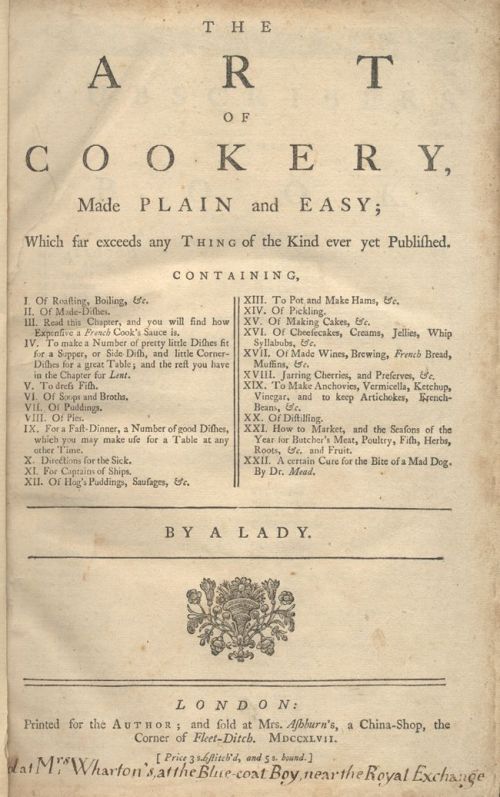
Hannah Glasse Book

Hannah Glasse’s “To the Reader.”

“I Believe I have attempted a branch of Cookery, which nobody has yet thought worth their while to write upon:  but as I have both seen, and found, by experienced, that the generality of servants are greatly wanting in that point, therefore I have taken upon me to instruct them in the best manner I am capable; and, I dare say, that every servant who can but read will be capable of making a tolerable good cook, and those who have the least notion of Cookery cannot miss of being very good ones.

“If I have not wrote in the high polite style, I hope I shall be forgiven; for my intention is to instruct the lower sort, and therefore must treat them in their own way.  For example:  when I bid them lard a fowl, if I should bid them lard with large lardoons, they would not know what I meant; but when I say they must lard with little pieces of bacon, they know what I mean.  So, in many other things in Cookery, the great cooks have such a high way of expressing themselves, that the poor girls are at a loss to know what they mean:  and in all Receipt Books yet printed, there are such an odd jumble of things as would quite spoil a good dish; and indeed some things so extravagant, that it would be almost a shame to make use of them, when a dish can be made full as good, or better, without them.  For example:  when you entertain ten or twelve people, you shall use for a cullis, a leg of veal and a ham, which, with the other ingredients, makes it very expensive, and all this only to mix with other sauce.  And again, the essence of ham for sauce to on dish; when I will prove it, for about three shillings I will make as rich and high a sauce as all that will be, when done.  For example:

“Take a large deep stew-pan, half a pound of bacon, fat and lean together, cut the fat and lay it over the bottom of the pan; then take a pound of veal, cut it into thin slices, beat it well with the back of a knife, lay it all over the bacon; then have six-penny worth of the coarse lean part of the beef cut thin and well beat, lay a layer of it all over, with some carrot, then the lean of the bacon cut thin and laid over that:  then cut two onions and strew over, a bundle of sweet-herbs, four or five blades of mace, six or seven cloves, a spoonful of whole pepper, black and white together, half a nutmeg beat, a pigeon beat all to pieces, lay that all over, half an ounce of truffles and morels, then the rest of your beef, a good crust of bread toasted very brown and dry on both sides:  you may add an old cock beat to pieces; cover it close, and let it stand over a slow fire two or three minutes, then pour on boiling water enough to fill the pan, cover it close, and let it stew till it is as rich as you would have it, and then strain off all that sauce.  Put all your ingredients together again, fill the pan with boiling water, put in a fresh onions, a blade of mace, and a piece of carrot; cover it close, and let it stew till it is as strong as you want it.  This will be full as good as the essence of ham for all sorts of fowls, or indeed most made-dishes, mixed with a glass of wine, and two or three spoonfuls of catchup.  When your first gravy is cool, skim off all the fat, and keep it for use. – This falls far short of the expense of a leg of veal and ham, and answers every purpose you want.

“If you go to market, the ingredients will not come to above half a crown, or for about eighteen-pence you may make as much good gravy as will serve twenty people.

“Take twelve-penny worth of coarse lean beef, which will be six or seven pounds, cut it all to pieces, flour it well, take a quarter of a pound of good butter, put it into a little pot or large deep stew-pan, and put in your beef:  keep stirring it, and when it begins to look a little brown, pour in a pint of boiling water; stir it all together, put in a large onion, a bundle of sweet herbs, two or three blades of made, five or six cloves, a spoonful of whole pepper, a crust of bread toasted, and a piece of carrot; then pour in four or five quarts of water, stir all together, cover close, and let it stew till it is as rich as you would have it; when enough, strain it off, mix it with two or three spoonfuls of catchup, and half a pint of white wine; then put all the ingredients together again, and put in two quarts of boiling water, cover it close, and let it boil till there is about a pint; strain it off well, add it to the first, and give it a boil together.  This will make a great deal of rich good gravy.

“You may leave out the wine, according to what use you want it for; so that really one might have a genteel entertainment, for the price the sauce of one dish comes to:  but if gentlemen will have French cooks, they must pay for French tricks.

“A Frenchman in his own country will dress a fine dinner of twenty dishes, and all genteel and pretty, for the expense he will put an English lord to for dressing one dish.  But then there is the little petty profit.  I have heard of a cook that used six pounds of butter to fry twelve eggs; when everybody knows (that understands cooking) that half a pound is full enough, or more than need be used; but then it would not be French.  So much is the blind folly of this age, that they would rather be imposed on by a French booby, than give encouragement to a good English cook!

“I doubt I shall not gain the esteem of those gentlemen; however, let that be as it will, it little concerns me; but should I be so happy as to gain the good opinion of my own sex, I desire no more; that will be a full recompence for all my trouble; and I only beg the favour of every lade to read my Book throughout before they censure me, and then I flatter myself I shall have their approbation.

“I shall not take upon me to meddle in the physical way farther than two receipts, which will be of use to the public in general: one is for the bit of a mad dog: and the other, if a man would be near where the plague is, he shall be in no danger; which, if made use of, would be found of very great service to those who go abroad.

“Nor shall I take upon me to direct a lady in the economy of her family, for every mistress does, or at least ought to know, what is most proper to be done there; therefore I shall not fill my Book with a deal of nonsense of that kind, which I am very well assured none will have regard to.

“I have indeed given some of my dishes French names to distinguish them, because they are known by those names:  and where there is a great variety of dishes and a large table to cover, so there must be a variety of names for them; and it matters not whether they be called by a French, Dutch or English name, so they are good, and done with as little expence as the dish will allow of.

“I shall say no more, only hope my Book will answer the ends I intend it for; which is to improve the servants, and save the ladies a great deal of trouble.”

Originally posted on History Undusted, 28 May 2013

5 Comments

Filed under Articles, History, History Undusted, Lists, Research

Interconnectivity

interconnectivity-internet

Interconnectivity

This weekend I led a singing workshop; at the time I was focused on the instrument as such, and the amazing, complex expressions the voice can produce.  I covered topics like anatomy, and the psychology of singing, as well as techniques and choices – the “paint palette” a singer can learn and use to produce a desired impact on the listener, painting an image before the mind’s eye through the choice of vocal colour and tone.  For me, the truest sense of interconnectivity in the context of vocals is that they are an expression not only of an individual’s anatomical uniqueness but also the personality, and even the spiritual condition.  I believe that we are created in the image of God – that is, a trinity:  We are body, soul, and spirit; and as such, when one area is facing challenges it will affect the other two areas, as well as the expression of the voice, tone, attitude and even the extent of the performer’s control over their vocals at any given moment.  [I also touch on this topic in my article about layering.]

Afterwards, the writer’s side of my brain kicked in and I began thinking of such things in terms of character development.  As I build a character’s profile, something must challenge that character or they’ll come across as flat and lifeless.  If a character had a traumatic experience with water as a child, they may have to face their fears through swimming across a lake, or getting into a rickety boat; if they’ve been abandoned by a parent, they may need to recognise a paralysing fear that keeps them from committing to relationships, and their arc may have primarily to do with overcoming that fear or not – it may be a side issue, but it will still add depth and humanity to the character.

Whatever weaknesses or challenges I decide on for a given character will guide the story to some extent; they will also influence their attitudes, responses and reactions in connecting with other characters.  These things will in turn influence the way they dress (rebellious, reserved, bold, fearful, quirky to keep people at a distance, etc.), the way they might walk or talk, or certain quirks like mannerisms or ways of speaking.  I might go through a list of a hundred related items (if they’re the main character, especially) to narrow down who the character is, even though most of it might not make it into the final cut.  The more I understand my character, the more consistent their responses, dialogues and actions will be throughout the story.

I just thought I’d share these thought processes with you, in the hopes that they can inspire you in your own characters’ developments.  Give them challenges, and find ways they can overcome (or be temporarily overwhelmed) in the midst of other more pressing issues, and (if you’ve chosen the path of hero-success over hero-failure) still find a way for them to triumph in the end.

Save

Save

3 Comments

Filed under Articles, Musings, Nuts & Bolts, Plot Thots & Profiles, Writing Exercise

History Undusted: WW2 Shipboard Journals

The following post was originally 3 separate posts on my History Undusted blog; it is a lengthier post than I usually offer, but well worth the read for those interested in history, World War Two, and life in the US Navy.  Enjoy!

My grandfather, Raymond Dale Kuhns, was a clerk aboard the cruiser USS Metevier for 6-9 months during World War 2, based out of San Diego, California.  His typewriter was bolted to the desk, the desk to the floor, but his chair was on rollers; so he’d type a few letters before rolling away, and wait to roll back; ever after he typed with the hunt and peck method, as it apparently didn’t do much good to learn touch typing.

The document below is the onboard journal that he kept during that time, beginning in November 1944, through June 1945.  There are a few notes for clarity interspersed, written by myself, or by my mother, Connie, of stories he told her; she was three at the time.  While the journal entries are very matter-of-fact, without many personal “memoir” elements, it is still a fascinating historical insight into life aboard a ship during the Second World War.  My grandfather was the biggest practical joker I will ever care or dare to come into contact with; any practical jokes that happened aboard, such as the monkey and chicken, were most likely instigated by him…

November 1944 – February 1945

3 Nov. 1944 – Underway in heavy fog.

4 Nov 1944 – Loaded ammunition.  Dropped some down hatch!  Whew!

9 Nov. 1944 (mail sent)  Passed through gate to Limon Bay, Canal Zone, Panama.   Moored Coaling Pier, Cristobal.  Left (Nov) 10th, went through Miraflores Lock.

13 Nov. 1944 (mail sent)  Crossed equator at 0756.  Now a “Shellback”.  (Connie’s note- Dad told stories about the hazing men endured first time to cross the equator. – had to run a gauntlet of fire hoses in action,  a “swat-line” between the “old timers” hitting them with paddles,  all kinds of practical jokes, etc.).  Entered Deolian Cave, Baltna Island, Galapagos.  Saw 2 seals, fishing.  Left 14th.

25 Nov. 1944. (mail sent) Entered Bora Bora, Society Island.  Beautiful.  Purchased 2 grass skirts, bracelet, 2 sets beads.  Were they made in U.S.???  Left 26th  (Connie – “We probably still have the grass skirts – and I know there is a picture of AJ and I with them.  Also, the “beads” were small conch shells – probably also a pic somewhere, I’ll try to find it”).

Summary:  Month was uneventful.  Seasick first night out.  Never set my foot on land.  Received no mail.

3 Dec. 1944.    No such date for us.  Crossed the International Date Line.

6 Dec. 1944.  Missed wife on her birthday.  Great gal.  Made landfall on Solomon.  Skirted NW tip of Guadalcanal.  First liberty.  4 Cokes!!  Left 8 Dec.

11 Dec. 1944.  Entered Humbolt Bay, Dutch New Guinea (“Hollandia”)  Left 19th

14 Dec. 1944.  Connie’s birthday.  Miss the rascal.

25 Dec. 1944.  Miss my wife and kiddies especially.  First enemy contact. Dropped bomb.  One plane.  Undamaged or undamaging.

26 Dec. 1944.  Entered Leyte Gulf.  Left 27th.

Summary:  Looks like business is picking up.  I forgot to mention that Dec. 24th, we made our first depth charge attack.  No luck!  Amazed at mass of ships in Leyte.  No attacks while there.

15 Jan. 1945.  Leaving Lingayen Gulf for  Leyte??

16 Jan 1945. Friendly plane came out of clouds. G.Q. called (“general quarters”).  Came near firing.  From angle it approached, we couldn’t hardly of missed.  A real scare.

17 Jan. 1945.  0300 D.Disn. Convoy destroyed Jap barge.  Search light revealed several Japs in it.  Used 5″ and 40 mm.  Did not try to rescue any.

20 Jan. 1945. (mail sent/  mail received)  Entered San Pedro Bay, Leyte, Philippines.  Hope wife receives letter I wrote today.

26 Jan. 1945. Left Leyte for invasion of Luzon, just north of Subic Bay.

29 Jan. 1945.  14 hours minus 1 or 7:30 naval bombardment of beaches to begin.  However, 10 minutes before, Philippine guerillas came out and informed us territory taken.  So this invasion force of 60,000 landed without a shot being fired.  We are sitting 60 miles from Manila.  It is now mid-afternoon, and Japs have not contested invasion at all.  Things look good for us here.  Left 2000 for Leyte without once contacting enemy.

30 Jan 1945.  Ship in convoy was struck by torpedo.  No casualties.  Ship towed in and repaired.

This month really went fast!

1 Feb. 1945.  Arrived back in Leyte.  No action or alerts on return trip from Luzon.  Too late to go after mail!!!  SHUCKS!

2 Feb. 1945.  Liberty in Leyte.  6 Cokes!!  Learned foot soldiers’ view of our enemy.

3 Feb. 1945 (mail received/ mail sent)  Brought 2 monkeys and 2 roosters aboard.  Had to get rid of them.

6 Feb. 1945.  Left Leyte without getting any more mail.

11 Feb. 1945.  Arrived Woendi.  This is a group of coral islands near New Guinea.  Beautiful.  Like a vacation here.

12 Feb. 1945.  Liberty.  Played basketball, then went swimming.

13 Feb. 1945.  Received special liberty to play on baseball (softball) team.  Defeated tug 4 – 3 in 10 innings.  Won 4 cases beer and got 5 cases from ship.  The boys all came back stewed.  I had to drink one for thirst.  No fresh water available.

14 Feb, 1945,  Left this “rest camp” with memories of best time since leaving dear wife and kiddies.  Going back to front in all probability.  Feeling ready now.  Hope to get mail SOON!!

20 Feb. 1945.  (Mail received/ mail sent)  Arrived back on Leyte.  Trip back uneventful.  Received 24 letters. Boy oh Boy!

21 Feb, 1945.  Liberty.  Sold beer for $1,  gave other 3 away.

24 Feb, 1945, (mail sent/mail received).  Received 16 more letters.

25 Feb. 1945.  Attended church USS Wasatch.  Refused liberty. Stayed aboard and wrote letters.

27 Feb. 1945.  Left Leyte for Mindoro.  Glad to get away.  Poor liberty.

Summary:  This month very uneventful.  Enjoyed liberty at Woendi more than anything else.  Got fairly well caught up on mail.

Here are a few extra bits of trivia from my mother:

  • “4 Nov. ’44 –  the “Whew” was probably a prayer of thankfulness that the whole load had not exploded when some got dropped!
  • I only heard your grandpa talk once about the horrors he must have seen. – ships blown out of the water, etc.  He and my uncle Victor talked one Christmas when I was a teen about picking surviving mates off an adjacent ship in the fleet that had been torpedoed – and picking survivors out of the ocean.
  • 13 Feb ’45.  Your grandpa didn’t drink beer – of course, his father (Reverend H.A. Kuhns) wouldn’t have liked it – although before H.A. was saved, he had “owned a dance hall” – your grandpa told me after we were grown women.  So I’m sure beer at least was part of my grandpa’s experience B.C.
  • 25 Feb. ’45 –  Of course “liberty” for most meant finding liquor and women, which were not for your grandpa.  I am so thankful for the Christian heritage we have!!!!!”
  • Note of interest:  Aboard they slept in hammocks; once the guy above him jumped up at the call for general quarters, and knocked himself out on the overhead beam; needless to say he didn’t make it to his station on time…

March – April 1945

raymond-kuhns-age-45-taken-in-1965

Raymond Kuhns, Age 45, taken in 1965

[NOTE:  Back in the mid-1980s I was in the Philippines for two months, living near the Subic Bay Naval Base just across a bridge from Olongapo.  I saw up close and personal the temptations men in the military face, and for a Christian man such as my grandfather, he had to try and find alternatives to “going out with the boys” on liberty, though often the Red Light District was (and is) where the restaurants were, so it was a Catch 22.  When I was living there I was working with a Christian missions organisation among the prostitutes, drug dealers and pimps, as well as those who worked in street shop/booths (I’m still in touch with one or two!), and our home was a place for the Christian military men to come and hang out when they were off-duty; nearly every day I’d come down to the living room to find strangers there, reading or talking.  I don’t know if he had such a place back then, but fisherman’s missions and military missions are far more common now, because the temptations (the sex industry, drugs, alcohol, etc.) are more rampant than ever.  When I returned to the States he enjoyed talking to me about Subic and the PI as he knew it, and I think it was special for him to talk to his granddaughter who had seen some of the places and things he’d seen so many years before.]

1 March 1945.  This month started off with a bang.  Dropped D.C. (depth charges)- 5 of them in the middle of the night.  I was on helm.  Boys sleeping really thought we got it. Entered Mindoro.

2-5 March 1945.  (mail sent/mail received) A/S duty Mangatin Bay.  Got mail, which means they transferred us here for duty.

6 March 1945. Off Manila Bay A/S duty, then returned to Mangatin Bay.

7 March 1945.  Entered Bay for fueling.

8,9,10 March, 1945. Another A/S* sweep to Luzon. (*anti-mine sweep)

11 March 1945.  Back to A/S Mindoro.

12 March 1945.  (mail sent/mail received).  Got mail via ship that had been in Port.  Proceeded into Bay and got more mail.

14 March 1945. Availability cancelled.  A ship on A/S sweep run aground we had to relieve it.  Just our luck.

15-18 March 1945.  A/S sweep and on 18 entered Mangarin for 2 days availablity.

19 March 1945.  Liberty in Mindoro.  Quite a place.  Rode in a jeep with army captain to San Jose.  Saw sugar mill that was hit by P-47 in morning.  Saw unit of paratroopers who made landings on Corrigedor.  Helped sort mail at P.O.  FINALLY got Christmas presents. Included billfold, leather toilet kit, shower shoes, pictures, and wedding band.  Every gift perfect.  One box of candy had to be thrown away.  Really enjoyed it even though it was late.

20-23 March 1945.  A/S sweep off Mindoro.

24-25 March 1945. (mail sent/mail received)  A/S sweep to Luzon and returned.  Fueled and got underway for Leyte.  These two days were roughest I have seen.  Had to strap myself in sack.  Did not get sick.  36 bags Christmas mail.

26-28 March 1945.  Escorting Army tug with barge at 3-1/2 knots.  No wonder it took us 4 days to get here.  Entered San Pedro Bay.

29-31 March 1945. (sent mail/received mail).  Available for maintenance.  We got 11 bags of mail, but most of it was rest of Christmas packages.

Summary:  Most of this month was spent on ping line of A/S duty.  The first was most amusing.  Christmas packages really helped our moral.  Nothing exciting or dangerous.

1-4 April 1945.  (mail sent/mail received)  In San Pedro Bay.  Received one liberty – had interesting conversation with Philippine guerrila.  Scabby sores on natives pathetic sight.  Still getting good mail service.  Red Light District.

(Note: the “scabby sores” were probably secondary syphillis – sailors often given penicillin IM before they let them off the boat!)

5 April 1945. Underway to Manila.  3 escorts with one troop ship.  15 knots – exceptionally fast convoy.

7 April 1945.  Arrived Manila. Passed very close to Corregidor and got a good look at it.  Liberty in Manila.  What a place.  Harbor full of sunken Jap ships.  Every building in business district damaged.  Most of them blown to bits.  Saw Jap mass-burial place.  Cars that looked like strainers.  Eats very high – 75 cents for one scoop ice cream.  Rode in cart affair (horse-drawn) through town cost us $2.50.  Men came back to ship drunk and not virgins.  People dress very American.  Had to wear whites on this liberty.  Really got my first glimpse of war devastation.  Got stamps and money souvenirs.

8-9 April 1945. Anchored in Manila harbor.  No mail service here at all.

10 April 1945.  Left Manila for Leyte

11 April 1945.  All hell broke loose at 1130.  We rammed native sailboat that was carrying 42 persons.  Called to G.Q.  As I was asleep, I really bounced out of my sack when alarm sounded.   Arrived at G.Q. station and heard hysterical screams of survivors and saw them as we illuminated them.  Picked up 37 survivors.  Continued search.  Picked up 2 small babies floating face down.  Dead when rescued, but boys worked feverishly for 3 hours with artificial respiration, but no luck.

12 April 1945.  (sent mail/received mail)  0330 another G.Q. with fire amidships.  I couldn’t imagine us having another G.Q. and just stood and listened to alarm, but when fire was announced, I tore up to station.  I was not in my sack at the time, as survivors had our compartment.  Two small girls had my bunk.  Fire not serious and confined to drying room.  Had 4-8 watch, so was up till 10:30 next night without sleep.  One small baby died from effects of night before.  Transferred the survivors around noon, as we arrived back in Leyte.  There were 36 alive (one expected to die), 3 dead, and 3 we could not find in the wreckage.  The miracle to me was the number that lived through the ordeal.  Saw anguish in mothers’ faces as they looked at dead children.  Saw and sympathized with those who missed their children.  The native craft was supposed to have been 50 feet in length and cost 10,000 pesos.  A very large native boat.  It was taking natives away from Japs on Mindanao.  We were first Americans they had seen since 1941. Doubt very much if they were happy to see us.  Made Y2C (Yeoman 2nd class).  Received authorization from ComSerfor.  Ship was very nice and did not make me wait for first of month.  That means treats for the boys.

13 April 1945.  (mail received)  Learned of President’s death (FDR).  Also got news of being 50 miles from Berlin.  Liberty at Pambujuan, Samar.  Pulled joke on chief regarding censorship regulations – very effective.

14 April 1945. LOST MY WEDDING BAND!  Don’t know how or where.  Did not eat morning chow, I felt so bad.  Hope my darling wife isn’t too mad at me for it.

15 April 1945.  (Mail sent/mail received)  Church on USS Medusa.  Memorial service for Roosevelt.  Very good.  Got our first fresh provisions in approx 3 months.  Received  letters from Wanda. Put 3 coats of paint on bottom of ship in 48 hours.  Not bad while in dry dock. Got us up at 5:30 for special sea details, then didn’t get away before 1100.  Purchased treats on ratings*. (Note:  *Rations?)

May – June 1945

25 April 1945 (sent mail/received mail)  Received Easter pictures.  Just love the ones of my wife.

26 April 1945 Saw 10 carriers of British Fleet which was a  big encouragement.  Firing practice.

27 April 1945 (mail sent/mail received)  Underway to Okinawa.  More firng practice.  New war cruising watch.  Now at G-2.

30 April 1945.  G.Q. at 0200.  3 planes.  Did not close.  Started dusk and dawn alerts.

Summary:  What a Month!!  Interesting at Manila.  Sailboat incident.  Lost wedding band. Made Rate (grade of official standing of enlisted men). Dry Dock (Whooie).  Headed for Okinawa.  196 days since I have seen my family.  Sure miss them.

1 May 1945 –  Rolled D.C. (damage control?) at good contact. At 1305, called to G-2.  Exploded a mine.  We were headed right for it when lookout sighted it.  Explosion sent water 150 feet in the air.

2 May 1945. Arrived Okinawa.  No suicide raids.  Shelling beaches.

3 May 1945.  1000 left Okinawa in company with BB Tennesee.  Heard of suicide raids 6 hours after we left.  One DD who was stationed 3000 yards from us was hit with 5 suicides.

4 May 1945.  Big suicide raids on Okinawa and Jap reinforcements landed.  Believe God definitely answered prayers of protection on this mission.  It was too rainy all the time we were in Okinawa for raids.  Numerous ones feel we were fortunate and lucky, but as far as I am concerned, God gets the credit.

6 May 1945. (mail sent/mail received)  Arrived back in Leyte after sinking floating nets earlier in the morning. Received 11 letters – more than I deserved for the ones I wrote this trip.

7 May 1945.  Liberty.  tramped through hills of  Samar.  Rest of day uneventful.  May 8 or 9- V.E. Day!!

9 May 1945  Into Dry Dock again.  Sound dome came loose.  Oh Me!!  Manicani Island.

10 May 1945.  Water hours.

11 May 1945.  Left dry dock.  Reported on ping line between Homonhon Island and Dinagat Island in Surigao Straits.  This is point of big Philippine naval battles.

12 May 1945.  Firing practice.  Shore bombard on Dinagat Island.

13 May 1945.  Firing Practice.  Held Vesper service in accordance with President’s request for prayers. Remembered and offered thanks for V.E. Day.  Mothers’ Day.  Sure miss you, Wanda.   Picked up loose sono buoy.

14 May 1945.  AA (anti-aircraft) Practice.  Knocked down sleeves, which indicates we could hit airplanes. Returned to Leyte.  Movies.  I played checkers.

15 May 1945. (mail sent/mail received).   Received 5 letters.  On liberty in Samar.  Boys couldn’t get over seeing WAC Camp – white women.  First group we have seen.  Played checkers again.

16 May 1945.  Starting on mail run.  Best and safest duty we could have gotten.

17 May 1945.  Arrived Zamboanga, Mindanao.  First stop on mail run.  Natives came out to ship in droves.  Bought large seashell.  Left at 1300.

18 May 1945.  Arrived Panay, second stop mail run.  PT boat came out so we didn’t go into port.  Left 0700.  Arrived Mindoro at 1900.  Showed movie.  Left 1000.

19 May 1945.  Arrived Manila 0600, left 1130.  Arrived Subic Bay 1500, left 0630.

21 May 1945.  Arrived Leyte 0600. Trip very uneventful.  No mail.  I was sort of disappointed.  Attended U.S.O. show on beach.  Oklahoma – very good under conditions.

22 May 1945.  Left 0930 for Guivan Roadstead.  Arrived 11:00.  Got stores, had movie in PM (I played checkers).

23 May 1945.  Left 0600.  Arrived Leyte 0800.  Left Leyte at 1000 for San Bernadine Straits.

24 May 1945.  Arrived on patrol station in straits. Boiler trouble, so we head back to Leyte.

25 May 1945.  (mail sent/mail received).  Saw 2 water spouts.  Arrived back home.  Received 3 letters.

26 May 1945 (mail sent/mail received)   Received 2 more letters today.  Got 2 Cokes off Medusa, Oh Boy!  2 for a nickel.

26 May to 9 June 1945.  Tied up alongside Medusa.  Enjoyed being able to get Cokes, Ice Cream, liberty every third day, and movies every night.  One  fellow went nuts and run off in the woods.  Not such a bad idea.  It got him back to the states.  Good church services on Medusa.

10 June 1945. Underway 1800 for Calicoan to get supplies.

11 June 1945.  Helped get stores on beach.  Missed good turkey dinner.  Left for Leyte about 1800.  Just got outside nets when we discovered 3 men left behind, so we turned around.

12 June 1945.  Headed for Leyte with full crew. Then headed out for patrol halfway between Leyte and  Yap. Firing practice.

15 June 1945. Dropped hedge hogs [A type of depth charge employed against U-Boats which were thrown ahead of the ASW ship. These devices were designed to explode on contact.].  Probably scared fish.  Sub reported sighted in our area, but we didn’t get any good contacts.

17 June 1945.  FATHERS’ DAY.  Oh me!  Here I am way out here. Headed for tropical storm area to investigate storm.  This navy is NUTS at times!!

He signed off “This is all I have”  – apparently he had written more, but the rest was lost – either while he was still in the military or in the subsequent years.

My grandfather passed away 8 February 2004.  I saw him for the last time in October of 2003 when I went back to America for a visit; I told him at the time that I knew it would be the last time I’d see him this side of heaven, and that I would not be able to be there for his funeral (I live in Switzerland).  His response was typical:  He said, “Well that’s alright, I won’t be there either!”  I loved him dearly, and I miss him; but I did give him one final warning:  God had strict instructions not to allow him anywhere NEAR my mansion until I get there… no booby trapping allowed!

Originally posted on History Undusted, 28 May 2013
Save

6 Comments

Filed under Articles, History, History Undusted, Military History

Imagination vs Knowledge

Some say that imagination is more important than knowledge; to a certain extent, that may be true because imagination leads to new discoveries, inventions, and revelations.  But knowledge is often the basis for such discoveries; that which has been passed down by others who’ve researched, discovered, identified and recorded are the foundational stones upon which things are often built, whether in science, technology, or life in general.

beware-of-the-half-truth-wrong-halfIn this day and age, however, sometimes imagination overtakes knowledge (or simply ignores it).  An informed mind is a powerful tool; an uninformed mind can be a dangerous weapon.  This is true whether writing non-fiction, fiction, or passing on something on social media.  We should beware of the half truths – we may have gotten hold of the wrong half.

It’s now more important than ever to test the veracity of reports and even images; anyone can make an ass out of an angel, so to speak, with photoshop, et al.  How much misinformation is spread by simple carelessness or wilful misdirection (that includes, unfortunately, mainstream news media)?  Or by assuming that since something is from a trusted friend it must be true?  How often have you gotten upset by an article you’ve seen and commented on it, or passed it on, allowing it to form an opinion in your subconscious at the very least, and in your active thoughts at worst, only to find out later that it was a false report, a hoax, or sloppy journalism?

abraham-lincoln-internet-quote

As you probably know, I love to learn; I have a steel trap of a mind for little bits of trivia, like the fact that certain microbes concentrate and disperse (read “poop”) gold, or that all living creatures, including you and I, emit visible light (probably a byproduct of biochemical reactions).  As a writer of fiction that comes in handy; I can extrapolate knowledge and use it as a plot detail or a character quirk; but when I’m writing a blog, e.g. about a historical detail, I want to make sure I get it right.  A case in point was an article I wrote in 2014 about post-mortem photography in the Victorian period; it was by far the most popular post to date on that blog and continues to generate interest.  In particular, two points from the article were addressed, researched, and edited/corrected either in the article itself or in the comments and discussion that ensued.  Mistakes happen, but when I catch them, I will do my best to correct them!

For writers, it is important to cross-reference anything you find online, especially if you’re basing something significant on it such as character development, location, or plot.  Assumptions can also get you into trouble; I know that Geneva is part of Switzerland, but in writing 18th-century fiction, I need to be aware of the fact that it was merely an ally of the Swiss Confederacy from the 16th century, but only became part of Switzerland in 1814.  Any reference I have to it in my trilogy needs to reflect that fact.

I recently read a collection of short stories on Kindle, and on nearly every single Kindle page there were mistakes (that adds up to a lot of mistakes per manuscript page!):  Missing words that the authors assumed were there, typos, commas 2 or 3 words off-position, stray quotation marks, and countless words they assumed were the correct ones but obviously were not (e.g. catwalk instead of rampart for a castle).  This is where imagination overtook the writer, and knowledge gave way to ignorance…  I have understanding for one or two such errors in a manuscript of that length, but none whatsoever for several per page; that simply smacks of laziness and poor-to-no editing, and it boils down to an unintentional slap in the face to any reader who’s taken the time to read their story.

Knowledge without imagination is like a rusted hinge; imagination is the oil that makes the knowledge come to life, and the writer is the door handle that opens the door to new worlds, new ideas, new discoveries, and inventions. It sounds noble, doesn’t it?  But did you realize that many of the electronic gadgets we take for granted today were at one time birthed in the imaginations of men like Gene Roddenberry, creator of Star Trek?  It inspired countless children who went on to become astronauts, scientists, and engineers, who made those science-fiction inventions become reality and discovered distant worlds (now known as exoplanets).  I’m waiting with bated breath for the transporter to replace airline security queues…

Those hinges are necessary, as is the oil, so that the door handle can do its job and get out of the way, allowing the world beyond to unfold.

Save

Save

2 Comments

Filed under Articles, History, History Undusted, Musings, Nuts & Bolts, Plot Thots & Profiles, Research, Science & Technology, Space, Astronomy

Buying Credit

No, the title is not referring to money or cash cards, but writing.  Stick with me.  If you’ve made yourself at home here and nosed through my cupboards, you’ll know that I do a LOT of research.  I love it.  It adds spice to my character’s meals, salty spray that blackens the redcoats of marines aboard a royal navy ship, tells me that heated arsenic smells like garlic, and makes the ship creak so loudly you’ll swear you’re going down to Davy Jones’ locker.  But there are times when, as an author, I’m required to blur the lines between fact and fiction.

There are certain things that people erroneously assume (such as Viking helmets) that I may need to adapt in order not to lose a reader’s trust (though trust me, I will never add horns!):  The sentence structures of bygone days were far more complex, with vestiges of Germanic linguistic influences – for my current manuscript (set in 18th century England and mostly aboard a Royal Navy ship of the line) I need to modernize the syntax without losing the High English flavour, and without compromising on the linguistic purity of my story’s time-setting; modern sensibilities (in social ladders, issues such as slavery, war, etc.); laxer standards (in, say, relationships or politics or social ranks), and so on.  A modern reader will most likely not appreciate the complex social mores of a time when men and women were never alone in a room – even when the man wanted to propose to the woman, and the parents wanted it to take place; and so, such things need to be adapted at times, to a certain extent, to reach a modern audience without alienating the audience that revels in bygone literature.

If I, as an author, want my reader (who is perhaps a stickler for all things historical) to give me the permission to bend a few social rules of the 18th century, I must first buy credit with them – prove to them that I’ve done my homework – so that they won’t get ripped out of the story in disbelief when I contrive to leave a man and a woman alone in the same room without a chaperone.  In my current manuscript, the husband and wife come from opposite ends of the social ladder, and the husband becomes a captain in the royal navy at the tender age of 20 or 21.  Both of these situations have many historical precedents; I know that from countless hours of research.  But most people who read historical novels might think, “But Viking helmets always have horns” – or something to that effect.  If written well, these disparities in understanding can be smoothed over, so that when I really DO break historical moulds, I am allowed to do so without offending the reader “in the know”.

1761-joshua-reynolds-lady-elizabeth-keppel

1761, Lady Elizabeth Keppel, by Sir Joshua Reynolds

This portrait illustrates an important point:  Many people, when thinking of the British rule of India, perceive it through postmodern lenses; we see it from the hindsight of Gandhi and the independence of the country from the imperialistic rule of British paramountcy.  But the other aspects were the children and wives of British soldiers, diplomats, and tradesmen, and the loneliness faced, the friendships struck with Indian men and women… these are important aspects to weave into a story, too, and thus require research.  Notice the pearls adorning the Indian woman below?  The researcher in me wants to know her story far more than the story of Lady Keppel (who died of a broken heart at the age of 29, just months after her husband had died of injuries from a riding accident).  Some readers may get jolted out of the world you create by the pearls, though it is historically accurate – so you’d still need to buy credit by setting up that aspect well.

These same credit-buying rules apply to any genre, even science fiction:  If you create a world set on another planet, that world will have laws – physics laws, indigenous social mores, etc. – and you as a writer must know what they are, and if or how they can be broken if need be.  You can’t claim that all liquid on the planet is frozen, and then have your character drinking from a fountain or stream, unless you explain how that’s possible.  If you do, you’ve taxed your believability credits and pulled the reader out of the world they’ve agreed to follow you into.  The manuscript that I’ll work on next (after the current one is published!) is science fiction; the air of the planet is toxic to humans, so I need to create a way for facial expressions, dialogue, etc. to come through even when the characters are outside in their suits.  I have done a lot of preliminary research into geology (that told me about heated arsenic, among other things); I also need to explain how a planet with multiple suns can have a stable enough orbit not to be drawn into one of the stars and burn up – i.e. I need to follow known physics laws, or explain how they are suspended for my planet.  I think you get the idea!

So if, as a writer, you want readers to believe what you write about a fictional character set in British India, you first need to buy credit with your readers by doing your historical homework and sculpting the landscape and characters in the rich tapestry they deserve.  If you are writing science fiction, establish your world and stick to your rules so that, if you need to bend them for a plot development, the readers will be willing to follow you on the adventure.  Whatever you do, keep writing!

Save

Save

Save

8 Comments

Filed under Articles, History, Military History, Nuts & Bolts, Plot Thots & Profiles, Research, Science & Technology, Writing Exercise

A Little Light Reading… Not

I will admit that I have quite odd tastes in reading, especially for a woman; I tend toward history, nautical, and obscure or long-forgotten books.  In writing my current manuscript, which is Asunder, the third book in the Northing Trilogy, I’ve read more than a fair share of military history books, specifically covering the 18th century of the Royal Navy.  Once, on a research trip to London, I searched out a bookstore that specializes in military and transport books, even reputed to have remainders; I don’t think they’d seen a woman in the shop in years (who’d entered intentionally) by the looks I got; one of the men even said, “The beauty shop’s two doors down, love.”  When I asked if they had the out-of-print autobiography by William Spavens, a unique lower deck view of the 18th century navy, they froze as if they hadn’t heard me correctly.  The question must have been laced with catnip, because after that I had the entire shop of men eating out of my hand, and I spent nearly two hours in there being helped to the finest pick of naval history books (including the autobiography I was after!).  Sadly, the last time I was there the shop was gone, but I’ve since found the largest used book shop in London, Skoob, which is highly dangerous for a bibliophile with a private library…!

A few of the books I’ve read in the course of research for Asunder are fairly gory, like Medicine Under Sail (I’d bet my bottom dollar that the screen writers for “Master and Commander“, with Russell Crowe, read that book as they wrote the script) and “Poxed & Scurvied” – the story of sickness and health at sea, while others have been like reading a thriller, such as “The Seven Years War” by Rupert Furneaux  or “A Sailor of King George” by Captain Frederick Hoffman.

I devour history books like other people devour pulp fiction; but especially during the first draft of the book, I had to continually keep in mind that I was writing historical fiction, not a history book; the details that I included had to serve the plot and character development, and not visa versa.  Only a fraction of what I learned has gone into the book; but those rich details give salt to the waves, creaks to the ship, and whip to the rope (I’ve also spent hours aboard the Cutty Sark “filling in the blanks” of a docked ship, so to speak, but that’s another story).  I could have peppered the dialogue with so much naval slang you wouldn’t have been able to swing a cat (naval slang, by the way), but if readers were to get ripped out of the story trying to figure things out, then I would have missed the mark.

So, the next time you sit down for a little light reading, you might want to consider one of the books linked above; then again, if you don’t want gory dreams, rather go with “The Price of Freedom“, or “Redemption“, or “The Cardinal, Part One or Part Two“…  and enjoy!

third-rate-ship-of-the-line-diagram

One of my library posters

8 Comments

Filed under Articles, History, Military History, Musings, Nuts & Bolts, Research

History Undusted: Decisions, Decisions

In May 2013, I began blogging here on WordPress; at the time, I had several topics of interest that I wanted to pursue, and to that end I began several blogs.  As time has marched on sometimes other priorities took over, or focus changed, and now I have three active blogs.  This eponymous blog is my home-base, but one of my favourite blogs to write besides this one is History Undusted.  I love finding the dusty bits of history and “undusting” them for the unsuspecting public.  But sadly, it has never really seemed to find notice by WordPress, and many of the posts have gone unseen.

Because history and the research thereof is a big part of my writing process, whether it be Viking history, archaeology, Scottish history, 18th century England, science, technology, advertisement, historical characters, or any of a dozen other topics, I have decided to combine the two blogs into this one.  If history isn’t your thing, don’t worry – I will still enjoy posting articles regularly about the writing process and the nuts and bolts involved!  I will begin “importing” (and, if necessary, augmenting) those blogs gradually, until they’re all safely here.

So without further ado, here is the first offering:

Decisions, Decisions

gieves-dress-wheelHave you ever heard of a butler (or male servant, in general) referred to as “Gieves” or “Jeeves”?  This might just be where it all started:  The Gieves Gentlemen’s Tailor Company was founded in 1771, and became a limited company in 1785; their dress wheel aided naval officers in choosing what to wear at any particular occasion, for any part of the world they might have found themselves in at the time.  Dressing, even for men, was an extremely complex social signal in bygone eras.  By 1935 there were twelve styles of dress, including tropical options.  By turning the wheel, an officer could see just what to wear on any occasion.  A handy little marketing device, it gained Gieves loyal royal naval customers, and the company has thrived ever since, with loyal customers including members of the British royal family today. For an interesting history of the company, click here.

Sir P.G. Wodehouse, an English author and one of the most widely-read humorists of the 20th century, named the comical fictional character of his shrewd valet “Jeeves”; the name was taken from Percy Jeeves, who was a cricketer killed during the First World War. Both the wheel and the fictional character served to cement the name in the collective conscience of the western world as a reliable servant.

Originally posted 27 May 2013 on History Undusted

10 Comments

Filed under Articles, Etymology, History, Images, Military History, Research

New Year’s Resolutions

new-years-resolutions-3It’s that time of the year again, when people talk about “New Year’s Resolutions”, as if the turning of the yearly calendar will somehow magically give them the impetus to make changes.  Rarely does it work that way, however.

A work colleague of my husband once upon a time trained to be a competitive  cyclist, and he said that once one makes the decision to give up in a race – for whatever reason – it makes it all the more difficult to persevere thereafter… once resolve caves, winning it back is harder work than ever before.  The same can be said of life, and resolutions.  If our daily goals don’t match our long-term goals, those long-term goals will never be reached; if we give up or cave in, we’ll find daily excuses why we can’t reach for the goal “yet”, and we’ll have a growing sense of guilt that makes us less willing to face the challenge.

Resolutions at the beginning of the year are usually related to a desire to better oneself; but resolve is something that’s built on a day-to-day basis, and should be a process.  If you set a mental goal – such as going to the gym twice a week  – which is not in agreement with your heart’s desires, then it won’t happen; our mind and heart need to get aligned in order for us to reach any target.

So I say, rather than making a resolution, become resolved.  Take baby steps to reach a goal; those steps might be to go on a walk once a week, or to take the stairs instead of the lift, or to purchase an exercise bike and put it somewhere in your home that’s a motivating place (e.g. near a window with a nice view), and then resolve to build up your stamina gradually with an initial time limit, stretching it as you feel you want to rise to the challenge.  If your goal is to write more, then decide on a specific amount, and take those baby steps – make space in your schedule, or learn how to utilize “limbo” moments toward your goal; carry a notebook and pen, and use them.  If your goal is to appreciate those around you more, then begin to focus on the positives, not the negatives; learn to compliment more and criticize less.

Whatever you want to see change in your life, go for it!  If you fail today, pick yourself back up, dust off your knees, and try again tomorrow.  Anything worth reaching is worth the effort, and every new day is full of opportunities.

Have a wonderful year, and may you look back on 2017 with satisfaction, knowing you’ve grown in positive ways!

6 Comments

Filed under Articles, Cartoon, Musings

A Blast from the Past: 1906

Living in the Cyber Age, it’s easy to forget that personal computers only came into existence for the mass market in 1981 (and even then, didn’t become common household items until the early 1990s), with the launch of the IBM Personal Computer (they coined that term, and the shortened “PC”).  We got our first personal computer in 1993, and it had the astounding RAM of 256 MB!

As far as telephones went, I grew up with several:  My grandparents’ farm had a box phone on the wall, with the separate ear piece; then they modernized to a heavy black beast of a rotary phone – the kind you could really slam down if the need arose; in fact, you had to be careful how you set it down when you weren’t upset, because it was so heavy that it might sound like a slam in the receiver!  My family had wireless land-line phones, but the signal was poor if you moved much farther away than a long cable would have allowed.   Remember the impatience of dialling a number on the rotary dial, especially if it contained nines or zeros?  And remember that curly cable that got tangled on itself from being over-stretched?  Cell phones didn’t really come into their own until the late 1990s as a mass-market item; kids today would find that hard to imagine, as they seem to think they’ll fall off the edge of the known universe and die if they leave the house without their cells.

Before Spotify, iTunes or MP3s, and even before CDs were common, cassette tapes and LP (long-play) records were all the rage.  Remember winding cassettes with a pencil?  Now that films like “Guardians of the Galaxy” have highlighted cassettes, this generation thinks they’re a novel gadget, and history begins to repeat itself with the labels of “retro” or “vintage” attached to make “old” sound “cool”!  We had an 8-track player in our car, with a cumbersome disc the size of an old Beta movie cassette case.  My father was always at the cutting edge of technology, and in the late 70s we had a laser disc player; the DVDs were the size of LP records (yet looked just like a CD or DVD of today), and we had films like “Logan’s Run” and “Heaven Can Wait”.  The technology didn’t catch on, so I’ve never known anyone else who had that contraption (an image below shows the size comparison to a modern DVD).  Another gadget we had was a set of picture frames hanging on our living room wall; they were filled with psychedelic lights that reacted to sounds, changing colours as you talked, sang, or watched television.  The topic of TVs is a whole other kettle of fish!  As the way of dinosaurs, cassettes and 8-tracks, CDs are nearly a thing of the past now, with digital clouds; even television stations will struggle to survive in the changing technology with on-demand digital providers becoming more popular.  Here are a few images to stir your nostalgia for stone-age technology:

This slideshow requires JavaScript.

With so many changes happening just within a few decades, it’s easy to imagine that a century ago, things were even more different.  I wish I had statistics for Europe, but here are a few US stats for the year 1906 – 110 years ago.  Some of these items came in the form of a chain e-mail several years ago, and I didn’t forward it; even so, I’ve made new friends, I haven’t been hit by a meteorite, and I’ve been perfectly happy, despite the threats that come from breaking such a chain…

  • 18% of households in the US had at least one full-time servant or domestic help.
  • 2 out of every 10 adults were illiterate; only 6% of all Americans had graduated from high school.
  • 90% of all doctors had NO college education; they rather attended “medical schools,” many of which were condemned by the press and the government as sub-standard.
  • A 3-minute call from Denver to New York City cost 11 dollars.
  • A competent accountant could expect to earn $2,000 per year, a dentist $2,500, a veterinarian between $1,500 and $4,000, and a mechanical engineer about $5,000 per year.
  • Alabama, Mississippi, Iowa, and Tennessee were each more heavily populated than California.
  • Canada passed a law that prohibited poor people from entering into their country for any reason.
  • Crossword puzzles, canned beer, and ice tea hadn’t been invented yet.
  • Marijuana, heroin and morphine were all available over the counter at corner drugstores; pharmacists claimed that, “Heroin clears complexion, gives buoyancy to the mind, regulates the stomach and bowels, and is, in fact, a perfect guardian of health.”
  • More than 95% of all births in the US took place at home.
  • Most women only washed their hair once a month, and used borax or egg yolks for shampoo.
  • Sugar cost 4 cents per pound; eggs were 14 cents for a dozen; coffee was 15 cents a pound.
  • The American flag had 45 stars: Arizona, Oklahoma, New Mexico, Hawaii and Alaska had not yet been admitted into the Union.
  • The population of Las Vegas, Nevada was 30.
  • The average life expectancy was 47.
  • The average US worker made between $200 and $400 per year.
  • The average wage in the US was 22 cents per hour.
  • The maximum speed limit for most cities was 10 mph.
  • The tallest structure in the world was the Eiffel Tower.
  • There was no official Mother’s Day or Father’s Day.
  • There were about 230 reported murders in the entire US.
  • There were only 8,000 cars in the US, and only 144 miles of paved roads.
  • With a mere 1.4 million people, California was only the 21st-most populous state.
  • The five leading causes of death in the US:
    1. Pneumonia and influenza
    2. Tuberculosis
    3. Diarrhea
    4. Heart Disease
    5. Stroke
  • The top news articles of the time:
    1. Roald Amundsen, Norwegian explorer, located the Magnetic North Pole.
    2. Ethiopia declared independent in a tripartite pact; the country was divided into British, French, and Italian spheres of influence.
    3. Finland was the first European country to give women the vote.
    4. President Roosevelt sailed to the Panama Canal Zone. It was the first time a U.S. president travelled outside the country while in office.
    5. Reginald Fessenden invented wireless telephony, a means for radio waves to carry signals a significant distance. On December 24, he made the first radio broadcast: a poetry reading, a violin solo, and a speech.
    6. In Economy, federal spending was $0.57 billion; unemployment was 1.7%, and the cost of a first-class stamp was 2 cents.
    7. On 18 April, a magnitude 7.8 earthquake hit San Francisco, California, killing over 3,000. Though many have heard of the famous quake, a less-publicized 8.8 magnitude earthquake hit Ecuador and Columbia earlier in the year, on 31 January, causing a tsunami.  On 16 August, a magnitude 8.2 earthquake in Valparaíso, Chile left approximately 20,000 dead, while on 18 September, a typhoon and tsunami killed an estimated 10,000 in Hong Kong.  The media all but ignored such events, making the San Fran earthquake the best-known, though it was the least of all these events in the loss of lives. [Note the warning about shooting looters, from the San Fran mayor, in the images below.]
    8. A few famous births in 1906: Dietrich Bonhoeffer (4 Feb.); Hans Asperger (18 Feb.); Lou Costello (6 March).

Below are a few ads and gadgets from 1906 (gleaned around Pinterest), for your amusement:

This slideshow requires JavaScript.

5 Comments

Filed under Articles, History, Images, Musings