These past few weeks have flown by so quickly, I’ve hardly had time to look up from my keyboard! Except when I went to the optometrist for new glasses (there might have been a slight connection between the two). I’ve been editing my final sci-fi draft. When I need a break from editing, I’ve been reading into articles by the new ebook company I’ll be working with, Draft2Digital, which has recently merged with Smashwords (my current and former platform). And in the context of editing, I’ve been down several rabbit holes:
Dashes
Back when I learned English, we had the good ol’ hyphen and the dash. Somewhere along the way the en-dash and the em-dash moved in, and they turned out to be worthy additions to the conversation. Now to make things confusing, 2em-dashes and 3em-dashes have elbowed their way into the punctuation party. I’m not sure how I feel about them yet, but their definitions seem to have squeezed the others so close that they often overlap or exchange places on the definition and usage dance floor. Until I need them to fix me a drink, I’ll probably ignore the party crashers.
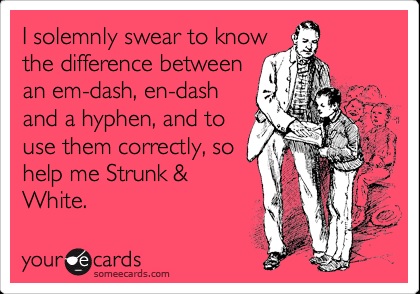
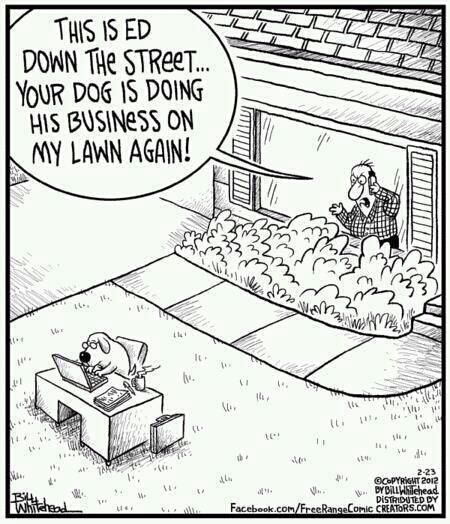
Strunk and White’s The Element of Style is a cornerstone of grammar and writing style and is widely considered timeless; in fact, it was listed by TIME in 2011 as one of the 100 best and most influential books written in English since 1923. The irony of this cartoon is that when I recently pulled out my copy to find out the nitty-gritty of using en- and em-dashes in dialogue, I found not a jot or tittle about them in the entire book. It covers hyphens and dashes, both briefly, but nary a word beyond. Every website that I looked at had contradictory definitions and usages of all types of dashes; so until an authoritative source comes up with a defined set of rules, I will continue to use them the way I’ve learned them, and just be consistent in my punctuation within my current manuscript.
Dialogue Tags vs. Action Tags
Another rabbit hole I went down was a learning curve on the two types of tags. On one hand, I’d never honestly thought about the fact that there could a difference in punctuation between the two; on the other hand, for the most part, I’ve intuitively done it right, though not always, which is why I’ve added it to my checklist of edits – and something I will keep a closer eye on in the future. Here’s an example:
He said, “Oh, the irony of ignorance!” – This is a dialogue tag with its attending punctuation. Dialogue tags are any verb that can be spoken – said, cheered, whispered, etc.
He nodded. “I hadn’t thought about it, but that makes sense.” – Nodding is something done, and this is, therefore, an action tag. Notice that its attending punctuation is a period separating the action tag from the dialogue.
Two things make less logical sense to me; if you have insight on them or experience using them or reading them in novels, please comment! [Keep in mind that these are American English rules; I am writing my current novel in American English, though until now, I’ve written in Commonwealth English (I use that term rather than British English because it is used beyond Britain).]
- How often have you spoken and laughed, chuckled, or smiled simultaneously? These are, for me, nuances in spoken vocabulary, and not action tags. Would you rather write: He smiled, “I thought you might say that.” or He smiled. “I thought you might say that.” ? In this particular instance both would work, but there are times when it has the potential to break up the rhythm of a sentence or scene too much. Which do you prefer?
- When an action interrupts dialogue, it needs to be separated with (IMHO) rather odd punctuation, for example: “From what I’ve read about these dwellings” –he looked at the woman kindly– “they’re far from mud huts.” My years as an English teacher mean that missing commas and attached en-dashes hurt my eyes; maybe that’s why I needed new glasses!
Euphemisms
Another tangent this week has been looking for creative swear words. Nothing irritates me more, when reading a book, for the author to fall back on standard F-bombs. That just says too lazy to be creative to me. It’s unimaginative. It doesn’t make a character stand out from the rest of the lazy crowd. There are so many fun alternatives, there really is no excuse! Here are a few I’ve come across and found myself smiling:
- People cussing in a foreign language; it sounds better to them.
- Fart knocker (e.g. “you little fart knocker”)
- Sun of a nutcracker! Sun of a biscuit!
- Cheese n’ crackers!
- Shoot a monkey!
- Shiitake mushrooms!
- Well, butter my bum!
- Clusterfluff!
- In a type of Chinese Whispers, “Hells bells” became “hells bells, conker shells”, misunderstood by kids as “hells bells, taco shells” – now that family just yells, “Taco shells!” when they’re upset!
- Names as swear words might backfire if you happen to meet someone by that name; here are a few: Christopher Columbus; Gordan Bennett (in Scotland); Gottfried Stutz (here in Switzerland – I actually taught English in a company that had an employee with that name!)
- Sugar Honey Ice Tea!
- Sunny Beaches
- Fudgenuts
- Someone I used to know would say things like “bug knuckles” or “dog feathers” or “ants pants” when she was upset.

These are just a few of the areas I’ve delved into in the past few weeks; I’m still deep in the editing/proofreading process; once that’s complete, the “behind the scenes” checklists begin – those are the things readers will never see: The number of hours put into finding the right images and designing the best cover art possible; choosing the right fonts; formatting for the various mediums online and print; writing blurbs, preparing marketing bits and bobs, and setting up all the dominoes in a row for the final push of publishing!
Clusterfluff! I’d better get my fanny in gear!



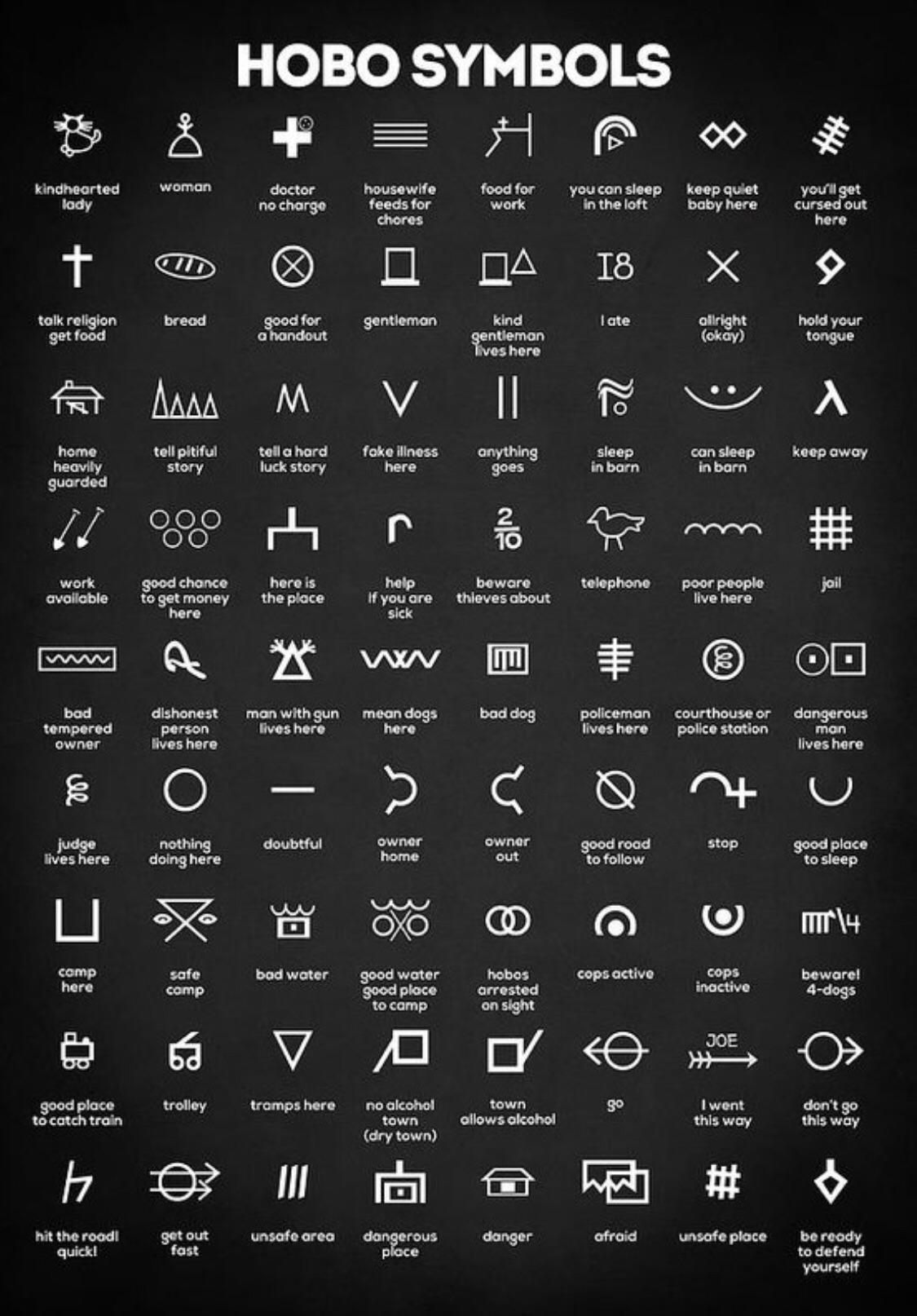













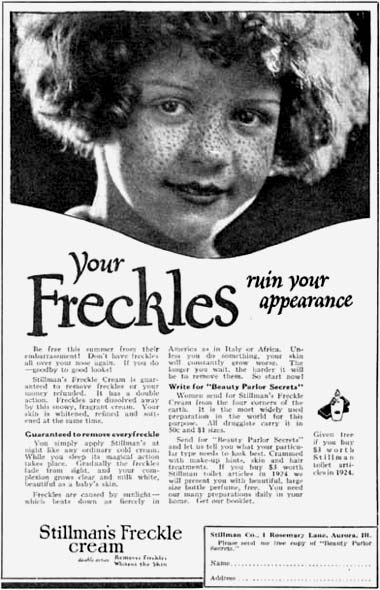


 Every generation creates new ones, because a parent’s euphemism becomes the general term which is then too close to the original meaning, and so the children get creative with words, and so on. There are a few euphemisms that have remained unchanged over centuries, such as passed away, which came into English from the French “passer” (to pass) in the 10th century; others shift gradually, such as the word “nice”: When it first entered English from the French in the 13th century, it meant foolish, ignorant, frivolous or senseless. It graduated to mean precise or careful [in Jane Austen’s “Persuasion”, Anne Elliot is speaking with her cousin about good society; Mr Elliot reponds, “Good company requires only birth, education, and manners, and with regard to education is not very nice.” Austen also reflects the next semantic change in meaning (which began to develop in the late 1760s): Within “Persuasion”, there are several instances of “nice” also meaning agreeable or delightful (as in the nice pavement of Bath).]. As with nice, the side-stepping manoeuvres of polite society’s language shift over time, giving us a wide variety of colourful options to choose from.