Category Archives: Linguistics

Etymology Undusted: Fiddle-Faddle

Sometimes, my husband and I discuss history, and an odd topic here or there pops up; I’ll often delve into the history or etymology of a phrase, word, or idiom and share my findings here. So, no more fiddling about; let’s get to it.

A reduplication in English is a word or sound that’s doubled or altered the second time for effect; there are a few kinds of reduplications: Exact repeats, like bye-bye or night-night; rhyming, like okey-dokey, easy-peasy, or higgledy-piggledy; ablauts, like chit-chat, criss-cross, splish-splash, or wishy-washy; there is even a series of -shm reduplications, like fancy-shmancy, laborday-shmaborday, or work-shmerk. Some reduplications emphasise the first term to focus on the prototypical or normal form of something, e.g. ‘I just was a salad-salad (not bean salad or tuna salad)’. Many such words have become standard in English, such as flip-flops, wingdings, or zig-zag. Every language probably has such words; German has krimskrams, schnikschnak, mischmasch, larifari, Wirrwarr and more. Italian has a few that have slipped into use in other languages, such as piano piano (very slowly), Mamma mia (literally, my mother, but used as an expression of surprise, frustration, or even delight, similar to ‘Oh my goodness‘), or bric-a-brac (knick-knack).

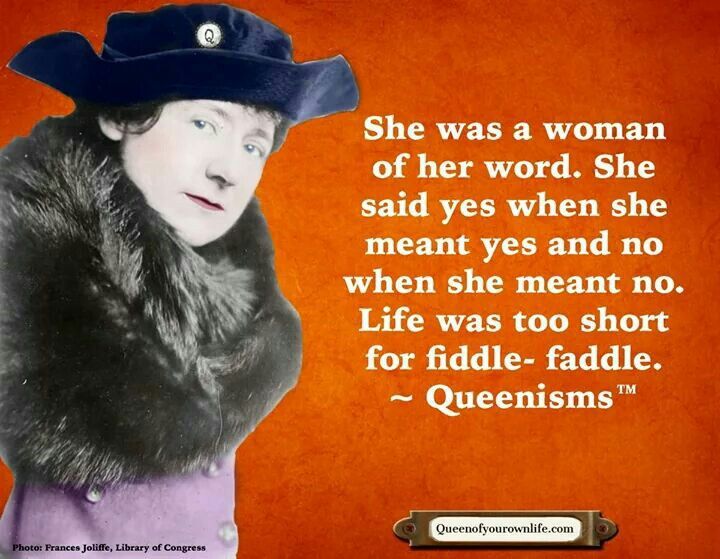
Have you ever said (or heard someone else say) Fiddle-faddle? It first appeared in English in the 1570s, meaning trifles, or to talk nonsense or speak of something not worth serious attention. Fiddle is another word for violin and is the more colloquial/casual of the two; as such, it has long been associated with less important things. Georgette Heyer uses fiddle without faddle to mean trivial or nonsense; the reduplication would merely emphasise the meaning of the first word, so she chose to drop the second.

John Milton Edwards (the pen-name of William Wallace Cook, 1867-1933) wrote, “There’s a lot of fiddle-faddle wrapped up in that word ‘inspiration.’ It is the last resort of the lazy writer, of the man who would rather sit and dream than be up and doing...”

It was also used as an adjective to describe a troublesome person, such as a nit-picky, ceremonious old woman. As a verb, to fiddle-faddle means to dally, which leads us to another reduplication: dilly-dally, which means to loiter, delay, or trifle! A fiddle-faddler is a person who trifles or dallies.

No dilly-dallying, let’s get to the point: Which reduplications have you used? Have you ever known a fiddle-faddler or a dilly-dallier? If you know of more such words, please put them in the comments below!

10 Comments

Filed under Articles, Etymology, History Undusted, Liguistics, Linguistics

Idioms Undusted: When Too Many is Too Much

I know that most of you can relate to the occasional feeling of having too many things going on at once; juggling jobs, family, civic responsibilities and household management can bring on the feeling of a hamster in a wheel, moving, moving, but not really getting anywhere!

That feeling began creeping up again for me last week, and a few idioms came to mind related to that feeling – which tells me that the condition of being overwhelmed or over-busy is an age-old challenge.

You can’t dance at two weddings

This idiom means that you can’t do two things simultaneously – you have to decide for one or the other. Sometimes that’s a tough choice – both things would be great to be involved in but, unless you’ve learned how to clone yourself, a choice must be made.

The phrase’s etymology leads us to the Yiddish language: Historically Judeo-German, Yiddish is a West Germanic language historically spoken by Ashkenazi Jews and originated in the 9th century. What I find interesting is that, about 25 years ago, when I was still learning High German alongside Swiss German (Zurich dialect), my husband was invited to perform some of his troubadour songs in a concert with several other artists; one of the groups performed in Yiddish. I could understand and follow the story of their song, while my husband and other Swiss around me couldn’t. I think it was a combination of me being a fresh learner of the two languages simultaneously, having a musical ear and, perhaps more importantly, having a Scottish accent still in my ear and a bit in my Swiss German – for me, it sounded a bit like a combination of the two! My brain combined it all, and I could follow the story – my explanation to my husband was then confirmed by their translation given after the song was over.

The idiom is likely derived from the Hebrew translation of the story in 1 Kings 18:21; the English NIV says “How long will you waver between two opinions?” but the Tanach could be read as, “How long will you hop between two platforms?”

Spread butter too thin (over too much toast)

This idiom, with a similar connotation, implies that one overcommits to too many things, leading to unsuccessful results, or leading to exhaustion or poor performance.

A good example of this idiom is happening right now in our flat: Of all the companies we’ve had to work with on the various issues of resolving water damage (the entire process began in April 2024, and no, it’s not over yet!), one company has teams in several functions – floor renovation, plastering, painting… and probably others, of which I hope I never have experience. Every single repair they’ve undertaken has been shoddy, and they’ve had to repeat the exercise – meaning we have had to move half of our flat away from floors, walls and pathways several times already as they have to re-do badly-done work! I’ve put my foot down and insisted that project managers show up and check the work before the workers are done, from now until I never have to see the company again!

The companies that concentrate their expertise on one area, such as plumbing, balcony renovation, façade renovation, or electrical repairs, have all done great work, done and dusted.

Have one’s fingers in too many pies

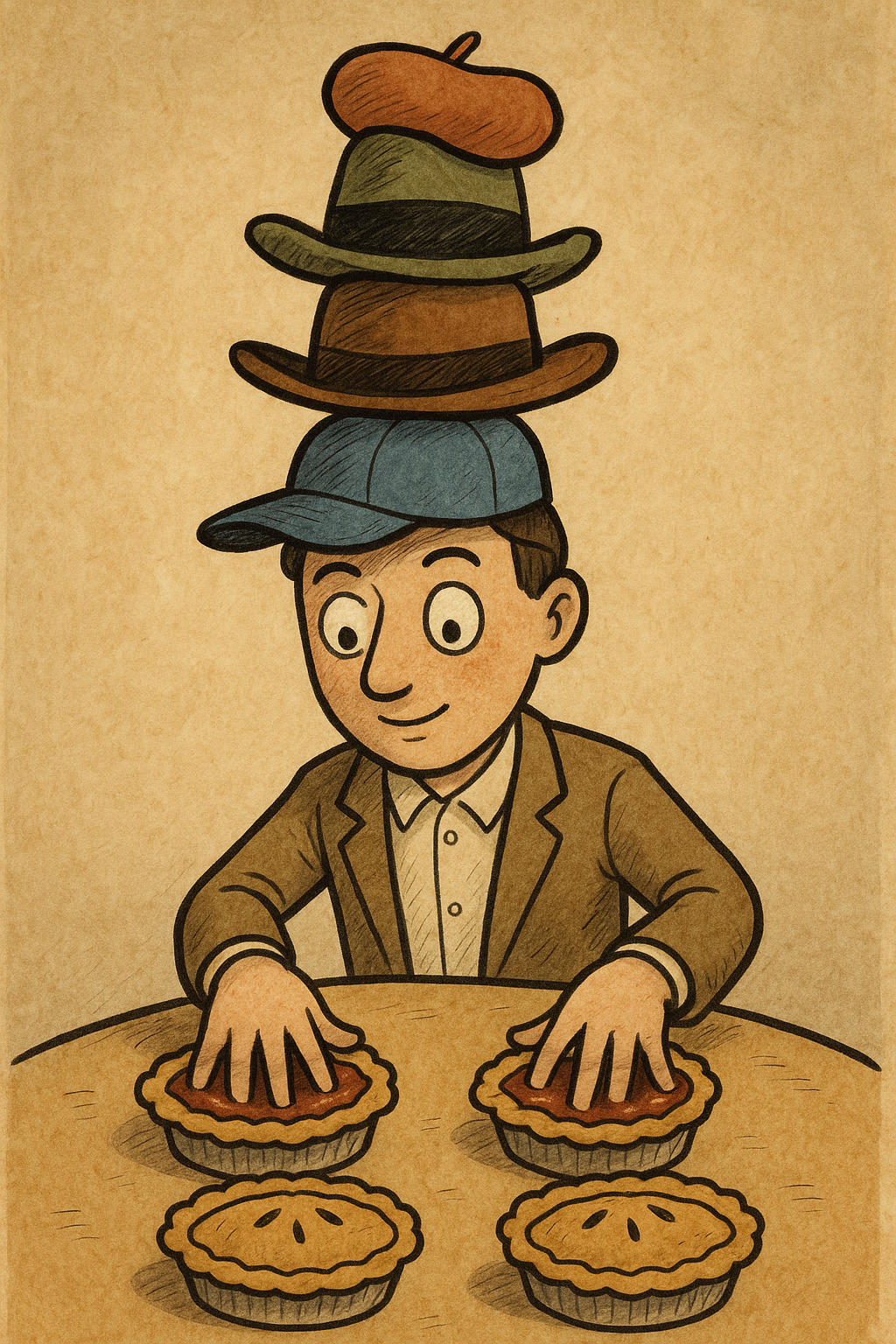
This idiom is similar to the butter metaphor, and it means to be involved in many different activities or projects at once, often to the point of being overstretched; It suggests a lack of focus or a tendency to dabble in various things without fully committing to any. 

Shakespeare used this imagery in Henry VIII, in which the Duke of Buckingham refers to Cardinal Wolsey: “The devil speed him! no man’s pie is freed from this ambitious finger“.

In Italian, the phrase “avere le mani in pasta” means to have one’s hand in the pies, or pasta, or simply being hands-on.

This idiom is so visual that it is difficult to trace its origins, as it likely had many concurrent origins throughout history. Shakespeare most likely wasn’t the first to use it, though he no doubt popularized it, like so many things he’s “credited” with.

Wearing too many hats

This idiom, also as “man of many hats” stems from a recent past when people wore hats on a daily basis.

Men had hats, usually bowlers, to wear in the city during the day, while they wore a different hat on the hunting field, another when riding horses, and another for evening parties. Cricketers, cowboys, players of various sports (baseball, American football, etc.), military ranks with casual uniforms or dress uniforms or combat uniforms all wear different hats.

To wear too many hats implies that a person is trying to perform too many different roles or jobs than is realistically feasible, implying that they may struggle to fulfil responsibilities effectively.

Have you had times in your lives when too many is too much? If so, let’s all learn to slow dance, eat less butter, bake fewer pies, and choose one hat at a time!

1 Comment

Filed under Etymology, History, History Undusted, Linguistics, Military History

Etymology Undusted: Ducks and Drakes

Today’s phrase, playing at / making ducks and drakes, refers to skipping stones across a water surface, much like the image of a waterbird coming in for a watery landing. By 1614, the meaning had come to be associated with squandering or throwing one’s money away needlessly, much like stones were tossed away in stone-skipping.

The first written evidence of the phrase was in 1585, The nomenclator, or remembrancer of Adrianus Junius, translated by John Higgins:

“A kind of sport or play with an oister shell or stone throwne into the water, and making circles yer it sinke, etc. It is called a ducke and a drake, and a halfe-penie cake.”

These two terms also appear in nursery rhymes; the first, found in A History of Nursery Rhymes (1899) by Percy B. Green, where he mentions that this rhyme was repeated when skimming stones:

A duck, a drake, a barley cake,
A penny to pay the baker;
A hop, a scotch, another notch –
Slitherum, slitherum, take her.

The “barley cake” is “halfpenny cake” in this 1916 version of The Real Mother Goose:

A duck and a drake,
And a halfpenny cake,
With a penny to pay the old baker.
A hop and a scotch
Is another notch,
Slitherum, slatherum, take her.

In 1626, it is mentioned in the play Dick of Devon:The poorest ship-boy Might on the Thames make duckes and drakes with pieces Of eight fetchd out of Spayne.”

Many cultures share the simple pastime of stone tossing, with their own terms for it: American English, skipping stones; British English, skimming stones or ducks and drakes; in Scottish, Skiting or Skliffing; in Irish, stone skiffing. In French, making ricochets (faire des ricochets); in German, stone flitting (Steinehüpfen); in various languages such as Bulgarian, Greek, Latvian and Lithuanian, their terms refer to frogs rather than ducks. In Japanese, cutting water. In Norwegian, fish bounce (fiskesprett). In Portuguese, either water shearing (capar a água) or making tiny hats (fazer chapeletas). The list goes on and on!

The oldest reference to the pastime goes back to the 2nd century AD by the Greek scholar Julius Pollux; in the 3rd century, Marcus Minucius Felix (a Latin writer) mentions children skipping shells on the beach.

Today, of course, it has become a serious competition for some. According to the Guinness Book of World Records, the record for the number of skips is 88, held by Kurt Steiner; the furthest distance for men is 121.8m, made by Scotsman Dougie Isaacs, and 52.5m for women, thrown by Nina Luginbuhl from Switzerland.

The next time you’re out at a lake or shore, toss a stone and remember the long and colourful history of ducks, drakes, frogs, fish, hats and water!

Leave a comment

Filed under Etymology, History Undusted, Liguistics, Linguistics, Snapshots in History

The Fascinating History Behind the Fraktur Typeface

Last Sunday at church, a friend filled an entire room with her late father’s books, setting up an impromptu book shop. I chose several books, most of which are in Fraktur typeface, known to some people as “Gothic” or “Old German”. I enjoy reading such books because they offer a snapshot of a cultural way of thinking. The books I chose were printed between 1877 and 1940. The latter date is significant, as you’ll soon see.

First of all, let’s clarify a few terms: Though many people think of font and typeface as interchangeable, in fact, they refer to two different aspects of a writing style. Typeface refers to a particular style of lettering (e.g. Times New Roman), while font refers to the variations within that style, such as size and weight (CAPS, bold, italic, etc.). Another term we know but may not fully understand is Serif: This refers to the small stroke or line attached to the larger stroke of a letter; an example would be an A with “feet” at the bottom of each down-stroke. Sans Serif simply means “without Serif”.

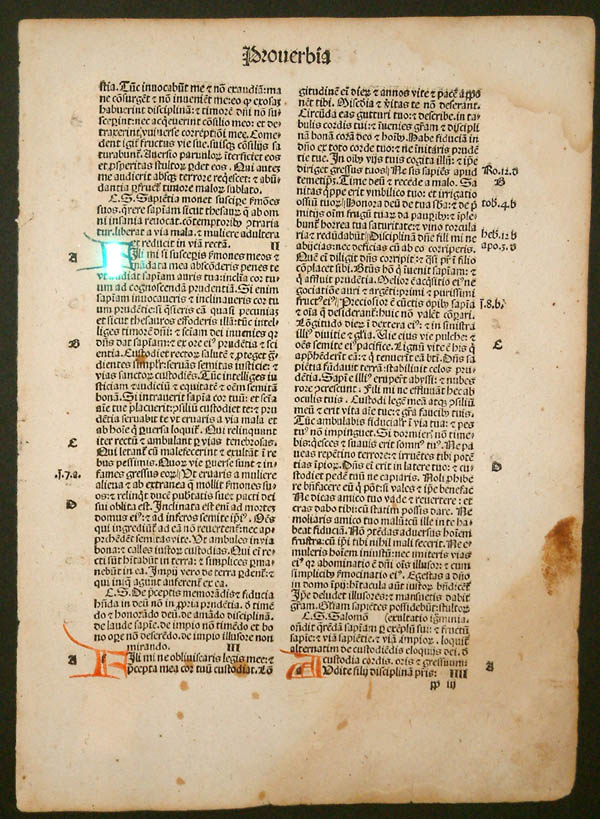
The first moveable-type printing press, designed by Johannes Gutenberg in Germany around 1440, was based on the ancient Roman design of a screw press used to press wine or oil, which in turn went on to be used to press designs into cloths. He was likely familiar with intaglio printing and may have done some work himself in copper engraving.  These designs and uses likely fermented in his inventor’s mind into what became the revolutionary turning point of literacy. Gutenberg’s original typeface was called Donatus-Kalender; the metal type design was itself a form of Textura (more on that in a moment).

Donatus Kalender
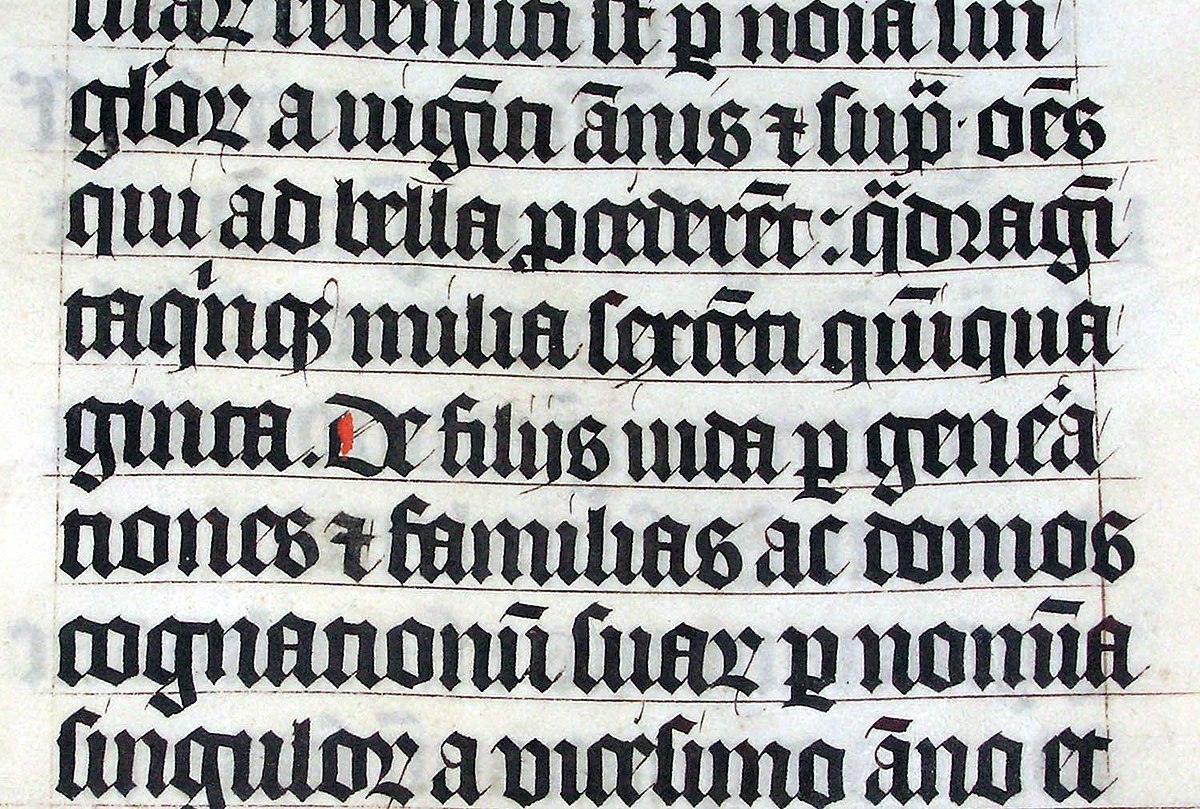
Example of Blackletter (Source: Wikipedia)

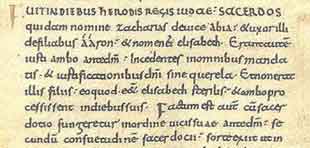
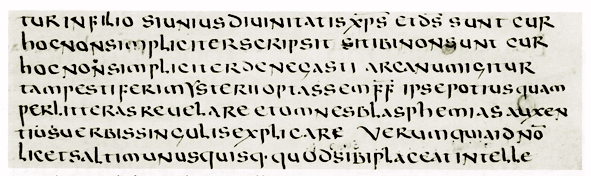
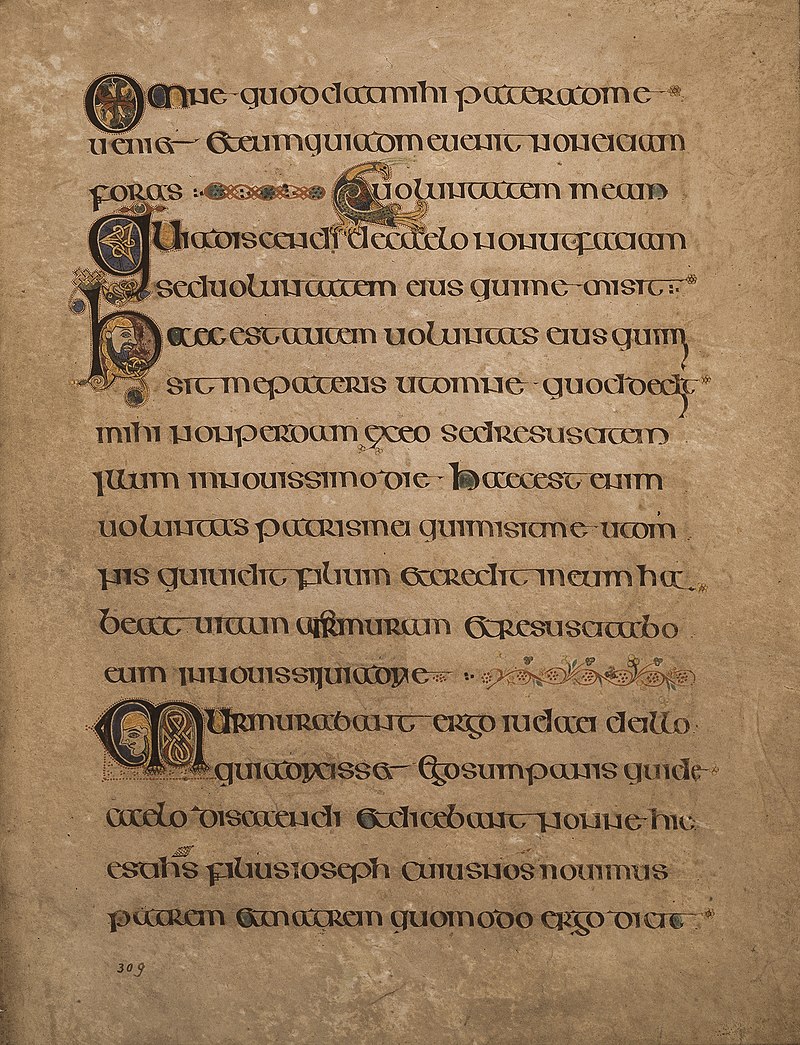
This original family of typefaces was known as “Blackletter”, aka “Gothic scripts”, with the height of popularity peaking around the 14th to 15th centuries. The ancestor of the Blackletter was called the Carolingian minuscule, a calligraphic standard of handwriting widely used in the medieval period, when literacy began increasing and a need for books in a wide range of subjects began to be in demand. It is thought to have been developed in the mid-770s by Benedictine monks north of Paris in the Corbie Abbey, famous for its scriptorium and library. The minuscule itself was derived from Roman Uncial as well as Irish Insular script, which was developed in Irish monasteries and spread throughout Europe.

Carolingian Minuscule
Roman Uncial
From the Book of Kells, an example of the Irish Insular script

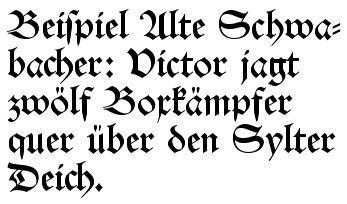
The family of Blackletter typefaces included Early Gothic, which was a transitional script between the Carolingian miniscule and Textura (the most calligraphic form of Blackletter); Schwabacher was a form popular in early German print typefaces (it became widely known with the spread of Luther Bibles from 1522), in use from the 15th century until it was eventually replaced by Fraktur around 1530, though it was still used alongside Fraktur for emphasis, much like we use bold or italic today.

Schwabacher Typeface
Textura Typeface

Another blackletter typeface developed between 1470 and 1600: Antiqua. This typeface’s letters were designed to look like the handwriting of ancient Roman documents, with the letters flowing together, strokes connecting them in a continuous line, whereas Fraktur was distinguished by having letters “fractured” – separate from one another. The Antiqua-Fraktur Dispute deserves its own article, so stay tuned!

Antiqua Typeface (Source: Wikipedia)
Fraktur Typeface (Source: Fonts in Use)

The Habsburg Emperor Maximillian I (1459-1519) was King of the Romans* from 1486 to 1519 [the title of king was used by the kings of East Francia, the territory later referred to as the Kingdom of Germany, from the time of Henry II (1002) to Joseph II (1764)]. The king commissioned the artist Albrecht Dürer to create a series of woodcut engravings of the Triumphal Arch [Though many are familiar with the Arc de Triomphe in Paris, it is only one example of this ancient Roman architectural feature used as a free-standing structure (rather than the Greek version, which was used within a structure such as a temple).]. These engravings would be used to create what we would recognize today as essentially wallpaper, though its purpose was more of a statement of power or propaganda (read personal marketing) commemorating his nobility, generosity, and military conquests – an incongruous combination, if you ask those conquered… The final composite of printed papers stood nearly 3 metres (12 feet) high and was only one part of a series of three enormous prints commissioned by the king.

Albrecht Dürer’s The Triumphal Arch, for Maximilian I

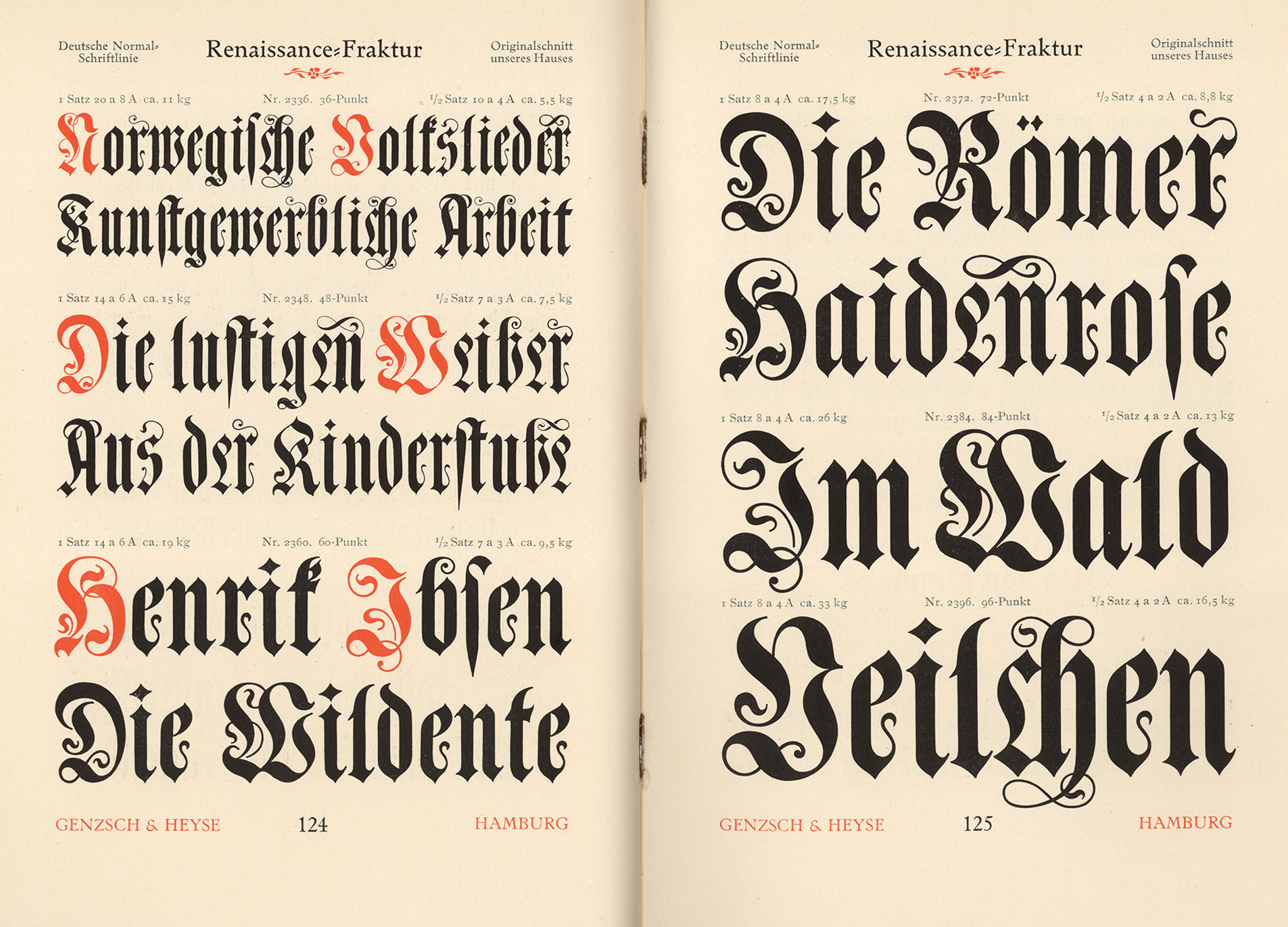
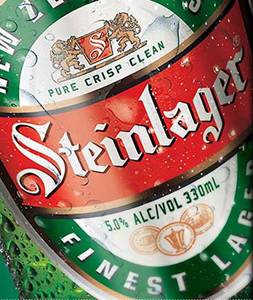
 The Fraktur typeface was designed in the 1530s by Hieronymus Andreae, a German woodblock cutter, printer, publisher, and typographer closely connected to Albrecht Dürer. The typeface was made to decorate the arch, telling the stories of the figures depicted throughout. The typeface became popular in Europe and was in use in the German-speaking world, as well as areas under its influence (Scandinavia, Central Europe, and some eastern European regions), into the 20th century. Specifically, Fraktur was in use in German until 1941, when it was actually banned (which places one of the books I purchased on Sunday within one year of the end of the era of Fraktur!). The atmosphere that led to that ban arose from the dispute mentioned above. Once the Nazis were defeated, the ban was lifted, but Fraktur never regained its widespread popularity after that, though you can still see it occasionally in pub signs or various forms of ads, like beer brands.

I just pulled two books from my library shelves: One is an English book originally printed in 1895, with my book being printed in 1915; the other is a German book printed in 1892. The typefaces are widely different: The English text likely used the French Oldstyle, while the German book uses Renaissance Fraktur for the text body, while the end pages act as indexes and use a variety of blackletter typefaces, such as Muenchner Fraktur, Antike Kanzlei, and Enge verzierte Altdeutsch. To see examples of the typefaces mentioned here, please click on the link for Fonts In Use.

I hope you enjoyed this jaunt through history! Nearly every name mentioned, every typeface, and every event deserves its own undusting. Next time, we’ll deep-dive into the dispute that lasted well over a century!

3 Comments

Filed under Articles, Etymology, History, History Undusted, Humanity Highlights, Images, Liguistics, Linguistics, Links to External Articles, Military History, Signs, Snapshots in History

History Undusted: Shop Signage

I’m fascinated by a few aspects of architecture in particular, such as doorways, knockers, unusual features such as sundials on the sides of buildings, mural paintings (here in Switzerland, these are sometimes hundreds of years old), and shop signage – you’ll see the latter even in the smallest town here.

This past summer, my husband and I rented a motorhome and travelled mostly in eastern Switzerland. I would say that 90% of my photos were of shop signs! I find that if you focus in on one topic, you’ll begin to see that thing everywhere.

Known as commercial signage or trade signs, such symbols of a shop’s products have been used as far back as ancient Egypt. As many people were illiterate, the pictorial shop sign not only advertised what was for sale in a shop but also distinguished the shops with similar items. By the mid-15th century, English laws even required shops that sold ale to hang a shop sign out; it made inspections of the quality of the ale easier. Some signs were temporary; for instance, if a woman made more ale or bread than her family could consume, she would put out a sign to sell the surplus and thus earn a bit of money. In the narrow streets of medieval towns, signs might be so large as to nearly touch the building on the other side of the lane, and they could become a hazard to passing horsemen or coachmen. By the mid-16th century, regulations were passed to limit the size of signage, and the securing of the sign to the building to avoid it endangering passersby. In Britain, hanging signs were eventually phased out in favour of what were are most familiar with – a flat sign denoting the store along the space above the front windows. But here in Switzerland, shop signage is everywhere – not just old, but also newer additions.

The development of the signs, including elements of guilds or heraldry symbols, led to competition between blacksmiths to create the most elaborate ironwork. The signs evolved from simple displays of ware to symbolic representations of a shop owner’s name or a heraldic connection or patronage of royalty (e.g. a crown). Examples might include shoemakers displaying a shoe or gilt boot, bakeries displaying bread, and haberdasheries displaying a needle and thread or a coat.

Here is just a fraction of the signs I photographed during our holidays, with brief explanations:

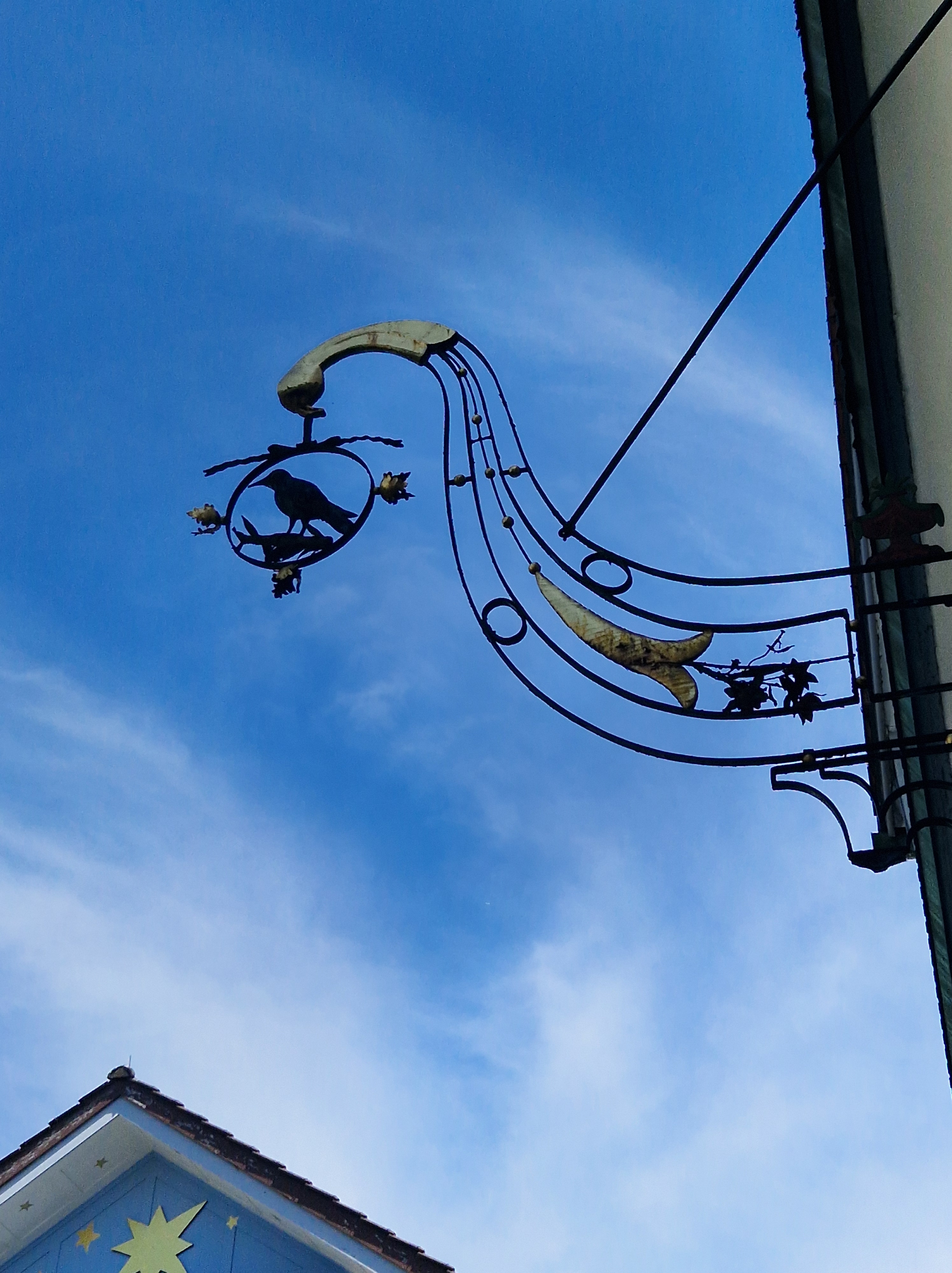
The building from which this sign hangs was built originally in 1664, and renovated to the current form in 1830. It was originally an inn/tavern on one side, and a forge (blacksmith) on the other. The Raven, as a tavern, took its symbol from the legend of St. Meinrad (797-861 AD); he was a hermit who rescued two young ravens from a sparrowhawk and raised them in his hut in the Finstern Wald (dark forest). In 861, he was murdered by two robbers; when they realized what they’d done, they fled to Zürich, but the crows followed them into a tavern and attacked them; the others present thought it unusual, so they took the men captive; they confessed, and were executed. The raven became a symbol of inns along a pilgrimage road; it was sometimes combined with a wine jug and bread.

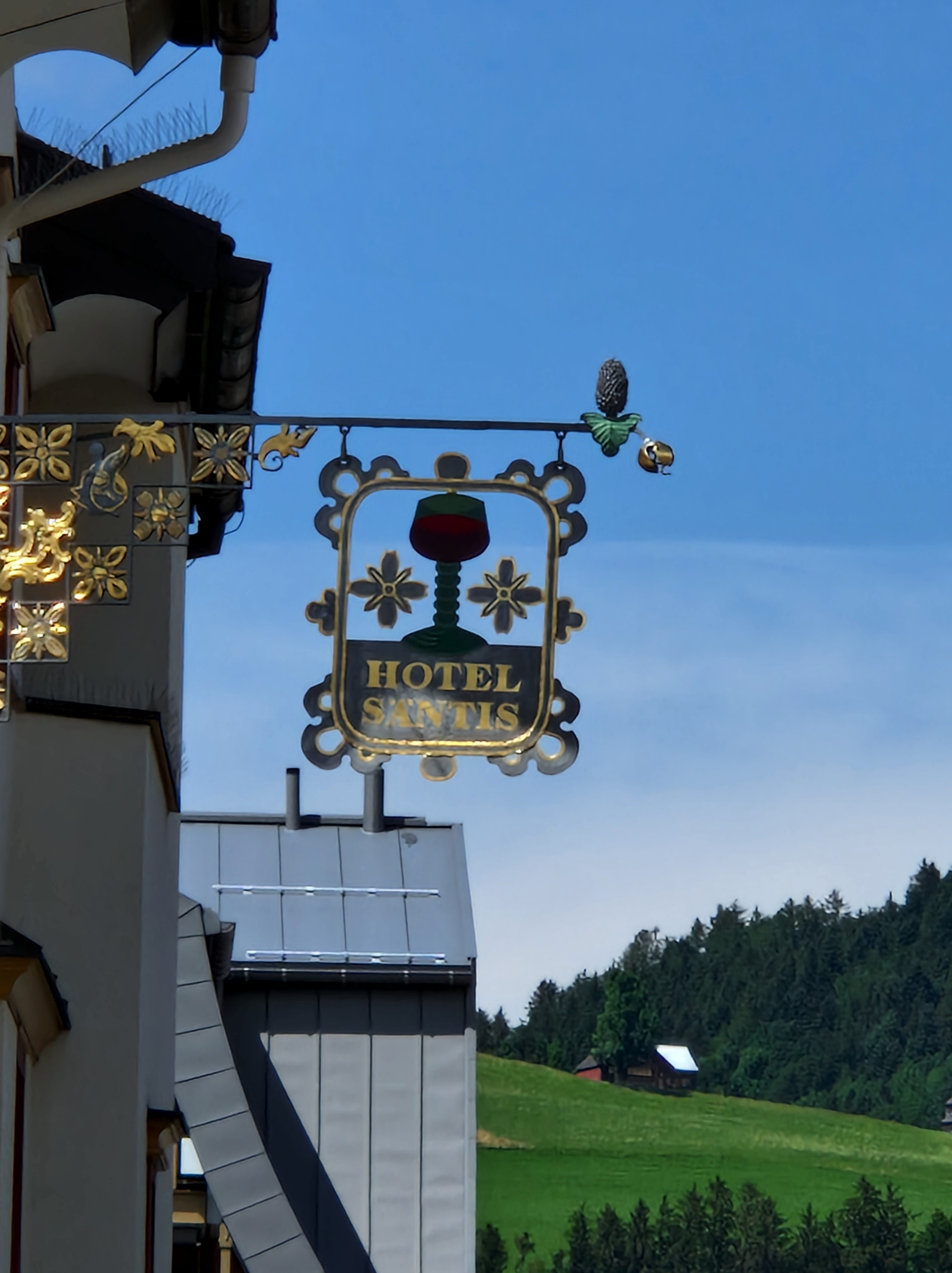
The Hotel Santis sign has a few symbols: The wine is an obvious reference to a tavern, pub or inn; the pine cone is an interesting addition: It was the symbol of the field sign of the Roman legion stationed in Rhaetia in 15 BC, and hence it is used as a heraldic charge (an emblem on a shield). It may have been included in this sign to proclaim a good place for soldiers to eat or sleep, or as an advertisement that it was protected under a legion or unit of the military at a time when such protection would have been welcome. The bell symbolized a pilgrimage or an invocation of guardian angels over a premises.

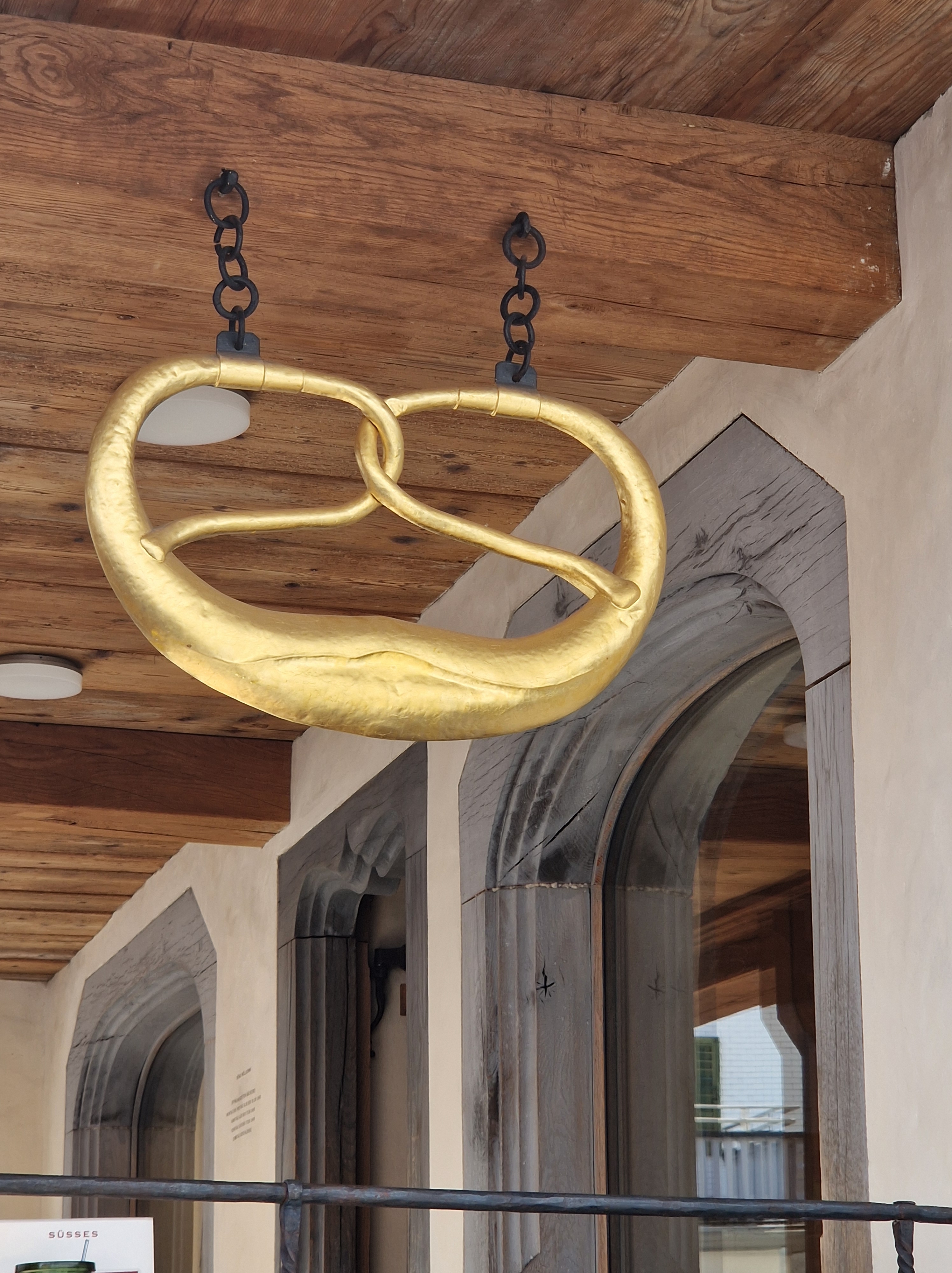
I think this is fairly clear – it’s a bakery!

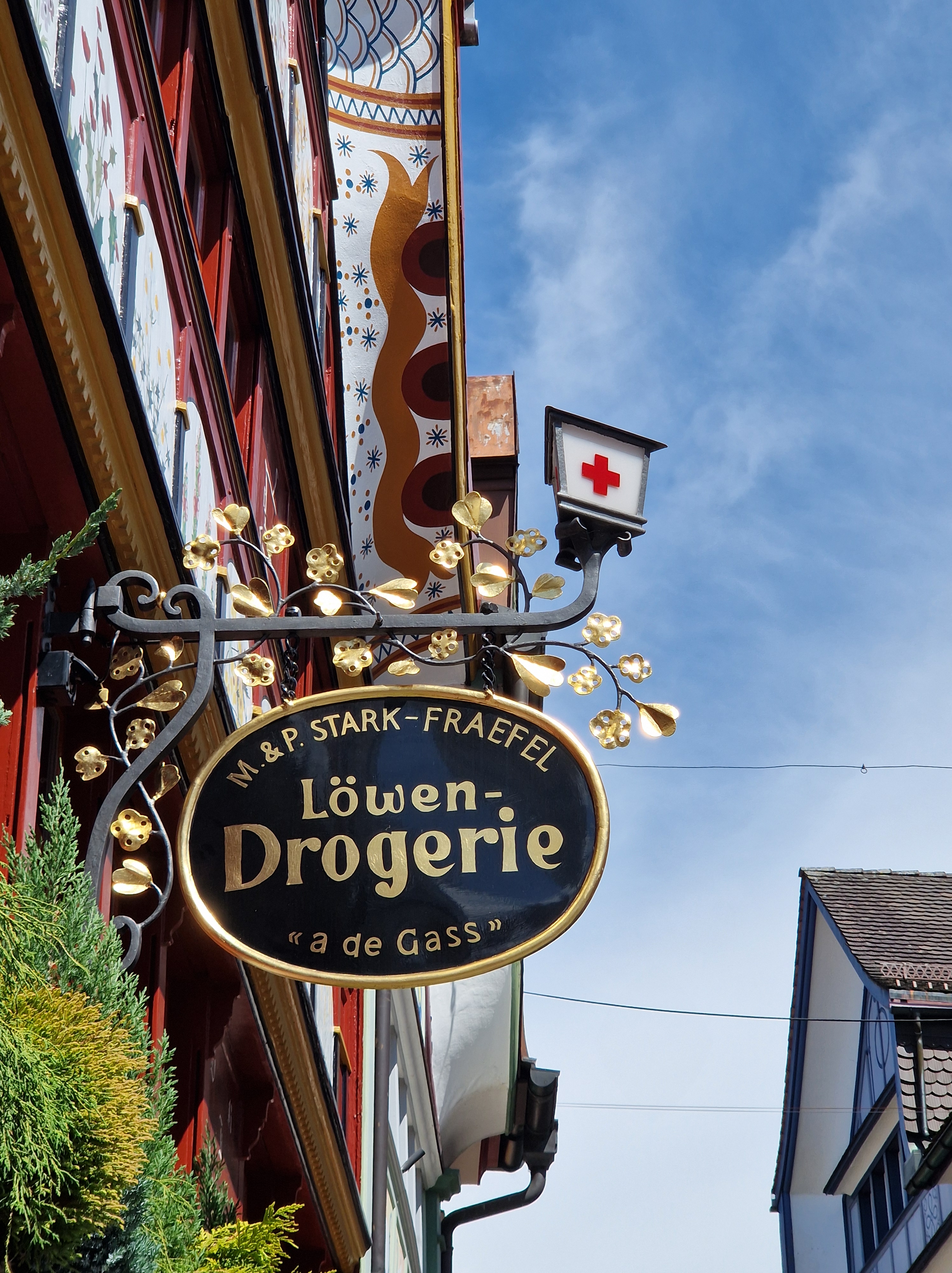
This building is a pharmacy; the front of the building is a beautiful example of the mural painting I mentioned earlier; these panels represent the herbs and flowers used medicinally. The saying painted toward the right side reads: Vielerlei Kraut gegen Leibesnot, aber kein einzigs wider den Tod (Many herbs against bodily pain, but none against death).

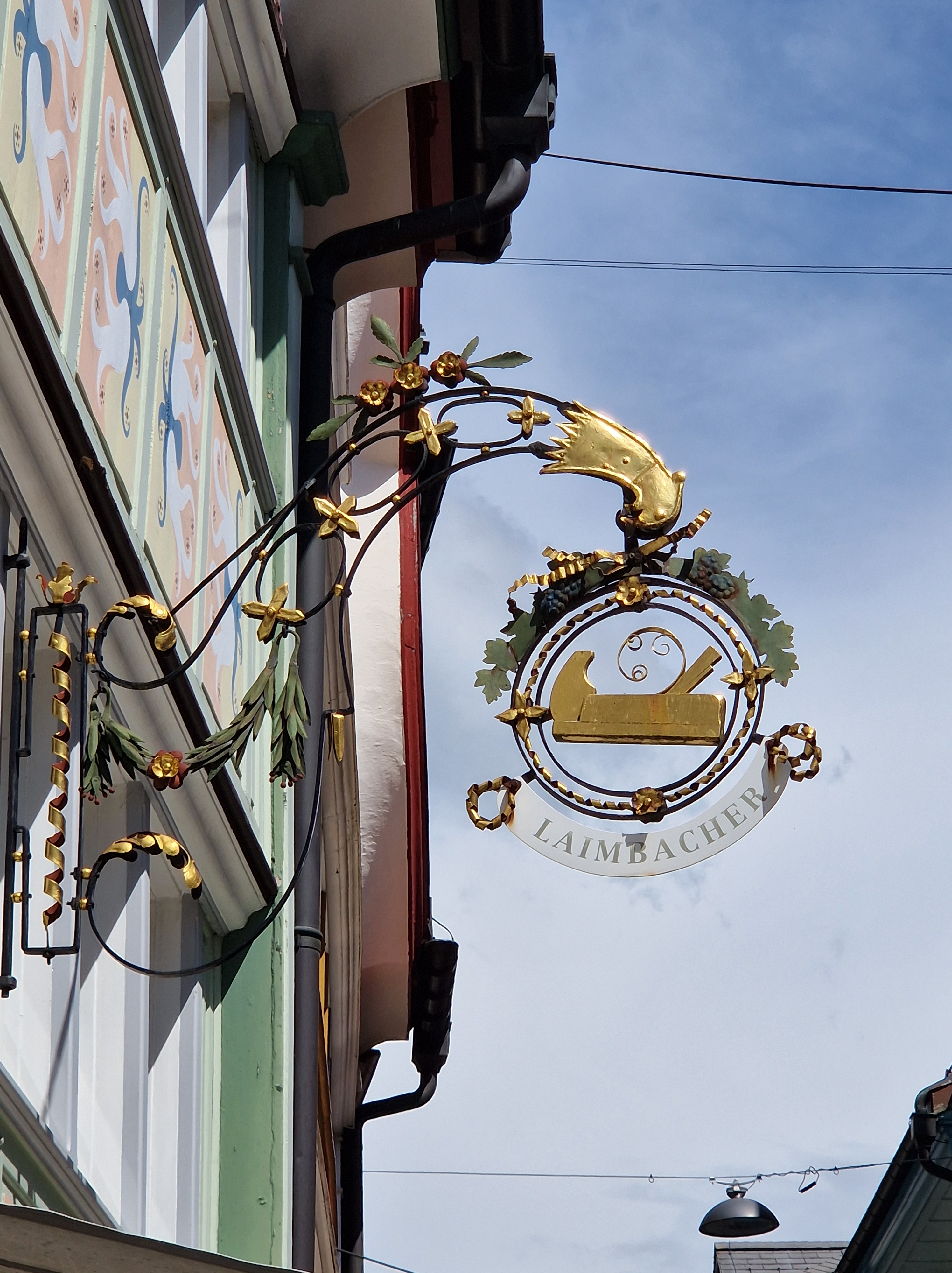
This symbol denotes a carpenter’s shop.

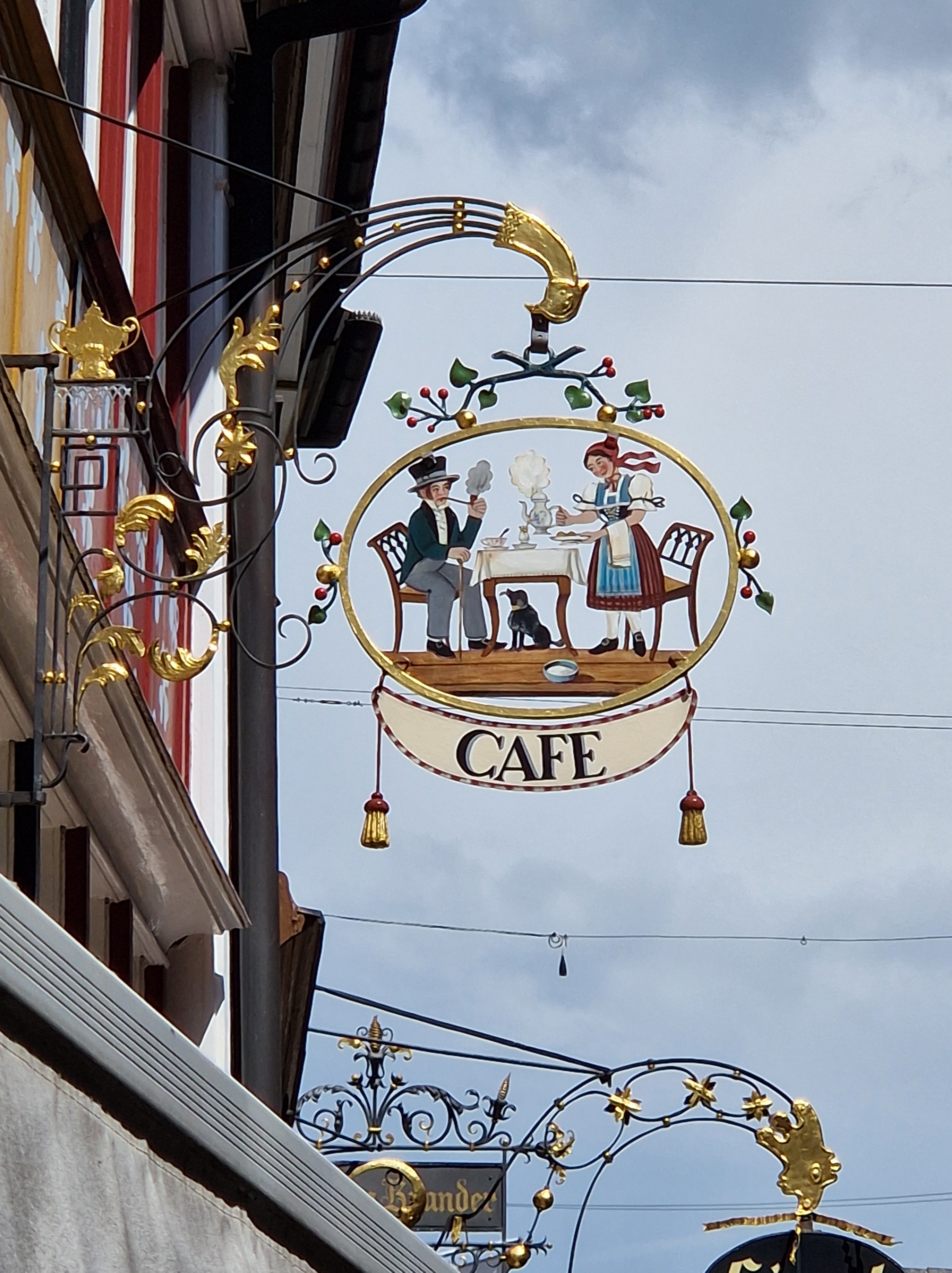
This café sign would be clear from any stagecoach stopping for a break and horse change what could be expected inside. The figures are dressed in traditional Appenzeller clothing.

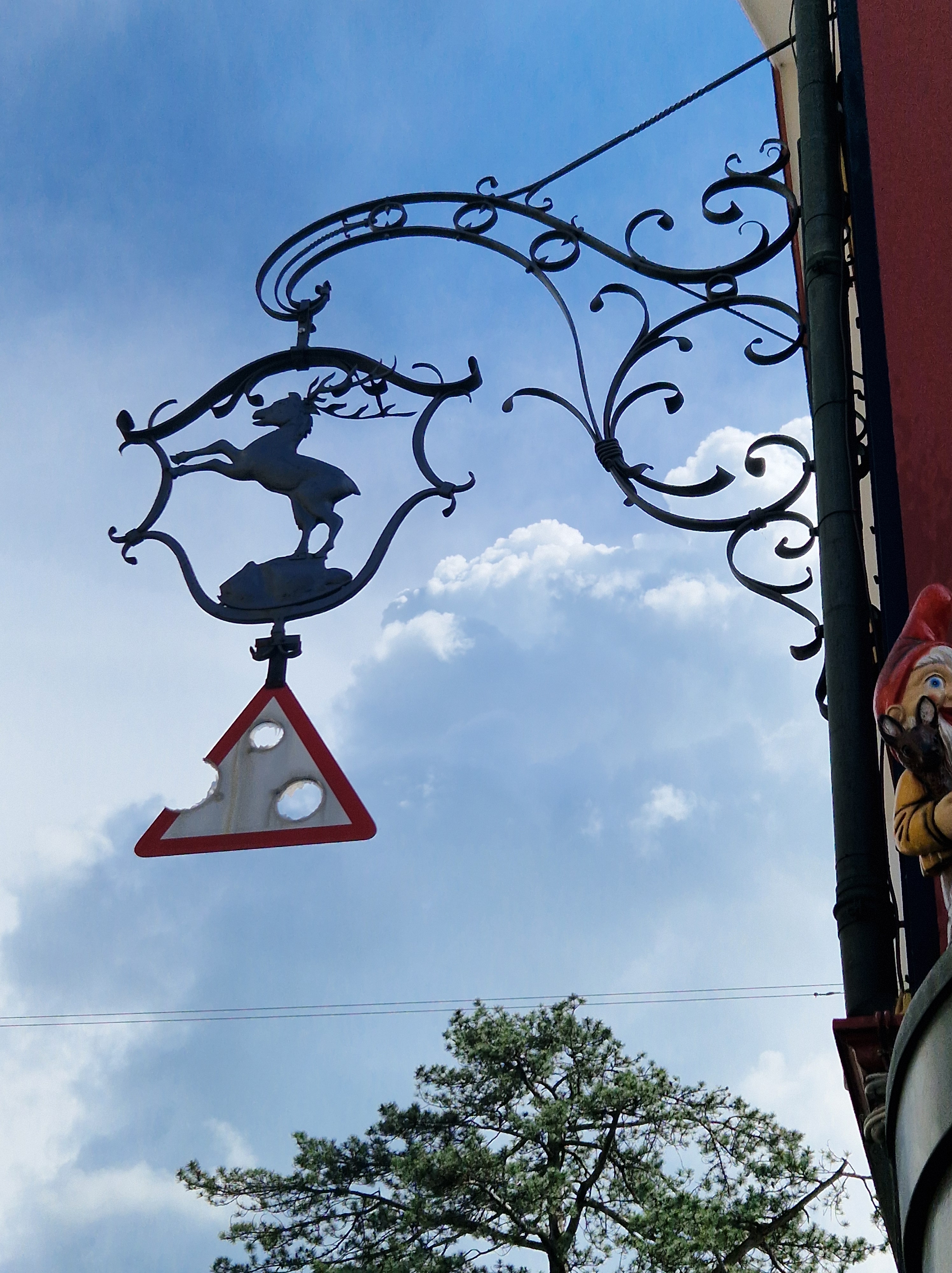
And lastly, here’s a traditional sign with a modern addition: It’s a hunting lodge, or inn that serves wild game meat. Next to it, peeking around the corner, is a figure from a toy shop.

 I hope you enjoyed this little excursion!

11 Comments

Filed under Articles, Etymology, History, History Undusted, Linguistics, Military History, Signs, Snapshots in History, Translations, Virtual Tours

History Undusted: The Great Vowel Shift

My husband and I were having lunch recently, and a package of Swedish crackers was on the table; I pointed to the brand name, Pågen. In English, our pronunciation of these vowels would lead us to say pagan /pæg-in/, whereas the Swedish would rather be more like /po-gen/. I just mentioned that English might have sounded similar to that before the Great Vowel Shift, which he’d never heard of (being Swiss, it’s not likely he would be familiar with this aspect of English etymology), so I promised to write a blog about it; here we go!

The term Great Vowel Shift was coined by the Danish linguist, Otto Jespersen (1860-1943), who specialised in the English language. Though the GVS is considered a single event (because of the changes being viewed as part of a chain reaction, with each vowel sound changing in a predictable way), the actual transition of English pronunciation was gradual, taking place over about 200 years, from ~1400 to ~1600. The shift began in Middle English, which was spoken from 1066 until the late 15th century – that form familiar to Geoffrey Chaucer (though his pronunciation would be unintelligible to us, his words still survive through his famous Canterbury Tales) – into Early Modern English (from the beginning of the Tudor period through to the Stuart Restoration period); Shakespeare would have been familiar with it. From there, English transitioned into Modern English in the mid-to-late 17th Century.

The main changes were that, from Middle to Early Modern English, the long vowels shortened; weef became wife, moos* became mice, beet became bite, and so on. (*The word moose entered English through Native American languages in 1610). I will also mention that in Scottish, a lot of the older vowel pronunciations still exist; house is still huus, full is homophonous with fool, etc.

Here’s a look at just how the English vowels shifted:

Source: SlideShare

If you’ve been paying any sort of attention to English, you’ll know that our spelling is a bit chaotic; the language is full of homonyms, which are divided into either homophones (words that sound the same but have different spellings, e.g. beet and beat; bear and bare; to, too and two), or homographs (two words with differing meanings, same spellings, but not necessarily the same pronunciation: e.g. bank [of river; finance] or agape [with mouth open; love], or entrance [a way inside; to delight]) or tear [ripping; crying]. These -graphs and -phones came into English from regional dialects that were transported as migration and cultural mixing took place, and the GVS added its two pennies to the mix. Just think of the variety we have in the sounds /ea/ (bread, beat, bear, break); /oo/ (look, spool, blood); or /gh/ (through, cough, sight).

Certain factors contributed to the speed of language shift: The Black Death (1346-1353) wiped out up to 50% of Europe’s population. Stop a minute and let that sink in. What if the population of your town were reduced by half? And the next town, and the next. That single event changed the course of history on many levels; surfs could finally demand better wages wherever they ended up settling; if you lived in a town that no longer had the skills of a baker, blacksmith, or any other trade you’d depended on, you’d move to where those services existed – and jobs existed – and that meant places that had been hit the hardest by the plague and thus where everyone else was migrating, such as London. As mass movement followed the epidemic, people brought their dialects and their spellings with them. It began to converge into a new, distinct way of speaking, thinking and spelling. The geopolitical climate of the time also influenced English; England and France have been annoying each other for over a thousand years; whenever England was enamoured by all things French, they tried to emulate their pronunciations. That influence came and went; in one such moment, the pilgrims set sail for America (1620), taking a time capsule of the language with them, while England’s English continued to be influenced by French up until the French Revolution, when it quickly fell out of favour in England, though the changes had already taken place (one example is the American /k/ in schedule, closer to the original Latin, while the English say /sch/ without the /k/, which is closer to the French cedule). This factor of influence also affected differences of speech between the lower class and upper class at that time; the upper class wanted to sound more posh, more fashionable, and above all, not like the lower class.

A major contributing factor to our chaotic spelling is that ca. 1440, the Gutenberg printing technique was introduced, and by the 1470s, William Caxton had imported the invention to England; we have him to thank for Chaucer’s Canterbury Tales being known today, as that was the first book he printed in England. We also have him to thank for the influence of Chancery English (the English used by the secretariat of King Henry VI) in the standardization of the language, as he used it as his own guidelines in printing. The vowels had already begun to shift by that time; enter the written word, a rise in literacy, and you have the jumbled effects of “mid-shift” on English spelling – people began to adapt their pronunciation to the written word, so whichever form the printer used is the one that began to prevail, even though some sounds were still in transition. Like nailing down jelly. You could say that many of our odd spellings are simply a snapshot in time.

It is also important to point out that the GVS didn’t have the same influence everywhere: The main changes occurred around London, but the farther away you move from that epicentre, the less the effects on the local dialects, which still holds true today – though gradual merging has allowed people from, say, Cornwall, to understand people from Yorkshire – which wouldn’t have been the case centuries ago. Even though they can understand each other, their dialects are still distinct. I’ve already mentioned that Scots English (as opposed to Gaelic) still retains many of the longer vowels long since lost in standardized English; being so far from London, they simply ignored them. English may be taught in their schools, but Scots dialects prevail in the home and hearth. Regional dialects in English exist the world over, and though spelling and pronunciation may differ from region to region, and the language continues to be a living, breathing, growing and changing being, it’s still a language that enables the modern world to communicate, whether English is their mother tongue or not.

3 Comments

Filed under Articles, Etymology, Grammar, History, History Undusted, Liguistics, Linguistics, Snapshots in History