Category Archives: Nuts & Bolts

Punctuation Dragons

Raphael - Saint George and the DragonThose wee things called punctuation are probably the most important things in writing; they are the proverbial insects of the writing world, for without them the entire system would disintegrate.  At the same time, they can sometimes be as daunting as fighting a dragon.

So without further ado, below is a brief breakdown of the most familiarly-confusing punctuation marks.  There may be a few discrepancies between various dialects / regional rules, but these are the basic rules – if you have these firmly in hand and use them consistently, you’ll recognize those rules that differ to what you learned in school; just apply whichever rules you use with consistency.  Feel free to copy / paste the post and print it out to keep handy (with that goal in mind, I’ll keep it comment-free)!

 Commas:

Where possible, leave out.  Where confusing, put in.

  • Separate elements in a series.
  • , + small conjunction (i.e. and, but, or):  If in doubt, use it here.
  • To set off introductory elements.  The comma can be omitted for short elements unless it makes the meaning unclear or confusing.
  • To set off parenthetical elements (added information that, if removed, does not affect the meaning of the sentence).
  • To separate coordinate adjectives (e.g. tall, distinguished woman)
  • To set off quoted elements:  , “(quote/dialogue).”  OR  , “(quote/dialogue),” (prose).
  • To set off contrasting expressions.
  • To avoid confusion.
  • Never use only one comma between a subject and its verb! (Only one would constitute a splice – see below)
  • Typographical reasons (i.e. dates, numbers, location references, etc.)

Comma Splice:  When a comma is misplaced between two independent clauses or randomly in the middle of a sentence, or between the subject and its verb.

Semi-Colon:

  • Use to join two independent clauses (e.g. “My wife would like tea; I would prefer coffee.”)
  • Use to separate items in a list that includes other punctuation (e.g. “The people present were Jamie, who came from New Zealand; John, the milkman’s son; and George, a gaunt kind of man.”)

 Apostrophe:

  • To express the possessive (e.g. Jane’s book)
  • To signify contractions (e.g. It’s cold outside.)
  • Some proper names use an apostrophe (e.g. O’Donnell, O’Malley)
  • Apostrophes are NEVER to be used to form a plural.  Never.  It’s CDs, not CD’s; DVDs, not DVD’s; the 1980s, not the 1980’s; 100s, not 100’s.  This may be a controversial “never” as they are common mistakes – so common that some writers perceive them as correct (just because some people use them does not make them correct usage… jumping off a cliff and all that).  The only exception to this “never” is when there may be the possibility of misreading.

 Hyphen (-) vs. en-dash (–) vs. em-dash (—)

Hyphen:

  • To join two words into a single meaning (e.g. decision-maker), or linked as an adjective before a noun (e.g. decision-making process).

En-dash: (Key: Ctrl + number – / Alt+0150)

  • To join two words that are separate but related, for example as a substitute for and or to.

Em-dash:  (Key:  AltGr + number – / Alt+0151)

  • Used to form parenthetical phrases.  These are used, for example, if there is the risk of confusion when other punctuation is used in the same sentence – for example commas.

The general rule of thumb in the UK seems to be as follows:  Use the en-dash within dialogues and prose, but end abrupt, interrupted dialogue with an em-dash.

There is a fourth dash called the Horizontal Bar.  It is usually used to set off quotation sources.  it is generally the same length as an em-dash, so this is often used instead. The main difference between the two is that some software may insert a line break after an em-dash but not after a quotation dash.

Parentheses / Brackets:

  • Order of usage:  (…[…{…}…]…).
  • Use to contain material that could be omitted without altering a sentence’s meaning, and where commas used elsewhere may lead to confusion if too many are used.  Any punctuation inside the brackets is independent from the main sentence.
  • […] Square brackets/crochets are used to mark omitted material from a quote of an original, more complete text.

Ellipsis:  … / . . . aka “Suspension Point”

  • Use for intentional omissions or an unfinished thought.
  • Use for unstated alternatives (implied by context).  E.g. “I’m on a… special diet.” (Edward Cullen, in Twilight)
  • Use for a slight pause.
  • Use for a nervous or awkward silence.
  • Use at the beginning or end of a sentence to inspire feelings of melancholy or longing.

Leave a comment

Filed under Nuts & Bolts, Writing Exercise

The 3 Levels of Editing

EditingWriting is not just about stringing words together to express a coherent thought; at that level one might say it’s primary school basics.  The deeper I delve into the written world of words, the more I recognize the shades of colour, light and moods, and the fact that when I am telling a story, I am really painting a picture.  But to get to that depth, besides the fundamental skills of telling a good story, every writer needs to be familiar with what I consider to be three basic levels of editing; there’s a wide palette for discussion, and the order below is not chronological but often simultaneous phases of editing.  Here are a few points to keep in mind:

1:  The Matrix Level

I call this the “Matrix Level” because it really is the foundation – without it, don’t even think about giving up your day job.  This level includes things like spelling, vocabulary (choosing the best word or phrase in a given situation) and punctuation.  At this level you might also include things like formatting (being consistent in usage of fonts; spacing; size and heading styles; margins; indentations; double-or single-spacing after a full stop; capitalizations; abbreviations [e.g. Mr. or Mr {that choice depends on whether or not you’re using American Standard English, or British Standard English}]; and consistent use of italics, bolds and underlines).

2:  The 3-C Level

This is what I call the 3-C level because it’s just that:  Coherency, Consistency, Conciseness.  This is the level you work on things like clear expression; showing, not telling (re-writing those scenes that tell into a scene that shows the action or the purpose of that scene); assessing what your demographic target is (teenagers, women, men, children, intellectual readers, pulp-fiction readers, genre-specific groups, etc.) and writing with them in mind as you make choices of expression and complexity.

This level includes things like pacing/timing/rhythm of the overall script; logical connections, organic changes, filling in the “holes” in the plot, the building of action or tension (again, in an organic way to the story—don’t just slap in a sex scene or a car chase because you need to pick up the pace in a dragging scene!), and keeping an eye out for things like vocabulary repetition (if it’s there, it needs to be organic, e.g. perhaps a character likes to use a phrase as a “trademark”) or filler words (actually, really, etc.).

3:  The “Cutting Room Floor” Level

This is the level where tough decisions come in; here you need to ask yourself some basic questions:  Does scene XYZ support the plot in more than one way?  [Plot, by the way, applies whether you’re writing a novel, a business case plan, or a newspaper article.]  If not, can I glean the core sentiment or information that needs to be conveyed and splice it in somewhere else?  Does the purpose / goal come through or remain clear in this scene?  If not, how can I change it, trim it, or chop it?  Are paragraphs unified (i.e. one main goal / thought each)?  This process is very similar to film editing, and you can learn a lot from that process by listening to good film commentaries (the best I’ve come across are films with commentaries by Steven Spielberg – he’s a natural teacher in that respect!).

In the current novel I’m writing, a fantasy-history spanning from first century AD Scotland and Norway to modern-day Scotland, an earlier draft had too many characters; there are still enough to warrant a Cast of Characters section at the end (due to the complex structure that will be woven together in the next draft), but the general rule is to not tax the reader with more than four characters in any given scene.  So even though each character was well-developed and interesting, I had to let some heads roll.

The way I write works for me:  If I’ve written a scene that somehow doesn’t sit right with the tone/mood but I know it conveys something necessary to the construct as a whole, I will paste that scene to the end of the document and title it “Scene to Salvage: —” with a brief description.  Later I can go back to the core of that scene and salvage it, or decide that it no longer fits and delete it—it’s nonetheless served the purpose of helping me solidify the plot by hashing out certain elements.  I may really like one key sentence or idea, so I’ll cut it out and drop it in where it works well organically to the story.  I might also add that each of these levels is vital in this story as each section (Pictish; an otherworldly kingdom; Norse settlements; and modern archaeology) has its own colour palette:  Stone, rain and sea; mist, sky and whispers; leather, smoke and wood; and technology, pubs and peat mire.  Each sections’ dialogue and prose need to reflect those palettes, and that’s the secret of showing, not telling!

The more structured you work, and the more confident you become with each level, the better and faster the writing process will become.  I hope this inspires you, and spurs you on to greater writing!

Leave a comment

Filed under Articles, Lists, Nuts & Bolts, Publications

Lost in Translation: Foreign Signs

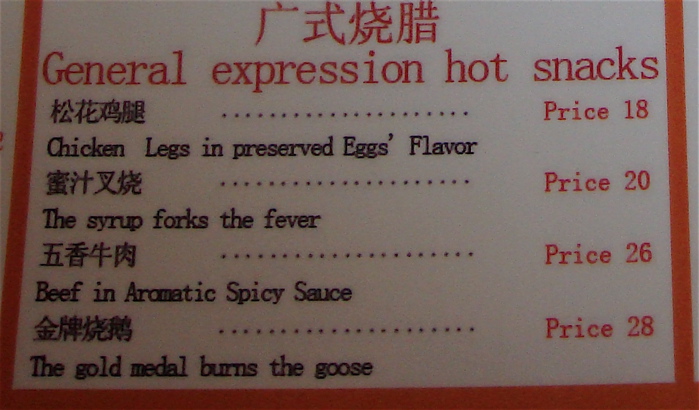
I love it when signs or notices are translated by non-mother tongue English speakers;it can be anything from cute to funny, misleading or just downright embarrassing.  I especially love Asian translations!  Here are a few examples.

Lost in Translation 1 Lost in Translation 2 Lost in Translation 9 Lost in Translation 11 Lost in Translation 23

Leave a comment

Filed under Images, Mistranslations, Nuts & Bolts, Quotes

20 Common Grammar Errors

For writers and bloggers, being reminded of the basic grammar rules from time to time is a good thing; they can help to improve our communication and efficiency.  If you’re like me, you may be writing along when a question pops up like, “Does this sentence need a comma here or not?”  The more familiar we become with the rules (and keep in mind that there are some differences between nationally-accepted rules, e.g. between the British standard and the American standard), the faster such decisions will become and the less time will be lost on such mundanely important details.  Click on the image below for a link to the 20 most common grammar errors and how to solve them.

AA Mistakes

Leave a comment

Filed under Nuts & Bolts, Research, Writing Exercise

The Etymology of February and Wednesday


February & Wednesday

We can blame both spellings on the Romans!  February is fairly clear:  Februa is thought to be a Sabine word (maybe we could blame them for italics, too), meaning “purifications”; Februarius mensis was the month of purification.  Before 450 BC this was actually the last month in the ancient calendar and referred to the feast of purification celebrated on the ides of that month throughout the Roman Empire.  Ides was the term used for approximately mid-month, being the 13th or 15th, depending on whether that particular month had 29 or 31 days.  Interestingly, in English it replaced the Old English solmonað (“mud month”… very appropriate, that) sometime in the 12th century when they began using the Old French term Feverier.

Wednesday accumulated slightly more pedigree before landing in our agendas:  It started off as the “day of (the god) Mercury,” the Latin dies Mercurii.  It was confiscated by the Scandinavians for their own religious version for Odin, Oðinsdagr (Old Norse) or Onsdag in Swedish.  This came with them over the Channel and was adopted by their English counterparts as wodnesdæg, or “Woden’s day.”  Old Frisian came fairly close to modern English with Wonsdei (I’ve probably seen that spelling on Facebook from people who can’t type with their i-phones properly…).  By the mid- 400 AD period, the Germanic Goths had been converted from Paganism to Christianity by Greek missionaries, and their language began to reflect the changes:  The astrological or religious terms gave way to ecclesiastical (or at least neutral) ones.  This difference is reflected in words like Mittwoch (German for Wednesday, meaning literally “mid-week”), sreda (Russian), or środa (Polish), both meaning literally “middle.”

So there you have it:  Blame it on the Romans, or the Vikings; but whoever you blame, just remember to spell them in correct modern English.

Leave a comment

Filed under History, Nuts & Bolts

5 Inspiring Gadgets

Once in a while I like to go surfing… internet, that is.  I like to search for inspiring images, whether people, architecture, Hi-Tech, transportation, or whatever floats my boat.  I come across them through a wide range of sites, and I’ve collected them for so long that I have no idea where some of them are from, but I hope that they will inspire you to go surfing, and find them on the original sites, read the articles, and be amazed, awed, or just dumb-founded.  So without further ado, here are a few gadgets:

1:  Airless tires.  How cool is that?!

Airless Tires

2: Blood-powered tattoo display.  It’s perhaps just a matter of time.  I wonder what all of those people will do who are already covered with tattoos? “Oops, lost the phone again… I know it’s on my arm somewhere…”

blood-powered-tattoo-display-gadget

3: Insect Spy Drone.  Whether or not it’s really in production by the US government, it’s either a frightening thought, or inspiring for Sci-Fi writers… either way, feel free to swat mosquitoes, even if they’re multi-million dollar ones.

Insect Spy drones

4:  The Skin Gun was developed by Jörg C. Gerlach and colleagues at Stem Cell Systems GmbH in Berlin.  It replicates the healthy skin of burn victims, injecting it straight onto the burn area to grow new skin, avoiding skin-graft rejections.

The Skin Gun, developed by Jörg C. Gerlach at Stem Cell Systems GmbH in Berlin

5:  Duluth, GA-based global systems integrations firm Polytron – transparent cell phone.  I know a lot of teenagers who already have enough trouble keeping track of where they saw their phone last.  Now make it invisible… that’s either a fun prank, or just mean.  Either way, it’s cool.

Duluth, GA-based global systems integrations firm Polytron - transparent cell phone


2 Comments

Filed under Nuts & Bolts, Research

Merisms

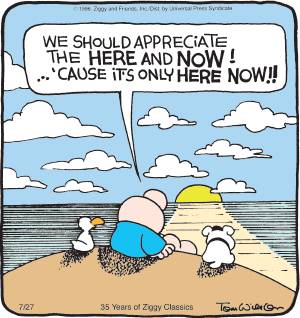
Here and NowMerisms are figures of speech in which a single thing is implied by stating several elements of it, usually contrasting concepts or parts, used to refer to an entirety; the elements can be literal or metaphorical.  They are striking features in ancient Biblical poetry, such as “The God of heaven and earth” meaning of everything (the universe).  Here are a few more:

here and there

here and now

life and death

body and soul

the length and breadth

high and low

ladies and gentlemen

young and old

rich and poor

kind and cruel

smart and stupid

from A to Z

Alpha and Omega

The beginning and the end

lock, stock and barrel

day and night

left and right

bag and baggage

the whole kit and caboodle


Can you think of any others?

Leave a comment

Filed under Cartoon, Grammar, Nuts & Bolts, Writing Exercise

Affect vs. Effect

aardvark - affect vs effectAffect and effect are probably two of the more confusing words in the English language.  Or should I say the use of them is the confusing bit.

A general rule of thumb is that affect is usually used as a verb, and effect is usually used as a noun.  As with other parts of speech, when in doubt try to replace it with a word you know the function of (i.e. clearly a verb, or clearly a noun); if it still makes sense then you know which one to use.

Example:  “The arrow affected the aardvark.”  “The arrow injured the aardvark.”  Injured makes sense here, so you need the verb form.

Effect is a noun, so try to replace it with another noun, e.g. “outcome.”

Example:  “The outcome was eye-popping.”  If you place these substitute words in the other sentences they wouldn’t make sense.

I hope that helps!  If you’re confused, just think of the aardvarks…

2 Comments

Filed under Articles, Nuts & Bolts, Writing Exercise

Spoonerisms

A Spoonerism is a deliberate (or accidental) play on words in which the corresponding consonants of two words, vowels, or morphemes are switched between two words in a sentence to create two new words.  For instance, “talking back” becomes “balking tack.”  The name comes from an Oxford minister, Rev. William A. Spooner, who was notorious for making these mistakes.  He must have been an entertaining minister to listen to!  The poor fellow didn’t appreciate the honour of using his name for such mistakes; he had enough on his plate with being Albino with poor eyesight, but he was well-liked, and the dubious honour accorded him was kindly meant.

spoonerism 3Here are a few examples (the interchangeable letters are capitalized):

The Weight of Rages will press hard upon the employer. (Rev. Spooner)

a Tip of the Slung

Dear old Queen / Queer old Dean

Runny Babbit

is the Bean Dizzy?

Fight in your Race

a Pack of Lies

Pest in DRink

the Might is in my Lies

Belly Jeans

BRimulate your Stain

as the FLow CRies

SMart Feller

I’d rather have a bottle in front of me than a frontal lobotomy.

SHake a Tower

well-boiled icicle, well-oiled bicycle

the Pea little THrigs

Roaring with Pain

Ragged Jocks

the Loose that Gaid the olden Geggs

the Mog in the Danger

the Pag at the STool

Beeping SLeauty

… and the Gist Loes on!


All I can say is, Roonerisms SPock!

Leave a comment

Filed under Articles, Nuts & Bolts

Paraprosdokians. Parawhat?

Paraprosdokian is not a word I would readily remember.  I can even admit freely I’d never heard of it until recently.  Maybe I’m just weird, but I can remember a word much better if I know where it came from; this one actually makes sense: (Greek) para– meaning “against”, and prosdokaō meaning “I expect.”  Against expectations.  It’s not actually that old, and is thought of by some linguists as a bogus term; but there are a lot of words that have crept into the English language on just such a pretext, and have hung around for centuries (thereby gaining loyalty from linguists).  I’d say that sounds like a bit of cosmic humour.

A Paraprosdokian is a phrase or sentence that ends with an unexpected twist.  Now it may be as common as rain where you live, but not here.  I tend to think of these sentences as one-liners, and with good reason – this figure of speech is popular with comedians as it’s short and ends on a punch.  Some Paraprosdokians use a familiar phrase and twist the ending such as the first sentence (“Where there’s a will, there’s a way”).  So I say, call them what you will – just use them well!

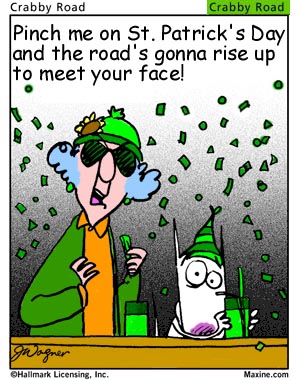
Crabby Road

Where there’s a will, I want to be in it.

I sleep eight hours a day and at least ten at night. (Bill Hicks)

The last thing I want to do is hurt you, but it’s still on my list.

Since light travels faster than sound, some people appear bright until you hear them speak.

You can always count on the Americans to do the right thing – after they have tried everything else. (Winston Churchill)

If I agreed with you, we’d both be wrong.

I don’t belong to an organized political party. I’m a Democrat. (Will Rogers)

We never really grow up, we only learn how to act in public.

War does not determine who is right – only who is left.

This is not a novel to be tossed aside lightly.  It should be thrown with great force.

Knowledge is knowing a tomato is a fruit. Wisdom is not putting it in a fruit salad.

They begin the evening news with Good Evening, then proceed to tell you why it isn’t.

He Ain’t Heavy, He’s My Brother. (Variations on this phrase are attested as early as 1884.)

There’s a fine line between cuddling and holding someone down so they can’t get away.

To steal ideas from one person is plagiarism. To steal from many is research.

If I am reading this graph correctly… I’d be very surprised. (Stephen Colbert)

I haven’t slept for ten days, because that would be too long. (Mitch Hedberg)

Money can’t buy happiness, but it sure makes misery easier to live with.

Buses stop in bus stations. Trains stop in train stations. On my desk is a work station.

I thought I wanted a career. Turns out I just wanted paychecks.

In filling out an application, where it says, ‘In case of emergency, notify, I put DOCTOR.

I like going to the park and watching the children run around because they don’t know I’m using blanks. (Emo Philips)

I didn’t say it was your fault, I said I was blaming you.

Women will never be equal to men until they can walk down the street with a bald head and a beer gut, and still think they are sexy.

Behind every successful man is his woman. Behind the fall of a successful man is usually another woman.

A clear conscience is the sign of a fuzzy memory.

You do not need a parachute to skydive. You only need a parachute to skydive twice.

I used to be indecisive. Now I’m not so sure.

He was at his best when the going was good. (Alistair Cooke on the Duke of Windsor)

You’re never too old to learn something stupid.

To be sure of hitting the target, shoot first and call whatever you hit, the target.

Nostalgia isn’t what it used to be.

Change is inevitable, except from a vending machine.

I’ve had a perfectly wonderful evening, but this wasn’t it. (Groucho Marx)

A modest man, who has much to be modest about. (Winston Churchill, about Clement Attlee)

If I could just say a few words… I’d be a better public speaker.

She was good as cooks go, and as cooks go she went.

Leave a comment

Filed under Articles, Cartoon, Grammar, Humor, Nuts & Bolts