The word Mondegreen is an example of what it means: Misheard lyrics in songs. The word was coined by the journalist Sylvia Wright in 1954, when she misheard the lyrics in a Scottish ballad; instead of hearing They have slain the Earl o’ Moray, / And laid him on the green, she heard Lady Mondegreen.
Examples of this happen frequently; when I was a child, I misheard the lyrics from Dashing through the snow in a one-horse open sleigh as a one-hose hope and slay – I had no idea what that was supposed to mean, but I sang it with gusto! A famous mondegreen is Bob Dylan’s The answer, my friend, is blowing in the wind misheard as The ants are my friends. All the whiskey in the sea can be heard in Club Tropica, by Wham!; the actual line is All that’s missing is the sea. From Toto’s song Africa, instead of the line bless the rains down in Africa, some people hear left my brains down in Africa. In Abba’s Dancing Queen, they sing feel the beat from the tambourine, but Ihear tangerine. There are likely as many mondegreens as there are songs, as garbled communication, Chinese whispers, accents and the mix of words and music can all lead to different conclusions than those intended by the singers or songwriters.
Have you ever misheard lyrics? Share your mondegreens below!
This word is doubly obscure, at least for me: Whilom (c. 1200), means having once been; former; once upon a time, erewhile, or at times past. It comes from the Old English hwilum, meaning at times, and is related to today’s while. It is doubly obscure for me because it has a similar formation to an equally obscure German word, weiland, meaning formerly, of yore. This German word is related to the modern weil, which is a false friend to the English word; the German word means because. The relation between the two is not a far stretch, as because implies that something happened in times past, once upon a time.
What do you think? Should we bring back whilom? I think, at any rate, we should start using of yore every chance we get!
No one likes a doryphore – a pedantic & annoyingly persistent critic of others; a petty pedant, a person who complains about minor mistakes. The word comes to us through French, and is also the term used for the Colorado beetle – perhaps alluding to the meaning of the word related to “pest” (doing double duty for a bug and for someone who is a pest). Alas, I think doryphore deserves to be brought back – it’s much more sophisticated and subtle than mere pest.
Most languages in the world probably have a term for such people as they are, unfortunately, rife; in Swiss German we would say that someone is “bünzlig” – they’re usually the people who become meter readers and give you a parking ticket as you’re getting into your car 10 seconds too late. We recently paid a parking ticket because we parked for 10 minutes in a business parking, on a Saturday when the business was closed and spots were empty; yes, technically a ticket can be issued; but most authorities use common sense in such situations – but not the doryphore; they were likely waiting, watching for shoppers to do just that. In all the years I’ve been driving and parking in Switzerland, it’s the first time this has happened, but there will always be that one bünzlig person. Pity them. They live in shrinking worlds.
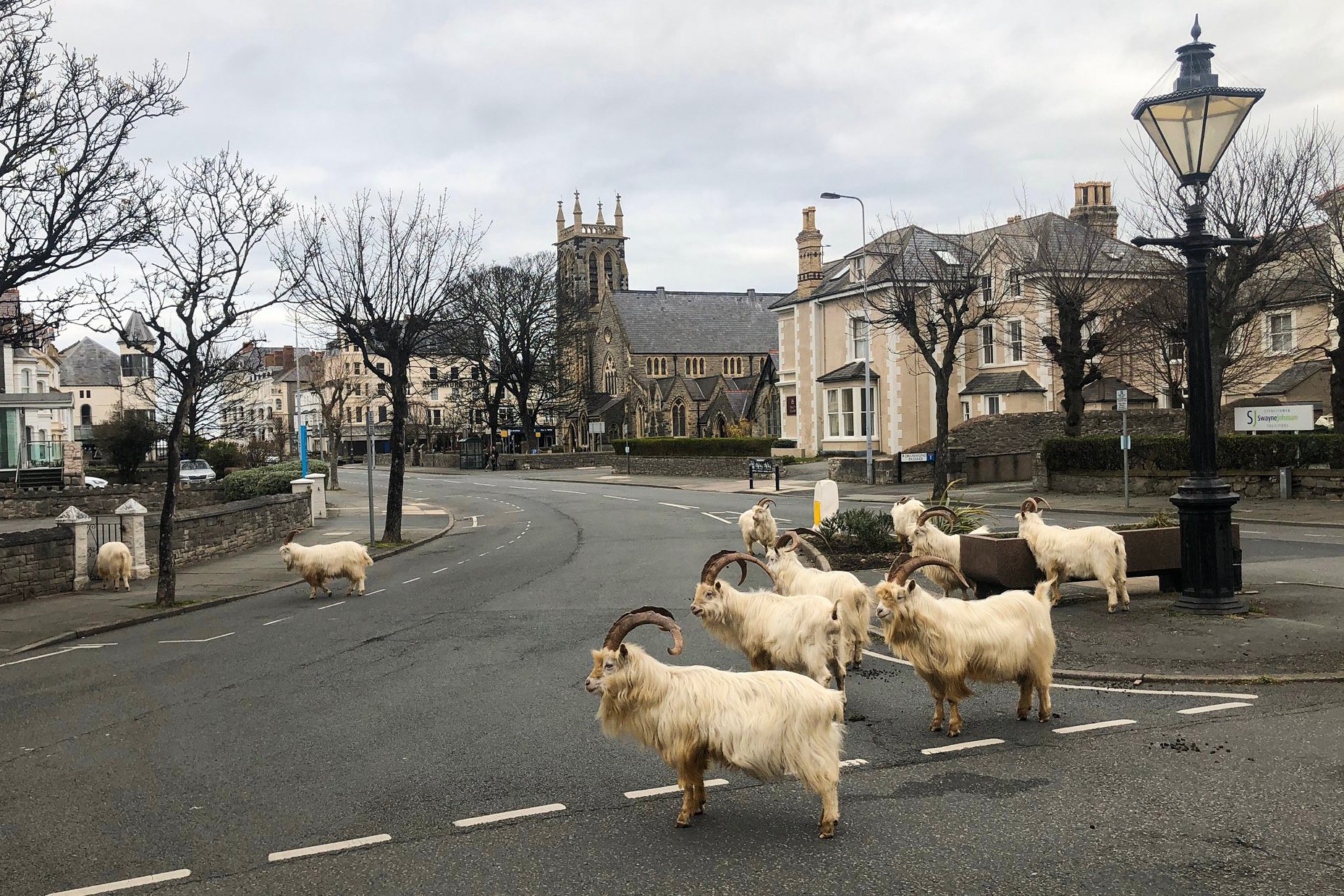
I came across this word today, and knew I had to find out more: Coined by scientific researchers in 2020, it refers to the impact on wildlife that Covid-19 has had; specifically, the pause of mankind on a global scale through lockdowns and travel restrictions.
Whales have changed their conversations – it’s quieter out there, with fewer cruise ships (those massive floating cities can drown out every other sound in underwater monitors for an hour as they pass by); Pumas have been spotted roaming through Santiago, Chile, and flocks of Flamingos have landed in the waterways of Mumbai, India. The wild animals that live in cities, coming out only at nights in normal times, have started coming out to play in broad daylight. Birds, who have had to learn to call louder to attract mates in areas with traffic, can suddenly be heard loud and clear.
Not all changes have been positive, however; we live in a complex world, and in a world where some people will take advantage of the situation: Poaching has risen, as has Amazon deforestation. But on the whole, wildlife has benefited from the absence or reduction of human activity and presence. Roadkill has been reduced, and in those areas near nesting sites, such as beaches, birds have been laying more eggs than in previous years, possibly because they feel safer and are less disturbed by human noise pollution. Studies are beginning to emerge about just how the withdrawal of humans on a mass scale is impacting the environment and wildlife, and I hope that one of the results of such research is a plan for making our lives on a global scale become more compatible with, and supportive of, nature and natural rhythms.
In the meantime, with lockdowns continuing in many parts of the world (and because one never knows when and how travel restrictions will return, and no one wants to get stuck paying for a hotel in a foreign country for weeks on end of quarantine, travel is largely self-restricted), mankind is safely behind closed doors, and wildlife will come out to play.
Most people collect something as a hobby; I’ve collected various things over the years: Stamps, postcards, arrow heads, fossils and minerals or gemstones, and coins. All of those are fairly common. The oddest thing I used to collect, in middle school, was spiders: I had about 500 different species in test tubes, and I would use them with my science fair presentations that was, for several years in a row, a growing display of all things arachnid, including my pet tarantulas. But there are folks out there who make that last collection of mine look normal: People who collect thousands of toothbrushes, or back scratchers, or “Do Not Disturb” signs, or erasers, or milk bottles. Where most of us have a collection that fits into a storage box, others have them the size of an entire room or two. OCD is probably also on the top of their profile descriptives, but then maybe they’re just passionate or fascinated about something most people would never think about collecting.
To have a look at 43 odd collections, just click HERE. Some of these are only odd in their amount collected, while others are just downright gross (think world’s largest chewed gum ball, or navel lint…). Perhaps “enjoy” is the wrong sentiment in those cases, but nevertheless, have a fascinating time vicariously checking out the odd quirks of others!
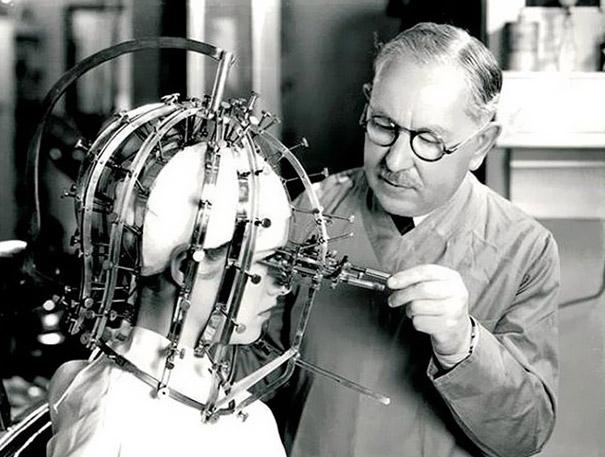
This device from 1930, invented by Max Factor (pictured), helps correct the application of makeup. Note: It’s only this complicated when a MAN does it…
Limbo-life goes on, but I thought I’d do a bit of dusting… of history, that is. I love historical images – they have a story that may have gotten lost over the years, or may document a significant achievement, such as the moon landings. Then there are those lovely photographs of bygone inventions: Some have succeeded into the modern era, while others were dumped somewhere along the wayside (and rightly so). Fortunately, the photo above falls into the latter category! As far as this topic goes, this is just a light dusting; there have been entire books and documentaries addressing this vast issue; if you’re interested in viewing a few documentaries on the topic, click here.
Makeup, as a topic of history, goes back thousands of years. Ancient Egypt is famous for their eyeliners and other cosmetic enhancements; lipstick may have been invented as far back as 5,000 years ago, by ancient Sumerians. The word “cosmetic” comes from Greek, and originally meant “technique of dress and ornament” or “skilled in ordering or arranging”. Natural ingredients used included charcoal, beeswax, crushed gemstones, castor oil, olive oil, milk (Cleopatra’s famous milk bath), rosewater, seaweed, fish scales (still used today), and seashells. In past ages, there were dubious forays into using tinctures of white lead, mercury, arsenic, quicklime, Belladonna, and even mouse fur eyebrows (for when the woman’s hair fell out due to using any of the above in combination…). A common insect still used in blushes and lipsticks is the cochineal, the Dactylopius coccus, a scale insect.
Probably as far back as the dawn of the Industrial Revolution in Europe, there has been a fascination with mechanics, even in the beauty industry (as illustrated by the image above). Though I have yet to find images that document the attempts at enhancing a man’s handsomeness, there are dozens, if not hundreds, of such inventions for women’s beauty. I think that fact simply reveals something about a deep-set, double-standard mindset that women need cosmetic improvement while men don’t *; that notion has been inescapably engrained into women for thousands of years (with the exception of the Egyptian culture, in which men used eyeliner just as much as the women). [*The two exceptions that I can find to this general trend is that men were berated in the mid-war years for being too scrawny, and they were encouraged to develop their physique; they were also ridiculed for baldness and were offered hair growth concoctions to counter the natural process.] While many of these gadgets and products have thankfully gone the way of the Dodo, some are still lurking around – and to them, I say, Shame on them for shaming natural features!
Here are a few other bygone mechanical attempts at enhancing the beauty of women:
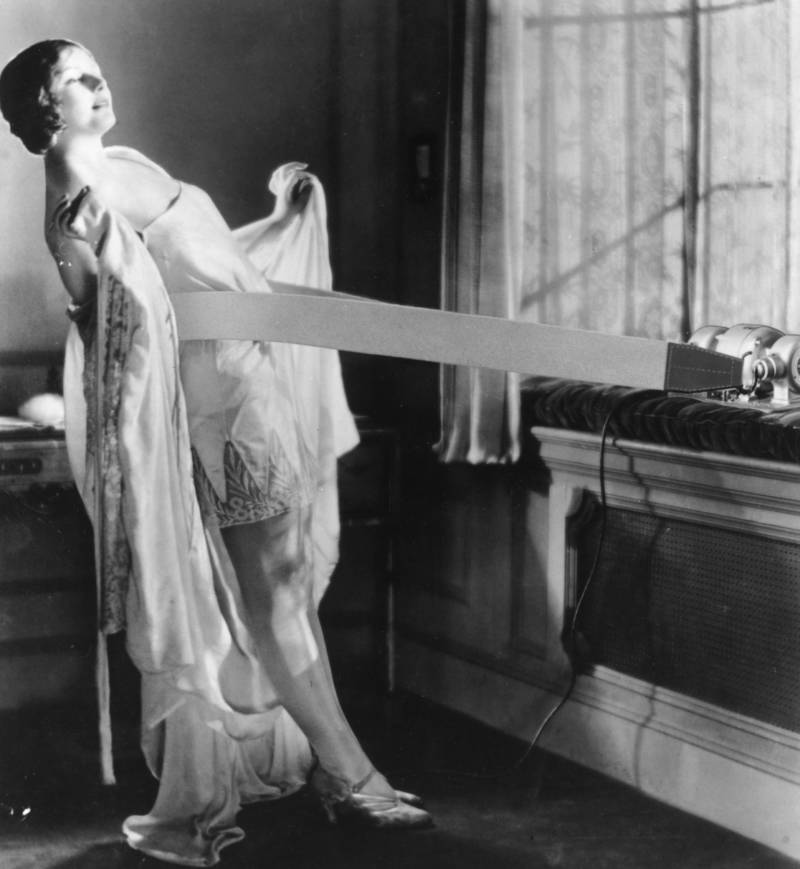
1928 – A woman uses a vibrating weight loss tool. Credit: Getty Images
1940s: Slenderising salons devised all sorts of weight-loss treatments; this chair massaged clients’ legs with metal rollers. Credit: Getty Images
1958 – Invented by a South African doctor, this machine was supposed to massage away any unwanted bits using electric currents. Credit: Getty Images
Stillman’s Freckle Cream, originally from Illinois, has been sold for over 120 years, and is still touted in cultures desiring paler skin, such as in Asian countries.
1960s – ice masks were used by Hollywood actresses to freshen their faces between takes without spoiling their makeup. Credit: Getty Images
1875 – A flexible mask intended to bleach the skin, removing blemishes.
Today’s obscure word is one which describes something most of us know and love, but which most of us have probably never even thought about naming: Petrichor. It’s used to describe that delicious scent hanging in the air after rain has fallen on dry ground. The word entered the English language in the 1960s, and is a combination of the Greek terms “petra,” which means stone, and “ichor,” which means the fluid that flows in the veins of the gods in Greek mythology.
I grew up quite aware of nature: We would sit outside on porch swings to soak in the atmosphere of a spring or summer rain, sometimes curled up in blankets and usually silent as we listened to the rain pattering off tree leaves, or grass, or hitting the steaming asphalt of the street in front of our house. I could recognize the smell of approaching rain; I could recognize the signs of a coming tornado (that’s Kansas for you!) and could feel the crackle of electricity in the air prior to a lightning storm. Just before lightning strikes, there’s ominous silence, as if all energy has suddenly been diverted to that interaction; after it releases, the sounds of nature pick up again where they left off.
One sound I miss that was associated in my mind with those spring and summer rains is the chirping of cicadas in the evenings. We don’t really have such insects here in Switzerland, though I still have the sounds of crickets chirping at night, and the rain dancing across the forest and housetops, and the smell of Petrichor hanging in the air.
Have you ever had that feeling that, when you meet someone for the first time, you already know them? Most of us might think of that person as a soulmate – someone we understand and who understands us without using many words or having to explain ourselves.
Well, adronitis might be the antithesis: It means “the frustration with how long it takes to get to know someone”. There are people I’ve known for years and tried to understand better, who are still a mystery to me. I can’t feel how they are doing or know what they are thinking, even with a lot of words. One might say with such people that they’re “on another wavelength” – and unless that person is a relative, they usually end up falling out of our lives fairly quickly.
May we all meet more people who are soulmates than those who give us adronitis!
A word might become obscure because it falls out of use, or another word comes along that can do the job better; sometimes it’s because a word might be hard to pronounce at first glance, and sometimes it’s because the concept it represents falls into obscurity, dragging the word down with it. I would say that the latter two reasons apply to today’s word: Dustsceawung. A noun, it means the viewing or contemplation of dust. The “contemplation” aspect also leads to a second definition: The reflection of former civilizations and peoples, and on the knowledge that all things return to dust.
In our fast-paced world, not many people take the time to contemplate dust. But I would argue that, now more than ever, such times of contemplation are healthy – even necessary – to give us a balanced perspective on life. So next time you dust your house or your car dashboard, be grateful you have a roof over your head or transport…take some time to enjoy a bit of dustsceawung, contemplating the good things in your life.
“In order to improve the mind, we ought less to learn, than to contemplate.”










 Today’s obscure word is one which describes something most of us know and love, but which most of us have probably never even thought about naming: Petrichor. It’s used to describe that delicious scent hanging in the air after rain has fallen on dry ground. The word entered the English language in the 1960s, and is a combination of
 Have you ever had that feeling that, when you meet someone for the first time, you already know them? Most of us might think of that person as a soulmate – someone we understand and who understands us without using many words or having to explain ourselves.






 Stephanie Huesler