History Undusted: Loch Eriboll, Scotland

Loch Eriboll and region. Click to enlarge.
Loch Eriboll is a sea loch along the northern coast of Scotland, roughly 16 km (10 mi) long. It’s been used (probably as long as inhabitants were in the area) as a safe anchor from the stormy seas off of Cape Wrath and the Pentland Firth. Bronze Age remains can be found in the area, including the souterrain I wrote about recently. There’s also a well-preserved wheelhouse on a hillside above the western shore, and on the small peninsula jutting out into the loch you’ll find the ruins of a small scale lime industry that developed there in the 19th century. The shores around the area are fascinating, as the geological composition is a conglomeration of an amazing variety, split along the eastern shore of the loch by the Moine Thrust. Even along the roads, you’ll find chunks of pink metamorphic rocks glittering with mica.

Loch Eriboll, taken Summer 2012, © Stephanie Huesler. Click to enlarge.
In 1945, thirty-three German U-boats surrendered in the deep loch, ending the Battle of the Atlantic. Eilean Choraidh, the largest island in the loch, was used as target practice for aerial bombing due to its size and resemblance to the shape of a ship. Along the western hills, you can see words written with stones near the settlement of Laid: They are the names of warships, such as the Hood and Amethyst, arranged there by the sailors of those ships.
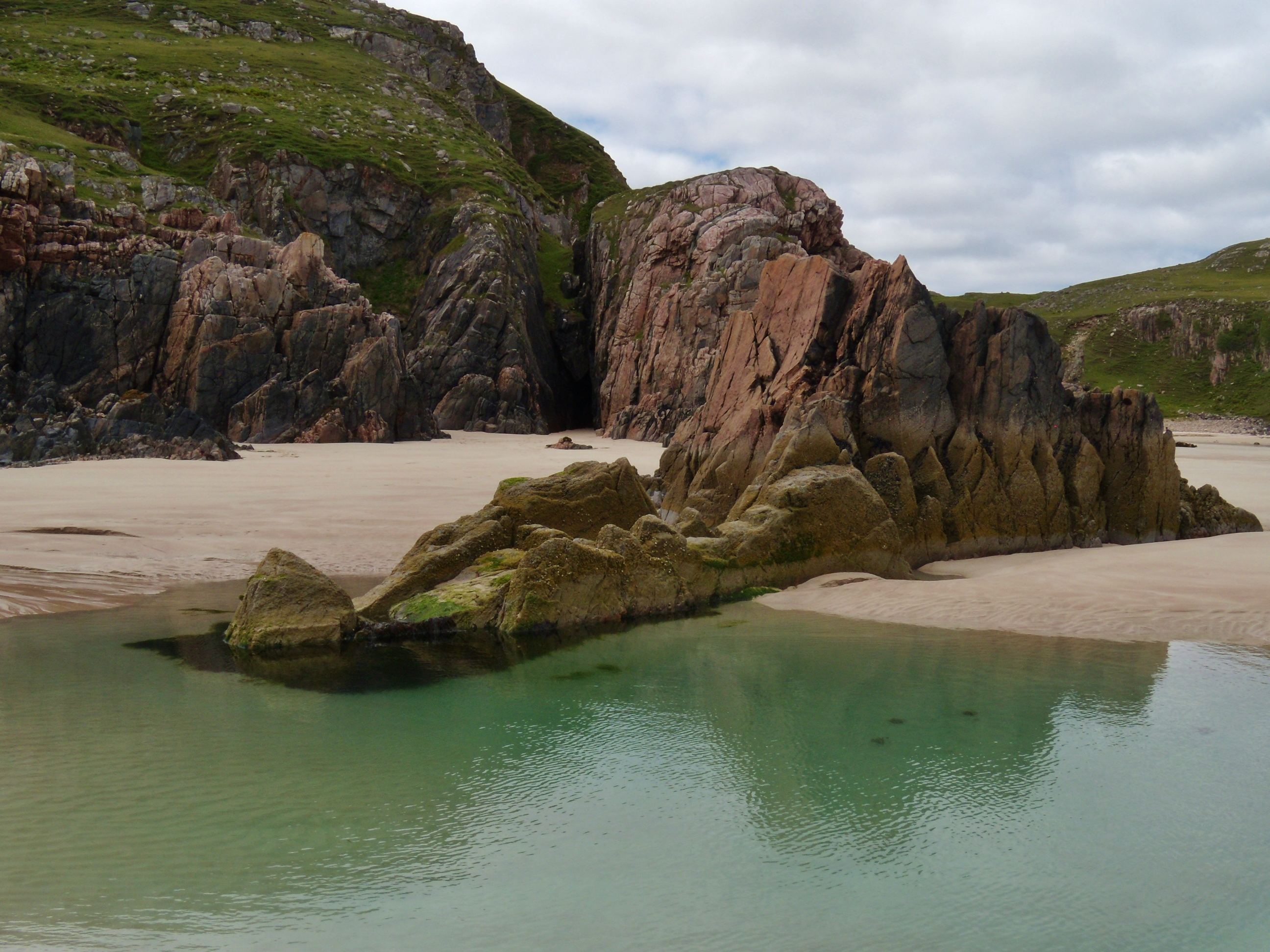
Tràigh Allt Chàilgeag Beach, taken Summer 2012, © Stephanie Huesler. Click to enlarge.
Not far from Loch Eriboll, on the way to Durness, is a treasure: Tràigh Allt Chàilgeag is a beach of vertical walls of stones layered in colours ranging from black to pink. When the tide is out the beach is endless, and when it’s in, climb the rocks! The beach was created as the Ice Age sheets began to melt, pushing the walls of rocks upward as the island actually rose, no longer being held down by the massive weight of ice.
On a clear day, you can see the southern-most Orkney Isles, and the waters around the coast are still busy highways for ships of all sizes.
My husband and I were on holiday in Scotland in 2012, and we spent several days in this area so that I could do research for The Cardinal; both the souterrain and the above-mentioned beach play a role in the story.
History Undusted, September 7, 2013
Filed under History Undusted, Musings, Research
A Swatter for Time Flies
Do you sometimes get the feeling that everything’s moving far too fast? I don’t necessarily mean technology, media, or time in general, though it could all certainly be included. I’m referring to your specific life circumstances. Perhaps, like me, you’ve got a goal looming ahead, and you see dozens of things that need to be done before it arrives. Just thinking of it all makes your head spin. Time flies by. If you’re like me, it’s the vagueness of those “dozens of things” that can stress me out, or as the Brits say, “get my knickers in a knot”.
When I feel that pressure building, I do three things, and I’d like to share them with you:
- Make a list. Break the list down into sections – whether those sections be things like “phone calls to make” or “research” or “phase one” or “today”, you know how best to get your tasks organised. For me, my current list branches out into ten topics, each with sub-sections, not counting my list of daily tasks around the house. I’d encourage you to buy a “to do” pad or notebook pages, or make up your own and print them out; having it written out makes it concrete, and therefore manageable.


Use a time management app. I use two: “aTimeLogger” and “Clear Focus”. I’ve mentioned these both before in my article about productivity (check it out for more tips!). When I sit down to work, I put my phone into airplane mode, open these two apps, and use them to keep me focused. Sometimes I work straight through on one topic and its sections, and sometimes I break it up into several different topics that are related. Set yourself a time goal for the day, and set yourself up to reach it! The time goal of Clear Focus can be adjusted to your needs; I have mine set at 30 minutes, with a long break every 3 sessions; I also have the paid version, which adds a “pause button” – helpful if e.g. the doorbell rings (and I decide to answer it!). The time logger app can be adapted to your needs; I’ve eliminated unnecessary categories and added my own – including writing, editing, and blogging. Also, it’s practical if you’re interested in learning just how much time you spend in any given area; if you think you spend too much time on social media, log it to find out!
- Minimize distractions. Several weeks ago, I removed Facebook from my list of “home page” tabs on my computer; it’s amazing how much that little decision has saved me time! It becomes a habit to check in because it’s there; out of sight, out of mind. Now, I must remind myself to go check in occasionally to answer messages. When you’re working on the computer, and you need the internet open, then minimize the distractions by controlling which tabs remain open, and make your first tab one that prompts you to write or work – a dictionary, thesaurus, etc. If you have websites you want to regularly check out, then limit that time to your 5- or 15-minute breaks (set in Clear Focus) as a “reward” for staying focused. My treat is Pinterest; it’s a place I could easily get lost in for longer than I’d like, so the time app keeps me focused there, too.
I hope these thoughts help you focus, take the stress out of the vague, and encourage you to tackle your goals, whatever they be! Keep writing!
PS: Don’t forget to sign up for my news!
Filed under Articles, Musings, Nuts & Bolts, Writing Exercise
Pure URLs
I’m fairly savvy in a lot of things to do with technology; I’m usually the one in our house who figures out how something works, from electronic gadgets to computer programs. Having said that, I’m probably a complete novice when it comes to all things “webby” – web design, computer programming, SEOs, and their ilk.
I found out about something recently that I thought I’d share with you – especially those of you who are authors with e-book editions: Pure URLs.
When you do a search, say, on Amazon, for your book, the URL will reflect the search phase. If you use that URL as a hyperlink in your ebook, it won’t work for anyone else – which is hard for you to know as, when you test it, Amazon will recognize your computer and reinstate that search result.
Here’s an example:
If I do a search on Amazon for one of my books, the URL looks like this (with spaces added to prevent conversion):
https: // www. amazon .com / Cardinal-Part-One-Stephanie-Huesler-ebook/dp/B00PKS2EWO/ ref=sr_1_1?s=digital-text&ie=UTF8&qid=1501893862&sr=1-1 &keywords=Stephanie+Huesler+The+Cardinal+Part+One
the pure URL will be shorter, like this:
https:// www. amazon .com / Cardinal-Part-One-Stephanie-Huesler-ebook / dp/B00PKS2EWO
If I remove the spaces and paste the pure URL into this post, it will look like this:
I hope this helps you as you prepare your document for publication. It’s something I am in the process of editing in my already-published books (in preparation for updates). As always, honing skills means that there will be cringe-moments when looking back on writing results from years ago. Bringing out a new book is good reason to go back and give the other documents (which need to be updated with new book information anyway) a good run-through!
Filed under Nuts & Bolts, Publications
The Passing of Mr Stubbs
The people of Talkeetna, Alaska sound like my kind of people: No-nonsense and pragmatic with a big dose of humour. If you haven’t heard the sad news, their honorary mayor of twenty years, Mr Stubbs, passed away recently. He was originally elected because they couldn’t find a politician worth voting for; he was merely “honorary” because Talkeetna is only a historical district, and holds no local election. Mr Stubbs was a cat.
Historically, he’s not alone in being a non-human electoral candidate; often, votes for such candidates are a form of protest or political satire. There has been a long line of them: In 1938, Milton, Washington elected a brown mule, Boston Curtis – he won 51 to 0; in the 1968 US Presidential election, Pigasus the Immortal, a boar hog, was nominated as candidate; Sunol, California elected Bosco – a black Labrador-Rottweiler mix – as mayor, 1981-1994; there have been turkeys, monkeys, rhinos, goats, and even non-animate objects such as a fire hydrant, a sock puppet, and a ficus tree that have attempted (and sometimes succeeded in) getting on the ballots.
Did you know that America could have had a much worthier president now? Limberbutt McCubbins, a cat, was officially registered with the Federal Election Commission as a Democratic candidate for the 2016 Presidential elections. His campaign slogan was “Meow Is The Time”. Here is the link for you to peruse the extensive list of historical non-human politicians and candidates.
Go to the list and choose your favourite example; it might give someone inspiration for their own political conundrum! Comments about non-human politicians, only, please…
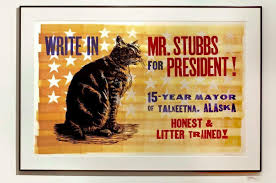
Mr Stubb’s presidential campaign, 2012
Contact
Hi, everyone!
These days I’m getting ready to publish my fifth novel, the third instalment in The Northing Trilogy, called Asunder. In preparation, besides all the tasks such as final editing, formatting, writing blurbs, back cover copy, graphics and cover designs (to name a few!), I’ve also been reading books on the technical aspects; I don’t know about you, but I tend to avoid the bits such as marketing. That term tends to engender visions of those flashy pop-up ads that interrupt my focus with demands. I hate those things. Though marketing is integral to getting the word out about my books and other publications, I used to think of it like a kind of math homework… I put it off as long as possible! I’m gradually warming up to it.
Having said that, I’ve just read a great book by James Scott Bell, called Marketing for Writers Who Hate Marketing. How did he know? It was a relief and an encouragement to realise that a) I must not be alone in my feelings toward that topic, and b) I’d been doing a lot of it right instinctively, with one exception: In light of his advice, I’ve decided to set up a mailing list.

Here’s my idea: With those who sign up on my contact page, I’d like to share occasional insights into my writing process that I don’t often share on this blog; I’ll also share things like information on resource material that I use in either publishing or research. I’ll let you be the first to know about new releases, and to inform you when a sales promotion or special offer is coming up.
Don’t worry – I won’t flood your inbox with emails. Our generation is on information overload as it is so I will keep my emails to a minimum, but I hope to make it well worth your while to read them when they arrive. I’m looking forward to this new venture; it’s been a long time since I wrote letters to friends, and that’s how I see this – from me to you.
To sign up, just fill in this contact form. Thank you, and I hope we have a great journey together!
Filed under Musings, Nuts & Bolts, Plot Thots & Profiles, Publications, Research
On Bending History

“Few will have the greatness to bend history itself; but each of us can work to change a small portion of events, and in the total of all those acts will be written the history of this generation.”
Robert F. Kennedy
Filed under History, History Undusted, Quotes
Shetland
I don’t know about you, but when we go on holidays, we usually head to cooler climes. We were recently (technically) in Scotland for a fortnight’s holiday, this time on the Shetland Isles: For those of you who don’t know where that’s at, hop on to Google Earth, and have a vicarious look around. Shetland is a subarctic archipelago in the Atlantic; you’re never more than 3 miles away from the sea because, though the total landmass is about 1,470 square kilometres, there are over 2,700 kilometres of coastline.
We stayed at the Lerwick Hotel, making day-trips out from there. In the 2 weeks we were there we managed to see nearly every nook and cranny by rental car. Many of the “towns” are no more than a collection of a house or two; Lerwick is really the only proper town on Shetland. We covered everything from Sumburgh Head in the south to Hermanness on the northern tip of Unst, the northerly-most inhabited island of the UK.
We usually had perfect weather for being out and about; the wind was mild, and only one day of what’s known as a “flying gale”… that’s when the wind actively tries to either rip the car door out of your hands or slam it shut as you’re trying to get in or out of the car; flying gales drive ships ashore. I point that out because great weather is not to be taken for granted on rocks in the middle of the Atlantic that have no naturally-occurring trees, i.e. windbreaks, and everything that happens is scheduled with the contingency of weather permitting. While we were there, it was “Simmer Dim” = NO night; you could easily read a book outside, no matter the time of day or night.
Some of the Highlights:
Our hotel window: We could see Breiwick Bay, the traffic of large ships coming and going from the harbour (even this large three-masted sail ship), and the wildlife of Shetland: Otters, both grey and common seals, dive-bombing gannets, arctic terns flitting over the water like butterflies, and a variety of gulls that kept us entertained.
Mousa Isle: We took a “dusk” (midnight) boat trip and hiked ½ a mile across the moors to the Mousa Broch, the most intact broch in the world. In the walls of this ancient tower are around 500 pairs of Storm Petrels – swallow-like sea birds who sound like purring kittens with hiccups as they call for their mates, to be found by them in the crowded darkness. Darkness is relative in the summer; they need to wait until it’s darkest before returning from their time at sea, as they are targets for larger bird’s menus.
Norwick Beach: On northern Unst, this beach is a visual smorgasbord for any geologist, because it’s where an ocean floor was thrust upward to collide with the continent millions of years ago. The stone formations jutting out in the middle of the beach are two distinct colours, dark and light, side by side. That beach is just an example of the stunning geological history and beauty of the islands. They’ve even got an app, “Geopark Shetland”.
Wildlife: Shetland has the highest density of otters of anywhere in Europe, with around 1,000; Shetland ponies (everywhere!); puffins – the darlings of the sea, and one of our favourite birds; gannets, terns, guillemots, razorbills, oyster catchers, great black-backed gulls, great skuas, herring gulls, black-hooded gulls, kittiwakes, and dozens of other seabirds; cliff-dwelling rabbits (puffins are even known to share their burrows with them); Shetland sheep – they’ve got very soft wool, and tend to be brownish with black spots; some of them were adorable, with spotted eyes like pandas.
History: With over 6,000 archaeological sites and dozens of great museums, there was never a dull moment! Clickhimin Broch was a short walk away from our hotel; Mousa Broch was an amazing experience – to sit inside it, as people did 2,000 years ago… you could still see the slats in the walls where wooden beams would have supported upper floors. We spent a lot of time at the Shetland Museum in Lerwick; well laid out, it was informative and inviting, with a great restaurant.
I could go on and on – and perhaps I’ll write an article or two more about some aspect of the Isles in the future, but for now, here are a few photos.
On Long Walks
“In these days of increasing rapid artificial locomotion, may I be permitted to say a word in favour of a very worthy and valuable old friend of mine, Mr. Long Walk? I am afraid that this good gentleman is in danger of getting neglected, if not forgotten. We live in days of water trips and land trips, excursions by sea, road and rail – bicycles and tricycles, tram cars and motor cars… but in my humble opinion, good honest walking exercise for health beats all other kinds of locomotion into a cocked hat.”
T. Thatcher, “A Plea for a Long Walk”, the Publishers’ Circular, 1902

Filed under Cartoon, History, History Undusted, Quotes