Tag Archives: Grammar

The Jabberwocky and the Totemügerli

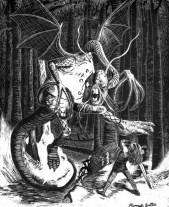
Unless you’ve been living under a rock, chances are you’ve heard of Alice in Wonderland; at the least your curiosity might have been piqued enough to read it after seeing The Matrix, or be mistaken in thinking that you don’t need to read the book if you saw Tim Burton’s film with Johnnie Depp.  The sequel to Lewis Carroll’s most famous work (mentioned above), called “Through the Looking-Glass, and What Alice Found There“, written in 1871, contains the famous nonsensical poem called the Jabberwocky, which I present here:

“Jabberwocky”

‘Twas brillig, and the slithy toves

Did gyre and gimble in the wabe;

All mimsy were the borogoves,

And the mome raths outgrabe.

“Beware the Jabberwock, my son!

The jaws that bite, the claws that catch!

Beware the Jubjub bird, and shun

The frumious Bandersnatch!”

He took his vorpal sword in hand:

Long time the manxome foe he sought—

So rested he by the Tumtum tree,

And stood awhile in thought.

And as in uffish thought he stood,

The Jabberwock, with eyes of flame,

Came whiffling through the tulgey wood,

And burbled as it came!

One, two! One, two! and through and through

The vorpal blade went snicker-snack!

He left it dead, and with its head

He went galumphing back.

“And hast thou slain the Jabberwock?

Come to my arms, my beamish boy!

O frabjous day! Callooh! Callay!”

He chortled in his joy.

‘Twas brillig, and the slithy toves

Did gyre and gimble in the wabe;

All mimsy were the borogoves,

And the mome raths outgrabe.

Many of the nonsensical words are what Lewis Carroll (aka Charles Lutwidge Dodgson) coined Jabberwockyas “portmanteau words” meaning the combination of both sound and meaning of two words into one; e.g. frumious being “fuming” and “furious”.  Some of the words have since made it into the English language, such as galumph or chortle, while some were words he revived, such as gyre and beamish.  And personally I think some of his words deserve wider use, such as brilling, slithy, snicker-snack and Bandersnatch!  Click on the photo to the right to hear the poem read.
Now… “what is the Totemügerli,” I hear you ask?  It is the Swiss-German version – not a translation, but an original story by Franz Hohler, a Swiss cabaret performer; Bernese German, to be more precise.  Bern is the political capital of Switzerland, and historically has one of the richest, most colourful dialects of all the Swiss German dialects; I am fluent in the Zürich dialect, and can understand all the other Swiss-German dialects, including Walliserdïïtsch, which is the oldest of all Swiss dialects; and I can guarantee you that the Totemügerli story is 90% nonsense, and yet tells a clear tale!  For those of you interested in the text, here it is:

Ds Totemügerli

von Franz Hohler

Gäuit, wemer da grad eso schön binanger sitze, hani däicht, chönntech

vilicht es bärndütsches Gschichtli erzelle. Es isch zwar es bsungers

uganteligs Gschichtli, wo aber no gar nid eso lang im Mittlere

Schattegibeleggtäli passiert isch:

Der Schöppelimunggi u der Houderebäseler si einischt schpät am Abe,

wo scho der Schibützu durs Gochlimoos pfoderet het, über s Batzmättere

Heigisch im Erpfetli zueglüffe u hei nang na gschtigelet u gschigöggelet,

das me z Gotts Bäri hätt chönne meine, si sige nanger scheich.

«Na ei so schlöözige Blotzbänggu am Fläre, u i verminggle der s Bätzi,

dass d Oschterpföteler ghörsch zawanggle!»

«Drby wärsch froh, hättsch en einzige nuesige Schiggeler uf em Lugipfupf!»

U so isch das hin u härgange wie nes Färegschäderli amene Milchgröözi,

da seit plötzlech Houderebäseler zu Schöppelimunggi:

«Schtill! Was ziberlet dert näbem Tobelöhli z grachtige n uuf u aab?»

Schöppelimunggi het gschläfzet wie ne Gitzeler u hets du o gseh. Es

Totemügerli! U nid numen eis, nei, zwöi, drü, vier, füüf, es ganzes

Schoossinjong voll si da desumegschläberlet u hei zäng pinggerlet u

globofzgerlet u gschanghangizigerlifisionööggelet, das es eim richtig agschnäggelet het.

Schöppelimunggi u Houderebäseler hei nang nume zuegmutzet u hei ganz

hingerbyggelig wöllen abschöberle. Aber chuum hei si der Awang ytröölet,

gröözet es Totemügerli:

«Heee, dir zweee!»

U denen isch i d Chnöde glöötet wie bschüttigs Chrüzimääl dure Chätschäbertrog.

Düpfelig u gnütelig si si blybe schtah wie zwöi gripseti Mischtschwibeli,

u scho isch das Totemügerli was tschigerlisch was

pfigerlisch binene zueche gsi. Äs het se zersch es Rüngli chyblig u

gschiferlig aagnöttelet u het se de möögglige gfraget:

«Chöit dir is hälfe, ds Blindeli der Schtotzgrotzen ueche z graagge?»

Wo der Schöppelimunggi das Wort «Blindeli» ghört het, het em fasch

wölle ds Härzgätterli zum Hosegschingg uspföderle,

aber der Houderebäseler het em zueggaschplet:

«Du weisch doch, das men imene Totemügerli nid darf nei säge!»

U du si si halt mitgschnarpflet.

«Sooo, dir zweee!» het ds Totemügerli gseit, wo si zum Blindeli cho si,

u die angere Totemügerli si ganz rüeiig daaggalzlet u hei numen ugschynig ychegschwärzelet.

Da hei die beide gwüsst, was es Scheieli Gschlychets ds Gloubige

choschtet u hei das Blindeli aagroupet, der eint am schörpfu, der anger a de Gängertalpli.

Uuuh, isch das e botterepfloorigi Schtrüpfete gsi!

Die zwee hei gschwouderet u ghetzpacheret, das si z näbis meh gwüsst hei,

wo se der Gürchu zwurglet.

Daa, z eis Dapf, wo si scho halber der Schtotzgrotzen

uecheghaschpaaperet si, faht sech das Blindeli afah ziirgge u bäärgglet mit

schychem Schtimmli:

«Ooh, wie buuchet mi der Glutz!»

Jetz hets aber im Schöppelimunggi böös im Schyssächerli gguugget.

Är het das Blindeli la glootsche u isch der Schtotzgrotz abdotzeret,

wie wenn em der Hurligwaagg mit em Flarzyse der Schtirps vermöcklet hätt.

«Häb dure, Münggu!» het em der Houderebäseler na naagräätschet;

u de het er nüt meh gwüsst.

Am angere Morge het ne ds Schtötzgrötzeler Eisi gfunge, chäfu u tunggig

wien en Öiu, u es isch meh weder e Monet gange,

bis er wider het chönne s Gräppli im Hotschmägeli bleike.

Totemügerli u Blindeli het er keis meh gseh sis Läbe lang, aber o der

Schöppelimunggi isch vo da a verschwunde gsi.

S git Lüt, wo säge, dass sider am Schtotzgrotzen es Totemügerli meh desumeschirggelet.

If you’d like to hear it read out by Franz Hohler himself, in a cabaret show recorded during the ’80s, just click on the image below.

Totemürgeli, by Willy Vogelsang

6 Comments

Filed under Articles, History, Quotes, Videos

The Separate Language

Having lived on both sides of the Puddle (that’s the Atlantic, for you Americans), I can confirm that English truly is a language that separates the Old World from the New.  While the American language seems to be simplifying through the school system and mass media (and don’t even get me started on the spelling!), I doubt that will ever happen in the UK… the language is far too entertaining to let it get boring.  Click on the image below for a few gems like “Donkey’s Years”, “it’s monkeys”, “to have a butcher’s”, and “up the wooden hill to Bedfordshire”.

Anglophenia


Leave a comment

Filed under Translations, Videos

Illiterate? Read These Ads…

Once in a while I come across ads that hit my funny bone; Some are simply not thought through as far as double meanings are concerned, while others are just downright bizarre.  My all-time favourite is the used tombstone:  Just the fact of it begs questions, but the name nearly pulled a muscle in my side from my laughing so hard…

Classified Ads classified-new class-new

Leave a comment

Filed under Images

Simply English, not Simple English

No VowelsThe following poem has been floating around for years; it’s so popular because it’s a great encapsulated example of the weirdness of English as a language!  It’s also a great exercise in stretching your vocabulary, being more aware of how to say words that are often only seen written and never heard pronounced.  And if you come across a word you don’t know, or could swear it’s pronounced differently than the rhyme of the poem indicates, I challenge you to look it up (Wiktionary is an example of a good source which shows how various dialects of English pronounce words if there is more than one option); and if you feel completely overwhelmed, click on the cartoon above to watch someone else chew their way through it!

Simply English

Dearest creature in creation,

Study English pronunciation.

I will teach you in my verse

Sounds like corpse, corps, horse, and worse.

I will keep you, Suzy, busy,

Make your head with heat grow dizzy.

Tear in eye, your dress will tear.

So shall I! Oh hear my prayer.

Just compare heart, beard, and heard,

Dies and diet, lord and word,

Sword and sward, retain and Britain.

(Mind the latter, how it’s written.)

Now I surely will not plague you

With such words as plaque and ague.

But be careful how you speak:

Say break and steak, but bleak and streak;

Cloven, oven, how and low,

Script, receipt, show, poem, and toe.

Hear me say, devoid of trickery,

Daughter, laughter, and Terpsichore,

Typhoid, measles, topsails, aisles,

Exiles, similes, and reviles;

Scholar, vicar, and cigar,

Solar, mica, war and far;

One, anemone, Balmoral,

Kitchen, lichen, laundry, laurel;

Gertrude, German, wind and mind,

Scene, Melpomene, mankind.

Billet does not rhyme with ballet,

Bouquet, wallet, mallet, chalet.

Blood and flood are not like food,

Nor is mould like should and would.

Viscous, viscount, load and broad,

Toward, to forward, to reward.

And your pronunciation’s OK

When you correctly say croquet,

Rounded, wounded, grieve and sieve,

Friend and fiend, alive and live.

Ivy, privy, famous; clamour

And enamour rhymes with hammer.

River, rival, tomb, bomb, comb,

Doll and roll and some and home.

Stranger does not rhyme with anger,

Neither does devour with clangour.

Souls but foul, haunt but aunt,

Font, front, wont, want, grand, and grant,

Shoes, goes, does. Now first say finger,

And then singer, ginger, linger,

Real, zeal, mauve, gauze, gouge and gauge,

Marriage, foliage, mirage, and age.

Query does not rhyme with very,

Nor does fury sound like bury.

Dost, lost, post and doth, cloth, loth.

Job, nob, bosom, transom, oath.

Though the differences seem little,

We say actual but victual.

Refer does not rhyme with deafer.

Foeffer does, and zephyr, heifer.

Mint, pint, senate and sedate;

Dull, bull, and George ate late.

Scenic, Arabic, Pacific,

Science, conscience, scientific.

Liberty, library, heave and heaven,

Rachel, ache, moustache, eleven.

We say hallowed, but allowed,

People, leopard, towed, but vowed.

Mark the differences, moreover,

Between mover, cover, clover;

Leeches, breeches, wise, precise,

Chalice, but police and lice;

Camel, constable, unstable,

Principle, disciple, label.

Petal, panel, and canal,

Wait, surprise, plait, promise, pal.

Worm and storm, chaise, chaos, chair,

Senator, spectator, mayor.

Tour, but our and succour, four.

Gas, alas, and Arkansas.

Sea, idea, Korea, area,

Psalm, Maria, but malaria.

Youth, south, southern, cleanse and clean.

Doctrine, turpentine, marine.

Compare alien with Italian,

Dandelion and battalion.

Sally with ally, yea, ye,

Eye, I, ay, aye, whey, and key.

Say aver, but ever, fever,

Neither, leisure, skein, deceiver.

Heron, granary, canary.

Crevice and device and aerie.

Face, but preface, not efface.

Phlegm, phlegmatic, ass, glass, bass.

Large, but target, gin, give, verging,

Ought, out, joust and scour, scourging.

Ear, but earn and wear and tear

Do not rhyme with here but ere.

Seven is right, but so is even,

Hyphen, roughen, nephew Stephen,

Monkey, donkey, Turk and jerk,

Ask, grasp, wasp, and cork and work.

Pronunciation — think of Psyche!

Is a paling stout and spikey?

Won’t it make you lose your wits,

Writing groats and saying grits?

It’s a dark abyss or tunnel:

Strewn with stones, stowed, solace, gunwale,

Islington and Isle of Wight,

Housewife, verdict and indict.

Finally, which rhymes with enough?

Though, through, plough, or dough, or cough?

Hiccough has the sound of cup.

My advice is give it up!


Leave a comment

Filed under Cartoon, Mistranslations, Nuts & Bolts, Quotes, Videos, Writing Exercise

How To Boost Your Focus

I’m probably the most organised person I know; I’m not OCD about it, I just work better when things are organised.  Writing a book means that I accumulate bits and pieces of information, research facts, website links, editing tips, formatting guidelines, historical trivia that I can integrate into my plot (but only if I can find it when I get there), maps, diagrams, lists of names in various languages, grammar points to remember (I’ve made up a word for “points to remember” – poitrems – you heard it here first), How-To cheat-sheets for PhotoShop, publication checklists (pre- and post-), Shelfari to-dos, and… need I continue?  I’m just getting started.  And that’s my point.  If I’m not organised, I’ll waste half my day looking for something… where did I put that note about the dimensions of a modern casket?  Was it hot arsenic or cyanide that smells like garlic?  Are blue diamonds more valuable than pure white?  What kind of micro-organism poops arsenic?  A friend of mine complimented me one day when I told her some of the things I was researching; she said, “You’re just weird.”  And it’s something my husband repeats fondly on a regular basis.

So, I’d like to share a few of my organisational tips with you:

1)  Know thyself.  Know your weaknesses (You know, those distractions, procrastination excuses, time-eating habits like “just checking into Facebook for a minute before I sit down to write” and an hour later you’re hungry, then you see that the kitchen needs cleaning… you know who you are.).  Recognize those time-wasters, and nip them in the bud before they mushroom into a day wasted.  Keep your cell phone at a safe distance; wear earplugs if you need to; turn on music if it helps you focus, turn it off if it distracts you.  Write down points to research and only dive into research when you have 5 items on the list (and stay away from time-monster sites like Facebook and Youtube while you’re working!)

Character Profile Worksheet 12)  Find a system that works for you.  I organise my notes, etc. in various ways:  I have pocket-sized Moleskin books for quick reference character profiles, lists of words, family trees of characters, etc.; I also have lined notebooks with those heavy-duty post-it tabs labelling the sections (that are well-spaced apart for future additions); I write the section names on the front and back of those tabs so that I can find it from either way the notebook lands on my desk.  For instance, one notebook I always have at hand has sections like publications, pre- & post- publication to-dos, paperback formatting checklist, KDP guidelines, CreateSpace guidelines, grammar, PhotoShop Elements helps, editing checklists, proofing checklists, Beta checklists, and step-by-step guides for various publication formats.  Another notebook I keep on hand has things like time-related notes (Julian calendar terms, Ages [Stone Age = ~6,000-2,000 BC], etc.), medical notes (that’s where I put that note about modern casket dimensions), glossaries for archaeological terms, 18th century England notes, lists of museum curators’ names, phone numbers and emails, etc.  Besides notebooks, I keep “cards” – here’s an example (to the right):  I type up the information in PowerPoint, then save each “card” to .jpg format through MS Paint.  These cards are then saved onto my Tab through Dropbox, and Bob’s your uncle, I’ve got them handy whether I’m writing on the couch, on holiday, or in a café.

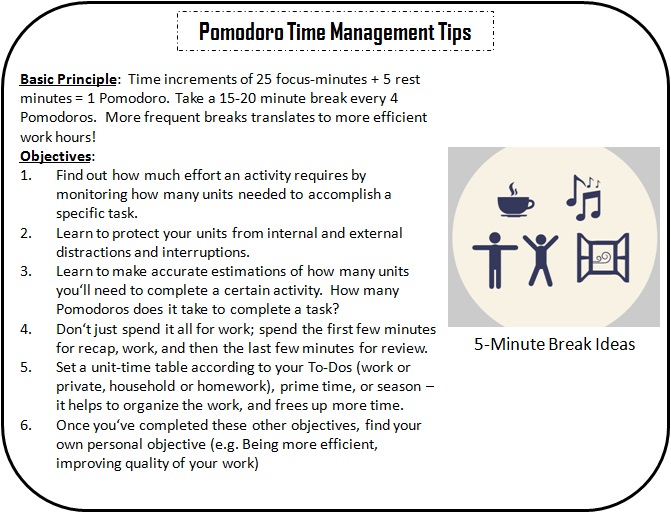
Pomodoro Time Management Tips3) Learn to focus.  I’ve recently found a great way to focus better through those hours of the day and night when I know I’m going to be most distracted:  It’s called Focus Booster.  It’s basically a timer on your desktop that counts down time increments, with an additional break-time at the end of each cycle.  The standard unit of time is 25/5, though you can adjust it to your rhythm.  The thinking is that anyone can focus on a given task for 25 minutes, even those who struggle with ADD.  In using it, I’ve realized how often I get distracted by a thought that comes into my mind while writing and I get up to do something quickly.  This way, I stay working for a solid amount of time, and use that 5 minutes to switch gears and get other things done; it’s amazing how much you can get accomplished in 30 minutes.  I’d encourage you to download it and give it a try if you struggle with concentration.  Here’s a second card I’ve made with the basic principles for the Booster.

Those are just a few ideas; if you struggle with a specific area, or would like suggestions on dealing with specific challenges in focusing, just ask away!  Focus well, and your writing will flow so much more smoothly and swiftly.


3 Comments

Filed under Articles, Nuts & Bolts, Research, Writing Exercise

Punctuation Dragons

Raphael - Saint George and the DragonThose wee things called punctuation are probably the most important things in writing; they are the proverbial insects of the writing world, for without them the entire system would disintegrate.  At the same time, they can sometimes be as daunting as fighting a dragon.

So without further ado, below is a brief breakdown of the most familiarly-confusing punctuation marks.  There may be a few discrepancies between various dialects / regional rules, but these are the basic rules – if you have these firmly in hand and use them consistently, you’ll recognize those rules that differ to what you learned in school; just apply whichever rules you use with consistency.  Feel free to copy / paste the post and print it out to keep handy (with that goal in mind, I’ll keep it comment-free)!

 Commas:

Where possible, leave out.  Where confusing, put in.

  • Separate elements in a series.
  • , + small conjunction (i.e. and, but, or):  If in doubt, use it here.
  • To set off introductory elements.  The comma can be omitted for short elements unless it makes the meaning unclear or confusing.
  • To set off parenthetical elements (added information that, if removed, does not affect the meaning of the sentence).
  • To separate coordinate adjectives (e.g. tall, distinguished woman)
  • To set off quoted elements:  , “(quote/dialogue).”  OR  , “(quote/dialogue),” (prose).
  • To set off contrasting expressions.
  • To avoid confusion.
  • Never use only one comma between a subject and its verb! (Only one would constitute a splice – see below)
  • Typographical reasons (i.e. dates, numbers, location references, etc.)

Comma Splice:  When a comma is misplaced between two independent clauses or randomly in the middle of a sentence, or between the subject and its verb.

Semi-Colon:

  • Use to join two independent clauses (e.g. “My wife would like tea; I would prefer coffee.”)
  • Use to separate items in a list that includes other punctuation (e.g. “The people present were Jamie, who came from New Zealand; John, the milkman’s son; and George, a gaunt kind of man.”)

 Apostrophe:

  • To express the possessive (e.g. Jane’s book)
  • To signify contractions (e.g. It’s cold outside.)
  • Some proper names use an apostrophe (e.g. O’Donnell, O’Malley)
  • Apostrophes are NEVER to be used to form a plural.  Never.  It’s CDs, not CD’s; DVDs, not DVD’s; the 1980s, not the 1980’s; 100s, not 100’s.  This may be a controversial “never” as they are common mistakes – so common that some writers perceive them as correct (just because some people use them does not make them correct usage… jumping off a cliff and all that).  The only exception to this “never” is when there may be the possibility of misreading.

 Hyphen (-) vs. en-dash (–) vs. em-dash (—)

Hyphen:

  • To join two words into a single meaning (e.g. decision-maker), or linked as an adjective before a noun (e.g. decision-making process).

En-dash: (Key: Ctrl + number – / Alt+0150)

  • To join two words that are separate but related, for example as a substitute for and or to.

Em-dash:  (Key:  AltGr + number – / Alt+0151)

  • Used to form parenthetical phrases.  These are used, for example, if there is the risk of confusion when other punctuation is used in the same sentence – for example commas.

The general rule of thumb in the UK seems to be as follows:  Use the en-dash within dialogues and prose, but end abrupt, interrupted dialogue with an em-dash.

There is a fourth dash called the Horizontal Bar.  It is usually used to set off quotation sources.  it is generally the same length as an em-dash, so this is often used instead. The main difference between the two is that some software may insert a line break after an em-dash but not after a quotation dash.

Parentheses / Brackets:

  • Order of usage:  (…[…{…}…]…).
  • Use to contain material that could be omitted without altering a sentence’s meaning, and where commas used elsewhere may lead to confusion if too many are used.  Any punctuation inside the brackets is independent from the main sentence.
  • […] Square brackets/crochets are used to mark omitted material from a quote of an original, more complete text.

Ellipsis:  … / . . . aka “Suspension Point”

  • Use for intentional omissions or an unfinished thought.
  • Use for unstated alternatives (implied by context).  E.g. “I’m on a… special diet.” (Edward Cullen, in Twilight)
  • Use for a slight pause.
  • Use for a nervous or awkward silence.
  • Use at the beginning or end of a sentence to inspire feelings of melancholy or longing.

Leave a comment

Filed under Nuts & Bolts, Writing Exercise

The 3 Levels of Editing

EditingWriting is not just about stringing words together to express a coherent thought; at that level one might say it’s primary school basics.  The deeper I delve into the written world of words, the more I recognize the shades of colour, light and moods, and the fact that when I am telling a story, I am really painting a picture.  But to get to that depth, besides the fundamental skills of telling a good story, every writer needs to be familiar with what I consider to be three basic levels of editing; there’s a wide palette for discussion, and the order below is not chronological but often simultaneous phases of editing.  Here are a few points to keep in mind:

1:  The Matrix Level

I call this the “Matrix Level” because it really is the foundation – without it, don’t even think about giving up your day job.  This level includes things like spelling, vocabulary (choosing the best word or phrase in a given situation) and punctuation.  At this level you might also include things like formatting (being consistent in usage of fonts; spacing; size and heading styles; margins; indentations; double-or single-spacing after a full stop; capitalizations; abbreviations [e.g. Mr. or Mr {that choice depends on whether or not you’re using American Standard English, or British Standard English}]; and consistent use of italics, bolds and underlines).

2:  The 3-C Level

This is what I call the 3-C level because it’s just that:  Coherency, Consistency, Conciseness.  This is the level you work on things like clear expression; showing, not telling (re-writing those scenes that tell into a scene that shows the action or the purpose of that scene); assessing what your demographic target is (teenagers, women, men, children, intellectual readers, pulp-fiction readers, genre-specific groups, etc.) and writing with them in mind as you make choices of expression and complexity.

This level includes things like pacing/timing/rhythm of the overall script; logical connections, organic changes, filling in the “holes” in the plot, the building of action or tension (again, in an organic way to the story—don’t just slap in a sex scene or a car chase because you need to pick up the pace in a dragging scene!), and keeping an eye out for things like vocabulary repetition (if it’s there, it needs to be organic, e.g. perhaps a character likes to use a phrase as a “trademark”) or filler words (actually, really, etc.).

3:  The “Cutting Room Floor” Level

This is the level where tough decisions come in; here you need to ask yourself some basic questions:  Does scene XYZ support the plot in more than one way?  [Plot, by the way, applies whether you’re writing a novel, a business case plan, or a newspaper article.]  If not, can I glean the core sentiment or information that needs to be conveyed and splice it in somewhere else?  Does the purpose / goal come through or remain clear in this scene?  If not, how can I change it, trim it, or chop it?  Are paragraphs unified (i.e. one main goal / thought each)?  This process is very similar to film editing, and you can learn a lot from that process by listening to good film commentaries (the best I’ve come across are films with commentaries by Steven Spielberg – he’s a natural teacher in that respect!).

In the current novel I’m writing, a fantasy-history spanning from first century AD Scotland and Norway to modern-day Scotland, an earlier draft had too many characters; there are still enough to warrant a Cast of Characters section at the end (due to the complex structure that will be woven together in the next draft), but the general rule is to not tax the reader with more than four characters in any given scene.  So even though each character was well-developed and interesting, I had to let some heads roll.

The way I write works for me:  If I’ve written a scene that somehow doesn’t sit right with the tone/mood but I know it conveys something necessary to the construct as a whole, I will paste that scene to the end of the document and title it “Scene to Salvage: —” with a brief description.  Later I can go back to the core of that scene and salvage it, or decide that it no longer fits and delete it—it’s nonetheless served the purpose of helping me solidify the plot by hashing out certain elements.  I may really like one key sentence or idea, so I’ll cut it out and drop it in where it works well organically to the story.  I might also add that each of these levels is vital in this story as each section (Pictish; an otherworldly kingdom; Norse settlements; and modern archaeology) has its own colour palette:  Stone, rain and sea; mist, sky and whispers; leather, smoke and wood; and technology, pubs and peat mire.  Each sections’ dialogue and prose need to reflect those palettes, and that’s the secret of showing, not telling!

The more structured you work, and the more confident you become with each level, the better and faster the writing process will become.  I hope this inspires you, and spurs you on to greater writing!

Leave a comment

Filed under Articles, Lists, Nuts & Bolts, Publications

20 Common Grammar Errors

For writers and bloggers, being reminded of the basic grammar rules from time to time is a good thing; they can help to improve our communication and efficiency.  If you’re like me, you may be writing along when a question pops up like, “Does this sentence need a comma here or not?”  The more familiar we become with the rules (and keep in mind that there are some differences between nationally-accepted rules, e.g. between the British standard and the American standard), the faster such decisions will become and the less time will be lost on such mundanely important details.  Click on the image below for a link to the 20 most common grammar errors and how to solve them.

AA Mistakes

Leave a comment

Filed under Nuts & Bolts, Research, Writing Exercise

The Etymology of February and Wednesday


February & Wednesday

We can blame both spellings on the Romans!  February is fairly clear:  Februa is thought to be a Sabine word (maybe we could blame them for italics, too), meaning “purifications”; Februarius mensis was the month of purification.  Before 450 BC this was actually the last month in the ancient calendar and referred to the feast of purification celebrated on the ides of that month throughout the Roman Empire.  Ides was the term used for approximately mid-month, being the 13th or 15th, depending on whether that particular month had 29 or 31 days.  Interestingly, in English it replaced the Old English solmonað (“mud month”… very appropriate, that) sometime in the 12th century when they began using the Old French term Feverier.

Wednesday accumulated slightly more pedigree before landing in our agendas:  It started off as the “day of (the god) Mercury,” the Latin dies Mercurii.  It was confiscated by the Scandinavians for their own religious version for Odin, Oðinsdagr (Old Norse) or Onsdag in Swedish.  This came with them over the Channel and was adopted by their English counterparts as wodnesdæg, or “Woden’s day.”  Old Frisian came fairly close to modern English with Wonsdei (I’ve probably seen that spelling on Facebook from people who can’t type with their i-phones properly…).  By the mid- 400 AD period, the Germanic Goths had been converted from Paganism to Christianity by Greek missionaries, and their language began to reflect the changes:  The astrological or religious terms gave way to ecclesiastical (or at least neutral) ones.  This difference is reflected in words like Mittwoch (German for Wednesday, meaning literally “mid-week”), sreda (Russian), or środa (Polish), both meaning literally “middle.”

So there you have it:  Blame it on the Romans, or the Vikings; but whoever you blame, just remember to spell them in correct modern English.

Leave a comment

Filed under History, Nuts & Bolts

Affect vs. Effect

aardvark - affect vs effectAffect and effect are probably two of the more confusing words in the English language.  Or should I say the use of them is the confusing bit.

A general rule of thumb is that affect is usually used as a verb, and effect is usually used as a noun.  As with other parts of speech, when in doubt try to replace it with a word you know the function of (i.e. clearly a verb, or clearly a noun); if it still makes sense then you know which one to use.

Example:  “The arrow affected the aardvark.”  “The arrow injured the aardvark.”  Injured makes sense here, so you need the verb form.

Effect is a noun, so try to replace it with another noun, e.g. “outcome.”

Example:  “The outcome was eye-popping.”  If you place these substitute words in the other sentences they wouldn’t make sense.

I hope that helps!  If you’re confused, just think of the aardvarks…

2 Comments

Filed under Articles, Nuts & Bolts, Writing Exercise