Today’s phrase, playing at / making ducks and drakes, refers to skipping stones across a water surface, much like the image of a waterbird coming in for a watery landing. By 1614, the meaning had come to be associated with squandering or throwing one’s money away needlessly, much like stones were tossed away in stone-skipping.
The first written evidence of the phrase was in 1585, The nomenclator, or remembrancer of Adrianus Junius, translated by John Higgins:
“A kind of sport or play with an oister shell or stone throwne into the water, and making circles yer it sinke, etc. It is called a ducke and a drake, and a halfe-penie cake.”
These two terms also appear in nursery rhymes; the first, found in A History of Nursery Rhymes (1899) by Percy B. Green, where he mentions that this rhyme was repeated when skimming stones:
A duck, a drake, a barley cake, A penny to pay the baker; A hop, a scotch, another notch – Slitherum, slitherum, take her.
The “barley cake” is “halfpenny cake” in this 1916 version of The Real Mother Goose:
A duck and a drake, And a halfpenny cake, With a penny to pay the old baker. A hop and a scotch Is another notch, Slitherum, slatherum, take her.
In 1626, it is mentioned in the play Dick of Devon: “The poorest ship-boy Might on the Thames make duckes and drakes with pieces Of eight fetchd out of Spayne.”
Many cultures share the simple pastime of stone tossing, with their own terms for it: American English, skipping stones; British English, skimming stones or ducks and drakes; in Scottish, Skiting or Skliffing; in Irish, stone skiffing. In French, making ricochets (faire des ricochets); in German, stone flitting (Steinehüpfen); in various languages such as Bulgarian, Greek, Latvian and Lithuanian, their terms refer to frogs rather than ducks. In Japanese, cutting water. In Norwegian, fish bounce (fiskesprett). In Portuguese, either water shearing (capar a água) or making tiny hats (fazer chapeletas). The list goes on and on!
The oldest reference to the pastime goes back to the 2nd century AD by the Greek scholar Julius Pollux; in the 3rd century, Marcus Minucius Felix (a Latin writer) mentions children skipping shells on the beach.
Today, of course, it has become a serious competition for some. According to the Guinness Book of World Records, the record for the number of skips is 88, held by Kurt Steiner; the furthest distance for men is 121.8m, made by Scotsman Dougie Isaacs, and 52.5m for women, thrown by Nina Luginbuhl from Switzerland.
The next time you’re out at a lake or shore, toss a stone and remember the long and colourful history of ducks, drakes, frogs, fish, hats and water!
Last Sunday at church, a friend filled an entire room with her late father’s books, setting up an impromptu book shop. I chose several books, most of which are in Fraktur typeface, known to some people as “Gothic” or “Old German”. I enjoy reading such books because they offer a snapshot of a cultural way of thinking. The books I chose were printed between 1877 and 1940. The latter date is significant, as you’ll soon see.
First of all, let’s clarify a few terms: Though many people think of font and typeface as interchangeable, in fact, they refer to two different aspects of a writing style. Typeface refers to a particular style of lettering (e.g. Times New Roman), while font refers to the variations within that style, such as size and weight (CAPS, bold, italic, etc.). Another term we know but may not fully understand is Serif: This refers to the small stroke or line attached to the larger stroke of a letter; an example would be an A with “feet” at the bottom of each down-stroke. Sans Serif simply means “without Serif”.
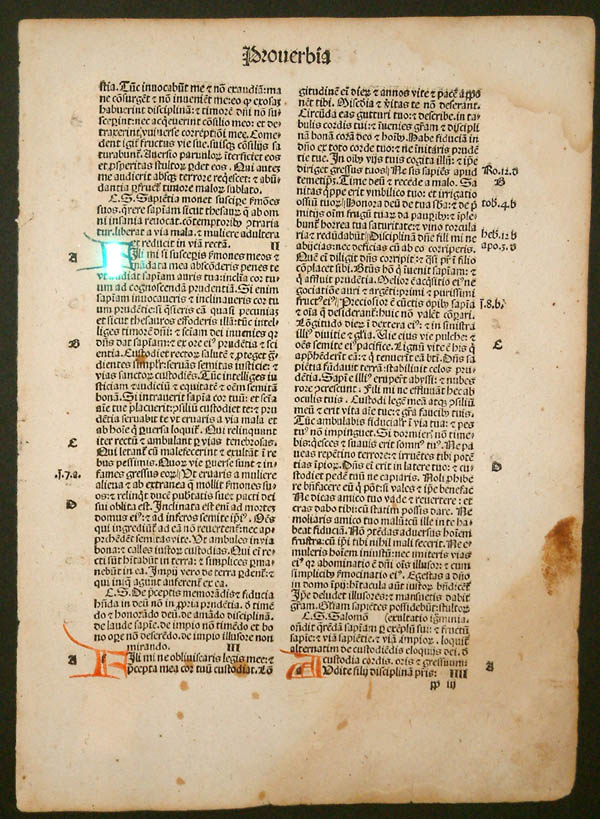
The first moveable-type printing press, designed by Johannes Gutenberg in Germany around 1440, was based on the ancient Roman design of a screw press used to press wine or oil, which in turn went on to be used to press designs into cloths. He was likely familiar with intaglio printing and may have done some work himself in copper engraving. These designs and uses likely fermented in his inventor’s mind into what became the revolutionary turning point of literacy. Gutenberg’s original typeface was called Donatus-Kalender; the metal type design was itself a form of Textura (more on that in a moment).
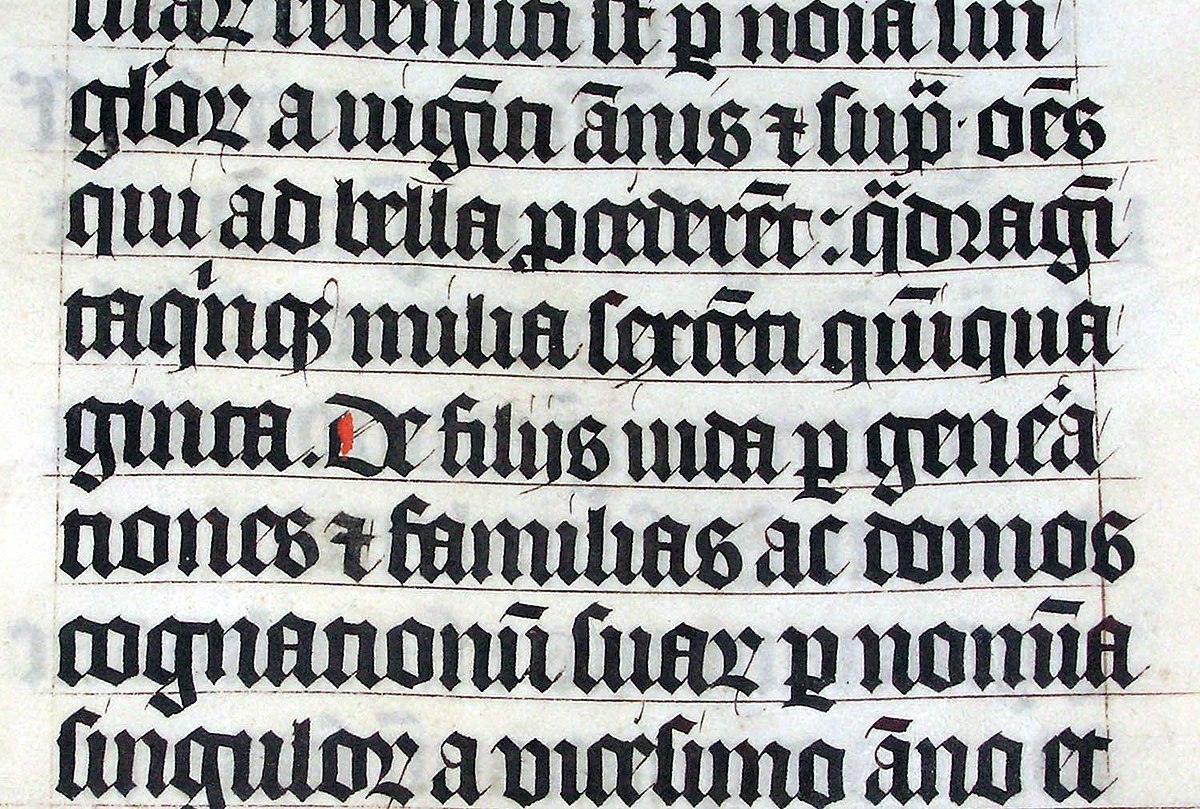
Donatus Kalender
Example of Blackletter (Source: Wikipedia)
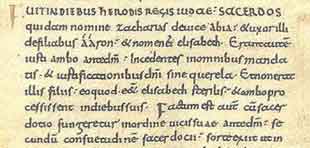
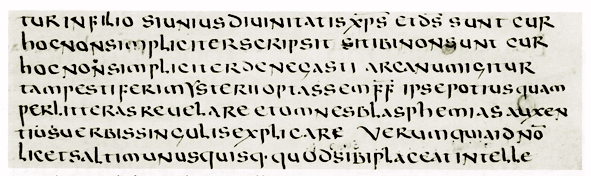
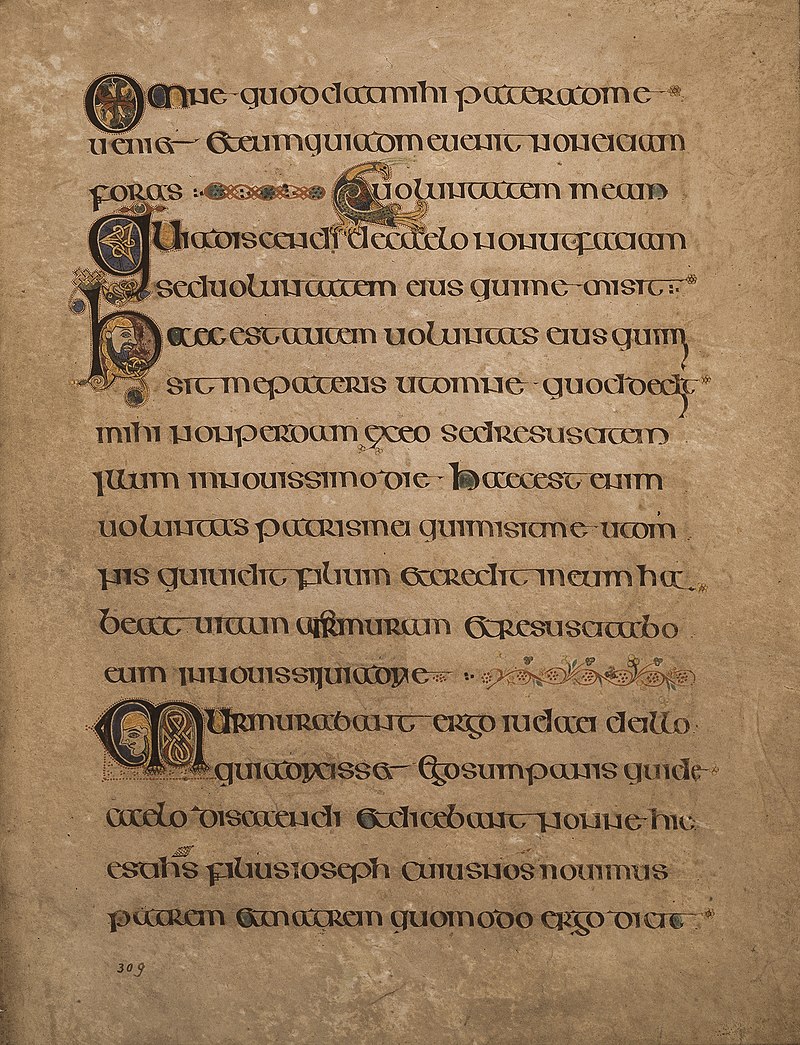
This original family of typefaces was known as “Blackletter”, aka “Gothic scripts”, with the height of popularity peaking around the 14th to 15th centuries. The ancestor of the Blackletter was called the Carolingian minuscule, a calligraphic standard of handwriting widely used in the medieval period, when literacy began increasing and a need for books in a wide range of subjects began to be in demand. It is thought to have been developed in the mid-770s by Benedictine monks north of Paris in the Corbie Abbey, famous for its scriptorium and library. The minuscule itself was derived from Roman Uncial as well as Irish Insular script, which was developed in Irish monasteries and spread throughout Europe.
Carolingian Minuscule
Roman Uncial
From the Book of Kells, an example of the Irish Insular script
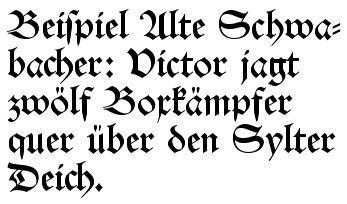
The family of Blackletter typefaces included Early Gothic, which was a transitional script between the Carolingian miniscule and Textura (the most calligraphic form of Blackletter); Schwabacher was a form popular in early German print typefaces (it became widely known with the spread of Luther Bibles from 1522), in use from the 15th century until it was eventually replaced by Fraktur around 1530, though it was still used alongside Fraktur for emphasis, much like we use bold or italic today.
Schwabacher Typeface
Textura Typeface
Another blackletter typeface developed between 1470 and 1600: Antiqua. This typeface’s letters were designed to look like the handwriting of ancient Roman documents, with the letters flowing together, strokes connecting them in a continuous line, whereas Fraktur was distinguished by having letters “fractured” – separate from one another. The Antiqua-Fraktur Dispute deserves its own article, so stay tuned!
Antiqua Typeface (Source: Wikipedia)
Fraktur Typeface (Source: Fonts in Use)
The Habsburg Emperor Maximillian I (1459-1519) was King of the Romans* from 1486 to 1519 [the title of king was used by the kings of East Francia, the territory later referred to as the Kingdom of Germany, from the time of Henry II (1002) to Joseph II (1764)]. The king commissioned the artist Albrecht Dürer to create a series of woodcut engravings of the Triumphal Arch [Though many are familiar with the Arc de Triomphe in Paris, it is only one example of this ancient Roman architectural feature used as a free-standing structure (rather than the Greek version, which was used within a structure such as a temple).]. These engravings would be used to create what we would recognize today as essentially wallpaper, though its purpose was more of a statement of power or propaganda (read personal marketing) commemorating his nobility, generosity, and military conquests – an incongruous combination, if you ask those conquered… The final composite of printed papers stood nearly 3 metres (12 feet) high and was only one part of a series of three enormous prints commissioned by the king.
Albrecht Dürer’s The Triumphal Arch, for Maximilian I
The Fraktur typeface was designed in the 1530s by Hieronymus Andreae, a German woodblock cutter, printer, publisher, and typographer closely connected to Albrecht Dürer. The typeface was made to decorate the arch, telling the stories of the figures depicted throughout. The typeface became popular in Europe and was in use in the German-speaking world, as well as areas under its influence (Scandinavia, Central Europe, and some eastern European regions), into the 20th century. Specifically, Fraktur was in use in German until 1941, when it was actually banned (which places one of the books I purchased on Sunday within one year of the end of the era of Fraktur!). The atmosphere that led to that ban arose from the dispute mentioned above. Once the Nazis were defeated, the ban was lifted, but Fraktur never regained its widespread popularity after that, though you can still see it occasionally in pub signs or various forms of ads, like beer brands.
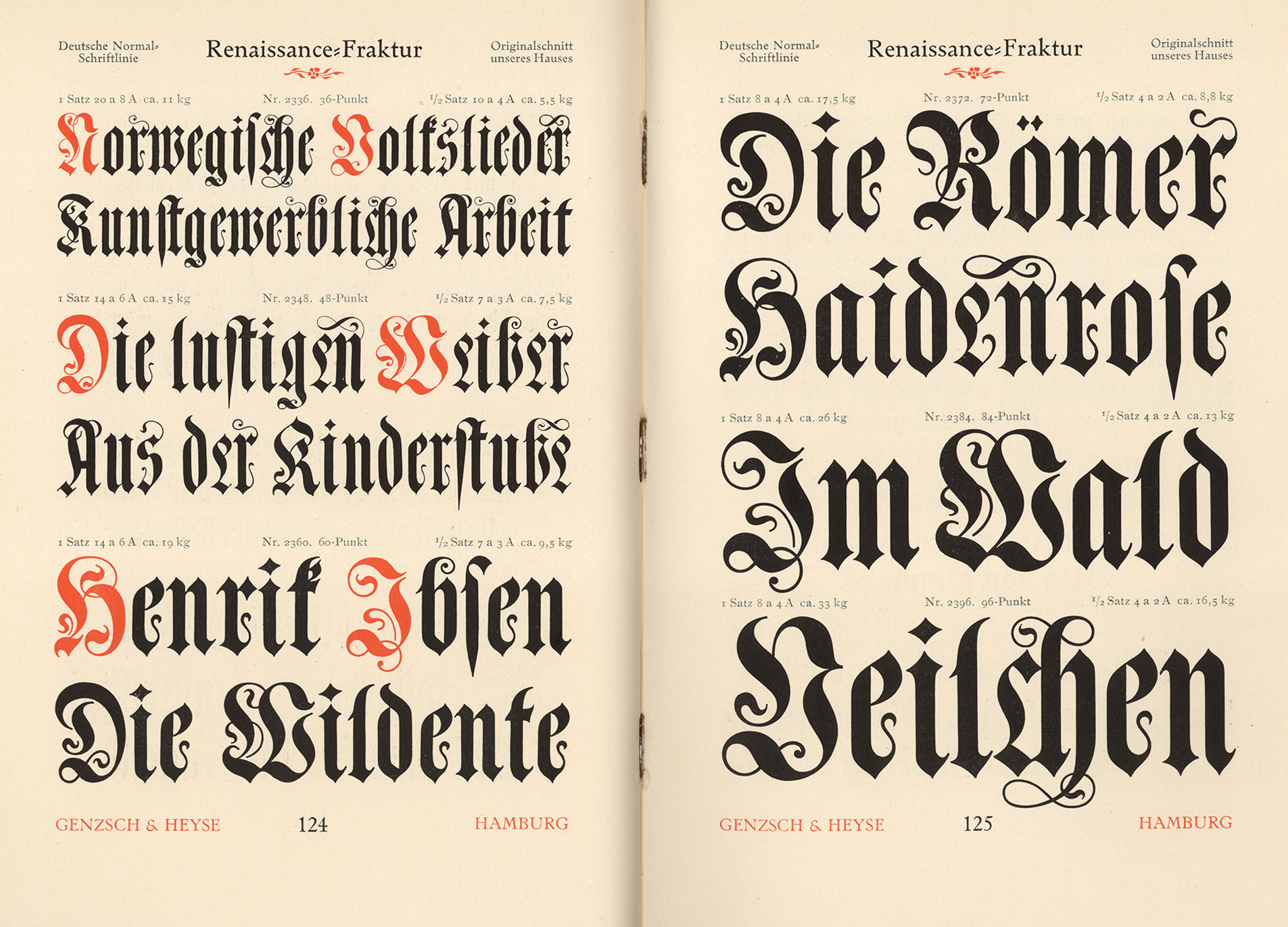
I just pulled two books from my library shelves: One is an English book originally printed in 1895, with my book being printed in 1915; the other is a German book printed in 1892. The typefaces are widely different: The English text likely used the French Oldstyle, while the German book uses Renaissance Fraktur for the text body, while the end pages act as indexes and use a variety of blackletter typefaces, such as Muenchner Fraktur, Antike Kanzlei, and Enge verzierte Altdeutsch. To see examples of the typefaces mentioned here, please click on the link for Fonts In Use.
I hope you enjoyed this jaunt through history! Nearly every name mentioned, every typeface, and every event deserves its own undusting. Next time, we’ll deep-dive into the dispute that lasted well over a century!
I’m fascinated by a few aspects of architecture in particular, such as doorways, knockers, unusual features such as sundials on the sides of buildings, mural paintings (here in Switzerland, these are sometimes hundreds of years old), and shop signage – you’ll see the latter even in the smallest town here.
This past summer, my husband and I rented a motorhome and travelled mostly in eastern Switzerland. I would say that 90% of my photos were of shop signs! I find that if you focus in on one topic, you’ll begin to see that thing everywhere.
Known as commercial signage or trade signs, such symbols of a shop’s products have been used as far back as ancient Egypt. As many people were illiterate, the pictorial shop sign not only advertised what was for sale in a shop but also distinguished the shops with similar items. By the mid-15th century, English laws even required shops that sold ale to hang a shop sign out; it made inspections of the quality of the ale easier. Some signs were temporary; for instance, if a woman made more ale or bread than her family could consume, she would put out a sign to sell the surplus and thus earn a bit of money. In the narrow streets of medieval towns, signs might be so large as to nearly touch the building on the other side of the lane, and they could become a hazard to passing horsemen or coachmen. By the mid-16th century, regulations were passed to limit the size of signage, and the securing of the sign to the building to avoid it endangering passersby. In Britain, hanging signs were eventually phased out in favour of what were are most familiar with – a flat sign denoting the store along the space above the front windows. But here in Switzerland, shop signage is everywhere – not just old, but also newer additions.
The development of the signs, including elements of guilds or heraldry symbols, led to competition between blacksmiths to create the most elaborate ironwork. The signs evolved from simple displays of ware to symbolic representations of a shop owner’s name or a heraldic connection or patronage of royalty (e.g. a crown). Examples might include shoemakers displaying a shoe or gilt boot, bakeries displaying bread, and haberdasheries displaying a needle and thread or a coat.
Here is just a fraction of the signs I photographed during our holidays, with brief explanations:
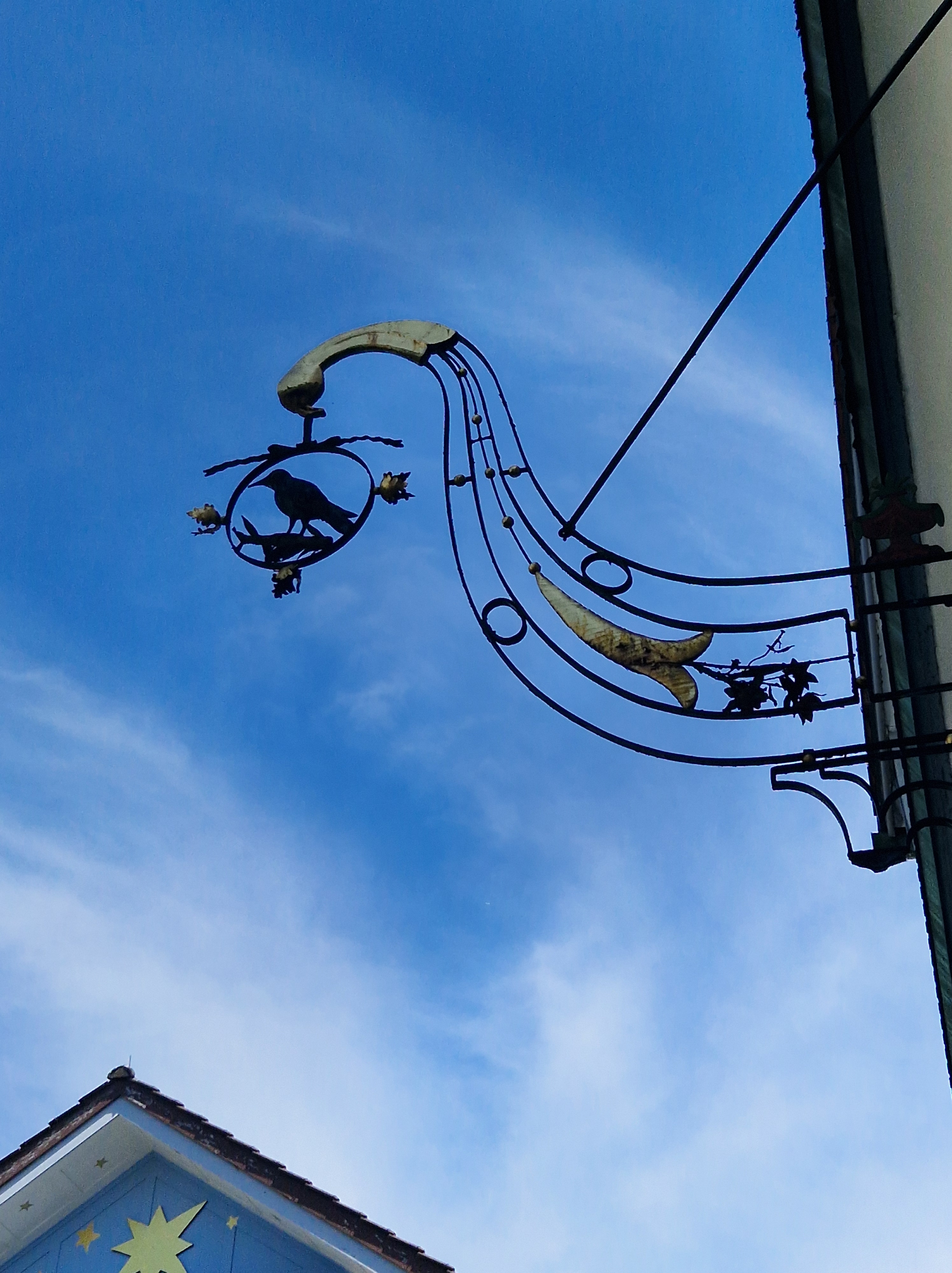
The building from which this sign hangs was built originally in 1664, and renovated to the current form in 1830. It was originally an inn/tavern on one side, and a forge (blacksmith) on the other. The Raven, as a tavern, took its symbol from the legend of St. Meinrad (797-861 AD); he was a hermit who rescued two young ravens from a sparrowhawk and raised them in his hut in the Finstern Wald (dark forest). In 861, he was murdered by two robbers; when they realized what they’d done, they fled to Zürich, but the crows followed them into a tavern and attacked them; the others present thought it unusual, so they took the men captive; they confessed, and were executed. The raven became a symbol of inns along a pilgrimage road; it was sometimes combined with a wine jug and bread.
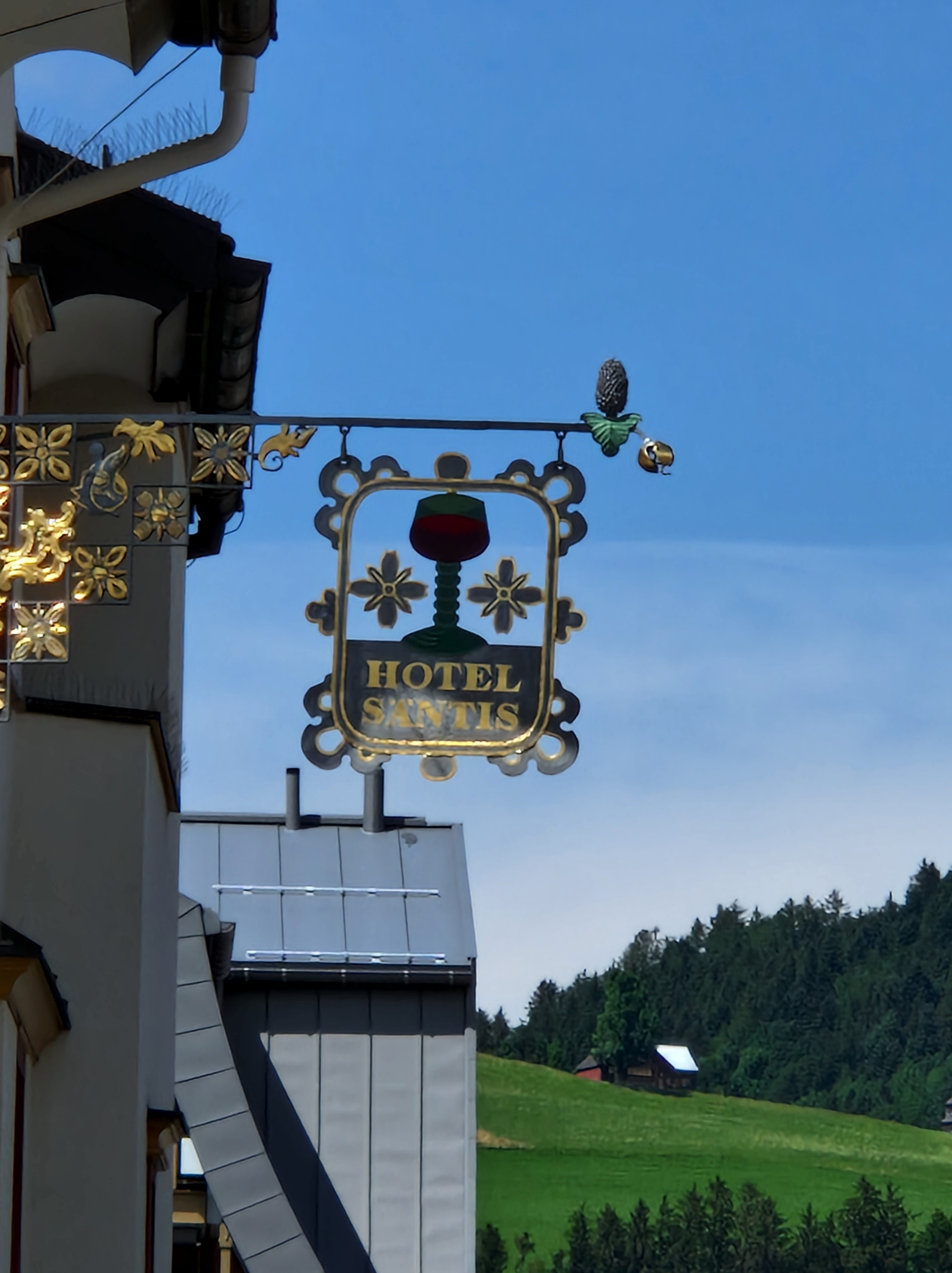
The Hotel Santis sign has a few symbols: The wine is an obvious reference to a tavern, pub or inn; the pine cone is an interesting addition: It was the symbol of the field sign of the Roman legion stationed in Rhaetia in 15 BC, and hence it is used as a heraldic charge (an emblem on a shield). It may have been included in this sign to proclaim a good place for soldiers to eat or sleep, or as an advertisement that it was protected under a legion or unit of the military at a time when such protection would have been welcome. The bell symbolized a pilgrimage or an invocation of guardian angels over a premises.
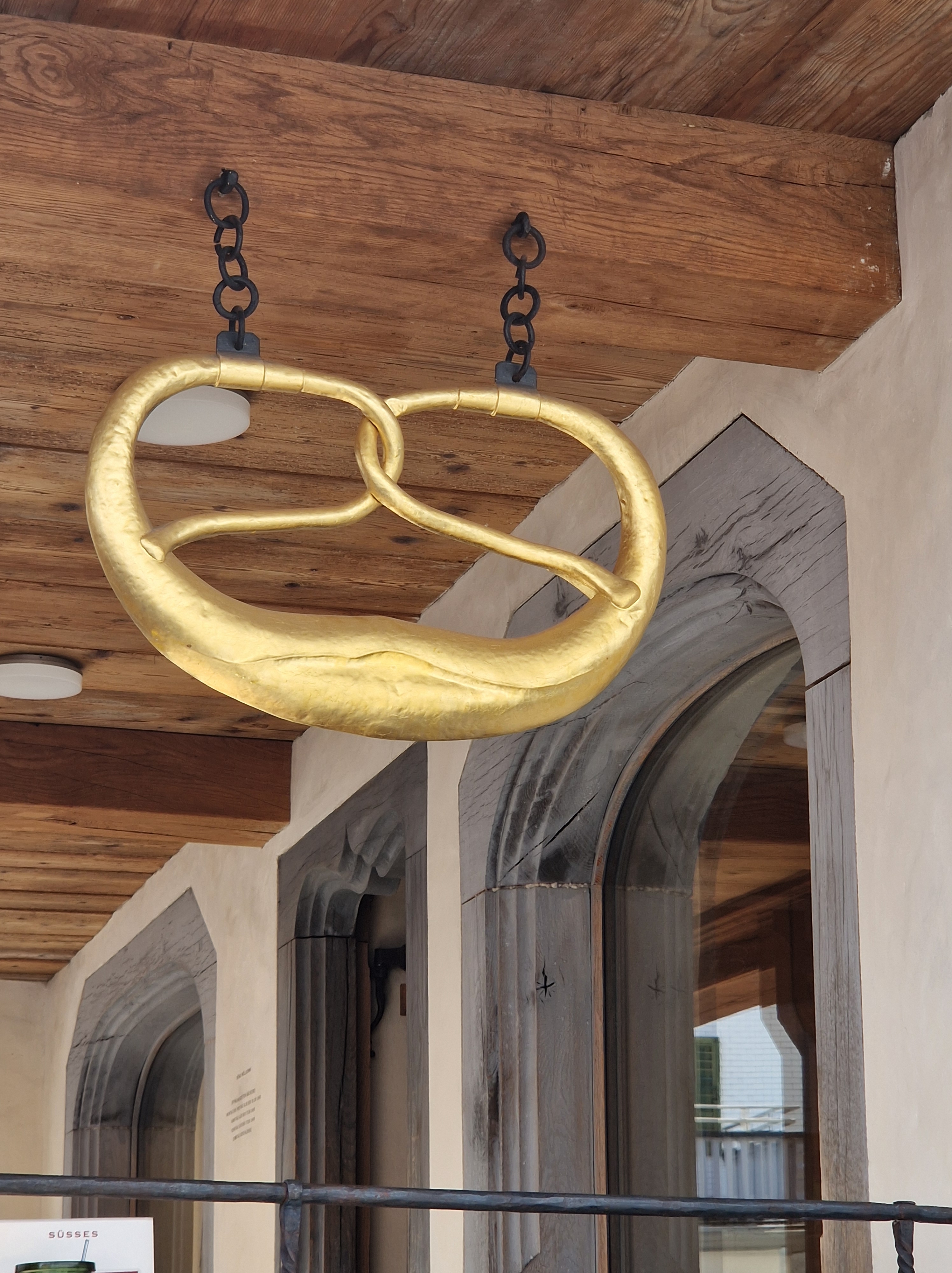
I think this is fairly clear – it’s a bakery!
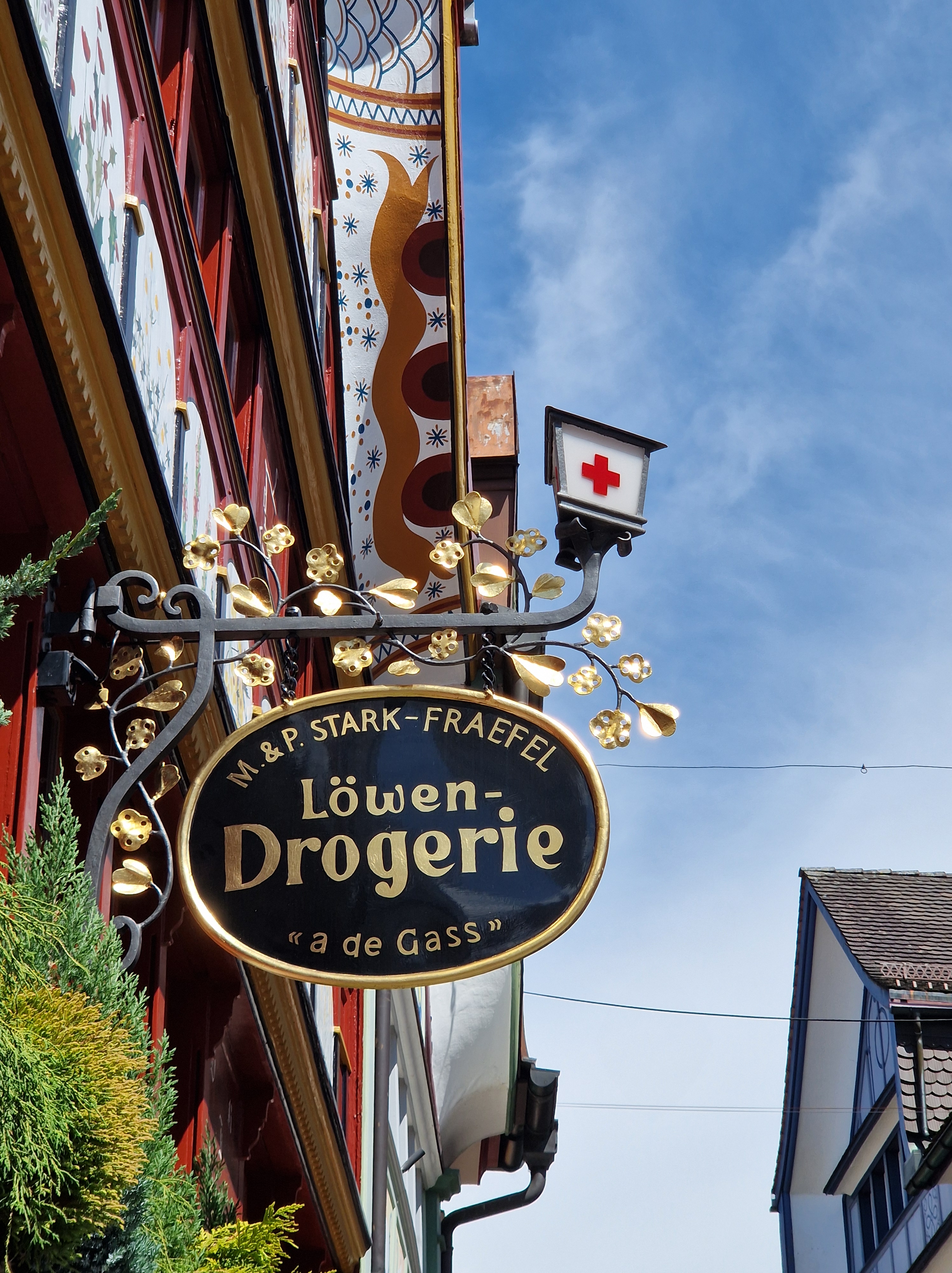
This building is a pharmacy; the front of the building is a beautiful example of the mural painting I mentioned earlier; these panels represent the herbs and flowers used medicinally. The saying painted toward the right side reads: Vielerlei Kraut gegen Leibesnot, aber kein einzigs wider den Tod (Many herbs against bodily pain, but none against death).
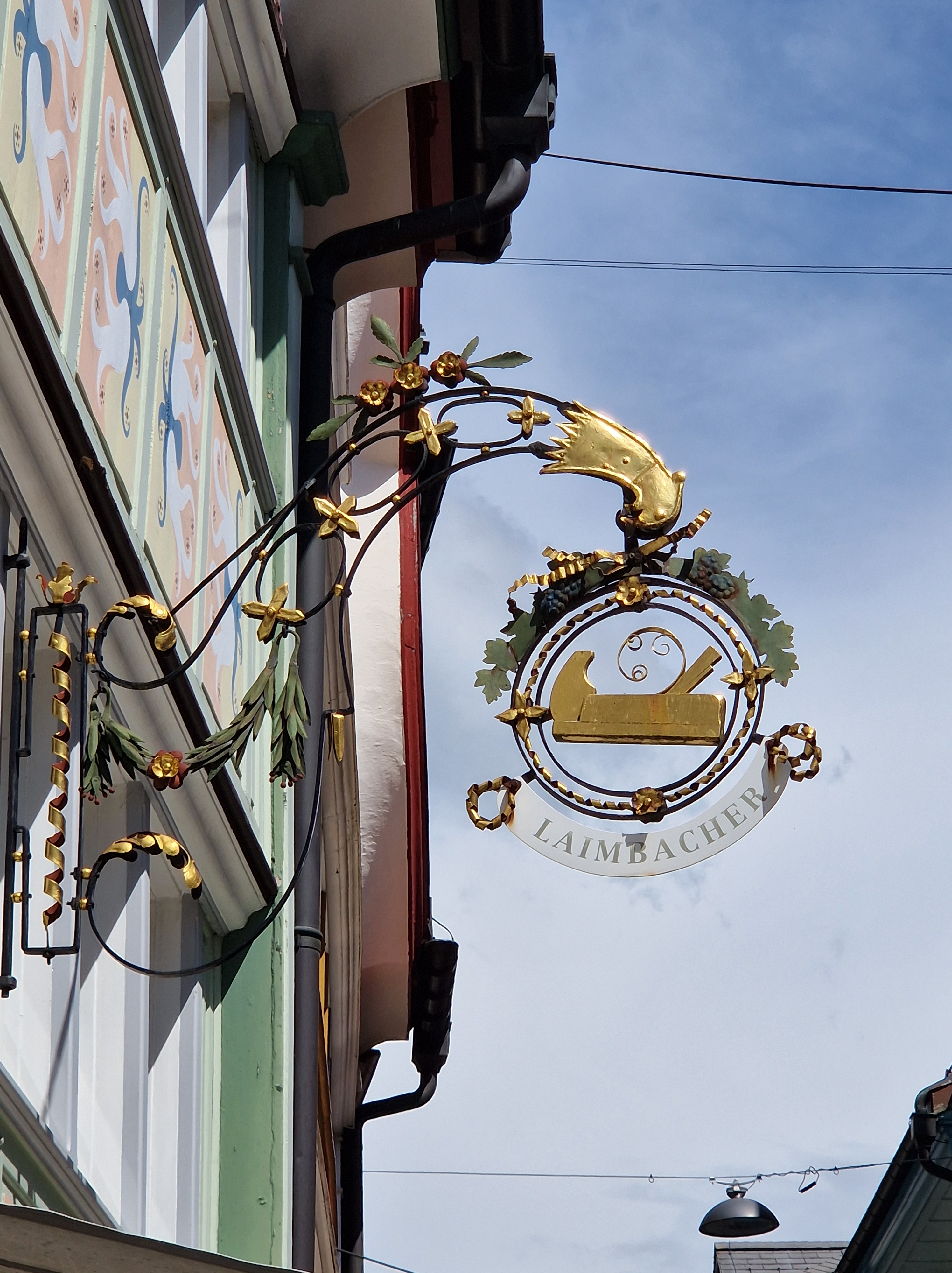
This symbol denotes a carpenter’s shop.
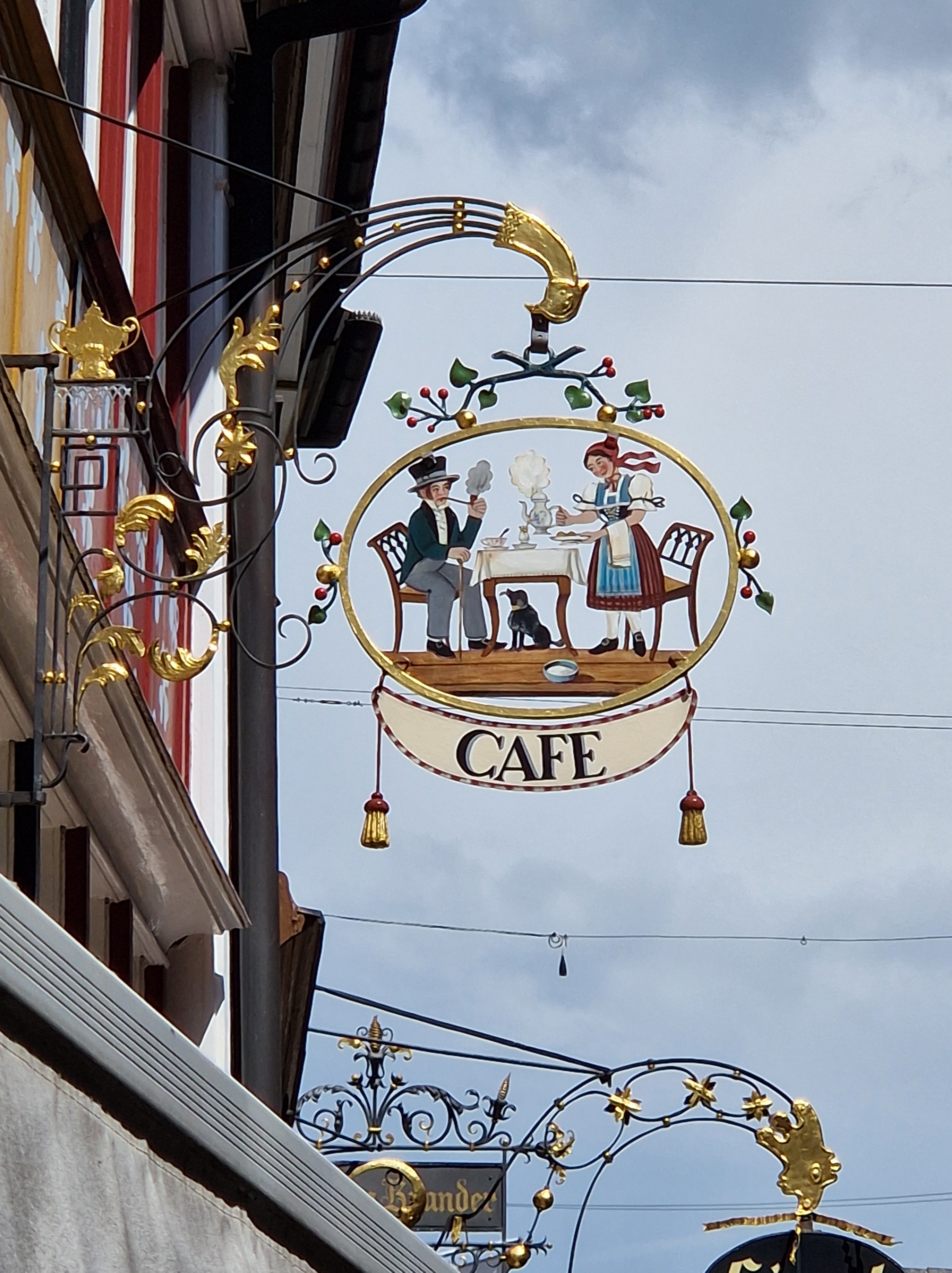
This café sign would be clear from any stagecoach stopping for a break and horse change what could be expected inside. The figures are dressed in traditional Appenzeller clothing.
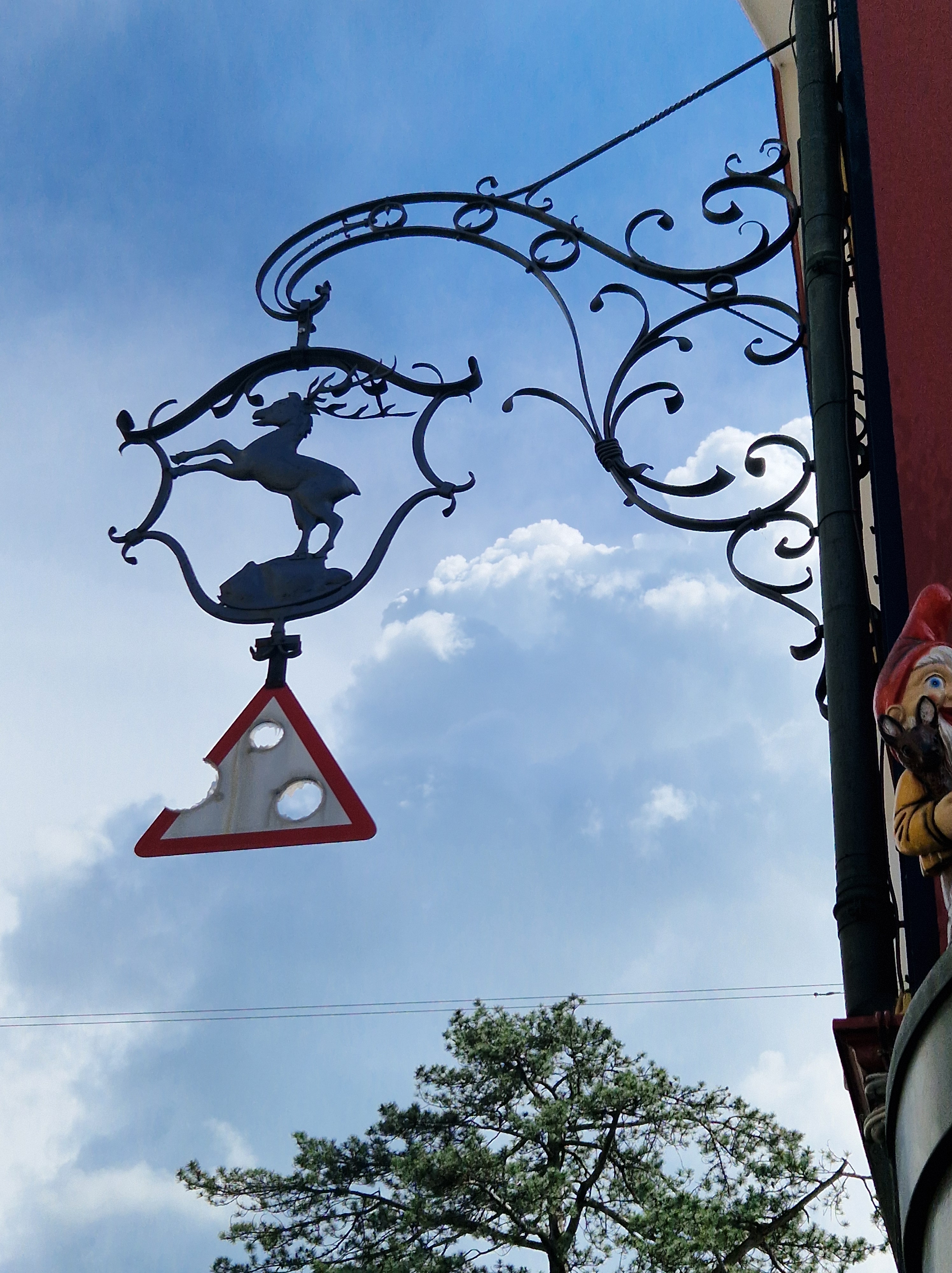
And lastly, here’s a traditional sign with a modern addition: It’s a hunting lodge, or inn that serves wild game meat. Next to it, peeking around the corner, is a figure from a toy shop.
Unless you’ve been busier than I‘ve been, you’ll have realized that half of January 2025 is already gone. The end of 2024 was crazy busy, and after the dust of the Christmas holidays settled, life was about getting caught up with all of those little things that had been neglected for a couple of months.
I’ve thought about how I want to go forward with this blog in the coming year; I enjoy having this platform to dive into topics I might not otherwise encounter in my day-to-day life, but life in the real world has many facets that keep me busy, too. I’ve decided to post roughly once per fortnight, giving me time to live, write/edit/publish, and research topics of interest. I’ve always tried to write quality above quantity, and I want to share things that interest me, grab my imagination, or give me a good laugh. If you feel the same, sit back and enjoy the ride!
Since this is mid-January, let’s take a look at some of the highlights of history on this day, the 15th of January:
1541: A commission to settle New France (Canada) was granted by King Francis I of France.
1559: Queen Elizabeth I was crowned Queen of England in Westminster Abbey, London.
1759: The British Museum opened to the public for the first time.
1777: In the American Revolutionary War, New Connecticut (Vermont) declares its independence.
1782 – The U.S. Congress was petitioned to establish a national mint and decimal coinage.
1870 – For the first time, a political cartoon symbolizes the Democratic Party with a donkey (“A Live Jackass Kicking a Dead Lion” by Thomas Nast for Harper’s Weekly).
1889 – The Pemberton Medicine Company (later to become known as the Coca-Cola Company) is incorporated in Atlanta.
1908 – The Alpha Kappa Alpha sorority becomes the first Greek-letter organization founded and established by African American college women.
1919 – Great Molasses Flood (a wave of molasses ejected from an exploding storage tank) sweeps through Boston, Massachusetts.
1943 – The Pentagon is dedicated in Arlington County, Virginia.
2001 – Wikipedia, a free Wiki content encyclopedia, is launched (Wikipedia Day).
2009 – US Airways Flight 1549 ditches safely in the Hudson River after the plane collides with birds less than two minutes after take-off. This became known as “The Miracle on the Hudson” as all 155 people on board were rescued. This story was adapted for the “Sully” film in 2016.
2015 – The Swiss National Bank abandons the cap on the Swiss franc’s value relative to the euro, causing turmoil in international financial markets.
2022 – The Hunga Tonga-Hunga Haʻapai volcano erupts, cutting off communications with Tonga and causing a tsunami across the Pacific. It was the largest volcanic eruption since the 1991 eruption of Mt. Pinatubo (Philippines).
Which of these events do you find most interesting? Please comment below and let us know! For me personally, it’s the opening of the British Museum. What was it like back in 1759, and how has it evolved into the massive collection it is today? I’ve been there a few times, but I have yet to see it all!
This is AI’s interpretation of “ancient scroll rolled up”. No idea where the man came into that result, but his longsuffering expression is apt!
My husband and I were having lunch recently, and a package of Swedish crackers was on the table; I pointed to the brand name, Pågen. In English, our pronunciation of these vowels would lead us to say pagan /pæg-in/, whereas the Swedish would rather be more like /po-gen/. I just mentioned that English might have sounded similar to that before the Great Vowel Shift, which he’d never heard of (being Swiss, it’s not likely he would be familiar with this aspect of English etymology), so I promised to write a blog about it; here we go!
The term Great Vowel Shift was coined by the Danish linguist, Otto Jespersen (1860-1943), who specialised in the English language. Though the GVS is considered a single event (because of the changes being viewed as part of a chain reaction, with each vowel sound changing in a predictable way), the actual transition of English pronunciation was gradual, taking place over about 200 years, from ~1400 to ~1600. The shift began in Middle English, which was spoken from 1066 until the late 15th century – that form familiar to Geoffrey Chaucer (though his pronunciation would be unintelligible to us, his words still survive through his famous Canterbury Tales) – into Early Modern English (from the beginning of the Tudor period through to the Stuart Restoration period); Shakespeare would have been familiar with it. From there, English transitioned into Modern English in the mid-to-late 17th Century.
The main changes were that, from Middle to Early Modern English, the long vowels shortened; weef became wife, moos* became mice, beet became bite, and so on. (*The word moose entered English through Native American languages in 1610). I will also mention that in Scottish, a lot of the older vowel pronunciations still exist; house is still huus, full is homophonous with fool, etc.
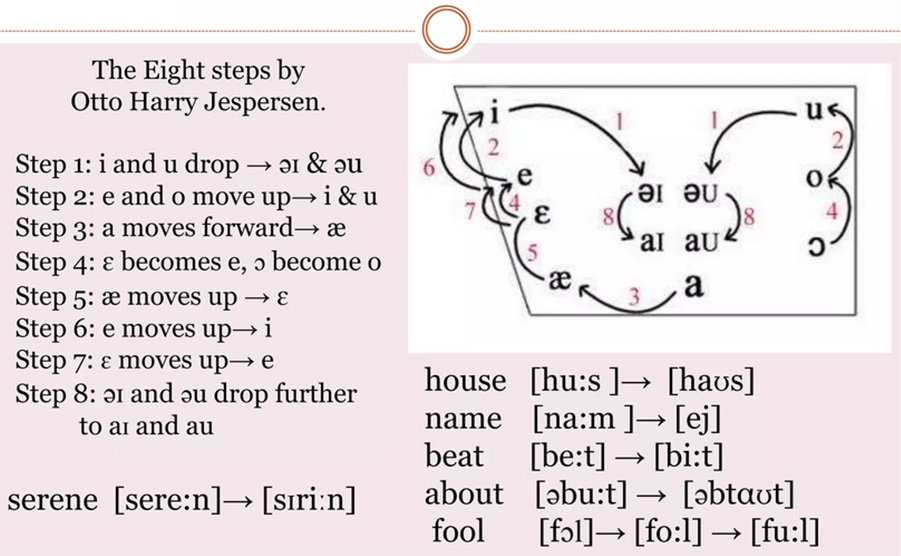
Here’s a look at just how the English vowels shifted:
Source: SlideShare
If you’ve been paying any sort of attention to English, you’ll know that our spelling is a bit chaotic; the language is full of homonyms, which are divided into either homophones (words that sound the same but have different spellings, e.g. beet and beat; bear and bare; to, too and two), or homographs (two words with differing meanings, same spellings, but not necessarily the same pronunciation: e.g. bank [of river; finance] or agape [with mouth open; love], or entrance [a way inside; to delight]) or tear [ripping; crying]. These -graphs and -phones came into English from regional dialects that were transported as migration and cultural mixing took place, and the GVS added its two pennies to the mix. Just think of the variety we have in the sounds /ea/ (bread, beat, bear, break); /oo/ (look, spool, blood); or /gh/ (through, cough, sight).
Certain factors contributed to the speed of language shift: The Black Death (1346-1353) wiped out up to 50% of Europe’s population. Stop a minute and let that sink in. What if the population of your town were reduced by half? And the next town, and the next. That single event changed the course of history on many levels; surfs could finally demand better wages wherever they ended up settling; if you lived in a town that no longer had the skills of a baker, blacksmith, or any other trade you’d depended on, you’d move to where those services existed – and jobs existed – and that meant places that had been hit the hardest by the plague and thus where everyone else was migrating, such as London. As mass movement followed the epidemic, people brought their dialects and their spellings with them. It began to converge into a new, distinct way of speaking, thinking and spelling. The geopolitical climate of the time also influenced English; England and France have been annoying each other for over a thousand years; whenever England was enamoured by all things French, they tried to emulate their pronunciations. That influence came and went; in one such moment, the pilgrims set sail for America (1620), taking a time capsule of the language with them, while England’s English continued to be influenced by French up until the French Revolution, when it quickly fell out of favour in England, though the changes had already taken place (one example is the American /k/ in schedule, closer to the original Latin, while the English say /sch/ without the /k/, which is closer to the French cedule). This factor of influence also affected differences of speech between the lower class and upper class at that time; the upper class wanted to sound more posh, more fashionable, and above all, not like the lower class.
A major contributing factor to our chaotic spelling is that ca. 1440, the Gutenberg printing technique was introduced, and by the 1470s, William Caxton had imported the invention to England; we have him to thank for Chaucer’s Canterbury Tales being known today, as that was the first book he printed in England. We also have him to thank for the influence of Chancery English (the English used by the secretariat of King Henry VI) in the standardization of the language, as he used it as his own guidelines in printing. The vowels had already begun to shift by that time; enter the written word, a rise in literacy, and you have the jumbled effects of “mid-shift” on English spelling – people began to adapt their pronunciation to the written word, so whichever form the printer used is the one that began to prevail, even though some sounds were still in transition. Like nailing down jelly. You could say that many of our odd spellings are simply a snapshot in time.
It is also important to point out that the GVS didn’t have the same influence everywhere: The main changes occurred around London, but the farther away you move from that epicentre, the less the effects on the local dialects, which still holds true today – though gradual merging has allowed people from, say, Cornwall, to understand people from Yorkshire – which wouldn’t have been the case centuries ago. Even though they can understand each other, their dialects are still distinct. I’ve already mentioned that Scots English (as opposed to Gaelic) still retains many of the longer vowels long since lost in standardized English; being so far from London, they simply ignored them. English may be taught in their schools, but Scots dialects prevail in the home and hearth. Regional dialects in English exist the world over, and though spelling and pronunciation may differ from region to region, and the language continues to be a living, breathing, growing and changing being, it’s still a language that enables the modern world to communicate, whether English is their mother tongue or not.
Throughout history, languages have come and gone; an estimated 30,000 have existed at some point in time, though currently, there are roughly 6,000 to 7,000 languages in use – and most are threatened with extinction. Think about that. The impact on the loss of cultural history, connection to ways of thinking, ways of communicating, and ways of processing information; senses of humour, and national heritages will be lost.
An example of a language nearly lost, but which is now familiar to most of us by sight, is the logogram language of Egyptian hieroglyphs. The knowledge of how to interpret the symbols had been lost for centuries, until 1799, when a stone was found near Rosetta, along the Nile Delta in Egypt; the stone was a stele with a decree issued in 196 BC; the texts carved into the stone were Ancient Egyptian (“demotic” text), hieroglyphs, and Ancient Greek. Because Greek was a known language, they could use the Rosetta stone to decipher the forgotten languages.
When we think of writing, we may think of various alphabets: Greek, Roman (of which English makes use), Norse Runes, or the logographic or ideographic languages of Asia, such as Chinese or Japanese, or the cuneiform writing of the Ancient Near East. But did you know that there have been languages based on string?
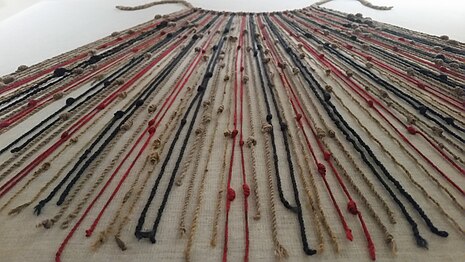
Quipu in the Museo Machu Picchu, Casa Concha, Cusco. Source: Wikipedia
The Inca people, in the region of modern Peru and Chile, used knots on an elaborate system of connected strings or cords for collecting data, keeping records, recording taxes or census records, making calendars, or for military organisation. When the Spanish Conquistadors swept through, they found numerous bundles of strings, but had no idea of their significance; they destroyed many of the quipu*, not realizing that they might have held in their hands a record of an individual’s wealth in animals or crops. [*Quipu is the Spanish spelling used in English; it is also spelled khipu or kipu.] Other cultures have also used similar concepts with knotted strings to record information, unrelated to South America; these include China, Japan, Taiwan New Zealand, Hawaii, and other parts of Polynesia.
As with most textiles, they unfortunately didn’t stand the test of time very well, and only a fraction remains today. The ancient world may have taken the concept of the quipu one step further in creating the more flexible abacus, though the latter was (and is still) used for temporary calculations, while the former was rather for recording information. Whether or not there is a historical link, both are visual tools that can be used for similar functions to a certain extent.
Even with such widespread use of these knotting records, their meaning was nearly lost, until a Harvard student, Manny Madrano, had time on his hands one summer and solved a centuries-old mystery!
For an interesting video on this topic, please click here. I hope you’ve learned something! Keep being curious about our fascinating world!
The baroque town of Solothurn, though only an hour away from our home, was unfamiliar to us until my husband and I took a day trip this week. It has a beautiful historical centre and is known as the “city of elevens”: It was the 11th canton to join the Swiss Confederation; there are 11 towers in the fortification walls of the city; there are 11 churches and chapels, and 11 historical fountains throughout the city; the stairs leading up to the St. Ursus Cathedral have landings every 11 steps; the cathedral itself has 11 altars and 11 bells; the local brewery, producing an eponymous beer, is even called Oeufi – which is a Swiss dialectical word for eleven. 11:00 is the most “auspicious” time to set appointments in the town, and there is even a clock, hanging on the wall of a local bank, which is segmented into 11 hours; it has 11 cogs and 11 bells, which are chimed by a metalwork sculpture of a harlequin on the hours of 11:00, 12:00, 17:00 and 18:00. The bells chime to the tune of the city’s unofficial anthem, the Solothurner Lied.
Solothurn’s history dates back to the palaeolithic era, and its Roman era is dated to around AD 15-25; it was first mentioned in AD 219 as vico saloduro, and may have referred to a Celtic settlement, possibly meaning “Salo’s fort/stronghold”. In the Battle of Sempach, July 1386, the Habsburgs attacked Solothurn; it was a decisive Swiss victory, and even more importantly, it helped to solidify the loosely allied Swiss Confederation cantons into a more unified nation and is seen as a turning point in the growing strength of Switzerland as a nation. Today, it is largely bypassed by tourists due to its proximity to Bern, the Swiss capital, so it remains a hidden gem.
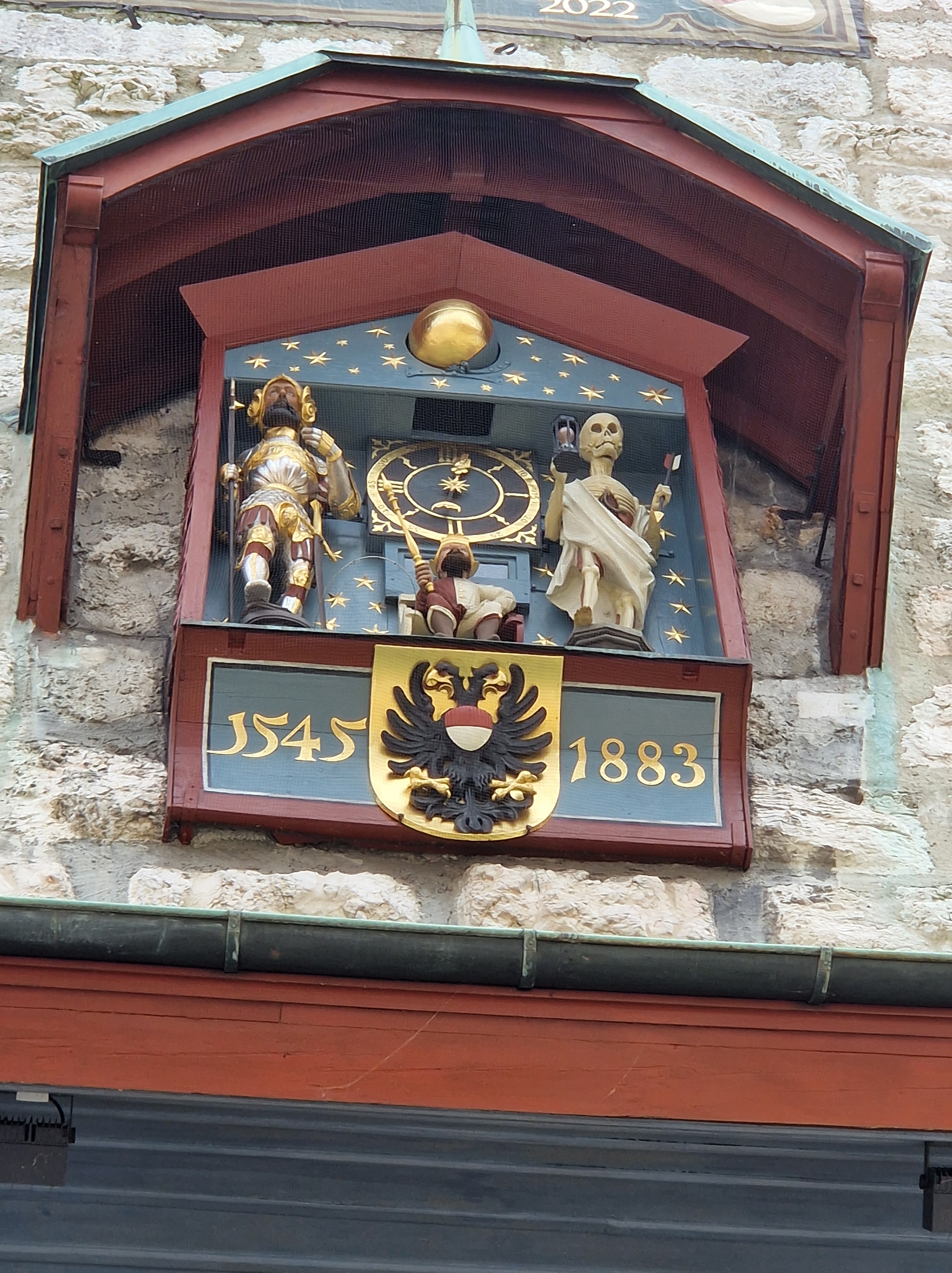
Another interesting clock is the clock tower, the “Zeitglockenturm”, a tower built in 1152 and first mentioned as a “clock tower” in 1406. If you look closely, you’ll see typical rain spouts coming off of the corners of the tower’s spire and roof, shaped like dragon’s heads. The 24-hour astronomical clock was built by Lorenz Liechti and Joachim Habrecht in 1545. The sun and moon hands both run counterclockwise; the moon makes one complete rotation every 27 days, while the sun makes one complete rotation every 365 days.
According to the Roter Turm website, there’s a humorous story connected to the upper, 12-hour clock: By 1753 the hour hand and the bells were no longer in sync; a commission contacted the watchmaker Niklaus Pfluger, reminding him of his gild’s oath, i.e. his responsibility to correct the clock. He suggested to the local government council that they add a minute hand; but minutes were not so important in the 18th century, apparently – they told him to leave it as it had always been. He took matters into his own hands (I guess it was easier to ask for forgiveness than permission…) and in 1756, he added a minute hand. He justified it as the “warning hand of God” – but he made it smaller, less noticeable than the hour hand, so on this clock, the small hand shows the minutes, not the hours.
Because the clock tower was built and added to over time, you’ll see four dates on the full image of the tower: 1411 and 2022 on the highest, 12-hour clock; and 1545 and 1883 on the central tableau; the latter dates usually refer to restorations.
The three figures in the central tableau above the clock are a knight, king, and skeleton (Death), which perform every hour: The knight holds a battleaxe in his right hand, and a sword in his left; every quarter-hour, he turns his head toward Death and strikes his breast, signifying his loyalty to the central figure, the king. On the right stands Death; in its right hand is a hourglass, which is turned on the hour, symbolizing the contradictions of life – good, bad, life, death. In the other hand is an arrow, showing that one could be struck down at any moment. On the hour, its head turns toward the knight.
On the throne between these two figures is the king: In his right hand is a sceptre, which he lifts on the hour. His jaw moves in rhythm with the hour hand, and his beard represents wisdom. However, notice that he’s wearing red and white fool’s garb: If the king does not rule with wisdom and the humour of a fool, his reign will become a tyranny. It tells us that life should have moments of both wisdom and a jester’s humour.
While Death announces the hours, the king swings his sceptre. At the same time, Death nods with each stroke and confirms the relentless passing of the hours. The king with his fool’s garb reminds us of the memento mori. When death or illness reigns, even the power of a wise king can do little (Solothurn was hit by the plague, e.g. in 1348). Though the Freudian era banished death from contact with the living in many Western cultures, death personified as a skeleton is still a symbol seen in many countries around the world. Having death constantly before your eyes encourages you to savour each moment of life.
I hope you’ve enjoyed this brief glimpse into a beautiful city with an ancient history!
Some of today’s nautical idioms are well known, such as to be on board with a proposal or suggestion or learning the ropes in a new job or position, while others, such as three sheets to the wind are less common (unless you happen to work in a bar – then it may come in quite handy). Either way, enjoy these, matey!
Be On Board: As part of a crew, a sailor bore their part of the responsibilities. In today’s terms, it means to accept or agree with a proposal or a way of doing something and go along with it.
Rats Deserting a Sinking Ship: Rats and mice were common aboard ships, often in the bulkhead (lowest section of a ship, where the grains were stored (the weightier things being stored low and balanced to keep the ship sturdy in rough seas). If the ship began to take on water, the rats would go up the deck ladders to stay away from the water; if they started jumping overboard, sailors wouldn’t stand much better of a chance (most sailors could not swim). It’s a vividly grim picture of life aboard. Now, it’s an idiom describing people abandoning a failing activity or situation.
Close/Tight Quarters: Tightly packed (e.g. people in a small space). Space was at a premium, especially on the lower decks of a ship of sail. Men slept in hammocks close together and shared the space with stowed ship equipment and their own storage chests. Even today on submarines, bunks are shared by those who are off-duty and those on-duty to save sleeping quarter space.
Run a Tight Ship: Manage and organization strictly, efficiently, and effectively. A ship, especially in times of war, was run tightly to avoid unnecessary dangers and/or deaths, and to maintain discipline that would be needed to succeed in crucial moments.
Learn the Ropes: Sails were raised and lowered with ropes, and knowing how to control the sails allowed a ship to take full advantage of the wind and sail safely. There were miles of ropes on a ship, each with an important and specific function. Learning the ropes was essential for everyone aboard – it would keep others out of danger and oneself alive! Today, one learns the way things are done in a given setting or situation.
Broadside: The broadside was the side of the ship which sat above the waterline; cannons were arranged on several decks, and when ships sat broadsides facing, firing simultaneously, it was known as broadsiding. Today, it refers to being taken off guard or being surprised by something unpleasant.
Broad in the Beam: Describes the width of the beam or mast on a larger ship. It denotes a person who’s wide across the hips and buttocks.
Keel Over: To collapse, to die. If the keel of a boat were to rise out of the water, the ship would be in danger of capsizing; this might happen due to a storm or damage by an enemy attack.
To Keelhaul: To rebuke harshly. It was a punishment meted out in extreme cases by dragging someone, ankles weighted, by ropes beneath the ship along or over the keel (the backbone of wood along the bottom of the ship). As these were usually covered with barnacles, clothes and skin would be shredded by the barnacle shells, and if the salt water of the ocean didn’t disinfect the wounds on the way up, it could be a death sentence. How much it was actually practised is difficult to say, as written records are sparse (perhaps a cruel captain didn’t want it on record, or perhaps it was not as widely practised as we think); the most concrete records of the punishment come from the Dutch. It was banned by the British Royal Navy around 1720, and by the Dutch around 1750. That bans were necessary tells its own tale…
Three Sheets to the Wind: Implies an unsteady, drunk person. The sheet referred to the ropes (lines) used to control the trim (the advantageous angle of the sails in relation to the wind) of the sail. If the sheets are loose, the sails will flap in the wind which causes the ship to lurch about like a drunken sailor. There are variations of the number of sheets in the idiom: 1 would be tipsy, 3 would be staggering drunk!
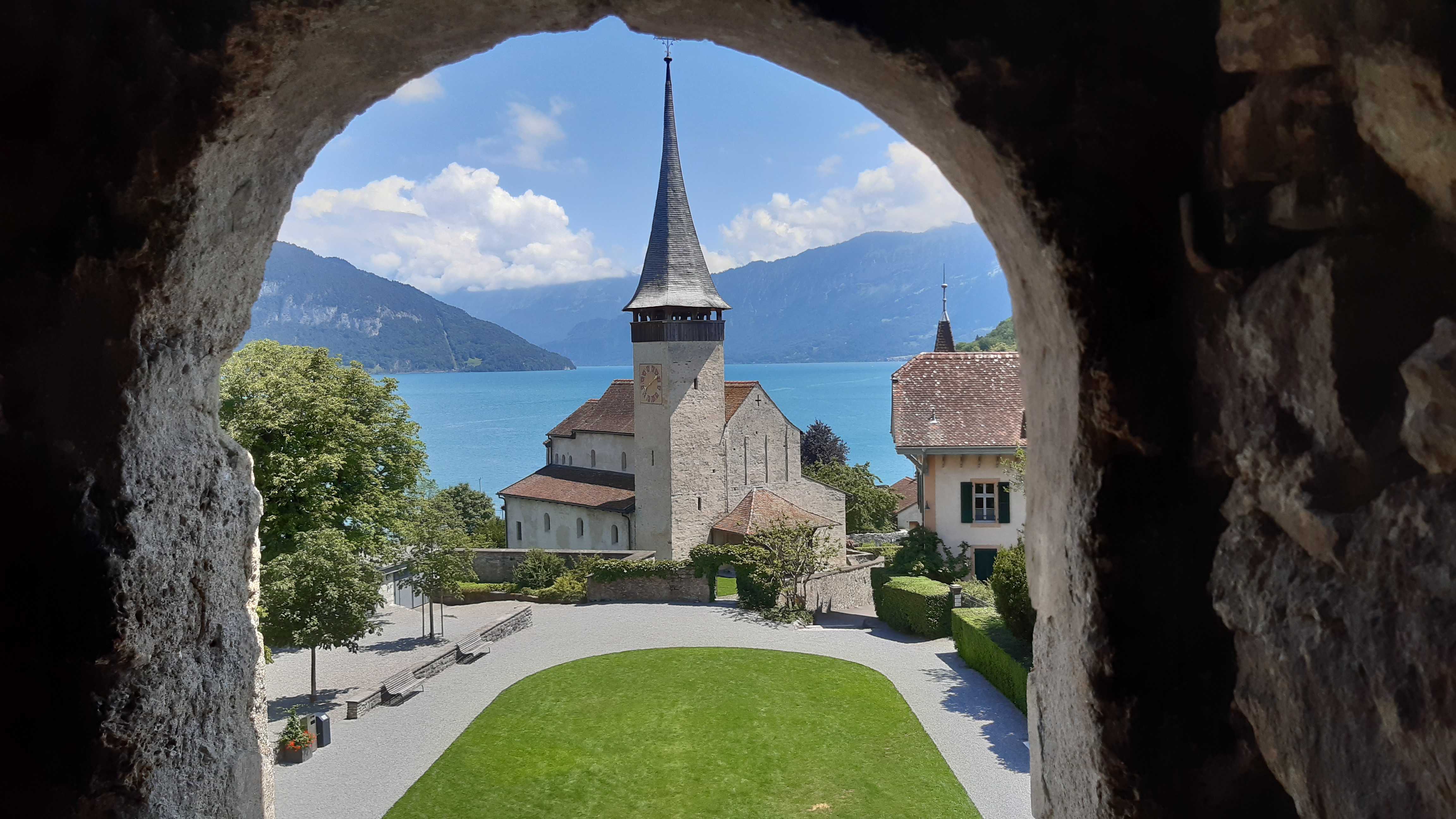
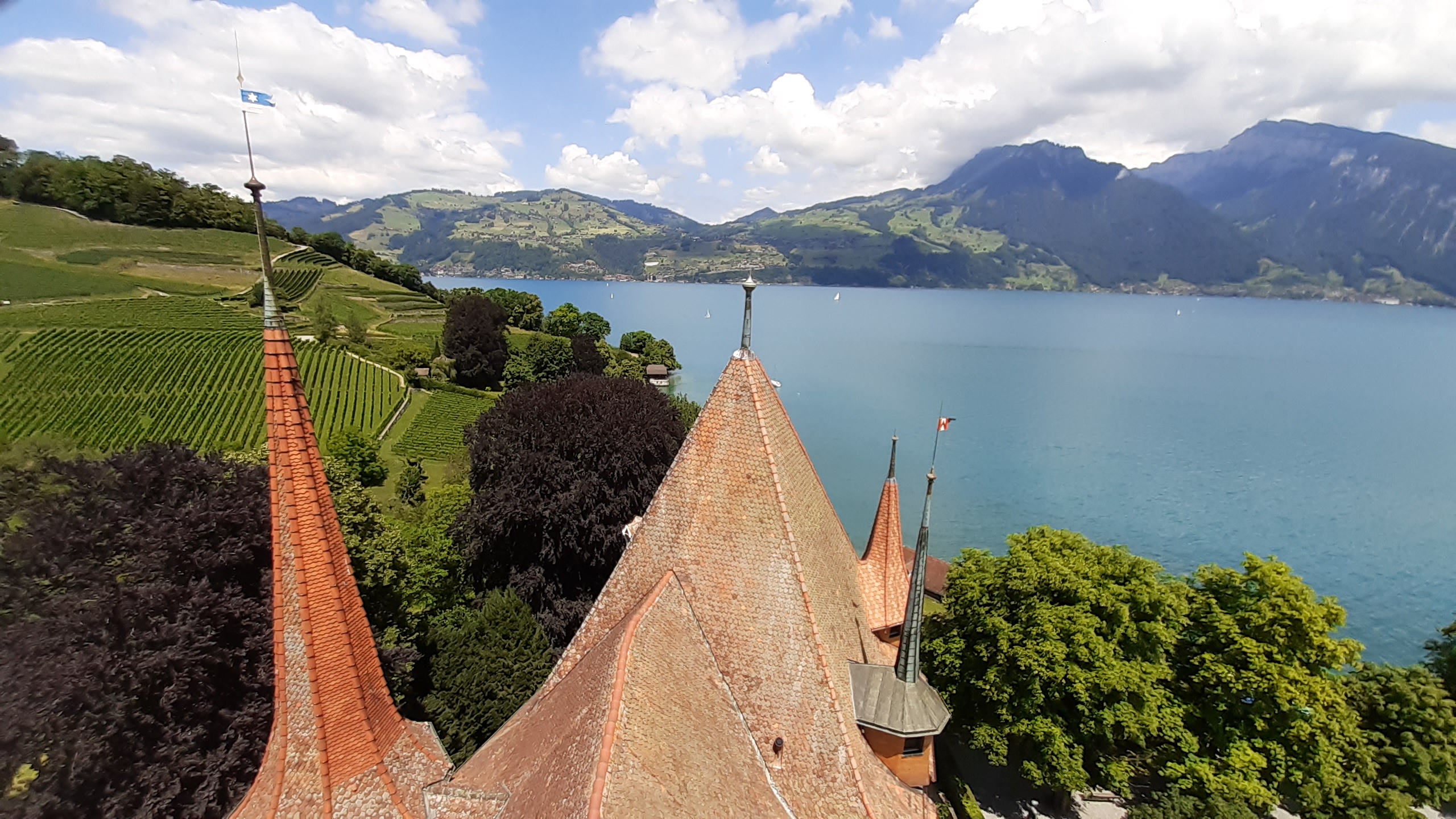
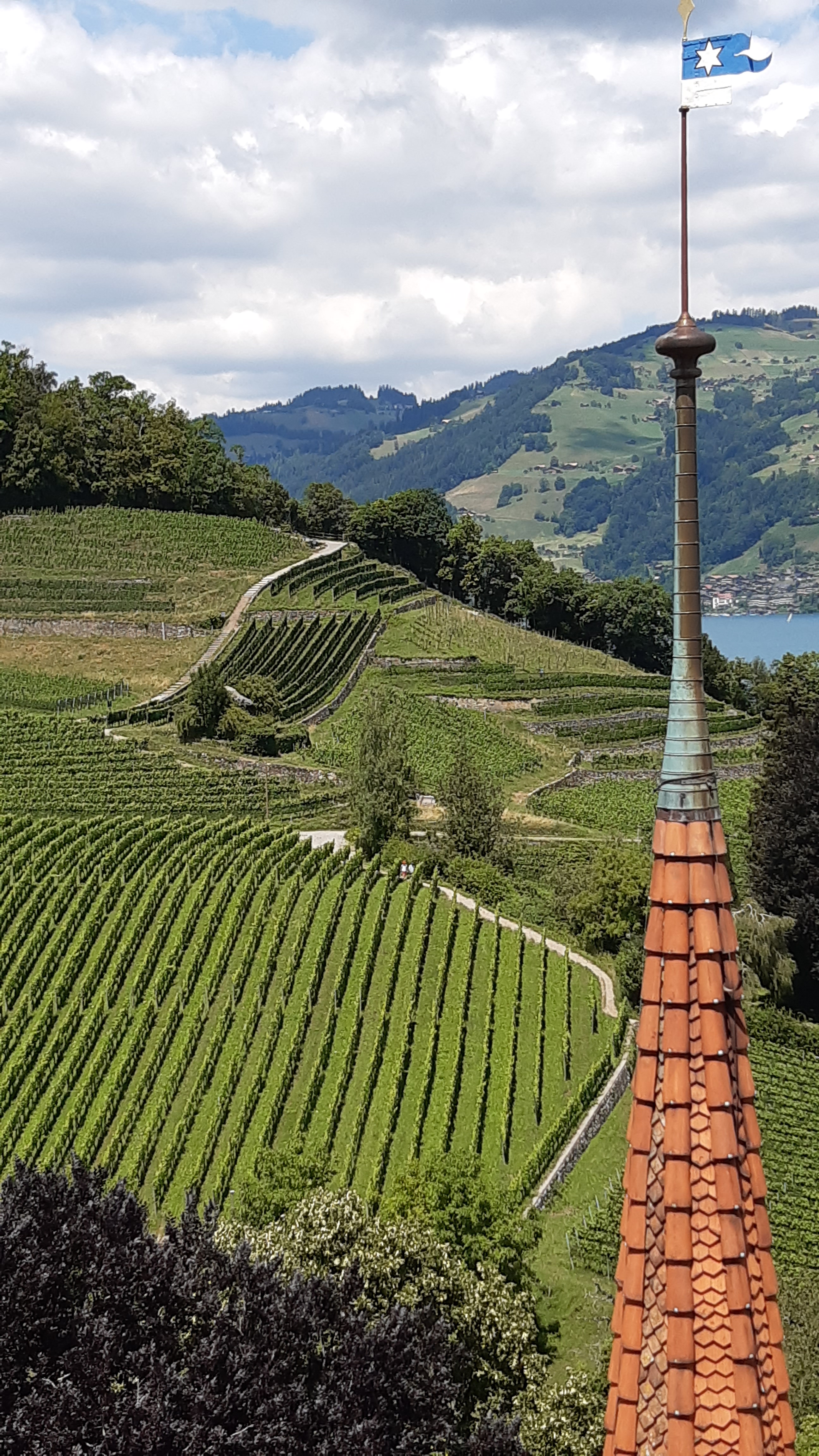
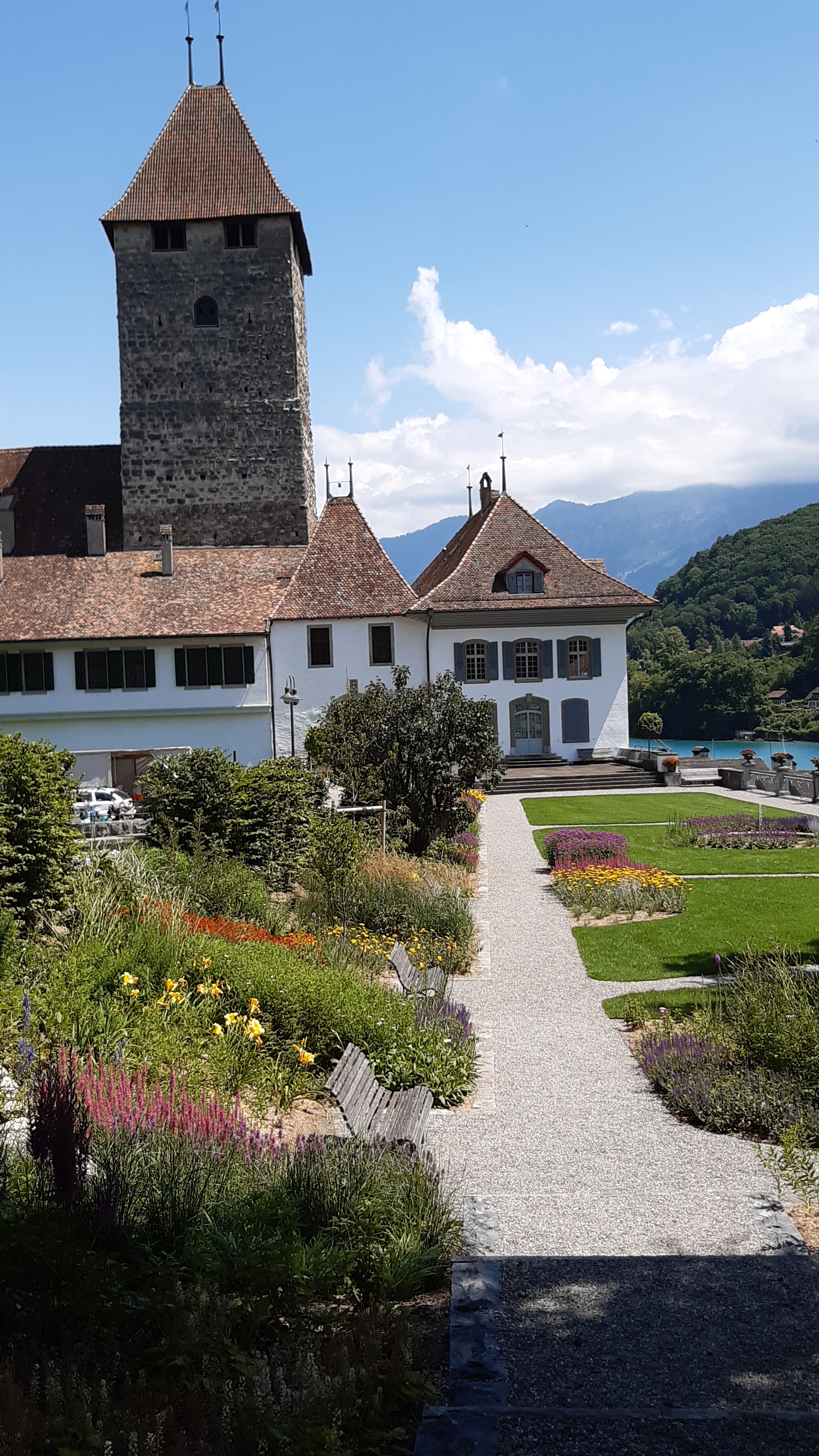
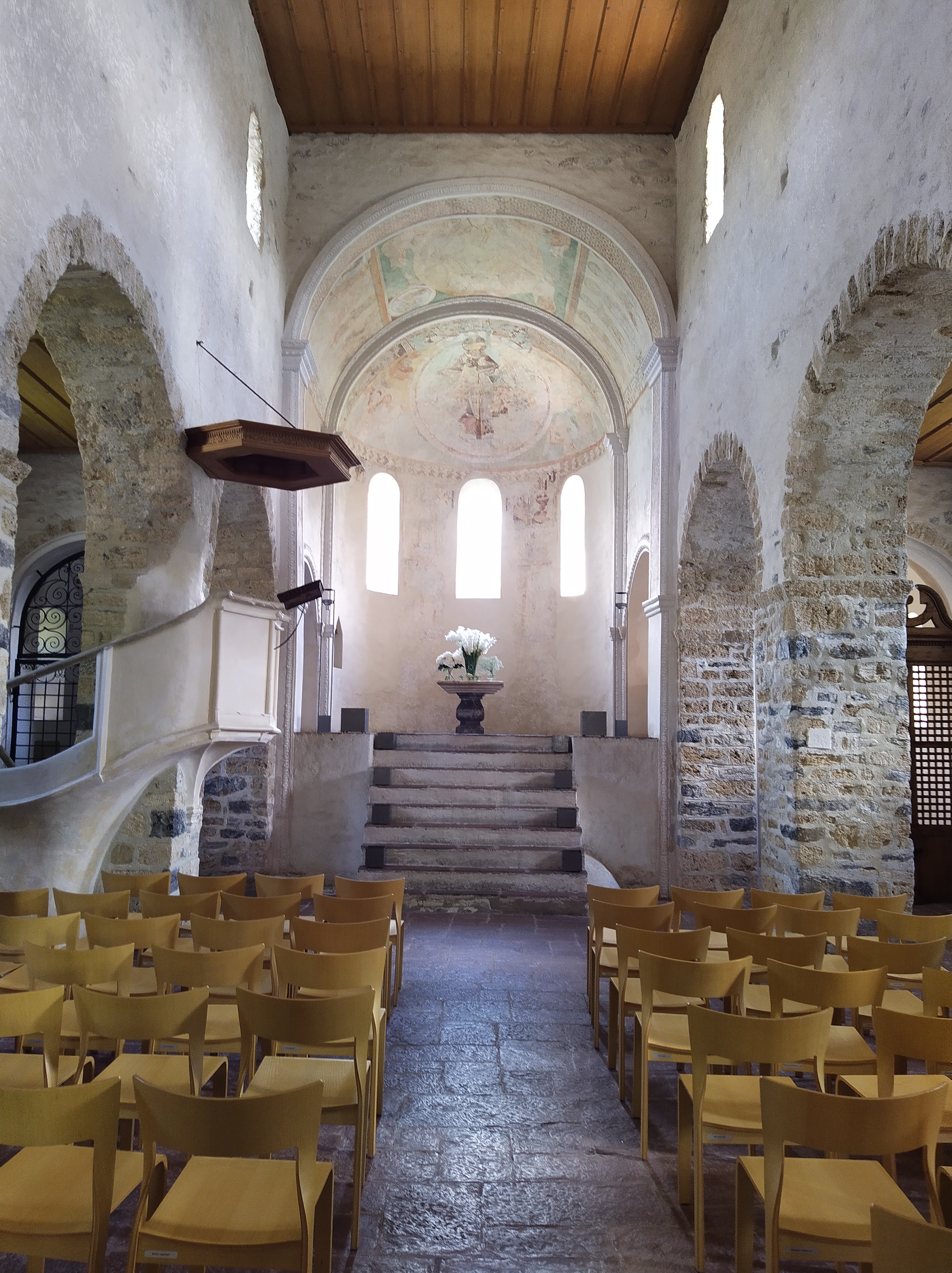
Let’s take a virtual tour of a beautiful little castle on Lake Thun, here in Switzerland: Spiez Castle is a grand but pocket-sized edifice that sits on a spit of land jutting out into the lake, with the town of Spiez surrounding it. The area has several substantial bronze- and iron-age settlement sites, which shows that the area has been rich in natural resources and populated since time immemorial. The town and its church were first mentioned around AD 762, when Bishop Heddo of Strasbourg disposed of the church and tithes in his will. In AD 933, the King of Burgundy, Rudolph II, had Spiez castle built, and soon the Freiherr of Strättligen settled there. [Freiherr was a rank of nobility within Germanic-speaking areas that would have roughly translated to the English rank of baron.] Sections of the current shield walls and tower were built in the 12th century, and though the town was originally located within the castle walls, by the 13th century it had outgrown the walled enclosures. The small church, which is on the castle grounds, is one of the twelve Lake Thun churches mentioned in the Strättliger Chronicle [a Swiss dynastic and national history of the rulers of Bebenberg and Strättligen and their lands and churches – all within canton Bern, covering from AD 1100 through 1464].
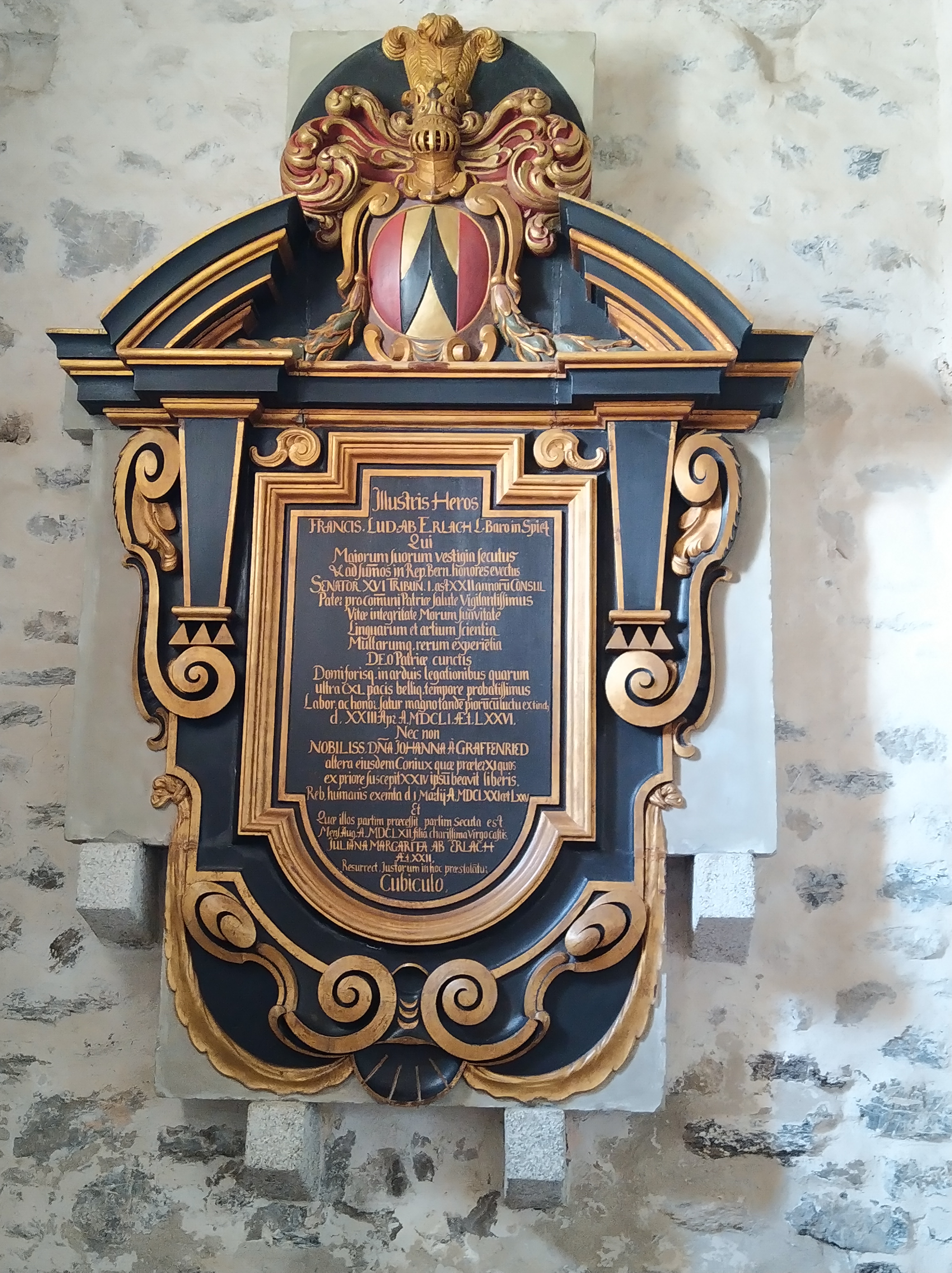
The castle changed hands numerous times, whether through political manoeuvring or through dynastic extinction. Last week, my article touched on the French invasion of Switzerland; After that 1798 French invasion and the creation of the Helvetic Republic, the von Erlach family lost the rights to hold the lands as well as their jurisdiction over the village, but retained ownership of the castle until 1875. In the church is a panel in Latin about the titles of the baron von Erlach and of (who I assume was) his wife, Johanna Graffenried (from another noble family in Berne), with the family crest (see the images below).
This past summer, my husband and I toured the castle and the church; it was an awe-inspiring feeling to know that we were walking where people have walked for well over a thousand years; where nobility and peasants, servants and pilgrims have stood, walked, talked, lived and passed. Here are a few impressions of the castle, church and the views we enjoyed, and I hope you enjoy, too.
This past summer, my husband and I rented a motorhome and travelled around Switzerland; we tend to prefer nature or museums to overly-touristy attractions. One of the places we visited was Spiez Castle. Before I tell you about that, however, a little historical backdrop is necessary, so buckle up and enjoy the ride!
Everyone’s heard of the French Revolution, which began in May 1789: It was a struggle to become free from the heavy yoke of an elitist monarchical regime, quasi out of the frying pan and into the fire of the Reign of Terror – during which many of the original rebels, in a twist of morbid irony, also had their heads removed by Monsieur Guillotine; it ended in November 1799 with the abolition of the Ancien Régime and the creation of constitutional monarchy (not far from where they started) and the French Consulate (which lasted nearly 5 years until the start of the Napoleonic Empire in May 1804).
But what many people might not know is that the French Revolution was internationally both influenced and influential. Modern “small world” effects are not modern at all; even in ancient times, people had international news: Travelling merchants and traders, messengers, signal towers (such as those the Romans used along the British frontiers), and even smoke signals, all conveyed news. When the French Revolution began, there was already a growing political dissent spreading throughout Western Europe; the English “coffeehouse culture” enabled men to gather in small groups and discuss business and politics; this concept travelled to America, and the discontent culminated in the American Revolution, starting in April of 1775. The French people watched and learned. The British government naturally became wary – they were losing the American colonies to the Revolutionary War, which they finally lost in September 1783. The Americans were supported during that time by France and Spain (the two main long-term enemies of Britain), so the British were hemmed in by threats to their own social order from both the east and the west, and they had well-founded fears of the discontent sparking revolt in the dry tinder of their own oppressed ranks.
And now we come to Switzerland: To understand the Swiss backstory in a nutshell, which does no justice to a history that began in the Palaeolithic Age or further back, let me sum it up: The Old Swiss Confederacy was an alliance between independent small states, starting on 1 August 1291 with the “Rütlischwur”(an oath of allegiance between the cantons of Uri, Schwyz and Unterwalden), which date is considered by the Swiss to be the birth of the nation (though history is more complicated). As the French Revolution was beginning to wind down, Napoleon Bonaparte, then a French general, pressed the French Directory (the then-current French governing committee) to invade Switzerland. The atmosphere within the Old Swiss Confederacy was tense, fearing that the French Revolution would spill over with or without direct French military involvement. At the invitation of a French-speaking faction in Vaud (then part of Canton Berne), 12,000 French troops invaded through Vaud on 28 January 1798, and for the next four months, battles were waged between the French and the Swiss “Loyal Legions”. It ended in May with the swift collapse of the Swiss Old Confederacy.
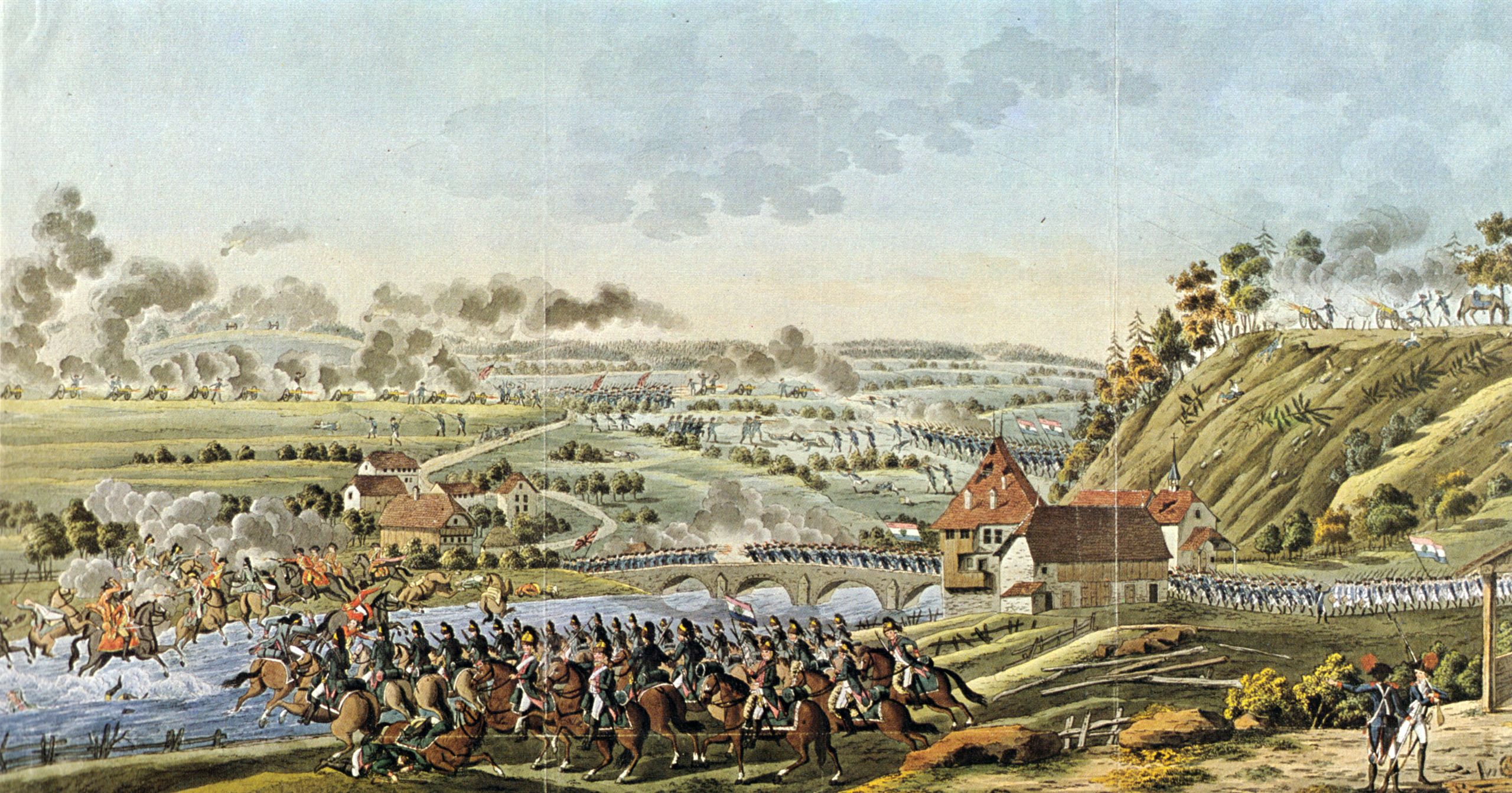
The Battle of Neuenegg, 1798 – Graphics Collection, Central Library, Zürich
However, the French Directory needed a solid neighbour, a buffer zone along their eastern borders, not a loosely associated collection of small states; they tried to steer toward a re-establishment of national unity with a Paris-drawn constitution, but on April 1798, Swiss cantonal leaders proclaimed the Helvetic Republic, with new legal structures that abolished feudal rights within individual cantons in favour of a national unity. A few battles later, and coalition armies waging war in and around Switzerland against France, eventually left Switzerland as a sovereign, neutral nation; it has remained so ever since, despite two world wars.
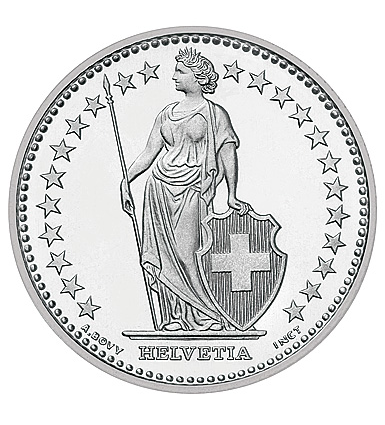
An etymological side note on the Latin name of the Swiss Confederation (Switzerland), Confoederatio Helvetica: Helvetia is the female personification of Switzerland, found on nearly every coin, much like Lady Liberty of America. The name derives from Helvetii, a Celtic tribe that inhabited the Swiss Plateau since before the Roman Era. The earliest reference of the name is dated to ca. 300 BC, written in Etruscan on a vessel from Mantua (located in Lombardy, Italy). By the time the Romans arrived, they were well-established tribes governed by noblemen; the Roman historians tended to refer to anyone not Roman as “barbarian”, which tends to skew modern understanding of the peoples they conquered; it was perhaps their way of justifying invasions against peaceful, intact civilisations. Naming no names, but R—– is repeating that same shameful tactic today; there’s nothing new under the sun.
It’s easy to overlook the complexities of historical events or view them from only one nation’s side; after all, as Mark Twain once wrote, “The very ink with which all history is written is merely fluid prejudice.” History’s angle is in the hands of those who wrote it – if they were Roman, everyone else was barbarian; if they were English, the Scottish / Irish / Indians were backwaters in need of a guiding stick, and so on.
So, now that you know a bit more about the history in and around Switzerland, I’ll highlight Spiez Castle next!