Tag Archives: writing

The Fascinating History Behind the Fraktur Typeface

Last Sunday at church, a friend filled an entire room with her late father’s books, setting up an impromptu book shop. I chose several books, most of which are in Fraktur typeface, known to some people as “Gothic” or “Old German”. I enjoy reading such books because they offer a snapshot of a cultural way of thinking. The books I chose were printed between 1877 and 1940. The latter date is significant, as you’ll soon see.

First of all, let’s clarify a few terms: Though many people think of font and typeface as interchangeable, in fact, they refer to two different aspects of a writing style. Typeface refers to a particular style of lettering (e.g. Times New Roman), while font refers to the variations within that style, such as size and weight (CAPS, bold, italic, etc.). Another term we know but may not fully understand is Serif: This refers to the small stroke or line attached to the larger stroke of a letter; an example would be an A with “feet” at the bottom of each down-stroke. Sans Serif simply means “without Serif”.

The first moveable-type printing press, designed by Johannes Gutenberg in Germany around 1440, was based on the ancient Roman design of a screw press used to press wine or oil, which in turn went on to be used to press designs into cloths. He was likely familiar with intaglio printing and may have done some work himself in copper engraving.  These designs and uses likely fermented in his inventor’s mind into what became the revolutionary turning point of literacy. Gutenberg’s original typeface was called Donatus-Kalender; the metal type design was itself a form of Textura (more on that in a moment).

Donatus Kalender
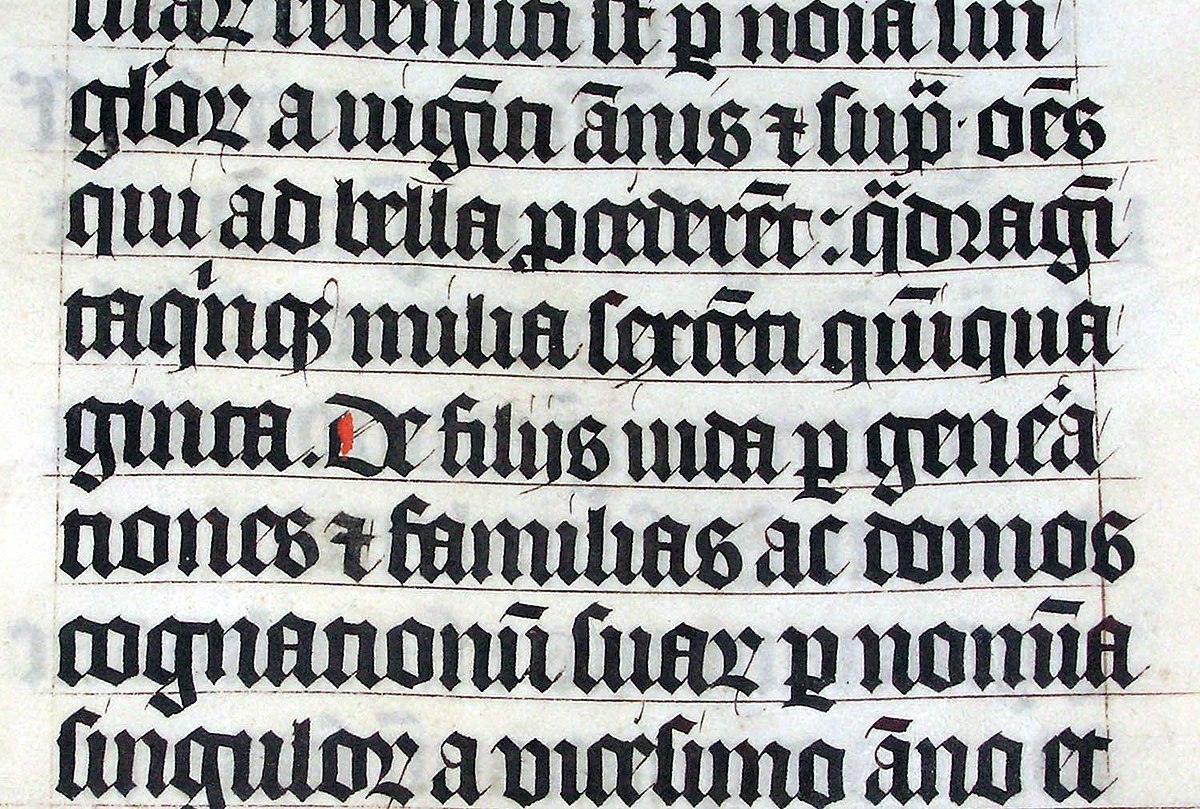
Example of Blackletter (Source: Wikipedia)

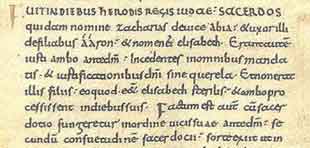
This original family of typefaces was known as “Blackletter”, aka “Gothic scripts”, with the height of popularity peaking around the 14th to 15th centuries. The ancestor of the Blackletter was called the Carolingian minuscule, a calligraphic standard of handwriting widely used in the medieval period, when literacy began increasing and a need for books in a wide range of subjects began to be in demand. It is thought to have been developed in the mid-770s by Benedictine monks north of Paris in the Corbie Abbey, famous for its scriptorium and library. The minuscule itself was derived from Roman Uncial as well as Irish Insular script, which was developed in Irish monasteries and spread throughout Europe.

Carolingian Minuscule
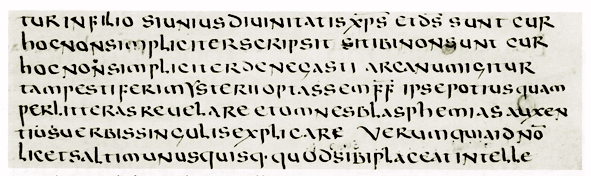
Roman Uncial
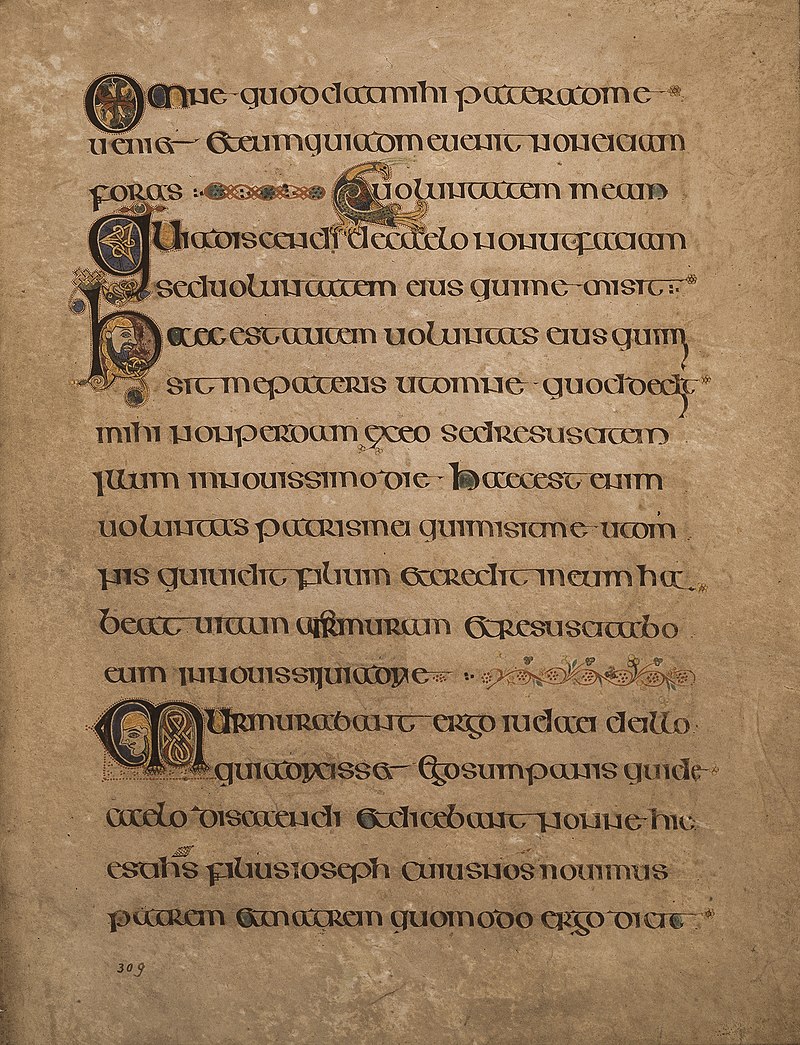
From the Book of Kells, an example of the Irish Insular script

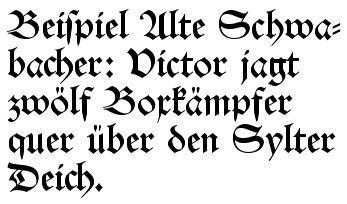
The family of Blackletter typefaces included Early Gothic, which was a transitional script between the Carolingian miniscule and Textura (the most calligraphic form of Blackletter); Schwabacher was a form popular in early German print typefaces (it became widely known with the spread of Luther Bibles from 1522), in use from the 15th century until it was eventually replaced by Fraktur around 1530, though it was still used alongside Fraktur for emphasis, much like we use bold or italic today.

Schwabacher Typeface
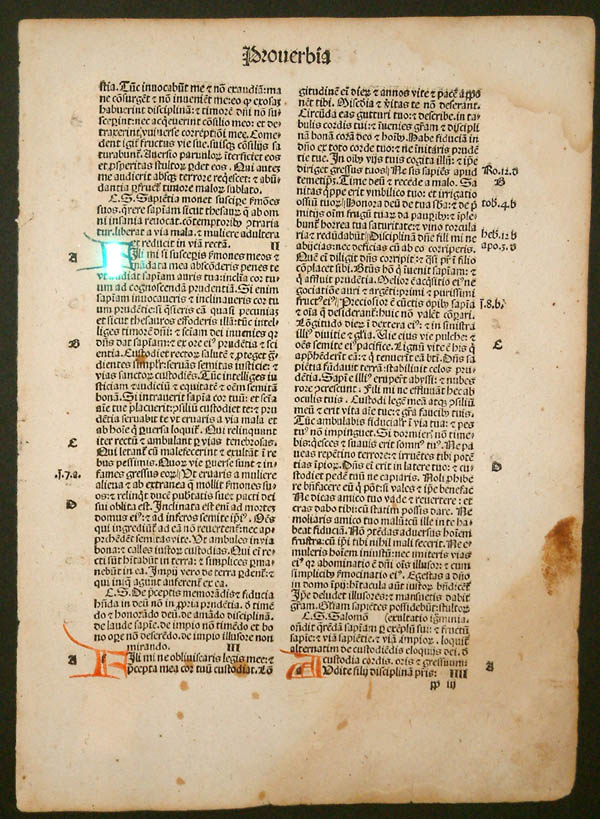
Textura Typeface

Another blackletter typeface developed between 1470 and 1600: Antiqua. This typeface’s letters were designed to look like the handwriting of ancient Roman documents, with the letters flowing together, strokes connecting them in a continuous line, whereas Fraktur was distinguished by having letters “fractured” – separate from one another. The Antiqua-Fraktur Dispute deserves its own article, so stay tuned!

Antiqua Typeface (Source: Wikipedia)
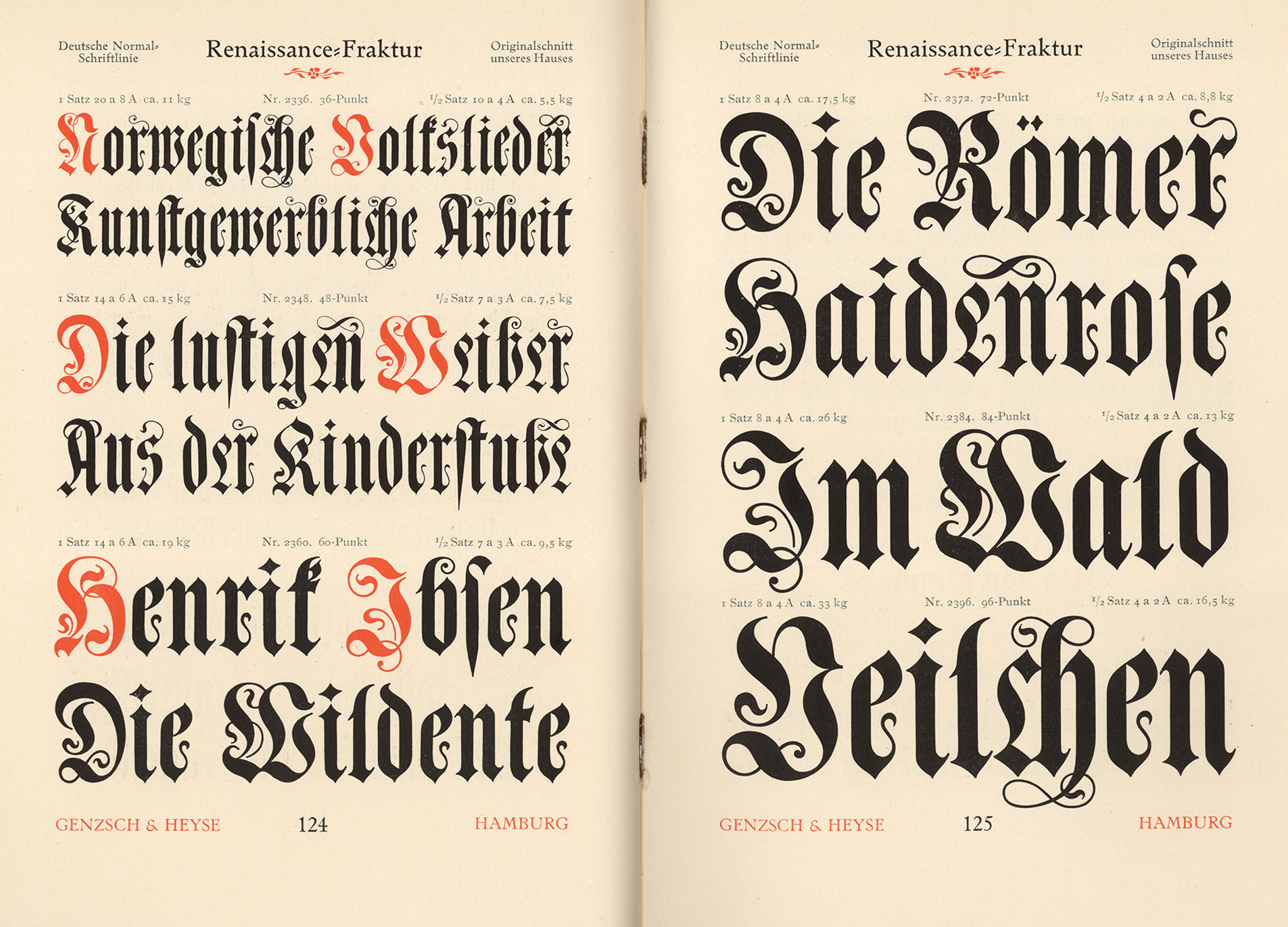
Fraktur Typeface (Source: Fonts in Use)

The Habsburg Emperor Maximillian I (1459-1519) was King of the Romans* from 1486 to 1519 [the title of king was used by the kings of East Francia, the territory later referred to as the Kingdom of Germany, from the time of Henry II (1002) to Joseph II (1764)]. The king commissioned the artist Albrecht Dürer to create a series of woodcut engravings of the Triumphal Arch [Though many are familiar with the Arc de Triomphe in Paris, it is only one example of this ancient Roman architectural feature used as a free-standing structure (rather than the Greek version, which was used within a structure such as a temple).]. These engravings would be used to create what we would recognize today as essentially wallpaper, though its purpose was more of a statement of power or propaganda (read personal marketing) commemorating his nobility, generosity, and military conquests – an incongruous combination, if you ask those conquered… The final composite of printed papers stood nearly 3 metres (12 feet) high and was only one part of a series of three enormous prints commissioned by the king.

Albrecht Dürer’s The Triumphal Arch, for Maximilian I

 The Fraktur typeface was designed in the 1530s by Hieronymus Andreae, a German woodblock cutter, printer, publisher, and typographer closely connected to Albrecht Dürer. The typeface was made to decorate the arch, telling the stories of the figures depicted throughout. The typeface became popular in Europe and was in use in the German-speaking world, as well as areas under its influence (Scandinavia, Central Europe, and some eastern European regions), into the 20th century. Specifically, Fraktur was in use in German until 1941, when it was actually banned (which places one of the books I purchased on Sunday within one year of the end of the era of Fraktur!). The atmosphere that led to that ban arose from the dispute mentioned above. Once the Nazis were defeated, the ban was lifted, but Fraktur never regained its widespread popularity after that, though you can still see it occasionally in pub signs or various forms of ads, like beer brands.

I just pulled two books from my library shelves: One is an English book originally printed in 1895, with my book being printed in 1915; the other is a German book printed in 1892. The typefaces are widely different: The English text likely used the French Oldstyle, while the German book uses Renaissance Fraktur for the text body, while the end pages act as indexes and use a variety of blackletter typefaces, such as Muenchner Fraktur, Antike Kanzlei, and Enge verzierte Altdeutsch. To see examples of the typefaces mentioned here, please click on the link for Fonts In Use.

I hope you enjoyed this jaunt through history! Nearly every name mentioned, every typeface, and every event deserves its own undusting. Next time, we’ll deep-dive into the dispute that lasted well over a century!

3 Comments

Filed under Articles, Etymology, History, History Undusted, Humanity Highlights, Images, Liguistics, Linguistics, Links to External Articles, Military History, Signs, Snapshots in History

History Undusted: The Great Vowel Shift

My husband and I were having lunch recently, and a package of Swedish crackers was on the table; I pointed to the brand name, Pågen. In English, our pronunciation of these vowels would lead us to say pagan /pæg-in/, whereas the Swedish would rather be more like /po-gen/. I just mentioned that English might have sounded similar to that before the Great Vowel Shift, which he’d never heard of (being Swiss, it’s not likely he would be familiar with this aspect of English etymology), so I promised to write a blog about it; here we go!

The term Great Vowel Shift was coined by the Danish linguist, Otto Jespersen (1860-1943), who specialised in the English language. Though the GVS is considered a single event (because of the changes being viewed as part of a chain reaction, with each vowel sound changing in a predictable way), the actual transition of English pronunciation was gradual, taking place over about 200 years, from ~1400 to ~1600. The shift began in Middle English, which was spoken from 1066 until the late 15th century – that form familiar to Geoffrey Chaucer (though his pronunciation would be unintelligible to us, his words still survive through his famous Canterbury Tales) – into Early Modern English (from the beginning of the Tudor period through to the Stuart Restoration period); Shakespeare would have been familiar with it. From there, English transitioned into Modern English in the mid-to-late 17th Century.

The main changes were that, from Middle to Early Modern English, the long vowels shortened; weef became wife, moos* became mice, beet became bite, and so on. (*The word moose entered English through Native American languages in 1610). I will also mention that in Scottish, a lot of the older vowel pronunciations still exist; house is still huus, full is homophonous with fool, etc.

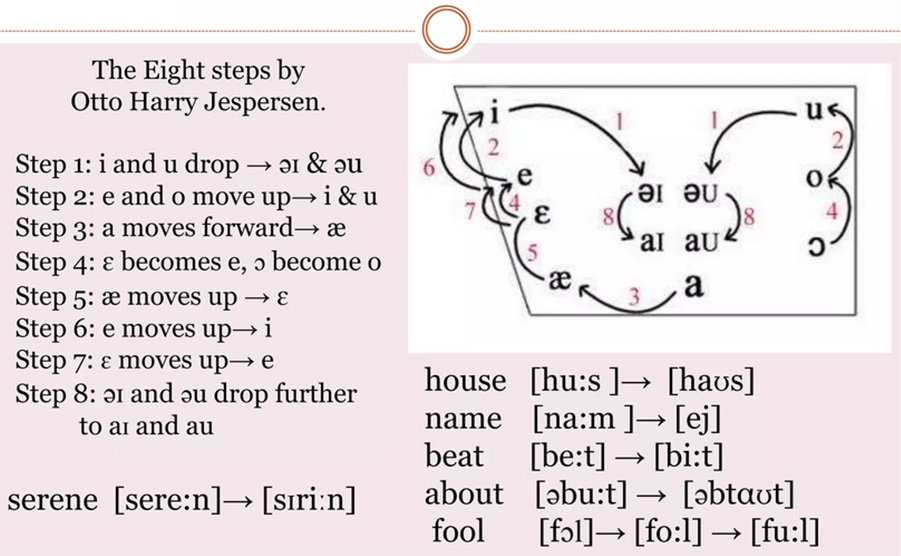
Here’s a look at just how the English vowels shifted:

Source: SlideShare

If you’ve been paying any sort of attention to English, you’ll know that our spelling is a bit chaotic; the language is full of homonyms, which are divided into either homophones (words that sound the same but have different spellings, e.g. beet and beat; bear and bare; to, too and two), or homographs (two words with differing meanings, same spellings, but not necessarily the same pronunciation: e.g. bank [of river; finance] or agape [with mouth open; love], or entrance [a way inside; to delight]) or tear [ripping; crying]. These -graphs and -phones came into English from regional dialects that were transported as migration and cultural mixing took place, and the GVS added its two pennies to the mix. Just think of the variety we have in the sounds /ea/ (bread, beat, bear, break); /oo/ (look, spool, blood); or /gh/ (through, cough, sight).

Certain factors contributed to the speed of language shift: The Black Death (1346-1353) wiped out up to 50% of Europe’s population. Stop a minute and let that sink in. What if the population of your town were reduced by half? And the next town, and the next. That single event changed the course of history on many levels; surfs could finally demand better wages wherever they ended up settling; if you lived in a town that no longer had the skills of a baker, blacksmith, or any other trade you’d depended on, you’d move to where those services existed – and jobs existed – and that meant places that had been hit the hardest by the plague and thus where everyone else was migrating, such as London. As mass movement followed the epidemic, people brought their dialects and their spellings with them. It began to converge into a new, distinct way of speaking, thinking and spelling. The geopolitical climate of the time also influenced English; England and France have been annoying each other for over a thousand years; whenever England was enamoured by all things French, they tried to emulate their pronunciations. That influence came and went; in one such moment, the pilgrims set sail for America (1620), taking a time capsule of the language with them, while England’s English continued to be influenced by French up until the French Revolution, when it quickly fell out of favour in England, though the changes had already taken place (one example is the American /k/ in schedule, closer to the original Latin, while the English say /sch/ without the /k/, which is closer to the French cedule). This factor of influence also affected differences of speech between the lower class and upper class at that time; the upper class wanted to sound more posh, more fashionable, and above all, not like the lower class.

A major contributing factor to our chaotic spelling is that ca. 1440, the Gutenberg printing technique was introduced, and by the 1470s, William Caxton had imported the invention to England; we have him to thank for Chaucer’s Canterbury Tales being known today, as that was the first book he printed in England. We also have him to thank for the influence of Chancery English (the English used by the secretariat of King Henry VI) in the standardization of the language, as he used it as his own guidelines in printing. The vowels had already begun to shift by that time; enter the written word, a rise in literacy, and you have the jumbled effects of “mid-shift” on English spelling – people began to adapt their pronunciation to the written word, so whichever form the printer used is the one that began to prevail, even though some sounds were still in transition. Like nailing down jelly. You could say that many of our odd spellings are simply a snapshot in time.

It is also important to point out that the GVS didn’t have the same influence everywhere: The main changes occurred around London, but the farther away you move from that epicentre, the less the effects on the local dialects, which still holds true today – though gradual merging has allowed people from, say, Cornwall, to understand people from Yorkshire – which wouldn’t have been the case centuries ago. Even though they can understand each other, their dialects are still distinct. I’ve already mentioned that Scots English (as opposed to Gaelic) still retains many of the longer vowels long since lost in standardized English; being so far from London, they simply ignored them. English may be taught in their schools, but Scots dialects prevail in the home and hearth. Regional dialects in English exist the world over, and though spelling and pronunciation may differ from region to region, and the language continues to be a living, breathing, growing and changing being, it’s still a language that enables the modern world to communicate, whether English is their mother tongue or not.

3 Comments

Filed under Articles, Etymology, Grammar, History, History Undusted, Liguistics, Linguistics, Snapshots in History

Comprehensive Examination

Recently, my office got an upgrade, my “office” being in our home library. I got a larger desk, and in the process of moving the old out and the new in, I took the opportunity to do a bit of “house cleaning” – sorting through papers, a notebook full of articles, and bits and bobs I’d kept over the years for teaching English to adults (I was an active EFLA teacher for more years than I care to calculate!). One of the papers I came across was the following; I knew I needed to share it because it always gives me and my husband a good laugh. I don’t know who originally wrote this, but it’s genius!

Comprehensive Examination

Instructions: Read each question carefully. Answer all questions. Time limit: 4 hours.  Begin immediately.

HISTORY: Describe the history of the papacy from its origins to the present day, concentrating especially but not exclusively, on its social, political, economic, religious and philosophical impact on Europe, Asia, America and Africa. Be brief, concise and specific.

MEDICINE: You have been provided with a razor blade, a piece of gauze and a bottle of scotch. Remove your appendix. Do not suture until your work has been inspected. You have fifteen minutes.

PUBLIC SPEAKING: 2,500 riot-crazed Aborigines are storming the classroom. Calm them. You may use any ancient language except Latin or Greek.

BIOLOGY: Create life. Estimate the differences in subsequent human culture if this form of life had developed 500 million years earlier, with special attention to its probable effect on the English parliamentary system. Prove your thesis.

MUSIC: Write a piano concerto. Orchestrate and perform it with flute and drum. You will find a piano under your seat.

PSYCHOLOGY: Based on your knowledge of their works, evaluate the emotional stability, degree of adjustment and repressed frustrations of each of the following: Alexander of Aphrodisias, Ramses II, Gregory of Nicea, Hammurabi. Support your evaluation with quotations from each man’s work, making appropriate references. It is not necessary to translate.

SOCIOLOGY: Estimate the sociological problems which might accompany the end of the world. Construct an experiment to test your theory.

MANAGEMENT SCIENCE: Define management. Define Science. How do they relate?

COMPUTER SCIENCE: Create a generalized algorithm to optimize all managerial decisions, assuming an 1130 CPU supporting 50 terminals, each terminal to activate your algorithm; design the communications interface and all necessary control programs.

ENGINEERING: The disassembled parts of a high-powered rifle have been placed in a box on your desk. You will also find an instruction manual, printed in Swahili. In ten minutes a hungry Bengal tiger will be admitted to the room. Take whatever action you feel appropriate. Be prepared to justify your decision.

ECONOMICS: Develop a realistic plan for refinancing the national debt. Trace the possible effects of your plan in the following areas: Cubism, the Donatist controversy, and the wave theory of light. Outline a method for preventing any negative effects. Criticize this method from all possible points of view. Point out the deficiencies in your point of view, as demonstrated in your answer to the last question.

POLITICAL SCIENCE: There is a red phone on the desk beside you. Start World War III. Report at length on its socio-political effects, if any.

EPISTEMOLOGY: Take a position for or against the truth. Prove the validity of your position.

PHYSICS: Explain the nature of matter. Include in your answer an evaluation of the impact of the development of any other kind of thought.

PHILOSOPHY: Sketch the development of human thought; estimate its significance. Compare this with the development of any other kind of thought.

GENERAL KNOWLEDGE: Describe in detail. Be objective and specific.

EXTRA CREDIT: Define the universe; give three examples.

7 Comments

Filed under Humor, Just for Fun, Lists, Writing Exercise

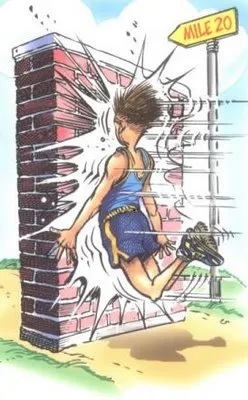
Of Marathons and Brick Walls

That title fairly describes my life over the past few months. Anyone who’s published a book will know what I mean by marathon. But is mine published yet? Nope. That’s where the brick wall comes into the story.

Back in the summer, my publishing platform, Smashwords, merged with Draft 2 Digital (D2D). The books would eventually be migrated, they said. But I took the opportunity to apply the things I’ve learned over the past years to my already-published books, trimming and tweaking what are still essentially the same stories, with every word counting. Three of the four were done. Or so I thought. They are successfully released as e-books, but the paperback has been a huge headache.

D2D now offers the option of paperback books, which Smashwords didn’t have, and I was relieved to have that format again. Their claims were that they could simply apply the e-book file to a paperback version, and would create a full book cover from the e-book cover I provided, or I could upload a full cover myself. I chose the latter because the former was simply taking the main colour of the front cover and slapping it on the back and spine. With some tweaking to my inside document, I gave the okay for an e-book release and ordered paperback proof copies.

Oh. My. Goodness. Everything that could be wrong with a book printing was there: No gutter margin adjustments (“gutter” refers to the inside margin at the spine of the book; you should be able to read the entire line without breaking the book spine!); the spine of my design was partially wrapped to the front cover; the cover colouring was way off; the size of the actual book was too large (not the standard size which I’ve always chosen); there were orphans and widows all over the place (those refer to “abandoned” text, such as “Dear John” on the bottom of a page with the rest of the letter on the next page, or a single line at the end of a chapter on an otherwise blank page); centred elements were NOT; the divider images, clear on every other printing I’ve ever had, are fuzzy. The list goes on. Brick walls.

What it all means is that, as much as I’d worked toward a pre-Christmas release, it will now likely turn into a late-2023 or early 2024 release! I will have to reformat not one, but five books for their paperback versions. Picture five brick walls to surmount that you weren’t planning to face at all. It was work that I had hoped D2D’s claims would relieve me of. But I guess the old adage is still true:

If you want something done right, you have to do it yourself.

For a few days, I was in shock at the poor quality of printing (and the first proof book took weeks to arrive), and I wondered why I was putting myself through this. I seriously thought about just throwing in the towel on writing. But I know myself; I’ll give myself a few days, and then I’ll be spit-fire again. And then D2D will be getting comprehensive feedback on their paperback program (in all other ways so far, I’m satisfied with their service and tools). After that, before I can move on to the next story, I’ll be working for months getting re-releases and my new release ready for paperbacks.

In all this time, I’ve heard that real life has gone on outside of my library (where I write). I had a craft stand at our annual local Christmas market, which meant weeks of preparing when I wasn’t writing. Someone usually cleans our house (me), does our shopping (me), and cooks our meals (me). I’m also part of the decoration trio in our church, which has meant regular stage design changes and creating elements for that – some as simple as wire figures, some as complex as giant wheat stalks.

And I’ve heard the rumour that Christmas is coming! Somehow, with all the editing, graphics, publishing and not publishing lately, I’ve not gotten into the season’s mood yet. But now that the Christmas goal has been ripped away, I’ve allowed myself time. Time to breathe. Time to think about and write something other than manuscripts and blurbs and bios. It’s not that I’ve forgotten this blog, and it’s not as if I’ve had no ideas for it – I’ve had dozens; I’ve just had no time to pursue them, and if you’re like me and don’t write them down as they come, the ideas flit away like startled sparrows. So, I’ll start writing them down – and when I need a break from the editing marathon, I’ll investigate those ideas, and start sharing them with you! Thank you for hanging in there in my long silence!

14 Comments

Filed under Articles, Musings

Cutting Room Floor

I’ve been squirrelled away, editing. Editing. Editing. Once in a while, I come up for air or a tea. Then back to it. Then take a walk. Cook dinner. Back to it.

Everyone has their own writing techniques, and over the course of my career, I’ve tried most of them: I’ve outlined a plot and characters to a T; I’ve written out scene cards on post-its and rearranged them until I had the story down. But my tried-and-true method is to open a Word document and make use of their post-it function (that’s what I call their review/comment function), then type out 10 scenes that cover the arc of the story. After that, I toss my characters into the room (parameters of the scene) and let ’em loose. That comment function is worth its weight in gold, as I can slice out something and pop it in a comment off to the side, move it, scrap it, or take out the core and put it somewhere else. I can put reminders to check continuity in there, along with plot development thoughts, what-ifs, alternatives, etc. and try them out whenever it’s time, then delete them and move on. I tried the popular Scrivener program once, and it ate a manuscript for lunch (fortunately, I’d saved a Word version!)! Besides, I’m more organized than that program will ever be!

In my current manuscript, which is science fiction, I tossed the characters on an alien planet (a character in its own right) and let them figure it out. As they talk and move through the scenes and through time, they ripen and develop into full characters with a deeper story as a result. But that can also result in a chunky manuscript, that then needs to go through the toning process – cutting away the excess fat of characters, scenes, and dialogues and making them lean… in the film industry, it’s called the “cutting room floor” process. And that’s the current stage I’m in. When I started out, I had no idea how I’d reach my goal: My starting point, which was the completed manuscript in December last year, was a whopping 148K! My end goal, with a marketable science-fiction range of 100-115K, was over a few hills. But every journey begins and ends with small steps. I started going through my usual edit/proofing list, and I’m now in sight of the goal, just under 117K, and I’m not done yet. The trick is taking off my writer’s cap and putting on my editor’s hat; that means letting go of favourite scenes, plot points, and even characters when necessary. If it doesn’t serve the main- and sub-plots and character development, then out it goes. My husband, who was once a black belt in Lean Six Sigma, has called it my “lean sigma process”.

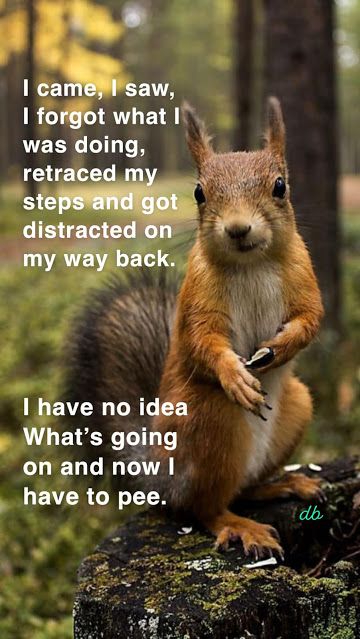
Sometimes I feel like this squirrel… and that’s where that comment function comes in handy again!

So… I’m off to make myself lunch, then dive back into the editing. I’ll reach my goal, with a comfortable margin, within the next week!

If you’re a writer, what is your approach? Copious amounts of pre-notes and hundreds of questions to develop characters and plot in your mind, or winging it? Please spill the beans in the comments below!

6 Comments

Filed under Articles, How It's Made, Musings, Nuts & Bolts, Plot Thots & Profiles

A New Year

Happy New Year! I don’t know about you, but I’m happy to leave 2021 behind me! On New Year’s Eve, my husband and I sit down and review the last year, and talk about what we’d like to see or do in the following; this year, when we reviewed the last 12 months, we had to say, “what did we experience unrelated to health issues?” and we were hard-pressed to come up with anything substantial: Holidays were a non-topic, as my husband was in and out of the hospital, sometimes emergency, with complications that delayed his chemotherapy; finally, that got started – which meant that either he had little energy for taking day trips, or we couldn’t go because he had appointments. If anyone has had it themselves or has a family member who’s had cancer, you’ll know the “routine” – if you can even call it that.

In the midst of all that, with my energy and focus on him, or on communicating with friends and family, everything else seemed to fall to the back burner, including regular blog posts. In the past few months, if I wrote at all, I worked on my next novel; I finished the final draft in mid-December! Then I immediately did a straight read-through and began the work of fine-tuning and editing. I have Beta readers for feedback, but because I’m an Indie publisher, I do all of the nitty-gritty myself, the work of graphics, formatting, editing, and a long list of to-dos that could fill a book by themselves. Those are what I’m tackling next – after the feedback is in and incorporated where needed.

Now that chemotherapy is behind us (his last ended on Christmas Day!), we’re still not out of the woods but at least we can see the skies through the thinning trees. Also in December, I had my 2nd Covid vaccination and have noticed a marked drop in the long-term symptoms that had been slowing me way down, some days stopping me altogether, since March 2020. The end of those two issues gives me more hope for the coming year! It also means that we can look forward. Last year, it was impossible to plan; at the worst times, we couldn’t even plan an hour ahead. Of course, Covid complicates things, with travel restrictions or threats of lockdowns, but I think we’re all used to that by now.

Have you made any holiday plans for the coming year? If we could fly anywhere, without Covid complications at the airport or crossing borders, ideally we would love to go back to Scotland, where I used to live and where we met back in the day! But we live in one of the other most beautiful patches on Earth, so we’re hoping to take the Grand Tour route of Switzerland this year instead. In the past, we’ve often rented a motorhome for holidays, whether in New Zealand, Norway or Scotland, so perhaps we’ll do that here, too. Every plan is qualified these days with a maybe, perhaps, or we’ll see.

My hope for this blog in the coming year is that I can take control of time and energy once again and begin posting regularly. I have a few ideas, so keep an eye on this space!

8 Comments

Filed under Articles, Musings

Life & All that Jazz

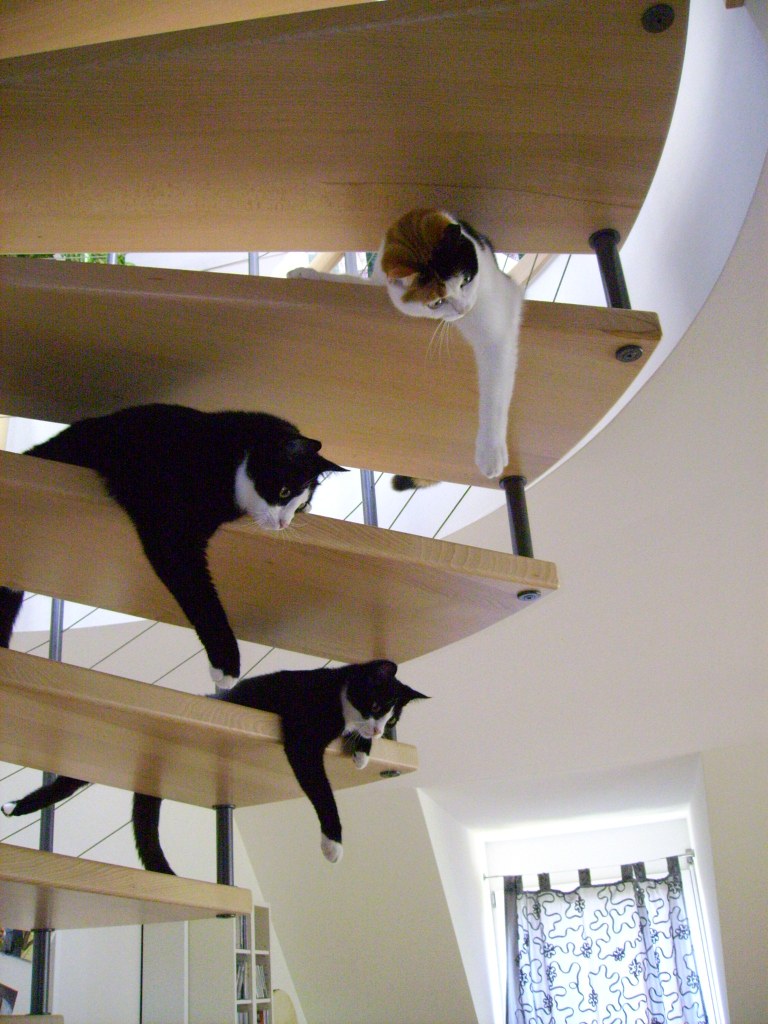
It’s been nearly 2 weeks since I wrote, so I thought I’d catch you up on why: At the end of last month, one of our cats, 12 years old, was diagnosed with breast cancer; I didn’t even know that was something cats could have, but the vet was confident that she had some time left – as long as she ate, and felt like living, we’d make her as spoiled and comfortable as possible. She’d lost a lot of weight, so we were given a few cans of “recovery” food to help her gain weight; they were barely touched. That was a Monday; by the following Friday, it had gone into her lungs and she went downhill rapidly. Less than a week after the diagnosis, we had to say goodnight for the last time. So I haven’t really felt like writing much lately. Our other two cats* had sensed that Gandria needed more space than usual (she was always more of a loner than the other two, who always seem to be synchronized and near me – as I write, they’re both asleep in boxes on my desk), so when she finally left our home for the last time, they accepted it smoothly. She was part of our family for 12 years; anyone who’s lost a loved pet knows what that feels like. [* Amendment, 10 January 2021: In the image below, the middle cat, Caprino, passed away yesterday after a 6-week battle with kidney disease, diagnosed end-November…]

From top to bottom: Gandria, Caprino & Allegra

Even though I haven’t written here, when I’ve had the focus, I’ve been working on my current manuscript, a science fiction novel. It’s nearly done as far as the second draft goes; after that it’s the long process of editing, perhaps re-writing scenes, and then the long haul of technical formatting and preparing the manuscript, covers, blurbs, etc. for publication.

Besides all that, I’ve been in the kitchen: I’ve always had a good supply of reserve foods on hand for that surprise visit or for those times when I’m too focused on writing to go to the store (I don’t like shopping). When the lockdown hit earlier this year, we were better off in that respect than many, but I began to notice certain areas that could improve. [I wrote about it a bit in my article “Preparedness”, as well as here.] One thing I want to get away from in our eating habits is the one “convenience” food we allow at lunch times when my husband has home office days: Quick Lunches (those plastic one-meal pots that you just add boiling water to). It turns out that there are a lot of great recipes for in-a-jar meals; they just require a few extra skills like knowing how to dehydrate cooked ground meat safely, or how to dehydrate sour cream or pre-cooked beans. Many of such recipes are coming out of America, where they assume you can just run down to your local Walmart or Costco and pick up dehydrated meat; fortunately, there are others out there who’ve figured out how to save expenses and make their own and shared that knowledge online. What I don’t have, and wish I could find for sale online with delivery to Switzerland, is a Food Saver vacuum packer with an adapter for canning jars. But I’ll just have to figure out a way with what I’ve got, because it is what it is.

I’ve also been canning more – things like tomato stews, jams, etc. These kinds of meals are not just for us; we’ve got families in our church that are struggling through issues, and being relieved of meal planning and prep is a relief for them. I plan to collect the recipes I find most accessible for Swiss cooks, and post them on my recipe blog so that they can access them and we get an organized distribution chain going. In doing so, I’m also aware that I’m probably the only one with dehydrators, so I’ll be providing some of those ingredients for others to pack up – which means that I’ve got some prep ahead.

Whatever you’re up to, I hope you’re well, staying healthy physically, mentally, emotionally and spiritually. Taking care of ourselves is vital; it’s the only way we can then also help care for others.

7 Comments

Filed under Articles

The Long and Short

It’s been nearly 3 weeks since I last posted, for which I apologize. Sometimes life just takes over, and my mind gets going in several different directions; when that happens, it’s hard to focus on writing a blog that’s worth its content, and I don’t want to post just to post. It needs a purpose.

In my post about cutting my nails, I told you that I’m getting down to serious writing. It’s been an interesting process, as I’m actually writing two manuscripts at the moment – one from the perspective of the heroine, and the other, the villain. But as any villain will tell you, they are the hero of their own story; I started writing from the second POV to develop the character and decipher the plot ins and outs through that back door, so to speak – if I don’t have a clear grasp on the villain and their motives, this particular plotline won’t work.

But in the meantime, life has intruded (so rude of it) several times; I’m involved in leadership teams in our church, so that’s taken quite a bit of time in this phase of our growth; my husband and I also went away to the Alps for a long weekend this past week, and while it was enjoyable, I didn’t sleep much – and I didn’t have my laptop with me to work when I couldn’t sleep. [Sleep is a whole other kettle of fish; I’ll just say that I don’t sleep horizontally, as it’s too painful.] So, to pass the time, I watched stars or wrote short stories.

I started writing short stories several years ago – just as a hobby, really; but this year, I decided to take it to the next level – competitions, and looking into anthologies. My mother has been sending me helpful links in the latter category, and in the former, I have a whole list of month-by-month due dates that I could target. If I miss the deadline for a particular competition, I can still write a short using their criteria, for practice as well as having something ready the next time.

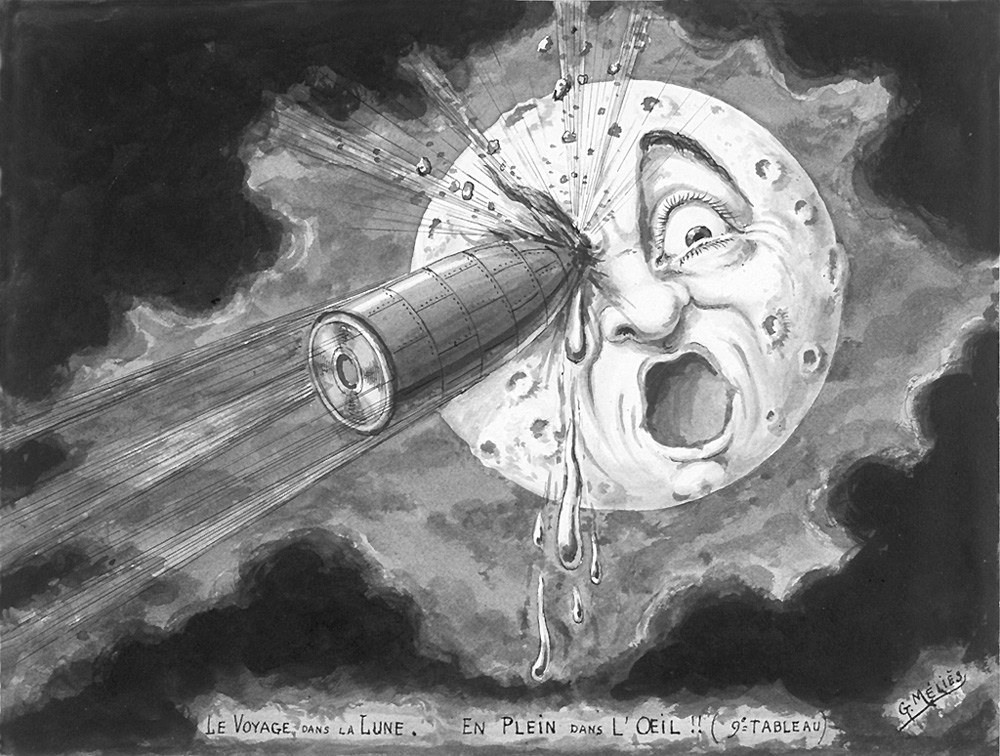
Part of my writing “time” has been spent trying to figure out a way around the monopoly that is Amazon. Basically, that’s been nothing but frustration. I used to be able to order paperback books through CreateSpace, at author’s cost, and have them shipped to Switzerland. They no longer ship here, because apparently, we’re now behind Timbuktu. Authors in other countries can buy author copies; basically, anywhere except Switzerland, Liechtenstein, and “some regions in Germany”. That’s a quote from a reply to my enquiry. How does one region of Germany differ from any other, I ask (rhetorically)? There is no longer a Berlin Wall – or does Amazon not realize this yet? If I could shoot Amazon to the moon, I would do it in a heartbeat. Any suggestions? I wonder if they sell rocket fuel?

Rocket in the Moon's Eye

7 Comments

Filed under Articles, Musings

Cutting My Nails

I know that’s an odd title, but it will make sense in a minute!

You know the feeling when you have a big project looming; it might be a household chore, such as cleaning the cellar, or a work project that just needs undivided time. If you’re like me, you think about it long before it actually happens; but there comes that moment when you make the decision to tackle it. Perhaps to do so, you need to make a purchase (like clear plastic boxes to help you organize the cellar), or something needs to happen before the project begins, but once you’ve done that something, it will happen.

Nail Art Inspiration

What my nails looked like until yesterday. Photo credit: Instagram 8715

Well, that’s where cutting my nails comes in: I have very hard nails; cutting and filing them takes about an hour, and usually, I can’t be bothered so I let them grow, keeping them oval-shaped as they go. I enjoy doing nail art, so I’ve been experimenting (this photo was my inspiration when I painted my [longer] nails last week, and it came out looking exactly like the image, minus the cool ring!). But long nails also kill my keyboards – I’ve at length (no pun intended) resorted to keyboard letter stickers; as long as the keys still work, other people can find their way around my keyboards. Even at that, when writing a novel, I go through a keyboard a year (e.g. the letters stop working).


Lately, I’ve been working on short stories, and doing a bit of “spring cleaning” in my writing files – projects half done (what I call my “PHDs”),  ideas that want fleshing out, etc. and so I haven’t had to cut my nails. But now I’m getting ready to tuck into my next novel – this time science fiction. And so, today, I cut my fingernails. For me, it’s an act that means I’m serious about this project; in my mind, it moves from “hobby” to “profession” by that simple act.

Maybe there’s a project you want to work on, but something’s keeping you from digging into it. I write this to encourage you to go for it! Take that step, whatever it is, that’s between you and getting down to brass tacks about your goal. Cut your nails; clean off your writing desk to eliminate distractions; buy those boxes if you need them; simplify life; get rid of the clutter that keeps you from your goal. Then enjoy that sweet moment when you reach that goal, or begin a new chapter in your life, figuratively or (as in my case) literally.

9 Comments

Filed under Articles, Musings

Square Eyes

word-500x392

How my brain looks at the moment…


I’ve been staring at the computer screen so much the past few weeks that everything else in life got put on the back burner (including this blog – my apologies!). I could afford to do this because my husband’s been away on his annual hiking & biking holidays, so I could focus on huge chunks of editing for (10-14) hours at a time. I’ve taken the stereotype of authors as hermits to the limits, I must say! And I enjoy it for the moment. With minimal appointments/classes/students during this period, I’ve gotten a LOT done: I’ve been updating/tweaking/editing the already-published novels because they needed to be uploaded again anyway (due to new releases, and broken links*).

This simple goal opened a pandora’s box of issues – like the fact that I’ve realised that I need to keep an active eye on Amazon; they manage to screw up things on a regular basis with links to books, links to my Author Page, and external links to my blog.  They don’t care that their mistakes cost me readers. And not just Amazon.com – but .de and co.uk… that translates to, ideally (heavy dose of sarcasm) checking 10 book links per website times 3… regularly. Obviously, I have nothing else to do with my time.

That’s one issue; another is something I’ve recently become aware of, and I think anyone publishing e-books using Word as a basis-format needs to be aware of: Start off your manuscript with a “nuclearized” version – NO formatting, and turning off all Word auto-corrects and auto-formats.  Word tends to add hidden bookmarks to help navigate through a manuscript; however, these can also mess up your final version if you’re sending it off as Word to be *converted by the end-publisher. That means, go to “Insert”, click “bookmark”, and unclick / re-click the “hidden bookmarks” checkbox. Anything beginning with _(gibberish) needs to be deleted. The bad news: each one has to be deleted individually (unless you pay for a tool like Kutools for Word)! I just did one of my e-books, and I had 280 superfluous bookmarks… Joy.

Once I get this all done, the next phase begins: Preparing all 5 e-book manuscripts for release on another website, Smashwords. They use what they affectionately call “the Meatgrinder” – a program that converts a nuked document into the various formats through which they distribute.  That means sifting through a 120-page PDF for grains of useful info in a vat of chafe – things I already know (like how to copy/paste!). They leave no stone unturned, but I still need to read through it and prepare my personalized list of editing/formatting points.

Every time I look at my to-do list at the moment, I take a few deep breaths. There’s a light at the end of the tunnel, however: When I start work on my next manuscript, it will be nuclearized from the get-go; putting pure practices into effect from the beginning will (hopefully) save me a lot of headaches later on when it comes time to publish again!

In a few days, I hope to emerge from the cave to become a modern, socializing human again – in the meantime, just gimme a cuppasoup and turn off the phone, please.

20 Comments

Filed under Articles, Musings, Nuts & Bolts