Tag Archives: writing

Imagination vs Knowledge

Some say that imagination is more important than knowledge; to a certain extent, that may be true because imagination leads to new discoveries, inventions, and revelations.  But knowledge is often the basis for such discoveries; that which has been passed down by others who’ve researched, discovered, identified and recorded are the foundational stones upon which things are often built, whether in science, technology, or life in general.

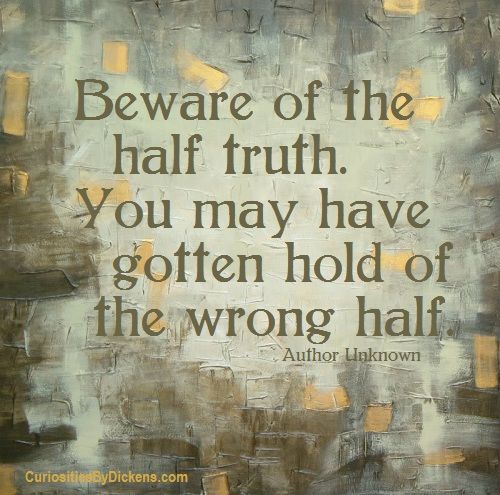
beware-of-the-half-truth-wrong-halfIn this day and age, however, sometimes imagination overtakes knowledge (or simply ignores it).  An informed mind is a powerful tool; an uninformed mind can be a dangerous weapon.  This is true whether writing non-fiction, fiction, or passing on something on social media.  We should beware of the half truths – we may have gotten hold of the wrong half.

It’s now more important than ever to test the veracity of reports and even images; anyone can make an ass out of an angel, so to speak, with photoshop, et al.  How much misinformation is spread by simple carelessness or wilful misdirection (that includes, unfortunately, mainstream news media)?  Or by assuming that since something is from a trusted friend it must be true?  How often have you gotten upset by an article you’ve seen and commented on it, or passed it on, allowing it to form an opinion in your subconscious at the very least, and in your active thoughts at worst, only to find out later that it was a false report, a hoax, or sloppy journalism?

abraham-lincoln-internet-quote

As you probably know, I love to learn; I have a steel trap of a mind for little bits of trivia, like the fact that certain microbes concentrate and disperse (read “poop”) gold, or that all living creatures, including you and I, emit visible light (probably a byproduct of biochemical reactions).  As a writer of fiction that comes in handy; I can extrapolate knowledge and use it as a plot detail or a character quirk; but when I’m writing a blog, e.g. about a historical detail, I want to make sure I get it right.  A case in point was an article I wrote in 2014 about post-mortem photography in the Victorian period; it was by far the most popular post to date on that blog and continues to generate interest.  In particular, two points from the article were addressed, researched, and edited/corrected either in the article itself or in the comments and discussion that ensued.  Mistakes happen, but when I catch them, I will do my best to correct them!

For writers, it is important to cross-reference anything you find online, especially if you’re basing something significant on it such as character development, location, or plot.  Assumptions can also get you into trouble; I know that Geneva is part of Switzerland, but in writing 18th-century fiction, I need to be aware of the fact that it was merely an ally of the Swiss Confederacy from the 16th century, but only became part of Switzerland in 1814.  Any reference I have to it in my trilogy needs to reflect that fact.

I recently read a collection of short stories on Kindle, and on nearly every single Kindle page there were mistakes (that adds up to a lot of mistakes per manuscript page!):  Missing words that the authors assumed were there, typos, commas 2 or 3 words off-position, stray quotation marks, and countless words they assumed were the correct ones but obviously were not (e.g. catwalk instead of rampart for a castle).  This is where imagination overtook the writer, and knowledge gave way to ignorance…  I have understanding for one or two such errors in a manuscript of that length, but none whatsoever for several per page; that simply smacks of laziness and poor-to-no editing, and it boils down to an unintentional slap in the face to any reader who’s taken the time to read their story.

Knowledge without imagination is like a rusted hinge; imagination is the oil that makes the knowledge come to life, and the writer is the door handle that opens the door to new worlds, new ideas, new discoveries, and inventions. It sounds noble, doesn’t it?  But did you realize that many of the electronic gadgets we take for granted today were at one time birthed in the imaginations of men like Gene Roddenberry, creator of Star Trek?  It inspired countless children who went on to become astronauts, scientists, and engineers, who made those science-fiction inventions become reality and discovered distant worlds (now known as exoplanets).  I’m waiting with bated breath for the transporter to replace airline security queues…

Those hinges are necessary, as is the oil, so that the door handle can do its job and get out of the way, allowing the world beyond to unfold.

Save

Save

2 Comments

Filed under Articles, History, History Undusted, Musings, Nuts & Bolts, Plot Thots & Profiles, Research, Science & Technology, Space, Astronomy

Wordless Wednesday no. 16: Book Nook Inspirations

This slideshow requires JavaScript.

18 Comments

February 16, 2017 · 12:19 AM

Buying Credit

No, the title is not referring to money or cash cards, but writing.  Stick with me.  If you’ve made yourself at home here and nosed through my cupboards, you’ll know that I do a LOT of research.  I love it.  It adds spice to my character’s meals, salty spray that blackens the redcoats of marines aboard a royal navy ship, tells me that heated arsenic smells like garlic, and makes the ship creak so loudly you’ll swear you’re going down to Davy Jones’ locker.  But there are times when, as an author, I’m required to blur the lines between fact and fiction.

There are certain things that people erroneously assume (such as Viking helmets) that I may need to adapt in order not to lose a reader’s trust (though trust me, I will never add horns!):  The sentence structures of bygone days were far more complex, with vestiges of Germanic linguistic influences – for my current manuscript (set in 18th century England and mostly aboard a Royal Navy ship of the line) I need to modernize the syntax without losing the High English flavour, and without compromising on the linguistic purity of my story’s time-setting; modern sensibilities (in social ladders, issues such as slavery, war, etc.); laxer standards (in, say, relationships or politics or social ranks), and so on.  A modern reader will most likely not appreciate the complex social mores of a time when men and women were never alone in a room – even when the man wanted to propose to the woman, and the parents wanted it to take place; and so, such things need to be adapted at times, to a certain extent, to reach a modern audience without alienating the audience that revels in bygone literature.

If I, as an author, want my reader (who is perhaps a stickler for all things historical) to give me the permission to bend a few social rules of the 18th century, I must first buy credit with them – prove to them that I’ve done my homework – so that they won’t get ripped out of the story in disbelief when I contrive to leave a man and a woman alone in the same room without a chaperone.  In my current manuscript, the husband and wife come from opposite ends of the social ladder, and the husband becomes a captain in the royal navy at the tender age of 20 or 21.  Both of these situations have many historical precedents; I know that from countless hours of research.  But most people who read historical novels might think, “But Viking helmets always have horns” – or something to that effect.  If written well, these disparities in understanding can be smoothed over, so that when I really DO break historical moulds, I am allowed to do so without offending the reader “in the know”.

1761-joshua-reynolds-lady-elizabeth-keppel

1761, Lady Elizabeth Keppel, by Sir Joshua Reynolds

This portrait illustrates an important point:  Many people, when thinking of the British rule of India, perceive it through postmodern lenses; we see it from the hindsight of Gandhi and the independence of the country from the imperialistic rule of British paramountcy.  But the other aspects were the children and wives of British soldiers, diplomats, and tradesmen, and the loneliness faced, the friendships struck with Indian men and women… these are important aspects to weave into a story, too, and thus require research.  Notice the pearls adorning the Indian woman below?  The researcher in me wants to know her story far more than the story of Lady Keppel (who died of a broken heart at the age of 29, just months after her husband had died of injuries from a riding accident).  Some readers may get jolted out of the world you create by the pearls, though it is historically accurate – so you’d still need to buy credit by setting up that aspect well.

These same credit-buying rules apply to any genre, even science fiction:  If you create a world set on another planet, that world will have laws – physics laws, indigenous social mores, etc. – and you as a writer must know what they are, and if or how they can be broken if need be.  You can’t claim that all liquid on the planet is frozen, and then have your character drinking from a fountain or stream, unless you explain how that’s possible.  If you do, you’ve taxed your believability credits and pulled the reader out of the world they’ve agreed to follow you into.  The manuscript that I’ll work on next (after the current one is published!) is science fiction; the air of the planet is toxic to humans, so I need to create a way for facial expressions, dialogue, etc. to come through even when the characters are outside in their suits.  I have done a lot of preliminary research into geology (that told me about heated arsenic, among other things); I also need to explain how a planet with multiple suns can have a stable enough orbit not to be drawn into one of the stars and burn up – i.e. I need to follow known physics laws, or explain how they are suspended for my planet.  I think you get the idea!

So if, as a writer, you want readers to believe what you write about a fictional character set in British India, you first need to buy credit with your readers by doing your historical homework and sculpting the landscape and characters in the rich tapestry they deserve.  If you are writing science fiction, establish your world and stick to your rules so that, if you need to bend them for a plot development, the readers will be willing to follow you on the adventure.  Whatever you do, keep writing!

Save

Save

Save

8 Comments

Filed under Articles, History, Military History, Nuts & Bolts, Plot Thots & Profiles, Research, Science & Technology, Writing Exercise

A Little Light Reading… Not

I will admit that I have quite odd tastes in reading, especially for a woman; I tend toward history, nautical, and obscure or long-forgotten books.  In writing my current manuscript, which is Asunder, the third book in the Northing Trilogy, I’ve read more than a fair share of military history books, specifically covering the 18th century of the Royal Navy.  Once, on a research trip to London, I searched out a bookstore that specializes in military and transport books, even reputed to have remainders; I don’t think they’d seen a woman in the shop in years (who’d entered intentionally) by the looks I got; one of the men even said, “The beauty shop’s two doors down, love.”  When I asked if they had the out-of-print autobiography by William Spavens, a unique lower deck view of the 18th century navy, they froze as if they hadn’t heard me correctly.  The question must have been laced with catnip, because after that I had the entire shop of men eating out of my hand, and I spent nearly two hours in there being helped to the finest pick of naval history books (including the autobiography I was after!).  Sadly, the last time I was there the shop was gone, but I’ve since found the largest used book shop in London, Skoob, which is highly dangerous for a bibliophile with a private library…!

A few of the books I’ve read in the course of research for Asunder are fairly gory, like Medicine Under Sail (I’d bet my bottom dollar that the screen writers for “Master and Commander“, with Russell Crowe, read that book as they wrote the script) and “Poxed & Scurvied” – the story of sickness and health at sea, while others have been like reading a thriller, such as “The Seven Years War” by Rupert Furneaux  or “A Sailor of King George” by Captain Frederick Hoffman.

I devour history books like other people devour pulp fiction; but especially during the first draft of the book, I had to continually keep in mind that I was writing historical fiction, not a history book; the details that I included had to serve the plot and character development, and not visa versa.  Only a fraction of what I learned has gone into the book; but those rich details give salt to the waves, creaks to the ship, and whip to the rope (I’ve also spent hours aboard the Cutty Sark “filling in the blanks” of a docked ship, so to speak, but that’s another story).  I could have peppered the dialogue with so much naval slang you wouldn’t have been able to swing a cat (naval slang, by the way), but if readers were to get ripped out of the story trying to figure things out, then I would have missed the mark.

So, the next time you sit down for a little light reading, you might want to consider one of the books linked above; then again, if you don’t want gory dreams, rather go with “The Price of Freedom“, or “Redemption“, or “The Cardinal, Part One or Part Two“…  and enjoy!

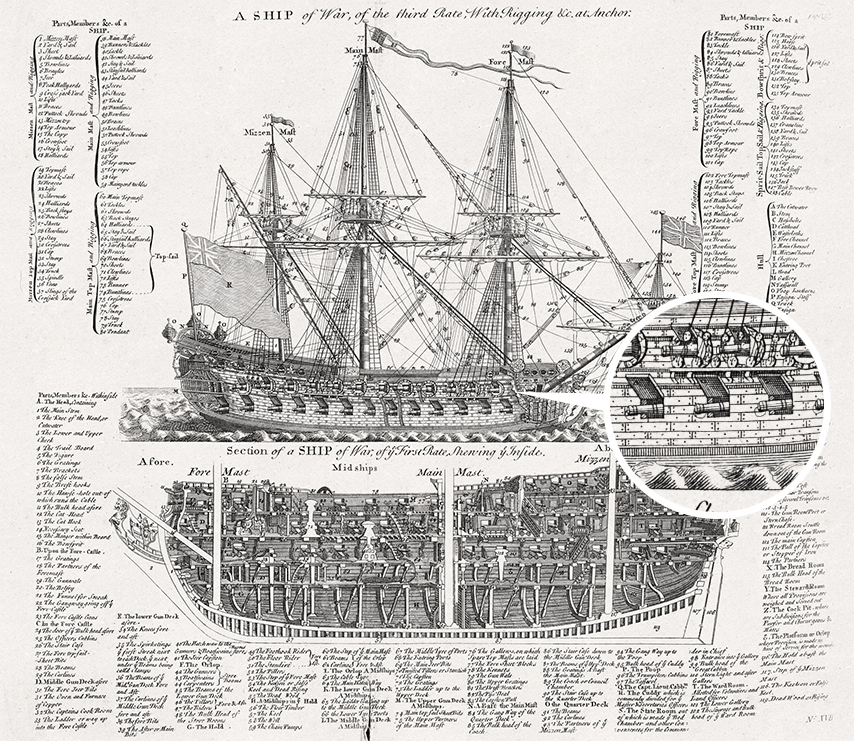
third-rate-ship-of-the-line-diagram

One of my library posters

8 Comments

Filed under Articles, History, Military History, Musings, Nuts & Bolts, Research

The Ultimate Final Exam

DIGITAL CAMERAAfter 11 months with an exchange student here with us, our life is now beginning to revert to its previous “business as usual” state.  That means that I can schedule my time, my days, and even weeks, and actually see those goals come within reach and grasp them.  It means that I can sit down at my computer, and write 10 hours straight if I’m on a roll!  It’s suspiciously quiet here now, but that does not mean something’s afoot this time… unless the cats are up to something.  With all of her exams through the school year, I was reminded of a list I’d seen years ago; when I shared a similar list in my previous post, I decided to track this one down and share it with you.

This ought to keep you entertained and out of trouble, while I dive into my fifth novel’s manuscript with a fresh eye (since I haven’t really seen hide or hair of it since April…!).  Enjoy, and have a great week!

Warning:  I take no responsibility for snorted drinks or explosions of anything out of your north or south ends

The Ultimate Final Exam

  Read each question carefully.  Answer all questions.    Time Limit: Four hours. 

 HISTORY:

Describe the history of the papacy from its origins to the present day, concentrating especially but not exclusively, on its social, political, economic, religious and philosophical impact on Europe, Asia, America and Africa.  Be brief, concise and specific.

  GEOGRAPHY:

Predict the position of the tectonic plates as they will appear two billion years from now. Be prepared to prove your results.

  MEDICINE:

You have been provided with a razor blade, a piece of gauze and a bottle of Scotch.  Remove your appendix.  Do not suture until your work has been inspected.  You have fifteen minutes.

  BIOLOGY:

Create life.  Estimate the differences in subsequent human culture if this form of life had developed 500 million years earlier with special attention to its probable effect on the English parliamentary system.  Prove your thesis.

  PUBLIC SPEAKING:

2500 riot-crazed aborigines are storming the classroom.  Calm them.  You may use any ancient language except Latin or Greek.

  ART:

Give an objective analysis of the relative significance and quality of the works of the major artists of the past three millennia. Be specific, and prove your analysis with detailed examples.

  MUSIC:

Write a piano concerto.  Orchestrate and perform it with flute and drum.  You will find a piano under your seat.

  PSYCHOLOGY:

Based on your knowledge of their works, evaluate the emotional stability, degree of adjustment and repressed frustrations of each of the following:

  • Alexander of Aphrodisias
  • Ramses II
  • Gregory of Nicea
  • Hammurabi

Support your evaluation with quotations from each man’s work, making appropriate references.  It is not necessary to translate.

  SOCIOLOGY:

Estimate the sociological problems which might accompany the end of the world.  Construct an experiment to test your theory.

  COMPUTER SCIENCE:

Write a program that will end world hunger and homelessness. You may use the computer console next to you, however use of a modem or any other communications device is prohibited, as is the use of electricity.

  ENGINEERING:

The disassembled parts of a high-powered rifle have been placed in a box on your desk.  You will also find an instruction manual, printed in Swahili. In ten minutes a hungry Bengal tiger will be admitted to the room.  Take whatever action you feel appropriate. Be prepared to justify your decision.

  PHYSICS:

Explain the nature of matter.  Include in your answer an evaluation of the impact of the development of mathematics on science.

  ASTRONOMY:

Create a miniature stellar fusion reaction, and describe in detail the effects of close-range stellar radiation on human flesh.

  POLITICAL SCIENCE:

There is a red telephone on the desk beside you.  Start World War III; report at length on its socio-political effects, if any.

  EPISTEMOLOGY:

Take a position for or against truth. Prove the validity of your position.

  RELIGIOUS STUDIES:

Prove or disprove the existence of God, without the use of religious texts over a century old. Be specific, and include a discussion on the possible true meanings and uses for the Tetragrammaton. Also be prepared show how your proof relates to the national debt and the Watergate scandal.

  ECONOMICS

Develop a realistic plan for refinancing the national debt.  Trace the possible effects of your plan in the following areas:

  • Cubism
  • The Donatist controversy
  • The wave theory of light

Outline a method for preventing these effects.  Criticize this method from all possible points of view.  Point out the deficiencies in your point of view, as demonstrated in your answer to the last question.

  PHILOSOPHY:

Sketch the development of human thought; estimate its significance.  Compare with the development of any other kind of thought.

  GENERAL KNOWLEDGE:

Describe in detail.  Be objective and specific.

  EXTRA CREDIT:

Define the Universe; give three examples.

Save

23 Comments

Filed under Lists, Writing Prompt

Rules of Writing: Elmore Leonard

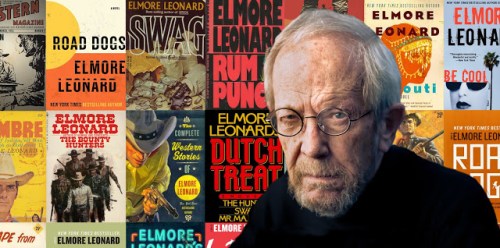
elmore-leonard-authorElmore Leonard, best known for countless novels and their film adaptations, such as Get Shorty, Jackie Brown and Out of Sight, was known for this gritty writing style and strong dialogues.
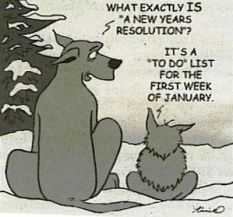
Here are a few of his gems of advice for writers (with my comments in parentheses):

  • “If it sounds like writing, I rewrite it.”
  • “Try to leave out the parts that readers tend to skip.” (Think: thick paragraphs of prose; boring lists; role calls that seem to be there more to remind the writer who’s in the scene than to entertain the reader.)
  • “If proper (grammar) usage gets in the way, it may have to go.  I can’t allow what we learned  in English composition to disrupt the sound and rhythm of the narrative.” (This advice should follow the adage, however:  First learn the rules; then you’ll know how and when you can break them.)
  • “Never open a book with weather.  There are exceptions.  If you happen to be Barry Lopez, who has more ways to describe snow and ice  than an Eskimo, you can do all the weather reporting you want.”
  • “I never see my bad guys as simply bad.  They want pretty much what you and I want:  They want to be happy.”
  • “At the time I begin writing a novel, the last thing I want to do is follow a plot outline.  To know too much at the start takes the pleasure out of discovering what the book is about.”
  • “It doesn’t have to make sense, it just has to sound like it does.”

19 Comments

Filed under Lists, Nuts & Bolts, Plot Thots & Profiles, Quotes

New Year’s Resolutions

new-years-resolutions-3It’s that time of the year again, when people talk about “New Year’s Resolutions”, as if the turning of the yearly calendar will somehow magically give them the impetus to make changes.  Rarely does it work that way, however.

A work colleague of my husband once upon a time trained to be a competitive  cyclist, and he said that once one makes the decision to give up in a race – for whatever reason – it makes it all the more difficult to persevere thereafter… once resolve caves, winning it back is harder work than ever before.  The same can be said of life, and resolutions.  If our daily goals don’t match our long-term goals, those long-term goals will never be reached; if we give up or cave in, we’ll find daily excuses why we can’t reach for the goal “yet”, and we’ll have a growing sense of guilt that makes us less willing to face the challenge.

Resolutions at the beginning of the year are usually related to a desire to better oneself; but resolve is something that’s built on a day-to-day basis, and should be a process.  If you set a mental goal – such as going to the gym twice a week  – which is not in agreement with your heart’s desires, then it won’t happen; our mind and heart need to get aligned in order for us to reach any target.

So I say, rather than making a resolution, become resolved.  Take baby steps to reach a goal; those steps might be to go on a walk once a week, or to take the stairs instead of the lift, or to purchase an exercise bike and put it somewhere in your home that’s a motivating place (e.g. near a window with a nice view), and then resolve to build up your stamina gradually with an initial time limit, stretching it as you feel you want to rise to the challenge.  If your goal is to write more, then decide on a specific amount, and take those baby steps – make space in your schedule, or learn how to utilize “limbo” moments toward your goal; carry a notebook and pen, and use them.  If your goal is to appreciate those around you more, then begin to focus on the positives, not the negatives; learn to compliment more and criticize less.

Whatever you want to see change in your life, go for it!  If you fail today, pick yourself back up, dust off your knees, and try again tomorrow.  Anything worth reaching is worth the effort, and every new day is full of opportunities.

Have a wonderful year, and may you look back on 2017 with satisfaction, knowing you’ve grown in positive ways!

6 Comments

Filed under Articles, Cartoon, Musings

Shifting Sands

The title is an apt one this year for me:  In February, we went from having no kids to having a love-starved, distrustful PTSD teenager with defence mechanisms and trauma-induced autism, who, in the first few weeks of her being here, barely spoke intelligible sentences (communication with the outer world is a challenge for her, whether in her mother tongue or not).  She’ll be with us until late-January 2017 as an exchange student, but she’ll be in our lives for years to come, because we’ve become the parents she never had.  When she returns home, we will have to release her back into the abusive situation which caused many of the problems in the first place.  The country she comes from in Asia seems to be stuck in the past by several centuries, especially when it comes to things like psychology; diagnosis and treatment are nearly impossible, simply because they see such things as a weakness that would cause the family to lose face, and in this particular case the fear is that the father would put her on the streets if he found out.  Because of that fact, we’ve not been able to draw on the help of the student organisation’s volunteer psychologist (they would need to inform the father), so we’ve basically been on our own in this complex process; even the diagnosis is my own, having had to apply my research skills into an unknown field and narrow down the symptoms and manifestations, and figure out what we were all dealing with (it’s since been confirmed by friends who work with autistic children). shifting-sands-2 I have a profound respect for parents who raise autistic children on any spectrum of the condition; I know that our situation is simply not comparable – in a few weeks she will be leaving us; at the same time, we had no preparation for going from zero to a hundred overnight.  We thought we’d be getting the average exchange student; God had other plans both for her and for us – plans that go far beyond a year, touching eternity.
What that’s translated into for me this year is an abrupt shift in long-term goals and the shifting sands of daily priorities getting turned on their heads at a moment’s notice.  If you’re like me as a writer or creative person, an inner irritability arises when I can’t write – not as in “writer’s block”, but as in “as soon as I sit down I’m going to be interrupted, so I can’t even begin”.  Two weeks of this month were school holidays, which meant she was here 24/7 except when she was out with friends (which was unpredictable, and not very often as she enjoys being “home”); one week of that time it was just the two of us as my husband was away.  By 24/7, I mean it – any time night or day, when I was trying to focus, she’d show up in the doorway, whether noon or 3 a.m; parents understand!  We watched films, talked, painted, and did our own things.  By the time she went back to school on Monday, I was ready to have my time for focusing again – I’m sure every mother on the planet can empathise!  She gravitates to me, soaking in my presence; that’s lovely – it means she trusts me, wants to be with me, and gets the attention she craves (and should have been getting throughout her life).  I like spending time with her; but it also means that my priorities – writing, editing, graphics, blurbs, and all of the thousand other steps toward publishing my fifth novel – have taken a back burner; the goal of getting this book out by Christmas had shifted away with the dunes of life by May.  It also means that I can’t really relax – I never know when, after finally sitting down for a moment, I open one eye to find myself being watched.  Literally.  Or I just sit down and hear, “Mom!” from a distance corner of the flat.  Sometimes it feels like every move I make draws some kind of commentary – it’s her way of trying to connect, and I understand that with my heart, but sometimes my mind wishes I could just flip a switch and turn it off for a while.  Again, I know that every mother can relate to those feelings; just keep in mind that I’m not actually the mother, in the sense that I haven’t had years to get used to these things!  She has a great father-daughter relationship with my husband, too – pillow fights, lots of fun and talks at the dinner table, and the occasional ice hockey date are icing on the cake.

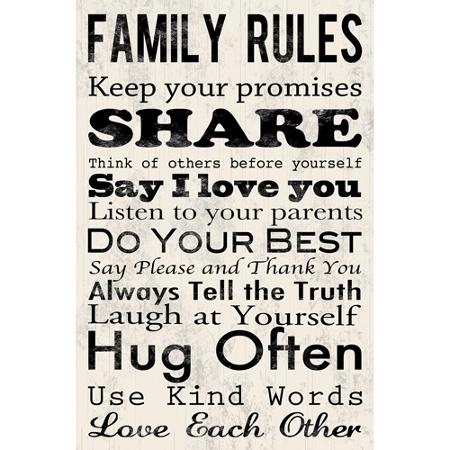
maidWe’ve had to raise a teenager that had basically raised herself the past (very formative) five years (her father bought her a flat in another city, and just paid for a maid).  I am not a maid (this image is a magnet hanging on our guest room door frame).  Everything that parents teach their children along the way over the years, we’ve had to try to teach her within a few months, as far as what it means to live in a family, communicate with each other, and basic principles such as clean up after yourself, turn off lights behind you, shut the refrigerator door, fold and put away clothes neatly, respect others’ property, and the list goes on and on and on. family-rule-signThis family rule sign, which hangs outside our front door, is what we’re trying to teach as a foreign concept in more ways than one… oh, and her mouth would have driven sailors from bars the first fortnight she was here; we started charging 1 Franc for every curse word, and encouraged her to get creative with such things; now she says “Fluff-butt” and “sweet cheese and crackers” instead!  Needless to say, it’s been a huge learning curve for us all.

Sands have shifted; priorities, for this year, have been relentlessly shifted; but more importantly, we’ve seen the shifting sands in one life transform into a foundation planted on solid rock.  We’ve seen her open her heart to be loved, to begin to recognize the issues in her own life that will need professional help once she’s old enough to seek it without repercussions, and also begin to have an understanding and patience for and with herself.  We’ve played a part in rescuing someone from the verge of suicide to a place of eternal perspective, future hope, and present happiness, and we are humbly grateful for the opportunity entrusted to us.  Writing priorities be hanged… there are more important things in this life sometimes.  There is a time for every purpose under heaven.

Save

Save

Save

Save

Save

Save

23 Comments

Filed under Articles, Musings

Novels Worth Reading

As a novel writer, I’m first and foremost a reader; I love to read, I love to buy books, smell them, feel them, upload them… any form is fine by me.  I want the books I read to be witty, intelligent, and well developed in terms of plots, characters and environments.

Kitchen Sink Realism

Everyone has different tastes – that’s why there are so many different genres; but for me personally, there’s also a list of things I don’t want in a novel:  I don’t want to be confronted with messy lives dealing with self-inflicted problem after problem; I don’t want tragic or sad or bitter endings; I don’t want to be confronted with the grit, grime, blood and gore of dysfunctional lives that end up learning nothing, making no character arcs, and end up in the mud by the end of the tale.   This genre description actually has a name:  Kitchen Sink Realism.  It was a cultural movement in Britain back in the ‘50s and ‘60s that was portrayed in films, books, plays, and art – the grit, grime, anger, disillusionment and harsh realities of realistic social scenarios.  It’s what might also be referred to as postmodernism.  My personal response to this kind of novel is, “If I wanted that kind of realistic tension, I could just go hang out at the nearest bar.”

A Tough Nut

I once had an English student, and our focus was medical English in preparation for their upcoming medical exams (two nurses came together for semi-private tutoring).  As part of the lesson we needed to work on basic conversational skills and sentence structures, and I find that the best way to bring in a wide variety of scenarios is usually to do a type of role play – nothing embarrassing, but each person is given a character to put themselves into a situation that they might not normally deal with:  They may be a chef, or a secretary, or a customer in a hardware store.  This particular student, when asked what kinds of books she read, said, “history and autobiographies or biographies”.  When asked what novels she read, she said she found such things ridiculous and a complete waste of time (this was back before I became an author!); she categorically refused to even try to put herself into someone else’s shoes for the scenarios.  My impression of her as a person was that she was narrow-minded, knew it, and was proud of that fact.  She was a hard character, and all the time I knew her or met her afterwards, I never saw a soft side emerge, either toward herself or toward others; I often found myself wondering why she’d gotten into the nursing profession in the first place – as a patient, I wouldn’t necessarily want her working on my ward…  A line from the novel I’m currently writing (Asunder, the third book in the Northing Trilogy) would have fit her life too:  “he has never had the propensity for engendering compassion; I pray he never needs it, as he never gives it.”  An epic love story might do her a world of good.

What’s Worth Reading

What I want when I read a book is to be transported into another life, whether that’s in the past, present or future, on this earth, or on another planet, or in another dimension; I want to be entertained, made thoughtful, learn something about the world around me, and learn something about myself.  Ideally, I will come away from the experience having been changed, in even a small way.  I want to feel connected; somewhere out there is a person I can relate to – whether it be the author, or the character, or other readers that appreciate the same books.

Aside from places and times that are genre-specific, such as science fiction and alien planets in the future, or London in the 18th century, all of the elements of what I like in novels are universal.  Humans the world over, in every century, want to feel connected; to feel that they can relate to something someone else is going through; even to have parts of their own life’s experiences explained through someone else’s perspectives in similar circumstances.  Above all else, at the heart of every good novel – regardless of the genre – is a story of love; that is the ultimate connection between characters.  It may be a child finding the love of a family after being shoved through the knocks of life too much for their age; it may be the hero or heroine finding love; it may be a widow or widower finding love again, or reuniting with true loves; it may be someone coming to the point in their life that they accept and love themselves just the way they are.

On to You!

When you read novels, what is it you’re looking for?  I would love to hear about it – please comment below, even if it’s just a few key words!

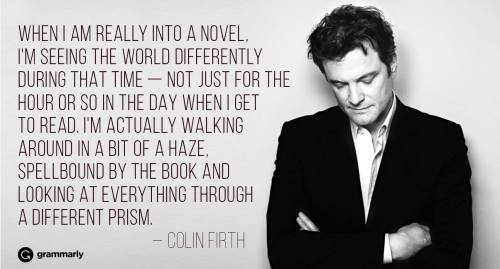
novel-colin-firth

Save

28 Comments

Filed under Articles, Musings, Nuts & Bolts, Plot Thots & Profiles, Quotes, Writing Exercise

Just Smile

smileHave you ever stared at a word for days on end?  I have, and coming to the end of the tunnel is bliss.  When writing, I tend to use “place-markers” – anywhere from a single word to a rough-sketch of a scene that I know will need to be fleshed out, moved, replaced or “cannibalized” for a concept.  Some people like to use special writing programs, and I’ve tried a few over the years, but I tend to do all of my writing in Word; it’s got review “post-its” I can type into the side margins, and I’m usually more organized than programs like Scrivener anyway.  When I go back over such sections, I take off my writer’s hat and put on my editor’s cap, and dive in.

I’ve been editing a manuscript, and at the moment I’m focusing on repetitions; the most recent word was smile.  Each time I came across the word, I needed to read the context, think about whether it should be removed, replaced, the sentence reworded, or left as-is.  I’ve discovered that there are not actually that many synonyms for “smile” in the English language; smirk, sneer, grimace, simper, scowl, grin… they each have their own connotations, and are not simply interchangeable – each choice will effect the overall meaning in distinct ways.   as William Blake once said, “There is a smile of Love, And there is a smile of Deceit, And there is a smile of smiles In which these two smiles meet.”  Sometimes it can simply be left out – the context informs the reader about which emotions are being displayed by the characters.  Characters in love have a different smile for each other than for frenemies, or antagonists, or superiors, or subordinates, and each situation in which various characters are combined might result in a different word for smile.  And does one smile warmly, or coldly?  Broadly or tight-lipped?

theoden-king-of-rohan-lord-of-the-ringsSometimes I wonder if I think far too much about such details; but I’d rather think about it once too often and get it right than not.  It might have seemed a tad extravagant for Weta Workshop to emboss the inside of King Théoden’s breastplate armour for the Lord of the Rings: The Two Towers, and Return of the King (in which the character appears), knowing it would never actually be seen in the films; but Bernard Hill, who played the king, said that such details helped him easily slip into the role, even feeling the nobility of a king, and it thus enhanced and influenced his performance.  As visuals matter in epic films such as LoR, words matter in writing a novel, drawing the reader into the imaginary landscape of the world the author creates. ever-after

They also matter in script-writing:  In Ever After, starring Drew Barrymore and Dougray Scott, some of the dialogue lines are just downright embarrassing – especially those of Anjelica Huston:  They go to the trouble of being opulent and period-accurate in costumes, locations and scene dressings, and then throw in lines like Relax, child and I’m management!  The editor in me cringes.

One man’s smile is another man’s smirk; one woman’s grin is another woman’s sneer.  Now, on to the next item on my list of editing revisions!

Save

Save

18 Comments

Filed under Articles, Images, Musings, Nuts & Bolts, Research, Writing Exercise