Category Archives: Articles

History Undusted: Jumièges Abbey

Jumièges Abbey is one of the oldest Benedictine monasteries in Normandy; to dive into its history is akin to diving down Alice’s rabbit hole. For instance, I could say that the abbey was sponsored by the Frankish Queen Balthild, as she persuaded her husband, King Clovis II, to donate land to the Frankish nobleman Filibertus in order to found an abbey. But to know who she was, ah, that is where the intrigue begins.

Who and where were the Franks, when were they a thing, and what are they to us today?

Who, where and when: They were a Western European people who began as a Germanic people along the lower Rhine (which flows from Bonn, Germany, and ends up in the North Sea at the southwestern corner of the Netherlands), along the northern frontier of the Roman Empire. During the Middle Ages, they expanded their scope of rule as the Western Roman Empire began to collapse, and they imposed their power over many post-Roman kingdoms and beyond. That’s the crux of the matter though, as with any political history, it’s far more complex than that. The Franks are distinguished into two main groups by historians: The Salian Franks, to the west, and the Rhineland Franks, to the east.

In the mid-5th century, The Salian king, Childeric I, was a commander of Roman forces against the Gauls, most of whom Childeric and his son, Clovis I, conquered in the 6th century. Clovis was the first king of the Franks to unite the Frankish tribes under one ruler, and he founded the Merovingian dynasty – which ruled the Frankish tribes for 2 centuries. Clovis, in essence, is known as the first king of what would become France. As a side note, the Frankish name of Clovis is at the root of the French name of Louis, borne by eighteen kings of France.

Now, back to Queen Balthild (AD 626 – 680): Sold into slavery as a young girl, she was beautiful and intelligent. She served in the household of Erchinoald, the mayor of the palace of Neustria to Clovis II. Her master, a widower, wanted to marry her, but she hid herself from his sight until he married someone else (apparently the household of servants was numerous enough to enable her to avoid her unwanted suitor). Perhaps through Erchinoald’s notice of her, she came to the attention of Clovis II, who proposed to her and was accepted; hiding herself away may have been a political tactic to gain a higher rank with the king than with the mayor; According to the Vita Sancti Wilfrithi by Stephen of Ripon (written around AD 710), Bathild was a ruthless ruler, in conflict with the bishops and perhaps responsible for several assassinations. Some historians interpret Queen Balthild’s association with founding monasteries as a way of balancing or neutralizing aristocratic opposition to her rule. By installing her own bishops and donating lands for abbeys, she strengthened her own power as ruler (she was regent during the minority of her son). To put that in proper perspective, she was no different than most male counterparts of her day. [I could go off on a tangent about how adjectives differ when applied to the male or female state of affairs (a man is ambitious; a woman is pushy or ruthless), but I won’t. Yet.] From most accounts, however, she was pious and humble. Whichever way you butter that croissant, in ca. 860 she was canonized, thereafter to be referred to as Saint Balthild…

In 654, Balthild gave a parcel of royal land to Philibert, or Filibertus, on which he founded the Notre Dame de Jumièges. His main spiritual influence was that of the Irish monk, Columbanus (who founded several monasteries in the Frankish and Lombardi kingdoms).  The abbey flourished until the Viking invasions of 841 (Remember Rolf Ganger?), which caused disruptions to its first momentum, but it soon began to prosper again. The church itself was rebuilt between 1040 and 1066; it was dedicated on 1 July 1067, with none other present than William the Conqueror, Duke of Normandy and King of England (1066 and all that). The patronage of such a nobleman ensured the abbey’s success.

Jumièges Abbey was, like any abbey of its time, a veritable town. The church was only the heart of the community; there was a 14-acre enclosed park, terraced gardens, the abbatial manor, a bakery, landscaping to evoke biblical scenes, a hostelry, the 14th century “Charles VII” walkway (a covered walkway between the Notre Dame and St Peter’s church, named after the fact that Charles VII and his favourite mistress visited the monastery), and the cloister.

The next major disruption was from 1415, when the monks were forced to regularly seek refuge in Rouen as the English occupied Normandy during the Hundred Years’ War. The abbey eventually recovered and began to flourish again, until the whole province was plunged into the chaos of the Wars of Religion (1562-1598), resulting in the population’s decimation and famine. In 1649, the abbey was taken over by a Benedictine congregation, when some of its former glory was revitalized. Having survived all of that, its ruin came at the hands of the French Revolution, when it was sold as a “national property” and turned into a stone quarry (seen only as a source of ready-cut stones). At last, its historical value was recognized in the 19th century, putting an end to its wanton deconstruction.

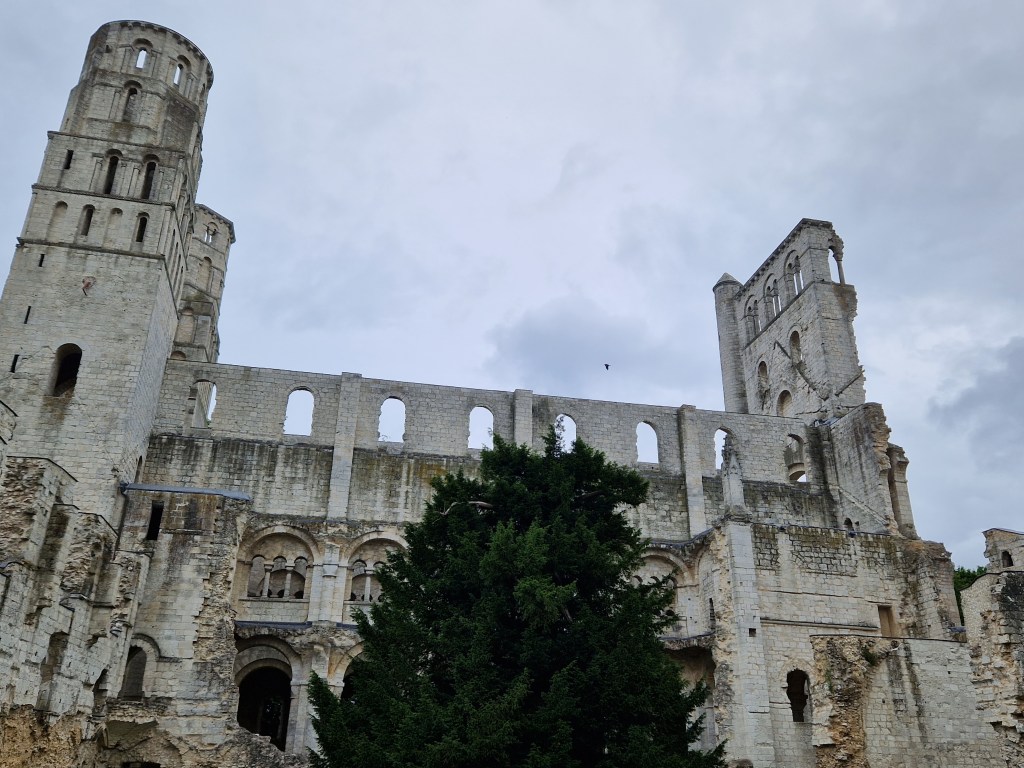
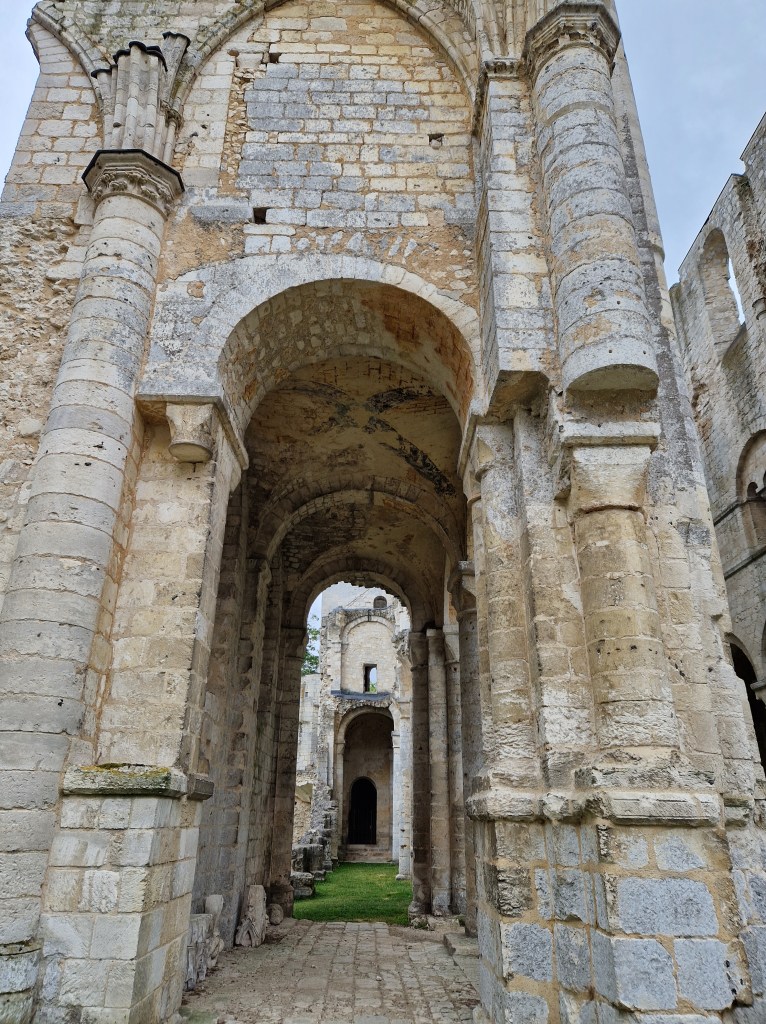
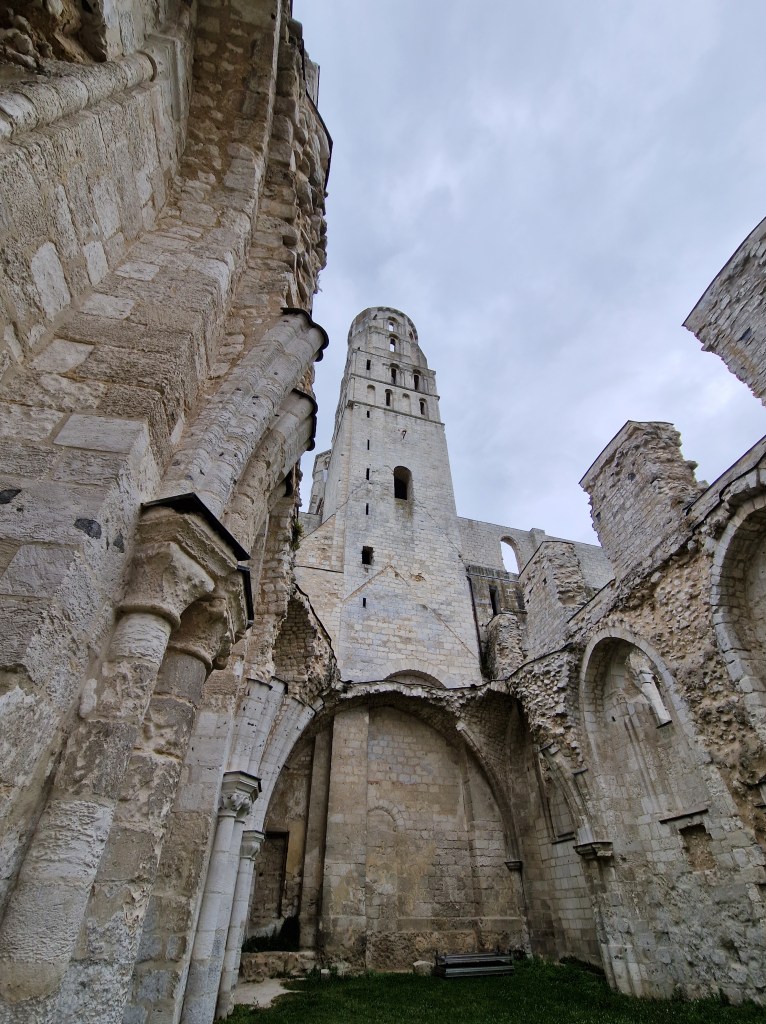
When we visited the abbey last summer, its grandeur, although only ruins today, is still evident; when it was at its height of prosperity, it must have been an awesome sight to behold! In the photos below, which I took during our visit, you can see evidence of the various phases of destruction and reconstruction. Enjoy!
2 Comments

Filed under Articles, Etymology, History, History Undusted, Military History, Snapshots in History

History Undusted: Rolf Ganger, Viking Outlaw and Founder of Normandy

How does a rabble-rousing Viking end up causing a war centuries after his death (as if stirring up trouble during his lifetime wasn’t enough fun and gigs)? Read on… this is going to be a quick, deep dive into history, so buckle up!

Firstly, let’s start with Rolf Ganger, aka Rollo, Rolloun, Rollon, or Hrôlfr – depending on which language you read. On his tomb, the Latin version of his name is Rollonis (see image).

Tomb of Rollonis (Rolf) Ganger, the first ruler of Normandy, in Rouen Cathedral (He’d probably roll in his grave to find himself so simperingly portrayed…!)

The Heimskringla is a collection of ancient Norwegian sagas about Norwegian kings and rulers, written by Snorri Sturluson (great name, by the way) around AD 1230. It tells us that Rolf was the oldest legitimate son of Earl Ragnvald, best friend of King Harald Harfager (“Fair Hair” – a nickname given to him by the Earl due to Harald’s thick, fair hair), who was the first king of Norway, reigning from ca. AD 872 to 930. It tells us that Rolf was so hefty that no horse could carry his weight; thus, he had no choice but to walk everywhere, from which Ganger, his second name derives (I cannot find a direct translation of the meaning of the name, but Germanic languages have similar words: In German, “gehen” means go or walk; “gangart” means gait, or way of walking).

Harald Harfagre, First King of Norway – Statue in Haugusund, Norway

He was rowdy, even by Viking standards. Heimskringla records that he plundered most of the East Sea (likely referring to what is now the region around the Baltic Sea). Then, “One summer, as he was coming from the east on a Viking’s expedition to the coast of Viken*, he landed there and made a cattle foray. As King Harald happened, just at that time, to be in Viken, he heard of it, and was in a great rage; for he had forbid, by the greatest punishment, the plundering within the bounds of the country. The king assembled a Thing**, and had Rolf declared an outlaw over all Norway.”

*Viken was a region that lay over the modern border between Norway and Sweden.

**To assemble a Thing means to gather a council or general assembly. These still take place in some parts of Switzerland, as well as on the Isle of Man and in Scotland; the Icelandic Althing is considered the oldest active, surviving parliament in the world, dating back to the AD 900s. The first detailed description of such a Thing was made by Tacitus, a Roman historian and senator, in AD 98; the oldest reference to a Thing is inscribed on a stone near Hadrian’s Wall, dated as early as AD 43.

According to the Heimskringla, Rolf, now banished from Norway, headed toward the Hebrides, and from there to “Valland” [In Norse legend, Valland is the name of the part of Europe which is inhabited by Celtic and Romance peoples, and Snorri Sturluson mentions it several times as the Old Norse name for Gaul, which was a region of Western Europe first clearly described by the Romans, encompassing present-day France, Belgium, Luxembourg, and parts of Switzerland, the Netherlands, Germany, and Northern Italy, and covering an area of around 494,000 km2.].

Arriving in Gaul, he did what he did best – went a-Viking, plundering and pillaging and “subduing for himself a great earldom”. He populated it with his own best rabble of Norsemen, which the French called Normanz, literally “north men” which quickly led to the Anglicized term Normans (similar to the word for the people group and language, Norse).

One of the places known to have been invaded by the Vikings in AD 841 is the Jumièges Abbey, which is along the Seine River on its way to Rouen, which they also ransacked. At some point (around AD 885), Rolf also raided Bayeux, carrying off a woman, Popa (whose lineage is unverified – later historians for the duke may have sanitized her parentage to legitimize their son’s noble lineage, as she was married “more danico”). She gave birth to his heir, William Longsword. When Rolf and his gang were all done hacking their way through towns and villages along the Seine, they eventually made their way back to Rouen, where he established the Duchy of Normandy in AD 912.

So, how did Rolf cause a war centuries later? Well, his son, William Longsword, fathered a son, Richard the Fearless (who became ruler of Normandy at the age of 10 when his father died). Richard’s son was called Richard the Good, and he became the father of Robert the Magnificent and grandfather to the illegitimate William the Bastard, who became known as William the Conqueror (a sword seems to have cleared up his illegitimacy quite neatly) – from whom all the subsequent English kings descended. Now to the crux of the matter: William, descendent of Rolf Ganger, fathered English kings, who thus claimed their right to the Norman throne by connection, birth, rank… in short, any excuse for raiding was still in their blood. Rouen was one of the largest and most prosperous cities of medieval Europe, and (as mentioned in my last post) was made wealthy through textiles and trade along the Seine River and beyond. Rouen became the focal point of the Hundred Years’ War (1337-1453) because of that pesky connection. So now ya know!

5 Comments

Filed under Articles, Etymology, History, History Undusted, Links to External Articles, Quotes

Yes and No

To answer your burning questions: First: Yes, I’m still alive. No, I was not eaten by wild turtles, abducted by aliens, swallowed by a whale, or struck by lightning.

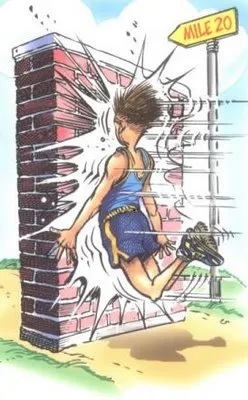
Second: Why has my blog been silent for so long? Ah, that is an easy question – but a complex answer. The most important reason was what I would term writers’ fatigue.  In my post from December 2022, I talked about the publishing brick wall; five brick walls, to be precise. I thought it would only take me a few days to recover from that shock, but when the shock wore off, I questioned why I still wanted to write anything. I literally avoided my computer work for months. I got busy with life; I took on new creative projects that involved my hands.

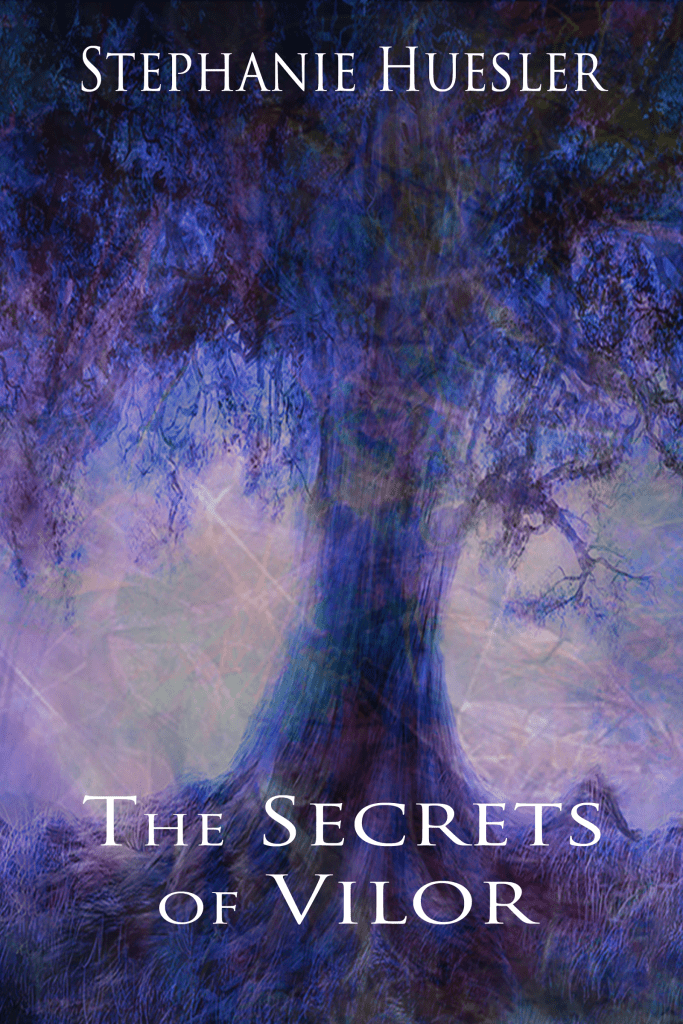
Then, I decided that, if I was going to have to reformat and re-do everything for the new publisher’s specs, I might as well do it right; I re-read through all of my books and, as I’ve learned a lot over the years of writing, I tweaked a few things. I tightened prose and dialogues; sometimes, as in my fan-favourite, “The Cardinal”, I broke up the chapters into shorter lengths, taking the epic fantasy/sci-fi from 26 chapters to 47 chapters, and I added in a couple extra Easter eggs for fans. I prepared my new book, The Secrets of Vilor, for publication, which included getting a new graphic software and learning how to use it, to create the cover designs (I’ve always done my cover designs; I tried going with a graphic designer for the first novel but realized they weren’t intimate enough with the feeling of the novel to convey that visually, and I was; so. I took it on and have enjoyed the process – now even more, since getting a newer, more user-friendly program).

In all of this, the blog community has never been far from my thoughts; I have tons of ideas; but my writing energy, as it began to recover from the discouragement of the brick walls, needed to be invested for a time in the re-edits and preps that go into publishing a new book and re-publishing (again, sigh) the others (through my new publisher, D2D). I hope I never have to revisit the editing side of my novels, and can simply enjoy them as a reader from here on out (if this publisher ever goes under and I’m forced to find a new one, I hope to God I never have to reformat these again!!).

This year, my husband and I have been underway more than usual; our summer holidays were renting a private motorhome in Normandy, France, and travelling the region for 10 long, perfect-weather days. Soon after, my husband’s 2-month sabbatical began – the same day our Norwegian godson and his best friend arrived for a 10-day visit; we showed them a few highlights of a land overflowing with beauty and history and interesting places and amazing mountains and lakes; we took them across the borders to Liechtenstein, Austria, and Germany (a novelty for them, as Norway is so large that their nearest neighbour, Sweden, is the only place they can reach in a day’s drive). We spent some time in the Hundertwasser Markthalle, visited a butterfly greenhouse, and went on a tour of Zürich, among many other activities. Needless to say, during their visit, editing and writing were put on pause to enjoy time with them.

After that, I had a few weeks of focused time once again as my husband went on his annual hike with friends, then his annual bike trip, as he bikes Europe from south to north; this year, he biked from Portsmouth to Glasgow! I was a bit jealous of his time in the UK, but I was able to deep-dive into editing, graphics, and a list of to-dos as long as my arm. I’ve finally begun seeing light at the end of a very long tunnel.

What’s next?

My goal is to begin writing this blog regularly once more – once a week. After not having written a blog for nearly a year, that goal seems a bit daunting; but I’ve had the time to release my e-books, and have begun thinking about the next writing project, even though I still have the paperback graphics to complete and release (after the proof is approved!). This tells me that the writing fatigue is past. I look forward to the challenges of research and posting once again.

And now, for a glimpse of the fruits of my labour these past months, without further ado, here is my latest novel:

Kira is haunted by nightmares from her past, and she’s been on the run ever since her discovery made her the target of the corrupt, the greedy and the powerful. She can trust no one but her family. Now, forced onto a motley exploration crew heading to the toxic, stormy planet of Vilor, she’d rather be anywhere else. They arrive to find an abandoned base with cryptic messages left behind by a former crew. Kira’s budding sense of safety is shattered as she discovers that someone is on her trail, and she’s on the run again.

Josh, a crew member Kira’s only just met, ends up on the run with her. But he’s hiding something, too. Is he safe? Does he have his own agenda? Is he the hunter? As the secrets of Vilor begin to unfold, the dark ambitions of the human heart unleash a race against time.

For those of you who’ve stuck with me through the long silence, thank you – I’m grateful! For those of you who stumble across my blog randomly, or come to visit because of my books, welcome!

5 Comments

Filed under Articles

Of Marathons and Brick Walls

That title fairly describes my life over the past few months. Anyone who’s published a book will know what I mean by marathon. But is mine published yet? Nope. That’s where the brick wall comes into the story.

Back in the summer, my publishing platform, Smashwords, merged with Draft 2 Digital (D2D). The books would eventually be migrated, they said. But I took the opportunity to apply the things I’ve learned over the past years to my already-published books, trimming and tweaking what are still essentially the same stories, with every word counting. Three of the four were done. Or so I thought. They are successfully released as e-books, but the paperback has been a huge headache.

D2D now offers the option of paperback books, which Smashwords didn’t have, and I was relieved to have that format again. Their claims were that they could simply apply the e-book file to a paperback version, and would create a full book cover from the e-book cover I provided, or I could upload a full cover myself. I chose the latter because the former was simply taking the main colour of the front cover and slapping it on the back and spine. With some tweaking to my inside document, I gave the okay for an e-book release and ordered paperback proof copies.

Oh. My. Goodness. Everything that could be wrong with a book printing was there: No gutter margin adjustments (“gutter” refers to the inside margin at the spine of the book; you should be able to read the entire line without breaking the book spine!); the spine of my design was partially wrapped to the front cover; the cover colouring was way off; the size of the actual book was too large (not the standard size which I’ve always chosen); there were orphans and widows all over the place (those refer to “abandoned” text, such as “Dear John” on the bottom of a page with the rest of the letter on the next page, or a single line at the end of a chapter on an otherwise blank page); centred elements were NOT; the divider images, clear on every other printing I’ve ever had, are fuzzy. The list goes on. Brick walls.

What it all means is that, as much as I’d worked toward a pre-Christmas release, it will now likely turn into a late-2023 or early 2024 release! I will have to reformat not one, but five books for their paperback versions. Picture five brick walls to surmount that you weren’t planning to face at all. It was work that I had hoped D2D’s claims would relieve me of. But I guess the old adage is still true:

If you want something done right, you have to do it yourself.

For a few days, I was in shock at the poor quality of printing (and the first proof book took weeks to arrive), and I wondered why I was putting myself through this. I seriously thought about just throwing in the towel on writing. But I know myself; I’ll give myself a few days, and then I’ll be spit-fire again. And then D2D will be getting comprehensive feedback on their paperback program (in all other ways so far, I’m satisfied with their service and tools). After that, before I can move on to the next story, I’ll be working for months getting re-releases and my new release ready for paperbacks.

In all this time, I’ve heard that real life has gone on outside of my library (where I write). I had a craft stand at our annual local Christmas market, which meant weeks of preparing when I wasn’t writing. Someone usually cleans our house (me), does our shopping (me), and cooks our meals (me). I’m also part of the decoration trio in our church, which has meant regular stage design changes and creating elements for that – some as simple as wire figures, some as complex as giant wheat stalks.

And I’ve heard the rumour that Christmas is coming! Somehow, with all the editing, graphics, publishing and not publishing lately, I’ve not gotten into the season’s mood yet. But now that the Christmas goal has been ripped away, I’ve allowed myself time. Time to breathe. Time to think about and write something other than manuscripts and blurbs and bios. It’s not that I’ve forgotten this blog, and it’s not as if I’ve had no ideas for it – I’ve had dozens; I’ve just had no time to pursue them, and if you’re like me and don’t write them down as they come, the ideas flit away like startled sparrows. So, I’ll start writing them down – and when I need a break from the editing marathon, I’ll investigate those ideas, and start sharing them with you! Thank you for hanging in there in my long silence!

14 Comments

Filed under Articles, Musings

Virtual Tour: Vintage Switzerland

I’ve been preparing my manuscripts for new releases through a new publisher, and making crafts for our church’s annual craft sale; in the latter process, I’ve discovered a wealth of images through Pinterest (nothing new to me in itself). How many of you used to collect stamps, or postcards, or specific objects? For me, the new method is Pinterest. You can find stamps on any topic, and rare ones; you can find coins, bank notes, and just about anything you used to collect physically, now available at a click with historic backgrounds and full details you could never have fit into an album.

But today, I’d like to focus on Vintage travel posters, specifically for Switzerland. So far, I have nearly 350 in my collection, and it’s likely a drop in the bucket of what was produced; every region advertised itself to attract tourists or travellers, and it’s fascinating to see what they highlighted, how they did so, what their perspective was, and how the people dressed (if they’re shown – in Switzerland, at least, a big focus is on the Alps). Did you know that the word “homesick” in English came from Switzerland? The Swiss merchants that travelled abroad in the 17th century took the word with them; when they spoke of “Heimweh”, however, they weren’t referring to people, or their home, or even their town, but of the mountains. They missed the Alps when they were away… and I can understand why. I think it must run in the veins of every Swiss-born person; when my husband and his mother speak of the mountains, it’s a foreign language to me (even though I’m fluent in Swiss German!).

We might tend to think of tourism as a modern thing; but Grand Tours began in the 17th Century, when wealthy young men, and sometimes women, would embark from the UK on a European tour. At the beginning, Switzerland was a sleepy backwater in some ways – there were few, if any, hotels – if a traveller arrived in a town seeking accommodation for themselves, their servants, postillions and horses, they were often invited to stay in the home of the local politician, who likely had the largest house… But the Swiss soon caught up with the trend, and tourism became a vital source of income, especially for small settlements in the mountainous regions.

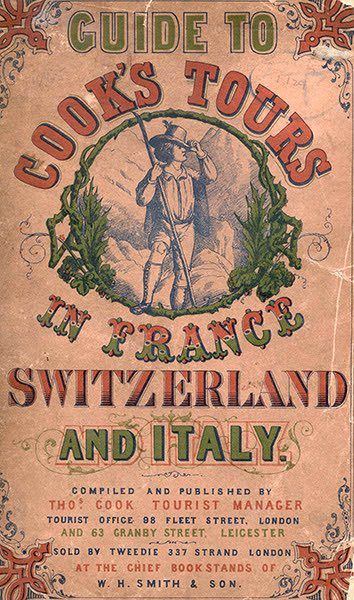
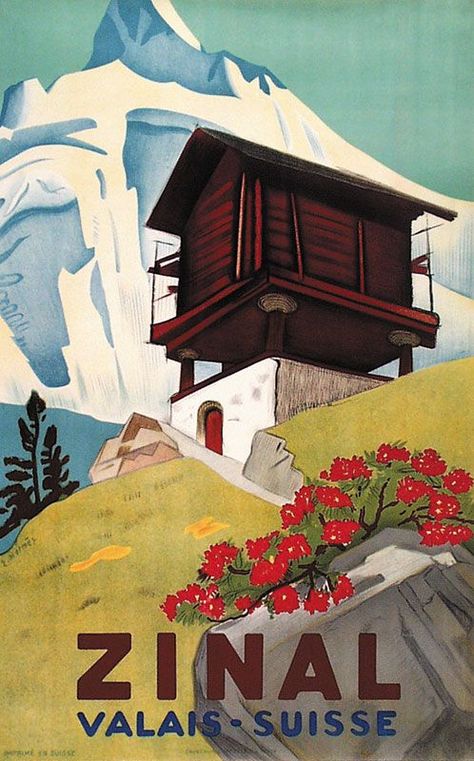
The three images below are, from left to right, from 1897, 1865, and likely the early 19th century. The house shown in the Zinal ad is typical of Wallis (Valais in French): It is built on stilts with round, flat stones between the pillar and house base; we chatted with an elderly man when we were on holidays in the region and asked him about it; it is a way to keep rats and mice out of the houses. It also means that the back, and sometimes even the front, is only accessible by ladder.

The 1865 poster is about a tour organized by Thomas Cook, a well-known name in the British travel industry even today; Cook took his first tour group of around 485 people on an 11-mile train trip from Leicester station to Loughborough, in 1841. Soon, he began to expand his scope, and by the 1860s, that included Switzerland.

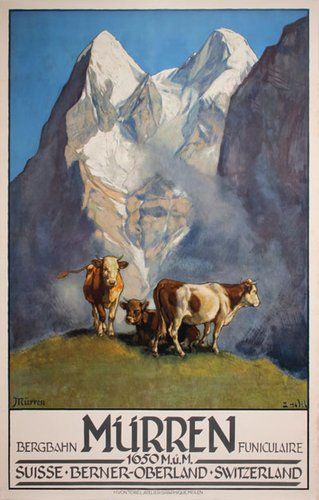
The Spiez poster below shows the castle and lake; The Zürich poster shows a view over Lake Zürich from atop the Uetliberg mountain, the summit of which is called Uto Kulm. To see a live-cam panorama from that vantage point, just click here. The Mürren poster is a view typical of every Alpine pasture, even today.

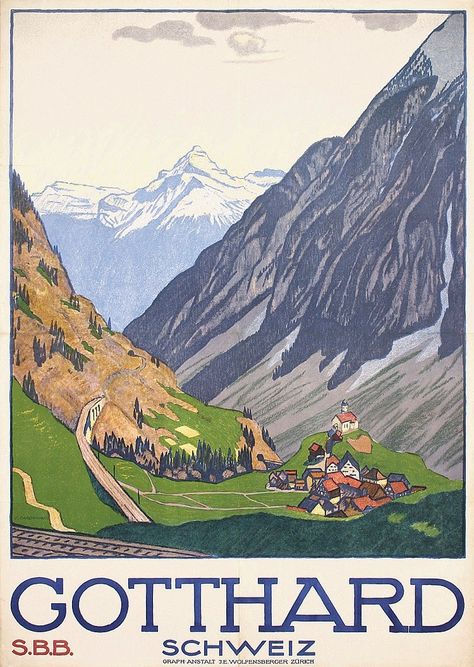
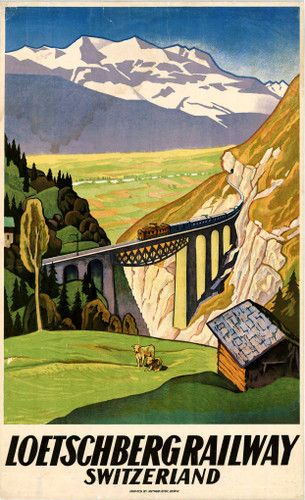
The next 3 images are firmly in the Alps: The glacier shown in the first image is the Aletsch Glacier, the largest in the Alps, covering around 80 square kilometres (31 m2), with a length of ~23 km (14 miles) with a maximum thickness of ~1 km of ice. As with most glaciers in the world, it is retreating. Gotthard (officially the Saint-Gotthard Massif) is an impressive region connecting north and south Switzerland between Uri and Ticino, German- and Italian-speaking cantons, respectively. It has long been a major axis of Europe, with a road across, a vehicle tunnel through (built 1980), a cargo and transport train tunnel (opened 1882), and now a passenger- and vehicle-transport train tunnel which opened in 2016 and is the world’s longest railway tunnel and the deepest traffic tunnel, as well as the first flat low-level tunnel through the Alps. The 3rd poster highlights the Lötschberg, a massif with a train transport tunnel linking the north and south of Switzerland through the Berne and Valais routes. We often take this route when going to Valais or Ticino on holidays; the train is an open, continuous carriage, meaning you drive on, sit in your car, and watch the tunnel fly past.

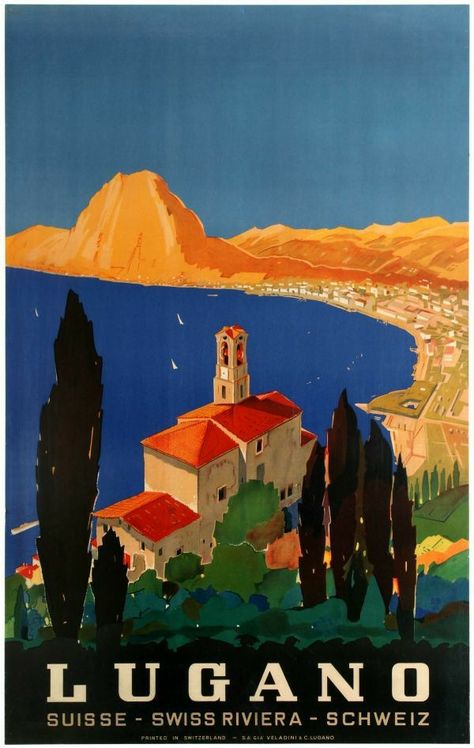
The next 3 posters highlight something nearly ubiquitous in Switzerland: Lakes. They’re everywhere. We even share Lake Constance with Germany and Austria, and Lake Geneva with France. From border to border, we have over 100 main lakes and countless smaller ones (in an area what easily fits within the state of Maine, US, to give you a size comparison). The first poster is encouraging locals to explore, commemorating the 650th anniversary of the formation of the core of Switzerland. The second shows Lake Lugano from the perspective of Monte Bre, with the city of Lugano along the shore. It’s a perspective I know well, as the family had a holiday home on the flanks of Monte Bre until last year. San Salvatore is the mountain peak shown. The third poster is of the Vierwaldstättersee (“Lake of the four forested settlments”): This is the most complex lake in Switzerland, and not only for its names: In English it’s known as Lake Lucerne, although that is just one arm of the sprawl. Sections are Lake Lucerne, Lake Urner, Lake Kussnacht, Chrüztrichter and Lake Alpnacher. The many-armed lake is shared by the cantons of Uri, Schwyz, Obwalden, Nidwalden (originally one canton known as Unterwalden) and Lucerne. Signs of settlements found by archaeologists go back to at least 3,000 BC. To see this lake through live-cams, just click here. The site is in German, but just click on the view you’d like to explore.

I hope you’ve enjoyed this virtual tour! And perhaps you’ll come to Switzerland one day to see it for yourself!

2 Comments

Filed under Articles, Etymology, Family History, History, Links to External Articles, Nature, Snapshots in History, Virtual Tours

History Undusted: Spiez Town, Church & Castle

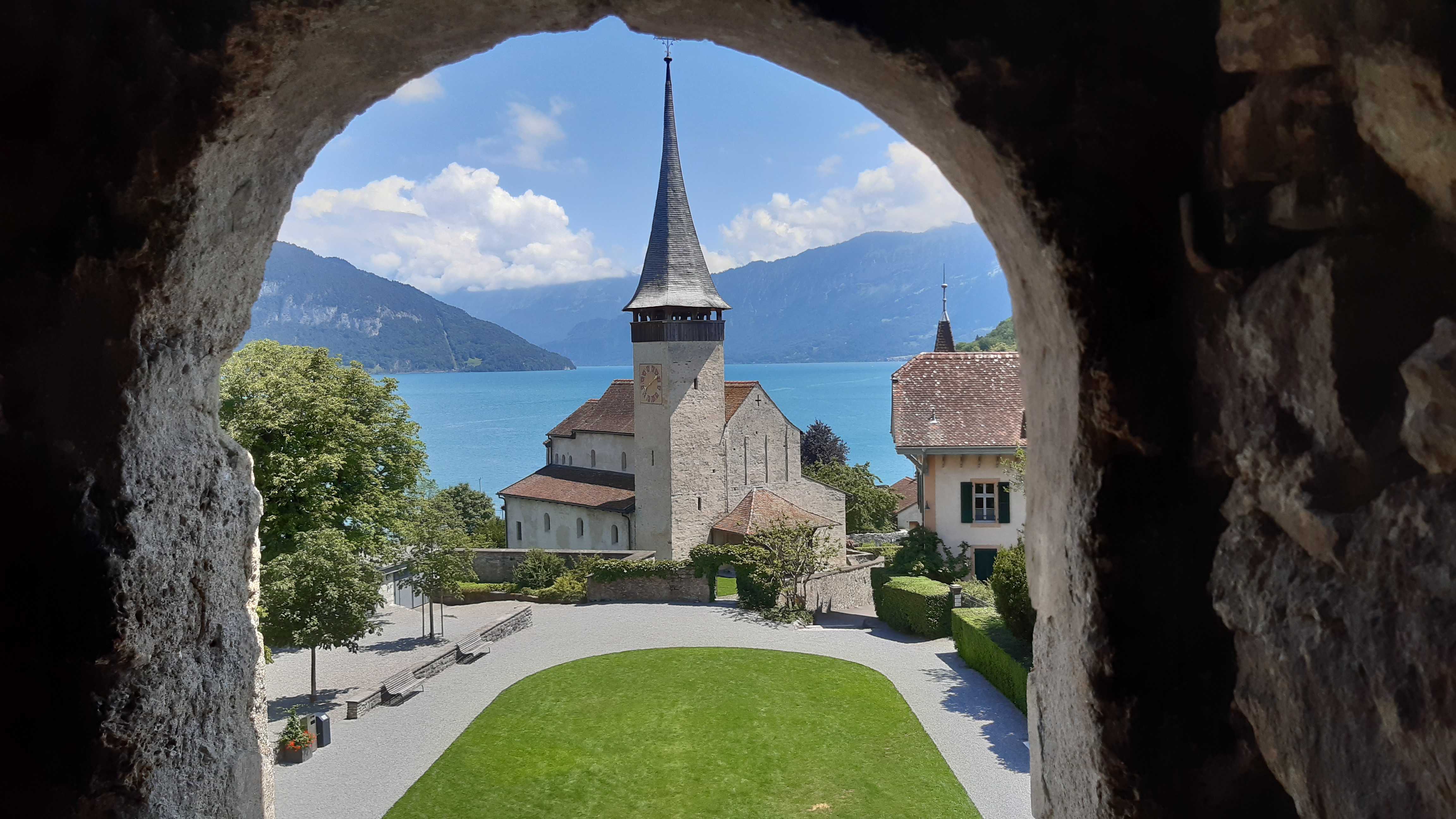
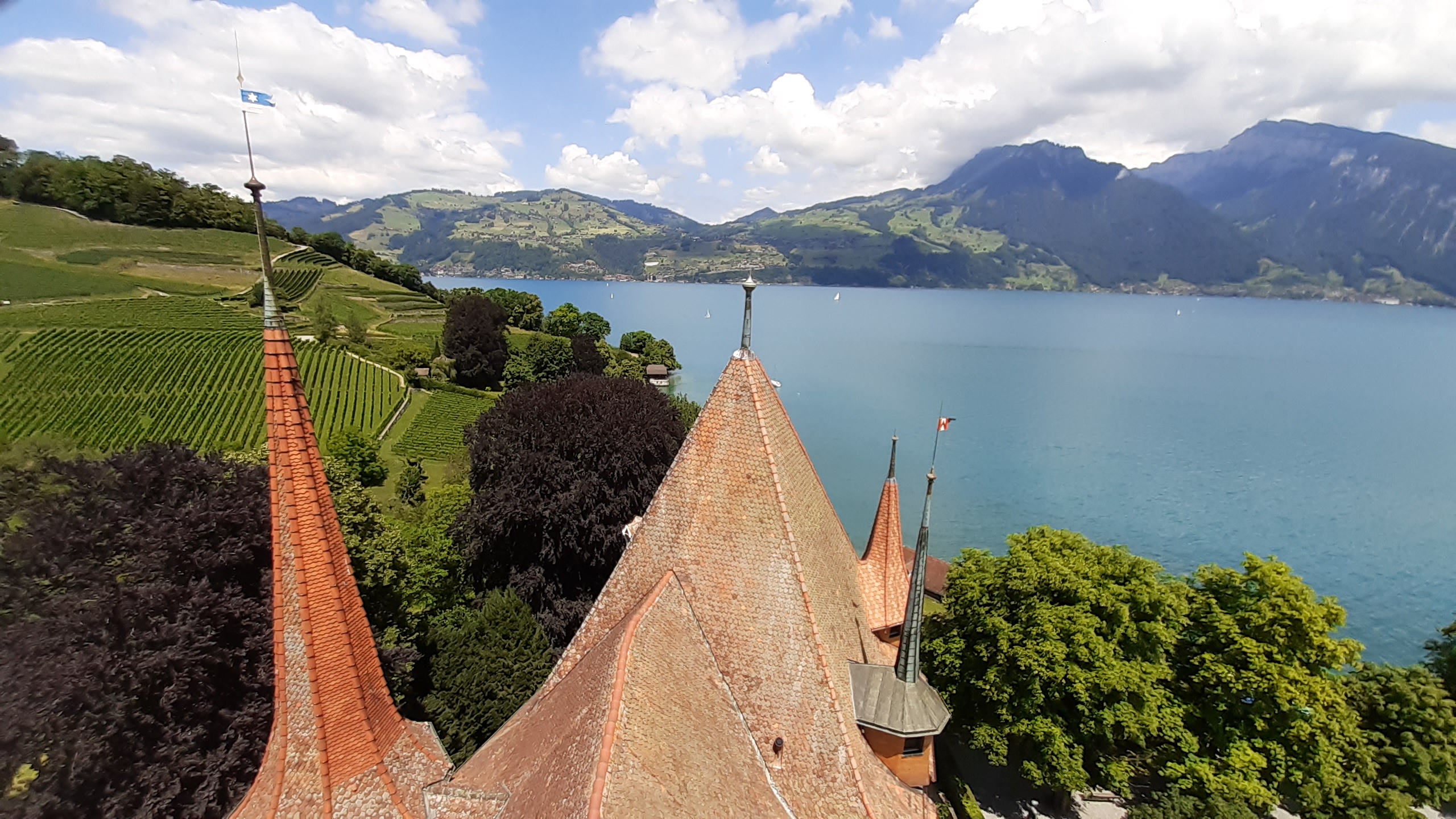
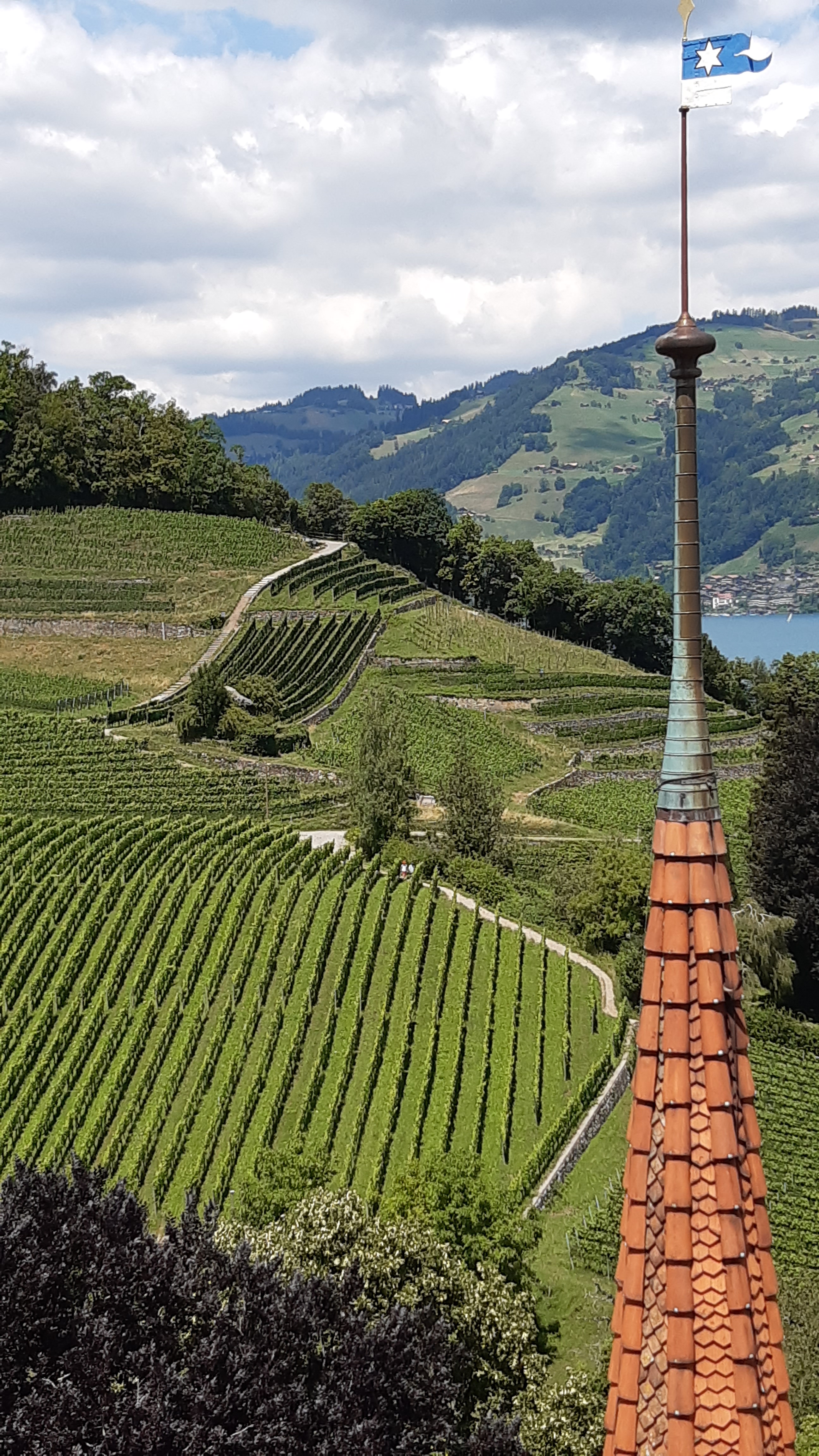
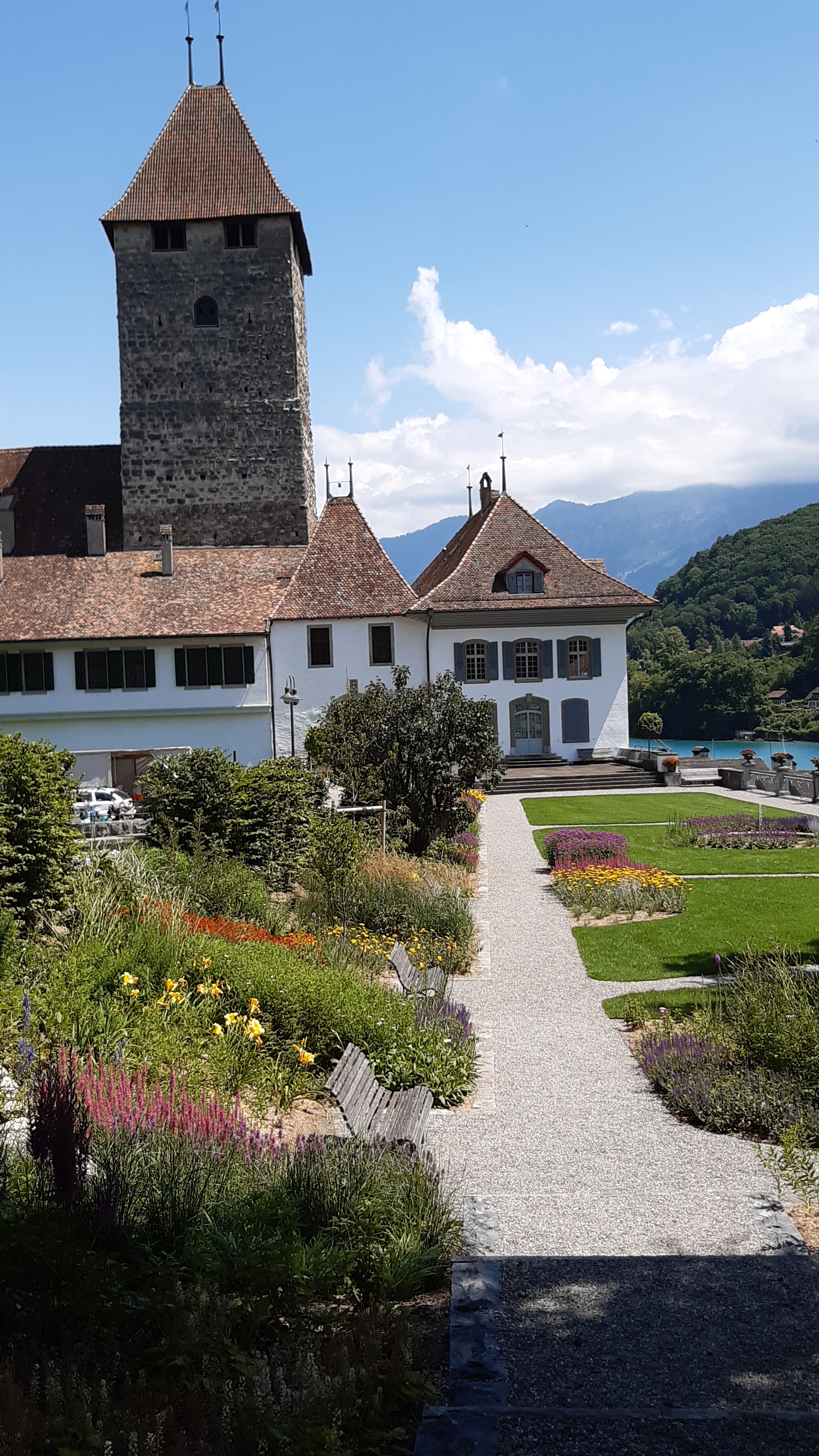
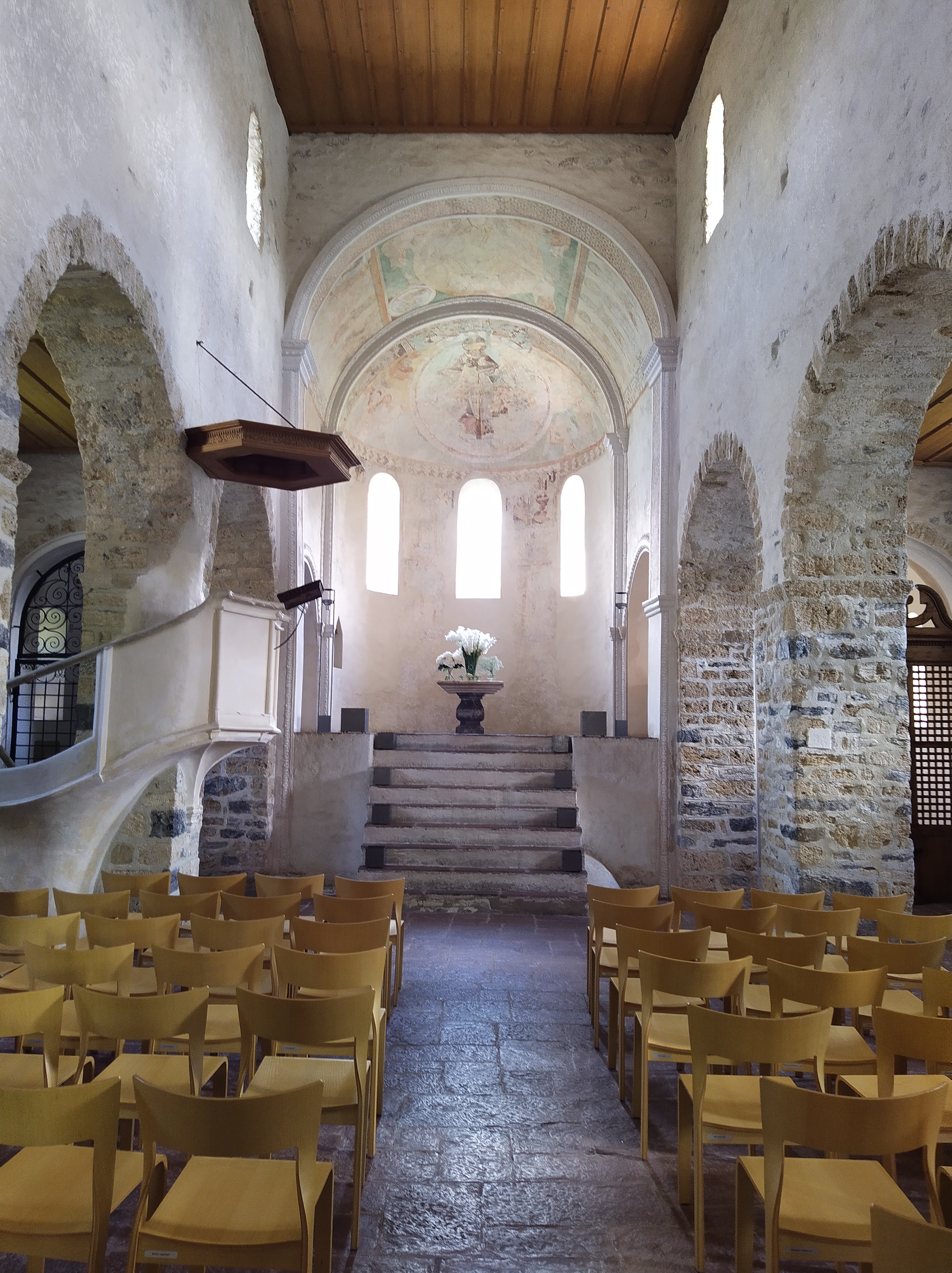
Let’s take a virtual tour of a beautiful little castle on Lake Thun, here in Switzerland: Spiez Castle is a grand but pocket-sized edifice that sits on a spit of land jutting out into the lake, with the town of Spiez surrounding it. The area has several substantial bronze- and iron-age settlement sites, which shows that the area has been rich in natural resources and populated since time immemorial. The town and its church were first mentioned around AD 762, when Bishop Heddo of Strasbourg disposed of the church and tithes in his will. In AD 933, the King of Burgundy, Rudolph II, had Spiez castle built, and soon the Freiherr of Strättligen settled there. [Freiherr was a rank of nobility within Germanic-speaking areas that would have roughly translated to the English rank of baron.] Sections of the current shield walls and tower were built in the 12th century, and though the town was originally located within the castle walls, by the 13th century it had outgrown the walled enclosures. The small church, which is on the castle grounds, is one of the twelve Lake Thun churches mentioned in the Strättliger Chronicle [a Swiss dynastic and national history of the rulers of Bebenberg and Strättligen and their lands and churches – all within canton Bern, covering from AD 1100 through 1464].

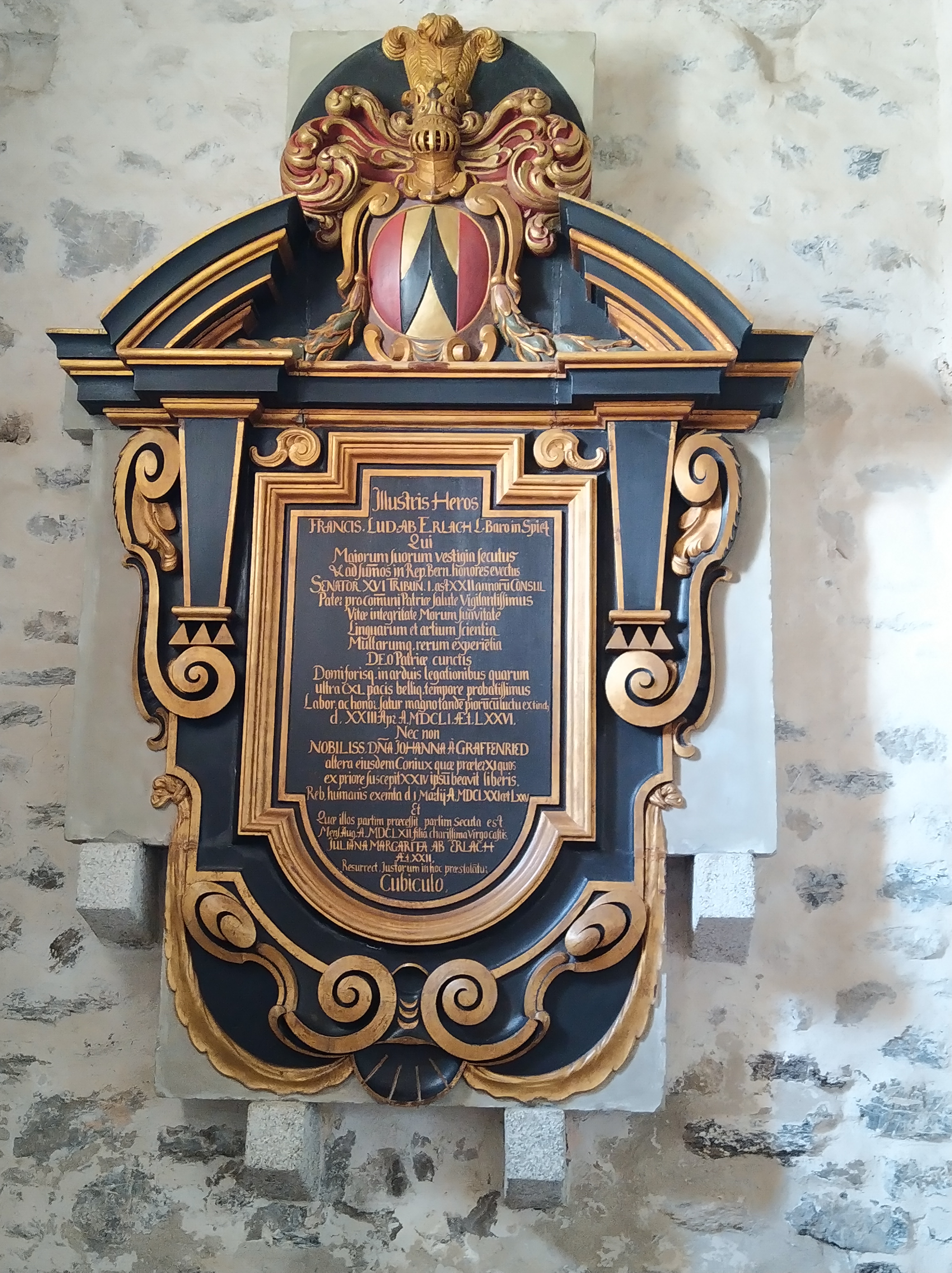
The castle changed hands numerous times, whether through political manoeuvring or through dynastic extinction. Last week, my article touched on the French invasion of Switzerland; After that 1798 French invasion and the creation of the Helvetic Republic, the von Erlach family lost the rights to hold the lands as well as their jurisdiction over the village, but retained ownership of the castle until 1875. In the church is a panel in Latin about the titles of the baron von Erlach and of (who I assume was) his wife, Johanna Graffenried (from another noble family in Berne), with the family crest (see the images below).

This past summer, my husband and I toured the castle and the church; it was an awe-inspiring feeling to know that we were walking where people have walked for well over a thousand years; where nobility and peasants, servants and pilgrims have stood, walked, talked, lived and passed. Here are a few impressions of the castle, church and the views we enjoyed, and I hope you enjoy, too.

6 Comments

Filed under Articles, History, History Undusted, Military History

Finally Back!

Hi everyone! As I mentioned in my last blog in June, I thought I’d solved the problem of accessing my blog; but after that, I was blocked out until 10 minutes ago! Finally, I got the help needed; until now, every time I’ve logged in and started to do anything, it would log me out again. I figured it was a clash between WordPress and some other app or program, but I couldn’t figure out the connections. Now it’s sorted, and I’ll know what to look for in the future if it happens again.

Since my last blog, life has hit a bump or two in the fast lane: We caught Covid a second time just before our summer holidays. Since that time, I’ve had frequent Covid migraines, which are a different monster than the usual species of migraines in that there’s nothing you can do about them – no medicine works. They start at the base of the skull and shoot into existence in a flash sometimes, and then they hang on for up to 24 hours. Not conducive to focus or creative writing, so I’ve used what time I can in my craft room to get things done toward a Christmas market at which I sell things every year.

At the same time we had Covid, we had a very sick senior cat that ended up needing surgery to remove a few impacted teeth; antibiotics and pain medicines both ended just in time to hand over cat-sitting without the extra complications before we headed out for much-needed holidays. She’s now doing better, though her diet is mostly soft food – which seems to suit her just fine.

Summer holidays this year were spent in our own back garden, so to speak, here in Switzerland. We rented a small motor home and spent most of our time in the French-speaking area for a week. After that, we’d planned to take day-trips out from home; we managed to get in one or two until my right knee decided to blow out; that took a few weeks to heal, so I was basically house-bound, but we’ve got a nice, large flat to be stuck in, if need be.

July and August flew by in a blur, and September is following suit. I’m hoping to get my next novel out before Christmas, but with the delays of migraines and life catching up to us after summer holidays, it’s been a challenge to block out the world and focus on graphics and all the technical bits and bobs that go along with launching a book.

Now that I can access my blog again, I’ll take you on a few virtual tours around Switzerland next!

I hope this finds all of you well!

Spiez Castle: View from an arrow slit in the tower

9 Comments

Filed under Articles

Humanity Highlight: Redeeming Toxic Land with Lavender

I came across this story today, and wanted to share it: In the US, coal mining used to be big business; but with the move away from fossil fuels toward solar and other less destructive sources, companies have been in decline; before the mid-1970s, mining companies could just abandon the scarred land, but laws were passed that would require the companies to revitalise the wasteland; but if a company simply went bankrupt, the land sat barren, polluting the surrounding environment for decades, as rocks and minerals that had been buried forever were exposed to air and water, releasing their substances into groundwater and the air. Millions of acres of scarred land are the result.

Now, Appalachian Botanical Company in West Virginia has begun reclaiming the land in a beautiful way: Hiring ex-miners who’ve lost their jobs or other people who need a second chance just like the land, such as ex-drug addicts, they are now working in fields of flowers. Lavender is a hardy plant in the mint family that likes to grow in poor soil; it’s a perfect match for the rocky wastelands around coal mines. Every part of the plant is used: The flowers and upper stems are distilled down to make lavender essential oils that are then also used to make various creams and lotions, honey, salts, and hand sanitisers; when it’s done, they transform the biomass into compost to revitalise the land. The lower leaves are first removed, dipped in rooting powder, and planted to make the next harvest.

It’s an amazingly holistic approach to the problems: Creating jobs in the regions that have been hard-hit by economic downturns; revitalising the land through restoration – lavender will help prepare the land for other less hardy species to take root; and on a larger scale, it provides an example of what could be done with scarred land. To watch the Business Insider video, just click here. To check out the ABCo website and their products, click on the image below. Enjoy, and if you’d like to support what they’re doing, check out the pages on their websites, too.

2 Comments

Filed under Articles, How It's Made, Humanity Highlights, Links to External Articles, Nature, Science & Technology, Videos, YouTube Link

History Undusted: Rabbit Holes & Licorice Candy

This week, I did a major shopping at a couple Asian food stores; I stocked up on the ingredients I know, and some I didn’t; I like to get things I’ve never heard of, and do a bit of research on how to use it in cooking; things I picked up in that category are Iranian Kashk, which is a tangy fermented, yoghurt used as a condiment; canned palm hearts, which make a nice topping on desserts; and fermented black beans, which can be used in a variety of Asian dishes, including in a black bean sauce. I also bought several fresh vegetables and herbs to dehydrate and turn into a greens powder for adding flavours to dishes (I have a more usual greens powder with standard greens, like cauliflower leaves, spinach, etc. that I use daily).

One of the herbs I used was acacia leaf: When I opened the package, a pungent, sulphur-like smell hit me, and I wasn’t sure I’d use it. But when I began de-leafing it (much like you would thyme, though carefully as it’s got some vicious thorns!), it began to smell like mint! As I added lemongrass, Thai water spinach and other herbs, you can imagine the cacophony of fragrances in my kitchen – which filled the house as they dehydrated.

So what does this have to do with licorice? Well, one of the fresh herbs I also processed was Thai basil; I’d never used it before, and when I opened the packaging, a wave of anise- or licorice aroma hit me. And as usual, that set my mind off, thinking about the history of licorice!

Licorice is a flowering plant native to parts of Asia and Europe; its scientific name, Glycyrrhiza, comes from Greek and means “sweet root” (the linguistic roots are related to words like glycerine and rhizome); it is the ingredient that gives the signature flavour to black licorice, though today anise oil is often used as a substitute because the Glycyrrhiza can have toxic effects if ingested too much.

In looking into the history of this flavour, I came across a fascinating documentary: Ostensibly, it covers the history of the Switzer Licorice candy company. But in truth, it’s a fascinating historical insight into the history of Irish immigration, social unrest, the Irish famine, Irish revolution and exile, union labour foundations, World War 1 through the eyes of a family, the economic upheavals of war, rations and the company’s creative solutions, the history of sugar, post-war recovery, the Great Depression, the American Dream, candy-making, the rise of a family from Kerry Patch (the Irish ghetto of St. Louis, Missouri) to the suburbs, the history and development of St. Louis, and the demise of a family company resurrected by later generations. All in a 55-minute video!

 To watch this fascinating slice of history, click here. To check out the company’s website, click here.

I hope you enjoy this short history, and while you’re at it, enjoy a piece of licorice!

Image Credit: Switzer website (see link above)

Leave a comment

Filed under Articles, Etymology, History, History Undusted, How It's Made, Links to External Articles, Military History, Science & Technology, Snapshots in History, Videos, YouTube Link

Cutting Room Floor

I’ve been squirrelled away, editing. Editing. Editing. Once in a while, I come up for air or a tea. Then back to it. Then take a walk. Cook dinner. Back to it.

Everyone has their own writing techniques, and over the course of my career, I’ve tried most of them: I’ve outlined a plot and characters to a T; I’ve written out scene cards on post-its and rearranged them until I had the story down. But my tried-and-true method is to open a Word document and make use of their post-it function (that’s what I call their review/comment function), then type out 10 scenes that cover the arc of the story. After that, I toss my characters into the room (parameters of the scene) and let ’em loose. That comment function is worth its weight in gold, as I can slice out something and pop it in a comment off to the side, move it, scrap it, or take out the core and put it somewhere else. I can put reminders to check continuity in there, along with plot development thoughts, what-ifs, alternatives, etc. and try them out whenever it’s time, then delete them and move on. I tried the popular Scrivener program once, and it ate a manuscript for lunch (fortunately, I’d saved a Word version!)! Besides, I’m more organized than that program will ever be!

In my current manuscript, which is science fiction, I tossed the characters on an alien planet (a character in its own right) and let them figure it out. As they talk and move through the scenes and through time, they ripen and develop into full characters with a deeper story as a result. But that can also result in a chunky manuscript, that then needs to go through the toning process – cutting away the excess fat of characters, scenes, and dialogues and making them lean… in the film industry, it’s called the “cutting room floor” process. And that’s the current stage I’m in. When I started out, I had no idea how I’d reach my goal: My starting point, which was the completed manuscript in December last year, was a whopping 148K! My end goal, with a marketable science-fiction range of 100-115K, was over a few hills. But every journey begins and ends with small steps. I started going through my usual edit/proofing list, and I’m now in sight of the goal, just under 117K, and I’m not done yet. The trick is taking off my writer’s cap and putting on my editor’s hat; that means letting go of favourite scenes, plot points, and even characters when necessary. If it doesn’t serve the main- and sub-plots and character development, then out it goes. My husband, who was once a black belt in Lean Six Sigma, has called it my “lean sigma process”.

Sometimes I feel like this squirrel… and that’s where that comment function comes in handy again!

So… I’m off to make myself lunch, then dive back into the editing. I’ll reach my goal, with a comfortable margin, within the next week!

If you’re a writer, what is your approach? Copious amounts of pre-notes and hundreds of questions to develop characters and plot in your mind, or winging it? Please spill the beans in the comments below!

6 Comments

Filed under Articles, How It's Made, Musings, Nuts & Bolts, Plot Thots & Profiles