Category Archives: Cartoon

December Musings

December means a lot of things to a lot of people:  For some it’s a month for slowing down, or baking, or taking time with family and friends, or cuddling up on the couch with a good book while it snows and blows and freezes outside (for those of us in the northern hemisphere, at least); for others it’s a month of work stress in winding up the year-end’s tasks, or cramming in meetings and project plans that need to take off in the New Year; for others it’s stress due to shopping – either because one has no idea what so-and-so wants/needs yet one must give said person a gift, or because of the crowds that seem to defy population censuses for any given town.

For me, it’s the juxtaposition of wanting to cuddle up with a selection of books on the couch between our three cats, settling in with an Earl Grey tea and a blanket and ignoring the world for a day or two, versus reaching my goal of getting the first draft of my fifth novel done before Christmas.  Said draft goal is only realistic if I keep at it, every day, disciplining myself to ignore the urge to kick up my feet and read, and (I will admit it) even ignoring the urge to write for my blogs, until I’ve written 1,000 words toward the completion of the manuscript.  Once that’s done (or the equivalent in editing and tweaking), other things can be given attention.  Important tasks that come at the right time are “priority”, but when they come up at the wrong time and intrude on my concentration, they are merely distractions.

So here I sit, 2:30 a.m. and finally have time to sit down to write to you.   Whatever your December looks like – whether stressful or relaxed, planned to the gills or with room for the spontaneous – remember that each day we wake up is a fresh opportunity to get it right, and each time we go to bed is an opportunity to take a moment to remember the blessings that came our way that day.

Awkward

4 Comments

Filed under Cartoon, Musings

The Pitfalls of Analogies

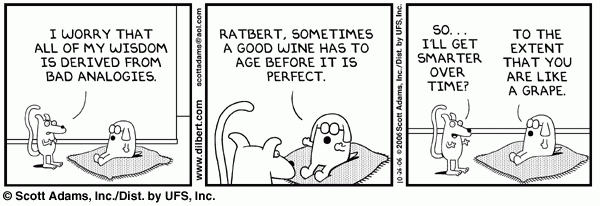
These are priceless examples of creativity gone awry.  I don’t know who originally wrote these gems or compiled them; if you know, please tell me so that I can give credit where credit is due!

21 Analogies Used by High School Students in English Essays

  1. “When she tried to sing, it sounded like a walrus giving birth to farm equipment.”
  2. “Her eyes twinkled, like the moustache of a man with a cold.”
  3. “She was like a magnet: Attractive from the back, repulsive from the front.”
  4. “The ballerina rose gracefully en pointe and extended one long slender leg behind her, like at dog at a fire hydrant.”
  5. “She grew on him like she was a colony of E. Coli and he was a room temperature Canadian beef.”
  6. “She had him like a toenail stuck in a shag carpet.”
  7. “The lamp just sat there, like an inanimate object.”
  8. “Her face was a perfect oval, like a circle that had two sides gently compressed by a Thigh Master.”
  9. “Her eyes were like the stars, not because they twinkle, but because they were so far apart.”
  10. “His career was blowing up like a man with a broken metal detector walking through an active minefield.”
  11. “The sun was below the watery horizon, like a diabetic grandma easing into a warm salt bath.”
  12. “From the attic came an unearthly howl. The whole scene had an eerie, surreal quality, like when you’re on vacation in another city and Jeopardy comes at 7:00 p.m. instead of 7:30.”
  13. “It was as easy as taking candy from a diabetic man who no longer wishes to eat candy.”
  14. “She had a deep, throaty, genuine laugh, like that sound a dog makes before it throws up.”
  15. “Their love burned with the fiery intensity of a urinary tract infection.”
  16. “It’s basically an illusion and no different than if I were to imagine something else, like Batman riding a flying toaster.”
  17. “If it was any colder, it would be like being in a place that’s a little colder than it is here.”
  18. “Joy fills her heart like a silent but deadly fart fills a room with no windows.”
  19. “The bird flew gracefully into the air like a man stepping on a landmine in zero gravity.”
  20. “He felt confused. As confused as a homeless man on house arrest.”
  21. “The revelation that his marriage of 30 years had disintegrated because of his wife’s infidelity came as a rude shock, like a surcharge at a formerly surcharge-free ATM.”

dilbert-bad-analogies

4 Comments

Filed under Cartoon, Grammar, Humor, Lists, Nuts & Bolts, Writing Exercise, Writing Prompt

The Glorious Chaos of English

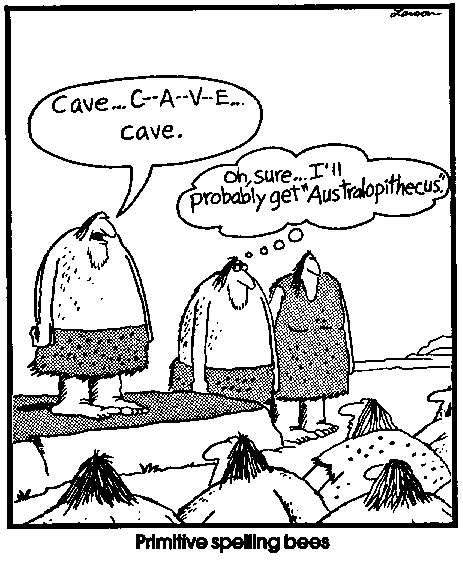
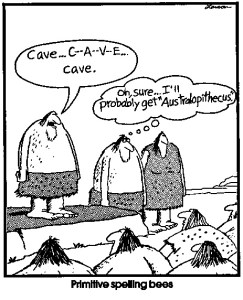
Primative Spelling BeesEnglish, in many ways, is one of the simplest languages to learn quickly and in which to converse fluently; but scratching below the surface one rapidly finds incongruities.  As a teacher for English as a foreign language for adults (TEFLA), I was frequently confronted with the challenges of teaching students to spell and pronounce words correctly, but I was also comforted by the fact that English nouns only come with four possible preceding cases, or articles (a, an, the, and none), rather than, say, German, in which each noun has a nominative, genative, dative or accusative, singular or plural form of their case; or Finnish, which has a whopping 15 cases.

The Chaos, a poem written by the Dutch traveller & teacher,  Gerard Nolst Trenité (1870–1946), gives ~800 examples of irregular spelling.  In general one can say that there are spelling “rules”, but English, in all its historic complexities of absorbing, digesting and recycling influences from conquerors, enemies, travelling companions and allies, seems designed to say “rules can and will be broken”.  I would never give his last advice to anyone – but after reading this poem, you’ll understand that English needs tenacity and constant practice to use well!

The Chaos

by G. Nolst Trenite’ a.k.a. “Charivarius” 1870 – 1946

Dearest creature in creation

Studying English pronunciation,

I will teach you in my verse

Sounds like corpse, corps, horse and worse

I will keep you, Susy, busy,

Make your head with heat grow dizzy.

Tear in eye your dress you’ll tear,

So shall I! Oh, hear my prayer,

Pray, console your loving poet,

Make my coat look new, dear, sew it!

Just compare heart, beard and heard,

Dies and diet, lord and word,

Sword and sward, retain and Britain.

(Mind the latter, how it’s written).

Made has not the sound of bade,

Say said, pay-paid, laid, but plaid.

Now I surely will not plague you

With such words as vague and ague,

But be careful how you speak,

Say break, steak, but bleak and streak.

Previous, precious, fuchsia, via,

Pipe, snipe, recipe and choir,

Cloven, oven, how and low,

Script, receipt, shoe, poem, toe.

Hear me say, devoid of trickery:

Daughter, laughter and Terpsichore,

Typhoid, measles, topsails, aisles.

Exiles, similes, reviles.

Wholly, holly, signal, signing.

Thames, examining, combining

Scholar, vicar, and cigar,

Solar, mica, war, and far.

From “desire”: desirable–admirable from “admire.”

Lumber, plumber, bier, but brier.

Chatham, brougham, renown, but known.

Knowledge, done, but gone and tone,

One, anemone. Balmoral.

Kitchen, lichen, laundry, laurel,

Gertrude, German, wind, and mind.

Scene, Melpomene, mankind,

Tortoise, turquoise, chamois-leather,

Reading, reading, heathen, heather.

This phonetic labyrinth

Gives moss, gross, brook, brooch, ninth, plinth.

Billet does not end like ballet;

Bouquet, wallet, mallet, chalet;

Blood and flood are not like food,

Nor is mould like should and would.

Banquet is not nearly parquet,

Which is said to rime with “darky.”

Viscous, Viscount, load, and broad.

Toward, to forward, to reward.

And your pronunciation’s O.K.,

When you say correctly: croquet.

Rounded, wounded, grieve, and sieve,

Friend and fiend, alive, and live,

Liberty, library, heave, and heaven,

Rachel, ache, moustache, eleven,

We say hallowed, but allowed,

People, leopard, towed, but vowed.

Mark the difference, moreover,

Between mover, plover, Dover,

Leeches, breeches, wise, precise,

Chalice, but police, and lice.

Camel, constable, unstable,

Principle, disciple, label,

Petal, penal, and canal,

Wait, surmise, plait, promise, pal.

Suit, suite, ruin, circuit, conduit,

Rime with “shirk it” and “beyond it.”

But it is not hard to tell,

Why it’s pall, mall, but Pall Mall.

Muscle, muscular, gaol, iron,

Timber, climber, bullion, lion,

Worm and storm, chaise, chaos, and chair,

Senator, spectator, mayor,

Ivy, privy, famous, clamour

And enamour rime with hammer.

Pussy, hussy, and possess,

Desert, but dessert, address.

Golf, wolf, countenance, lieutenants.

Hoist, in lieu of flags, left pennants.

River, rival, tomb, bomb, comb,

Doll and roll and some and home.

Stranger does not rime with anger.

Neither does devour with clangour.

Soul, but foul and gaunt but aunt.

Font, front, won’t, want, grand, and grant.

Shoes, goes, does. Now first say: finger.

And then: singer, ginger, linger,

Real, zeal, mauve, gauze, and gauge,

Marriage, foliage, mirage, age.

Query does not rime with very,

Nor does fury sound like bury.

Dost, lost, post; and doth, cloth, loth;

Job, Job; blossom, bosom, oath.

Though the difference seems little,

We say actual, but victual.

Seat, sweat; chaste, caste.; Leigh, eight, height;

Put, nut; granite, and unite.

Reefer does not rime with deafer,

Feoffer does, and zephyr, heifer.

Dull, bull, Geoffrey, George, ate, late,

Hint, pint, Senate, but sedate.

Scenic, Arabic, Pacific,

Science, conscience, scientific,

Tour, but our and succour, four,

Gas, alas, and Arkansas.

Sea, idea, guinea, area,

Psalm, Maria, but malaria,

Youth, south, southern, cleanse and clean,

Doctrine, turpentine, marine.

Compare alien with Italian,

Dandelion with battalion.

Sally with ally, yea, ye,

Eye, I, ay, aye, whey, key, quay.

Say aver, but ever, fever.

Neither, leisure, skein, receiver.

Never guess–it is not safe:

We say calves, valves, half, but Ralph.

Heron, granary, canary,

Crevice and device, and eyrie,

Face but preface, but efface,

Phlegm, phlegmatic, ass, glass, bass.

Large, but target, gin, give, verging,

Ought, out, joust, and scour, but scourging,

Ear but earn, and wear and bear

Do not rime with here, but ere.

Seven is right, but so is even,

Hyphen, roughen, nephew, Stephen,

Monkey, donkey, clerk, and jerk,

Asp, grasp, wasp, and cork and work.

Pronunciation–think of psyche–!

Is a paling, stout and spikey,

Won’t it make you lose your wits,

Writing “groats” and saying “grits”?

It’s a dark abyss or tunnel,

Strewn with stones, like rowlock, gunwale,

Islington and Isle of Wight,

Housewife, verdict, and indict!

Don’t you think so, reader, rather,

Saying lather, bather, father?

Finally: which rimes with “enough”

Though, through, plough, cough, hough, or tough?

Hiccough has the sound of “cup.”

My advice is–give it up!

1 Comment

Filed under Articles, Cartoon, Grammar, Nuts & Bolts, Quotes, Writing Exercise

To-Too-Two-Tutu

Funny

2 Comments

Filed under Cartoon, Humor, Images

Writing Tips: Dialogue

howtobebritish1Dialogue is (to point out the obvious) vital to a novel; it displays the voices of your characters and helps the reader get to know and care about the characters, understand their motives, their interrelationships, and distinguish each character’s point of view.  If you don’t get the dialogue right, you rip the reader out of the story, or worse – make them put down your novel and add your name to “never again” lists!  So, here are a few pointers and tips to keep in mind as you develop your characters and put words into their mouths:

1) Develop your characters well enough to make their voice distinct; do they have catch-phrases, or local dialects that influence their vocabulary?  Do they tend toward long or short sentences, or are they from a past time and place that had a different way of speaking?  Educate yourself if necessary in various modes of speech .

2) Dialogue is an illusion of conversation; but it’s also about what is not said.  Non-verbal actions reveal:

a) How a character says something

b) What a character chooses not to say, but inadvertantly reveals through actions.

c) Why the character says what they do.

Do they have particular actions when they are upset or aggitated that communicate their moods to the reader?  Do they bounce their knees when excited?  Does their body language confirm or contradict their verbal message?

3)  Fictional dialogue needs to cut to the chase; if there’s no point to the text (revealing motivation, character or plot point), then chop it!

4)  Avoid the trap of using dialogue as exposition (the proverbial villain’s monologue as he prepares to destroy the hero), but rather reveal essential information through action, or narration.

Explore your characters and develop their voices, and above all – keep writing!

Leave a comment

Filed under Articles, Cartoon, Nuts & Bolts, Plot Thots & Profiles, Writing Exercise, Writing Prompt

Never Give Up

I love this image; I used to have a tea mug with a similar image to the one below, and it made me smile every time I used it.  There are times in our lives when we might feel discouraged, or overwhelmed at what we have to do or to go through.  If you have a goal or a dream, just keep putting one foot in front of the other – do something each day, no matter how small or insignificant that action may seem, toward reaching that goal.  Eventually you’ll get there!never-give-up

“Don’t give up whatever you’re trying to do — especially if you’re convinced that you’re botching it up.  Giving up reinforces a sense of incompetence; going on gives you a commitment to success.”

George Weinberg, English writer, activist

1 Comment

Filed under Articles, Cartoon, Images

Euphemisms

Euphemism 1Language is a fluid concept, constantly changing, adapting, creating, compensating and inventing itself.  Euphemisms are a prime example of that fluctuation and adaptation; successive generations come to know only the euphemism which in turn ceases to be one by that very definition, and which means that new ones will be invented to skirt the issue once again. For instance, there are hundreds of words for smell or stink, yet only a handful of satisfactory synonyms for words like fragrance, simply because hiding the ugly requires far more creativity than hiding the lovely.  For that reason alone, writers who fall back on expletives like the highly offensive F-word (a euphemism for, well, you know) are simply lazy in my book; they’re missing a great opportunity for creativity!  Interestingly, that word’s meaning has never shifted over time – it’s been in the English language since before the fifteenth century, and even then it was only written in cipher because it was too offensive to record in ink.  In my opinion it still is, and one should consider very carefully before offending unknown numbers of readers from continuing to read your book or blog; more than once have I ended reading a book when they used the word several times in the course of the first few chapters, because honestly it says something about the extent of their language abilities and their spectrum (or lack thereof) of creativity.
As a society’s norms shift, so do the euphemisms that they use to communicate.  In the Renaissance, corpulent women were considered the height of beauty; curvy, curvaceous, and shapely were instances of positive euphemisms; today they might be used by some idiot in the media to insult a Hollywood starlet who (by any other standard would be considered normal if not a little thin) gained a pound or two. Now idiot might be too strong a word; I could say brain cell-deficient, or someone who has delusions of adequacy.  I would like to point out the obvious here:  If you’re going to insult someone, at least spell it right… more often than not, you see people calling someone “dumn” or “dumm”, which smacks of the pot calling the kettle black…

For an interesting TED Talk (13:00) on the topic of euphemisms, please click here.

4 Comments

Filed under Articles, Cartoon, Etymology, Grammar, Nuts & Bolts, Writing Exercise

Politeness Cultures

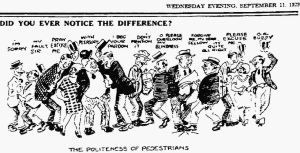
I recently came across a very interesting TED video addressing the differences between the American and British cultures on the specific aspect of politeness.  I grew up in the Midwest of America, emigrated to Scotland, lived in England for a while as well, and have friends scattered all over the “British Empire” & Commonwealth; I now live in Switzerland (adding several “Germanic” mentalities to my experience in that process!).  What the speaker (Lynne Murphy) observes makes a LOT of sense on both sides of the Puddle (Atlantic).  I share it with you because as a writer I know that those subtle, unspoken, unwritten differences in the ways people interact with each other and show their masks, or as Lynne calls them “faces”, make or break the authenticity in writing both prose and dialogue.  Click on the image below to watch the video; it’s 18 minutes long, so please watch it when you have time to focus! (By the way, the two cartoons below illustrate perfectly the difference between the “positive” face and the “negative” face.)

Politeness Politeness2

1 Comment

Filed under Articles, Cartoon, Images, Nuts & Bolts, Videos

Simply English, not Simple English

No VowelsThe following poem has been floating around for years; it’s so popular because it’s a great encapsulated example of the weirdness of English as a language!  It’s also a great exercise in stretching your vocabulary, being more aware of how to say words that are often only seen written and never heard pronounced.  And if you come across a word you don’t know, or could swear it’s pronounced differently than the rhyme of the poem indicates, I challenge you to look it up (Wiktionary is an example of a good source which shows how various dialects of English pronounce words if there is more than one option); and if you feel completely overwhelmed, click on the cartoon above to watch someone else chew their way through it!

Simply English

Dearest creature in creation,

Study English pronunciation.

I will teach you in my verse

Sounds like corpse, corps, horse, and worse.

I will keep you, Suzy, busy,

Make your head with heat grow dizzy.

Tear in eye, your dress will tear.

So shall I! Oh hear my prayer.

Just compare heart, beard, and heard,

Dies and diet, lord and word,

Sword and sward, retain and Britain.

(Mind the latter, how it’s written.)

Now I surely will not plague you

With such words as plaque and ague.

But be careful how you speak:

Say break and steak, but bleak and streak;

Cloven, oven, how and low,

Script, receipt, show, poem, and toe.

Hear me say, devoid of trickery,

Daughter, laughter, and Terpsichore,

Typhoid, measles, topsails, aisles,

Exiles, similes, and reviles;

Scholar, vicar, and cigar,

Solar, mica, war and far;

One, anemone, Balmoral,

Kitchen, lichen, laundry, laurel;

Gertrude, German, wind and mind,

Scene, Melpomene, mankind.

Billet does not rhyme with ballet,

Bouquet, wallet, mallet, chalet.

Blood and flood are not like food,

Nor is mould like should and would.

Viscous, viscount, load and broad,

Toward, to forward, to reward.

And your pronunciation’s OK

When you correctly say croquet,

Rounded, wounded, grieve and sieve,

Friend and fiend, alive and live.

Ivy, privy, famous; clamour

And enamour rhymes with hammer.

River, rival, tomb, bomb, comb,

Doll and roll and some and home.

Stranger does not rhyme with anger,

Neither does devour with clangour.

Souls but foul, haunt but aunt,

Font, front, wont, want, grand, and grant,

Shoes, goes, does. Now first say finger,

And then singer, ginger, linger,

Real, zeal, mauve, gauze, gouge and gauge,

Marriage, foliage, mirage, and age.

Query does not rhyme with very,

Nor does fury sound like bury.

Dost, lost, post and doth, cloth, loth.

Job, nob, bosom, transom, oath.

Though the differences seem little,

We say actual but victual.

Refer does not rhyme with deafer.

Foeffer does, and zephyr, heifer.

Mint, pint, senate and sedate;

Dull, bull, and George ate late.

Scenic, Arabic, Pacific,

Science, conscience, scientific.

Liberty, library, heave and heaven,

Rachel, ache, moustache, eleven.

We say hallowed, but allowed,

People, leopard, towed, but vowed.

Mark the differences, moreover,

Between mover, cover, clover;

Leeches, breeches, wise, precise,

Chalice, but police and lice;

Camel, constable, unstable,

Principle, disciple, label.

Petal, panel, and canal,

Wait, surprise, plait, promise, pal.

Worm and storm, chaise, chaos, chair,

Senator, spectator, mayor.

Tour, but our and succour, four.

Gas, alas, and Arkansas.

Sea, idea, Korea, area,

Psalm, Maria, but malaria.

Youth, south, southern, cleanse and clean.

Doctrine, turpentine, marine.

Compare alien with Italian,

Dandelion and battalion.

Sally with ally, yea, ye,

Eye, I, ay, aye, whey, and key.

Say aver, but ever, fever,

Neither, leisure, skein, deceiver.

Heron, granary, canary.

Crevice and device and aerie.

Face, but preface, not efface.

Phlegm, phlegmatic, ass, glass, bass.

Large, but target, gin, give, verging,

Ought, out, joust and scour, scourging.

Ear, but earn and wear and tear

Do not rhyme with here but ere.

Seven is right, but so is even,

Hyphen, roughen, nephew Stephen,

Monkey, donkey, Turk and jerk,

Ask, grasp, wasp, and cork and work.

Pronunciation — think of Psyche!

Is a paling stout and spikey?

Won’t it make you lose your wits,

Writing groats and saying grits?

It’s a dark abyss or tunnel:

Strewn with stones, stowed, solace, gunwale,

Islington and Isle of Wight,

Housewife, verdict and indict.

Finally, which rhymes with enough?

Though, through, plough, or dough, or cough?

Hiccough has the sound of cup.

My advice is give it up!


Leave a comment

Filed under Cartoon, Mistranslations, Nuts & Bolts, Quotes, Videos, Writing Exercise

Merisms

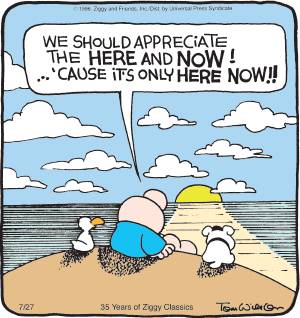
Here and NowMerisms are figures of speech in which a single thing is implied by stating several elements of it, usually contrasting concepts or parts, used to refer to an entirety; the elements can be literal or metaphorical.  They are striking features in ancient Biblical poetry, such as “The God of heaven and earth” meaning of everything (the universe).  Here are a few more:

here and there

here and now

life and death

body and soul

the length and breadth

high and low

ladies and gentlemen

young and old

rich and poor

kind and cruel

smart and stupid

from A to Z

Alpha and Omega

The beginning and the end

lock, stock and barrel

day and night

left and right

bag and baggage

the whole kit and caboodle


Can you think of any others?

Leave a comment

Filed under Cartoon, Grammar, Nuts & Bolts, Writing Exercise