Category Archives: Etymology

10 Everyday Phrases with Nautical Origins #3

Some of today’s nautical idioms are well known, such as to be on board with a proposal or suggestion or learning the ropes in a new job or position, while others, such as three sheets to the wind are less common (unless you happen to work in a bar – then it may come in quite handy). Either way, enjoy these, matey!

Be On Board: As part of a crew, a sailor bore their part of the responsibilities. In today’s terms, it means to accept or agree with a proposal or a way of doing something and go along with it.

Rats Deserting a Sinking Ship: Rats and mice were common aboard ships, often in the bulkhead (lowest section of a ship, where the grains were stored (the weightier things being stored low and balanced to keep the ship sturdy in rough seas). If the ship began to take on water, the rats would go up the deck ladders to stay away from the water; if they started jumping overboard, sailors wouldn’t stand much better of a chance (most sailors could not swim). It’s a vividly grim picture of life aboard. Now, it’s an idiom describing people abandoning a failing activity or situation.

Close/Tight Quarters: Tightly packed (e.g. people in a small space). Space was at a premium, especially on the lower decks of a ship of sail. Men slept in hammocks close together and shared the space with stowed ship equipment and their own storage chests. Even today on submarines, bunks are shared by those who are off-duty and those on-duty to save sleeping quarter space.

Run a Tight Ship: Manage and organization strictly, efficiently, and effectively. A ship, especially in times of war, was run tightly to avoid unnecessary dangers and/or deaths, and to maintain discipline that would be needed to succeed in crucial moments.

Learn the Ropes: Sails were raised and lowered with ropes, and knowing how to control the sails allowed a ship to take full advantage of the wind and sail safely. There were miles of ropes on a ship, each with an important and specific function. Learning the ropes was essential for everyone aboard – it would keep others out of danger and oneself alive! Today, one learns the way things are done in a given setting or situation.

Broadside: The broadside was the side of the ship which sat above the waterline; cannons were arranged on several decks, and when ships sat broadsides facing, firing simultaneously, it was known as broadsiding. Today, it refers to being taken off guard or being surprised by something unpleasant.

 Broad in the Beam: Describes the width of the beam or mast on a larger ship. It denotes a person who’s wide across the hips and buttocks.

Keel Over: To collapse, to die. If the keel of a boat were to rise out of the water, the ship would be in danger of capsizing; this might happen due to a storm or damage by an enemy attack.

To Keelhaul: To rebuke harshly. It was a punishment meted out in extreme cases by dragging someone, ankles weighted, by ropes beneath the ship along or over the keel (the backbone of wood along the bottom of the ship). As these were usually covered with barnacles, clothes and skin would be shredded by the barnacle shells, and if the salt water of the ocean didn’t disinfect the wounds on the way up, it could be a death sentence. How much it was actually practised is difficult to say, as written records are sparse (perhaps a cruel captain didn’t want it on record, or perhaps it was not as widely practised as we think); the most concrete records of the punishment come from the Dutch. It was banned by the British Royal Navy around 1720, and by the Dutch around 1750. That bans were necessary tells its own tale…

Three Sheets to the Wind: Implies an unsteady, drunk person. The sheet referred to the ropes (lines) used to control the trim (the advantageous angle of the sails in relation to the wind) of the sail. If the sheets are loose, the sails will flap in the wind which causes the ship to lurch about like a drunken sailor. There are variations of the number of sheets in the idiom: 1 would be tipsy, 3 would be staggering drunk!
3 Comments

Filed under Etymology, History, History Undusted, Lists, Military History

10 Everyday Phrases with Nautical Origins #2

Today’s everyday phrases can come in handy when you’re in a tight spot, avoiding danger, or reaching your goal (land ho!) Chockablock came in handy for me last week, as it described how I felt after having been sick for nearly two months (Covid into bronchitis, joy), and then catching up with all those little things in our household that had gone undone. Anyone who’s been married for any length of time will know that spouses tend to take over specific jobs – whether that’s carrying out the rubbish or doing the laundry, cleaning drains or watering plants. I’ll let you guess which jobs are whose. Catching up with those undone jobs stemmed the tide of accumulating chores, and helped me get our home back to shipshape and in Bristol fashion! So enjoy these phrases, and please share in the comments which ones apply to your life!

Chockablock: Jam-packed; overcrowded; completely filled, stuffed, or jammed tightly together. You may have heard the term block and tackle; This refers to a system in which a rope, chain or cable (= tackle) is passed over pulleys enclosed in two or more blocks, one fixed and one attached to a load (see image). When these blocks are pulled so close together that no further movement is possible, this is known as being chockablock (this is the usual spelling, which illustrates its meaning perfectly – no space, not even a dash between words!).

Stem the Tide: Try to prevent a situation from becoming worse than it already is. Nautically, it means to tack (steer) against the tide or oncoming storm to avoid being blown off course or capsized.

To be Shanghaied: A city in China, Shanghai implied a long voyage (just as Switzerland today implies neutrality in the collective conscious). When landsmen were impressed (volunteered against their will) into the British or American navies in the days of wooden ships of sail, to be Shanghaied meant to be impressed and sent away from home for a long time or extended voyage (not necessarily to China!).

Limey: Shortened slang for “lime juicer”, referring to the English naval ships and the practice of carrying barrels of limes or lime juice to ward off scurvy on long voyages. As the British navy was a dominant force on the seas, the term gradually came to mean British.

Shipshape (and in Bristol Fashion): Everything is okay and in good order. Bristol was, at one point, Britain’s main west coast port; the idiom was used to describe everything being in order with cargo and at the port.

Give a Wide Berth: Leave space for, veer around. Even when a ship is at anchor, it will move with the tide and wind, so the berth, or a docking space, for a ship needs to be ample for a safe mooring. The modern phrase still denotes the danger of steering too close to an unpredictable situation.

Loose Cannon: Unpredictable danger (can be said of a person or situation). When a cannon or a cannonball broke free from its mooring, it created a hazardous situation as it rolled around or across the deck during a storm or in battle.

Port, Starboard: This simple explanation is that these are left and right, respectively, on any ship or airplane. But simple is a bit boring! Buckle up: In the past, as today, the majority of people were right-handed; ships of sail had rudders centred on the stern (back of the ship), but the steering oar came up onto the quarter deck through the right side of the stern. This leads us to the term starboard: Old English steorbord literally meant steer-board, the side on which a vessel was steered.

When pulling into a port, as the steering oar was on the right side, they would anchor starboard out, port in. The port, the left side of the ship as seen from the stern facing forward toward the bow, was formerly known as larboard, from Middle English ladde-borde, meaning loading board (side); it was eventually renamed as the similarity to starboard was confusing in the loud life aboard.

Most airplanes follow this tradition today, with boarding being on the left (port) side. In fact, jet bridges are designed to match the left side of the plane, so unless you are climbing into a grasshopper flight on a remote island, you will board port side!

Ahoy: Used to hail a ship, a boat or a person, or to attract attention. Used today as a humorous warning of impending danger or inconvenience.

Land Ho: To call out “Land ho!” was to let the crew know that land had been spotted. It is a way to let everyone know that the end of a voyage is imminent.

2 Comments

Filed under Articles, Etymology, History, History Undusted, Lists, Military History

10 Everyday Phrases with Nautical Origins #I

A phrase I use often is to “batten down the hatches” – meaning “put things away in preparation for (leaving on holidays, guests arriving, or the next project)”. I know that it originates from ship jargon, where it means preparing for rough seas or as a precaution to some other danger. That set me thinking about how many other phrases and idioms we use regularly in English that have their roots in nautical history. I’ve written on this topic before, highlighting the phrases of cathead, to swing a cat, down the hatch or break the ice, and even toe the line vs tow the line. Here are 10 more to get you thinking, with more to come!

Long Shot: A situation needing a good deal of luck. The guns aboard ships of sail were often inaccurate, or the decks would be too high for close-range accuracy. If a cannon successfully struck its target from a “long shot”, it was considered extraordinarily good luck.

Flotsam and Jetsam: A collection of miscellaneous items of little importance; odds bods, odds and ends. Flotsam refers to items unintentionally cast adrift or washed ashore, while Jetsam describes items intentionally cast overboard, such as when lightening the load for buoyancy.  They are almost always a paired idiom.

Taken Aback: Suddenly or unexpectedly checked or disappointed; startled or surprised.  It comes from the situation when a ship’s square sails were flattened against the masts by a sudden change of wind, stopping the forward motion.

In the Doldrums: Listless, depressed. Doldrums, aka the Intertropical Convergence Zone (ITCZ), is an area of the ocean near the equator where calms, squalls, and light, baffling winds are common. Sailing ships would often hit the Doldrums and be stranded until the wind could pick up their sails and empower the ship to move on. Large ships of sail had the disadvantage of having no ability to be oared forward.

The Cut of One’s Jib: One’s general appearance. The jib was the large, triangular foresail of a ship. When someone on the watch spotted a vessel on the horizon, they would look at the cut of the sails to determine whether they were friend or foe. A modern equivalent would be plane spotters, who can determine the make of an airplane by the shape of its hull and wings.

Show One’s True Colours: Being honest, open. Though the cut of the jib would determine a ship’s origin, it became more complicated as ships were captured by an enemy and repurposed for their own use. Because of that, ships of sail would hoist their colours – flags – to proclaim their current nationality. To show one’s true colours meant being honest, because enemy vessels might fly false colours until within firing range and then switch flags, declaring their true intentions at the last minute.

Pipe Down: Imperative – be quiet. Aboard a ship, the bo’sun’s pipe whistle would signal various activities.  To “pipe down” was the signal given to dismiss the crew from duty.

Landlubber: This word has a long history, though it eventually became known as a derogatory nautical term for people who struggle with being at sea or who get seasick and therefore dislike boats, or what the sailor considered a lazy person preferring life ashore. The term lubber goes much further back: In the mid-fourteenth century, it meant a clumsy, stupid person who lives in idleness. An earlier form, Lobi, meaning lazy lout, may have Scandinavian roots; it may also derive from the Old French term lobeor, meaning swindler, parasite. Any way you slice it, being called a Landlubber was basically an insult – or an accurate description of your character, depending on whether you were on the receiving or giving end of the word…

Bottoms Up: Known today as a drinking cheer to encourage people to finish off their drink, it has a much darker past. During the days of sail, the British navy would press men into service. If you volunteered, you were given “the King’s shilling” as first payment. Scrupulous press gangs would slip a shilling into a man’s drink, and if he finished off the drink, he was considered as having accepted the payment and was hauled off to sea. Innkeepers became wise to their tactics and began serving drinks in glass beer mugs rather than earthenware mugs, encouraging their patrons to check “bottoms up” to make sure there wasn’t a coin in the glass.

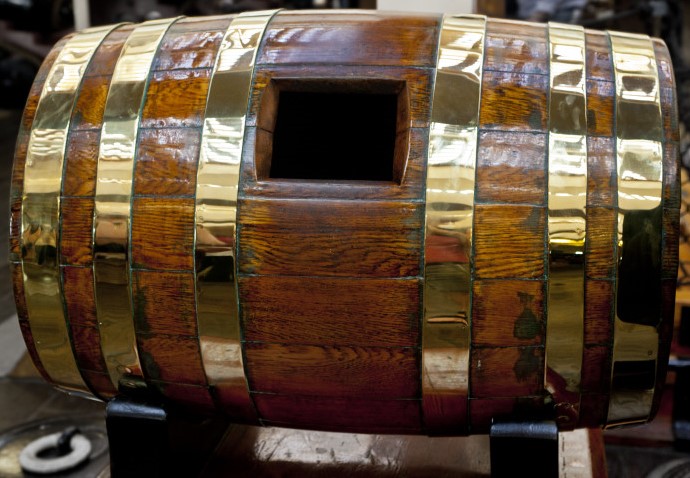
Scuttlebutt: The Butt was a cask with a capacity of between 110 to 140 imperial gallons of liquid (see my article about it here).  Scuttle was an opening in the ship’s deck, and as a verb, it meant to intentionally sink a ship by either putting a hole in it or leaving the portholes open with the intention of making a vessel unusable by an enemy. The barrels aboard ships were usually laid on their sides within braces, and a scuttle was a hole in the side for a cup or scoop to be inserted. The drinking hole became a popular gathering place, and the term “drinking hole” also became synonymous with the office drinking fountain or the local pub – a place to gather and have a drink together. To scuttlebutt means to idly chatter, start rumours, or gossip.

Which of these phrases are new to you? How many do you use, and if you use them, how frequently? I’d love to hear about it in the comments!

4 Comments

Filed under Etymology, History, History Undusted, Lists, Military History, Snapshots in History

Oh, Gnome, it’s almost Christmas!

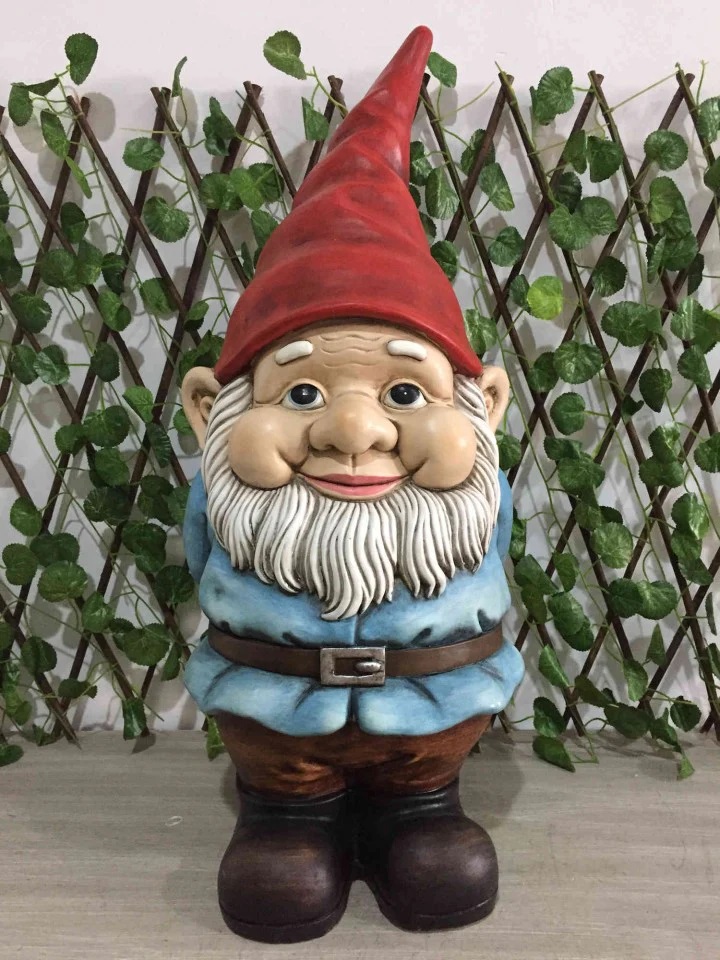
Image Credit: Familyflowers.ca

This past weekend I had a craft stand at our church’s annual advent market. Ten hours a day. I sold (as you might guess by the title), among other things, gnomes. It got me thinking about the history of these little creatures. I don’t know about where you live, but here in Switzerland, they’re popping up everywhere this season! Statues, cookie tins, ornaments, wrapping paper, socks and anything else you can think of.

You might think of garden gnomes; but the gnomes I’m referring to simply have a bushy beard, a nose, and a body with a hat on top; sometimes arms, but no eyes, though I added artisan sunglasses to some of mine, and those sold out relatively quickly. The image below is a typical Wichtel here in Switzerland.

I’d always vaguely assumed that gnomes were Scandinavian in origin, but it turns out that they are actually Swiss! First introduced in the 16th century by Paracelsus, born Theophrastus von Hohenheim, who was a Swiss physician, alchemist, lay theologian, and philosopher of the German Renaissance. The term “gnome” might have even been his own invention, based on the Latin genomos, meaning earth-dweller. Paracelsus may have been the first to describe them, but there are examples of similar myths in other cultures, too.

Perhaps the reason I’d thought of gnomes as Scandanavian is that, in the early 19th century Romantic writings, gnomes became entangled in the fairy tales which led them to becoming synonymous with goblins, leprechauns, and brownies, which are in turn similar in character to the Nordic troll. Trolls are said to live in isolated mountains, rocks or caves, and as such, are “earth-dwellers”. While the gnomes were thought to be helpful, trolls were rather unhelpful. Scandinavia does have a gnome-type character as well, known as the Danish and Norwegian nisse, the Swedish tomte, or Finnish tonttu, as well as many dialectical names throughout Scandinavia. In German, they are known as Gartenzwerg or Wichtel.

In folklore, gnomes were thought to be short, stout guardians of mines, treasures, and precious stones, and were the antithesis of the tall and slender elves. JRR Tolkien was likely influenced by these legends when creating his races of dwarves and elves.

The practice of garden statues goes back to ancient Rome, where they set up idols thought to help plants thrive and protect animals. by the 18th century, however, such garden statues were simply seen as a status symbol of wealthier families. The statuary as we think of it today is visually based on the Disney dwarves of Snow White; before that, their look was less homogeneous. Over time, they fell into disfavour among serious gardeners; at the Chelsea Garden Show in the UK, they were banned for several years; the powers that be were accused of snobbery, as garden gnomes were popular among the working class; they were eventually allowed in the show’s garden designs once again.

Garden gnomes in particular are something that you either find adorable or tacky. Like any display piece, if it’s done well, they can add a touch of whimsy to your garden or home.

The topic is one of those rabbit holes you could easily dive into; the traditions of the gnome, after all, go back thousands of years.

A Scandanavian Tomte, or German Wichtel

1 Comment

Filed under Articles, Etymology, History

History Undusted: Jumièges Abbey

Jumièges Abbey is one of the oldest Benedictine monasteries in Normandy; to dive into its history is akin to diving down Alice’s rabbit hole. For instance, I could say that the abbey was sponsored by the Frankish Queen Balthild, as she persuaded her husband, King Clovis II, to donate land to the Frankish nobleman Filibertus in order to found an abbey. But to know who she was, ah, that is where the intrigue begins.

Who and where were the Franks, when were they a thing, and what are they to us today?

Who, where and when: They were a Western European people who began as a Germanic people along the lower Rhine (which flows from Bonn, Germany, and ends up in the North Sea at the southwestern corner of the Netherlands), along the northern frontier of the Roman Empire. During the Middle Ages, they expanded their scope of rule as the Western Roman Empire began to collapse, and they imposed their power over many post-Roman kingdoms and beyond. That’s the crux of the matter though, as with any political history, it’s far more complex than that. The Franks are distinguished into two main groups by historians: The Salian Franks, to the west, and the Rhineland Franks, to the east.

In the mid-5th century, The Salian king, Childeric I, was a commander of Roman forces against the Gauls, most of whom Childeric and his son, Clovis I, conquered in the 6th century. Clovis was the first king of the Franks to unite the Frankish tribes under one ruler, and he founded the Merovingian dynasty – which ruled the Frankish tribes for 2 centuries. Clovis, in essence, is known as the first king of what would become France. As a side note, the Frankish name of Clovis is at the root of the French name of Louis, borne by eighteen kings of France.

Now, back to Queen Balthild (AD 626 – 680): Sold into slavery as a young girl, she was beautiful and intelligent. She served in the household of Erchinoald, the mayor of the palace of Neustria to Clovis II. Her master, a widower, wanted to marry her, but she hid herself from his sight until he married someone else (apparently the household of servants was numerous enough to enable her to avoid her unwanted suitor). Perhaps through Erchinoald’s notice of her, she came to the attention of Clovis II, who proposed to her and was accepted; hiding herself away may have been a political tactic to gain a higher rank with the king than with the mayor; According to the Vita Sancti Wilfrithi by Stephen of Ripon (written around AD 710), Bathild was a ruthless ruler, in conflict with the bishops and perhaps responsible for several assassinations. Some historians interpret Queen Balthild’s association with founding monasteries as a way of balancing or neutralizing aristocratic opposition to her rule. By installing her own bishops and donating lands for abbeys, she strengthened her own power as ruler (she was regent during the minority of her son). To put that in proper perspective, she was no different than most male counterparts of her day. [I could go off on a tangent about how adjectives differ when applied to the male or female state of affairs (a man is ambitious; a woman is pushy or ruthless), but I won’t. Yet.] From most accounts, however, she was pious and humble. Whichever way you butter that croissant, in ca. 860 she was canonized, thereafter to be referred to as Saint Balthild…

In 654, Balthild gave a parcel of royal land to Philibert, or Filibertus, on which he founded the Notre Dame de Jumièges. His main spiritual influence was that of the Irish monk, Columbanus (who founded several monasteries in the Frankish and Lombardi kingdoms).  The abbey flourished until the Viking invasions of 841 (Remember Rolf Ganger?), which caused disruptions to its first momentum, but it soon began to prosper again. The church itself was rebuilt between 1040 and 1066; it was dedicated on 1 July 1067, with none other present than William the Conqueror, Duke of Normandy and King of England (1066 and all that). The patronage of such a nobleman ensured the abbey’s success.

Jumièges Abbey was, like any abbey of its time, a veritable town. The church was only the heart of the community; there was a 14-acre enclosed park, terraced gardens, the abbatial manor, a bakery, landscaping to evoke biblical scenes, a hostelry, the 14th century “Charles VII” walkway (a covered walkway between the Notre Dame and St Peter’s church, named after the fact that Charles VII and his favourite mistress visited the monastery), and the cloister.

The next major disruption was from 1415, when the monks were forced to regularly seek refuge in Rouen as the English occupied Normandy during the Hundred Years’ War. The abbey eventually recovered and began to flourish again, until the whole province was plunged into the chaos of the Wars of Religion (1562-1598), resulting in the population’s decimation and famine. In 1649, the abbey was taken over by a Benedictine congregation, when some of its former glory was revitalized. Having survived all of that, its ruin came at the hands of the French Revolution, when it was sold as a “national property” and turned into a stone quarry (seen only as a source of ready-cut stones). At last, its historical value was recognized in the 19th century, putting an end to its wanton deconstruction.

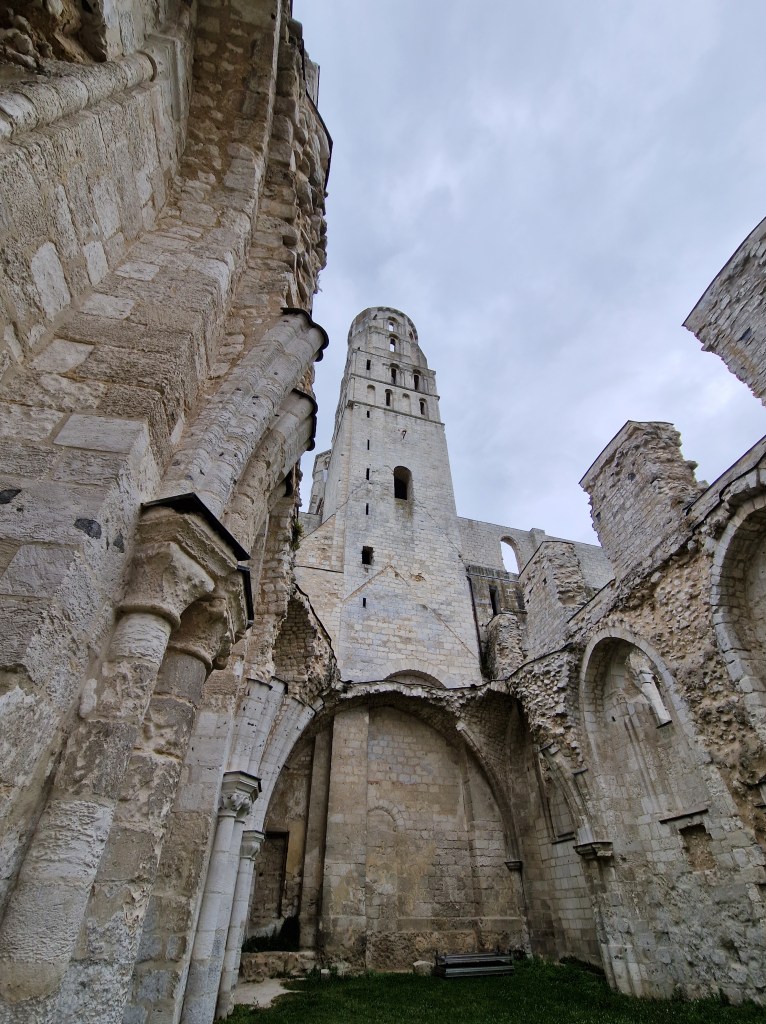
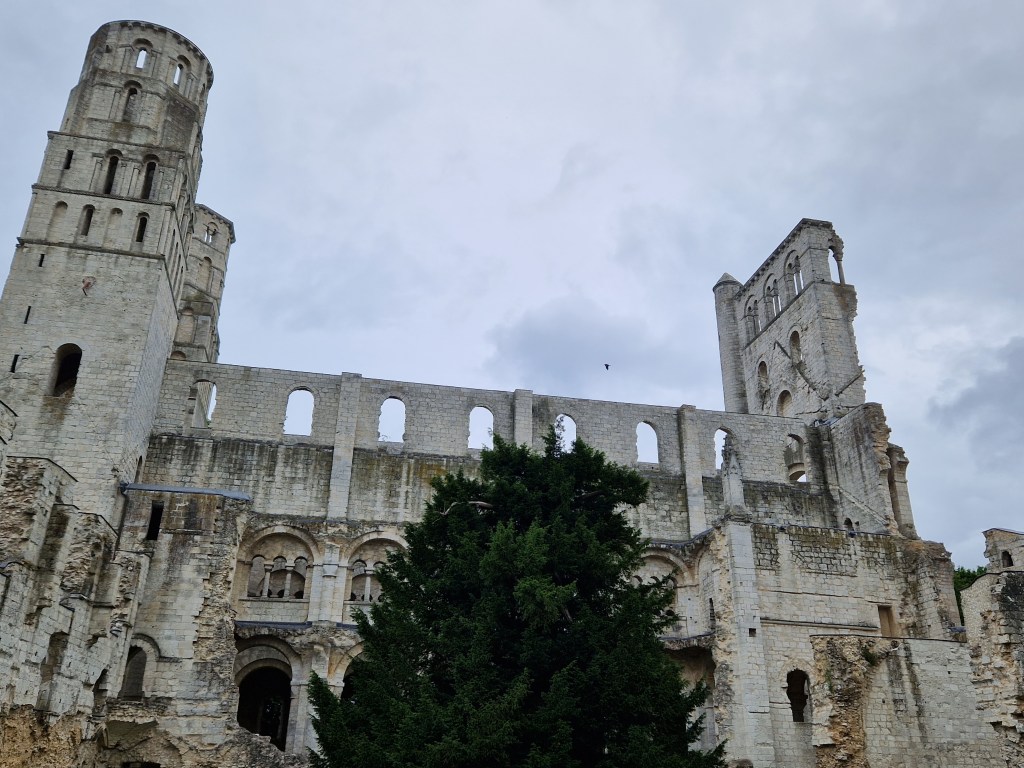
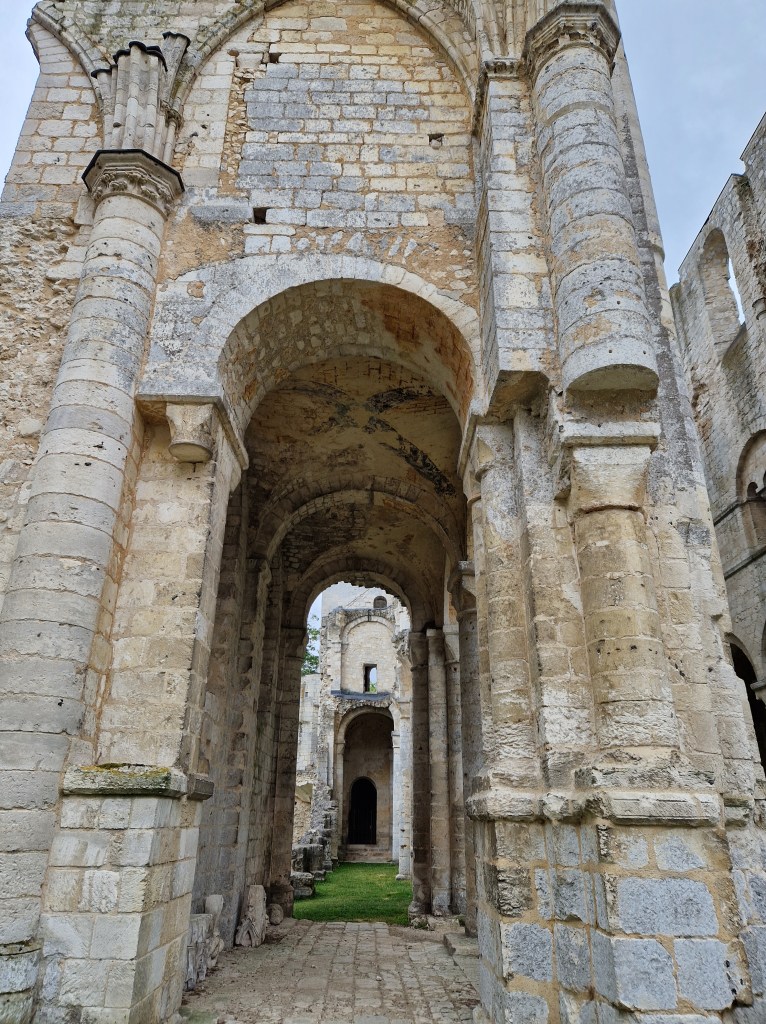
When we visited the abbey last summer, its grandeur, although only ruins today, is still evident; when it was at its height of prosperity, it must have been an awesome sight to behold! In the photos below, which I took during our visit, you can see evidence of the various phases of destruction and reconstruction. Enjoy!

2 Comments

Filed under Articles, Etymology, History, History Undusted, Military History, Snapshots in History

History Undusted: Rolf Ganger, Viking Outlaw and Founder of Normandy

How does a rabble-rousing Viking end up causing a war centuries after his death (as if stirring up trouble during his lifetime wasn’t enough fun and gigs)? Read on… this is going to be a quick, deep dive into history, so buckle up!

Firstly, let’s start with Rolf Ganger, aka Rollo, Rolloun, Rollon, or Hrôlfr – depending on which language you read. On his tomb, the Latin version of his name is Rollonis (see image).

Tomb of Rollonis (Rolf) Ganger, the first ruler of Normandy, in Rouen Cathedral (He’d probably roll in his grave to find himself so simperingly portrayed…!)

The Heimskringla is a collection of ancient Norwegian sagas about Norwegian kings and rulers, written by Snorri Sturluson (great name, by the way) around AD 1230. It tells us that Rolf was the oldest legitimate son of Earl Ragnvald, best friend of King Harald Harfager (“Fair Hair” – a nickname given to him by the Earl due to Harald’s thick, fair hair), who was the first king of Norway, reigning from ca. AD 872 to 930. It tells us that Rolf was so hefty that no horse could carry his weight; thus, he had no choice but to walk everywhere, from which Ganger, his second name derives (I cannot find a direct translation of the meaning of the name, but Germanic languages have similar words: In German, “gehen” means go or walk; “gangart” means gait, or way of walking).

Harald Harfagre, First King of Norway – Statue in Haugusund, Norway

He was rowdy, even by Viking standards. Heimskringla records that he plundered most of the East Sea (likely referring to what is now the region around the Baltic Sea). Then, “One summer, as he was coming from the east on a Viking’s expedition to the coast of Viken*, he landed there and made a cattle foray. As King Harald happened, just at that time, to be in Viken, he heard of it, and was in a great rage; for he had forbid, by the greatest punishment, the plundering within the bounds of the country. The king assembled a Thing**, and had Rolf declared an outlaw over all Norway.”

*Viken was a region that lay over the modern border between Norway and Sweden.

**To assemble a Thing means to gather a council or general assembly. These still take place in some parts of Switzerland, as well as on the Isle of Man and in Scotland; the Icelandic Althing is considered the oldest active, surviving parliament in the world, dating back to the AD 900s. The first detailed description of such a Thing was made by Tacitus, a Roman historian and senator, in AD 98; the oldest reference to a Thing is inscribed on a stone near Hadrian’s Wall, dated as early as AD 43.

According to the Heimskringla, Rolf, now banished from Norway, headed toward the Hebrides, and from there to “Valland” [In Norse legend, Valland is the name of the part of Europe which is inhabited by Celtic and Romance peoples, and Snorri Sturluson mentions it several times as the Old Norse name for Gaul, which was a region of Western Europe first clearly described by the Romans, encompassing present-day France, Belgium, Luxembourg, and parts of Switzerland, the Netherlands, Germany, and Northern Italy, and covering an area of around 494,000 km2.].

Arriving in Gaul, he did what he did best – went a-Viking, plundering and pillaging and “subduing for himself a great earldom”. He populated it with his own best rabble of Norsemen, which the French called Normanz, literally “north men” which quickly led to the Anglicized term Normans (similar to the word for the people group and language, Norse).

One of the places known to have been invaded by the Vikings in AD 841 is the Jumièges Abbey, which is along the Seine River on its way to Rouen, which they also ransacked. At some point (around AD 885), Rolf also raided Bayeux, carrying off a woman, Popa (whose lineage is unverified – later historians for the duke may have sanitized her parentage to legitimize their son’s noble lineage, as she was married “more danico”). She gave birth to his heir, William Longsword. When Rolf and his gang were all done hacking their way through towns and villages along the Seine, they eventually made their way back to Rouen, where he established the Duchy of Normandy in AD 912.

So, how did Rolf cause a war centuries later? Well, his son, William Longsword, fathered a son, Richard the Fearless (who became ruler of Normandy at the age of 10 when his father died). Richard’s son was called Richard the Good, and he became the father of Robert the Magnificent and grandfather to the illegitimate William the Bastard, who became known as William the Conqueror (a sword seems to have cleared up his illegitimacy quite neatly) – from whom all the subsequent English kings descended. Now to the crux of the matter: William, descendent of Rolf Ganger, fathered English kings, who thus claimed their right to the Norman throne by connection, birth, rank… in short, any excuse for raiding was still in their blood. Rouen was one of the largest and most prosperous cities of medieval Europe, and (as mentioned in my last post) was made wealthy through textiles and trade along the Seine River and beyond. Rouen became the focal point of the Hundred Years’ War (1337-1453) because of that pesky connection. So now ya know!

5 Comments

Filed under Articles, Etymology, History, History Undusted, Links to External Articles, Quotes

Virtual Tour: Vintage Switzerland

I’ve been preparing my manuscripts for new releases through a new publisher, and making crafts for our church’s annual craft sale; in the latter process, I’ve discovered a wealth of images through Pinterest (nothing new to me in itself). How many of you used to collect stamps, or postcards, or specific objects? For me, the new method is Pinterest. You can find stamps on any topic, and rare ones; you can find coins, bank notes, and just about anything you used to collect physically, now available at a click with historic backgrounds and full details you could never have fit into an album.

But today, I’d like to focus on Vintage travel posters, specifically for Switzerland. So far, I have nearly 350 in my collection, and it’s likely a drop in the bucket of what was produced; every region advertised itself to attract tourists or travellers, and it’s fascinating to see what they highlighted, how they did so, what their perspective was, and how the people dressed (if they’re shown – in Switzerland, at least, a big focus is on the Alps). Did you know that the word “homesick” in English came from Switzerland? The Swiss merchants that travelled abroad in the 17th century took the word with them; when they spoke of “Heimweh”, however, they weren’t referring to people, or their home, or even their town, but of the mountains. They missed the Alps when they were away… and I can understand why. I think it must run in the veins of every Swiss-born person; when my husband and his mother speak of the mountains, it’s a foreign language to me (even though I’m fluent in Swiss German!).

We might tend to think of tourism as a modern thing; but Grand Tours began in the 17th Century, when wealthy young men, and sometimes women, would embark from the UK on a European tour. At the beginning, Switzerland was a sleepy backwater in some ways – there were few, if any, hotels – if a traveller arrived in a town seeking accommodation for themselves, their servants, postillions and horses, they were often invited to stay in the home of the local politician, who likely had the largest house… But the Swiss soon caught up with the trend, and tourism became a vital source of income, especially for small settlements in the mountainous regions.

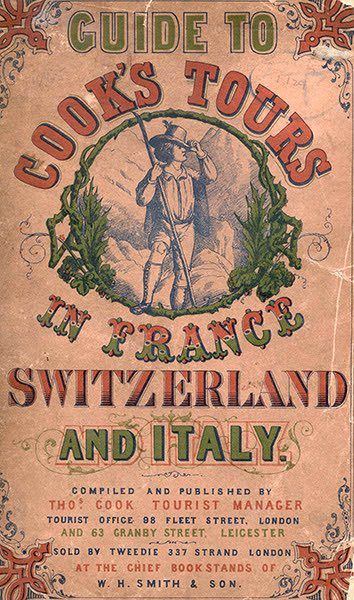
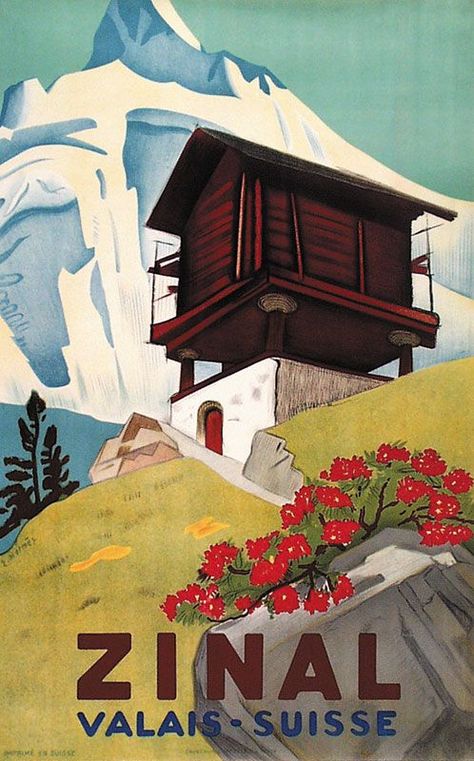
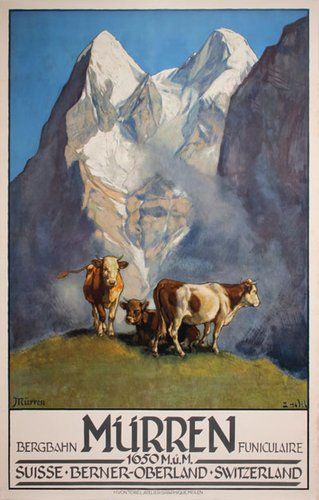
The three images below are, from left to right, from 1897, 1865, and likely the early 19th century. The house shown in the Zinal ad is typical of Wallis (Valais in French): It is built on stilts with round, flat stones between the pillar and house base; we chatted with an elderly man when we were on holidays in the region and asked him about it; it is a way to keep rats and mice out of the houses. It also means that the back, and sometimes even the front, is only accessible by ladder.

The 1865 poster is about a tour organized by Thomas Cook, a well-known name in the British travel industry even today; Cook took his first tour group of around 485 people on an 11-mile train trip from Leicester station to Loughborough, in 1841. Soon, he began to expand his scope, and by the 1860s, that included Switzerland.

The Spiez poster below shows the castle and lake; The Zürich poster shows a view over Lake Zürich from atop the Uetliberg mountain, the summit of which is called Uto Kulm. To see a live-cam panorama from that vantage point, just click here. The Mürren poster is a view typical of every Alpine pasture, even today.

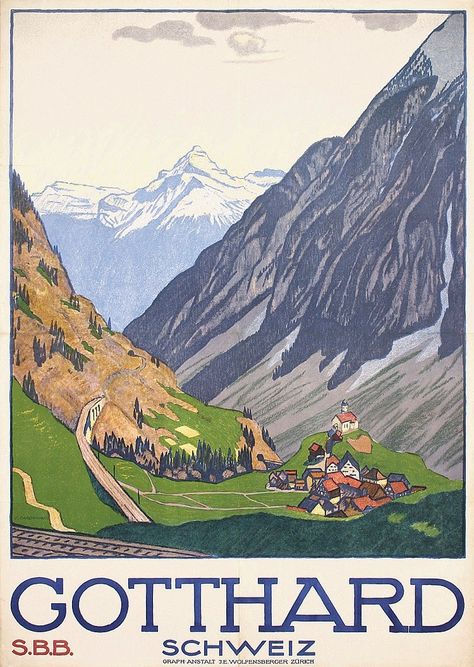
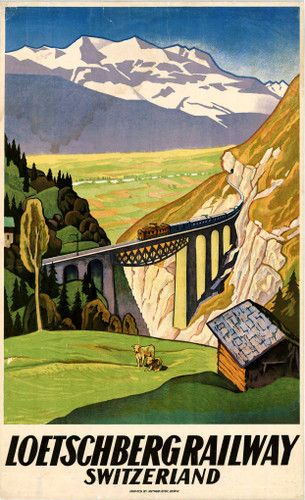
The next 3 images are firmly in the Alps: The glacier shown in the first image is the Aletsch Glacier, the largest in the Alps, covering around 80 square kilometres (31 m2), with a length of ~23 km (14 miles) with a maximum thickness of ~1 km of ice. As with most glaciers in the world, it is retreating. Gotthard (officially the Saint-Gotthard Massif) is an impressive region connecting north and south Switzerland between Uri and Ticino, German- and Italian-speaking cantons, respectively. It has long been a major axis of Europe, with a road across, a vehicle tunnel through (built 1980), a cargo and transport train tunnel (opened 1882), and now a passenger- and vehicle-transport train tunnel which opened in 2016 and is the world’s longest railway tunnel and the deepest traffic tunnel, as well as the first flat low-level tunnel through the Alps. The 3rd poster highlights the Lötschberg, a massif with a train transport tunnel linking the north and south of Switzerland through the Berne and Valais routes. We often take this route when going to Valais or Ticino on holidays; the train is an open, continuous carriage, meaning you drive on, sit in your car, and watch the tunnel fly past.

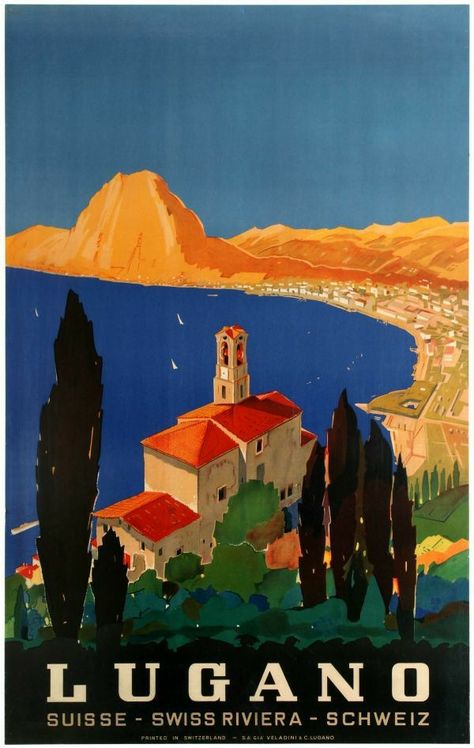
The next 3 posters highlight something nearly ubiquitous in Switzerland: Lakes. They’re everywhere. We even share Lake Constance with Germany and Austria, and Lake Geneva with France. From border to border, we have over 100 main lakes and countless smaller ones (in an area what easily fits within the state of Maine, US, to give you a size comparison). The first poster is encouraging locals to explore, commemorating the 650th anniversary of the formation of the core of Switzerland. The second shows Lake Lugano from the perspective of Monte Bre, with the city of Lugano along the shore. It’s a perspective I know well, as the family had a holiday home on the flanks of Monte Bre until last year. San Salvatore is the mountain peak shown. The third poster is of the Vierwaldstättersee (“Lake of the four forested settlments”): This is the most complex lake in Switzerland, and not only for its names: In English it’s known as Lake Lucerne, although that is just one arm of the sprawl. Sections are Lake Lucerne, Lake Urner, Lake Kussnacht, Chrüztrichter and Lake Alpnacher. The many-armed lake is shared by the cantons of Uri, Schwyz, Obwalden, Nidwalden (originally one canton known as Unterwalden) and Lucerne. Signs of settlements found by archaeologists go back to at least 3,000 BC. To see this lake through live-cams, just click here. The site is in German, but just click on the view you’d like to explore.

I hope you’ve enjoyed this virtual tour! And perhaps you’ll come to Switzerland one day to see it for yourself!

2 Comments

Filed under Articles, Etymology, Family History, History, Links to External Articles, Nature, Snapshots in History, Virtual Tours

History Undusted: The Age of Revolutions

This past summer, my husband and I rented a motorhome and travelled around Switzerland; we tend to prefer nature or museums to overly-touristy attractions. One of the places we visited was Spiez Castle. Before I tell you about that, however, a little historical backdrop is necessary, so buckle up and enjoy the ride!

Everyone’s heard of the French Revolution, which began in May 1789: It was a struggle to become free from the heavy yoke of an elitist monarchical regime, quasi out of the frying pan and into the fire of the Reign of Terror – during which many of the original rebels, in a twist of morbid irony, also had their heads removed by Monsieur Guillotine; it ended in November 1799 with the abolition of the Ancien Régime and the creation of constitutional monarchy (not far from where they started) and the French Consulate (which lasted nearly 5 years until the start of the Napoleonic Empire in May 1804).

But what many people might not know is that the French Revolution was internationally both influenced and influential. Modern “small world” effects are not modern at all; even in ancient times, people had international news: Travelling merchants and traders, messengers, signal towers (such as those the Romans used along the British frontiers), and even smoke signals, all conveyed news. When the French Revolution began, there was already a growing political dissent spreading throughout Western Europe; the English “coffeehouse culture” enabled men to gather in small groups and discuss business and politics; this concept travelled to America, and the discontent culminated in the American Revolution, starting in April of 1775. The French people watched and learned. The British government naturally became wary – they were losing the American colonies to the Revolutionary War, which they finally lost in September 1783. The Americans were supported during that time by France and Spain (the two main long-term enemies of Britain), so the British were hemmed in by threats to their own social order from both the east and the west, and they had well-founded fears of the discontent sparking revolt in the dry tinder of their own oppressed ranks.

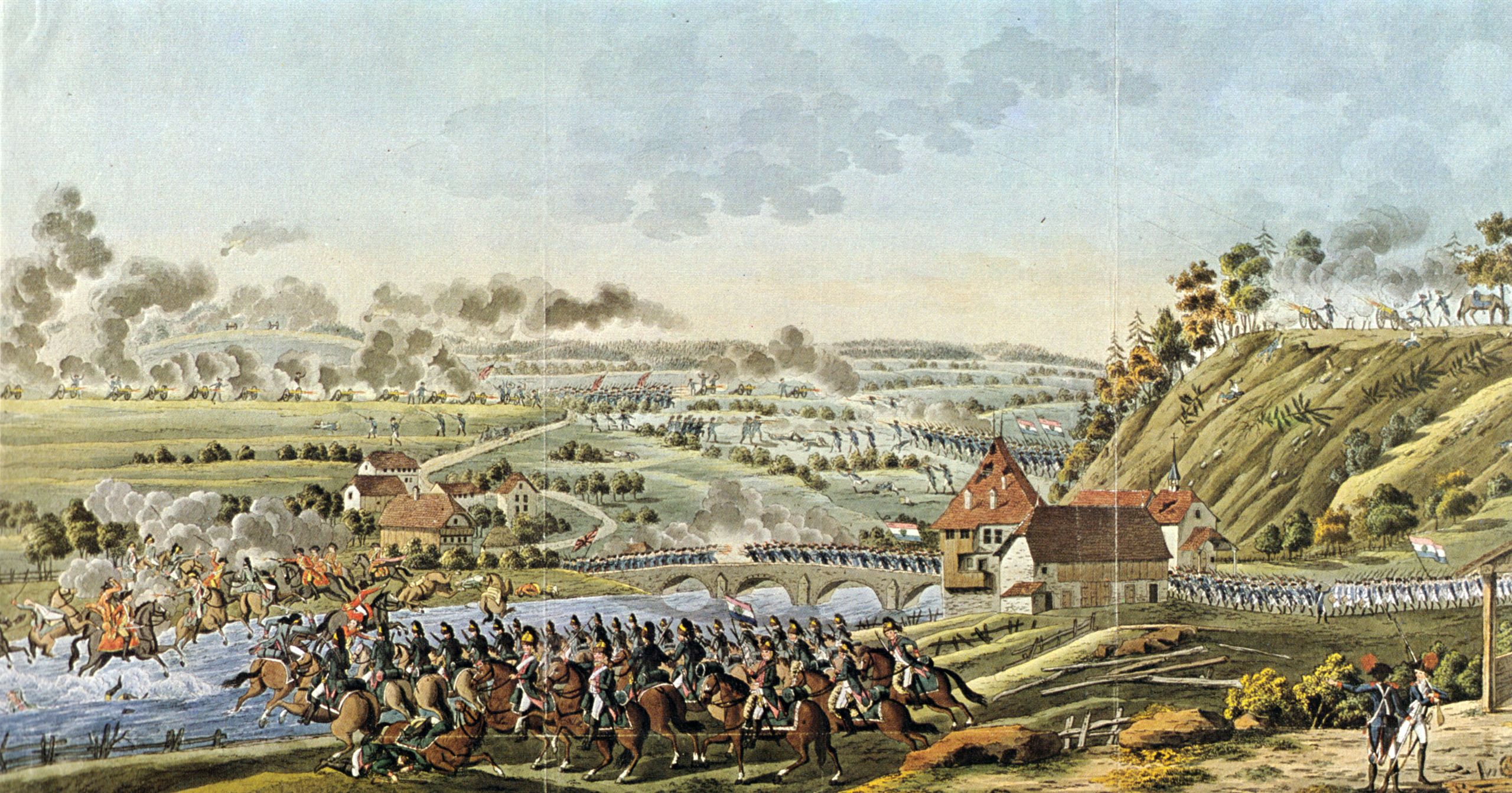
And now we come to Switzerland: To understand the Swiss backstory in a nutshell, which does no justice to a history that began in the Palaeolithic Age or further back, let me sum it up: The Old Swiss Confederacy was an alliance between independent small states, starting on 1 August 1291 with the “Rütlischwur”(an oath of allegiance between the cantons of Uri, Schwyz and Unterwalden), which date is considered by the Swiss to be the birth of the nation (though history is more complicated). As the French Revolution was beginning to wind down, Napoleon Bonaparte, then a French general, pressed the French Directory (the then-current French governing committee) to invade Switzerland. The atmosphere within the Old Swiss Confederacy was tense, fearing that the French Revolution would spill over with or without direct French military involvement. At the invitation of a French-speaking faction in Vaud (then part of Canton Berne), 12,000 French troops invaded through Vaud on 28 January 1798, and for the next four months, battles were waged between the French and the Swiss “Loyal Legions”. It ended in May with the swift collapse of the Swiss Old Confederacy.  

The Battle of Neuenegg, 1798 – Graphics Collection, Central Library, Zürich

However, the French Directory needed a solid neighbour, a buffer zone along their eastern borders, not a loosely associated collection of small states; they tried to steer toward a re-establishment of national unity with a Paris-drawn constitution, but on April 1798, Swiss cantonal leaders proclaimed the Helvetic Republic, with new legal structures that abolished feudal rights within individual cantons in favour of a national unity. A few battles later, and coalition armies waging war in and around Switzerland against France, eventually left Switzerland as a sovereign, neutral nation; it has remained so ever since, despite two world wars.

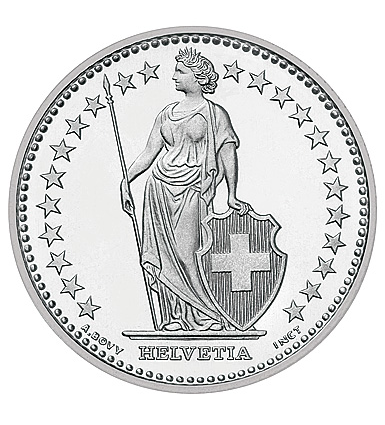
An etymological side note on the Latin name of the Swiss Confederation (Switzerland), Confoederatio Helvetica: Helvetia is the female personification of Switzerland, found on nearly every coin, much like Lady Liberty of America. The name derives from Helvetii, a Celtic tribe that inhabited the Swiss Plateau since before the Roman Era. The earliest reference of the name is dated to ca. 300 BC, written in Etruscan on a vessel from Mantua (located in Lombardy, Italy). By the time the Romans arrived, they were well-established tribes governed by noblemen; the Roman historians tended to refer to anyone not Roman as “barbarian”, which tends to skew modern understanding of the peoples they conquered; it was perhaps their way of justifying invasions against peaceful, intact civilisations. Naming no names, but R—– is repeating that same shameful tactic today; there’s nothing new under the sun.

It’s easy to overlook the complexities of historical events or view them from only one nation’s side; after all, as Mark Twain once wrote, “The very ink with which all history is written is merely fluid prejudice.” History’s angle is in the hands of those who wrote it – if they were Roman, everyone else was barbarian; if they were English, the Scottish / Irish / Indians were backwaters in need of a guiding stick, and so on.

So, now that you know a bit more about the history in and around Switzerland, I’ll highlight Spiez Castle next!

3 Comments

Filed under Etymology, History, History Undusted, Military History, Quotes, Snapshots in History

History Undusted: William Caxton (the father of English as we know it today)

I’ve been trying to blog the last few weeks, but to do so, it helps to be logged in to WordPress – and it kept logging me out every time I switched to my site. I finally found the solution this morning, so here I am!

One thing I’ve been ruminating about is the etymology of everyday words; words come from somewhere, and I’ve always wondered what word(s) were used before a word came along. There are famous examples of invented words that never stuck, such as Lewis Carol’s “Jabberwocky“, but what I’m referring to are common words. What did they use before the word “egg” came along? The word itself comes from Old Norse, eggys, eggja, or egge, but before the common spelling was decided on, every English dialect in Britain had at least a couple of different spellings of the word!

William Shakespeare (1564-1616) is sometimes credited with having created upwards of 1,700 words, but many of those were likely already in circulation – he simply wrote them down in his plays. Some words accredited to him are: dishearten; dislocate; auspicious; obscene; monumental; majestic; accommodation; amazement; dwindle; exposure; bloody; countless; courtship; impartial; gnarled; gloomy; generous; reliance; pious; inauspicious; bump; frugal; submerge; critic; lapse; laughable; lonely, suspicious, and many, many more.

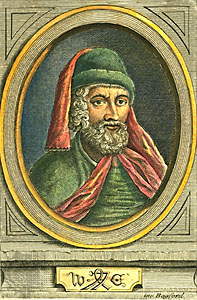
But long before William Shakespeare drew breath, there was another William who influenced English in profound ways, and yet his name is little known today: William Caxton. Born around 1420, he was a merchant, printer and the first English retailer of books; he introduced the printing press to England, set up in Westminster, 1476. Though he published many books, the first book he is known to have published is The Canterbury Tales, by Geoffrey Chaucer (1340s – 1400); that work alone is credited with influencing both the English language and literature, as it shows a clear correspondence between the rhythm of written English poetry and the cadence of spoken English. Chaucer is also known for having looted the French language, bringing into English such words as governance, paramour, difficult, dishonest, edifice, and ignorant, to name a few. Chaucer was aware of the wide variety of English dialects, which we would never recognize as English today, and he was anxious about the confusion of languages in Britain and that his work would be able to be comprehended in the future. In his poem, Troilus and Criseyde, he bids it a poignant but troubled farewell: “Go, litel bok . . . And for ther is so gret diversite In Englissh and in writyng of oure tonge, So prey I God that non miswryte the [thee]. . . . That thow be understonde, God I biseche!”

However, because William Caxton chose to publish Chaucer’s work, we still have it to this day. Caxton was also the first to translate Aesop’s Fables into English (1484). Although he was not a great translator and sometimes simply used the French word “Englishified”, his translations were popular; because of that, he inadvertently helped promote Chancery* English as the standard English dialect throughout England. (*Chancery refers to the dialect used by the officials of Henry V’s government). Thanks to men like William Caxton and those who followed, refining and shaping the language we know today, we are able to enjoy a standard English spelling and grammar structure that is understood around the world; there are still regional and national dialect differences, but we can be understood wherever in the world English is used.

If you’d like to learn more about this topic, one book I can highly recommend is Melvyn Bragg’s The Adventure of English (The Biography of a Language); it’s available in physical form, e-book, and audiobook.

William Caxton

8 Comments

Filed under Etymology, Grammar, History, History Undusted, Links to External Articles, Lists, Poetry

History Undusted: Rabbit Holes & Licorice Candy

This week, I did a major shopping at a couple Asian food stores; I stocked up on the ingredients I know, and some I didn’t; I like to get things I’ve never heard of, and do a bit of research on how to use it in cooking; things I picked up in that category are Iranian Kashk, which is a tangy fermented, yoghurt used as a condiment; canned palm hearts, which make a nice topping on desserts; and fermented black beans, which can be used in a variety of Asian dishes, including in a black bean sauce. I also bought several fresh vegetables and herbs to dehydrate and turn into a greens powder for adding flavours to dishes (I have a more usual greens powder with standard greens, like cauliflower leaves, spinach, etc. that I use daily).

One of the herbs I used was acacia leaf: When I opened the package, a pungent, sulphur-like smell hit me, and I wasn’t sure I’d use it. But when I began de-leafing it (much like you would thyme, though carefully as it’s got some vicious thorns!), it began to smell like mint! As I added lemongrass, Thai water spinach and other herbs, you can imagine the cacophony of fragrances in my kitchen – which filled the house as they dehydrated.

So what does this have to do with licorice? Well, one of the fresh herbs I also processed was Thai basil; I’d never used it before, and when I opened the packaging, a wave of anise- or licorice aroma hit me. And as usual, that set my mind off, thinking about the history of licorice!

Licorice is a flowering plant native to parts of Asia and Europe; its scientific name, Glycyrrhiza, comes from Greek and means “sweet root” (the linguistic roots are related to words like glycerine and rhizome); it is the ingredient that gives the signature flavour to black licorice, though today anise oil is often used as a substitute because the Glycyrrhiza can have toxic effects if ingested too much.

In looking into the history of this flavour, I came across a fascinating documentary: Ostensibly, it covers the history of the Switzer Licorice candy company. But in truth, it’s a fascinating historical insight into the history of Irish immigration, social unrest, the Irish famine, Irish revolution and exile, union labour foundations, World War 1 through the eyes of a family, the economic upheavals of war, rations and the company’s creative solutions, the history of sugar, post-war recovery, the Great Depression, the American Dream, candy-making, the rise of a family from Kerry Patch (the Irish ghetto of St. Louis, Missouri) to the suburbs, the history and development of St. Louis, and the demise of a family company resurrected by later generations. All in a 55-minute video!

 To watch this fascinating slice of history, click here. To check out the company’s website, click here.

I hope you enjoy this short history, and while you’re at it, enjoy a piece of licorice!

Image Credit: Switzer website (see link above)

Leave a comment

Filed under Articles, Etymology, History, History Undusted, How It's Made, Links to External Articles, Military History, Science & Technology, Snapshots in History, Videos, YouTube Link