Category Archives: Links to External Articles

History Undusted: Rolf Ganger, Viking Outlaw and Founder of Normandy

How does a rabble-rousing Viking end up causing a war centuries after his death (as if stirring up trouble during his lifetime wasn’t enough fun and gigs)? Read on… this is going to be a quick, deep dive into history, so buckle up!

Firstly, let’s start with Rolf Ganger, aka Rollo, Rolloun, Rollon, or Hrôlfr – depending on which language you read. On his tomb, the Latin version of his name is Rollonis (see image).

Tomb of Rollonis (Rolf) Ganger, the first ruler of Normandy, in Rouen Cathedral (He’d probably roll in his grave to find himself so simperingly portrayed…!)

The Heimskringla is a collection of ancient Norwegian sagas about Norwegian kings and rulers, written by Snorri Sturluson (great name, by the way) around AD 1230. It tells us that Rolf was the oldest legitimate son of Earl Ragnvald, best friend of King Harald Harfager (“Fair Hair” – a nickname given to him by the Earl due to Harald’s thick, fair hair), who was the first king of Norway, reigning from ca. AD 872 to 930. It tells us that Rolf was so hefty that no horse could carry his weight; thus, he had no choice but to walk everywhere, from which Ganger, his second name derives (I cannot find a direct translation of the meaning of the name, but Germanic languages have similar words: In German, “gehen” means go or walk; “gangart” means gait, or way of walking).

Harald Harfagre, First King of Norway – Statue in Haugusund, Norway

He was rowdy, even by Viking standards. Heimskringla records that he plundered most of the East Sea (likely referring to what is now the region around the Baltic Sea). Then, “One summer, as he was coming from the east on a Viking’s expedition to the coast of Viken*, he landed there and made a cattle foray. As King Harald happened, just at that time, to be in Viken, he heard of it, and was in a great rage; for he had forbid, by the greatest punishment, the plundering within the bounds of the country. The king assembled a Thing**, and had Rolf declared an outlaw over all Norway.”

*Viken was a region that lay over the modern border between Norway and Sweden.

**To assemble a Thing means to gather a council or general assembly. These still take place in some parts of Switzerland, as well as on the Isle of Man and in Scotland; the Icelandic Althing is considered the oldest active, surviving parliament in the world, dating back to the AD 900s. The first detailed description of such a Thing was made by Tacitus, a Roman historian and senator, in AD 98; the oldest reference to a Thing is inscribed on a stone near Hadrian’s Wall, dated as early as AD 43.

According to the Heimskringla, Rolf, now banished from Norway, headed toward the Hebrides, and from there to “Valland” [In Norse legend, Valland is the name of the part of Europe which is inhabited by Celtic and Romance peoples, and Snorri Sturluson mentions it several times as the Old Norse name for Gaul, which was a region of Western Europe first clearly described by the Romans, encompassing present-day France, Belgium, Luxembourg, and parts of Switzerland, the Netherlands, Germany, and Northern Italy, and covering an area of around 494,000 km2.].

Arriving in Gaul, he did what he did best – went a-Viking, plundering and pillaging and “subduing for himself a great earldom”. He populated it with his own best rabble of Norsemen, which the French called Normanz, literally “north men” which quickly led to the Anglicized term Normans (similar to the word for the people group and language, Norse).

One of the places known to have been invaded by the Vikings in AD 841 is the Jumièges Abbey, which is along the Seine River on its way to Rouen, which they also ransacked. At some point (around AD 885), Rolf also raided Bayeux, carrying off a woman, Popa (whose lineage is unverified – later historians for the duke may have sanitized her parentage to legitimize their son’s noble lineage, as she was married “more danico”). She gave birth to his heir, William Longsword. When Rolf and his gang were all done hacking their way through towns and villages along the Seine, they eventually made their way back to Rouen, where he established the Duchy of Normandy in AD 912.

So, how did Rolf cause a war centuries later? Well, his son, William Longsword, fathered a son, Richard the Fearless (who became ruler of Normandy at the age of 10 when his father died). Richard’s son was called Richard the Good, and he became the father of Robert the Magnificent and grandfather to the illegitimate William the Bastard, who became known as William the Conqueror (a sword seems to have cleared up his illegitimacy quite neatly) – from whom all the subsequent English kings descended. Now to the crux of the matter: William, descendent of Rolf Ganger, fathered English kings, who thus claimed their right to the Norman throne by connection, birth, rank… in short, any excuse for raiding was still in their blood. Rouen was one of the largest and most prosperous cities of medieval Europe, and (as mentioned in my last post) was made wealthy through textiles and trade along the Seine River and beyond. Rouen became the focal point of the Hundred Years’ War (1337-1453) because of that pesky connection. So now ya know!

5 Comments

Filed under Articles, Etymology, History, History Undusted, Links to External Articles, Quotes

Virtual Tour: Vintage Switzerland

I’ve been preparing my manuscripts for new releases through a new publisher, and making crafts for our church’s annual craft sale; in the latter process, I’ve discovered a wealth of images through Pinterest (nothing new to me in itself). How many of you used to collect stamps, or postcards, or specific objects? For me, the new method is Pinterest. You can find stamps on any topic, and rare ones; you can find coins, bank notes, and just about anything you used to collect physically, now available at a click with historic backgrounds and full details you could never have fit into an album.

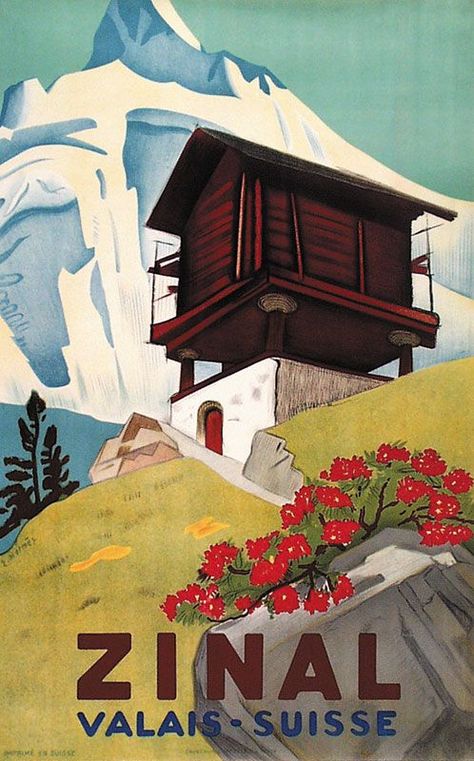
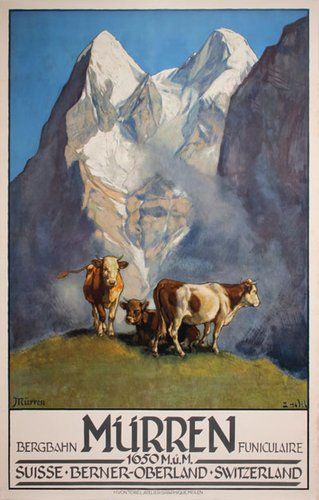
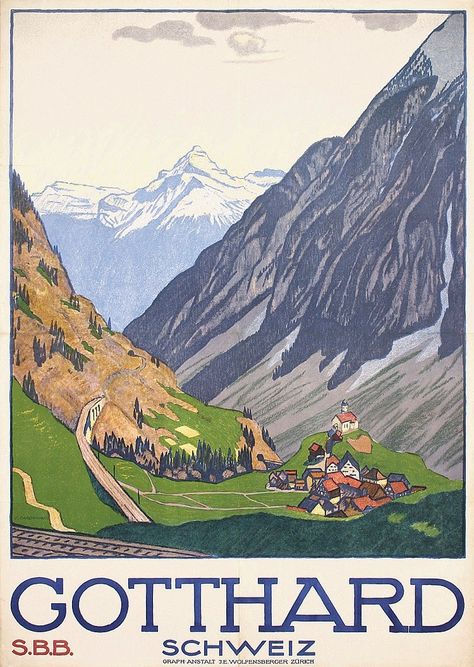
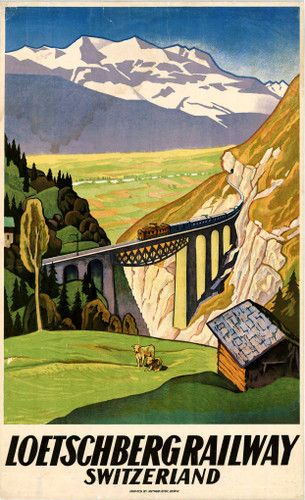
But today, I’d like to focus on Vintage travel posters, specifically for Switzerland. So far, I have nearly 350 in my collection, and it’s likely a drop in the bucket of what was produced; every region advertised itself to attract tourists or travellers, and it’s fascinating to see what they highlighted, how they did so, what their perspective was, and how the people dressed (if they’re shown – in Switzerland, at least, a big focus is on the Alps). Did you know that the word “homesick” in English came from Switzerland? The Swiss merchants that travelled abroad in the 17th century took the word with them; when they spoke of “Heimweh”, however, they weren’t referring to people, or their home, or even their town, but of the mountains. They missed the Alps when they were away… and I can understand why. I think it must run in the veins of every Swiss-born person; when my husband and his mother speak of the mountains, it’s a foreign language to me (even though I’m fluent in Swiss German!).

We might tend to think of tourism as a modern thing; but Grand Tours began in the 17th Century, when wealthy young men, and sometimes women, would embark from the UK on a European tour. At the beginning, Switzerland was a sleepy backwater in some ways – there were few, if any, hotels – if a traveller arrived in a town seeking accommodation for themselves, their servants, postillions and horses, they were often invited to stay in the home of the local politician, who likely had the largest house… But the Swiss soon caught up with the trend, and tourism became a vital source of income, especially for small settlements in the mountainous regions.

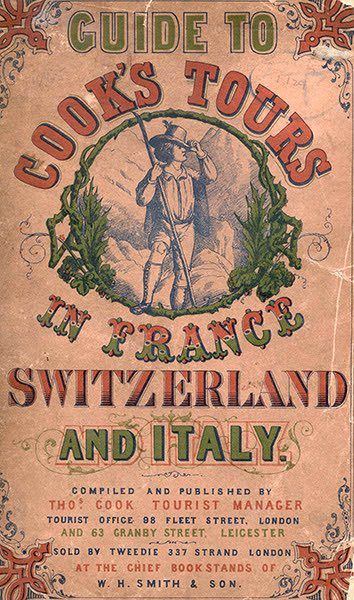
The three images below are, from left to right, from 1897, 1865, and likely the early 19th century. The house shown in the Zinal ad is typical of Wallis (Valais in French): It is built on stilts with round, flat stones between the pillar and house base; we chatted with an elderly man when we were on holidays in the region and asked him about it; it is a way to keep rats and mice out of the houses. It also means that the back, and sometimes even the front, is only accessible by ladder.

The 1865 poster is about a tour organized by Thomas Cook, a well-known name in the British travel industry even today; Cook took his first tour group of around 485 people on an 11-mile train trip from Leicester station to Loughborough, in 1841. Soon, he began to expand his scope, and by the 1860s, that included Switzerland.

The Spiez poster below shows the castle and lake; The Zürich poster shows a view over Lake Zürich from atop the Uetliberg mountain, the summit of which is called Uto Kulm. To see a live-cam panorama from that vantage point, just click here. The Mürren poster is a view typical of every Alpine pasture, even today.

The next 3 images are firmly in the Alps: The glacier shown in the first image is the Aletsch Glacier, the largest in the Alps, covering around 80 square kilometres (31 m2), with a length of ~23 km (14 miles) with a maximum thickness of ~1 km of ice. As with most glaciers in the world, it is retreating. Gotthard (officially the Saint-Gotthard Massif) is an impressive region connecting north and south Switzerland between Uri and Ticino, German- and Italian-speaking cantons, respectively. It has long been a major axis of Europe, with a road across, a vehicle tunnel through (built 1980), a cargo and transport train tunnel (opened 1882), and now a passenger- and vehicle-transport train tunnel which opened in 2016 and is the world’s longest railway tunnel and the deepest traffic tunnel, as well as the first flat low-level tunnel through the Alps. The 3rd poster highlights the Lötschberg, a massif with a train transport tunnel linking the north and south of Switzerland through the Berne and Valais routes. We often take this route when going to Valais or Ticino on holidays; the train is an open, continuous carriage, meaning you drive on, sit in your car, and watch the tunnel fly past.

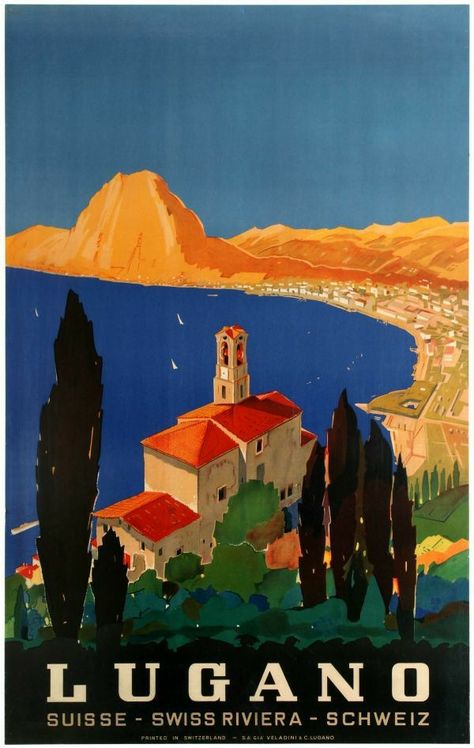
The next 3 posters highlight something nearly ubiquitous in Switzerland: Lakes. They’re everywhere. We even share Lake Constance with Germany and Austria, and Lake Geneva with France. From border to border, we have over 100 main lakes and countless smaller ones (in an area what easily fits within the state of Maine, US, to give you a size comparison). The first poster is encouraging locals to explore, commemorating the 650th anniversary of the formation of the core of Switzerland. The second shows Lake Lugano from the perspective of Monte Bre, with the city of Lugano along the shore. It’s a perspective I know well, as the family had a holiday home on the flanks of Monte Bre until last year. San Salvatore is the mountain peak shown. The third poster is of the Vierwaldstättersee (“Lake of the four forested settlments”): This is the most complex lake in Switzerland, and not only for its names: In English it’s known as Lake Lucerne, although that is just one arm of the sprawl. Sections are Lake Lucerne, Lake Urner, Lake Kussnacht, Chrüztrichter and Lake Alpnacher. The many-armed lake is shared by the cantons of Uri, Schwyz, Obwalden, Nidwalden (originally one canton known as Unterwalden) and Lucerne. Signs of settlements found by archaeologists go back to at least 3,000 BC. To see this lake through live-cams, just click here. The site is in German, but just click on the view you’d like to explore.

I hope you’ve enjoyed this virtual tour! And perhaps you’ll come to Switzerland one day to see it for yourself!

2 Comments

Filed under Articles, Etymology, Family History, History, Links to External Articles, Nature, Snapshots in History, Virtual Tours

History Undusted: William Caxton (the father of English as we know it today)

I’ve been trying to blog the last few weeks, but to do so, it helps to be logged in to WordPress – and it kept logging me out every time I switched to my site. I finally found the solution this morning, so here I am!

One thing I’ve been ruminating about is the etymology of everyday words; words come from somewhere, and I’ve always wondered what word(s) were used before a word came along. There are famous examples of invented words that never stuck, such as Lewis Carol’s “Jabberwocky“, but what I’m referring to are common words. What did they use before the word “egg” came along? The word itself comes from Old Norse, eggys, eggja, or egge, but before the common spelling was decided on, every English dialect in Britain had at least a couple of different spellings of the word!

William Shakespeare (1564-1616) is sometimes credited with having created upwards of 1,700 words, but many of those were likely already in circulation – he simply wrote them down in his plays. Some words accredited to him are: dishearten; dislocate; auspicious; obscene; monumental; majestic; accommodation; amazement; dwindle; exposure; bloody; countless; courtship; impartial; gnarled; gloomy; generous; reliance; pious; inauspicious; bump; frugal; submerge; critic; lapse; laughable; lonely, suspicious, and many, many more.

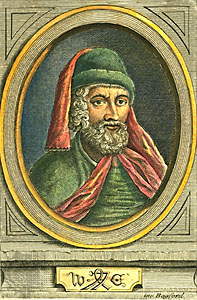
But long before William Shakespeare drew breath, there was another William who influenced English in profound ways, and yet his name is little known today: William Caxton. Born around 1420, he was a merchant, printer and the first English retailer of books; he introduced the printing press to England, set up in Westminster, 1476. Though he published many books, the first book he is known to have published is The Canterbury Tales, by Geoffrey Chaucer (1340s – 1400); that work alone is credited with influencing both the English language and literature, as it shows a clear correspondence between the rhythm of written English poetry and the cadence of spoken English. Chaucer is also known for having looted the French language, bringing into English such words as governance, paramour, difficult, dishonest, edifice, and ignorant, to name a few. Chaucer was aware of the wide variety of English dialects, which we would never recognize as English today, and he was anxious about the confusion of languages in Britain and that his work would be able to be comprehended in the future. In his poem, Troilus and Criseyde, he bids it a poignant but troubled farewell: “Go, litel bok . . . And for ther is so gret diversite In Englissh and in writyng of oure tonge, So prey I God that non miswryte the [thee]. . . . That thow be understonde, God I biseche!”

However, because William Caxton chose to publish Chaucer’s work, we still have it to this day. Caxton was also the first to translate Aesop’s Fables into English (1484). Although he was not a great translator and sometimes simply used the French word “Englishified”, his translations were popular; because of that, he inadvertently helped promote Chancery* English as the standard English dialect throughout England. (*Chancery refers to the dialect used by the officials of Henry V’s government). Thanks to men like William Caxton and those who followed, refining and shaping the language we know today, we are able to enjoy a standard English spelling and grammar structure that is understood around the world; there are still regional and national dialect differences, but we can be understood wherever in the world English is used.

If you’d like to learn more about this topic, one book I can highly recommend is Melvyn Bragg’s The Adventure of English (The Biography of a Language); it’s available in physical form, e-book, and audiobook.

William Caxton

9 Comments

Filed under Etymology, Grammar, History, History Undusted, Links to External Articles, Lists, Poetry

Humanity Highlight: Redeeming Toxic Land with Lavender

I came across this story today, and wanted to share it: In the US, coal mining used to be big business; but with the move away from fossil fuels toward solar and other less destructive sources, companies have been in decline; before the mid-1970s, mining companies could just abandon the scarred land, but laws were passed that would require the companies to revitalise the wasteland; but if a company simply went bankrupt, the land sat barren, polluting the surrounding environment for decades, as rocks and minerals that had been buried forever were exposed to air and water, releasing their substances into groundwater and the air. Millions of acres of scarred land are the result.

Now, Appalachian Botanical Company in West Virginia has begun reclaiming the land in a beautiful way: Hiring ex-miners who’ve lost their jobs or other people who need a second chance just like the land, such as ex-drug addicts, they are now working in fields of flowers. Lavender is a hardy plant in the mint family that likes to grow in poor soil; it’s a perfect match for the rocky wastelands around coal mines. Every part of the plant is used: The flowers and upper stems are distilled down to make lavender essential oils that are then also used to make various creams and lotions, honey, salts, and hand sanitisers; when it’s done, they transform the biomass into compost to revitalise the land. The lower leaves are first removed, dipped in rooting powder, and planted to make the next harvest.

It’s an amazingly holistic approach to the problems: Creating jobs in the regions that have been hard-hit by economic downturns; revitalising the land through restoration – lavender will help prepare the land for other less hardy species to take root; and on a larger scale, it provides an example of what could be done with scarred land. To watch the Business Insider video, just click here. To check out the ABCo website and their products, click on the image below. Enjoy, and if you’d like to support what they’re doing, check out the pages on their websites, too.

2 Comments

Filed under Articles, How It's Made, Humanity Highlights, Links to External Articles, Nature, Science & Technology, Videos, YouTube Link

History Undusted: Rabbit Holes & Licorice Candy

This week, I did a major shopping at a couple Asian food stores; I stocked up on the ingredients I know, and some I didn’t; I like to get things I’ve never heard of, and do a bit of research on how to use it in cooking; things I picked up in that category are Iranian Kashk, which is a tangy fermented, yoghurt used as a condiment; canned palm hearts, which make a nice topping on desserts; and fermented black beans, which can be used in a variety of Asian dishes, including in a black bean sauce. I also bought several fresh vegetables and herbs to dehydrate and turn into a greens powder for adding flavours to dishes (I have a more usual greens powder with standard greens, like cauliflower leaves, spinach, etc. that I use daily).

One of the herbs I used was acacia leaf: When I opened the package, a pungent, sulphur-like smell hit me, and I wasn’t sure I’d use it. But when I began de-leafing it (much like you would thyme, though carefully as it’s got some vicious thorns!), it began to smell like mint! As I added lemongrass, Thai water spinach and other herbs, you can imagine the cacophony of fragrances in my kitchen – which filled the house as they dehydrated.

So what does this have to do with licorice? Well, one of the fresh herbs I also processed was Thai basil; I’d never used it before, and when I opened the packaging, a wave of anise- or licorice aroma hit me. And as usual, that set my mind off, thinking about the history of licorice!

Licorice is a flowering plant native to parts of Asia and Europe; its scientific name, Glycyrrhiza, comes from Greek and means “sweet root” (the linguistic roots are related to words like glycerine and rhizome); it is the ingredient that gives the signature flavour to black licorice, though today anise oil is often used as a substitute because the Glycyrrhiza can have toxic effects if ingested too much.

In looking into the history of this flavour, I came across a fascinating documentary: Ostensibly, it covers the history of the Switzer Licorice candy company. But in truth, it’s a fascinating historical insight into the history of Irish immigration, social unrest, the Irish famine, Irish revolution and exile, union labour foundations, World War 1 through the eyes of a family, the economic upheavals of war, rations and the company’s creative solutions, the history of sugar, post-war recovery, the Great Depression, the American Dream, candy-making, the rise of a family from Kerry Patch (the Irish ghetto of St. Louis, Missouri) to the suburbs, the history and development of St. Louis, and the demise of a family company resurrected by later generations. All in a 55-minute video!

 To watch this fascinating slice of history, click here. To check out the company’s website, click here.

I hope you enjoy this short history, and while you’re at it, enjoy a piece of licorice!

Image Credit: Switzer website (see link above)

Leave a comment

Filed under Articles, Etymology, History, History Undusted, How It's Made, Links to External Articles, Military History, Science & Technology, Snapshots in History, Videos, YouTube Link

Virtual Tour: Museum of Play

Playing keeps us young. Everyone who’s got a healthy sense of balance has a little kid inside of them that likes to come out to play once in a while. And because it’s something all of us can relate to in one way or another, some clever folks have put together a museum dedicated to having fun! From toys, electronic games, television programmes like Sesame Street, board games, ball games, dolls, card games – you name it, they’ve probably got an exhibit about it! The Strong National Museum of Play also has a large number of online exhibits, so if you don’t live near Rochester, New York, you can still enjoy their collections. So come along on a tour of playing – just click on the image below and enjoy playing around!

Question: What was your favourite game as a child? I’d love to hear from you in the comments below!

Photo Credit: Strong National Museum of Play website

“It’s the things we play with and the people who help us play that make a great difference in our lives.”

Fred Rogers, American television personality, 1928–2003

6 Comments

Filed under History, Links to External Articles, Virtual Tours

Virtual Tour: Money Museum

Let’s go on a virtual outing! This time, to a Swiss museum located on my doorstep, in Zürich. I can’t imagine a better place to have a museum on that topic.

Have you ever wondered where coins started, or what the history of money is? Look no further. Have you ever wondered what blockchain technology is, or what cryptocurrencies are (and there are over 8 thousand so far!)?

Included in the tour are 5-minute podcasts exploring the topic of money, as well as visual tours of coins throughout time and regions.

Besides the online presence, this museum is also a library and a forum, where people can gather for lectures and discussion groups around the topic of money, finances, markets, etc.

Coins are just one form of payment, but throughout the centuries, different people have put a value on different objects, and trading them became a type of currency: When the Russian currency nosedived in value, vodka became a currency because, in that culture, vodka was the most stable commodity! In other cultures, beads, shells, water gourds, and many other objects have been currency; in another article, I’ve talked about hack silver – jewellery worn with scoring to allow easy division into pieces to trade for goods.

Here’s a quick question for you: Do you know what your money really looks like? We may have handled it dozens of times in a week, but have we ever really stopped to examine it? I remember back when shillings were still valid coinage in Britain – they were used in lieu of 5p pieces; when the new coins came into circulation, I would have been hard-pressed to tell you what they’d looked like before! The same goes for banknotes here in Switzerland, which changed to the current design back in 1995. Once a new coin or banknote comes into use, it’s hard to remember what the old ones looked like. Interestingly, some Swiss coins have not changed; I once found a 10-rappen coin in my purse from 1899! It went straight into my coin collection. Since then, I always check my loose change. As a matter of fact, the 10-rappen coin holds the Guinness World Record for the oldest original currency in circulation.

The history and scope of money is a fascinating one, once you scratch below the surface. Click here to take the virtual tour through the world of money, and enjoy!

The Swiss 10-rappen coin, the oldest original currency in circulation today.

2 Comments

Filed under History, History Undusted, Links to External Articles, Virtual Tours

History Undusted: Advent Calendars

This month has flown by! Last weekend was our church’s annual advent market, and I was present with tables full of crafts, as well as marble-iced cookies, Spitzbuben, cheese cookies & apple chips (dehydrated). Before it took off, I was preparing, baking, labelling, and doing all the little bits and bobs to get ready; it went off well, considering the limitations of Covid. I also got our own Advent calendar completed – I talk about that more in a previous post. But the whole topic of the market got me wondering where Advent calendars started, so I thought I’d share with you what I’ve discovered: As you probably know, advent calendars today can take any form you choose; the only common factor is that they usually cover 24 days and begin on 1 December (as opposed to following the 4 Advent Sundays – this year, the first Sunday fell on 28 November). The first calendars weren’t: In the early 1800s, German protestants began marking chalk lines on a wall or lighting a candle each day of the Advent season; they sometimes accompanied the act with a devotional reading or with an image centered around the advent, or coming, of Jesus (traditionally celebrated on 25 December, though that was hardly his birthday – but that’s another topic). The first actual calendars were made of cardboard in Germany, and appeared in the early 1900s; they often had either a poem or a picture behind each door, and were produced until World War 2, when the Nazis banned their use on the excuse that cardboard was scarce – and then, in 1943, they promptly sent out advent booklets to every mother in the land – but they seem to have missed the point: their versions had images of German soldiers blowing up Russian tanks and sinking allied ships!
The Nazi’s idea of Advent celebrations… the less said, the better!
After the war, Richard Sellmer, of Stuttgart, was able to get permission from the allied officials to begin printing cardboard Advent calendars once again, and his company still produces them today – click here to visit their website. After the war was over, the American soldiers took the idea back to the States; their popularity took off in the 1950s after a photo appeared in a newspaper of President Eisenhower’s grandchildren with a Sellmer calendar.
Image from the Sellmer website, showing President Eisenhower’s grandchildren opening a Sellmer calendar
I guess you could say that the rest is history! With Advent beginning, I hope yours is ready for Wednesday! And Christmas is coming soon! If you’re interested in knowing the history behind Santa’s red suit, just click here!

2 Comments

Filed under Articles, History, History Undusted, Links to External Articles, Military History

Project TeamSeas

If you don’t follow certain vloggers on YouTube, you might not have heard of #TeamSeas yet; if you do and have, then join the team!

First, a bit of history on this campaign: Back in 2019, YouTuber MrBeast hit 20 million followers, and a fan suggested that he celebrate it by planting 20 million trees (as one does). Fellow YouTuber and engineer/inventor Mark Rober, formerly of Nasa’s JPL Mars Curiosity rover team, joined the effort to launch the collaboration with the Arbor Day Foundation; YouTubers would raise the money through raising awareness, and for each dollar donated, a tree seedling would be planted by volunteers somewhere it was most needed, based on the assessments of the foundation’s research. The goal was reached before the end of 2020, reaching over $23,166,000 and counting.

Now fast forward to 29 October 2021: The same YouTubers have teamed up once again to launch TeamSeas, the aim of which is to clean up plastic marine debris.

Plastics, in the broader sense of the word, have been around for thousands of years, though the original products were made of natural rubbers or animals horns, both of which would break down and be reabsorbed into the environment with little impact. What we think of as plastics really began to boom after World War 2. The tragedy, or travesty, of it is that, from the beginning, manufacturers had no solution for recycling their product waste, but that didn’t slow down production. Every piece of plastic that has ever been made is in the environment somewhere.

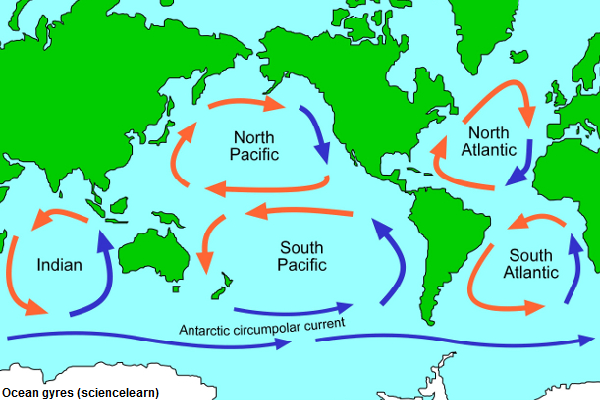
In the oceans specifically, there are five natural gyres, or large circular ocean currents, and these corral floating debris into what are now known as “garbage patches”. The Great Pacific Garbage Patch is twice the size of Texas, and that’s just what’s floating on the surface.

The topic is a fascinating one to me, because I’ve collected garbage from beaches when we’ve gone on holidays to coastal areas, and I’ve seen the problem growing. About ten years ago, a Dutch teenager, Boyan Slat, was diving while on holiday in Greece. The garbage outnumbered the fish, and he decided to do something about it. He has invented robotic boats that are “great at catching plastic and terrible at catching fish,” as the catchments only go down a few meters, and move slow enough for fish and marine animals to simply swim down and away. He plans to release a fleet of these ships not only to the garbage gyres but also to the sources of the problems – rivers that wash garbage into the ocean from upstream.

The goal is for TeamSeas to raise $30 million before the end of this year; as of the moment of writing this, they have reached over $12,720,000. Half of the money raised will be going to Boyan Slat’s nonprofit organization to build and launch garbage-eating ships, and the other half of the money will go toward ocean conservation – this will be in the form of providing volunteers with the equipment necessary to clean up the beaches and waterways, and getting out onto the ocean to join the Ocean Cleanup’s work.

To find out more, please take the time to follow the links below:

Mark Rober’s informative video about what it’s all about

Boyan Slat’s The Ocean Cleanup nonprofit organization

TeamSea’s website – here, you can get up to date with what’s happening, and donate!

Watch some of the activity that takes place aboard an Ocean Cleanup vessel when a load comes in.

The Ocean Cleanup begins to tackle the Great Pacific Garbage Patch and closes the loop by recycling the collected garbage into pellets, which can be turned into useable products, such as sunglasses.

Please consider getting involved in any way you can! If you can’t get out there and collect rubbish from a beach, a few dollars will go a long way to helping others reach the goal of cleaning up the oceans. The biggest thing you can do is to become aware of your own environmental impact: Recycle; use products wisely and dispose of them properly; upcycle where possible; check with your local government agencies about ways to improve collection and reuse of rubbish in your area; buy products that are not wrapped in plastic (e.g. fresh fruits and vegetables bought loose rather than in a plastic-wrapped convenience pack). Like the butterfly effect, every little step makes a huge difference in the long run.

Leave a comment

Filed under Articles, History, Links to External Articles, Nature, Research, Science & Technology

Psychology Undusted: Digital Dysmorphia

This topic is a bit of a rabbit hole, and longer than my usual article, but I feel that it’s an important issue to address.

Image Credit: Spark.ac.in

On one hand, living in a digital age is a blessing: It allows us to reach out and stay in contact with distant friends, family and, in these months of lockdowns and home offices, our co-workers. It allows us to learn anything, with a world of libraries and teachers and experts at our fingertips, but on the other hand, this age has also brought with it a phenomenon known as Digital Dysmorphia, Zoom-, Instagram-, Snapchat-, Facebook-, or simply Body Dysmorphia.

When lockdowns started in 2020, it wasn’t only a personal challenge for many, but also a huge challenge for businesses of every branch. Suddenly their personnel could no longer travel to international, or even national, meetings; they couldn’t meet their co-workers face to face, or even go into the office. Home office became, for many that still had work, a dream come true: Businesses that for years had claimed that home office would be too impractical suddenly found ways to carry on using tools like Zoom and Skype to gather virtual groups together for meetings. It became a common joke that many would be dressed for success on the top half, while the unseen half was PJs or boxer shorts or tutus, like John Krasinski’s “Some Good News” YouTube channel.

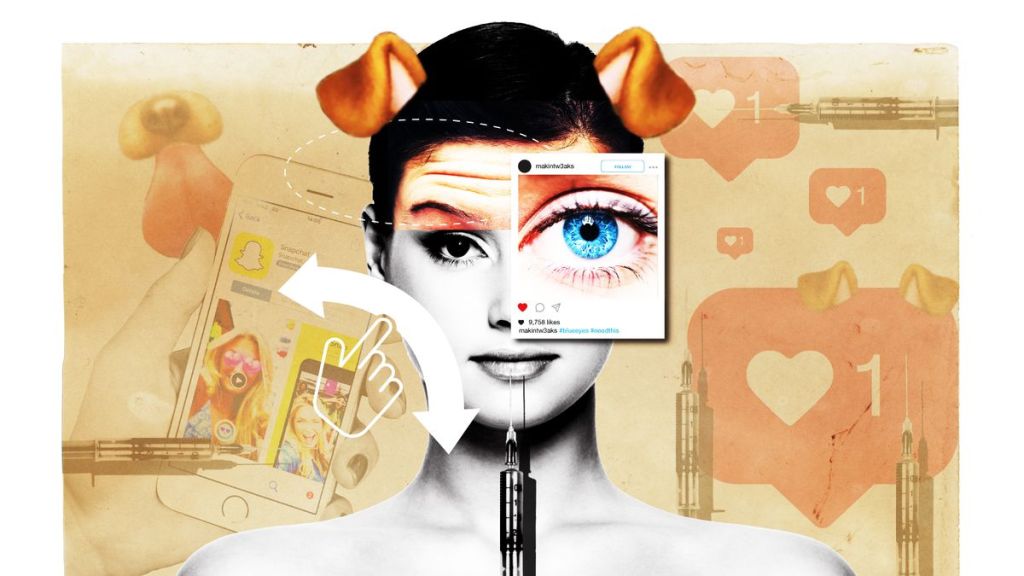
So what is Digital Dysmorphia? It’s the separating of oneself from one’s own real image by the distortion brought about through filters, enhancers and additions of body parts (e.g. large eyes, or bunny ears), using apps such as Snapchat; it’s the altering of reality, modifying self-perceived flaws, and presenting an altered reality of not only one’s physical appearance, but even one’s lifestyle (Instagram). Its danger is the destruction of self-esteem, fear of getting “caught in the lie” by being seen face-to-face by someone who only knows your digitalized self-image, and therefore fear of seeing people in person. It’s a different phenomenon than, say, knowing you need to update your online profile picture that was taken a decade ago. This dysmorphia, also known as BDD (Body Dysmorphic Disorder), is an active destruction of self-esteem through choosing distortions over reality. When someone has BDD, they are focused on their supposed physical flaws for hours a day, and they may take drastic measures to hide or fix them. BDD is sometimes diagnostically confused with OCD, social anxiety disorders, social phobia or depression. BDD was first described around the turn of the 20th century, but has only been taken seriously as an illness in the past few decades. To find out more, here is an interesting YouTube video (~8 min.)

The reason visual apps such as Zoom have made a negative impact on people is because we often see the image of ourselves onscreen as unflattering, perhaps because the camera sits too low, but also because we are looking at our own face for an hour or more at a time (it’s natural to be curious about how others see us, and our eyes are drawn to our own image because of it); while you might not be a teenager glued to your phone, if you’ve used Zoom or Skype, you’ve seen yourself through digital eyes.

Women especially, but not exclusively, have an added challenge: Every magazine image, and many social media images, are all air-brushed, photo-shopped and tweaked beyond humanly-attainable standards. We can never live up to the standard of beauty that marketing companies press on us, and that can wear on someone’s self-esteem.

Another danger in the digital age is the addiction to selfies: Trying to capture the perfect shot, the perfect moment, keeps people so focused on themselves that they completely miss the actual moment they’re trying to capture themselves in. Once in Scotland, my husband and I were enjoying a window-side lunch in a small road-side restaurant on the Isle of Skye; a bus-load of Asian tourists pulled up, and they faced the restaurant to take selfies of themselves with the background (which was the majestic Cuillin mountain range); they did not once turn around to see the actual scenery, but took dozens of photos of themselves before loading back up into the bus and leaving. They could have just saved themselves the trip, stayed at home, and put up a green screen with an image in the background.

Although we may tend to think of girls when we think of selfie addiction, the first British documented case was in 2014, then-19-year-old Danny Bowman. To read a fascinating article, click here: “Faking it: How Selfie Dysmorphia is Driving People to Seek Surgery”. Danny got to the point that he tried to commit suicide but was found in time by his parents and rehabilitated. He now raises awareness about mental health issues.

Image Credit: Bored Panda, Byron Denton

A few years ago, plastic surgeons were being asked to make a person look like this or that celebrity. Then lockdowns came into our collective lives, and Zoom became a household name; but with the sudden increase in digital contact, another, darker phenomena also increased, dubbed by cosmetic surgeons as the “Zoom Boom” to describe the increase. Now to be fair, Zoom is by no means solely responsible; every social media platform has the same dangers. Today, cosmetic surgeons are getting requests to make a person look like their digitalized self; but the requests are often not only impossible (e.g. Anime eyes or removing skin pores to give a porcelain complexion), but would also damage the person’s self-image further. A psychological anorexia, of sorts, it’s addictive and destructive. Plastic surgeons that place the patient’s mental health above their dollar signs must draw moral lines of age limits (younger and younger people are trying to get “preventative Botox” or “corrective” surgeries) and psychological screening.

For more in-depth articles on the topic, just click on the images in this article.

So, how can we avoid falling into the BDD traps? There are a few things you can do:

  • TURN OFF THE CAMERA: Just because you have the ability to have a visual call does not mean you must. If the caller complains that they can’t see you, just tell them to use their imagination, but leave the camera off. This can also apply to phone cameras – if you’re tempted to take selfies, put a sticker over the camera [this is something I do anyway, over front and back cameras – not because I take selfies, but because apps such as Google can and do hijack your camera to see you and your environment, and listen in… so keep your cell phone on flight-mode whenever possible, and “blindfold” them!].
  • LEARN TO IDENTIFY NEGATIVE THOUGHT PATTERNS: Everyone has something about their physical appearance that they don’t like; but if you catch yourself dwelling on a particular feature, try to change your perspective about it – try to compliment yourself, and then move on… positively focus on someone or something else besides yourself.
  • APPRECIATE YOURSELF: Taking care of yourself, getting enough rest, eating wisely, and exercising will all go a long way to restoring your self-esteem. Set small goals for yourself each day, and celebrate those times your reach those goals, giving yourself a big dose of grace when you’ve not been able to reach them. Taking this attitude will alleviate stress, which goes a long way toward supporting mental health.
  • GIVE COMPLIMENTS: This not only takes the focus off of ourselves, but it may be that the other person is struggling in this area, and a timely compliment may be the thing that saves their lives, literally. It’s never wrong to compliment someone, friend or stranger.

I hope that this “undusts” this topic a bit for you; if you know anyone who’s struggling with their self-image, let them know that they’re not alone, and that they’re beautiful.

5 Comments

Filed under Articles, Links to External Articles, Lists, Psychology Undusted, Research, Science & Technology