Tag Archives: writing

A Postcard from Lugano II

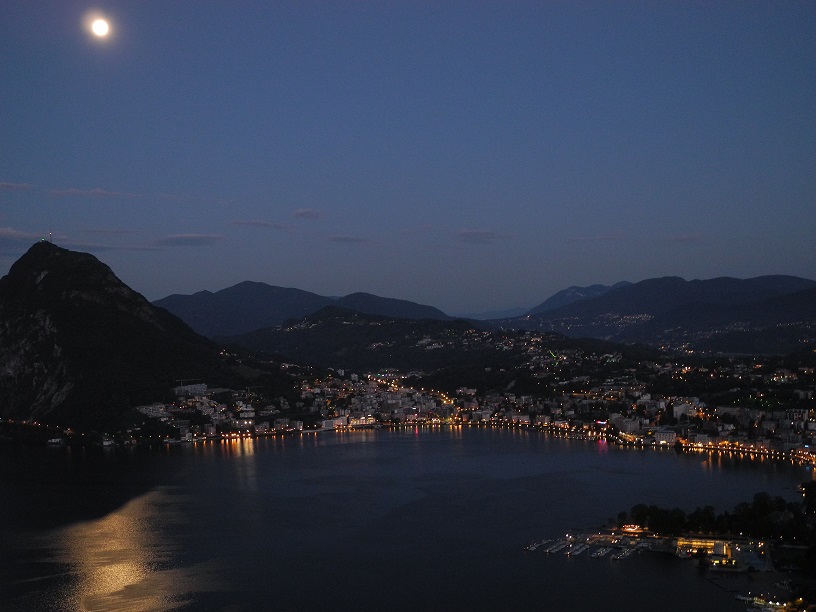
Lago di Lugano, Switzerland, with San Salvtore beneath the moon.

Lago di Lugano, Switzerland, with San Salvtore beneath the moon.

I’ve been absent from posting for a few weeks now, as I was away on holiday and I left most of my writing at home.  Most.  Last summer I wrote you the first Postcard from Lugano; and I will say that not much has changed.  It’s still beautiful, with lazy hot days with a cool breeze coming off the lake, and warm evenings with glistening stars  overhead and a glittering city below.  This first photo was taken at about 4 in the morning (I have no sleeping rhythm, which is handy when such scenes present themselves).


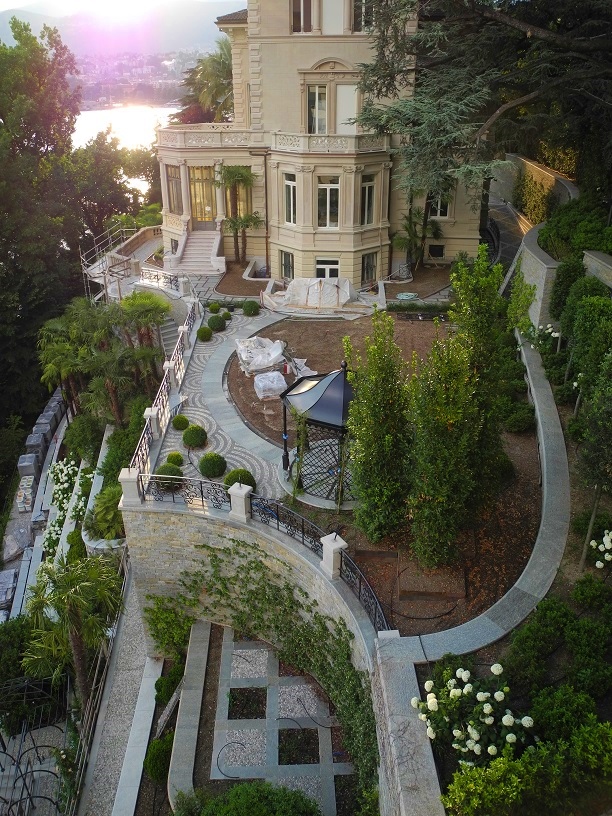
Villa Helios:  The back of the mansion with the terraced walk leading toward the lake.  Under renovation.

Villa Helios: The back of the mansion with the terraced walk leading toward the lake. Under renovation.

But as I told you, I left most of my writing at home – not all.  When in Lugano, I’ve been working on a novel the past few years; it started out as a fun idea to explore, and gradually developed into a  more serious endeavor.  I thought I’d share it with you as it may inspire you to take on such a writing project of your own on holidays (it may not classify as travel writing per se, though in some ways [like my postcards] it may at times take on those characteristics):  Our family flat overlooks a sprawling mansion that we have watched decay from neglect for over 20 years; it was most likely trapped in an inheritance dispute.  It had been boarded up, its windows bricked in, its magnificent garden going wild until it was an impassable jumble of green.  About three or four years ago suddenly a crane was set up, and renovations began!  Of course it sparked my writer’s brain – who had inherited it, or purchased it?  What was its history?  From the looks of it I will have several more years to ponder its end as the renovations continue; but by now the gardens and the terraced walls have been brought to life, a new drive laid with mosaic stones, and the house itself has been set free of its bricked-over, blinded windows, the roof replaced, and the beautiful stones (I would venture to guess Bath Freestone) sand-blasted and cleaned to their pristine beauty.

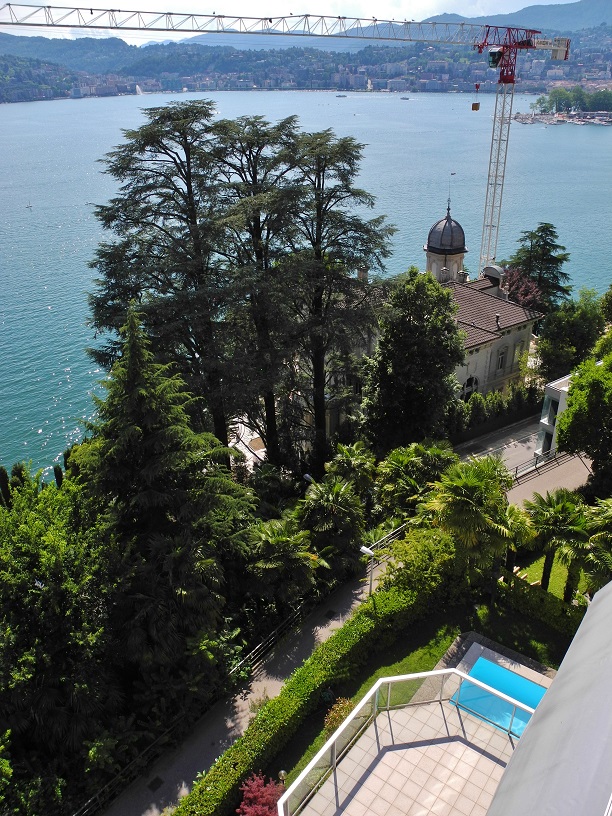
Villa Helios, as seen from our balcony.

Villa Helios, as seen from our balcony.

Called Villa Helios, it was designed by architect Otto Maraini, who was born in Lugano on 8 November 1863 and died there 16 January 1944. Villa Helios in Castagnola was built in 1901-1902, including a series of walls and terraces that formed part of the lake shore.  I came across a few historical photos at arteeidee – thank you to them for sharing the old magazine photos (“The Modern Building” monthly magazine of architecture and construction practice, August 1904)!  Check out that blog post for the older photos (click on them to enlarge); The photos I’ve added here are current shots.  I’ll just say two things about the crane:  Note the box hanging from it, near the vertical shaft – that is the tool crate, hung up at the end of work days to deter construction site thieves.  Also, though the crane interrupts our view of Lugano at times (it shifts freely with the wind when not in use, so sometimes we barely see it), it gives us a brilliant view of birds that take over when the workers are gone – there’s a constant conversation between the seagulls and the Hooded crows.  I’d love to do more research on this building, but most of the information is in Italian, which I can fight my way through only passably, but as I said I still have plenty of time.  That’s the beauty of holidays.

To you writers out there:  Find an interesting old building in your own area, research into its history, and create a story with the building as one of the characters and not merely a location.

Leave a comment

Filed under Articles, History

Simply English, not Simple English

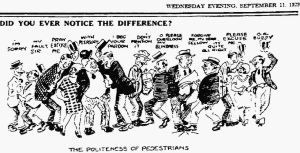
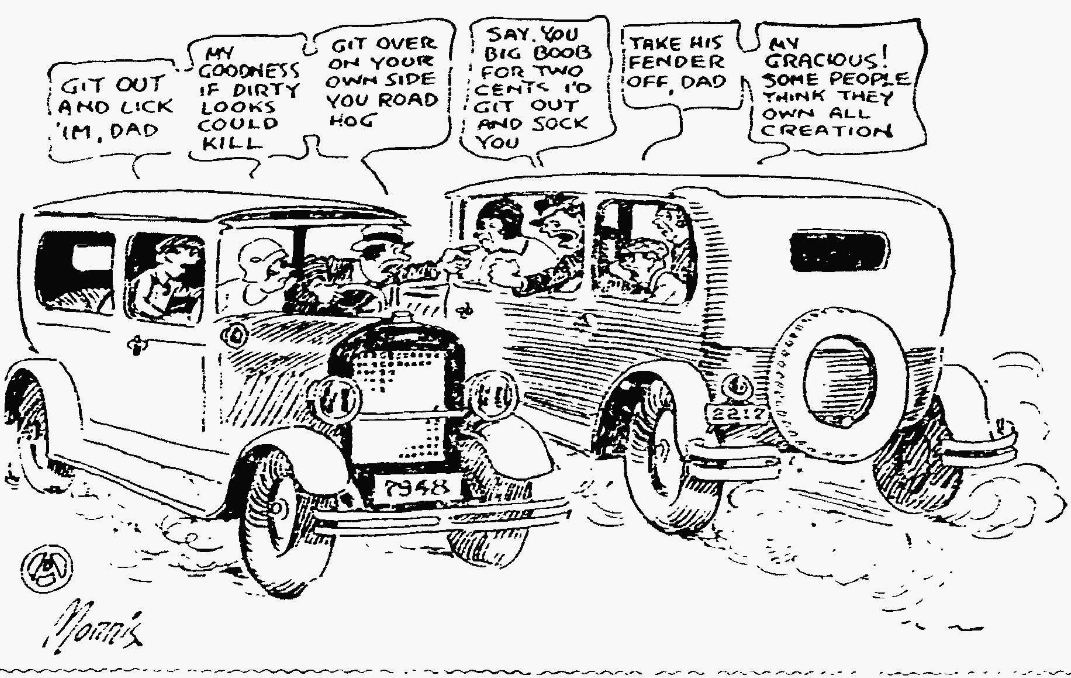
No VowelsThe following poem has been floating around for years; it’s so popular because it’s a great encapsulated example of the weirdness of English as a language!  It’s also a great exercise in stretching your vocabulary, being more aware of how to say words that are often only seen written and never heard pronounced.  And if you come across a word you don’t know, or could swear it’s pronounced differently than the rhyme of the poem indicates, I challenge you to look it up (Wiktionary is an example of a good source which shows how various dialects of English pronounce words if there is more than one option); and if you feel completely overwhelmed, click on the cartoon above to watch someone else chew their way through it!

Simply English

Dearest creature in creation,

Study English pronunciation.

I will teach you in my verse

Sounds like corpse, corps, horse, and worse.

I will keep you, Suzy, busy,

Make your head with heat grow dizzy.

Tear in eye, your dress will tear.

So shall I! Oh hear my prayer.

Just compare heart, beard, and heard,

Dies and diet, lord and word,

Sword and sward, retain and Britain.

(Mind the latter, how it’s written.)

Now I surely will not plague you

With such words as plaque and ague.

But be careful how you speak:

Say break and steak, but bleak and streak;

Cloven, oven, how and low,

Script, receipt, show, poem, and toe.

Hear me say, devoid of trickery,

Daughter, laughter, and Terpsichore,

Typhoid, measles, topsails, aisles,

Exiles, similes, and reviles;

Scholar, vicar, and cigar,

Solar, mica, war and far;

One, anemone, Balmoral,

Kitchen, lichen, laundry, laurel;

Gertrude, German, wind and mind,

Scene, Melpomene, mankind.

Billet does not rhyme with ballet,

Bouquet, wallet, mallet, chalet.

Blood and flood are not like food,

Nor is mould like should and would.

Viscous, viscount, load and broad,

Toward, to forward, to reward.

And your pronunciation’s OK

When you correctly say croquet,

Rounded, wounded, grieve and sieve,

Friend and fiend, alive and live.

Ivy, privy, famous; clamour

And enamour rhymes with hammer.

River, rival, tomb, bomb, comb,

Doll and roll and some and home.

Stranger does not rhyme with anger,

Neither does devour with clangour.

Souls but foul, haunt but aunt,

Font, front, wont, want, grand, and grant,

Shoes, goes, does. Now first say finger,

And then singer, ginger, linger,

Real, zeal, mauve, gauze, gouge and gauge,

Marriage, foliage, mirage, and age.

Query does not rhyme with very,

Nor does fury sound like bury.

Dost, lost, post and doth, cloth, loth.

Job, nob, bosom, transom, oath.

Though the differences seem little,

We say actual but victual.

Refer does not rhyme with deafer.

Foeffer does, and zephyr, heifer.

Mint, pint, senate and sedate;

Dull, bull, and George ate late.

Scenic, Arabic, Pacific,

Science, conscience, scientific.

Liberty, library, heave and heaven,

Rachel, ache, moustache, eleven.

We say hallowed, but allowed,

People, leopard, towed, but vowed.

Mark the differences, moreover,

Between mover, cover, clover;

Leeches, breeches, wise, precise,

Chalice, but police and lice;

Camel, constable, unstable,

Principle, disciple, label.

Petal, panel, and canal,

Wait, surprise, plait, promise, pal.

Worm and storm, chaise, chaos, chair,

Senator, spectator, mayor.

Tour, but our and succour, four.

Gas, alas, and Arkansas.

Sea, idea, Korea, area,

Psalm, Maria, but malaria.

Youth, south, southern, cleanse and clean.

Doctrine, turpentine, marine.

Compare alien with Italian,

Dandelion and battalion.

Sally with ally, yea, ye,

Eye, I, ay, aye, whey, and key.

Say aver, but ever, fever,

Neither, leisure, skein, deceiver.

Heron, granary, canary.

Crevice and device and aerie.

Face, but preface, not efface.

Phlegm, phlegmatic, ass, glass, bass.

Large, but target, gin, give, verging,

Ought, out, joust and scour, scourging.

Ear, but earn and wear and tear

Do not rhyme with here but ere.

Seven is right, but so is even,

Hyphen, roughen, nephew Stephen,

Monkey, donkey, Turk and jerk,

Ask, grasp, wasp, and cork and work.

Pronunciation — think of Psyche!

Is a paling stout and spikey?

Won’t it make you lose your wits,

Writing groats and saying grits?

It’s a dark abyss or tunnel:

Strewn with stones, stowed, solace, gunwale,

Islington and Isle of Wight,

Housewife, verdict and indict.

Finally, which rhymes with enough?

Though, through, plough, or dough, or cough?

Hiccough has the sound of cup.

My advice is give it up!


Leave a comment

Filed under Cartoon, Mistranslations, Nuts & Bolts, Quotes, Videos, Writing Exercise

One-Sentence Stories

One of the most challenging things as a writer is to remain succinct; “every word counts” needs to be printed on the back of my hands whether I’m working on a book manuscript, writing to a friend, or answering grammar questions on a forum I lead.  Occasional ramblings are far more acceptable than chronic ones; everyone has a friend, acquaintance or family member who rambles (or – you know who you are!):  I have a neighbour near our building who can turn the reply to a simple, “How are you?” into a 45-minute explanation of how her cousin’s frog’s nephew’s classmate’s teacher’s son’s uncle came by with a blue – or was it green?  You know the kind of green that looks like wilting grass, no, that’s too yellow… by the time she takes a breath she’s gone down so many detours I have NO idea what she’s talking about, or even what the original question was.  Needless to say, when I’m on a deadline I politely avoid that side of the house.

I’ve come across a website that would be a literal impossibility for that neighbour, and would even be a challenge for many of us who consider ourselves to personify the phrase, “brevity is the soul of wit”:  Click on the image below to see “One Sentence – True Stories Told in One Sentence”.  Take the challenge – can you write a story in one sentence?  And take inspiration from the site as well; there are some great starter-sentences there that could be expanded upon to make a short story, or even a novel.

Note:  Since this was originally posted, the site at the link below has gone offline.  Instead, just go to Google and search for “one-sentence stories“, and you’ll come across several great options.

That One Sentence

Leave a comment

Filed under Links to External Articles, Nuts & Bolts, Research, Writing Exercise

Punctuation Dragons

Raphael - Saint George and the DragonThose wee things called punctuation are probably the most important things in writing; they are the proverbial insects of the writing world, for without them the entire system would disintegrate.  At the same time, they can sometimes be as daunting as fighting a dragon.

So without further ado, below is a brief breakdown of the most familiarly-confusing punctuation marks.  There may be a few discrepancies between various dialects / regional rules, but these are the basic rules – if you have these firmly in hand and use them consistently, you’ll recognize those rules that differ to what you learned in school; just apply whichever rules you use with consistency.  Feel free to copy / paste the post and print it out to keep handy (with that goal in mind, I’ll keep it comment-free)!

 Commas:

Where possible, leave out.  Where confusing, put in.

  • Separate elements in a series.
  • , + small conjunction (i.e. and, but, or):  If in doubt, use it here.
  • To set off introductory elements.  The comma can be omitted for short elements unless it makes the meaning unclear or confusing.
  • To set off parenthetical elements (added information that, if removed, does not affect the meaning of the sentence).
  • To separate coordinate adjectives (e.g. tall, distinguished woman)
  • To set off quoted elements:  , “(quote/dialogue).”  OR  , “(quote/dialogue),” (prose).
  • To set off contrasting expressions.
  • To avoid confusion.
  • Never use only one comma between a subject and its verb! (Only one would constitute a splice – see below)
  • Typographical reasons (i.e. dates, numbers, location references, etc.)

Comma Splice:  When a comma is misplaced between two independent clauses or randomly in the middle of a sentence, or between the subject and its verb.

Semi-Colon:

  • Use to join two independent clauses (e.g. “My wife would like tea; I would prefer coffee.”)
  • Use to separate items in a list that includes other punctuation (e.g. “The people present were Jamie, who came from New Zealand; John, the milkman’s son; and George, a gaunt kind of man.”)

 Apostrophe:

  • To express the possessive (e.g. Jane’s book)
  • To signify contractions (e.g. It’s cold outside.)
  • Some proper names use an apostrophe (e.g. O’Donnell, O’Malley)
  • Apostrophes are NEVER to be used to form a plural.  Never.  It’s CDs, not CD’s; DVDs, not DVD’s; the 1980s, not the 1980’s; 100s, not 100’s.  This may be a controversial “never” as they are common mistakes – so common that some writers perceive them as correct (just because some people use them does not make them correct usage… jumping off a cliff and all that).  The only exception to this “never” is when there may be the possibility of misreading.

 Hyphen (-) vs. en-dash (–) vs. em-dash (—)

Hyphen:

  • To join two words into a single meaning (e.g. decision-maker), or linked as an adjective before a noun (e.g. decision-making process).

En-dash: (Key: Ctrl + number – / Alt+0150)

  • To join two words that are separate but related, for example as a substitute for and or to.

Em-dash:  (Key:  AltGr + number – / Alt+0151)

  • Used to form parenthetical phrases.  These are used, for example, if there is the risk of confusion when other punctuation is used in the same sentence – for example commas.

The general rule of thumb in the UK seems to be as follows:  Use the en-dash within dialogues and prose, but end abrupt, interrupted dialogue with an em-dash.

There is a fourth dash called the Horizontal Bar.  It is usually used to set off quotation sources.  it is generally the same length as an em-dash, so this is often used instead. The main difference between the two is that some software may insert a line break after an em-dash but not after a quotation dash.

Parentheses / Brackets:

  • Order of usage:  (…[…{…}…]…).
  • Use to contain material that could be omitted without altering a sentence’s meaning, and where commas used elsewhere may lead to confusion if too many are used.  Any punctuation inside the brackets is independent from the main sentence.
  • […] Square brackets/crochets are used to mark omitted material from a quote of an original, more complete text.

Ellipsis:  … / . . . aka “Suspension Point”

  • Use for intentional omissions or an unfinished thought.
  • Use for unstated alternatives (implied by context).  E.g. “I’m on a… special diet.” (Edward Cullen, in Twilight)
  • Use for a slight pause.
  • Use for a nervous or awkward silence.
  • Use at the beginning or end of a sentence to inspire feelings of melancholy or longing.

Leave a comment

Filed under Nuts & Bolts, Writing Exercise

Writing to Distraction!

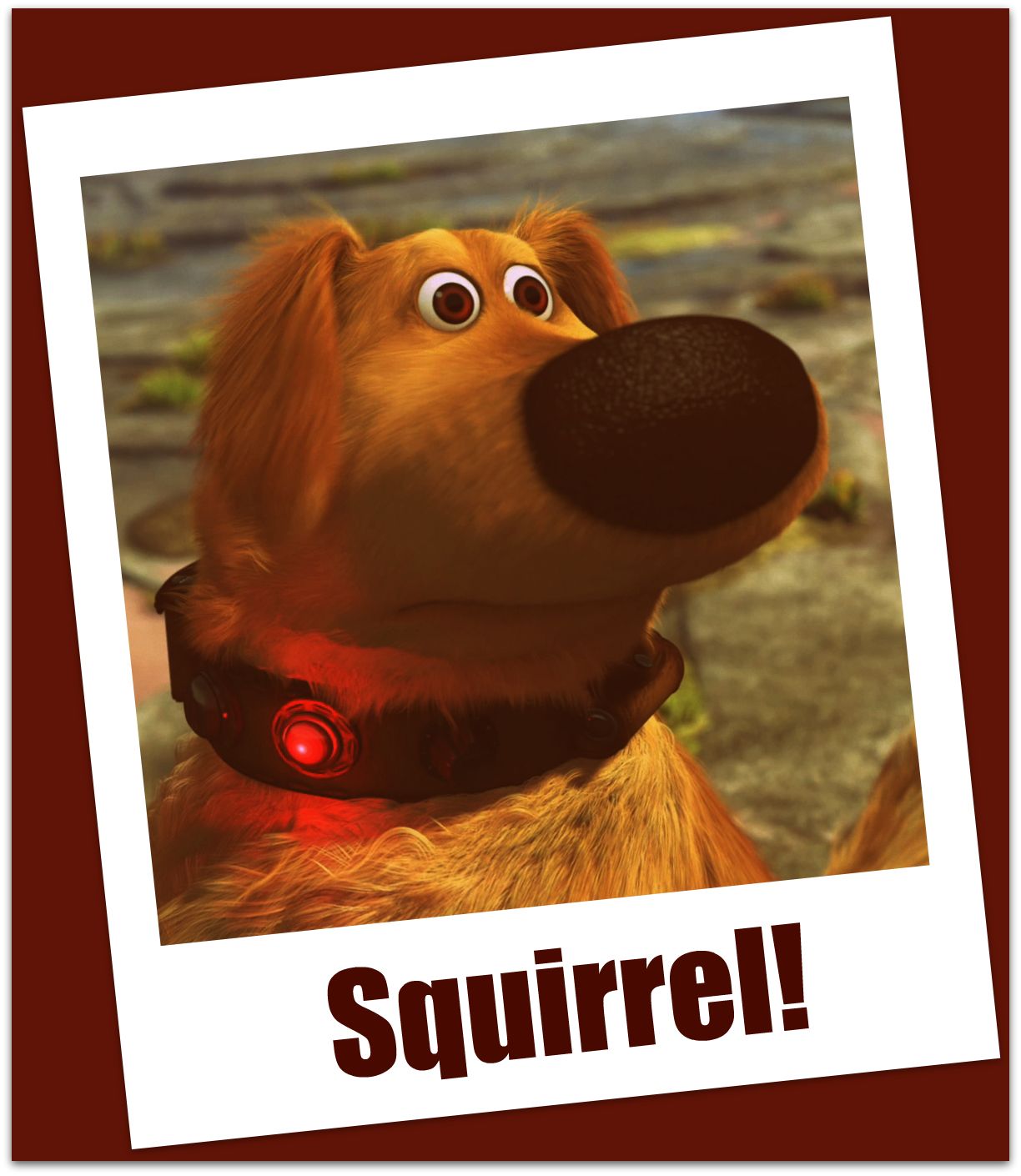
Squirrel_DugIf you’re a writer you know exactly what that title means.  Working on a project usually requires research; I don’t know what I’d do without internet connection, honestly – I’m too busy to take a day and plough through the local library, and as my local library consists of 99.9% German books anyway it’s not very helpful for writing English novels.  I have an extensive library here at home, and my research section is better equipped than the public library… but I digress.  Sometimes distractions come at you from every side; I feel like those dogs in “Up”… Squirrel!

And that’s the point.  Let’s say I go to YouTube for research:  It’s a great place to find out how to do just about anything, from how to throw a keris dagger and the aerodynamic difference between the wavy and the straight blade; how to make a vase out of a plastic bottle; how to make yarn from plastic bags; how to make an emergency stove out of a coke can or a light bulb out of a PET bottle with water, and the list goes on and on and on and on.  There are also hundreds of documentaries available on YouTube, from entertainment like the Horrible Histories series, to astronomy, science, history, you name it.  But if you’re like me you are interested in all of the above; and like Pringles, it’s hard to watch just one.  When I need a change of pace I also like to watch things on YouTube like the Actor’s Studio series, or talk show interviews (and we don’t have English-language television channels, which is actually fine by me – we use our television for sports programs and DVDs – but I digress.  Again.).  And YouTube is just one resource.  I have dozens of links to glossaries, websites that specialize in various aspects of history, science, technology, historical fashions, linguistics, etymology or other areas of interest, reference and research.

An important rule in dealing with online information is to have it confirmed by legitimate sources before using it, for instance, as a basis for anything substantial in a novel or other work of literature.  That rule has led me more than once to buying a book online.  In researching for The Price of Freedom and Redemption, I was especially frustrated with online research in the area of accurate apparel:  1788 was a world of difference in England to 1790, as the French Revolution changed fashion sensibilities in England – people distanced themselves from France, and patriotic influences as well as English fashion designers and trend setters came into their own more because of the vacuum.  But most online research that I came across either had the 18th century all lumped into one style, or “1700 to 1750” and “the latter half of the 18th century” which meant “French Revolution and thereafter” nine times out of ten.  Dubious at best, that.  Not even contemporary paintings are an accurate reference, as many of the “new middlings” had their clothing, and even background houses and gardens, “augmented” (read “upgraded”) for their paintings to add elegance to their new money.  And often, when I search for “18th century” I come across sites that actually mean the 1800s (that is, the 19th century).  My definitive source of information on that topic has become “The Dress of the People: Everyday Fashion in Eighteenth-Century England.”

So in trying to find one tiny little detail for fleshing out a scene, one can spend hours surfing, reading, searching, scanning and getting distracted by something else interesting along the way.  Yesterday I spent hours trying to find online PDFs or text of any kind from actual October 1789 The Times (London) newspaper (I’d have been satisfied with any month of that year!), just to find out what topics were being written about in the newspaper at the time aside from the Revolution.  What were the gossip columns writing about?  What kind of advertisements were there?  What were things considered newsworthy in that newspaper that year?  So far, Research – zilch, Time Spent – 3+ hours.  I looked at archives.com, Google images… nothing.  If anyone knows a resource for that, please let me know!! (If you think it would be impossible to find such old bits and pieces online in the cyber age, think again; I’ve found all kinds of documents far older that have been digitalized; someone out there is interested in it besides me, and chances are, someone has uploaded it into cyberspace; it’s just a matter of finding it in the static of cutesy videos and brainless teenage selfies…)

It can be so easy, and so enticing, to “waste” hours researching.  I try to follow two rules, and perhaps they’ll help you save time as well:

1)  Set a time limit for research.  When I need a break from the manuscript, but I don’t want to stray too far, I look at the clock and set myself one hour to find something on my research list.

2)  Make that research list; as you’re writing, keep a list somewhere (I have an e-post-it on my desktop) of things you’ll need to research, and do it all at once or in organized chunks.  It helps keep you focused on the manuscript, and makes the time you spend both on and off the actual script more efficient.

3 Comments

Filed under Articles, Research

Lost in Translation: Foreign Signs

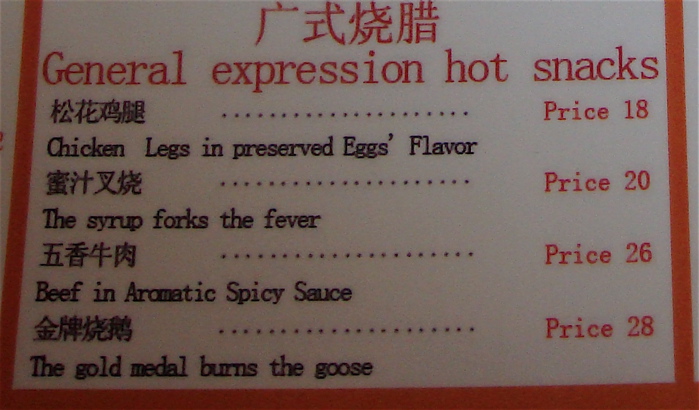
I love it when signs or notices are translated by non-mother tongue English speakers;it can be anything from cute to funny, misleading or just downright embarrassing.  I especially love Asian translations!  Here are a few examples.

Lost in Translation 1 Lost in Translation 2 Lost in Translation 9 Lost in Translation 11 Lost in Translation 23

Leave a comment

Filed under Images, Mistranslations, Nuts & Bolts, Quotes

The Svalbard Global Seed Vault

Like something out of a Science Fiction film, the Svalbard Global Seed Vault looks like a monolith rising out of the snowy mountains in Norway.  Its purpose could be out of the same film:  It’s a depository for seeds from around the world, to preserve plants in case of global disaster, whether fire, flood, ice or nuclear.  To read the whole story, check out the Wikipedia article by clicking on the image below.  If you write Science Fiction, be inspired!  If you are into gardening, global environmental issues, or simply worried about the direction society is heading, take comfort… there are people planning ahead.

Svalbard Seed Vault

Leave a comment

Filed under Articles

20 Common Grammar Errors

For writers and bloggers, being reminded of the basic grammar rules from time to time is a good thing; they can help to improve our communication and efficiency.  If you’re like me, you may be writing along when a question pops up like, “Does this sentence need a comma here or not?”  The more familiar we become with the rules (and keep in mind that there are some differences between nationally-accepted rules, e.g. between the British standard and the American standard), the faster such decisions will become and the less time will be lost on such mundanely important details.  Click on the image below for a link to the 20 most common grammar errors and how to solve them.

AA Mistakes

Leave a comment

Filed under Nuts & Bolts, Research, Writing Exercise

60 Uncommon Things Men Find Attractive About Women

Here’s a list that proves attraction is just weird, and that beauty really is in the eye of the beholder! I find this interesting especially because of the possibilities for finding that quirky element for building fictional characters. Enjoy, and be inspired to write depth and breadth!  Click on the image below to view the article:

Shutterstock

Leave a comment

Filed under Lists

The Etymology of February and Wednesday


February & Wednesday

We can blame both spellings on the Romans!  February is fairly clear:  Februa is thought to be a Sabine word (maybe we could blame them for italics, too), meaning “purifications”; Februarius mensis was the month of purification.  Before 450 BC this was actually the last month in the ancient calendar and referred to the feast of purification celebrated on the ides of that month throughout the Roman Empire.  Ides was the term used for approximately mid-month, being the 13th or 15th, depending on whether that particular month had 29 or 31 days.  Interestingly, in English it replaced the Old English solmonað (“mud month”… very appropriate, that) sometime in the 12th century when they began using the Old French term Feverier.

Wednesday accumulated slightly more pedigree before landing in our agendas:  It started off as the “day of (the god) Mercury,” the Latin dies Mercurii.  It was confiscated by the Scandinavians for their own religious version for Odin, Oðinsdagr (Old Norse) or Onsdag in Swedish.  This came with them over the Channel and was adopted by their English counterparts as wodnesdæg, or “Woden’s day.”  Old Frisian came fairly close to modern English with Wonsdei (I’ve probably seen that spelling on Facebook from people who can’t type with their i-phones properly…).  By the mid- 400 AD period, the Germanic Goths had been converted from Paganism to Christianity by Greek missionaries, and their language began to reflect the changes:  The astrological or religious terms gave way to ecclesiastical (or at least neutral) ones.  This difference is reflected in words like Mittwoch (German for Wednesday, meaning literally “mid-week”), sreda (Russian), or środa (Polish), both meaning literally “middle.”

So there you have it:  Blame it on the Romans, or the Vikings; but whoever you blame, just remember to spell them in correct modern English.

Leave a comment

Filed under History, Nuts & Bolts