Category Archives: Quotes

Musings A to Z Challenge: B

Challenge:  Write a short entry (100 words or less) on a topic beginning with the sequential letter of the alphabet.

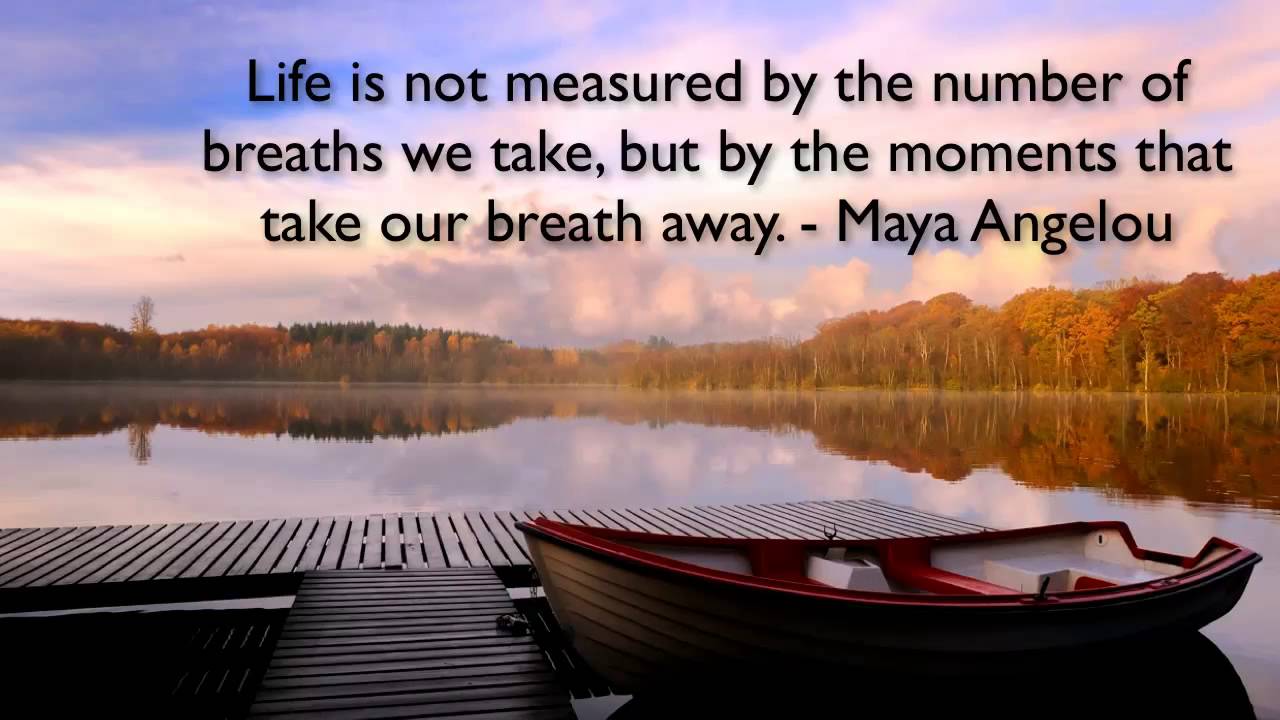
Breath


Breath is such a simple thing, in some ways; it’s easy to ignore what a gift it is until it’s the last one.  For those with asthma or other illnesses that affect the lungs, it’s never taken for granted.  Though it’s merely air that passes through our lungs and in and out of our noses or mouths, it can convey so many messages:  Sensuality; warmth; coolth (yes, it’s a word); exasperation; satisfaction, and even attraction.  It can be turned into a whistle, and has even inspired the concept for an upcycled air-conditioner in third-world countries. Ain’t breath cool?

Breath

2 Comments

Filed under A-Z Writing Challenges, Images, Quotes, Writing Exercise

Musings A to Z Challenge: A

For those of you who stop by for a visit and a chat regularly, you know that I post once a week (barring illness and holidays).  If you read through my “about the author” page, you’ll also learn that I rarely sit around on my laurels… a rolling stone gathers no moss, and all that.  I’ve recently finished the manuscript for my 5th novel – by “finish” I mean I’ve completed the third draft, which has now gone out to Beta readers, but I still have all the bits and bobs associated with the publishing of a book to begin tackling (the cover graphics, back cover copy, blurbs, synopsis, etc.), until the feedback comes in and I begin the next round of polishing and honing.

With all that extra time on my hands (splutter in uncontrollable laughter here), I thought I’d try something a bit more challenging with my writing blog:  One post a day for a month.  The posts will be an A to Z challenge of 100 words or less on a topic beginning with the sequential letters of the alphabet; each post will include one or more quotes (not in the word count) on the topic at hand.  On weekends I may break the pattern to continue on with the other topics of late, such as “Odd Jobs” or “Lost in Translation” posts. The entries will simply be my musings on the topic, thus the title of this post.

Let me know what you think, and if you’d like to take up the challenge on your own blog, just let me know in the comments so that I can come over and cheer you on!

So, without further ado, let the games begin!

Challenge:  Write a short entry (100 words or less) on a topic beginning with the sequential letter of the alphabet.

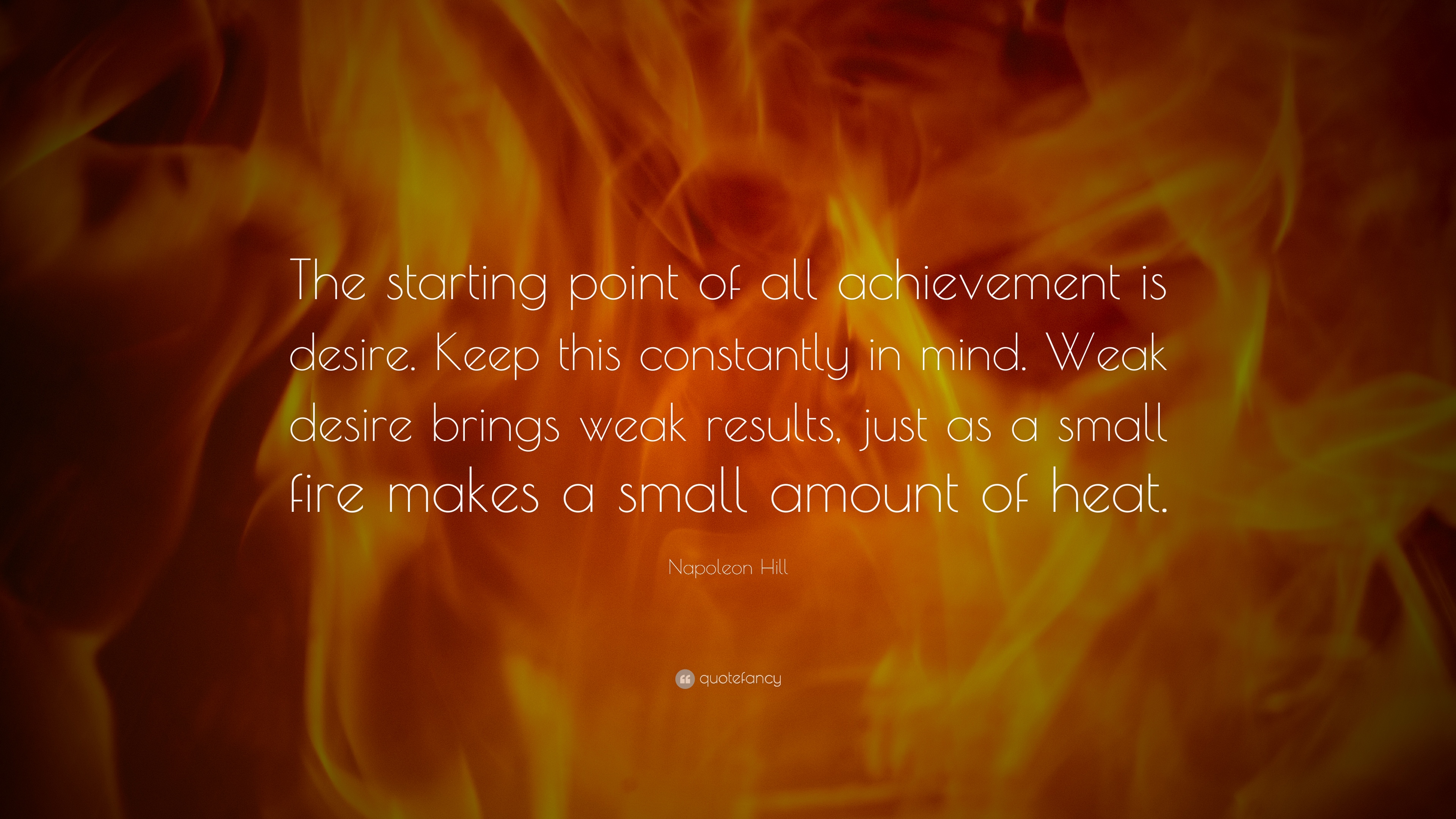
Achievement

When a goal is achieved, I need a new one or my momentum will peter out; I usually choose a new goal before the current project is completed so that I know where to go next.  When I’m working on a section of my novel’s manuscript, I jot down what I want to work on next (dialogue, scene, etc.), so that I know where to pick up the next day.  For me, achievement isn’t about the big goals or the milestones in my life as much as daily goals – without those daily goals, the life-goals will never come to be.

Achievement - Napoleon Hill Quote.jpg

Leave a comment

Filed under A-Z Writing Challenges, Musings, Quotes, Writing Exercise

Not Just A Pretty Face

History is full of fascinating stories; some of them are so strange that they would be tossed onto the sludge pile of any self-respecting publisher if it came across their desk in the form of a novel’s premise.  As Mark Twain so elegantly put it, “Truth is stranger than fiction, but it is because fiction is obliged to stick to possibilities; truth isn’t.”  The proof is in the pudding, as they say, in the following story:

What do the following three things have in common:  A young Jewish woman by the name of Hedwig Eva Maria Kiesler, born in 1914 in Vienna, Austria; the spread-spectrum technology that enables Wi-Fi, CDMA & Bluetooth; and a Hollywood starlet discovered in Paris by Louis B. Mayer in 1937?  Quite a lot, in fact; because the woman born in Austria was otherwise known as Hedy Lamarr, inducted posthumously into the National Inventors Hall of Fame in 2014 for developing technology useful for a radio guidance system for torpedoes, the concept behind Bluetooth, Wi-Fi & CDMA (Code Division Multiple Access) and now used for entertainment and communication around the globe.

Lamarr, who became known as “the most beautiful woman in Europe”, was the only child of a prominent upper-class Jewish family, and her birth name was Hedwig (Hedy is the diminutive form).  At 18, she married Friedrich Mandl, reputed to be the third wealthiest man in Austria and an arms dealer who made a killing during the wars (in both senses of the word), in the proverbial bed with both Mussolini and the Nazis.  Lamarr would attend lavish dinner parties and business meetings with her husband as he networked with scientists and those involved in military technology, and her intelligent mind soaked up the information, nurturing her scientific talents.

Lamarr escaped her controlling and jealous husband by disguising herself as a maid and fleeing to Paris, where she obtained a divorce.  There she met Louis B. Mayer, who was scouting for European film talent; he had her change her surname to Lamarr, in homage to the silent film actress Barbara La Marr.  In 1938 she made her American film debut in “Algiers”, but because of her beauty, she was often typecast as a seductress; to alleviate the boredom, she set up an engineering room in her home and turned to applied sciences and inventing.  With the outbreak of World War II, she wanted to help in the war against the Germans, particularly in improving torpedo technology.  She met a composer, George Antheil, who had been tinkering with automating musical instruments; together they came upon the concept of “frequency hopping”:  Until then, torpedoes guided by radio signals could be jammed and sent off course just by tuning into their broadcasting frequency and causing interference; hopping frequencies would enable torpedoes to reach their target before their signal could be locked down.

Hedy Lamarr - Austrian-Actress-Invents-Control-Device

In classic Hollywood-portrayal style, the US Navy wasn’t interested in a technology developed by a beautiful actress and a musician in some suburban home.  I find the Stars and Stripes article above very telling as to their views of a pretty face actually being smart too; its tone is quite condescending from beginning to end.  The US military didn’t apply the groundbreaking technology for another 20 years, until the Cuban Missile Crisis in 1962.  That same technology serves as the basis for our modern communication technology, enabling many people to use broadband simultaneously without interfering with each other; such situations as portrayed between Doris Day and Rock Hudson in “Pillow Talk” are unthinkable today, and all because of Hedy Lamarr.

So the next time you’re sitting in a café using Wi-Fi next to someone else on their own cell phone, give a wink to the memory of Hedy Lamarr.  May you be inspired to reach beyond the possibilities, and create fiction worth reading even in the distant future!

Hedy Lamarr Quote

12 Comments

Filed under History, Quotes, Research

Mark Twain on Switzerland & the Awful Language of German

This past week I’ve been quite busy getting ready for a big change in our lives:  Taking in an exchange (high school) student for nearly a year.  She’s coming from Thailand, and wants to learn German; I’m not sure she knows what she’s getting herself into, as we don’t speak the German she will need to learn for school; we speak Swiss German, which is about as similar to High German as Old English is to modern English.

In preparation, I’ve been doing a bit of spring cleaning too – might as well, right?  My main work room, our library, is also where I keep folders full of stories I’ve saved over the years, and while sifting through them I was reminded of an article about Mark Twain’s observations on the German language.  I found what I was looking for in a Kindle book; it would be astonishing (and perhaps a bit discouraging) to Mark Twain if he could see his entire life’s work reduced to an e-book for less than $ 2.00, but so it is.  I was surprised to find a short description of his time in Switzerland, as part of his Grand Tour no doubt.  And as I mentioned above, the German dialects we speak are not the German Mark Twain describes, so I can laugh along with the rest of you (and I can laugh at the fact that the WordPress spell check is going berserk).  I’ll need to resort to High German for the sake of our exchange student, but it grates on my ears and tongue like sandpaper on the eyeballs.  Mark Twain seems to have had similar sentiments.  I will first share his impression of Switzerland, and then bombard you with his opinion of the German language.  This post is a bit longer than my usual offering, but Twain is well worth it!  So put your feet up, get a cuppa, and enjoy!

On Switzerland

Interlaken, Switzerland, 1891.

“It is a good many years since I was in Switzerland last. … there are only two best ways to travel through Switzerland. The first best is afloat. The second best is by open two-horse carriage. One can come from Lucerne to Interlaken over the Brunig by ladder railroad in an hour or so now, but you can glide smoothly in a carriage in ten, and have two hours for luncheon at noon—for luncheon, not for rest. There is no fatigue connected with the trip. One arrives fresh in spirit and in person in the evening—no fret in his heart, no grime on his face, no grit in his hair, not a cinder in his eye. This is the right condition of mind and body, the right and due preparation for the solemn event which closed the day—stepping with metaphorically uncovered head into the presence of the most impressive mountain mass that the globe can show—the Jungfrau. The stranger’s first feeling, when suddenly confronted by that towering and awful apparition wrapped in its shroud of snow, is breath-taking astonishment. It is as if heaven’s gates had swung open and exposed the throne. It is peaceful here and pleasant at Interlaken. Nothing going on—at least nothing but brilliant life-giving sunshine. There are floods and floods of that. One may properly speak of it as “going on,” for it is full of the suggestion of activity; the light pours down with energy, with visible enthusiasm. This is a good atmosphere to be in, morally as well as physically.

DCF 1.0

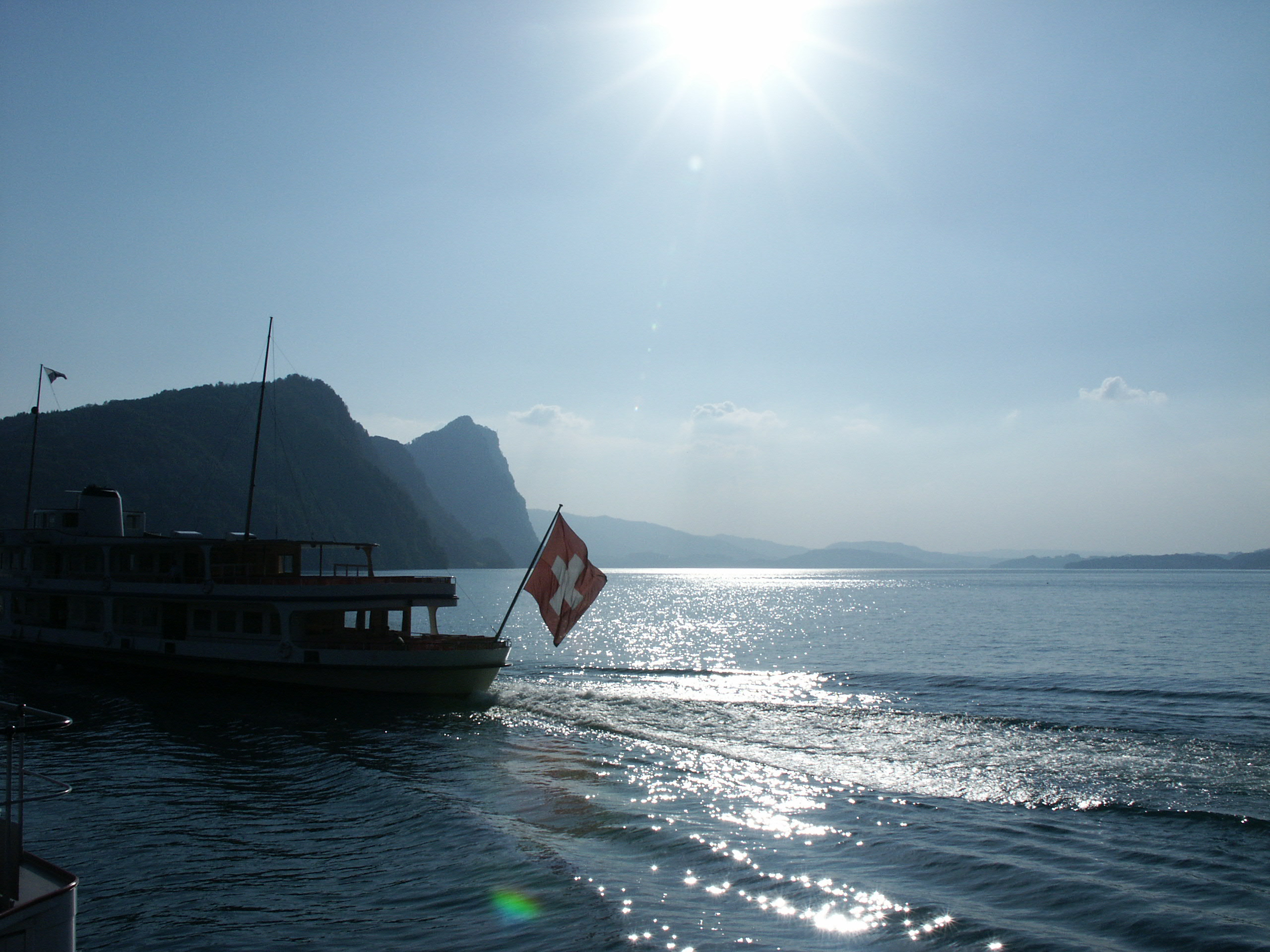
Vierwaldstättersee, taken 2006

“After trying the political atmosphere of the neighboring monarchies, it is healing and refreshing to breathe air that has known no taint of slavery for six hundred years, and to come among a people whose political history is great and fine, and worthy to be taught in all schools and studied by all races and peoples. For the struggle here throughout the centuries has not been in the interest of any private family, or any church, but in the interest of the whole body of the nation, and for shelter and protection of all forms of belief. This fact is colossal. If one would realize how colossal it is, and of what dignity and majesty, let him contrast it with the purposes and objects of the Crusades, the siege of York, the War of the Roses, and other historic comedies of that sort and size. Last week I was beating around the Lake of Four Cantons [Vierwaldstättersee], and I saw Rutli and Altorf. Rutli is a remote little patch of meadow, but I do not know how any piece of ground could be holier or better worth crossing oceans and continents to see, since it was there that the great trinity of Switzerland joined hands six centuries ago and swore the oath which set their enslaved and insulted country forever free…”

On the Awful German Language

What he had to say about the German and their language is quite different, however:

“Even German is preferable to death.”

“Surely there is not another language that is so slipshod and systemless, and so slippery and elusive to the grasp. One is washed about in it, hither and thither, in the most helpless way; and when at last he thinks he has captured a rule which offers firm ground to take a rest on amid the general rage and turmoil of the ten parts of speech, he turns over the page and reads, “Let the pupil make careful note of the following EXCEPTIONS.” He runs his eye down and finds that there are more exceptions to the rule than instances of it. So overboard he goes again, to hunt for another Ararat and find another quicksand.”

“German books are easy enough to read when you hold them before the looking-glass or stand on your head—so as to reverse the construction—but I think that to learn to read and understand a German newspaper is a thing which must always remain an impossibility to a foreigner.”

“…in a German newspaper they put their verb away over on the next page; and I have heard that sometimes after stringing along the exciting preliminaries and parentheses for a column or two, they get in a hurry and have to go to press without getting to the verb at all. Of course, then, the reader is left in a very exhausted and ignorant state.”… “It reminds a person of those dentists who secure your instant and breathless interest in a tooth by taking a grip on it with the forceps, and then stand there and drawl through a tedious anecdote before they give the dreaded jerk.”

Mark Twain, Young“Some German words are so long that they have a perspective. Observe these examples:

Freundschaftsbeziehungen.

Dilettantenaufdringlichkeiten.

Stadtverordnetenversammlungen.

These things are not words, they are alphabetical processions. And they are not rare; one can open a German newspaper at any time and see them marching majestically across the page—and if he has any imagination he can see the banners and hear the music, too. They impart a martial thrill to the meekest subject. I take a great interest in these curiosities. Whenever I come across a good one, I stuff it and put it in my museum. In this way I have made quite a valuable collection. When I get duplicates, I exchange with other collectors, and thus increase the variety of my stock. Here are some specimens which I lately bought at an auction sale of the effects of a bankrupt bric-a-brac hunter:

Generalstaatsverordnetenversammlungen.

Alterthumswissenschaften.

Kinderbewahrungsanstalten.

Unabhängigkeitserklärungen.

Wiedererstellungbestrebungen.

Waffenstillstandsunterhandlungen.

Of course when one of these grand mountain ranges goes stretching across the printed page, it adorns and ennobles that literary landscape—but at the same time it is a great distress to the new student, for it blocks up his way; he cannot crawl under it, or climb over it, or tunnel through it. So he resorts to the dictionary for help, but there is no help there. The dictionary must draw the line somewhere—so it leaves this sort of words out. And it is right, because these long things are hardly legitimate words, but are rather combinations of words, and the inventor of them ought to have been killed.”

“My philological studies have satisfied me that a gifted person ought to learn English (barring spelling and pronouncing) in thirty hours, French in thirty days, and German in thirty years. It seems manifest, then, that the latter tongue ought to be trimmed down and repaired. If it is to remain as it is, it ought to be gently and reverently set aside among the dead languages, for only the dead have time to learn it.”

Quotes from the Complete Works of Mark Twain (Illustrated). Delphi Classics. Kindle Edition.

11 Comments

Filed under Articles, Humor, Musings, Quotes

Just Sayin’

I had to share this!  As Mark Twain once said, “The difference between the right word and the almost right word is the difference between lightning and a lightning bug.”  In this case, it’s the difference between a home run and a strike…

Right Word


3 Comments

Filed under Humor, Images, Quotes

A Page in History

As a writer, I’m constantly absorbing information; I never know when something might come in handy!  It may inform my scene with more realism, or infuse a character with a quirk or a background that gives them depth.  History is full of oddities and amazing events that can spark our imaginations; the event below is one such event:  If you ever need to write a scene about an explosion, or the effects of wrong decisions gone awry, look to history to teach you how it’s done (or in this case, how it should not be done).  This story shows the importance of decisions, and begs the question, “What if?”  What if one of those factors had changed?  What if the captain of the SS Imo had given way to the captain of the SS Mont-Blanc?  We’ll never know, but as writers, we can use our greatest tool:  Imagination.

This day in history:  The Halifax Explosion

6 December 1917 will live on in infamy in Halifax, Nova Scotia, and in Canada, as one of the worst disasters in history.  On that day, the largest man-made explosion prior to the Nuclear Age occurred, wiping out several communities and reshaping Halifax forever.

The events that led up to the explosion that killed thousands and maimed thousands more reads like a thriller:  The delay of a shipment of coal; the climate of war that complicated the comings and goings from the harbour; an experienced captain now behind schedule who “bent the rules” for once; the captain whose impatience at previous delays pressed him to disregard the harbour speed limits and refuse to give way a third time; the third ship in his path who, because of their cargo (tons of explosives), could not make sudden manoeuvres and was relying on him to give way; a right decision made too late.  Curious onlookers who gathered at their windows to watch the blazing ship in the harbour had little idea that it would be the last thing most of them would ever see; if they were not obliterated in the initial blast, the light from the flash or the window glass shattering [in virtually every window within a 2.6-kilometre (1.6 mile) radius] blinded them; some 5,900 eye injuries were treated, leaving over 40 survivors permanently blind.

Confusion after the initial blast was compounded when people began evacuating thinking that it was a German bomb attack; fires throughout the city (caused by tipped oil lamps and ovens in collapsed homes) added to the confusion and hindrance to rescue efforts,  but within a few hours the true cause had become widely-enough known to calm initial fears.  Rescue teams started arriving from as far away as 200 km (120 miles), their help hampered by damaged roads and fears of secondary explosions from a munitions magazine at the Wellington Barracks.  To make matters worse, the next day blew in a blizzard which dumped 41 cm (16 inches) of heavy snow on the area; this blocked train transport with snowdrifts, and tore down hastily-erected telegraph lines.  Halifax was isolated, though the snow did help to extinguish the fires throughout the city.

Here in Switzerland, the NZZ (Neue Zürcher Zeitung) reported on the 7th of December:

“Zerstörung der Stadt Halifax? New York, 6. Dez. (Havas.)  Aus Halifax wird gemeldet: Die Hälfte der Stadt Halifax sei ein Trummerhaufen infolge einer Explosion.  Die Verluste werden auf mehrere Millionen geschätzt.  Der Nordteil der Stadt steht in Flammen.  Es gibt hunderte von Toten und an die tausend Verwundete.

[“Destruction of the city of Halifax?  New York, 6 December (Havas – a French media group based in Paris.)  From Halifax was reported:  Half of the city of Halifax lies in ruins as a result of an explosion.  The loss has been estimated at several million (unclear whether it means Canadian dollars or Swiss Francs).  The northern part of the city is in flames.  There are hundreds of dead and thousands injured.”]

On the 8th of December, a similar footnote was reported, adding, “Kein Haus der Stadt ist unbeschädigt geblieben…” (“No house in the city has remained undamaged”)

That it even made it into a footnote of the international news section is actually remarkable, considering that Switzerland was surrounded by war at the time and had far more pressing matters on the home front and in neighbouring countries with which to keep abreast.

In the end, it is estimated that over 2,000 people were killed and 9,000 injured (of those injured, it is unclear how many died of the injuries, and how many were permanently disabled in some way).  The blast was so hot that it evaporated water in the harbour, exposing the harbour’s floor momentarily; as water rushed back in to fill the void, the resulting tsunami erased a settlement of  Mi’kmaq First Nations along the shores of Bedford Basin, on the Dartmouth side of the harbour; how many were killed is not known, though around 20 families lived there at the time.

Halifax Explosion, 6 December 1917To read the fascinating history of this event, please click here.

Sources:  Wikipedia; NZZ digital archives

8 Comments

Filed under Articles, History, Plot Thots & Profiles, Quotes, Research, Translations

Time of the Mad Atom

I came across this poem recently; more of Virginia Brasier’s works can still be found in printed form, or on Google Books.  This was originally posted (from what I can find out) in the Saturday Evening Post, Volume 221, 1949.  Whenever it was written, it’s just as timely and poignant today.

“Time of the Mad Atom”

This is the age of the half-read page.

And the quick hash and the mad dash.

The bright night with the nerves tight.

The plane hop and the brief stop.

The lamp tan in a short span.

The Big Shot in a good spot.

And the brain strain and the heart pain.

And the cat naps till the spring snaps—

And the fun’s done!

By Virginia Brasier

Sunlamp

3 Comments

Filed under History, Poetry, Quotes

The Glorious Chaos of English

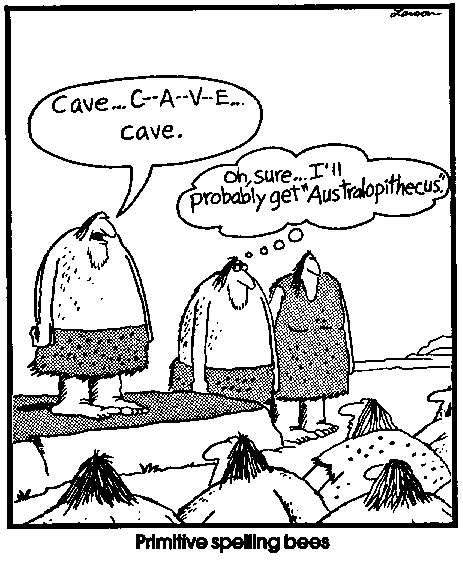
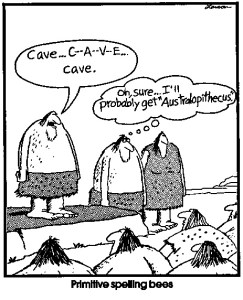
Primative Spelling BeesEnglish, in many ways, is one of the simplest languages to learn quickly and in which to converse fluently; but scratching below the surface one rapidly finds incongruities.  As a teacher for English as a foreign language for adults (TEFLA), I was frequently confronted with the challenges of teaching students to spell and pronounce words correctly, but I was also comforted by the fact that English nouns only come with four possible preceding cases, or articles (a, an, the, and none), rather than, say, German, in which each noun has a nominative, genative, dative or accusative, singular or plural form of their case; or Finnish, which has a whopping 15 cases.

The Chaos, a poem written by the Dutch traveller & teacher,  Gerard Nolst Trenité (1870–1946), gives ~800 examples of irregular spelling.  In general one can say that there are spelling “rules”, but English, in all its historic complexities of absorbing, digesting and recycling influences from conquerors, enemies, travelling companions and allies, seems designed to say “rules can and will be broken”.  I would never give his last advice to anyone – but after reading this poem, you’ll understand that English needs tenacity and constant practice to use well!

The Chaos

by G. Nolst Trenite’ a.k.a. “Charivarius” 1870 – 1946

Dearest creature in creation

Studying English pronunciation,

I will teach you in my verse

Sounds like corpse, corps, horse and worse

I will keep you, Susy, busy,

Make your head with heat grow dizzy.

Tear in eye your dress you’ll tear,

So shall I! Oh, hear my prayer,

Pray, console your loving poet,

Make my coat look new, dear, sew it!

Just compare heart, beard and heard,

Dies and diet, lord and word,

Sword and sward, retain and Britain.

(Mind the latter, how it’s written).

Made has not the sound of bade,

Say said, pay-paid, laid, but plaid.

Now I surely will not plague you

With such words as vague and ague,

But be careful how you speak,

Say break, steak, but bleak and streak.

Previous, precious, fuchsia, via,

Pipe, snipe, recipe and choir,

Cloven, oven, how and low,

Script, receipt, shoe, poem, toe.

Hear me say, devoid of trickery:

Daughter, laughter and Terpsichore,

Typhoid, measles, topsails, aisles.

Exiles, similes, reviles.

Wholly, holly, signal, signing.

Thames, examining, combining

Scholar, vicar, and cigar,

Solar, mica, war, and far.

From “desire”: desirable–admirable from “admire.”

Lumber, plumber, bier, but brier.

Chatham, brougham, renown, but known.

Knowledge, done, but gone and tone,

One, anemone. Balmoral.

Kitchen, lichen, laundry, laurel,

Gertrude, German, wind, and mind.

Scene, Melpomene, mankind,

Tortoise, turquoise, chamois-leather,

Reading, reading, heathen, heather.

This phonetic labyrinth

Gives moss, gross, brook, brooch, ninth, plinth.

Billet does not end like ballet;

Bouquet, wallet, mallet, chalet;

Blood and flood are not like food,

Nor is mould like should and would.

Banquet is not nearly parquet,

Which is said to rime with “darky.”

Viscous, Viscount, load, and broad.

Toward, to forward, to reward.

And your pronunciation’s O.K.,

When you say correctly: croquet.

Rounded, wounded, grieve, and sieve,

Friend and fiend, alive, and live,

Liberty, library, heave, and heaven,

Rachel, ache, moustache, eleven,

We say hallowed, but allowed,

People, leopard, towed, but vowed.

Mark the difference, moreover,

Between mover, plover, Dover,

Leeches, breeches, wise, precise,

Chalice, but police, and lice.

Camel, constable, unstable,

Principle, disciple, label,

Petal, penal, and canal,

Wait, surmise, plait, promise, pal.

Suit, suite, ruin, circuit, conduit,

Rime with “shirk it” and “beyond it.”

But it is not hard to tell,

Why it’s pall, mall, but Pall Mall.

Muscle, muscular, gaol, iron,

Timber, climber, bullion, lion,

Worm and storm, chaise, chaos, and chair,

Senator, spectator, mayor,

Ivy, privy, famous, clamour

And enamour rime with hammer.

Pussy, hussy, and possess,

Desert, but dessert, address.

Golf, wolf, countenance, lieutenants.

Hoist, in lieu of flags, left pennants.

River, rival, tomb, bomb, comb,

Doll and roll and some and home.

Stranger does not rime with anger.

Neither does devour with clangour.

Soul, but foul and gaunt but aunt.

Font, front, won’t, want, grand, and grant.

Shoes, goes, does. Now first say: finger.

And then: singer, ginger, linger,

Real, zeal, mauve, gauze, and gauge,

Marriage, foliage, mirage, age.

Query does not rime with very,

Nor does fury sound like bury.

Dost, lost, post; and doth, cloth, loth;

Job, Job; blossom, bosom, oath.

Though the difference seems little,

We say actual, but victual.

Seat, sweat; chaste, caste.; Leigh, eight, height;

Put, nut; granite, and unite.

Reefer does not rime with deafer,

Feoffer does, and zephyr, heifer.

Dull, bull, Geoffrey, George, ate, late,

Hint, pint, Senate, but sedate.

Scenic, Arabic, Pacific,

Science, conscience, scientific,

Tour, but our and succour, four,

Gas, alas, and Arkansas.

Sea, idea, guinea, area,

Psalm, Maria, but malaria,

Youth, south, southern, cleanse and clean,

Doctrine, turpentine, marine.

Compare alien with Italian,

Dandelion with battalion.

Sally with ally, yea, ye,

Eye, I, ay, aye, whey, key, quay.

Say aver, but ever, fever.

Neither, leisure, skein, receiver.

Never guess–it is not safe:

We say calves, valves, half, but Ralph.

Heron, granary, canary,

Crevice and device, and eyrie,

Face but preface, but efface,

Phlegm, phlegmatic, ass, glass, bass.

Large, but target, gin, give, verging,

Ought, out, joust, and scour, but scourging,

Ear but earn, and wear and bear

Do not rime with here, but ere.

Seven is right, but so is even,

Hyphen, roughen, nephew, Stephen,

Monkey, donkey, clerk, and jerk,

Asp, grasp, wasp, and cork and work.

Pronunciation–think of psyche–!

Is a paling, stout and spikey,

Won’t it make you lose your wits,

Writing “groats” and saying “grits”?

It’s a dark abyss or tunnel,

Strewn with stones, like rowlock, gunwale,

Islington and Isle of Wight,

Housewife, verdict, and indict!

Don’t you think so, reader, rather,

Saying lather, bather, father?

Finally: which rimes with “enough”

Though, through, plough, cough, hough, or tough?

Hiccough has the sound of “cup.”

My advice is–give it up!

1 Comment

Filed under Articles, Cartoon, Grammar, Nuts & Bolts, Quotes, Writing Exercise

On Being Remembered

“If you would not be forgotten as soon as you are dead, either write things worth reading or do things worth writing.”

Benjamin Franklin

Time for Reading

Leave a comment

Filed under Quotes

On the Other Side of Silence

“If we had a keen vision of all that is ordinary in human life, it would be like hearing the grass grow or the squirrel’s heart beat, and we should die of that roar which is the other side of silence. “

George Eliot (Mary Ann Evans), Poet

Lost Gardens of Heligan, Cornwall

Leave a comment

Filed under Quotes