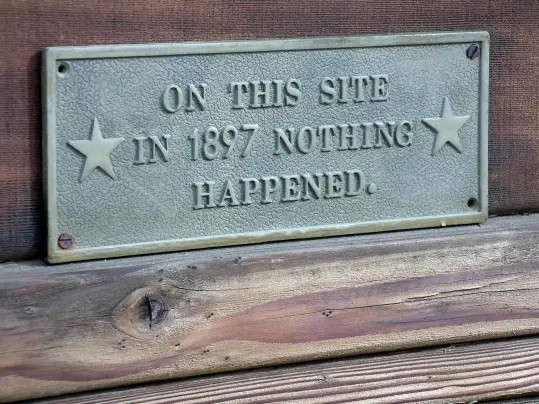
I don’t know where this is, or who took the photo, but someone’s got a great sense of humour!
Just for Fun: Nothing Happened
Filed under Humor, Just for Fun, Signs
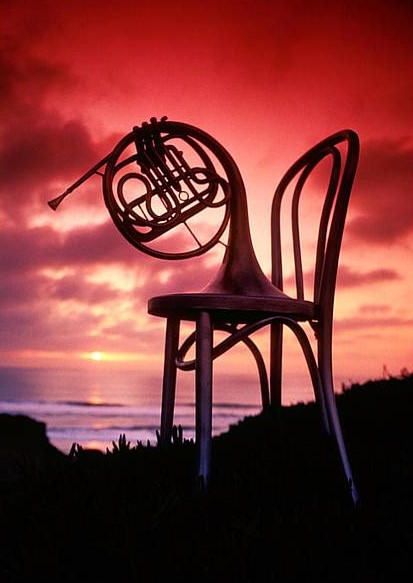
Life & All that Jazz: Musical Chairs
Have you ever played musical chairs? If yes, you know that feeling: Everything’s going along, the music’s playing, and suddenly it stops – you have to change your plans immediately or you’re too late and out of the game.
In a way, this describes the past few months for me: If you’ve read my past few posts, you’ll know that my husband was diagnosed with colon cancer in March. Life had been running relatively smoothly up until that moment, the music purring right along. Then screech, it stopped, he had surgery in April, and a piece of colon had to leave the game. The music had started again: After six weeks of him recovering and us thinking things were on track for a smooth ride, screech, the music stopped and we had to take immediate counter-action. He was in and out of hospital with infections, problems with the stoma, ups and downs, changes of plans several times (sometimes several times in 24 hours), and the stoma (thankfully) finally had to leave the game. Every time he was in hospital, because of Covid regulations, I was the only one allowed to visit him, which meant that every other day I took an hour’s trek there, maximum one hour’s visit, and another hour to reach home again. For three weeks, the music played along as he healed from surgery and began to regain weight bit by bit (he’d lost around 12 kgs. by then, not one of which was “extra weight”, I might add). Then the chemo started; we had everyone and their friends praying, worldwide, that there would be no dire side effects, and into the third round, that’s exactly what’s been happening – basically nothing! Nothing negative, I should say; all he’s really felt is a bit “blah” on the third day in, and a bit of tingling in his fingertips, and that’s it! PTL!
In all of that, I was holding the fort here; trying to keep friends and family updated, keeping the house clean and making sure we had food in the cupboard in case my husband got his appetite back, and then cooking whatever he felt like eating at the time. We had three weeks of holidays (here in Switzerland, we’d refer to them as UHU [Ums Huus Uma] Ferien, meaning “around the house holidays”; in English, one term is staycation): We took day-trips out as my husband had energy for: We took a day trip on Lake Zurich, with lunch on the lake; we had a picnic at a local bird sanctuary park that has mainly storks and ducklings; we took driving tours, went to a pocket-sized zoo, and then, as his energy returned, he started going on small (for him) hikes, then longer ones, as well as longer bike rides, building his energy and his appetite again.
As his energy improved, mine took a breather! I’m sure all of you can relate – at some point in your life, when a pressure is removed, your adrenaline subsides and you suddenly start feeling like you’re deflating. I’ve had several Covid flare-ups in the past few weeks, which hasn’t helped (I had a mild case of Covid-19 back in March 2020, and after months of bone-deep exhaustion, it started tapering off, with flare-up days happening less frequently now, but still rearing up occasionally). So far, vaccination has been a questionable option for me because of other health considerations; but more research is required – if it will eliminate flare-ups and the other long-term symptoms, I might just get it over and done.
All of this may help explain why I’ve been silent here for a month. I don’t like it – I’ve been having withdrawals; but when I haven’t had the energy to dive into an interesting topic for this blog, I’ve tried to work on my current novel’s manuscript (though on flare-up days, I can kiss any creative endeavour goodbye!). Now that life is starting to settle into some semblance of a routine once more, I hope to meet with you here more often again!
In the meantime, take care, and stay healthy! I will see you very soon, so keep your eye on the blog!
Psychology Undusted: Third Places
Several years ago, I wrote about this topic; but viewed from today’s perspective, I thought it might be worth ruminating on, so here’ goes:
Everyone has three places they spend time in: The first place is the home; the second is either school or the workplace; and the third is a place that feels comfortable – a home away from home, or a place we can unwind. The third place varies from person to person; it might be your local hairdresser’s, a pub, Starbucks, a small café, a favourite park bench, a nearby spot out in nature, or a library or museum. Companies like Starbucks have capitalized on people’s need for an environment of comfort; they have couches and armchairs and free Wi-Fi, and don’t make you feel like you need to drink up and move on. Your third place might even be virtual – Facebook and other social media sites where you like to “hang out” and connect with friends. It might be your local community centre; such places are crucial to a neighbourhood, whether or not we realize it, because they facilitate a sense of group identity. When a local crisis arises, they have been the places people gather to distribute clothing or food to those hit; meeting others, encouraging them, helping and being able to contribute to the greater good are all important to our sense of humanity; we all want to feel useful and needed in some way.
Thinking about that topic now through Covid-coloured glasses, at some point we’ve all lost our third places through lockdowns; the rules that govern social interaction have changed drastically, and it has effected the psychological health of both individuals and communities alike. While some of you may have been able to return to business as usual more or less, other regions have had multiple lockdowns; in either case, the subtle changes have made third places less inviting: Regulations about masks, needing to make reservations in restaurants that are half-empty, filling out contact tracing forms, etc. Perhaps your favourite haunt didn’t survive the financial strain of months of forced closure, or it closed because the owner passed away. More than missing that physical place, many people have suffered because of social distancing: Not being able to meet up with friends, spend time in good company, and, in the advent of mass home-office work, even the absence of spontaneous encounters with co-workers around the break room. Having a drink together over Skype or Zoom just isn’t the same; the spontaneity is missing. Those people who thrive on physical contact, such as a hug or a pat on the back, have suffered deeply on a psychological level whether they realize it or not.
Some positive effects have also come from lockdown: Many people have intentionally invested more into their local community; we’ve shopped locally or supported the local restaurants by ordering delivery or take-away more often than we normally would have, or bought from local farm shops (we’re blessed with an abundance of those in our area); by working at home, carbon emissions have been reduced by thousands of daily commuters (usually only one per car) not being on the road. Our holiday budgets have taken a breather. We’ve wasted less money on impulse-shopping. More and more people have felt the growing need to be off-grid and self-sufficient for future times of crisis, and the tiny home and homesteading movements are booming. More people are planting gardens, or they’re spending more time with their family.
Pre-pandemic habits made it easier to compartmentalize life: We had the home and the workplace in separate physical locations, which made it easier to leave the stress of one behind when returning to the other and, depending on your home or work environment, the relief of change might have been a subtle but necessary transition for your mental health. The potential emotional or mental strain that happened when those two places merged, at the same time losing our third place possibilities through lockdown, is not to be glossed over. The thing about the third place is that it’s also a responsibility-free zone; there are no expectations or obligations placed on us there; that kind of environment also inspires productivity and creativity, and many people have lamented becoming more “lazy” or “lackadaisical” in their habits over the past year; why get dressed up if you don’t have to go to work or be seen in public? Maybe you’ve grown comfortable in your “junk around the house” attire, or not wearing make-up or not shaving. The old adage of “Fine feathers make fine birds” is true: If you want to feel creative, dress for it; if you want to mean business in your schedule, dress for it. Even if you’re alone at home. Then, the transition to being seen by friends and strangers again might not be so daunting.
Returning to those third places may not be as easy at it sounds; we may never perceive such places the same ol’ way again. While some people can’t wait to get out and mingle, many of us have become cautious around groups of strangers – will they observe healthy social distancing and hygiene rules? Will they stay home if they’re sick? One thing I will never miss is someone giving me the Swiss three-kisses-to-the-cheeks greeting and then telling me they forgot to mention it – they have a cold. I’ve been far less sick in the last year, because of social distancing, than ever before*! I’ve been relieved to know that people are not wiping their noses on their hands and then offering it to me in greeting; hand disinfectants are ubiquitous now, and I’m perfectly fine with that.
[* I was recently chatting with my doctor about that topic, and she said that serious cases of influenza and pneumonia are already beginning to increase, even though it’s summer here; the suspicion in the medical community is that, because we’ve been disinfected and protected from fighting the minor cold viruses throughout the year, they’ve learned to hit aggressively if they get the chance. So talk to your doctor, or educate yourself through serious medical websites, about how you can support or encourage a healthy immune system.]
Today, while we were out for a day trip on the Lake of Zurich, I noticed that while many people have the typical pale blue medical masks, a variety of colours are becoming more common; they’ve at length become a fashion accessory. You can buy cloth masks in shops everywhere here now, or sew your own like I do. Back when this all started in 2020, many people scoffed at the idea of wearing a mask in public, and now it’s so engrained in us that we stare if someone forgot to put theirs on (here, they are required inside any building as well as when using public transport). Despite the hygienic regulations, things are slowly returning to a semblance of normalcy here; restaurants are open again (though masks can only be removed while you’re seated at your table); street cafés are popular because, as of right now, masks are not required outdoors (though that may change again now that the dangers of infection through aerosols are better understood and greater than previously assessed); and third places are becoming available again. People are cautious – and frankly, they have reason to be (I say this from the perspective of one who has long-term Covid symptoms that flare up every 3-4 weeks), but they’re starting to emerge from their hibernation, and that’s a good thing.

Filed under Articles, Links to External Articles, Musings, Psychology Undusted
Psychology Undusted: Lines of Desire
Have you ever felt guilty for taking a shortcut across a grassy patch rather than following the official concrete path? Or have you ever noticed a bare strip through grass? These are known as desire paths, or lines of desire (the latter term comes from the French phrase, “lignes de désir”, from the French philosopher Gaston Bachelard’s 1958 book, “The Poetics of Space”).
Architects would be well advised to pay attention to these worn paths when planning official paths through public parks or around businesses, because no matter how neat their officially-laid paths look, those lines of desire will continue to be followed and worn into the earth. Perhaps it’s a manifestation of democracy triumphing when a desire path gets paved over after the fact.
So why do they happen? Sometimes it’s a question of taking a shortcut from one building to the next, or from one corner to the next. Sometimes they are made out of consideration for others: During the pandemic, new lines of desires began appearing, but rather than being shortcuts, they simply ran parallel to existing paths – these were likely an attempt at avoiding proximity with others when passing on a side walk. Desire paths can be seen as the paths of least resistance, or as a silent protest against being told where to walk or how to get from points A to B. These paths have been seen as symbols of rebellion, anarchism, individual creativity, intuitive design, opportunities to take fate into one’s own hands even if treading the expected nine-to-five otherwise, or even as a passive aggressive reaction against authority.
Many languages have their own terms for desire paths or lines of desire: In Dutch, they’re known as “elephant paths”, and in French, they’re known as donkey paths, while the Germans, pragmatically, call them “trample paths” (so unimaginative!) But the diversity proves that desire paths are a universal human tendency.
Some businesses or schools, such as the University of Michigan, waited until students and staff showed them where paths would be most appreciated before paving them in; the aerial view (Google Earth) over the campus shows the intricate weave of the lines of desire that would likely not have occurred to the landscape architects:

I’d encourage you to take a walk, keeping an eye out for those lines of desire near you; if you’d prefer not to go out, then take a virtual walk – google the term “desire paths” in the image mode, and see just what pops up! Enjoy!
Personal update:
For those of you following our situation, I will say that the day after my last update everything got turned on its head once again! Chemo has been delayed another 3-4 weeks, as my husband ended up in emergency again, and they finally decided to rebuild his stoma before starting chemo. He’s now back home after over a week in the hospital, and is gaining appetite, and hopefully gaining weight again now! He’ll have a couple weeks to recover before the next phase of his treatment takes off… that’s as of THIS moment. Planning further ahead than a day is a bit pointless right now, so it’s a wait-and-see game…
Filed under Articles, Etymology, History Undusted, Science & Technology
Psychology Undusted: The Doorway Effect
We all know that experience of walking into a room with a purpose and immediately forgetting why we went in there. Don’t worry, you’re not alone, and it’s not a sign of senility or even a question of age: It’s a function of our working memory that glitches by going through a doorway – as simple as that.
Our brains process a lot that we don’t even think about: We breathe without a thought, we walk in a straight line usually, we can walk with relatively good balance (unless there’s something else interfering, like alcohol or an ear infection), and we can think about a myriad of other things while walking, sitting, or even laying down – all thanks to the grey matter inside our skulls. We can create something physical or something using words or music, and we can differentiate between events of the past, present, and the future.
But sometimes our brains chuck out things it considers irrelevant or no longer required; our working memory is constantly adjusting to the new circumstances we find ourselves in in any given moment, so it creates what are known as “event boundaries” – and one common boundary in our physical world is a doorway. We can also have virtual doorways: when we move from one circumstance to the next, the events are segmented or “compartmentalized” in our brains; this is known as the “location updating effect”, or simply, “the doorway effect”. You may have wanted to get an ingredient for dinner from your pantry; but when you walk through that doorway, your brain mistakes the temporary requirement as no longer applicable and moves on to the next circumstance facing you. That leaves you standing there with a blank expression, wondering why you’re there.
In this age of relentless bombardment of marketing, of internet, or of being able to face-time or Skype or WhatsApp with friends and family in any time zone at the touch of a screen, it’s no wonder our brains sometimes feel overloaded and chuck out something we actually needed to remember just a bit longer. But there’s a trick to remembering what you forgot: Just walk back through the doorway into the room you had the thought in the first place, and it should trigger that forgotten purpose.
PERSONAL UPDATE:
For those of you wondering how we are doing: My husband starts chemo this week; it’s been an up-and-down ride, and planning further ahead than a day has been a waste of time, so we’re taking one day at a time. After a week in the hospital with an infection and a round of antibiotics that also messed with his stomach and digestion, he’s beginning to feel a bit better, and is gaining a bit of weight again. We have holidays over the next few weeks, so when he’s feeling up to doing something, we can take day trips out. Today, we drove to a nearby nature reserve and enjoyed watching nesting storks and large prey birds, as well as Highland cattle. we’re taking life very slowly right now. Thank you for your prayers and well wishes!
Filed under Nature, Science & Technology
History Undusted: Limbo
Over the past year and more, we’ve all experienced limbo in one form or another: Lock downs, restrictions, cancellations of events or flights or holidays or plans to meet up with friends, and the uncertainty of how long it will all last. Then there is the feeling of limbo that comes with my personal situation of waiting for the cascade of appointments for my husband’s chemo to begin; we had a set-back last week with a bacterial infection and a week’s hospitalization, so we’ll just have to wait and see if he can keep the appointments already made or not. Limbo. Waiting to find out if he can be brought home tomorrow. Limbo.
My writing, both in the forms of this blog and of my manuscript, have both been sucked into the state of limbo as well, as I’ve spent most of the past few weeks, and more intensively the past three days, on the phone with people who’ve asked how we’re doing, or answering messages on my phone or social media. Sometimes I feel like my manuscript is calling for me to work on it, and I’m trying to reach it while wading toward it waist-deep in a thick sludge of other priorities – it’s been just out of reach for days, because by the time I actually reach it, I have no energy left.
As I was thinking about those limbo moments, I actually started wondering just where the limbo dance comes from, historically; I remember doing it as a child – the local indoor skating rink played limbo every night. So, here’s a brief low-down on the low-down dance:
The origins are vague, as is the etymology of the name: Starting in late-1800s Trinidad, the name might have come from the Jamaican English “limba“, i.e. limber. Interestingly, the game is used in Africa as a funeral game, and there may be a connection between the two regions through the slave trade which brought Africans to the Jamaican islands, as it is also a popular “dance” for wakes in Trinidad. The rules are simple: a person passes under a bar, face-up, with the only body part allowed to touch the ground being the feet. The game is considered the unofficial national game of Trinidad and Tobago, it only began to gain popularity beyond the region in the 1950s; it was adopted in the mid-1950s as a form of physical exercise for American military troops. It was often attempted to a rhythmic song, and one of the most popular was the Limbo Rock, by Chubby Checker. Just listening to the song brings back the feeling of the cool breeze blowing around the skating rink as people sped to get in line for the limbo stick as soon as they heard the music start over the loudspeaker!
As we face our own times of limbo in this age of Corona, or in the circumstances we find ourselves in, perhaps it would perk up our spirits to hum the Limbo Rock and take it with a bow and a smile.

Filed under Articles, Etymology, History, History Undusted, Military History, Research, Snapshots in History
Virtual Tour: Odd Collections
Most people collect something as a hobby; I’ve collected various things over the years: Stamps, postcards, arrow heads, fossils and minerals or gemstones, and coins. All of those are fairly common. The oddest thing I used to collect, in middle school, was spiders: I had about 500 different species in test tubes, and I would use them with my science fair presentations that was, for several years in a row, a growing display of all things arachnid, including my pet tarantulas.
But there are folks out there who make that last collection of mine look normal: People who collect thousands of toothbrushes, or back scratchers, or “Do Not Disturb” signs, or erasers, or milk bottles. Where most of us have a collection that fits into a storage box, others have them the size of an entire room or two. OCD is probably also on the top of their profile descriptives, but then maybe they’re just passionate or fascinated about something most people would never think about collecting.
To have a look at 43 odd collections, just click HERE. Some of these are only odd in their amount collected, while others are just downright gross (think world’s largest chewed gum ball, or navel lint…). Perhaps “enjoy” is the wrong sentiment in those cases, but nevertheless, have a fascinating time vicariously checking out the odd quirks of others!
Filed under Links to External Articles, Lists, Obscurities, Research, Virtual Tours
Life & All that Jazz: Peace in the Storm
It’s been a few weeks since I posted; right after my last post, our lives got turned upside down, so I wanted to take a moment to explain what’s been going on, and why I haven’t been present recently:
At the end of March, my husband had to find a new general doctor, as his former doctor retired; because of the full check-up, they found a tumour in his colon. It turned out to be malignant. Since that moment, everything has been moving either lightening-speed or at a snail’s pace, with nothing in between… He had a round of radiation therapy, and then surgery, after which he was in the hospital for several days; now he’s at home, and what should have been a 6-week period with a stoma will now be much shorter, as he needs to have that reconstructed before any chemotherapy can begin…we’ll know more after a consultation in a week, so this week is an emotional and mental limbo. Through it all, we are at peace; we have dozens of people around the world praying for us, and we know that our lives are in God’s hands. Our lives are always in God’s loving hands; often, we humans think we have things in our control, but that’s an illusion. The healthiest person in the world could get hit by a train tomorrow. There are no guarantees of a long, healthy life on this earth; that’s why it’s important to know where you’re going after you leave your mortal frame behind. If you haven’t thought about that, I’d encourage you to do so. Most westerners are taught that death is an uncomfortable topic, and so most people avoid it; in other cultures, death is considered a part of life’s cycle, which is closer to reality than ignoring the topic as if that would make it go away. My husband and I are Christians, so for us, mortal death is just a one-way ticket home, so to speak. Death is something we don’t have to fear – not that we’re eager for it to come, but I think you understand what I mean. Our hope rests in Someone greater than us who has our very best interests at His heart; it doesn’t rest with doctors, though we can trust God to guide their hands, decisions, discernment and actions. Even if your life philosophy doesn’t agree with mine, I’d encourage you to consider my perspective.
I don’t know if you’ve ever been in this kind of situation, but I find that for me, while normal energy is going elsewhere, I still need to keep my hands and my mind busy. While keeping one part of my mind on my husband and where he’s at in the flat, or if he needs something, or if I can entice him to eat something, the other part of my mind is too distracted to focus too much on creative writing. I don’t ever want to post a blog just to post something; if it’s not something I’m interested in personally – if it doesn’t grab my own attention, or if it’s not from my heart – I won’t post. Quality over quantity has always been my guiding motto. So instead, I’ve been cleaning – in German, we would say entschlacken, or decluttering. Our library is now nine grocery bags slimmer of books; we still have over a thousand, but these are books we read, or antiques, or first editions, or hardbacks. What I could find on Kindle got physically eliminated if it didn’t fall into those 4 categories. Besides decluttering, I crochet – right now, I’m making small toys for a Christmas gift campaign that our church participates in each year; we package up 200 boxes with toiletries, school supplies, warm hats and scarves, and toys. It gives me a goal to reach before December and keeps my hands busy.
Hopefully, in the coming week, I’ll find the creative juices to take you on our next virtual tour. In the meantime, stay healthy, stay safe, and be the best version of you.