Category Archives: Articles

How To Boost Your Focus

I’m probably the most organised person I know; I’m not OCD about it, I just work better when things are organised.  Writing a book means that I accumulate bits and pieces of information, research facts, website links, editing tips, formatting guidelines, historical trivia that I can integrate into my plot (but only if I can find it when I get there), maps, diagrams, lists of names in various languages, grammar points to remember (I’ve made up a word for “points to remember” – poitrems – you heard it here first), How-To cheat-sheets for PhotoShop, publication checklists (pre- and post-), Shelfari to-dos, and… need I continue?  I’m just getting started.  And that’s my point.  If I’m not organised, I’ll waste half my day looking for something… where did I put that note about the dimensions of a modern casket?  Was it hot arsenic or cyanide that smells like garlic?  Are blue diamonds more valuable than pure white?  What kind of micro-organism poops arsenic?  A friend of mine complimented me one day when I told her some of the things I was researching; she said, “You’re just weird.”  And it’s something my husband repeats fondly on a regular basis.

So, I’d like to share a few of my organisational tips with you:

1)  Know thyself.  Know your weaknesses (You know, those distractions, procrastination excuses, time-eating habits like “just checking into Facebook for a minute before I sit down to write” and an hour later you’re hungry, then you see that the kitchen needs cleaning… you know who you are.).  Recognize those time-wasters, and nip them in the bud before they mushroom into a day wasted.  Keep your cell phone at a safe distance; wear earplugs if you need to; turn on music if it helps you focus, turn it off if it distracts you.  Write down points to research and only dive into research when you have 5 items on the list (and stay away from time-monster sites like Facebook and Youtube while you’re working!)

Character Profile Worksheet 12)  Find a system that works for you.  I organise my notes, etc. in various ways:  I have pocket-sized Moleskin books for quick reference character profiles, lists of words, family trees of characters, etc.; I also have lined notebooks with those heavy-duty post-it tabs labelling the sections (that are well-spaced apart for future additions); I write the section names on the front and back of those tabs so that I can find it from either way the notebook lands on my desk.  For instance, one notebook I always have at hand has sections like publications, pre- & post- publication to-dos, paperback formatting checklist, KDP guidelines, CreateSpace guidelines, grammar, PhotoShop Elements helps, editing checklists, proofing checklists, Beta checklists, and step-by-step guides for various publication formats.  Another notebook I keep on hand has things like time-related notes (Julian calendar terms, Ages [Stone Age = ~6,000-2,000 BC], etc.), medical notes (that’s where I put that note about modern casket dimensions), glossaries for archaeological terms, 18th century England notes, lists of museum curators’ names, phone numbers and emails, etc.  Besides notebooks, I keep “cards” – here’s an example (to the right):  I type up the information in PowerPoint, then save each “card” to .jpg format through MS Paint.  These cards are then saved onto my Tab through Dropbox, and Bob’s your uncle, I’ve got them handy whether I’m writing on the couch, on holiday, or in a café.

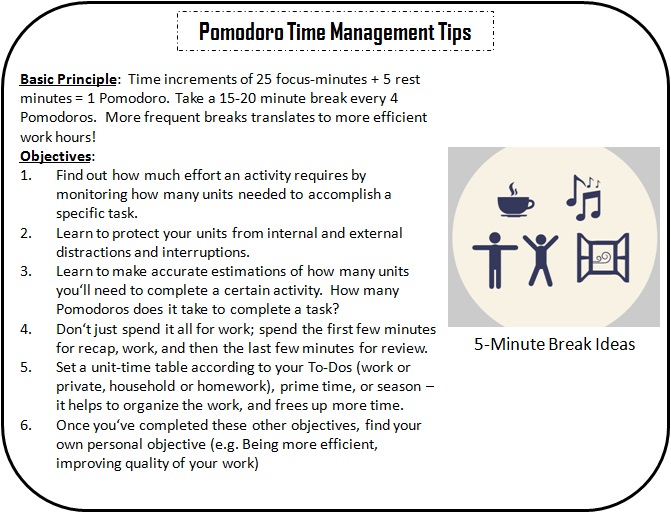
Pomodoro Time Management Tips3) Learn to focus.  I’ve recently found a great way to focus better through those hours of the day and night when I know I’m going to be most distracted:  It’s called Focus Booster.  It’s basically a timer on your desktop that counts down time increments, with an additional break-time at the end of each cycle.  The standard unit of time is 25/5, though you can adjust it to your rhythm.  The thinking is that anyone can focus on a given task for 25 minutes, even those who struggle with ADD.  In using it, I’ve realized how often I get distracted by a thought that comes into my mind while writing and I get up to do something quickly.  This way, I stay working for a solid amount of time, and use that 5 minutes to switch gears and get other things done; it’s amazing how much you can get accomplished in 30 minutes.  I’d encourage you to download it and give it a try if you struggle with concentration.  Here’s a second card I’ve made with the basic principles for the Booster.

Those are just a few ideas; if you struggle with a specific area, or would like suggestions on dealing with specific challenges in focusing, just ask away!  Focus well, and your writing will flow so much more smoothly and swiftly.


3 Comments

Filed under Articles, Nuts & Bolts, Research, Writing Exercise

Writing to Distraction!

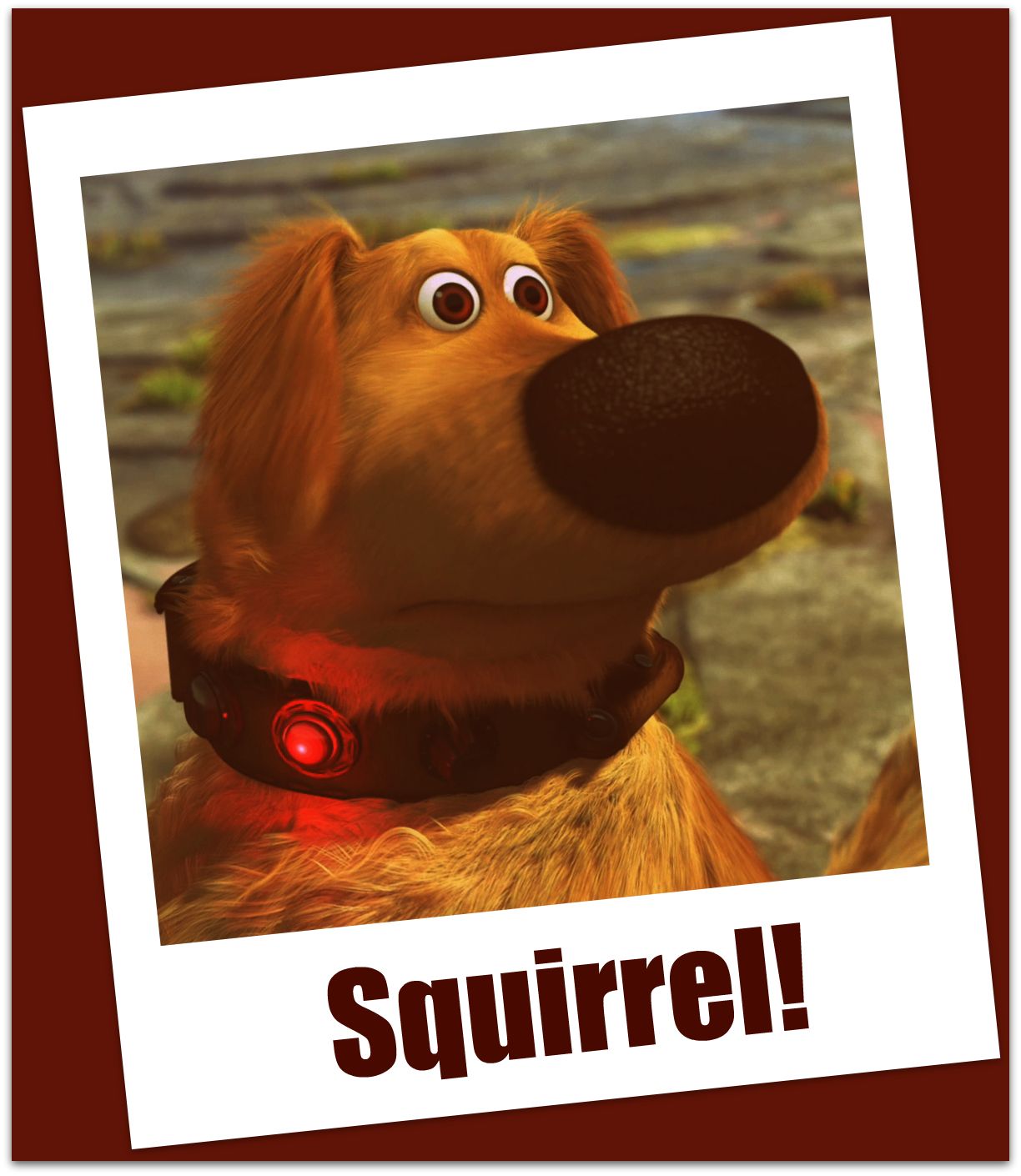
Squirrel_DugIf you’re a writer you know exactly what that title means.  Working on a project usually requires research; I don’t know what I’d do without internet connection, honestly – I’m too busy to take a day and plough through the local library, and as my local library consists of 99.9% German books anyway it’s not very helpful for writing English novels.  I have an extensive library here at home, and my research section is better equipped than the public library… but I digress.  Sometimes distractions come at you from every side; I feel like those dogs in “Up”… Squirrel!

And that’s the point.  Let’s say I go to YouTube for research:  It’s a great place to find out how to do just about anything, from how to throw a keris dagger and the aerodynamic difference between the wavy and the straight blade; how to make a vase out of a plastic bottle; how to make yarn from plastic bags; how to make an emergency stove out of a coke can or a light bulb out of a PET bottle with water, and the list goes on and on and on and on.  There are also hundreds of documentaries available on YouTube, from entertainment like the Horrible Histories series, to astronomy, science, history, you name it.  But if you’re like me you are interested in all of the above; and like Pringles, it’s hard to watch just one.  When I need a change of pace I also like to watch things on YouTube like the Actor’s Studio series, or talk show interviews (and we don’t have English-language television channels, which is actually fine by me – we use our television for sports programs and DVDs – but I digress.  Again.).  And YouTube is just one resource.  I have dozens of links to glossaries, websites that specialize in various aspects of history, science, technology, historical fashions, linguistics, etymology or other areas of interest, reference and research.

An important rule in dealing with online information is to have it confirmed by legitimate sources before using it, for instance, as a basis for anything substantial in a novel or other work of literature.  That rule has led me more than once to buying a book online.  In researching for The Price of Freedom and Redemption, I was especially frustrated with online research in the area of accurate apparel:  1788 was a world of difference in England to 1790, as the French Revolution changed fashion sensibilities in England – people distanced themselves from France, and patriotic influences as well as English fashion designers and trend setters came into their own more because of the vacuum.  But most online research that I came across either had the 18th century all lumped into one style, or “1700 to 1750” and “the latter half of the 18th century” which meant “French Revolution and thereafter” nine times out of ten.  Dubious at best, that.  Not even contemporary paintings are an accurate reference, as many of the “new middlings” had their clothing, and even background houses and gardens, “augmented” (read “upgraded”) for their paintings to add elegance to their new money.  And often, when I search for “18th century” I come across sites that actually mean the 1800s (that is, the 19th century).  My definitive source of information on that topic has become “The Dress of the People: Everyday Fashion in Eighteenth-Century England.”

So in trying to find one tiny little detail for fleshing out a scene, one can spend hours surfing, reading, searching, scanning and getting distracted by something else interesting along the way.  Yesterday I spent hours trying to find online PDFs or text of any kind from actual October 1789 The Times (London) newspaper (I’d have been satisfied with any month of that year!), just to find out what topics were being written about in the newspaper at the time aside from the Revolution.  What were the gossip columns writing about?  What kind of advertisements were there?  What were things considered newsworthy in that newspaper that year?  So far, Research – zilch, Time Spent – 3+ hours.  I looked at archives.com, Google images… nothing.  If anyone knows a resource for that, please let me know!! (If you think it would be impossible to find such old bits and pieces online in the cyber age, think again; I’ve found all kinds of documents far older that have been digitalized; someone out there is interested in it besides me, and chances are, someone has uploaded it into cyberspace; it’s just a matter of finding it in the static of cutesy videos and brainless teenage selfies…)

It can be so easy, and so enticing, to “waste” hours researching.  I try to follow two rules, and perhaps they’ll help you save time as well:

1)  Set a time limit for research.  When I need a break from the manuscript, but I don’t want to stray too far, I look at the clock and set myself one hour to find something on my research list.

2)  Make that research list; as you’re writing, keep a list somewhere (I have an e-post-it on my desktop) of things you’ll need to research, and do it all at once or in organized chunks.  It helps keep you focused on the manuscript, and makes the time you spend both on and off the actual script more efficient.

3 Comments

Filed under Articles, Research

The Debate: Online vs. Onscreen vs. Physical Reading

I came across an interesting article (click on the photo below to read it for yourself) on the Scientific American website; it compares e-reading to physical reading, and discusses the pros and cons, the questions as to whether our brains are adapting to deal with the new technological challenges, and whether or not we as a human race could risk losing certain cognitive functions by abandoning physical reading.  I found the article informative; but I also observed myself while reading and I discovered a few things:

As I write (type) this, I’m sitting in my usual writing location – in our home library surrounded by well over a thousand books.  I’ve collected antique books over the years, and have some nearly 200 years old, while I have my own latest books fresh off the press as well.  Those books, old or new, aren’t for show – they’re for reading.  I also have a Kindle, and often read books either on the Kindle or on my android Tab, or even my computer with the Kindle for PC app.  But as I read the article I found myself getting impatient, and I realized that the article, while professing to be a neutral assessment of the two mediums, had broken a few unspoken criteria for Netiquette:  When I read online my expectation is that the article is succinct (not rambling); 300-500 words is the optimal length (give or take a bit), and yet this SA article was over 3,900 words long, equivalent to 7 A4 typed pages (I copied the article to plain text for a quick check).  As a comparison, a random chapter from a novel (taken from my Kindle) was at 3,200 words (5 A4 pages).  Underlying assumptions are that a) a typical magazine or periodical article that works in a printed format should work equally as well for an online format and b) if it doesn’t it must mean that people reading online are less patient or (dare I say it?) less intelligent than our print readers.  But some of the questions (and one assumes they are rhetorical) the article raises are, “As digital texts and technologies become more prevalent, we gain new and more mobile ways of reading—but are we still reading as attentively and thoroughly? How do our brains respond differently to onscreen text than to words on paper?” Had they looked at any resources for tips on writing articles online, they would have seen a tip at the top of most lists regarding length.  Our brains do respond differently to online text because we have a different set of expectations or criteria.

Personally, I read a lot.  A LOT.  Both digital as well as printed formats.  I would classify myself as, for want of a proper word, “Polyliterate”: I read equally thoroughly in a book and on my Kindle / computer.  But criteria and expectations are different for online vs. onscreen, and I think the article misses that distinction.  Onscreen, I’m thorough; online, I expect the text to get to the crux of the matter within the first screen-length (and conclude by the end of the second); I have no patience for those sites that force a reader to click through several screens to get to their point(s).  Precisely because I work on the computer, my online time is more valuable; I want conciseness.  And as to reading books, like any true bibliophile I love the feel of a good book in my hands, the tactile experience of knowing just where I am in the context of the whole story; but I also love taking an entire library with me in my Kindle, getting lost in the story either way (and not the format).

Just Curious:

If any of you take the time to read the entire article (by clicking on the photo) below, what are your thoughts?  Or if you have given extensive thought to this issue yourself, what do you think?  What are your reading habits and expectations of physical vs. onscreen vs. online matter?


Image Credit:  Amazon

Image Credit: Amazon

9 Comments

Filed under Articles

The 3 Levels of Editing

EditingWriting is not just about stringing words together to express a coherent thought; at that level one might say it’s primary school basics.  The deeper I delve into the written world of words, the more I recognize the shades of colour, light and moods, and the fact that when I am telling a story, I am really painting a picture.  But to get to that depth, besides the fundamental skills of telling a good story, every writer needs to be familiar with what I consider to be three basic levels of editing; there’s a wide palette for discussion, and the order below is not chronological but often simultaneous phases of editing.  Here are a few points to keep in mind:

1:  The Matrix Level

I call this the “Matrix Level” because it really is the foundation – without it, don’t even think about giving up your day job.  This level includes things like spelling, vocabulary (choosing the best word or phrase in a given situation) and punctuation.  At this level you might also include things like formatting (being consistent in usage of fonts; spacing; size and heading styles; margins; indentations; double-or single-spacing after a full stop; capitalizations; abbreviations [e.g. Mr. or Mr {that choice depends on whether or not you’re using American Standard English, or British Standard English}]; and consistent use of italics, bolds and underlines).

2:  The 3-C Level

This is what I call the 3-C level because it’s just that:  Coherency, Consistency, Conciseness.  This is the level you work on things like clear expression; showing, not telling (re-writing those scenes that tell into a scene that shows the action or the purpose of that scene); assessing what your demographic target is (teenagers, women, men, children, intellectual readers, pulp-fiction readers, genre-specific groups, etc.) and writing with them in mind as you make choices of expression and complexity.

This level includes things like pacing/timing/rhythm of the overall script; logical connections, organic changes, filling in the “holes” in the plot, the building of action or tension (again, in an organic way to the story—don’t just slap in a sex scene or a car chase because you need to pick up the pace in a dragging scene!), and keeping an eye out for things like vocabulary repetition (if it’s there, it needs to be organic, e.g. perhaps a character likes to use a phrase as a “trademark”) or filler words (actually, really, etc.).

3:  The “Cutting Room Floor” Level

This is the level where tough decisions come in; here you need to ask yourself some basic questions:  Does scene XYZ support the plot in more than one way?  [Plot, by the way, applies whether you’re writing a novel, a business case plan, or a newspaper article.]  If not, can I glean the core sentiment or information that needs to be conveyed and splice it in somewhere else?  Does the purpose / goal come through or remain clear in this scene?  If not, how can I change it, trim it, or chop it?  Are paragraphs unified (i.e. one main goal / thought each)?  This process is very similar to film editing, and you can learn a lot from that process by listening to good film commentaries (the best I’ve come across are films with commentaries by Steven Spielberg – he’s a natural teacher in that respect!).

In the current novel I’m writing, a fantasy-history spanning from first century AD Scotland and Norway to modern-day Scotland, an earlier draft had too many characters; there are still enough to warrant a Cast of Characters section at the end (due to the complex structure that will be woven together in the next draft), but the general rule is to not tax the reader with more than four characters in any given scene.  So even though each character was well-developed and interesting, I had to let some heads roll.

The way I write works for me:  If I’ve written a scene that somehow doesn’t sit right with the tone/mood but I know it conveys something necessary to the construct as a whole, I will paste that scene to the end of the document and title it “Scene to Salvage: —” with a brief description.  Later I can go back to the core of that scene and salvage it, or decide that it no longer fits and delete it—it’s nonetheless served the purpose of helping me solidify the plot by hashing out certain elements.  I may really like one key sentence or idea, so I’ll cut it out and drop it in where it works well organically to the story.  I might also add that each of these levels is vital in this story as each section (Pictish; an otherworldly kingdom; Norse settlements; and modern archaeology) has its own colour palette:  Stone, rain and sea; mist, sky and whispers; leather, smoke and wood; and technology, pubs and peat mire.  Each sections’ dialogue and prose need to reflect those palettes, and that’s the secret of showing, not telling!

The more structured you work, and the more confident you become with each level, the better and faster the writing process will become.  I hope this inspires you, and spurs you on to greater writing!

Leave a comment

Filed under Articles, Lists, Nuts & Bolts, Publications

Science-Fiction Made Real: The Origami Microscope

Recently I looked at past technologies; today I came across a TED video that is simply mind-boggling:  An Origami microscope that is cheap, powerful (magnifications up to 2,000x), waterproof, durable, and can be made available to anyone.  It sounds like science fiction, but it’s real, today; think of the possibilities for early diagnosis for the remote people of the earth who have all too often been neglected due to a lack of funds.  Click on the image below to see a 9-minute presentation by Stanford bioengineering professor Manu Prakash, PhD.

origami-microscope


2 Comments

Filed under Articles, How It's Made, Research, Videos

The Svalbard Global Seed Vault

Like something out of a Science Fiction film, the Svalbard Global Seed Vault looks like a monolith rising out of the snowy mountains in Norway.  Its purpose could be out of the same film:  It’s a depository for seeds from around the world, to preserve plants in case of global disaster, whether fire, flood, ice or nuclear.  To read the whole story, check out the Wikipedia article by clicking on the image below.  If you write Science Fiction, be inspired!  If you are into gardening, global environmental issues, or simply worried about the direction society is heading, take comfort… there are people planning ahead.

Svalbard Seed Vault

Leave a comment

Filed under Articles

On Getting an Education

Christmas is over and schools are starting back up this coming Monday here in Switzerland.  We all know the adage of the older generation answering the complaints of the younger generation about going to school with, “When I was your age, I (fill in the blanks)____________ (had to cross a snow storm on my hands and knees every day / rode a horse sixty miles one way / had to eat the horse halfway to avoid starvation…).”

I don’t know what it’s like where you live, but here children need to know what they want to do with their careers by the time they’re 12 or 13 so that they can begin training specifically in maths or sciences toward that goal.  I don’t know about you, but I never thought that far ahead at that age!  I don’t know a child who does; so it puts a tremendous amount of pressure on them at a far too early age, if you ask me.  Having said that, children here don’t have to traverse war zones, landmine fields, or floods to get to their school here.  Some may have to cross mountains, but they do so in a school bus.  Yet for all of that, education is one of the most precious assets on the planet; with it, the world lays open before us; without it, opportunities often remain just out of reach, or so far away that they’re completely out of sight.

So the next time you hear a teenager you know complain about going to school, just show them the photos from the link by clicking on the images below, and may we all remember to count our blessings!

risking-lives-for-school[2]

Leave a comment

Filed under Articles

What a Pink Tutu Can Do

What on the surface just looks like a man going through mid-life crisis in a pink tutu turns out to be a heart-warming and inspirational story that will make you smile every time you see a pink tutu from now on.  Just click on the photo below to hear the story of a man’s love for his wife and the lengths he’s gone to, to bring a smile to her face in the midst of the trials of cancer, and where it’s gone from that simple desire.

pink-tutu-bob-carey

2 Comments

Filed under Articles

What We Eat

Photographer Peter Menzel has gathered an amazing visual documentation on eating habits around the world; each photo represents the food eaten in a week by the people in the photo (which implies that it is the number of people who live in the same household, even it that “house” is a cardboard box or a tin shack…).  It’s eye-opening in many ways:  The amount of junk food in any one of the American households outweighs nearly the entire weekly diet of a family in Chad; some cultures are starch-oriented (pastas, breads, potatoes), and others are meat-oriented.  Click on the photo below to see a video compilation, with the countries labeled, of who eats what.

What do you eat in a week?  How much is natural, how much is man-made?  How much water and natural drinks (teas, fruit juices) vs. artificial drinks (sodas, syrups) do you drink in a week?  Just curious…!

A Week of Food - Ecuador

2 Comments

Filed under Articles, History

Families of Complete Strangers

Photographer Richard Renaldi has a unique way of posing humanity, and something unique happens along the way:  Complete strangers discover that feeling of family, even if only for a moment.  They’ll never look at strangers the same way again.  Click on the image below to see for yourself.

Complete Strangers - Richard Renaldi

2 Comments

Filed under Articles, History