
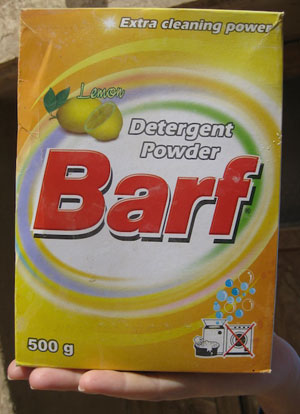
In Iran, where this laundry detergent is produced, the name means “snow”. For obvious reasons I don’t think they should try to break into the English market…
For other ads lost in translation, click here.
In Iran, where this laundry detergent is produced, the name means “snow”. For obvious reasons I don’t think they should try to break into the English market…
For other ads lost in translation, click here.
Filed under Humor, Images, Mistranslations, Signs
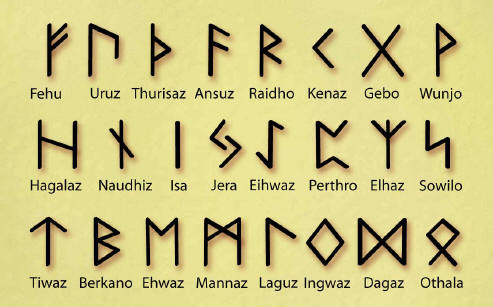
Have you ever wondered about the old-fashioned “ye” in shop signs? It was a lazy printer’s solution to saving space for “th”, and should be pronounced as “the”, not “yee”! The Old English character “y” was a graphic alteration of the Germanic rune “Þ” (which came over with the Viking raiders and the Norman King Canute and his rabble, but that’s another story). When English printing typefaces couldn’t supply the right kind of “P” they substituted the “Y” (close enough, right?). That practice continued into the 18th century, when it dropped out of use. By the 19th century it was revived as a deliberate antiquarianism – to give a shop a pedigree, so to speak (read “marketing scam”), and soon came to be mocked because of it. And now we think of it as the quaint way they used to write…
For a short, fun video on the topic, click on Ye Olde Web link, below.
Filed under History, Humor, Mistranslations, Nuts & Bolts, Translations
 Recently I used the title’s idiom, and to be honest I don’t know if I’d ever used it before in writing; I’ve heard it said onk-times, but never had much use for it so far in written form. Then came the question, is it “toe” or “tow”? Actually the original phrase is nautical; but that could still be either spelling. I did a bit of research, in both etymology dictionaries and a book of naval slang, online and in my library. The consensus, I present here.
“Toe the line,” according to Naval History & Heritage, comes from the practice of waterproofing between deck boards with a layer of oakum, pitch and tar, thus creating a striped deck; when the crew was ordered to fall in at quarters they would line up at their designated area of the deck, toes to the line to ensure a neat line for inspection. Toeing the line was also used as a form of punishment for lighter misdemeanours aboard a ship, such as younger crew members talking at the wrong time; they were made to stand at the line for a specified amount of time to remind them to behave. A logical leap later and we have our idiom, because the young lads were warned to “toe the line” – they were to mentally toe the line to avoid getting in trouble.
 However, “Tow the line” could be seen as a malapropism, a mondegreen, or an eggcorn. A malapropism (also called Dogberryism) is the substitution of an inappropriate word or expression in place of the correct and similarly-sounding word. Example: “Officer Dogberry said, “Our watch, sir, have indeed comprehended two auspicious persons” (apprehended two suspicious persons). A mondegreen is an error arising from understanding a spoken word or song text incorrectly. Example: “The ants are my friends, blowin’ in the wind” (the answer my friends) – Bob Dylan. An eggcorn is an idiosyncratic (but semantically motivated) substitution of a word or phrase for a word or phrase that sound identical, or nearly so, at least in the dialect the speaker uses. Example: “for all intensive purposes” instead of “for all intents and purposes”. Depending on your view of things, “tow the line” could fall into any of those categories. But it has so often been misused that it has begun to develop its own connotation independent of the original idiom: While “toe the line” indicates a passive agreement or adherence to a particular regulation or ideology, “tow the line” implies more of an active participation in the enforcement or propagation of that “line” whether political, social, or business policy, as towing an object is not passive, but participative.
Filed under Articles, History, Mistranslations, Nuts & Bolts, Research
 The following poem has been floating around for years; it’s so popular because it’s a great encapsulated example of the weirdness of English as a language! It’s also a great exercise in stretching your vocabulary, being more aware of how to say words that are often only seen written and never heard pronounced. And if you come across a word you don’t know, or could swear it’s pronounced differently than the rhyme of the poem indicates, I challenge you to look it up (Wiktionary is an example of a good source which shows how various dialects of English pronounce words if there is more than one option); and if you feel completely overwhelmed, click on the cartoon above to watch someone else chew their way through it!
Dearest creature in creation,
Study English pronunciation.
I will teach you in my verse
Sounds like corpse, corps, horse, and worse.
I will keep you, Suzy, busy,
Make your head with heat grow dizzy.
Tear in eye, your dress will tear.
So shall I! Oh hear my prayer.
Just compare heart, beard, and heard,
Dies and diet, lord and word,
Sword and sward, retain and Britain.
(Mind the latter, how it’s written.)
Now I surely will not plague you
With such words as plaque and ague.
But be careful how you speak:
Say break and steak, but bleak and streak;
Cloven, oven, how and low,
Script, receipt, show, poem, and toe.
Hear me say, devoid of trickery,
Daughter, laughter, and Terpsichore,
Typhoid, measles, topsails, aisles,
Exiles, similes, and reviles;
Scholar, vicar, and cigar,
Solar, mica, war and far;
One, anemone, Balmoral,
Kitchen, lichen, laundry, laurel;
Gertrude, German, wind and mind,
Scene, Melpomene, mankind.
Billet does not rhyme with ballet,
Bouquet, wallet, mallet, chalet.
Blood and flood are not like food,
Nor is mould like should and would.
Viscous, viscount, load and broad,
Toward, to forward, to reward.
And your pronunciation’s OK
When you correctly say croquet,
Rounded, wounded, grieve and sieve,
Friend and fiend, alive and live.
Ivy, privy, famous; clamour
And enamour rhymes with hammer.
River, rival, tomb, bomb, comb,
Doll and roll and some and home.
Stranger does not rhyme with anger,
Neither does devour with clangour.
Souls but foul, haunt but aunt,
Font, front, wont, want, grand, and grant,
Shoes, goes, does. Now first say finger,
And then singer, ginger, linger,
Real, zeal, mauve, gauze, gouge and gauge,
Marriage, foliage, mirage, and age.
Query does not rhyme with very,
Nor does fury sound like bury.
Dost, lost, post and doth, cloth, loth.
Job, nob, bosom, transom, oath.
Though the differences seem little,
We say actual but victual.
Refer does not rhyme with deafer.
Foeffer does, and zephyr, heifer.
Mint, pint, senate and sedate;
Dull, bull, and George ate late.
Scenic, Arabic, Pacific,
Science, conscience, scientific.
Liberty, library, heave and heaven,
Rachel, ache, moustache, eleven.
We say hallowed, but allowed,
People, leopard, towed, but vowed.
Mark the differences, moreover,
Between mover, cover, clover;
Leeches, breeches, wise, precise,
Chalice, but police and lice;
Camel, constable, unstable,
Principle, disciple, label.
Petal, panel, and canal,
Wait, surprise, plait, promise, pal.
Worm and storm, chaise, chaos, chair,
Senator, spectator, mayor.
Tour, but our and succour, four.
Gas, alas, and Arkansas.
Sea, idea, Korea, area,
Psalm, Maria, but malaria.
Youth, south, southern, cleanse and clean.
Doctrine, turpentine, marine.
Compare alien with Italian,
Dandelion and battalion.
Sally with ally, yea, ye,
Eye, I, ay, aye, whey, and key.
Say aver, but ever, fever,
Neither, leisure, skein, deceiver.
Heron, granary, canary.
Crevice and device and aerie.
Face, but preface, not efface.
Phlegm, phlegmatic, ass, glass, bass.
Large, but target, gin, give, verging,
Ought, out, joust and scour, scourging.
Ear, but earn and wear and tear
Do not rhyme with here but ere.
Seven is right, but so is even,
Hyphen, roughen, nephew Stephen,
Monkey, donkey, Turk and jerk,
Ask, grasp, wasp, and cork and work.
Pronunciation — think of Psyche!
Is a paling stout and spikey?
Won’t it make you lose your wits,
Writing groats and saying grits?
It’s a dark abyss or tunnel:
Strewn with stones, stowed, solace, gunwale,
Islington and Isle of Wight,
Housewife, verdict and indict.
Finally, which rhymes with enough?
Though, through, plough, or dough, or cough?
Hiccough has the sound of cup.
My advice is give it up!
Filed under Cartoon, Mistranslations, Nuts & Bolts, Quotes, Videos, Writing Exercise
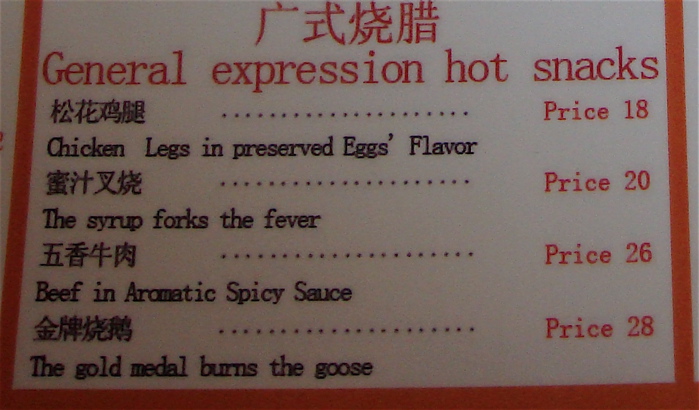
I love it when signs or notices are translated by non-mother tongue English speakers;it can be anything from cute to funny, misleading or just downright embarrassing. I especially love Asian translations! Here are a few examples.


Filed under Images, Mistranslations, Nuts & Bolts, Quotes




 Stephanie Huesler